Archive for the ‘ Taliban ’ Category

War in Afghanistan is Destabilising Pakistan, Says President

By Simon Tisdall for The Guardian

The war in Afghanistan is destabilising Pakistan and seriously undermining efforts to restore its democratic institutions and economic prosperity after a decade of military dictatorship, Pakistan’s president, Asif Ali Zardari, has told the Guardian.

Speaking during an exclusive interview in the imposing presidential residence in Islamabad, Zardari also pointed to widespread concern in Pakistan at the slow pace of efforts to end the Afghan conflict, and said some US politicians showed limited understanding of the impact of American policies.

“Just as the Mexican drug war on US borders makes a difference to Texas and American society, we are talking about a war on our border which is obviously having a huge effect. Only today a suicide bomber has attacked a police compound in Baluchistan. I think it [the Afghan war] has an effect on the entire region, and specially our country,” Zardari said.

Asked about harsh criticism of Pakistan’s co-operation in the “war on terror” published in a White House report last week, Zardari said Pakistan always listened to Washington’s views. But he suggested some members of Congress and the US media did not know what they were talking about when it came to Pakistan.

“The United States has been an ally of Pakistan for the last 60 years. We respect and appreciate their political system. So every time a new parliament comes in, new boys come in, new representatives come in, it takes them time to understand the international situation. Not Obama, but the Congress, interest groups and the media get affected by ‘deadline-itis’ [over ending the Afghan war],” Zardari said.

“I think it is maybe 12 years since America has become engaged in Afghanistan and obviously everybody’s patience is on edge, especially the American public, which is looking for answers. There are no short-term answers and it is very difficult to make the American taxpayer understand.”

With less than three months left before Barack Obama has promised to begin withdrawing US troops from Afghanistan, the White House recriminations reflected the growing pressures on all three governments to agree a workable, long-term strategy. The report complained bitterly that after years of US funding of the Pakistani military, “there remains no clear path towards defeating the insurgency” inside Pakistan.

It criticised as ineffectual Pakistani army operations in some areas of the western tribal belt bordering Afghanistan, which are believed to be used as safe havens by Afghan Taliban and al-Qaida elements.

A congressional panel also weighed in this week, urging the Obama administration to abandon Pakistan in favour of India. “Pakistan is about to go broke or collapse,” said Gary Ackerman, a New York Democrat.

Zardari suggested that if that assertion were true, the interventionist policies of the US and other foreign governments in south Asia would be a significant contributory factor. Pakistan had been in a state of “security alert” for several decades, he said.

“Our emphasis has been on security rather than our commerce and we need commerce for our survival.

“We have all the gas in the world waiting to go through to markets in India and the Red Sea but it cannot be brought in until Afghanistan is settled. So Afghanistan is a growth issue for us. I think most of the time, the quantification of the effect of the war is not calculated [by the US].

“Prices are going up, obviously we are a high fuel-importing country, and fuel prices are going up. Because of the war situation, the industry in one of our provinces has practically closed down … When one whole sector is not working, there is an effect on the other sectors.”

According to senior intelligence officials, the “war on terror” has cost the Pakistani economy approximately $68bn (£42bn) since 2001.

More than 33,300 Pakistani civilians and military personnel have been killed or seriously injured. Last year’s record-breaking floods added to the strain on the economy.

Zardari said the security situation was also undercutting efforts to strengthen democratic institutions bypassed or overturned during the military rule of his predecessor, General Pervez Musharraf. “Democracy is evolving. It’s a new democracy. It takes time to bring institutions back. Destroying institutions during a decade of dictatorial regime is easy … So there is a political impact as well as an economic impact.”

Pakistani officials say relations with the US reached a “low ebb” following the recent row over Raymond Davis, a CIA contractor who shot dead two Pakistanis; a CIA drone attack in Pakistan’s tribal areas last month that accidentally killed dozens of civilian elders meeting in a jirga (council), and Pakistan’s suspicions that it is being excluded from discussions about an Afghan peace deal.

Zardari, who is expected to visit Washington next month, said he would ask Obama to share drone technology with Pakistan so future attacks could be planned and directed under a “Pakistani flag”. Although this request had been turned down in the past, he said he was hopeful the Americans would be more receptive this time, given the huge anger and rising anti-American feeling that the drone attacks were causing.

Zardari and other senior government officials said all parties felt a sense of growing urgency about forging an inclusive peace settlement in Afghanistan, but the process must be “Afghan-led”. Pakistan was ready to play its part, consistent with its national interest, they said.

Salman Bashir, Pakistan’s foreign secretary, said: “Everybody is gradually coming round to our point of view that this requires greater diplomatic pressure. There is no military solution in Afghanistan.”

Afghan Midwives Deliver Life-Saving Birth Education

By Nadene Ghouri for the BBC

Afghanistan is one of the most dangerous places in the world to have a child. Women face a one-in-11 risk of dying during pregnancy and childbirth, while one in five children dies during or after birth or before the age of five. One initiative is under way to try to make giving birth safer.

Training and education is helping Rogul to save babies’ lives
Rogul wraps a grimy blue scarf around her face and uses the cleanest corner of it to wipe her tears.

She has just told me how nine of her babies died after she gave birth to them at home. Her firstborn, a little boy, was premature. Her mother asked a village mullah for advice. He suggested prayer and a type of holy water. The baby died.

Her second child died from an infection a few hours after birth. And so it went on – nine dead babies in total. I am sitting in an Afghan neonatal clinic in Guldara district, just 20 minutes drive from the capital city Kabul.

Women, some in traditional blue burka, others wearing the brightly coloured scarves and loose pantaloons more typical of the nomadic Kuchi tribe, are here.

Some are clutching roundly pregnant bellies, others are here to have their babies vaccinated. Few would be here at all, if they had not been persuaded to come by a local midwife.

A young girl called Pashtu, with a dirty face and scared eyes, agrees to talk. She does not know how old she is but looks no more than 15. She is eight months pregnant with her second child.

Next month she will give birth in the safety of the clinic. She gave birth to her first child in a filthy hole-in-the-ground toilet at home with only her elderly mother-in-law for help. Her son was born blue and barely breathing. He survived for just under an hour.

I ask her why the baby died? She gives me a nonchalant shrug. Her aunt, a large woman with long braided dark hair is sitting next to her. “Pashtu is too skinny and doesn’t eat enough,” she asserts loudly. “This is why her child died.”

Another woman tells me it is because Pashtu’s husband is an opium addict. Many babies in Afghanistan also die because of traditional cultural practices.

It is common for babies to be washed in freezing cold water immediately after birth – which can cause pneumonia – umbilical cords are cut with unsterile knives, or babies are placed on a dirty floor to ward off evil spirits, which can cause infection.

Few women breastfeed for the first few days because colostrum, the nutritious fluid in early breast milk – something which is vital for a baby’s immune system – is seen here as “dirty”. Instead newborns are often fed melted butter.

Istiqlal Hospital in central Kabul houses the city’s largest maternity ward. Here stories of ignorance prevail. Two teenage girls giggle as they tell me they had no idea how pregnancies happened, even after they were married.

One of them is here because she miscarried at five months. She had not known she was pregnant, because she was not aware of any of the symptoms of pregnancy.

“If we ask any questions about these things, we will be called bad girls,” they explain as their faces flush red with embarrassment. The doctor tells me that their mothers often assume they will work it out for themselves after they marry. But they often do not.

“I see many young girls who have married and still don’t realise sex with their husband equals babies,” he tells me. But change is beginning to happen. The ministry of public health has launched a programme to train and deploy 400 new midwives a year.

What is key is that the women are not outsiders forced on a mistrustful local population, but are local women from the communities they serve. This means religious leaders and conservative husbands do not prevent them from working.

Largely as a result of this, the number of women giving birth who were helped by a trained midwife has more than tripled since 2003. Rogul, who learned the hard way just what giving birth alone can mean has now been given midwifery training by the British charity Save the Children.

This woman who lost nine of her own babies has now saved lives of many others.

She tells me how, the week before, she had locked an angry mother-in-law out of a room where a young woman gave birth, because the mother-in-law had tuberculosis and could have passed the infection to the newborn.

She chuckles with glee as she recounts the tale of the mother-in-law banging on the door trying to get in.

It is clear what Rogul, with a combination of personal tragedy and a solid new education, can achieve in her community. But as yet, there are not enough Roguls to go around.

And for her the story has a happy ending. After her training she realised why her first nine babies had died. When she fell pregnant again, she knew what to do and now has a son and two daughters. “They are living proof of my work,” she says with a big smile.

Why Pakistan’s Taliban Target the Muslim Majority

By Omar Waraich for Time

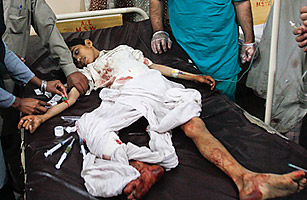
Although Pakistan’s headlines are dominated by the violent excesses of Taliban extremists, the majority of Pakistanis subscribe to the more mystical Sufi tradition of the country’s Barelvi school of Islam. And attacks on their places of worship are becoming depressingly familiar. Last Sunday, two bombers attacked the 13th Century Sakhi Sarwar shrine, near the southern Punjabi town of Dera Ghazi Khan, slaughtering 50 people and injuring twice as many. Mercifully, two other bombers failed to detonate their devices, preventing even higher casualties. Still, it was the deadliest assault yet on a Sufi shrine in Pakistan — and the sixteenth in the last two years.

The Pakistani Taliban swiftly claimed responsibility for the attack, as they have done for each previous one. Pakistan’s Taliban claims the mantle of the hardline Deobandi tradition, with many beliefs in common with the austere Wahabism of Saudi Arabia. They regard the Barelvi, who comprise more than three quarters of Pakistan’s Sunni Muslims, as irredeemable heretics. The Barelvis favor a more tolerant approach to Islam, promoting a cult of the Prophet and incorporate folkloric traditions such as seeking intercession from rural saints. Sakhi Sarwar, a mystic who is also revered by some Hindus and Sikhs, is said to grant women a son — a local legend that rouses anger among Islam’s more literalist adherents, who ascribe such powers only to Allah.

Tensions between Deobandis and Barelvis have punctuated most of Pakistan’s history. But with the arrival of al-Qaeda in the country a decade ago, local militants forged links with the global jihadists, their sectarianism sharpened to accept al-Qaeda’s “takfiri” worldview that deems adherents of other strains of Islam as deviant apostates worthy of death.

One reason for the uptick in sectarian-based terror attacks may be that the militants’ ability to strike the high profile urban targets that once grabbed global headlines has been diminished by Pakistani military offensives in their strongholds over the past two years. “It has become harder for the militants to strike hard targets,” says security analyst Ejaz Haider. “Some lessons have been learned from the previous attacks.”

So, the militants have, over the past two years, more keenly focused on sectarian attacks. Traditional Shi’ite processions are now routinely targeted by suicide bombers. In May 2010, two mosques of the minority Ahmedi sect were targeted in Lahore, killing 93 people. And there’s been an escalation of bombings directed against the majority Barelvis. After attacks on two of their most prominent shrines, Data Darbar in Lahore’s old city and Abdullah Shah Ghazi in Karachi, Barelvis came out on to the streets, wielding weapons and vowing revenge against the Taliban. They did not extend blame to the broader spectrum of Deobandis, perhaps wisely evading the beginnings of a more gruesome sectarian conflict that Pakistan can ill-afford.

Not all Barelvis are the models of peace and tolerance that some have portrayed them to be. It was a Barelvi, Mumtaz Qadri, that assassinated Punjab Governor Salmaan Taseer in January, for his opposition to Pakistan’s prejudicial blasphemy laws. The assassination was applauded by 500 Barelvi scholars in a joint statement. And the Sunni Tehreek, a Barelvi militant outfit, rewarded Qadri’s family and threatened Taseer’s daughter. While they may favor a more permissive vision of Islam, certain Barelvis are quite capable of violence where they feel the Prophet has been dishonored.

The campaign to defend Pakistan’s blasphemy laws from reform has, in fact, united Barelvis and Deobandis since last November. Barelvi anti-Taliban rhetoric was also put on pause. “We had seen the Barelvis getting ready to organize a campaign against the Taliban,” observes analyst Nasim Zehra, “but they got sidetracked by the blasphemy issue and this was forgotten.” Until last month’s assassination of Minorities Minister Shahbaz Bhatti, the religious right was able to frequently draw tens of thousands on to the streets.

Sectarian hatred aside, rural shrines are a far easier terror target than the more heavily guarded state and economic targets in the cities. Suicide bombers, especially the teenage boys favored by militants, can often evade notice before they reach the target. A crowded space helps secure the militants’ aim of causing high casualties. In the case of the Sakhi Sarwar bombers, they only had travel to a relatively short and unimpeded distance from North Waziristan to the edge of Punjab.

The bombings may also be an attempt to relieve pressure from sporadic Army actions against militants in the northern tip of the tribal areas. “Just to remain alive there, the militants have to try and force the government’s hand into diminishing pressure,” says analyst Haider. “To counter that pressure, they mount attacks in the mainland in the hope of securing some deal back in the tribal areas.” By targeting shrines across the country, the militants are able to demonstrate their enduring geographical reach and expose the state’s vulnerabilities.

The bad news is that the state is in a poor position to respond. After the latest bombings, Barelvi leaders denounced the Punjab provincial government for failing to provide security at shrines. The Punjab government dismisses the charge. “It’s happening all over,” says Ahsan Iqbal, a leading politician from the Pakistan Muslim League-N, the ruling party in Punjab. “This is not something that is province-specific.” Iqbal casts blame on the federal government for failing to share intelligence. The federal government reverses the charge, and argues that the law and order is a provincial responsibility. What no one seems to be focusing on is the desperate need to enhance the police’s capacity, with better equipment, counterterrorism training and an intelligence gathering network that reaches deep into Pakistan’s remote areas.

Teen says 400 Pakistan suicide bombers in training

As Reported by The Deccan Chronicle

A teenager arrested as an accomplice to Pakistan’s deadliest suicide bombing of the year has said that up to 400 suicide bombers are being groomed to wage carnage in the nuclear-armed nation.

Umar Fidayee, 14, said the would-be bombers were being trained in North Waziristan, the premier Al-Qaeda and Taliban fortress in Pakistan’s tribal belt where US officials want Pakistan to flush out militant strongholds.

He made the remarks in an interview aired Friday from his hospital bedside, where he is being treated after detonating a hand grenade in the April 4 attack that killed 50 people at a 13th-century Sufi shrine.

It was Pakistan’s deadliest bomb attack since November.

Police arrested Fidayee as an alleged accomplice and said they removed his own suicide vest, which he failed to detonate in a crowd of hundreds in Dera Ghazi Khan just minutes after two other bombers blew themselves up.

Shown covered in tubes and bandages, the teen appeared to express remorse and lifted the lid on harrowing details of his training at the camp in the Mir Ali district of North Waziristan, which lies on the border with Afghanistan.

“Three hundred and fifty to 400 would-be suicide bombers are getting training in Mir Ali in North Waziristan,” he said in the interview broadcast by Pakistani television channels Samaa, Express, ARY and Geo.

“I was trained for two months and saw many boys being trained there,” he said, going on to appeal on Pakistanis to “please forgive me”.

“God has given me a new life but I am sad that we killed innocent people, innocent children,” he said.

Fidayee said he was initially recruited on the understanding that he would be smuggled into Afghanistan to kill non-Muslims.

“But they brought me here to Dera Ghazi Khan. I told them ‘there is no kafir (non-believer) here’,” he said.

“They told me these people are worse than kafirs,” Fidayee said.

Exposing an apparently disturbing recruitment at the gates of an ordinary school in North Waziristan, the teenager claimed a man he identified as Qari Zafar convinced him to begin a life of militancy.

“He told me that all this education is useless and said ‘become a fighter and you will go to heaven’,” Umar told the reporters.

He said he was told to attack the shrine 30 minutes after the other two detonated their bombs, in order to cause maximum carnage among those rushing to aid casualties of the first two blasts.

In a message to other potential suicide bombers he said: “Please refuse to carry suicide attacks. Such attacks are forbidden in Islam.”

Islamist militants have increasingly targeted Sufi worshippers, who follow a mystical strain of Islam, in Muslim-majority Pakistan.

Dera Ghazi Khan is close to Pakistan’s tribal belt which is described by Washington as the most dangerous place on Earth and an Al-Qaeda headquarters.

More than 4,200 people have been killed across Pakistan in attacks blamed on homegrown Taliban and other Islamist extremist networks since government troops stormed a radical mosque in Islamabad in July 2007.

India Continues to Dominate Pakistan’s Strategic Thinking: US

As Reoported By The Times of India

Pakistan’s efforts to launch a comprehensive fight against terrorism are greatly hampered by its perceived threat perception against India, US President Barack Obama has said in a new report to Congress.

“As India continues to dominate their strategic threat perception, large elements of Pakistan’s military remain committed to maintaining a ratio of Pakistani to Indian forces along the eastern border,” Obama said in the third-quarterly report to the Congress on Afghanistan and Pakistan sent yesterday.

“This deprives the Pakistani COIN (counter-insurgency) fight of sufficient forces to achieve its ‘clear’ objectives and support the ‘hold’ efforts and causing available Army forces to be bogged down with ‘hold’ activities because there are insufficient trained civilian law enforcement personnel to assume that responsibility,” Obama said in his 38-page unclassified (rpt) unclassified version of the report.

Due to flood in Pakistan last year the offensive military operations Pakistan had envisioned for KP (Khaibar Pakhtoonwah) and the Federally Administered Tribal Areas (FATA) in the second half of 2010 were overtaken by events, he said.

“Militants were impacted by the floods as well, so we did not observe significant offensive actions on their side, but as Pakistani forces ceased offensive operations, extremists extended their control to areas without sufficient Pakistani central government-provided security and governance,” he wrote.

Between October 1 and December 31, 2010, Obama said Pakistani security forces remained largely static, generally focusing on maintaining the security of previously cleared areas in the FATA and KP and continuing to support flood relief operations.

There were small but notable security operations in November and December in Orakzai Agency and Dir District, but no major operations.

National attention during the reporting period focused on the need for continued flood relief and the start of early recovery efforts, he said.

“The military served as a force of stability during the monsoons, ensuring that Pakistani and international emergency resources were available for rescue and relief operations. The Pakistan Army, Air Force, and Navy committed large numbers of personnel and resources to the flood relief operations throughout October and November,” he said.

The civilian government’s response suffered from a lack of coordination and reflected broader shortcomings in the government’s ability to execute the civilian “hold” and “build” phases of COIN.

The last quarter of 2010 saw no progress on effectively executing the COIN cycle in KP and the FATA.

Pakistan Rejects US Taliban Report

As Reported by The BBC

The Pakistani military has dismissed the findings of a US report that says it has no clear plans to defeat the Taliban insurgency.

The report assessing the war against militants in Pakistan and Afghanistan has been submitted by the Obama administration to the US congress.

But a senior Pakistan security official told the BBC that operations against militants have been a great success.

The official said that Pakistan should be proud of the progress it had made.

The White House report said that Pakistan still has no “clear path” to defeat militants on its soil.

But the senior official – who wished to remain anonymous – said that Pakistan’s plate was full enough already.

“Instead of pushing us to do more, the other side should carry out an introspection of its own operations,” he said.

“We are quite satisfied with our counter-insurgency campaign in the Swat and Malayan regions and parts of the tribal areas. We can safely say this has been a great success story.”

The BBC’s Shoaib Hasan in Pakistan says that the White House report has been released at a time when relations between the security establishments of the two countries have been strained.

Our correspondent says that the report is likely to raise the ire of the Pakistan military – which says it has lost more men than any other country in the fight against militancy in the region.

‘Vexing’

The White House report said that in spite of “tremendous human sacrifices” made by Pakistani security forces and increased military co-operation between Pakistan and US in the last three months, the fight against militancy was making little progress.

Pakistan claims to have lost more men than any other country in the fight against militancy It cited the example of the this January’s third operation in two years to clear insurgents from Mohmand and Bajaur tribal agencies.

The Pakistani military’s efforts have been hobbled by resistance from the militants, bad weather and the need to settle internally displaced people.

“What remains vexing is the lack of any indication of ‘hold’ and ‘build’ planning or staging efforts to complement ongoing clearing operations,” the White House report said.

“As such there remains no clear path to defeating the insurgency in Pakistan, despite the unprecedented and sustained deployment of over 147,000 forces.”

The report said that Pakistan and Afghanistan needed to co-operate more to destroy insurgent havens on both sides of the border.

The US has long expressed frustration about Pakistan’s reluctance to take on militants in the tribal areas.

A Nation Overloaded with Religion

By Tanzeel for Tanzeelism

Frequent assassinations of Pakistan People’s Party leaders have not only shaken the ideology of this country but left a clear cut message for Government to avoid any confrontation against strengthening religious lobby in Pakistan.

The Tehreek e Taliban and Al Qaeda backed groups in Pakistan especially in Punjab are after the ruling party and eradicating its moderate forces one by one. As a result the PPP systematically takes back seat, and gets blackmailed by the religious forces.
Government’s evident policy shift from the party manifesto of ensuring religious harmony among all faiths in the wake of doctrine of necessity further pushes nation in the hands of extremists.

From the assassination of Benazir Bhutto to Shehbaz Bhatti, the message is clear. Let Taleban pursuit their agenda of violent Islam and whoever comes in between will become history.

In such horrific circumstances when even the ruling party leaders are not safe how unarmed liberal forces would dare voice their opinion seems to be a big ask. As a result the clouds of insanity steadily prevailing and a common man is reluctant to counter them not because of being blithe but for his own safety resulting mass surrender of journalists, civil society, liberal political forces and minority rights groups against religious forces.

A common Pakistani despite wanting to express deep displeasure is suppressed by the bearded gun totted black sheep who are gelled up in the society to take necessary ‘religious measures’ against those who prefer humanity over religion.

Salman Taseer’s assassination by his own security guard Mumtaz Qadri and the subsequent showering of rose petals by lawyers’ community is one of the shocking examples of deep rooted religious fanaticism within our society. Be it media, armed forces, politics (not to mention the historical speech of Punjab Chief Minister Shehbaz Shareef during which he proudly endorsed the agenda of Taleban), judiciary, education or even sports.

In my view the traces of religious terrorism can be found back during partition campaign when the voices of independent ‘Muslim Land’ were on rise.

At that time some of the Muslims might had opted the idea of migrating to separate land due to vested interests but by and large it was the dominating religious sentiment that caused division with the objective of turning Pakistan into the “Fort of Islam” comprised by majority of Muslims.

Two- Nation Theory which clearly rejects any of idea co existence of Muslims with Hindus is a true depiction of Pakistan’s current situation where Muslims are unable to coexist with other sects let alone religions and ethnicities.

Today, I being a moderate Muslim who is deeply concerned about his country’s image foresee not only the bleak future of Pakistan but raises the doubts whether creation of Pakistan was really an apt approach.

Shahbaz Bhatti, Modern Day Martyr in Pakistan

By Terry Mattingly for The Pocono Record

In the early days of Christianity, martyrs often gave their final testimonies of faith to Roman leaders before they were crucified, burned or fed to lions.

Times being what they are, Shahbaz Bhatti turned to Al-Jazeera and YouTube. The only Christian in Pakistan’s Cabinet knew it was only a matter of time before his work as minister for minority affairs got him killed. Threats by the Taliban and al-Qaida kept increasing.

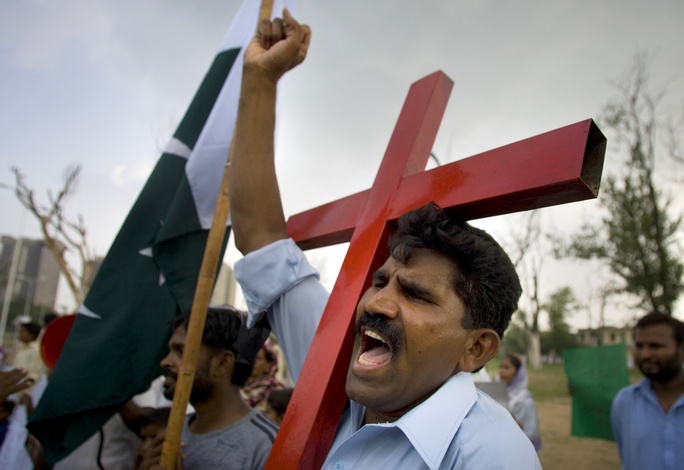
“I want to share that I believe in Jesus Christ, who has given his own life for us. I know what is the meaning of the cross and I follow him on the cross,” said Bhatti, in a startlingly calm video recorded several weeks before his assassination on March 2.

“When I’m leading this campaign against the sharia laws for the abolishment of blasphemy law, and speaking for the oppressed and marginalized persecuted Christian and other minorities, these Taliban threaten me. … I’m living for my community and suffering people and I will die to defend their rights. So these threats and these warnings cannot change my opinion and principles.”

The last straw was almost certainly the Catholic statesman’s defense of Asia Bibi, a Christian mother of five who was sentenced to death last November for the crime of blasphemy after she publicly defended her faith in a village argument. The verdict — which must be upheld by a higher court — further polarized a tense nation and sparked a global firestorm.

Then again, in 2009 Bhatti received the U.S. Commission on International Religious Freedom’s first medallion for the promotion of religious freedom. A year later, he met with Pope Benedict XVI to discuss interfaith work and religious liberty in Pakistan. Bhatti was not hiding his convictions.

The blasphemy laws in question went into effect in 1986, during the dictatorship of Gen. Muhammad Zia-ul-Haq. They ban, among other actions, the use of “derogatory remarks, etc; in respect of the Holy Prophet. Whoever by words, either spoken or written or by visible representation, or by any imputation, innuendo or insinuation, directly or indirectly, defiles the sacred name of the Holy Prophet Mohammed (PBUH) shall be punished with death, or imprisonment for life, and shall also be liable to fine.”

These blasphemy laws have been used against hundreds of Muslim dissenters and Ahmadi sect members, whose approach to Islam is specifically attacked in the laws. In practice, conversion from Islam to another faith is considered blasphemy, as are attempts to advocate or defend minority faiths, such as Christianity or Hinduism.

Vigilantes often kill those formally or informally accused of blasphemy — making trials irrelevant.

This was the case with Bhatti’s death in a wave of machine-gun fire into his unarmored car. Pakistani officials had denied his request for an armored car, despite the constant threat of drive-by shootings.

Formalities were also irrelevant on Jan. 4, when Salmaan Taseer, the governor of Pakistan’s Punjab Province, was assassinated by one of his bodyguards. This outspoken Muslim also defended Bibi and called for reform in the use of blasphemy laws.

Adoring crowds showered Taseer’s assassin with rose petals and garlands as he arrived to face a magistrate, while moderate Muslim leaders remained silent. Pakistan’s legislators observed a moment of silence for Bhatti, since it probably would have been fatal for anyone to offer a prayer in his honor.

After all, pamphlets left by those who killed Bhatti warned that they would keep fighting “all the world’s infidels, crusaders, Jews and their operatives within the Muslim brotherhood. … This is the fate of that cursed man. And now, with the grace of Allah, the warriors of Islam will pick you out one by one and send you to hell, God willing.”

Apparently, many radicals in Pakistan have concluded — a perfect Catch-22 — that it is blasphemy to oppose the blasphemy laws.

Meanwhile, the Pakistani conference of Catholic bishops is preparing to render a judgment of its own. Later this month the bishops will review a proposal to ask the Vatican to designate Bhatti as a martyr.

“Bhatti is a man who gave his life for his crystalline faith in Jesus Christ,” Bishop Andrew Francis of Multan told a Vatican news agency. “It is up to us, the bishops, to tell his story and experience to the church in Rome, to call for official recognition of his martyrdom.”

-Terry Mattingly is director of the Journalism Center at the Council for Christian Colleges and Universities.

In Pakistan, Justifying Murder for Those Who Blaspheme

By Aryn Baker for Time

“I believe in Jesus Christ who has given his own life for us,” the doomed man said, staring straight into the video camera. “And I am ready to die for a cause.” Shahbaz Bhatti had no hesitation in his voice as he responded to a question about threats from the Taliban and al-Qaeda. “I’m living for my community … and I will die to defend their rights.” It was his last answer in a four-month-old self-produced video that was to be broadcast in the event of his death. But the radicals had the final say. On March 2, Bhatti, Pakistan’s Minister for Minority Affairs, was shot dead in Islamabad. Pamphlets scattered on the ground claimed the act for a new alliance of “the organization of al-Qaeda and the Punjabi Taliban” and asserted that other infidels and apostates would meet the same fate.

Bhatti’s death had been foretold not just by himself but also in the nation’s response to a previous assassination, that of Punjab governor Salmaan Taseer on Jan. 4. Taseer, a self-made millionaire, had turned his largely ceremonial post into a platform for a campaign to amend Pakistan’s blasphemy laws. Bhatti, the only Christian in the Cabinet, refused to be a token and swore to battle intolerance. Both men supported clemency for Aasia Noreen, a Christian woman who had been accused of blasphemy and sentenced to death. Taseer’s stance on the issue infuriated a large part of the population that, thanks to religious leaders and school curriculums, believes that blasphemy is a sin deserving of execution. In the weeks leading up to his assassination, Taseer had been denounced at Friday prayers, excoriated in the media and largely abandoned by his Pakistan People’s Party (PPP) for fears that his campaign would prove politically toxic. The witch hunt culminated in a bodyguard’s pumping 27 rounds into his head and chest in the parking lot of a popular Islamabad shopping center.

Within hours of Taseer’s death, telephone text messages celebrating his assassination made the rounds. “Justice has been done,” read one. “If you love the Prophet, pass this on.” A Facebook fan page for assassin Malik Mumtaz Hussain Qadri garnered more than 2,000 members before site administrators shut it down. Even the leaders of state-funded mosques refused to say funeral prayers for the slain governor. When Qadri was transferred to a local jail, he was garlanded with roses by hundreds of lawyers — the vanguard of a movement that in 2008 helped unseat a military dictator — offering to take on his case for free.

At his court appearance a few days later, Qadri told the judge that he believed in a Pakistan where loyalty to the Prophet eclipses all other rights. According to Taseer’s daughter Shehrbano, her father “wanted an egalitarian society where open debate is protected and people are not killed for speaking out.” And Bhatti dreamed of a nation true to founder Muhammad Ali Jinnah’s vision, one where “you are free to go to your temples, you are free to go to your mosques or to any other place of worship.” Which vision prevails — Qadri’s or Taseer and Bhatti’s — will decide the future of the country.

The Roots of Extremism

 
It is not news that Pakistan has a lunatic fringe. What is disturbing is that after Taseer’s murder, when the silent majority finally spoke up, it praised Qadri, not his victim. The public reaction exploded the myth of Pakistan’s moderate Islam; Qadri belongs to a mainstream sect that routinely condemns the Taliban. “The Pakistan we saw in the wake of Taseer’s killing is the real Pakistan,” says Amir Muhammad Rana of the Pak Institute for Peace Studies. For the past two years, Rana’s organization has conducted in-depth interviews with a broad spectrum of Pakistani citizens. “They might dress Western and eat at McDonald’s, but when it comes to religion, most Pakistanis have a very conservative mind-set.”

Pakistan’s religious parties rarely do well at the polls — a fact often cited by those countering concerns that the country is going fundamentalist — but their street power is considerable. The furor over blasphemy appears to be partly in response to significant losses for the religious right in the 2008 elections. With the current government on the verge of collapse and popular sentiment against the PPP mounting, the religious parties are betting on significant gains if fresh elections are called. The case of Raymond Davis, a CIA contractor accused of killing two Pakistanis during what appears to have been a botched attempt to rob him, demonstrates the state of Pakistan’s politics. It has gone virtually unremarked in Pakistan that Qadri, a confessed murderer, has been hailed as a national hero, while Davis — who, whatever his background, seems to have been acting in self-defense — is considered worthy of the death penalty. Over the past few weeks, street rallies led by the religious right have simultaneously called for the release of Qadri and the hanging of Davis. (Read: “Pakistan’s Christians Mourn, and Fear for Their Future.”)

Using religion to shore up political support is nothing new in Pakistan. Founded as a Muslim nation carved from a newly independent India in 1947, Pakistan has long struggled to unite a diverse population divided by language, culture and ethnicity. Islam was the common denominator, but Jinnah was famously enigmatic about its role in government.

Then, in 1977, Muhammad Zia-ul-Haq, an Islamist military general, overthrew the democratically elected government of Zulfikar Ali Bhutto, who was already retrenching his secular vision of Pakistan in an effort to win religious support. To further appease Muslim religious leaders, Zia-ul-Haq strengthened the colonial-era blasphemy laws, mandating that breaches should be answered by the death penalty. Since then, more than 1,274 cases have been lodged. As repeating blasphemous words could be considered to be perpetuating the crime, many cases are accepted without evidence, a system well primed for the pursuit of vendettas. That nobody has yet been executed by court order is hardly reassuring: 37 of the accused have been killed by vigilantes. (In 1929, Jinnah famously defended an illiterate carpenter who shot to death a Hindu publisher accused of blasphemy. The plea failed, and after the carpenter was hanged, Taseer’s father was one of the pallbearers.)

The Uses of Blasphemy
When a nation rises up in support of a murderer instead of his victim, it’s hard not to believe it is heading down a dangerous path. “What is happening now won’t matter in five years,” says Shehrbano Taseer. “It will matter in 25 years. What we are seeing now is the fruit of what happened 30 years ago. If people had stood up against [Zia-ul-Haq], we would not be here today. Because of that silence we have madrasahs spewing venom, a true Islam threatened by the same people who claim to serve it, and a cowed majority too afraid to speak.”

President Asif Ali Zardari, an old friend of Taseer’s, condemned the murders but didn’t go to either funeral. After paying his respects to Taseer’s family, Interior Minister Rehman Malik gave an impromptu press conference outside Taseer’s house during which he announced that he too would kill any blasphemer “with his own hands.” A few days later, the Prime Minister announced that he would drop the issue of the blasphemy laws altogether. Meanwhile, the government is under pressure to go through with Aasia’s sentence, and now her two champions are dead.

Reaction to Bhatti’s murder has been muted, characterized mostly by denial. What little newspaper coverage there was focused on security lapses or the role of the country’s Christian community rather than on the motives of the killer. On television talk shows, members of the religious parties and right-wing commentators spun a conspiracy theory that alleged that Bhatti’s murder had been “a plot” hatched by “outside forces” to “divert attention from the Raymond Davis affair.” There was no mention of the fact that Bhatti was campaigning alongside Taseer on the issue of blasphemy.

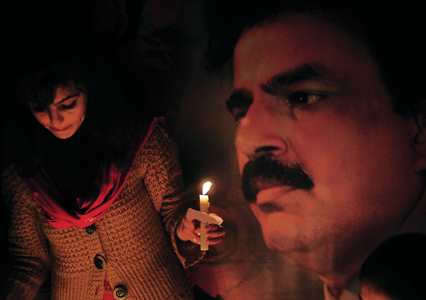
The PPP was founded in 1967 with the goal of bringing secular democracy to a nation under military rule. It vowed to give power to the people and promised to protect the nation’s downtrodden. That Pakistan’s most progressive party — one that has already endured the assassination of former Prime Minister Benazir Bhutto — should cave in the face of religious fundamentalism speaks volumes about the strength of the religious right. A candlelight vigil promoting a progressive Pakistan a few days after Taseer’s assassination drew nearly 1,000 supporters; a religious rally in Karachi the same day had 40,000 in the street chanting Qadri’s name. “Taseer’s murderer was tried in the court of public opinion, and he has emerged a hero,” says a woman shopping for vegetables in the same market where the governor was killed. “If someone kills me because I criticize Qadri, will he too be called a hero?” She declined to give her name. (Read: “Murder in Islamabad: Pakistan’s Deepening Religious Divide.”)

Of course, few Pakistanis would ever go as far as Taseer’s or Bhatti’s killers. But their ambivalence can easily be manipulated. “Just because we are religious does not mean we will all be reaching for guns the next time someone says something wrong,” says Malik Khan, a university student who spent a recent afternoon at a shrine in Lahore dedicated to a revered Islamic saint. “But Salmaan Taseer was an extremist as well. He should not have touched the blasphemy law.” Khan received a text message praising Qadri and exhorting him to pass it along. It posed a moral quandary: “I don’t agree with the message,” he says. “But I love the Prophet. My thumb hesitated a long time over the delete button.” In the end, he passed the hate along.

Qadri himself was the religious-minded youngest son of a family just stepping into the middle class. Like his brother, he joined the special-forces branch of the Punjab police in 2002. He had been flagged as a security risk because of his strong religious leanings but was nevertheless appointed to Taseer’s security detail when he visited Islamabad. In his confession, Qadri said he had been inspired by the teachings of his local mullah, Hanif Qureshi. At a rally a few days later, Qureshi claimed credit for motivating Qadri. “He would come to my Friday prayers and listen to my sermons,” he said. Then he repeated his point: “The punishment for a blasphemer is death.”

But is it? Two weeks after Taseer’s murder, I visited Qari Muhammad Zawar Bahadur, the head of one of Pakistan’s mainstream religious groups and a co-signer of a statement that advised Muslims not to show “grief or sympathy on the death of the governor, as those who support blasphemy of the Prophet are themselves indulging in blasphemy.” For more than an hour, he justified his group’s stance, telling me that the Koran was clear on the issue. I asked Bahadur to show me the exact verse that detailed the punishments for blasphemy. He mumbled that “there are several passages,” as if there were so many, he couldn’t decide which one to quote. When pressed further, he consulted a Koran and read aloud a passage that spoke of killing a man who had once harmed the Prophet.

That verse has routinely been dismissed by leading Islamic scholars as referring to a specific case and having nothing to do with blasphemy. They say there is no definition of blasphemy in the Koran, nor any prescription for its punishment. “Nobody challenges these mullahs, and that is our problem,” says Omar Fazal Jamil, who runs a p.r. firm in Lahore. “We can’t invoke liberal secular values anymore. I have to have the knowledge to contradict these men who distort our religion for their own political gain. I have to be able to say, ‘No, this did not happen, this is not right, and show me where it says in the Koran that blasphemers should be shot on sight.’ ”

The Sin of Silence
In the absence of such challenges, those favoring religious intolerance will continue to have things go their way. In late 2007, Benazir Bhutto released an updated manifesto for her father’s party. “The statutes that discriminate against religious minorities and are sources of communal disharmony will be reviewed,” it said. Less than a month later she was dead, killed in a bomb attack just 13 km from where both Taseer and Bhatti were murdered. Her death was an opportunity to rally the nation against the forces of extremism. Instead the party focused on consolidating power. The manifesto remains an empty promise, and two more voices of tolerance have been silenced. For evil to prevail, goes the old aphorism, all that is required is for good men to do nothing.

— With reporting by Ershad Mahmud / Lahore and Omar Waraich / Rawalpindi

The Myth of ‘Moderate Pakistan’

By Sadanand Dhume for The Wall Street Journal

It’s time to bury the myth of moderate Pakistan. You know the one: the notion, repeated ad nauseam in magazine articles, think-tank reports and congressional testimony—as though saying it often enough will make it true—that Pakistan is an essentially tolerant country threatened by a rising tide of fundamentalism. Here’s a news flash: The tide has risen.

The most recent reminder of this came last Wednesday in Islamabad, when suspected Taliban militants shot dead Shahbaz Bhatti, Pakistan’s 42-year-old minister for minority affairs and the only Christian in the overwhelmingly Muslim nation’s cabinet. His crime? Supporting the repeal of a barbaric blasphemy law that makes insulting the prophet Muhammad punishable by death.

The law is often used to settle scores with hapless religious minorities, especially Christians such as Asia Bibi, an illiterate peasant sentenced to hang last year after she allegedly badmouthed the prophet during a row with Muslim coworkers. Bhatti’s assassination comes two months after a bodyguard murdered Punjab Gov. Salmaan Taseer for visiting Ms. Bibi in jail and speaking out against abuse of the law.

To be fair, Pakistan’s claim to relative moderation has been kept alive thus far by more than just wishful thinking. Overtly Islamist parties such as the Jamaat-e-Islami have rarely commanded more than a fraction of the national vote. Women enjoy freedoms in the public square that their counterparts in Saudi Arabia and Iran could only dream of. At great personal risk, a small but courageous group of activists, intellectuals and politicians speak out publicly against bigotry and religious intolerance.

Scratch the surface, however, and a bleaker picture emerges. Islamist parties may not garner large-scale electoral support, but Islamist ideas are widely tolerated by mainstream political parties. The major opposition party, former Prime Minister Nawaz Sharif’s Pakistan Muslim League, flaunts its closeness to sundry Islamists, including Jamaat-ud-Dawa, the parent organization of the international terrorist group Lashkar-e-Taiba.

Ostensibly secular, the ruling Pakistan Peoples Party supported both Kashmiri militancy and the Afghan Taliban in the past. In its current incarnation it appears permanently cowed by the country’s legion of vocal fundamentalists. President Asif Ali Zardari failed to attend the funerals of either Taseer or Bhatti. His government has made it clear that it will not touch the controversial blasphemy law. Interior Minister Rehman Malik declared that he would personally kill anyone who dared blaspheme Muhammad’s name.

As for Pakistan’s undeniably brave activists and intellectuals, unfortunately they appear to have more admirers overseas than among their compatriots. Hand-wringing in the pages of Dawn and the Friday Times, two of the country’s leading English-language newspapers, has not prevented Mumtaz Qadri, Taseer’s murderer, from becoming a national hero.

Not surprisingly, anti-American sentiment—often a reliable shorthand for a society’s paranoia and self-loathing—is rampant. According to the Pew Global Attitudes Project, American favorability ratings stood at 17% last year, the lowest of all countries surveyed. On the streets, bloodcurdling yells for the execution of alleged Central Intelligence Agency operative Raymond Davis, accused of killing two Pakistanis in January, have prevented the government from granting Mr. Davis the diplomatic immunity that the U.S. claims he is entitled to. This despite personal pleas by President Barack Obama and Sen. John Kerry.

By now the reasons for Pakistan’s predicament are well known. They include the intolerance embedded in the nation’s founding idea of a separate “land of the pure” for Indian Muslims, the malign shadow of Saudi Arabia on religious life, blowback from the anti-Soviet jihad of the 1980s, and the overwhelming influence that the army and its thuggish intelligence wing, the Inter-Services Intelligence, wield on national life. The army’s very motto, Jihad-fi-Sabilillah, or jihad in the path of Allah, is an exhortation to holy war.

For the international community, the long road to fixing Pakistan begins with the simple recognition that the country’s true face is not the urbane intellectual making reasoned arguments, but the frenzied mob showering rose petals on a murderer for his services to the faith. Over time, Pakistan can only be saved by re- arranging the basic building blocks of the country.

This means backing provincial autonomy and linguistic identity as an alternative to the centralized pan-Islamism used by the military and its supporters to weld the country together. It means deploying social networks and satellite television to open the door to reasonable discourse about religion. It means channeling aid to ensure that children are no longer taught to glorify Islamic conquest and reflexively mistrust the West and India. It means accepting that the most poisonous madrassas—such as Jamia Binoria in Karachi and Darul Uloom Haqqania outside Peshawar—must be shuttered if they can’t be reformed.

Needless to say, none of this will be easy. But the consequences of the alternative—pandering to fundamentalists while blaming outsiders for all the country’s ills—can be seen in the freshly turned soil of Bhatti’s grave.

-Sadanand Dhume is a resident fellow at the American Enterprise Institute and a columnist for WSJ.com.

Sindh Saves the Day

By Nadeem F Paracha for Dawn
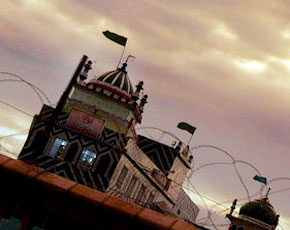
Plans are afoot to build the world’s first ever international Sufi university near Bhit Shah in Sindh. The main purpose of the institution would be to promote interfaith and intercultural education to tackle extremism in the country.

Such a thought and project could only have come about in Sindh. Especially in the context of what Pakistan has beengoing through in the last many years.

Not only have the country’s other provinces – especially the Punjab and Khyber Pakhtunkhwa (KP) – become central targets of horrid terrorist attacks by extremist organisations, the Punjab in particular has also been witnessing a steady growth of faith-based conservatism within its urban middle and lower middle-classes.

When extremists (calling themselves ‘Punjabi Taliban’) attacked the famous Sufi shrine, Data Darbar in Lahore late last year, economist and political analyst, Asad Sayeed, made a rather insightful observation.

He said that had such an attack on the Darbar taken place twenty years ago, thousands of Lahorites would have poured out to protest.

But not anymore. The attack on one of Punjab’s most popular Sufi shrines was simply treated as just another terrorist attack.

Though it is now clear that the Wahabi/Deobandi extremists have been going around blowing up Sufi shrines frequented by the majority Barelvi Muslims, the Barelvi leadership has looked elsewhere, putting the blame on the ever-elusive ‘foreign hands.’

Journalist and intellectual Khaled Ahmed once wrote a telling tongue-in-cheek article about the annual gathering of the Dawat-i-Islami in Multan.

The Dawat is the Barelvi equivalent of the Deobandi Tableeghi Jamat. Both these outfits are considered to be non-political organisations who are more interested in evangelizing their respective versions of Islam and its rituals. One should also mention that both these (sub-continental) strains of Islam accuse one another of being ‘flawed Muslims.’

Ahmed wrote how after Dawat’s huge congregation in Multan, when police found some bullet-riddled bodies of Dawat members, the outfit’s main leadership simply refused to acknowledge the glaring evidence that pointed towards the involvement of an opposing Sunni sect’s organisation in the murders.

Ahmed adds that Dawat leaders began babbling about ‘outside forces (RAW, CIA, Mossad)’ who wanted to create disharmony between Pakistan’s Barelvi majority and the Deobandi and Wahabi sects.

Barelvis: From moderate to militant

One can understand the above-mentioned episode as an example of the confusion Barelvi spiritual leadership has gone through since the 1980s.

From its inception in the 18th century and until about the mid-1980s, the Barelvi sect was largely apolitical in orientation, non-Jihadist and followers of some of the most relaxed dictates of the Hanafi madhab – the first of the four main Islamic schools of law that is also considered to be the most moderate.

‘Barelvi Islam’ (as it is sometimes called) is purely a sub-continental phenomenon that fuses elements of Indian Sufism with the folk and populist strains of various cultures that exist in the sub-continent.

It is also called the ‘folk Islam’ of the region in which a high degree of tolerance exists between various faiths, sects, classes and ethnicities and in which the puritanical aspects of other Islamic sects are eschewed and even rejected.

The Sufi shrine and an intense reverence of the Prophet (PBUH) play a central role in Barelvi Islam. Its populist and moderate make-up helped it become the majority Sunni sect amongst the Muslims of the sub-continent.

Two of its leading opponents have been the Sunni Deobandi sect (also a product of the subcontinent) and the Saudi-inspired Wahabism.

Both have accused Barelvis of ‘adopting Hindu rituals and practices’ and assorted ‘heresies.’

In spite of being the majority sect amongst Sunni Muslims in Pakistan, ‘Barelvi Islam’ hardly ever had a coherent political expression in shape of a mass-based political party or organisation.

Its spiritual leadership remained pro-Jinnah (unlike Deobandi organizations of undivided India), and various Pakistani political leaders have continued to appeal to the symbolism and lingo associated with various populist aspects of Barelvi-ism.

Zulfikar Ali Bhutto and his Pakistan Peoples Party (PPP) was the most successful in this respect.

Bhutto was also one of the first leading Pakistani political figures to undertake the act of regularly visiting various famous Sufi shrines in Sindh and Punjab.

Barelvis are in the majority in Sindh and the Punjab, whereas Deobandis are largely centred in Khyber Pakthunkhwa and in the Pushtun-dominated areas of Balochistan.

Until the 1970s Barelvi-ism also prevailed among many of Sindh and Punjab’s urban middle-classes, especially those who considered themselves to be progressive and likely supporters of secular politics.

However, the arrangement in this context was suddenly disturbed with the arrival of the Ziaul Haq dictatorship in 1977.

Dipped in the political Islam of scholar and Jamat-i-Islami (JI) chief Abul Ala Mauddudi, Zia soon moved towards infiltrating the spiritual and political nerve centres of Barelvi-ism in an attempt to ‘reform’ them.

Barelvi dominance across the country’s religious landscape reminded him of Z A. Bhutto’s populism (which he, like JI, considered to be ‘vulgar’ and ‘un-Islamic’), and from 1979 onwards Pakistan under Zia also became one of the leading client states of Saudi-generated Wahabi propaganda and aid.

Stunned by the ‘Islamic revolution’ in the Shia-dominated Iran in 1979, Saudi Arabian monarchy and its Wahabi Sunni religious elite began seeing Pakistan’s Barelvi-dominated make-up as venerable to Shia-ism’s revolutionary symbolism and also of socialist propaganda, especially with the arrival of Soviet forces in Afghanistan.

At least that was one of the reasons used by Zia and his Saudi allies to draw the United States into giving Pakistan billions of dollars worth of aid and arms.

With the aid also came Wahabi propaganda literature and preachers who along with Pakistani Deobandi and Wahabi spiritual and political groups began setting up madressas and mosques.

These madressas operated as institutions that would indoctrinate young Pakistanis – most of whom were immersed in the non-Jihadi traditions of Barelvi-ism – and prepare them for Jihad against Soviet forces in Afghanistan.

Bralevi tradition had also not been very kind to the ulema and the clergy.

To address this, Zia also began describing famous Sufi saints as ulema and banned (in the media) all criticism and humour aimed at the clergy.

The Afghan war, Saudi propaganda, the mushrooming of Deobandi and Wahabi madressas and televangelists, and a concentrated campaign by the Zia regime to equate the dictatorship’s capitalist-Islamist makeup as something in accordance with the Shariah and with ‘Jinnah and Iqbal’s vision,’ had a telling impact on Pakistan’s religious sociology.

In the Khyber-Pakhtunkhwa many moderate and progressive Deobandi strains that had prevailed in the province began sliding into the sect’s more radical dictates, coming closer to the puritanical Wahabi and Salafi ideas about faith.

This slide was celebrated by the Punjab-dominated military as a successful blow to the secular and ‘treacherous’ Pukhtun separatist tendencies.

In the Punjab, the province benefited the most from Zia’s Punjab-centric capitalist maneuvers. This coupled with unprecedented remittances coming from Pakistanis who had begun going to Arab Gulf states to work from the 1970s onwards, gave birth to new moneyed classes.

Many from the petty-bourgeoisie and bourgeoisie sections began moving away from their Barelvi heritage and towards more puritanical strains of faith.

Their Barelvi past now reminded them of their lower status and economic modesty, whereas they began relating their enhanced economic standing with the adoption of the more puritanical strains of Islam.

That’s why the growth of puritanical Islamist and sectarian organizations that Punjab saw under Zia, a lot of their local funding came from Punjab’s nouveau-riche and petty-bourgeois trader classes.

Interestingly, it was also the same classes that also pushed the Barelvi leadership to become more conservative and radical. Those sections of the Punjabi petty-bourgeoisie that stuck to Barelvi-ism encouraged their spiritual leadership to compete with the Puritanism and radicalism of the growing number of Deobandi and Wahabi groups.

This trend saw the first ever emergence of radical Barelvi groups. In the early 1980s, the Dawat-i-Islami was formed to counterbalance the growth of the Deobandi Tableeghi Jamaat that had begun making deep inroads into Punjab’s bourgeoisie and the military.

The Dawat discouraged the Barelvis from indulging in antics associated with the region’s folk Islam, emphasising an increased reverence of holy personalities and encouraging holding of recitals of naats and milads instead of quwalis and dhamals. The last two became associated with the practices of the lower-class Barelvis.

In 1992, emerged the Sunni Thereek (ST). A Barelvi outfit that emerged from the splintering of the oldest Barelvi Islamic political party, the Jamiat Ulema Pakistan (JUP).

Such occurrences did not really help the Barelvi sect defend its traditions in the face of the state-sponsored Deobandi and Wahabi onslaught –  rather, these organisations began turning Barelvi-ism into an equally anti-pluralistic and militant political phenomenon.

Sindh saves the day?

By the 1990s, Zia’s manoeuvres and Saudi involvement in reshaping Pakistan’s religious tradition had seen Khyber Pakhtunkhwa and Punjab become hostage to various violent Deobandi/Wahabi outfits and new-born Barelvi reactionary-ism.

The Punjab also saw a rise in the use of reactionary political and religious narratives within its lower-middle and middle-classes, whereas in Balochistan attempts were being made (by intelligence agencies) to neutralize secular Baloch nationalist militancy with the help of puritanical evangelical outfits. The agencies had already done this successfullyin Khyber Pakhtunkhwa in the 1980s.

But what happened in Sindh? Barelvi-ism in Sindh (outside Karachi) has always been a lot more secular and pluralistic than the Bareilvi-ism in the Punjab.

Its  sociology  in Sindh heavily revolves around the staunchly secular historicity that the province’s famous scholar, GM Syed’s literary work generated.

He described a highly pluralistic and secular reading of Sufism as being the cultural and religious make-up of the Sindhis and it is this narrative that still rules the roost in the province’s social and religious psyche.

This is one of the reasons why Zia completely failed to impose his version of Islam here. Also, just like the majority of the Baloch who equate puritanical Islam with the ‘Punjabi civil-military elite,’ so does the socio-political discourse in Sindh.

On the other hand, in Karachi, though Zia-backed Deobandi and Wahabi radical outfits did manage to find a foothold, two things have always worked against these outfits here.

The first is the fact that the sprawling ethnic, sectarian and religious diversity found in Karachi actually absorbs and neutralizes any attempt by an outfit to impose its version of Islam.

Secondly, MQM, a party that first emerged as a mohajir nationalist group, adopted almost the same populist Barelvi symbolism and lingo as Bhutto did in the 1970s.

Also, the other two big political parties in the city too are secular: the PPP and ANP.

Though the Sunni Thereek (ST) has managed to infiltrate some sections of MQM’s support, ST is Barelvi and anti-Taliban (albeit reactionary).

In spite of the rampant crime and ethnic tensions that are a constant in Karachi, it will not be an overstatement to claim that Karachi along with the rest of Sindh today stands to be perhaps the only (ragged) sanctuaries in present-day Pakistan that are (comparatively-speaking) largely free of the factors that have created opportunities in the Punjab and KP for violent extremist activity as well as for reactionary conservatism to now become a mainstay in Punjab’s bourgeois psyche.
Our Noblest Selves

By Marvi Sirmed for Newsweek Pakistan

Be careful. After the assassination of Shahbaz Bhatti, federal minister for minorities, on March 2 and of Salmaan Taseer, governor of the Punjab, two months before that, friends and family put out the same, simple message. Be careful. But with two brave men slain so violently and so publicly, can we afford to be careful?

Everything changed after the governor’s assassination. For Taseer’s killer, there are shrines on Facebook and rose petals. For those of us who, accurately, refer to Taseer as a martyr, there is concern from well-wishers—and death threats from others. Lawyers lined up in the hundreds to defend and garland Taseer’s self-confessed killer, while cleric after another refused to lead his funeral services. The right’s pundits called Qadri a ghazi or holy warrior, while state-owned Pakistan Television dropped shaheed or martyr for Taseer within hours of his death. Qadri supporters brandished their bloody hands at rallies that pulled in tens of thousands, while those who mourn Taseer and what he represented struggled to manage mere hundreds at vigils. The polarization and plight of Pakistan have never before been so painfully obvious.

Like Taseer, Bhatti, too, gave his life up for a cause that must be owned by those who run our country. But people everywhere are being careful. And this just won’t do.

Bhatti was one of those rare public figures who never sought the spotlight, who spoke softly, who had no skeletons in his closet. Bhatti could have played it safe. He began receiving death threats after the Gojra massacre. These picked up after he championed the cause of Aasia Noreen, a Christian mother convicted under the blasphemy laws, which the Pakistan Peoples Party had committed to review in order to prevent their misuse. After Taseer’s death, Bhatti could have played it safe and gone quiet. He did not. He was not “careful.” He was laid to rest in Faisalabad on March 4 with thousands turning out to honor him.

What can we do? We need to be honest with ourselves. Bhatti was killed by a group that calls itself the Punjabi Taliban. Punjab Chief Minister Shahbaz Sharif has taken exception to interior minister Rehman Malik highlighting this fact. Terrorists are a national problem, they are not Punjabis or Sindhis, says Sharif, who is also the home minister of his province. What more has to happen before the chief minister, a compassionate man by most accounts, finally acknowledges that we have a problem in the Punjab?

Second, we need to stop passing the buck and offering contrition practiced for television. Prime Minister Yousaf Raza Gilani reportedly offered his resignation to the cabinet the day Bhatti was assassinated. There have been two shocking high-profile murders in Islamabad in as many months and not a single soul has been sacked. There’s no shortage of candidates who deserve the ax. Let’s start with the state-employed clerics who refused to perform Taseer’s last rites.

Third, name and shame the members of Parliament who refused to raise their hands in prayer for Taseer and Bhatti. There was a prayer for Taseer in the National Assembly, but, infamously, not in the Senate. Bhatti got two minutes of silence in the National Assembly on March 3 and a walkout from all parties—including, oddly, the ruling party—against the government’s failure to protect Bhatti, but no prayers. What have we come to when we cannot bring ourselves to pray for the departed and their devastated families? This is not coldhearted or remotely Islamic, but pure evil.

Fourth, we need to enforce a strict ban on hate speech. Incitement to murder, character assassination and hate words cannot be provided mainstream platforms—whether print or electronic—under the pretense of free speech. Some channels promoted the false impression that Taseer had blasphemed, and they publicized fatwas against him. They also hyped up pro-Qadri rallies. It never came to light that these processions, while big, were limited to three cities. Responsibility will not suddenly dawn on our lawless media. To keep television honest and to counter the state’s halfhearted ban on militant groups, corporations need to step up and withhold ad spend from channels providing support to the jihadists. Consumers can then hold these corporations accountable by buying or boycotting their products.

The brave among us refuse to be careful when they see the rapid undoing of their motherland, and whose faith in man’s goodness speaks to our noblest selves. We are not a nation of murderers and monsters, but we sure are close.

Sirmed is a rights activist in Islamabad.

Bombing kills 25 Near Intelligence Office in Eastern Pakistan

By Karen Brulliard for The Washington Post

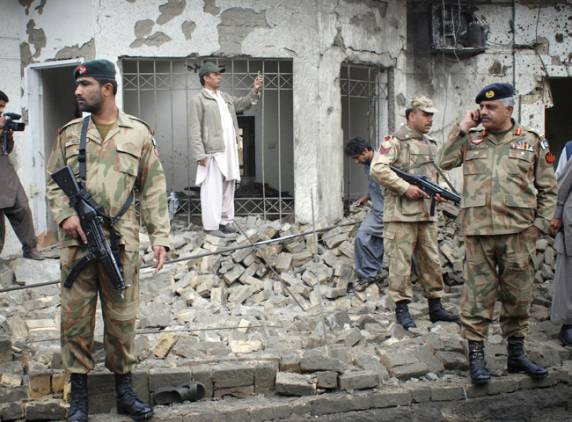
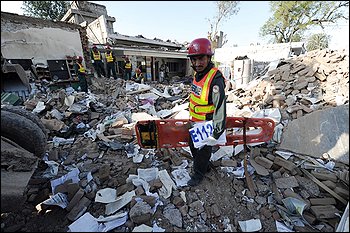
ISLAMABAD, PAKISTAN – A car bomb exploded near an office of Pakistan’s main intelligence agency in the eastern city of Faisalabad on Tuesday, killing 25 people in the type of militant attack that is growing more common in the country’s populous heartland.

A spokesman for the Pakistani Taliban asserted responsibility for the attack and said it was aimed at the intelligence office, the Associated Press reported.

Police said the bomb, which was detonated at a gas station, sparked additional explosions of natural gas cylinders, compounding the damage. The blast destroyed parts of several businesses, including an office of the national airline, and wounded at least 100 people.

Sectarian violence is common in Faisalabad, Pakistan’s third-largest city and a textile-producing hub, but Tuesday’s blast was the first major militant attack there. Militants have often carried out bombings in other large cities, including Lahore, about 80 miles to the east. The attacks regularly target Pakistan’s security forces, who in recent years have mounted counterterrorism offensives against insurgent hideouts in the mountainous northwest.

Now, Pakistani authorities and analysts say, violent extremist organizations are spreading across Punjab province, of which Lahore is the capital.

Southern Punjab is home to militant groups that traditionally focused attacks on Indian targets but are now thought to be deepening ties to Taliban factions in Pakistan and Afghanistan.

The car bombing occurred nearly a week after the assassination of federal cabinet minister Shahbaz Bhatti, which a group calling itself the Punjabi Taliban said it had carried out.

Bhatti, a Christian, had spoken out against Pakistan’s anti-blasphemy laws, which are enforced most stringently in Punjab. The laws are defended by religious groups, which say that violators of the statutes – and supporters of the violators – deserve death.

Not much Islamic about Islamic Pakistan

By Haroon Siddiqui for The Toronto Star

In the failing state of Pakistan, a junior cabinet minister is killed. Shahbaz Bhatti was a member of the Christian minority. He had taken up the cause of a poor Christian woman condemned to death for allegedly defaming Islam. He knew he was a marked man. But on a recent visit to Canada, where his brother lives, he said he was determined to carry on.

Eight weeks ago, a veteran politician was gunned down for the same sin. He, too, had championed the woman’s cause and condemned the blasphemy law that imposes the death penalty for insulting Islam or the Prophet Muhammad. Salman Taseer was the governor of Punjab, the most populous and prosperous province, and an influential billionaire tycoon, a socialite and an unrepentant liberal in a society that’s becoming militantly conservative. He was a Muslim.

Bhatti was gunned down by unknown assailants. Taseer was assassinated by a member of the elite security unit assigned to guard him. More shockingly, the assassin was hailed a hero. Hundreds turned up at his house, chanting “we salute your bravery.” About 500 clerics signed a statement calling him “a true soldier of Islam.” When he appeared in court, young lawyers showered rose petals and kissed him. At a rally in cosmopolitan Karachi, marchers waved his portrait.

This is a sick society. There’s little Islamic about the Islamic Republic of Pakistan.

The blasphemy law may have been enacted by the British colonials in 1860. But it was toughened by the Muslim rulers of Pakistan in the name of Islam. And both in its wording and implementation, the law violates the most basic principles of Islamic jurisprudence. In allowing hearsay evidence and innuendo, it ignores the necessity of incontrovertible proof for a finding of guilt.

The act is allowed to be abused in personal and property disputes. (A majority of those charged have been Muslims, according to the Human Rights Commission of Pakistan, a voluntary organization). Or it is wielded as a weapon in political and religious vendettas. In one particularly horrific case, two Christian brothers were framed with a handwritten note defaming the Prophet, found in a marketplace with their home address and phone number.

Yet local police and magistrates dare not toss out such trumped-up charges. Cases have to be taken to higher courts to be overturned. Not a single person has been executed under the act. Yet more than 30 people charged or acquitted have been killed.

Under Islamic law, such jungle justice constitutes a greater crime than the alleged original one. It is deemed particularly egregious when the innocents prosecuted are poor and powerless.

The blasphemy law is just one of many flashpoints.

Christian churches have been bombed. So have been mosques belonging to the minority Ahmadi sect, deemed heretic. So also mosques of the minority Shiite Muslim sect. So also Sufi shrines, along with the devotees who turn up for the anniversary festivals of dance and music dedicated to those saints.

Not just that.

Pakistani Taliban and other militants have been killing fellow Muslims who won’t side with them. Such attacks were once restricted to the remote Afghan-Pakistan border but now they are routine in the populated south. Tens of thousands have been killed, including Benazir Bhutto, assassinated in December of 2007.

Yet the government is too weak to provide basic security and too corrupt to care — both egregious Islamic crimes. The politicians and the bureaucrats are not the only ones on the take. Too many clerics are also money-grabbing machines.

Several reasons are proffered for this sad state of affairs.

One is that Pakistan has had too many military dictators, and that the longest-serving one, Zia ul-Haq (1977-88) Islamized Pakistan, which he did. But he did so in tandem with the American-led effort to Islamize the war against the Soviet occupation of Afghanistan. Another inconvenient truth is that while the military used jihadist proxy militias against India and Afghanistan, political parties use them as vote banks and to flex street muscle.

The secular-Islamic divide is also cited. Yet both religious and secular elites have pandered to extremists. It was the wine-sipping prime minister Zulfiqar Ali Bhutto who in the 1970s restricted liquor and declared the Ahmadi sect non-Muslim. It is his People’s Party, once again in power, that abandoned backbencher Sherry Rahman after she proposed amendments to the blasphemy law.

Meanwhile, the economy is in ruins. Inflation is rampant, the currency is losing value and the central bank is printing more rupees.

Don’t be surprised if Pakistanis begin clamouring, yet again, for the return of the military to power.

Haroon Siddiqui is the Star’s editorial page editor emeritus. His column appears on Thursday and Sunday. hsiddiqui@thestar.ca

Uniting Pakistan’s Minority and Majority

By Mohsin Hamid for The Express Tribune

There’s a nurse I know in Lahore. She’s tall and stocky, middle-aged. She is on call 24 hours a day and works six days a week. She’s also a freelance headhunter, placing cooks and drivers and maids. She sleeps little. She has five children she hopes to give better lives. Last year, she donated time and money to flood victims.

She is a Pakistani Christian. And on Wednesday, I saw her weep.

She was staring at a TV set. It was reporting the assassination of Shahbaz Bhatti, Pakistan’s federal minister for minorities, a Roman Catholic. “What’s going to happen to Christians in this country?” she asked me.

I had no answer. But her question is searingly important. A country should be judged by how it treats its minorities. To the extent it protects them, it stands for the ennobling values of empathy and compassion, for justice rooted, not in might, but in human equality, and for civilisation instead of savagery.

Pakistan ought to be exemplary in this regard. After all, ours is a nation of minorities: A patchwork of cultures, ethnicities, languages and sects. Since independence, we’ve tried to use Islam to bind us together, to undo our inherent and pervasive minority-ness. After the country split in 1971, these appeals to religion expanded under ZA Bhutto and reached previously unimaginable extents under Ziaul Haq. They have continued to intensify ever since.

One problem with this approach, of course, has been that our religious minorities, a twentieth of our population, have been left out of our grand national narratives. Five per cent may seem like a small proportion, but in absolute numbers it includes almost 10 million Pakistanis, which equals everyone in Tunisia, or one-and-half times all of Libya. If Pakistan’s religious minorities were a country, they would be more populous than half the members of the UN.

So how have they been treated by Pakistan? Shamefully. They are looked down upon, discriminated against, physically threatened and not infrequently killed. They are second-class citizens in every sense. Nor has our state offered them much support. Indeed, our state has been actively involved in their oppression.

None of this is new, of course. So, for those of us fortunate enough to belong to the religious majority, does it even matter?

Yes. Desperately. Minority relations are a microcosm of society. Each individual human being is, after all, a minority of one. And, as Pakistan becomes a country at war with its minorities, it is becoming a country at war with its individuals, with itself, with you and with me, with the human desire to be allowed to believe what we believe. In this direction lies Orwellian Newspeak, an inability to say what we mean, a condition of external dishonesty that inevitably leads to internal dishonesty. Orwell imagined the result of this to be something he called doublethink: People holding “simultaneously two opinions which cancelled out, knowing them to be contradictory and believing in both of them.”

I find it difficult to imagine a better description of many of our TV talk show hosts — or much of our public discourse — today.

There are three main political positions we hear over and over in Pakistan, and all three are suffused with doublethink. There is the national security position: ‘America is our enemy; America should give us more aid.’ The privileged liberal position: ‘There should be equal rights for all; I should not have to share my riches with the poor.’ And the (remarkably similar) ambitious cleric position: ‘Religion makes us all equal; only I decide what religion says.’

It is unsurprising that the privileged liberal position is the one most often associated with attempts to protect the rights of religious minorities in our country. It is also unsurprising that it has been largely unpersuasive.

The good news, from a religious minority standpoint, is that the other positions are equally incoherent. (The bad news is that they are much more willing to resort to violence in support of their arguments.)

What Pakistan’s religious minorities need, therefore, is a new position, a position that champions equality while, and this is the tricky part, also championing equality. In other words, a position that dispenses with the illusion that equality can be enhanced in a society prostrate before either its rich or its clerics.

Such a position would also be to the benefit of the country’s economic majority, its poor. For they, too, are looked down upon, discriminated against, physically threatened and not infrequently killed. They, too, are second-class citizens. They, too, have been actively oppressed by our state.

At its heart, our country’s toxic treatment of its religious minorities is intertwined with its toxic treatment of its impoverished majority. Both groups suffer from the denial of our common humanity. And that, paradoxically, offers great hope. For we can reject false dichotomies between our clerical and our liberal positions, between our minorities and our majority. We can begin the search for common ground that has eluded us as a nation thus far.

We might, for example, shift from disputes over blasphemy laws to actually delivering due process of law, from arguments over curbing radical madrassas to actually building a high-quality state education system, from alternately buying off and fighting tribal chieftains to actually empowering local tribespeople.

Our problems are not insurmountable. Pakistan is, simply put, a land that mistreats its minorities and its majority. It is ripe for a revolution, except that it already has many trappings of democracy: Elected assemblies, free media, independent judges. A revolution in our thinking and behaviour, brought about by sustained pressure from below, is what is really called for.

Let us be clear: The messy but effective compromises we require can only come about through the dramatically improved functioning of our democracy. But a better-functioning democracy is feared by many with vested interests who benefit from the impaired system we currently have. They must be convinced otherwise.

Above all, we must convince our powerful national security state. Rationally, it is clear that under our current policies, Pakistan is becoming ever less secure. The stability and growth that a well-functioning democracy could bring is our country’s best chance of escaping from its ‘eagerly-dependent-on-enemy-America’ strategic incoherence. Unless, that is, our national security doublethink really boils down to this: ‘I will protect you; you are the threat.’

For the sake of our vulnerable, which is to say, in different ways, just about all of us, I hope this is not the case. Too much Pakistani blood has already been shed and too many Pakistanis have already gone to bed hungry.