Posts Tagged ‘ India ’

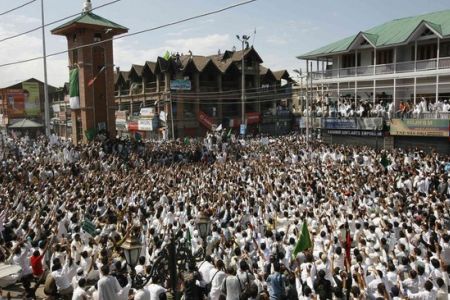
Pakistan Observes Kashmir Solidarity Day Today

As Reported on Sify News, India

Pakistan is observing the Kashmir Solidarity Day on Saturday (today) to renew its pledge to provide full moral, political and diplomatic support to the Kashmiri people.

“We would not rest unless the people of Kashmir get their right to self-determination and win freedom from the Indian domination. We regard the Quaid-i-Azam’s dictum as our ideal wherein he said, “Kashmir is our jugular vein”. The day is not far when the Kashmiris would determine their own future,” The Nation quoted Prime Minister Syed Yousuf Raza Gilani, as saying in his message on the occasion.

The government and the people of Pakistan join their Kashmiri brothers and sisters in observing the Kashmir Solidarity Day, said Gilani, adding that the whole nation stands united in seeking a just and peaceful solution to the Jammu and Kashmir dispute in accordance with the legitimate aspirations of the Kashmiris as enshrined in relevant UN resolutions.

It will be a public holiday throughout Pakistan today, and special programmes will be broadcasted on television in this regard.

Apart from mass rallies, symposia, conventions meetings and speech declamations, a unique ceremony will be held at all six bridges linking Pakistan and PoK, where Pakistani and Kashmiri people will form a human chain.

It may be mentioned here that the day is observed every year in Pakistan, in continuation of the first call given by the then Prime Minister Zulfiqar Ali Bhutto in 1975.

Indo-Pak Express: Chugging for Peace

Originally posted on Aman Ki Asha

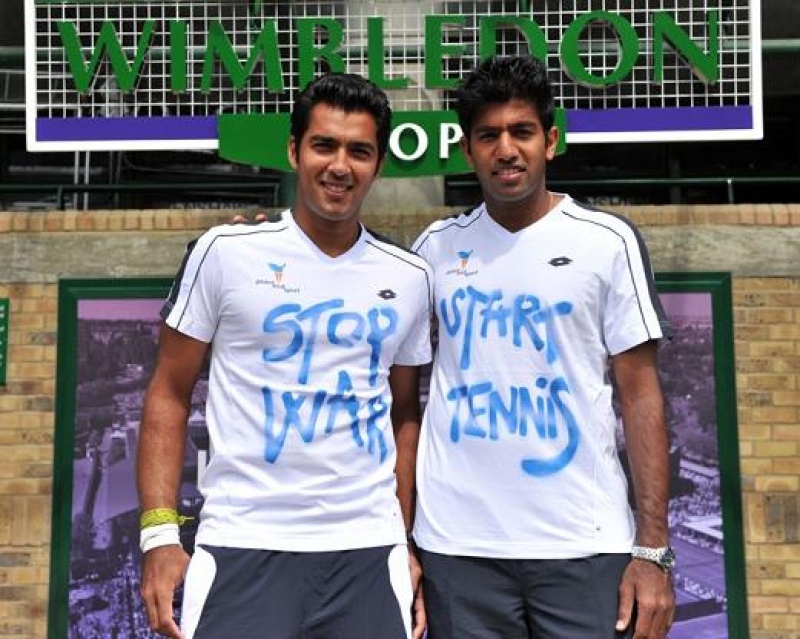
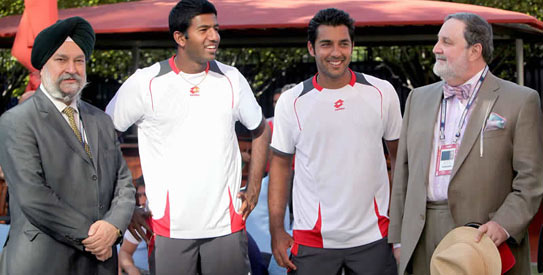
The unique tennis doubles team, Pakistani Aisam-ul-Haq Qureshi and Indian Rohan Bopanna popularly known as ‘Indo-Pak Express’ have urged their governments to allow tennis matches across the border.

There is growing support for their symbolic event – the Stop War Start Tennis campaign. Both players want a match organised between the two countries, but with a twist. They want the match to be held with a net strung across Wagah border. Now that would be a great feat.

The duo are hopeful that their doubles partnership will improve bitter relations between their countries, particularly since the initiative is now backed by the world tennis body and an international peace group.

The International Tennis Federation (ITF) has thrown its support behind the scheme, along with Peace and Sport, a non-governmental organisation run by Prince Albert of Monaco.

“A lot of good things have been achieved, the ITF is now supporting this, Peace and Sport is also supporting this,” Qureshi, who is also Aman ki Asha Ambassador, has said. “The letters have gone to both the prime minister and president of both countries.

“It is a political issue and there are a lot of security concerns, so we are just hoping that the governments will give us the green light so we can play that match on the border.”

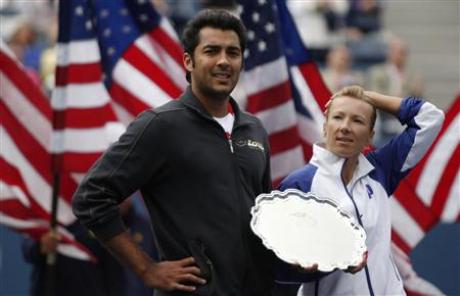
Both players, who were finalists at last year’s US Open and gave their opponents, the top-seeded Bryan brothers tough competition, are confident of a positive response from their respective governments.

“Things are going in the right direction,” Qureshi said.
“Last year, at the US Open, both the UN Ambassadors for Pakistan and India came and watched our matches, which was a huge thing and they are supporting the cause as well.
“Things are going in the right direction; we just have to keep playing our matches and get more and more publicity on the bigger occasions. Hopefully it will happen this year.”
– Aman Ki Asha

Difficult Outlook for India-Pakistan Talks

By Tom Wright for The Wall Street Journal 

The Times of India reported today that India and Pakistan may try to rekindle peace talks in early February.

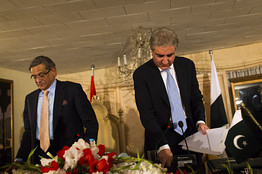
The paper says Pakistan Foreign Minister Shah Mehmood Qureshi could meet his Indian counterpart, S.M. Krishna, informally after a regional meeting in Bhutan on Feb. 8.

The report suggests that the idea is to set the ground rules for an official visit to India by Mr. Qureshi sometime later this year in a bid to normalize relations that have soured since a major terror attack in Mumbai in 2008.

Given the disastrous outcome of Mr. Krishna’s last formal visit to Pakistan – in July of last year – those ground rules will be important.

At that meeting, Mr. Qureshi became incensed during a press conference over India’s claims that Pakistan’s military intelligence services had orchestrated the Mumbai attacks in November 2008, during which 10 Pakistani gunmen killed more than 160 people over three days.

Mr. Krishna arrived back in India to criticism of being made to look a fool by Mr. Qureshi and a peace talks process begun in 2004 was put on hold amid mutual recriminations. The slow-moving (and now stalled) dialogue is an attempt to normalize relations that have been rocky ever since the two nations were created out of British India in 1947.

India has stuck to its claims of official Pakistan involvement in the Mumbai attacks and says Islamabad is not doing enough to prosecute the perpetrators and rein in India-focused militants in general.

Pakistan retorts that it is committed to fighting terrorism. It also has called on India to broaden the agenda for peace talks to include other topics, such as the disputed Himalayan territory of Kashmir, which both countries claim in its entirety.

It is uncertain whether talks at this stage can produce anything meaningful

India is set against any wider peace talks until Pakistan sentences seven militants that it has charged for involvement in the Mumbai attacks.

But the atmosphere in Pakistan right now means it is unlikely that any politician will want to be seen vigorously cracking down on Islamist groups.

The killing earlier this month of Salmaan Taseer, governor of Pakistan’s Punjab province, by one of his own police guards has uncovered the extent to which hardline religious views have permeated many layers of society.

The police guard admitted he was angered by Mr. Taseer’s defense of a Christian woman sentenced to death by a Pakistani court in November for blasphemy.

In recent days, scores of Pakistanis, including lawyers and clerics, have publicly rallied in support of the police officer.

Gandhi and King- Two Martyrs Who Will Never Die

By Manzer Munir for Pakistanis for Peace

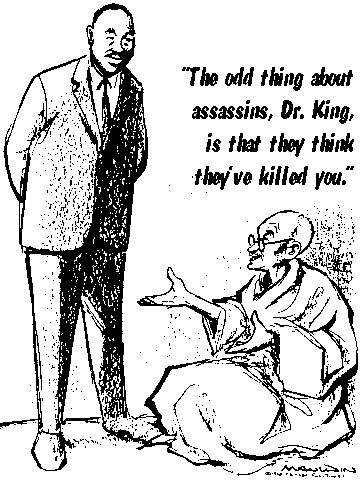
Martin Luther King Jr, who would have been 82 years old January 15, was a great believer of Mohandas K Gandhi, the leader of India’s independence movement from Britain. King saw that Gandhi’s peaceful civil disobedience and non-violent methods of protest were very effective in bringing down the British Empire in India and as a result Pakistan after some 300 years of direct and indirect rule. Gandhi had believed that people could resist immoral government action by simply refusing to cooperate. Gandhi adopted many peaceful resistance techniques in developing his concept of Satyagraha, which was a philosophy and practice of passive nonviolent resistance.

Gandhi had earlier used this resistance technique in his struggles for freedom and equality for blacks and Indians in South Africa where both minorities were subjected to second and third class citizenry. His methods and refusal to bow down to the injustices that Indians faced in colonial South Africa inspired Nelson Mandela several years later to start his own peaceful struggle that eventually led to the end of Apartheid in South Africa in 1990.

While at Morehouse College, King learned about Gandhi and became very excited about his ideas. He wanted to further educate himself and read many books on Gandhi and his life and beliefs. In his book, Stride Toward Freedom, King states that “Gandhi was probably the first person in history to lift the love ethic of Jesus above mere interaction between individuals to a powerful and effective social force on a large scale. He further writes in his book that “It was in this Gandhian emphasis on love and nonviolence that I discovered the method for social reform that I had been seeking. I came to feel that this was the only morally and practically sound method open to oppressed people in their struggle for freedom.”

King felt that he had finally found a way to where oppressed people could successfully unlock social protest through Jesus’ teachings of love. In fact Gandhi himself had said “What does Jesus mean to me? To me, he was one of the greatest teachers humanity has ever had.” He also once mentioned Jesus as the “most active resister known perhaps to history. His was non-violence par excellence” Therefore to the Christian minister living in the pre-civil rights era in the South in America, Gandhi appeared to King as a follower of Christ, someone who preached peace and love even at the expense of suffering. Martin Luther King once said of Gandhi “It is ironic yet inescapably true that the greatest Christian of the modern world was a man who never embraced Christianity.”

In 1959, King visited India and became fully convinced that Satyagraha could be effectively applied to the struggle by blacks in the United States for racial integration. He came back to the United States where he continued the struggle for freedom and equality for all Americans. Like Gandhi, King also talked about suffering as a path to self purification and spiritual growth. He not only experienced this suffering by being jailed, beaten and harassed by the authorities of the day, but he eventually ended up paying for this cause for freedom for all with his life.

 Mohandas K Gandhi and Martin Luther King Jr arguably were two of the greatest men of the last century.  Both men believed that “injustice anywhere was a threat to justice everywhere.” They both led their people and millions of others out of slavery and servitude against seemingly insurmountable odds to freedom and salvation. On what would have been his 82nd birthday, let us recognize that despite an assassin’s bullet and in the greatest democracy in the history of the world, the spirit and dream of a King still live on.


Originally published on 1/18/2010 for Pakistanis for Peace

India Urges Pakistan to Resume Onion Exports

As Reported by The BBC

India is trying to persuade Pakistan to resume exporting onions overland to curb soaring prices. The matter has been taken up with the government of Pakistan, External Affairs Minister SM Krishna said.

Pakistan banned overland exports of onions to India on Tuesday with traders saying they feared shortages at home. Last month, India abolished import taxes on onions after prices nearly tripled in a month.

“We have initiated talks and before not too long, we are hopeful we will find a solution to this, easing pressure within our country for onions,” Mr Krishna told a press conference in Delhi.

Pakistan banned exports to India through the land route via the Attari-Wagah border crossing, although the sea route is still open. Much of the trade, however, is by road and rail which are cheaper and quicker.

India’s food inflation has risen for the fifth straight week this week to 18.32% – the highest in more than a year.

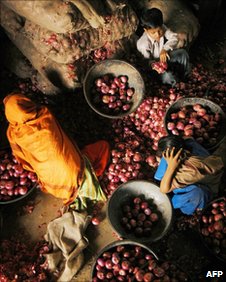
The price of onions, a key food staple for Indian families used in almost all dishes, has risen dramatically over the past month.

A kilogram which usually costs 20 rupees went up to 85 rupees ($1.87; £1.20) last month. At present, it is 65 to 70 rupees a kilo.

The rise has been blamed on unusually heavy rains in the bulk-producing western states of Maharashtra and Gujarat and in southern states, as well as on hoarders and speculators.

Discontent over food inflation has been a major headache for the government.

High prices of essential commodities such as onions have previously sparked unrest and helped bring down the national government in 2004.

Pakistanis, Indians want peace, friendship, says poll

As Reported by SANA (South Asian News Agency)

Despite a history of conflicts, mistrust and estranged relationship, an overwhelming number of Pakistanis and Indians want peace and friendship between the nuclear-armed South Asian nations, a survey conducted on both sides of the border has revealed.

The survey – conducted by independent research agencies and sponsored by the Jang Group of Pakistan and The Times of India on the first anniversary of their joint peace initiative ‘Aman Ki Asha’ – showed that 70 per cent of Pakistanis and 74 per cent of Indians want peaceful relations.

Although, the process of composite dialogue between Islamabad and New Delhi remains stalled since the 2008 Mumbai carnage, 72 per cent Pakistanis and 66 per cent Indians hope to see ’sustainable friendly relations’ in their lifetime. Compared with last year, the number of Indians hoping to see peace in their lifetime has surged by 17 per cent.

The optimism at the people’s level appears in a stark contrast to the current bitter official positions. The Indian government accuses Pakistan of harbouring terrorists and not doing enough against the alleged sponsors of the Mumbai attack, while Islamabad says that New Delhi has been using this incident as a ‘propaganda’ tool to avoid talks on the core issue of Kashmir. Islamabad also blames India for instigating violence in Balochistan.

According to the survey, awareness of the Kashmir problem as being central to the state of relations between the two countries, particularly in India, has increased. The survey results show that 77 per cent Pakistanis and 87 per cent of Indians feel that peace can be achieved by settling the protracted Kashmir dispute.

The scientific survey covered 10 Pakistani cities and 42 villages, covering a cross-section of people from rural and urban areas. Pakistani cities where the survey was carried out were: Karachi, Lahore, Rawalpindi, Islamabad, Peshawar, Quetta, Multan, Faisalabad, Hyderabad and Sukkur. In India, the survey was conducted in six cities: Delhi, Mumbai, Kolkata, Bangalore, Hyderabad (Deccan) and Chennai. Adult population, both male and female, were represented in the survey.

This was the second survey on Pakistan-India relations. The first survey was conducted in December 2009; just before the Aman Ki Asha peace campaign was launched. Survey results show a consistent and marked improvement in perceptions about each other by people in both countries.

The survey showed that the issue of Pakistan-India relations featured in the thoughts of 73 per cent Pakistanis and 68 per cent Indians. The survey results said apart from settling the Kashmir dispute, 80 per cent Pakistanis and 91 per cent Indians think ’stronger relations and better defence’ would also contribute in achieving the goal of peace.

The survey tracked the impact of the Aman Ki Asha campaign in India by asking a similar set of questions to two groups of people – one aware of this peace campaign and the other not aware of it. On all four questions asked – perceiving Pakistan as a high threat to India, as a sponsor of terror, desire for peace and being hopeful for achieving sustainable peace – there was a marked difference in the responses of the two groups. The group that was aware of the Aman Ki Asha initiative had a much better perception of Pakistan.

Around 77 per cent of Pakistanis and 87 per cent Indians consider that international pressure may help in bringing peace, while 71 per cent Pakistanis and 72 per cent Indians pin hopes on greater people-to-people contact to pave the way for friendly relations. Eighty-one per cent Pakistanis and Indians see people-to-people contact as an effective ‘instrument of peace’.

An increase in business has also been tipped as a vehicle of peace by 67 per cent Pakistanis and 69 per cent Indians, the survey said. Among other steps needed to promote peace, 32 per cent Pakistanis pinned hopes on sports, 28 per cent on business, 22 per cent on tourism, 20 per cent on travel for health treatment and 13 per cent each on culture and higher education. The data from the Indian side regarding this questionnaire was not available.

For 51 per cent of Pakistanis, business can help bring peace, while 46 and 45 per cent of respondents said that it can also be done through sports and tourism respectively.

AMAN KI ASHA: The first of its kind peace drive ‘Aman Ki Asha’ was seen by a vast majority as articulating the aspirations of the people. Around 87 per cent Pakistanis and 74 per cent Indians were of the view that this sustained campaign ‘developed tremendous awareness about the Indo-Pak relationship’. Around 85 per cent Pakistanis and 61 per cent Indians said Aman Ki Asha communicated ‘peoples’ desire for peace to their governments, while 80 per cent Pakistanis and 86 per cent Indians said it ‘helped bring the people of the two countries together’.

The Jang Group and The Times of India have held a series of events over the last 12 months that involved a broad section of people, including students, intellectuals, artists, businessmen, doctors, information technology experts and ordinary citizens in an attempt to boost people-to-people ties.

In Pakistan, the recall of the ‘Aman Ki Asha’ campaign has been around an impressive 92 per cent. Shahrukh Hasan, Group Managing Director of the Jang Group, said this media-led civil society movement had made a huge contribution for peace at a time when tensions remained high between the two countries.

“The survey results should lay to rest any misgivings or apprehensions people may have had about the objectives or chances of success of the campaign,” he said. “The survey results show that Aman Ki Asha has brought about a sea change in perceptions in India about Pakistan. Every negative perception has decreased and every positive perception has improved. The Jang Group feels vindicated and is delighted that we have helped put across Pakistan’s point of view through honest dialogue, seminars, people-to-people contacts and cultural events.”

According to the survey, the terror perception in India about Pakistan is down to 42 per cent from 75 a year ago, of bomb threats to 29 per cent from 54 and awareness about the Kashmir dispute rising to 17 per cent from a mere four per cent. Hasan hoped that the Pakistani and Indian governments would continue to facilitate the Aman Ki Asha peace campaign and take advantage of the access to the hearts and minds of the people of the two countries that the Jang Group and the Times of India provided.

China Ramps Up Pressure Over Kashmir

By Sudha Ramachandran The Asia Times

BANGALORE – A recent report in the Chinese media describing the Sino-Indian border as being 2,000 kilometers long, roughly 1,500 km shorter than that defined by India, has evoked an alarmed response among sections of the Indian strategic community.

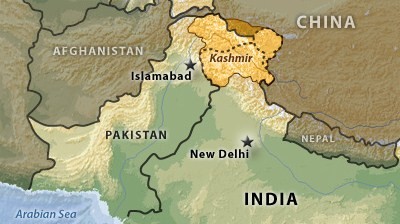
The “missing 1,500 km” from the definition of the Sino-Indian border is seen to be a clear pointer to Beijing’s hardening position, not only on its long-standing boundary dispute with India but also on Jammu and Kashmir (J&K). While India holds about 45% of J&K territory and Pakistan controls 35%, China occupies about 20% (including Aksai Chin and the Shaksgam Valley, ceded by Pakistan to China in 1963).

A Beijing-datelined Xinhua news agency report of an official briefing by China’s Assistant Foreign Minister Hu Zhengyue on the eve of Prime Minister Wen Jiabao’s recent visit to India triggered the flap. “China and India share a 2,000-km-long border that has never been formally demarcated,” the report said. India describes the border as being 3,488 km.

The different positions were made even more explicit by the Global Times, an English-language newspaper published by the People’s Daily, the official mouthpiece of the ruling Chinese Communist Party. In an interview with Global Times, India’s ambassador to China, Subrahmanyam Jaishankar, spoke of the “long common border of 3,488 kilometers” between the two countries. But a comment by the editors of Global Times in parentheses said: “There is no settled length of the common border. The Chinese government often refers to the border length as being ‘about 2,000 kilometers’.”

Reports in state-owned media have been describing the border as being 2,000 km for at least a year now.

The roughly 1,500 km-long shortfall in the Chinese perception is believed to refer to the Sino-Indian boundary in J&K. “China apparently no longer treats the line of nearly 1,600 km separating Jammu and Kashmir on the one hand and Xinjiang and Tibet on the other as a border with India,” strategic affairs expert C Raja Mohan wrote in the Indian Express. That is, it does not recognize Kashmir to be part of India.

Beijing is questioning India’s locus standi to discuss J&K’s border with China, observes B Raman, a retired director in India’s external intelligence agency, the Research and Analysis Wing (RAW). In essence, it is seeking to exclude discussion of the western sector of the disputed Sino-Indian boundary with India. The western sector includes the large chunk of Indian territory, Aksai Chin, in the Ladakh region of Jammu and Kashmir that China occupied in 1962.

Besides, China “wants to change the format of the border talks in order to keep it confined bilaterally to the eastern and middle sectors and expand it to a trilateral issue involving India, China and Pakistan in the western sector,” Raman wrote recently.

China has become increasingly assertive in its questioning of India’s sovereignty over J&K. Since 2008, it has been issuing visas on a separate sheet of paper to residents of Jammu and Kashmir rather than stamping the visa in their passports, as is the norm with other Indian citizens. In August last year, China also denied a visa to Lieutenant General B S Jaswal – commander of the Indian army’s Northern Command, which includes Kashmir – for an official visit to China, on the grounds that he “controlled” a “disputed area”.

Besides, over the past year, Beijing has been reaching out to the Hurriyat Conference, an umbrella organization of Kashmiri separatist outfits. In March 2010, for instance, Chinese Foreign Affairs director Ying Gang met with Hurriyat leader Mirwaiz Umar Farooq in Geneva on the sidelines of the 13th session of the UN Human Rights Council. Besides questioning India’s sovereignty over Kashmir, China has been endorsing Islamabad’s control over the part of Kashmir it has administered since 1947.

It was with India that the Maharajah of Jammu and Kashmir, Hari Singh, signed an Instrument of Accession in October 1947. However, only 45% of the territory of the former princely state is in India’s hands today, roughly 35% remaining under Pakistani administration and another 20% under Chinese control. The territory under Chinese occupation includes Aksai Chin and the Shaksgam Valley that Pakistan gifted to China in 1963.

In the Northern Areas of Pakistan-administered Kashmir, China is involved in the construction of several infrastructure projects, including roads, hydroelectric power projects, dams, expressways, bridges and telecommunication facilities. During Wen’s recent visit to Pakistan, the two countries signed a US$275 million agreement for repair and expansion of the Karakoram Highway. Earlier in September, Beijing underlined its support to Islamabad’s territorial claims over parts of Pakistan-administered Kashmir when it described the Northern Areas as “a northern part of Pakistan”.

The India-Pakistan dispute over Kashmir predates the People’s Republic of China (PRC). India and Pakistan had already fought their first war over Kashmir when the PRC came into being. Initially, China took its cues from the Soviet Union on the issue. It described the conflict as a Western creation and maintained that the US and Britain were hoping to make Kashmir a Western base.
China took a “neutral position” in the 1950s. It opposed foreign arbitration on the Kashmir issue, which pleased India. At the same time, it did not endorse Delhi’s claims over Kashmir. Fraying Sino-Soviet relations and Moscow’s overt support to Jammu and Kashmir as “an inalienable part of the Republic of India”, as well as concerns that its backing of India would push Pakistan into a closer embrace of the US, seem to have prompted it to adopt a more “neutral position” between India and Pakistan on Kashmir.

With Sino-Indian relations deteriorating from 1959 onwards, China began tilting towards Pakistan. It signed a border agreement with Pakistan. Since this dealt with areas that constituted Pakistan-administered Kashmir, the agreement amounted to a de facto Chinese recognition of Pakistan’s control over this area. Although it subsequently denied such recognition, describing this as “provisional” and “pending settlement of the Kashmir dispute”, a joint communique issued at the end of prime minister Zhou Enlai’s visit to Pakistan in February 1964 was a strong endorsement of the Pakistani position. It urged a solution of the dispute “in accordance with the wishes of the people of Kashmir”. India is opposed to a plebiscite in Kashmir.

By the mid/late 1970s, China began advocating a status quo on Kashmir. Support for the Kashmiris’ right to self-determination was toned down. In 1976, in his speech before the UN General Assembly, Chinese foreign minister Chia Kuan-Hua omitted naming Kashmir in a list of territories where the right to self-determination had not been exercised. It is believed that China’s own troubles with separatism and improving ties with India prompted its shrinking support on self-determination.

With Sino-Indian rapprochement gathering momentum in the 1990s, China began describing Kashmir as a bilateral matter to be resolved by India and Pakistan through peaceful means. On his visit to India in 1996, president Ziang Zemin called on India and Pakistan to set aside contentious issues and build a cooperative relationship. During the brief Kargil conflict in 1999, China called on India and Pakistan to respect the Line of Control that separates Pakistani- and Indian-administered Kashmir. These were seen as signs of Beijing taking a neutral position on Kashmir again.

China has never accepted India’s sovereignty over Jammu and Kashmir, even over the part that is under its control. After all, if it did it would mean giving up the roughly 43,180 square kilometers of territory that is currently under its control. However, it had avoided provoking India on the matter publicly. This has changed in recent years, with Beijing being “deliberately provocative” on Kashmir.

India is not letting the repeated provocations go unchallenged. After all, the territorial integrity of the country is a core concern of the Indian state. A couple of months ago, in his talks with Chinese Foreign Minister Yang Jiechi, India’s External Affairs Minister S M Krishna did some tough talking. According to officials quoted by the Hindu, for the first time India drew a parallel between “the territorial red lines” of the two countries.

Krishna reportedly told Yang that just as India had been sensitive to its concerns over Tibet and Taiwan, Beijing too should be mindful of Indian sensitivities on Jammu and Kashmir. The message that India is sending is that if China questions India’s sovereignty over Kashmir, India will question Beijing’s sovereignty over Tibet and Taiwan.

Delhi has indicated that Krishna’s warning was to be taken seriously. The joint communique issued at the end of Wen’s visit to India made no reference to India’s commitment to a “one china policy”. This is the first time since 1988 that a summit-level joint communique has made no mention of the policy. Instead, both sides agreed to show “mutual respect and sensitivity for each other’s concerns and aspirations”.

-Sudha Ramachandran is an independent journalist/researcher based in Bangalore.
Pakistan, India Swap Nuclear Sites Lists

By Zhang Xiang for Xinhua News

Pakistan and India exchanged lists of nuclear installations and facilities on Saturday in spite of a tension over the 2008 Mumbai attacks that has disrupted the dialogue process between the two countries, the Foreign Ministry said.

The two countries exchange the lists of nuclear sites on the first day of the new year under an agreement signed in 1988 and came into force in January 1991.

“The government of Pakistan and India today exchanged lists of their respective nuclear installations and facilities in accordance with Article-II of the Agreement on Prohibition of Attacks against Nuclear Installations and Facilities between Pakistan and India of Dec. 31, 1988,” a Foreign Ministry statement said.

The statement said the Ministry of Foreign Affairs handed over the list of Pakistan’s nuclear installations and facilities to an officer of the Indian High Commission in Islamabad at the Foreign Office on Saturday morning.

The Indian side also handed over their list to an officer of the Pakistan High Commission at the Ministry of External Affairs in New Delhi, it said.

After the agreement was signed the first exchange took place Jan. 1, 1992.

Sources said it is the 20th consecutive list exchange between the two countries.

Pakistan and India conducted tit-for-tat nuclear tests in 1998. India conducted its first nuclear test in 1974, followed by five more in 1998. Pakistan conducted its six nuclear tests in 1998. Neither India nor Pakistan is a signatory to the Nuclear Non- Proliferation Treaty (NPT).

India considers the NPT discriminatory, while Pakistan has indicated that it won’t join the international agreement till its neighbor does so.

Neither of the two rival neighbors have signed the Comprehensive Test Ban Treaty.

In 2004 they launched a peace process, but that is now on hold following the Mumbai attacks, with New Delhi pressuring Islamabad to do more to punish those responsible for the carnage and to crack down on anti-India groups.

Meanwhile, both countries also exchanged Lists of Prisoners in the two countries, the Foreign Ministry said.

According to the Agreement on Consular Access signed between Pakistan and India on May 21, 2008, both countries are required to exchange lists of prisoners in each other’s custody on Jan. 1 and July 1 every year, the statement said.

“Consistent with the provisions of this Agreement, the Ministry of Foreign Affairs handed over the list of Indian prisoners in Pakistan to the Indian High Commission in Islamabad today,” it said.

Will India Win Coveted UN Seat?

By Sunil Sharan for The Huffington Post

Indian foreign secretary Nirupama Rao says Pakistan is hypnotically obsessed with India but she and her bosses too are fixated on a coveted prize, a permanent seat at the United Nations Security Council. The mandarins of New Delhi must be pleased as punch to have had over to visit leaders of all five permanent member countries in quick succession. Inexorable appears the march but will India find the pot of gold at the end of the rainbow? And, if it does, what are the implications for itself as well as for Pakistan?

First in was David Cameron of Britain, who arrived during the summer and offered unstinting support, whetting local appetite for the main American course. And, did he fail to disappoint? No sir, Barack Obama set the cat amongst the pigeons by endorsing India for the seat, the first time ever by the US. India rejoiced while Pakistan recoiled.

But a careful examination shows him adhering closely to what he told Bob Woodward in the book, Obama’s Wars. In lieu of the seat, he expects India to resolve Kashmir. At a press conference with Manmohan Singh, Obama characterized Kashmir as a long-standing dispute making the latter stutter that the K-word was not scary. Only then did Obama hand over the endorsement in India’s Parliament but couched in such diplomatese that countless local hair were split over when “the years ahead” would dawn.

Next waltzed in Nicolas Sarkozy of France. The French, like the British, have consistently seen merit in India’s case. Sarkozy though, true to type, proved an enigma. He first tagged on the applications of Africa, the Arabs and pretty much the rest of the world onto India’s, befuddling his hosts, who are willing to concede as equal aspirants only “self-appointed frontrunners” Germany, Japan and Brazil. Just as they were about to give up on him, Sarkozy warmed the cockles of India’s heart by throwing in 2011 as early as when it could make it.

But soon came the caveat. Sarkozy, just like Obama before him, cautioned that with great power status came great responsibilities. Whereas Obama wanted India to be more mindful of human rights violations of countries such as Iran and Myanmar, Sarkozy wanted India to send military forces to keep world peace. With India already being one of the foremost contributors to UN peacekeeping missions throughout the world, the mandarins of New Delhi must have been left wondering what more was being asked of them.

No matter, three down, two to go. By now the state jets were landing at Delhi airport almost on top of one another. Wen Jiabao, the leader India was least looking forward to, came with the master key to entry. Shortly before his visit, WikiLeaks revealed China’s opposition to any council expansion. Indian hopes were up nevertheless but Wen remained inscrutable, willing only to acknowledge an understanding of India’s aspirations. No one in India knew quite what to make of him and since Wen was off to Pakistan next, all the country could do was wait with clenched teeth to hear what he would say there.

Rounding off the passage to India was Dmitry Medvedev. Relations between Russia and India have frayed considerably since the heady days of the cold war, so much so that Russia has waffled on India’s bid. Medvedev signaled that the waffle still needed baking, voicing support for India while reiterating that reforming the council was tough and required consensus.

All the while Pakistan protested vociferously against what it deemed an indulgence of Indian hegemonism. But what will India gain with a permanent UN seat? Could it block Pakistani claims on Kashmir? True a permanent member wielding veto power can stonewall but the veto seems unattainable for seekers since they themselves have forsaken it. And, while India sees red when the K-word is uttered in the UN by Pakistan, no ascension to permanency can make it strangle the latter. Nor can it efface any past security council resolutions.

So then, what is it? Nothing comes to mind but the obvious, the acceptance that any arriviste craves. Even that appears a false hankering because ever since its early years, Gandhi’s legacy and Nehru’s charisma burnished the country with global influence disproportionate to its economic and military capabilities. A bee once in one’s bonnet is hard to get rid of though. And, as every journey must have a fitting end, India has found a destination to its liking.

Flush with cash, New Delhi wants to beef up its military. All of the recent visitors bar China are major suppliers of defence equipment to India. As bees flock to honey, they arrived armed with catalogues of the most terrifying stuff. Inherent was a delicate diplomatic quid-pro-quo. The more arms you buy from us, the more we will push your candidacy. As Islamabad keeps raising the bar for India’s seat, so too will India have to up its arms binge.

Lost in Pakistan’s current rhetoric was its vote in October to put India in the security council for two years beginning January 1, 2011. Once on, we will never get off is the new mantra of India’s brave. India seemingly returned the favor by taking in stride the sale of Chinese nuclear reactors to Pakistan. Is there more afoot than meets the eye?

Every country is entitled to its obsession. Pakistan’s is obvious. By continually thumbing its nose at a NATO mired in Afghanistan, it has put the K-word in spotlight, albeit on the backstage. A deal has been blessed by the powers that be. Both the seat and Srinagar are not far away.

The writer edits a website on India: http://www.scooptime.com.

Chinese Premier Visits Pakistan to Reinforce Ties

By Salman Masood for The New York Times

ISLAMABAD, Pakistan — Chinese Prime Minister Wen Jiabao arrived in Islamabad on Friday for a three-day visit that Pakistani officials said was aimed at strengthening the strategic partnership and economic cooperation between the two neighboring countries.

Prime Minister Yusuf Raza Gilani and members of his cabinet welcomed Mr. Wen at Chaklala Air Base in neighboring Rawalpindi on Friday afternoon. A red carpet was rolled out and elaborate ceremonies were held to signify the importance Pakistan attaches to China, which is considered a close ally.

“Friendship with China is a matter of pride for our nation,” Mr. Gilani was quoted as saying by local media as he welcomed his Chinese counterpart.

Apart from holding meetings with Mr. Gilani and President Asif Ali Zardari, Mr. Wen was scheduled to address a special joint session of the Parliament on Sunday.

Pakistan’s military ties with China are strong and China has assisted Pakistan in tank production, fighter aircraft manufacturing and naval technology. But since the late 1990s, economic concerns have gained increased importance. Trade and energy have taken precedence in Pakistan’s relations with China.

Mr. Wen was accompanied by 260 business executives.

Pakistani officials say there is a need to enhance trade between the countries that stands around $7 billion a year. But there also are concerns here that the trade deficit is growing heavily in favor of China.

“The relationship is undergoing a qualitative change,” said Mansoor Ahmad, an independent security analyst based in Islamabad. “This change is manifested in China’s relationship with emerging markets and developing countries, which is essentially based on forging and enhancing trade linkages and securing new markets for Chinese investment.”

The Chinese are also cooperating with Pakistan in developing its civil nuclear energy program despite discontent from Washington and New Delhi.

Mr. Wen, the Chinese prime minister, arrived here after completing a two-day tour of India, the estranged neighbor of Pakistan.

China would have to undertake a fine balancing act regarding enhancing its cooperation with both India and Pakistan, said Mr. Ahmad. China and India would forge economic ties despite their continuing territorial disputes, given India’s huge market, he said. Tensions between India and Pakistan worsened after the terrorist attacks in Mumbai in 2008, which India and the United States blamed on Lashkar-e-Taiba, a militant Islamic group based in Pakistan.

The Pakistan government sees China as a counterweight to India, and officials said that closer Chinese cooperation with India would not affect Pakistani ties with China.

Nonetheless, Mr. Wen’s visit to India this week yielded greater immiediate progress on the economic front than toward resolving the more complicated geostrategic issues.

“In Pakistan’s case, we have already had a longstanding strategic partnership which is now being supplemented by increasing Chinese investment in infrastructural development, civil nuclear cooperation and establishing rail and road linkages between the two countries,” Mr. Ahmad said.

Pakistan Shifted Emphasis Away From India Border, says US

As reported by The Economic Times

WASHINGTON: Pakistan was shifting its emphasis away from its eastern border with India, a decision it had taken on its own because of a “definite shift” in Islamabad’s military posture brought about by fundamental changes within the country, the US has said.

It said while it does want Islamabad to act more aggressively against extremists within Pakistan it played little role in Islamabad’s decision to move its troops away from the border with India.

“First of all, how Pakistan decides to deploy its military forces is a decision for Pakistan,” State Department spokesman P. J. Crowley told reporters Friday what role the US had played in the movement of 140,000 troops away from the Pakistani-Indian border as mentioned by Secretary of State Hillary Clinton.

“We’ve made no secret of our desire to see Pakistan take more aggressive action against extremist elements within its own borders,” he said. “That is a threat to Pakistan itself.”

“And as the Secretary said, we have seen Pakistan shift its emphasis away from the Pakistani-Indian border and more aggressively to the Swat Valley and other areas where these extremists operate.”

“And no military has suffered more significant casualties in undertaking these operations than Pakistan. But these were obviously decisions for Pakistan to make,” Crowley said.

“But the context of increasing dialogue and reducing tensions between Pakistan and India is something that we have stressed in our dialogue with both countries,” he said.

Asked if Clinton was making an announcement, Crowley said: “Yeah, we’ve seen a definite shift in the Pakistani military’s posture. (But), it wasn’t an announcement.”

“I think it was a reflection of fundamental changes that have occurred in Pakistan as part of our strategic dialogue and our cooperation on dealing with the threat on both sides of the Afghan-Pakistan border.”

Asked about India’s role in Afghanistan after the recent review of the US Af-Pak strategy, Crowley said: “Well, we do have a regional strategy. India has legitimate interest in helping with the future of Pakistan.

“It has contributed significantly to development and reconstruction projects within Afghanistan. And we encourage that activity, even as we stress the importance of dialogue between India, Pakistan, Afghanistan, other countries. So no efforts like this are misunderstood,” he said.

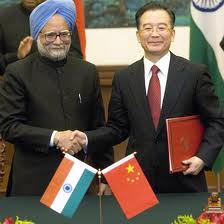
China’s Wen, India’s Singh Make Little Progress at Summit

By Mark Magnier, Los Angeles Times

Chinese Premier Wen Jiabao and Indian Prime Minister Manmohan Singh met Thursday in New Delhi, the main event of a three-day summit aimed at building trust and reducing long-standing irritants. But they announced no substantive breakthrough and little progress on border disputes, access to shared water resources or security issues.

Nor was there any apparent progress on India’s bid to open Chinese markets to its software, pharmaceuticals and farm products. New Delhi also remains wary of Beijing’s regional ambitions and its ties with Pakistan, India’s nuclear adversary.
The two rising Asian superpowers made some modest progress on the economic front, pledging to expand trade to $100 billion by 2015 from $60 billion at present and try to reduce the trade gap. China is India’s largest trading partner, but trade flows are heavily weighted in Beijing’s favor.

The two leaders also agreed to set up a hotline, and both sides spoke about the need for improved ties.

“I hope that my visit will help increase our cooperation in a wide range of fields and raise our friendship and cooperation to an even higher level,” Wen told reporters on leaving a welcoming ceremony at the presidential palace.

“A strong partnership between India and China will contribute to long-term peace, stability, prosperity and development in Asia and the world,” Singh added.

But any move to turn the regional cooperation rhetoric into reality will quickly run into roadblocks, analysts said, given the nations’ differences over Iran’s nuclear ambitions, North Korea’s long-standing conflict with the international community and continued warfare in Afghanistan.

China appeared keen to outdo the recent visit to India by President Obama. Chinese officials brought a contingent of 400 business executives, compared with the 250 American business men and women who accompanied the U.S. leader. And they signed $16 billion worth of business deals, compared with America’s $10 billion.

Singh and Wen reportedly discussed many of their nations’ core differences, including Pakistan; divided Kashmir; and the Dalai Lama, the exiled Tibetan spiritual leader based in northern India and considered by Beijing to be a “splittist” enemy of a unified China. But neither side made any significant concessions.

The two nations agreed to keep working on peacefully resolving their lingering border disputes, the focus of a brief war in 1962. Talks have languished for years.

China claims much of the Indian state of Arunachal Pradesh, whereas India wants China to back away from a slice of territory it controls in Kashmir, the disputed region largely divided between India and Pakistan.

“It will not be easy to completely resolve this question,” Wen said in a speech. “It requires patience and will take a fairly long period of time. Only with sincerity, mutual trust and perseverance can we eventually find a fair, reasonable and a mutually acceptable solution.”

In other words, said analysts: Don’t hold your breath. Add it up, they said, and this meeting — the 11th between the two leaders in five years — accomplished relatively little.

“Issues that fuel mutual mistrust, such as Kashmir for the Indians and Tibet for the Chinese, were addressed, but not substantially,” said Srikanth Kondapalli, a professor of Chinese studies at New Delhi’s Jawaharlal Nehru University. “The boundary dispute has not been resolved. There’s no road map.”


Break for the Border: Indo-Pakistan Tennis Duo’s Dream for Peace

As Reported by CNN

One half Indian, the other Pakistani, they are the most talked-about partnership in tennis.

Dubbed “the Indo-Pakistan Express,” Rohan Bopanna and Aisam-Ul-Haq Qureshi hope to end their breakthrough year with a showdown at the infamous Wagah border that divides their countries.

Bopanna, an Indian Hindu, and Qureshi, a Pakistani Muslim also aged 30, reached their first major doubles final at the U.S. Open in September and climbed to eighth in the world rankings.

Yet their work off the court has attracted just as much attention as they try to soften the often-fractious relationship between their two nations since partition in 1947.

The pair have been honored with a string of awards for their humanitarian work in the past 12 months, and are determined to start picking up tournament titles in 2011.

But a showpiece clash at the notorious border crossing that hosts a nightly pageant between India and Pakistan’s border forces would be the perfect way to carry their “Stop War, Start Tennis” campaign into the new year.

“We’re thinking how to get to a wider audience and spread the message of peace through our partnership and thought,” Qureshi told CNN’s Open Court.

“How about playing a match at the Wagah border, with Rohan playing on the Pakistani side and me on the Indian side for a gesture of friendship?

“At the U.S. Open the ambassadors to the United Nations for Pakistan and India both came to watch the semifinals and finals. That was a huge deal because normally you don’t see two diplomats cheering for one cause — it was a really positive sign. I just hope in the near future we can have that match at the border, that would be great.”

The village of Wagah, near the Indian city of Amritsar and the Pakistani city of Lahore, is the only road border crossing between the two countries, and the daily ceremony — which includes a lot of strutting, stamping and saluting — regularly attracts a crowd of thousands.

A match there could be a watershed moment for a pairing that first emerged in 2003 but did not make a major impact until this season.

Their burgeoning partnership on court is allied to a deep-rooted desire to strengthen links between two countries which have a long and deep distrust of each other.

“We’re both brand ambassadors for an organization called Peace and Sport,” Bopanna said. “Right now we’re trying to see if we can help tennis in both our countries, promote it and keep the sport growing as much as we can.”

As well as receiving the Arthur Ashe Humanitarian of the Year award at the recent ATP World Tour Finals in London, they were also given the Peace and Sport Award for 2010 at a glittering ceremony in Monaco.

I’ve always told him I think he’s the most popular Indian guy in Pakistan this year!
–Aisam-Ul-Haq Qureshi on Rohan Bopanna

The citation read: “Their commitment to promoting peace between the two countries and their conviction that peace was possible was shown amply during the year.”

Joel Bouzou, president of the Peace and Sport Foundation, added of the proposed Wagah match: “The sport is ready for peace. Will the two governments rise to the occasion?”

Their partnership may have attracted plenty of headlines but for Qureshi, teaming up with his Indian counterpart made perfect sense.

“I’ve been playing with Indian players ever since I started playing tennis,” he said.

“Unfortunately there are not that many Pakistanis on the tour, and playing with an Indian was actually the most natural thing that came to me — having the same language, most of the time having the same dinner, Indian or Pakistani foods in the evening.

“The first time I ever traveled to India when I was 16, I was one of the top [Pakistani] juniors and he was one of the top juniors in India and that’s how I got to know him.

“Knowing his attacking style of play, I always knew if we played together we’d be able to make a really good impact. I think results clearly show in that way I was right, though normally he tells me that I am always wrong!”

As well as their run to the final of the U.S. Open, where they were beaten by the Bryan brothers from America, they also enjoyed success at Wimbledon which made them household names back home.

“This year we made the quarterfinal at Wimbledon and that was very, very big in Pakistan,” Qureshi said. “I’ve always told him I think he’s the most popular Indian guy in Pakistan this year!

“I can thank him enough for that because obviously without him I wouldn’t have been able to achieve all those goals, and with him being my best friend on the tour it makes it the icing on the cake. It’s been a great journey so far.”

Aasia Bibi and Impurities in the Land of the Pure

By Manzer Munir for Pakistanis for Peace

The case of Aasia Noreen aka Aasia Bibi illustrates how far Pakistan has to go to secure freedoms for its religious minorities. Christians and Hindus are not the only minorities who are persecuted for their beliefs but it is also Muslim minorities such as the Ismailis, Ahmadis, and Shiites who are routinely harassed, discriminated and also killed. Sadly, it is the case of Aasia Bibi that has brought some much needed attention to Pakistan’s sad state of affairs towards the treatment of its religious minorities.

Several sections of Pakistan’s Criminal Code consist of its blasphemy laws and of all the Muslim countries of the world that have anti-blasphemy laws, Pakistan’s anti-blasphemy laws are by far the strictest. There is section 295 that forbids damaging or defiling a place of worship or a sacred object. Then there is section 295-A that “forbids outraging religious feelings.” There is also 295-B which prohibits defiling the Qu’ran and was originally punishable by life imprisonment but has since been amended to up to three years imprisonment.

No section of the blasphemy law is more controversial or harder to prove than Article 295-C, the law that Aasia Bibi is allegedly charged with having broken. In respect to prophet Muhammad, this statute states that ” Whoever by words, either spoken or written, or by visible representation, or by any imputation, innuendo, or insinuation, directly or indirectly defiles the sacred name of the Holy Prophet Muhammad shall be punished with death, or imprisonment for life and shall also be liable to a fine.”

Aasia’s case and charges against her started almost a year and a half ago when there was a quarrel over a bowl of water in a dusty village in the heart of Pakistan’s Punjab province. A group of women were working the fields in the heat of the Pakistani sun when one of them, Aasia Bibi, dipped her glass in the communal bucket of drinking water to fetch herself and others a glass of water to drink and immediately was rebuffed by the other women who claimed that the water was now unclean as it had been touched by a non-Muslim. According to witnesses, instead of quietly bowing her head and taking the indignities, Aasia’s crime was that she mounted a strong defense of her faith and remained steadfast in her demeanor that she did nothing wrong. Too often in Pakistan, the blasphemy laws are used against religious minorities to settle personal vendettas and old scores according to Pakistan’s Human Rights Watch, a watchdog group monitoring the case.

The news traveled fast in Aasia’s village of Ittan Wali, in Punjab’s Sheikhupura district that a Christian woman had insulted the prophet. The local mullah got on the mosque loudspeakers, urging the “faithful” to take action against Aasia Bibi. In sad but familiar pattern, her defense of her faith was somehow twisted into an accusation of blasphemy, according to her family and others familiar with the case. Soon as a mob gathered outside her home ready to take the law into their own hands and handing out vigilante justice, the police moved in and took her into custody. But instead of protecting her, they charged her with insulting Islam and its prophet under the blasphemy laws.

And then on Nov. 8, after suffering 18 months in prison, Aasia Bibi was sentenced to death by a district court, making her the first person to be handed the death penalty in Pakistan under the blasphemy laws. Many before her over the years have been charged, but punishment had been commuted to lesser penalties than the death sentence imposed on Aasia Bibi. No concrete evidence was ever presented against Aasia, according to Pakistan’s Human Rights Watch. Instead, the district judge relied on the testimonies of three other women, all of whom were hostile towards her.

Unfortunately this is a common insult hurled at many of Pakistan’s 2 million Christians who make up just 1.59% of the total population. Often, Christians in Pakistan are discriminated and persecuted and many times only get the lowest of the low jobs such as street sweepers, janitorial and sanitation workers. In fact, in Pakistan, the term ‘Chura‘ has become synonym with the Christian community as it relates to an unclean person akin to how the untouchables or Dalit community is seen in India. In India however, the Dalits are not subjected to arcane state blasphemy laws geared towards religious minorities as in Pakistan or are threatened with their lives at the hands of the Hindu majority.

As discussed in a couple of my previous articles, Taliban 1o1, History and Origins and Taliban 201, The Rise of the Pakistani Taliban, the Islamization of Pakistan started under the late General Zia ul Haq of Pakistan who took over the leadership of the country through a military coup in 1977 when he hung the deposed and democratically elected Prime Minister Zulfiqar Ali Bhutto. Earlier in 1973, the 1973 Constitution of Pakistan had declared that “Islam shall be the religion of the Pakistan” and had systematically begun the process of restricting the participation of religious minorities in government and politics.

Before General Zia, there were only two reported cases of blasphemy. Since the death sentence was inserted in 1986 into the Penal Code for the blasphemy laws, this number has now reached 962 — including 340 members of the Ahmadi Muslim community, 119 Christians, and 14 Hindus. A close examination of the cases reveals the blasphemy laws are often invoked to settle personal scores, or they are used by Islamist extremists as cover to persecute religious minorities, sadly with the help of the state under these laws.

General Zia began this policy of Islamization of Pakistan in conjunction with his support for the war against the Russians and assistance to the Afghan Mujahedeen as well as the building of thousands of madrassahs or religious schools across Afghanistan and Pakistan which nurtured the young men into what later became the Taliban. Many of these blasphemy laws fully came into being under his reign, although some were around since as early as more than 100 years prior when the British drew up the Indian Penal Code of 1860 which was initially an ill foreseen aim at keeping the peace among the many fractured faiths of the subcontinent. For instance, section 295-A, which “forbids outraging religious feelings”, could have been applied against a Muslim who insulted a Hindu or a Hindu who taunted a Sikh or Christian or vice versa. However under Zia, the blasphemy laws were expanded and almost exclusively applied against Muslim minorities such as the Ahmadis, Islamilis and Shiites as well as against the Christian and Hindu populations.

Recently, a religious ‘leader’ came out and has offered over $6000 to anyone who can kill Aasia Bibi while she awaits her punishment in police custody. Outrage and denunciations on this case are coming from across the world as many people are appalled at the sad state of rights for religious minorities in Pakistan. The Pope has intervened also asking for clemency for Aasia Bibi from Pakistan’s President Asif Ali Zardari. Against all manner of reason and justice, Lahore’s High Court recently issued an order on November 29, 2o1o, preventing Zardari from exercising his constitutional authority to pardon Aasia Bibi.

In a country rife with violence and chaos and one that has become synonymous with terror the world over, the case of Aasia Bibi is yet another dark stain on the country’s image around the world. The Taliban and the extremist groups ravaging Pakistan can be explained as being a violent minority and do not and should not reflect on the nation as a whole as the majority of people in Pakistan are opposed to them and their views of Islam. But the blasphemy laws, for as long as they have stayed on the books in Pakistan and in the constitution, cannot and should not be excused in any shape or form. These laws need to be repealed and the constitution needs to be amended in an emergency manner so that Aasia Bibi and other religious minority citizens of Pakistan are not subjected to cruel and subjective laws that are almost exclusively used against minorities to settle scores, personal vendettas, and instill terror in less than 3 percent of the country that is not part of the religious majority of Sunni Muslims.

There needs to be international pressure placed on Pakistan from the United Nations, the United States, Europe and others to modify the constitution immediately and to pardon this 45 year old mother of five children. It is ironic that in a country where many people sympathize with Osama’s Al Qaeda and profess to hate the west with one hand, they decry with the other why not enough western aid has came to their country when it recently saw the worst flooding in its history. Can you blame the American citizens, the Europeans or citizens of any other Christian nation from hesitating to give aid to a country that not only plays a duplicitous game when it comes to terrorists and terror havens but also treats Christians and other religious minorities in the manner as in the case of Aasia Bibi?

The name Pakistan literally translates into “The Land of the Pure”. And as a child growing up I was told that the meaning of Pakistan’s flag is this: “The green is a traditional Islamic color and the crescent moon and star are also Islamic symbols. The white stripe represents the non-Muslim minority and religious groups of Pakistan and there place in the country.” In my view, as long as the nation sanctions and tolerates these utterly unjust and biased blasphemy laws, the religious minorities of Pakistan clearly have no place in this land of the ‘pure’.

-Manzer Munir, a proud Pakistani American and peace activist, is the founder of Pakistanis for Peace and blogs at www.PakistanisforPeace.com as well at other websites as a freelance journalist and writer.

Pakistan Consider Pitching up in China

As Reported by Reuters

The Pakistan Cricket Board (PCB) is considering using China as a neutral venue for its international cricket events, Chinese state media said today. The official Xinhua news agency cited sources as saying that the board’s director Javed Miandad had submitted a report to the PCB suggesting its management “take special steps to finalise China as a neutral venue.”

“We should take immediate and solid steps to decide this issue soon before the time passes away,” Miandad was quoted as saying.

Pakistan became a no-go area for cricket’s leading nations after an armed attack on the Sri Lanka team bus in Lahore in March last year killed eight people, and injured seven Sri Lankan players and their assistant coach.

Pakistan was due to host matches in next year’s World Cup. But the attack on the Sri Lanka bus saw the tournament restricted to the three remaining Asian Test nations of India, Bangladesh and Sri Lanka.

Even before the Lahore incident, countries such as Australia had refused to tour Pakistan, where thousands have died in a decade of conflict.

The security situation led Pakistan to play its “home” series against Australia in England this year. In the last two years, the nation’s “home” games have also been staged in the United Arab Emirates and New Zealand.

According to Xinhua, Pakistan will support China in its bid to host the 2012 Asia Cup in the southern city of Guangzhou, where the Asian Games recently concluded successfully with their first-ever cricket tournament.

Pakistani authorities say China’s hosting of its first major international cricket event would pave the way for making it a neutral venue.