Posts Tagged ‘ India ’

On the ground: For border village, peace is a beautiful dream

By Taha Siddiqui for The Express Tribune

We left behind everything when we came to this side, but not for such living conditions. Some of our family that stayed behind in India now mock us about our migration,” says Haji Shahzad.

Shahzad, in his early 70s, is a resident of Bhanoo Chak, a village located on the Indo-Pak border.
“The border force here has made our lives miserable. We live not under the threat of India but this force. Day and night, we have to live by their rules,” Shahzad says.

Bhanoo Chak, a village occupied by Sikhs who fled at the time of partition, is an hour’s drive from central Lahore and is closest in distance to the border.

“We just want peace so that there is relaxation on the border and we can have normal lives again,” adds Shahzad.
Mostly farmers, these men are not allowed to roam around freely after 6pm and need to acquire no-objection certificates before constructing anything on their property.

Many of these villagers have families that were divided in the partition in 1947 and wish to go meet them.
“We have family in Rajasthan. They want to come visit us and we want to go and visit them too. But we have to go through bureaucratic hurdles that we have stopped making the effort,” says Shahzad.

Pakistan Rangers Colonel Osman Siddiqui, who is in charge of the Wagah Border area, says that without checks and balances, he cannot trust anyone in the area. “The border is a sensitive spot, and to stop smuggling and unwanted people from crossing over, we have devised a system where we allow men to roam in these areas only between 6am and 6pm,” he says.

When asked if he will ease the policy in case the Pakistan-India dialogue is successful, he replied that national policy and local policy are different subjects. “When a change happens in the national policy, we can see. But for now, the policy will stay the same since the force needs to be vigilant,” he said.

Many villagers believe that if Pakistani and Indian leaders sincerely wanted peace, an accord could be reached today. They also do not fear another war with India.

“In 1965, Indian forces destroyed our homes. There were planes overhead and even the Pakistan Army had little idea what was going on,” says Mohammad Tayyab, who was barely seven years old at the time. “But today, we cannot expect the same as we are now a nuclear state.”
Still, the villagers are always on their toes. “Every time Pakistan Army increases its presence on the border area, I fear I may have to leave home again,” says Tayyab, who moved his family out of the village during a standoff in 2002.

For some, however, peace is just a far-fetched but beautiful dream. “Peace is not possible, even though it will be good for both our countries. We will [finally] be living with no fear,” says Azeem impatiently, during a short break from a cricket match.

Pakistan’s Bubbling Water Crisis

By Haider Warraich for Foreign Policy

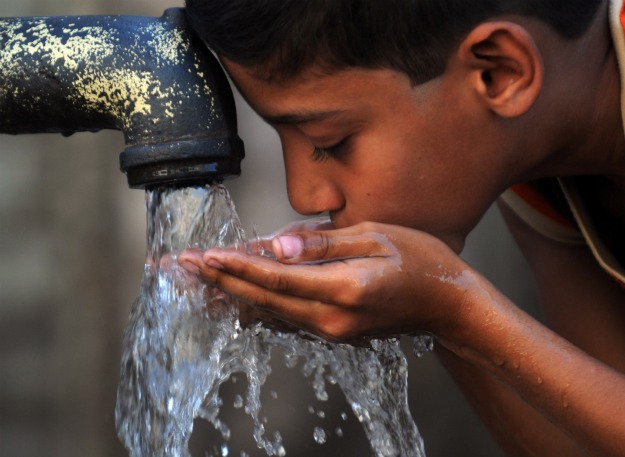
More than 1 billion people in the developing world lack access to clean water, with this number slated to rise to more than 2 billion by 2020. According to UNESCO, 2.3 billion people suffer from water-related diseases, 5 million of whom die each year. However, the burden of water scarcity is not shared equally. According to Rajendra Pachauri, chair of the intergovernmental panel on climate change (IPCC), “At one level the world’s water is like the world’s wealth. Globally, there is more than enough to go round. The problem is that some countries get a lot more than others. With 31 percent of global freshwater resources, Latin America has 12 times more water per person than South Asia.”

Pakistan is on the dry end of the water stress spectrum. About a third of Pakistanis do not have access to safe drinking water, while a further 46% lack access to proper sanitation. However, this deficiency is not uniformly distributed. Pakistan is populated to a large extent around the Indus River that runs the length of the country. The Indus plains cover about a quarter of the country’s landmass and host two thirds of its people, meaning that people living outside this region are particularly water stressed. Furthermore, according to a World Bank report, Pakistan’s per capita water availability has diminished five-fold from 5000 cubic meters in 1951 to 1100 cubic meters in 2006 due to rising consumption by a growing population coupled with rising water waste.

What is even more worrisome is that of the water that is actually available, very little is safe for consumption. A study of 14,000 water sources in 24 major Pakistani districts conducted by the Pakistan Council of Research in Water Resources (PCRWR) over a five-year period found that 82% of sources in Pakistan were unfit for human consumption. The major contaminants noted were bacteria, dissolved solids, nitrates and fluoride.
By Haider Warraich for Foreign Policy

This worsening water crisis is having a drastic impact on public health in Pakistan. According to a UNICEF report, 20-40 percent of hospitalized patients in Pakistan suffer from water-borne infections. Several disease epidemics in Pakistan have been traced back to water contamination, including several outbreaks of the potentially fatal Hepatitis E, rotavirus diarrhea, typhoid fever and dysentery. Polio is also a water-borne infection, and Pakistan is one of the last countries on earth to continue to suffer major problems from the disease.

The sustained high levels of chemical compounds in Pakistan’s drinking water supply have also caused the outbreak of population-wide poisonings. Fluoride toxicity, known to cause bone pain and deformation, has been reported from several areas of Punjab province, with a high occurrence in children. Arsenic poisoning, which causes a wide array of dangerous complications, has been reported to be present in up to 73% of the residents of Sindh province’s Manchar Lake, the largest freshwater lake in Pakistan and one of the largest in Asia. Pesticide poisoning, also linked to infiltration into the water supply, has been reported in Pakistani farmers.

Pesticide poisoning, among other problems, stems from the endemic misuse of water in Pakistan. About 97 percent of Pakistan’s freshwater resources are expended in irrigation and agriculture, yet Pakistan has one of the lowest productivities per unit of water and unit of land in the world. Waste is incurred at several stages: Canal heads, water courses and farms themselves all are the sites of considerable leakage. Furthermore, with Pakistan’s major hydroelectric dams losing storage capacity, there is little reserve during times of famine. Pakistan is in dire need of major hydroelectric projects to increase power generation, protect against seasonal flooding, and to have greater control over the water supply. However, provincial politics has stifled this debate, halting any progress in this direction. Concerns abound about the fate and compensation for displaced people, fears of downstream provinces of a reduction in water supply. Another important issue is that most Pakistani rivers originate from Indian-occupied Jammu and Kashmir. Pakistan and India in 1960 signed the Indus Water Treaty, in which both countries agreed to abstain from any activity that would jeopardize water supply of the other. However, according to a recent U.S. Senate report, India has made several dams in Jammu and Kashmir, which “could give India the ability to store enough water to limit the supply to Pakistan at crucial moments in the growing season.” Pakistani officials have argued that in doing so, India has violated the treaty, worsening the water situation in Pakistan.

The lack of access to water in Pakistan only exacerbates the country’s already dire public health situation. Hand washing, for instance, is the most effective step against infection in both homes and hospitals, but hand washing practices prescribed by public health organizations are impractical in water stressed areas, with one study concluding that an extra 20 liters per person per year would be required in order to follow handwashing recommendations. Another review of medical literature found that access to potable water sources has far more of an impact on reduced infections than water quality. With a deficit in both water quality and quantity, then, public health in Pakistan faces an immense burden frrom water-related illness.

Several measures need to be taken to ward off this crisis. Water policy, currently a minor issue in Pakistan, needs to be brought to the center stage of national debate. It will remain easy for politicians to defer the contentious issue of building dams unless the masses realize the extent to which they are needed. The good work conducted by the PCRWR should be better-funded and -promoted in order to highlight problems as well as evaluate possible solutions. Water waste in agriculture and irrigation also needs to be addressed; the government must make more of an effort to line canals to prevent leakage, and further promote water efficiency on farms. To increase access of rural populations to potable water, India has developed a successful project to provide piped water and hand pumps, with a particular emphasis on improving child health — Pakistan needs to develop a similar program. Pakistan should also make the most of the post-Cricket World Cup diplomatic thaw with India, insofar as it still exists, and ensure equitable implementation of the Indus Water Treaty. Access in arid areas such as desert regions of Sindh and practically all of Baluchistan need to be particularly improved. Promotion of hygienic practices such as boiling water to kill bacteria and appropriate sanitary practices needs to be increased to reduce water-borne infections. This can be conducted on both a national level using television programs, and on a grass root level using community health workers and prominent locals. Finally, the most long-lasting solution to improving water supply will be to slow Pakistan’s population growth, which will only put further strain on reduced water supplies. Unless measures are taken now, this bubbling crisis might reach the point of overflowing.

Haider Warraich, MD, is a research fellow at Harvard Medical School. He is a graduate of the Aga Khan University in Karachi, Pakistan, and the author of the forthcoming novel, Auras of the Jinn.

Pakistan Leaders Must Make Choice After Clinton’s Warning

By The Bloomberg News Editorial Board

When U.S. Secretary of State Hillary Clinton visited Pakistan last week, she noted that U.S.- Pakistani relations were at a turning point after the killing of Osama bin Laden. It was up to the Pakistanis, she said, to decide “what kind of country they wish to live in.”

The brutalized body of investigative journalist Syed Saleem Shahzad, which turned up outside of Islamabad on May 31, may provide a clue to the answer.
Shahzad disappeared after publishing the first of two promised articles linking elements of the Pakistan navy to al- Qaeda following a deadly May 22 attack on a Karachi naval station. Last fall, after being questioned about a different story by Pakistan’s Directorate for Inter-Services Intelligence (ISI), Shahzad wrote that he was threatened by the spy agency.

Alternatively, it could be that foul play like Shahzad’s murder will become a thing of the past in Pakistan. While in Islamabad May 27, Clinton and Chairman of the Joint Chiefs of Staff Admiral Mike Mullen demanded authorities take “decisive steps” to crush the violent extremists the government has long supported, which would end the need to intimidate journalists who expose that support. Whichever way the Pakistan government goes, the May warnings by the U.S. ought to be the last.

The U.S. administration has continued to insist, as President Barack Obama did in a May 22 interview with the BBC, that the Pakistanis have “generally been significant and serious partners against the terrorist threat to the West.” This simply isn’t the case.

Victim, Sponsor

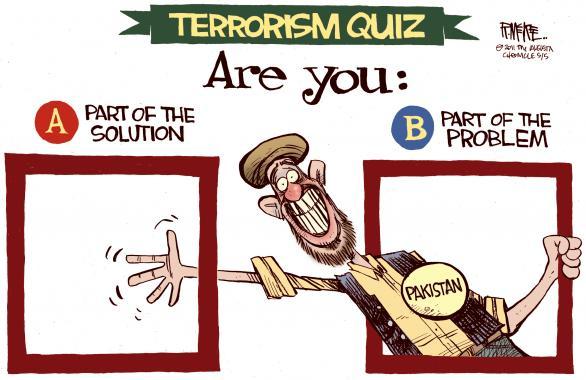
For much of the past decade, Pakistan has been both a victim and a sponsor of Islamic militants. Its soldiers are fighting bravely against homegrown terrorists seeking to install an Islamic government. In 20 attacks in May, these radicals killed some 150 people.

At the same time, the Pakistani army, led by General Ashfaq Parvez Kayani, is a longstanding patron of violent groups targeting Afghanistan and India.
Guided by excessive fear bordering on paranoia about India, Pakistan’s military and intelligence services believe that nurturing those extremists is an effective way to frustrate India’s regional ambitions. The ISI largely created and continues to support the Taliban and the Haqqani Network, the principal groups battling U.S. forces in Afghanistan and the fledgling government in Kabul. It also backs Lashkar-e-Taiba, the group responsible for the 2008 attacks in Mumbai that killed more than 160 people.

Double-Dealing

President George W. Bush’s administration tried to end this double-dealing by giving Pakistan billions in economic and military assistance. Yet Bush didn’t make the aid contingent on a crackdown on extremists. The Pakistanis cooperated somewhat with U.S. efforts to dismantle al-Qaeda but refused to act against other groups, including the Afghan Taliban, which was given refuge inside Pakistan’s borders.

The Obama administration accelerated the failed Bush policy, substantially increasing military and economic assistance, again without imposing rigorous conditions. And Pakistan continued to ignore administration warnings about continued support for extremists.
In one incident reported by the Washington Post, Obama’s first national security adviser, James Jones, warned officials in Islamabad that there would be “consequences” if a terrorist attack directed at the U.S. was traced to Pakistan. Yet when a man who had trained at a terrorist camp in that country attempted to detonate a car bomb in Times Square in May 2010, the U.S. administration did nothing. Shortly thereafter, Obama watered down Jones’s words, telling Kayani that a “successful” attack would have consequences.

Meaning Business

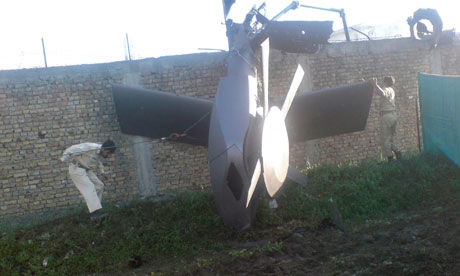
So when U.S. authorities learned that Osama bin Laden might be housed in a villa in a Pakistani garrison town, they dispatched Navy Seals to capture or kill him without so much as notifying the Pakistanis in advance. The raid provoked great outrage from officials in Pakistan. Since then, emotions have cooled. Clinton and Mullen have delivered their warnings, public and private. And this time, the Americans may mean business.

Will the Pakistanis respond?

Shahzad’s murder is a bad sign. On the other hand, reports from Pakistani tribal leaders suggest that the Pakistani army may be preparing a serious campaign in North Waziristan, where the leaders of the Haqqani Network and other extremist groups live.
It will soon be clear whether Clinton’s latest message got through. If not, the administration must consider new ways to persuade Pakistan to change course, recognizing that the country is behaving more like an adversary than a partner.

India and Pakistan Discuss Demilitarisation of Siachen

As Reported by The Economic Times

India and Pakistan today discussed demilitarisation of Siachen, a mountainous region where borderline is not demarcated, in a “constructive framework”, picking up the threads of the issue after a gap of three years.

The issue came up for discussion during the 12th round of two-day Defence Secretary level talks between the two sides.

“The talks were held in a constructive framework. Both sides apprised each other of their perception about the Siachen issue and also discussed the surrounding issues,” Defence Ministry officials said.

Defence Secretary Pradeep Kumar led the Indian delegation at the talks with his Pakistani counterpart Lt General (Retd) Syed Ather Ali.

The decision to resume the talks between the two countries was taken last year during the meeting of Prime Minister Manmohan Singh and his Pakistani counterpart Yousuf Raza Gilani in Thimpu when they decided to take forward the dialogue process.

While the Pakistani delegation has two civilian officials and four military officers, the Indian side includes Special Secretary R K Mathur, Director General of Military Operations (DGMO) Lt General A M Verma and Surveyor General S Subha Rao.

The Pakistani Defence Secretary met Defence Minister A K Antony in the afternoon for over 20 minutes.

The two sides may come up with a joint statement tomorrow after the talks, the officials said.

Pakistan has been asking for demilitarisation of the Siachen glacier and raised the issue of climate change there due to presence of troops from both sides and its effects on the environment.

Siachen, with an area of over 2500 sq km, the world’s highest militarised zone, has been a long pending issue between India and Pakistan over differences on the location of the 110-km long Actual Ground Position Line (AGPL) which passes through the Soltoro Ridge and Siachen Glacier.

Pakistan must stop treating India as ‘biggest enemy’: Nawaz Sharif

As Reported by The Economic Times

As Pakistan’s powerful military held out threats to India, former Prime Minister Nawaz Sharif has called for reappraisal of ties with its neighbour to move forward and progress, saying Islamabad must stop treating New Delhi as its “biggest enemy”.

Sharif, who was earlier involved in talks with India when the Kargil crisis erupted, also sought a probe into the 1999 conflict with India.

The former Prime Minister, who is the chief of main opposition PML-N party, is currently on a three-day visit to southern Sindh province where he made the remarks during an interaction with the media in Karachi yesterday.

He called on the government to also conduct an inquiry into the 2006 killing of Baloch leader Nawab Akbar Bugti in a military operation and the carnage in Karachi on May 12, 2007 that killed over 40 people who tried to rally in support of then-deposed Supreme Court Chief Justice Iftikhar Chaudhry.

Sharif, whose government was deposed in a military coup led by former President Pervez Musharraf in 1999, reiterated his demand for the budgets of the military and the ISI to be placed before Parliament for scrutiny in line with the practice in other democracies.

He said one of his biggest regrets was not taming the powerful military when he was Prime Minister in the 1990s.

The Parliamentary resolution calling for an independent commission to investigate the killing of al-Qaeda leader Osama bin Laden in a US raid on May 2 was the first step towards making Parliament a sovereign body, Sharif said.

“We need structural changes and this inquiry has provided an opportunity to move forward and put the country on the right track, correct its direction by putting our house in order, establish the rule of law and bring all institutions under civilian control,” Sharif said.

If the government fixes responsibility for the Abbottabad incident and punishes those found guilty, a message will go out to the world that the people of Pakistan will not brook another embarrassment like the US raid, he said.

Sharif spoke out against the recent alliance forged by the ruling PPP and the PML-Q, both of which are rivals of his PML-N in Punjab and at the centre.

Pakistan’s Nuclear Surge

By Andrew Bast for Newsweek

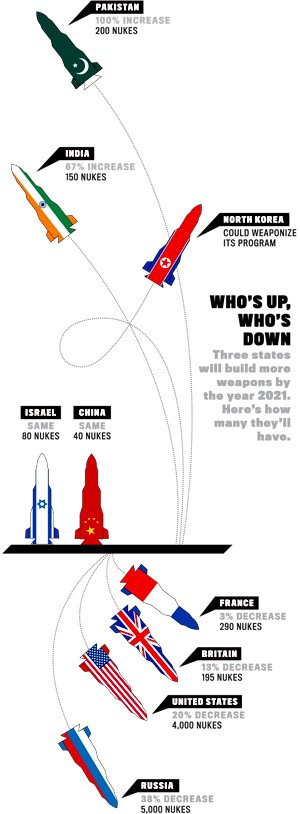
Even in the best of times, Pakistan’s nuclear-weapons program warrants alarm. But these are perilous days. At a moment of unprecedented misgiving between Washington and Islamabad, new evidence suggests that Pakistan’s nuclear program is barreling ahead at a furious clip.

According to new commercial-satellite imagery obtained exclusively by NEWSWEEK, Pakistan is aggressively accelerating construction at the Khushab nuclear site, about 140 miles south of Islamabad. The images, analysts say, prove Pakistan will soon have a fourth operational reactor, greatly expanding plutonium production for its nuclear-weapons program.

“The buildup is remarkable,” says Paul Brannan of the Institute for Science and International Security. “And that nobody in the U.S. or in the Pakistani government says anything about this—especially in this day and age—is perplexing.”

Unlike Iran, which has yet to produce highly enriched uranium, or North Korea, which has produced plutonium but still lacks any real weapons capability, Pakistan is significantly ramping up its nuclear-weapons program. Eric Edelman, undersecretary of defense in the George W. Bush administration, puts it bluntly: “You’re talking about Pakistan even potentially passing France at some point. That’s extraordinary.”

Pakistani officials say the buildup is a response to the threat from India, which is spending $50 billion over the next five years on its military. “But to say it’s just an issue between just India and Pakistan is divorced from reality,” says former senator Sam Nunn, who co-chairs the Nuclear Threat Initiative. “The U.S. and Soviet Union went through 40 years of the Cold War and came out every time from dangerous situations with lessons learned. Pakistan and India have gone through some dangerous times, and they have learned some lessons. But not all of them. Today, deterrence has fundamentally changed. The whole globe has a stake in this. It’s extremely dangerous.”

It’s dangerous because Pakistan is also stockpiling fissile material, or bomb fuel. Since Islamabad can mine uranium on its own territory and has decades of enrichment know-how—beginning with the work of nuclear scientist A. Q. Khan—the potential for production is significant.
Although the White House declined to comment, a senior U.S. congressional official who works on nuclear issues told NEWSWEEK that intelligence estimates suggest Pakistan has already developed enough fissile material to produce more than 100 warheads and manufacture between eight and 20 weapons a year. “There’s no question,” the official says, “it’s the fastest-growing program in the world.”

What has leaders around the world especially worried is what’s popularly known as “loose nukes”—nuclear weapons or fissile material falling into the wrong hands. “There’s no transparency in how the fissile material is handled or transported,” says Mansoor Ijaz, who has played an active role in back-channel diplomacy between Islamabad and New Delhi. “And the amount—they have significant quantities—is what’s so alarming.”

That Osama bin Laden was found in a Pakistani military community, and that the country is home to such jihadi groups as Lashkar-e-Taiba, only heightens concerns. “We’ve looked the other way from Pakistan’s growing program for 30 years,” says Sharon Squassoni, a director at the Center for Strategic and International Studies. What we’re facing, she says, is “a disaster waiting to happen.”

A Defense Department official told NEWSWEEK that the U.S. government is “confident that Pakistan has taken appropriate steps toward securing its nuclear arsenal.” But beyond palliatives, few in Washington want to openly discuss the nightmare scenario of terrorists getting hold of nuclear material or weapons. “The less that is said publicly, the better,” says Stephen Hadley, national-security adviser to President George W. Bush. “But don’t confuse the lack of public discussion for a lack of concern.”

The bomb lends the Pakistanis a certain diplomatic insouciance. Nukes, after all, are a valuable political tool, ensuring continued economic aid from the United States and Europe. “Pakistan knows it can outstare” the West, says Pakistani nuclear physicist Pervez Hoodbhoy. “It’s confident the West knows that Pakistan’s collapse is too big a price to pay, so the bailout is there in perpetuity. It’s the one thing we’ve been successful at.”

Pakistani leaders defend their weapons program as a strategic necessity: since they can’t match India’s military spending, they have to bridge the gap with nukes. “Regretfully, there are several destabilizing developments that have taken place in recent years,” Khalid Banuri of Pakistan’s Strategic Plans Division, the nuclear arsenal’s guardian, wrote in response to NEWSWEEK questions. Among his country’s concerns, Banuri pointed to India’s military buildup and the U.S.’s -civilian nuclear deal with India.

“Most Pakistanis believe the jihadist scenario is something that the West has created as a bogey,” says Hoodbhoy, “an excuse, so they can screw us, defang, and denuclearize us.”

“Our program is an issue of extreme sensitivity for every man, woman, and child in Pakistan,” says former Pakistani president Pervez Musharraf, adding that the nukes are “well dispersed and protected in secure locations.” When asked whether the U.S. has a role to play in securing the arsenal, Musharraf said: “A U.S. role to play? A U.S. role in helping? Zero role. No, sir. It is our own production?.?.?.?We have not and cannot now have any intrusion by any element in the U.S.” To guard its “strategic assets,” Pakistan employs two Army divisions—about 18,000 troops—and, as Musharraf drily puts it, “If you want to get into a firefight with the forces guarding our strategic assets, it will be a very sad day.”

For now, the White House appears to have made a tacit tradeoff with Islamabad: for your cooperation in Afghanistan, we’ll leave you to your own nuclear devices. “People bristle at the suggestion, but it follows, doesn’t it?” says Rolf Mowatt-Larssen, formerly the CIA’s chief officer handling terrorism and weapons of mass destruction. “The irony is that the U.S. presence in Afghanistan and Pakistan, and the money we’re giving them to fight terrorism, could inadvertently aggravate the very problem we’re trying to stop. After all, terrorism and nukes is the worst-case scenario.”

With this fourth nuclear facility at Khushab coming online as early as 2013, and the prospect of an accelerated nuclear-weapons program, the U.S. is facing a diplomatic dilemma. “The Pakistanis have gone through a humiliation with the killing of Osama bin Laden,” says Nunn. “That’s never a time to corner somebody. But with both recent and preexisting problems, we are in a race between cooperation and catastrophe. Both sides need to take a deep breath, count to 10, and find a way to cooperate.”

U.S. Attorney Sends a Message to Wall Street

By Benjamin Weiser and Peter Lattman for The New York Times

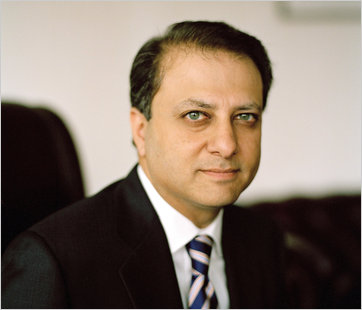
Every few days during the trial of Raj Rajaratnam, the Galleon Group’s co-founder, Preet Bharara, the United States attorney for the Southern District of New York, would quietly enter the courtroom and take a seat in the last row of the gallery.

From that unassuming vantage point, Mr. Bharara watched his colleagues try to persuade a jury to convict the former hedge fund titan of securities fraud and conspiracy.

The consistent presence of Mr. Bharara at the largest insider trading case in a generation — and the office’s resounding victory on Wednesday — signaled that the chief federal prosecutor in Manhattan was back as the sheriff of Wall Street.

Over the last decade, the New York attorney general, federal prosecutors in Brooklyn, the Manhattan district attorney and even the Justice Department in Washington angled for their share of financial fraud cases, an area traditionally dominated by the Southern District. For example, Eliot Spitzer grabbed headlines when he was New York attorney general by focusing on malfeasance at investment banks.

But Mr. Bharara has not-so-quietly reaffirmed his office’s leading role in pursuing corporate crime with this landmark insider trading case, which relied on aggressive prosecutorial methods and unprecedented tactics. For the first time, federal authorities used wiretaps to listen in on stock traders swapping illegal tips.

“What this case has done,” said Neil M. Barofsky, a former Southern District prosecutor who recently served as the special inspector general for the government’s Troubled Asset Relief Program, “goes well beyond simply putting a billionaire hedge fund manager behind bars.”

“The case will impact an entire industry,” Mr. Barofsky said. He said that Mr. Bharara “did more than just oversee and support the prosecution — he made sure that the target audience, traders on Wall Street, fully understood the extraordinary lengths that his office will go to discover these crimes, and that justice will be served.”

It has been 21 months since Mr. Bharara, 42, was appointed United States attorney by President Obama.

In that short tenure, his staff has ventured far beyond Wall Street, prosecuting some of the nation’s — and the world’s — most prominent defendants. Among them: Faisal Shahzad in the Times Square bomb plot; agents in a Russian spy ring; Ahmed Khalfan Ghailani, the first Guantánamo Bay detainee to be tried in the civilian system; Viktor Bout, a Russian accused of being an arms trafficker; a Somali man charged with piracy; and four men charged in a plot to bomb synagogues in the Bronx.

Not every case has gone smoothly. In Mr. Ghailani’s trial, the jury acquitted him of more than 280 counts of murder and conspiracy and convicting him of a single count of conspiracy to destroy government buildings and property. Nonetheless, Mr. Ghailani received a life sentence.

Some academics and newspaper columnists have also criticized Mr. Bharara for not filing criminal charges against senior executives at the center of the financial crisis. Last week, when his office filed a civil mortgage-fraud lawsuit against Deutsche Bank, he said there was not enough evidence to justify a criminal complaint.

Mr. Bharara was an infant in 1970 when he came to the United States from India with his parents. He grew up in Eatontown, N.J., and earned degrees from Harvard and Columbia Law School.

After several years in private practice, including a stint at Gibson Dunn & Crutcher in New York, Mr. Bharara became a federal prosecutor in Manhattan, handling organized crime, narcotics and securities fraud cases. In 2005, he became chief counsel to Senator Charles E. Schumer of New York, leading a Congressional inquiry into the firings of United States attorneys.

Some lawyers have wondered aloud whether Mr. Bharara may have political aspirations like his predecessors, including former New York Mayor Rudolph W. Giuliani, who filled the post in the 1980s. As with Mr. Giuliani, Mr. Bharara is a charismatic figure who is comfortable in front of cameras, can talk tough and has a knack for the witty sound bite. At a news conference announcing Mr. Rajaratnam’s arrest, Mr. Bharara riffed off a famous line from the movie “Wall Street.”

“Greed, sometimes, is not good,” he said.

Unlike Mr. Giuliani, whose political ambitions seemed barely hidden while he led the prosecutor’s office, Mr. Bharara has told friends he has no interest in elected office.

“Everything about Preet’s record suggests that he’s a federal prosecutor for all the right reasons,” said Randy Mastro, a lawyer at Gibson Dunn and a former top deputy under Mayor Giuliani. “The best prosecutors are often those who don’t have political ambitions.”

Mr. Mastro, who overlapped for a time with Mr. Bharara at Gibson Dunn, added, “But that doesn’t mean he shouldn’t be drafted into running.” Ellen Davis, Mr. Bharara’s spokeswoman, said in a statement on Thursday: “Preet loves his job and has no desire to run for public office now or ever.”

Mr. Bharara has not commented publicly on the Rajaratnam verdict, other than a short statement in a news release. But in a series of speeches, he has explained his aggressive approach to corporate crime.

“When sophisticated business people begin to adopt the methods of common criminals, we have no choice but to treat them as such,” Mr. Bharara said weeks after revealing the use of wiretaps in building a case against Mr. Rajaratnam. “To use tough tactics in these circumstances is not being heavy-handed; it is being even-handed.” He has taken that approach in other areas of financial crime.

His office secured convictions in two high-profile criminal cases against bank executives accused of stealing proprietary computer code related to high-frequency trading businesses, including a case against a former programmer at Goldman Sachs. More recently, Mr. Bharara’s prosecutors charged the operators of three popular online poker sites with fraud and money laundering.

And Mr. Bharara continues to pursue insider trading cases. Over the last 18 months, his office has charged 47 individuals with insider trading crimes, 36 of whom have pleaded guilty or been convicted. At a recent news conference, he indicated there was more to come.

“I wish I could say we were just about finished, but sadly we are not.”

The Power of Pakistani Conspiracy Theories

By Ahmed Rashid for The New Republic

Pakistan is not a failed state, or as yet a failing one, even though it may be in a state of chaos or meltdown. Unlike really failed states, it has a powerful army and a corrupt, run-down, but still functioning bureaucracy, judiciary, and police force. Pakistanis perform outstandingly well in the realm of culture: in the arts, television, fashion design, pop music, and of course cricket. What is missing are adequate social services, such as health care, education, population-control programs, and jobs for a population that is nearing 200 million people. Like many Arab countries, Pakistan faces a youth bulge, with an estimated 60 percent of its people under twenty-five years old.

For these young people without adequate education and employment, who have to deal with a corrupt system that offers no panacea to the poor, joining an Islamic extremist group is not at all unusual. It is the norm. For this reason, a replay of an “Arab awakening” in Pakistan would not lead to the dawn of true democracy, but rather to a mass movement whose leadership would swiftly fall into the hands of Islamic extremists, who would then try to overthrow the state.

What Pakistanis desperately need is a new narrative by their leaders—a narrative that does not blame the evergreen troika of India, the United States, and Israel for all of the country’s ills, that breaks the old habit of blaming outsiders and instead looks at itself more honestly and more transparently. Pakistanis as a nation seem incapable of self-analysis, of apportioning blame according to logic and reason rather than emotion.

Along with the causes that I listed above, the wave of intolerance sweeping the country is also due substantially to the conspiracy theories put about by the ruling establishment and their allies in the media. These various hallucinations paint Pakistan as the victim, maligned and wronged at the hands of foreign powers—especially the United States and India. In the imagination of many Pakistanis, the country is regularly used for some geopolitical aim by the Americans and then discarded in favor of India. These sinister outsiders want to subvert, destroy, and undermine Pakistan—but no logical reason is offered as to why. And few will publicly argue that in fact it is the selective state sponsorship of extremism that is destroying the country.

The narrative that has been peddled by the state for much of the past decade is that Pakistan is being undermined by the presence of American forces in Afghanistan, and that if they were to leave the Pakistani Taliban would go home, the suicide bombings would cease, and everything would go back to normal. The ultimate aim of the United States in Afghanistan—so the narrative continues—is to capture Pakistan’s nuclear weapons, even as India is busily dismembering Pakistan by funding Baloch separatists and the Pakistani Taliban. But if that is so, why on earth did the state allow the revival of the Afghan Taliban in 2003, which has only delayed the American withdrawal from Afghanistan? And for those demanding higher military budgets, the most self-serving conspiracy theory is that Pakistan is locked in an interminable conflict with India, which cannot be resolved.

With Friends Like Pakistan…

By Manzer Munir for Pakistanis for Peace
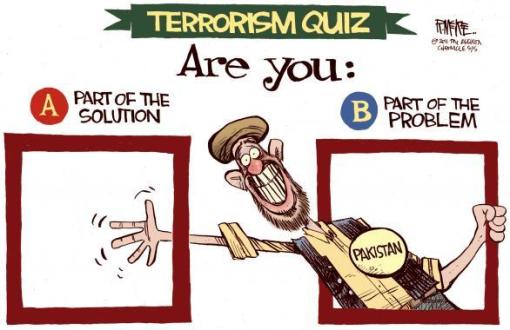
Many people in Pakistan these days are wondering why their nation often finds itself on the wrong side of recent history. First, there is the continued and unjust imprisonment of a Christian Pakistani woman named Asia Bibi who has been languishing in jail for nearly two years. She has been given a death sentence for allegedly making derogatory remarks about the prophet Muhammad.

Then there was the killing of Salman Taseer, who was the then sitting governor of Punjab, Pakistan’s most populous province, by one of his own bodyguards for his outspoken support for Asia’s rights and her freedom. Instead of swift punishment and public outcry at his actions, the killer, Malik Mumtaz Hussain Qadri, was showered with rose petals by some cheering members of the bar association of Lahore when he came to the courthouse for formal charges of murder. Yes, members of the judiciary were cheering his unilateral action of murdering another human being simply for his support towards a condemned non Muslim woman’s rights.

You can only imagine the warped sense of logic and justice in a country where lawyers cheer the cold blooded murder of an innocent man whose only crime was to come at the aid of a condemned Christian mother of two children.

Fast forward to a few months later, the extremists managed to assassinate the only Christian member of President Asif Ali Zardari’s government when the Minister for Minority Affairs, Shahbaz Bhatti, was killed in a hail of bullets by unknown gunmen who then managed to escape on their motorcycle. Bhatti being a Christian as well as a minister in the government, had campaigned for the release of Asia as well as for the repeal of the blasphemy laws in Pakistan that at help promote a culture of state sanctioned hatred against religious minorities in Pakistan.

The culture of fear and hatred as well as violence against the religious minorities has progressively gotten worse along with the security situation inside the country in the last ten years. If there is anything that has been proven by some of these recent events in Pakistan, it is only that the country has become the undisputed global hotbed of extremism, fanaticism, and Islamic militancy in the Muslim world. It has now morphed into a country where the Wahhabi and Salafi fanatics have successfully used fear and hate to silence the majority moderate Barelvi and Sufi Muslims of Pakistan.

When powerful moderate voices like those of Bhatti and Taseer are silenced despite having heavy protection, how safe can the common man feel about his life if he chooses to speak up against the radicals within Islam? To kill someone is against Islamic belief at its core, unless it is done in self defense but you would be hard pressed to hear that view from the religious fanatics in Pakistan. They have justified killing others over many insane reasons such as making derogatory remarks about Islam or the prophet Muhammad. They also rationalize the killing of someone over a family’s honor, thus honor killings where often young women are killed if they are deemed to have brought dishonor to their family. These radical Islamists will even want someone dead for simply uttering disparaging remarks against Islam or its prophet. It is both ironic and hypocritical to see that the same derogatory remarks towards other figures such as Jesus, Moses, Abraham or other prophets of the Quran do not meet the same outcry nor receive the same impassioned response from the masses as when Islam or its prophet Muhammad are criticized.

The seeds of this current fanaticism fanning the flames of hatred were planted during an earlier conflict, this one involving the Soviets against an under matched adversary in Afghanistan. It was during this time in the ‘80’s when the Pakistani dictator, General Zia ul Haq, was in power and he accepted American aid from the Reagan administration in thwarting the threat from the 1979 Soviet invasion of neighboring Afghanistan. At the time, Pakistan’s ISI worked very closely with these “freedom fighters” waging what many thought was a just jihad against a communist foe who disallowed all religious worship. In fact, a good movie to rent right now to put some of these current events in perspective would be Charlie Wilson’s War starring Tom Hanks which details this era of Pakistan-US relations and cooperation against a common enemy in the Soviets.

The trouble now however is that in this current uneasy alliance between Pakistan and the US, there is not a common enemy, at least not as how it is viewed by many in Pakistan, which recently was polled to be the most anti-American nation in the world. Even though radical Islam and fanaticism is as much a threat to Pakistan’s sovereignty and prosperity as it is to the United States, India has always been seen as the big threat by its army and rulers. Pakistan has long seen Afghanistan as a country offering it strategic depth in any future wars with India. Thus, its interests in Afghanistan do not coincide with those of the United States.

The Pakistani media also constantly feeds a steady news diet of bombings by the Taliban/Haqqani network as well as any one of the other fill-in-the-blank militants groups seemingly operating freely from within its borders. There is also the regular news reports of US drone attacks and NATO actions in the AfPak region, as well as the all ubiquitous and constant threat faced from India, who is still seething from the Mumbai bombings in 2008, which were blamed on Pakistani trained terrorists. To further add insult to their injury, not a single leader of the Lashkar E Taiba has been convicted in Pakistan for the attacks in Mumbai that claimed 174 deaths and seriously injured several hundred others.

To the Indians, the perpetrator of their version of 9/11 is not an Arab from Yemen named Osama, but rather a whole nation state with whom it has fought three wars in 60 years and who is a long time sworn enemy with which it shares a long border. Too often it is rightly assumed by many that Pakistan will not act against Lashkar E Taiba and other openly anti-Indian militant groups because these groups are seen as a strategic asset for use against India. Only the fear of an all out nuclear war between the two nations by a trigger happy Pakistan placated India enough so that New Delhi did not immediately take military action against Pakistan after the Mumbai attacks.

So this culture of fear from all enemies both foreign and domestic to Pakistan’s sovereignty is now at an all time high within the nation. With a several decade long war on its western border in Afghanistan as well as the constant threat from its arch enemy to the east in India, Pakistan has never felt more threatened or squeezed. This pressure is now only going to get ratcheted higher since last week’s killing of Osama Bin Laden at a compound in a suburb of Islamabad, Pakistan. Living for five years undetected in the compound, Bin Laden was less than a mile away from the Kakul Military Academy in Abbottabad, Pakistan’s version of the famed American military college of West Point, when he was killed by a US Navy Seal team.

For the world’s most wanted terrorist to hide in plain sight in such a manner and for so many years, rightly points a lot of suspicion on Pakistan. Long suspected by many intelligence analysts, elements within Pakistan’s spy agency, the ISI, naturally now attracts a lot of suspicion in their possible involvement in the whole affair. There are strong voices and calls within the US Congress to halt all aid to Pakistan in light of Bin Laden’s death. We certainly can assume that any other country in the world found to be harboring terrorists would already have been labeled a state sponsor of terrorism and would be facing immediate sanctions from the international community. “You are either with us or against us” were the words so famously uttered by then President Bush to Pakistan specifically after 9/11. But due to Pakistan’s importance for a successful pullout from Afghanistan of US troops, as well as its strategic position within the Islamic world, neither side can afford to cut off relations with each other.

Although the Obama administration stopped short of claiming that the corrupt civilian government of Zardari was directly involved in protecting and sheltering Bin Laden, all signs point to complicity to some extent by some segments within Pakistan’s hierarchy. There is near unanimous agreement among many in Washington, and this is true on both sides of the aisle, that there are many sympathizers of the Taliban and Al Qaeda within the ranks of the army and the intelligence agencies of Pakistan.

Having driven the Soviets out of the region with the help of militant jihadi groups like the Taliban, no doubt a cadre of army and intelligence officers must have come to espouse the belief that it is in Pakistan’s best interests to have a religiously frenzied force available to use as a weapon against India in a future conflict also. In fact, Pakistan has always had this policy of seeking strategic depth in Afghanistan against India.

The death of Osama Bin Laden in Pakistan by Special Forces of the American military illustrates just what a duplicitous game the country has been playing with the United States and more importantly with itself. In the war on terror America lost nearly 3,000 citizens in the attacks on 9/11. In that same period stretching the last ten years, Pakistan has lost nearly 31,000 citizens to terrorist attacks by the Taliban, Al Qaeda and other militant groups. So it has always been in Pakistan’s best interests to fight the militant threat brewing in its borders the last two decades that has claimed so many lives and caused so much instability.

The murders of Salman Taseer and Shahbaz Bhatti illustrates the dire situation within Pakistani society where many young underprivileged men gravitate towards Osama Bin Laden’s ideology of hate against the US, which is seen by many, as the aggressor in an already very anti-American country. Also western ideas, religious and political liberties, and freedoms, such as those for women in western society, are all seen by the Islamic clergy and religious establishment as being against Islamic doctrine and clashing with the Muslim way of life. Therefore, the madrassahs and the masjids continue to espouse rhetoric against the American and European way of life which is seen as contradicting the teachings of the Quran. Even moderate Muslims and their sites of worship have come under heavy attack by the militants as witnessed by a new strategy of attacking Sufi Muslim shrines and mosques. Pakistan may not want to admit it, but there is a raging war going on within itself for the control of Islam and the attack on moderate Islam by the extremists within the religion.

The Bin Laden killing makes Pakistan seem either highly incompetent about knowledge his whereabouts or at the very least appear to be deeply complicit in sheltering and keeping him hidden while the United States launched the biggest manhunt in US history. At this point, the United States justly feels betrayed and distrustful towards anyone in the Pakistani establishment. After all, how are they to know who now to trust in the army or the civilian government?

It is imperative that Pakistan mount an immediate and urgent investigation that has the full cooperation and assistance of the US so that both countries can discover the source of this support system that Bin Laden has had from within Pakistan. Certainly, some heads do need to roll in Islamabad over this. Whether those resignations be of the current ISI chief, Ahmad Shuja Pasha, head of the army, General Ashfaq Parvez Kayani, or Zardari and Gilani themselves, as some accountability needs to occur. This is important not just for the sake of American-Pakistani relations, but just as importantly for the benefit of the Pakistani populace who is both deeply embarrassed by breach of Pakistan’s sovereignty, but also for the intelligence failure by the government of Pakistan at Osama’s whereabouts. Until and unless Pakistan makes this investigation a top priority, USA and Pakistan relations will continue to slide downhill and will mire further in distrust.

Pakistan must realize that in this global war against religious Islamic fanaticism, it cannot continue to speak from both sides of its mouth. Not when everything, including its very existence is at stake. It cannot at once be both a front line ally in the war against terror and receive billions of dollars in US aid, and at the same time, be found to shelter or allow terrorists and militant organizations safe havens and allow them to operate within its territory.

It is up to Pakistan to salvage a quickly deteriorating situation. However at the time of publication of this article, it seems that President Asif Ali Zardari’s government is off to a horrible start in mending fences with the US. First the name and identity of the CIA station chief in Pakistan was leaked by someone in the ISI to members of the local press. This leak compromised his mission and even poses a danger to his life as the anonymity of all operatives is a necessary requirement in intelligence work.

Then later in the day, in remarks given by Pakistan’s Prime Minister Yousuf Raza Gilani to its Parliament, he defiantly stated that neither Pakistan’s army nor its intelligence agency should be suspected by the Obama administration for providing support to Bin Laden. Gilani also went as far as to say that any future unilateral action by the US or any other nation inside Pakistan’s territory will be met with like force. I thought to myself, did he really just that? Did Pakistan just threaten the United States? It is appalling to see the political posturing now being done by the Pakistani government and the long term negative consequences they will have on the nation.

For a country that is receiving nearly $3.5 billion in US aid yearly, these are very tough words that will undoubtedly only make the strained relations between the two countries worse. Pakistan should realize that United States wants to feel that it can trust it to be a full partner in the fight against militancy and extremism. And unless this distrustful and at times, very adversarial relationship changes, the United States cannot help but feel that with friends like Pakistan, it does not need enemies!

-Manzer Munir, a proud Pakistani American and peace activist, is the founder of Pakistanis for Peace and blogs at http://www.PakistanisforPeace.com as well at other websites as a freelance journalist and writer. 

Pakistan Questions Legality of U.S. operation that killed bin Laden

By Karen Bulliard for The Washington Post

Pakistan’s foreign minister on Thursday appeared to question the legality of the U.S. operation that killed Osama bin Laden, and again denied that his country had knowingly sheltered the world’s most-wanted terrorist.

The comments by Foreign Secretary Salman Bashir came as Pakistani officials faced rising domestic backlash about the helicopter-borne assault in a sleepy neighborhood of a military garrison city, which they have acknowledged they did not know about in advance and — once they became aware of it — could not prevent.

The preservation of national sovereignty, particularly against incursions by U.S. troops, is a highly sensitive issue in nuclear-armed Pakistan, and both the presence of bin Laden and the dramatic American raid that killed him have greatly embarrassed the military here.

Bashir, citing United Nations Security Council resolutions on counter-terror operations, told reporters that the “modalities for combating terrorism raises certain legal and moral issues” and said that “everyone concerned ought to be mindful of their international obligations.”

On Tuesday, the foreign ministry in a statement expressed “deep concerns and reservations” that the U.S. carried out the mission in the city of Abbottabad unilaterally, without Pakistan’s knowledge or permission.

Such comments differ considerably from Pakistan’s measured statements in the hours after the killing, when Prime Minister Yousaf Raza Gillani called bin Laden’s death a “great victory.”

But though clearly directed at the United States, the suggestions that the operation might have breached international law also appeared to be a warning to Pakistan’s archenemy, India, which has been targeted in terror bombings and attacks by Pakistani militants.

On Wednesday, India’s army chief said his forces were capable of carrying out a similar raid — a notion Bashir called “bravado.”

“We feel that sort of misadventure or miscalculation could result in a terrible catastrophe,” Bashir told reporters here, while also vowing that Pakistan’s nuclear arsenal is safe. Pakistan and India, which also possesses nuclear weapons, have fought three wars.

Bashir indicated that there would be little introspection inside Pakistan about how and why bin Laden was able to reside here, under the nose of the military. Some Pakistani officials in recent days have said there would be an inquiry into intelligence failures, but Bashir played down that, saying questions about bin Laden were “for historians.”

“I would call it a ‘view,’ ” rather than an inquiry, Bashir said. “I think we are in a constant process of viewing at every level. … This is a routine. So I think we should not try to give it a slant in terms of an inquiry. There’s no such thing as an inquiry.”

Bashir provided additional details about Pakistan’s role in the years-long search for bin Laden, and about its actions the morning of the raid, when he said two Pakistani F-16 fighter jets were deployed in response to the U.S. operation. By the time the jets reached the compound, the raid was over.

He said a cellphone number for bin Laden’s trusted courier was discovered by Pakistan’s top spy agency and provided to the CIA, which used it to locate bin Laden’s compound.

U.S. officials have said they were monitoring the courier’s phone and e-mail communications and found him when he contacted a family member.

Bashir contradicted previous Pakistani statements that Abbottabad was under “sharp focus” since 2003 — a year when, a Pakistani intelligence official said earlier this week, the construction site for what would become the bin Laden compound was first raided.

Satellite images provided by U.S. officials, however, show there was no building happening on the property at that time.

On Thursday, Bashir said Abbottabad first surfaced on Pakistan’s radar as an al-Qaeda hideout in 2004, when the driver of Faraj al-Libbi, an al-Qaeda operative who would be arrested by Pakistan in 2005, was traced to the garrison city.

Fight Against Extremists Stretches Pakistan’s Military

By Jim Garamone for The American Forces Press Service

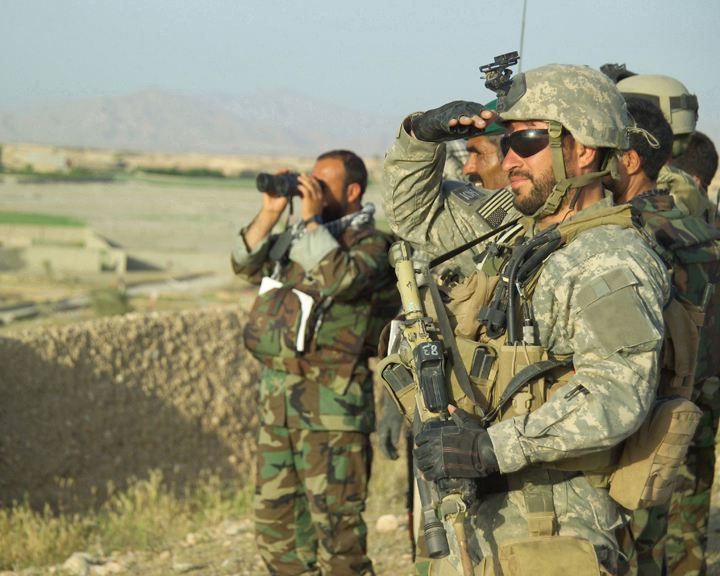
Just as two wars over the last decade have stretch the U.S. Army thin, the Pakistani military is stretched by its fight against extremist groups along the country’s western border, senior defense officials said here today.

At any given time, roughly one-third of the Pakistani army is deployed along the border region. Another third is along Pakistan’s border with India, and the rest is in garrison training and re-equipping.

“There are units along the border that have been in the fight for two years,” said a senior defense official, speaking on background. “That’s a long time. They are stretched.”

While many in the United States want the Pakistani military to do more against terrorist groups in North Waziristan, the truth is it may not be able to do much more, the official said. Pakistani troops – including members of the Frontier Corps – are in Khyber province, South Waziristan and other areas of Pakistan’s federally administered tribal areas. North Waziristan, specifically, is a safe haven for many senior Taliban leaders launching attacks in Afghanistan.

The military has launched a campaign against terrorists in Mohmond province – an area they cleared once, but where extremists have re-emerged. And that’s the problem, the official said: once the army clears an area – “and they do that quite well,” he said – the soldiers don’t have a force to turn it over to, and they’re forced to police the region. “The civil capacity does not exist in the region to hold the area,” the official said.

The civil capacity also does not exist to rebuild areas, and the army is stepping into the breach. “They are building schools and roads and water projects,” the official said. “This should be the job of civilian agencies, but they are not available.”

If Pakistan’s army could turn over the policing and development duties, troops would be available for further operations against the extremists, the official said, but they cannot.

The Pakistani military could deploy troops from the border with India to step up the fight against extremists, but Pakistan sees India – a nation with which it has fought four wars– as the foe. India and Pakistan have troops facing each other in Kashmir province. A solution to the dispute over Kashmir, which goes back to the founding of the two nations in 1947, could “unlock solutions” for Pakistan, Navy Adm. Mike Mullen, chairman of the Joint Chiefs of Staff, said in an interview with Pakistani reporters.

It was a major move to deploy the Pakistani forces from the Indian border in 2008, and U.S. officials do not expect that to happen again.

Meanwhile, Pakistani officials are worried about the spread of radicalism in the nation. While most incidents still are centered on the western border, many incidents have occurred in Balochistan, Sindh and even the Pakistani heartland of Punjab. “They even use the term Punjabi Taliban,” the official said. “And it concerns them.”

The United States is set to provide roughly $3 billion in aid to the Pakistani military in fiscal 2012, the defense official noted.

The “Indo-Pak Express” Overthrows No. 2 Seeds to Reach Semis in Monte Carlo

By Erin Frauenhofer for 10SBalls.com

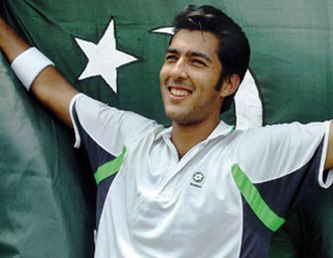
The India/Pakistan pairing of Rohan Bopanna and Aisam-ul-Haq Qureshi made waves at the Monte Carlo Masters with a quarterfinal upset over No. 2 seeds Daniel Nestor of Canada and Max Mirnyi of Belarus. With a 6-1, 7-5 victory on Friday, the sixth-seeded duo advanced to Saturday’s semifinals, where the pair will play Argentina’s Juan Ignacio Chela and Brazil’s Bruno Soares.

Bopanna and Qureshi took command in the first set, breaking Nestor’s serve and holding steady on their own serve to take a 4-1 lead. The “Indo-Pak Express,” as the pair has been dubbed, remained in control for the rest of the set, breaking Mirnyi to give Qureshi the opportunity to serve for the set. Bopanna and Qureshi won the game to wrap up the first set handily, in only 21 minutes.

Nestor and Mirnyi displayed a stronger performance in the second set, after suffering an early break to fall behind 1-2. They rallied back to break Bopanna and Qureshi in the next game, and both pairs held serve for the next four games, until Nestor and Mirnyi were broken once again.

At 5-4, Bopanna and Qureshi had their first chance to serve for the match, but Nestor and Mirnyi battled back to even the score with a break. Bopanna and Qureshi retaliated in the next game with another break to take a 6-5 lead.

Serving for the match for the second time, with victory nearly in sight, Bopanna and Qureshi dropped the first two points of the game but recovered to close out the match. Bopanna and Qureshi broke their opponents a total of five times during the match and lost their serve twice.

Friday’s win was the second victory of the tournament for Bopanna and Qureshi. After receiving a bye in the first round, Bopanna and Qureshi notched a 7-6 (4), 6-3 win over the American/Netherlands Antilles duo of Eric Butorac and Jean-Julien Rojer to reach the quarterfinals.

Chela and Soares have recorded three wins in the tournament thus far. The duo took a straight-set win in the quarterfinals, defeating Ukranian Sergiy Stakhovsky and Russian Mikhail Youzhny, 6-4, 6-3. In the previous round, the pair upset No. 8 seeds Robert Lindstedt of Sweden and Horia Tecau of Russia by a score of 6-2, 6-4. Earlier, Chela and Soares had prevailed in a three-set first-round match, outlasting Michal Mertinak of Slovakia and Dick Norman of Belgium, 6-2, 3-6, 10-7.

Monte Carlo is the first clay-court Masters tournament for the Indo-Pak Express, and the duo has high hopes for the French Open. Bopanna and Qureshi’s strong showings this year and efforts toward peace between their countries have earned them an enthusiastic and steadily growing following.

Bopanna and Qureshi have made recent headlines for their request to play an exhibition match on the India-Pakistan border in an attempt to foster reconciliation efforts between the two nations. As part of a “Stop War, Start Tennis” campaign, the duo plans to string a net across the Wagah border crossing and switch sides during the match.

Religious Harmony: Thousands of Indian Sikhs Arrive for Baisakhi

As Reported By The Express Tribune

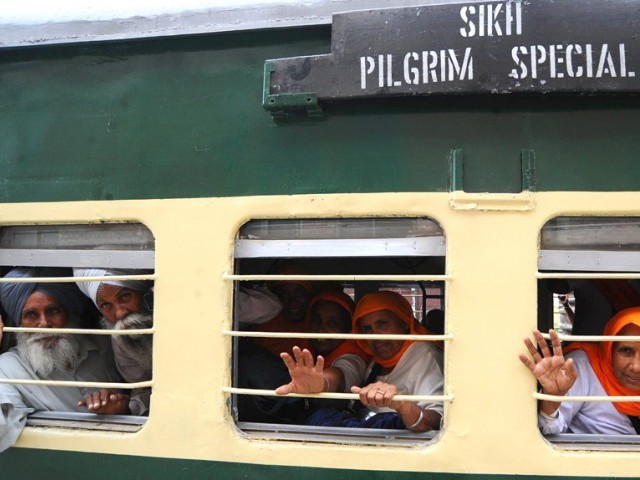
Over 2,000 Sikh yatrees from India arrived at the Wagah railway station on Monday to attend the 312th Baisakhi festival.
The pilgrims, who arrived via special trains, will be taken to the recently-renovated

gurudwara at Punja Sahib in Hassan Abdal where the festival begins today (Tuesday). As many as 13,000 Sikh men and women, from Pakistan and India, are expected to participate in the festival, which marks the commencement of the Sikh new year.

On April 14, the pilgrims will go to Nankana Sahib, the birthplace of Guru Nanak, and return to Dera Sahib, Lahore, on April 17. They will also visit Dera Rohri Sahib, Aimanabad, and Kartarpur in Narowal, before they return to India on April 20.

The Evacuee Trust Property Board (ETPB) has made special arrangements to provide free transport, accommodation and food to the pilgrims during their 10-day stay. Stalls of immigration, customs and a medical camp have been set up at the railway station.

India Continues to Dominate Pakistan’s Strategic Thinking: US

As Reoported By The Times of India

Pakistan’s efforts to launch a comprehensive fight against terrorism are greatly hampered by its perceived threat perception against India, US President Barack Obama has said in a new report to Congress.

“As India continues to dominate their strategic threat perception, large elements of Pakistan’s military remain committed to maintaining a ratio of Pakistani to Indian forces along the eastern border,” Obama said in the third-quarterly report to the Congress on Afghanistan and Pakistan sent yesterday.

“This deprives the Pakistani COIN (counter-insurgency) fight of sufficient forces to achieve its ‘clear’ objectives and support the ‘hold’ efforts and causing available Army forces to be bogged down with ‘hold’ activities because there are insufficient trained civilian law enforcement personnel to assume that responsibility,” Obama said in his 38-page unclassified (rpt) unclassified version of the report.

Due to flood in Pakistan last year the offensive military operations Pakistan had envisioned for KP (Khaibar Pakhtoonwah) and the Federally Administered Tribal Areas (FATA) in the second half of 2010 were overtaken by events, he said.

“Militants were impacted by the floods as well, so we did not observe significant offensive actions on their side, but as Pakistani forces ceased offensive operations, extremists extended their control to areas without sufficient Pakistani central government-provided security and governance,” he wrote.

Between October 1 and December 31, 2010, Obama said Pakistani security forces remained largely static, generally focusing on maintaining the security of previously cleared areas in the FATA and KP and continuing to support flood relief operations.

There were small but notable security operations in November and December in Orakzai Agency and Dir District, but no major operations.

National attention during the reporting period focused on the need for continued flood relief and the start of early recovery efforts, he said.

“The military served as a force of stability during the monsoons, ensuring that Pakistani and international emergency resources were available for rescue and relief operations. The Pakistan Army, Air Force, and Navy committed large numbers of personnel and resources to the flood relief operations throughout October and November,” he said.

The civilian government’s response suffered from a lack of coordination and reflected broader shortcomings in the government’s ability to execute the civilian “hold” and “build” phases of COIN.

The last quarter of 2010 saw no progress on effectively executing the COIN cycle in KP and the FATA.

India’s World Cup Cricket Victory: The Measure of a Nation

By Gethin Chamberlain for The Guardian

It is 3pm in a small British bar in the tourist state of Goa about 550km south of Bombay – where the country’s cricketers are harrying Sri Lanka’s batsmen in the early overs of the World Cup final.

It is 28 years since India last won this most cherished of titles in a nation so crazy about the game. There are fewer than nine hours to go until it does so again. But we don’t know that yet.

Mohinder Amarnath, the man of the match in the 1983 World Cup, is certain, however, that the moment has arrived to repeat his team’s success. Every Indian can realise their dreams through the 11 men on the field today, he says.

He need not have worried. Corrin, the eponymous owner of the Goan bar, is reaching for a brush, and dipping it into the pot of orange acrylic paint on the table in front of her. She holds the arm of the little Indian girl in front of her, draws the first rectangle of the national flag, hands the brush to Sonny, the barman, and watches him draw the white and green stripes. The girl, the daughter of the beautician who runs the shop upstairs, beams, delighted, and skips away to show off her affirmation of support for the home team.

In the street outside, a truck thunders by, horn blaring, Indian flags fluttering in from the cab. The picture is repeated across the country; millions are glued to their televisions or radios, donning their replica shirts, daubing themselves in the national colours. India is partying; each successful delivery from its bowlers greeted by a round of beating drums. The country that has made cricket its national game is certain that this year, finally, it will capture the ultimate prize, the World Cup.

India is certain that this is no more than it is due. It has already celebrated what many in the country regard as the real final, victory over its most reviled opponent, the notoriously unpredictable – unless you happen to be a friendly bookmaker – Pakistan team, which on Wednesday managed to throw away a magnificent bowling performance to lose ignominiously.

And India was desperate for this victory; the humiliation of the Commonwealth Games corruption scandal was still fresh; the country’s recent diplomatic successes – not least towards a permanent seat on the UN Security Council – has been overshadowed by fresh concerns about its aspiration to be regarded as a first world nation.

This is a nation demanding international approval: buoyed by the news that projections now show it will overtake China as the world’s most populous nation by 2030, there is a sense that its time has come.

As Saturday dawned, prayers were said, puja [offerings to the gods] were made, anything to give the Indian team an edge. Across the country, people painted themselves in the blue of the national team strip or in the orange, white and green of the flag, and prepared to party.

Bars and hotels hiked prices and charged admission to the more rarefied environments. In many places, TV screens were set up and even when the big screen was not an option, the nation gathered anywhere that a television was on, peering over each other’s shoulders to catch a glimpse of the match.

In Corrins’, even Sonny was applauding as Sri Lanka upped the ante in their final overs, smashing the ball hither and thither. Then a nation of – according to the new census figures – 1.2 billion fell silent as top batsman Sehwag fell to the second ball of the Indian innings.

Yet important as the game was, some felt that there was a sense of anticlimax after the Pakistan game. “The excitement among people is lacking,” Manoj Kumar, a hotel manager, told the Times of India.

Not so among the Sri Lankans, who had sidled into the final without the fireworks of the Indian progress. Captain Kumar Sangakkara pulled no punches when he explained what it meant to a country even more desperate for international approval after the end of three decades of bloody civil war: “It means everything. We have come through a very tough period. A lot of people have laid down lives for our country. In this new future, hopefully we can take home the World Cup, and that will be even more occasion for celebration.”

Gautam Gambhir, the Indian batsman who stabilised the nation’s innings after the loss of influential opener Sehwag, was no less compelling when he told a news channel that India had to win to honour the dead of the 2008 terrorist attacks in Mumbai: “For me it will be dedicated to the people who lost their lives in the 26/11 massacre.”

For India, the desire to be taken seriously by other nations in sport is perhaps more important than diplomatic point-scoring. Like its neighbour China, it has been unable to translate a mass of bodies into international sporting success. In terms of international trade, it has come on in leaps and bounds, yet still it is unable to project that power into other fields.

Such desperation for success was reflected in the way many in the country fell back on superstition in their desire to ensure success. One fan, Ritangshu Bhattacharya, from Delhi, assured journalists that he would be attempting to tip the odds in India’s favour by defying nature: “I won’t pee in the entire match… I feel whenever I go to the loo, a wicket falls or India drops a catch.”

Even his stoicism was outdone by one politician from the state of Madhya Pradesh, who stood from 10am to 10pm during the India-Pakistan match.

In Corrins’, there is no doubt about who should have won: “You have to support the team, don’t you?,” she said. “We live here, we have to support the local team, however it goes.”

It is 10.45pm, and MS Dhoni, the Indian captain, is hammering the ball to the boundary again. Six to win, two overs. There are fireworks going off everywhere, drowning out the commentary. India knows it has won. It is the Pakistan game all over again: victory from defeat, India defiant.

Six runs, and he smacks it over the boundary. The fireworks explode. In the cities, there is madness; in the villages, too, people are hugging and screaming. The firecrackers are exploding, the night a blur of colour. India wins.