Posts Tagged ‘ Jens Stoltenberg ’

The Norway Tragedy

By Farooq Sulehria for The News International
One does not expect funeral processions in paradise. The horrific events in Norway on July 22 – the bomb blast outside the office of Prime Minister Jens Stoltenberg in Oslo, followed by a shooting spree in the holiday island of Utoya, which together claimed 92 lives – were this kind of tragedy, because they happened in a country which is a haven of peace.

The Oslo massacre has taken away its innocence from Norway. In the same way as the murder of Prime Minister Olof Palme in February 1986 marked the end of the fond myth of an eternally peaceful Sweden. He was shot as he walked home with his wife from a cinema in Stockholm.

As Pakistani-born activist Toni Usman notes in an email to his friends, Norwegian democracy is unique in that the prime minister and other ministers can go about their daily lives without security by their side. King Harald V “can travel by public transport without anyone batting an eyelid, and it is this democracy which is under attack.” A successful TV and stage actor, Usman himself is a shining example of tolerance in Norway, a country where royals, elite politicians and celebrities freely mix with commoners. Ordinary citizens live a life unheard-of in much of Europe, without violence or fear of theft. The Norwegian lifestyle may appear naive even to Europeans.

Secret addresses or telephone numbers are rare. Online, Yellow Pages will offer aerial shots of people’s homes, maps of areas where they live, even their email addresses. The press runs details on celebrities’ incomes and fortunes. “To them, living in an open society has been not just a privilege, but also a statement to the rest of the world; a display of how it is possible to live together in peace,” as a BBC correspondent commented.

After another assassination there in September 2003, when Foreign Minister Anna Lindh was stabbed in Stockholm, Sweden drew a security wedge between top politicians and ordinary Swedes. But Norway still resisted calls for greater home security.

Since July 22, all public places such as clubs and restaurants have been closed as these lines are being written on July 24. Parliament House is surrounded by troops. The Oslo city centre looks like a war zone.

Anders Behring Breivik, apparently the lone director and scriptwriter of the tragedy, has confessed to his crime. Norwegian and Swedish media are rife with reports about his extreme Islamophobic and anti-left views. It is not coincidence that Breivik unleashed his terror on activists of the Labour Youth Club, the youth wing of the Norwegian Labour Party.

Both the Labour Party and the AUF have been campaigning against racism. Ever since the 1950s, a summer camp at the island of Utoya has been a regular feature of AUF activities. (Most Scandinavian left parties, big or small, hold summer schools for the political education of their cadres.)

The Norwegian Labour Party, perhaps the most radical wing of social democracy in Europe, has a unique history. Once a member of Lenin’s Third International, the Norwegian Labour Party is staunchly pro-immigrant, in a country that has seen the phenomenal growth of the anti-Muslim Fremskritts Party (Progress Party). Breivik had been a member of the Fremskritts Party between 1999 and 2006.

In Norway, “Muslim” has become synonymous with the word “Pakistanien.” The carnage is therefore extremely significant for Pakistan because Pakistanis constitute Norway’s biggest immigrant community.

Until Breveik’s identity was revealed, Pakistani Norwegians remained behind closed doors, hoping against hope that no Pakistani link was found to the atrocity.

Ironically, when Breveik’s identity had been established, the Pakistani community began to invoke victimhood. Whitewashing even the crimes for which Al-Qaeda & Co. have claimed responsibility, some community leaders were heard saying, “Look! We are always implicated for nothing.”

In terms of proportion, Norway hosts the largest immigrant population of Pakistani origin in any European country. Yet the Pakistani media downplayed the tragedy, out of ignorance perhaps. An Al-Qaeda signature on the tragedy would have proved fatal not merely for Norwegian Pakistanis but also for the sizable Pakistani-Danish and the small Pakistani-Swedish populations.

The Norwegian leadership, as well as the media especially the daily Dagbladet, played a praiseworthy role in the immediate aftermath of twin tragedy. No knee-jerk response.

However, refusing to learn any lessons from the News of the World scandal, the Murdoch press was quick to discover Al-Qaeda footprints in Utoya. The Sun, the flagship of Rupert Murdoch’s media empire in Britain, described the tragedy as “Norway’s 9/11.” The headline screamed: “AL-QAEDA MASSACRE.” (Yes, in capital letters.)

Qatar’s Al-Jazeera, as if in a bid to outdo even the Murdoch media, attributed the tragedy to Mullah Krekar, a Kurd from northern Iraq living in Norway. Mullah Krekar is a controversial character. When his asylum plea was rejected, he appealed to the courts to reconsider his case. However, he keeps declaring that his mission is to annihilate Western civilisation.

But such lucky escapes do not offer any respite from the growing fascism and religious fanaticism in Europe. Norwegian police seems to have been monitoring extremist Muslim outfits too closely to keep an eye on their Christian counterparts. The tragedy demonstrates yet again the dangers inherent in the “othering” of Muslims on the continent.

One hopes that the Norwegian paradise has been lost only temporarily, not forever. Prime Minister Stoltenberg has advised Norwegians to stay optimistic despite the tragedy. “The answer to violence is even more democracy. Even more humanity,” he says.
Norway Suspect Wanted European Anti-Muslim Crusade

As Reported by The Associated Press

The man blamed for killing at least 93 people during terrorist attacks on Norway’s government headquarters and an island retreat for young people wanted to trigger an anti-Muslim revolution in Norwegian society, his lawyer said Sunday.

A chief surgeon treating the wounded from Friday’s mass shooting, meanwhile, said he believes the attacker used special “dum-dum” bullets that cause massive internal injuries. The doctor told The Associated Press that the killer’s chosen ammo “exploded inside the body.”

The manifesto that 32-year-old suspect Anders Behring Breivik published online ranted against Muslim immigration to Europe and vowed revenge on those “indigenous Europeans” whom he deemed had betrayed their heritage. The document said they would be punished for their “treasonous acts.”

Police said they were analyzing the approximately 1,500-page document. They said it was published Friday shortly before the back-to-back bomb and gun attacks.

Breivik’s lawyer, Geir Lippestad, said his client wrote the document alone. While police said they were investigating reports of a second assailant on the island, the lawyer said Breivik claims no one helped him.

The treatise detailed plans to acquire firearms and explosives, and even appeared to describe a test explosion: “BOOM! The detonation was successful!!!” It ends with a note dated 12:51 p.m. on July 22: “I believe this will be my last entry.”

That day, a bomb killed seven people in downtown Oslo and, about 90 minutes later, a gunman began opening fire on about 600 young people at a retreat on Utoya Island. Police said the death toll in the shooting rose by one Sunday to 86.

That brings total fatalities to 93, with more than 90 wounded. People remain missing at both scenes. Police have not released the names of any victims.

Authorities revealed Sunday that one of the attacker’s first victims on the island was an off-duty police officer who had been hired by the camp directors to provide private security in his spare time. Oslo Police Union Chairman Sigve Bolstad declined to identify the victim.

That detail sheds new light on the confusion many survivors described during the 90-minute massacre. The attacker arrived dressed as a policeman, and some campers were killed when they approached the killer thinking he was there to save them.

Dr. Colin Poole, head of surgery at Ringriket Hospital in Honefoss northwest of Oslo, told The Associated Press the gunman used special bullets designed to disintegrate inside the body and cause maximum internal damage. Poole said surgeons treating 16 gunshot victims have recovered no full bullets.

“These bullets more or less exploded inside the body,” Poole said. “It’s caused us all kinds of extra problems in dealing with the wounds they cause, with very strange trajectories.”

Ballistics experts say the so-called “dum-dum” bullets also are lighter in weight and can be fired with greater accuracy over varying distances. They commonly are used by air marshals and hunters of small animals. Such characteristics potentially would have allowed the gunman to carry more ammunition and fire his weapons at varying targets without adjusting his sights.

Officials at the lakeside scene of the island shooting spent Sunday continuing to account for the dead.

Six hearses pulled up at the shoreline as orange-jacketed Red Cross searchers on small boats slowly explored the extensive shoreline.

Body parts remain inside the Oslo building, which housed the prime minister’s office. In a chilling allusion to the fact that the tragedy could have even been greater, police said Sunday that Breivik still had “a considerable amount” of ammunition for both his guns — a pistol and an automatic rifle — when he surrendered.

Police and his lawyer have said that Breivik confessed to the twin attacks, but denied criminal responsibility for a day that shook peaceful Norway to its core and was the deadliest ever in peacetime. Breivik has been charged with terrorism and will be arraigned Monday.

Lippestad said his client has asked for an open court hearing “because he wants to explain himself.”

Police Chief Sveinung Sponheim said a forensics expert from Interpol was joining the investigation Sunday.

European security officials said they were aware of increased Internet chatter from individuals claiming they belonged to the Knights Templar group that Breivik describes, in fantastical terms, in the manifesto. They said they were still investigating claims that Breivik, and other far-right individuals, attended a London meeting of the group in 2002. The two officials spoke on condition of anonymity because they were not authorized to speak about the investigation.

The officials would not confirm whether they had identified Breivik as a potential threat.

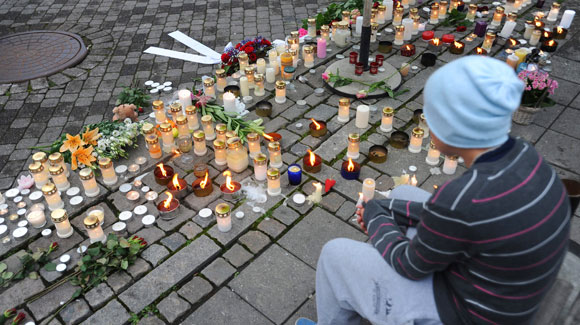
As authorities pursued the suspect’s motives, Oslo mourned the victims. Norway’s King Harald V and his wife Queen Sonja and Prime Minister Jens Stoltenberg crowded into Oslo Cathedral, where the pews were packed, and people spilled into the plaza outside. The area was strewn with flowers and candles, and people who could not fit inside the grand church huddled under umbrellas amid drizzling rain.

The king and queen both wiped tears from their eyes during the service themed on “sorrow and hope.”

Afterward, people sobbed and hugged one another in the streets. Many lingered over the flowers and candles. The royal couple and prime minister later visited the site of the bombing in Oslo. The royals then visited shooting survivors at Ringriket Hospital.

The attacker picked targets linked to Norway’s left-wing Labor Party. Breivik’s manifesto pilloried the political correctness of liberals and warned that their work would end in the colonization of Europe by Muslims.

Such fears may derive, at least in part, from the fact that Norway has grown increasingly multicultural in recent years as the prosperous Nordic nation has opened its arms to thousands of conflict refugees from Pakistan, Iraq and Somalia. The annual Labor Party retreat — which the prime minister, Stoltenberg, fondly remembers attending in his own youth — reflected the country’s changing demographics as the children of immigrants have grown increasingly involved in Labor politics.

The assaults have rattled Norway, home to the Nobel Prize for Peace and where the average policeman patrolling in the streets doesn’t carry a firearm. Norwegians pride themselves on the openness of their society and cherish the idea of free expression.

“He wanted a change in society and, from his perspective, he needed to force through a revolution,” Lippestad, the lawyer, told public broadcaster NRK. “He wished to attack society and the structure of society.”

Lippestad said Breivik spent years writing the manifesto titled “2083 – A European Declaration of Independence.” It was signed “Andrew Berwick.” The document later explained that 2083 was to be the year when European government would be overthrown en masse.

Sponheim, the police chief, said there was no indication whether Breivik had selected his targets or fired randomly on the island. The manifesto vowed revenge on those it accused of betraying Europe.

“We, the free indigenous peoples of Europe, hereby declare a pre-emptive war on all cultural Marxist/multiculturalist elites of Western Europe. … We know who you are, where you live and we are coming for you,” the document said. “We are in the process of flagging every single multculturalist traitor in Western Europe. You will be punished for your treasonous acts against Europe and Europeans.”

The use of an anglicized pseudonym could be explained by a passage in the manifesto describing the founding, in April 2002 in London, of a group he calls a new Knights Templar. The Knights Templar was a medieval order created to protect Christian pilgrims in the Holy Land after the First Crusade in the 11th century.

A 12-minute video clip posted on YouTube with the same title as the manifesto featured symbolic imagery of the Knights Templar and crusader kings as well as slides suggesting Europe is being overrun by Muslims.

Police could not confirm whether Breivik posted the video, which also featured photographs of him dressed in a formal military uniform and in a wet suit pointing an assault rifle.

The video contained a series of slides that accused left-wing politicians in Europe of allowing Muslims to overrun the continent. One image showed the BBC’s logo with the “C” changed into an Islamic crescent. Another referenced the former Soviet Union, declaring that the end result of the left’s actions would be an “EUSSR.”

In London, the leader of Ramadhan Foundation, one of Britain’s largest Muslim groups, said mosques are being extra vigilant in the wake of the attacks. Mohammed Shafiq told The AP he was talking to European Muslim leaders and British police about the need to increase security.

The last 100 pages of the manifesto apparently lay out details of Breivik’s social and personal life, including his steroid use and an intention to solicit prostitutes in the days before the attack.

Also Sunday, police carried out raids in an Oslo neighborhood seeking explosives. Police spokesman Henning Holtaas said no explosives were found and no one was arrested.

Police said the bomb used in the Oslo blast was a mixture of fertilizer and fuel similar to what home-grown U.S. terrorists used to blow up a federal building in Oklahoma City in 1995.

A farm supply store said Saturday they had alerted police that Breivik bought six metric tons of fertilizer, a popular terrorist component for car bombs.

Norway Attacks Shatter a Nation’s Innocence

By Edmund Sanders for The Los Angeles Times

After a bombing and a shooting rampage that left 93 people dead, some believe the open and trusting attitude that’s been a hallmark of the Norwegian psyche is forever lost. The prime minister tells mourners, ‘Our answer is more democracy, more openness, more humanity, but never naivete.’

Norwegians have always taken pride in their open, trusting society.

It’s a country where you might encounter the prime minister at the grocery store and offer a hug. Many police don’t carry guns and most government buildings are unprotected. Homicide is rare, with only a handful of gun-related deaths a year.

But as Otto Lovik stood Sunday on a muddy lakeshore overlooking Utoya Island and recalled how he rescued about 60 people fleeing Friday’s massacre by a gunman, the 56-year-old prison guard, still shaking from the experience, said his country must change.

“We can’t go back to being open and trusting after this,” said Lovik, who loaded his boat with so many terrified, bleeding victims that he feared it would capsize. “This is the price we must pay.”

As Norway recovers from the initial shock of the shooting rampage and earlier Oslo bombing and begins the mourning process for 93 people who were slain, many predict the nation will never be the same.

“It’s going to have a deep, long-lasting impact,” said Atle Dyregrov, director of Norway’s Center for Crisis Psychology, which has helped other countries recover from disasters such as the 2008 China earthquake and this year’s Japanese tsunami.

“Our innocence is lost,” he said. “We used to think that these things only happened in other countries, not here. Now that illusion is shattered forever.”

He predicted that Norway’s relaxed security policies and reluctance to impinge of civil rights will give way to familiar restrictions already in place in other Western nations, including limited access to government facilities and increased surveillance of suspected extremist groups. He likened the changes to Sweden’s security tightening after the 1986 assassination of Prime Minister Olof Palme.

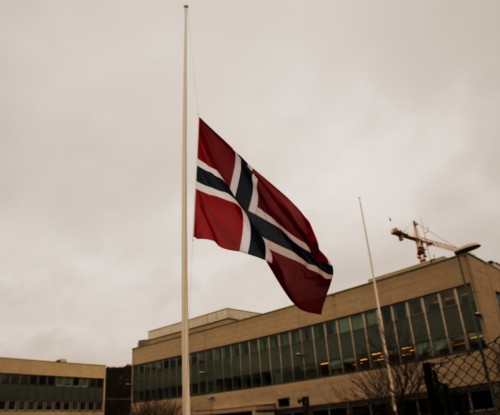
On Sunday, however, the nation’s focus was on grieving and healing. National flags throughout the capital flew at half staff.

At the ornate Oslo Domkirken cathedral in the heart of the capital, hundreds participated in a national mourning ceremony attended by the prime minister, King Harald, Queen Sonja and some of the young people who escaped the island attack. The suspect, Anders Behring Breivik, is expected to be formally charged Monday.

“A heavy darkness is now clouding our lives,” Bishop Helga Haugland Byfuglien told tearful mourners, urging them to maintain their faith in the goodness of Norway’s people and commitment toward an open society.

In an emotional address, Norwegian Prime Minister Jens Stoltenberg said Norway would not be cowed. “Our answer is more democracy, more openness, more humanity, but never naivete,” he said.

Outside the cathedral, just blocks from the site of the Friday bomb blast that killed at least eight people, well-wishers laid flowers and candles in a makeshift memorial that by nightfall was spreading into the streets.

Waiting in line to enter the cathedral to pay her respects, Oslo resident Christine Arnese, a 47-year-old nurse, stood alone with tears streaming down her cheeks.

“I think this might bring us all closer together,” she said. “It’s important that we keep our country free and open.”

But as the scale of the tragedy sunk in, fears about possible future attacks were already leading some Norwegians to call on the government to bolster security. Some said that police guards who were dispatched to government facilities in the hours after the attacks should become permanent fixtures.

Others called for tougher punishments for terrorists, complaining that estimates Breivik that would face only 21 years in prison if convicted underscores the inadequacy of current law.

“We have to do more to protect ourselves,” said Julie Groseth, who works at a small market overlooking Utoya Island in the community of Hole. She said she worried about copy-cat attacks.

“Maybe that means not being as open to other countries,” she said. “This has showed us how weak Norway is in the war against terrorism. We are not prepared.”

At one of Oslo’s main mosques, many Pakistan-born immigrants expressed apprehension about how the attacks may affect Norwegian society and its tolerance of foreigners.

“When we first heard about the attacks, we all gathered together and prayed,” said mosque official Mohamed Sulieman, who moved to Norway 35 years ago. First they prayed for the victims, he said. Then they prayed that the perpetrators would not turn out to be Islamic extremists. The country has reason enough to fear retribution from overseas extremists: Its troops serve in Afghanistan, where 10 Norwegian soldiers have been killed.

Though he said they were relieved to hear authorities describe Breivik as a home-grown terrorist who acted alone, some remain concerned that any tighter security rules or rising public anxieties might nevertheless trigger a backlash against them. At times in the past, the increasing presence of immigrants and foreigners in Norway has come under criticism from conservative parties.

“We’ve never really had a problem before,” Sulieman said. “But still, it’s in the back of our minds.”