Posts Tagged ‘ Lahore ’

Pakistani militant taunts US: ‘I will be in Lahore tomorrow’

By Sebastian Abbot for The Associated Press

One of Pakistan’s most notorious extremists mocked the United States during a defiant media conference close to the country’s military headquarters Wednesday, a day after the US slapped a $10 million bounty on him.

“I am here, I am visible. America should give that reward money to me,” said Hafiz Mohammad Saeed, referring to the fact that the bounty was given to a man whose whereabouts are not a mystery. “I will be in Lahore tomorrow. America can contact me whenever it wants to.”

Analysts have said Pakistan is unlikely to arrest Saeed, founder of the militant group Lashkar-e-Taiba, because of his alleged links with the country’s intelligence agency and the political danger of doing Washington’s bidding in a country where anti-American sentiment is rampant.

Saeed, 61, has been accused of orchestrating the 2008 attacks in the Indian city of Mumbai that killed 166 people, including six American citizens. But he operates openly in Pakistan, giving public speeches and appearing on TV talk shows.

He has used his high-profile status in recent months to lead a protest movement against US drone strikes and the resumption of NATO supplies for troops in Afghanistan sent through Pakistan. The supplies were suspended in November in retaliation for American airstrikes that accidentally killed 24 Pakistani soldiers.

Hours before Saeed spoke, US Deputy Secretary of State Thomas Nides met Pakistani Foreign Minister Hina Rabbani Khar in the nearby capital, Islamabad, for talks about rebuilding the two nation’s relationship. In a brief statement, Nides did not mention the bounty offer but reaffirmed America’s commitment to “work through” the challenges bedeviling ties.

Increasingly ‘brazen’ appearances
The US said Tuesday it issued the bounty for information leading to Saeed’s arrest and conviction in response to his increasingly “brazen” appearances. It also offered up to $2 million for Lashkar-e-Taiba’s deputy leader, Hafiz Abdul Rahman Makki, who is Saeed’s brother-in-law.

The rewards marked a shift in the long-standing US calculation that going after the leadership of an organization used as a proxy by the Pakistani military against archenemy India would cause too much friction with the Pakistani government.

This shift has occurred as the US-Pakistani relationship steadily deteriorated over the last year, and as the perception of Lashkar-e-Taiba’s potential threat to the West increased.

Bounty backfire?
The US may be hoping the bounty will force Pakistan to curb Saeed’s activities, even if it isn’t willing to arrest him. But the press conference he called at a hotel in the garrison city of Rawalpindi on Wednesday was an indication that is unlikely, and the bounty may even help him by boosting his visibility.

At the hotel, located near the Pakistani army’s main base and only a half hour drive from the US Embassy in Islamabad, Saeed was flanked by more than a dozen right-wing politicians and hardline Islamists who make up the leadership of the Difa-e-Pakistan, or Defense of Pakistan, Council. The group has held a series of large demonstrations against the US and India in recent months.

Some in the media have speculated the movement has the tacit support of the Pakistani military, possibly to put pressure on Washington.

“I want to tell America we will continue our peaceful struggle,” said Saeed. “Life and death is in the hands of God, not in the hands of America.”

Denies involvement in Mumbai massacre
He denied involvement in the Mumbai attacks and said he had been exonerated by Pakistani courts.

Pakistan kept Saeed under house arrest for several months after the attacks but released him after he challenged his detention in court. It has also resisted Indian demands to do more, saying there isn’t sufficient evidence.

The bounty offers could complicate US efforts to get the NATO supply line reopened. Pakistan’s parliament is currently debating a revised framework for ties with the US that Washington hopes will get supplies moving again. But the bounties could be seen by lawmakers and the country’s powerful army as a provocation and an attempt to gain favor with India.

Origins in the Kashmir dispute
Saeed founded Lashkar-e-Taiba in the 1980s allegedly with ISI support to pressure India over the disputed territory of Kashmir. The two countries have fought three major wars since they were carved out of the British empire in 1947, two of them over Kashmir.

Pakistan banned the group in 2002 under US pressure, but it operates with relative freedom under the name of its social welfare wing Jamaat-ud-Dawwa — even doing charity work using government money.

The US has designated both groups foreign terrorist organizations. Intelligence officials and terrorism experts say Lashkar-e-Taiba has expanded its focus beyond India in recent years and has plotted attacks in Europe and Australia. Some have called it “the next Al Qaeda” and fear it could set its sights on the US

* Associated Press writer Asif Shahzad contributed to this report from Islamabad.

Pakistan’s Sesame Street: Can an Urdu Elmo Aid a Blighted Nation?

By Aryn Baker for Time

For a 3-year-old who has yet to master the use of the personal pronoun, Elmo is a whiz at foreign languages. Already fluent in Chinese, German, Hindi, Spanish and Arabic, among others, the fluffy red icon has just picked up Urdu, the most common language in Pakistan. At a time when the U.S.-Pakistani relationship is at its worst in more than a decade, Sesame Street — the quintessential American children’s television program — has burst onto the Pakistani scene in a flurry of fake fur, feathers and infectious ditties about the letter alef, or A.

With its background of ripening wheat, banyan trees and a center stage that features a village snack shop overflowing with exotic fruits and vegetables, the set of Sim Sim Hamara, as it is called in Pakistan, may seem far removed from the urban street scene familiar to most Americans. But the lovable Muppets, child actors and messages of tolerance are pure Sesame. And they have all been brought to life in Pakistan with the help of a $20 million, five-year grant from USAID.

Developed in 1969 by TV producer and early-childhood-education advocate Joan Cooney, Sesame Street was designed to tap the addictive qualities of television to bring early literacy education to American preschoolers. The “quaint” American streetscape, as Cooney then called it, has since grown into the “longest street in the world,” with more than 20 unique programs worldwide, according to Sesame Workshop’s senior vice president of global education Charlotte Frances Cole. Some features dubbed segments lifted from the American version; others, like Sim Sim Hamara, which means Our Sesame, are created in partnership with local production teams to reflect native culture. In Pakistan, Big Bird and Oscar have been replaced by a self-involved crocodile and a donkey with rock-star ambitions. “Children have to be able to recognize their environment and their friends if they are going to learn,” says Faizaan Peerzada, who directs Sim Sim Hamara from a studio just outside the city of Lahore. “So we had to give Elmo Pakistani citizenship.”

On a tour of the workshop where the show’s Muppets are made, Peerzada, a master puppeteer with more than 40 years of experience directing educational puppet shows for Pakistani children for the Rafi Peer Theatre Workshop, slips his hand into a limp, feathered pocket of gray felt. Even without eyes, the unfinished puppet springs to life with the mannerisms of an owl, swiveling its head to listen as Peerzada expounds on Sim Sim’s potential with evangelical zeal. Underfunded and neglected for more than 30 years, Pakistan’s education system is in a parlous state. The recently released Annual Status of Education report in Pakistan reveals that nearly 60% of school-age children can’t read, or even do basic, two-digit subtraction problems. For a country where 35% of the population is under the age of 14, the consequences are enormous.

“As a nation, Pakistan has failed its children,” says Peerzada. If Sesame Street brought the joy of learning to generations of American preschoolers, why can’t it help teach Pakistan’s 66 million children under the age of 14 how to read? he asks. “Our children deserve this. All children deserve this,” he says. Obviously a television program that airs twice a week can’t compensate for missing teachers and limited school access, but it’s a start. “To me, Sim Sim Hamara is a gift to Pakistani children, and a window into homes that might think their children are better employed in the fields than at school,” says Peerzada.

Like the original, Sim Sim Hamara is a half-hour-long program divided into skits, song segments and celebrity appearances designed to appeal to a wide spectrum of Pakistani society. The Muppets caper with live actors on a set that combines features recognizable across the country, a kind of Pakistani Main Street that doesn’t stand out as belonging to any particular region. A dhaba, the ubiquitous snack-and-grocery shop that is the center of any Pakistani community, stands in for Mr. Hooper’s store, and is manned (or womanned) by a heavily made up Muppet auntie who anchors the show with amusing lessons about manners, safety and healthy eating. In an effort to promote tolerance in a country marked by ethnic divisions, the Muppets’ skin colors range from brown to pale orange.

Most striking, however, considering Pakistan’s male-dominated society, is the lead character, Rani, a 6-year-old female Muppet who captains the cricket team and who is passionate about science and reading. In a country where only 22% of Pakistani girls complete primary school, Rani is a model of female empowerment. But it doesn’t stop there. The rest of the show’s characters encourage Rani’s quest for knowledge — “Where does the sun go every evening?” was a recent one — modeling acceptance of women’s progress for a wider society. “You are not just teaching little girls that they can have dreams,” says Sesame Workshop executive vice president Sherrie Westin. “You are also teaching boys that it’s O.K. for girls to have those dreams.”

Of course progressive values in one culture can be interpreted as transgressive in another. Sim Sim Hamara has the added burden of being sponsored by the U.S. in a country where American meddling is viewed with increasing hostility. For that reason, the program’s authors have had to broach sensitive issues with subtle creativity. One recent segment opened with a despondent Baily, the would-be rock-star donkey, who decided he would never sing again because someone told him it would make him grow horns. “This is how we get at the idea of mullahs who are against singing,” explained one of the producers. The skit ended with the appearance of one of Pakistan’s most famous rock stars leading the whole cast in an uplifting song about believing in your self, entitled, fittingly, “Faith.”

Teachers who see it as a way to promote literacy at home have praised Sim Sim Hamara, as do children who have never really had a program to call their own. “I find that those who regularly watch Sim Sim Hamara know more about health and body parts and their functions,” says Islamabad school principal Masart Sadiq. “They get lots of ideas about careers, which they discuss with their teachers too.” Aniqa Khan, a 12-year-old from Rawalpindi, says she now wants to be a pilot, like Munna, Rani’s 5-year-old Muppet co-star. “He is excellent at math, which inspires me to spend more time on math.”

So far, and against fears in a country where the assassination of a governor accused of blasphemy was celebrated in the streets, there has been no negative response to Sim Sim Hamara. “I think my biggest fear was that the program would be misunderstood before it even aired,” says Peerzada. “People might have thought it was some kind of brain-washing project. But at the end of the day, all we are doing is teaching a child to count.”

The same could not be said of reactions to the program in the U.S., where Fox News in October dubbed Sim Sim Hamara a boondoggle for Elmo and conservative commentators quickly took up the cause. But as Sesame Workshop’s Westin points out, $20 million pays for a lot more than Elmo’s Urdu lessons and a plane ticket to Pakistan. It covers a state-of-the-art studio, high-definition digital-video equipment that won’t be obsolete in a few years, and the foundations of an educational institution that, if all goes to plan, will provide Pakistani children with the basic-literacy building blocks that have been the mainstay of early-childhood education in America for more than four decades. Current estimates say that Sim Sim Hamara is reaching more than 3.5 million Pakistani children who have no other access to preschool education. “This is a smart investment,” says Westin. “Early-childhood education is one of the most effective ways to build stability in any country. An investment like this is not only going to benefit Pakistan, but our children as well. If we can help to create a more peaceful world, that is a benefit to all of our children.” And that sounds like something Elmo would love, in any language.

Pakistanis for Peace Editor’s Note– We commend this great project by the United States government and the USAID program. The $20 million grant and this educational program will not only help the children of Pakistan who are not provided an adequate educational system by their own government but a program like this goes a long ways in the betterment of ties between the United States and Pakistan and leaves a lasting legacy for the area’s children for years to come.

Made in India’ Show in Pakistan as Both Talk to Boost Trade

By Surojit Gupta for The Times of India

Trade ties between India and Pakistan are expected to get a boost as New Delhi reaches out to the business community across the border, starting Monday to assure them about the positive impact of normal trade ties. Commerce minister Anand Sharma will undertake a rare journey to Pakistan, leading a large delegation of senior officials and top businessmen as the two hostile neighbours take baby steps to normalise trade and economic relations.

The private sector led by industry chambers has put up an “India show”, in Lahore and Karachi – the first ever trade exhibitions from India where over 100 exhibitors are participating. Firms representing pharmaceuticals, textile, gems and jewellery, chemicals and petro-chemicals are showcasing products.

The move is a follow up to the efforts to normalise trade ties. The Pakistan government announced granting of Most Favoured Nation (MFN) status to India in November last year. But, criticism from a section of industry in Pakistan has forced Islamabad to take measured steps on the issue. But, officials said they were optimistic that by the end of 2012, the transition to full MFN status would be complete.

Officials said they will launch outreach programme to assure businessmen in Pakistan that Indian goods will not swamp the Pakistan market if trade is normalised. “We will tell them that there are enough trade safeguards measures to ensure that Indian goods do not flood the Pakistani market. Let us first liberalise trade and see the impact,” said a senior government official.

Pakistan allows exports to India but has a positive list of 1,938 items which are officially allowed to be imported from India. Latest data shows that formal trade between India and Pakistan rose to $2.7 billion in 2010-11 from $144 million in 2001, while informal trade including third country trade is estimated at $10 billion, according to a Ficci status paper. “I have no doubt in my mind that bilateral trade, which currently stands at $3 billion, can be raised to $10 billion if trade through third countries (Dubai, Singapore and Central Asian countries) is channelised into direct exchange between the two countries,” said R V Kanoria, president, Ficci.

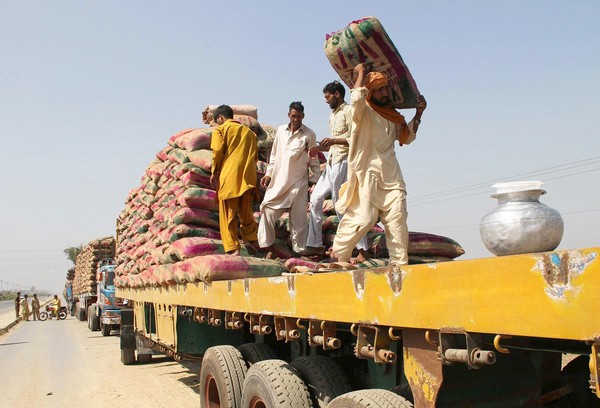
The government has undertaken a series of measures to increase bilateral trade. There is a move to open a second gate at the Attari-Wagah border, which is expected to increase the number of trucks crossing the border to 500-600 daily from 150-200 at present. Pakistan has agreed to remove restrictions on the number of commodities traded by the land route once the infrastructure in Wagah is ready, while both countries have agreed to avoid arbitrary stoppage of goods at ports. Suggestions have been made for opening up of an additional land route at Monabao-Khokhara Par on the Sindh border for faster movement of goods.

“We are taking significant steps to improve the border infrastructure. India has invested nearly Rs 150 crore to develop infrastructure at the Integrated Check post near Attari,” said a senior government official. He said the visa regime for business travel is also expected to be liberalised soon with multiple entry visas for 10 Indian cities, along with exemptions for police reporting. The formal announcement is expected to be made soon. Talks to expand trade in petroleum products are progressing, while efforts are also on to start negotiations for trade in electricity between the two nuclear-armed neighbours. Both sides have agreed on grid-connectivity between Amritsar and Lahore, which would pave the way for trade of up to 500 MW of power.

Trade experts said they were optimistic about the latest moves and said the effort will go a long way in helping faster regional integration. “The positive spin off for normalisation of trade is enormous. Pakistan has given signals and India now needs to take the initiative. Normalisation of bilateral trade relations will help in putting much of the political bickering on the backburner,” said Biswajit Dhar, director-general at Research and Information System for Developing Countries, an economic and trade thinktank. Experts said there was huge potential for forging joint ventures between Indian and Pakistani companies in sectors such as information technology, fish-processing, drugs and pharmaceuticals, agro chemicals, chemicals, automobile ancillary and light engineering.

Pakistanis for Peace Editor’s Note– The best chance of peace between India and Pakistan can only be achieved through trade and normalization of ties. The India Show at the Lahore International Expo Centre Feb 11-13 will go a long ways to bridging the gap and move us closer to achieving peace one day, which is the best scenario for both nations long term.

Pakistani and Indian Chefs Compete on Reality TV

By Sebastian Abbot for The Associated Press

For decades, archenemies Pakistan and India have engaged in a dangerous nuclear arms race. Now they’re also competing in a more cheerful forum. The outcome will be mouthwatering curries and soothing Sufi ballads, not violent conflict.

The fractious neighbors are going head-to-head in a pair of reality TV shows that pit chefs and musicians against each other. Producers hope the contests will help bridge the gulf between two nations that were born from the same womb and have been at each other’s throats ever since.

But so far it hasn’t completely worked out that way. The top Pakistani chef on the cooking show, which is called Foodistan, quit the contest early. He accused the judges of bias toward India and is threatening to sue. The producers denied the allegations.

Pakistan and India were founded in 1947 following the breakup of the British empire. They have fought three major wars, two of them over the disputed territory of Kashmir.

The TV shows do not try to hide or brush over this painful history. They make light of it.

“Now the world’s greatest rivalry is going to get spicier,” said co-host Ira Dubey during one of the early episodes of Foodistan, which first aired in India on Jan. 23 and will be shown in Pakistan starting in mid-February.

Her counterpart, Aly Khan, said the aim of the two teams “would be to grind the opposition into chutney, to make them eat humble pie, to dice them, slice them and fry them on their way to culinary glory.”

Eight chefs from each country were scheduled for individual and team competitions over 26 one-hour episodes, with the winner authoring the first Foodistan cookbook and receiving a trip to three cities of his or her choice anywhere in the world.

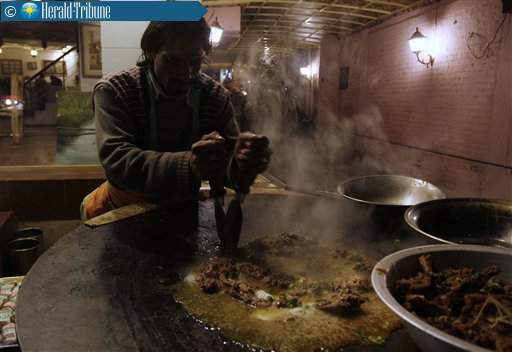
There is significant overlap in the cuisines of both countries, as there is in language, music and culture. Pakistanis and Indians both love curry, kebab and biryani – a spiced rice dish. But they often use different ingredients, and dishes can also vary from one region to another within the same country.

Pakistani dishes often include beef, which is not eaten by many people in majority Hindu India for religious reasons. India has more vegetarian dishes, and the food is often cooked with ingredients like coconut milk that are rarely found in Pakistan.

Many Pakistanis and Indians have missed out on enjoying the varied tastes of the other country because mutual enmity has made cross-border travel difficult.

“Even though they are neighbors, Indians don’t know what Pakistani food is like and vice versa,” said Mirza Fahad, a production assistant at India’s NDTV, which developed Foodistan. “It was long overdue to get to know each other’s foods.”

During the first cook-off on the show, filmed in New Delhi, the judges gave four chefs from each side two hours to prepare a biryani, curry, kebab and dessert. Each of the three judges gave the team’s meal a score out of 10.

The judges loved the Iranian-inspired fish biryani cooked by the Pakistanis, their chicken kebab stuffed with figs, olives, bread and mango chutney, and their shahi tukda – a dessert of fried bread soaked in hot milk with spices. They scored 21 out of a possible 30, losing points because a dish of chicken in shalimar curry was a tad chewy.

The Indians ended up winning the first contest by one point with a menu that included chicken tikka with truffle cream, cheese kofta in a tomato and water chestnut curry, lamb biryani and phirni – a sweet rice pudding that they topped with strawberry granita.

The captain of the Pakistani team, Mohammed Naeem, executive chef at the Park Plaza Hotel in Lahore, alleged the judges didn’t have enough knowledge of Pakistani food and were destined from the beginning to pick an Indian to win.

The judges included a British chef, an Indian food critic and a Bollywood actress of Pakistani and French descent.

Another member of the team, Akhtar Rehman, a chef at the Marriott Hotel in Islamabad, said concerns about the judges were fairly widespread on the Pakistani side, but Naeem was the only one to quit.

It remains to be seen whether the music competition – Sur Kshetra, or Musical Battlefield – also will spark ill will.

The contest, which is being filmed in Dubai, is scheduled to air in Pakistan and India starting in mid-February, said Mohammed Zeeshan Khan, a general manager at Pakistan’s Geo TV, which is developing the show.

“Music can unite people across borders and bring them closer together,” said Khan.

The competition will include teams of six musicians from each country between the ages of 18 and 27. The teams will be mentored by two well-known pop singers and actors, Pakistani Atif Aslam and Indian Himesh Reshammiya. They will compete across a range of genres, including jazz, pop, rock and qawwali – traditional Sufi Muslim ballads that are popular in both countries, said Khan.

The grand prize is still being worked out, but Khan said the winner can claim to be “the new musical icon for the subcontinent.”

World’s Youngest Microsoft Prodigy Arfa Laid to Rest

By Tariq Butt for The Gulf Today

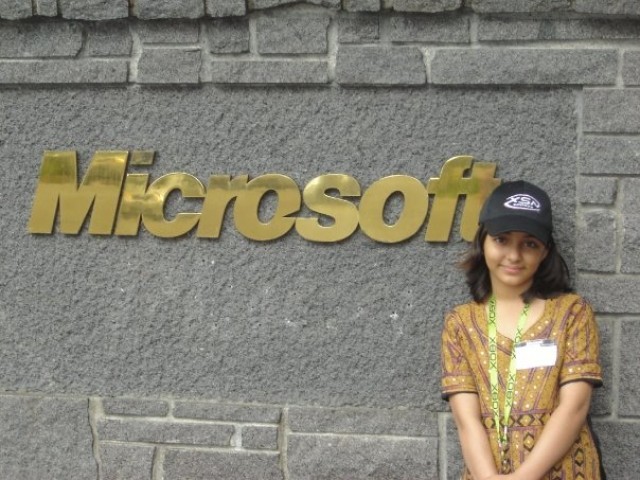
Funeral prayers of the world’s youngest Microsoft Certified Professional (MCP) Arfa Karim Randhawa, who passed away on Saturday night after protracted illness, were held in Lahore on Sunday.

The prayers, held in Cavalry Ground, were attended by Punjab Chief Minister Shahbaz Sharif and her close family members. Her coffin was draped in the national flag. She was 16. The teenage genius suffered an attack.

She got recognition and became her a source of inspiration for young and old across Pakistan. Arfa had an epileptic attack on Dec.22 and had been in a coma since.

Well-wishers prayed and watched her progress closely.

On Dec.29, doctors said there was no hope for her survival, and that her life support could be switched off any time. However, she had then miraculously responded to certain stimuli, as recently as Jan.13.

Two more funeral prayers will be held for Arfa, one in Faislabad and another in her ancestral village where she is to be buried.

As Pakistanis mourned the loss of the child prodigy, President Asif Ali Zardari and Prime Minister Yousuf Raza Gilani also expressed their grief and sorrow over the sad demise of Arfa. They prayed to Allah Almighty to rest the departed soul in eternal peace and grant courage to the bereaved family to bear the loss with fortitude.

Jamaat-e-Islami head Syed Munawar Hasan expressed grief at the death.

Muttahida Qaumi Movement chief Altaf Hussain said that Pakistan has lost “precious talent” in Arfa. He expressed grief at Arfa’s demise and has sympathised with the bereaved family members and prayed for Arfa’s soul.

Arfa became the world’s youngest Microsoft certified professional in 2004 at the age of nine. She was also invited to the Microsoft headquarters in the US by Bill Gates for being the world’s youngest MCP.

Gates had also offered to conduct the child legend’s treatment in the US, but the doctors advised against transporting her to the US due to the risk involved. However, the doctors continued her treatment in consultation with specialists in the United States.

Arfa had earned the Fatima Jinnah Gold Medal in the field of science and technology and the Salam Pakistan Youth Award in 2005 for her achievements. She is also the youngest recipient of the President’s Award for Pride of Performance.

She earned her first flight certificate by flying a plane at a flying club in Dubai at the age of 10, and was invited by Microsoft in 2006 to be a keynote speaker at the Tech-Ed Developers Conference, where she was the only Pakistani among over 5,000 developers.

Arfa represented her country Pakistan on a variety of international forum. She was also included as the honourable guest by IT Professionals of Dubai for two weeks stay in Dubai. During that trip, Arfa was awarded by a number of medals and awards from various tech societies and computer companies working in Dubai.

Arfa was a genius who had left an indelible mark on the international IT scene, winning millions of hearts in Pakistan and abroad for her excellence. The death of the child sensation had left millions of people, along with her family, relatives and friends, grieved over this national tragedy.

Why They Get Pakistan Wrong

By Mohsin Hamid for The New York Review of Books
Nearly ten years after the terrorist attacks of September 11, 2001, and the commencement of the US-led war in Afghanistan, the alliance between the US and Pakistan is on shaky ground. The killing of Osama bin Laden by US special forces this May in Abbottabad, Pakistan, has incensed officials on both sides: on the American side because bin Laden’s hiding place appears to suggest Pakistani perfidy; and on the Pakistani side because the US raid humiliatingly violated Pakistan’s sovereignty.

As Ted Poe, a Republican congressman on the House Foreign Affairs Committee, puts it: “Unless the State Department can certify to Congress that Pakistan was not harboring America’s number one enemy, Pakistan should not receive one more cent of American funding.” Dramatic words,1 for Pakistan has been allocated quite a few cents of American funding. Yet this money has bought little love. According to the Pew Global Attitudes Project, only 12 percent of Pakistanis have a favorable opinion of the United States, and only 8 percent would like to see US troops “stay in Afghanistan until the situation has stabilized.” Why might this be the case?

The past decade has been devastating for Pakistan. The country’s annual death toll from terrorist attacks rose from 164 in 2003 to 3,318 in 2009, a level exceeding the number of Americans killed on September 11. Some 35,000 Pakistanis, including 3,500 members of security forces, have died in terror and counterterror violence. Millions more have been displaced by fighting. It is difficult to convey how profoundly the country has been wounded. In 1989, my Lahore American School classmates and I (including children from Pakistan, America, Canada, Sweden, Germany, and Korea) were able to go to the beautiful valley of Swat by bus for a weeklong field trip with no security arrangements whatsoever. In 2009, the battle to retake Swat from Taliban militants involved two full divisions of the Pakistani army and hundreds of casualties among Pakistani soldiers. (Similarly, until a few years ago, there had never been a suicide bombing in Lahore. Now one occurs every three or four months.) The Pakistani government puts direct and indirect economic losses from terrorism over the last ten years at $68 billion.

Of the $20.7 billion in US funding allocated to Pakistan from 2002 to 2010, $14.2 billion was for the Pakistani military. On paper, economic assistance came to $6.5 billion, less than a third of the total. In reality the civilian share was even smaller, probably less than a quarter, for the $6.5 billion figure reflects “commitments” (amounts budgeted by the US), not “disbursements” (amounts actually given to Pakistan). The United States Government Accountability Office reports that only 12 percent of the $1.5 billion in economic assistance to Pakistan authorized for 2010 was actually disbursed that year. Independent calculations by the Center for Global Development suggest that $2.2 billion of civilian aid budgeted for Pakistan is currently undisbursed, meaning that total economic assistance actually received from the US over the past nine years is in the vicinity of $4.3 billion, or $480 million per year. (By comparison, Pakistanis abroad remit $11 billion to their families in Pakistan annually, over twenty times the flow of US economic aid.)

Pakistan is a large country, with a population of 180 million and a GDP of $175 billion. Average annual US economic assistance comes to less than 0.3 percent of Pakistan’s current GDP, or $2.67 per Pakistani citizen. Here in Lahore, that’s the price of a six-inch personal-size pizza with no extra toppings from Pizza Hut.

The alliance between the US and Pakistan is thus predominantly between the US and the Pakistani military. To enter the US as a Pakistani civilian “ally” now (a Herculean task, given ever-tighter visa restrictions) is to be subjected to hours of inane secondary screening upon arrival. (“Have you ever had combat training, sir?”) For a decade, meanwhile, successive civilian Pakistani finance ministers have gone to Washington reciting a mantra of “trade not aid.” They have been rebuffed, despite a WikiLeaked 2010 cable from the US embassy in Islamabad strongly supporting a free trade agreement with Pakistan and citing research showing that such an arrangement would likely create 1.4 million new jobs in Pakistan, increase Pakistani GDP growth by 1.5 percent per year, double inflows of foreign direct investment to Pakistan, and (because Pakistani exports would come largely from textile industries that US-based manufacturers are already exiting) have “no discernible impact” on future US employment.

Perhaps the vast majority of Pakistanis with an unfavorable view of the United States simply believe their annual free pizza is not worth the price of a conflict that claims the lives of thousands of their fellow citizens each year.

Pakistani journalist Zahid Hussain, in The Scorpion’s Tail, his examination of the rise of militants in Pakistan, makes clear that both sides of the alliance between the US and the Pakistani military share blame for the violence currently afflicting Pakistan. A long series of mutual policy missteps led to the present bloodshed.

As Hussain reminds us, the US and the Pakistani military together backed the Afghanistan guerrilla campaign against the Soviet invasion in the 1980s, thereby bequeathing to the world unprecedented international networks of well-trained jihadist militants. For the US, as in its previous alliance with the Pakistani military in the 1950s and 1960s, the primary objective was to counter the Soviets. For the Pakistani military, as ever, the primary objective of the alliance was to lessen India’s superiority in conventional arms. The US gained a proxy fighting force in the form of the Afghan Mujahideen (literally: “people who do jihad”). The Pakistani military gained access to advanced US-made weapons, the most important of which were forty F-16 fighter aircraft: too few, obviously, to resist any full-blown Soviet air assault, but enough to strengthen meaningfully the Pakistan air force against its Indian rival.

With the Soviet withdrawal, America turned abruptly away from the region and washed its hands of its militant cocreations; in the ensuing power vacuum Afghanistan descended into a bloody civil war among former Mujahideen. The US also severed its alliance with the Pakistani military, cutting off supplies of spare parts for Pakistan’s American weapons and withholding delivery of further F-16s that Pakistan had paid for but not yet received.

The outraged Pakistani military was seriously weakened as a conventional fighting force vis-à-vis India. But it now, as Hussain shows, had enormous experience of projecting power through jihadist militants and two opportunities to continue doing so. One was in the Indian-controlled part of Kashmir (the divided Muslim-majority territory at the center of the Indian–Pakistani conflict, claimed in its entirety by both Hindu-majority India and Muslim-majority Pakistan), where an insurgency against Indian troops had broken out in 1989 following a disputed election.

The other was in Afghanistan, where the largely ethnic-Pashtun, Pakistan-backed Taliban were battling the largely non-Pashtun, India-backed Northern Alliance, consisting of Tajiks, Uzbeks, Hazaras, and others. During the 1990s, Hussain writes,

the jihadist movement in Pakistan was focused entirely on supporting the regional strategy of the Pakistani military establishment: to liberate Kashmir from India and install a Pashtun government in Afghanistan.
But following the terrorist attacks of September 11, linked to members of al-Qaeda living under Taliban protection in Afghanistan, the US returned to the region in force and demanded that Pakistan choose sides. President Pervez Musharraf’s subsequent decision to align Pakistan with the US was perceived by many militants as a “betrayal.” Still, Musharraf hoped the Pakistani military’s conflict with its infuriated, jihadist offspring could be circumscribed, that it might be possible “to drive a wedge between the Pakistani militants and the al-Qaeda foreigners.”

This plan, besides denying the extent of the militant threat to Pakistan, was also undermined by US strategy, a strategy that suffered from the outset from what Hussein identifies as two “fundamental flaws.” The first of these was a failure to understand that unless Pashtun grievances were addressed—particularly their demand for a fair share of power—the war in Afghanistan would become “a Pashtun war, and that the Pashtuns in Pakistan would become
strongly allied with both al Qaeda and the Taliban.”

As the US campaign in Afghanistan began, Hussain writes, Musharraf “warned the United States not to allow the [Northern] Alliance forces to enter Kabul before a broad-based Afghan national government was put in place.” But the US ignored this advice, and later, at the Bonn conference of December 2001, Hamid Karzai was installed as chairman (and subsequently president) as Pashtun “window dressing, while the Northern Alliance took over the most powerful sections of the government.”

By backing the Northern Alliance against the Taliban and then failing to include a meaningful representation of Pashtuns in a power-sharing deal in Kabul, the US not only sided with India in the Indian–Pakistani proxy war in Afghanistan, it also elevated a coalition of Afghanistan’s smaller ethnicities above its largest ethnic group, the Pashtuns. Conflict was inevitable, and since twice as many Pashtuns live in Pakistan as in Afghanistan, it was also inevitable that this conflict would spill over the border.

The results for Pakistan were catastrophic. Over the following decade, as Hussain describes in detail, the Pakistani military’s attempts to separate “good” militants from “bad” foundered. Instead, strong networks developed between radical groups in Pakistan’s Punjabi east and those in its Pashtun west. With each move of the Pakistani military against them, the frequency and lethality of counterattacks by terrorists inside Pakistan, on both military and civilian targets, intensified. Pakistani casualties soared.

The only way out of this trap, in which an unwinnable “Pashtun war” threatens to swamp an essential Pakistani program to neutralize militants, Hussain suggests, is to address the second “fundamental flaw” in US strategy: the “failure to appreciate that combating the militant threat required something far more than a military campaign,” namely a “political settlement with the insurgents, requiring direct talks with the Taliban.”

Equally vital, it must be added, is a push toward political settlement between India and Pakistan over Kashmir. This simmering conflict fuels the Indian–Pakistani proxy war between the Northern Alliance and the Taliban in Afghanistan, encourages the Pakistani military’s embrace of militants, and helps subordinate Pakistani civilian governments to the Pakistani military (by allowing a near-perpetual state of security crisis to be maintained in Pakistan). The outlines of a deal on Kashmir were reportedly secretly agreed upon in 2007, but progress has been frozen since Musharraf’s fall from power in 2008 and the terrorist attacks on Mumbai that same year.

As a presidential candidate, Barack Obama acknowledged Kashmir’s central role. “The most important thing we’re going to have to do with respect to Afghanistan is actually deal with Pakistan,” he said in October 2008.

We should probably try to facilitate a better understanding between Pakistan and India, and try to resolve the Kashmir crisis so that they can stay focused not on India but on the situation with those militants.
Once he was elected, however, talk of Kashmir and peace between India and Pakistan receded from President Obama’s official pronouncements, and he embarked upon an Afghanistan policy that might be described as “shoot first, talk later.” US drone strikes in Pakistan’s Pashtun belt intensified, with more—53—in 2009, Obama’s first year in office, than during the entire Bush administration—42—followed by a further sharp increase in 2010, to 118. This unmanned assault was accompanied by a tripling of US military manpower in Afghanistan, which in turn resulted in a fourfold increase in the American fatality rate, with more deaths there of US soldiers in twenty-nine months under Obama (974) than in eighty-seven months under Bush (630).

Obama has now begun to reverse his Afghanistan escalation. His June 22 speech announced that 33,000 US forces (described as those of his “surge,” but more accurately representing the second of his two roughly equal-sized surges) would begin withdrawing this summer and be gone by the end of the next. There will then, he said, be a “steady pace” of further reductions until by 2014 the change of mission “from combat to support
will be complete.” He also stated that “America will join initiatives that reconcile the Afghan people, including the Taliban.”

The following day, in an interview with the Voice of America, Obama acknowledged a US “focus shifted to Pakistan” and declared:

I think what’s happened is that the [US–Pakistan] relationship has become more honest over time and that raises some differences that are real. And obviously the operation to take out Osama bin Laden created additional tensions, but I had always been very clear with Pakistan that if we ever found him and had a shot, that we would take it. We think that if Pakistan recognizes the threat to its sovereignty that comes out of the extremists in its midst, that there’s no reason why we can’t work cooperatively
.
The tone of Obama’s underlying message to Pakistan is certainly much improved from that of the US in September 2001, when Deputy Secretary of State Richard Armitage reportedly told Pakistan to cooperate with the imminent US campaign in Afghanistan or be prepared to be bombed “back to the stone age.” But implicit in Obama’s words, and explicit in his actions, is a continued willingness to escalate US armed intervention in Pakistan should Pakistani cooperation prove insufficient. The alliance between the US and the Pakistani military remains, therefore, a relationship between parties viewing one another through gunsights. Each side blames the other for putting its citizens in grave danger, and each is correct to do so.

A gunsight is not, however, the primary lens through which King’s College professor and former London Times journalist Anatol Lieven sees Pakistan. Quite the opposite: his Pakistan: A Hard Country, by far the most insightful survey of Pakistan I have read in recent years, reflects sensitivity and considerable, if clear-eyed, affection. Lieven has traveled extensively through Pakistan (dismayingly atypical for a contemporary foreign commentator), exploring all of its provinces and speaking with Pakistanis from a very broad range of backgrounds. He has also immersed himself in written sources, including pertinent anthropological research produced over a period of some two hundred years.

Pakistan’s is a diverse society, so diverse, in fact, that observers who deal best in generalizations are bound to get the country horribly wrong. Lieven recognizes this diversity and makes it central to his analysis. For him, Pakistan is a place of competing and overlapping clans, sects, tribes, beliefs, and practices. Its society, in order to function, has evolved powerful mechanisms to deal with rivalries inside shared localities. As a result, Lieven argues, Pakistan is characterized by structures—military, bureaucratic, social, political, spiritual, judicial—that are profoundly “Janus-faced,” in the manner of the two-faced Roman deity who gazes and speaks in opposite, contradictory directions. These structures, at once predatory and protective, operate to make the country both (frustratingly for reformers) very difficult to change and (bafflingly for forecasters of its demise) remarkably resilient.2

At the heart of Lieven’s account of Pakistan is kinship, pervasive networks of clans and biradiris (groups of extended kin) that he identifies as “the most important force in society,” usually far stronger than any competing religious, ethnic, or political cause. Several millennia of invasions, occupations, colonizations, and rule by self-interested states resulted in a “collective solidarity for interest and defense” based on kinship becoming paramount in the area that is Pakistan. It now, as Lieven points out, “is a cultural system so strong that it can persuade a father to kill a much-loved daughter, not even for having an affair or becoming pregnant, but for marrying outside her kinship group without permission.” Moreover it is enduring, having survived, for example, “more than half a century of transplantation of Pakistani immigrants to the very different climes of Britain.” It has done much the same in the far less dislocating shift to Pakistan’s cities, sustained, as in Britain, through constant replenishment by newly migrating kin from the countryside.

The effects of kinship on Pakistani politics are profound. Most of Pakistan’s leading political parties are dynastic, including the Bhutto family’s PPP and the Sharif family’s PML-N; even individual members of parliament are often elected on the basis of clan alliances and support. Politics is therefore about patronage far more than ideology. Furthermore, the Pakistani state is relatively weak, collecting taxes that amount to less than 10 percent of GDP.

As a consequence, Lieven notes, Pakistani governments follow a predictable pattern. They are elected (usually as coalitions, Pakistan’s many divisions making absolute majorities exceedingly rare) on general promises of higher living standards for the population and individual promises to particular politicians, families, and districts. The governments lack the resources to keep many of these promises (which are, in any case, often conflicting); their majorities ebb away; they lose power and await another turn.

Yet because of patronage, much of what politicians extract financially from official positions circulates among their kinship groups, which cut across class. Lieven believes this system, while hugely ineffective at driving real change, helps explain “Pakistan’s remarkably low inequality rating according to the Gini Co-efficient, measuring the ratio of the income of the poorest group in society relative to the richest.” By that measure in 2002 “the figure for Pakistan was 30.6, compared with 36.8 for India, 40.8 for the US, and 43.7 for Nigeria.”

The role of religion in Pakistan, a source of much hand-wringing in policy think tanks, is similarly complex. As Lieven points out: “the Islam of the Pakistani masses contains very different traditions.” Moreover, unlike in Saudi Arabia or Iran, where an oil-bankrolled state has tried to impose one monolithic version of Islam, “the Pakistani state is too weak to achieve this even if it wanted to.” Lieven describes the theological divisions among Sunnis sustained by Pakistan’s clan and kinship diversity. The Ahl-e-Hadith, heavily influenced by Wahabism, loathe saintly traditions. The Deobandis may praise saints but object to worshiping them. The Barelvis, Pakistan’s most numerous (and “fissiparous”) school, tend to embrace the intercession of saints with God. Veneration of saints is also central to Pakistan’s Shias. Because saintliness can be inherited, the heads of Pakistan’s powerful landowning “pir families remain of immense political importance.” They can actively create bridges among religious groups and they serve as major bosses in several mainstream political parties, especially the “secular” PPP.

Religiosity thus fuses with kinship networks and politics to reinforce Pakistan’s existing elite. But it also helps marginalize Pakistan’s Islamist parties, drawn primarily from the Ahl-e-Hadith and Deobandi schools, which struggle to capture more than a few percent of the country’s vote. (Away from politics and “hardly noticed outside the country,” Lieven believes Pakistan’s religiosity also softens “the misery of Pakistan’s poor” by contributing to an astounding level of charitable donation, which, “at almost 5 percent of GDP, is one of the highest rates in the world.”)

Throughout his analysis, Lieven rejects the notion that Pakistan fits somehow in a category apart from the rest of the South Asian subcontinent, a sui generis nuclear-armed “failed state” on the verge of collapse. Rather, he writes,

Pakistan is in fact a great deal more like India—or India like Pakistan—than either country would wish to admit. If Pakistan were an Indian state, then in terms of development, order and per capita income it would find itself somewhere in the middle, considerably below Karnataka but considerably above Bihar.

Indeed, even in the violent challenges confronting its state authority, Pakistan is like its subcontinental neighbors: “All of the states of this region have faced insurgencies over the past generation,” Lieven notes, and by comparison to the Taliban conflict in Pakistan, Sri Lanka’s Tamil rebellion “caused proportionally far more casualties” and India’s Naxalite Maoist insurgency controls “a far greater proportion of India.”

Lieven has evident sympathy for the Pakistani military (indeed there are points when, in referring to a uniformed ancestor who served during British rule in what is now Pakistan, one suspects Lieven may have his own feelings of kinship with the Pakistan army). But he is clear about the role the army has played in fomenting militancy, and about the deadly threat militants now pose to Pakistan, especially the potential for far worse bloodshed if the remaining militant groups that have not yet turned on the military and are therefore being kept “in existence ‘on the shelf ‘”—including Pashtun militants focused on Afghanistan and Punjabi militants focused on India—were to do so.

Still, despite the ineffectiveness of much of the Pakistani state, he believes Pakistan’s kinship groups and its stabilizing and antireformist social structures give the country a combination of diversity and toughness that makes successful revolution highly unlikely. He also writes that the Pakistani army, as it demonstrated in the “brutal but in the end brutally effective” operation to liberate Swat from militant control in 2009, is fully capable of routing guerrillas who seize territory when it sets its mind to doing so.

A key question, therefore, is whether the army itself could split. Lieven thinks not (and we must fervently hope that he is right). The army, he explains, is an all-volunteer institution with a strong shared ethos, nationalistic rather than pan-Islamic in outlook, and increasingly vigilant against Taliban sympathizers within—”after all, we are not suicidal idiots,” an officer tells him. The real risk, which Lieven argues must be avoided at all costs, is of “open intervention of US ground forces” in Pakistan. For if ordered by their commanders not to resist, “parts of the Pakistani army would mutiny in order to fight the invaders,” and in such an eventuality “Islamist upheaval and the collapse of the state would indeed be all too likely.”

In passages such as this, Lieven comes close to describing Pakistan as if through a gunsight; but the gunsight belongs to an American decision-maker on the hunt, with Lieven playing the role of preservationist guide. The best Western strategy, he counsels, would “stem from a recognition that Pakistan’s goals in Afghanistan are in part legitimate—even if the means with which they have been sought have not been”—and would “seek a peaceful solution to the Kashmir dispute, despite all the immense obstacles in both India and Pakistan.” For in the end, “not even the greatest imaginable benefits of US–Indian friendship could compensate for the actual collapse of Pakistan, with all the frightful dangers this would create not just for the West but for India too.”

Lieven’s is a vital book, with much wisdom in its advice for the West. But equally importantly, this detailed and nuanced survey offers Pakistanis a mirror in which to look hard at their country and themselves. Pakistan’s resilience is bound up with its resistance to reform, yet reform will be essential for facing the great challenges ahead, including the potentially devastating impacts of climate change on a dry and overpopulated land that is dependent on a single river and its tributaries. Pakistanis, and above all members of Pakistan’s military, would do well finally to reject their country’s disastrous embrace of militants. Pakistan must urgently mend its relationships in its own neighborhood and refocus on taking care of itself. Time is not on its side.

1
Indeed, perhaps more than just words: on July 9 the US announced it was holding back $800 million of military aid for Pakistan. ↩

2
Lieven is careful to point out that his analysis refers only to Pakistan as it has been configured for the past forty years, a territory with “more of a natural unity…[and] a degree of common history and ethnic intertwining stretching back long before British rule,” and not to what he terms 1947–1971’s “freak of history…[with] its two ethnically and culturally very different wings separated by 1,000 miles of hostile India,” a situation from which Bangladesh should have been given a “civilized divorce” but which instead “ended in horrible bloodshed.”

-Mohsin Hamid is the author of the novels Moth Smoke and The Reluctant Fundamentalist. He lives in Lahore, London, and New York. (Article originally appeared late September 2011)

Pakistanis for Peace Editor’s Note– The views expressed in this article are the solely the opinions of the writer and although interesting, do not necessarily reflect nor represent the views of Pakistanis for Peace and or Manzer Munir. 

US Hip Hop Troupe Praises Pakistan’s Rich Music

As Reported by Dawn.com

Pakistan has very rich music and through concerts we can open up conversations about different cultures and can make real relationships. The people we have met and worked with in Pakistan are amazing.

These were some of the views members of a United States hip hop troupe ‘FEW Collective’ that is currently visiting Pakistan as part of US cultural diplomacy programme shared with Dawn. The troupe is expected to perform in Lahore on Monday (tomorrow).

The troupe consists of six people — DJ Asad Jafri, Alsarah, a Sudanese-born singer and songwriter, Aquil Charlton, writer and performer, Manal Farhan, a performing artiste, Braveonk Daniel Haywood, dancer, and Jonathan St. Clair, aka Super Inlight, a multidisciplinary performing and teaching artiste.Throwing light on hip hop music and dance, Charlton said this genre of performing arts like rapping emerged in the United States at house parties in the late 1970s and early 1980s.

Charlton said The band ‘FEW Collective’ was formed in 2005 and its objectives included to convey positive message through the hip hop forum, to become the voice of the young and voice of the marginalised wanted to stand as an example for types of positive things that could happen and could bring young people from different backgrounds together and fuse their thoughts.
He said hip hop had four elements i.e. DJ, graffiti, break dance and know yourself, but ‘FEW Collective’ stood for ‘Fifth Element
Warriors’ since we are fighting for the knowledge.

St. Clair said the group had performed in Algeria, Morocco and China while Pakistan was their fourth destination.

Farhan said that Asad Jaffri, also her husband, had visited Pakistan a couple of times since his family belongs to Karachi. She said it’s been great here in Pakistan.

Asad Jaffri is also running a community-based non-profit charity organisation – Inner-city Muslim Action Network (IMAN).

Based in Chicago, IMAN organises works for social justice, provides direct services, and cultivates arts in urban communities.

Since 1997, IMAN has utilised arts as a vehicle for social change and to build bridges among communities and cultures. It also works closely with an international network of over 400 artists. This work includes artistic retreats, developmental workshops, and cultural exchanges. Through national and international efforts, IMAN stresses the importance of arts in creating mutual understanding, connecting cultures, and building community. Delivering a vast array of stories, music, movement and visual arts from rich cultures, IMAN highlights the work of Muslim artists and powerful artistic movements around the world.

The group members told Dawn that they had listened to Pakistani music which was very rich and they had also prepared a song ‘Dam Mast Qalandar’ in fusion with Pakistani instrumentalists.

During their stay in Lahore, they also worked and interacted with students of the BNU and LACAS.

The FEW is an artistic collective that believes in the power of art to engage, educate and inspire. It combines traditional forms of music, dance, and art with the elements of hip hop and theatre to address contemporary issues.

As representatives of hip hop culture, its members acknowledge the evolution of music, visual art, the spoken word, and dance as basic elements of the culture and knowledge as a master element.

Some know them as the Fifth Element Warriors, others relate them as From Every Walk, but they know themselves as always Finding Eternal Wisdom. The FEW specialises in hip hop theatre, concerts, arts workshops, team-building sessions and
leadership development.

Pakistanis for Peace Editor’s Note– This is a great initiative by the US State Department to help foster better understanding between the two countries who have hit a rough stretch after 60+ years of a close friendship and mutual regard between the people of the two nations.

Satirical Song, a YouTube Hit, Challenges Extremism in Pakistan

By Salman Masood for The New York Times


A satirical song that takes a tongue-in-cheek swipe at religious extremism, militancy and contradictions in Pakistani society has become an instant hit here, drawing widespread attention as a rare voice of the country’s embattled liberals.

The song, “Aalu Anday,” which means “Potatoes and Eggs,” comes from a group of three young men who call themselves Beygairat Brigade, or A Brigade Without Honor, openly mocking the military, religious conservatives, nationalist politicians and conspiracy theorists.

Their YouTube video has been viewed more than 350,000 times since it was uploaded in mid-October. The song is getting glowing reviews in the news media here and is widely talked about — and shared — on social networking sites like Twitter and Facebook.

The name of the band is itself a satire of Pakistan’s nationalists and conservatives, who are often described in the local news media as the Ghairat Brigade, or Honor Brigade.

Local musicians have produced work in the past vilifying the West, especially the United States, but rarely do they ridicule the military or religious extremists, and none have had Beygairat Brigade’s kind of success.

Sung in Punjabi, the language of the most populous and prosperous province, the song delivers biting commentary on the current socio-political milieu of the country, in which religious radicalism and militancy have steadily risen over the years and tolerance for religious minorities is waning.

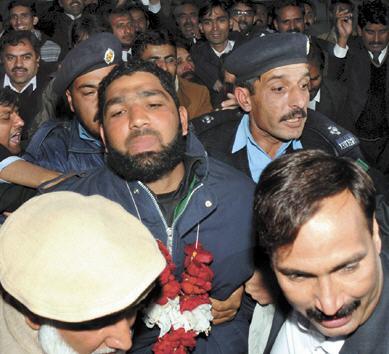
Just this year, a governor who opposed Pakistan’s contentious blasphemy law was killed by one of his guards. The assassin was then celebrated by many in the country, including lawyers who greeted him with rose petals and garlands.

The song rues the fact that killers and religious extremists are hailed as heroes in Pakistan, while someone like Abdus Salam, the nation’s only Nobel Prize-winning scientist, is often ignored because he belonged to the minority Ahmadi sect.

“Qadri is treated like a royal,” wonders the goofy-looking lead vocalist in the song, referring to Malik Mumtaz Qadri, the elite police guard who killed the governor of Punjab, Salman Taseer, in January after he challenged the blasphemy law.

Another line in the song, “where Ajmal Kasab is a hero,” makes a reference to the only surviving Pakistani gunman involved in the 2008 terrorist attacks in Mumbai, India. Still another line, “cleric tried to escape in a veil,” alludes to the head cleric of Islamabad’s Red Mosque — which was the target of a siege in 2007 by the Pakistani government against Islamic militants — who tried unsuccessfully to break the security cordon by wearing a veil.

The song even makes fun of the powerful army chief, Gen. Ashfaq Parvez Kayani, for extending his role for another three years.

Potatoes and eggs “never tasted so good,” wrote Fahd Husain in a commentary on Tuesday in The Daily Times, a newspaper based in Lahore. “They will always be credited for being politically incorrect when most needed, and giving voice to all those Pakistanis who live in fear.”

The popularity of the song on the Internet has made it a sensation across the border in India as well, surprising the band members, who have been incessantly asked whether they feel they have put their lives in danger by ridiculing the mighty.

There are certainly enough provocations to rile nationalists and conservatives. At one point in the music video, the lead singer holds a placard that reads, in English: “This video is sponsored by Zionists.”

The band members chose to upload the song on YouTube instead of handing it to television networks because they said the work was too offbeat and might be censored. Not surprisingly, some have criticized the song and its taunts as pedestrian and in bad taste.

“We were not expecting such a huge response,” said Ali Aftab Saeed, 27, the lead vocalist, who lives in Lahore, a city that is often considered the country’s cultural capital.

He said the assassination of Mr. Taseer was the inspiration for the song and its lyrics.

Resistance poetry and literature are not new to Pakistan, and they raised spirits during the somber years of military dictatorships.

During the protest rallies of the seminal lawyers movement in 2007, when they led the campaign to oust the president, Pervez Musharraf, the lawyers would sing and dance to a poem written by Faiz Ahmad Faiz, considered a giant of Urdu literature. Habib Jalib, another famous Pakistani poet, wrote several poems against Gen. Mohammad Zia ul-Haq, the military dictator in the 1980s.

But “Jalib is irrelevant to the generation of urban, young, middle-class kids that Beygairat Brigade is addressing,” said Nadeem Farooq Paracha, a culture critic based in Karachi.

“This band is offering an alternative narrative to the one this generation has grown up on, and provides a counternarrative to establishmentarian and conservative notions of politics, history and society advocated by televangelists, conspiracy theorists and, of course, the right-wing electronic media,” Mr. Paracha added. “And what better and more effective way to do this than by using satire and pop music.”

The band members, on the other hand, have no pretensions of being revolutionaries, activists or intellectuals, though they do feel that the song represents those who do not believe in extremism and want to live peacefully.

“At the end of the day,” said Mr. Saeed, the lead vocalist, “we are just musicians who raised some questions.”

Pakistan, India take Another Cautious Step Forward

By Alex Rodriguez and Mark Magnier for The Los Angeles Times


In cautious increments, nuclear archrivals Pakistan and Indiahave been easing the pall of tension that has overshadowed the two nations in recent years, as Islamabad increasingly worries about another neighbor: volatile Afghanistan.

The latest move toward rapprochement came last week, when the Pakistani Cabinet announced it would normalize trade relations with India by granting its longtime foe “most favored nation” status.

The designation has practical ramifications, including the elimination of discriminatory pricing and mutual imposition of lower tariffs and high import quotas. More important, however, it marks the latest in a series of decisions and events that signals a warming in relations between two countries that have fought three wars since their independence after the 1947 partition of British India.

Driving the move toward improved relations with India is Pakistan’s belief that strained ties with traditional allies such as the U.S. and Afghanistan are leaving it increasingly isolated, analysts say. India and Afghanistan signed a strategic partnership pact last month that included the training of Afghan troops by Indian forces — a move that rankled Islamabad.

The steps between the two South Asian neighbors have been small yet striking.

After an Indian military helicopter flying in bad weather strayed into Pakistani-controlled territory Oct. 23, Pakistani troops promptly released the aircraft and its crew and returned them to India, averting a crisis. Earlier this year, the two countries also resumed peace talks scuttled by the 2008 attacks in Mumbai that killed 166 people. Pakistani militants carried out the attacks, and India has accused Pakistan’s ISI spy agency of involvement in the assault.

Both countries are also discussing a deal that would allow Pakistan to import electricity from India to relieve massive power shortages crippling the Muslim nation’s economy. In addition, India didn’t oppose Pakistan’s nonpermanent seat on the United Nations Security Council last month, which passed by a single vote. And, earlier this year, New Delhi didn’t fight a European Union bid to allow duty-free imports of Pakistani textiles, even though it would cost competing Indian textile makers an estimated $1 billion a year in lost sales.

Experts warn that major roadblocks still loom. At the top of that list is the divided Himalayan region of Kashmir, claimed by both countries and the cause of two wars since 1947. A dispute over water rights remains unresolved, and New Delhi continues to accuse the ISI of backing militant groups that target India.

Still, bolstering trade relations between the two countries, said Zafar Hilaly, a former Pakistani ambassador to the U.S., “is a good first step. It shows a genuine feeling within Pakistan that the relationship should be normalized.”

Particularly significant is the Pakistani military’s decision to endorse granting MFN status to India. Foreign policy remains the purview of Pakistan’s security establishment, especially when it comes to the country historically regarded by the military as its chief enemy.

“All the stakeholders, including the military 
 are on board,” Pakistani Information Minister Firdous Ashiq Awan said in announcing the decision. “Such a big step could not be taken alone.”

The military’s backing of MFN status for India, Hilaly said, likely represents a realization that an easing of tensions with New Delhi may now be in Pakistan’s best interests, particularly at a time when relations with Washington and Kabul have soured. Both the U.S. and Afghanistan assert that their efforts to battle Afghan Taliban insurgents have been hampered by Pakistan’s backing of the insurgency there, a charge that Islamabad denies.

“What has happened is that, with respect to issues that the military faces, the priorities have changed,” Hilaly said. “India is still the main culprit as far as security is concerned, but the eastern front is much less active than the one developing in Afghanistan.”

Officials in Washington have been encouraged by the movement toward trade normalization between Islamabad and New Delhi, especially because economic interdependence is seen as an ideal path toward stability in South Asia. Testifying before the House Foreign Affairs Committee last month, Secretary of State Hillary Rodham Clinton called the Pakistan-India relationship “the real game-changer in the region.”

“We have in Pakistan today a leadership, both civilian and military, that wants to see progress with India, and we have the same on the Indian side,” Clinton told lawmakers. “I firmly believe greater regional economic integration would revolutionize the economy in Pakistan.”

Though India extended MFN status to Pakistan in 1996, Pakistan had not reciprocated until now. Observers in India wondered why it took Islamabad so long to see the value in the move. “Not allowing MFN status hurt Pakistan more than India and was shortsighted,” said Satish Chandra, an analyst and former Indian ambassador to Pakistan. “It was an exercise in cutting your nose to spite your face.”

With trade normalization, experts estimate two-way trade could triple to $8 billion within five years. Official trade flows currently run nearly 7 to 1 in New Delhi’s favor, with Indian exports to Pakistan totaling about $2.33 billion versus $332 million in the other direction.

“When trade picks up, there’s more and more confidence to ease political and other differences,” said Shaqeel Qalander, a furniture maker and former president of a business group on the Indian-held portion of Kashmir. “It’s a very good decision.”

Pakistan: More To Offer Than Bombs And Beards

By Asim Haneef for Al Jazeera

If you did not know anything about Pakistan and happened to pick up a newspaper or turn on the evening news, you might be forgiven for assuming that it is possibly the most broken, troubled and violent country on the face of the earth – a basket case just moments from imploding.

In the all-important arena of international public perception, Pakistan has taken an unprecedented battering in recent years, accumulating more bad headlines than nearly any other country and making places like Afghanistan and Iraq look relatively stable by comparison.

The list of challenges it faces is seemingly unending: terrorism, corruption, drone attacks, natural disasters, poverty, a deficit in leadership, discrimination against minorities, mistreatment of women, attacks on freedom of speech, mass tax evasion, match fixing, the murder of judges, politicians, union organisers and journalists – and that is just the tip of the iceberg.

So pervasive are the headlines pointing to a crisis in Pakistan that after a while they seem to blur into one another. Whether it is “hostages held in Karachi”, “al-Qaeda hideout discovered in Swat”, “floods bring pain to millions”, “suicide bomber explodes in market square”, “senior judge in blasphemy case shot dead” or “Pakistan’s ISI actively supporting Taliban in Afghan war” the message is uniformly bad news. The result is that for many the image of Pakistan is one of bombers, beards, shaking fists, distressed women and utter hopelessness. It makes for a pretty depressing picture.

I guess that is why the work of Syed Ali Abbas and his Pakistan Youth Alliance (PYA) featured in this week’s Activate, Pakistan: The New Radicals, is so refreshing. A courageous young social activist, Ali founded the PYA together with Maryam Kanwer when he was just 21 years old. It was born in the midst of severe political turmoil, as then-President Pervez Musharraf imposed emergency rule and fired the chief justice on national television, while the security forces brutally cracked down on dissenting lawyers.

Fed up with watching their country’s problems on the television, the PYA initially organised protests and rallies but quickly became more active. Its core premise and mission statement is to take a stand, to get as practically involved on the ground as possible and to exemplify the change they seek through their actions rather than merely proposing it on paper.

Their main goal is to create political and social awareness among the youth of Pakistan and to unite them irrespective of their religion, ethnicity, caste, race or language on an unbiased platform through which they can engage with one another and contribute practically to building a more progressive society in Pakistan – whether through protest, social and relief work or the arts.

Earlier this year, Ali was among a small group instrumental in organising counter protests to the hate filled ones celebrating and glorifying Mumtaz Qadri, the killer of Salman Taseer, the governor of Punjab who was murdered in January over his stance on Pakistan’s blasphemy laws and his ardent defence of religious minorities like Christians and Ahmadis. Ali says he did this because: “This is not what the founder of Pakistan and ‘Father of the Nation’ Quaid-i-Azam Muhammad Ali Jinnah would have wanted for this country today, especially as he repeatedly stressed the importance of inter-faith unity and religious harmony.”

Stories like these and others bring about something much needed in international news these days – a positive, hopeful narrative against the odds, showcasing some of the good news stories coming out of places like Pakistan, which often go unreported and deserve a spotlight too. So although we appear to have an extraordinary capacity to become fixated on negative headlines, there are also good things happening too and though progress and development is not as ‘sexy’ as a suicide bomber or a train-wreck, perhaps a little balance is in order, so that we do not become as, Ali says at the close of the film, “filled with dread, being hopeless about the future”.

So do good stories actually emanate from Pakistan? And, if so, where are they? Well an initiative by brothers and social entrepreneurs Majid and Mahmood Mirza aims to answer this. They set up a website simply titled Good News (www.goodnews.pk) , which focuses solely on positive developments coming out of the country. They describe the idea behind the website via Skype as being “to highlight amazing, awesome and inspirational news stories coming from Pakistan, as opposed to the usual negativities that steal the headlines”.

And they have plenty of examples ready. For instance, did you know that Pakistan has become only the sixth country in the world to map the human genome, joining the ranks of the US, the UK, China, Japan and India, which have all successfully sequenced it. Or, how about the fact that Pakistan has the largest volunteer ambulance organisation in the world started by “living saint” Abdul Sattar Edhi in 1948. Today, the radio-linked network includes 600 ambulances that work in every corner of the country. Or how about the recent news that Dr Umar Saif, an associate professor at the School of Science and Engineering in Lahore, has been recognised by MIT Technology Review as one of the top 35 innovators in the world – joining an elite group of researchers and entrepreneurs selected over the last decade, which includes Larry Page and Sergey Brin, the co-founders of Google, Mark Zuckerberg, the founder of Facebook, and Jonathan Ive, the chief designer at Apple. Now who has heard of those stories?

Then there are serial entrepreneurs like Monis Rahman, who just four years ago set-up Rozee.pk, which is now Pakistan’s largest jobs website, with 500,000 unique visitors a month; or Karachi-born freelance designer Vakas Siddiqui laying to rest the myth that Pakistani students are limited to excellence in science and the humanities by being selected as one of the top 28 designers in the world; or filmmaker Sharmeen Obaid Chinoy who has just been shortlisted for an Oscar in the ‘best documentary short’ category for her film Saving Face. Whether it be in music, fashion, academia, activism, technology, sports or science these are stories that people do not usually associate with Pakistan and which might just show that there is more to the country than just bombs and beards.

Some of these unreported positive stories, along with the courage and creativity shown by people like Syed Ali Abbas and the Pakistan Youth Alliance in challenging these problems, reflect a surprising shift in the country’s growing and increasingly switched-on, globally-minded youth. They are using outlets like social media platforms and blogs to become more aware, educated and informed about their rights and more savvy to the different methods they must perfect in order to stop their country peddling even further backwards than it already has and to lead it to a brighter day, free from the same old headlines we’re all universally tired of reading and hearing about.

Asim Haneef worked extensively on Activate, a new eight part series featuring grass-roots activists from across the globe who are challenging the status quo and bringing about a change in their society. You can follow him on Twitter @asimhaneef

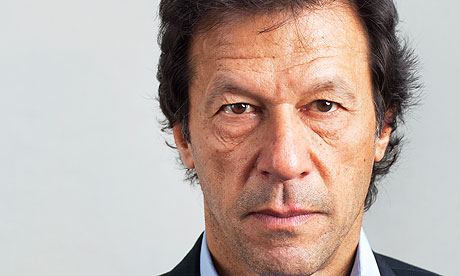
Imran Khan Laps Up Acclaim in Pakistan

Declan Walsh for The Guardian

For a decade Imran Khan has occupied the hinterland, if not quite the wilderness, of Pakistani politics. The cricket legend has won just one seat in parliament – his own – and been scorned by critics as a celebrity windbag at best and a Taliban sympathiser at worst.

But this weekend Khan dramatically transformed his standing at a stroke, bursting onto the national stage with an impressive show of street power that jolted Pakistan’s largest parties and turned received wisdom on its head.

At least 100,000 people gathered to hear Khan issue a rousing call to political “revolution” spiced with strident denunciations of government corruption.

“Declare your assets or face the wrath of the people,” he shouted, drawing roars of approval, in the largest rally for decades in Lahore, Pakistan’s political heartland.

The crowd reflected the vein that Khan has tapped – young, urban and mostly educated Pakistanis who have grown disillusioned by the chaotic politicking and inept governance of the traditional political elite. “It’s an activation of the upper middle class – people who, over the years, haven’t had a voice in Pakistani politics,” said political analyst Mosharraf Zaidi.

In contrast Khan enjoys a reputation for being incorruptible and straight-talking, polished by a glint of fame. Also in Lahore was his ex-wife Jemima, who remains a supporter, and Jennifer Robinson, a London media lawyer whose clients include WikiLeaks founder Julian Assange. “Yes we Khan,” she tweeted afterwards.

The rally set the political scene abuzz with speculation; “Imran’s Lahore rally stuns opponents” read the headline in Dawn. But large questions loom about whether he can transform his acclaim into power.

Despite his claims of a “revolution” against President Asif Ali Zardari, Khan is more likely to hurt Nawaz Sharif, the opposition leader who considers Lahore his political base. Sunday’s rally crowned a wave of smaller yet well-attended rallies across the surrounding Punjab province over the past three months.

“It’s been slowly taking root. People are getting disillusioned, they saw Imran as more dynamic and focused,” said Najam Sethi, a veteran journalist and analyst.

National elections are not scheduled until 2013, although a midterm Senate election next March – which is likely to see the Pakistan People’s party led by Zardari seize control of the upper house of parliament – has caused the political temperature to soar.

Electoral success for Khan would likely fracture politics further – a prospect that would please Pakistan’s spymasters and generals, who have traditionally liked their civilian leaders both shaken and stirred. Khan has faced accusations that his new-found popularity is being quietly boosted by the military, and his Lahore speech was notable for his lack of criticism of the army. Khan denies any link. “I think Imran and the army will get along very well – if he ever comes to power,” said Sethi. He entered politics in 1996 as one of the most loved public figures in a cricket-crazy nation, and the founder of a cancer hospital that remains one of Pakistan’s most respected charities.

But his politics have been more controversial. He supported Pervez Musharraf’s coup in 1999, sided with Islamist mullahs and, in 2009, opposed an army operation against the Taliban in the Swat valley, arguing it was better to talk than fight. He boycotted the 2008 election, a move that relegated him to the chat show fringe of politics.

But in recent years he has steadily built his popularity among young Pakistanis, capitalising on disillusionment with political corruption and anger at US drone strikes in the tribal belt.

His Lahore rally echoed many of those themes. Pakistan wanted “independence, not slavery” in its relations with the US, he said, before announcing that he would be leaving for China hours later. “I am leaving at the invitation of the Chinese government. Friendship with them will be pursued to the fullest,” he said.

But critics said that while his speech was high on inflammatory rhetoric – including gratuitous attacks at some rivals and one diplomat – it was lacking in concrete prescriptions. “His next challenge is to show that he understands Pakistan’s problems – and can formulate policy to deal with them” said Zaidi.

Why Not Free Qadri?

By Ayesha Siddiqa for The Express Tribune

How about freeing Mumtaz Qadri for the simple reason that the state system has lost the capacity to execute punishment? The Anti-Terrorism Court (ATC) judge, who gave him the death sentence, is already on the run. It will be quite a cost to protect Justice Shah and his family or other judges that may be brave enough not to overturn the ATC’s decision.

Why bother with the idea of punishing Qadri when it is no longer in the realm of the possible. An olive branch that is offered to the Tehreek-i-Taliban (TTP) Pakistan and other killers can be extended to Qadri as well. Not to forget that the political leadership in the form of the recent All Parties Conference has surrendered to a peculiar agenda. So, forget about Jinnah’s August 11 speech now as the state has already transformed to a hybrid-theocracy. It has small liberal spaces, equally smaller spaces where Sharia is formally implemented, and larger spaces where the orthodox law is informally enforced. Try standing in front of a Jamaat-i-Islami/Jamaatud Dawa procession in support of Qadri to feel the melting away of the state and its changed character. Sadly, many of our post-modernists scholars will, yet again, call this as part of the secularising process through bringing religion into public sphere. Driven by personal ambitions to establish their scholarship, they won’t even question that the current discourse is not secularising as it condemns all other arguments as being against Islam. Are the protesters even willing to explore other religious arguments that may not save Qadri from the sentence given by the ATC judge?

There are no governments that are willing to stand up to the bullying and to establish the writ of the state. There is no intent to even deradicalise society because, in the words of a senior bureaucrat of the Punjab government, reputed to be close to the chief minister, there is no radicalisation in Punjab and even if there were, why should the state become an ideological warrior. Obviously, this CSS-qualified babu considered deradicalisation as anti-religion or against the tenets of Islam. This bureaucrat was a good example to debunk the argument that radicalisation results from lack of education. Here was a case of a literate man not willing to understand that deradicalisation is about creating sufficient space for all religions and sects to co-exist without fear of persecution, and increasing the state’s capacity to provide justice for all, irrespective of their cast, creed and religion. Thus, he presented the Punjab government’s development priorities as devoid of the goal of deradicalisation.

It was almost unbelievable to think that the bureaucrat’s plan had the sanction of his political bosses, especially someone like Mian Nawaz Sharif who made some bold pronouncements of building ties with regional neighbours and condemned parties with militant wings. Notwithstanding the goodness of Mian Sahib’s heart, one wonders how familiar is he with his own party’s support of militant outfits and if he considers this linkage equally condemnable? The fact of the matter is that no political party can claim to be above board as far as rising radicalism is concerned. The absence of the state in most provinces — Balochistan where people are being picked up and killed, Khyber-Pakhtunkhwa where the provincial government has willingly opted to share space with certain types of militants, Sindh, which is devastated by floods and a government that is almost invisible and Punjab where the government opts to burn down state infrastructure — is visible. Therefore, it is not surprising to see militant outfits becoming the new arbiters even replacing the old feudal class. They have and will exercise greater influence on the electoral process, especially ensuring that no parliamentarian challenges the writ of these militant outfits.

The militants of today are the new feudal lords that will adjudicate and dispense justice not on the basis of any higher religious law but their personal bias for things which are superficially religious. These people, who hold jirgas and dispense justice, are not fully aware or trained to interpret religious text or other sources. Surely, memorising the Holy Book cannot be the sole criterion. For those who believe that voting another party into power will solve the problem of radicalism, they will be disappointed to know that religious radicalism is the only game in town. It is now time to think of ways to grapple with the new reality.

Death Sentence in Slaying of Pakistani Governor

By Salman Masood for The New York Times

A court on Saturday sentenced to death an elite police guard who assassinated a leading secular politician he had been charged with protecting, a slaying that sent shockwaves throughout Pakistan and was seen as a clear marker of the growing religious intolerance and extremism in the country.

The news made international headlines not just because of the prominence of the politician killed, Salman Taseer, but because the killer was celebrated by many in Pakistan, including lawyers who showered him with rose petals and garlands at a court appearance.

Judge Syed Pervez Ali Shah announced the sentence for the guard, Malik Mumtaz Qadri, in an antiterrorism court at Adiala Jail in Rawalpindi. “Nobody can be given a license to kill on any pretext,” the judge was quoted as saying after the conclusion of the trial, which was held under tight security.

The ruling was unusual in Pakistan; frightened justices in recent years have been cowed into releasing Islamic militants or letting them off with light sentences. The judgment was especially noteworthy in such a high-profile case against a man whose popularity only grew with his confession and defense of the killing on religious grounds.

Mr. Taseer was the governor of Punjab Province and one of the country’s most outspoken opponents of the country’s controversial blasphemy laws, which mandate a death sentence for anyone convicted of insulting Islam.

Liberals and rights activists were encouraged by the verdict, but noted that it could be overturned in appeals that can drag on for years.

“Today’s judgment is a positive development whereby norms of justice have prevailed,” said Raza Rumi, a political analyst and columnist in the eastern city of Lahore. “Pakistan cannot be allowed to become a vigilante society, and the state — its judges and prosecutors — need to uphold the law.”

No matter what happens with the case, however, Mr. Taseer’s death cast a pall over discussions of the blasphemy laws — which had become something of a test case for broader debate of how religion and politics mix in Pakistan. That trend continued Saturday. The usually voluble Pakistani press dutifully covered the story, but news broadcasts were mainly devoid of the normal commentary or debate.

“Local media’s muted coverage of the sentence is reflective of the fear factor and the polarization within the society which includes media personnel,” Mr. Rumi said.

Mr. Qadri, 26, was convicted of murder and committing an act of terrorism, and was handed two life sentences.

No date for the execution has been announced, and Mr. Qadri has a right to appeal within seven days. Raja Shuja-ur-Rahman, a lawyer for Mr. Qadri, told the DAWN television channel that an appeal would be filed.

Mr. Qadri killed Mr. Taseer in a hail of bullets on Jan. 4, shooting at close range as Mr. Taseer was getting into his car.

Mr. Taseer, a businessman and a liberal politician, had emerged as a leader in a fight against the blasphemy law, which rights groups say has been used to persecute minorities, especially Christians.

The law was introduced in the 1980s under the military dictatorship of Gen. Mohammad Zia ul-Haq as part of a policy of promoting Islam to unite Pakistan’s deeply fractious society.

Mr. Qadri was hailed as a hero by Islamist lawyers, several mainstream politicians and religious leaders.

On Saturday, dozens of supporters of Mr. Qadri gathered outside the jail and chanted slogans against the sentence, while the judge slipped out a back door.

“We will free you! We will die for you!” 20-year-old Mohamemd Aslam was quoted as saying by The Associated Press. Others yelled: “Long live Qadri, long live Qadri!”

“By punishing one Mumtaz Qadri, you will produce a thousand Mumtaz Qadris!” shouted another man.

The ruling Pakistan Peoples Party, to which Mr. Taseer belonged, has been accused of distancing itself from the cause of repealing the blasphemy law since the assassination.

Pakistan Struggles to Curb Dengue Fever

As Reported By Reuters

Pakistani authorities, already under pressure to help hundreds of thousands of flood victims, are struggling to contain dengue fever which has killed at least eight people, officials said on Wednesday.

Around 4,400 cases of the mosquito-borne disease have been reported in the central Punjab province over the past two months, forcing the provincial government on Tuesday to close down schools for 10 days.

Most of the cases have been reported in Lahore, the provincial capital, where about 2,950 people tested positive.

“So far, eight people have died of dengue. We are trying our best to control this epidemic,” Jehanzeb Khan, secretary of the provincial health department, told Reuters.

Health experts say the illness is spreading across the Punjab because of poor hygiene conditions, and heavy monsoon rain provides ideal conditions for dengue-carrying mosquitoes to thrive in stagnant waters.

The first case of dengue was reported in Pakistan in 1994.

Those who died included Ataullah Siddiqui, head of the provincial department of minerals and natural resources.

Khan said the government had launched a fumigation drive to kill mosquitoes.

Sri Lanka is sending a team of experts to Pakistan to help fight the disease, the Sri Lankan High Commission said in a statement.

Pakistan’s weak civilian government, struggling to deal with floods that have killed 266 people, has been criticised by the media for dragging its feet on the dengue issue.

“The response to dengue has been adhoc, ex post, and therefore reactionary at best,” The News daily said in its editorial.

The disease is a threat to nearly half of the world’s population. Of the estimated 220 million people infected each year, two million — mostly children in Latin America and Asia — develop a severe form called dengue hemorrhagic fever.

There is currently no cure or vaccine for dengue fever.

Poetry Soothes the Pain in Pakistan

By Nahal Toosi for The Associated Press

The outrage was swift after Pakistani security forces shot dead an unarmed young man in the southern city of Karachi, an incident caught on videotape and broadcast widely. Editorial writers demanded justice. Television talking heads decried the brutality of the men in uniform.

And then, a few poets got to work.

“No regard of life! No fear of Allah! Animals in jungle are better than you,” one English-language poem posted on YouTube rails at the culprits in the June incident. Another, in Urdu and circulated on Facebook, mourned victim Sarfraz Shah, who had “told his mom he will return home early.”

Pakistan is a country that reveres poetry, gently weaving it into daily life, and the last decade has provided no shortage of material. The rise and fall of a military ruler, the demands of a foreign superpower, the devastation of Taliban bombs — these themes and more have crept into Pakistani poems.

Some of the resulting verses carry overt messages about specific events. Often, though, the approach is more subtle, and occasionally, it’s tinged with humor.

“Of course, everything which is happening around a poet, it has an effect,” said Shahzad Nayyar, a published poet based in the eastern city of Lahore. “Such … events, which are causing destruction, which are causing loss to man, material and property, they are affecting poets a lot.”

Although Pakistan is just 64 years old, its people’s poetic tradition is centuries old and is intertwined with that of the rest of South Asia, while also influenced by the Persians. Urdu is the most widely used language, but even regional languages, such as Pashto and Sindhi, have notable poetic histories.

Today in Pakistan, one can find poetic verses on the back windows of taxis, on the sides of delivery trucks and atop gravestones. Newspapers regularly publish poetry, while Pakistani politicians, such as the country’s ambassador to the U.S., post verses on their Twitter feeds or use them in speeches.

Poetry recitals — known as “mushairas” — can draw thousands of spectators and last deep into the night, with audiences shouting encouragement to the men and women onstage. Sometimes, mushairas are part of larger gatherings, such as weddings or trade conferences; others are intimate affairs.

The country even has a national holiday dedicated to a poet-philosopher, Allama Muhammad Iqbal. Iqbal’s writings were seen as an inspirational force toward the creation of Pakistan as a Muslim homeland in 1947, though he died in 1938.

Of the 1,000 books published each year in Pakistan, there are some 50 books of poetry, said Saleem Malik, vice chairman of the Pakistan Publishers and Booksellers Association. While a handful of poets may earn enough to live on writing alone, at least for a while, most are engaged in other professions.

Many of the poetry books are self-published and distributed for free among friends. Still, that doesn’t account for the poetry that appears in other forums, such as magazines or websites such as Facebook, a popular setting for younger poets who can’t afford to publish their own books.

Perhaps the most popular form of poetry in Pakistan is the ghazal, which is made up of five or more units of two lines each and often sung.

Some of the most well-known Pakistani poets say that despite the material provided by the turmoil of recent years, they are careful about how they word their poems and often prefer to use indirect language and symbolism. This is in part to avoid being labeled a “propagandist.”

“It loses your emotional power when you are direct — it becomes like a slogan,” said Farhat Abbas Shah, a poet especially popular with younger Pakistanis.

Iftikhar Arif — a poet so famed in Pakistan that one section of his many, teeming bookshelves is devoted just to academic tracts written about him — said poets should aspire to write in a universal manner that can be appreciated beyond national borders and withstand the test of time.

There are poems written from other periods of turmoil in Pakistani history that are still relevant today because of this approach. “There is a history, perhaps more honest, more correct, more sincere, written by poets,” Arif said.

The line between direct and indirect is a fine one, however, and over the decades, some of Pakistan’s most popular poets have gone back and forth.

The late Habib Jalib, often described as a “revolutionary” or “the People’s Poet” raged against political tyranny, and even referred specifically to former U.S. president Jimmy Carter in his famed collection called “Ten Poems.”

Kishwar Naheed, a spry 71-year-old who is considered one of Pakistan’s pre-eminent feminist poets, is among those who occasionally embraces the direct approaches. In “A Mourning Poem for Bajaur,” Naheed decries the violence gripping Pakistan’s northwest regions bordering Afghanistan:

“Coffins have become so numerous, That the city is shrinking,” the poem begins.

A later verse: “We have the same court-yards, the same threshers. But bullets jump through them, Riddle holes in my fields, and in the bodies of my children.”

Naheed, who has published more than a dozen books of poetry, says every couple of months she receives threats because of her poems.

“They may say, ‘If you continue like this, you may have an accident in your car,'” she said, with a grin. “But I don’t mind having such reaction. If you don’t have a reaction, that means you have no appeal.”

Pakistani poets insist that their community is largely a peace-loving, liberal bunch — though many point out that they may feel just as much ire for U.S. actions toward Pakistan as they do for religious extremists.

Still, militant movements and their sympathizers also use poetry as a tool. After the U.S. killed Osama bin Laden in a nighttime raid in May, a group at Punjab University in Lahore advertised a poem and essay contest dedicated to glorifying the al-Qaida chief.

Taliban operating on both sides of the Pakistan-Afghan border, where the Pashtun ethnic group dominates, often use poems and chants, shared by way of CDs and cell phone recordings, to reach out to a largely illiterate population and persuade ordinary citizens to resist foreign troops.

Much of the poetry of Pakistan is not high art, but rather street-level verses exchanged by text messages, often with anonymous authors. Much of it is laced with the bitter, resigned humor of a people beset by poverty and downtrodden by corrupt elitists.

One popular Punjabi-language poem chastised former military ruler Pervez Musharraf, who was eventually ousted in 2008.

“You rush to Washington all the time, and please Bush again and again,” it says. “Beg at his feet all the time, and threaten the oppressed. Why don’t you confront the oppressors?”