Posts Tagged ‘ Lahore ’

In Ahmadis’s Desert City, Pakistan Closes In

By Myra MacDonald for Reuters
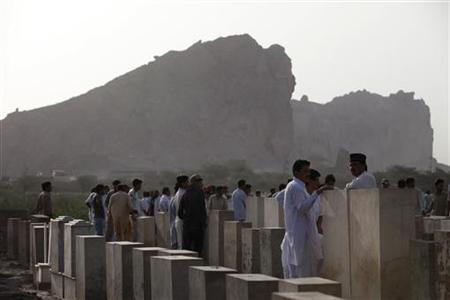
At the office of what claims to be one of Pakistan’s oldest newspapers, workers scan copy for words it is not allowed to use — words like Muslim and Islam.

“The government is constantly monitoring this publication to make sure none of these words are published,” explains our guide during a visit to the offices of al Fazl, the newspaper of the Ahmadiyya sect in Pakistan.

This is Rabwah, the town the Ahmadis built when they fled the killings of Muslims in India at Partition in 1947, and believing themselves guided by God, chose a barren stretch of land where they hoped to make the Punjab desert bloom.

Affluent and well-educated, they started out camping in tents and mud huts near the river and the railway line.

Now they have a town of some 60,000 people, a jumble of one- and two-storey buildings, along with an Olympic size swimming pool, a fire service and a world class heart institute.

Yet declared by the state in the 1970s to be non-Muslims, they face increasing threats of violence across Pakistan as the country strained by a weakening economy, an Islamist insurgency and internecine political feuds, fractures down sectarian and ethnic lines.

“The situation is getting worse and worse,” says Mirza Khurshid Ahmed, amir of the Ahmadi community in Pakistan. “The level of religious intolerance has increased considerably during the last 10 years.”

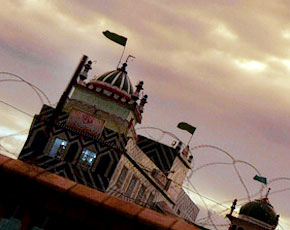
The town, renamed Chenabnagar by the state government since “Rabwah” comes from a verse in the Koran, is now retreating behind high walls and razor wire, awaiting the suicide bombers and fedayeen gunmen who police tell them are plotting attacks.

Last May, 86 people were killed in two Ahmadi mosques in Lahore, capital of Punjab; others were attacked elsewhere in the province. Many fled to Rabwah where the community gives them cheap housing and financial support.

Among them is 15-year-old Iqra from Narewal, whose shopkeeper father was stabbed to death last year as the family slept. “I was sleeping in another room when my father was attacked,” she begins in a small voice, pulling a black scarf across her face to cover her mouth in the style of Ahmadi women.

“The attacker wanted to kill all the Ahmadis in Narewal,” her brother Zeeshan continues. “My elder brother tried to help my father and he was stabbed and wounded too.”

Later police found the attacker hiding in a mosque. He had believed the mullahs when they told him that all Ahmadis were “wajib ul qatl”, or deserving of death.

BATTLEGROUND FOR POWER
The Ahmadis follow the teachings of Mirza Ghulam Ahmad, who in the town of Qadian in late 19th century British India called for a revival of a “true Islam” of peace and justice. His teachings were controversial with Muslims and Christians alike.

He argued that Jesus did not die on the cross but escaped and travelled to India and was buried in Kashmir. And he claimed to be the metaphorical second coming of Jesus, destined to put Muslims back on the true path.

Many Muslims were offended by the suggestion he had come as a prophet, breaching a basic tenet of Islam that there can be no prophet after Mohammad, whose teachings are believed to be based literally on the word of God, perfect and therefore final.

Yet his call for peace, hard work, temperance, education and strong community bonds resonated, and over the years the proselytizing movement acquired millions of followers worldwide.

At home, however, their history has been intimately bound up in Pakistan’s own descent from its relatively optimistic birth.

Lacking a coherent national identity, it has become a battleground for competing political, religious and ethnic groups seeking power by attacking others.

“The mistake of the Ahmadis was that they showed their political strength,” said an Ahmadi businessman in Lahore.

Better education he said, meant they obtained good positions in the army and civil service at first; strong community bonds made them an influential force in politics up to the 1970s.

But they also made an easy target for the religious right who could whip up anti-Ahmadi sentiment for political gain.

Ahmadis follow two different schools of thinking, but will argue, often with detailed references to the Koran in both Arabic and English, that they do not dispute the finality of the Prophet Mohammad. Their erudite theological arguments, however, had little chance against the power of the street.

After anti-Ahmadi violence, they were declared non-Muslims in 1974. In the 1980s, their humiliation was completed when legal provisions barred them from associating themselves with Islam, for example by using the call to prayer or naming their place of worship a “masjid” or mosque.

“You can say you don’t consider me to be a Muslim but you can’t force me to also say I am not a Muslim,” complains Ahmed, the amir, the pain clear in his voice.

Yet in the newspaper office in Rabwah, a white board displays the words they are not allowed to use — they could be accused of blasphemy, which carries the death penalty.

SPREADING TO OTHER SECTS
Many Pakistanis, if you ask about treatment of the Ahmadis, shrug it off — it’s an old story, they say, dredged up by westerners who do not appreciate the importance of the finality of the Prophet.

Yet there are signs the attitudes first directed toward Ahmadis are spreading to other sects. In a country which is majority Sunni, and where insurgents follow Sunni Islam, Shi’ites and even Sufi shrines have been bombed.

A 2010 study by Pakistani analyst Ayesha Siddiqa of students in elite colleges found that while 60 percent said the government was right to declare Ahmadis non-Muslims, a sizeable 18 percent believed Shi’ites were also non-Muslims.

These and other findings led her to conclude that radicalism was growing even among the educated youth — it is often, wrongly, blamed on poverty — which in its extreme form could lead people into violence.

Their tendency, she wrote, to see different groups with an unquestioned bias, she wrote, “especially coated with religious overtones or padded with religious belief prepares the mind to accept the message from militant organizations.”

In the nearest town to Rabwah, the central square as been renamed “Khatme Nubuwwat” Chowk, meaning the finality of the Prophet. Beyond, low jagged hills spike up above the dusty land, the summits of much bigger rock formations below the surface.

Many of the Ahmadis had been active supporters of the movement which created Pakistan and when they first came here they were inspired by a verse in the Koran, describing “an elevated land of green valleys and springs of running water.”

Now they are surrounded by a very different country.

Rabwah itself is open to the outside world — despite the high walls guarding individual houses, it is not a walled town.

“Under the circumstances we try to take the best measures we can to protect ourselves,” says the amir. “But what we can do is very limited. We don’t have a mindset or training for that.

And in any case, he adds, “How many people can leave Pakistan or Rabwah?”
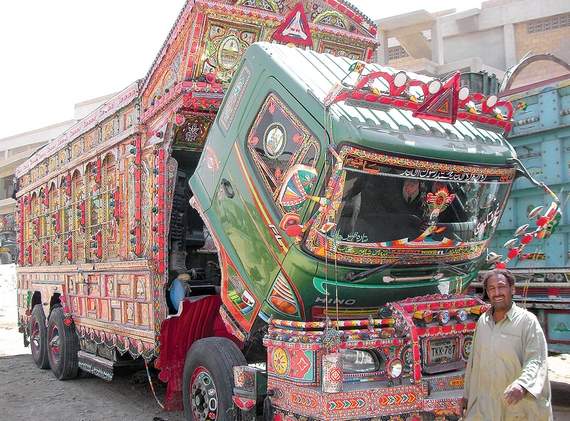
In Pakistan, Truck Decoration a High-Octane Art Movement

By James Parchman for The New York Times

MURIDKE, Pakistan — Here on the historic Grand Trunk Road, some 40 miles north of Lahore and a few hours south of the former bin Laden hideout of Abbottabad, a mosque’s call to Friday afternoon prayers was overwhelmed by Pakistani pop music spilling from open-air markets. The barks of bus conductors calling out destinations added to the din.

The passing parade of motorized rickshaws, farm tractors, buses and highway cargo trucks looked as if a re-enactment of ’60s peaceniks making the pilgrimage to Woodstock might be under way. A panorama of red, yellow and green, mixed with plastic whirligigs, polished mahogany doors and gleaming stainless steel cover plates, was a magical sight for a visitor with a love for anything on wheels.

It was not only the variety of vehicles — all are common across South Asia — that elicited this reaction, or even their Partridge-Family-meets-Ken-Kesey color schemes. Rather, it was the fascinating quantity and surrealistic detail of their decoration, unlike anything I’d seen in my travels around the world.

A deeper understanding of the origins and meanings of the decoration craft was gained over days of mingling with the truck drivers and the owners of decorating shops in Karachi, Lahore and Peshawar.

Karachi, situated on the Arabian Sea, is Pakistan’s major seaport. It is also the cargo hub of the country, and with 13 million people has a great many local and intercity buses. As such, the city supports a considerable customizing industry: When Saudi Aramco World magazine published an article about the trade in 2005, more than 50,000 people in Karachi were said to be employed decorating buses and trucks.

What I found at the Pakistani workshops was a pride of design and a willingness to answer questions — and to show off their creations to a former long-haul trucker.

Sparing no expense

At a driver’s cafe near Karachi’s 3-mile-long International Truck Yard (where I turned down an offer of boiled camel meat and cow-leg soup) workers took me by the hand to the shop of Masallah the truck decorator. My Dockers and Rockports were as out of place as their long-shirted, working-class shalwar kameez outfits and leather sandals, called chappals, would have been in one of New York City’s outer boroughs.

But my full beard may have helped in gaining their confidence and a look inside their truck cabs. Government safety agencies equivalent to OSHA were nowhere to be seen in the truck yards, and workers, many of whom were children of the owners, were being showered with sparks from their grinders and cutting torches.

Many of the trucks being outfitted at Masallah’s carried identification plates from Balochistan province. Their owners were prospering thanks to a steady demand for hauling loaded sea containers from Karachi’s port to landlocked Afghanistan. Their cargo, typically including supplies for U.S. and NATO military operations, make a trip of 500 miles by the southern route to Kandahar or 1,200 miles by a northern route to Kabul.

Pakistani truck owners can easily spend more on their trucks than on their homes. One driver from the Gwadar area of Balochistan told me he had just bought a Hino truck chassis for the equivalent of $35,000 and brought it straight to Masallah’s workshop. There he might spend another $25,000 for its body, paint and decoration. During the several weeks required to complete the work, he would sleep inside or under the truck, on his bedroll.

Adding decorative touches like ribbons, spinners, flags and polished steel cutouts in the shape of animals to a small bus costs an owner at least $800. This is considered an advertising expense; a highly decorated bus is usually the first choice of customers when there are several options.

Nissan and Hino tandem-axle trucks of the flat-front cabover design, many assembled in Pakistan, are the popular choices for cargo-haulers today, replacing the revered Vauxhall Bedford, a British model with a traditional cab. The Bedford was the mainstay of Pakistan’s cargo network since the early days of Pakistan’s independence.

The Bedford is still prized for its sturdy chassis and ability to continuously haul outsize loads. Many have bodywork with a high-crowned front prow, which lends itself to decoration and gives the truck the look of a sailing ship.

As is the case in the United States, offering a sharply decorated truck can be a powerful incentive for recruiting drivers. Pakistani bus and truck owners usually allow their drivers, whose average wages are about $75 a month, to work out their own designs in conjunction with the owner of the decoration shop.

Big business

Predictably, mass production has changed the business over the years. Adornments are no longer exclusively handmade.

“Pakistani buses were originally decorated using carved woodwork and individual paintings,” said Kurram Awan, the owner of a small shop of truck-decorating supplies in Lahore.

“Now, my shop sells over 1,000 different items, including braids, reflectors, flashing lights and antennas,” he said.

He added that the Pashtun drivers (Pashto speakers from the border region between Afghanistan and Pakistan) spent the most on decorations.

Durriya Kazi, an artist and teacher in Karachi, has long been a proponent of Pakistan’s folk art. She sees bus and truck decorating as an integral part of that tradition, noting the importance of distinguishing between sculpture as defined by the art gallery and the rich activity of actually making things that exists all over Pakistan.

In 2006, Kazi was instrumental in a program intended to spread Pakistan’s bus decoration skills to Melbourne, Australia, where a tram was transformed into a replica of a minibus used on Karachi’s W-11 route, resplendent in all its finery.

Another Pakistani with expertise in the subject is Jamal Elias of the University of Pennsylvania, a professor and the author of “On Wings of Diesel: Trucks, Identity and Culture in Pakistan” (Oneworld, 2011). His book explores the tradition of Pakistani truck decoration, and looks deeper into the “nature of response to religious imagery in popular Islamic culture.”

In an e-mail, Elias said that the creative inputs of decorators included several major themes, which could be combined across the cab and body of the truck or bus. These include Islamic religious images like the horse of Muhammad and depictions of the mosques at Mecca.

Other possibilities include images of a fish, representing good fortune, or the elegant eyes of a woman, representing beauty.

The End of AfPak

By Scott Malcomson for The New York Times

Remember how after 9/11, Osama bin Laden’s attacks on us could be linked to almost anything, from shopping habits to the rediscovery of Western values to carbon-pricing schemes? Something similar appears to be happening with Bin Laden’s death. Jihadism sure isn’t what it used to be. After 10 years, it seems, the time has come to go home. Troops are and will be coming back to the United States from Iraq and Afghanistan. The military budget will be cut. The outgoing secretary of defense feels able to openly mock NATO because, presumably, he thinks he can afford to — because it doesn’t matter all that much. The global war on terror is being downgraded from Armageddon to something more out of Leviticus: a tricked-out police action, just as John Kerry, in this magazine, always said it should be. On Sunday, Helene Cooper and Mark Landler reported that “American success in the counterterrorism campaign would seem to bolster arguments for a swift withdrawal from Afghanistan.” By Tuesday morning, they were reporting that President Obama would announce his withdrawal plans on Wednesday. Meanwhile, a Harris poll revealed that 51 percent of Americans and 54 percent of Britons believed “the death of Bin Laden meant it was time to bring troops from their countries home.”

That isn’t quite how it looked when I was in Washington a few weeks ago and spoke with about a dozen current and former American officials and with Pakistanis. The impression they each gave was that American withdrawal would be speeded not because of Bin Laden’s death but because of Pakistan’s reaction to it. After the initial shock, Pakistan’s (government-influenced) press latched onto a narrative of “national humiliation” as a result of the American raid, rather than, say, one of jubilation at the demise of a killer whose fantasies have brought Pakistan nothing but misery. A younger generation of military officers — Pakistan is dominated by its military — seemed at times about to revolt in reaction to the insult to Pakistan’s sovereignty. And the Inter Services Intelligence (I.S.I.), Pakistan’s ubiquitous military intelligence outfit, reacted, as was subsequently reported, by scouring the neighborhood around Bin Laden’s house for … evidence of how the C.I.A. found out he was there, and to determine who had been helping the Americans.

Finally, the Pakistan government did not respond to the Bin Laden raid by pressing its new advantage and rolling up terrorist networks across the land. No, it did not do that at all. So Secretary of State Hillary Rodham Clinton and Admiral Mike Mullen, chairman of the joint chiefs of staff, went to Islamabad and on May 27 presented a list of demands. These included the arrest or elimination of Ayman al-Zawahiri (of Al Qaeda), Ilyas Kashmiri (a long-sought semi-free-agent and former Pakistani military man), Sirajuddin Haqqani (of the AfPak-border based Haqqani network) and Atiya Abdur Rahman (Al Qaeda), and the shutting down of bomb factories in Pakistan.

By June 3, Kashmiri was dead. But this promising start now seems isolated. The other wanted men are still at large. The bomb-makers might well be getting tipped off. The revolt by younger Pakistani officers seemed only to get worse.

In short, the U.S. and Pakistan are really not getting along. Among members of Congress, beating up Pakistan has become ritualized; Senators McCain and Rogers were doing it again on the Sunday programs. I wondered: How many times can Pakistan be abandoned? As Bruce Riedel, a former C.I.A. officer and the head of President Obama’s first major AfPak review, shows in his excellent new book, “Deadly Embrace: Pakistan, America and the Future of Islamist Jihad,” embrace and abandonment have formed the pattern of American-Pakistani relations since the majority-Muslim nation was formed out of the breakup of British India in 1947. Harry Truman’s lack of interest yielded to Dwight Eisenhower’s enthusiasm for Pakistan as an anti-Communist bulwark and a base for spying on the Soviets. The relationship was and remained built around security and intelligence. Lyndon Johnson reversed course when India and Pakistan went to war in 1965; he cut off both, but Pakistan had, unlike India, been a strong ally, and it felt betrayed. This set the pattern: ultimately, Pakistan was tactical and India was strategic.

Now, after almost 10 years of intense engagement, Pakistan and the U.S. appear set for another split; at least that was the consensus among the officials I spoke with. There was a pervasive sadness in these conversations. It was due in part to the sheer human effort that has gone into the U.S.-Pakistan relationship. A lot of spies and soldiers and diplomats and politicians have put years of their lives into making “AfPak” work, which requires making Pak work. A lot (not all) of that effort seems to be going down the drain, along with much of the billions of taxpayer dollars that financed it.

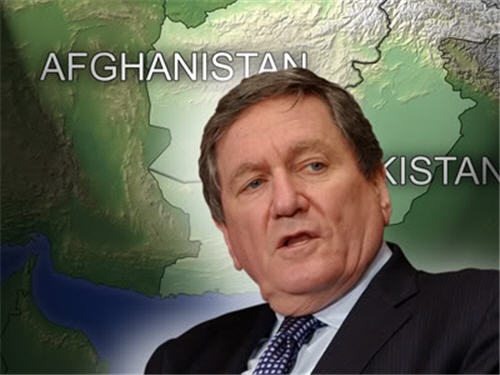
There is also personal sadness in that the AfPak effort was associated toward the end with Richard Holbrooke, whose death late last year brought the foreign-policy world up short. Holbrooke did not take great care of himself, so objectively his death could not be entirely a surprise, and among people over 70 the reactions I heard were more of the well-what-did-you-expect variety. But in the 35-to-65 range it was different. Holbrooke represented, very attractively, the assertion of youth and hope against experience. Even at 69 he had a distinct eagerness, even boyishness, alongside the baritone gravitas. He attracted bright young people. He could be young and old at the same time. Once he was gone, that sort of generational bridging disappeared. (Older figures are few in this administration.) The sense of continuity (as well as of optimism) is weakening. There’s something missing now.

There was also a sense of ideological loss of direction. For all their differences, Bill Clinton and George W. Bush shared a tangible optimism about American governmental involvement abroad. President Obama is different, and even if he weren’t the national mood is. The people’s representatives in Congress are vying to bring troops home faster, and if there is an internationalist remaining in the House he or she is keeping quiet. The Republican candidates for president seem to have settled on anti-war isolationism as a winning position. Obama’s great strength in foreign policy — his ability to repackage, and optimize, American power in a multipolar world — is the strategy that dare not speak its name, or it will bring accusations of “declinism.”

Finally, there is the tremendous sadness of Pakistan itself. The country doesn’t have enough water. It lacks the electricity to develop its industries. Literacy, by some reckonings, is actually declining. Democracy has been restored but the government is hardly stable. The one truly semi-stable institution, the military, is struggling against itself, just as Pakistanis are dividing, and attacking each other on an increasing scale (which is saying something).

But, in a way, the saddest thing of all, from a foreign-policy point of view — Pakistani or American — is that the one great card Pakistan has to play is to make itself a problem. Pakistan formed itself into a regional player through building its army, running terrorist proxies in Kashmir and Afghanistan, indulging in enough Islamist millenarianism to make itself frightening, and developing nuclear weapons. None of these strategies have a good future. But in the absence of a long-term committed relationship — what Holbrooke promoted as a “strategic partnership” — with the United States or, perhaps, with China, Pakistan is left with fear as its most successful export.

There was some discussion in Washington as to whether Mullah Omar’s name was on that list that Clinton and Mullen presented in Islamabad. It almost doesn’t matter. The doubt itself is the message: Pakistan stays valuable because it has terrorist “ties” or “links” or “proxies” or whatever. As national existential dilemmas go, Pakistan’s is particularly nightmarish. The U.S. will leave them to it — abandonment again — and choose the happier relationship with India. Secretary Clinton will be at the regional forum of the Association of Southeast Asian Nations in late July, helping to take her longtime initiative of eastward Indian engagement, and the integration of the United States into East Asian political structures, to a new level. This is part of a long-term strategy of accommodating the rise of China and of India.

And Pakistan, after 10 years, will be left behind; as the line in Washington goes, “There is no good solution.”

Gaddafi Stadium Name Must Go

By Manzer Munir for Pakistanis for Peace

It has been over three months since the Arab Spring arrived on Libyan shores. The Libyan Civil War started there in February of 2011 after Ben Ali of Tunisia and Hosni Mubarak of Egypt begrudgingly relinquished power in the neighboring North African nations. At first it had appeared that Mubarak would resort to thuggery and despotic abuse of his powers. But due to the brave people in Tharir Square in Cairo, he eventually was forced out by the Egyptian army and under American pressure once the Obama administration calibrated their stance to not support a long time ally in Mubarak and instead follow the popular opinion of the people of Egypt against his autocratic rule.

Unfortunately for the people of Libya, Muammar Gaddafi is not ready to step down from over 40 years at the helm of Libyan society. His army brutally quashed a rebellion against his rule and when it appeared that many thousands more would be killed by his troops, the US and NATO forces intervened and bombed Libyan government forces. The standoff between the Libya forces of Gaddafi and the US and NATO bombings have left Libyans in the middle as their nation continues to suffer several months into the fighting.

A brutal dictator like that who cares more about holding onto power than the fate of his nation does not deserve any honors. Instead he deserves to be tried for murdering many innocent people and if found guilty he should be hanged.

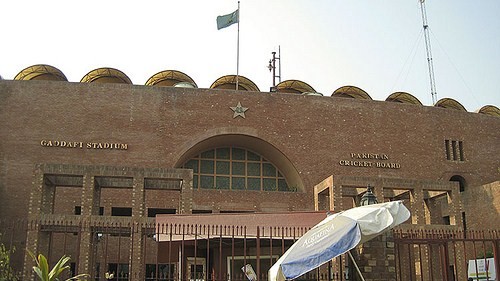
Therefore it is a shame that in Pakistan, one of the country’s most important stadium continues to bare the name of the Butcher of Tripoli. Yes, Gaddafi stadium in Lahore, a venue for many Pakistan Cricket Board sanctioned domestic and international cricket matches, is named after the Libyan dictator.

The stadium was built in 1959 and was originally named Lahore Stadium. However it was renamed in 1974 to Gaddafi stadium in honor of the Libyan ruler who had given a speech in favor of Pakistan’s right to pursue nuclear weapons at a meeting of the Organization of Islamic States Conference (OIC). The stadium also houses the headquarters of the Pakistan Cricket Board (PCB).

But now, as Qaddafi continues to kill his own people in the most brutal of ways, it is time that Pakistan’s Cricket Board changes the name of the country’s premier stadium back to Lahore stadium since honoring this man responsible for indiscriminately killing his fellow citizens unnecessarily further looks negatively upon Pakistan.

A country that already has a grave public relations image problem can surely give itself a break by doing something as simple as changing the name of this stadium. Afterall, what does it say of Pakistan if it continues to honor a man like Gaddafi? Do Pakistanis not care that this man is responsible for killing thousands of his own people?

It is time to put pressure on the Pakistan Cricket Board and on the government to immediately change the name of the stadium. I know that Pakistan has many other problems inside this fractured and unstable nation to think that changing the name of Gaddafi stadium can fix all that ails the country. Nay, it is merely a drop in the bucket. There are countless other problems facing the country that are too many and too complex to list here. But one easy fix the country can do to help improve its image is to change the name of this stadium.

There is absolutely no reason that the stadium should be associated with a lunatic such as Qaddafi. The name should never have been changed to begin with no matter what support he gave to Pakistan’s nuclear aspirations. He has never been a good or stable leader. In fact, the man is thought to have been directly responsible for numerous acts of terrorism in the 1970’s and ’80’s including the Pan Am Lockerbie bombing. And this was BEFORE he started killing his own people in order to quash a rebellion against his rule!

In light of the many recent embarrassments for the nation such as Osama Bin Laden’s hiding in their country, the continued imprisonment of Asia Bibi, the killings of Salmaan Taseer and Shahbaz Bhatti, Pakistanis must decide whether or not they want to join the community of nations or become a pariah state much like North Korea, Libya and Iran. Changing the name of the stadium is a small step, but it is indeed a step in the right direction.

–Manzer Munir, a proud Pakistani American and peace activist, is the founder of Pakistanis for Peace and blogs at http://www.PakistanisforPeace.com as well at other websites as a freelance journalist and writer.

Liberty Market, Lahore’s Hub

By Nagwa Malik

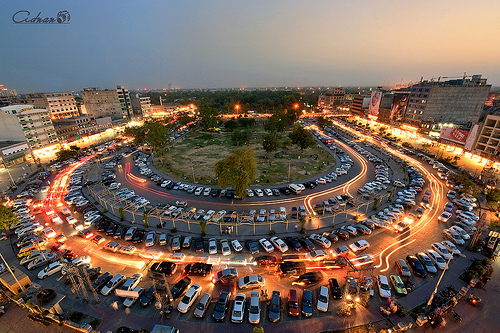
Pakistan is a country of historic and cultural importance. Lahore, the heart of this throbbing culture and history, was referred by Max Robinson as the “Pearl of the Punjab” in his article “Rebranding Lahore”. So what is Lahore to the common foreigner? Unfortunately nobody knows because we have an out-dated website of the Pakistan Tourism Development Corporation which does nothing to attract tourists. Lahore is claimed to have existed 4,000 years ago and history has established records of its existence go back at least 2,000 years. This city of vibrant culture, with its outlandish monuments and its commercial centers has changed over the years whilst still keeping the essence of the city itself. This change is reflected in the changes brought about in Liberty Market, the commercial hub of Lahore, set in the center area of Gulberg (originally the Gul-Bagh).

How does a commercial center signify the importance of any city, or its cultural out-look? Relatively! Any shopping center is designed according to the social and cultural needs of its citizens. Lahore is a modern city steeped in a history of thousands of years. It is the crown of Pakistan, originally the crown of Northern India. This is reflected in the architecture of its bazaars, and its modern shopping centers and malls. Liberty Market fits the bill of reflecting Lahore’s modern society. It is a half-souq/bazaar half mall in structure, where you have a huge plaza dominating the area, and then you have rabbit paths very much like those in Anarkali, those that twine from within the closed structure and out to the back where a bazaar like scenery hits you with food stalls, the embroiders, the tailors, walk back inside and you’re inside a branded shop. Liberty Market is the middle-class chic center, where you can find anything and everything, from clothes and accessories to shoes and restaurants. You can go there in the middle of the night and still find a place to sit and relax with a cup of chai and a shwarma. You can enjoy your shopping, breaking it with cool slushes from anyone of the cafes. You think of any type of food, from the traditional to the westernised or Arabian snacks and you have them, all in one area.

The facelift planned has come in handy. The parking space planned and worked on is made more secure, and with parking meters set rather quaintly, coupled with assistants to put in the “quarter” for you (only in this case it’s not a quarter). You have less bombardment of traffic-well; actually there is still the tiresome bombardment, but more controlled. This has helped induce discipline in our public which was lacking miserably these past years.
The commotion with the Sri-Lankan team also added to the, albeit negative, fame of Liberty Market. The worst part was best described by Max Robinson in the very article, when he said, “when the news broke about the attack on the Sri Lankan cricket team, my heart sank. There was Liberty Chowk, a place full of memories of fun, joyful evenings and feeling ever so slightly too full after gorging on chicken handi at Salt ‘n’ Pepper. If only the people watching that horror knew of the feelings and experiences that I and so many others associate with Liberty, the incident would have felt more like an anomaly or a tragedy. But, alas, the good name of Lahore was to be dragged through the mud and added to the list of dangerous terrorist-ridden holes to be avoided at all costs.”

This calls for an emergency upgrading of Liberty Market and of Lahore. This chic market which is one of the most delightful areas in Lahore is now known to the world as an area unsafe for Lahoris, let alone the tourists. Why? Liberty does not need a physical uplift. It does not need alarming blaring announcements over the speakers as each shop announces its sales, it does not need new plazas- it needs marketing. Yes, our market needs marketing and that even to the outer world. A reflection of its citizens, it should be used in overhauling the image of Lahore in particular and of Pakistan in general.

I mean if the few tourists that come to Lahore feel they have entered the “safest” city in the world, and move around Liberty as the “safest and most colourful” modern epic of Lahore, why shouldn’t it be trumpeted? Apart from those classic monuments of the walled city, what have we for the man of average social tastes? We have Liberty Market, more so due to the negative fame it achieved during the rare terrorist incident. Now people hear of Lahore and they associate it with Liberty Market. That can be propagated positively now, to promote tourism, to promote Lahore’s old name of “one of the most peaceful cities in the world”, to promote the Lahore of today, a modern city with its eons of culture and tradition.
If to one Max Robinson, “Cultural differences mean that a holiday in Pakistan will never be exactly like a vacation to India or Thailand. No boozy full moon dance parties or seedy cruises up and down the beaches here. But there is a market out there for cultural tourism. People who want to enjoy all the sights, sounds and smells of a place totally different to home.” What would it mean to many others once we invite them to come over, to pour in? And once they realize they do not have to go all the way to the walled city to see, in their own words, “wonder after wonder” that “thrills them”, but can enjoy the mundane act of shopping in a center like Liberty and still have a unique experience. Heck, it is a unique experience for our own Pakistanis who come to Lahore just to shop here…imagine what it would be to the foreigners who would greet an up-to-date mall-cum-bazaar well within reach, with products that are also well within reach.

US Envoy Upbeat Over Relations With Pakistan

By Phil Ittner for The Voice of America

Relations between the United States and Pakistan in the last few months have been severely strained by a series of events and ongoing disagreements. The U.S. ambassador to Pakistan spoke to Voice of America about how he feels things are improving.

U.S. Ambassador to Pakistan Cameron Munter said ties between Pakistan and the United States have been far from the best recently, and while there are still differences, there also is room for improvement.

“The issues are still on the plate. We still have to have discussions, but there was a period in February and some parts of March where we just didn’t have good ties. We’ve established a process,” said Munter.

Pakistan is seen by Washington and London as a vital ally in the “war on terror,” and the Pakistani government and army say they remain committed partners 10 years after the Afghan conflict began.

But, relations have been increasingly strained between the two countries.

Bitter disputes over covert CIA activities and drone attacks inside Pakistan, the security situation in neighboring Afghanistan and rising Islamist-led opposition to the presence of foreign forces in the region are fueling the discourse.

Relations also have been frayed since a CIA contractor fatally shot two Pakistani men in the city of Lahore earlier this year. The U.S. said Raymond Davis had diplomatic immunity and acted in self-defense. He was released after victims’ families accepted compensation.

Furthermore, a recent White House report criticized Pakistan’s counterterrorism campaign, accusing Islamabad of not doing enough to counter militants in North Waziristan. Pakistan rejected that report.

Munter said that while America may have some advice for their ally, at the end of the day, it is up to the Pakistanis to decide how to proceed.

“Ultimately the decision to bring peace, to bring the authority of the Pakistani leadership to bear in North Waziristan, that’s a decision for Pakistan. We’ve given our advice. Sometimes we may not have been diplomatic about it, but the fact is that’s going to be their decision and we do accept that.”

This diplomatic approach means having confidence that Pakistan will step up its efforts to rout out insurgents in safe havens in the tribal regions. Ultimately the U.S. hopes this will put pressure on certain groups there who plan their attacks on international forces in neighboring Afghanistan.

Why Pakistan’s Taliban Target the Muslim Majority

By Omar Waraich for Time

Although Pakistan’s headlines are dominated by the violent excesses of Taliban extremists, the majority of Pakistanis subscribe to the more mystical Sufi tradition of the country’s Barelvi school of Islam. And attacks on their places of worship are becoming depressingly familiar. Last Sunday, two bombers attacked the 13th Century Sakhi Sarwar shrine, near the southern Punjabi town of Dera Ghazi Khan, slaughtering 50 people and injuring twice as many. Mercifully, two other bombers failed to detonate their devices, preventing even higher casualties. Still, it was the deadliest assault yet on a Sufi shrine in Pakistan — and the sixteenth in the last two years.

The Pakistani Taliban swiftly claimed responsibility for the attack, as they have done for each previous one. Pakistan’s Taliban claims the mantle of the hardline Deobandi tradition, with many beliefs in common with the austere Wahabism of Saudi Arabia. They regard the Barelvi, who comprise more than three quarters of Pakistan’s Sunni Muslims, as irredeemable heretics. The Barelvis favor a more tolerant approach to Islam, promoting a cult of the Prophet and incorporate folkloric traditions such as seeking intercession from rural saints. Sakhi Sarwar, a mystic who is also revered by some Hindus and Sikhs, is said to grant women a son — a local legend that rouses anger among Islam’s more literalist adherents, who ascribe such powers only to Allah.

Tensions between Deobandis and Barelvis have punctuated most of Pakistan’s history. But with the arrival of al-Qaeda in the country a decade ago, local militants forged links with the global jihadists, their sectarianism sharpened to accept al-Qaeda’s “takfiri” worldview that deems adherents of other strains of Islam as deviant apostates worthy of death.

One reason for the uptick in sectarian-based terror attacks may be that the militants’ ability to strike the high profile urban targets that once grabbed global headlines has been diminished by Pakistani military offensives in their strongholds over the past two years. “It has become harder for the militants to strike hard targets,” says security analyst Ejaz Haider. “Some lessons have been learned from the previous attacks.”

So, the militants have, over the past two years, more keenly focused on sectarian attacks. Traditional Shi’ite processions are now routinely targeted by suicide bombers. In May 2010, two mosques of the minority Ahmedi sect were targeted in Lahore, killing 93 people. And there’s been an escalation of bombings directed against the majority Barelvis. After attacks on two of their most prominent shrines, Data Darbar in Lahore’s old city and Abdullah Shah Ghazi in Karachi, Barelvis came out on to the streets, wielding weapons and vowing revenge against the Taliban. They did not extend blame to the broader spectrum of Deobandis, perhaps wisely evading the beginnings of a more gruesome sectarian conflict that Pakistan can ill-afford.

Not all Barelvis are the models of peace and tolerance that some have portrayed them to be. It was a Barelvi, Mumtaz Qadri, that assassinated Punjab Governor Salmaan Taseer in January, for his opposition to Pakistan’s prejudicial blasphemy laws. The assassination was applauded by 500 Barelvi scholars in a joint statement. And the Sunni Tehreek, a Barelvi militant outfit, rewarded Qadri’s family and threatened Taseer’s daughter. While they may favor a more permissive vision of Islam, certain Barelvis are quite capable of violence where they feel the Prophet has been dishonored.

The campaign to defend Pakistan’s blasphemy laws from reform has, in fact, united Barelvis and Deobandis since last November. Barelvi anti-Taliban rhetoric was also put on pause. “We had seen the Barelvis getting ready to organize a campaign against the Taliban,” observes analyst Nasim Zehra, “but they got sidetracked by the blasphemy issue and this was forgotten.” Until last month’s assassination of Minorities Minister Shahbaz Bhatti, the religious right was able to frequently draw tens of thousands on to the streets.

Sectarian hatred aside, rural shrines are a far easier terror target than the more heavily guarded state and economic targets in the cities. Suicide bombers, especially the teenage boys favored by militants, can often evade notice before they reach the target. A crowded space helps secure the militants’ aim of causing high casualties. In the case of the Sakhi Sarwar bombers, they only had travel to a relatively short and unimpeded distance from North Waziristan to the edge of Punjab.

The bombings may also be an attempt to relieve pressure from sporadic Army actions against militants in the northern tip of the tribal areas. “Just to remain alive there, the militants have to try and force the government’s hand into diminishing pressure,” says analyst Haider. “To counter that pressure, they mount attacks in the mainland in the hope of securing some deal back in the tribal areas.” By targeting shrines across the country, the militants are able to demonstrate their enduring geographical reach and expose the state’s vulnerabilities.

The bad news is that the state is in a poor position to respond. After the latest bombings, Barelvi leaders denounced the Punjab provincial government for failing to provide security at shrines. The Punjab government dismisses the charge. “It’s happening all over,” says Ahsan Iqbal, a leading politician from the Pakistan Muslim League-N, the ruling party in Punjab. “This is not something that is province-specific.” Iqbal casts blame on the federal government for failing to share intelligence. The federal government reverses the charge, and argues that the law and order is a provincial responsibility. What no one seems to be focusing on is the desperate need to enhance the police’s capacity, with better equipment, counterterrorism training and an intelligence gathering network that reaches deep into Pakistan’s remote areas.

Shahbaz Bhatti, Modern Day Martyr in Pakistan

By Terry Mattingly for The Pocono Record

In the early days of Christianity, martyrs often gave their final testimonies of faith to Roman leaders before they were crucified, burned or fed to lions.
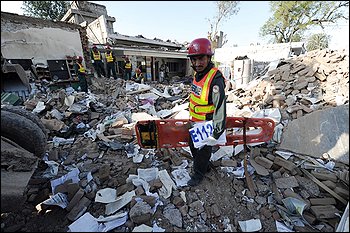
Times being what they are, Shahbaz Bhatti turned to Al-Jazeera and YouTube. The only Christian in Pakistan’s Cabinet knew it was only a matter of time before his work as minister for minority affairs got him killed. Threats by the Taliban and al-Qaida kept increasing.

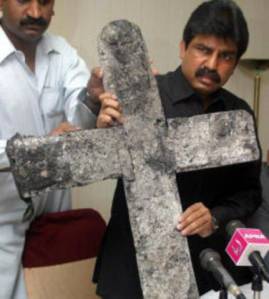
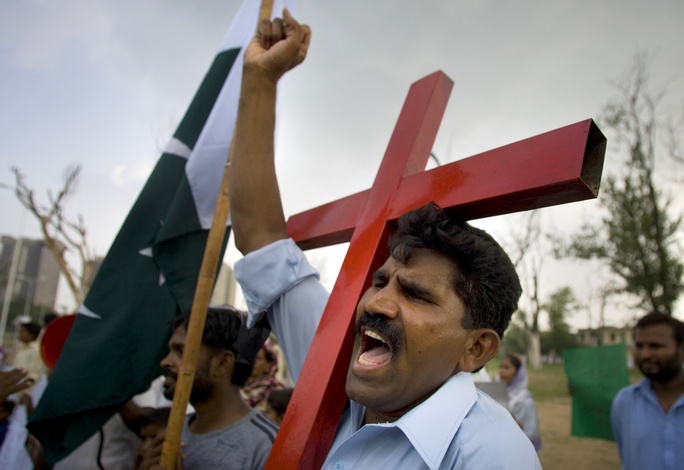
“I want to share that I believe in Jesus Christ, who has given his own life for us. I know what is the meaning of the cross and I follow him on the cross,” said Bhatti, in a startlingly calm video recorded several weeks before his assassination on March 2.

“When I’m leading this campaign against the sharia laws for the abolishment of blasphemy law, and speaking for the oppressed and marginalized persecuted Christian and other minorities, these Taliban threaten me. … I’m living for my community and suffering people and I will die to defend their rights. So these threats and these warnings cannot change my opinion and principles.”

The last straw was almost certainly the Catholic statesman’s defense of Asia Bibi, a Christian mother of five who was sentenced to death last November for the crime of blasphemy after she publicly defended her faith in a village argument. The verdict — which must be upheld by a higher court — further polarized a tense nation and sparked a global firestorm.

Then again, in 2009 Bhatti received the U.S. Commission on International Religious Freedom’s first medallion for the promotion of religious freedom. A year later, he met with Pope Benedict XVI to discuss interfaith work and religious liberty in Pakistan. Bhatti was not hiding his convictions.

The blasphemy laws in question went into effect in 1986, during the dictatorship of Gen. Muhammad Zia-ul-Haq. They ban, among other actions, the use of “derogatory remarks, etc; in respect of the Holy Prophet. Whoever by words, either spoken or written or by visible representation, or by any imputation, innuendo or insinuation, directly or indirectly, defiles the sacred name of the Holy Prophet Mohammed (PBUH) shall be punished with death, or imprisonment for life, and shall also be liable to fine.”

These blasphemy laws have been used against hundreds of Muslim dissenters and Ahmadi sect members, whose approach to Islam is specifically attacked in the laws. In practice, conversion from Islam to another faith is considered blasphemy, as are attempts to advocate or defend minority faiths, such as Christianity or Hinduism.

Vigilantes often kill those formally or informally accused of blasphemy — making trials irrelevant.

This was the case with Bhatti’s death in a wave of machine-gun fire into his unarmored car. Pakistani officials had denied his request for an armored car, despite the constant threat of drive-by shootings.

Formalities were also irrelevant on Jan. 4, when Salmaan Taseer, the governor of Pakistan’s Punjab Province, was assassinated by one of his bodyguards. This outspoken Muslim also defended Bibi and called for reform in the use of blasphemy laws.

Adoring crowds showered Taseer’s assassin with rose petals and garlands as he arrived to face a magistrate, while moderate Muslim leaders remained silent. Pakistan’s legislators observed a moment of silence for Bhatti, since it probably would have been fatal for anyone to offer a prayer in his honor.

After all, pamphlets left by those who killed Bhatti warned that they would keep fighting “all the world’s infidels, crusaders, Jews and their operatives within the Muslim brotherhood. … This is the fate of that cursed man. And now, with the grace of Allah, the warriors of Islam will pick you out one by one and send you to hell, God willing.”

Apparently, many radicals in Pakistan have concluded — a perfect Catch-22 — that it is blasphemy to oppose the blasphemy laws.

Meanwhile, the Pakistani conference of Catholic bishops is preparing to render a judgment of its own. Later this month the bishops will review a proposal to ask the Vatican to designate Bhatti as a martyr.

“Bhatti is a man who gave his life for his crystalline faith in Jesus Christ,” Bishop Andrew Francis of Multan told a Vatican news agency. “It is up to us, the bishops, to tell his story and experience to the church in Rome, to call for official recognition of his martyrdom.”

-Terry Mattingly is director of the Journalism Center at the Council for Christian Colleges and Universities.

Sindh Saves the Day

By Nadeem F Paracha for Dawn

Plans are afoot to build the world’s first ever international Sufi university near Bhit Shah in Sindh. The main purpose of the institution would be to promote interfaith and intercultural education to tackle extremism in the country.

Such a thought and project could only have come about in Sindh. Especially in the context of what Pakistan has beengoing through in the last many years.

Not only have the country’s other provinces – especially the Punjab and Khyber Pakhtunkhwa (KP) – become central targets of horrid terrorist attacks by extremist organisations, the Punjab in particular has also been witnessing a steady growth of faith-based conservatism within its urban middle and lower middle-classes.

When extremists (calling themselves ‘Punjabi Taliban’) attacked the famous Sufi shrine, Data Darbar in Lahore late last year, economist and political analyst, Asad Sayeed, made a rather insightful observation.

He said that had such an attack on the Darbar taken place twenty years ago, thousands of Lahorites would have poured out to protest.

But not anymore. The attack on one of Punjab’s most popular Sufi shrines was simply treated as just another terrorist attack.

Though it is now clear that the Wahabi/Deobandi extremists have been going around blowing up Sufi shrines frequented by the majority Barelvi Muslims, the Barelvi leadership has looked elsewhere, putting the blame on the ever-elusive ‘foreign hands.’

Journalist and intellectual Khaled Ahmed once wrote a telling tongue-in-cheek article about the annual gathering of the Dawat-i-Islami in Multan.

The Dawat is the Barelvi equivalent of the Deobandi Tableeghi Jamat. Both these outfits are considered to be non-political organisations who are more interested in evangelizing their respective versions of Islam and its rituals. One should also mention that both these (sub-continental) strains of Islam accuse one another of being ‘flawed Muslims.’

Ahmed wrote how after Dawat’s huge congregation in Multan, when police found some bullet-riddled bodies of Dawat members, the outfit’s main leadership simply refused to acknowledge the glaring evidence that pointed towards the involvement of an opposing Sunni sect’s organisation in the murders.

Ahmed adds that Dawat leaders began babbling about ‘outside forces (RAW, CIA, Mossad)’ who wanted to create disharmony between Pakistan’s Barelvi majority and the Deobandi and Wahabi sects.

Barelvis: From moderate to militant

One can understand the above-mentioned episode as an example of the confusion Barelvi spiritual leadership has gone through since the 1980s.

From its inception in the 18th century and until about the mid-1980s, the Barelvi sect was largely apolitical in orientation, non-Jihadist and followers of some of the most relaxed dictates of the Hanafi madhab – the first of the four main Islamic schools of law that is also considered to be the most moderate.

‘Barelvi Islam’ (as it is sometimes called) is purely a sub-continental phenomenon that fuses elements of Indian Sufism with the folk and populist strains of various cultures that exist in the sub-continent.

It is also called the ‘folk Islam’ of the region in which a high degree of tolerance exists between various faiths, sects, classes and ethnicities and in which the puritanical aspects of other Islamic sects are eschewed and even rejected.

The Sufi shrine and an intense reverence of the Prophet (PBUH) play a central role in Barelvi Islam. Its populist and moderate make-up helped it become the majority Sunni sect amongst the Muslims of the sub-continent.

Two of its leading opponents have been the Sunni Deobandi sect (also a product of the subcontinent) and the Saudi-inspired Wahabism.

Both have accused Barelvis of ‘adopting Hindu rituals and practices’ and assorted ‘heresies.’

In spite of being the majority sect amongst Sunni Muslims in Pakistan, ‘Barelvi Islam’ hardly ever had a coherent political expression in shape of a mass-based political party or organisation.

Its spiritual leadership remained pro-Jinnah (unlike Deobandi organizations of undivided India), and various Pakistani political leaders have continued to appeal to the symbolism and lingo associated with various populist aspects of Barelvi-ism.

Zulfikar Ali Bhutto and his Pakistan Peoples Party (PPP) was the most successful in this respect.

Bhutto was also one of the first leading Pakistani political figures to undertake the act of regularly visiting various famous Sufi shrines in Sindh and Punjab.

Barelvis are in the majority in Sindh and the Punjab, whereas Deobandis are largely centred in Khyber Pakthunkhwa and in the Pushtun-dominated areas of Balochistan.

Until the 1970s Barelvi-ism also prevailed among many of Sindh and Punjab’s urban middle-classes, especially those who considered themselves to be progressive and likely supporters of secular politics.

However, the arrangement in this context was suddenly disturbed with the arrival of the Ziaul Haq dictatorship in 1977.

Dipped in the political Islam of scholar and Jamat-i-Islami (JI) chief Abul Ala Mauddudi, Zia soon moved towards infiltrating the spiritual and political nerve centres of Barelvi-ism in an attempt to ‘reform’ them.

Barelvi dominance across the country’s religious landscape reminded him of Z A. Bhutto’s populism (which he, like JI, considered to be ‘vulgar’ and ‘un-Islamic’), and from 1979 onwards Pakistan under Zia also became one of the leading client states of Saudi-generated Wahabi propaganda and aid.

Stunned by the ‘Islamic revolution’ in the Shia-dominated Iran in 1979, Saudi Arabian monarchy and its Wahabi Sunni religious elite began seeing Pakistan’s Barelvi-dominated make-up as venerable to Shia-ism’s revolutionary symbolism and also of socialist propaganda, especially with the arrival of Soviet forces in Afghanistan.

At least that was one of the reasons used by Zia and his Saudi allies to draw the United States into giving Pakistan billions of dollars worth of aid and arms.

With the aid also came Wahabi propaganda literature and preachers who along with Pakistani Deobandi and Wahabi spiritual and political groups began setting up madressas and mosques.

These madressas operated as institutions that would indoctrinate young Pakistanis – most of whom were immersed in the non-Jihadi traditions of Barelvi-ism – and prepare them for Jihad against Soviet forces in Afghanistan.

Bralevi tradition had also not been very kind to the ulema and the clergy.

To address this, Zia also began describing famous Sufi saints as ulema and banned (in the media) all criticism and humour aimed at the clergy.

The Afghan war, Saudi propaganda, the mushrooming of Deobandi and Wahabi madressas and televangelists, and a concentrated campaign by the Zia regime to equate the dictatorship’s capitalist-Islamist makeup as something in accordance with the Shariah and with ‘Jinnah and Iqbal’s vision,’ had a telling impact on Pakistan’s religious sociology.

In the Khyber-Pakhtunkhwa many moderate and progressive Deobandi strains that had prevailed in the province began sliding into the sect’s more radical dictates, coming closer to the puritanical Wahabi and Salafi ideas about faith.

This slide was celebrated by the Punjab-dominated military as a successful blow to the secular and ‘treacherous’ Pukhtun separatist tendencies.

In the Punjab, the province benefited the most from Zia’s Punjab-centric capitalist maneuvers. This coupled with unprecedented remittances coming from Pakistanis who had begun going to Arab Gulf states to work from the 1970s onwards, gave birth to new moneyed classes.

Many from the petty-bourgeoisie and bourgeoisie sections began moving away from their Barelvi heritage and towards more puritanical strains of faith.

Their Barelvi past now reminded them of their lower status and economic modesty, whereas they began relating their enhanced economic standing with the adoption of the more puritanical strains of Islam.

That’s why the growth of puritanical Islamist and sectarian organizations that Punjab saw under Zia, a lot of their local funding came from Punjab’s nouveau-riche and petty-bourgeois trader classes.

Interestingly, it was also the same classes that also pushed the Barelvi leadership to become more conservative and radical. Those sections of the Punjabi petty-bourgeoisie that stuck to Barelvi-ism encouraged their spiritual leadership to compete with the Puritanism and radicalism of the growing number of Deobandi and Wahabi groups.

This trend saw the first ever emergence of radical Barelvi groups. In the early 1980s, the Dawat-i-Islami was formed to counterbalance the growth of the Deobandi Tableeghi Jamaat that had begun making deep inroads into Punjab’s bourgeoisie and the military.

The Dawat discouraged the Barelvis from indulging in antics associated with the region’s folk Islam, emphasising an increased reverence of holy personalities and encouraging holding of recitals of naats and milads instead of quwalis and dhamals. The last two became associated with the practices of the lower-class Barelvis.

In 1992, emerged the Sunni Thereek (ST). A Barelvi outfit that emerged from the splintering of the oldest Barelvi Islamic political party, the Jamiat Ulema Pakistan (JUP).

Such occurrences did not really help the Barelvi sect defend its traditions in the face of the state-sponsored Deobandi and Wahabi onslaught –  rather, these organisations began turning Barelvi-ism into an equally anti-pluralistic and militant political phenomenon.

Sindh saves the day?

By the 1990s, Zia’s manoeuvres and Saudi involvement in reshaping Pakistan’s religious tradition had seen Khyber Pakhtunkhwa and Punjab become hostage to various violent Deobandi/Wahabi outfits and new-born Barelvi reactionary-ism.

The Punjab also saw a rise in the use of reactionary political and religious narratives within its lower-middle and middle-classes, whereas in Balochistan attempts were being made (by intelligence agencies) to neutralize secular Baloch nationalist militancy with the help of puritanical evangelical outfits. The agencies had already done this successfullyin Khyber Pakhtunkhwa in the 1980s.

But what happened in Sindh? Barelvi-ism in Sindh (outside Karachi) has always been a lot more secular and pluralistic than the Bareilvi-ism in the Punjab.

Its  sociology  in Sindh heavily revolves around the staunchly secular historicity that the province’s famous scholar, GM Syed’s literary work generated.

He described a highly pluralistic and secular reading of Sufism as being the cultural and religious make-up of the Sindhis and it is this narrative that still rules the roost in the province’s social and religious psyche.

This is one of the reasons why Zia completely failed to impose his version of Islam here. Also, just like the majority of the Baloch who equate puritanical Islam with the ‘Punjabi civil-military elite,’ so does the socio-political discourse in Sindh.

On the other hand, in Karachi, though Zia-backed Deobandi and Wahabi radical outfits did manage to find a foothold, two things have always worked against these outfits here.

The first is the fact that the sprawling ethnic, sectarian and religious diversity found in Karachi actually absorbs and neutralizes any attempt by an outfit to impose its version of Islam.

Secondly, MQM, a party that first emerged as a mohajir nationalist group, adopted almost the same populist Barelvi symbolism and lingo as Bhutto did in the 1970s.

Also, the other two big political parties in the city too are secular: the PPP and ANP.

Though the Sunni Thereek (ST) has managed to infiltrate some sections of MQM’s support, ST is Barelvi and anti-Taliban (albeit reactionary).

In spite of the rampant crime and ethnic tensions that are a constant in Karachi, it will not be an overstatement to claim that Karachi along with the rest of Sindh today stands to be perhaps the only (ragged) sanctuaries in present-day Pakistan that are (comparatively-speaking) largely free of the factors that have created opportunities in the Punjab and KP for violent extremist activity as well as for reactionary conservatism to now become a mainstay in Punjab’s bourgeois psyche.

Bombing kills 25 Near Intelligence Office in Eastern Pakistan

By Karen Brulliard for The Washington Post

ISLAMABAD, PAKISTAN – A car bomb exploded near an office of Pakistan’s main intelligence agency in the eastern city of Faisalabad on Tuesday, killing 25 people in the type of militant attack that is growing more common in the country’s populous heartland.

A spokesman for the Pakistani Taliban asserted responsibility for the attack and said it was aimed at the intelligence office, the Associated Press reported.

Police said the bomb, which was detonated at a gas station, sparked additional explosions of natural gas cylinders, compounding the damage. The blast destroyed parts of several businesses, including an office of the national airline, and wounded at least 100 people.

Sectarian violence is common in Faisalabad, Pakistan’s third-largest city and a textile-producing hub, but Tuesday’s blast was the first major militant attack there. Militants have often carried out bombings in other large cities, including Lahore, about 80 miles to the east. The attacks regularly target Pakistan’s security forces, who in recent years have mounted counterterrorism offensives against insurgent hideouts in the mountainous northwest.

Now, Pakistani authorities and analysts say, violent extremist organizations are spreading across Punjab province, of which Lahore is the capital.

Southern Punjab is home to militant groups that traditionally focused attacks on Indian targets but are now thought to be deepening ties to Taliban factions in Pakistan and Afghanistan.

The car bombing occurred nearly a week after the assassination of federal cabinet minister Shahbaz Bhatti, which a group calling itself the Punjabi Taliban said it had carried out.

Bhatti, a Christian, had spoken out against Pakistan’s anti-blasphemy laws, which are enforced most stringently in Punjab. The laws are defended by religious groups, which say that violators of the statutes – and supporters of the violators – deserve death.

Uniting Pakistan’s Minority and Majority

By Mohsin Hamid for The Express Tribune

There’s a nurse I know in Lahore. She’s tall and stocky, middle-aged. She is on call 24 hours a day and works six days a week. She’s also a freelance headhunter, placing cooks and drivers and maids. She sleeps little. She has five children she hopes to give better lives. Last year, she donated time and money to flood victims.

She is a Pakistani Christian. And on Wednesday, I saw her weep.

She was staring at a TV set. It was reporting the assassination of Shahbaz Bhatti, Pakistan’s federal minister for minorities, a Roman Catholic. “What’s going to happen to Christians in this country?” she asked me.

I had no answer. But her question is searingly important. A country should be judged by how it treats its minorities. To the extent it protects them, it stands for the ennobling values of empathy and compassion, for justice rooted, not in might, but in human equality, and for civilisation instead of savagery.

Pakistan ought to be exemplary in this regard. After all, ours is a nation of minorities: A patchwork of cultures, ethnicities, languages and sects. Since independence, we’ve tried to use Islam to bind us together, to undo our inherent and pervasive minority-ness. After the country split in 1971, these appeals to religion expanded under ZA Bhutto and reached previously unimaginable extents under Ziaul Haq. They have continued to intensify ever since.

One problem with this approach, of course, has been that our religious minorities, a twentieth of our population, have been left out of our grand national narratives. Five per cent may seem like a small proportion, but in absolute numbers it includes almost 10 million Pakistanis, which equals everyone in Tunisia, or one-and-half times all of Libya. If Pakistan’s religious minorities were a country, they would be more populous than half the members of the UN.

So how have they been treated by Pakistan? Shamefully. They are looked down upon, discriminated against, physically threatened and not infrequently killed. They are second-class citizens in every sense. Nor has our state offered them much support. Indeed, our state has been actively involved in their oppression.

None of this is new, of course. So, for those of us fortunate enough to belong to the religious majority, does it even matter?

Yes. Desperately. Minority relations are a microcosm of society. Each individual human being is, after all, a minority of one. And, as Pakistan becomes a country at war with its minorities, it is becoming a country at war with its individuals, with itself, with you and with me, with the human desire to be allowed to believe what we believe. In this direction lies Orwellian Newspeak, an inability to say what we mean, a condition of external dishonesty that inevitably leads to internal dishonesty. Orwell imagined the result of this to be something he called doublethink: People holding “simultaneously two opinions which cancelled out, knowing them to be contradictory and believing in both of them.”

I find it difficult to imagine a better description of many of our TV talk show hosts — or much of our public discourse — today.

There are three main political positions we hear over and over in Pakistan, and all three are suffused with doublethink. There is the national security position: ‘America is our enemy; America should give us more aid.’ The privileged liberal position: ‘There should be equal rights for all; I should not have to share my riches with the poor.’ And the (remarkably similar) ambitious cleric position: ‘Religion makes us all equal; only I decide what religion says.’

It is unsurprising that the privileged liberal position is the one most often associated with attempts to protect the rights of religious minorities in our country. It is also unsurprising that it has been largely unpersuasive.

The good news, from a religious minority standpoint, is that the other positions are equally incoherent. (The bad news is that they are much more willing to resort to violence in support of their arguments.)

What Pakistan’s religious minorities need, therefore, is a new position, a position that champions equality while, and this is the tricky part, also championing equality. In other words, a position that dispenses with the illusion that equality can be enhanced in a society prostrate before either its rich or its clerics.

Such a position would also be to the benefit of the country’s economic majority, its poor. For they, too, are looked down upon, discriminated against, physically threatened and not infrequently killed. They, too, are second-class citizens. They, too, have been actively oppressed by our state.

At its heart, our country’s toxic treatment of its religious minorities is intertwined with its toxic treatment of its impoverished majority. Both groups suffer from the denial of our common humanity. And that, paradoxically, offers great hope. For we can reject false dichotomies between our clerical and our liberal positions, between our minorities and our majority. We can begin the search for common ground that has eluded us as a nation thus far.

We might, for example, shift from disputes over blasphemy laws to actually delivering due process of law, from arguments over curbing radical madrassas to actually building a high-quality state education system, from alternately buying off and fighting tribal chieftains to actually empowering local tribespeople.

Our problems are not insurmountable. Pakistan is, simply put, a land that mistreats its minorities and its majority. It is ripe for a revolution, except that it already has many trappings of democracy: Elected assemblies, free media, independent judges. A revolution in our thinking and behaviour, brought about by sustained pressure from below, is what is really called for.

Let us be clear: The messy but effective compromises we require can only come about through the dramatically improved functioning of our democracy. But a better-functioning democracy is feared by many with vested interests who benefit from the impaired system we currently have. They must be convinced otherwise.

Above all, we must convince our powerful national security state. Rationally, it is clear that under our current policies, Pakistan is becoming ever less secure. The stability and growth that a well-functioning democracy could bring is our country’s best chance of escaping from its ‘eagerly-dependent-on-enemy-America’ strategic incoherence. Unless, that is, our national security doublethink really boils down to this: ‘I will protect you; you are the threat.’

For the sake of our vulnerable, which is to say, in different ways, just about all of us, I hope this is not the case. Too much Pakistani blood has already been shed and too many Pakistanis have already gone to bed hungry.

The Cup That May Brighten Up Pakistan

By Nilankur Das for The Hindustan Times
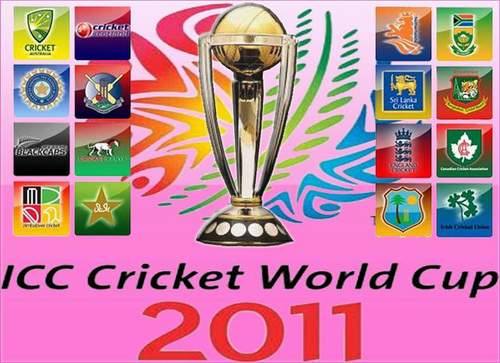
For others winning this World Cup could be a matter of pride and glory for the country. For Pakistan, which has won a World Cup and hosted a final, a lot more is at stake. A terror attack on the Sri Lanka team bus in Lahore in 2009 had put an end to Pakistan playing international matches at home an

d also taken away its rights to host World Cup ties. The country shredded by blasts and violence is now forced to host its international matches in Dubai.

Play to prove
Winning this World Cup, coach Waqar Younis feels, could change all that and pave the way to bring international cricket back to the country.

“It is unfortunate that we are not hosting. Yes, we are missing World Cup matches at home. But if we play as a unit, which we are at the moment and go on to win, I believe it will definitely help get international matches back to Pakistan,” Waqar said after Pakistan began their campaign with a win in a warm-up match against Bangladesh.

“Everyone back home is disappointed that the World Cup is not happening in Pakistan. But we are looking forward. Violence has taken international cricket away from the country but I am sure our cricket will bring cricket back,” Intikhab Alam, Pakistan’s first one-day captain who is the manager of the team here, told HT.

Ccricket Buzz
Back in Pakistan which is celebrating Id-e- Milad-un-Nabi, the birthday of Prophet Mohammad, cricket, it was learnt, is the buzz now.

“I think the people of Pakistan have already come to terms with the World Cup not happening here. Tuesday’s match was not on TV and so very few people could follow it. But people are keeping track and everywhere I went I heard cricket being discussed,” spokesperson of the Pakistan Cricket Board, Nadeem Sarwar told HT from Lahore.

“What Waqar said is right. But it will not happen overnight. Winning the World Cup will surely have a unifying effect on the country and if that means law and order is restored, the other boards too will not have problems sending their teams to Pakistan.

“We are making progress in this regard. The Afghanistan team was here. And now the Nepal women’s team is playing a T20 and one-day series here,” Sarwar said.

It’s still early days but a motto like this can definitely keep the team together. But sport has its share of such instances. When Spain, with a majority of Catalan players led by a man from Real Madrid, went on to win the football World Cup, a month-long euphoria blurred all differences.

Drug Row Sets Pakistan Scientists Against Ministries

By A A Khan for The Science and Development Network

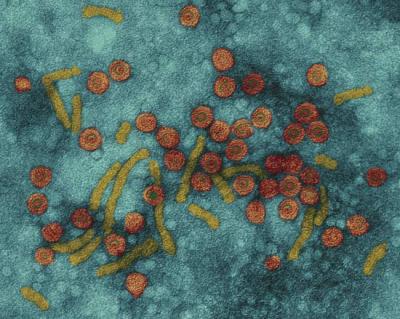
Efforts to produce a cheap local version of a hepatitis B drug have ground to a halt in Pakistan amidst a row between a leading scientist and senior officials from two government ministries.

Officials claim to have evidence that scientists involved in the drug’s production have cut corners in carrying out trials, abused resources and misused research funds.

But two of the scientists said they feel they are being deliberately prevented from launching the drug, interferon, because it could undermine the lucrative contracts for supplying it currently held by international pharmaceutical companies.

Viral hepatitis B is endemic in Pakistan, with an estimated seven million people infected,according to research published by the Pakistan Journal of Medical Sciences in 2009.   

The government’s claims relate to scientists at the Centre for Applied Molecular Biology (CAMB) in Lahore. The ministry of science and technology commissioned an audit of the centre, carried out by a committee of officials and external auditors, according to sources.

The ministry referred the findings to the Federal Investigation Agency this month (8 December) which will decide whether to proceed with charges. In the meantime, the centre’s accounts have been frozen.

Meanwhile, officials in the ministry of health said they are refusing to approve use of interferon produced by CAMB because of alleged irregularities in the clinical trials.

And, in a separate development, an independent petitioner, Batish Mahmood Tipu, filed a petition in the High Court this month (13 December) which has led to the court issuing notices to both ministries.

The notices require them to explain before the court why they are not allowing the use of locally produced interferon that, according to the petitioner, costs 70 Pakistan rupees (around 82 US cents) per injection, compared with the imported version, which costs around US$11.

CAMB trains molecular biologists and specialises in recombinant DNA technology. The centre has a good record of achievements related to Bt (Bacillus thuringiensis) rice, Bt cotton and Bt pesticide formulations. It has obtained more than ten patents. 

The centre received regular funding from the ministry of science and technology for the interferon project and, from 2004 onwards, it also received financial support from Pakistan’s Higher Education Commission (HEC).

CAMB also received prize money of US$100,000, in 2008, from the Islamic Development Bank for its outstanding contribution to molecular biology.

Clinical trials criticised

Sheikh Riazuddin, one of five scientists targeted by the government’s investigation, was director of CAMB from its establishment in 1985 until June 2009.

Riazuddin was working on a project entitled ‘Local Production of Interferon’, headed by Javed Akram, a professor at Jinnah Hospital, Lahore, which began in 2000.

According to Riazuddin phase III clinical trials of the local version of the drug were conducted at Jinnah Hospital, a teaching hospital of the Allama Iqbal Medical College, Lahore, and it was ready for final approval in December 2008.

By January 2009, CAMB had patented the drug and produced 100,000 vials of it — which have still not been used.

Sources from the ministry of health said they have not approved the drug because of the omission of two key stages normally conducted in clinical trials: phase I (laboratory testing of the drug) and phase II (safety testing on humans).

But Riazuddin said these stages are not necessary in the case of a ‘biosimilar’ drug — an exact copy of a drug for which these trials have already been conducted. 

Rauf Khalid, drug registration controller of the ministry of health, told SciDev.Net: “The approval of hepatitis interferon for commercial release can only be granted when CAMB completes all the requirements, including tests, and shows the capability of its production facilities”.   

The ministry of science and technology’s audit committee, whose findings have not been made public, has, according to sources, found among other alleged irregularities that Riazuddin had been using CAMB facilities, such as transport and phone, even after he had left the organisation.

The committee has also said it can find no satisfactory answer about where the bulk of the prize money from the IDB has gone.

Khalid Siddiqui, joint secretary of the ministry of science and technology, said: “Irregularities have taken place at CAMB for the last many years and all the findings by our committee have formally been sent to the Federal Investigation Agency for verification.

“We respect them [the CAMB scientists] as researchers but any irregularities identified by the fact-finding committee have to be dealt with according to law.” 

Allegations have ‘no substance’

Riazuddin confirmed to SciDev.Net that he has been contacted by the [FIA] which informed him that it had received a case against him involving corruption, to the tune of millions of rupees, and misuse of authority — charges he denies.

“There is no substance in the allegations,” he said.

He agreed that, even after leaving CAMB, he continued to direct the team and spent most of his time at CAMB.

“I did that not for my sake but to see my brainchild become a reality. I assumed if I do not look after the research I started, that might vanish, rendering many years’ effort futile.”

Riazuddin and Akram claimed that there have been government moves to try to block the development and production of their drug.

“Some sections in the ministry of science and technology and in the health ministry are playing into the hands of multinational companies who do not want a local launch of this medicine as Pakistan is importing hepatitis drugs worth Rs 4 billion (around US$47 million) annually from those multi-nationals,” Riazuddin said.

“This all is to force us into saying goodbye to the local production of interferon,” Akram told SciDev.Net. 

“At every step, from release of funds to the approval stages, we faced bureaucratic hurdles so much so that we felt that they do not want local production of hepatitis interferon,” Akram added.

Anwar Nasim, patron of the Pakistan Biotechnology Information Centre (PABIC), told SciDev.Net: “It is not shocking to know about corruption allegations in research when the menace of corruption is all around us. An external investigation by the FIA would soon help us know who was in the wrong — the ministry or the researchers”.

Bombers target Shiites in Pakistan, killing 12

As reported by The Associated Press

Suicide bombers attacked police protecting marches by minority Shiite Muslims in Pakistan’s two largest cities Tuesday, killing 12 people and wounding dozens, officials said.

The first and most deadly attack occurred in the eastern city of Lahore, where the bomber detonated his explosives as police tried to search him, killing 10 people. About an hour later, a second bomber struck in the southern port city of Karachi, killing at least two people.

The attacks laid bare the challenges facing Pakistani officials trying to secure cities far from the northwest, where militants fighting Pakistan’s U.S.-allied government and American forces in neighboring Afghanistan have long thrived. Many recent attacks have targeted minority Muslim and other religious groups.

The Taliban claimed responsibility for the attack in Lahore, where thousands of Shiite worshippers were marking the end of a 40-day mourning period for the Islamic sect’s most beloved saint when the blast hit their procession early Tuesday evening.

The bomber is believed to have been a young teenage boy who was wearing a suicide bomb jacket and also carrying a bag full of explosives, said senior police official Aslam Tareen. He detonated his explosives when police tried to search him, he said.

“It is a great sacrifice by the police officers who laid down their lives to protect innocent people,” said Tareen.

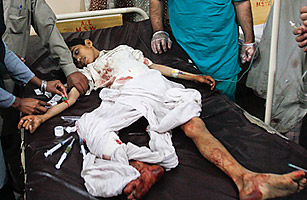
Footage from the scene showed ambulances racing to the area and men carrying away victims. One young man whose arm was apparently hurt screamed as he was placed on a stretcher. A white car caught up in the explosion was largely destroyed, its hood twisted upward. A man lay wounded on the ground with two women and a child weeping beside him.

Dr. Zahid Pervaiz at the city’s Mayo Hospital told reporters that 10 dead bodies had come in, while another 52 people were wounded.

Shakirullah Shakir, a spokesman for the Fidayeen-e-Islam wing of the Pakistani Taliban, told The Associated Press in a phone call that the militant group had dispatched the bomber and warned of more bombings.

Later Tuesday evening, a suicide bomber struck police protecting a group of people returning from a Shiite march in the Malir neighborhood of Karachi, Pakistan’s largest city.

Three people were killed and three wounded in the attack, said Hamid Paryar, a doctor at Karachi’s largest hospital. Two of those killed and one wounded were policemen, he said.

The third person killed is believed to be the suicide bomber, who was riding a motorcycle and carrying his explosives in a bag, said senior police official Shaukat Shah.

The blast occurred near a police van protecting the Shiite marchers, said Akbar Jaffry, who witnessed the bombing.

Attacks roughly tripled last year in Lahore and Karachi, according to a recent report by the Islamabad-based Pak Institute for Peace Studies.

The trend is a sign that militants are having greater success exporting the fight far from their northwest heartland along the Afghan border. The Pakistani army, under U.S. pressure, has carried out several offensives against militants in its northwest, but violence persists.

Pakistanis, Indians want peace, friendship, says poll

As Reported by SANA (South Asian News Agency)

Despite a history of conflicts, mistrust and estranged relationship, an overwhelming number of Pakistanis and Indians want peace and friendship between the nuclear-armed South Asian nations, a survey conducted on both sides of the border has revealed.

The survey – conducted by independent research agencies and sponsored by the Jang Group of Pakistan and The Times of India on the first anniversary of their joint peace initiative ‘Aman Ki Asha’ – showed that 70 per cent of Pakistanis and 74 per cent of Indians want peaceful relations.

Although, the process of composite dialogue between Islamabad and New Delhi remains stalled since the 2008 Mumbai carnage, 72 per cent Pakistanis and 66 per cent Indians hope to see ’sustainable friendly relations’ in their lifetime. Compared with last year, the number of Indians hoping to see peace in their lifetime has surged by 17 per cent.

The optimism at the people’s level appears in a stark contrast to the current bitter official positions. The Indian government accuses Pakistan of harbouring terrorists and not doing enough against the alleged sponsors of the Mumbai attack, while Islamabad says that New Delhi has been using this incident as a ‘propaganda’ tool to avoid talks on the core issue of Kashmir. Islamabad also blames India for instigating violence in Balochistan.

According to the survey, awareness of the Kashmir problem as being central to the state of relations between the two countries, particularly in India, has increased. The survey results show that 77 per cent Pakistanis and 87 per cent of Indians feel that peace can be achieved by settling the protracted Kashmir dispute.

The scientific survey covered 10 Pakistani cities and 42 villages, covering a cross-section of people from rural and urban areas. Pakistani cities where the survey was carried out were: Karachi, Lahore, Rawalpindi, Islamabad, Peshawar, Quetta, Multan, Faisalabad, Hyderabad and Sukkur. In India, the survey was conducted in six cities: Delhi, Mumbai, Kolkata, Bangalore, Hyderabad (Deccan) and Chennai. Adult population, both male and female, were represented in the survey.

This was the second survey on Pakistan-India relations. The first survey was conducted in December 2009; just before the Aman Ki Asha peace campaign was launched. Survey results show a consistent and marked improvement in perceptions about each other by people in both countries.

The survey showed that the issue of Pakistan-India relations featured in the thoughts of 73 per cent Pakistanis and 68 per cent Indians. The survey results said apart from settling the Kashmir dispute, 80 per cent Pakistanis and 91 per cent Indians think ’stronger relations and better defence’ would also contribute in achieving the goal of peace.

The survey tracked the impact of the Aman Ki Asha campaign in India by asking a similar set of questions to two groups of people – one aware of this peace campaign and the other not aware of it. On all four questions asked – perceiving Pakistan as a high threat to India, as a sponsor of terror, desire for peace and being hopeful for achieving sustainable peace – there was a marked difference in the responses of the two groups. The group that was aware of the Aman Ki Asha initiative had a much better perception of Pakistan.

Around 77 per cent of Pakistanis and 87 per cent Indians consider that international pressure may help in bringing peace, while 71 per cent Pakistanis and 72 per cent Indians pin hopes on greater people-to-people contact to pave the way for friendly relations. Eighty-one per cent Pakistanis and Indians see people-to-people contact as an effective ‘instrument of peace’.

An increase in business has also been tipped as a vehicle of peace by 67 per cent Pakistanis and 69 per cent Indians, the survey said. Among other steps needed to promote peace, 32 per cent Pakistanis pinned hopes on sports, 28 per cent on business, 22 per cent on tourism, 20 per cent on travel for health treatment and 13 per cent each on culture and higher education. The data from the Indian side regarding this questionnaire was not available.

For 51 per cent of Pakistanis, business can help bring peace, while 46 and 45 per cent of respondents said that it can also be done through sports and tourism respectively.

AMAN KI ASHA: The first of its kind peace drive ‘Aman Ki Asha’ was seen by a vast majority as articulating the aspirations of the people. Around 87 per cent Pakistanis and 74 per cent Indians were of the view that this sustained campaign ‘developed tremendous awareness about the Indo-Pak relationship’. Around 85 per cent Pakistanis and 61 per cent Indians said Aman Ki Asha communicated ‘peoples’ desire for peace to their governments, while 80 per cent Pakistanis and 86 per cent Indians said it ‘helped bring the people of the two countries together’.

The Jang Group and The Times of India have held a series of events over the last 12 months that involved a broad section of people, including students, intellectuals, artists, businessmen, doctors, information technology experts and ordinary citizens in an attempt to boost people-to-people ties.

In Pakistan, the recall of the ‘Aman Ki Asha’ campaign has been around an impressive 92 per cent. Shahrukh Hasan, Group Managing Director of the Jang Group, said this media-led civil society movement had made a huge contribution for peace at a time when tensions remained high between the two countries.

“The survey results should lay to rest any misgivings or apprehensions people may have had about the objectives or chances of success of the campaign,” he said. “The survey results show that Aman Ki Asha has brought about a sea change in perceptions in India about Pakistan. Every negative perception has decreased and every positive perception has improved. The Jang Group feels vindicated and is delighted that we have helped put across Pakistan’s point of view through honest dialogue, seminars, people-to-people contacts and cultural events.”

According to the survey, the terror perception in India about Pakistan is down to 42 per cent from 75 a year ago, of bomb threats to 29 per cent from 54 and awareness about the Kashmir dispute rising to 17 per cent from a mere four per cent. Hasan hoped that the Pakistani and Indian governments would continue to facilitate the Aman Ki Asha peace campaign and take advantage of the access to the hearts and minds of the people of the two countries that the Jang Group and the Times of India provided.