Posts Tagged ‘ Muslims ’

Islam & the NYPD

By Dr Qanta A Ahmed for NY Post

The relentless campaign to paint the NYPD as Islamophobic is itself an offense to Islam. In fact, our faith compels American Muslims to stand with the NYPD — both to protect the faith, and by its direct dictates.

Let me be clear: By investigating Islamist sympathizers who seek to curtail the freedoms of all Americans, the NYPD is aggressively protecting the freedoms and privileges that Muslims enjoy in America (freedoms that aren’t available even in the birthplace of Islam).

Islamism is distinct from the beliefs the majority of Islam’s 1.6 billion followers hold dear. The cry of “Islamophobia” is often merely an effort to silence those of us who seek to communicate this distinction, or to express concerns about Islamism. Most Muslims are spiritually private, committed persons active in their societies without a subversive political agenda. Think of them as pluralistic Muslims.

Because America’s religious freedom is protected by constitutional ideals, Muslims can pursue this pluralistic life — an American life that makes private space for faith, in parallel to public roles. Indeed, Muslims in America are freer to do this than Muslims in Pakistan (where my family is from), Saudi Arabia (where I have lived) or even Indonesia, because each of these Muslim-majority countries imposes laws restricting the practice of religion.

In many ways, Muslims are best able to follow their Islam — to become Muslim in the fullest sense — here in America, because of this nation’s astonishing, constitutionally guaranteed freedoms.

Political Islamism — variously called radical Islam, jihadism or Islamic fundamentalism — is completely different. In contrast to our centuries-old faith, it’s a modern political project that seeks to return any society to a supposed “scriptural foundation” of the Muslim community, removing existing forms of government and laws.

Sound like a war? Well, in the wider world and here in America, there is indeed a war afoot — a war of ideas, a “Battle for the Soul of Islam,” as my colleague, American Islamic Forum for Democracy president Zudhi Jasser, has termed it.

In this battle, the Islamist thrives — citing freedom of speech, claiming disadvantaged civil rights, exploiting the privileges that a liberal democracy accords him. Often operating via advocacy groups or “Islamic societies” that purport to represent mainstream Muslims, he or she truly serves a political agenda centered on replacing liberal democracy with fundamentalist theocracy.

In fact, the Koran is explicit on the loyalties a Muslim must accord his host nation, mandating a Muslim’s duty to be an unwavering and loyal patriot:
O ye who believe! Obey Allah, and obey His Messenger and those who are in authority from among you. (Ch.4: V.60).

That verse demands the Muslim express loyalty to any ruling authority. This isn’t a suggestion, this is mandated Islamic duty.
The Koran does not state leadership specified as Muslim. Leadership is whomsoever is empowered in the society where the Muslim finds himself. For us here, that includes loyalty to the NYPD, the FBI and their work to safeguard our highest authority — the principles of our liberal democracy.
Can any one group speak for the entire American Muslim community? Islam is diverse — especially in America. Islamism isn’t. The sooner we understand this, the better — because at stake are America’s ideals.

America’s extraordinary freedoms afford us an ability to define our own expressions of Islam as Muslims in a way that no Muslim-majority nation secures for any Muslim anywhere today. We must preserve these values, and join the NYPD, in understanding the Islamist threat to these values.
This means we must support, not vilify, our policemen and -women, our federal agents and our police commissioner — especially when they gather and interpret information they need to preserve us and our values.

How many devout Muslims were among the thousands killed on 9/11? Let us never forget that Islamists — moving among the broader Muslim and secular communities — have wrought atrocities in this city and around the world, and seek to do so again.
If you choose to smear the NYPD for its work to protect us and our society, so too you choose to smear me, a pluralistic patriotic Muslim in America, for demanding an honest discourse.

Dr. Qanta Ahmed practices medicine in New York. She is the author of “In the Land of Invisible Women.”
Twitter: @MissDiagnosis

Welcome To The First Annual Celebrity Religion Swap

By Wajahat Ali for Salon.com

Muslims worldwide groaned upon hearing the news that Oliver Stone’s son, Sean, converted to Islam while filming a documentary in Iran.

Although we — the collective 1.5 billion Muslims worldwide — assume Sean Stone is a fine, upstanding man and sincerely wish him spiritual contentment, we earnestly ask Allah why Islam only attracts controversial celebs (in this case, the son of a controversial celeb) who further tarnish our already toxic brand name?

We plead to the heavens for an answer as to why he converted in Iran, of all places, which is currently the most feared and loathed country in America and about as popular as herpes.

We have patiently endured, oh, Allah.

We miraculously survived Mike Tyson, who converted to Islam while incarcerated, and then angrily threatened Lennox Lewis in an infamous interview: “I want your heart. I will eat his children. Praise be to Allah.”

Awesome.

Islam has the lowest favorability rating of any religion in America. If Islam were a world economy, it would be Greece. If it were a professional athlete, it would be San Francisco 49ers punt returner Kyle Williams, who muffed two critical punts, which helped the New York Giants reach the Super Bowl. If Islam went to the prom, it would be the ugly girl with freckles and an overbite standing in the corner with a bucket of pig’s blood teetering precariously over its head. If Islam were a Republican presidential candidate, it would be Newt Gingrich.

A diverse jirga of American Muslim leaders decided “enough was enough” and held an emergency meeting at Lowes’ Home Improvement store in Dearborn, Mich., to strategize how to bolster Islam’s faltering image.

A consensus emerged that we needed to draft popular, mainstream celebrities whose successful addition to our starting lineup would boost our international brand name. After all, 1,400 years of civilization and the religious practices of 1.5 billion solely rest on the tanned shoulders of the rich, famous and beautiful.

Inspired by comedian Dave Chappelle, one of the few Muslim converts who could be considered a net gain, the Muslims held a “Religious Draft” this week, inviting major religions to participate on hallowed ground: McDonald’s.

The following is a summary of the proceedings.

THE FIRST ROUND PICK

Since it was universally accepted Islam was the 2011 Indianapolis Colts of world religions, they had first pick.

Predictably, the Muslims drafted free agent Liam Neeson, who recently said, “There are 4,000 mosques in [Istanbul]. Some are just stunning and it really makes me think about becoming a Muslim.” The Irish actor is experiencing a pop cultural rebirth as the 21st century embodiment of uncompromising, kick-ass masculinity and sage paternalism. On behalf of Muslims, he took revenge against France, which recently caved into hysteria and banned the burqa. Neeson single-handedly destroyed the entire country with his bare fists in the blockbuster action film “Taken.” Muslims believe Neeson will help rebrand them as Jedi Knights, due to his portrayal of Jedi Qui-Gon in “Star Wars: The Phantom Menace,” and replace their current image as Dark Lords of the Sith.

Rumors circulated that many Evangelical Christians felt slighted by this pick since Muslims stole their digital Avatar of Jesus: Neeson voices “Aslan the Lion” from the “Narnia” movies.

The rest of the day’s picks were organized according to different types of celebrity.

ATHLETES

In a surprise move, the Buddhists requested Mike Tyson from the Muslims. Exhausted from voluntarily suffering for the past 2,500 years, the Buddhists decided Tyson’s crushing right uppercut could “really eff up China.”

In turn, the Buddhists decided to offer the Beastie Boys — the aging, versatile, hip-hop trio from Brooklyn – sensing they peaked with their 1998 “Hello Nasty” album. The Muslims accepted, acknowledging the songs “Sabotage” and “Shake Your Rump” as perennial favorites in Egypt and Lebanon.

The Buddhists selflessly threw in Richard Gere and DVD copies of “American Gigolo” to sweeten the deal.

The Jews intervened and said they wanted the Beastie Boys back on their team. They offered the Muslims Ben Roethlisberger, two-time Super Bowl champion quarterback of the Pittsburgh Steelers. Having read about Big Ben’s dubious history of sexual impropriety, the Muslims passed, but decided to donate Mike D of the Beastie Boys to the Jews as a truce offering. Allegedly, the Muslims could never forgive Mike D for the horribly weak rhyme “Everybody rappin’ like it’s a commercial, acting like life is a big commercial” on the song “Pass the Mic.”

The Jews accepted the offer.

The Muslims, feeling emboldened, made an ambitious pitch to the Christians for Denver Broncos quarterback Tim Tebow, who “just wins.”

Muslims offered former NBA all-star Shaquille O’Neal, who fell from their graces after he acted as a giant genie in the box-office bomb “Kazaam.” They also threw in Mahmoud Abdul-Rauf, the controversial Denver Nuggets star who converted to Islam and refused to stand for “The Star-Spangled Banner” before games. The Christians were initially enticed, seeing this as a perfect “born-again” moment, but they passed.

The Muslims went aggressive and promised they wouldn’t supplant the Constitution with Shariah and replace the White House with minarets unless Tebow and Mel Gibson crossed over.

The Christians, anxious to excommunicate Gibson, agreed. For the 2012 NFL season, Tebowing will now consist of prostrating and praising Allah after every touchdown. The Christians asked the Muslims to preserve Tebow’s chastity and not introduce him to Miss USA Rima Fakih or hot Arab women from the reality TV show “All-American Muslim”; the Muslims said they’d try, but they promised nothing.

COMEDIANS

The Jews made a play for comedian Dave Chappelle, a Muslim, citing his hit series on Comedy Central “Chappelle’s Show” as a creative juggernaut that still influences the masses — especially several rabbis, who apparently love saying, “I’m Rick James, bitch!” after performing circumcisions.

The Muslims immediately rejected the offer, saying Chappelle is perhaps the only living proof that Muslims can be intentionally funny.

Instead, they offered Iranian President Mahmoud Ahmadinejad as an example of an unintentional comedian and provocateur in exchange for Israel cooling down its dangerous rhetoric of a preemptive strike on Iran.

Furthermore, the Muslims offered the newly acquired Mel Gibson straight up for Jerry Seinfeld.

The Mormons tried to intercept Seinfeld by playing one of their highest cards: “Napoleon Dynamite” actor Jon Heder. The Jews pretended not to hear this mockery and allowed the Mormons to slink away with some shred of remaining dignity.

The Jews finalized a deal with the Muslims and rumors have circulated since that Mel and Ahmadinejad are under house arrest in Tel Aviv, forced to watch “The Chosen” and “Fiddler on the Roof” on repeat while listening to Jerry Lewis perform comedy.

MUSICIANS

Sensing friendly relations, the Jews humbly approached the Muslims for rapper Ice Cube, citing his immense street cred and respect from the hip-hop and African-American communities. The Jews conceded the Matisyahu experiment, although initially promising, had failed, as the Hasidic reggae rapper never lived up to his “King Without a Crown” potential.

The Muslims mulled it over for a considerable time. The jirga decided they would retain eternal rights to Cube’s 1993 hit single “It Was a Good Day” from his multi-platinum album “Predator,” but ultimately release him because he inexplicably starred in the awful family comedy “Are We There Yet?”

Muslims in return asked the Jews for Kabbalah-worshipping Madonna, sensing serious comeback potential after her excellent Super Bowl halftime show.

Catholics made a request for multi-talented actor and hip-hop artist Mos Def from the Muslims, who soundly rejected any and all future offers, stating the entirety of the Middle East and North Africa could never bear to part with Def’s song “Ms. Fat Booty.”

Instead, Muslims counter-offered with alternative rock artist Everlast, whose 1998 single “What It’s Like” has made a surprising comeback on radio stations due to the economic recession. The Catholics still remember Everlast as the lead singer of the hip-hop band House of Pain, who produced the classic party anthem “Jump Around,” before his conversion to Islam. The Catholics accepted; South Asian Muslims danced to “Jump Around” one last time; and the Muslims in return received Taylor Swift and her legions of pubescent female fans, along with her former boyfriend Taylor Lautner, who played the ethnic werewolf in the “Twilight” movies.

The Muslims had finally secured their most promising young-adult celebrity.

POLITICIANS

The Mormons halfheartedly offered Mitt Romney. The Evangelicals promised Michele Bachmann and her lifetime supply of blinks. The Catholics, out of sheer desperation and embarrassment, bartered Newt Gingrich and his third wife, Callista.

The Muslims decided to stick with their boy, Barack Hussein Obama, in hopes of retaining the White House in 2012.

MISCELLANEOUS

Muslims threw a Hail Mary and asked fundamentalist Christians for Chuck Norris, who so thoroughly kicked the Middle East’s entire ass during the ’80s. The Muslims respected Norris for his ability to fire an Uzi, perform a roundhouse kick and wave an American flag at the same time. In return, Muslims offered the infamous WWF wrestler the Iron Sheikh and even agreed to teach the Christians the impregnable camel clutch. Norris, humbled by the offer, respectfully declined, and admitted that although he enjoyed killing hordes of fictional Arabs in jingoistic action movies like “Delta Force,” he currently fancied himself an intellectual and activist committed to exposing the nonexistent threat of Shariah infiltrating America. The Muslims were saddened, but collectively agreed to watch Norris in the summer action film “Expendables 2.”

The Hindus decided to play their strongest card, actress Julia Roberts, and made a request for journalist Lauren Booth, former British Prime Minister Tony Blair’s sister in law, who converted to Islam in 2010. The Hindus saw her as the perfect revenge and giant, henna-painted middle finger to England for the British Empire’s previous colonization and exploitation of India’s resources. The Muslims thought this was reasonable and now the “Pretty Woman” flashes her million-dollar smile behind a burqa.

THE CHOSEN ONE

Finally, the draft ended with all the religions coveting “the chosen one,” who would single-handedly redeem their public image both at home and abroad.

The Mormons offered former Republican presidential candidate Jon Huntsman, highlighting his excellent Chinese and fine hair. The Muslims initially offered NBA Hall of Famer and current cultural ambassador Kareem Abdul Jabbar. They sweetened the deal and threw in President Obama. The Jews presented Steven Spielberg and his entire film library. The Hindus humbly offered Bollywood actors Amitabh Bachan, Aishwarya Rai and a picture of Gandhi signed by Ben Kingsley. The Buddhists presented Tina Turner, Herbie Hancock and Tiger Woods.

But, it was sadly to no avail.

The Christians and Church of New York decided to keep NBA superstar and New York Knicks point guard Jeremy Lin. Rumors circulated that they were talking to China about a potential trade to ensure the ambitious superpower does not ask the United States to repay its debt, thus financially crippling and utterly destroying our great nation.

All in all, “it was a good day” for the Muslims in the first Religious Draft.

Wajahat Ali is a playwright, attorney, journalist and essayist. His award winning play”The Domestic Crusaders,” was published by McSweeney’s in 2011. He is the lead author of “Fear Inc., Roots of the Islamophobia Network in America.” He is currently writing a pilot for HBO. He is co-editing the anthology “All American: 45 American Men on Being Muslim” published in June 2012. More Wajahat Ali


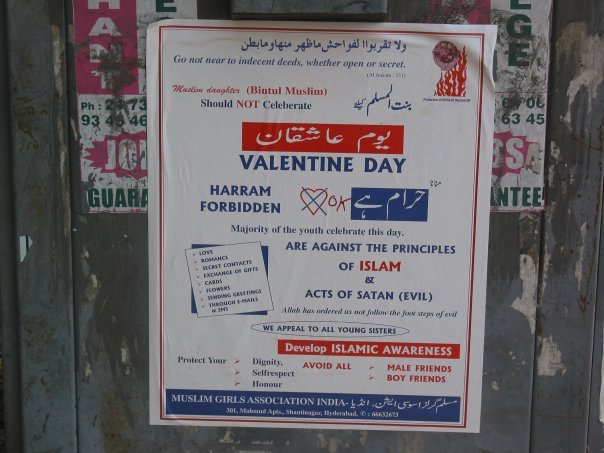
Valentine’s Day in Islam?

By Paul Salahuddin Armstrong Co-Director, Association of British Muslims

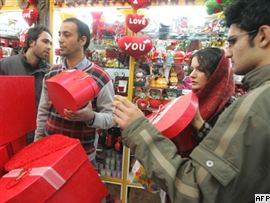
I was asked to share my views on Valentine’s Day. Personally, I really don’t see what’s the problem that some people seem to have with this celebration. The fact that it’s a Western, originally Christian festival is in all honesty, completely besides the point. We should celebrate Love everyday!

Many cultures have something similar, a day to celebrate love, to send a message of love to your beloved – a person whom you would like to marry or is already your husband or wife. Seriously, what’s wrong with that? What could possibly be wrong with that?
The only argument I’ve heard against Valentine’s Day, is the same one I hear about every other festival besides the two Eids – it’s not part of Islam. Well, sorry, if that’s the best these people can come up with, it’s a pathetic argument – cars and aeroplanes aren’t technically part of Islam either, but we still use them!

More to the point, a Muslim can celebrate any festival, even the social aspect of those of other religions, as long as this doesn’t mean they end up committing shirk – i.e. worshipping another deity besides God or associating partners with God – and this is the position of the mainstream scholars of Al-Azhar University in Egypt.

Indeed, for the vast majority of people who celebrate it, Valentine’s Day isn’t even that religious, rather it’s just a wonderful opportunity to show loved ones how much you appreciate them – which is something every Muslim should do anyway, even if they do not celebrate Valentine’s Day!

Pakistanis for Peace Editor’s Note– Finally, a Muslim perspective on Valentine’s Day that we can agree with! As compared to many other articles that decry Valentine’s Day as a pagan holiday and it is shirk to celebrate it, Paul has succinctly yet effectively given a great differing Muslim angle on this day as compared to the Orthodox Muslim view.

America’s Dark Age of Islamophobia

By Tony Norman for Philly.com

Muslims really thought they were doing the world a favor by pulling Europe and its mostly illiterate Christians out of the Dark Ages. But just because they foisted algebra, trigonometry, optics, astronomical charts, the classics, Arabic numerals, advanced surgical techniques, perspective in art, the lute, and artichokes on the world – while the Christian kings of Europe were smothering free inquiry – we’re not about to give them any credit a thousand years later.

Particularly in America, we remain ignorant of Islamic contributions to Western life. We suffer from a profound cultural amnesia when it comes to remembering our millennia-long debt to our Muslim brethren. But as the song goes, what has Averroes done for us lately?

Americans are so used to thinking of Muslims as an exotic “other” that many fail to realize they’re an inextricable part of who we are and have been since the nation’s earliest days. Unfortunately, too many non-Muslims see them as Manchurian candidates crouching in the shadows with explosive vests, waiting for the signal to wage terror on America’s malls. If you ask the average American citizen about Islam’s role as an incubator of Western ideas, expect stares of incomprehension.

If this ignorance were restricted to the margins of society, it wouldn’t be half as embarrassing. But Islamophobia, like its twin brother, anti-Semitism, has a way of injecting itself into the cultural discourse. Contempt for Muslims remains an acceptable prejudice for millions who continue to equate the religion with terrorism.

Recently, TLC began running an innocuous reality show called All-American Muslim. It documents the lives of five Muslim families in a Detroit suburb that boasts the highest concentration of Arabs and Muslims in America. The 99 percent of Americans who don’t share their faith are invited to explore the possibility that these very misunderstood Americans don’t have horns or drink the blood of infant Christians and Jews.

It didn’t take long for a conservative group calling itself the Florida Family Association to complain that the TLC series is “propaganda that riskily [sic] hides the Islamic agenda’s clear and present danger to American liberties and traditional values.”

Of course, there’s nothing on the show to indicate a subversive religious agenda, other than its blatant attempt to portray Muslims as humans.

Lowe’s Home Improvement couldn’t be bothered with such nuances. It pulled its ads from the show and issued the wimpiest justification of corporate cowardice ever: “Individuals and groups have strong political and societal views on this topic, and this program became a lightning rod for many of those views.”

Ted Lieu, a state senator in California, called Lowe’s capitulation to intolerance “un-American” and is considering calling for a boycott of the retailer. Lowe’s isn’t worried about a boycott from America’s Muslims, who number fewer than two million, but a sympathy boycott by fair-minded Americans of all faiths and political persuasions would be a nightmare for the company.

Crawling out of this depressing sequel to the Dark Ages won’t be easy.

Lowe’s Errs in Muslim Ad Uproar

By Laura Berman for The Detroit News

Lowe’s used to be the home supply store for macho do-it-yourselfers who want to pick up a chain saw or a sledge hammer along with a box of garbage bags.

Now it’s steeping in a political mess, the result of acceding to the demands of a “pro-family” group — a warm-and-fuzzy sounding way to describe a group that specializes in email campaigns targeted against TV shows that treat minorities as human beings.

In this case, the target was “All-American Muslim,” The Learning Channel’s new reality show that depicts five Muslim families in Dearborn as they entertain, bicker, laugh and get married. The show’s premise — that Muslims are Americans, too — verges on the silly in its obviousness, or so most would think. But the Florida Family Association branded the show, which premiered a month ago, as “propaganda that riskily hides the Islamic agenda’s clear and present danger to American liberties and traditional values.”

The group launched its email campaign in November, then triumphed when Lowe’s — among dozens of other sponsors — disappeared from the show in subsequent episodes.

Its big beef was the lack of negative portrayals of Muslims on the show: Insufficient underwear bombers and radical clerics. The FFA wants ordinary, tooth-brushing, family-friendly Muslims “balanced” with scary, America-hating radical Muslims, apparently as a way to keep suspicion and prejudice alive.

This strikes me as un-Christian to the max. But Lowe’s bought in or, more likely, tried to gracefully bow out of the political arena by removing itself from the show’s list of sponsors.

Lowe’s next error: releasing paragraphs of corporate mumbo-jumbo, pseudo-apologies that fueled the growing uproar. Now there’s a festive holiday season cultural eruption centered on Dearborn. Dearborn’s Muslim community leaders are denouncing Lowe’s, while the Florida Family Association brags online about its successful campaign to eliminate advertisers for “All-American Muslim.”

In the FFA’s version of All-American, only “God fearing” Christians are real Americans, released from requirements to be portrayed, at least some of the time, as crucial components of the axis of evil.

This xenophobic, self-justifying bigotry is, in fact, just as American as our more widely copied ideas about equality for all and a universal right to pursue happiness. But it’s hard to believe what a persistent undercurrent conspiracy theories are in American culture.

The Pulitzer-Prize winning historian Richard Hofstadter described 50 years ago what he called “the paranoid style” in American politics, giving as an example a 1964 campaign by the John Birch society to boycott Xerox for advertising on a television show about the United Nations.

Just as American Muslims are now subjected to bigotry and suspicion, Masons and Catholics were singled out by 19th century Americans bent on protecting their country through conspiracy theories, and Japanese Americans were forced into 20th century concentration camps.

“American politics has often been an arena for angry minds,” Hofstadter wrote, describing a state of mind that flourishes in America today.

The problem isn’t only anger but, also, how fear so easily drowns out even a chain-saw-wielding corporation’s All-American supply of courage.

This is not Prophet Muhammad’s Islam

By Manzer Munir for Pakistanis for Peace

The steady stream of negative news about the twisted way Islam is being practiced around the world seems to never end. In my view, it is not how the Prophet would have wanted his followers to behave.

Just when I thought I was beginning to get used to the ridiculousness of the news coming out of Saudi Arabia, where a religious edict is trying to force women there with beautiful eyes to  completely cover up their face in order to stop the temptation of the men, along comes the grim news of Gulnaz  from Afghanistan. If you are not familiar with Gulnaz’s story, let me give you the facts.

Two years ago, in 2009, Gulnaz, a 19 year old single girl who lived with her elderly mother in Afghanistan, was brutally raped by her cousin’s husband. To describe the events, she recalls that on this day, the rapist came into her house when her mother left for a brief visit to the hospital. “He had filthy clothes on as he does metal and construction work. When my mother went out, he came into my house and he closed doors and windows. I started screaming, but he shut me up by putting his hands on my mouth,” she said.

Afterwards, she hid what had happened out of shame and fear, as shockingly there is no difference seen between women who are raped and women who commit actual adultery.  In Afghanistan and in many conservative Muslim countries, any sex outside marriage, whether the guilty party is single or married is considered adultery by the society and the justice system.

A few weeks after her rape, she began to vomit and started showing signs of pregnancy with her attacker’s child. Instead of sympathy and proof of her ordeal, she was charged and found guilty of adultery by the courts and for having sex outside marriage and was sentenced to twelve years in prison. She has already served two years and even gave birth to her rapist’s child, a little girl, in Kabul’s Badam Bagh jail where sadly, her innocent daughter is being raised in captivity alongside the unfortunate mother.

Rather than being freed from jail and given justice for her painful ordeal, the only way out of the dishonor of rape or adultery for her is incredibly only by marrying her attacker. In Afghan culture, and indeed in most Muslim communities, this is believed to be the only way to restore a woman’s honor, by marrying the man who she had sex with, damned be the fact whether it was willingly or unwillingly!

Sadly in many Muslim countries, rape remains a common form of violence against women. In addition, women are often blamed for being the victim of rape. Islam however, views rape as a violent crime against the victim, against society, and against God. The perpetrator who commits a crime is morally and legally responsible for that crime and should be held accountable. The victim, who is an unwilling partner in the sex act and so should bear neither blame nor stigma associated with the unfortunate act. To either ostracize or condemn the victim because she was compelled to engage in sexual intercourse is against the laws of Islam since the victim was an unwilling, and therefore a blameless, participant.

As common as her story and circumstances are for a woman in Afghanistan, the world has only learned of it due to a chance foreign documentary.  Gulnaz’s ordeal came to light because of a dispute between filmmakers and the European Union who hired the crew to film a documentary on the improving situation of women’s rights in Afghanistan and the assistance that the EU has been providing in the better treatment of women in the country. It was only when the documentarians came across her story and the grave injustice being done to Gulnaz and indeed by some accounts, hundreds of women across Afghanistan in similar circumstances, that the EU decided to cancel the project out of fear of harming their relations with Afghan government and institutions. Officially the EU states that it fears for the safety of the women in the film as they could be identified and face reprisals but many human rights organizations believe it is due to the fact that the film shows Afghan justice system in a poor light and the EU is concerned about the Afghan government’s sensitivities to the situation. It is despicable that the EU is more concerned with the sensitivities of the Afghan government rather than fighting for justice for Gulnaz.

Customs such as these in Afghanistan or the recent religious ruling in Saudi Arabia warning women to cover their attractive eyes, or the continued religious persecution of Christians and other minorities in Pakistan through the egregious blasphemy laws as seen in the case of Aasia Bibi, only serve to illustrate to many within and outside Islam the tremendous challenges that exist in what is right and what is logically very wrong and goes against all sense of justice and common sense, not to mention the very essence of Islam.

I am certainly not arguing for making any changes in the Quran or interpretations of religious text or any wholesale revisions whatsoever. That would not only be blasphemous but also counterproductive and unnecessary. Furthermore,  a big part of the beauty of our religion stems from the fact that it has remained unchanged as we Muslims believe that mutations and changes in both the Bible and the Torah necessitated the need for a third Abrahamic religion, Islam,  to arrive some 1400+ years ago to “set the record straight” after all the changes over the years in the two earlier Holy Books. Instead, I believe the only thing that needs to occur is the realization amongst the leaders and countries of the Organization of Islamic Conference (OIC) that in this day and age, there are certain rights and freedoms that should be guaranteed to citizens of all countries of the world and this does not require any changes in the great religion but rather some simple changes in the current laws.

Aristotle once said that “You can judge a nation by the way it treats its most vulnerable citizens”. You could be a Hindu or a Christian in Pakistan, a woman in Afghanistan or Saudi Arabia or a homosexual or transgendered person in Iran, you do not deserve to lose your life or liberty under the guise of religious laws. Allah almighty is a just and fair God in Islam, just as he is in the Christian and Jewish faiths. He most certainly would never condone the treatment of Gulnaz, Aasia Bibi and countless other poor souls who are being mistreated under the banner of Islam.

I am not a religious scholar and nor do I profess to know everything I need to know about Islam, Christianity and many other religions. Some may even question my faith and belief in calling myself Muslim simply because I am asking these tough questions, and in their version of Islam, you never question, you simply obey. Lest they forget, Islam also clearly states to seek knowledge and to be just and fair and respectful of other religions.  “Surely those who believe and those who are Jews and the Sabians and the Christians whoever believes in Allah and the last day and does good — they shall have no fear nor shall they grieve.” (Quran 5:69)

I am however certain that the Prophet Muhammad (peace be upon him) would indeed be very upset with the current state of affairs of most Muslim countries when it comes to morality, religious freedoms,  respect for other religions and the treatment of women. Sadly, I do not see the changes necessary coming into being voluntarily by these nations, I believe it is incumbent of the benefactors of these nations, such as the United Nations, United States, the European Union, China and other trading partners, to push for better treatment of women and religious minorities in many Muslim countries of the world.  It is high time that they pressure these nations into enacting basic rights and freedoms for all people, regardless of their race, religion, gender, and sexual orientation. It must become a precursor to being a part of the civilized nations of the world and in being a member of the world community of nations. Freedom after all is what the Arab Spring is all about!

-Manzer Munir, a proud American of Pakistani descent, is a practicing Sufi Muslim and member of Muslims for Progressive Values, he is also the founder of Pakistanis for Peace and blogs at www.PakistanisforPeace.com as well at other websites as a freelance journalist and writer.

Muslims in America: A mosque rehabilitates its image

Conversations / Live Q&A Washington Post

ABOUT THE HOST
Imam Johari Abdul-Malik
Imam Johari Abdul-Malik serves as the director of Community Outreach for the Dar Al-Hijrah Islamic Center. He was the first Muslim Chaplain installed at Howard University. The imam is the former chair of Government Relations for the Muslim Alliance in North America [MANA founded by Imam Siraj Wahhaj] and is the founding President of the Muslim Society of Washington, DC Inc and Associate Imam of First Hijrah Islamic Center in Washington, DC.

Known nationally for his fundraising efforts for masjids, schools and relief organizations, Imam Johari is a founding member of the Muslim Advocacy Commission of Washington, D.C. and “Muslim Men Against Domestic Violence” [MMADV] and has edited a book on”What Islam Says About Domestic Violence”.
ABOUT THE TOPIC
Dar Al-Hirjah is one of the largest mosques in America, and it can be linked to many terrorism suspects in some way. Imam Johari Abdul-Malik discussed the Dar Al-Hijrah mosque, rehabilitating the mosque’s image after 9-11, how 9-11 has affected Muslim life in America, and more.

Read: Imam serves as public face of an embattled mosque
IMAM JOHARI ABDUL-MALIK :
Salaam-Shalom-OmShanti-Peace,

I would like to thank The Washington Post and especially William Wan and Jahi for their work on this article. I pray that it will inspire more bridge building

– September 19, 2011 11:03 AM Permalink
Q.
CHANGES IN SENSITIVITIES
What are examples of what you have heard from fellow Muslims to any changes in how they have been treated since 2001? How much of a difference has there been? How often do they find themselves in a situation where someone has said or done something offensive or hurtful?
– September 19, 2011 10:43 AM Permalink
A.
IMAM JOHARI ABDUL-MALIK :
The overall experience has actually been positive. However, the negative experiences have been structural (Homeland Security, etc) but I expect that those things will change with time. I am a very positive person and I expect things to continue to only get better

– September 19, 2011 11:06 AM
Q.
AMERICAN MUSLIMS
Salaam alaykum, Imam Johari I am a devout American Muslim woman (and a convert like yourself), but after reading this, I would be terrified to attend your masjid. Instead of honoring your women, you make them go through a separate entrance in the back, for what? To protect men from seeing their wives and daughters? In the time of the Prophet, peace be upon him, men and women prayed in the same space. So my question is this, how can you hope to move from simply defending your community to integrating them into the country at large? This type of isolation and anger only breeds mistrust and silently encourages the behavior of men like Aulaqi. I truly wish you luck and will pray for your community. Please believe that there is another way. My masjid in Brooklyn is nothing like this.
– September 19, 2011 10:57 AM Permalink
A.
IMAM JOHARI ABDUL-MALIK :
I agree with you that the architecture of the mosque is not women friendly. I am working first to change to minds of people who attend the mosque and then we have to work on reconstructing the bricks to be more women and family friendly.

– September 19, 2011 11:09 AM
Q.
SHARIA
Do you agree with sharia?
– September 19, 2011 11:02 AM Permalink
A.
IMAM JOHARI ABDUL-MALIK :
Firstly, “sharia” for me, is similar to keeping kosher for Jews. I don’t believe that my beliefs or practices should be enforced on others. In short, I don’t believe that stoning or cutting off hands are what the Qur’an intended for the 21st century

– September 19, 2011 11:09 AM
Q.
PEDOPHILIA
Do you think its OK for a 53 year old man to marry a 6 year old girl? If so, why?
– September 19, 2011 11:03 AM Permalink
A.
IMAM JOHARI ABDUL-MALIK :
I would advise you not to do!

– September 19, 2011 11:10 AM
Q.
COEXISTENCE
What kind of outreach are you doing to local Christians and Jews?

– September 19, 2011 11:09 AM Permalink
A.
IMAM JOHARI ABDUL-MALIK :
We have been working with several churches and synagogues in the DC metro area for the past decade and have built many strong relationships…

– September 19, 2011 11:13 AM
HALEY CRUM :
What’s the most common question you usually get?

– September 19, 2011 11:15 AM Permalink
IMAM JOHARI ABDUL-MALIK :
The most common question to me is as a convert “how did you become a muslim?”.

– September 19, 2011 11:15 AM
Q.
FGM
Where do you stand on female genital mutilation?
– September 19, 2011 11:05 AM Permalink
A.
IMAM JOHARI ABDUL-MALIK :
FGM: Is not a practice of Islam and although many cultures before Islam practiced it and this unislamic practice continues. I am working with relief organizations and interfaith organizations to end this horrible pracitice.

– September 19, 2011 11:15 AM
IMAM JOHARI ABDUL-MALIK :
I wanted to mention here that it is my hope that terms such as “non-Muslim” and “Muslim World” will cease to be used as I see those terms as divisive. I always make it a point to correct anyone that I hear use these terms. I prefer “people of other faiths/traditions” when speaking of those that do not share my faith

– September 19, 2011 11:21 AM Permalink
Q.
AMERICAN MUSLIMS
But how do we change hearts and minds? Especially in a climate that seems to have grown more hostile to us? It’s difficult to tell other Muslims, especially conservative immigrants that they should embrace change and their new country when we’re being told we can’t build mosques. Park51 (aka the supposed Ground Zero mosque) is the perfect example. We worked so hard and against so much opposition for this place. Yet when I attended services a couple Fridays ago, a community member began berating a young Muslim woman for leading two male journalists in for both being uncovered and talking to a man. It’s humiliating.
– September 19, 2011 11:17 AM Permalink
A.
IMAM JOHARI ABDUL-MALIK :
I have learned so much from the examples of great people and the prophet Muhammad and Jesus (peace be upon them). We have to increase our efforts for the positive, try to understand the other. New immigrants have their baggage as everyone does. Dr. King said, ‘Let us overcome them with our capacity’ to love

– September 19, 2011 11:30 AM
HALEY CRUM :
What has the Muslim community done for America lately – is America a better place because of Muslims? – rickdumbronski

– September 19, 2011 11:30 AM Permalink
IMAM JOHARI ABDUL-MALIK :
First of all, there is single “Muslim community”. There are many different “communities” of Muslims with many diverse ethnic groups and sects. Secondly, there are Muslims in the US Armed Services and working within Homeland Security (including the FBI) that are serving their country with honor. Thirdly, there are many Muslim civilians that are working with law enforcement and are the very key to keeping us safe from terror plots. Without the help of Muslims, it would be much more difficult to fight terror

– September 19, 2011 11:30 AM
Q.
HOW TO COMBAT SHARIA STEREOTYPES?
I’m a humanistic Jew, and while I do not practice traditional Jewish law, I’m well versed in them. I personally don’t see a difference between Sharia and the Talmudic laws that also dictate not just keeping kosher, but divorces, shabbat, how, when, and where to pray, conversions, and all other sorts of elements of daily life. There are orthodox rabbinic courts, Beit Dins, that are sometimes used as alternative dispute resolution mechanisms instead of regular secular courts. The Catholic Church has ecclesiastical courts that gives annulments and hears other similar sorts of cases. How can we better express that Sharia is no different from the rules and institutions of other systems?
– September 19, 2011 11:21 AM Permalink
A.
IMAM JOHARI ABDUL-MALIK :
You are right on brother! We all need to speak this truth from the hill tops. Criminal law needs to stay in the hands of law enforcement.

– September 19, 2011 11:32 AM
Q.
THE ETHICS OF A FAIR FIGHT
Salam dear brother. Islam, as a way of life, prescribes an appropriate way to deal with oppression and systemic injustice. While it was recently reported that Muslims in the U.S. are less likely to justify attacks on civilians (Source – http://www.gallup.com/poll/148763/Muslim-Americans-No-Justification-Violence.aspx) than other groups, there are specific limits on what is acceptable when engaging against an oppressive military, even in self defense. Could you provide an example of a just war, at level of a country, based in what Islam teaches us? Could you provide an example that could apply to daily life at an individual level? Salam!
– September 19, 2011 11:28 AM Permalink
A.
IMAM JOHARI ABDUL-MALIK :
The “just war” theory seems to have only been applied to justify war. As they say, “war is hell”.

– September 19, 2011 11:37 AM
Q.
SHOUDLN’T YOU LEAVE THE COUNTRY?
In view of the past associations like Awlawki and the obvious distrust with which you and your mosque are held, don’t you think it is time you moved to a country like Pakistan or Yemen where you would find a more positive response to your preachings? Face the facts you don’t really fit in here.
– September 19, 2011 11:29 AM Permalink
A.
IMAM JOHARI ABDUL-MALIK :
I take great issue with the hate speech of Anwar Awlawki.

I’m from Brooklyn, NY. I am the decendent of enslaved Africans – I have every right to live in my own country. The first amendment affords me the right and responsibility to practice my faith alone with my fellow Americans.

– September 19, 2011 11:37 AM
Q.
TRUST
Mosques are places of public worship. What is wrong with the FBI monitoring places of interest in these times of distrust and international Islamic terrorism? Muslims in the West must accept a reasonable amount of observation given the facts. Muslims rooting out and identifying the dangerous extremists amongst them is not an unreasonable expectation of the non-Muslim citizenry. Trust has to be built by both sides. – Cretius

– September 19, 2011 11:19 AM Permalink
A.
IMAM JOHARI ABDUL-MALIK :
I agree that trust works both ways. My issue is the engagement with the leadership of the mosque as a partnership. I have worked with law enforcement on many cases but they only come to me after the fact. There have been instances where had they been a partner early on perhaps our security as a nation could be better secured. I like president Obamas new a approach – “Empowering Local Partners to prevent violentextremism in the US” . We are safer when we work together.

– September 19, 2011 11:37 AM
Q.
MUSLIME IN THE WEST
Many Muslims who came in an earlier age, assimilated well — but the new iimmigrnts refuse to assimilate but continue to wear Muslim dress, demand we set aside muslim holidays in our schools etc. don’t you think these muslims would be better off staying in a country which is predominately muslim.?
– September 19, 2011 11:37 AM Permalink
A.
IMAM JOHARI ABDUL-MALIK :
The question remains: Is American the great melting pot or the mulligan stew.

In the melting pot – all of the ingredients get boiled down.

I believe that what makes the great dish are the spices of every culture that adds to the favors of America, while still being able to identify the fruits.

– September 19, 2011 11:42 AM
Q.
ON TO THE NEXT
Do you think people view Muslims as “the enemy” now and will move on to another religion/ culture when the next big attack happens from another group? Is this a vicious cycle?

– September 19, 2011 11:40 AM Permalink
A.
IMAM JOHARI ABDUL-MALIK :
While Islam is the issue of time, we should not be in denial about the violence that is besieging our societies. All ideologies that promote violence as a mechanism for social change are dangerous whether they are so-called Muslims, White Supremist or drug cartels….non-violent resistance for social change must become the new revolution.

– September 19, 2011 11:46 AM
Q.
PART OF THE PROBLEM.
Don’t you think that your and your mosque are part of the problem and not part of the solutions? After all when you see the number of terrorists who have passed through your mosque, how can you not see yourself as part of the problem?
– September 19, 2011 11:45 AM Permalink
A.
IMAM JOHARI ABDUL-MALIK :
knowledge is power! I think the article addresses this issue well. I believe that my work is to counter-radicalization.

– September 19, 2011 11:52 AM
Q.
AMERICAN A MELTING POT FOR WESTERN EUROPE
The American melting pot, a description beloved of so many who know no history, forget that that melting was for people from W. Europe who came from similar backgrounds as Americans. The melting pot image lack veracity when you include non Westeners in the picture – it is they who have created the problem and ripped appart the melting pot immage.

– September 19, 2011 11:48 AM Permalink
A.
IMAM JOHARI ABDUL-MALIK :
With the melting pot only being for W Europeans, you are forgetting that there were slaves that were brought here from Africa 400 years ago. What is to happen to their decendents? We must work together -ALL OF US – and build bridges and not fantasize about an all white country that will never happen

– September 19, 2011 11:55 AM
IMAM JOHARI ABDUL-MALIK :
This has been a wonderful conversation and only increases the need for more dialogue and understanding. I would like to thank the Post for this wonderful medium of exchange – The On-Line Chat. Please share your experience with you friends and family –

‘You have been created into tribes and nations that you might know each other..verily the best among you are those who have faith and good deeds’-Quran

How Many Sufis Are There in Islam?

By Stephen Schwartz for The Huffington Post

Devotees of Sufism, the spiritual interpretation of Islam, face problems wherever they are found. In the West, many self-styled Sufis have never become Muslim, know little of the religious background of the Sufi way, and give Sufism a reputation as simply another flavor of New-Age, “weekend” mysticism. In Muslim lands, especially in the Arab core countries, classic Sufi authors may be praised while living Sufi teachers are derided as un-Islamic charlatans. And in some places, Sufis are imprisoned and murdered.

As a Muslim Sufi adherent, however, I am troubled especially by another expression of contempt very widely cast against Sufism by Islam-hating amateur experts in the West. That is the claim of Sufi irrelevance. Since the horror of Sept. 11, now almost a decade past, the identification of a moderate and contemplative form of Islam, which can oppose radical and fundamentalist doctrines, has seemed of considerable importance both for the moral health of Muslim believers and for the security of non-Muslims and Muslims alike. But the Sufi alternative to Islamist extremism is neglected or even disparaged, typically, by Muslim and non-Muslim commentators.

Western misperception of the importance of Sufis in Islamic life is complicated by lack of clarity as to who and what Sufis are. Sufis often enjoy great prestige with the mass of Muslims, based on Sufi examples of personal humility in fervor for God and Sufi preaching of love for humanity. But Sufis are not, mainly, other-worldly, exotic individuals or groups that spend all their time absorbed in semah (ecstatic turning on one foot and other forms of dance).

Some Sufis withdraw from the daily affairs of society, but others pursue satisfaction of the Creator by seeking social justice through improvement of popular education and services to the needy, such as housing of the homeless and free distribution of food. Rather than disappearing in a misty aura of meditation, numerous Sufis around the Muslim world contribute actively to defense of the victims of oppression.

Sufis may also take on the risky challenge of overt political engagement. This has been seen most strikingly in Turkish developments over the past two decades. Turkish Sufis were suppressed by the secularist regime established in the 1920s, but flourished in clandestinity, and have now emerged to lead Islamist parties and to assume positions in government. How the relations between Turkish Islamist politicians and Turkish and Kurdish Sufis will evolve remains to be seen.

Essential principles shared by most Muslim Sufis include emphasis on commonalities with other faiths and traditions, which has contributed to improved relations between Muslims and Jews, Christians, Buddhists and other non-Islamic believers. Commentators concerned to denigrate Islam altogether have asserted that Sufis, even if they embody moderation and mutual respect among people of religion, comprise no more than 5 percent of the world’s Muslims. Since the importance of Sufism stands, in the minds of many Westerners, on demographic measurement, let us therefore ask: How many Sufis are found in the Muslim world?

I would first observe that Sufis are present, persistently, in every Muslim population, including those where they were persecuted the longest: Saudi Arabia. Although the Saudi kingdom prohibited and punished possession of Sufi books and the practice of Sufi observances, the country always possessed a thriving Sufi underground with access to the heights of power. Before his elevation to the throne in 2005, then-Saudi Crown Prince, and now King Abdullah, who favored Sufis, gained them the right to hold zikr (remembrance of God by vocal or silent chanting, singing and bodily movements) in their homes.

In some countries Sufism is praised as an item of a proud heritage while it is repressed in daily life. The most obvious such example is that of Iran. The clerical regime established by Ayatollah Ruhollah Khomeini could not act easily against Sufis, since so many famous Sufis — such as Jalaladdin Rumi, the 13th century author believed by many to be, currently, the most widely read poet in the West — wrote in Persian, and Sufi texts became the national literature of the Iranians.

But while the Tehran clerics honor the Sufis of the past, they repress Sufis in the present. Sufis have most often functioned as an alternative to clerical authority in Islam, and widely represented Iranian Sufi bodies like the Nimatullahi-Gonabadi dervish order and the “hidden,” Kurdish-speaking Ahl-e Haqq or “people of truth” have sustained a difficult challenge to the Iranian authorities. Iranian Sufis have been arrested and disappeared into the obscurity of the prisons, with some doubtless dealt a fatal destiny.

As certain Islamic countries are ambivalent about Sufism, in other Muslim societies we see variations in the intensity of Sufi “activism.” Analyzing Islamic Sufism, I have generally divided Muslim territories between those in which Sufism has a deep but informal influence in local Islam, in contrast with those where it has a well-established institutional presence.

In the great Eurasian expanses, Islam is widely permeated by Sufi teachings and customs. From my travels, observation and participation in Muslim life, I have seen and experienced that Sufi-oriented Islam is prevalent among Slavic and Russian Turkic Muslims, dominant in Central Asia, and widely-represented in South Asia and in Southeast Asia. Across this heartland, Sufi authors are studied and throngs of pilgrims visit Sufi shrines or otherwise commemorate the lives of Sufi saints.

Elsewhere the spiritual heritage is maintained by powerful, organized orders, sometimes called “brotherhoods” although they typically include female disciples. These are prominent in North Africa, French-speaking West Africa, East Africa, the Albanian lands, plus Syria, Iraq, Kurdistan and Iran.

In Turkey, most Muslims are Sufi either by identification with the normative Sunnism subsidized by the state, which exalted Sufis and places the works of Rumi in all Turkish mosques, or by participation in Sufi orders as well as widespread, part-time study circles and other voluntary communities that teach an esoteric Islam. Others are involved in more singular phenomena like the Turkish-Kurdish, Shia-Sufi-shamanist Alevi movement. As a different variant in the Sufi continuum, Indonesia possesses a Sufi civic movement of national scope — the Nahdatul Ulama (NU) organization. Returning to South Asia, organized Sufism there is enacted with a backdrop of a broader, “cultural” Sufism and is under bloody attack by radicals.

Aggregating Sufi-influenced Muslims with active Muslim Sufis from Senegal to Singapore, I believe it is realistic to claim a large plurality, at least, of the world’s 1.3-plus billion Muslims. This should be a source of optimism for those who seek conciliation, rather than confrontation, between the world’s religions, affecting positively both the direction of Islam and the image of Islam among non-Muslims. For these reasons, more concentrated attention on the Sufis by social-science investigators and other experts would be welcome.

Muslims Are the Most Loyal American Religious Group, New Poll Says

As reported by The Christian Science Monitor

After the 9/11 attacks, Muslim Americans faced intense scrutiny, both individually and from federal agencies such as the Federal Bureau of Investigation. Obama is credited with helping smooth tensions through his outreach to the US Muslim community and his effort to end the Iraq war responsibly. The poll shows that 83 percent of Muslim Americans – more than any other religious group – say the war was a “mistake.”

Despite the positive signs, “there are still obstacles” for Muslim Americans, Ms. Mogahed says. “They embrace American values and democratic principles but aren’t sure if the rest of American embraces them,” she says.

Some 56 percent of Protestants said American Muslims had no sympathy for Al Qaeda, the lowest number of any faith group. By comparison, 63 percent of Catholics and 70 percent of Jews thought Muslim Americans had no sympathies for Al Qaeda.

“That’s certainly a challenge for the [US Muslim] community – to have their loyalty questioned by such a large number of their fellow Americans,” Mogahed says.

Those challenges, however, have not led Muslim Americans to try to affect change at the ballot box. They are the least likely religious group to vote, with just 65 percent of Muslims in America are registered. One reason is age: The average age of a Muslim-American is 35, while the average American Protestant is 55. Younger people tend to be less politically active, Mogahed says.

Another reason is affiliation: Poll findings show that the majority of Muslim Americans say that none of the leading Muslim organizations in the US, such as the Council on American-Islamic Relations or the Islamic Society of North America, represents their interests.

With the 2012 election around the corner, Mogahed says political parties that want to reach out to Muslim-American voters might be better off establishing partnerships with local mosques than focusing on winning endorsements from national advocacy organizations. This is especially relevant considering that Muslim Americans who attend a religious service once a week are two times more likely to be politically active than those who attend less frequently, the poll found.

“The mosque should be more the mobilization engine” for get-out-the-vote drives than it has been in the past, she says.bThe poll surveyed 2,482 adults, 475 of whom were Muslim. For Muslims, there was a margin of sampling error of plus or minus 7 percentage points.

Why My Father Hated India

By Aatish Taseer for The Wall Street Journal

Ten days before he was assassinated in January, my father, Salman Taseer, sent out a tweet about an Indian rocket that had come down over the Bay of Bengal: “Why does India make fools of themselves messing in space technology? Stick 2 bollywood my advice.”

My father was the governor of Punjab, Pakistan’s largest province, and his tweet, with its taunt at India’s misfortune, would have delighted his many thousands of followers. It fed straight into Pakistan’s unhealthy obsession with India, the country from which it was carved in 1947.

Though my father’s attitude went down well in Pakistan, it had caused considerable tension between us. I am half-Indian, raised in Delhi by my Indian mother: India is a country that I consider my own. When my father was killed by one of his own bodyguards for defending a Christian woman accused of blasphemy, we had not spoken for three years.

To understand the Pakistani obsession with India, to get a sense of its special edge—its hysteria—it is necessary to understand the rejection of India, its culture and past, that lies at the heart of the idea of Pakistan. This is not merely an academic question. Pakistan’s animus toward India is the cause of both its unwillingness to fight Islamic extremism and its active complicity in undermining the aims of its ostensible ally, the United States.

The idea of Pakistan was first seriously formulated by neither a cleric nor a politician but by a poet. In 1930, Muhammad Iqbal, addressing the All-India Muslim league, made the case for a state in which India’s Muslims would realize their “political and ethical essence.” Though he was always vague about what the new state would be, he was quite clear about what it would not be: the old pluralistic society of India, with its composite culture.

Iqbal’s vision took concrete shape in August 1947. Despite the partition of British India, it had seemed at first that there would be no transfer of populations. But violence erupted, and it quickly became clear that in the new homeland for India’s Muslims, there would be no place for its non-Muslim communities. Pakistan and India came into being at the cost of a million lives and the largest migration in history.

This shared experience of carnage and loss is the foundation of the modern relationship between the two countries. In human terms, it meant that each of my parents, my father in Pakistan and my mother in India, grew up around symmetrically violent stories of uprooting and homelessness.

But in Pakistan, the partition had another, deeper meaning. It raised big questions, in cultural and civilizational terms, about what its separation from India would mean.

In the absence of a true national identity, Pakistan defined itself by its opposition to India. It turned its back on all that had been common between Muslims and non-Muslims in the era before partition. Everything came under suspicion, from dress to customs to festivals, marriage rituals and literature. The new country set itself the task of erasing its association with the subcontinent, an association that many came to view as a contamination.

Had this assertion of national identity meant the casting out of something alien or foreign in favor of an organic or homegrown identity, it might have had an empowering effect. What made it self-wounding, even nihilistic, was that Pakistan, by asserting a new Arabized Islamic identity, rejected its own local and regional culture. In trying to turn its back on its shared past with India, Pakistan turned its back on itself.

But there was one problem: India was just across the border, and it was still its composite, pluralistic self, a place where nearly as many Muslims lived as in Pakistan. It was a daily reminder of the past that Pakistan had tried to erase.

Pakistan’s existential confusion made itself apparent in the political turmoil of the decades after partition. The state failed to perform a single legal transfer of power; coups were commonplace. And yet, in 1980, my father would still have felt that the partition had not been a mistake, for one critical reason: India, for all its democracy and pluralism, was an economic disaster.

Pakistan had better roads, better cars; Pakistani businesses were thriving; its citizens could take foreign currency abroad. Compared with starving, socialist India, they were on much surer ground. So what if India had democracy? It had brought nothing but drought and famine.

But in the early 1990s, a reversal began to occur in the fortunes of the two countries. The advantage that Pakistan had seemed to enjoy in the years after independence evaporated, as it became clear that the quest to rid itself of its Indian identity had come at a price: the emergence of a new and dangerous brand of Islam.

As India rose, thanks to economic liberalization, Pakistan withered. The country that had begun as a poet’s utopia was reduced to ruin and insolvency.

The primary agent of this decline has been the Pakistani army. The beneficiary of vast amounts of American assistance and money—$11 billion since 9/11—the military has diverted a significant amount of these resources to arming itself against India. In Afghanistan, it has sought neither security nor stability but rather a backyard, which—once the Americans leave—might provide Pakistan with “strategic depth” against India.

In order to realize these objectives, the Pakistani army has led the U.S. in a dance, in which it had to be seen to be fighting the war on terror, but never so much as to actually win it, for its extension meant the continuing flow of American money. All this time the army kept alive a double game, in which some terror was fought and some—such as Laskhar-e-Tayyba’s 2008 attack on Mumbai—actively supported.

The army’s duplicity was exposed decisively this May, with the killing of Osama bin Laden in the garrison town of Abbottabad. It was only the last and most incriminating charge against an institution whose activities over the years have included the creation of the Taliban, the financing of international terrorism and the running of a lucrative trade in nuclear secrets.

This army, whose might has always been justified by the imaginary threat from India, has been more harmful to Pakistan than to anybody else. It has consumed annually a quarter of the country’s wealth, undermined one civilian government after another and enriched itself through a range of economic interests, from bakeries and shopping malls to huge property holdings.

The reversal in the fortunes of the two countries—India’s sudden prosperity and cultural power, seen next to the calamity of Muhammad Iqbal’s unrealized utopia—is what explains the bitterness of my father’s tweet just days before he died. It captures the rage of being forced to reject a culture of which you feel effortlessly a part—a culture that Pakistanis, via Bollywood, experience daily in their homes.

This rage is what makes it impossible to reduce Pakistan’s obsession with India to matters of security or a land dispute in Kashmir. It can heal only when the wounds of 1947 are healed. And it should provoke no triumphalism in India, for behind the bluster and the bravado, there is arid pain and sadness.

—Mr. Taseer is the author of “Stranger to History: A Son’s Journey Through Islamic Lands.” His second novel, “Noon,” will be published in the U.S. in September

-Pakistanis for Peace Editor’s Note– Aatish Taseer’s brutally honest and forthright column is one of the best articles I have read in a long time.  As a Pakistani American, I find a lot of truth in what he is saying, no matter how ill received it may be back in Pakistan, I feel that Aatish does make some good points and it was well worth sharing with you readers.

Like Jesus, the Hidden Imam Will Come Again

By Fatima Kermalli, Special to The Morning Call

On Sunday, Muslims will be celebrating the birth anniversary of Muhammad al Mahdi. He is the Twelfth Imam or leader after the Holy Prophet Muhammad as well as being from among his descendents.

He is also known as the Hidden Imam because he is unknown among the masses. He will make himself known when the Lord decrees. Therefore, Al Mahdi is according to the Muslims the coming Messiah and Savior. The Holy Prophet mentioned, “I bring you glad tidings of al-Mahdi, God shall send him to my nation, in a time different from your own, and after a series of earthquakes, and he shall fill the earth with justice and equity as it was filled with injustice and oppression. He shall distribute the wealth equitably among the inhabitants of the earth.”

Consequently, while Christians look for Jesus’ second coming, the Jews await the Messiah, Muslims are waiting for the 12th Imam. However, one striking difference is that whilest the Muslims await for the Mahdi, the believers are not left alone without his guidance. The Mahdi is a guide as well as a Savior as his title al Mahdi indicates, which means “The Guide.” Therefore, the Twelfth Imam is ever ready to assist his followers when they need him by one method or another. Imam Mahdi is aware of the state of his followers and is prepared to assist when he is called upon. This has been confirmed by the Imam himself when he said, “As to the way of benefiting from my presence during my disappearance, it is similar to the profit we gain from the sun while it is hidden from sight by the clouds.”

According to Islamic beliefs, there must always be a Prophet or Imam existing on earth to guide the people. It is believed that God has not created anyone without sending a leader for instruction and direction. From the time of Adam till the end of time, no person will be left without a divine teacher sent by God. The Holy Qur’an states in Chapter 17, verse 71, “(Remember) the day when We will call every people with their imam.”

According to this verse, everyone will be summoned on the Day of Judgment with their leader who was existing during their time and the people will be questioned whether they obeyed the tenants and guidance delivered by their specific leader.

Therefore, it is important for the believers to recognize the Imam of their time and to follow them.

Furthermore, Muslims believe Al Mahdi is the last of the divine teachers who was sent for all people. Likewise his assistance is for all as well because Islam is a universal faith. Islam is not confined to any particular ethnic group or class of people. It is a message open to the whole of mankind to accept and practice. The Mahdi’s existence is paramount in order for believers to be led on the correct path and not sway to any extremes in the faith. If individuals do so, then they have not followed the true teachings of Islam.

Everyday Muslims recite the chapter from the Quran ‘The Opening’ in each one of their prayers which seeks guidance from the Lord. With this prayer and one’s own effort, Muslims strive towards receiving blessings from the Almighty.

In the name of the most Beneficiant, most Merciful. All praise and thanks be to God, the Lord of existence. The Most Gracious, the Most Merciful. The Owner of the Day of Recompense. You (alone) we worship, and You (alone) we ask for help. Guide us to the straight path. The way of those on whom You have granted Your grace, not (the way) of those who earned Your anger, nor of those who went astray.”

Fatima Kermalli is a member of and a Sunday school teacher at Shia Ithna-Asheri Jamaat of Pennsylvania in Allentown.

In This Country, Religious Freedom Is Real

By Imran Hayee for The StarTribune

My childhood memories of celebrating Independence Day are no different than those of my fellow citizens — except that it was on Aug. 14th instead of July 4th.

I grew up in Pakistan, which obtained its independence from British rule on Aug. 14, 1947.

As a child, I marked Independence Day year after year without having a clue about what independence really meant. As I grew older, I read from a speech of Muhammad Ali Jinnah, Pakistan’s founder, which he had delivered immediately after the nation’s independence was announced.

“You are free; you are free to go to your temples,” he said. “You are free to go to your mosques or to any other places of worship in this State of Pakistan. You may belong to any religion or cast or creed — that has nothing to do with the business of the State.”

This was Jinnah’s dream, the founding principle behind the independence of Pakistan as he himself stated in the same landmark speech: “We are all citizens and equal citizens of one State. We should keep that in front of us as our ideal and you will find that in due course, Hindus would cease to be Hindus and Muslims would cease to be Muslims, not in the religious sense, because that is the personal faith of each individual, but in the political sense as citizens of the State.”

Growing up in Pakistan, as a Muslim, I never saw Jinnah’s dream materializing. The constitution of Pakistan defines who is a Muslim — any “impersonator” is subject to imprisonment or death. Temples, churches and mosques not ascribing to a single distorted version of Islam are routinely attacked.

What caused the secular ideology of Jinnah to take this U-turn?

Soon after the nation’s creation in 1947, and Jinnah’s demise a year later, Pakistan’s rulers succumbed to the demands of religious extremists who wanted to convert Pakistan into a puritanical fundamentalist state.

Gradually, the monster of religious fundamentalism grew large enough to devour Jinnah’s philosophy of spreading freedom and equality.

I never experienced independence until I came to America 18 years ago. For the first time — when Independence Day was being celebrated on July 4th instead of Aug. 14th — I wanted to rejoice once again.

I was unaware of the history behind America’s Independence Day, but still, I saw freedom and equality prevail all around me. I could freely go to my mosque without having to fear the state’s interference.

As I learned more about the history behind July 4th, it reminded me of the same philosophy of freedom and equality that Jinnah dreamed for Pakistan. What made the difference in America was that its rulers never succumbed to extremists’ demands.

Rather, its forefathers risked their wealth and lives to uphold the principles of freedom and equality. Their sacrifices paved the way for a Muslim like me to emigrate from a Muslim country and practice Islam the way I wanted to but could not do in the country of my birth.

More recently, while some European countries have banned building minarets on mosques and the wearing of veils by Muslim women, U.S. courts have struck down any such attempted restrictions as unconstitutional.

Addressing the Muslim world in Cairo, President Obama proudly announced, “Freedom in America is indivisible from the freedom to practice one’s religion. That is why there is a mosque in every state of our union, and over 1,200 mosques within our borders. That is why the U.S. government has gone to court to protect the right of women and girls to wear hijab, and to punish those who would deny it.”

As a Muslim-American, I feel proud and honored to be in America and find many reasons to celebrate Independence Day on July 4th. Among others, let me add that the founding principles of America’s Constitution are in perfect harmony with the Qur’an.

The Qur’an (2:257) proclaims, “There is no compulsion in religion. Surely, the right way has become distinct from error.” It further declares fundamental human equality: “O mankind, We have created you from male and female; and We have made you into tribes and sub-tribes that you may recognize one another” (Qur’an 49:14).

These golden principles of freedom and equality have been implemented — in America. In fact, I find the American Constitution to be more Islamic than the constitution of Pakistan or of any other Muslim country in the world today.

Imran Hayee is a professor of engineering at the University of Minnesota Duluth.

The Prime of Ms. Irshad Manji

By Leslie Scrivener for The Toronto Star

Has Irshad Manji, one of Canada’s most controversial Mulims, mellowed out? So it would seem. The renowned Canadian firebrand writes in her new work, Allah, Liberty & Love, that she has moved from “anger to aspiration.”

A rallying cry to readers to question orthodoxy without fear, the book concludes with the suggestion they get together to trade ideas. Manji even includes a recipe for chai tea to fuel such discussions.

Anger was at the centre of The Trouble with Islam, her 2003 worldwide bestseller decrying her own religion’s entrenched prejudice against Jews and injustice toward women. The book earned her many fans but also hate mail, pinched-face cranks calling her the daughter of Satan, and even a smiling man who leaned in to shake her hand but instead spat in her face.

Manji still gets death threats, but she’s now on a mission of reconciliation.

She has even made up with conservative Michael Coren, with whom she argued weekly — and ferociously — on a TVO current affairs show in the early ’90s. “We absolutely hated each other, very unpleasant,” he says of that time. They were developing their public personalities, he recalls. “She was prickly and very defensive, and I’m sure I was too.”

But when they last met, some years ago, “She hugged me and said, ‘I think we’ve done quite a lot of growing up.’ ”

In Toronto this week promoting her new book, Manji looks less edgy than she used to. Gone are the tinted spikes in her hair. At 42, she’s sleek, polished and very thin.

At the old Citytv building on Queen St. W., Manji greets a crew of cameramen she’d worked with on City’s Queer Television in the late ’90s. They throw their arms around her and burble enthusiastically. They say they loved the way, as producer and host, she’d made stories about gay and lesbian issues provocative and interesting to mainstream viewers.

At another Toronto gathering, in the offices of her publisher, Random House, Manji basks in the affection of adoring booksellers. She quizzes them about what kept them watching her 2007 Emmy-nominated film, Faith without Fear, in which she travels the world exploring how people live within the constraints of Islam.

She seems truly delighted by the booksellers’ engagement with her and her work. “Did I blush?” she asks.

Manji now lives in a book-filled apartment — she calls it her Manji cave — in New York’s Greenwich Village, where she moved in 2008 to launch the Moral Courage Project at New York University’s Robert F. Wagner Graduate School of Public Service. In the course, she encourages students to “challenge intellectual conformity and self-censorship.”

A regular on Bill Maher’s late-night HBO show — the audience cheers when she comes on the set — and on the networks MSNBC, CNN, Al Jazeera, Al Arabyia and, occasionally, FOX, she’s seen all over America and around the world. Manji writes twice monthly for The Globe and Mail, and contributes to The New York Times op-ed page and The Wall Street Journal.

The Trouble with Islam, her second book, was published in more than 30 countries and led to invitations to lecture around the world. Translated on her website into Arabic, Urdu and Farsi, the book has been downloaded two million times.

After its publication she walked around for a few months with a muscular bodyguard and installed bulletproof glass in her Riverdale house.

But Manji realized that by having a bodyguard, she was sending the wrong message to young Muslims. She was encouraging them to be bold and to advocate for change in their religion while giving the impression that they would need protection if they dared to speak out.

Manji still has to be careful. She’s been trained to check under cars for bombs. Not every car and not cabs, just those driven by people she doesn’t know. She won’t use a cellphone for fear of being tracked.

Still, her intensity has not diminished. Conversation with Manji is like being on an express train that careers wildly down the track, but in which everything has been neatly tied up once it has reached its destination.

Bill Maher tried to interrupt her on his talk show a few weeks ago, and her hand went up: she had a bit more to say about the killing of Osama bin Laden.

Her confidence would be unnerving if she weren’t so affable and polite. “I don’t see that as confidence,” she says. “I see that as embracing your freedom so sincerely and seriously, that it’s a natural part of the conversation, to say, ‘Let me finish the thought — I am getting there.’

“It could also be a moral clarity. I know what my values are — individual liberty, freedom of conscience, pluralism, peaceful ideas — and they all combine in me every single day to make for a love of engagement.”

She wants to apply the principles of the U.S. civil rights movement to reform in Islam and, at the same time, to convince people of all walks that they should not be caged by dogma from another era, another culture. She calls for moral courage, a phrase borrowed from Robert F. Kennedy. Ordinary folk can make change, she argues, while people in positions of influence — the well-educated and well-connected, including journalists and politicians — must “develop backbone” and use their privilege for social purpose.

Despite Manji’s wide audience in the U.S., her work has not resonated in parts of Canada’s mainstream Muslim community. “I don’t know why, but there seems to be little mention of Irshad in Muslim circles in Canada,” says Alia Hogben, executive director of the Canadian Council of Muslim Women.

“Most of the people who tell me they love her are not Muslim,” says El-Farouk Khaki, a Toronto lawyer and gay activist. “What crowd is she outreaching to? Moral courage is when you put yourself on the front lines.”

“We give her due credit for having stood up to the bullies in the community, but we feel she is too self-centred,” says Tarek Fatah, author and founder of the progressive Muslim Canadian Congress. “She refuses to be associated with any organization or be accountable to anyone but herself.”

In response, Manji refers to her new “Guidance Council” (at irshadmanji.com). The council is made up of volunteers who address readers’ issues, such as marriage between Muslims and non-Muslims. She encourages these unions. (Manji, who is a lesbian, has never been married.)

“It’s front-line, in-the-trenches work,” she says of the council. “This time, though, it is more than me responding to young people, as I’ve been doing for years; it’s a network of wise and compassionate individuals who are free of organizational agendas and group think.”

Group think has never been her practice. Born of political refugees who fled Idi Amin’s Uganda and settled in Richmond, B.C. when she was four, she displayed a precocious intelligence and self-assuredness early on.

She had a violent father who stayed in the family home until Manji, the middle of three daughters, was 17. Today she has no contact with him.

Her mother, Mumtaz, to whom she is devoted, worked as a cleaner for airline carriers. Mumtaz, still living in Richmond, recalls a classic Irshad-as-outsider moment. “She was a little girl, and we were at a family gathering. She wouldn’t mix with the others, but she’d go on her tricycle, reading her book, riding round and round. She was kind of a loner who liked to do her own thing.”

At 14, Manji was booted out of her Saturday Islamic school for questioning a teacher’s assertion that Jews were the enemy.

In junior high, running for class representative, she was beaten by one vote by a boy who said he “didn’t want a Paki representing” him. The next year, she became student body president. She went on to graduate with scholarships and as class valedictorian.

When speaking of her mother, the well-spoken writer cracks a little. Manji says the situation in her family spurred her activist spirit. She recalls once saying to her mother, “Ma, I saw what you are made of, but I didn’t understand why you couldn’t be more independent as a woman.”

One thing the two do share is a profound faith.

Over the eight years since The Trouble with Islam was published, Manji has had a spiritual awakening. Here’s where a certain vagueness and gentleness creeps into her otherwise crystalline analysis. “By coming to know yourself, you come to know the source that created you,” she says.

It’s easy to picture Manji as an atheist, like the Somali-born intellectual Ayaan Hirsi Ali, author of the autobiographical Infidel. Friends have teased Manji that she is a “closet non-believer.”

“For a while I challenged myself to be still and interrogate myself about whether I truly believed in God,” she says. “With the greatest certitude of belief I cannot shake my love of God. It is the central relationship in my life.”

She points to her gold ring, brought from Mecca by her grandmother and inscribed with the word “Allah.” Manji wears it on her wedding-ring finger, a symbol of mutual devotion. In her mind, it says, “This is my beloved.”

‘Quran on trial’ more despicable than book burning

By Douglas Sharp for Protestants for the Common Good

Given the global attention received last fall by the Florida pastor who announced that he would burn the Quran on the anniversary of 9/11, I was frankly surprised to learn that he had found a way to break his promise and burn one anyway.

Pastor Terry Jones and his congregation at Dove World Outreach Center had managed to stay below the national media radar; most people probably forgot about them in places other than their community of Gainesville, Florida. But they have certainly been caught in the radar now, having done something even more daring and despicable than the demeaning act of burning a copy of the Quran.

The pastor held court with the Quran as the defendant. On March 20, 2011, he set himself up as the judge, invited a Muslim who had converted to Christianity to serve as prosecuting attorney and the president of the Islamic Center of Texas to act as defense attorney. “Expert” witnesses included other Muslims who had converted to Christianity.

What were the charges? In his video on the Stand Up America website, Pastor Jones said, “We are accusing the Quran of murder, rape, deception, being responsible for terrorist activities all around the world. We are accusing the Koran of these violent acts.”

Anticipating a “guilty” verdict, the question announced in advance on the lawn of the church’s property was whether the Quran should be burned, drowned, shredded, or shot. Following the jury’s rendering of the verdict, the Quran was soaked in kerosene and ignited, like charcoal in a barbeque pit.

In spite of all the absurdity and chicanery of this “mock trial” and the sophomoric behavior of its master-mind, I find this whole affair to be not at all amusing. To the contrary, it is not only a shameful display of religious bigotry and ignorance, but also a burlesque-like mockery of our system of jurisprudence. All things considered, it is frighteningly childish act.

What I find so alarming about this act is the extent to which Jones and his flock have gone to accomplish now what they set out to do last fall. All the reasons given then for not burning a copy of the Quran still apply: inflaming the Muslim world, aiding and abetting Al-Qaeda’s recruitment, putting U.S. military personnel forces at greater risk, etc.

But surrounding oneself with the accoutrements of justice and feigning to sit in judgment on the sacred literature of 23 percent of the world’s population, about whom you really—and evidently—know next to nothing, is a most disturbing demonstration of antipathy in search of a venue in order to attract attention and stoke further the barbeque pit of mind-numbing evil.

World To Valentine’s Day: I Love You, I Love You Not

By Kristin Deasy for Radio Free Europe Radio Liberty

The East is coy when it comes to celebrating Valentine’s Day, with some countries banning it as a Western imposition, while activists in other countries use the traditional day of love to play politics.

In Iraq, three youth groups have called for a Valentine’s Day rally in Baghdad’s Tahrir (Liberation) Square, which like many regional capitals bears the same name as the Egyptian square that made headlines recently during the country’s uprising.

Following the lead of countries like Egypt and Tunisia, where protesters took to the streets demanding political reform, these young Iraqis are using Facebook to call for an end to the political deadlock and rampant corruption in the country. The corruption watchdog Transparency International lists Iraq as the fourth-most corrupt country in the world.

“We chose February 14, Valentine’s Day, to prove to the world that we have made the Valentine’s Day of Iraq. We are here today to express our love for Iraq. Iraqi protester Nawf al-Falahi told Reuters today.

“Our demand is not a difficult one, we demand reform of the situation,” Falahi added. “There has been no tangible change since 2003 and until now, there is no development. We want [the government] to fulfill the promises they made before the election, their promises were rosy. We want them on the ground. This is the only thing we want.”

For these protesters, any thought of celebration is cut short by the condition in the country. “We are so upset. We can’t celebrate Valentine’s Day, because we have a lot of problems,” one woman tells RFE/RL’s Radio Free Iraq, “like the shortage of items on our monthly ration card, a lack of electricity, and poverty.”

Iraq’s protests come as an opposition demonstration is set for today in neighboring Iran, where the opposition Green Movement has defied a government ban to call for a march in solidarity with protesters in Egypt and Tunisia.

Supporters of the Iranian rally have been posting a “V” on their personal Facebook profile pages in a nod to the “V for victory” sign used by the opposition during the country’s 2009 antigovernment protests and, perhaps, also in recognition of the coinciding holiday.

Valentine’s Day is generally seen as a Christian holiday, but it is actually pagan in origin, arising out of the ancient Roman Lupercalia festival. Early efforts by Christian leaders to “Christianize” the pagan feast led to its observance as a feast day honoring a legendary third-century Roman priest allegedly named Valentine.

Over time, however, the celebration of St. Valentine’s Day moved from a day of Christian piety to a more all-embracing celebration of love, particularly the love between couples.

This is a point of concern for authorities in many Islamic countries, who cleave to traditional moral values not typically associated with the modern celebration of Valentine’s Day.

The Uzbek newspaper “Turkiston” wrote on February 12 that “forces with evil goals” were behind “making the ‘lovers’ day popular,” while in Kazakhstan last week a youth group symbolically destroyed Valentine’s Day cards for local media to protest the attempt to introduce a “foreign” holiday.

Over in Russia’s Belgorod region, officials banned St. Valentine’s festivities for the sake of the people’s “spiritual safety,” with one local government spokesman telling reporters that “we could just as well have introduced a Vodka Day.”

Updating The Language Of Love

Iran, meanwhile, forbids unmarried couples from socializing publicly, a policy that tends to have a chilling effect on most Valentine’s Day plans.

But the policy is difficult to enforce on the country’s swelling — and often defiant — younger generation. For example, a Tehran-based author who wishes to remain anonymous is currently at work on a book, “The Persian Dating Glossary,” which includes the explanation of various Persian slang words used to circumvent Iran’s dating restrictions, including “doostmamooli,” a word that roughly translates to “regular friend” and is used to refer to someone with whom there is absolutely no romantic involvement.

The word evolved from the more ambiguous “doost,” which literally means friend but also serves as the basis of weightier words like boyfriend, girlfriend, and best friend.

So this year, Iranian authorities issued a particularly strict warning against “producing any products related to Valentine’s Day, including posters, brochures, advertising cards, boxes with the symbols of hearts, half-hearts, or red roses.”

The Islamic authorities’ worst fear is being realized in Thailand, where 14 couples from around the world are set to compete in a marathon kissing contest to see who can keep their lips locked the longest.

The event is to challenge a German couple, who last year set the world record of the longest continuous kiss, which lasted over one full day.

“We successfully broke the world’s record with seven couples still kissing after 32 hours, 7 minutes, 14 seconds,” contest organizer Somporn Naksuetrong told Reuters. “Anyhow, the contest is still continuing, as only one couple will be named as the new record holder. We still don’t know how long the contest will last.”

A Pakistani Take

Meanwhile, in Pakistan, Valentine’s Day draws a mixed reaction. Young women browse in a shop decorated with Valentine’s Day gifts in Peshawar.
“If we look at it from the religious point of view, then it should not be celebrated because this is based on a Christian celebration,” says Ajab Khan, a young student at Peshawar’s Institute of Management Sciences. “But if you look at it from a different perspective, then I think there is no harm in it because people are happy to go out and give each other presents.

Khan points out that in the English city of Southall, commonly known as “Little India, where many South Asian festivals are held, whether its Eid, the Hindu festival of Holi, or a Christian celebration, “the whole Asian community is happy with it. So why shouldn’t we be a part of it as well in Pakistan? I don’t think it can harm anyone or will affect our religion.

“In my opinion, it’s good to celebrate it and it’s not only for couples. You can give presents to your friends, or even give a rose to your mother.”

The holiday brings back memories for Maskeen Aka, who lives in the Pakistani city of Karachi. He associates it with an ancient Pashtun custom called “rebaar,” in which a messenger would be sent — usually a child — with affectionate greetings or to share news between loved ones.

The practice has slowly disappeared in Pakistan thanks to the growing availability of telephones and Internet technology, but Aka sees a hint of it in the observance of Valentine’s Day.

“I am almost 50 years old now,” he says. “I have also done [rebaar] for some time. Rebaar means to ask about one’s health. In old times, life was very simple and there were no letters or telephones. So it was used to find information, and there would occasionally be messages sent back from the other side, and that was how it came into being.”

‘No Life Without Love’

In Central Asia, Valentine’s Day is a new holiday there because it was not observed under the former Soviet Union.

These countries tend to take a more pragmatic approach, with flower shops and candy stores upping their prices today in Kyrgyzstan and Tajikistan.

A Kyrgyz student, Ermek, explains his reasons for observing the holiday while buying flowers for his girlfriend at a Bishkek market, saying, “We need such a holiday, a day of love.”

“If people don’t love each other, how will they get married? There is no life without love,” Ermek says. “I know my girlfriend loves roses, and that’s why I’m buying them.”

It seems that regardless of what countries celebrate the controversial Valentine’s Day, love is what makes the world go ’round.