Posts Tagged ‘ Osama Bin Laden ’

Pakistan Questions Legality of U.S. operation that killed bin Laden

By Karen Bulliard for The Washington Post

Pakistan’s foreign minister on Thursday appeared to question the legality of the U.S. operation that killed Osama bin Laden, and again denied that his country had knowingly sheltered the world’s most-wanted terrorist.

The comments by Foreign Secretary Salman Bashir came as Pakistani officials faced rising domestic backlash about the helicopter-borne assault in a sleepy neighborhood of a military garrison city, which they have acknowledged they did not know about in advance and — once they became aware of it — could not prevent.

The preservation of national sovereignty, particularly against incursions by U.S. troops, is a highly sensitive issue in nuclear-armed Pakistan, and both the presence of bin Laden and the dramatic American raid that killed him have greatly embarrassed the military here.

Bashir, citing United Nations Security Council resolutions on counter-terror operations, told reporters that the “modalities for combating terrorism raises certain legal and moral issues” and said that “everyone concerned ought to be mindful of their international obligations.”

On Tuesday, the foreign ministry in a statement expressed “deep concerns and reservations” that the U.S. carried out the mission in the city of Abbottabad unilaterally, without Pakistan’s knowledge or permission.

Such comments differ considerably from Pakistan’s measured statements in the hours after the killing, when Prime Minister Yousaf Raza Gillani called bin Laden’s death a “great victory.”

But though clearly directed at the United States, the suggestions that the operation might have breached international law also appeared to be a warning to Pakistan’s archenemy, India, which has been targeted in terror bombings and attacks by Pakistani militants.

On Wednesday, India’s army chief said his forces were capable of carrying out a similar raid — a notion Bashir called “bravado.”

“We feel that sort of misadventure or miscalculation could result in a terrible catastrophe,” Bashir told reporters here, while also vowing that Pakistan’s nuclear arsenal is safe. Pakistan and India, which also possesses nuclear weapons, have fought three wars.

Bashir indicated that there would be little introspection inside Pakistan about how and why bin Laden was able to reside here, under the nose of the military. Some Pakistani officials in recent days have said there would be an inquiry into intelligence failures, but Bashir played down that, saying questions about bin Laden were “for historians.”

“I would call it a ‘view,’ ” rather than an inquiry, Bashir said. “I think we are in a constant process of viewing at every level. … This is a routine. So I think we should not try to give it a slant in terms of an inquiry. There’s no such thing as an inquiry.”

Bashir provided additional details about Pakistan’s role in the years-long search for bin Laden, and about its actions the morning of the raid, when he said two Pakistani F-16 fighter jets were deployed in response to the U.S. operation. By the time the jets reached the compound, the raid was over.

He said a cellphone number for bin Laden’s trusted courier was discovered by Pakistan’s top spy agency and provided to the CIA, which used it to locate bin Laden’s compound.

U.S. officials have said they were monitoring the courier’s phone and e-mail communications and found him when he contacted a family member.

Bashir contradicted previous Pakistani statements that Abbottabad was under “sharp focus” since 2003 — a year when, a Pakistani intelligence official said earlier this week, the construction site for what would become the bin Laden compound was first raided.

Satellite images provided by U.S. officials, however, show there was no building happening on the property at that time.

On Thursday, Bashir said Abbottabad first surfaced on Pakistan’s radar as an al-Qaeda hideout in 2004, when the driver of Faraj al-Libbi, an al-Qaeda operative who would be arrested by Pakistan in 2005, was traced to the garrison city.

Raid Sparks Question: Is Pakistan Doing Enough?

As Reported By CNN

The United States wants answers from Pakistan about how Osama Bin Laden could have lived in that country — near a major military base not far from the capital — without the government knowing.

The United States is asking Pakistan for information on who built and owned the compound where bin Laden lived, two senior U.S. officials said Wednesday. The United States also wants to know about security at the compound, in the city of Abbottabad.

Pakistani government officials have insisted that they did not know Bin Laden’s whereabouts. They reacted angrily to news that CIA Director Leon Panetta told U.S. legislators in a closed-door hearing that “either they (the Pakistanis) were involved or incompetent. Neither place is a good place to be.”

“What worse statement can come than that we heard from Panetta?” a senior Pakistani intelligence official said. “I am afraid this statement is totally regrettable. (Panetta) of all people knows how much we have been doing.”

The official, who did not want to be named, said his country had been generously sharing intelligence with their American counterparts.

“We have been sharing everything with them, but they have been selectively sharing with us,” the official said. “They are entirely dependent on what we provided them. Why were details (of the operation to kill bin Laden) not shared with us?”

Pakistan has argued that it has provided valuable intelligence information and worked with the United States to capture or kill numerous al Qaeda members and other Islamic extremists.

Yet the questions around bin Laden’s presence in Pakistan has exacerbated an already rocky relationship between the two nations.

Many Obama administration officials, lawmakers and observers from across the political spectrum want to know how bin Laden — based at a compound in the military garrison city of Abbottabad — could have eluded Pakistani capture, or whether the government or elements of it harbored bin Laden.

They want to know whether Pakistan is firmly backing the fight against terror or is supportive of militants fighting against troops in Afghanistan.

In Islamabad Tuesday, Marc Grossman, the special U.S. representative on Afghanistan and Pakistan, met with Pakistan’s president Asif Ali Zardari, the head of the ISI military intelligence Gen. Ahmed Pasha, and military chief Gen. Ashfaq Kayani. During that visit, which was scheduled before the killing of bin Laden, Grossman discussed the operation with the officials, the State Department confirms.

Those officials say the Pakistani officials expressed surprise that bin Laden was living at the compound and the U.S. officials tell CNN they are taking that at face value until more information is available.

The United States has a “complicated but important relationship” with Pakistan, White House press secretary Jay Carney said Tuesday.

Carney told reporters that U.S. officials need to learn more about the “support network” that sustained bin Laden in Pakistan. But he also warned against “tarring” everyone in Pakistan’s government because of the revelation that bin Laden had been living so close to Islamabad.

There has also been “a great deal of important cooperation” in the fight against Islamic extremism, he said. “The idea that these kinds of complications exist is not new.”

But Rep. Peter King, the New York Republican who is chairman of the Committee on Homeland Security, said “this can’t be allowed to go on.”

In comments Tuesday at a House subcommittee hearing on Pakistan, King noted that bin Laden’s compound was near a headquarters for the Pakistani intelligence services.

“There are two possibilities and one answer,” King said. “One is that it was a direct facilitation by elements of the Pakistani government, or Pakistani intelligence is entirely inept, and that has not proven to be the case over the years.”

According to two sources who were in the closed-door briefing with Panetta Tuesday on Capitol Hill, the CIA director echoed King’s concerns.

Panetta made clear, the sources said, that he and other administration officials are trying to get to the bottom of which it was — involvement or incompetence — on the part of the Pakistanis.

In an interview with TIME magazine, Panetta explained why the Pakistanis were not told of the bin Laden mission “It was decided that any effort to work with the Pakistanis could jeopardize the mission,” he said. “They might alert the targets.”

At King’s hearing, Seth Jones of the Rand Corporation told the panel that bin Laden’s presence in Pakistan showed that “at the very least, there has not been a high priority in targeting senior al Qaeda leaders” in the country.

“Based on the threat streams coming from this area, those interests have to change in my view,” Jones said. Another terrorism expert, Frederick Kagan of the American Enterprise Institute, said mistrust between the United States and Pakistan runs both ways, with Pakistani officials fearful that the United States will abandon the region after eliminating bin Laden.

“It is essential that we find ways not only to communicate our frustration to Pakistan,” Kagan said, but also to say “we’re not leaving.”

The United States has regarded Pakistan as a top ally in the fight against the Taliban, al Qaeda, the Haqqani Network and other Pakistan-based militants who have launched attacks against international and Afghan troops in Afghanistan. At Tuesday’s hearing, experts also identified Lashkar-e-Taiba as a major emerging threat from Pakistan to the Indian subcontinent and beyond.

According to the U.S. Government Accountability Office, the United States has provided $18 billion in foreign assistance and reimbursements to Pakistan, two-thirds of which are security-related.

The administration and lawmakers have praised the Pakistanis for their anti-terrorism efforts, but at the same time some lawmakers suspect the country hasn’t been robust enough in going after terrorists. Some say elements of Pakistan’s intelligence services — the Inter-Services Intelligence or ISI — have close ties with militants.

Sen. Dianne Feinstein, the California Democrat and chairwoman of the Senate Intelligence Committee, agrees that they have been “good at going after some terrorists” but have “very subtly walked both sides of the street.”

“That’s of concern to many of us, I think, because you have to declare yourself,” she told reporters, noting that the issue of Pakistan will be addressed by her committee.

Denis McDonough, who is President Barack Obama’s deputy national security adviser, told CNN that despite legitimate questions about what Pakistani authorities knew, the United States needed to maintain the relationship.

“We obviously recognize that nobody has sacrificed more in this war against al Qaeda than the Pakistanis,” McDonough said. “Al Qaeda had declared war, in fact, on the Pakistani government, have threatened and continues to threaten to try to get their hands on nuclear material in that country. … So they obviously have a lot at stake in this fight. So we’re going to continue to work with them and continue to try to partner with them against al Qaeda, because we recognize that it’s not only in our interests, but in their interests.”

Asked if the U.S. funding to Pakistan should continue, McDonough said such investments bolster U.S. security.

“We’ll continue to try to work with them to train, to try to target the common threat that we face from al Qaeda,” McDonough said, adding: “Nobody has greater concern about our ability to … carry out the fight against al Qaeda than the president. We’re going to continue to do that, either with our Pakistani friends or alone. But this is too big a fight for us to give it up.”

McDonough also said he agreed with the reported quote by Panetta that the United States decided not to share intelligence with Pakistan in the run-up to the Monday raid that led to bin Laden’s death because of fears of a leak. Sen. Richard Lugar, the top Republican on the Senate Foreign Relations Committee, also cited concern that some Pakistani officials might alert bin Laden.

“This is one reason we did not inform the Pakistanis of our actions,” Lugar said, while noting “there were probably many who were very uncomfortable about the presence likewise.”

The Pakistani government on Tuesday “categorically” denied reports that its leadership “had any prior knowledge” of the U.S. operation against bin Laden

One ISI official denied any complicity in hiding bin Laden, saying one failure and embarrassment doesn’t negate its “track record” of capturing more al Qaeda members than anyone else.

“Yes, we did fail to locate him. Yes, we are embarrassed. But that does not mean we are incompetent and straddling the fence,” the official said. “Had we known that OBL was there we would have raided it and handed him over to the U.S. to silence the critics talking about the complicity of the ISI.”

The United States is reviewing intelligence seized in the compound to determine whether bin Laden received support inside Pakistan, a senior U.S. official told CNN. This comes amid discussions in Washington over the extent of the Pakistani intelligence service’s knowledge of his whereabouts and whether it provided him sanctuary.

Lugar was asked in Washington why taxpayers should support money for Pakistan.

“It’s a very complex country. A very complex set of officials,” the Indiana senator said. “To try to obtain perfection in terms of who the recipients ought to be is out of the question. It’s a question of if there are goals we can achieve if we have some accountability of the money.”

Former Secretary of State Condoleezza Rice told CNN on Tuesday that Pakistan has been an “important partner in counterterrorism cooperation and we’ve had very important cooperation from them.”

But she questions how bin Laden could “hide in plain sight in that kind of compound without the knowledge of high-ranking officials.”

“We have captured many, many al Qaeda operatives in Pakistan, including Khalid Sheikh Mohammed, so Pakistan has been a cooperating counterterrorism partner,” Rice said, making reference to the mastermind of the 9/11 attacks. “But everyone knows that there are elements within Pakistan that are still tied to extremism, that has been a concern, and it is very important now that the Pakistanis take a hard look at how this possibly could have happened,”

Mark Quarterman, director of the Program on Crisis, Conflict, and Cooperation at the Center for Strategic and International Studies and an expert on Pakistan, said there have been strong differences between Washington and Islamabad over U.S. drone strikes in the tribal region and calls to remove CIA operatives in the country. The bin Laden operation and the issues surrounding it add to the tension, he said.

“I would not be surprised if there are questions on Capitol Hill about continued level of support to Pakistan, about the U.S. relationship with Pakistan and the consideration of the nature of that relationship and how we handle it going forward,” he said.

The Pakistan government and the ISI supported the Taliban when it controlled Afghanistan during the 1990s, but the government broke ties with the Taliban after the 9/11 attacks. American officials have consistently indicated that there are rogue ISI elements supportive of militants.

One reason Pakistanis also have supported militants in the tribal region is that the fighters are seen as serving as a bulwark for Pakistani interests. That includes a focus against the influence of longtime rival India in Afghanistan, Quarterman said.

“The Pakistanis are hedging their bets,” he said. “They know the United States isn’t there to stay.”

Jamie Metzl, executive vice president of the Asia Society, said the onus will be on Pakistan to do a thorough investigation to assess what happened with bin Laden.

“If Pakistan denies any official involvement with bin Laden, it will be difficult to prevent a backlash among members of the U.S. Congress who will believe that Pakistan is playing a double game,” Metzl said.

Metzl also says Pakistan’s fear is that India will increase influence in Afghanistan and surround Pakistan, and that calculation has led Pakistan to keep militants under its sway.

Mike Rogers, a Michigan Republican who is chairman of the House Select Intelligence Committee, said Pakistan and the United States have “a very funny relationship.”

Pakistan dispatched “troops into the tribal areas at our request” and “took thousands and thousands of casualties trying to fight Taliban and al Qaeda elements,” Rogers said on CNN’s “American Morning.”

“There are some concerns about their ISI being penetrated, their intelligence services being penetrated, but at the same time,” he said, “we’ve got to have them.”


-CNN’s Joe Sterling, Jill Dougherty, Elise Labott, Zain Verjee, Ted Barrett, Elise Labott, Alan Silverleib, Tom Cohen and Nick Paton Walsh contributed to this report

Pakistan’s president denies harboring bin Laden

By Nahal Toosi and Zarar Khan for The Associated Press

Pakistan’s leader denied suggestions that his country’s security forces sheltered Osama bin Laden as Britain demanded Tuesday that Islamabad answer for how the al-Qaida chief lived undetected for six years in a large house in a garrison town close to the capital.

But in a nod to the complexities of dealing with a nuclear-armed, unstable country that is crucial to success in the war in neighboring Afghanistan, British Prime Minister David Cameron said having “a massive row” with Islamabad over the issue would not be in Britain’s interest.

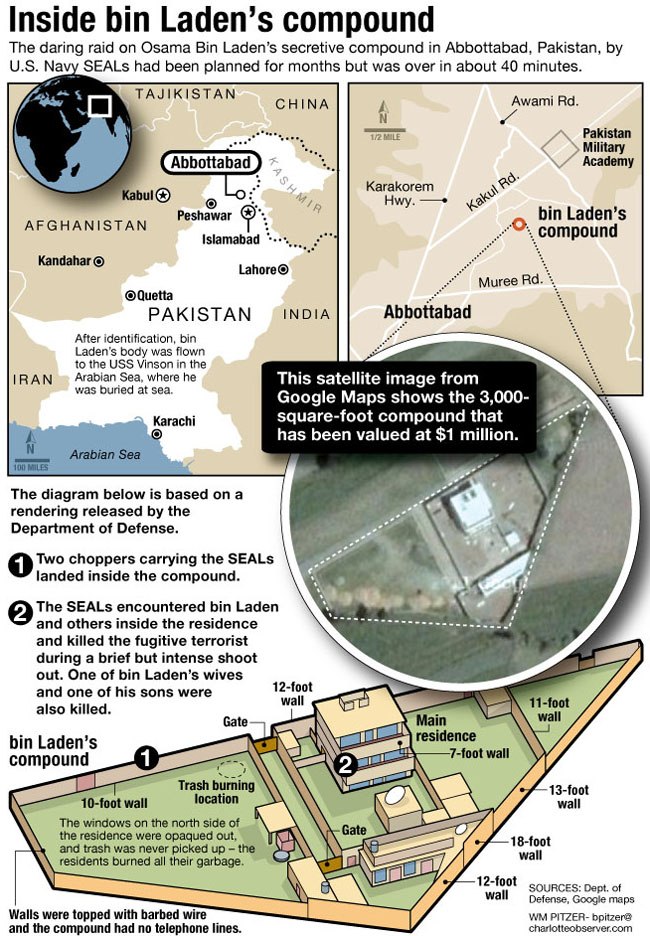
A day after U.S. commandos killed bin Laden, reporters were allowed within the 15-foot, barbed-wire-topped walls of the compound for the first time. But the doors of the house were sealed shut and police were in no mood to open them.

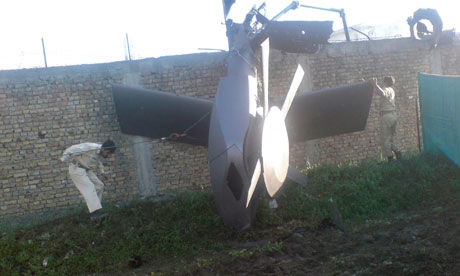
Local residents showed off small parts of what appeared to be a U.S. helicopter that Washington said malfunctioned and was disabled by the American strike team as they retreated. A small servant’s room outside the perimeter showed signs of violent entry and had been briskly searched, clothes and bedding tossed to the ground. Its wall clock was on the floor, the time stuck at 2:20, when the U.S. team would have been on the ground in the early hours of Monday.

Asif Ali Zardari’s comments, in a Washington Post opinion piece Monday, were Pakistan’s first formal response to suspicions raised by U.S. officials and others. Those suspicions could further sour relations between Islamabad and its Western backers at a key point in the war in Afghanistan.

Bin Laden was killed close to a military academy in the bustling northwestern town of Abbottabad, not in the remote Afghan border region where intelligence assessments had assumed he had been holed up. That was quickly taken as a sign of possible collusion with the country’s powerful security establishment, which Western officials have long regarded with a measure of suspicion despite several notable al-Qaida arrests in the country since 2001.

“Some in the U.S. press have suggested that Pakistan lacked vitality in its pursuit of terrorism, or worse yet that we were disingenuous and actually protected the terrorists we claimed to be pursuing. Such baseless speculation may make exciting cable news, but it doesn’t reflect fact,” Zardari wrote.

Ties between the two nominal allies were already strained amid U.S. accusations that the Pakistanis are supporting militants in Afghanistan and Pakistani anger over American drone attacks and spy activity on its soil. They came to head in late January after a CIA contractor shot and killed two Pakistan’s, in what Washington said was self-defense.

Senior U.S. officials did not directly accuse Pakistan of collusion, but made it clear they had concerns.

“People have been referring to this as hiding in plain sight,” Obama’s counterterrorism chief John Brennan told reporters Monday. “Clearly, this was something that was considered as a possibility. Pakistan is a large country. We are looking right now at how he was able to hold out there for so long and whether or not there was any type of support system within Pakistan that allowed him to stay there.”

Lawmakers were more direct.

U.S. Senate Armed Services Committee Chairman Carl Levin said Pakistan’s intelligence and army have “got a lot of explaining to do,” given that bin Laden was holed up in such a large house with surrounding buildings, the fact that its residents took the unusual step of burning their garbage and avoiding any trash collection.

“It’s hard to imagine that the military or police did not have any ideas what was going on inside of that,” Levin said.

Cameron, who has also made supporting Pakistan a major foreign policy commitment, echoed those concerns.

“Those are questions we have to ask, those are questions we will want answered and we will be asking that question of everyone in Pakistan and the Pakistani government,” Cameron told BBC radio before acknowledging the West’s limited leverage against Islamabad.

“We could go down the route of having some massive argument, massive row with Pakistan, but I assess our relationship with Pakistan and it is my very clear view that it is in out interests to work with the government and people of Pakistan to combat terrorism, combat extremism and help development in that country.”

Suspicions were also aired in many Pakistan’s media and on the street Tuesday.

“That house was obviously a suspicious one,” said Jahangir Khan, who was buying a newspaper in Abbottabad. “Either it was a complete failure of our intelligence agencies or they were involved in this affair.”

Pakistan’s security establishment has yet to explain how bin Laden was able to live there undetected, and given that it is rarely transparent about what it does, it might never do so. Asked about the raid, Pakistani Foreign Secretary Salman Bashir said it was time to move on.

“The issue of Osama bin Laden is history and I think we do now want to keep ourselves mired in the past,” he told reporters.

U.S. officials have said that Pakistani officials were not told about the early morning helicopter raid until the strike team had killed bin Laden had returned to Afghanistan from where they took off from, citing security reasons.

Many Pakistanis were surprised at how this was possible, especially when initial reports stated that the choppers took off from a Pakistani air base. Some were angry that the country’s sovereignty had been violated — an especially sensitive issue given the unpopularity of America here.

Zardari said it “was not a joint operation” — the kind of which has been conducted in the past against lesser terror suspects in Pakistan — but that Pakistani cooperation, in a general sense, had helped lead them to bin Laden.

“A decade of cooperation and partnership between the United States and Pakistan led up to the elimination of Osama bin Laden as a continuing threat to the civilized world,” he said.

President Barack Obama also said the country’s anti-terror alliance had helped in the run-up to the operation, but did not thank Pakistan when he announced the death of bin Laden.

The death has raised fears of revenge attacks, both in Pakistan — which has seen hundreds of suicide attacks by al-Qaida and its allies since 2007 — and internationally. The U.S Embassy said its missions in Pakistan would remain closed to the public until further notice.

Osama Bin Laden Hunted Down And Killed By US

By Brad Norington for The Australian

Bin Laden was killed in Pakistan and his body retrieved by a US strike team nearly 10 years after the September 11 terror attacks on the World Trade Centre in New York and the Pentagon killed more than 3000 people.

Announcing “justice has been done”, Mr Obama said bin Laden had been found hiding in Pakistan and a targeted operation launched today by a small US team.

“After a firefight they killed Osama bin Laden and took custody of his body,” Mr Obama said, adding that no Americans were harmed in the assault.

“The death of bin Laden marks the most significant achievement to date in our nation’s efforts to defeat al-Qa’ida,” the President said. “His demise should be welcomed by all that believe in peace and human dignity.

“It’s important to note our counter terrorism cooperation with Pakistan helped lead us to bin Laden and the compound where he had been hiding.” “Yet his death does not mark the end of our effort.

“There is no doubt that al-Qa’ida will continue to pursue attacks against us. “We must and will remain vigilant at home and abroad.”

Despite the decade that has elapsed since the September 11 attacks, the event, one of the most traumatic in US history, still stirs raw emotions, and his demise will be celebrated across the United States.

Chants of “USA, USA” rang out from tourists outside the White House as the news of bin Laden’s death sent an electric charge through Washington.

Hundreds of people gathered outside the fence of the presidential mansion and sang the US national anthem and started shouting and cheering. Mr Obama said the United States people understood the cost of war, but would not stand by if threatened.

“As a country we will never tolerate our security being threatened nor stand idly by when our people have been killed,” he said. “We will be relentless in defence of our citizens and our friends and allies.

“We will be true to the values that make us who we are. “And on nights like this one we can say to those families who have lost loved ones to al-Qa’ida terror, justice has been done.”

The location of bin Laden and his family confirms recent speculation that he was hiding in comfortable surroundings and close to civilisation, not in the remote mountains dividing Pakistan and Afghanistan.

US armed forces have been hunting the Saudi terror kingpin for years, an effort that was redoubled following the 2001 terror attacks on the World Trade Centre in New York and the Pentagon which killed 3000 people. But bin Laden always managed to evade US armed forces and a massive manhunt.

The death of bin Laden will raise huge questions about the future shape of al-Qa’ida and also have steep implications for US security and foreign policy 10 years into a global anti-terror campaign. It will also raise fears that the United States and its allies will face retaliation from supporters of bin Laden and other Islamic extremist groups.

Osama bin Mohammed bin Awad bin Laden was a member of the wealthy Saudi bin Laden family and the founder of the jihadist organisation al-Qa’ida, most widely recognised for the September 11 attacks on the US and numerous other mass-casualty attacks against civilian and military targets.

As a result of his dealings in and advocacy of violent extremist jihad, bin Laden lost his Saudi citizenship and was disowned by his billionaire family.

Bin Laden evaded US capture in Afghanistan after the 9/11 attacks and since then he and his organisation have been major targets of the US war on terror.

Bin Laden and fellow al-Qa’ida leaders are believed to have been hiding near the border of Afghanistan and Pakistan, in tribal areas that lie outside government control.

Aasia Bibi and Impurities in the Land of the Pure

By Manzer Munir for Pakistanis for Peace

The case of Aasia Noreen aka Aasia Bibi illustrates how far Pakistan has to go to secure freedoms for its religious minorities. Christians and Hindus are not the only minorities who are persecuted for their beliefs but it is also Muslim minorities such as the Ismailis, Ahmadis, and Shiites who are routinely harassed, discriminated and also killed. Sadly, it is the case of Aasia Bibi that has brought some much needed attention to Pakistan’s sad state of affairs towards the treatment of its religious minorities.

Several sections of Pakistan’s Criminal Code consist of its blasphemy laws and of all the Muslim countries of the world that have anti-blasphemy laws, Pakistan’s anti-blasphemy laws are by far the strictest. There is section 295 that forbids damaging or defiling a place of worship or a sacred object. Then there is section 295-A that “forbids outraging religious feelings.” There is also 295-B which prohibits defiling the Qu’ran and was originally punishable by life imprisonment but has since been amended to up to three years imprisonment.

No section of the blasphemy law is more controversial or harder to prove than Article 295-C, the law that Aasia Bibi is allegedly charged with having broken. In respect to prophet Muhammad, this statute states that ” Whoever by words, either spoken or written, or by visible representation, or by any imputation, innuendo, or insinuation, directly or indirectly defiles the sacred name of the Holy Prophet Muhammad shall be punished with death, or imprisonment for life and shall also be liable to a fine.”

Aasia’s case and charges against her started almost a year and a half ago when there was a quarrel over a bowl of water in a dusty village in the heart of Pakistan’s Punjab province. A group of women were working the fields in the heat of the Pakistani sun when one of them, Aasia Bibi, dipped her glass in the communal bucket of drinking water to fetch herself and others a glass of water to drink and immediately was rebuffed by the other women who claimed that the water was now unclean as it had been touched by a non-Muslim. According to witnesses, instead of quietly bowing her head and taking the indignities, Aasia’s crime was that she mounted a strong defense of her faith and remained steadfast in her demeanor that she did nothing wrong. Too often in Pakistan, the blasphemy laws are used against religious minorities to settle personal vendettas and old scores according to Pakistan’s Human Rights Watch, a watchdog group monitoring the case.

The news traveled fast in Aasia’s village of Ittan Wali, in Punjab’s Sheikhupura district that a Christian woman had insulted the prophet. The local mullah got on the mosque loudspeakers, urging the “faithful” to take action against Aasia Bibi. In sad but familiar pattern, her defense of her faith was somehow twisted into an accusation of blasphemy, according to her family and others familiar with the case. Soon as a mob gathered outside her home ready to take the law into their own hands and handing out vigilante justice, the police moved in and took her into custody. But instead of protecting her, they charged her with insulting Islam and its prophet under the blasphemy laws.

And then on Nov. 8, after suffering 18 months in prison, Aasia Bibi was sentenced to death by a district court, making her the first person to be handed the death penalty in Pakistan under the blasphemy laws. Many before her over the years have been charged, but punishment had been commuted to lesser penalties than the death sentence imposed on Aasia Bibi. No concrete evidence was ever presented against Aasia, according to Pakistan’s Human Rights Watch. Instead, the district judge relied on the testimonies of three other women, all of whom were hostile towards her.

Unfortunately this is a common insult hurled at many of Pakistan’s 2 million Christians who make up just 1.59% of the total population. Often, Christians in Pakistan are discriminated and persecuted and many times only get the lowest of the low jobs such as street sweepers, janitorial and sanitation workers. In fact, in Pakistan, the term ‘Chura‘ has become synonym with the Christian community as it relates to an unclean person akin to how the untouchables or Dalit community is seen in India. In India however, the Dalits are not subjected to arcane state blasphemy laws geared towards religious minorities as in Pakistan or are threatened with their lives at the hands of the Hindu majority.

As discussed in a couple of my previous articles, Taliban 1o1, History and Origins and Taliban 201, The Rise of the Pakistani Taliban, the Islamization of Pakistan started under the late General Zia ul Haq of Pakistan who took over the leadership of the country through a military coup in 1977 when he hung the deposed and democratically elected Prime Minister Zulfiqar Ali Bhutto. Earlier in 1973, the 1973 Constitution of Pakistan had declared that “Islam shall be the religion of the Pakistan” and had systematically begun the process of restricting the participation of religious minorities in government and politics.

Before General Zia, there were only two reported cases of blasphemy. Since the death sentence was inserted in 1986 into the Penal Code for the blasphemy laws, this number has now reached 962 — including 340 members of the Ahmadi Muslim community, 119 Christians, and 14 Hindus. A close examination of the cases reveals the blasphemy laws are often invoked to settle personal scores, or they are used by Islamist extremists as cover to persecute religious minorities, sadly with the help of the state under these laws.

General Zia began this policy of Islamization of Pakistan in conjunction with his support for the war against the Russians and assistance to the Afghan Mujahedeen as well as the building of thousands of madrassahs or religious schools across Afghanistan and Pakistan which nurtured the young men into what later became the Taliban. Many of these blasphemy laws fully came into being under his reign, although some were around since as early as more than 100 years prior when the British drew up the Indian Penal Code of 1860 which was initially an ill foreseen aim at keeping the peace among the many fractured faiths of the subcontinent. For instance, section 295-A, which “forbids outraging religious feelings”, could have been applied against a Muslim who insulted a Hindu or a Hindu who taunted a Sikh or Christian or vice versa. However under Zia, the blasphemy laws were expanded and almost exclusively applied against Muslim minorities such as the Ahmadis, Islamilis and Shiites as well as against the Christian and Hindu populations.

Recently, a religious ‘leader’ came out and has offered over $6000 to anyone who can kill Aasia Bibi while she awaits her punishment in police custody. Outrage and denunciations on this case are coming from across the world as many people are appalled at the sad state of rights for religious minorities in Pakistan. The Pope has intervened also asking for clemency for Aasia Bibi from Pakistan’s President Asif Ali Zardari. Against all manner of reason and justice, Lahore’s High Court recently issued an order on November 29, 2o1o, preventing Zardari from exercising his constitutional authority to pardon Aasia Bibi.

In a country rife with violence and chaos and one that has become synonymous with terror the world over, the case of Aasia Bibi is yet another dark stain on the country’s image around the world. The Taliban and the extremist groups ravaging Pakistan can be explained as being a violent minority and do not and should not reflect on the nation as a whole as the majority of people in Pakistan are opposed to them and their views of Islam. But the blasphemy laws, for as long as they have stayed on the books in Pakistan and in the constitution, cannot and should not be excused in any shape or form. These laws need to be repealed and the constitution needs to be amended in an emergency manner so that Aasia Bibi and other religious minority citizens of Pakistan are not subjected to cruel and subjective laws that are almost exclusively used against minorities to settle scores, personal vendettas, and instill terror in less than 3 percent of the country that is not part of the religious majority of Sunni Muslims.

There needs to be international pressure placed on Pakistan from the United Nations, the United States, Europe and others to modify the constitution immediately and to pardon this 45 year old mother of five children. It is ironic that in a country where many people sympathize with Osama’s Al Qaeda and profess to hate the west with one hand, they decry with the other why not enough western aid has came to their country when it recently saw the worst flooding in its history. Can you blame the American citizens, the Europeans or citizens of any other Christian nation from hesitating to give aid to a country that not only plays a duplicitous game when it comes to terrorists and terror havens but also treats Christians and other religious minorities in the manner as in the case of Aasia Bibi?

The name Pakistan literally translates into “The Land of the Pure”. And as a child growing up I was told that the meaning of Pakistan’s flag is this: “The green is a traditional Islamic color and the crescent moon and star are also Islamic symbols. The white stripe represents the non-Muslim minority and religious groups of Pakistan and there place in the country.” In my view, as long as the nation sanctions and tolerates these utterly unjust and biased blasphemy laws, the religious minorities of Pakistan clearly have no place in this land of the ‘pure’.

-Manzer Munir, a proud Pakistani American and peace activist, is the founder of Pakistanis for Peace and blogs at www.PakistanisforPeace.com as well at other websites as a freelance journalist and writer.

Teen Held in Alleged Portland Bomb Plot

By Bob Drogin and April Choi for The Los Angeles Times

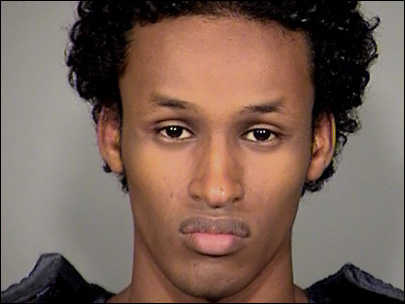
Reporting from Washington and Corvallis, Ore. — In August, the FBI says, 19-year-old Mohamed Osman Mohamud told two men who claimed to be Al Qaeda operatives that he had considered violent jihad since he was 15, and that he now was ready to commit mass slaughter.

Mohamud, a naturalized U.S. citizen from Somalia, said he wanted to set off a bomb during the lighting of a giant Christmas tree the day after Thanksgiving in an outdoor plaza in downtown Portland, Ore. The festive ceremony on the busiest shopping day of the year normally draws thousands of people.

“You know, the streets are packed,” said Mohamud, at the time a student at Oregon State University in Corvallis. When one of the men responded that “a lot of children” would attend, according to an FBI affidavit, he replied, “Yeah, I mean, that’s what I’m looking for.”

Mohamud — tall, thin and known for enjoying rap music and pickup basketball — reportedly shrugged off concerns about security at the event, explaining: “They don’t see it as a place where anything will happen…. It’s on the West Coast, it’s in Oregon, and Oregon’s like you know, nobody ever thinks about it.”

But the two men were undercover FBI agents, and audio and video recorders captured that conversation and many others like it. Mohamud now sits in federal custody — the latest alleged domestic terrorist to fall for an elaborate FBI sting — after months of secret surveillance and a grisly plot worthy of Jack Bauer.

A 38-page FBI affidavit released Saturday paints Mohamud as highly determined and deadly serious. He is charged with attempted use of a weapon of mass destruction, which carries a maximum sentence of life in prison. He is due in court Monday.

“The threat was very real,” said Arthur Balizan, special agent in charge of the FBI in Oregon. “Our investigation shows that Mohamud was absolutely committed to carrying out an attack on a very grand scale.”

According to the FBI, they arrested Mohamud after he dialed a cellphone that he thought would detonate a huge bomb — six 55-gallon drums, diesel fuel and a large box of screws — in a large white van parked near the tree lighting.

But the bomb was a fake built by the FBI, and the packed crowds who enjoyed a youth choir and a symphony orchestra at Friday’s holiday celebration at Pioneer Courthouse Square were never in danger, authorities said.

Mohamud appears to have joined a growing list of amateurs who have shown more fervor than smarts in their apparent plots against America. His alleged operation unfolded under the careful supervision, and with the direct assistance, of undercover FBI agents.

Aided by good luck and good intelligence, U.S. authorities have disrupted or uncovered at least 15 homegrown terrorist conspiracies over the last two years, often by penetrating the scheme at an early stage and carefully orchestrating the results.

Two domestic attacks have produced casualties — the shooting deaths of 13 people at Ft. Hood, Texas, and the slaying of an Army recruiter in Little Rock, Ark., both last year. Another plot, involving a failed car bomb in New York’s Times Square in May, was traced to a Pakistani-born U.S. citizen, who was arrested and pleaded guilty.

The alleged plot in Portland also would have carried the potential for mass slaughter.

According to the affidavit:

The FBI began tracking Mohamud in August 2009 when they discovered he was e-mailing a former Oregon student who was living in Pakistan’s lawless northwest region, where Al Qaeda has a stronghold. The Associated Press reported that the bureau was led to Mohamud by a tip from someone concerned about him.

By December, Mohamud was trying to visit the area. His friend, who was not named in court documents, urged him to contact an associate named Abdulhadi to arrange the trip. But Mohamud repeatedly mixed up the Hotmail address with the password, and the e-mails bounced back.

Apparently frustrated, Mohamud tried to fly to Kodiak, Alaska, on June 10. He already was on a no-fly list, however, and was stopped from boarding at Portland International Airport. He told the FBI that he had hoped to go to Yemen, but couldn’t obtain a visa or ticket, so had gotten a summer fishing job in Alaska instead.

Two weeks later, an FBI undercover agent contacted Mohamud and pretended to be Abdulhadi, providing an e-mail address that the FBI controlled. Mohamud and the agent met for the first time on July 30 in downtown Portland.

Mohamud boasted that he had written in support of violent jihad for an online, English-language propaganda magazine called Jihad Recollections, using the pen name Ibnul Mubarak.

The FBI later recovered the three articles, including one titled “Getting in shape without weights.” It seeks to introduce Pilates training to those preparing “physically for jihad.”

Mohamud also submitted an article to Inspire, an extremist magazine published by the media arm of the Al Qaeda affiliate in Yemen. Samir Khan, a Pakistani-American, allegedly ran Jihad Recollections from his parents’ home in Charlotte, N.C. He moved to Yemen last year and now is believed to edit Inspire.

Mohamud told “Abdulhadi” that he “initially wanted to wage war in the U.S.” The FBI agent told Mohamud he could not tell him what to do, but suggested several options, including going “operational” or becoming a shaheed, or martyr. Mohamud said he wanted to build a car bomb, but would need help.

At Oregon State, about 80 miles south of Portland, Mohamud had a benign profile. “He wasn’t the most social person, but he wasn’t anti-social,” said Omar Mohamed, president of the Muslim Student Assn. “He seemed like a pretty normal guy.”

Mohamud also was not known for being particularly pious. “From what I understand, he wasn’t the most religious person,” Mohamed said. “He didn’t regularly go to mosque.”

And unlike some Muslim students, he was known to attend college parties where alcohol was served, though it was unclear whether Mohamud actually drank.

On Aug. 19, Mohamud and “Abdulhadi” met again — in a bugged hotel room — and “Abdulhadi” brought another undercover FBI agent, who claimed to be an expert in explosives. Mohamud told them that he had begun thinking of jihad when he was 15.

The FBI affidavit then goes on to say how he described his plan to bomb the Nov. 26 event.

“They have a Christmas lighting and some 25,000 people that come,” he said. They should “be attacked in their own element with their families celebrating the holidays,” he added, quoting Osama bin Laden.

He said he had scouted where Black Friday shoppers streaming from nearby stores would likely gather in the busy outdoor square. The tree lighting was scheduled for 5:30 p.m., “so I was thinking that would be the perfect time.”

The trio met again Sept. 7. This time, the undercover agents asked Mohamud to buy the bomb components. They gave him $2,700 in cash to rent an apartment where they could all hide, and $110 to cover the cost of the bomb parts.

Over the next few weeks, the affidavit says, Mohamud mailed them a Utiliteck programmable timer, two Nokia cellphones, stereo phone jacks, a toggle switch and other gear, mostly from Radio Shack. One package also had a pack of gum and a scrawled note: “Good Luck with ur stereo system Sweetie. Enjoy the Gum.”

They held more meetings in early October in Corvallis, and Mohamud gave them a computer thumb drive with Google street-view photographs of his preferred parking spot, the attack site and escape routes. And he enthused again about his plan.

“It’s going to be a fireworks show… a spectacular show… New York Times will give it two thumbs up.”

According to the university, Mohamud stopped attending the school that month.

On Nov. 4, Mohamud and the two agents drove to a remote location near the coast west of Corvallis, supposedly to test the homemade bomb design. In reality, federal agents remotely detonated a device.

On the way home, he recalled the Sept. 11 attacks. “Do you remember when 9/11 happened, when those people were jumping from skyscrapers? … I thought that was awesome.” He said he hoped people attending the tree lighting would “leave either dead or injured.”

That afternoon, the undercover agents helped Mohamud record a video statement. Explaining that he wanted to dress “Sheik Osama style,” he donned a white robe and camouflage jacket. He then read a lengthy testimonial to jihad on camera. According to an FBI transcript of the statement, Mohamud, who was born in Mogadishu, briefly mentions his parents and suggests they had tried to steer him on another path in life. Arabic phrases are set off in brackets:

“To my parents, who held me back from jihad in the cause of Allah. I say to them [by Allah] if you — if you make allies with the enemy, then Allah’s power [the glorified and exalted] will ask you about that on the day of judgment, and nothing you can do can hold me back.”

In a follow-up meeting, their seventh, he gave the FBI agents hard hats, safety glasses, and reflective vests and gloves. He said they would wear the gear before the attack as a disguise, and put traffic markers around the parked van.

Abdulhadi, the first FBI agent, picked up Mohamud at about noon Friday, and they went to inspect the bomb. Built by FBI technicians, it appeared impressive. But the explosives, the detonation cord and the blasting caps all were inert.

“Beautiful,” Mohamud said.

At 4:45 p.m., they drove the van to Yamhill and Sixth Street and parked. Police had secretly kept the space open. Mohamud attached the blasting cap and flipped the toggle switch to arm the bomb, then put on his hard hat.

They walked several blocks, got in another car and drove to a pre-selected parking lot. Mohamud quickly dialed the number to detonate the bomb. When they didn’t hear anything, he got out of the car to look for a better signal, and FBI agents swarmed in for the arrest.

An Oregon State student directory listed an apartment address for Mohamud in the Portland suburb of Beaverton. A woman who answered the apartment door declined to speak with a reporter. Hanging to the right of the door was a heart-shaped sign with the words “Bless this home.”

When Mohamud attended Oregon State, he was not a member of the Muslim Student Assn. and rarely attended events held by the group. But Mohamed, the association president, recalls that Mohamud had recently attended “Night of the Crescent: Understanding Muslims,” a program aimed at showing that “Muslims in general are not scary people. They are neighbors, your best friends. We’re not all scary men with beards.”

That was Nov. 17. The next day, Mohamud met with the undercover agents to continue planning the attack.

Pakistanis for Peace Editor’s Note– We are thankful on this Thanksgiving Day weekend that the FBI folied this terror attack in Oregon and averted the loss of countless innocent lives. Both the authorities and Muslim Americans as a whole must keep vigilant about others like Mohamud in their midst who have extremist views and want to do us harm.

Staying Nimble to Fight Al-Qaeda’s Shifting Threat

By David Ignatius for The Washington Post

Behind the latest terrorism plots is an al-Qaeda leadership that is getting battered in Pakistan but that is determined to strike back wherever it can – using a dispersed network and new tactics that are harder to detect.

The package bombs sent last week from Yemen are one face of al-Qaeda’s continuing campaign. The Yemeni operatives are nimble, adaptive and “frustratingly clever,” says a U.S. counterterrorism official. “They have one main goal, which is to mess with us.”

The Yemen-based operations came as intelligence officials were struggling to disrupt another al-Qaeda plot to launch Mumbai-style attacks in European cities. Officials say that plan involved roughly 25 al-Qaeda terrorists, organized into cells of perhaps three to five members who would stage roving assaults in one or more European cities. Of the 25, about 10 have been captured or killed, according to a second U.S. official.

While these operations are tactically separate, officials say they both reflect a secret mid-2009 directive from an embattled Osama bin Laden to his followers to demonstrate that al-Qaeda could still do damage.

For U.S. officials, these latest terror plots have been a grim reminder that there’s a long fight ahead against al-Qaeda, with no “quick fixes” available. Defense isn’t enough: The explosives sent from Yemen can’t be detected by conventional X-ray screening or sniffer dogs, so stopping these plots requires good intelligence, as was the case last week when Saudi Arabia tipped the United States about the package bombs.

Nobody wants to say so publicly, but the lesson of the past few weeks, for me at least, is that one of these days the terrorists will succeed – and people should be prepared for that likelihood. The greatest damage won’t be the attack itself but the public response. The Yemeni plotters saw the frenzy produced by their failed Christmas Day bombing attempt on a flight to Detroit. They must be hoping now, with the package bombs, to disrupt cargo-handling around the world and damage a fragile global economy.

As the CIA has stalked al-Qaeda over the past two years, this has been a story of punch and counterpunch, of escalating U.S. drone attacks over Pakistan’s tribal areas and defiant al-Qaeda responses. As the senior U.S. official says, this is a “learning enemy” that adapts its tools and tactics as the West alters its defenses.

To understand the latest news, it helps to scroll back to early 2008. The CIA gathered intelligence that al-Qaeda leaders were regrouping, forming new alliances and planning new operations in the West. At that time, the CIA’s attacks from Predator drones were sporadic, and Pakistan was consulted before each attack.

So the Bush administration escalated the drone attacks in mid-2008. Now, Pakistan was given only “concurrent” notification, which in practice meant it was informed after the drone had launched its missile. Moreover, the CIA was authorized to strike targets that had a “signature” of terrorist activity, rather than a precise identification. President Obama has increased the tempo of Predator attacks even more.

The drone attacks have pounded al-Qaeda and killed key members of its leadership. Bin Laden reacted with his mid-2009 directive, which the U.S. official summarizes this way: “Undertake operations however and wherever you can. We need to prove ourselves again.” Specifically, bin Laden directed operatives to plan assaults in Europe similar to the November 2008 attacks that killed about 175 people and terrified Mumbai.

The United States and its European allies have been working hard to disrupt the Mumbai copycat operations. Since the third week of August, the CIA has conducted more than 40 drone attacks on the tribal areas, more than in all of 2008. A British national was killed in Pakistan in September, and two Germans in October. Other plotters have been arrested in Europe and Pakistan. Officials say they can’t be sure yet whether the terror plans have been shelved.

A similar escalation is likely in Yemen, with soldiers from the U.S. Joint Special Operations Command working with Yemeni government forces. The JSOC sums up its lethal approach with the phrase “find, fix, finish,” but a U.S. official says it has been hard to keep track of al-Qaeda targets in Yemen’s tribal villages and cities.

The reality is that the adversary that declared war on the United States in 1996 is still active – morphing and mobilizing even as it is hunted by America and its allies. It’s a nasty fight, and it’s far from over.

Message to Muslims: I’m Sorry

By Nicholas D Kristof for The New York Times

Many Americans have suggested that more moderate Muslims should stand up to extremists, speak out for tolerance, and apologize for sins committed by their brethren.

Go to Columnist Page »That’s reasonable advice, and as a moderate myself, I’m going to take it. (Throat clearing.) I hereby apologize to Muslims for the wave of bigotry and simple nuttiness that has lately been directed at you. The venom on the airwaves, equating Muslims with terrorists, should embarrass us more than you. Muslims are one of the last minorities in the United States that it is still possible to demean openly, and I apologize for the slurs.

I’m inspired by another journalistic apology. The Portland Press Herald in Maine published an innocuous front-page article and photo a week ago about 3,000 local Muslims praying together to mark the end of Ramadan. Readers were upset, because publication coincided with the ninth anniversary of 9/11, and they deluged the paper with protests.

So the newspaper published a groveling front-page apology for being too respectful of Muslims. “We sincerely apologize,” wrote the editor and publisher, Richard Connor, and he added: “we erred by at least not offering balance to the story and its prominent position on the front page.” As a blog by James Poniewozik of Time paraphrased it: “Sorry for Portraying Muslims as Human.”

I called Mr. Connor, and he seems like a nice guy. Surely his front page isn’t reserved for stories about Bad Muslims, with articles about Good Muslims going inside. Must coverage of law-abiding Muslims be “balanced” by a discussion of Muslim terrorists?

Ah, balance — who can be against that? But should reporting of Pope Benedict’s trip to Britain be “balanced” by a discussion of Catholic terrorists in Ireland? And what about journalism itself?

I interrupt this discussion of peaceful journalism in Maine to provide some “balance.” Journalists can also be terrorists, murderers and rapists. For example, radio journalists in Rwanda promoted genocide.

I apologize to Muslims for another reason. This isn’t about them, but about us. I want to defend Muslims from intolerance, but I also want to defend America against extremists engineering a spasm of religious hatred.

Granted, the reason for the nastiness isn’t hard to understand. Extremist Muslims have led to fear and repugnance toward Islam as a whole. Threats by Muslim crazies just in the last few days forced a Seattle cartoonist, Molly Norris, to go into hiding after she drew a cartoon about Muhammad that went viral.

And then there’s 9/11. When I recently compared today’s prejudice toward Muslims to the historical bigotry toward Catholics, Mormons, Jews and Asian-Americans, many readers protested that it was a false parallel. As one, Carla, put it on my blog: “Catholics and Jews did not come here and kill thousands of people.”

That’s true, but Japanese did attack Pearl Harbor and in the end killed far more Americans than Al Qaeda ever did. Consumed by our fears, we lumped together anyone of Japanese ancestry and rounded them up in internment camps. The threat was real, but so were the hysteria and the overreaction.

Radicals tend to empower radicals, creating a gulf of mutual misunderstanding and anger. Many Americans believe that Osama bin Laden is representative of Muslims, and many Afghans believe that the Rev. Terry Jones (who talked about burning Korans) is representative of Christians.

Many Americans honestly believe that Muslims are prone to violence, but humans are too complicated and diverse to lump into groups that we form invidious conclusions about. We’ve mostly learned that about blacks, Jews and other groups that suffered historic discrimination, but it’s still O.K. to make sweeping statements about “Muslims” as an undifferentiated mass.

In my travels, I’ve seen some of the worst of Islam: theocratic mullahs oppressing people in Iran; girls kept out of school in Afghanistan in the name of religion; girls subjected to genital mutilation in Africa in the name of Islam; warlords in Yemen and Sudan who wield AK-47s and claim to be doing God’s bidding.

But I’ve also seen the exact opposite: Muslim aid workers in Afghanistan who risk their lives to educate girls; a Pakistani imam who shelters rape victims; Muslim leaders who campaign against female genital mutilation and note that it is not really an Islamic practice; Pakistani Muslims who stand up for oppressed Christians and Hindus; and above all, the innumerable Muslim aid workers in Congo, Darfur, Bangladesh and so many other parts of the world who are inspired by the Koran to risk their lives to help others. Those Muslims have helped keep me alive, and they set a standard of compassion, peacefulness and altruism that we should all emulate.

I’m sickened when I hear such gentle souls lumped in with Qaeda terrorists, and when I hear the faith they hold sacred excoriated and mocked. To them and to others smeared, I apologize.

Obama Calls For Religious Tolerance

By Christi Parsons, Tribune Washington Bureau

In a news conference on the eve of Sept. 11, he speaks of his own Christianity, the economy, and asks Americans to remember they’re not at war with Islam, but with terrorists that distort the faith.

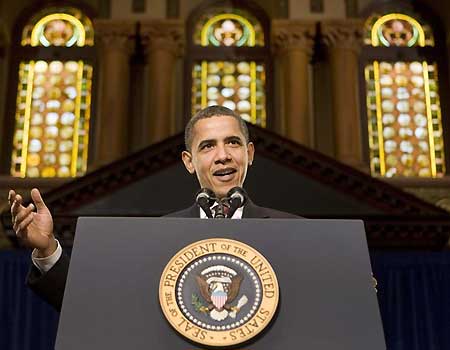
President Obama spoke of his own Christianity on Friday while calling on Americans to turn away from religious divisions and join together as “one nation, under God.” It was a rare personal reference from the president, coming in a news conference that sounded more like a homily to the nation before a somber anniversary.

“As somebody who relies heavily on my Christian faith in my job, I understand the passions that religious faith can raise,” Obama said. “But I’m also respectful that people of different faiths can practice their religion, even if they don’t subscribe to the exact same notions that I do, and that they are still good people, and they are my neighbors and they are my friends, and they are fighting alongside us in our battles.”

In his first news conference in several months, Obama talked up his plans for stimulating economic growth and complained about Republican obstruction to his proposals. He said people should remember that there is still a terrorist threat to Americans nine years after Sept. 11, even though U.S. troops overseas are successfully compromising the ability of extremists to carry out new plots.

Capturing or killing Osama bin Laden and Ayman Zawahiri, Al Qaeda’s No. 2 leader, is a high priority, he said, though it “doesn’t solve all our problems.”

But as a Florida preacher held out the possibility of a Koran-burning demonstration on Saturday, tying it to plans for the development of a mosque near the site of the World Trade Center attacks, even Obama’s messages about the economy and overseas conflict were interwoven with a larger message about religious tolerance.

If there is an increase in suspicion and resentment of Islam in this country, Obama said, it arises during trying times when the country is feeling a sense of general anxiety. He said he worries that the threat of a Koran burning could endanger American troops and cause others around the country to think it’s a good way to get attention.

The proposed New York City mosque has run up against the “extraordinary sensitivities around 9/11,” he said. “But I go back to what I said earlier: We are not at war against Islam,” Obama said. “We are at war against terrorist organizations that have distorted Islam or falsely used the banner of Islam to engage in their destructive acts.”

Americans, he said, must cling to the shared belief in religious tolerance. “We’ve got millions of Muslim Americans, our fellow citizens, in this country,” he said. “They’re going to school with our kids. They’re our neighbors. They’re our friends. They’re our co-workers. And when we start acting as if their religion is somehow offensive, what are we saying to them?”

Obama devoted a substantial portion of his Friday remarks to the economy, beginning with the announcement that he is naming Chicago economist Austan Goolsbee to head his Council of Economic Advisors. Goolsbee is an economist with expertise in tax policy.

The president refused to characterize his proposal to spend money on infrastructure as a “second stimulus” plan, despite one reporter’s prodding and even though he said he has “no problem with people saying the president is trying to stimulate growth and hiring.”

“I would assume that’s what the Republicans think we should do, to stimulate growth and jobs,” Obama said. Senate Republican leader Mitch McConnell of Kentucky fired off a speedy critique, saying Americans are more interested in lower taxes and reductions in federal spending.

“The president spent a lot of time blaming others and talking about more government spending,” McConnell said. “But Americans want to know that Washington is going to stop the reckless spending and debt, the burdensome red-tape and job-killing taxes.”

But McConnell and others hastened to echo the president’s words about who, exactly, the U.S. is targeting with its war effort. “I agree wholeheartedly with the president that we need to do everything we can to fight Al Qaeda, while being clear who the enemy is,” McConnell said. “This war on terror goes on,” McConnell said. “We are confident in the strength and goodness of our cause and our country.”

Why The Mosque Needs To Be Built At Ground Zero

By Manzer Munir for Pakistanis for Peace

This is already my third article on the NYC Mosque controversy. When I started my Facebook group and website Pakistanis for Peace by the same name nearly two years ago, I did it in response to the tragic and callous terrorist attacks in Mumbai India in 2008 and my desire to see peace in that region and beyond. As a firm believer in God, but not a particularly religious person, I never would have imagined that I would end up making a big part of my focus not just peace between India and Pakistan, but also peace and understanding between the Muslim and non-Muslim worlds as well. Heaven knows I have my own questions and issues with certain Muslim laws and practices and I of all people am the least suitable to be one of its defenders. However, I am a strict constitutionalist and as mentioned in my previous articles on this subject, I have advocated the building of the mosque simply on First Amendment religious freedom grounds.

Now here I am in less than one month, I find myself already writing a third article on the mosque controversy. Much has been written already by others on this topic also, but I wanted to give a few more opinions from a rational, moderate and patriotic American Muslim perspective, one which is missing in the current dialogue.

We know that many people who are opposed to the building of the mosque in lower Manhattan simply ask “Why there?” “Why would “they” possibly want to build it there of all places? It is seen as an affront by them that Muslims should want to build an inter-faith mosque, community center and a planned outreach ministry in the heart of Manhattan two city blocks from the site of the World Trade Center and the attacks of September 11, nine year ago. In fact, last night, while watching CNN, I saw Rick Sanchez ask former Governor George Pataki of New York about the Ground Zero Mosque controversy and his views on the subject. “Why there of all places would you build a mosque?” asked Gov. Pataki.  Why there?  As if he had fully bought into a favorite point of right wing groups that “Muslims build mosques at places they conquer” and that this is somehow a celebration of their “victory” over us because of the deaths of so many of our fellow countrymen on 9/11. That statement is wrong on so many levels that normally I would not even waste energy answering a clearly misguided assumption, but I will make an exception to clear the air as that is precisely what this article aims to do.

First of all, the 9/11 attacks were not a result of the actions of mainstream Muslims or the collective billion plus adherents of the religion but instead by members of a terror group known as Al-Qaeda, whose leader, Osama Bin Laden, we were very familiar and friendly with during the Soviet Afghan War of the 1980’s as he had assisted us in stopping the Red Army from conquering Afghanistan at the height of the Cold War between the two superpowers. Also a mosque is a place of worship. It is not a place where bombs are made and terrorists are trained either in ideology or practical training. To equate the building of a mosque to a direct link to terrorism or some other nefarious activity is in itself a deeply offensive argument to any Muslim, if one must speak of insensitivities.

So are we at war with Islam? This really is the only question we must ask ourselves to understand the debate over the mosque controversy. Debra Burlingame, the co-founder of 9/11 Families for a Safe and Strong America, issued a statement saying that “Building a 15-story mosque at Ground Zero is a deliberately provocative act.” This is simply not true as it is not exclusively just a mosque, but rather a multi layered structure that will house an auditorium, restaurant, gymnasium, library, conference rooms and multi-faith prayer halls devoted to allowing non-Muslim visitors the chance to come explore the center and at the same time take time to meditate and pray according to their own customs.

The center, as its leader Imam Faisal Abdul Rauf pointed out recently, “will establish this community as the place where the moderate Muslim voice condemns terrorism and works for new, peaceful, and harmonious relationships with all New Yorkers and indeed all Americans.” Just the fact that this center will have a restaurant, conference rooms, a library and multi-faith dialogue and prayer rooms, already makes this proposed building the most uniquely American mosque in the world. Nowhere else will one find a mosque so devoted to understanding and bridge building between Islam and other religions and no other place and location will it be more sorely needed in the years to come than in New York City! Too often, many non-Muslims complain about the self segregation practices of Muslims and indeed a characteristic of all minority communities to be in their own bubble and for not having a lot of interaction between other communities or faiths.

Many times my own non-Muslim friends have been curious and inquired on how Muslims pray and what they believe in and what exactly goes on in a typical mosque. But typically a small, regular mosque does not have the sort of access and resources to satisfy this curiosity and neither the infrastructure nor the logistics to handle curious visitors of other faiths. Primarily mosques in this country have been built with Muslims as its sole audience and occupants. This is the first time a mosque and cultural center is being proposed that will eliminate the barriers that many non-Muslims feel when it comes to understanding Islam and Muslims and actually takes into considerations its non-Muslim visitors when planning the structure. For many years to come, many Americans and indeed tourists from around the world will be coming to the proposed complex now under construction at the site of the World Trade Centers that will house the 9/11 Memorial. What better place  will there be than a few blocks away from the 9/11 Memorial where visitors can be told about the Islam of the great boxer Muhammed Ali and hall of fame basketball player Kareem Abdul Jabbar and not that of evil individuals such as Mohammed Atta and Osama Bin Laden? Where else should they be told of the difference between the Islam that is practiced by comedian Dave Chappelle and Oprah’s Dr Mehemt Oz versus the one practiced by the backward barbarian murderers known as the Taliban in the mountains of Afghanistan? Where else can they come to know of the type of Islam practiced by patriotic Bronze Star and Purple Heart decorated deceased US soldier Kareem Rashad Sultan Khan or the one practiced by the deranged Major Nidal Malik Hasan, the accused perpetrator of the Fort Hood Army base who sadly killed 13 fellow soldiers almost 1 year ago?

Now in order to satisfy the opponents and critics of the center, I also believe that all the funding needs to be transparent, there needs to be a multi-faith board of directors, and the Muslim leadership needs to be cognizant that this is indeed a very special place for all Americans and a place of national mourning. This mosque needs to therefore address the attacks of 9/11 and also needs to be a reminder not just to non-Muslims of the tragedy that was 9/11 but more importantly it needs to  serve as a constant reminder to the rest of the Muslim world of the terrible actions some have committed in the name of Islam.

Why build it here of all places you may still ask? Why not here? What other place in America, nay, what other place in the world did Islam take the biggest blow to its reputation and image? It is Ground Zero and lower Manhattan itself where this religion of over a billion people got literally hijacked and its message of peace and tolerance got forever destroyed in the eyes of the world’s non-Muslims by events of 9/11 and the actions of a handful of radical extremists who were terrorists and part of a network known as Al-Qaeda. So, why not build a monument to tolerance and understanding for the very religion that took the biggest hit to its global credibility by events that happened in this area?  I believe that it is not out of any provocation or insensitivities that Muslims want to build a community center near Ground Zero, but rather because this is the one place in the world where truth about the religion needs to be told and the need to showcase the real Islam of the world’s Muslims rather than allow the story of the hatred and violence perpetrated by the terrorists to be the only story one hears when discussing the religion of Islam. This center needs to be a part of the healing process we must go through as a nation and will be a testament for the rest of the Muslim world outside our shores of the grandeur of our nation and for our acceptance of Muslims and for not allowing the stereotyping of a religion of hundreds of millions of people over the actions of 19 evildoers. 

Trust me, the terrorists will triumph if this mosque does not get built.  We must not forget who we’re fighting against, and what we are indeed fighting for. The Taliban, the terrorists and other radical Islamists do not respect religious freedom or tolerance. Their distorted and narrowly interpreted Wahhabi views of Islam leave no room for dissent, debate or disagreements. These terrorists are responsible for more deaths of dissenting and or differing Muslims than of any other religion at their hands. These terrorists are Islam’s biggest enemy and threat and we must remember that this is not a war between us and the Muslim world. It is a war between us and Al-Qaeda. And to prevent moderate, peace seeking, bridge building, and patriotic American Muslims from building a structure that will help ease the pain and misunderstanding of the events of that dark day 9 years ago in September will only play into the hands of those who hate us for our freedoms. To have Muslim Americans potentially lose these very freedoms due to all the pressure, in this land built on freedom and liberty, will only strengthen the hands of the terrorists and bolster their claims that this is truly a war on Islam and that they are second class citizens who do not even have the fundamental rights to worship that is afforded to all Americans. This is a battle for Islam itself, one where the forces of evil are attempting to commandeer the entire religion towards their narrow minded interpretation of the sacred texts. We must hold steadfast to our principles and ideals and support moderate Islam in taking back the religion from the extremists and allowing this mosque to be built will go a long ways in turning the tide of radicalism, and ensuring that we stand for our time tested principles, no matter how unpopular they may be in the current climate.

-Manzer Munir, founder of Pakistanis for Peace, a proud Pakistani American and peace activist, is a freelance journalist that writes for PakistanisforPeace.com and other publications.

Ground Zero Mosque Controversy Helps Give Rise to Islamophobia Across the US

By Manzer Munir for Pakistanis for Peace

A man was accused of attempted murder for his vicious knife attack on a Muslim New York City Cab driver Tuesday evening in what is being described as a hate crime by the authorities.

Michael Enright, a college student who also did some volunteer work in Afghanistan, was being held without bail on charges of assault and attempted murder as hate crimes.

In a criminal complaint filed by the New York Police Department, Michael Enright allegedly asked the driver if he was a Muslim. The cab driver, Ahmed H Sharif, an immigrant from Bangladesh, replied that yes he was indeed a Muslim. At this point, Mr. Enright is alleged to have uttered the customary Arabic greeting of “Aslaam-a-laikum” (Peace be with you) and brutally attacked the cab driver with a knife, slashing him badly on the face, hands and neck. During the attack, Mr Enright also uttered “Consider this a checkpoint” to the cab driver, all the while brutally attacking him with his knife.

 Besides a serious neck wound, the cab driver, Mr Sharif, suffered cuts on his forearms, face, and hands while trying to defend himself from the attacker.

Inexplicably, Einright had volunteered with Intersections International, a group that promotes interfaith dialogue between religions and an organization that has also supported the plans for the Islamic center and mosque 2 blocks from Ground Zero. He had also recently returned from Afghanistan where he volunteered to be embedded with a combat battalion so that he could document their experiences as soldiers that Einright wanted to showcase in an upcoming documentary.

Police stated that Einright was drunk and intoxicated at the time of the attack on Mr Sharif and it is not clear what his motive was for perpetrating the violence on the cab driver. There is growing speculation however amongst members of the American Muslim community as well as several civil rights organizations such as the ACLU and CAIR that the attack is a result of the growing Islamophobia and fear amongst the American public as a direct result of the Ground Zero Mosque controversy that has been brewing for weeks and has been front and center in the media and the American public for some time now.

The plan to build an Islamic community center and mosque two blocks from the 9/11 tragedy and the site of the World Trade Center towers became controversial as right wing groups seized on what they believed to be “an insensitive provocation towards the American public”. Muslim groups demanded their First Amendment rights of freedom of religion and pointed to the New York City council vote allowing them the permit to build as reasons for what they are doing as legal and in fact an effort to build bridges between Islam and other faiths following the events of September 11. However, the issue became nationally prominent and controversial by then as fanned by right wing blogs and ad campaigns, the majority of the American public became against the building of the mosque, according to recent polls.

Thankfully, the voice of reason in this whole debate has been none other than the billionaire Jewish mayor of New York, Mayor Michael Bloomberg. His stance and views in support of the mosque as a constitutionally protected right has been welcomed by Muslims as well as civil rights organizations and he should be commended for standing up for what is constitutionally the right thing to do. Briefly, President Obama also came out in support of the group’s right to build the mosque as being a constitutional right, before making statements the next day that “questioned the wisdom” of building it there.

Nonetheless, a link has been made by the right wing, no matter how unfairly, that Islam promotes terror and violence. This can be seen in the fact that the vast majority of Americans now have a negative and unfavorable view of Muslims. For the country to be even having a debate whether a group of Americans can build a house of worship is a testament to how far things have regressed.

No one would ever have thought that a constitutionally protected right such as that of freedom of religion would ever seem controversial. Many have argued that only the area around Ground Zero is off limits to Muslims and they are free to build their mosques elsewhere. This does not appear to be the case as mosques thousands of miles away from Ground Zero in California, Tennessee, Ohio and elsewhere across the country have now come under heavy opposition by local zoning boards and people in those communities. The fear and hatred of Muslims is becoming a growing problem as the Ground Zero Mosque controversy has began to fuel acts of violence against Muslims as seen in the attack on the NYC cab driver. It is a message that is being sent to the American public that Muslims in the United States do not deserve the same rights and privileges enjoyed by all others. In fact, there is an attempt to link all mosques to terror somehow, which is very offensive to millions of peaceful Muslims who abhor violence and who live decent hard working lives in their communities.

At first I was not happy to learn that Muslims planned to build a mosque near Ground Zero as I knew that this would become controversial. But as the opposition to mosques has grown across the nation, and not just for building near Ground Zero, but hundreds and thousands of miles away, it has become clear that this anti-mosque movement is not just about that hallowed area near the World Trade Center site but is in fact becoming an opposition to the religion of Islam as a whole.

This idea by the opponents of the mosque and the right wingers that somehow it is perverted and insensitive to build a mosque several blocks from Ground Zero is in reality only true if we buy into the belief that Muslims and Islam brought down the towers and not a handful of radical extremists of the religion of Islam. If we believe that mainstream Islam itself was responsible for all those deaths on American soil and not Osama Bin Laden and his Al-Qaida network, only then would building the mosque there be insensitive. But for us to somehow associate the whole religion of Islam of over 1.5 billion people by the actions of 19 terrorists is ridiculous.

It is my fear that attacks similar to the one a few days ago on the NYC cab driver will continue to grow as we allow an environment of hate to perpetuate and grow against a group of people. At the very least, this opposition to mosques across the country will certainly grow and continue to spread the notion that ALL Muslims are violent and terrorists. This is simply not true as the 5-7 million American Muslims and the 1.5 billion Muslims around the world will attest.

We must remember that we have a war on terror and not a war on Islam. Far away from Ground Zero in cities across the US as more and more mosques come under opposition in their communities, we must hold steadfast to our ideals, principles and to the US Constitution. As the best nation in the world, we have to defend our ideal and the basis of what makes us the best and that is the US Constitution. Speaking as an American and not even as a Muslim, I know that if we stop defending it for fear of being distasteful, insensitive, or inconsiderate, then we lose what makes us who we are as the freest nation in the world and we must not ever let that happen!

-Manzer Munir, a peace activist, and the founder of Pakistanis for Peace, is a freelance journalist who writes for www.PakistanisforPeace.com and other online journals.

Pakistan Fight Stalls for U.S.

By Julian Barnes for The Wall Street Journal

The U.S. military has stopped lobbying Pakistan to help root out one of the biggest militant threats to coalition forces in Afghanistan, U.S. officials say, acknowledging that the failure to win better help from Islamabad threatens to damage a linchpin of their Afghan strategy.

Until recently, the U.S. had been pressing Islamabad to launch major operations against the Haqqani network, a militant group connected to al Qaeda that controls a key border region where U.S. defense and intelligence officials believe Osama bin Laden has hidden.

The group has been implicated in the Dec. 30 bombing of a CIA base in Khost, a January assault on Afghan government ministries and a luxury hotel in Kabul, and in the killing of five United Nations staffers in last year’s raid on a U.N. guesthouse.

But military officials have decided that pressing Pakistan for help against the group—as much as it is needed—is counterproductive.

U.S. officials believe elements of Pakistan’s intelligence agency, Inter-Services Intelligence, are continuing to protect the Haqqani network to help it retain influence in Afghanistan once the U.S. military eventually leaves the country. U.S. officials say the support includes housing, intelligence and even strategic planning,

During a trip to Pakistan last month, Adm. Michael Mullen, chairman of the Joint Chiefs of Staff, chose not to raise the issue of an offensive against the Haqqani network—a departure from the message U.S. defense officials delivered earlier this year.

The U.S. also had intensified the pressure for Pakistani operations in North Waziristan in May after the attempted bombing of New York’s Times Square was linked to militants in Pakistan.

Pakistan officials reject the U.S. conclusions about their efforts. They say they are taking significant action against militants in North Waziristan. They say their intelligence service has severed all ties with the Haqqani network. Islamabad points to a series of surgical strikes the Pakistani military has executed in North Waziristan, and say they have ratcheted up those efforts in recent months in a precursor toward more aggressive moves.

Pakistan’s operations complement a Central Intelligence Agency drone campaign targeting militants in North Waziristan, a Pakistani official said.

Defense Secretary Robert Gates praised the Pakistani effort to rout al Qaeda and other militants from Swat and South Waziristan. “Are they doing a lot to help us? The answer is yes,” Mr. Gates said Thursday.

U.S. officials acknowledged the recent Pakistani operations, but discounted their value against the Haqqani network.

A U.S. defense official said that most of the raids have been against the Pakistani Taliban, a militant group that poses no direct threat to U.S. forces in Afghanistan, but opposes the Pakistani government.

Pakistan has failed to act on detailed intelligence about the Haqqanis provided in recent months, said a senior military official. “Our forces have put a significant dent in the Haqqani network,” said the official. “It would be good if the [Pakistanis] would do the same on their side.”

U.S. officials say they have concluded that making more demands, public or private, on Islamabad to start a military offensive against the Haqqani network will only strain U.S.-Pakistani relations.

The Haqqani network has decades-long ties with al Qaeda leaders that date back to their days of fighting the Soviets in Afghanistan prior to al Qaeda’s formation.

The network now is believed to provide al Qaeda with protection, shelter and support in North Waziristan. The group’s historic base is in Afghanistan’s Khost province and it remains the most potent insurgent force in the eastern part of the country and is closely aligned with the Taliban.

The number of al Qaeda fighters in Afghanistan is thought to be very small, under 100; Haqqani network fighters number in the thousands.

The U.S. shift partly is in recognition that the Pakistanis simply may not have the military capacity to expand operations enough to secure the North Waziristan area, one U.S. official acknowledged.

Pakistani efforts in North Waziristan so far are too small to have a significant impact, said Bruce Riedel, a former CIA analyst who headed the Obama administration’s first review of U.S. policy toward Afghan and Pakistan.

“It is mostly show to keep the Americans happy,” he said.

In the wake of Pakistan’s recent flooding, U.S. officials also are concerned the Pakistanis may ratchet back counterterrorism operations as they redeploy troops to help respond to a burgeoning humanitarian crisis.

U.S. defense officials now argue the only way to convince Pakistan to take action in North Waziristan is to weaken the Haqqani network so much that Pakistan sees little value in maintaining an alliance with the group—though they acknowledge that will be harder without Pakistani help.

The U.S. military has stepped up its own operations against the Haqqani network since April, and most significantly in the last two weeks, according to military officials. Strikes have significantly reduced the Haqqani network’s ability to mount attacks in Kabul and outside their traditional tribal areas of eastern Afghanistan, said senior U.S. military officials.

In eastern Afghanistan, a task force of elite troops assigned to target the Haqqani network conducted 19 operations in April, 11 in May, 20 in June and 23 in July. The high pace continued in the first week of August with seven operations.

The Haqqanis threatened to disrupt an international conference in Kabul last month, but were not able to make good on the threat.

Clinton, With Initiatives in Hand, Arrives in Pakistan

By Mark Landler for The New York Times

Secretary of State Hillary Rodham Clinton arrived here Sunday for high-level deliberations with Pakistani leaders, the latest in a series of encounters that the Obama administration hopes will chip away at decades of suspicion between Pakistan and the United States.

Hillary Rodham ClintonMrs. Clinton will announce a raft of initiatives to help Pakistan in public health, water distribution and agriculture, to be funded by $500 million in American economic aid. Among other things, the United States will build a 60-bed hospital in Karachi and help farmers export their mangoes.

Yet these projects, however beneficial to this economically fragile country, do not disguise several nagging sources of friction between the two sides. American officials still question Pakistan’s commitment to root out Taliban insurgents in its frontier areas, its motives in reaching out to war-torn Afghanistan and its determination to expand its own nuclear program.

Pakistan plans to buy two nuclear reactors from China — a deal that alarms the United States because it is cloaked in secrecy and is being conducted outside the global nonproliferation regime. Administration officials said they did not know if Mrs. Clinton planned to raise the purchase.

Relations could be further tested if the Obama administration decides to place a major Pakistani insurgent group, the Haqqani network, on the State Department’s list of terrorist organizations. Islamabad maintains ties to the group through its intelligence service, and it is seeking to exploit those connections as a way to extend its influence over Afghanistan.

For all that, tensions between the two sides have ebbed since Mrs. Clinton’s last visit here in October, when she was peppered with hostile questions in public meetings and bluntly suggested that people in the Pakistani government know the whereabouts of Osama bin Laden and Mullah Omar.

“We needed to change the core of the relationship with Pakistan,” said Richard C. Holbrooke, the special representative to Afghanistan and Pakistan. “The evolution of the strategic dialogue, and the fact that we are delivering, is producing a change in Pakistani attitudes.”

Mr. Holbrooke noted a U-turn in Pakistan’s policy on issuing visas to American diplomats. For months, Pakistani officials had held up those applications, creating a huge backlog and frustrating the United States. But Pakistan issued 450 visas in the last five days, he said.

Mr. Holbrooke conceded that public-opinion polls toward the United States had yet to show much of a change. Mrs. Clinton may receive more criticism on Monday at a town-hall meeting in Islamabad. Her visit, which was not announced due to security concerns, is being conducted under tight security.

Vali Nasr, a senior advisor to Mr. Holbrooke, said it was unrealistic to expect “to change 30 years of foreign policy of Pakistan on a dime.” But he said, “On foreign policy issues, we’re seeing a lot more convergence.”

The United States is encouraged by the burgeoning dialogue between President Hamid Karzai of Afghanistan and Pakistani leaders, including the chief of the staff of the army, Gen. Ashfaq Parvez Kayani. Any resolution of the war, Mr. Holbrooke said, must involve Pakistan.

While American officials would like to see a more aggressive Pakistani military push in North Waziristan, the stronghold of the Haqqani network, they praise the military’s campaigns in South Waziristan and the Swat Valley, where Taliban insurgents had also made gains.

Pakistan’s battle against insurgents has exacted a fearful civilian toll. Last week, a suicide bomber killed 45 people, and injured 175, in an attack on a 1,000-year-old Sufi shrine in Lahore. Many Pakistanis blame the American-led war in Afghanistan for fomenting anti-Pakistan terrorism.

A coalition of protest groups issued a statement Sunday, timed to Mrs. Clinton’s arrival, which calls for an end to the war in Afghanistan and for Americans and Pakistanis who are involved in clandestine air strikes on Pakistani targets to be tried for war crimes.

Mrs. Clinton is to meet General Kayani on Monday, after meetings on Sunday with President Asif Ali Zardari and Prime Minister Yousaf Raza Gillani. She was also scheduled to meet Pakistani business leaders and the head of the Pakistani opposition, Nawaz Sharif.

Mrs. Clinton has brought a shopping-bag full of commitments for Pakistan, drawn from the $7.5 billion in non-military aid, over five years, pledged by Congress last year. The emphasis is on basic services like electricity and water, politically-charged issues in this country, particularly during the hot summer.

“Our commitment is broad and deep,” said Rajiv Shah, the administrator of the United States Agency for International Development, who is with Mrs. Clinton. “We will not do what we’ve done in the past.”

Administration officials said the project to upgrade Pakistan’s creaky power grid, which involves building hydroelectric dams and rehabilitating power plants, had helped reduce chronic power outages. But on the day Mrs. Clinton landed, television reports here warned of further outages.

Pakistan Bans India Osama Bin Laden Comedy

From The BBC

Pakistan has banned an Indian comedy called Tere Bin Laden (Without You Laden), about a lookalike of Osama Bin Laden.

The country’s film censor board has objected to the way the movie portrays Bin Laden and warned that it could trigger a “terrorist attack”. The film was due to have been released in Pakistan on Friday.

Its main distributor told the BBC that an appeal has been filed against Thursday’s decision. In a statement the film board said that Tere Bin Laden was “unsuitable for public exhibition”.

They said it was a “controversial subject which depicted the character of Osama Bin Laden in a comic way… and contains vulgar and objectionable dialogue, abuses and derogatory remarks”.

The board said that the film also “portrayed a bad and negative image of law enforcing agencies of the country”. Correspondents say that it is not unprecedented for Pakistan to ban films, especially if they are linked to India – Islamabad’s longtime regional arch rival.

But the impact of such censorship is likely to be limited, correspondents say, because DVDs are the most common means of watching movies in the country and pirated ones are easily secured.

The BBC’s Syed Shoaib Hasan says that although the announcement of the ban was unexpected, it was not altogether surprising as the country’s government remains touchy on the subject of Bin Laden. His current whereabouts are unknown, with some US officials maintaining that the world’s most wanted man is hiding in Pakistan.

The main distributor for the film, Nadeem Mandviwala, told the BBC that the the ministry of culture will announce its decision against the appeal on Friday. “I find it quite disturbing that we cannot portray Osama Bin Laden and the law enforcement agencies,” Mr Mandviwala told the BBC.

“It’s acceptable that we make comedies about the president and prime minister all the time, but not Osama.” Indian films are popular in Pakistan, though only some make it to the big screens.

Tere Bin Laden is about a struggling Pakistani journalist who tries to sell an interview of a fake Bin Laden as a scoop who wants to move to the US to fulfil his American dream.

When he comes across a person who looks like Osama, he decides to sell his interview as a scoop to the international media, which results in a series of goof-ups.

Though the film is a comedy, the director says they have been careful about the authenticity of locations in Karachi, facts about Osama Bin Laden and the context of the story

American Arrested in Pakistan was on Solo Mission to Hunt Bin Laden

By Manzer Munir for Pakistanis for Peace

Gary Brooks Faulkner, a 51 year old construction worker from California was arrested by Pakistani police Monday night with a pistol, night vision goggles, and a 40 inch sword and apparently on a mission to kill Osama Bin Laden in revenge for the September 11 attacks on the US.

Faulkner was captured by the Pakistani police in the city of Chitral in the northwestern region of Pakistan near the Afghanistan border. According to a senior police officer, Faulkner was carrying religious Christian books and was reportedly on a mission to avenge the victims of the 9-11 attacks in New York, Washington and Pennsylvania.

According to Pakistani officials, Faulkner arrived in Pakistan on June 3 and stayed in a local hotel in an area of Pakistan known for its spring festivals and frequented by foreign tourists also. Apparently this was Mr. Faulkner’s sixth trip to Pakistan since 2002. At a press conference in his present state of Colorado, Faulkner’s brother Scott Faulkner, a physician, stated that his brother Gary was “on a mission.”

“He’s not crazy,” Dr. Faulkner said of his brother. “He’s not a psychopath. He’s not a sociopath.” Because of Osama Bin Laden’s security and Gary Faulkner’s kidney condition, Dr Faulkner did not believe he would see his brother again as he dropped him off at the airport prior to his flight to Pakistan this month. “I did not think I was going to see my brother again,” Dr. Faulkner said. “That’s the nature of going to Pakistan and hunting a wanted man who is surrounded by people with automatic weapons.”

Dr Faulkner stated that his brother underwent kidney dialysis three times a week and that if he killed or capture Bin Laden, he would use the reward money to live the rest of his life in Nicaragua helping build houses for the homeless.

According to Pakistani police, Mr Faulkner disappeared from his hotel Sunday night and away from the posted police guards, who are customarily there for the security of foreigners. When he checked out without informing police, officers began looking for him, according to the top police officer in the Chitral region, Mumtaz Ahmad Khan. He was in custody after a 10 hour search in a forest area in a high security zone close to the border with Afghanistan. He surrendered without any resistance and was flown to Peshawar where members of the United States embassy were notified of the arrest of an American.

“We initially laughed when he told us that he wanted to kill Osama bin Laden,” Khan said. But when officers seized the weapons and night-vision equipment, “our suspicion grew.” He said the American was trying to cross into the nearby Afghan region of Nuristan.

Chitral and Nuristan are among several rumored hiding places for bin Laden along the mountainous border between Afghanistan and Pakistan. He is currently being questioned by members of Pakistan’s intelligence officials according to reports and is in Peshawar where at present he has not been charged with any wrongdoing.

Whether Faulkner was there on a half baked suicidal, Rambo style mission or he truly believed he could be successful in finding and infiltrating Osama’s inner circle in order to capture or kill him remains to be seen. Nonetheless, it is a testament to the American “Can-do” spirit that a patriotic yet perhaps disillusioned and aging construction worker could take it upon himself to go to dangerous areas of Pakistan in order to avenge the victims of September 11. Whether he is simply crazy or foolish, one can not deny his desire to capture one of the most wanted man in history. We can only dream of the possibilities of real capture or death of Bin Laden if the majority of people in the Afghanistan-Pakistan region wanted to capture Osama and the terrorist Taliban leaders like Mullah Omar and others who shelter him.