Posts Tagged ‘ Pakistan floods ’

Pakistan’s Project of Renewal

By Asif Ali Zardari for The Wall Street Journal
Pakistan, a nation beset by political tragedies for generations, now faces a new test of its national character: a natural calamity unprecedented in our history. Millions have been displaced and thousands have died in floods caused by unabated rain. The monsoons are destroying villages and exposing thousands to illnesses including cholera and dysentery. Apart from organizing immediate rescue and relief operations, our people and our government also face the challenges of rehabilitation and reconstruction.

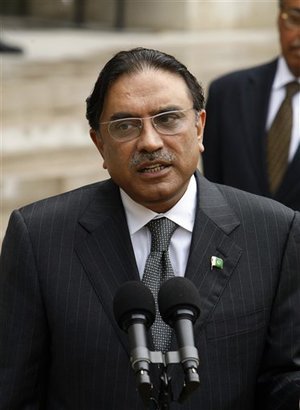
As the floods hit the country, I faced a dilemma as head of state. I could stay in Pakistan and support the prime minister in our response to the floods, or I could continue with a scheduled visit abroad. I chose to use my travels to mobilize foreign assistance—money, supplies, food, tents, medical care, engineers, clean water and medicine—for our people. Some have criticized my decision, saying it represented aloofness, but I felt that I had to choose substance over symbolism.

As a result of my meetings with French President Nicolas Sarkozy and British Prime Minister David Cameron, the plight of Pakistan’s flood victims is receiving full international attention. The British government pledged $24 million in aid. The U.S. government, with which I was in touch by telephone, has pledged $35 million in relief funds and made helicopters available for rescue efforts. The NATO coalition, at war in neighboring Afghanistan, has also offered help, as have major European nations and Japan.

My visit to Britain, an important ally in fighting terrorism, also helped defuse potential political friction over Mr. Cameron’s remarks in India ostensibly criticizing past Pakistani policy on jihadist militancy. And it allowed me to reaffirm to the relatively new British government Pakistan’s commitment to fighting all terrorist groups.

After a decade of suffering the political, economic and social abuses of military dictatorship, Pakistan has spent the last two years re-establishing our democratic infrastructure and rebuilding our national character and cohesiveness.

Our project of national renewal is even more difficult because we are on the front lines of the battle against international terrorism. In particular, we live with the effects of the historical errors of the 1980s that have come back to haunt the world. The use of jihad in Afghanistan as the blunt instrument to destroy the Soviet Union certainly had short-term benefits. But the decision to empower the most radical elements of the mujahideen—and then to abandon Afghanistan economically, politically and militarily after 1989—set the stage for the dreaded clash of civilizations that has plagued the world since.

Whatever horror the Western world has faced at the hands of extremists acting in the name of Islam pales in comparison to the nightmare endured by the people and government of Pakistan. Terrorists have killed more Pakistani soldiers than NATO coalition troops fighting in Afghanistan. Pakistan has lost 2,000 police in the war on terror, more than all other countries combined. And we have lost almost 6,000 civilians, twice the number who died in the World Trade Center.

We have also lost our country’s greatest recent political leader—my wife, Benazir Bhutto. My wife’s death was even more shocking than the United States losing a president or Britain its prime minister, because she defined our democratic consciousness in the face of dictatorship. She was a symbol of hope to tens of millions in my country—and hundreds of millions around the world—that there could be a better future ahead for our children.

As I return to Pakistan, I bring back tangible results that will help the flood victims in the short run and lay the foundations for national recovery in the long run. I might have benefitted personally from the political symbolism of being in the country at the time of natural disaster. But hungry people can’t eat symbols. The situation demanded action, and I acted to mobilize the world.

Now the work must continue. I call on the generous people of the United States to rise to this occasion as they have countless times over the last two centuries. Pakistan welcomes your contributions, as individuals and by your government.

Mr. Zardari is the president of Pakistan.
Time to Win Hearts in the Deluged Pakistan

By Saad Khan for The Huffington Post

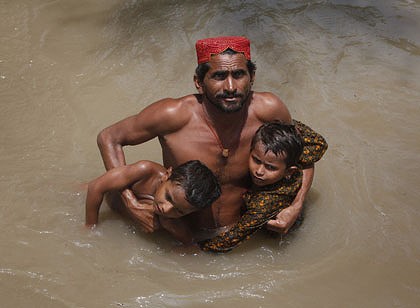
There has been a great deluge in northern and western Pakistan that has now spread to the southern parts, uprooting more than 14 million people and killing at least 1,600 . No one can remember a time when there has been such extensive flooding in the northwestern province of Pakistan, now renamed Khyber-Pakhtunkhwa (KP). The last major flooding was in 1929 and that too cannot hold a candle in front of the inundation that the present flooding has unfurled. Whole villages and even major cities and towns have been inundated with not a dry space in sight, water flowing as high as 20 feet. Pakistani houses are generally single story, especially in villages, and almost all have caved in due to surging waters.

Help is too little and too late to arrive. KP is the worst hit province and being the hotbed of extremism and suicide bombings, the little infrastructure that was left has been washed away by floods. As the information minister of the province, whose only son also lost his life recently in an extremist attack, aptly said, their province is now a mere shadow of what was once a lush green and relatively developed region.

During the massive flooding, federal government’s response was slow and cautionary at best. Prime Minister Gillani first paid an aerial visit of the submerged areas and did not bother coming down and talking with the people. He has just recently visited some areas and a medical camp that later turned out to be a fake and dummy one. President Zardari has not even done that. A federal relief fund was set up five days after the flooding and donations and contributions are little and far between. People simply don’t trust the government and prefer private organizations for their donations.

There was speculation in the Pakistani media that President Zardari would cancel his foreign trip to Britain and France after the flooding but he didn’t. Opposition leaders lashed out at him for not canceling the Britain trip because Premier Cameron had taken jibes at the ISI and the Pakistan Army. The ISI chief already canceled his trip but Zardari is on the last leg of his trip and has already met Cameron.

Amid this mayhem and chaos, the United States did respond rather quickly. American choppers are participating in the evacuation and have expanded their operations into the southern parts of Punjab besides KP.

Perhaps this is the time for the Americans to interact with the troubled and grief stricken Pakistanis and boost their image. American response after the 2005 earthquake was swift and exemplary and created a positive feeling among many Pakistanis. Khyber-Pakhtunkhwa is the haven of the Taliban and an extended rescue operation by the US will certainly change some minds, if not all.

There is a fear that the poor and stranded Pashtuns will turn to the Taliban if help does not arrive swiftly; extremist organizations have already started their relief operations. People are wary of the slow response and negligence of Pakistani officials. Taliban have an excellent opportunity to brainwash them and recruit them and they have already embarked on that path. The US can launch a counter strategy of winning hearts and minds. This is the perfect time for it and people are eager to hear the American side of the story. The US relief efforts so far are exceptional and they are apparently ahead of the extremists in the relief and rehabilitation process.

P.S. President Zardari has since returned to Pakistan but has not visited the flooded areas yet.

Pakistan Flood Crisis Bigger Than Tsunami, Haiti: UN

As reported by The Associated Press

ISLAMABAD: The number of people suffering from the massive floods in Pakistan could exceed the combined total in three recent megadisasters – the 2004 Indian Ocean tsunami, the 2005 Kashmir earthquake and the 2010 Haiti earthquake – the United Nations said Monday.

The death toll in each of those three disasters was much higher than the 1,500 people killed so far in the floods that first hit Pakistan two weeks ago. But the Pakistani government estimates that over 13 million people have been affected – two million more than the other disasters combined.

The comparison helps frame the scale of the crisis, which has overwhelmed the Pakistani government and has generated widespread anger from flood victims who have complained that aid is not reaching them quickly enough or at all.

”It looks like the number of people affected in this crisis is higher than the Haiti earthquake, the tsunami or the Pakistan earthquake, and if the toll is as high as the one given by the government, it’s higher than the three of them combined,” Maurizio Giuliano, spokesman for the UN Office for the Coordination of Humanitarian Affairs, told The Associated Press.

The UN has provided a lower number of people who have been affected in Pakistan, about 6 million, but Giuliano said his organization does not dispute the government’s figure. The UN number does not include the southern province of Sindh, which has been hit by floods in recent days, and the two sides have slightly different definitions of what it means to be affected.

The total number of people affected in the three other large disasters that have hit in recent years is about 11 million – 5 million in the tsunami and 3 million in each of the earthquakes – said Giuliano.

Many of the people affected by the floods, which were caused by extremely heavy monsoon rains, were located in Pakistan’s northwestern province of Khyber Pakhtunkhwa.

Rescue workers have been unable to reach up to 600,000 people marooned in the province’s Swat Valley, where many residents were still trying to recover from an intense battle between the army and the Taliban last spring, said Giuliano. Bad weather has prevented helicopters from flying to the area, which is inaccessible by ground, he said.

”All these people are in very serious need of assistance, and we are highly concerned about their situation,” said Giuliano.

Hundreds of thousands of people have also had to flee rising floodwaters in recent days in the central and southern provinces of Punjab and Sindh as heavy rains have continued to pound parts of the country.

One affected resident, Manzoor Ahmed, said Monday that although he managed to escape floods that submerged villages and destroyed homes in Sindh, the total lack of government help meant dying may have been a better alternative.

”It would have been better if we had died in the floods as our current miserable life is much more painful,” said Ahmed, who fled with his family from the town of Shikarpur and spent the night shivering in the rain that has continued to lash the country.

”It is very painful to see our people living without food and shelter,” he said.

Thousands of people in the neighboring districts of Shikarpur and Sukkur camped out on roads, bridges and railway tracks – any dry ground they could find – often with nothing more than the clothes on their backs and perhaps a plastic sheet to keep off the rain.

”I have no utensils. I have no food for my children. I have no money,” said Hora Mai, 40, sitting on a rain-soaked road in Sukkur along with hundreds of other people. ”We were able to escape the floodwaters, but hunger may kill us.”

A senior government official in Sukkur, Inamullah Dhareejo, said authorities were working to set up relief camps in the district and deliver food to flood victims.

But an Associated Press reporter who traveled widely through the worst-hit areas in Sindh over the past three days saw no sign of relief camps or government assistance.

The worst floods in Pakistan’s history hit the country at a time when the government is already struggling with a faltering economy and a brutal war against Taliban militants that has killed thousands of people.

The US and other international partners have stepped in to support the government by donating tens of millions of dollars and providing relief supplies and assistance.

But the UN special envoy for the disaster, Jean-Maurice Ripert, said Sunday that Pakistan will need billions of dollars more from international donors to recover from the floods, a daunting prospect at a time when the financial crisis has shrunk aid budgets in many countries. – AP

National Interest Equals 180 million

By Sibtayn Naqvi for The Blue Rickshaw

With the calamity struck upon Pakistan, many of our citizens have suffered at the hands of a horrific torrential downpour, a tragic AirBlue accident and a sickening “target killing” environment prevalent in Karachi. One would believe to look for guidance, consolation and leadership in the civilian government. To quote spider-man “with great power comes great responsibility”, but for Asif Zardari, this means pursuing “national interests” abroad, while thousands of lives have been disrupted and lost across the nation.

Now all in fairness, as one politician proudly displayed on his twitter “I cannot understand y a State visit by a President to further Pakistan’s national interests shud be politicised. It’s hard work no holiday”. Do tell me, is it absolutely vital for Mr. Zardari at this time to be pursing “national interests” by sipping tea and munching on biscuits with the very Prime Minister who stated that my country should not be allowed to “promote the export of terror”?

The President has made numerous trips abroad to pursue “national interests” since taking the reins of the Presidency. Even though such trips cost (on average) Rs. 20 million, I have rarely seen a public outcry in regards to such escapades. Being the President of a powerful nation housing 180 million people, Mr. President, some empathy in regards to the timing of your foreign affairs could have been witnessed this time around.

Was it absolutely crucial to use public money (that is already bare minimum) to travel abroad in the current circumstances? Would it not have been possible to formulate a domestic trip to Swat, Peshawar or Nowshera to stand by the unfortunate flood victims? Could the Rs. 20 million not have been used to conduct a memorial service for the tragic victims who lost their lives in the Margalla Hills? Is it too much to ask for Rs. 20 million to be spent on increased security in Karachi so we don’t read headlines on target killings every morning?

Throughout Pakistan’s turbulent history we have constantly heard drawing room chatter in regards to the Establishment not allowing the civilian government to flourish. Let’s put a spotlight over the recent weeks to see why the Pakistan Army has an image of being our savior rather than the civilian government. When target killings are carried out in Karachi, the Rangers step in. When ED202 crashed in the Margalla Hills, the Army came to the rescue (while one Minister exclaimed prematurely that there were a number of survivors), when the monsoonal floods hit the Northern regions, General Kayani surveyed the damage while expediting relief efforts, when the British Prime Minister made scathing remarks towards Pakistan, our ISI chief suspended his foreign trip to the United Kingdom. You of all people should know Mr. President public perception does matter.

Why was there a lack of civilian government presence in all the incidents mentioned above? Is the launch of Bilawal Zardari as a 21-year-old PPP-Chairman more important than the diminished livelihood of thousands across the country? Correct me if I am wrong, but didn’t the young Zardari exclaim “jaan chahyai, jaan deingay hum, khoon chahyai, khoon deingay hum”? I’d like to see some of that passion come to the forefront Mr. President.

Now let’s get to the favorite topic of the day. Fake degrees. For the 2008 general elections, there was a provision requiring all candidates to have an undergraduate degree. Regardless of whether the law is satisfactory, it was penned in ink. Do tell me, who gives the right to 47 sitting members of Parliament to provide the Election Commission of Pakistan with phony documents? Ironically, the majority of these illegal Parliamentarians are not even from the Pakistan Peoples Party. Take the high ground, the moral ground, Mr. President. Allow the report presented by the autonomous Higher Education Commission to run its proper course. Break down the barriers being constructed by the Ministry of Education.

Pakistan is a very resilient nation. Over the last decade, we have experienced the effects of an on-going war being carried out in Afghanistan. We have seen a rise in domestic violence that has cost 3,433 lives in 215 suicide attacks. Pakistan lost nearly 80,000 citizens in the tragic earthquake of 2005. Our military has suffered 8785 casualties of which 2273 soldiers have died. Karachi endured 156 incidents of targeted killings in 2009. 334 were targeted and killed in the first seven months of 2010, while their have been 889 murders in Karachi alone during the same time period. 152 Pakistani’s tragically lost their lives in the Margalla Hills, while the current flood that has swept the country has already taken the lives of more than 1,200 citizens.

But we are still standing strong. We carry out an honest day of living without electricity and ridiculously high prices of domestic commodities. Despite the hardships we have faced, our faith in this country has strengthened our confidence. In less than two weeks we will be out in the streets, waving our flags, saluting our soldiers and standing with our heads high. The globe may assume we are a fractured nation, and some may state that we export terror, but our national interests lay within our own borders. Our morals will carry us forward, but being at the helm of affairs Mr. President it is your duty to lead the way. We have suffered enough to watch Establishment dictate terms, or civilian governments bankrupting the national exchequer. It is high time the 180 million are looked after for they make up the “national interests”.

Sibtayn Naqvi is a freelance journalist and writes for The Blue Rickshaw. He may be contacted at sibtaynnaqvi@gmail.com

Pakistanis’ Anger Grows as Flood Damage Mounts

By Adam B Ellick for The New York Times

The damage from Pakistan’s worst floods in generations mounted on Monday as rescue operations continued and public fury rose in the country’s most volatile province.

The official death toll remains under 800, but on Monday the minister of information in Khyber-Pakhtunkhwa Province, formerly the North-West Frontier Province, estimated the true number to be 1,500. Another provincial official said 1.4 million people had lost their homes. As much as 70 percent of the region’s livestock is gone.

The number of people affected by the floods is 2.5 million, the International Federation of Red Cross and Red Crescent Societies said.

“The next week is critical. With further heavy rains there is a real danger that the flooding will spread further south into Sindh Province,” Ateeb Siddiqui, director of operations with the Pakistan Red Crescent Society, said in a statement.

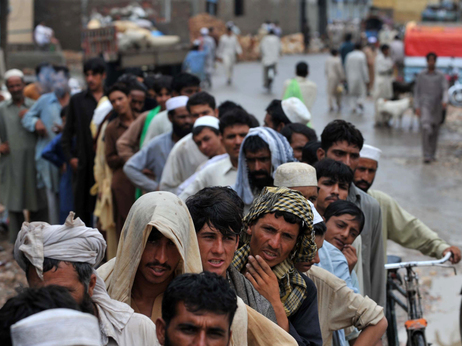
The displaced are clustered in hundreds of schools, largely fending for themselves for food and drinking water. Pakistani television channels showed survivors voicing venomous anger toward a government that has provided little immediate aid.

Meanwhile, President Asif Ali Zardari landed in France for talks with the French government.

“People think that the government is not providing anything to them,” said Adnan Khan, an official at the government’s disaster-relief management office. “But the scale is so high and huge that we cannot cater to all of the people.”

The growing frustration with the government adds to its troubles in dealing with the province, which abuts Afghanistan in Pakistan’s north and is a pivotal battleground against the Islamic militants operating in both countries.

For the past year, the government and the military have been engaged in a campaign to restore public services, trying to rebuild trust after more than two million people were displaced last year when government forces launched a major offensive against militants. But the reconstruction efforts have been painfully slow, and the public mood has shifted from frustrated to furious.

Analysts said the government’s flood relief effort would not only serve as another test of public trust, but would also most likely be exploited as a wedge by foreign governments and militant organizations.

Last summer, hard-line Islamist charities ended up providing significant aid to the displaced, while Pakistani authorities were unable to deliver enough help but refused to allow American agencies to deliver more. The authorities did not want to be associated with the United States, widely blamed here for many of the country’s ills.

That has not changed. For the moment, the United States, which has pledged $10 million in aid for flood victims and has donated thousands of meals, is handing over the supplies for Pakistan to deliver. The United States is also sending 2 water filtration systems, 7 helicopters and 12 prefabricated bridges.

One of the priorities is rebuilding a crucial bridge in Dir district, which remains largely cut off and where thousands are feared trapped or dead. And in Upper Swat, mules were being used to shuttle food rations across high waters to the hungry, an official said.