Posts Tagged ‘ Pakistan ’

Anna’s Trip to Pakistan: Should He Or Shouldn’t He

By Akshaya Mishra for Firstpost

Should he or shouldn’t he?

The supporters of Anna Hazare are in a bind. Two days after the Gandhian accepted the invitation of a human rights delegation from Pakistan to visit that country, the public opinion in India stands divided.

The Shiv Sena was first off the block opposing Anna’s move. Its argument follows the usual political theme. Islamabad must stop sponsoring terrorist activities in India first. The anti-corruption crusader should have taken cognisance of the sentiments of people before even considering such an invitation, it said.

Others are likely follow the Sena’s line soon. The hard line Hindutva followers, who have been silent so far, may erupt in anger, putting a communal spin to the visit.

Anna might just have put his feet in uncharted territory, and a minefield of potential controversies. Pakistan is not an easy proposition even for seasoned politicians to handle. He could be risking his reputation.

So, should he or should not he? There are no easy answers.

Anna is not just an individual, he is a phenomenon. He is an idea that easily transcends boundaries. The massive support to his anti-corruption movement across the social spectrum was a pointer to the fact.

“I will go to Pakistan. In fact, I will go anywhere for the sake of peace and poor people,” he said while meeting the Pakistani delegation, which included former judge of Supreme Court of Pakistan Nasir Aslam Zahid and founder of Pakistan India Forum for Peace and Democracy Karamat Ali.

Anna might just have put his feet in uncharted territory, and a minefield of potential controversies. PTI
“I believe in the religion of humanity, and humanity should begin with your neighbour. Like Indians, Pakistanis too are suffering due to widespread corruption in their country,” he added.

The statements reflect the man as he is — simple, honest and innocent of concerns that bother others so much. It’s possible he would not have given a serious thought to the troubled India-Pakistan equations. It is possible he would be worried about people and their happiness only, not issues or borders.

Isn’t corruption a big issue in Pakistan too? Don’t people suffer because of that? That would be his line of thinking. He would be oblivious to the fact that any movement there guided by him would amount to challenging the rulers in Islamabad and that any intention to help the country would inflame passions in India.

Sena chief Bal Thackeray has sounded the warning note. “Be it Anna or anyone else, they should first speak to kin of those killed in the Mumbai and Delhi blasts, before anointing themselves Nishan-e-Pakistan (Pakistan’s highest civilian award),” he wrote in the party mouthpiece Saamna today.

“Whether Anna goes to Pakistan or not is another matter, but it would have been better had he given a thought to the country’s sentiments on the issue,” he added.

Earlier, the party’s spokesperson Sanjay Raut had made his disapproval clear. “Anna should have told the visiting delegation to go back to Pakistan and create awareness among the people about the Pak-sponsored terrorism in India. The entire world may have praised the anti-corruption movement in India, but Anna cannot ignore sentiments of the people in his own country vis-a vis Pakistan,” he had said.

Anna is likely to lose most of his following in India if he goes ahead with his Pakistan trip, which for all practical purposes would be a symbolic one. Worse, notwithstanding the nature of his visit he would turn a political entity, without intending to be so.

His biggest achievement so far has been that he has managed to stay apolitical despite the desperate efforts from parties to align with him. He represents the common Indian and the other India, which stays out of the power circle that rules the country.

But the other India hates Pakistan too. This is where Anna is likely to run into a problem. Questions could be raised about his intention — the ordinary follower is not expected to understand and appreciate the nuances of his high thinking. The adulation for him is likely to shrink.

Anna should not let that happen. Pakistan can wait.

India, Pakistan To Open New Trade Check-Post

By Tom Wright for The Wall Street Journal

While India and Pakistan trade barbs over terrorism, the country’s trade officials are making small but notable steps toward opening up their economies to one another.

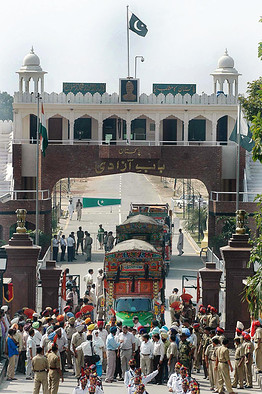
In October, authorities plan to open a second trade check-post at the Wagah border in Punjab state, the only land-crossing between the two hostile neighbors, in an attempt to boost trade volumes. The commerce ministers of both countries are expected to formally announce the new check-post at a meeting in New Delhi later this month.

It might look like a baby step in normalizing frozen trade relations. But with so much else going wrong in India-Pakistan ties, it’s a welcome bit of positive news and one that is energizing Indian businessmen who work close to the border.

Currently, trucks that carry the meager flow of trade between India and Pakistan have to stop unloading at 3 p.m. because that’s when tourists from both sides start arriving at the Wagah border for the evening “Beating Retreat” ceremony – a display of nationalistic bravado that precedes the formal closing of the gates between the countries each evening.

The new terminal will allow trade to continue until 7 p.m. and hopefully increase volumes passing through the check-post.

Some business groups in Amritsar, a city near the Indian side of the border,  are betting on an expansion of trade. Suneet Kochhar, director of a paper company based in Amritsar, is involved with a group of investors who have accumulated land to develop a freight terminal near the second trade check-post.

“Once it’s operational, things will change,” Mr. Kocchar says. Land near the border has doubled in value in the past two years, he adds.

To be sure, Pakistan and India have looked like moving ahead on trade in the past but things have gotten nowhere. Another attack like the one carried out by Pakistani militants on Mumbai in 2008, killing over 160 people, could easily nip the current optimism in the bud.

Two-way India-Pakistan trade was a paltry $1.8 billion in the year ended March 31, 2010, basically unchanged over the past five years, while India’s trade with China has skyrocketed to $60 billion.

Indian Prime Minister Manmohan Singh has said that India won’t be able to fulfill its economic potential unless it normalizes relations with Pakistan, which is a gateway to the Central Asian republics and beyond. For Pakistan, India is a huge potential market of 1.2 billion people. For now, businesses that want to get around restrictions have to ship goods at extra cost via ports like  Dubai.

The new check-post is a good start. Indian officials estimate two-way trade could easily jump to $2.7 billion in the short term. But there won’t be a seismic shift in trade volumes until both countries make serious efforts to expand the list of products that they can trade with one another. The current list encompasses just over 1,000 items.

That has frustrated some business people. Sunil Behal, director at Poplon Chemie, an Amritsar-based company that makes chemicals to treat leather, says some of its key products are not on the list. The company currently exports only $7,000 worth of products to Pakistan each month out of its total global exports of over $180,000 in the same period, he says.

But like many businesspeople in the area, he’s hopeful that politicians really mean to make progress this time. The check-post, he say, “will definitely boost business.”

There are tentative signs of seriousness. Ahead of the commerce ministers’ meeting later this month, officials from both sides met in New Delhi and thrashed out their differences. The minutes of the meeting  are here.

The officials were candid about the challenges. The new check-post, they agreed, will only be effective if both sides take other measures like simplifying customs procedures.

Pakistan officials complained they were not even aware of the customs rules followed by India, and faced a number of non-tariff barriers to trade such as cumbersome testing of products by Indian authorities that can take weeks, according to the minutes.

India lamented that Pakistan continues to put blocks in the way of trade, including proscribing a number of goods that aren’t allowed to enter Pakistan by road but instead have to come by rail. Mr. Kochhar, the paper company director, says he would export newsprint to Pakistan, but it’s uneconomical at the moment to ship via rail.

Both sides complain about the difficulty of getting business visas and have promised to remove bureaucratic obstacles.

The key, though, might be plans that India and Pakistan have to allow trade in most products, only protecting weak and strategic industries. The two countries are currently drawing up a list of these industries – known as a negative list – to submit to the other side.

Don’t expect these issues to be ironed out overnight. Still, there’s movement which both nations are trying to build on.

US Links Militant Group to Pakistan Government

As Reported by ABC News

The United States says there is evidence linking the Pakistani government to the militant group that carried out last week’s attack on the US embassy in Kabul.

The US ambassador to Pakistan, Cameron Munter, claims there are links between the Pakistani government and high-profile terrorist group the Haqqani network.

In blunt comments broadcast by state-run Radio Pakistan, Mr Munter said: “Let me tell you that the attack that took place in Kabul a few days ago that was the work of the Haqqani network,” he said, referring to a deadly miltant attack in on Tuesday.

“There is evidence linking the Haqqani network to the Pakistan government. This is something that must stop.

“We have to make sure that we work together to fight terrorism.”

Asked to provide evidence of the link with the Pakistani government, Mr Munter said only “we believe that to be the case”.

The Haqqani network, which is closely allied to the Taliban, has been blamed for several high-profile attacks against Western, Indian and government targets in Afghanistan.

The group is believed to be based in Pakistan but Islamabad has consistently denied links with militant groups.

The US has long urged Pakistan to take action against the Haqqani network and suspected the group had support within the Islamabad administration.

Strained ties
Acknowledging that the past year had been tough, Mr Munter urged joint action against terrorism and said that the United States and Pakistan were “fundamentally on the same side”.

But the public comments are a mark of strained ties between the fragile anti-terrorism allies, with relations fractious since the US raid on Pakistani soil that killed Al Qaeda leader Osama bin Laden in May.

The Haqqani network is thought to have been behind a number of attacks in Afghanistan, where NATO plans a gradual withdrawal of troops after a gruelling 10-year war.

Jalaluddin Haqqani, founder of the network, and his son Sirajuddin, who now runs the group, have both been designated “global terrorists” by Washington.

Mr Munter’s remarks follow a warning by US defence secretary Leon Panetta, who said after the Kabul attack that the US would retaliate against Pakistan-based insurgents.

“Time and again we’ve urged the Pakistanis to exercise their influence over these kinds of attacks from the Haqqanis and we’ve made very little progress in that area,” Mr Panetta said Wednesday, a day after the Kabul siege.

“I’m not going to talk about how we’re going to respond. I’ll just let you know that we’re not going to allow these kinds of attacks to go on,” he said.

Pakistan’s foreign ministry condemned those remarks as “out of line”, saying that “terrorism and militancy is a complex issue”.

Pakistan’s Floods: Deja Vu, All Over Again

By Ishaan Tharoor for Time

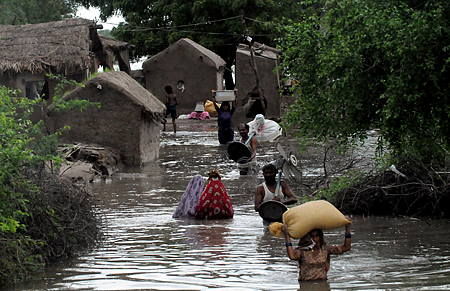
These days when it rains in South Asia, it doesn’t just pour — it floods. A month of monsoon squalls has deluged hundreds of towns and villages in northwest India and Pakistan. The latter has seen the most acute flooding, and, on all evidence, has been the least prepared for it. At least 233 people have already died and 300,000 are now stranded or in makeshift camps — a figure that will surely grow. Officials in Pakistan claim some 5.5 million people so far have been affected by rising waters. That’s still only a fraction of the 20 million hit by last year’s catastrophic rains, but the forecast looks ominous.

Neva Khan, Oxfam’s Pakistan country director, spelled out the dimensions of the crisis on the relief agency’s website:
There is an urgent need to provide immediate and life saving relief to the millions affected. It hasn’t stopped raining in Sindh for the last 10 days. Large swathes of land are underwater and people are desperately awaiting relief. They have lost their crops, homes and livestock for the second time – and been pushed from last year’s disaster to this one.

Sindh, the vast, fertile province abutting the Arabian Sea, appears the worst affected. Across Pakistan, some 900 villages have been wholly submerged and millions of hectares of arable land — some still irrevocably damaged by last year’s floods — are under water.
What’s most depressing about the situation now is how keenly it echoes the 2010 calamity. Omar Waraich, TIME’s Islamabad correspondent, wrote this excellent piece a year ago for the magazine’s international editions. As the waters rise, Pakistan faces a familiar cocktail of maladies from last summer.

Then, the civilian government headed by the unpopular President Asif Zardari was hampered by political infighting and its fundamental subservience to the real power of Pakistan’s influential military. Now, not much has changed (though Zardari is still in his position, a surprise to some). Then, militants and terrorists were exposing the fragility of the Pakistani state with cold-blooded strikes on some of country’s major cities. Now, after a rancorous summer of barb-flinging with the U.S., not much has changed either — not least when suspected al-Qaeda allied militants raided a prominent naval base in Karachi earlier this year. Then, the cash-strapped government pleaded for foreign assistance. Now similar calls are being issued, with similar notes of desperation.

In the weeks to come, inquests will be made into whether enough had been done to shore up riverbanks, provide shelter and food for the hundreds of thousands left destitute for over a year, and prepare for the next season’s rains. Already, there are reports of angry civilians blockading roads — like last year — demanding outside intervention and aid. Cities like Karachi, which this summer has seen a spasm of internecine blood-letting, will be further strained by refugees fleeing the countryside.

On many levels, though, the disaster is not man-made. The floodplain of the great Indus river, home to over 100 million people, birthed one of the world’s first ancient civilizations. But the river likely also swallowed it up. Because of its own particular ecology, the Indus can’t be controlled by similar mechanisms of levees prevalent in the West. And climate change has made weather patterns more unpredictable and volatile. This BBC story from a year ago cites the research of an Indian scientist: Professor Rajiv Sinha, from the Indian Institute of Technology in Kanpur, who has had first hand experience of Asian river floods, takes a more strident position.

“What all the climate models predict is that the distribution of monsoon rains will become more uneven in the future,” he told BBC News.
“Total rainfall stays the same, but it comes in shorter more intense bursts.”

In August 2010, more than half of the normal monsoon rain fell in only one week. Typically it is spread over three months.
Professor Sinha remarked: “Rivers just can’t cope with all that water in such a short time. It was five times, maybe 10 times, more than normal.”
So, if the unusually intense 2010 monsoon is the shape of things to come – and that is uncertain – the future may hold more flood misery for the people of Pakistan.

It’s a closing sentence that has proven sadly prophetic.

Pakistan Struggles to Curb Dengue Fever

As Reported By Reuters

Pakistani authorities, already under pressure to help hundreds of thousands of flood victims, are struggling to contain dengue fever which has killed at least eight people, officials said on Wednesday.

Around 4,400 cases of the mosquito-borne disease have been reported in the central Punjab province over the past two months, forcing the provincial government on Tuesday to close down schools for 10 days.

Most of the cases have been reported in Lahore, the provincial capital, where about 2,950 people tested positive.

“So far, eight people have died of dengue. We are trying our best to control this epidemic,” Jehanzeb Khan, secretary of the provincial health department, told Reuters.

Health experts say the illness is spreading across the Punjab because of poor hygiene conditions, and heavy monsoon rain provides ideal conditions for dengue-carrying mosquitoes to thrive in stagnant waters.

The first case of dengue was reported in Pakistan in 1994.

Those who died included Ataullah Siddiqui, head of the provincial department of minerals and natural resources.

Khan said the government had launched a fumigation drive to kill mosquitoes.

Sri Lanka is sending a team of experts to Pakistan to help fight the disease, the Sri Lankan High Commission said in a statement.

Pakistan’s weak civilian government, struggling to deal with floods that have killed 266 people, has been criticised by the media for dragging its feet on the dengue issue.

“The response to dengue has been adhoc, ex post, and therefore reactionary at best,” The News daily said in its editorial.

The disease is a threat to nearly half of the world’s population. Of the estimated 220 million people infected each year, two million — mostly children in Latin America and Asia — develop a severe form called dengue hemorrhagic fever.

There is currently no cure or vaccine for dengue fever.

Pakistan WSJ Ad Unlikely to Change Narrative

By Tom Wright for The Wall Street Journal

Pakistan has taken out a half-page advertisement in The Wall Street Journal to coincide with the 10th anniversary of the Sept. 11 attacks in an attempt to shift what Islamabad feels is an anti-Pakistan narrative in the American media.

“Which country can do more for your peace?” the ad asks, sitting below a story on page A10 of the U.S. Journal’s Saturday/Sunday edition titled “When the Towers Came Down.”

“Since 2001 a nation of 180 million has been fighting for the future of world’s 7 billion!” it continues.”Can any other country do so? Only Pakistan…Promising peace to the world.”

Pakistani army and civilian officials complain that in the U.S. their country is often portrayed in the media and by members of Congress as a double-dealing ally that takes billions of dollars in U.S. aid but secretly helps the Taliban kill U.S. soldiers.

Pakistan’s leaders have been publicly trying to promote a competing narrative, but with almost no success.

In their telling, Pakistan did foster Islamist militant groups, first to fight Soviet troops in Afghanistan and then Indian soldiers in Kashmir. Pakistan military and civilian officials point out the U.S. was all for the Mujahideen war against Moscow in the 1980s. But in the past decade, Pakistan’s army has severed its links with militants, who have unleashed a bloody war against Pakistan’s army and government, according to Islamabad’s narrative.

Pakistani officials regularly tell this version of events in public speechs and to visiting U.S. officials and journalists. The military has even made a local TV drama featuring real soldiers to publicize its sacrifices in the war against militants.

The advert in the Journal seeks to give the message to a wider audience.

To underline its point, the ad carries a picture of Benazir Bhutto, Pakistan’s former prime minister who was assassinated by Islamist militants in 2007, next to the slogan, “The promise of our martyrs lives on…”

The ad cites a series of statistics. Almost 22,000 Pakistani civilians have died or been seriously injured in the fight against terrorism, the ad said. The army has lost almost 3,000 soldiers. More than 3.5 million people have been displaced by the fighting and the damage to the economy over the past decade is estimated at $68 billion, it added.

People will quibble with these statistics from a country where reporters often find it difficult to get basic data.

It was not clear whether the ad was carried in other U.S. publications. Pakistan’s government also tried to place it in the New York Times. The Times asked for “more clarity in the ad about who was placing it,” according to a spokeswoman for the newspaper. The Times did not hear back from the government and so has not yet run the ad, she said.

The ad as printed in the Journal carries a line at the bottom in small font saying “Government of Pakistan” next to a web address for the government. A spokeswoman for the Journal declined to comment.

Will the advertisement be effective in shifting the narrative? It’s unlikely.

The points raised are all fair enough. Pakistan has been hammered by suicide bombings by Islamist militants against civilian and army targets. It’s perhaps fair to say that many in the U.S. have failed to recognize the changes in Pakistan, especially in the past few years, that have led to its domestic war against militancy.

Still, many in the U.S. and elsewhere are likely to shrug their shoulders. In the U.S. and India, where Pakistani-based militants are viewed as a daily threat to security, many politicians, analysts and ordinary citizens blame Pakistan for failing to stop the export of terrorism and being selective in which Islamist militant groups they go after.

Pakistan has waged a war against homegrown Pakistan Taliban militants for the past three years, suffering large casualties. But U.S. defense officials say publicly they are concerned that the country continues to protect Afghan Taliban fighters that don’t attack inside Pakistan. It’s these fighters who use Pakistan soil as a base from which to launch attacks on U.S. forces in Afghanistan, they say.

Some U.S. officials say they believe Pakistan’s argument that it’s too stretched fighting the Pakistan Taliban to open new fronts in its war against militants. But many members of Congress and U.S. defense officials say Islamabad wants to keep ties strong with the Afghan Taliban so it can influence politics over the border once the U.S. pulls out its troops by 2014.

India blames Pakistan for failing to crack down on Lashkar-e-Taiba, the militant group which carried out the attacks on Mumbai in 2008, killing over 160 people, and has hit Indian targets in Afghanistan. LET has not carried out any attacks against the Pakistan state.

Decade After 9/11, Afghans Languish in Pakistan

By Qasim Nauman and Rebecca Conway for Reuters

When Ghulum Nabi’s father heard U.S.-backed troops toppled Afghanistan’s Taliban after the September 11, 2001, attacks, he rushed to their family home in an Afghan refugee camp in Pakistan to spread the news.

Perhaps, one day they could all return to a peaceful and prosperous Afghanistan supported by a Western superpower.

After 10 years of U.S.-led efforts to pacify one of the world’s most turbulent countries, Afghan refugees in Pakistan have little hope for stability in their homeland.

“I grew up here and Pakistan is my country. When my father pushes me to go back to visit, I end up having a fight with him. I’m never going to live there. I want to get Pakistani nationality. This is my home,” said Nabi, 22, who runs a crockery shop.

“It doesn’t matter if it is America or anyone else trying to watch over Afghanistan. I will still be looking around to see if anyone is pointing a gun at me.”

Afghan President Hamid Karzai would welcome a return of the millions of Afghans living in Pakistan.

It would be a vote of confidence in his administration, which faces many problems, from widespread allegations of state corruption, to a resilient Taliban.

SOVIET INVASION TRIGGERED LIFE OF UNCERTAINTY

Many of the refugees are skilled labourers who could boost reconstruction and help revive a weak economy if they return. But it’s unlikely to happen.

Most of the refugees in Pakistan arrived after the Soviet invasion of Afghanistan in 1979. The conflict that followed consumed their homeland. After the mujahideen warriors defeated the Russians, warlords turned on each other and tore Afghanistan apart.

Many refugees fear a repeat of that chaos as a U.S. troop withdrawal looms.

Some would like to go home but feel they can’t. Others regard Pakistan as home despite its many disadvantages. Without proper Pakistani identification cards, Afghans can’t open bank accounts or buy or lease property.

Many are openly mistreated by Pakistanis who have little fear of being held to account.

On August 14, the anniversary of Pakistan’s independence, Saeed Anwar’s landlord showed up with three men armed with AK-47 assault rifles at his clothing shop at a busy bazaar in the city of Haripur, home to 80,000 Afghan refugees who live in camps.

“They threw around my merchandise and said I need to pay them a 300,000 Pakistani rupees ($3,450) advance on the rent. I had already paid the rent,” said Anwar, wearing traditional, loose Pakistani trousers.

“I went to the police to register a case. But when they see a dispute between a Pakistani and an Afghan, they automatically assume the Afghan has done something wrong.”

Still, many Afghans believe its wiser, and safer, to just accept the frequent humiliation than return to a homeland still shattered, despite a long U.S.-led military campaign against militancy and billions of dollars in Western aid.

Afghans — from elders who vividly remember the first Soviet gunship helicopters in Afghanistan, to teenagers who have only visited a few times — work for Pakistanis as welders or carpenters and tailors in Haripur and other cities.

Most of them prefer to run their own small businesses, from food carts to car dealerships. It’s the only sense of independence they have in the camps which consist of small cement and mud housing units near a reservoir.

The elders have set up a jirga, or tribal gathering, to settle internal disputes, as is done in much of Afghanistan. Cricket games are the only form of entertainment and leisure activity for most youths.

Two years ago Pakistan agreed to let displaced Afghans stay until the end of 2012, after a resurgence of militant violence along the Pakistan-Afghanistan border hindered repatriation.

Still, people like Sherullah, whose nine children were born in Pakistan, feel vulnerable. What if Pakistan asks them to leave one day?

“There is a lot of confusion. If there’s one thing I want, it’s for this confusion to go away, for us to know if we will be staying or not,” said Sherullah, who was cutting women’s clothing in his tailor shop.

“There are many people living here that can afford to build a proper house but don’t want to. They think ‘what if next year we are told to leave?’. So they continue to live in mud houses.”

Aside from 1.7 million officially registered Afghans in Pakistan, there are an additional 800,000 with no documentation.

According to the United Nations, Pakistan is home to the world’s largest refugee population, mostly Afghans, who strain the country’s troubled economy.

Pakistan would like to repatriate them.

There are, however, few incentives for refugees to head back to Afghanistan. So life in camps may drag on for many years.

Even though the U.S. disengagement is gradual, it brings back painful memories of what was widely seen as American abandonment of Afghanistan after the Soviet exit in 1989. Warlords soon took over and bloodshed returned.

Haji Aslam, 65, an elder in one of the camps, has seen conflict in Afghanistan over the last 30 years — from the battlefields where he fought the Soviets to what he sees today on his television screen. He is betting on the Taliban to prevail once the Americans leave.

“Even if just 10 Taliban show up, the Afghan government will flee Kabul,” said Aslam, a man with a white beard wearing a traditional flat Afghan cap. “In Pakistan, I am at peace. I know my children are safe.”

Jinnah’s Pakistan

By Ziyad Faisal for The Friday Times

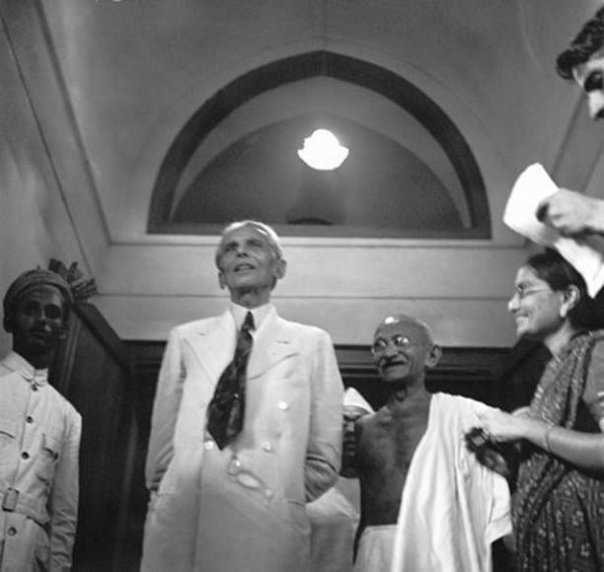
When a suicide-bomber targets a market-place, a rabid Islamist kills a figure who is not pious enough or Independence Day comes, we are reminded of the psychosis of the Pakistani state. We are reminded that in addition to shaky material foundations, the Pakistani state rests upon highly flimsy and contested ideological grounds. At such times, there is almost always a chorus from the literate urban middle-classes of the country: they want “Jinnah’s Pakistan”. For the more conservative sections of our urban middle-class, the Pakistan they long for is the “laboratory” which Jinnah claimed he sought, to implement Islamic values. For the more liberal sections of the urban middle-class, the Pakistan they want was described by a secular Jinnah in his speech on August 11, 1947. The more perceptive reader will already realize that while every historical figure can be interpreted in a wide variety of ways, if a single leader can be held up by secularists, conservatives, nationalists and Islamists alike, perhaps the leader himself was not so sure about certain things.

But what exactly was Mr Jinnah’s own vision for Pakistan, and how did it interact with the nature of the Pakistan Movement and the realities of post-1947 Pakistan? To understand the yearning for “Quaid-e-Azam ka Pakistan”, one must look at the founding myths of Pakistan and Jinnah’s place therein.

Almost any child who goes to school in Pakistan learns a certain story. The story involves a young man, burning the proverbial midnight oil as he studied at night, trying to shield the light he was using with cardboard sheets, so as not to disturb his siblings. When asked by his sister as to why he would not simply go to bed, he said something along the lines of how important this hard work was, for him to become a great man. The Pakistani reader will recognize immediately the young man we are talking about: the Quaid-e-Azam, Muhammad Ali Jinnah.

Most modern nation-states actively propagate their foundational myths: based on a kernel of truth but embellished greatly with fantasy, exaggeration and historical omissions. It is only natural that such myths centre around the integrity, heroism or ambition of one or more “founding fathers” who were instrumental in creating the state it in its modern, institutional form. So, for instance, Israel has its Bar Kochba and its Ben Gurion. Turkey has its Attaturk leading the fight for independence from barren Anatolia. The United States has its George Washington, who supposedly would not lie to his father about cutting a cherry tree, even as a boy. Latin American countries have their Simon Bolivar, Italy has its Garibaldi, Ireland has its Michael Collins. The Indian state has its own pantheon of founding fathers, from Asoka to the Rani of Jhansi, all the way down to Gandhi and Subhas Chandra Bose. Even Saudi Arabia has its epic tale of Bedouin raiders from the sand-dunes of Najd turning into majestic kings and defenders of the Holy Kaabah.

As for the foundational myths of Pakistan, let us bear in mind the following: every modern nation-state is ultimately a very artificial social construct, and the more artificial a state, the more artificial its founding myths.

And what is the Pakistani child taught about the founding fathers of the country? Well, if we put aside the valuable nation-building efforts of Muhammad bin Qasim and Mahmud of Ghazni, what we are left with is essentially Allama Muhammad Iqbal and, of course, the Quaid-e-Azam. Iqbal, as a brilliant poet and an aspiring philosopher, who dreamt of Pakistan. Mr Jinnah, the great political leader who brought this vision to fruition. Such is the clichĂŠd narrative we are given.

In that famous story about the hard-working youthful Jinnah, the Pakistani student is being taught that a boy in his mid-to-late teens had already within him a young Quaid-e-Azam: the Great Leader. He would go on to study the legal system of the British colonialists, gain the respect of the British and the adulation of the Muslim masses of South Asia and eventually this epic tale culminates in the heroic Muslim League’s achievements of Partition and its accompanying bloodbath.

The historical record suggests that the budding Leader was not exactly convinced about the need for communal Muslim politics until at least the early 1920s. He was, after all, the chief architect of the Lucknow Pact of 1916: the “ambassador of Hindu-Muslim unity” as Sarojni Naidu famously described him. Even as late as 1946, Jinnah as a practical politician could entertain the possibility of some sort of compromise with the Congress leadership and the British. The Muslim League leadership would have been satisfied with adequate guarantees of limited autonomy for Muslim-majority regions of Punjab, Sindh and Bengal. The Pashtun leaders of the north-western Frontier, of course, were not to be taken on board, because their loyalty to the Congress amounted to some sort of treachery. As for the Baloch, one imagines, it was assumed that they need not be considered in any calculations: they would somehow automatically be convinced to join the new nation-state and forget centuries of distinct history.

The Muslim League itself, founded in 1905-06 by disinherited and disgruntled members of the former Muslim elite of South Asia, was not committed to mass politics or independence from British rule – and certainly not an independent Pakistan. Unlike the populist appeals of Congress leaders like Gandhi, Nehru and others, the Muslim League’s political programme was for a long time directed towards the Aligarh-educated ex-nobility among Muslims. In the 1940s, were it not for a last-minute alliance with Muslim feudal lords in Punjab and some urban elements from Sindh, the Muslim League could never have mustered the political resources to make their demand for an independent Pakistan into a reality.

Conservative nationalists and Islamists in Pakistan are likely to be disappointed by the real Mr Jinnah. He was an intelligent, British-educated barrister, and had little time for the discourse of village mullahs. Steeped in the traditions of British liberalism, Jinnah could bring only a tiny minority of the Muslim clergy to his side even in the 1940s. It is obvious that he was looking for some form of constitutional liberal democracy, no matter how inspiring the pan-Islamic yearnings of Allama Iqbal might have been.

But perhaps our secular liberals are even more likely to be disappointed, notwithstanding the fact that Mr Jinnah laid out a set of principles for a secular Pakistani state in his speech to our first Constituent Assembly, on the 11th of August, 1947. To quote his memorable words on that occasion:

“You are free; you are free to go to your temples, you are free to go to your mosques or to any other place or worship in this State of Pakistan. You may belong to any religion or caste or creed that has nothing to do with the business of the State. ”

While these are admirable sentiments, perhaps we can be forgiven for pointing out the glaring contradiction here. If a citizen’s religion is not the business of the state, how does one explain the creation of Pakistan as a separate state? If it were not differences in religion with the Hindus and other religious communities of India, what else was it that motivated the Muslim League to demand Pakistan?

Allow me go one step further and remind the reader of the many occasions on which Mr Jinnah invoked Islamic rhetoric in his various speeches to justify the idea of Pakistan. With apologies beforehand, allow me to recall that it was the same Mr Jinnah who would not accept his daughter marrying a non-Muslim man, even though he himself had married a non-Muslim woman. One is reminded of the typical mindset of the contemporary Pakistani Muslim father or brother.

For years, Mr Jinnah brilliantly argued for federal autonomy in Muslim-majority provinces…until Partition happened and the Pashtuns, Bengalis, Baloch and other nationalities within Pakistan demanded the same autonomy. For years, Mr Jinnah pointed out the distinct cultural identity of South Asian Muslims…until Partition happened and Bengalis asked for their language to be given the status of a national language. Urdu and Urdu alone, Mr Jinnah firmly reminded them.

I understand that quite a few readers ought to be exasperated by now. What am I trying to say? What exactly was Muhammad Ali Jinnah? Was he socially liberal or conservative? Was he secular or not? What future did he envision for Pakistan?

The historical record shows that Mr Jinnah was himself has given us adequate arguments for just about any side we choose. Despite the personal integrity, intelligence and political skill of Mr Jinnah, it has to be recognized that the Muslim League was not exactly what it claimed to be. It was supposed to speak for the Muslims of South Asia, but its actual representative credentials were not very credible, even in the “moth-eaten and truncated” (to quote Mr Jinnah) Pakistan of 1947.

To limit ourselves to an imagined version of what Mr Jinnah wanted would mean limiting our political vision and perhaps the very frontiers of our political morality.

What sort of Pakistan does the hari from Sindh want? What sort of Pakistan does the silenced rape victim want? What sort of Pakistan does the tortured body of the young Baloch student want? What sort of Pakistan does the textile worker from Faisalabad want, considering he is paid some 6000 rupees a month? What sort of Pakistan does the terrified Ahmadi want? What sort of Pakistan do you want? What sort of Pakistan do I want?

You see, perhaps the real question is not what our founding father(s) wanted, but what today’s unfortunate Pakistanis want.

Perhaps it is time to consider a possibility: that the laboratory for implementing Islamic teachings was created, and the experiment went horribly wrong. And perhaps it is time to consider another possibility: given the many different interpretations which Mr Jinnah left himself open to, might we be forgiven for concluding that this is it? That this, where we live today, is Jinnah’s Pakistan in all its glory?

Al Qaeda’s Roots Grow Deeper in Pakistan’

As Reported in Zee News

Ten years after the 9/11 terrorist attacks and the subsequent “war on terror” launched by United Stated-led forces against al Qaeda, the terrorist outfit “continues to pose a serious threat to the world as it keeps surviving and thriving mainly on the Pakistan-Afghanistan tribal belt”, a senior Pakistani journalist and author has said.

“In these rugged areas, it [al Qaeda] has established an effective jihadi network that increasingly exploits its Pakistani affiliates to carry on the global jihadi agenda of Osama bin Laden, despite his May 02 killing in a United States military raid in Abbottabad in Pakistan,” Amir Mir wrote in a piece for Asia Times Online.

Until recently, analysts have been mostly focusing on the dangers posed by the growing Talibanisation of Pakistan, he noted.

“Yet, it has now become abundantly clear that the time has come to pay more attention to the bigger dangers posed by the Pakistanisation of al Qaeda,” he added.

Mir, who has written several books on the subject of militant Islam and terrorism, the latest being ‘The Bhutto murder trail: From Waziristan to GHQ’, said that the al Qaeda leadership’s choice of using the FATA region, especially the North and South Waziristan tribal agencies as their hideout, has enabled the terror outfit to build a new power base, separate from Afghanistan.

“As a result, despite Pakistan’s extensive contribution to the “war on terror”, many questions persist about the extent to which al Qaeda and its allied groups are operating within Pakistan,” he observed.

He said that al Qaeda’s success in forging close ties to Pakistani jihadi groups has given it an increasingly secure haven in Pakistan’s mountainous tribal areas, which have “replaced Afghanistan as the key training and indoctrination grounds for al Qaeda recruits to be used in operations abroad and for training those indoctrinated and radicalised elsewhere.”

The journalist also said it appears that al Qaeda not only remains in business in its traditional stronghold in the Waziristan tribal region, it has “also clearly advanced to the urban areas in all four provinces of Pakistan”.

“This is confirmed by the growing belief of the Barack Obama administration that if there is one country that matters most to the future of al Qaeda, it is Pakistan,” he added.

No Evidence Pakistan Helped Osama Bin Laden: U.S. Security Adviser

As Reported by The International Business Times

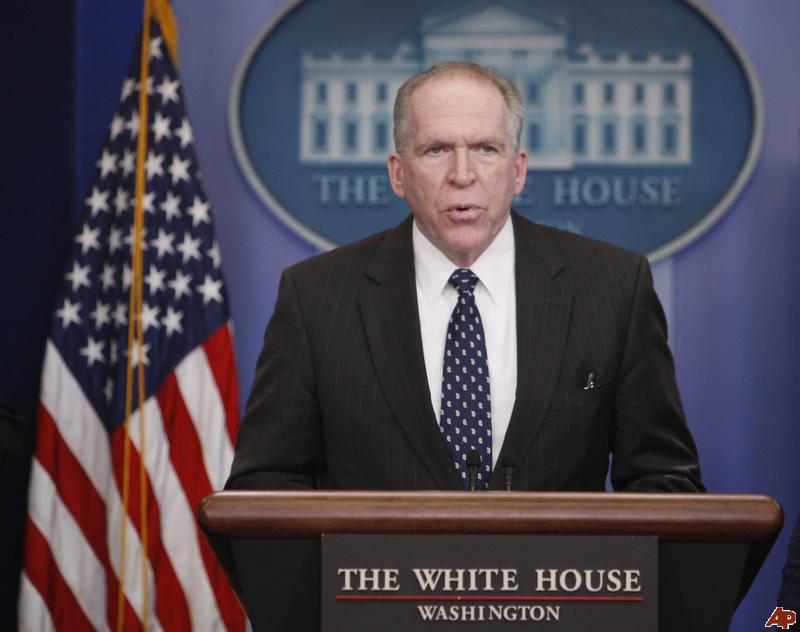
There is no evidence that Pakistan government officials helped and protected Osama bin Laden, claimed John Brennan, Deputy National Security adviser and President Barack Obama’s chief counter-terrorism adviser.

Brennan, speaking to reporters at a morning briefing said “I have not seen anything that the Pakistanis were aiding his refuge there.”

In May, Osama was found and killed by U.S. Navy SEALS in a large compound in the town of Abbottabad in northern Pakistan, near the capital Islamabad. Since that time, rumors have swirled that Pakistani intelligence officials had been aiding the former al-Qaeda terror chief as well as many other militants.

Brennan also said that based on examination of documents and data found and seized at Osama’s compound, it became apparent that bin Laden was “a little out of touch about how debilitated his organization was” after fighting for almost a decade against the U.S.

“It did reveal an organization in distress,” Brennan said.

Brennan also reportedly praised Pakistan’s offensive against terrorist groups operating the country and that Washington has a close working relationship with Islamabad in this joint effort.

He cited the recent arrest in Pakistan of Younis al-Mauritani, a senior al-Qaeda official, is proof that Islamabad is taking its responsibilities seriously.

He noted that al-Qaeda “has taken it on the chin” and has been “degraded significantly over the past couple of years.”

Brennan’s latest comments dramatically contradict assertions he made in May (just after the killing of Osama) when he declared that it was “inconceivable” that bin Laden did not have the support of officials within Pakistan.

A Monster Roaming The World

By Paul Mcgeough for The City Weekly
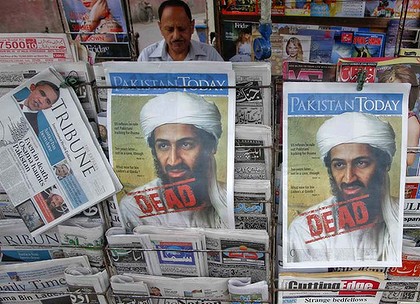
Search for a firm footing in Pakistan and there is none – all is quicksand … strategically, politically, morally.

Here in south Asia, strategically sandwiched between failing Afghanistan and the China and India powerhouses, is a country in which journalists are abducted in the night by agents of the state and murdered; in which the only advance after a decade in which Washington has tried to buy friendship with cheques for more than $20 billion, is the expansion of Pakistan’s nuclear arsenal – which is on the verge of surpassing Britain’s as the fifth biggest in the world.

In Pakistan, a 50-year-old woman is sentenced to death on a dubious blasphemy charge – and politicians who dare to speak in her defence are gunned down; and a woman is gang-raped and paraded naked through her village on the orders of a local council, over bogus claims that her 12-year-old brother has offended a 20-year-old woman from the clan of the men who defiled her.

But that’s village life. In the leafy garrison town of Abbottabad, an hour’s drive north of Islamabad, Osama bin Laden, mastermind of the attacks of September 11, 2001, was able to hide in plain sight for years. The location of his fortified bunker, a stone’s throw from a prestigious military academy, made it harder to give any credence to the generals’ repeated denials that significant elements of Pakistan’s extensive security apparatus sheltered the al-Qaeda chief and continue to give succour to the Taliban and other insurgency and terrorist movements.

In the south-west, in the wilds of provincial Baluchistan, there have been 150 ”kill and dump” operations this year. Most of the victims are Baluch nationalist rebels. Their killers are the Inter-Services Intelligence agency (ISI) and other elements of Pakistan’s national security forces – driven to brutality by a belief, which could be correct, that Pakistan’s arch foe, India, stirs the local nationalist pot. In turn, the Baluch nationalists are accused of running their own death squads – their victims are Punjabi ”settlers”, government workers brought in from other parts of the country.

Baluchistan is half Pashtun, which also makes it a sanctuary for the Taliban from adjoining Afghanistan, where Washington and the world still struggle, with little success, to impose a semblance of democracy on the bones of a fracturing, failing state. Here then is another of the ironies that puts a serious question mark over the bona fides of the Pakistani security forces: the leadership of the Afghanistan Taliban sequesters in Quetta, the provincial capital of Baluchistan, but the various Pakistani security services are so busy putting the Baluch nationalists through the mincer they don’t have time to take down the Taliban command-and-control centre. Instead, they reportedly socialise with the Taliban and sit in on their strategy meetings.

West from Baluchistan is the sprawling port city of Karachi, where the spiralling death toll in renewed ethnic turf-wars gives raw meaning to what local novelist Kamila Shamsie broaches obliquely, recounting how the city ”winks” at her. “Yes, the city said, I am a breeding ground for monsters, ” she writes, “but don’t think that is the full measure of what I am.”

This drab, chaotic home to 18 million people who account for 65 per cent of Pakistan’s economy is being carved up by bullets that this year have accounted for as many as 1000 ”wrong place, wrong time” deaths as gunmen randomly select their targets – sending messages to whole communities, not the individuals with whose blood they paint the rough pavements. As the suburbs seethe, police do little, because they are cowed by the systematic elimination of those in their ranks who intervened in the last iteration of these ethnic wars. Provincial and federal governments and the security forces only wring their hands.

In Karachi everyone lies. No one denies turf wars are being waged. They simply blame everyone else – all the political parties deny any links to the militias that prosecute their bloody agendas and to the crime, drug and land-development mafias that prosper in their wake. And the city’s once-dominant Urdu-speaking Mohajirs fight to maintain their control of corrupted city politics, amid an influx of Pashtuns fleeing upheavals along the Afghan border.

“Tension rises, we see killings and then scores must be settled,” an adviser to the provincial governor says. “We are at war – the political parties say they are not involved, but the mafias take shelter from the parties as they exploit the situation.”

In Islamabad, enter any of the city’s newsrooms, and see fear in the eyes of journalists who risk death and torture for going about assignments. Consider the words of their Karachi colleague Madiha Sattar – “a growth of intolerance has forged an extreme, murderous antipathy to freedom of expression.”

Most shocking in this campaign of fear and intimidation against one of the pillars of democracy was the disappearance in late May of Syed Saleem Shahzad, an investigative reporter for the respected, Hong Kong-based Asia Times Online. Two days after his abduction, Shahzad’s battered body was found at Mandi Bahauddin, 130 kilometres south-east of the capital. The reporter left detailed accounts of the threats he had received from the ISI; in Washington, senior officials unflinchingly confirming that Shahzad’s death had been ”sanctioned” by the Pakistani government.

Umar Cheema might just as easily have been their victim. Behind a door marked ”Investigation Cell” off a basement corridor in the Islamabad offices of The News, the 34-year-old father of two explains that the shock in his colleague Saleem Shahzad’s murder was a realisation it might just as easily have been him.

As Cheema drove home from a party in the early hours during Ramadan last year, 12 men who identified themselves as police commandos abducted him, he says. Informing him first that he was a suspect in a killing, they pulled a bag over his head and hauled him away.

“They took me to a building where the leader stripped off my clothes. Then I was ordered to lie on the floor and they beat me on the back and shoulders for 20 or 25 minutes with leather straps and wooden canes.

“I was writing about corruption in the government and the lack of accountability in the military and intelligence agencies – they said they were beating me because of my reporting. Then they shaved my head and eyebrows – that’s what is done to thieves in rural areas to humiliate them.

“Shahzad’s death left me speechless,” he says. “I was the second last victim before they took him. So I felt very much that this was a message for me – it was very, very personal.”

In Islamabad, the government of Prime Minister Yousaf Gillani is as overwhelmed as it is complicit in the nation’s failings. The economy is in crisis and the government has ceded control of more than half the country to the military or to extremist militias. “None of the cogs of state mesh to make it do what must be done,” Human Rights Commission of Pakistan’s Kamran Arif said.

Just south of Islamabad is Rawalpindi, a more typical Asian city than the sanitised and empty boulevards of Islamabad. As home and headquarters to the men and institutions that comprise Pakistan’s military and intelligence establishment, this is the centre of absolute power in Pakistan. And it is here that a deep-fried sense of humiliation over the American raid to kill Osama bin Laden, in May this year, is felt most acutely.

“After the bin Laden raid, it’s a question of the survival of the state,” the defence analyst and director of the South Asian Strategic Stability Institute, Maria Sultan, says. “The problem now is that by this very public humiliation, the US has lost its biggest supporter – it’s not the capability of the Pakistani military that is affected, it’s its credibility.”

A close reading of ”Getting Bin Laden”, The New Yorker’s inside account of the May 2 raid, reveals the mission was not just a single US incursion that managed to evade Pakistan’s air defences. On the night, there were effectively three separate American missions, none of which was detected by a military-security complex that demands indulgence by the people of Pakistan on the grounds that it is their only protection from the Indian hordes.

Pakistan’s generals faced a grim choice – they had to admit to deceiving the world in harbouring bin Laden, or to incompetence by not knowing he was lounging in their backyard. So supine were they in opting to plead incompetence there were fears of a mutiny in the middle ranks of the security services.

The US signal to the world of just how much it could not trust its south Asian ally came hard on the heels of serial embarrassments at the hands of the Taliban and other militant groups in Pakistan.

There have been a series of militant attacks on the most secure and sensitive defence establishments. The latest, which some observers concluded could not have been undertaken without inside help, saw a 10-man assault team storm the Mehran naval aviation base in Karachi. It took hundreds of Pakistani navy commandos, marines and paramilitaries to retake the base, but not before two aircraft were destroyed, hostages taken and the base had been occupied for the best part of a day.

But it takes a discerning Pakistani general to differentiate between militants – some are ”strategic assets” of the security apparatus and the generals refuse to go after them.

Dr Ayesha Agha, whose military and political commentaries appear in Pakistan’s Dawn newspaper, explains: “The military depends on these ‘assets’ – they are a cost-effective means to fighting wars that the Pakistani military wants to fight in India and Afghanistan.” Extrajudicial killings by the military now are counted in the hundreds.

When men in uniform were filmed recently murdering a detainee, the reckoning in human rights circles was that far from being a lapse of judgment, the recording had been allowed in the knowledge that its distribution on the internet would serve as a useful warning to the wider community.

A Karachi taxi driver becomes excited as he ferries us from the airport to a downtown hotel – “Pakistan lovely country,” he bellows. “Terrorism? No, no, no.”

But a single graphic in a 200-page study of Pakistan, published in May by the Washington-based Centre for Strategic and International Studies, reveals an impossible security challenge. Last year alone, 2113 terrorist attacks, 369 clashes between the security services and militants, 260 operational attacks by the security forces, 135 US drone attacks, 69 border clashes, 233 bouts of ethno-political violence and 214 inter-tribal clashes resulted in more than 10,000 dead and as many injured.

The death of bin Laden and the reported death of al-Qaeda’s new No. 2 figure, Atiyah Abd al-Rahman, in an American drone attack last week, are still being factored into a running debate among intelligence specialists on the extent to which al-Qaeda offshoots elsewhere in the world, especially the Yemen-based al-Qaeda in the Arabian Peninsula [AQAP], have taken the baton from the Pakistani organisation.

But a July study by the New America Foundation of 32 ”serious” jihadist terror plots against the West from 2004 to 2011, finds 53 per cent had operational or training links to jihadist groups in Pakistan – compared to just 6 per cent being linked to Yemen. And the rising tempo of the drone attacks has failed to dent the rising frequency of Pakistan-linked plots against the West, the study finds.

Implicit or explicit in any discussion on Pakistan’s volatile mix of militant violence and governmental chaos, is the level of anxiety around the world about the security of its nuclear arsenal. Confronted with claims such as that by bin Laden that acquiring a nuclear weapon was a ”religious duty” and the hope expressed by one of his lieutenants that such a weapon one day might be seized in Pakistan, officials in Islamabad invariably boast that all is tightly locked down.

But when we ask a Pakistani diplomat how secure were the weapons in the aftermath of the US mission to kill Osama bin Laden, he replies: “Less so, now that the Americans have revealed to the world that it is possible to sneak into Pakistan undetected, to take something that you really want.”

President Obama’s public appeal that Pakistan not become the world’s first ”nuclear-armed militant state” gives context to disclosures by The New Yorker’s Seymour Hersh of the existence of a US Special Operations rapid-response team which would be parachuted into Pakistan in the event of a nuclear crisis.

Rolf Mowatt-Larssen, a former director of intelligence and counter intelligence at the US Department of Energy, is boldest in setting out the fears of Washington, London and other capitals – some of which were disclosed without diplomatic varnish by Wikileaks last year.

Writing in Arms Control Today, Mowatt-Larssen, who served 20 years at the CIA, bills Pakistan as the most likely setting for terrorists bent on acquiring a nuclear device to co-opt a nuclear insider – of whom there are estimated to be as many as 70,000 in Pakistan.

“There is a lethal proximity between terrorists, extremists, and nuclear weapons insiders,” he writes. “Insiders have facilitated terrorist attacks. Suicide bombings have occurred at air force bases that reportedly serve as nuclear weapons storage sites. It is difficult to ignore such trends.

”Purely in actuarial terms, there is a strong possibility that bad apples in the nuclear establishment are willing to co-operate with outsiders for personal gain or out of sympathy for their cause.”

“Not possible,” says Maria Sultan. “About eight to 10,000 personnel working at the strategic level on security,” she says, ticking off seven or eight interlocking layers of complex security, the first of which she says would trip most intruders before they came within 80 kilometres of a nuclear facility. “The idea that a terrorist can walk in and get hold of a device is just not possible.”

Such is the bind in which Pakistanis find themselves. But if it is true feeble and corrupt civilian administrations make circumstances ripe for a military takeover, it is hardly surprising the generals have no respect for democratic fundamentals.

As revealed in one of the Wikileaks cables, Army chief General Ashfaq Parvez Kayani was ready to force President Asif Ali Zardari from office – save for the fact the general thought even less of Zardari’s likely civilian replacement. And historically, Washington has opted to connect with Pakistan through the military power of the generals, rather than the people power of the civilian leadership.

Bruce Riedel, a veteran CIA analyst, sets out the connections in Deadly Embrace: Pakistan, America and the Future of the Global Jihad. “…Richard Nixon turned a blind eye to the murder of hundreds of thousands of Bangladeshis to keep his friends in Pakistan’s army in power, a strategy that ultimately failed,” Riedel writes. “Ronald Reagan entertained Zia-ul-Haq even as Zia was giving succour to the Arab jihadists who would become al-Qaeda. George W. Bush allowed Pervez Musharraf to give the Afghan Taliban a sanctuary from which to kill American and NATO soldiers in Afghanistan.”

And in the judgment of Bushra Gohar, an elected MP from Pakistan’s troubled Swat Valley, Washington still prefers to deal with the military rather than the country’s civilian leadership. “That’s not a role that the military has under the constitution,” she says during a break in the business of the National Assembly in Islamabad. “There has been a democratic transition in this country and we expect the international community to support it.”

Power vacuums become ripe for exploitation, as was revealed with frightening clarity earlier this year when two of three elected figures who had dared to speak out against Pakistan’s draconian blasphemy laws were assassinated. In January, Punjab provincial governor Salman Taseer was gunned down by one of his state-provided security men; in March, the Minorities Minister and the only Christian in Gillani’s cabinet, Shahbaz Bhatti, died in a hail of gunfire as his car left his mother’s home in Islamabad.

Taseer’s killer confessed and became a national hero. His home is a shrine, he is garlanded with rose petals and, in the oddest twist of all, the young lawyers’ movement that effectively bundled Pervez Musharraf, the last dictator, from power in 2008, has taken the side of this cold-blooded murderer – not the principle for which his victim died.

A visitor leaves Pakistan wondering if anyone here speaks the truth. The dictators habitually resort to amping up religious parties – either to drown out secular ones that might be interested in the ideals of selfless democracy, or to further marginalise the country’s Shiia Muslim minority.

“And people like Musharraf have two faces,” Kamran Arif of the Human Rights Commission of Pakistan said. “He would say all the right things for the West and do just what he wanted to do at home.”

Some foreign analysts fall back on the seeming failure of Pakistan’s religious parties at the ballot box as a hopeful sign. But a sense of rising radicalisation, particularly in the military and the middle classes, suggests an asymmetric contest for control of a highly unstable society – the non-religious parties fight in the parliament, but the religious parties are street brawlers.

Sherry Rehman, the only elected figure in the country to defend the convicted blasphemer Aasia Bibi, makes the same point in explaining how that debate was lost. “The discourse shifted from the parliament to the street,” she says.

“We have to keep the agenda in the parliament, and not with the gun-toting thugs who make inflammatory speeches outside.”

Like the financial institutions in the 2008 global financial crisis, Pakistan is deemed by Washington to be ”too big to fail”. Between them, however, Washington and Islamabad have been unable in the past decade to make this relationship work – credibly or creditably.

Predictions of imminent collapse in Islamabad are exaggerated, but perhaps not overly so. “The government does not have the capacity to tackle any of the issues,” says the Human Rights Commission of Pakistan’s Arif. “Things will just keep getting bad … and I don’t discount the fact that we can fall into chaos.”

Like many other analysts, Bruce Riedel laboriously sets out the policy options by which Washington and Islamabad might work together to defeat the global jihadist movement – before he concludes that none is easy or guaranteed.

An adviser to several US administrations and now with the Brookings Institution, Riedel sees Pakistan under siege from a syndicate of radical terrorist groups unified by the notion that nuclear-armed Pakistan could be the extremist jihadist state they have never had.

“They want to hijack Pakistan and its weapons,” he says. Alluding to Islamabad’s role in creating a monster, as often as not with Washington’s sponsorship, he writes: “An extremely powerful jihadist Frankenstein is now roaming the world, with equally powerful protectors in Pakistani society, right up to the very top.

“Who cannot fear that the ‘long beards’ will prevail?”

Analysts: China Unlikely to Replace US in Pakistan

By William Idle for The Voice of America

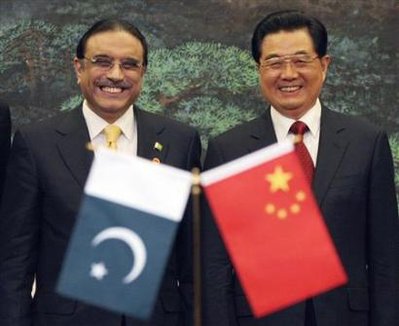
Pakistan’s President Asif Ali Zardari made a three-day visit to China this week at a time when relations between Islamabad and Beijing appear to be growing stronger. Regional analysts say that while China is of growing importance to Pakistan, it is unlikely to replace the U.S. role as a dominant influence there.

The opening ceremony at the first China Eurasia Expo was full of pomp and fanfare. Greeted with applause and smiles, Pakistan President Asif Ali Zardari ended his visit to China standing on stage next to the man who is widely expected to be the country’s next leader – Vice Premier Li Keqiang.

Ties have long been strong between Pakistan and China, a country Islamabad endearingly calls its “all-weather friend.” Mr. Zardari has visited China twice since the raid on Osama bin Laden’s compound – seven times since becoming president.

Some regional analysts say the recent deterioration of U.S.-Pakistan ties has pushed Pakistan into Beijing’s arms. They argue the combination of repeated drone strikes in Pakistani territory, the raid on Osama bin Laden’s compound, and suspension of $800-million in military American aid to Pakistan has brought Beijing and Islamabad closer together.

But regional analyst Tarique Niazi, an associate professor at the University of Wisconsin Eau Claire, says Mr. Zardari’s most recent visit to China is part of an ongoing effort by Pakistan to seek help to address its urgent needs and boost trade. And not necessarily a sign of shifting alliances.

“Pakistan is short of energy resources. It has about 4,000 megawatts of electrical shortage. So, China is helping Pakistan meet that shortage of electricity,” Niazi said.

One of the ways that China is doing that is by building massive hydropower projects in both Pakistan’s northern region of Gilgit-Baltistan and Pakistani-controlled Kashmir.

Niazi notes that representatives from both regions traveled to China this week with Mr. Zardari. Pakistan’s president is constantly focused on three things, he adds: investment, trade and economic development.

“President Zardari, especially I must say, that he is the first leader of Pakistan whose focus is almost entirely on economic development and developing business relationships with not only the public sector and the government sector of China, but the private sector also,” Niazi said.

When Mr. Zardari stepped into office, he pledged to visit China every three months – and for the most part has kept that promise. Since then, analysts say he has inked deals that will raise China’s overall investment in Pakistan from $20-billion to more than $50-billion.

China is eager to boost trade and investment in the region too.

At the opening ceremony of the China Eurasia Expo, Commerce Minister Chen Deming highlighted how China was reaching out to Asian and European countries at a time when the world economy has yet to recover from the global financial crisis.

Chen says China is moving faster in opening its western region and border areas to promote regional development. He says China is taking a big step forward to deepening development and cooperation between Asian and European countries.

And the benefits flow both ways.

“I would say that the best way to think about the current situation is that China is expanding in all directions, its power is growing, and it is looking north, south, east and west. And when it looks to Pakistan it sees potential in terms of access to Central Asia, Central Asia energy markets. It sees access to the Arabian Sea, the Indian Ocean,” said Daniel Markey, a senior fellow at the Council on Foreign Relations for India, Pakistan and South Asia.

Markey says that while Pakistan has been reaching out recently to China, in part to show Washington it has options, he is not convinced Beijing is interested in seeing a real rupture between Islamabad and Washington.

“My sense is that, yes, over the long term, China would like to be the dominant influence in Pakistan and really expand its influence throughout the region, which would probably mean a lesser influence for the United States. But, in the short time, China has been very comfortable essentially free-riding off of whatever stability and security the United States has provided and that they do not want to change,” Markey said.

He says one reason for that is because a rupture in ties between Pakistan and the United States could trickle over into relations between Beijing and Washington, and there the two already have enough to deal with as it is.

Pakistan Power Shortages Keep Growth Prospects Dim

By Alex Rodriguez The Los Angeles Times

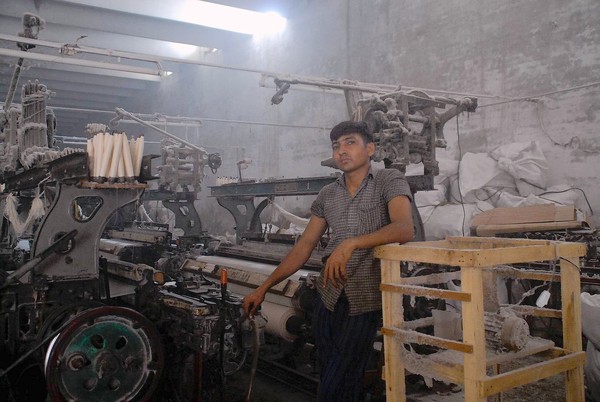
The machine operators lean back lazily on rolls of cotton fabric, shooing flies from their sweat-soaked tunics as their boss, Abdul Latif, paces between rows of silent electric looms covered in lint.

The textile plant owner knows it’s just one of several rolling blackouts that will darken his plant today, as they have every day for four years. Along his street, other textile plants have either closed or begun selling their looms for scrap. Latif scrapes by, but the outages have cut his plant’s output in half.

“The situation is very bad,” Latif says. “We’re losing contracts because of these outages. We can’t deliver on time. If it continues like this, we may have to shut down.”

One of Pakistan’s biggest scourges has nothing to do with suicide bombers or militants wielding Kalashnikov assault rifles. Because the country cannot produce the electricity needed to support a population of 177 million, the government intentionally shuts down power in staggered intervals, often for hours at a time.

The rolling blackouts are most frequent during the summer, when the whir of air conditioners in 100-plus-degree heat boosts demand for power. Apart from districts with top government and military offices, virtually every neighborhood and village suffers.

The stopgap policy prevents the country’s moribund economy from getting off the ground. And as long as the economy sputters, millions of Pakistanis remain mired in poverty and joblessness, leaving the country’s disaffected youth vulnerable to recruitment by Islamist militant groups.

President Asif Ali Zardari’s government has given Pakistanis little reason to hope for a solution anytime soon. This summer, government officials said that it would take at least seven years to build up the electricity generation capacity needed to eliminate the blackouts.

Various factors explain Pakistan’s power woes. During Gen. Pervez Musharraf’s rule from 1999 to 2008, strong economic growth fueled an upsurge in consumer spending that had Pakistanis flocking to stores to buy air conditioners, refrigerators and other appliances. But Musharraf failed to pump money into boosting generation capacity to keep up with demand and the country’s booming population.

Zardari inherited the massive gap between supply and demand, but his cash-strapped administration hasn’t moved fast enough on hydroelectric dam projects and has yet to shore up the country’s aging distribution network.

Other factors make the situation even worse. About 15% of the electricity generated is lost to theft, says Ejaz Qureshi, a spokesman for the state-owned Pakistan Electric Power Co. In addition, the government often fails to pay its bills to private power producers, which means those companies can’t buy sufficient fuel for their plants. At times, they cut off electricity to the offices of government agencies that owe them money.

The havoc wrought by the shortfall is particularly acute in the country’s textile industry, a pillar of Pakistan’s fragile economy.

Faisalabad, Pakistan’s third-largest city and home to its textile sector, has seen 200 of its 4,000 textile plants close in the last three years because of the blackouts, says Wahid Raamay, chairman of the city’s Council of Loom Owners and a plant owner.

During that period, 100,000 workers have been laid off, about 10% of the city’s textile work force, Raamay says.

Plant owners forced out of business face a grim future. In a country where many people distrust banks, many plant owners sell their personal property — gold, jewelry, cars — to buy the machinery needed to start the business. If their plants close, they may find themselves at rock bottom.

“They all used to have good cars, good homes, and now everything has disappeared,” Raamay says. “Now they ride motorcycles to get around.”

Five months ago, Malik Mohammed Kashif was forced to shut down his plant, lay off 80 workers and sell his 66 looms to scrap dealers.

On a sun-baked afternoon, Kashif strolls through his darkened, empty building and winces as he speaks of the future.

“As for me, I’m finished,” says Kashif, a 30-year-old father of four. “With the shutdown, we lost $350,000, nearly everything we had. We’re at the bottom now because of this.”

This summer, public anger over ceaseless power outages boiled over. In Mianwali, in Punjab province, throngs of demonstrators calling for a stop to the outages clashed with baton-wielding police in early July. Two people were killed and 22 were injured. In Karachi, four people were killed during protests and work stoppages in early June that brought sections of Pakistan’s largest city to a standstill.

In Faisalabad, the extent of blackout-induced layoffs in the textile industry has reached the point that plant owners often work the looms alongside their laborers.

At Latif’s plant, workers paid by the hour say the outages cut their already meager wages in half. Machine operator Mehmood Hussain makes $4.65 a day when the blackouts don’t occur and $2.32 when they do. For a family of seven reliant on his income, the difference is huge.

“It’s a critical situation now,” Hussain says. “We can’t buy decent food or buy clothes for ourselves. And there’s no way out. Looms are all we know.”

One group, however, prospers from the textile industry’s misery: the scrap dealers. Their stalls on the edge of the city are filled with grease-covered gears and flywheels stacked next to piles of wooden rollers and spool holders.

Dealer Mohammed Sharif says he sometimes buys up to 100 looms a day, paying just $290 for machines that cost plant owners $1,500.

“When the textile plants suffer, our business booms,” Sharif says. At the same time, he knows the scavenging can’t last indefinitely.

“If looms continue to shut down at this rate, a day will come when we won’t have any business at all. What will we do then?”

Noting that three in four terror suspects are acquitted in Pakistan, the United States has doubts its key ally would make any headway in prosecuting key plotters of 2008 Mumbai terror attacks.

“The accused in numerous high-profile terrorism incidents involving US victims had all been acquitted by the Pakistani legal system,” US State Department noted in its 2010 Country Reports on Terrorism, published last week.

“The Federal Bureau of Investigation has assisted with the respective prosecutions,” the report said. FBI had assisted India in the investigation of the Mumbai terrorist attack as six Americans were among the 166 victims.

The report found that while Pakistan maintained it was committed to prosecuting those accused of terrorism, a study of its Anti-Terrorism Court’s rulings last year disclosed “that Pakistan remained plagued by an acquittal rate of approximately 75 per cent”, and a legal system “almost incapable of prosecuting suspected terrorists”.

It complained that a new anti-terror bill, which would allow its security agencies to hold suspects for 90 days before bringing them to court and give them a freer hand to use electronic surveillance had not progressed in the country’s National Assembly.

Although Islamabad had increased pressure on money-launders and unofficial ‘hawala’ money transfer agents, “deficiencies remained,” the report found.

“Notably, the criminalisation of the financing of terrorist acts committed against foreign governments and international organisations was ambiguous, as was the criminalisation of financing groups that have not been explicitly banned by the government or designated by the UN,” it stated.

Pakistan’s “weak implementation” of a UN Security Council resolution which lists banned terrorist organisations remained a concern.

The report also criticises Islamabad’s failure to outlaw militant Islamic terror groups which escape bans by changing their names.

C.I.A. Drone Is Said to Kill Al Qaeda’s No. 2

By Mark Mazzetti for The New York Times


A drone operated by the CIA killed Al Qaeda’s second-ranking figure in the mountains of Pakistan on Monday, American and Pakistani officials said Saturday, further damaging a terrorism network that appears significantly weakened since the death of Osama bin Laden in May.

An American official said that the drone strike killed Atiyah Abd al-Rahman, a Libyan who in the last year had taken over as Al Qaeda’s top operational planner. Mr. Rahman was in frequent contact with Bin Laden in the months before the terrorist leader was killed on May 2 by a Navy Seals team, intelligence officials have said.

American officials described Mr. Rahman’s death as particularly significant as compared with other high-ranking Qaeda operatives who have been killed, because he was one of a new generation of leaders that the network hoped would assume greater control after Bin Laden’s death.

Thousands of electronic files recovered at Bin Laden’s compound in Abbottabad, Pakistan, revealed that Bin Laden communicated frequently with Mr. Rahman. They also showed that Bin Laden relied on Mr. Rahman to get messages to other Qaeda leaders and to ensure that Bin Laden’s recorded communications were broadcast widely.

After Bin Laden was killed, Mr. Rahman became Al Qaeda’s No. 2 leader under Ayman al-Zawahri, who succeeded Bin Laden.

There were few details on Saturday about the strike that killed Mr. Rahman. In the months since Bin Laden’s death, the C.I.A. has maintained a barrage of drone missile strikes on mountainous redoubts in Pakistan, a bombing campaign that continues to strain America’s already turbulent relationship with Pakistan.

The C.I.A almost never consults Pakistani officials in advance of a drone strike, and a Pakistani government official said Saturday that the United States had told Pakistan’s government that Mr. Rahman had been the target of the strike only after the spy agency confirmed that he had been killed.

The drone strikes have been the Obama administration’s preferred means of hunting and killing operatives from Al Qaeda and its affiliate groups. Over the past year the United States has expanded the drone war to Yemen and Somalia.

Some top American officials have said publicly that they believe Al Qaeda is in its death throes, though many intelligence analysts are less certain, saying that the network built by Bin Laden has repeatedly shown an ability to regenerate.

Yet even as Qaeda affiliates in places like Yemen and North Africa continue to plot attacks against the West, most intelligence analysts believe that the remnants of Al Qaeda’s leadership in Pakistan have been weakened considerably. Mr. Rahman’s death is another significant blow to the group.

“Atiyah was at the top of Al Qaeda’s trusted core,” the American official said. “His combination of background, experience and abilities are unique in Al Qaeda — without question, they will not be easily replaced.”

The files captured in Abbottabad revealed, among other things, that Bin Laden and Mr. Rahman discussed brokering a deal with Pakistan: Al Qaeda would refrain from mounting attacks in the country in exchange for protection for Qaeda leaders hiding in Pakistan.

American officials said that they found no evidence that either of the men ever raised the idea directly with Pakistani officials, or that Pakistan’s government had any knowledge that Bin Laden was hiding in Abbottabad.

Mr. Rahman also served as Bin Laden’s liaison to Qaeda affiliates. Last year, American officials said, Mr. Rahman notified Bin Laden of a request by the leader of Al Qaeda’s affiliate in Yemen to install Anwar al-Awlaki, the radical American-born cleric, as the leader of the group in Yemen.

That group, known as Al Qaeda in the Arabian Peninsula, apparently thought Mr. Awlaki’s status as an Internet celebrity, for his popular video sermons, and his knowledge of the United States might help the group’s fund-raising efforts. But according to the electronic files in Abbottabad, Bin Laden told Mr. Rahman that the group’s leadership should remain unchanged.

After Bin Laden’s death, some intelligence officials saw a cadre of Libyan operatives as poised to assume greater control inside Al Qaeda, which at times has been fractured by cultural rivalries.

Libyan operatives like Mr. Rahman, they said, had long bristled at the leadership of an older generation, many of them Egyptian like Mr. Zawahri and Sheikh Saeed al-Masri.

Mr. Masri was killed last year by a C.I.A. missile, as were several Qaeda operations chiefs before him. The job has proved to be particularly deadly, American officials said, because the operations chief has had to transmit the guidance of Bin Laden and Mr. Zawahri to Qaeda operatives elsewhere, providing a way for the Americans to track him through electronic intercepts.

Mr. Rahman assumed the role after Mr. Masri’s death. Now that Mr. Rahman has died, American officials said it was unclear who would take over the job.

China launches communications satellite for Pakistan

As Reported by The South Asian News Agency

The year 2011 marks 60 years of diplomatic relationship between China and Pakistan. This all-weather relationship has largely withstood ‘the test of time’.

Both states recognize the relevance of their cooperation in areas like security, trade and culture. All these years China has mostly followed the ‘friend of Pakistan policy’. From the Indian perspective the focus of their cooperation, which has mostly revolved around security issues, has been a source of anxiety. Apart from the question of direct military aid, India must also take note of China’s assistance to Pakistan in the field of science and technology as well since it has long-term strategic implications. China launched Pakistan’s first communications satellite (PAKSAT-1R) on August 12, 2011 on a Long March-3B carrier rocket. This event demonstrates the deepening in technological cooperation between these two states. For China this was also an event to display the capabilities of its rapidly growing commercial satellite industry.

Over the years Pakistan has largely demonstrated a copycat syndrome (with reference to India) as far as programmes of strategic importance are concerned. Pakistan’s technological and industrial base is not well-established in comparison with India. Therefore, to match India, Pakistan has relied on foreign (overt or covert) help. In certain cases Pakistan also developed underground networks to ‘manage’ hardware/technology. However, Pakistan’s investments in space technologies have been minimal. This is somewhat surprising particularly, because it has a reasonably well-developed missile programme which, in fact, could have helped at least partially to build up an indigenous space programme.

Pakistan’s lack of interest in space technology could be due to three reasons. Firstly, the Pakistani focus on long-term investments in technology has predominantly been military specific over the years. The use of technology for social, educational and scientific needs was not the prime focus. Secondly, Pakistan appears to have failed to anticipate the long-term strategic importance of space technologies. What is more surprising is the failure to understand the importance of space technologies particularly, in the background of the country’s nuclear ambitions. Thirdly, because of superfluous investments in military hardware, Pakistan was unable to make investments in space technology. Also, the state appears to have failed to realise the future commercial relevance of a space programme.

Against this backdrop the launch of the made in China PAKSAT-1R with 30 transponders for the purposes of communications services marks a new beginning. This satellite would take care of broadband Internet, telecom and broadcasting services. It is expected to cover South Asia, Europe, West Asia and eastern Africa and is also likely to help in weather monitoring. Being a communication satellite its dual-use nature could offer strategic defence applications as well. Pakistan has been collaborating with China in the space arena since the 1990s. Its first satellite Badr-1 was launched by China on July 16, 1990 (on a Long March 2E rocket). However, during the span of the last two decades, Pakistan’s space programme has not made any significant progress baring two more satellite launches with outside help. Pakistan’s space agency called Space and Upper Atmosphere Research Commission (SUPARCO) was established in 1961 as a committee. It was upgraded into a Commission in 1981. But it has failed to make any significant progress.

The August 2011 launch of a communication satellite opens a new chapter in Pakistan’s space history. Today, Pakistan has no launch vehicle of its own to launch satellites of any type. It has a long way to go in developing expertise in this arena as well as in satellite manufacture though the very first satellite was developed indigenously. Pakistan also needs to invest in the development of Spaceport and ground stations. All this will take time and its dependence on China is expected to increase in coming years.

Since their border settlement pact of March 3, 1963 the relationship between these two neighbours of India has been steadily growing. In the field of space there was a pause for almost two decades particularly, in the high-end projects like satellite launches. However, during these years a certain degree of collaboration was underway for personnel training and infrastructure development. Pakistan’s inadequacy in the space field offers China an opportunity to take their strategic partnership to a higher plane and also simultaneously maintain its own commercial interests.

For the last couple of years China has been using space technology to further its geopolitical as well as commercial interests. Now, Pakistan offers it an opportunity to use space engagement for strategic purposes as well. China has begun to help states like Nigeria and Venezuela with their satellite programmes. Also, recently China signed a deal with Bolivia for building and launching a satellite. In comparison with the western space agencies, China offers better commercial deals. Also, China has earned a prestige for its space programme with various successful space launches. Naturally, various developing states in the world are looking towards China.

China’s space programme is surging ahead at a much faster rate than India’s. Pakistan’s space programme is likely to remain in infancy for some more time to come. However, nuclear Pakistan is likely to pursue its space agenda (with China’s help) with more vigour in the future. On the military front, it is bound to benefit from various Chinese programmes like the navigational programme (COMPASS constellation). India needs to look at these developments seriously. Till date Pakistan’s space capabilities were probably not factored into India’s strategic planning, but that must change