Posts Tagged ‘ Pakistan ’

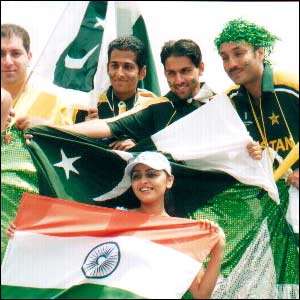
The Cup That May Brighten Up Pakistan

By Nilankur Das for The Hindustan Times
For others winning this World Cup could be a matter of pride and glory for the country. For Pakistan, which has won a World Cup and hosted a final, a lot more is at stake. A terror attack on the Sri Lanka team bus in Lahore in 2009 had put an end to Pakistan playing international matches at home an

d also taken away its rights to host World Cup ties. The country shredded by blasts and violence is now forced to host its international matches in Dubai.

Play to prove
Winning this World Cup, coach Waqar Younis feels, could change all that and pave the way to bring international cricket back to the country.

“It is unfortunate that we are not hosting. Yes, we are missing World Cup matches at home. But if we play as a unit, which we are at the moment and go on to win, I believe it will definitely help get international matches back to Pakistan,” Waqar said after Pakistan began their campaign with a win in a warm-up match against Bangladesh.

“Everyone back home is disappointed that the World Cup is not happening in Pakistan. But we are looking forward. Violence has taken international cricket away from the country but I am sure our cricket will bring cricket back,” Intikhab Alam, Pakistan’s first one-day captain who is the manager of the team here, told HT.

Ccricket Buzz
Back in Pakistan which is celebrating Id-e- Milad-un-Nabi, the birthday of Prophet Mohammad, cricket, it was learnt, is the buzz now.

“I think the people of Pakistan have already come to terms with the World Cup not happening here. Tuesday’s match was not on TV and so very few people could follow it. But people are keeping track and everywhere I went I heard cricket being discussed,” spokesperson of the Pakistan Cricket Board, Nadeem Sarwar told HT from Lahore.

“What Waqar said is right. But it will not happen overnight. Winning the World Cup will surely have a unifying effect on the country and if that means law and order is restored, the other boards too will not have problems sending their teams to Pakistan.

“We are making progress in this regard. The Afghanistan team was here. And now the Nepal women’s team is playing a T20 and one-day series here,” Sarwar said.

It’s still early days but a motto like this can definitely keep the team together. But sport has its share of such instances. When Spain, with a majority of Catalan players led by a man from Real Madrid, went on to win the football World Cup, a month-long euphoria blurred all differences.

Veteran US Diplomat To Replace Holbrooke as Pakistan-Afghan Envoy

By David Usborne for The Independent, UK

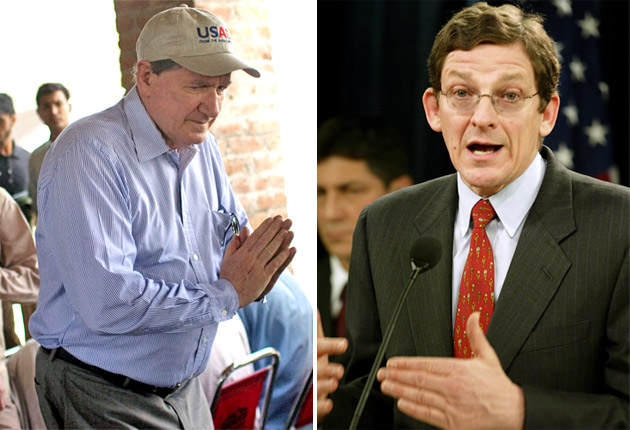
The long and fractious search for a replacement for the late Richard Holbrooke as a special US envoy to both Pakistan and Afghanistan is over, but the job of filling his shoes is looking more impossible than ever, not least because of an expected exodus of top American officials from Kabul this year.

Marc Grossman, who was a top-rank US diplomat for three decades until he moved to the private sector in 2005, has agreed to take on the post after others turned it down. His appointment is expected to be announced by Hillary Clinton, the US Secretary of State, during a speech in New York on Friday.

The death from a torn aorta of Mr Holbrooke, a giant on the diplomatic stage, left a void in America’s diplomatic front in Afghanistan and Pakistan. While some in the White House resented the wide remit he enjoyed dealing with both countries, Mrs Clinton was adamant she needed someone of similar stature in his place.

Several high profile names were passed over for the job or turned it down, including Strobe Talbott and John Podesta, both of whom served former President Bill Clinton. Another who declined to don the Holbrooke mantle was Frank Wisner, another former diplomat who unsuccessfully sought to mediate with Hosni Mubarak of Egypt before his ouster last week.

Mr Grossman, currently chairman of the Cohen Group which advises companies on ventures overseas, will take the job at a particularly tricky juncture. Relations between Washington and Islamabad are at an all time low, and in Afghanistan the clock is ticking on the start of US troop withdrawals this summer.

The diplomatic and military team he will inherit in Afghanistan will meanwhile begin to dissolve almost the moment he arrives there. Among those set to depart are Karl Eikenberry, the US Ambassador there, as well as all four of the top US officials in the embassy.

It is widely expected, meanwhile, that the top military commander of Nato forces in Afghanistan, General David Petraeus, will be rotated out before the end of the year. The number two military officer there, Lt Gen David Rodriguez, who runs day-to-day military operations, is also set to leave. Officials at the State Department and the Pentagon concede that finding replacements for the departing officials will be difficult.

Violence in Afghanistan is still at critical levels. On the political level, the US is striving to overcome long-running tensions with President Hamid Karzai, while trying to push forward a process of reconciliation talks with elements of the Taliban and other insurgent groups that are seen as crucial to achieving stability, and step up training of Afghan soldiers and police officers.

“Afghanistan is keen to work closely with the new Afghanistan-Pakistan envoy in better coordination and understanding,” commented Siamak Herawi, a spokesman for Mr Karzai, who had a prickly relationship with Mr Holbrooke.

The latest downturn in relations with Pakistan follows the arrest of an American at the US embassy on charges of murder. So far the Pakistani government has ignored calls from Washington that the accused, Raymond Davis, who is on the embassy staff, be given diplomatic immunity in the case. He has claimed that he shot the two men in self defence as they attempted to rob him.

In Islamabad yesterday on a mission to try to resolve the stand-off was Senator John Kerry, the chairman of the Senate Foreign Relations Committee and arguably the only person available in Washington with the stature to get the Pakistani government to focus on the issue. Bilateral talks that were scheduled to take place at the State Department next week have been postponed by Mrs Clinton because of the dispute.

The biggest challenge of all for Mr Grossman will be winning the trust and respect of leaders in both Pakistan and Afghanistan while navigating the sometimes conflicting priorities of his various bosses in Washington at the State Department, the Pentagon and the White House.

Leading players on their way out:

General David Petraeus

Unexpectedly pulled into Afghanistan after the sudden departure of General Stanley McChrystal last year, Petraeus is drafting withdrawal plans for President Obama. Once he has presented the President with options for the best exit strategy, which he is expected to do in July, there are suggestions that he could look to stand down. He has denied that he could seek the Republican presidential nomination for 2012.

Ambassador Karl Eikenberry

With his relationship with President Karzai strained at best, there have long been rumours in Washington of Eikenberry’s return home; any departure, though, was held up by the exit of McChrystal, when it was felt that another change at the top of Afghan policy would be unhelpful. A similar logic may have applied after Richard Holbrooke’s death. One of Grossman’s key tasks will be identifying the best candidates to replace him.

Lt. General David Rodriguez

Named as deputy commander in Afghanistan in 2009, Rodriguez has considerably more experience in the country than Petraeus, and holds responsibility for day-to-day operations, with particular expertise in counter-insurgency. If suggestions that he could be going home soon prove correct, there are fears that a shortage of top-class military leadership with knowledge of the country could be exposed.

World To Valentine’s Day: I Love You, I Love You Not

By Kristin Deasy for Radio Free Europe Radio Liberty
The East is coy when it comes to celebrating Valentine’s Day, with some countries banning it as a Western imposition, while activists in other countries use the traditional day of love to play politics.

In Iraq, three youth groups have called for a Valentine’s Day rally in Baghdad’s Tahrir (Liberation) Square, which like many regional capitals bears the same name as the Egyptian square that made headlines recently during the country’s uprising.

Following the lead of countries like Egypt and Tunisia, where protesters took to the streets demanding political reform, these young Iraqis are using Facebook to call for an end to the political deadlock and rampant corruption in the country. The corruption watchdog Transparency International lists Iraq as the fourth-most corrupt country in the world.

“We chose February 14, Valentine’s Day, to prove to the world that we have made the Valentine’s Day of Iraq. We are here today to express our love for Iraq. Iraqi protester Nawf al-Falahi told Reuters today.

“Our demand is not a difficult one, we demand reform of the situation,” Falahi added. “There has been no tangible change since 2003 and until now, there is no development. We want [the government] to fulfill the promises they made before the election, their promises were rosy. We want them on the ground. This is the only thing we want.”

For these protesters, any thought of celebration is cut short by the condition in the country. “We are so upset. We can’t celebrate Valentine’s Day, because we have a lot of problems,” one woman tells RFE/RL’s Radio Free Iraq, “like the shortage of items on our monthly ration card, a lack of electricity, and poverty.”

Iraq’s protests come as an opposition demonstration is set for today in neighboring Iran, where the opposition Green Movement has defied a government ban to call for a march in solidarity with protesters in Egypt and Tunisia.

Supporters of the Iranian rally have been posting a “V” on their personal Facebook profile pages in a nod to the “V for victory” sign used by the opposition during the country’s 2009 antigovernment protests and, perhaps, also in recognition of the coinciding holiday.

Valentine’s Day is generally seen as a Christian holiday, but it is actually pagan in origin, arising out of the ancient Roman Lupercalia festival. Early efforts by Christian leaders to “Christianize” the pagan feast led to its observance as a feast day honoring a legendary third-century Roman priest allegedly named Valentine.

Over time, however, the celebration of St. Valentine’s Day moved from a day of Christian piety to a more all-embracing celebration of love, particularly the love between couples.

This is a point of concern for authorities in many Islamic countries, who cleave to traditional moral values not typically associated with the modern celebration of Valentine’s Day.

The Uzbek newspaper “Turkiston” wrote on February 12 that “forces with evil goals” were behind “making the ‘lovers’ day popular,” while in Kazakhstan last week a youth group symbolically destroyed Valentine’s Day cards for local media to protest the attempt to introduce a “foreign” holiday.

Over in Russia’s Belgorod region, officials banned St. Valentine’s festivities for the sake of the people’s “spiritual safety,” with one local government spokesman telling reporters that “we could just as well have introduced a Vodka Day.”

Updating The Language Of Love

Iran, meanwhile, forbids unmarried couples from socializing publicly, a policy that tends to have a chilling effect on most Valentine’s Day plans.

But the policy is difficult to enforce on the country’s swelling — and often defiant — younger generation. For example, a Tehran-based author who wishes to remain anonymous is currently at work on a book, “The Persian Dating Glossary,” which includes the explanation of various Persian slang words used to circumvent Iran’s dating restrictions, including “doostmamooli,” a word that roughly translates to “regular friend” and is used to refer to someone with whom there is absolutely no romantic involvement.

The word evolved from the more ambiguous “doost,” which literally means friend but also serves as the basis of weightier words like boyfriend, girlfriend, and best friend.

So this year, Iranian authorities issued a particularly strict warning against “producing any products related to Valentine’s Day, including posters, brochures, advertising cards, boxes with the symbols of hearts, half-hearts, or red roses.”

The Islamic authorities’ worst fear is being realized in Thailand, where 14 couples from around the world are set to compete in a marathon kissing contest to see who can keep their lips locked the longest.

The event is to challenge a German couple, who last year set the world record of the longest continuous kiss, which lasted over one full day.

“We successfully broke the world’s record with seven couples still kissing after 32 hours, 7 minutes, 14 seconds,” contest organizer Somporn Naksuetrong told Reuters. “Anyhow, the contest is still continuing, as only one couple will be named as the new record holder. We still don’t know how long the contest will last.”

A Pakistani Take

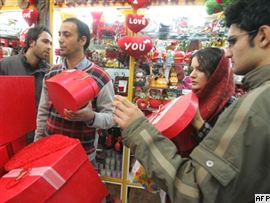
Meanwhile, in Pakistan, Valentine’s Day draws a mixed reaction. Young women browse in a shop decorated with Valentine’s Day gifts in Peshawar.
“If we look at it from the religious point of view, then it should not be celebrated because this is based on a Christian celebration,” says Ajab Khan, a young student at Peshawar’s Institute of Management Sciences. “But if you look at it from a different perspective, then I think there is no harm in it because people are happy to go out and give each other presents.

Khan points out that in the English city of Southall, commonly known as “Little India, where many South Asian festivals are held, whether its Eid, the Hindu festival of Holi, or a Christian celebration, “the whole Asian community is happy with it. So why shouldn’t we be a part of it as well in Pakistan? I don’t think it can harm anyone or will affect our religion.

“In my opinion, it’s good to celebrate it and it’s not only for couples. You can give presents to your friends, or even give a rose to your mother.”

The holiday brings back memories for Maskeen Aka, who lives in the Pakistani city of Karachi. He associates it with an ancient Pashtun custom called “rebaar,” in which a messenger would be sent — usually a child — with affectionate greetings or to share news between loved ones.

The practice has slowly disappeared in Pakistan thanks to the growing availability of telephones and Internet technology, but Aka sees a hint of it in the observance of Valentine’s Day.

“I am almost 50 years old now,” he says. “I have also done [rebaar] for some time. Rebaar means to ask about one’s health. In old times, life was very simple and there were no letters or telephones. So it was used to find information, and there would occasionally be messages sent back from the other side, and that was how it came into being.”

‘No Life Without Love’

In Central Asia, Valentine’s Day is a new holiday there because it was not observed under the former Soviet Union.

These countries tend to take a more pragmatic approach, with flower shops and candy stores upping their prices today in Kyrgyzstan and Tajikistan.

A Kyrgyz student, Ermek, explains his reasons for observing the holiday while buying flowers for his girlfriend at a Bishkek market, saying, “We need such a holiday, a day of love.”

“If people don’t love each other, how will they get married? There is no life without love,” Ermek says. “I know my girlfriend loves roses, and that’s why I’m buying them.”

It seems that regardless of what countries celebrate the controversial Valentine’s Day, love is what makes the world go ’round.

India to Invite Pakistan Home Secretary for March Talks, 26/11 on Agenda

As Reported by The Times of India

With India and Pakistan deciding to resume comprehensive dialogue over various issues, New Delhi will soon extend an invitation to Islamabad for home secretary-level talks on counterterrorism, including progress in the 26/11 Mumbai terror attack trial, here in March.

Home secretary Gopal K Pillai said, “I will call my Pakistani counterpart this week inviting him to New Delhi for talks. I will propose two sets of dates to him for a meeting in the second-half of next month.”

This will be the first structured home secretary-level meeting between India and Pakistan on counterterrorism after November 2008. The last such meeting between home secretaries had, incidentally, concluded in Islamabad on November 26, 2008 — the day Lashkar gunmen attacked Mumbai. India had suspended composite dialogue with Pakistan in the wake of the 26/11 attacks.

Home secretaries of both countries had also met on the sidelines of Saarc interior ministers’ conference in Islamabad in June last year.

On the issues to be taken up during the meeting with Pakistani interior secretary Chaudhry Qamar Zaman, Pillai told a news agency, “We will ask for voice transcripts (of perpetrators of 26/11) even though the trial court has said no. We will ask them why they have not gone and appealed. I am sure the high court or the Supreme Court may have said that the voice transcripts can be given.”

Referring to lack of action on the part of Pakistan, the home secretary said, “So far most of the people they have caught are all chaps who have sold outboard engines or… driven a taxi and not any of the main people whose voice has been identified by Pakistani-American terrorist David Headley.”

He added, “I think by now, if they wanted, they could have arrested the main persons behind it (26/11 attacks). No use catching people on the streets… and not the real controllers and those who are behind it (attacks).”

Asked what prevented Pakistan from taking strong action against those responsible for the attack, Pillai said Headley’s own evidence clearly showed that there was support of certain elements in the Pakistan state. So, to that extent, anything which leads back to them, there is “total deniability”, Pillai said.

He rejected the view that investigations into the Samjhauta Express blast, indicating involvement of right-wing extremism, will put pressure on India while talking to Pakistan on terrorism. “It will not put pressure on us. We are open about it. The investigations are open. Our courts are free. We are investigating the same. We had told them in June that the investigations are on and as something crystalizes, we shall share it with them. And now, we have said that as soon as the chargesheet is filed, we will share full details with them because a very large number of Pakistani citizens were killed,” he said.

Why Noor Inayat Khan, the Indian Princess and Decorated British Spy Who Was Shot By The Nazis, Deserves A Statue

by Gurinder Chadha and Shrabani Basu, Daily Mirror

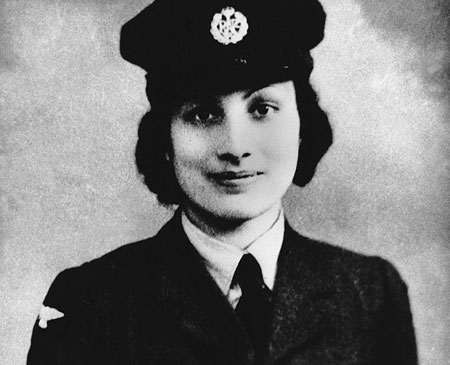
On September 13, 1944, a beautiful Indian princess lay dead on the floor at Dachau concentration camp. She had been brutally tortured by the Nazis then shot in the head. Her name was Noor Inayat Khan. The Germans knew her only as Nora Baker, a British spy.

The first female radio operator to infiltrate occupied Paris, she was posthumously awarded the Croix de Guerre and the George Cross – one of only three women from the Special Operations Executive to receive the latter medal.

But while Odette Hallowes and Violette Szabo have had Hollywood films made of their lives and blue plaques put up in their honour, Noor has been largely overlooked.

The gentle Indian woman who sacrificed her life for Britain, has become a footnote in history. A memorial to her has long been overdue.

And when a bust of Noor goes up in London’s Gordon Square in 2012, it will be the first statue to an Indian woman in Britain – and the first to any Muslim.

Given the contribution of Asian women in this country to arts, music, literature, law, human rights and education, it is a gap that is crying to out be filled.

Noor’s journey from her birthplace in Moscow to London was in many ways part of her exotic upbringing.

A descendant of Tipu Sultan – the famous 18th century ruler of South India, known as the Tiger of Mysore – she was brought up a fierce nationalist by her father, Hazrat Inayat Khan, a Sufi preacher and musician.

Inayat Khan left his hometown of Baroda in western India to take Sufism to the West. Deeply spiritual, he gave concerts and lecture tours in America where he met Noor’s mother, Ora Ray Baker. Soon the two moved to London where they were married, Ora taking the name of Ameena Begum.

In 1914, Inayat Khan was invited to Moscow and it was there that Noor-un-nisa Inayat Khan was born. She had the title of Pirzadi, daughter of the Pir.

Moscow at the time was rife with political discontent and Inayat Khan soon moved back to London. The family spent the next six years in a house on Gordon Square.

But the British government was suspicious of Inayat Khan, who was a friend of Nehru and Gandhi and a strong nationalist, so the family went to France. They began life again on the outskirts of Paris in a house called Fazal Manzil or House of Blessing. It was here Noor spent most of her life.

Educated and genteel, she went to the Sorbonne to study child psychology.

She started writing stories for children and in 1939 her first book, Twenty Jataka Tales, was published. But war clouds were gathering. And as England declared war on Germany, Noor and her brother Vilayat decided it was a crime to stand by and watch, even though as Sufis they believed in non-violence.

They went to London to be a part of the war effort. In November 1940, Noor volunteered for the Women’s Auxiliary Air Force.

Officers of the Special Operations Executive, Churchill’s secret army, were looking for people with language skills. Noor – fluent in French and now a trained wireless operator – fitted the bill. At an interview, she was told she would be sent as an agent to Paris – and shot if she was caught. She took the job.

Over the next few months, the gentle harp-playing Noor was trained as a secret agent, given arms training, taught to shoot and kill, and finally flown to Paris under the code name of Madeleine, carrying only a false passport, a clutch of French francs and a pistol. Despite her spy network collapsing around her, Noor stayed in France for three months, until she was betrayed. What followed in October 1943 was arrest, imprisonment in chains, torture and interrogation.

Noor bore it all. She revealed nothing to her captors, not even her real name. When the end came on September 13, 1944, it was not swift or painless.

All night long an SS officer kicked and tortured Noor. Defiant till the last, she shouted “Liberte” as she went down to a bullet fired at the back of her head. Then Britain gradually forgot about her brave sacrifice. Bringing Noor back to Gordon Square, near the house from where she left on her last mission, will be a worthy gesture by her adopted country.

Gurinder Chadha has directed Bend It Like Beckham, and Bhaji on the Beach. Shrabani Basu, author of Spy Princess, The Life of Noor Inayat Khan, is founder of the Noor Inayat Khan Memorial Trust. Contribute at www.noormemorial.org, or email noor.memorial@gmail.com.

Who is behind the war on Sufism?

By Dr Ehsan Azari Stanizi for Eurasia Review News & Analysis

On October 25, 2010 an al-Qaida affiliated militant group turned a majestic Sufi shrine into a bloodbath in the Punjab province of Pakistan, by detonating bombs hidden in milk cans, killing and wounding scores of innocent people. This was the latest of a spate of gruesome attacks on Sufism and dead Sufi saints this year alone, leaving hundreds of innocent people killed or wounded. Such violence has brought a new upheaval to Islam, shaking its ethical and moral foundations and reducing it to a merely a radical political ideology.

The ideological driving force behind this violence is religious extremism which considers everyone outside its ideological league, Muslim or non Muslim, dead or alive, as an enemy and an infidel deserving to be killed. The fanatics blow up ancient relics, Sufi heritage, Sufi shrines and the Sufi way of life everywhere they can. They want to micromanage social, cultural and individual life. They condemn gatherings and ceremonies in Sufi saints’ graves, shaving beards, wearing charms, music and painting as heresy. All this is like the Chinese Cultural Revolution of the 1960s.

The history of Islam is not alien to violence against Sufism. The root of the current upheaval lies in Wahhabism, which has been gradually institutionalised from a tiny band of theologians into a political ideology by the Saudi ruling dynasty. The Wahhabi religious movement was originated by Mohammad Ibn Abdul Wahhab (1703-1792), essentially to challenge the influence of the Ottoman Empire in the Arabian Peninsula. The Saudi petrodollars and Pakistani military ruling elite have helped the spread of this fanatical form of Islam.

In addition, the vision of this ideology was empowered in the Middle East and South Asia by another extremist movement known as the Muslim Brotherhood which originally emerged in Egypt in the 1920s. The Brotherhood copied much of its ideological agenda, political structure, revolutionary features and a violent persuasion from Marxism. Like the latter during the Cold War era, the Brotherhood’s ultimate objective has been to topple the state by violent means and extend a radical ideology to the West. The Iranian revolution of late 1970s gave further impetus to this ideology, which began to justify the export of Islamic revolution as an Islamic obligation everywhere in the world.

Like Saudi rulers, the secular Pakistani cunning and sly generals began to use the most lethal religious radicals for domestic security and as a tool to promote its foreign policy in Afghanistan and India. Pakistan served also as a gateway for the spread of Wahhabism in the region. At present they are pinching American coins in return for carrying out the Pashtun genocide.

As it was hinted, war on Sufism is not a new phenomenon. Hussein Al-Halaj, a great Sufi poet and teacher was condemned for heresy when in a state of mystical trance he exclaimed, “I am the Truth”. He was cut to pieces and his remains were burnt by a mob in Baghdad in 922 AD. He was the first Sufi martyr.

During the 17th-century Persian Safavid Empire, Sufis were suppressed, during the Indian Moguls, it flourished but in the twentieth-century the die-hard Turkish secular leader Kamal Atatürk banned Sufi monasteries and Sufi rituals in Turkey.

Sufism (comes from Arabic noun, suf, literary meaning course wool and the Sufi is the one wearing woolen garments) is the name of Islamic mysticism. The word Sufism was coined in the West for the first time by the German scholar August Tholuck in 1821. It has been divided into two practical and theoretical parts: To those who practice it, Sufism means a quick spiritual foray into a space where the presence of the divine could be experienced. To those who are concerned with its theory, it is a mystical and spiritual theology, a body of knowledge and an epistemology interwoven with Islamic metaphysical texts.

The Sufi philosophy was developed and promoted by the medieval Muslim philosophers such as Ibn-Arabi, Averroës (known in Islamic world as Ibn-i-Rushd), Avicenna and Farabi, who, for their Islamic Aristotelianism, were often referred to as the Oriental Peripatetics. This school of thought was greatly saturated with Plato and Aristotelian metaphysics. The Sufis also have created a vast body of a literary and poetic heritage.

As an elixir of wisdom and an intellectual Yoga, Sufism has been known, cherished and even practised in the West since time immemorial. It is hard to find a single great Western poet or thinker who has not been inspired by Sufism. Dr Johnson loved Sufi Oneness and pantheism; Voltaire in Candid saw Sufi philosophy as an antidote to religious extremism of his time. Goethe loved Sufi poetry, Richard Burton and Robert Graves were keen on practicing Sufism.

Sufism was cherished by Australia’s greatest poet professor Alec Derwent Hope. Hegel draws on Sufi thought in his works. Danish fairy-tale writer Hans Christian Andersen was the first who brought the news about the Sufi music and dance known as “Whirling Dervishes” to Europe.

Nobel laureate, Doris Lessing is the doyen of contemporary Sufis in the West. She identifies Western admiration of Sufism since the 1960s as ‘a Sufi craze,’ and ‘Sufi bandwagon’. For Lessing, Sufism was a kind of universal feeling, emotion, a quick fix and an access with no intermediary. “Sufism is something one experiences on one’s own,” she would say. In my own lectures in Australia and Europe, I came across with an enormous interest in Sufi philosophy and literature.

The al-Qaida zealots and the Pakistani militants will never win over Sufism. They might destroy their tombs on earth but cannot steal away Sufism from the hearts of people in the East and the West.

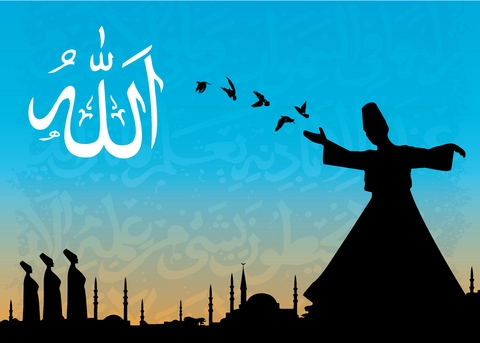
The 13th-century great Sufi poet and the founder of the Whirling Dervishes, Rumi knew this. He believed that fanatics will never extinguish the Sufi torch or destroy Sufi tombs as he says “when we are dead, see not our tombs in the earth, but find it in the hearts of the people.” And the 17th-century Pashtun Sufi poet Rahman Baba, known in the West as the Nightingale-of-Peshawar to the vandals:

We are all one body, whoever tortures another, wounds himself.

Last spring (2010), his mausoleum was bombed by the Punjabi Taliban. Rumi declared the Sufi manifesto of universal love, tolerance of nonbelievers, pluralism and interfaith harmony in one of his quatrains:

Come, come whoever you are, An unbeliever, a fire or idol-worshiper, come, Our convent is not of desperation, Even if you have broken your vows a hundred time,
Come, come again.

Top Diplomats From India, Pakistan Meet on Sidelines of Regional Conference

By Anjana Pasricha for The Voice of America

Officials from India and Pakistan have met to discuss the possible resumption of a stalled peace process. The meeting was held Sunday on the sidelines of a regional conference in Bhutan. The discussions are another step in building trust between the two rival nations.

Indian and Pakistani diplomats made no specific announcements, but sounded positive after their late Sunday discussions in the Bhutanese capital, Thimpu.

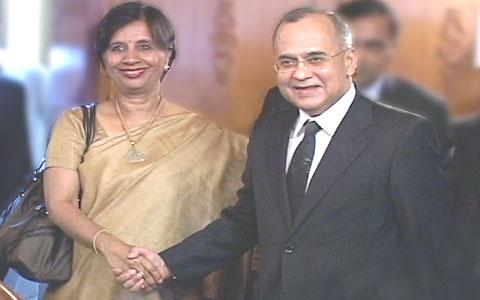
Indian Foreign Secretary Nirupama Rao expressed optimism on Monday. But she also said government leaders would remain realistic, pointing out that the relationship between the two countries is “complex.”   

“We talked about the process to chart the way forward, what the best modalities would be,” Rao said.

The meeting in Bhutan was held on the sidelines of a South Asian Association for Regional Cooperation conference. It was the first time in six months that officials representing the two countries met to discuss the possibility of resuming peace talks. India suspended peace talks more than two years ago after terror attacks in Mumbai killed more than 160 people. The attacks were blamed on Pakistan-based Islamic militants.

There had been some expectation that the two countries would set a date for resuming full-fledged peace talks, but that did not happen.

Commenting on the meeting, Indian Foreign Minister S.M. Krishna said in New Delhi that the two countries are trying to re-build trust, and build bridges of confidence.

“The very fact that the two foreign secretaries have met, it is certainly an indication of the fact that solid foundations are being laid for getting the two countries on to a sustained engagement,” Krishna said.  

India is under pressure to return to the negotiating table and resolve its many differences with Pakistan.

But New Delhi accuses Islamabad of not doing enough to bring the Pakistan-based perpetrators of the Mumbai terror attacks to justice. It says relations between the two countries cannot improve unless Pakistan cracks down on the Islamic militant group, Laskhar-e-Taiba.

Pakistan says it has put on trial seven of the suspected Mumbai attackers. Meanwhile, Islamabad says it wants New Delhi to take action against those responsible for the 2007 bombing of a train that runs between the two countries.

Books Not Bombs at Pakistan Literature Festival

As Reported by The AFP

Pakistan is hosting one of the world’s youngest and fastest-growing literary festivals, a showcase of new talent where writers urge citizens to reverse the tide of Islamist extremism and global isolation.

Now into a second year and determined to become an annual fixture on the international circuit, the Karachi Literature Festival portrays the softer face of a country more often associated with terrorism than award-winning prose.

Students, authors, budding writers and avid readers have descended on a hotel in an exclusive neighbourhood near the Arabian Sea for two days of book launches, workshops, dance, music and theatrical exhibits ending Sunday.

“It’s to promote our authors, who are underrated and do not get the credit they’re due, and also to interest people in reading and buying books,” organiser and Oxford University Press managing director Ameena Saiyid told AFP.

Women in T-shirts and skinny jeans rub shoulders with religious girls cloaked in Islamic veils at events with standing room only, as pensioners on crutches fold themselves into chairs and children race up the aisles.

Gathering nearly 100 authors and moderators, a handful from Britain, France, Germany and the United States give the event a veneer of the cosmopolitan, but the government denied visas to three of six Indians invited, organisers said.

Peace efforts between nuclear rivals India and Pakistan have been stagnant since Islamist gunmen killed 166 people in Mumbai in 2008. India and the United States blamed the attack on Pakistani militants.

Pakistan denies it is not doing enough to shut down Islamist terror groups, in a country where more than 4,000 people have been killed in Taliban-related bomb attacks in three years.

At the festival, where up to 5,000 people devoted their weekend to listen to their favourite authors — about twice the number of visitors compared with last year — some felt there was a duty to confront growing extremism.

“It’s the most fabulous development for Karachi,” said Aliya Naqvi, a doctorate student in Islamic history and wife of author H.M. Naqvi, whose debut novel “Home Boy” recently won an Indian prize for South Asian literature.

“Life goes on. You take a risk every time you step outside… But to ignore the rise of extremism would be disingenuous. It has to be acknowledged,” she told AFP between sessions.

The September 11, 2001 attacks put Pakistani writers on the international map as inquisitive Westerners searched for insight into the Taliban and Islam, at the same time as throwing the country into war and chaos.

Ahmed Rashid, whose book “Taliban” became a US bestseller, delivered a thundering address, saying it was time Pakistan faced up to its own mistakes rather than blame the United States.

“We have to do something to save ourselves,” he said, accusing Pakistan of meddling in Afghanistan, obsessing about India at the expense of national interest, failing the economy, sheltering Al-Qaeda and sponsoring the Taliban.

Nuclear physicist and social activist Pervez Hoodbhoy went further, warning a packed session on “Taking Stock: Where is Pakistan Now?” that the country is on “a knife-edge” and at risk of being overrun by a “clerical tsunami”.

Mohsin Hamid, best-selling author of novels “Moth Smoke” and “The Reluctant Fundamentalist”, said he did his best to look for the positive but conceded: “Fear is fundamental to what it’s like to live in Pakistan right now.”

The revolts in Egypt and Tunisia have resonated widely in Pakistan and were touched upon in questions from the audience. In response to one man, Hamid said it was not for him to lead a social movement onto the streets.

Inevitably in a country where mastery of English remains the preserve of the elite, who often live more luxuriously than the middle classes in the West and where the poor struggle on less than a dollar a day, there were cries of elitism.

While the event was free to all, sponsored by the British Council, Oxford University Press and USAID, some complained it was not on the public bus route.

US-educated novelist Bina Shah, whose new book “Slum Child” was snapped up like hotcakes, was asked how difficult she found it to write about a slum when she herself did not use public transport or go out to work.

“I’ve been in a rickshaw!” she hit back.

“My experience of a slum is obviously going to be different. It should convince you enough that a slum person could have told the story,” she said.

Pakistan Observes Kashmir Solidarity Day Today

As Reported on Sify News, India

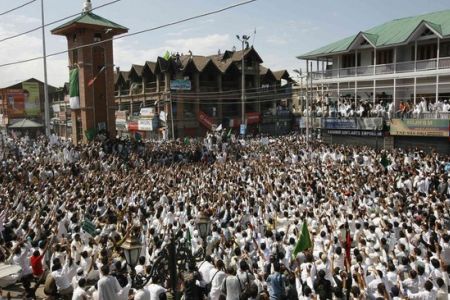
Pakistan is observing the Kashmir Solidarity Day on Saturday (today) to renew its pledge to provide full moral, political and diplomatic support to the Kashmiri people.

“We would not rest unless the people of Kashmir get their right to self-determination and win freedom from the Indian domination. We regard the Quaid-i-Azam’s dictum as our ideal wherein he said, “Kashmir is our jugular vein”. The day is not far when the Kashmiris would determine their own future,” The Nation quoted Prime Minister Syed Yousuf Raza Gilani, as saying in his message on the occasion.

The government and the people of Pakistan join their Kashmiri brothers and sisters in observing the Kashmir Solidarity Day, said Gilani, adding that the whole nation stands united in seeking a just and peaceful solution to the Jammu and Kashmir dispute in accordance with the legitimate aspirations of the Kashmiris as enshrined in relevant UN resolutions.

It will be a public holiday throughout Pakistan today, and special programmes will be broadcasted on television in this regard.

Apart from mass rallies, symposia, conventions meetings and speech declamations, a unique ceremony will be held at all six bridges linking Pakistan and PoK, where Pakistani and Kashmiri people will form a human chain.

It may be mentioned here that the day is observed every year in Pakistan, in continuation of the first call given by the then Prime Minister Zulfiqar Ali Bhutto in 1975.

Indo-Pak Express: Chugging for Peace

Originally posted on Aman Ki Asha

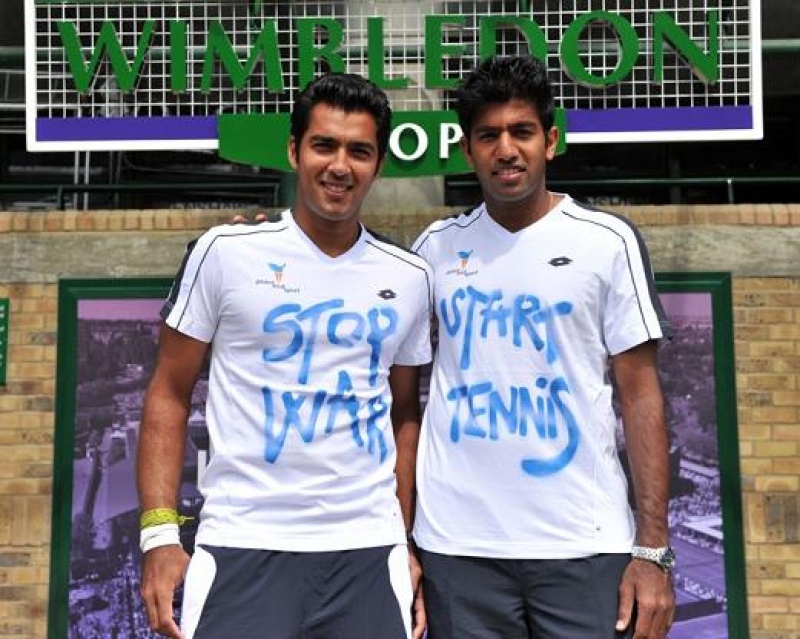
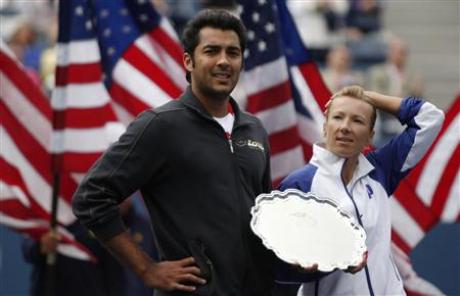
The unique tennis doubles team, Pakistani Aisam-ul-Haq Qureshi and Indian Rohan Bopanna popularly known as ‘Indo-Pak Express’ have urged their governments to allow tennis matches across the border.

There is growing support for their symbolic event – the Stop War Start Tennis campaign. Both players want a match organised between the two countries, but with a twist. They want the match to be held with a net strung across Wagah border. Now that would be a great feat.

The duo are hopeful that their doubles partnership will improve bitter relations between their countries, particularly since the initiative is now backed by the world tennis body and an international peace group.

The International Tennis Federation (ITF) has thrown its support behind the scheme, along with Peace and Sport, a non-governmental organisation run by Prince Albert of Monaco.

“A lot of good things have been achieved, the ITF is now supporting this, Peace and Sport is also supporting this,” Qureshi, who is also Aman ki Asha Ambassador, has said. “The letters have gone to both the prime minister and president of both countries.

“It is a political issue and there are a lot of security concerns, so we are just hoping that the governments will give us the green light so we can play that match on the border.”

Both players, who were finalists at last year’s US Open and gave their opponents, the top-seeded Bryan brothers tough competition, are confident of a positive response from their respective governments.

“Things are going in the right direction,” Qureshi said.
“Last year, at the US Open, both the UN Ambassadors for Pakistan and India came and watched our matches, which was a huge thing and they are supporting the cause as well.
“Things are going in the right direction; we just have to keep playing our matches and get more and more publicity on the bigger occasions. Hopefully it will happen this year.”
– Aman Ki Asha

Drug Row Sets Pakistan Scientists Against Ministries

By A A Khan for The Science and Development Network

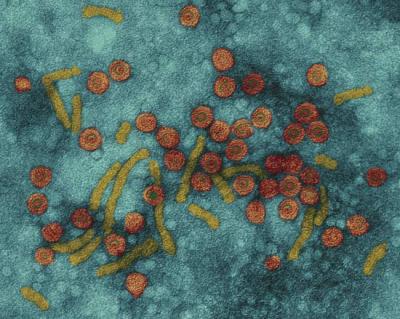
Efforts to produce a cheap local version of a hepatitis B drug have ground to a halt in Pakistan amidst a row between a leading scientist and senior officials from two government ministries.

Officials claim to have evidence that scientists involved in the drug’s production have cut corners in carrying out trials, abused resources and misused research funds.

But two of the scientists said they feel they are being deliberately prevented from launching the drug, interferon, because it could undermine the lucrative contracts for supplying it currently held by international pharmaceutical companies.

Viral hepatitis B is endemic in Pakistan, with an estimated seven million people infected,according to research published by the Pakistan Journal of Medical Sciences in 2009.   

The government’s claims relate to scientists at the Centre for Applied Molecular Biology (CAMB) in Lahore. The ministry of science and technology commissioned an audit of the centre, carried out by a committee of officials and external auditors, according to sources.

The ministry referred the findings to the Federal Investigation Agency this month (8 December) which will decide whether to proceed with charges. In the meantime, the centre’s accounts have been frozen.

Meanwhile, officials in the ministry of health said they are refusing to approve use of interferon produced by CAMB because of alleged irregularities in the clinical trials.

And, in a separate development, an independent petitioner, Batish Mahmood Tipu, filed a petition in the High Court this month (13 December) which has led to the court issuing notices to both ministries.

The notices require them to explain before the court why they are not allowing the use of locally produced interferon that, according to the petitioner, costs 70 Pakistan rupees (around 82 US cents) per injection, compared with the imported version, which costs around US$11.

CAMB trains molecular biologists and specialises in recombinant DNA technology. The centre has a good record of achievements related to Bt (Bacillus thuringiensis) rice, Bt cotton and Bt pesticide formulations. It has obtained more than ten patents. 

The centre received regular funding from the ministry of science and technology for the interferon project and, from 2004 onwards, it also received financial support from Pakistan’s Higher Education Commission (HEC).

CAMB also received prize money of US$100,000, in 2008, from the Islamic Development Bank for its outstanding contribution to molecular biology.

Clinical trials criticised

Sheikh Riazuddin, one of five scientists targeted by the government’s investigation, was director of CAMB from its establishment in 1985 until June 2009.

Riazuddin was working on a project entitled ‘Local Production of Interferon’, headed by Javed Akram, a professor at Jinnah Hospital, Lahore, which began in 2000.

According to Riazuddin phase III clinical trials of the local version of the drug were conducted at Jinnah Hospital, a teaching hospital of the Allama Iqbal Medical College, Lahore, and it was ready for final approval in December 2008.

By January 2009, CAMB had patented the drug and produced 100,000 vials of it — which have still not been used.

Sources from the ministry of health said they have not approved the drug because of the omission of two key stages normally conducted in clinical trials: phase I (laboratory testing of the drug) and phase II (safety testing on humans).

But Riazuddin said these stages are not necessary in the case of a ‘biosimilar’ drug — an exact copy of a drug for which these trials have already been conducted. 

Rauf Khalid, drug registration controller of the ministry of health, told SciDev.Net: “The approval of hepatitis interferon for commercial release can only be granted when CAMB completes all the requirements, including tests, and shows the capability of its production facilities”.   

The ministry of science and technology’s audit committee, whose findings have not been made public, has, according to sources, found among other alleged irregularities that Riazuddin had been using CAMB facilities, such as transport and phone, even after he had left the organisation.

The committee has also said it can find no satisfactory answer about where the bulk of the prize money from the IDB has gone.

Khalid Siddiqui, joint secretary of the ministry of science and technology, said: “Irregularities have taken place at CAMB for the last many years and all the findings by our committee have formally been sent to the Federal Investigation Agency for verification.

“We respect them [the CAMB scientists] as researchers but any irregularities identified by the fact-finding committee have to be dealt with according to law.” 

Allegations have ‘no substance’

Riazuddin confirmed to SciDev.Net that he has been contacted by the [FIA] which informed him that it had received a case against him involving corruption, to the tune of millions of rupees, and misuse of authority — charges he denies.

“There is no substance in the allegations,” he said.

He agreed that, even after leaving CAMB, he continued to direct the team and spent most of his time at CAMB.

“I did that not for my sake but to see my brainchild become a reality. I assumed if I do not look after the research I started, that might vanish, rendering many years’ effort futile.”

Riazuddin and Akram claimed that there have been government moves to try to block the development and production of their drug.

“Some sections in the ministry of science and technology and in the health ministry are playing into the hands of multinational companies who do not want a local launch of this medicine as Pakistan is importing hepatitis drugs worth Rs 4 billion (around US$47 million) annually from those multi-nationals,” Riazuddin said.

“This all is to force us into saying goodbye to the local production of interferon,” Akram told SciDev.Net. 

“At every step, from release of funds to the approval stages, we faced bureaucratic hurdles so much so that we felt that they do not want local production of hepatitis interferon,” Akram added.

Anwar Nasim, patron of the Pakistan Biotechnology Information Centre (PABIC), told SciDev.Net: “It is not shocking to know about corruption allegations in research when the menace of corruption is all around us. An external investigation by the FIA would soon help us know who was in the wrong — the ministry or the researchers”.

Bombers target Shiites in Pakistan, killing 12

As reported by The Associated Press

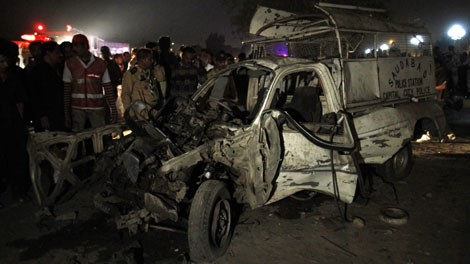
Suicide bombers attacked police protecting marches by minority Shiite Muslims in Pakistan’s two largest cities Tuesday, killing 12 people and wounding dozens, officials said.

The first and most deadly attack occurred in the eastern city of Lahore, where the bomber detonated his explosives as police tried to search him, killing 10 people. About an hour later, a second bomber struck in the southern port city of Karachi, killing at least two people.

The attacks laid bare the challenges facing Pakistani officials trying to secure cities far from the northwest, where militants fighting Pakistan’s U.S.-allied government and American forces in neighboring Afghanistan have long thrived. Many recent attacks have targeted minority Muslim and other religious groups.

The Taliban claimed responsibility for the attack in Lahore, where thousands of Shiite worshippers were marking the end of a 40-day mourning period for the Islamic sect’s most beloved saint when the blast hit their procession early Tuesday evening.

The bomber is believed to have been a young teenage boy who was wearing a suicide bomb jacket and also carrying a bag full of explosives, said senior police official Aslam Tareen. He detonated his explosives when police tried to search him, he said.

“It is a great sacrifice by the police officers who laid down their lives to protect innocent people,” said Tareen.

Footage from the scene showed ambulances racing to the area and men carrying away victims. One young man whose arm was apparently hurt screamed as he was placed on a stretcher. A white car caught up in the explosion was largely destroyed, its hood twisted upward. A man lay wounded on the ground with two women and a child weeping beside him.

Dr. Zahid Pervaiz at the city’s Mayo Hospital told reporters that 10 dead bodies had come in, while another 52 people were wounded.

Shakirullah Shakir, a spokesman for the Fidayeen-e-Islam wing of the Pakistani Taliban, told The Associated Press in a phone call that the militant group had dispatched the bomber and warned of more bombings.

Later Tuesday evening, a suicide bomber struck police protecting a group of people returning from a Shiite march in the Malir neighborhood of Karachi, Pakistan’s largest city.

Three people were killed and three wounded in the attack, said Hamid Paryar, a doctor at Karachi’s largest hospital. Two of those killed and one wounded were policemen, he said.

The third person killed is believed to be the suicide bomber, who was riding a motorcycle and carrying his explosives in a bag, said senior police official Shaukat Shah.

The blast occurred near a police van protecting the Shiite marchers, said Akbar Jaffry, who witnessed the bombing.

Attacks roughly tripled last year in Lahore and Karachi, according to a recent report by the Islamabad-based Pak Institute for Peace Studies.

The trend is a sign that militants are having greater success exporting the fight far from their northwest heartland along the Afghan border. The Pakistani army, under U.S. pressure, has carried out several offensives against militants in its northwest, but violence persists.

NY Jets, NY Mets and Pakistan

By Dr Sayed Mansoor Hussain for The Daily Times

Just as most Mets and Jets fans never gave up on their teams, it is necessary that Pakistanis must not give up on Pakistan. And if the Jets can win the big one this year and the Mets do it later this year, Pakistan also has a chance

By the time this column is printed, the New York Jets (an American Football team) will either have qualified to play in the ‘Super Bowl’ or else will have been eliminated in the Sunday evening game by the Pittsburgh Steelers. For most of my adult life I have been a fan of the NY Jets and the NY Mets. Of the New York metropolitan area teams, these two probably have the longest history of losing persistently. The Jets have not won a Super Bowl since 1969 and the Mets have won the World Series (of baseball) only twice, in 1969 and then in 1986. The NY Yankees (baseball) and the NY Giants (football team that plays in New Jersey) have a much better winning record and yet I do not consider myself a fan of either one of them.

Why then did a foreigner ‘fresh off the boat’ like me become a fan of two teams with such a dismal record? Probably it is all about timing. I arrived in the US in 1971 and spent my first six years living and working in New York State barely 20 miles away from New York City. And for the next 30 years I lived just across the river from NYC. When I arrived in NY these two teams had just won the championships a couple of years ago and for the Jets, their quarterback Joe Namath (Broadway Joe) was a household name as was the star pitcher for the Mets, Tom Seaver also known as ‘Tom Terrific’.

For many years people like me waited for either of these two teams to hit the big time once again but then got used to the idea that they would not win another championship any time soon. Frankly, seeing your favourite team lose again and again builds character, brings a sense of fortitude and above all teaches patience. The Jets never did come back after their first win but the Mets did have a brief resurgence when they won the World Series in 1986 and for a couple of years were a dominant baseball team. This time around it seems that the Jets have finally got their act together and even if they do not win the ultimate prize, they will have established themselves as ‘contenders’.

Why these thoughts at just this time? Two reasons. First, if the Jets win the big one all the years of waiting will have finally paid off. And only a diehard Jet fan can really and truly understand and empathise with how I feel about this. Second, when I think of my favourite NY teams that keep losing and I keep hoping, praying and waiting for them to win I just cannot help comparing them to my other favourite team and that is Pakistan. And yes I am still waiting for Pakistan to get its act together and win the big one or at least become a contender.

About the baseball Mets, their brief and meteoric rise in the middle 80s was epitomised by two young and brilliant players, Dwight Gooden the pitcher and Darrel Strawberry the long ball hitter. Both of them within a couple of years literally flamed out and with their fall from favour of the gods of baseball, so did their team. Here I must admit that when the Mets won the World Series in 1986, it was indeed a truly ‘shining moment’ for Mets fans like me. And the sixth game of that World Series will always be etched in my memory as one of the great moments in sports history.

When I think of these two teams during those early years of my life in the US, I cannot help but compare Broadway Joe (Namath) with Jinnah. Namath put the NY Jets and the young American Football League on the sports map of the US just as Jinnah put Pakistan on the map of the world. Tom Terrific (Seaver), the star pitcher of the NY Mets, on the other hand was a person of perseverance and little flamboyance who kept the Mets going for a few more years after their win in 1969. Perhaps he could be compared to Liaquat Ali Khan, the first prime minister of Pakistan.

As far as the Mets duo of the 80s, Gooden and Strawberry are concerned, they do make me think of ZAB and his rise and fall, mediated by his own personal failings rather than by adverse circumstances surrounding his brief but brilliant career as a politician. The point is that being a fan of these two NY teams taught me the perseverance to wait for a possible resurgence. This sense of patience combined with hope has allowed me as writer for these pages over the last many years to be much more optimistic about the future of Pakistan than many in the ‘commentariat’.

Just as I have faith in my favourite teams, I have faith in Pakistan. I realise that many ‘observers’ insist that Pakistan has reached the end of its tether or its rope or whatever apocalyptic metaphor one might wish to use, but it still survives and like the players on those teams the people of this country go to work every day and more often than not do the best they can. Yes, they will benefit from better leadership and with a few ‘star’ players that actually act as role models for the rest. And I am not willing to accept the proposition that Pakistan is devoid of such ‘star’ players.

Just as most Mets and Jets fans never gave up on their teams, it is necessary that Pakistanis must not give up on Pakistan. And if the Jets can win the big one this year and the Mets do it later this year, Pakistan also has a chance. What then about the prospects of the Pakistani cricket team? Let’s not get carried away here!

The writer has practised and taught medicine in the US.  He is expressing his own opinions in this article and not connected to this website. He can be reached at smhmbbs70@yahoo.com

New Zealand Thrash Pakistan in Cricket ODI

As Reported by The Associated Press

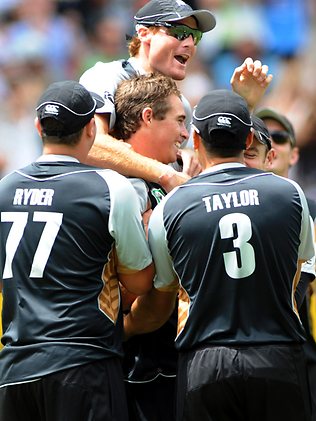
A five-wicket haul for Tim Southee and a blistering 55 by Jesse Ryder saw New Zealand shatter an 11-match losing streak in style with a nine-wicket win over Pakistan in their one-day match Saturday.

New Zealand were so dominant in the opening ODI of the six-match series that they took just 17.2 overs with the bat to wrap up the match after whipping Pakistan out for 124 at the Westpac Stadium in Wellington.

Under pressure to perform after being whitewashed in successive series against Bangladesh and India, New Zealand rejigged their batting order with swashbuckling opener Brendon McCullum dropped down to number six.

The aim was to give New Zealand strength at the top and tail but McCullum never reached the wicket as his regular opening partner Jesse Ryder carved up the Pakistan attack in a whirlwind reply to an ineffective performance.

The only success for Pakistan was when captain Shahid Afridi won the toss and opted to bat, their day going downhill from there.
The Pakistan innings lasted just 37.3 overs and the outcome was almost inevitable once Ryder opened up in the fifth over of New Zealand’s innings, taking 17 off Shoaib Akhtar including two fours and a six.

He made his 55 in only 34 balls in a batting display which complemented the bowling of 22-year-old Southee, who assumed the role of New Zealand’s senior quick for the first time and claimed his first ODI five-wicket bag.

New Zealand skipper Daniel Vettori said it was good to snap the losing streak and full credit had to go to man-of-the-match Southee.
“It was a good win for us after a long time. Tim Southee set it up for us with his swing,” he said, leaving Afridi to rue an ineffective batting performance by his side.
“I think the pitch was very good. I don’t think that was a bad decision batting first. We were missing partnerships.”
Southee destroyed Pakistan in three spells in which he ripped out the top order, came back to break up the middle and returned again to wrap up the innings.

His figures of five for 33 from 9.3 overs were backed up by three for 26 for Hamish Bennett, playing in only his third ODI and first at home, and two for 33 by the veteran Jacob Oram. Only Misbah-ul-Haq produced an innings of substance for Pakistan, reaching 50 before he was bowled by Southee to end the innings.

But the New Zealand openers Ryder and Martin Guptill showed there were no demons in the wicket as they put on 84 in 10 overs before Ryder’s departure. Ryder brought up his 50 edging Abdul Razzaq for a single and in the following over took a single off Sohail Tanvir before attempting to pick up the pace again.

He smacked another four and then went for back-to-back boundaries only to pull the ball straight to Asad Shafiq on the mid-wicket boundary.
Guptill, averaging almost a run a ball, made an unbeaten 40 but it was Ross Taylor, promoted to number three in the new-look New Zealand batting line up, who stroked the winning single, finishing on 23.

Pakistan’s innings was shaky from the start with Mohammad Hafeez dropped by McCullum in the first over, but falling soon after when he edged an outswinger from Southee.

It was the start of a penetrating period for Southee in which he took the wickets of Kamran Akmal (eight) and Asad Shafiq (four) to take three for 16 from his first spell of six overs, leaving Pakistan 32-3.

Younis Khan and Misbah-ul-Haq, who provided the backbone of each Pakistan innings in the Tests, set about repairing the situation but had added only 28 for the fourth wicket when Bennett struck.

He had Younis caught behind for 24 and then dismissed Umar Akmal with his next delivery, caught at second slip by Taylor. Shahid Afridi avoided the hat-trick but was dismissed by Southee in his second spell to have Pakistan 88-6 before the quick ended the Pakistan innings in his third turn with the ball by bowling Misbah. The second match in the series is in Queenstown on Wednesday.

Thou Shalt not Mock or It May Cost You Your Life!

By Manzer Munir for Pakistanis for Peace

In the wake of the murder of Salmaan Taseer, the Governor of Punjab a couple weeks back, I did a great deal of contemplation about the situation in Pakistan and the current state of affairs of Pakistan and indeed in much of the Muslim world.

The current situation, especially in Pakistan and when it concerns the rights of the non-Muslims, is apparently the worst of anywhere in the Muslim world. Indeed, the plight of Asia Bibi, (also known as Aasia, Ayesa Noreen) Islam and Islamic Blasphemy laws have come under rightful scrutiny as of late.

One question that tugs at the heart of the debate for me is why is it that Muslims seem to get so very offended to the point they want to KILL you over a remark or something that comes out of your mouth? As Americans, we wonder to ourselves, “Haven’t they ever heard of sticks and stones may break my bones, but words don’t hurt me?!

Sadly, what the fundamentalist preachers at all the podiums of their Friday sermon or khutbah, nor any of their brethren on the run and in caves like the Taliban and Al Qaeda fail to realize that we are all God’s children. And God, Allah, Yahweh, Jesus, or whatever name you assign him, he is One and the same God of all religions. He is too big to fit into just one religion, concept, version or story of him.

And we all are his creations. Not one of us is superior over the other in his eyes and he judges us all equally. To him, the children of these three religions and its offspring’s are all related to each other. Adam being the first man, then Eve, and then all the Biblical figures and names such as Noah, Abraham, Moses, Jesus, yes especially Jesus. He is their Messiah too!

Jesus, in fact is mentioned some 28 times in the Muslim holy book, Qu’ran whereas their own prophet Muhammad is mentioned only 4 times. And the fact that Jesus is also considered by Muslims to be the Messiah, it is sad that his followers should get such abject treatment in Pakistan and sadly, many Muslim countries.

If only the bad guys realized the connections between Christians and Jesus only then would a Pakistani Christian woman, suffering needlessly in a cell tonight going on 2 years away from her children in solitude, and constantly fearful for her life, would see her horrific ordeal come to an end.

These people are incapable of understanding basic rights, freedoms and even the unhindered concept of free will. No, they are primitive minded in their their spiritual and daily lives. They fail to see that a Christian’s God and a Muslim’s God are the one and the same. And he never would agree to laws like Pakistan’s Blasphemy laws at all. Why? Well because the Muslim God is known first and foremost as a Gracious, Merciful, Compassionate God.

In fact, the Arabic phrase Bismillah ir-Rahman ir-Rahim is a beautifully poetic phrase which offers both deep insight and brilliant inspiration to the average Muslim who says it countless times as he or she starts each day and till they rest their head to sleep. “ It has often been said that the phrase Bismillah ir-Rahman ir-Rahim contains the true essence of the entire Qur’an, as well as the true essence of all religions. Muslims often say this phrase when embarking on any significant endeavor and the phrase is considered by some to be a major pillar of Islam. This expression is so magnificent and so concise that all except one chapter of the Qur’an begins with the words Bismillah ir-Rahman ir-Rahim.”

The common translation:”In the name of God, most Gracious, most Compassionate” essentially is saying that God is compassionate, and full of grace. So how would this God punish Asia Bibi? What would he do if he is so full of compassion and mercy? Would he even punish her? And if he is such a gracious and a compassionate God, then wouldn’t he feel that nearly a two year jail sentence in solitary is already far more than her crime not to mention being away from husband and children and being worried about mob vengeance on her or the death penalty?

That God may act in a multitude of ways and we cannot ever know till said Judgment Day. That is what Judgment Day is all about after all. In fact, this is probably one day when the man upstairs works overtime judging all of us mankind, from the beginning with Adam to the last standing comes till Tribulation and the End of Days. It is only he, the Creator who will do the judging and this is something that the men with the loudspeakers who climb to the top of the minaret five times a day to call the faithful to prayers, just do not really understand, in my opinion. They apparently constantly seem to forget and pass judgment from the pulpit and this in turn helps set the “popular” opinion amongst the ultra-religious faithful of Pakistan’s society.

My only prayer to this Creator is that may he keep Asia Bibi safe tonight and continue to give her strength. And if God should call her home and have her die a death at the hands of the real savages those that not only kill but shockingly, in your name, then please Allah grant her heaven just as you should governor Salmaan Taseer, a man who was only defending the rights of all your children, including those of other faiths. He was being compassionate and gracious towards a fellow human being God, as he was only trying to emulate his creator, You Lord. Ameen.

And while you are at it Lord, will you also please let the imam at the microphone know that “Thou shall not mock, should not cost you your life.” Afterall, “Thou shall not kill is one of your top 10 commandments, whereas mocking prophets or religious figures does not make the list!

Manzer Munir, a proud Pakistani American and peace activist, is a Sufi Muslim who is also the founder of Pakistanis for Peace and blogs at www.PakistanisforPeace.com and at other websites such as www.DigitalJournal.com, www.Allvoices.com, www.Examiner.com and www.open.salon.com as a freelance journalist and writer. He asks that you like the Official Facebook Page of Pakistanis for Peace to get the latest articles as they publish here: http://www.facebook.com/home.php#!/pages/Pakistanis-for-Peace/141071882613054