Posts Tagged ‘ Pakistani Floods ’

Pakistan: Study Shows Appreciation for US Disaster Aid

By Howard LaFranchi for The Christian Science Monitor
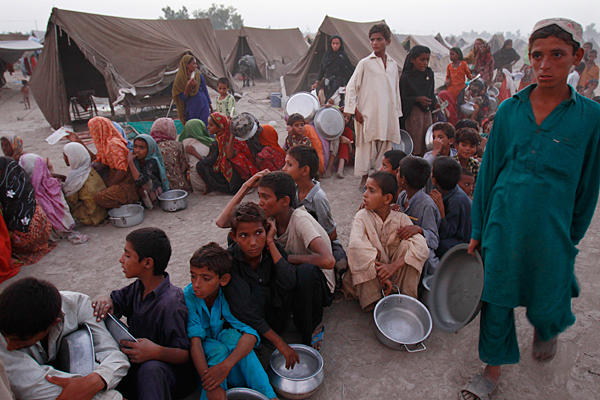
A survey of Pakistanis living near the worst-hit areas of 2005 earthquake finds enduring positive attitudes toward foreigners, including Americans.

Is all that foreign aid flowing into Pakistan in the aftermath of last month’s massive floods changing the way Pakistanis feel about the West, and in particular the United States?

Public opinion surveys conducted in Pakistan in the past have suggested that the country’s very low opinion of Westerners and Americans in particular doesn’t improve much as a result of sudden foreign largesse in response to a natural disaster.

But a new study plumbing the views of more than 28,000 households in 126 villages in the part of Pakistan devastated by a massive earthquake in 2005 finds that attitudes toward foreigners, including Americans, shifted significantly to the positive and in an enduring manner as a result of assistance from abroad.

“What we found is that trust in foreigners changes in response to action,” says Tahir Andrabi, a political economist at Pomona College in Claremont, Calif., who organized the study with Jishnu Das, a World Bank research economist. “The big picture from our work says that what you do on the ground as a country and a people really does matter.”

Debate over the impact of foreign aid and what role it plays in improving America’s image abroad has bubbled ever since the 9/11 terrorist attacks and the ensuing national probing around the theme of “Why do they hate us?” Surveys showed that opinions of America improved sharply among Indonesians after significant US assistance flowed in following the 2004 tsunami. But similar polls in Pakistan suggested that minor improvements in America’s rock-bottom image after the 2005 earthquake were soon lost.

Subsequent surveys of Pakistani opinion also have suggested no lasting improvement in views of the US and Americans. The question is resurfacing once again in the wake of the summer’s centennial floods and the significant assistance the US has provided.

At a ministerial meeting at the United Nations in New York Sunday, Secretary of State Hillary Rodham Clinton announced that the US has provided about $345 million in what was initially rescue and emergency aid efforts and which has now shifted to relief and early recovery work. The American military was involved in the rescue of more than 15,000 people and in delivering more than 7 million pounds of food and other supplies, she said.

In particular, a Pakistan Relief Fund created especially for individual Americans to make $10 donations over their cell phones has brought in $2 million, Secretary Clinton said. That sum will be matched by Proctor and Gamble and will go towards new water purification projects in flood-stricken areas.

Not only is such assistance appreciated, but Mr. Andrabi found in his study that affected populations remember who provided assistance – and retain a positive image of foreigners because of it – years after the disaster. Andrabi and the World Bank’s Mr. Das carried out their study in 2009, four years after the earthquake.

“What really struck me is that the image of foreigners remained so positive in many of these households a considerable length of time after the disaster, and also over a period that included things that tarnished Westerners’ image generally in Pakistan,” he adds. Such harmful factors include the controversy over the Danish cartoons depicting the prophet Muhammad, the growing use of US drones in Pakistan in targeted attacks on Taliban leaders, and rising terrorist violence across the country that many Pakistanis attribute to stepped-up US involvement in domestic issues.

In particular, Andrabi’s study finds that trust of foreigners rose higher the closer people lived to the quake’s fault line, while the level of trust in national institutions did not vary over the wider quake-effected region. That suggests to Andrabi that the concentration of foreign assistance in the most devastated areas – often in places where few foreigners had traveled before – was retained by locals as a positive expression of global concern. Previous polling of Pakistani attitudes sought to reflect national views.

The Andrabi survey shows that while the affected populations understood that the US and other foreign countries were operating from a mix of motivations, most people did not see the assistance as “a cynical attempt by Americans to win hearts and minds,” Andrabi says.

“Hillary Clinton speaks about a ‘shared humanity’ that is behind the US relief effort, and I think most people see it that way,” he says. “People are smart enough to understand that America has multiple faces, we all do,” he adds. “But what they seem to have concluded is that the basic motivation is human.”
Pakistan’s Strange Response Towards Indian Aid offer

by Omer Farooq Khan for The Times of India

The worst floods in Pakistan’s history provided a good opportunity for both the South Asian nations to come closer. Accepting Indian aid offers half-heartedly and that too after US insistence, Pakistan has given an impression that it is convinced that its policy on India cannot change.

Pakistan’s initial response to the Indian offer of five million dollars was a positive one but then it was unsure how to respond. It took several days for Pakistan to finally accept the offer, saying that the aid had to come through the UN. Now, a total of $25 million Indian assistance for flood relief efforts in Pakistan has to be spent by the UN.

Pakistan’s foreign minister Shah Mehmood Qureshi had said that the delay was due to the sensitivities involved in the relationship with India. Even, a section of policymakers, conspiracy theorists in media and some India-centric elements within the Pakistani establishment blamed India for opening floodgates of its dam to inundate Pakistan’s cities and towns. While building public opinion, they did not care that their contention was technically wrong. The fact is that the rivers that caused destruction in Pakistan do not originate in India.

Some defence analysts argue that Pakistan’s strange response towards India’s aid offer was meant not to get obliged. “Pakistan reacted politically towards Indian humanitarian gesture. The destruction is so colossal that petty politics must be avoided. Pakistan asks for help and when it is offered by a neighbour, its ego comes its way. The main hurdle was that Pakistan did not want to be obliged,” argues defence analyst General Talat Masood.

Kamran Shafi, Dawn’s columnist says that Indian-centric approach within the security establishment and intelligence agencies was the main predicament that the government accepted Indian offer half heartedly. “Values and wisdom demand that politics must be kept aside at time of tragedy. Pakistan needed to have warmly welcomed neighbour’s goodwill gesture.”

India and Pakistan have made major efforts in recent months to build confidence in their relations, which were badly strained by the Mumbai 2008 terror attacks that India blamed on militants from Pakistan. If Indian civil society, volunteers and NGO’s were allowed to do relief work in the flood affected areas, this could have been an ideal confidence building measure in the relations of the two countries.

Certainly, it would have served the spirit of Thimphu where Pakistani PM Yusuf Raza Gilani and his Indian counterpart Manmohan Singh tasked their top diplomats to create CBMs. An opportunity is still not lost if governments, media and civil societies in both the countries come forward and create enough space to use this calamity into an opportunity.

-Editor’s Note for Pakistanis for Peace- The writer is spot on with his analysis of Pakistan’s aid offer from India. During times of a humanitarian crisis of biblical proportions, its political response was petty and irresponsible to its citizens. Furthermore, half heartedly accepting several days after the response does little to build on the goodwill. Either accept it right away with gratitude (our advice) or reject it outright. It did neither and so was ineffective in either cause. The politicians of Pakistan continue to show their incompetence by ineffectively managing the affairs of the country both domestically and internationally.

How Pakistan’s Floods Have Made Women Dangerously Visible

By Rania Abouzeid for TIME

Nagina drew her modest light-green cotton dupatta, the scarf that Pakistani women drape over their arms, head and chest, up over her face as she cautiously peered out from a muddy white tent to watch her youngest child, a barefoot, trouserless four-year-old boy in a navy blue shirt streaked with mud. The timid Pathan woman has four other children, three older girls and a boy, but her daughters are not with her in this overcrowded cluster of tents known as the Khandar relief camp in Nowshera, a flood-devastated northwestern district some 90 miles west of the capital Islamabad in the insurgency-plagued, religiously conservative Khyber Pakhtunkwa province. “We are trying to keep the girls away,” Nagina says, “because parda is impossible now.”

Parda, which is also spelled “purdah” and means “curtain” in Urdu, is the practice of shielding women from men they are not directly related to, both through physical segregation and through the custom of modesty, that is, with the women wearing clothing to conceal their shape. It is observed by many women in rural areas of Pakistan, including in the majority-Pathan northern belt bordering Afghanistan. In these parts, a family’s honor is often tied to the chastity and obedience of its women — and protecting and defending the honor of women from verbal and physical harm is part of an ancient code of honor and revenge. But the code is all too often taken to extremes. Barely a week goes by without stories appearing in the Pakistani media about an enraged male — from across Pakistan’s multiethnic spectrum — who has killed his female relative or relatives for some perceived infringement of “honor.” For women adhering to Parda, it’s usually easier and safer for them to simply remain secluded in their homes.  

The floods have made that option unavailable in many places. Desperation has driven women to vigorously jostle with men for limited relief goods at distribution points. Overcrowding and densely pitched tents have forced them into close quarters with men they don’t know, the flimsy canvas coverings providing little privacy from prying eyes. In the camp at Nowsherra, Adiba nods in gloomy agreement as her sister-in-law Nagina discusses the limits of parda amid the calamity . Her tribal tattoos — a green dot on her forehead and another on her chin — mark her as a member of a conservative tribe from the Taliban-infested town of Bajaur. Both women say their husbands are understanding of the conditions but they fear that their men’s patience will run out. “My husband is very upset,” says Adiba, a mother of six. “This is why we’re just sitting in our tents during the day and the night, like in a cage.”  

Pakistan’s northwest, the first region to be hit by the floods and the most devastated, “is an extremely conservative society,” says Imtiaz Gul, author of The Most Dangerous Place, a book about the Pakistan’s northwestern tribal belt bordering Afghanistan. “You hardly see women outside and they hardly have any role except for cooking and cleaning the house and that’s about it.”  

Nagina, like many of the women in Nowsherra’s camps and other places the Pathan have sought refuge from the waters, has sent her unmarried daughters away to live with relatives whose homes were not washed away by the deluge. She hasn’t seen them for a month. “We have no choice,” she says sullenly. “This situation is forced on us.”

Gul says that the longer it takes to get people back to their homes, the greater the possibility of social unrest between men from different conservative towns who have been thrown together. The situation “is pregnant with the possibility of social friction,” he says. “Frustrations will start boiling over. People are saying the worst is over, but I would say that the worst has just started.”

Akbar Ali, a 27-year-old driver who has been in the Khandar camp for 18 days now with his wife and two-year-old daughter, is simmering. He is desperately trying to rent a house at any price he says, to get his family indoors, but there’s little left on the market. He has been offered work, but turned it down because he did not want to leave his wife, who used to be in parda, alone in the camp. “We are all Pathan but we are still very different from each other. The men move around the camp. I’m just afraid that one day if they say something to my wife, it will cause a problem, a fight because I will have to respond, it’s my duty.”

As relative newcomers to the camp, Ali and his small family had missed out on securing a tent on the grounds of the Government College of Technology, or a space inside the school’s two-storey brick structure. The classrooms were already brimming with evacuees, packed four or five families per room, by the time he arrived. And so, he has had to make do with a slab of concrete outside the college cafeteria open to the elements. “We have become like dogs,” he says bitterly from behind dark sunglasses. “Wherever we hear that relief supplies have arrived, we just run after them.”

To avoid violence, he and the several other men whose families are also squatting along the cafeteria wall, have banded together to try and prevent strangers from approaching them. “Some people have tried to come around here, but they only try once,” Ali says. “They know not to come around again.”