By Steven Solomon for The New York Times
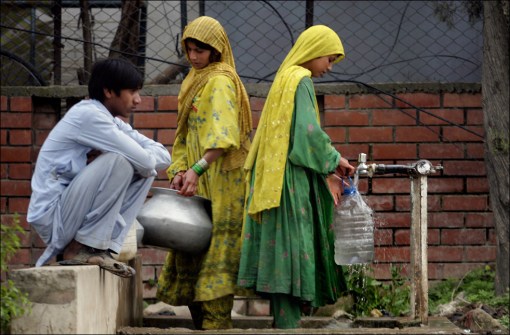
Hard as it may be to believe when you see the images of the monsoon floods that are now devastating Pakistan, the country is actually on the verge of a critical shortage of fresh water. And water scarcity is not only a worry for Pakistan’s population — it is a threat to America’s national security as well.
Given the rapid melting of the Himalayan glaciers that feed the Indus River — a possible contributor to the current floods — and growing tensions with upriver archenemy India about use of the river’s tributaries, it’s unlikely that Pakistani food production will long keep pace with the growing population.
It’s no surprise, then, that Secretary of State Hillary Clinton made Pakistani headlines a few weeks before the flooding by unveiling major water projects aimed at bolstering national storage capacity, irrigation, safe drinking water and faltering electrical power service under America’s new $7.5 billion assistance program. In March, the State Department announced that water scarcity had been upgraded to “a central U.S. foreign policy concern.” Pakistan is at the center of it.
This is because a widespread water shortage in Pakistan would further destabilize the fractious country, hurting its efforts to root out its resident international terrorists. The struggle for water could also become a tipping point for renewed war with India. The jihadists know how important the issue is: in April 2009, Taliban forces launched an offensive that got within 35 miles of the giant Tarbela Dam, the linchpin of Pakistan’s hydroelectric and irrigation system.
Pakistan needs to rebuild and overhaul the administration of the world’s largest contiguous irrigation network. For decades, Islamabad has spent far too little on basic maintenance, drainage and distribution canals, new water storage and hydropower plants.
To some extent, these deficiencies have been masked since the 1970s by farmers drilling hundreds of thousands of little tube wells, which now provide half of the country’s irrigation. But in many of these places the groundwater is running dry and becoming too salty for use. The result is an agricultural crisis of wasted water, inefficient production and incipient crop shortfalls.
Like Egypt on the Nile, arid Pakistan is totally reliant on the Indus and its tributaries. Yet the river’s water is already so overdrawn that it no longer reaches the sea, dribbling to a meager end near the Indian Ocean port of Karachi. Its once-fertile delta of rice paddies and fisheries has shriveled up.
Chronic water shortages in the southern province of Sindh breed suspicions that politically connected landowners in upriver Punjab are siphoning more than their allotted share. There have been repeated riots over lack of water and electricity in Karachi, and across the country people suffer from contaminated drinking water, poor sanitation and pollution.
The future looks grim. Pakistan’s population is expected to rise to 220 million over the next decade, up from around 170 million today. Yet, eventually, flows of the Indus are expected to decrease as global warming causes the Himalayan glaciers to retreat, while monsoons will get more intense. Terrifyingly, Pakistan only has the capacity to hold a 30-day reserve storage of water as a buffer against drought.
India, meanwhile, is straining the limits of the Indus Waters Treaty, a 1960 agreement on sharing the river system. To cope with its own severe electricity shortages, it is building a series of hydropower dams on Indus tributaries in Jammu and Kashmir State, where the rivers emerge from the Himalayas.
While technically permissible under the treaty provided the overall volumes flowing downstream aren’t diminished, untimely dam-filling by India during planting season could destroy Pakistan’s harvest. Pakistan, downriver and militarily weaker than India, understandably regards the dams’ cumulative one-month storage capacity as a potentially lethal new water weapon in India’s arsenal.
Now, on top of all this, come the monsoon floods, which have obliterated countless canals, diversion weirs and huge swaths of cropland. Pakistan needs help, and projects like those heralded by Secretary Clinton, while valuable, are not on the scale needed to turn things around.
The best first step is a huge one: for Washington to kick-start progress on the Diamer-Bhasha dam, an agricultural and hydroelectric project on the Indus that’s been on the drawing board for decades. The project, likely to cost more than $12 billion, has languished for want of financing. It has also has run afoul of the developed world’s knee-jerk disfavor of giant dams.
But there is simply no other project that can add so much desperately needed water storage and hydroelectricity — Pakistan is tapping just 12 percent of its hydropower potential. Giant dams, moreover, can be inspiring, iconic projects — the Hoover Dam was a statement of American fortitude at the height of the Depression. Beleaguered Pakistan could use a symbol of progress.
There are other projects, already shown to be successful, that on a larger scale could save more water than building half a dozen giant dams. Managers at one Punjabi canal branch, for example, are working with international experts to replace the traditional supply system called warabandi — in which farmers draw water on a simple rotational basis — with one that requires less overall water but delivers it on a reliable, as-needed basis.
Finally, President Obama should take a lesson from John F. Kennedy. In 1961 President Kennedy and President Ayub Khan of Pakistan established a technical collaboration between American experts and a young generation of Pakistani engineers who, together, largely ameliorated Pakistan’s seemingly intractable problem of waterlogging and soil salinization. Yes, Washington’s interest may have been more related to the cold war than to helping the Pakistani people, but we’ve again reached the point where national security and benevolence align.
The Pakistanis may never come to love us. But as the current spectacle of Islamic jihadists bringing emergency aid to flooded areas warns us, we can’t afford to ignore Pakistan’s looming freshwater crisis.
Steven Solomon is the author of “Water: The Epic Struggle for Wealth, Power, and Civilization.”



You must be logged in to post a comment.