Posts Tagged ‘ Taliban ’

Pakistan Suicide Bombing Death Toll Jumps to 102

By Riaz Khan and Nahal Toosi for The Associated Press

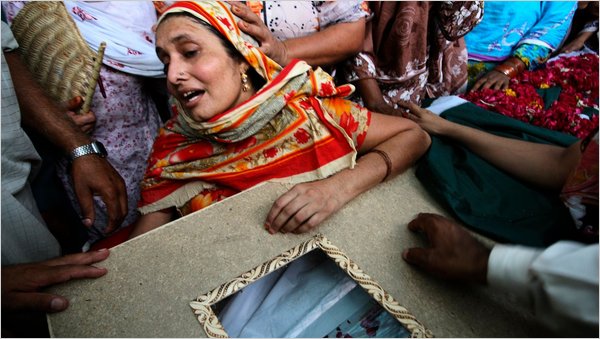
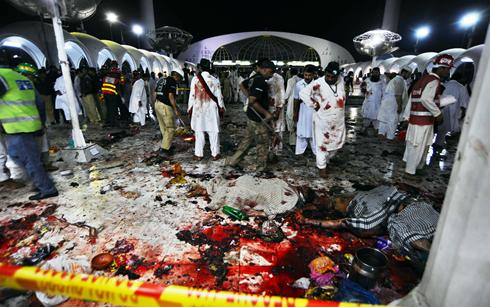
The death toll from twin suicide bombings in Pakistan jumped to 102 with 115 people wounded on Saturday, making it the deadliest attack this year in the country.

Authorities continued to remove debris from the site of the attack in the village of Yakaghund in a northwest tribal region, after two bombers struck seconds apart Friday near a government office.

One of the bombs appeared fairly small but the other was huge, officials said. At least one bomber was on a motorcycle.

The attackers detonated their explosives near the office of Rasool Khan, a deputy Mohmand administrator who escaped unharmed. Tribal elders, including those involved in setting up militias to fight the Taliban, were in the building, but none was hurt, according to Mohmand chief administrator Amjad Ali Khan.

Video footage showed dozens of men searching through piles of yellow brick and mud rubble for survivors. Women and children were among the victims.

Mohmand is one of several areas in Pakistan’s lawless tribal belt where Taliban and al-Qaida members are believed to be hiding.

Abdul Wadood, 19, was sitting in a vehicle at the time of the bombings.

“I only heard the deafening blast and lost consciousness,” said Wadood, who was being treated for head and arm wounds in Peshawar, the main city in the northwest, about 15 miles (25 kilometers) away. “I found myself on a hospital bed after opening my eyes. I think those who planned or carried out this attack are not humans.”

Some 70 to 80 shops were damaged or destroyed, while damage to a prison building allowed 28 prisoners — ordinary criminals, not militants — to flee, said Rasool Khan, who gave the casualty figures.

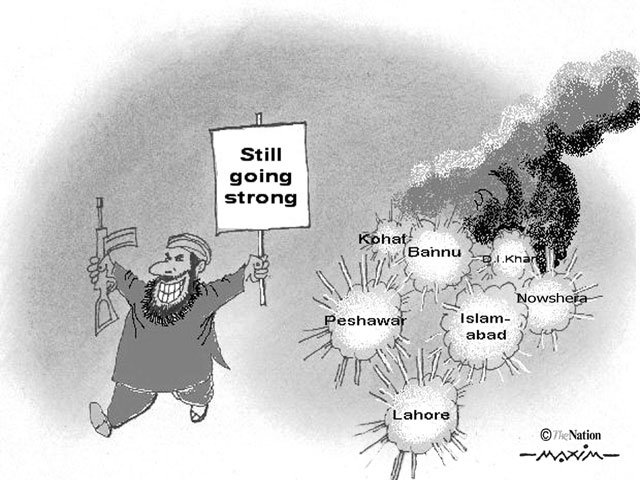
Friday’s was the deadliest attack this year in Pakistan. On New Year’s Day, a suicide car bomber struck a sports event near a meeting of tribesmen who supervise an anti-Taliban militia near the South Waziristan tribal area, killing 96 people.

Near the attack site, officials had been distributing wheelchairs Friday to disabled people and equipment to poor farmers, Amjad Ali Khan said. It was unclear how many participants in that event were among the victims.

Pakistani Taliban spokesmen could not be immediately reached after the attack. There were scattered reports the militant group’s branch in Mohmand had claimed responsibility and said it was targeting the elders.

The Pakistani army has carried out operations in Mohmand, but it has been unable to extirpate the militants. Its efforts to rely on citizen militias to take on the militants have had limited success there.

Nevertheless, there have been fewer attacks in Pakistan this year than in previous years — most notably in the northwest. In the last three months of 2009, more than 500 people were killed in a surge of attacks in the country.

Government in Pakistan Calls Meeting on Terrorism

By Jane Perlez for The New York Times

In an unusual sign of accord between the two major political parties, Prime Minister Yousaf Raza Gilani announced over the weekend that the government and the opposition would hold a national conference on ways to combat terrorism.

The announcement came days after 42 people were killed and hundreds were wounded when two suicide bombers struck the famed Sufi shrine Data Darbar on Thursday night in Lahore, the capital of Punjab Province.

The attack incited street protests in Lahore on Saturday, and it provoked complaints that law enforcement was not doing enough to protect holy sites from sectarian militant groups.

Nawaz Sharif, the leader of the main opposition party, Pakistan Muslim League-N,  deplored the attack at a news conference on Saturday. It is time, he said, for the government to hold a national conference on terrorism and open talks with the Pakistani Taliban, “who are ready to talk and ready to listen.”

Mr. Sharif, whose brother Shahbaz Sharif  is the chief minister of Punjab, did not specify which Taliban figures such talks should include.

Prime Minister Gilani agreed late Saturday to the proposal for a national conference, though it appeared unlikely that it would involve representatives of any militant groups. The conference will discuss how to better fight back against the militants, and show concern for the problem, politicians said.

The creation of such a conference was interpreted as an encouraging step by politicians who have called for greater leadership by the civilian government against terrorism. Until now the army has mostly led the effort against the Pakistani Taliban, fighting the militants in the tribal areas adjacent to Afghanistan.

The Pakistani Taliban denied responsibility for the Data Darbar attack. The shrine, one of the most popular in Lahore, is considered un-Islamic by followers of the Wahhabi and Salafi schools of Islamic thought that Taliban fighters generally adhere to.

Some religious scholars were so outraged by the attack on the shrine that they called for the resignations of Chief Minister Sharif and the Punjab law minister, Rana Sanaullah.

Earlier this year, Chief Minister Sharif was criticized by the national government, led by the more secular Pakistan Peoples Party, when he appealed to the Taliban to stop attacking Punjab on the grounds that the Muslim League and the Taliban had a common enemy in the United States. Since then, he has been accused of not doing enough to crack down on militant groups that have coalesced under the umbrella of the Punjabi Taliban.

The federal Interior Ministry said after the assault on the shrine that it had warned Punjab authorities of a possible terrorist attack in Lahore last week.

A rare joint statement by the prime minister and Nawaz Sharif on Sunday said now was “not the time for blame games.”

A similar conference on terrorism by the two main political parties was held in Islamabad two years ago, but those talks petered out and responsibility for tackling terrorism was handed to the army.

An effective national strategy by the civilian government would need stronger and more cohesive leadership and more money for the poorly financed police forces in the major cities, according to law enforcement officials.

Sectarianism Has Poisoned Pakistan

By Basim Usmani for The Guardian

The recent attacks on a prominent shrine in Lahore demonstrate how the unrest in Pakistan is caused by a minority of few who cannot tolerate the plurality of beliefs in Pakistan. The Tehrik-e-Taliban are lying through their teeth when they claim that they do not attack public places. It’s becoming more and more apparent that these militants aren’t resisting American hegemony; this a war to determine Pakistan’s future and, by proxy, the future of Islam.

Whether the Tehrik-e-Taliban actually arranged the bombers’ suicide belts is irrelevant; they have created a domino effect that’s likely to spread from commercial capitals such as Lahore to cities with historic shrines and Pakistani historical sites, such as Multan, or Taxila.

Unlike Baghdad, where violence between Islamic sects is a product of the war America is waging, the onus of last Thursday’s blasts falls squarely on us, the citizens of Pakistan. We have been complacent about sectarianism for too long.

A good friend who works for a transportation company told me in 2007 that in villages along the highways to Waziristan where the Taliban had seized control were the bodies of butchered Shia Muslims. That year, Lahore’s public was too busy mobilising about the judiciary and President Musharraf to pay the violence any mind.

Sectarianism has a brutal history in Pakistan that existed long before militants in Afghanistan began calling themselves the Taliban. I remember as a child in Lahore the broadcasts of gun violence outside Shia houses of worship during the early 1990s.

Many Pakistanis feel that the attacks on two Ahmadiyya mosques last May, where gunmen unloaded bullets and grenades on Friday prayer-goers, were unprecedented. Certainly the Ahmadiyya community doesn’t think they are.

To have a Pakistani passport requires citizens to assert that they are not part of the Ahmadiyya community. In a sense, holding that passport also makes you complicit in the blasts that killed dozens in Lahore’s most famous Sufi shrine last week. Our inability to understand that this war is about national identity is rooted in the same complacency.

We are OK with the state deciding for us who is or isn’t Muslim. In this regard, the Pakistani government has the weakest moral fibre in taking on this growing strand of extremism. It is hypocritical to fight the Taliban in Waziristan if we are okay about denying citizenship to millions of Muslims born in Pakistan.

It may sound extreme of me, but we should be jailing clerics in Pakistan that give edicts declaring believers to be non-Muslim or anti-Pakistani. It may seem extreme to an American that writers who deny the Holocaust are imprisoned in Europe, but extreme contexts call for extreme measures.

Pakistanis must stress how being born or raised in their country is enough to be Pakistani; laws preventing Ahmadis from referring to themselves as Muslims were amended to the constitution by Zulfikar Ali Bhutto in the 1970s.

I remember being uneasy at my desk in middle school when I was studying at Aitchison College in Lahore, and some of my classmates were getting bullied for having marks on them after returning from Shia processions during Muharram. Pakistanis themselves are the only ones capable of stamping out this discriminatory culture.

Some proactiveness is necessary on our part to make it clear that mystics, Shias, Ahmadis and Christians are all fellow Pakistanis. When you are pulled over by street police in any major Pakistani city, the first bit of information the police ask for is your family name. From one name your caste, religious beliefs and affluence is determined.

This came as a shock to all of my family who have emigrated away: that collectively our stock in our own nationhood has plummeted so. In a sense, these problems are all accrued debt we’ve accumulated for being so complacent. In the light of our bigoted constitution and deterministic culture we have to – for ourselves – decide that being Pakistani is enough to make us all countrymen. Otherwise, we might as well just refer to ourselves as Taliban, Muslim extremists, Islamic militants, and so forth.

Deadly blasts hit Sufi shrine in Lahore

By Syed Shoaib Hasan for The BBC

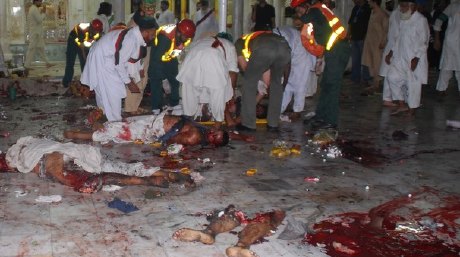
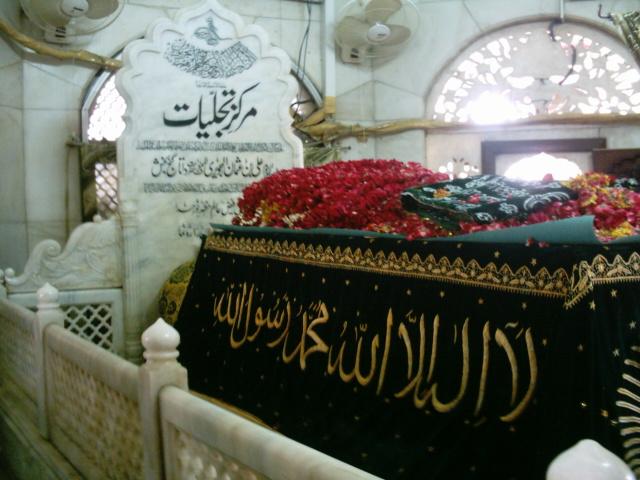
Suicide bombers have launched a deadly attack on a Sufi shrine in the eastern Pakistani city of Lahore. At least 35 people died in the blasts at the popular Data Darbar shrine late on Thursday evening, officials say. At least 175 other people were hurt in the blasts, believed to be the first targeting a shrine in Lahore. Thousands of people were visiting the shrine at the time, officials say. It holds the remains of a Persian Sufi saint, Abul Hassan Ali Hajvery.

Although no-one has yet said they carried out the attack, Taliban militants and their Punjabi jihadi allies have been involved in several such bombings in the northern Khyber Pakhtoonkhwa province. The shrine is largely frequented by members of the majority Barelvi sect, who are seen as heretics by the Taliban. Most of the Taliban belong to the rival Deoband Sunni sect, which strongly disapproves of worship at shrines. Many are also allied to the Sipah-e-Sahaba, and its armed splinter group, Lashkar-e-Jhangvi, which seeks to turn Pakistan into a Deoband Sunni state.

The shrine is visited by hundreds of thousands of people each year from both Sunni and Shia traditions of Islam. At least two attackers were involved, although police initially said three explosions had been heard.  The impact of the blasts ripped open the courtyard of the shrine. Rescue workers could be seen clambering over the rubble as they carried out the victims. Khusro Pervez, commissioner of Lahore, said two of the attacks took place in the main courtyard and one in the lower level of the shrine.

The first attacker struck in the underground area where visitors sleep and prepare themselves for prayer, he said. As people fled, a second bomber detonated his explosives in the upstairs area. Officials say they believe the bombers used devices packed with ball-bearings to maximise the impact of their attack.  A volunteer security guard at the shrine described scenes of devastation.

“It was a horrible scene,” said Mohammed Nasir. “There were dead bodies all around with blood and people were crying.” The attack is the biggest on a Sufi shrine in Pakistan since militant attacks began in 2001.  No group has said it carried out the attack, but correspondents say the attacks continue a growing trend among militants to target members of other sects as well as minorities.

Lahore has been hit by a series of bomb attacks, including a suicide blast at anti-terrorist offices in March, when at least 13 people died. In May, more than 90 people were killed in a double attack on the minority Ahmadi sect in the city.

Earlier, security chiefs had been congratulating themselves after what was the first month in two years in which there had been no suicide bombings in Pakistan, the BBC’s Aleem Maqbool reports from Islamabad.

They said it was proof the militant networks had been disrupted. Most Pakistanis knew the battle against militancy in this country was far from over, he adds. Last year Pakistan launched a major military offensive against militant strongholds in South Waziristan.  In December the military said they had achieved victory, but subsequent reports have suggested the militants remain active in the region.

Vengeful New Militant Group Emerges in Pakistan

By Kathy Gannon for The Associated Press
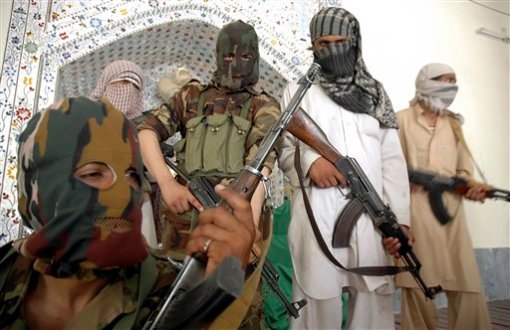
Pakistani authorities now believe a dangerous new militant group, out to avenge a deadly army assault on a mosque in Islamabad three years ago, has carried out several major bombings in the capital previously blamed on the Taliban.

The emergence of the Ghazi Force was part of the outrage among many deeply religious Pakistani Muslims over the July 2007 attack by security forces against the Lal Masjid, or Red Mosque, a stronghold of Islamic militants.

The fierce attack, in which scores of young, heavily armed religious students died, inspired a new generation of militants. These Pakistanis have turned against a government they felt has betrayed them and, to their dismay, backed the U.S. role in neighboring Afghanistan.

The brief but bloody history of the Ghazi Force illustrates the unintended results of Pakistan’s policy of promoting Islamic extremists to fight India in the disputed area of Kashmir. That policy — which Pakistan denies it pursues — now threatens regional stability as the U.S. and Pakistan’s other Western partners pour billions of dollars into the country to stop the rise of Islamic militancy.

The new group is made up of relatives of students who died in the Red Mosque assault. It is named after the students’ leader, Maulana Abdul Rashid Ghazi, who was also killed. The mosque’s religious school, or madrassa, had been a sanctuary for militants opposed to Pakistan’s support of the U.S.-run war in Afghanistan.

Private television stations broadcast vivid scenes of the assault — commandos in black fatigues rapelling down ropes, the crackle of gunfire, bodies of black-shrouded girls carried out through the smoldering gates. Those images stunned the nation, especially families of the students and Pakistanis with deep religious feelings.

“Before the Lal Masjid, militants hadn’t yet declared war on the state of Pakistan. That changed with Lal Masjid,” said Zahid Hussain, author and terrorism expert who has written extensively about Pakistan.

Islamabad’s inspector general of police, Kalim Imam, told The Associated Press that the Ghazi Force was behind most of the deadliest attacks in the capital during the last three years. The attacks targeted the military, the Inter-Services Intelligence agency or ISI — which had ties to a number of militants — and a five-star hotel frequented by foreigners and the Pakistani elite.

The Ghazi Force helped recruit a security official who blew himself up inside the office of the World Food Program last October, killing five people, according to Imam. The force also sent a suicide bomber in September 2007 into the mess hall of the commando unit that attacked the Red Mosque, killing 22 people, he said.

Ghazi Force members may also have been involved in the audacious June 9 attack north of the capital that killed seven people and destroyed 60 vehicles ferrying supplies to NATO and U.S. soldiers next door in Afghanistan, Imam said.

Many of those attacks had been attributed to the Pakistani Taliban, which operates in the remote tribal areas of the northwest along the border with Afghanistan. There is evidence of close ties between the Ghazi Force and the Pakistani Taliban, which the government has vowed to crush.

The Ghazi Force is believed to be headquartered in the Orakzai region of the border area, where the leader of the Pakistan Taliban, Hakimullah Mehsud, held sway for years. The leader of the Ghazi Force is believed to be Maulana Niaz Raheem, a former student at the Red Mosque.

Anger over the bloodshed at the mosque was all the greater because many of the militants and their supporters felt betrayed by a government that had once supported them. Both Ghazi and his brother Maulana Abdul Aziz Ghazi, who was freed on bail this year after two years in jail, were widely believed to have been on the payrolls of both the government and the ISI intelligence service.

Their father, Maulana Mohammed Abdullah, enjoyed a close relationship with the late President Mohammad Zia ul-Haq, and the mosque was a center for recruiting volunteers to fight against the Soviets in Afghanistan in the 1980s.

As opposition grew to Pakistan’s support of the U.S. role in Afghanistan, the mosque became a center of religious agitation against the government, with armed students taking over the complex and police laying siege.

A former senior official in the Interior Ministry told The Associated Press that the police wanted to storm the mosque and end the siege at its outset, send the students home and shut down the religious school and a neighboring library until tempers cooled.

President Gen. Pervez Musharraf refused, the official said, even though police knew that members of al-Qaida’s affiliate organization Jaish-e-Mohammed, which is banned in Pakistan, were bringing in weapons for the students.

Musharraf relented and ordered the assault after militants kidnapped several Chinese nationals running a massage parlor in Islamabad, accusing them of prostitution. The death toll remains in dispute. Red Mosque officials say hundreds died. The government says fewer than 100 were killed.

In a rare interview, Abdul Aziz Ghazi told AP he warned the government that an assault on the mosque would unleash forces that no one could control.

“I have been in jail. I did not form this force and I don’t condone the violence but they are angry at the injustices done,” he said this week.

Although the assault turned many Islamic hard-liners against the government, Pakistan remains unwilling to break all ties to the militants, instead following a high-risk strategy of coddling “good militants” while fighting those deemed “bad militants,” analysts say.

“The military and the ISI have given importance to these militants as assets. But those who have openly declared war, and there is no chance of them returning back to the state, the army is going after them,” said Manzar Jameel, a terrorism expert and researcher on the growth of extremism in Pakistan. “Yet they still believe that some are still assets and that they can keep control of the assets. It’s a failure of strategy.”

Army spokesman Maj. Gen. Athar Abbas denies any assistance to militant groups, saying past ties have long since been severed. He says the Ghazi Force is among the groups the 120,000 Pakistani soldiers waging war in the tribal regions are fighting.

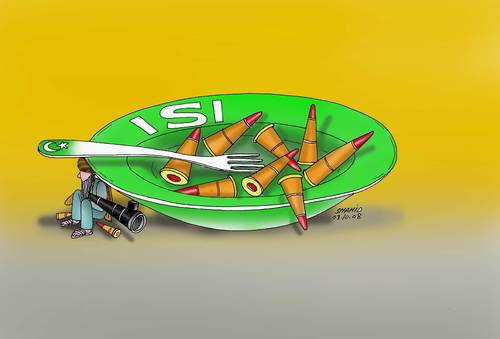
Yet Anatol Lieven, a terrorism expert with the Department of War Studies at London’s King College, said it’s clear that the ISI continues to protect some militant groups, even if it has broken with others.

In a June report, the Rand Corporation think tank also alleged that Pakistan’s military and intelligence still support some militant groups “as a tool of its foreign and domestic policy.”

“A key objective of U.S. policy must be to alter Pakistan’s strategic calculus and end its support to militant groups,” the report said.

Christine Fair, a co-author of that report and an assistant professor at Georgetown University’s Center for Peace and Security Studies, said the battle against extremists in Pakistan is mired in layers of subterfuge by Pakistani intelligence and a “mystifying” acceptance by the CIA of Pakistan’s “good-militant, bad-militant” policy.

She said U.S. intelligence knows Pakistan protects one group — Lashkar-e-Taiba, which India blames for the 2008 Mumbai assault and Afghanistan accuses of masterminding deadly attacks against the Indian Embassy in Kabul.

“Lashkar-e-Taiba remains intact. I have had conversations with … officials in Washington. It is not their priority. Lashkar-e-Taiba is not an issue,” she said in an interview. “Yet Lashkar-e-Taiba has been attacking us in Afghanistan since 2004.”
Pakistan Rejects Allegations of Taliban Ties

As reported by CNN

Pakistani officials Sunday rejected allegations that their country’s powerful intelligence agency still supports the Taliban and other Afghan insurgents after a paper from a Harvard academic accused the agency of continued links to the rebels.

The powerful Inter-Services Intelligence agency does not “actually control the Afghan insurgency” and does not have “the ability to bring it to an end,” Matt Waldman argues in a paper for the London School of Economics. But the ISI provides “sanctuary, and very substantial financial, military and logistical support to the insurgency,” giving it “strong strategic and operational influence — reinforced by coercion,” according to his report, which cites Taliban commanders among its sources.

The ISI is widely thought to have played a key role in creating the Afghan Taliban during the 1990s, but Pakistan officially denies supporting them now. Maj. Gen. Athar Abbas, spokesman for the Pakistani military, called the claim “rubbish” on Sunday and said Waldman’s report “does not have a credible source or authenticity.”

“At best, it is speculative and only gives open sources without naming [them],” Abbas told CNN. “So, therefore, this kind of report requires a treatment which it really deserves. We are not going to formally respond to this, but we reject these allegations and accusation. If there are hard evidence, we would like for them to be brought out and we would be able to respond accurately.”

And Farahnaz Ispahani, a spokeswoman for President Asif Ali Zardari, called Waldman’s report “one-sided” and dismissed what she called its “wild accusations.”

“If Mr. Waldman had been a seasoned academic, he would have conducted interviews in Pakistan itself to balance his so-called research report,” Ispahani said. “The Pakistani government and its military have been performing an outstanding service to the world community as well as the region in its fight against militancy and extremism, and we can count the dead we have sacrificed in the thousands.”

Waldman’s report is titled, “The Sun in the Sky: The relationship between Pakistan’s ISI and Afghan insurgents.” He based his conclusions on interviews with nine insurgent field commanders in three regions of Afghanistan, plus former Taliban officials, tribal leaders, politicians, experts and diplomats. The title comes from Taliban commanders’ claims that their relationship with Pakistani intelligence is “as clear as the sun in the sky.”

Waldman concluded that that Pakistan “continues to give extensive support to the insurgency in terms of funding, munitions and supplies.” But Abbas dismissed the unnamed sources, calling the report “rubbish.”

“Has he named any Taliban commanders in this, has he named any officials?” Abbas said. “So, therefore, if it doesn’t have any specific source, which is not willing to disclose a name, it just becomes one of those reports that keep appearing. It is a serious allegation, but unless it has a credible evidence to support it or substantiate the report, only then it warrants a serious consideration for response.”

The ISI works not only with the Taliban, but also with the armed Haqqani network, led by Jalaluddin Haqqani and his son Sirajuddin, Waldman wrote. The Haqqani network sometimes cooperates with the Taliban and sometimes fights it.

The Taliban members interviewed believe that the ISI has a heavy influence on their leadership, which some of them said amounts to control, according to the report.

One of the southern commanders claimed: “If anyone rejects that the ISI backs or controls the Taliban, he has a mental problem … all our plans and strategy are made in Pakistan and step by step it is brought to us, for military operations or other activities,” the report says.

And southern Taliban commanders all complained of heavy ISI involvement, which they blamed for some attacks on civilians.

“One southern commander described their predicament as follows: ‘Another group of Taliban is directly supported by the ISI. They will never stop fighting in the country; they want to destroy the government and bring chaos. Behind all the attacks on … NGOs, schools, teachers, doctors, this is Pakistan. We cannot deny that it is Taliban; but there are Pakistan controlled groups among us. They want destabilisation …,’ ” the report says.

Waldman’s report comes two months after a U.N. report on the assassination of former Prime Minister Benazir Bhutto in 2007 — an attack blamed on Pakistani Taliban leaders — found that intelligence agencies hindered the subsequent investigation. The report concluded that the “pervasive reach” of Pakistan’s intelligence agencies left police “unsure of how vigorously they ought to pursue actions, which they knew, as professionals, they should have taken,” the report states.

American Arrested in Pakistan was on Solo Mission to Hunt Bin Laden

By Manzer Munir for Pakistanis for Peace

Gary Brooks Faulkner, a 51 year old construction worker from California was arrested by Pakistani police Monday night with a pistol, night vision goggles, and a 40 inch sword and apparently on a mission to kill Osama Bin Laden in revenge for the September 11 attacks on the US.

Faulkner was captured by the Pakistani police in the city of Chitral in the northwestern region of Pakistan near the Afghanistan border. According to a senior police officer, Faulkner was carrying religious Christian books and was reportedly on a mission to avenge the victims of the 9-11 attacks in New York, Washington and Pennsylvania.

According to Pakistani officials, Faulkner arrived in Pakistan on June 3 and stayed in a local hotel in an area of Pakistan known for its spring festivals and frequented by foreign tourists also. Apparently this was Mr. Faulkner’s sixth trip to Pakistan since 2002. At a press conference in his present state of Colorado, Faulkner’s brother Scott Faulkner, a physician, stated that his brother Gary was “on a mission.”

“He’s not crazy,” Dr. Faulkner said of his brother. “He’s not a psychopath. He’s not a sociopath.” Because of Osama Bin Laden’s security and Gary Faulkner’s kidney condition, Dr Faulkner did not believe he would see his brother again as he dropped him off at the airport prior to his flight to Pakistan this month. “I did not think I was going to see my brother again,” Dr. Faulkner said. “That’s the nature of going to Pakistan and hunting a wanted man who is surrounded by people with automatic weapons.”

Dr Faulkner stated that his brother underwent kidney dialysis three times a week and that if he killed or capture Bin Laden, he would use the reward money to live the rest of his life in Nicaragua helping build houses for the homeless.

According to Pakistani police, Mr Faulkner disappeared from his hotel Sunday night and away from the posted police guards, who are customarily there for the security of foreigners. When he checked out without informing police, officers began looking for him, according to the top police officer in the Chitral region, Mumtaz Ahmad Khan. He was in custody after a 10 hour search in a forest area in a high security zone close to the border with Afghanistan. He surrendered without any resistance and was flown to Peshawar where members of the United States embassy were notified of the arrest of an American.

“We initially laughed when he told us that he wanted to kill Osama bin Laden,” Khan said. But when officers seized the weapons and night-vision equipment, “our suspicion grew.” He said the American was trying to cross into the nearby Afghan region of Nuristan.

Chitral and Nuristan are among several rumored hiding places for bin Laden along the mountainous border between Afghanistan and Pakistan. He is currently being questioned by members of Pakistan’s intelligence officials according to reports and is in Peshawar where at present he has not been charged with any wrongdoing.

Whether Faulkner was there on a half baked suicidal, Rambo style mission or he truly believed he could be successful in finding and infiltrating Osama’s inner circle in order to capture or kill him remains to be seen. Nonetheless, it is a testament to the American “Can-do” spirit that a patriotic yet perhaps disillusioned and aging construction worker could take it upon himself to go to dangerous areas of Pakistan in order to avenge the victims of September 11. Whether he is simply crazy or foolish, one can not deny his desire to capture one of the most wanted man in history. We can only dream of the possibilities of real capture or death of Bin Laden if the majority of people in the Afghanistan-Pakistan region wanted to capture Osama and the terrorist Taliban leaders like Mullah Omar and others who shelter him.

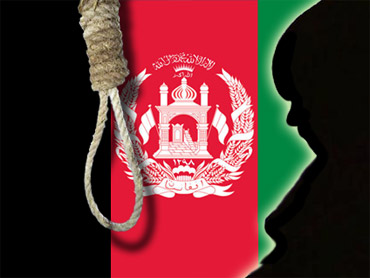
Taliban Hangs 7 Year Old Afghan Boy For Spying

By Tucker Reals for CBS News

Taliban militants accused a seven-year-old boy of spying and hanged him earlier this week in Afghanistan’s southern Helmand province, a local government official tells CBS News.  

Provincial government spokesman Daud Ahmadi confirmed the incident which took place on Tuesday in the Taliban stronghold of Sangin, in Helmand. Ahmadi told CBS News’ Fazul Rahim the boy was hanged in public after a Taliban commander read a verdict out loud, accusing the youth of spying for international forces.

Afghan President Hamid Karzai said Thursday that, if confirmed by his national government, the hanging would be “heart breaking and shocking.”

Karzai spoke in Kabul at a joint news conference with Britain’s new Prime Minister David Cameron, who was in town for his first visit as head of state. Cameron said the alleged hanging would be a “horrific crime… a crime against humanity,” if proven.

A local resident in the remote village of Sang e Hissar, in the Sangin valley, tells CBS News he witnessed the hanging. The man says three militants brought the boy before a crowd of about 150 people, read the short verdict, and then hanged him from a tree.

The youngster was the grandson of a respected local elder, the resident tells CBS. According to the villager, the Taliban have intensified their campaign of intimidation in the area in recent months.

A Taliban source in Helmand told CBS News’ Sami Yousafzai on Thursday he was aware of the boy being killed, but that it was a case of a militant settling a personal vendetta against the boy’s family, then using the spying charges as an excuse. The source said he believed the boy’s executor had fled across the border to Pakistan.

The hanging comes as a Taliban commander in neighboring Kandahar province — the Taliban’s traditional home territory — tells CBS News that a suicide attack on a wedding party that left 40 people dead was “collective punishment” for villagers standing up to the Islamic militants’ control in the region.

Official Admits Militancy’s Deep Roots in Pakistan

By Jane Perlez and Waqar Gillani for The New York Times

LAHORE, Pakistan — Days after one of the worst terrorist attacks in Pakistan, a senior Pakistani official declared in a surprising public admission that extremist groups were entrenched in the southern portion of the nation’s most populous province, underscoring the growing threats to the state.

 The statements by the interior minister, Rehman Malik, after the killing of more than 80 people at two mosques last week here in Lahore, were exceptional because few Pakistani politicians have acknowledged so explicitly the deep roots of militancy in Pakistan. They also highlighted the seeming impotence of the civilian government to root out the militant groups, even in Punjab Province, providing a troubling recognition that decades of state policy to nurture extremism had come home to roost in the very heart of the country.

 The extent of the problem has become an increasing concern for the United States, which has pressed the government to deal with the issue with renewed urgency since the failed attempt by a Pakistani-American to explode a car bomb in Times Square.

 “We’re dealing with a problem that is so deeply burrowed into the bosom of the society,” said a senior Western official about the difficulty of loosening the grip of the militant groups. “And we’re dealing with a government that is unhappy within itself.”

The problem for Pakistan, Western officials and some Pakistani politicians said, is not only the specific acts of terrorism by these groups, but the far more pervasive jihadi mentality that has been nurtured in the society by an extensive network of extremist madrasas and mosques.

Mr. Malik’s remarks — in which he rattled off a host of extremist groups once supported by the state — were a nod to these larger problems. In contrast to the tribal areas at the nation’s periphery, where the military is battling the Pakistani Taliban on several fronts, militants were “now active” in the southern part of Punjab and were trying to “destabilize the country,” he said.

Though Mr. Malik seemed to hint at possible military action in Punjab, the civilian government, led by the Pakistan Peoples Party, the more secular of the political parties in Pakistan, has little leverage to make it happen.

The Pakistani military, which still holds most power, has shown little interest in taking on extremist groups in Punjab. The province is a major recruiting area for the army, and many of the militant groups there were created by the state decades ago and have been fostered since as arms of Pakistan’s enduring anti-India strategy.

To a large degree, they have slipped from the control of their handlers in the military and intelligence services, according to Western diplomats and Pakistani security experts, and have linked up with Taliban fighters and other militant groups that are now striking deeper into Pakistan in an effort to overthrow the state.

Today these militants move back and forth easily between the tribal areas for training and Punjab, where they carry out a rising number of spectacular attacks.

“They — Lashkar-e-Janghvi, the Sipah-e-Sohaba Pakistan and Jaish-e-Mohammad — are allies of the Taliban and Al Qaeda,” Mr. Malik told reporters in Lahore after the mosque attacks. 

The loose conglomerate of militants that Mr. Malik listed is now being grouped by officials and others under the name of the Punjabi Taliban, a designation that itself highlights the expanding nature of the threat in Pakistan’s most important province and the militants’ shifting ambitions. Under that rubric also falls Lashkar-e-Taiba, an anti-India militant group. Like the others listed by Mr. Malik, Lashkar-e-Taiba has been banned by the state, but continues to operate under a different name and apparently with the blessing of the military.

The Punjabi Taliban took credit for the assaults on the two Ahmadi mosques last Friday. At least one of the men arrested by the Pakistani authorities in connection with the Times Square bombing case is connected to Jaish-e-Mohammed, according to law enforcement officials in Karachi.  Adding to the difficulty of clamping down on the groups, the Punjabi government, led by Shahbaz Sharif, a leader of the more conservative Pakistan Muslim League-N and a chief political rival of President Asif Ali Zardari, has stopped short of condemning the militants. In some respects, he has treated them as allies.

Two months ago, Mr. Sharif asked the Taliban to stay away from Punjab, arguing that his party and the Taliban had a common enemy in the United States. The Punjab government is “in a state of denial,” said Arif Nizami, a columnist with the newspaper The News. Mr. Sharif played down the attack on the two mosques in Lahore, Punjab’s capital. Instead, he visited the wounded survivors in a hospital quietly at night without the usual television coverage.

The groups hold such sway that Pakistani politicians frequently pander to some, like the pro-Taliban Sipah-e-Sohaba Pakistan, during elections.  In a bold illustration of the power of one of the militant groups in southern Punjab, the provincial law minister, Rana Sanaullah, campaigned alongside the leader of Sipah-e-Sohaba, Maulana Muhammad Ahmed Ludhianvi, during a March by-election for the provincial assembly in the city of Jhang.

In an interview, Mr. Sanaullah, said he saw nothing wrong with campaigning with Mr. Ludhianvi. It was a good thing, he said, because it helped bring groups that he described as no longer militant into the democratic mainstream. “If they want to be law-abiding citizens, we should allow them to be,” Mr. Sanaullah said.  Mr. Sanaullah was not alone in seeking votes from Sipah-e-Sohaba. A candidate for the National Assembly running for the Pakistan Peoples Party also won with its support earlier this year. Though security is a paramount concern, government officials and others acknowledge that the problem of militancy will not be solved by military force alone. Having been nurtured through generations, it will also not be undone quickly.

A program announced by Mr. Zardari two years ago to rein in the madrasas has yet to get off the ground, blocked by bureaucratic inertia and fears of a backlash from powerful conservative religious groups, Pakistani officials say. As state-sponsored education becomes too expensive for poor parents, the number of madrasas has actually increased in the past three years, to more than 17,000 in 2010 from 13,000 in 2007. At least several thousand of the madrasas churn out militant students, experts say.

Al Qaeda Aide Believed Dead- Drone Attack in Pakistan Said to Have Killed No. 3 Official

By Kimberley Dozier for AP

Al Qaeda’s third in command, who played key roles in a recently foiled terrorist plot against the U.S. and the 2001 terrorist attacks, is believed to have been killed by a U.S. drone strike in Pakistan’s tribal areas, potentially dealing a significant blow to the terrorist network. Mustafa al-Yazid, al Qaeda’s chief operating officer, was killed a little more than a week ago, according to two U.S. officials. This is the main person who everyone has been looking for,” one official said.

Al-Qaida announced Monday that its No. 3 official, Mustafa al-Yazid, had been killed along with members of his family — perhaps one of the most severe blows to the terror movement since the U.S. campaign against al-Qaida began. A U.S. official said al-Yazid was believed to have died in a U.S. missile strike.

A statement posted on an al-Qaida Website said al-Yazid, which it described as the organization’s top commander in Afghanistan, was killed along with his wife, three daughters, a grandchild and other men, women and children but did not say how or where.

The statement did not give an exact date for al-Yazid’s death, but it was dated by the Islamic calendar month of “Jemadi al-Akhar,” which falls in May.

A U.S. official in Washington said word was “spreading in extremist circles” of his death in Pakistan’s tribal areas in the past two weeks.

His death would be a major blow to al-Qaida, which in December “lost both its internal and external operations chiefs,” the official said on condition of anonymity because of the sensitivity of the information.

The Egyptian-born al-Yazid, also known as Sheik Saeed al-Masri, was a founding member of al-Qaida and the group’s prime conduit to Osama bin Laden and Ayman al-Zawahri. He was key to day-to-day control, with a hand in everything from finances to operational planning, the U.S. official said.

Al-Yazid has been reported killed before, in 2008, but this is the first time his death has been acknowledged by the militant group on the Internet.

Two Pakistani intelligence officials, speaking on condition of anonymity because they were not authorized to talk to the media, said al-Yazid died in a U.S. missile strike on May 21 in the North Waziristan tribal area.

Soon after the attack, officials reported that two foreigners were among the 10 people killed, but did not know their identities. Five women and two children were also wounded in the attack, which occurred in the village of Boya near the main town in the area, Miran Shah.

The intelligence officials said they received word of al-Yazid’s death last week and confirmed it by speaking to local tribal elders and Taliban members. They said their sources had not seen al-Yazid’s body and did not know where he was buried.

Al-Yazid has been one of many targets in a U.S. Predator drone campaign aimed at militants in Pakistan since President Barack Obama took office. Al-Yazid made no secret of his contempt for the United States, once calling it “the evil empire leading crusades against the Muslims.”

“We have reached the point where we see no difference between the state and the American people,” al-Yazid told Pakistan’s Geo TV in a June 2008 interview. “The United States is a non-Muslim state bent on the destruction of Muslims.”

The shadowy, 55-year-old al-Yazid has been involved with Islamic extremist movements for nearly 30 years since he joined radical student groups led by fellow Egyptian al-Zawahri, now the No. 2 figure in al-Qaida after bin Laden.

In the early 1980s, al-Yazid served three years in an Egyptian prison for purported links to the group responsible for the 1981 assassination of Egyptian President Anwar Sadat. After his release, al-Yazid turned up in Afghanistan, where, according to al-Qaida’s propaganda wing Al-Sabah, he became a founding member of the terrorist group.

He later followed bin Laden to Sudan and back to Afghanistan, where he served as al-Qaida’s chief financial officer, managing secret bank accounts in the Persian Gulf that were used to help finance the Sept. 11, 2001, attacks on New York and Washington. After the U.S. and its allies invaded Afghanistan in 2001, al-Yazid went into hiding for years. He surfaced in May 2007 during a 45-minute interview posted on the Web by Al-Sabah, in which he was introduced as the “official in charge” of the terrorist movement’s operations in Afghanistan.

Some security analysts believe the choice of al-Yazid as the Afghan chief may have signaled a new approach for al-Qaida in the country where it once reigned supreme.

Michael Scheuer, former head of the CIA unit that tracked bin Laden, believes bin Laden and al-Zawahri wanted a trusted figure to handle Afghanistan “while they turn to other aspects of the jihad outside” the country.

Al-Yazid had little background in leading combat operations. But terrorism experts say his advantage was that he was close to Taliban leader Mullah Omar. As a fluent Pashto speaker known for impeccable manners, al-Yazid enjoyed better relations with the Afghans than many of the al-Qaida Arabs, whom the Afghans found arrogant and abrasive.

That suggested a conscious decision by al-Qaida to embed within the Taliban organization, helping the Afghan allies with expertise and training while at the same time putting an Afghan face on the war.

Al-Yazid himself alluded to such an approach in an interview this year with Al-Jazeera television’s Islamabad correspondent Ahmad Zaidan. Al-Yazid said al-Qaida fighters were involved at every level with the Taliban.

“We participate with our brothers in the Islamic Emirate in all fields,” al-Yazid said. “This had a big positive effect on the (Taliban) self-esteem in Afghanistan.”

A September 2007 al-Qaida video sought to promote the notion of close Taliban-al-Qaida ties at a time when the Afghan insurgents were launching their comeback six years after their ouster from power in Kabul.

The video showed al-Yazid sitting with a senior Taliban commander in a field surrounded by trees as a jihad anthem played. The Taliban commander vowed to “target the infidels in Afghanistan and outside Afghanistan” and to “focus our attacks, Allah willing, on the coalition forces in Afghanistan.”

There is also evidence that al-Yazid has promoted ties with Islamic extremist groups in Central Asia and Pakistan, where other top al-Qaida figures are believed to be hiding.

“He definitely seems to have significant influence among the Pakistani Taliban and the Central Asian groups,” terrorism expert Evan Kohlman said. “They regularly post and share his videos on the Web, just as they would with bin Laden or al-Zawahri.”

In August 2008, Pakistani military officials claimed al-Yazid had been killed in fighting in the Bajaur tribal area along the Afghan border. However, he turned up in subsequent al-Qaida videos, all of which had clearly been made after the Bajaur fighting.

Pakistan, Training Camps, and a Culture of Terror

By Manzer Munir for Pakistanis for Peace

The arrest of the would be Times Square bomber Faisal Shahzad has brought increased scrutiny to the fact that Pakistan has become the central destination for the world’s would be terrorists and extremists. This should not come as a surprise to anyone as there have been reports of everyone from the militant Muslims of the Philippines to the Arab Al-Qaeda extremists of Yemen and Saudi Arabia who have all trained side by side with each other. Now Pakistan and Pakistanis everywhere are increasingly coming under suspicion due to the numerous instances of Pakistani men’s involvement in attacks and attempted terrorist attacks.

The London Tube bombings in 2005 by young Pakistani British men, the Mumbai attackers in late 2008, and the attempted Times Square bombing by Faisal Shahzad all are linked by the fact that all the perpetrators in these instances were Pakistani men and that they all got their schooling at terrorist training camps in Pakistan.

Something I have never understood is how are these guys from all over the world able to come to Pakistan and simply find training camps to attend? If these camps are so easy to find by your average would be terrorist wanna-be, then how come with the billions being spent on the war on terror are we not able to find the locations, the leadership, and the infrastructure of these camps and destroy it? I know that the US government has been aiding Pakistan with billions of dollars for the fight against the Taliban and Al Qaeda. So how come are there still terrorist training camps and extremist groups in throughout Pakistan?

Part of the problem as to why there are still terrorist and militant camps in Pakistan is because a number of Pakistan’s army leadership and specifically Pakistan’s spy agency, Inter-Services Intelligence (ISI), view India as the ultimate threat to Pakistan’s security and sovereignty. And in order to fuel a low level insurgency in the disputed state of Jammu and Kashmir, the rationale was to use the militants and insurgents in causing maximum havoc and to use them in the decades old war with India over the disputed Kashmir region.

The real issue is that the groups such as Lashkar e-Taiba and Harkat-ul-Mujahideen were originally founded by the ISI to help obtain volunteers for the Pak army who would be willing to fight India and aid the militancy in Indian Kashmir. Pakistan’s army and the ISI used the same technique used by the US during the Soviet-Afghan war where militants were encouraged to wage a “jihad” against the Russians and were now asked to do the same in Kashmir against India. So this climate of tacit state approval for militancy and the funding and support for militant groups took root at the time of the Russian invasion of Afghanistan and continued after the Soviet retreat.

Once the Soviets left, warring factions or warlords in neighboring Afghanistan led to great instability and hardship for the average Afghani who was just trying to survive in a thoroughly destroyed and desperate country. During this time, students or Talibs of local madrassas in Afghanistan and neighboring Pakistan, emerged as a force as they started to defeat various powerful warlords around Afghanistan with the help of Pakistan’s ISI.

These young men, and in many cases boys, were made up mostly of Afghan refugees who had studied at Islamic religious schools in Pakistan during the Soviet-Afghan war. These young Talibs had received important training, supplies and arms from the Pakistani government and particularly from the ISI as well as logistical and financial support. The ISI historically supported the Taliban throughout the 1990s, viewing it as a counter to what they regarded as an Indian-supported Northern Alliance. In a matter of months, the Taliban captured many key provinces inside Afghanistan and soon Kabul and declared themselves rulers of the country. Only three countries ever did recognize the Taliban government’s 5 years in office running Afghanistan from 1996 to 2001, and they were United Arab Emirates (UAE), Saudi Arabia, and Pakistan.

For the Pakistani government, the psychological thinking has always been figuring out this: How do you contain India to the east? What ways can we leverage ourselves in a retreat and counter strike strategy if ever the eastern border with India collapsed in the event of an all out 4th war in 60 years? This is what has always kept the generals up in their barracks in Rawalpindi at Pakistan Army’s Headquarters. When the country of Afghanistan was embroiled in a struggle for power between the warring factions of among others Gulbuddin Hekmatyar, Ahmed Shah Massoud, and other warlords for control of various provinces and cities, the Taliban were gaining valuable training from the ISI and eventually becoming into the force they did culminating in their rise to power in 1996.

When 9/11 happened in 2001, the Taliban were in the cross hairs of the US forces for not handing over their guest, Osama Bin Laden. And since the arrival of US troops have continued to be on the run from American and Pakistani forces. The problem is that certain elements in the ISI still view the predominantly Pashtun Taliban as an important ally in Afghanistan. Despite Pakistan’s efforts to combat and eradicate the Taliban, there is evidence that they are still receiving some support from some members within the Pakistani spy agency.

Now despite being on the run in Afghanistan and Pakistan, the Taliban have joined forces with other militants in the country. These previously separate and independent Islamic extremist groups are now joining forces to fight the Pakistani government. What makes the apparent link-up of Islamic militant groups so much more dangerous than they were on their own is the fact that now the fighters are also coming from Punjab, the country’s largest and most important province, and who were originally trained by the Pakistani military to fight a guerilla war in Kashmir against India.

So now the chickens have come home to roost as both the Taliban who were trained to fight the Soviets and the other groups trained to fight the Indians are instead now causing chaos and mayhem inside Pakistan while fighting Pakistani and foreign forces. These extremist groups are the real threat to Pakistan as they are responsible for near daily civilian deaths inside the country as they battle government forces. This culture of jihadist and militant Islam propagated during the time of General Zia-ul-Haq’s efforts to fight the Soviets has ended up making Pakistan a haven for terrorist groups and militant Islamic ideology. Now couple this with the fact that elements in both the Pakistan army and the spy agency, ISI, continue to provide support, logistics, and information about Pakistani and American forces efforts to capture them, and you start to see picture why there are still terrorist networks and camps available for individuals like Faisal Shahzad to join and get support from in terrorist activities.

Several decades of both fighting the Russians, each other, Pakistani and now American forces along with training from the ISI has made these terrorist and militant groups very adept at surviving. And even though by all accounts the Pakistani government is now fighting the Taliban with full force and in all earnest, it is not doing enough to dismantle and destroy all the other groups that have sprung up throughout the country. If it is so easy for a thirty something year old Pakistani American from a Connecticut to come and get training from a terrorist group as is the case with Shahzad gaining assistance by the Pakistan Taliban, then why can the ISI or Pakistan army or even American or Nato forces sniff out all the training camps and terrorist infrastructure within Pakistan?

Unfortunately that answer is more complex than this simple question. There are many competing interests fighting each other inside Pakistan. As their conflict flares on and continues to escalate, the citizens of Pakistan continue to pay the biggest price with their lives as slowly Pakistan is itself turning into Afghanistan in front of our very eyes. The only solution that makes any sense is a durable peace with India. For if there is peace with the giant neighbor to the east, the very reason for the existence of many of these militant groups will cease and that will allow Pakistan to focus entirely on the Taliban and stabilization of Afghanistan to the west. Also it would free up hundreds of thousands of troops from the Indian border who would go into Waziristan and the North West Frontier Province (NWFP) bordering Afghanistan to finish off the Taliban and destroy their terror training camps and infrastructure.

Eliminating the terrorist infrastructure and militant and extremist network ingrained in Pakistan is the only way that the war on terror will have a fitting and lasting end. And in order for Pakistan to successfully accomplish that, it must eliminate the threat it constantly feels from India by aggressively attaining the elusive peace treaty with its neighbor. Just like the French and the British are such good enemies that they cannot resist being friends, so too must Pakistan extend a hand of friendship to India, if only to ensure its survival from the vicious cycle of violence it now finds itself as a result of decades of militant ideology primarily directed at its Hindu neighbor.

Pressure Builds on Pakistan’s Military

By Omar Waraich for Time.com

“When in doubt, do nothing” could have served as the Pakistani military’s unofficial motto until now on the tricky question of tackling militant strongholds in the tribal badlands of North Waziristan. But doing nothing may no longer be an option, now that the Obama Administration is blaming the failed Times Square bomb attack on the Pakistani Taliban, or Tehrik-e-Taliban Pakistan (TTP). Washington has long cajoled the Pakistani army to extend its campaign against militants on its own soil into North Waziristan, where the TTP leadership has set up shop amid a viper’s nest of militant groups that include al-Qaeda, but the generals have until now demurred, claiming a lack of resources. Following reports that Times Square bombing suspect Faisal Shahzad was trained by TTP elements in North Waziristan, the pressure on Pakistan from Washington has sharply increased, leaving the Pakistani military leadership in an increasingly uncomfortable position.

On May 7, the top U.S. military commander in Afghanistan, General Stanley McChrystal, met with Pakistan’s army chief, General Ashfaq Kayani, reportedly to coax Pakistan into moving into North Waziristan. And on May 9, Secretary of State Hillary Clinton sternly warned of “very severe consequences” for Pakistan if an attack similar to the one tried in Times Square were to prove successful.

Pakistanis are already embarrassed at the fact that Shahzad was not only born in Pakistan and is alleged to have been trained there, but is also the son of a retired senior military officer. More alarming still is the apparent move by the TTP, until now a domestic insurgency directed at the Pakistani state, to target a U.S. city in retaliation for drone attacks in Pakistan. That leaves Pakistan’s political and military leadership to find a response sensitive to both the needs of a key ally and the concerns of a skeptical public.

Wary of U.S. motives at the best of times, Pakistani public opinion was rankled by Clinton’s warning. Even liberal newspapers committed to fighting militancy warned of the statement’s unintended effects. “Ms. Clinton’s comments are unfortunate and will rekindle suspicions here that America is no real friend of Pakistan,” said an editorial in Dawn, Pakistan’s leading newspaper. The fear is that those who oppose the campaign against jihadist militancy will turn Pakistani ire at Clinton’s perceived bullying to their advantage in the battle for Pakistani hearts and minds.

But while an offensive launched under pressure from the U.S. could antagonize the Pakistani public, there could be an even greater backlash should the U.S. decide to take matters into its own hands. This year alone has seen at least 32 U.S. drone strikes in Pakistan, principally at targets in North Waziristan, and that program — which infuriates many Pakistanis — is set to continue. While the authorities may be able to absorb the political fallout from the increasingly accurate drone strikes, their real worry is that Washington might decide to send its own ground forces into North Waziristan. “[The presence of U.S. troops] would be truly disastrous,” says Aftab Sherpao, who served as Interior Minister under former military ruler General Pervez Musharraf. The mere presence of foreign soldiers, he believes, would inflame public opinion to dangerous proportions, weakening the hand of the civilian government and the army. In September 2008, the only known case of an American boots-on-the-ground operation triggered a chorus of outrage, led by General Kayani himself.

Even if the U.S. refrained from expanding its own actions on Pakistani soil, the generals and politicians also fear that failure to act could jeopardize the flow of hundreds of millions of dollars in civilian and military aid from Washington. Given the risks that follow from doing nothing, Pakistan will have to take action. “The army realizes that it must go into North Waziristan,” says retired Pakistani general and analyst Talat Masood. “They have been looking at this option for quite some time, but they have been hesitant, as they are overstretched.” Tens of thousands of Pakistani troops are already fanned out across the northwest and the tribal areas in an effort to consolidate gains made in recent offensives. “Washington should appreciate that we have covered a lot of area,” insists Sherpao, the former Interior Minister. “There have been operations in Swat, Bajaur, Mohmand and South Waziristan. We cannot move troops from the eastern border because there’s no comfort as far as India is concerned.” As the military’s decision to test-fire two ballistic missiles at the weekend demonstrates, India remains its principal focus.

The Pakistani military has long drawn a distinction between the Taliban, and related insurgent groups, using its soil as a base from which to attack NATO forces in Afghanistan and those waging war on the Pakistani state. The Afghanistan-oriented groups have been allowed to operate largely unmolested in keeping with Pakistan’s desire to recover lost influence in Afghanistan, while the military has gone after the TTP. But as the army pushed into the TTP’s strongholds in South Waziristan, the group moved north, into territory controlled by Hafiz Gul Bahadur — a militant leader who enjoys a fragile nonaggression pact with the Pakistan army. “It’s a very complex area,” says Masood, “particularly because there are elements there that are not so hostile to the Pakistani military.” By that he means the Haqqani network, an al-Qaeda linked Afghan Taliban group deemed one of the most dangerous confronting the U.S. in Afghanistan but viewed as a strategic asset by Pakistan’s intelligence services. “The army will prefer to take a limited operation, one that is confined to the Mehsud areas,” says Masood, referring to TTP leader Hakimullah Mehsud.

But North Waziristan is only one part of the jihadist infrastructure that enables terror attacks beyond Pakistan’s borders. As Shahzad’s alleged story — making contact with militant elements in Karachi before heading off to North Waziristan for training — demonstrates, there are jihadist groups seeded throughout the country, and they’re strengthening their cooperative ties with one another.

Dismantling that infrastructure will take years, say Pakistani analysts and politicians. “You can’t start operations against all these groups simultaneously,” says Sherpao. “You have to proceed step by step. You have to consolidate your gains first, then move on to the next target.” But the Shahzad case, says Sherpao, should serve as a wake-up call. “The political and military leadership have to sit down now and devise a serious response,” he says. “Otherwise, it will become very difficult.”

Behind the Scenes of a Pakistani Suicide Bombing

By Chris Brummit and Asif Shahzad for The Associated Press

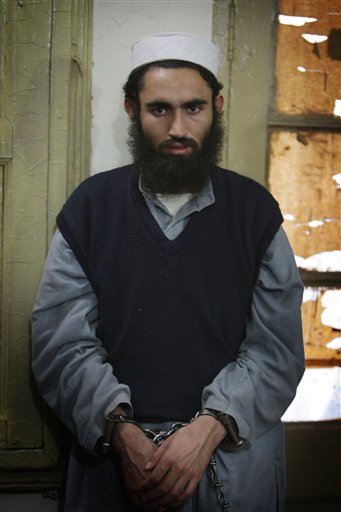
Abdul Baseer sent the grenades and explosive vest ahead, then boarded a bus that would take him to his target, accompanied by the 14-year-old boy he had groomed as his suicide bomber.

But before they could blow up their target, a luxury hotel in Lahore where they believed Americans would be staying, the two were arrested and are now in jail — Baseer unrepentant about having plotted to send a boy to his death, and the boy saying he never knew what was in store for him.

The story that unfolded in an interview with The Associated Press offers a rare insight into the world of a Pakistani militant, from his education at hard-line Islamic schools, through his professed participation in an attack on a U.S. patrol in Afghanistan, up to his arrest by Pakistani police along with the the boy, Mohi-ud-Din. His tale shares much with that of the thousands of other foot soldiers who make up the Taliban-led insurgency that is ravaging Pakistan, experts say. It also shows how the wars here and in neighboring Afghanistan bleed into each other.

The Associated Press, after several requests, was allowed to interview the two detainees, with police present for most of the meeting at a police interrogation center in Lahore, a political and military power center in eastern Pakistan. Baseer was born in 1985 close to the Swat Valley, which last year was overrun by Taliban and recaptured by the Pakistanis. The eldest of seven children, his father was a wheat farmer and earned barely enough to feed the family. Meat was reserved for guests, he recalled.

Like many who cannot afford a regular education, Baseer attended three Islamic boarding schools where children learn the Quran by heart and spend little time on secular subjects. The religious schools provide free board and lodging, but are widely criticized for indoctrinating students with an extreme version of Islam. At least one of the schools Baseer attended, Jamia Faridia in the capital, Islamabad, has been linked to terror.

“Through my studies, I became aware that this is the time for jihad and fighting the infidels, and I saw that a jihad was going on in Afghanistan,” said Basser, a rail-thin man speaking just louder than whisper. “I looked for a way to get there.” “A trip to Afghanistan is considered part of the profession for a militant,” said Imtiaz Gul, director of the Center for Research and Security Studies in Islamabad. “It is almost like you need to do it for graduation. “The American troops are there, and it’s a cause of resentment.”

Baseer said he spent three summer vacation periods in Kunar, an Afghan province just across the border from northwest Pakistan, which he reached through a network of sympathetic clerics. On his first trip, in his mid-teens, he cooked for around 30 or 40 other militants, most of them Afghans, who were living in a large cave complex. On his second stay he had military training and learned to make suicide jackets. On the final trip he took part in the ambush of a U.S. patrol after he and other fighters had lain in wait in the snow for two days.”I was happy to be in place where I could kill unbelievers,” he said. “I thank God that we all returned safely and had a successful mission.”

He said he was in the rear of the attack, in which automatic weapons and rocket-propelled grenades were fired. He said the vehicles were left smoldering and that later the assailants were told two U.S. soldiers were killed, but there was no way of confirming that.

Back in Pakistan, Baseer worked as a mosque preacher in the Khyber region, not far from the northwestern capital, Peshawar. He said it was there that he hooked up with a man named Nazir, a commander in the Pakistani Taliban, who was plotting the attack in Lahore. Baseer said he made 10 suicide vests for Nazir.

Lahore, a city of around 9 million, has suffered scores of attacks by gunmen and suicide bombers over the last 1 1/2 years. Last month, two suicide bombers killed 43 people in near-simultaneous blasts. Baseer boarded a passenger bus along with the boy, Mohi-ud-Din, heading down the smooth highway to Lahore, where they were supposed to pick up the bomb and grenades.

Police officer Waris Bharawan, as well as Baseer, said the plan was to hook up with other militants and storm the PC International, one of Lahore’s grandest hotels. They said the suicide vest for the attack was sent to the city before the strike. Baseeer gave only a rough outline of the plan: He and others were to hurl the grenades around the lobby or entrance gate of the hotel, and then Mohid-ud-Din was to run in and detonate his explosive belt. Did he feel any guilt about what lay in store for his traveling companion? No, he said. “I was feeling good because he was going to be used against Americans.”

As he sat in Bharawan’s office, handcuffed and dressed in robe and baggy pants, an officer brought in the vest, dropping it on the floor with a thud. The explosive pads studded with ballbearings looked like slices of honeycomb. Also in the evidence bag were 26 grenades. Baseer obliged with a demonstration, miming the yanking of a white cable that would detonate the vest. “My instructors used to say this was the most important weapon in the fight against the enemy,” he said. In the same lockup, a crumbling building built when Britain ruled the Indian subcontinent, police also briefly presented Mohi-ud-Din to the AP. He seemed nervous and tongue-tied, claiming only that he knew nothing about the alleged attack.

The pair were arrested as they arrived at the house of another suspect, just days before the attack was due to have taken place, said Bharawan, who led the arresting officers. He said they acted on surveillance work in Lahore, but declined to give details. Torture and beatings are common inside Pakistani jails, according to rights groups. During a short time when no police were present, Baseer was asked how he was treated. He said he was beaten, but by members of Pakistan’s shadowy and powerful intelligence agencies soon after his arrest, not by the police. Police said Baseer and the boy would be tried for terrorist offenses behind closed doors and without a jury, as is customary in Pakistan

Freelance Journalist Missing, Feared Kidnapped from Pakistan’s Northwest Frontier Province

By Nayana Jayarajan for International Press Institute

A freelance journalist and filmmaker has gone missing under suspicious circumstances from the tribal areas around the city of Kohat in the Northwest Frontier Province of Pakistan according to a senior editor for a broadcaster with whom the reporter was working, and a source at Pakistan’s Dawn newspaper.

The senior broadcast editor asked that neither he nor the broadcaster be identified out of concern for the safety of the reporter.

The Dawn newspaper source also requested anonymity for security reasons. He identified the journalist as freelance reporter and filmmaker Asad Qureshi.

According to Dawn, which first reported the story, Qureshi was traveling with two retired officers from Pakistan’s intelligence agency, the Inter-Services Intelligence (ISI).

The Dawn source told IPI that Qureshi and the two former ISI operatives had been returning from a meeting with Taliban representatives when they were all intercepted and kidnapped by unknown individuals. The two officers have been identified by local media as Col (R) Imam and Sq Leader (R) Khalid Khawaja.

So far, the source told IPI, no group has claimed responsibility. “Everything is shrouded in mystery,” he said.

The senior broadcast editor said: “I think we can say that something has happened.” He said that the journalist and the two retired ISI operatives had been believed to merely have been delayed until yesterday morning, when it was suddenly reported that they had gone missing and had been kidnapped.

When IPI called a mobile phone number for Qureshi listed on his website, it was switched off.

A reporter working in the NWFP told IPI that the son of one of the missing ISI operatives had spoken to his father before the kidnapping, and had been told that the trio would return in about two hours time. They have not been heard from since. The source was not able to confirm the exact time of the kidnapping, but estimated it to have taken place two to three days ago.

“We are gravely concerned for Qureshi’s well-being and safety”, said IPI Director David Dadge. “We call on the authorities to investigate his disappearance and to do everything possible to ensure his safe release.”

The North West Frontier Province has witnessed a long-running battle for control between the Pakistani military and tribal and Islamist political factions.

On Monday 5 April, forty people were killed and over a 100 injured in a suicide bomb attack at Timergarah of the Lower Dir district in the northwest province. The bomb was planted at a party meeting of the ANP, the Awami National Party, which is in a ruling coalition in the NWFP, along with Pakistani President Asif Ali Zardari’s ruling Pakistan People’s Party.

The rising levels of violence have made the region one of the world’s most dangerous for journalists.

According to IPI’s Death Watch, in the last two years alone 14 journalists have been killed in Pakistan. Seven of the deaths occurred in the Northwest Frontier Province. In August 2009, Aaj TV correspondent Sadiq Bacha Khan was gunned down in broad daylight on his way to work in Mardan, a town in the province. On 4 January 2009, Muhammad Imran, 20, a trainee cameraman with Express TV, and Saleem Tahir Awan, 45, a freelance reporter with the local dailies Eitedal and Apna Akhbar, were killed when a suicide bomber blew himself up in front of The Government Polytechnic College in Dera Ismail Khan in the North West Frontier Province. And on 18 February 2009, Musa Khankhel, a reporter for Geo TV and the English-language newspaper The News, was shot dead by unidentified gunmen while on assignment covering a peace march led by Muslim cleric Sufi Muhammad in the Swat valley.

-Read more about Asad Qureshi in his own words from his website prior to his disappearance at http://www.asadqureshi.com

Hamid Karzai Is Losing All His Marbles and His Credibility

By Manzer Munir for Pakistanis for Peace

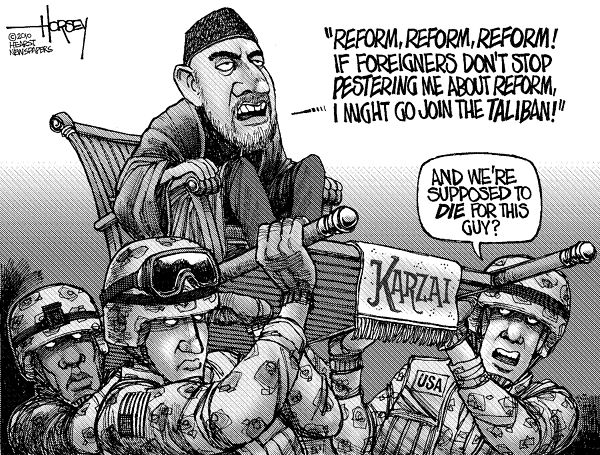
Kabul, Afghanistan- President Hamid Karzai’s troubling remarks this past Saturday that he would join the Taliban if he continues to come under pressure to reform by the United States and other “outsiders” has caused a stir in Washington DC.  Karzai’s comments came a week after President Obama’s surprise visit to Afghanistan at the end of March to pressure Karzai’s government to reform the political system, end corruption, and do a better job of fighting the Taliban.

Instead, what Karza delivered was a threat of the worse kind and quite possibly the most offensive and troubling thing one can say to a country that is risking countless soldiers lives daily to secure the country from the Taliban and other militant warlords in Afghanistan. In 8 short years, Hamid Karzai has gone from being the special guest of honor at George Bush’s State of the Union address to a leader who threatened to join our worst enemy. All because he feels that the US needs to stop badgering him to be a more responsible, fair, and an equitable leader as well as an effective partner in fighting the Taliban.

Karzai apparently made these unusual comments at a closed door meeting of lawmakers on Saturday, just days after accusing “foreigners” presumably the Unites States of being behind the fraud of the disputed elections of 2009. “He said that if I come under foreign pressure, I might join the Taliban”, said Farooq Marenai, a lawmaker from the eastern province of Nangarhar.  Mareni also stated that Karzai appeared nervous and demanded to know why parliament last week rejected legal reforms that would have strengthened Karzai’s authority over the country’s electoral institutions. Several other lawmakers confirmed that Karzai twice threatened to join the insurgency and the Taliban.

Karzai’s comments are troubling on many levels. First and foremost, he gives legitimacy and strength to the Taliban as his comments present the Taliban as an alternative option to American support or view on the situation. Karzai’s statement will no doubt have traveled the length and breadth of Afghanistan as word will spread that there is a weakness in the American-Afghan coalition that has been fighting and hunting the Taliban since October of 2001, post 9-11. The remarks by Karzai also puts every American, NATO, and Pakistani soldier at risk as instead of liberators, the foreign armies would be thought of as invaders, literally overnight. Lastly, Karzai’s remarks prove to the fact that Karzai is no longer an ally nor a credible partner for the US , NATO, and Pakistani army that have been fighting the Taliban with all their might.

There are reports of widespread nepotism, corruption, fraud, looting of the treasuries, and even drug trafficking, as Karzai’s brother, Ahmed Wali Karzai, has been alleged to be a prominent figure in Afghanistan’s world leading illegal heroin production, cultivation and its global distribution. These facts along with his inability to rule effectively and assist the United States in its exit strategy out of Afghanistan by end of 2011 has made the Obama administration weary of dealing with Karzai. Also his typically slow response in instituting political and social freedoms along with a renewed focus in fighting the Taliban, has also been a factor in displeasure from Washington.

The Obama administration has refocused on the Afghan war with 30,000 additional troops to help with the war effort and that initial surge has helped the commanders on the ground in running the Taliban out of certain areas. There have also been great recent victories by the Pakistani army to go after the Taliban militants on its side of the border and in helping cut down the bases of support for the Afghan Taliban from the Pakistani tribal areas sympathetic to their cause. So these comments come at the worst possible time when the Taliban are on the run both in Afghanistan and Pakistan and a strong coalition of US-Afghan-Pakistan resistance against them could help eliminate or destroy the militants for good. But instead, the US and its allies are left wondering what to do with Karzai and how much he could be trusted in this tenuous partnership against the Taliban.