Posts Tagged ‘ Taliban ’

Suspected Political Violence Kills 25 in Pakistan

By Ashraf Khan for the Associated Press

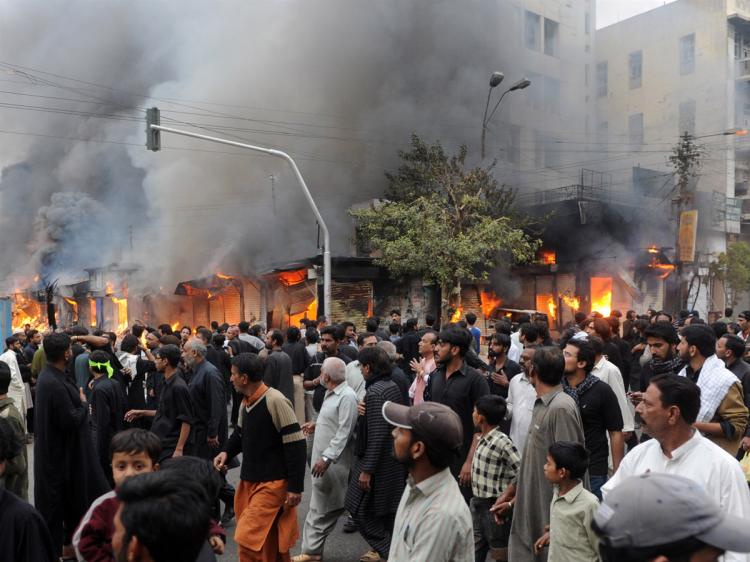
KARACHI, Pakistan – Gunmen have killed at least 25 people in Karachi in the past 24 hours, raising tensions in Pakistan’s largest city as voters cast ballots Sunday to replace a provincial lawmaker murdered in August.

Police said they were still investigating the motives behind the shootings, but many so-called “target killings” in Karachi have been linked to gangs controlled by the city’s main political parties, which have been feuding for much of the last 20 years.

“We cannot say whether all the killings were politically motivated or some gangs were involved because the killings took place in different parts of the city and were not confined to the area where the elections were being held,” Karachi police Chief Fayyza Leghari said.

The two parties most linked to violence in Karachi — the Muttahida Quami Movement and the Awami National Party_ have their electoral bases in different ethnic groups that make up a large chunk of the city’s population.

The MQM claims to represent the Urdu-speaking descendants of those people who came to Karachi from India soon after the birth of Pakistan in 1947. It is secular and likes to speak out against the so-called Talibanization of the city, a jab at the Awami National Party, which represents the ethnic Pashtuns from the Taliban heartland in the northwest.

Raza Haider, the member of the provincial assembly who was gunned down in August, was a senior member of the MQM. In the wake of the shooting, the MQM accused the ANP of supporting Islamist militants suspected of being behind the murder — an allegation denied by the ANP.

Both parties were competing for Haider’s vacant seat, but the ANP announced Saturday evening that it would boycott the election, saying the MQM would rig the vote. The shootings began around the time the ANP made its announcement.

At least 25 people have been gunned down in Karachi since Saturday evening, said Zulfiqar Mirza, the home minister of Sindh province, where Karachi is the capital. He called on party leaders to come forward to “help us turn Karachi back into the city of light and peace.”

“If someone has a complaint, it should not be settled on the street,” Mirza told a news conference. “It is disappointing that we are shedding our priceless blood with our own hands.”

The dead include members of a broad range of ethnic groups in the city, he said.

Haider Abbas Rizvi, a senior MQM leader and member of Parliament, accused the ANP of being behind the shootings, saying “19 of our workers and supporters have been killed so far.”

Senior ANP member Amin Khattak denied the accusation, saying, “we are not involved in killings, and I think that this blame game should be stopped.”

Leghari, the police chief, said at least three of the killings did not seem to be politically motivated and were carried out during “other criminal offenses.”

The killings were reminiscent of the violence that followed Haider’s murder. At least 45 people died in the days following his killing.

Police have arrested at least 60 people in connection with the most recent shootings, Mirza said. But few killers in such cases have ever been brought to justice, and motives for the attacks have not been revealed.

The rising tension between the MQM and the ANP represents a serious danger to stability in Karachi, a city of some 16 million people and Pakistan’s commercial hub.

Pashtuns have been arriving in the city in greater numbers in recent years, fleeing Pakistan army offensives against the Taliban. An estimated 4 million Pashtuns are now in Karachi and many live in sprawling slums on the outskirts that are “no-go” areas for authorities.

Violence has surged in Karachi this year with hundreds of people slain in target killings. This increase has echoes of the city’s bloody past.

In the 1980s and 1990s, Karachi was regularly convulsed by violence in which hundreds were killed. MQM leader Altaf Hussain fled to London in 1992 as a result of that bloodshed and was granted asylum. He regularly addresses large gatherings of supporters by telephone link.

Police: Plot to Kill Pakistan PM Uncovered

By Frederik Pleitgen for CNN

Several people have been seized in a plot to kill Pakistan’s prime minister, and the suspects claim they were getting orders from a militant in the country’s volatile tribal region, police said.

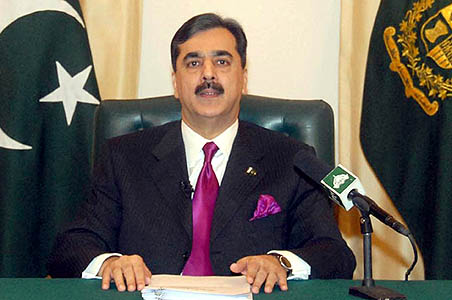
Police official Babar Bakhat Qureshi told CNN that officers arrested several suspects who were plotting to attack the compound of Pakistani Prime Minister Yousaf Raza Gilani.

Shabir Anwar, Gilani’s press secretary, had no comment on the alleged plot because it is a security matter.

The plot to strike the compound, located in the Punjab provincial city of Multan, was in its “final planning stages,” Qureshi said. The location is about 395 kilometers, or 245 miles, southeast of the nation’s capital, Islamabad.

The suspects were planning to use a car bomb for the attack, and that they had acquired large amounts of fertilizer to manufacture an improvised explosive device, since confiscated by police, he said.

A vehicle for the attack had not been acquired yet.

The police confiscated one kilogram of gold and and two and a half kilograms of silver, which the men were going to sell to fund the plot, the official said.

Qureshi said the suspects have confessed that they were getting their orders and instructions from Kari Imram, a leader of a Taliban offshoot group from Miran Shah in North Waziristan. Drone strikes said to be conducted by the United States have targeted militants in North Waziristan, one of seven of the county’s tribal districts.

The arrests were made after police stopped three suspects traveling on two motorcycles near Multan in the town of Ahmed Pur Sharkia on a check during a police patrol. Questioning led police to other suspects.

Pakistan is Not America’s Enemy

 By Ryan Crocker for The Wall Street Journal

 The news from Pakistan is grim. NATO helicopters engage suspected militants inside Pakistan, killing three, only to discover they are Pakistani soldiers. The angry Pakistani government blocks NATO fuel shipments at the Khyber Pass, and militants attack the stalled trucks. An Obama administration report to Congress charges that the Pakistanis aren’t doing enough against the Taliban and al Qaeda. Press accounts quote unnamed officials asserting that elements in Pakistani intelligence are encouraging the Taliban to step up attacks on NATO forces. And Bob Woodward cites President Obama as saying “the cancer is in Pakistan.”

One could easily conclude that we are describing an enemy, not an ally. Many in Pakistan feel the same way. And yet the prospects for stabilizing Afghanistan, defeating al Qaeda and preventing further attacks on the United States are a direct function of that strained alliance. It is time for a collective deep breath.

Pakistan’s historical narrative focuses on how the U.S. worked with Pakistanis and Afghans to drive the Soviets from Afghanistan in the 1980s: We succeeded—and then we left. And on our way out, we slapped sanctions on Pakistan, ending all security and economic assistance because of the country’s nuclear program, which we had known about since 1974 when Pakistan’s prime minister announced it publicly. We left Pakistan alone to deal with a destabilizing civil war in Afghanistan, and when the Taliban emerged as a dominant force in the mid-1990s, Islamabad supported them as a means of ending the conflict.

Then came 9/11 and the U.S. was back. Pakistanis welcomed the renewed assistance. But a constant question I heard while serving as ambassador to Pakistan from 2004-2007 was “How long will you stay this time, and what mess will you leave us with when you go?” For a fragile state with innumerable problems, including a vicious internal insurgency, these are existential questions.

Never in Pakistan’s six decades of existence has the U.S. sustained a long-term, strategic commitment in the country. The Bush administration recognized this and enacted security and economic assistance programs designed to make a long-term difference in education, health care and governance. In 2006, I argued successfully for a five-year assistance package for Pakistan’s Federally Administered Tribal Areas (FATA), which are notable both for chronic underdevelopment and extremism. The Obama administration has built on this, and last year’s Kerry-Lugar bill provided $7.5 billion in assistance over five years. So we have the architecture in place to build a strategic relationship.

Still, short-term pressures risk undermining long-term strategy. When I was ambassador, voices in Congress, the media and even the administration were constantly calling for the U.S. to get tough on Pakistan, make Pakistanis do more, threaten them with consequences. Such exhortations were—and remain—generally counterproductive, as they fuel fears that the U.S. will again abandon Pakistan.

The U.S. can better work with Pakistan if we improve our understanding of history: Given its rivalry with India and its organic disunity, which dates back to its founding, Pakistan fears for its basic survival. The country has always had a difficult relationship with Afghanistan, not least because in the 19th century the British deliberately drew the Pakistani-Afghan border, the so-called Durand Line, in order to divide the Pashtun people. Today Pashtuns make up Afghanistan’s largest community, but there are more Pashtuns in Pakistan.

The Durand Line also set the groundwork for the tribal areas, which are legally distinct from the rest of Pakistan because the British could never exert direct control over them. No central authority ever has. Winston Churchill’s first published work, “The Story of the Malakand Field Force,” is about fierce tribesmen declaring jihad against a Western army. It could be a contemporary account.

So what does this mean in concrete terms?

First, the U.S. should appreciate Pakistan’s challenges and support its government in dealing with them. This summer’s devastating floods have disappeared from the U.S. media but will continue to wreak havoc in Pakistan for a long time to come. In 2005 and 2006, after an earthquake in Kashmir killed almost 80,000 Pakistanis, the U.S. organized the largest relief operation since the Berlin Airlift. The floods’ death toll is lower, but their long-term damage will be far greater. U.S. support should be commensurate.

Second, the U.S. should not carry out cross-border military actions, which I strongly resisted as ambassador. They are clearly counterproductive, and not just because we hit the wrong target. If NATO can carry out military actions in Pakistan from the west, Pakistanis wonder, what stops India from doing the same from the east? There are other options, including drone strikes, which the U.S. is now coordinating more closely with Pakistanis.

Third, with Pakistan’s government (as with Afghanistan’s), we must be private in our criticism and public in our support

Private talks should deepen regarding challenges like the insurgent Haqqani network in North Waziristan, and we need to listen at least as much as we lecture.Fourth, any talks between the U.S. or Afghanistan and the Taliban must be transparent to the Pakistanis. A nightmare for Islamabad is the prospect that the Americans and Afghans come to some accommodation with Taliban elements that would leave them hostile to Pakistan. If Pakistan is not part of the process, we will be working at cross-purposes and only the Taliban will benefit.

Pakistan’s arrest of Taliban leader Abdul Ghani Baradar—at a time when he had begun reconciliation talks with Afghan authorities—underscored the risks of leaving Islamabad out of the loop. Going forward, the timing and nature of talks with the Taliban should be set by Afghans, Pakistanis and Americans working together.

None of this will be easy, but it is essential. A sustained U.S.-Pakistani partnership after the Soviet withdrawal from Afghanistan could have produced a very different history than the one we wrestle with today. Writing a different future requires making long-term commitments—on both sides of the Durand Line.

Mr. Crocker, the dean of Texas A&M’s George Bush School of Government and Public Service, was U.S. ambassador to Pakistan from 2004 to 2007 and U.S. ambassador to Iraq from 2007 to 2009.

How to End the War in Afghanistan

As Reported on CNN

New York (CNN) — Afghan President Hamid Karzai has started talks with representatives of the Taliban, a move that analyst Fareed Zakaria says could bring an end to the nine-year-long war.

Karzai convened a meeting Thursday with the Afghan Peace Council, which was formed to help negotiate with the Taliban. Referring to the militants, Karzai said, “I call on them once again to use this opportunity and say ‘yes’ to this endeavor. I want them to come and bring peace to this land.”

The author and host of CNN’s “Fareed Zakaria GPS” spoke to CNN on Thursday. Here is an edited transcript:

CNN: Hamid Karzai has launched a council to help negotiate with the Taliban? What’s the significance of that step?

Fareed Zakaria: I think it’s about time. If you look at any good study of civil wars, what you find is that most of them end in a negotiated settlement. Maybe because Americans have the memory of our civil war in which the North crushes the South, we somehow think that that’s how civil wars end. But that’s actually is very unusual.

What normally happens is some kind of settlement that is negotiated in which the losers are reintegrated into the political order. Civil wars are unlike normal wars, because the winners and losers are going to have to live with one another.

CNN: How does that apply to Afghanistan?

Zakaria: The Taliban, which is mounting this insurgency, is not a foreign element within the body politic. The Taliban is basically the political representative of the conservative elements of the Pashtun community.

The Pashtuns are 50 percent of Afghanistan. … It is a political force in Afghanistan. Coming to terms with it politically and seeing if there’s some way it can be reintegrated into the political order makes sense. You’re not going to kill every member of the Taliban. They’re not going to be exiled to a foreign land. They’re going to be there at the end of the day so it’s better to to have them in the tent.

CNN: The U.S. military view seems to be that the talks haven’t yielded progress so far, and a senior defense official told CNN, “We don’t think the Taliban believe that they’re losing to the degree that they’d come to terms in large numbers.” Are the talks premature because the effects of the U.S. military buildup haven’t been felt yet?

Zakaria: First the very fact that the Taliban are coming to the table in a way they had not been willing to before suggests that they are feeling some pressure.

But I also think you can’t get too hung up with this idea that you have to negotiate from a position of strength. Ideally we would have them totally prostrate on the floor and that would be the time to negotiate. But the reality is that this is a very mixed military campaign. I don’t know if it’s going to be dramatically better one year from now or three years from now.

This is a little like somebody who owns a stock, who says, it’s at six now, I need to sell it, but I’m going to wait till it goes to eight. Well maybe it will go to eight, maybe it will go to four.

You might as well start talking at this point. First of all you learn a lot in the process of negotiations. And secondly, the military campaign could move in many different directions. If the surge starts succeeding even more, that will be reflected in our negotiating posture.

CNN: Is there an idea yet of what a negotiated settlement might involve?

Zakaria: It seems as though the Taliban demands are that they want all foreign troops out. They don’t want to accept the Afghan constitution and they don’t want to lay down their arms.

Now those are obviously their opening demands. Foreign troops aren’t going to be out, but one could point out that President Obama has said there is going to be a reduction of foreign forces next year.

On the Afghan constitution, there is a compromise there where there could be a few amendments to the constitution. But on laying down their arms, that it seems to me you can’t really compromise, they would have to lay down their arms. Could some elements be integrated into the militia, or the Afghan national army? Perhaps — that’s what happened in Iraq.

CNN: Isn’t there also a clashing conception of society, with the Taliban being a closed society that doesn’t recognize an elevated role for women as opposed to a potentially democratic kind of society that’s envisioned by the Afghan constitution?

Zakaria: Yes, it is the kind of society envisioned by the Afghan constitution. But Afghanistan is a fairly conservative society. While the extreme elements of the Taliban have draconian visions which are obviously not supported by the Afghans — the polls bear this out — it’s also true that on issues of women’s rights and some of the more progressive elements of the Afghan constitution, the Karzai government is in a minority and those rights are not popularly supported.

There are clashing visions, but there is probably a reality of Afghanistan which is a lot more progressive and open than the Taliban believe but is still a society that is somewhat conservative, and often tribal, and with very traditional views on something like women’s rights.

The key is creating a situation where these rights are guaranteed but not fetishizing it. For example, one of the things the Afghan constitution has is a requirement for 25 percent representation of women in parliament. We don’t have such a requirement either in the U.S. Constitution or in the amendments. Many European countries don’t.

Is it conceivable that something like that could be compromised? Perhaps, and that’s the kind of thing where we’d have to be creative in coming up with a solution that moderates and some elements of the Taliban could live with.

CNN: Is this an honorable exit for the United States?

Zakaria: I think so, and it’s not really an exit, it’s a reduction in our forces and in our role. And I think it would be appropriate. We’ve been there for nine years. It’s not the only battleground, the only place where al Qaeda operates. There are many more members of al Qaeda in Pakistan than in Afghanistan.

You’re trying to create a political settlement, and a self-sustaining political framework in Afghanistan that can survive the departure of American troops. And finally you’re leaving enough troops in there where you could still prosecute a fairly vigorous counterterrorism operation against those elements of the Taliban or al Qaeda that continue to plot and plan to do violence to civilians, foreigners, westerners.

And I do think, if we could get this kind of a settlement, it would be an honorable way for the United States to begin reducing its exposure in Afghanistan.

Fareed Zakaria is an author and foreign affairs analyst who hosts “Fareed Zakaria GPS” on CNN

Sufi Shrine in Pakistan Is Hit by a Lethal Double Bombing

By Huma Imtiaz for The New York Times

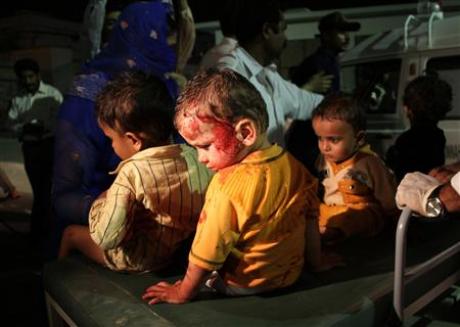
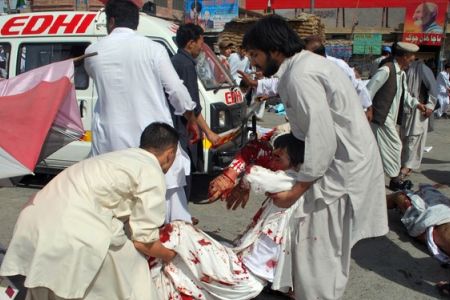
KARACHI, Pakistan — A nearly simultaneous double explosion that may have been the work of suicide bombers struck a crowded Sufi shrine in Pakistan’s main port city of Karachi on Thursday evening, killing at least 7 people and wounding 65, officials and rescue workers said. Pakistani women mourn the death of a child killed in an attack on the shrine Sufi Saint Abdullah Shah Ghazi.

It was the first attack on the shrine, the grave of the Sufi saint Abdullah Shah Ghazi, and it appeared to be an effort by hard-line militants in Pakistan to strike at the heart of Sufism, the moderate, more flexible blend of Islam practiced by most Pakistanis.

The attack came three months after militants struck one of the country’s most important Sufi shrines in the city of Lahore, which left at least 42 people dead.

The first blast at the Karachi shrine occurred at the main gate. Police officials said that within 25 seconds, the second blast hit the steps leading up to the saint’s grave.

Rescuers said three children were among the dead.

Dr. Seemi Jamali, deputy director of the emergency ward at Jinnah Hospital in Karachi, where the wounded were taken, said “many of them have severe injuries, trauma to the head and neck.”

Television channels showed body parts strewn at the site and chaotic scenes of unnerved, sobbing survivors.

The home minister of Sindh Province, Zulfiqar Mirza, told reporters that the severed heads of two suspected suicide bombers had been recovered from the site. Police officials were more circumspect, saying it was premature to conclude that the attack was by suicide bombers.

Local TV channels reported later that Tehreek-e-Taliban, or Movement of Taliban, an umbrella group of militants, had claimed responsibility for the attack. The group is known to have trained cohorts of suicide bombers for attacks in Pakistan and Afghanistan.

The attackers apparently chose Thursday night because it is one of the most crowded times of the week at the shrine, when hundreds throng to seek blessings from the saint and to receive free food.

The government closed all shrines in the city after the bombings.

Revisiting Pakistan’s ‘Strategic Depth’

By Syed Nadir El Edroos for The Express Tribune

Two words that hold our country hostage is our policy of maintaining ‘strategic depth’ in Afghanistan. Apart from referring to a poorly titled adult film, the policy envisages to protect Pakistan’s eastern borders from unwanted Indian influence.

However, the consequences of continuing with this policy and differentiating between the ‘good’ and the ‘bad’ Taliban, has led to accusations of Pakistan playing a ‘double-game’  in Afghanistan. For many the accusation has become quite stale and repetitive. It seems to have become an open secret, with many accepting it as a reality, a part of the status-quo for dealing with the troubles in the region.

Whether the policy has been successful is debatable. The military’s and the ISI’s continued links with the Haqqani network ensures that they are a sought after broker for any back channel attempt to woo the Taliban.

The strategy aims to maintain Pakistani influence in/over Afghanistan, and to thwart alleged Indian designs. However, the policy has at the same time made Pakistan quite unpopular with large segments of the Afghan establishment. Interfering in Afghanistan’s affairs, while demanding an end to foreign influence in Pakistan is met with much ridicule in foreign capitals; it reeks of hypocrisy.

The policy is also questionable, as it breeds violence, and is responsible for the deaths of thousands in Pakistan and Afghanistan. As the violence continues, Pakistan is sure to be in the news, accused for fostering, abating or at the very least tolerating continued bloodshed to maintain its interests.

The result is the ‘image deficit’ that haunts Pakistan. The dismal public response to the floods in Pakistan for example was attributed to this effect. It has also been more difficult for our economic managers to garner favourable trade concessions and development grants. Winning over wider public support remains a problem, as Pakistan remains associated with fostering rather than curtailing violence in Afghanistan. Politicians in the west are portrayed as weak by the right-wing media, such as Fox News in the US, for taking initiatives to support Pakistan.

Look at any article posted on any western news outlet. The comments question the calls for sympathy for Pakistan as we are branded as supporters of terrorism, who inflict material and physical damage on their interests.

An alternative strategy

There needs to be an alternative to our current strategy. The alternative need not be between defending Pakistan from India or bowing before it and allowing it a free hand in Afghanistan. We need to engage with both Afghanistan and India to leverage our geographic position to develop strategic depth with positive connotations.

The US, Afghanistan and India have been pressing Pakistan to allow the transit of Indian goods over Pakistan through to Afghanistan and vice versa for years. I say, let the goods pass, hell put them on the trains. That will help to give our faltering railways a financial shot in the arm. Extend the Iran-Pakistan pipeline into India, let the gas flow. Transit fees galore! Rather than questioning Indian development aid to Afghanistan we should support it. Geographically it’s more of an advantage for us, as any increase in economic activity in Afghanistan will immediately suck in Pakistani exports.

What would the advantages be? Imagine the headlines. Pakistan would look like the peace builder, shunning international criticism and situating itself as committed to the development of an Afghan state. We would also be seen on the diplomatic offensive vis-à-vis India. With Pakistan offering so many incentives, India will have to respond in the affirmative. After all India is cultivating its image as a regional and global superpower, the ball will firmly be in India’s court. It cannot be seen rebuffing genuine gestures from its old foe.

Importantly, a policy that leverages our geographic position economically rather than militarily negates any association with violence.  We would be treated as victims rather than the guilty.

If India is indeed developing consulates across Afghanistan housing RAW agents that ferment trouble in Pakistan, improved economic ties will help shed a spotlight on the functioning of these consulates. As Pakistan becomes vital for transporting Indian-Afghanistan exports and imports to each other, minimising any threat to these links will become a primary concern for Indian traders. This will build added pressure on those who dare concoct nefarious designs to fuel militancy in Balochistan for example.

India can switch on and off the belligerent rhetoric as India’s economy has little or no interests in Pakistan. However, a Pakistan which is vital for Indian trade, supply of resources etc will have no choice but to tone down any sabre rattling that seems to be a cyclical part of Pakistan-India relations.

So where does Pakistan’s security come in?

In any period of belligerent hostility Pakistan will have the ability to cut of energy and trade links. Containers can be seized, Indian traders in Pakistan arrested, and diplomatically we can garner support by portraying ourselves of peace. We have gone the extra mile to foster our relations with India and support a viable Afghanistan. India would be seen as the aggressor. How is that for maintaining strategic depth?

Our present policy allows for India’s security establishment to deal with her interests in Afghanistan ignoring any media or public scrutiny. A policy that places economic links at its foundations will open up Indian policy on Pakistan and Afghanistan and the actions of its security agencies to wider scrutiny. The competition between competing interests will insure that whatever policy is actually implemented is a watered down compromise that is not a real threat to Pakistan.

We have to find alternatives to the status-quo. With the nation reeling under flooding, terrorism and economic stagnation we are more dependent on foreign assistance than at any point in our history. They are not many variables that we can control for. We can’t control how the foreign press paints us, how we are perceived abroad etc. However, what little we can do to help alter these perceptions, we must. And this does not have to lead to subjugation to Indian influence that many right wing commentators would suggest.

If we are to continue with our obsession with thwarting Indian designs, can we please do it in a manner that doesn’t hold us all hostage to violence and paint us as terrorist?

Shaping global opinion is a long term effort which must start sooner than later. Our challenges for the future, access to water, natural disasters caused by climate change and development depends in a large part to interaction and support of our neighbours and the international community. Politics and security needs are always a concern, but we must get society at large, the world over on our sign. We are not the cause but the victims. Strategic depth? Sure, but by other means.

God Bless Islam with Courageous Leadership

By Ebrahim Moosa for Religion Dispatches

As Muslim Americans and millions around the world celebrate the end of Ramadan 2010 what will they pray for? What was the spiritual harvest of the month of fasting, prayer, deep reflection, and discipline? Given the growing hostility directed towards Muslims in the United States and the horrible deeds perpetrated by persons aligned to Islam on 9/11 and elsewhere in the world, I for my part, will be making two prayers.

The first is to urge Muslims to affirm their solidarity with all of humanity. The words of this prayer come from a tradition of the Prophet Muhammad. It reads:

Oh Allah, Lord (Rabb) of all things. I testify that You alone are the Lord of the world, Lord of all things… I testify that all servants of God are one family… Make me and my family truthful to you in every moment of life in this world and the next. Oh powerful and generous one, hear and respond to my prayers…

My second prayer is that God bless Islam with a religious leadership that has a modicum of Solomonic wisdom and tons of moral courage.

Why these two prayers? I think many Muslims have forgotten the message of humanism and solidarity with all creation that are the cornerstones of Islam. All servants of God are part of a single family, the Prophet Muhammad taught. So how can faiths be at war, if only to serve earthly gods? Many of our religious leaders have forgotten that our theologies, teachings, and practices were means to serve a transcendent Creator; not for idolatrous ends. Many of the most prominent Muslim religious and moral authorities the world over—clergy, intellectuals, scholars, politicians—have, through silence and inaction, invited a plague of craven violence on a number of Muslim societies. In a manner of speaking, in many places, the asylum is in charge of the mosque. Religious leaders are more interested in cowing to public adulation through demagoguery than in showing courage and exhorting people to piety and sanity.

Check if the sermon in the`Id al-Fitr (End of Fasting) sermon at your mosque hinted at the cowardly acts of al-Qaeda who killed thousands on September 11 and elsewhere. Or if deeds of the Somalian Shabab who killed dozens of Ugandans watching a soccer World Cup match in the suburbs of Kampala caused outrage. Has anyone been able to keep track of the death toll inflicted in Pakistan by Taliban suicide bombers, who most recently killed more than 60 people in Quetta because they were Shi’a? Did anyone even notice that a radical Muslim group in India chopped off the hand of a Catholic professor in the state of Kerala in July for apparently offending the image of the Prophet Muhammad in an exam questionnaire?

`Id is a day of celebration with family and friends. But it is unconscionable if Muslims do not think seriously and act in unison about the deep moral crises afflicting our communities here and abroad. To think critically is not to bow to the hate of the Islamophobes, it is a sign of strength and faith. Those who claim that there are no “moderate” Muslim voices denouncing acts of violence committed by Muslims are wrong, and yes, there are many good things happening in Muslim societies that do not make the headlines. Yet it is delusional to think that the evil masquerading as faith does not erode the belief and values each Muslim.

To Muslim Americans I say, next time you wonder why young men like the Times Square bomber Faisal Shahzad become entangled in conspiracies to commit acts of violence in this country and abroad please ask the following questions: What is the qualification of the imam at your mosque? Is he enriched by the best of American and Islamic culture, in tune with his environment, or is he preaching a theology no longer even appropriate for people in Iran, Egypt, or Pakistan? Does he teach the tradition creatively and help people think imaginatively? Or does he focus on impieties and promote the virtues of paraphernalia like the dress code and the mandatory length of facial hairs? If the imam is as wise as the religious leader in the Canadian sitcom Little Mosque on the Prairie, it will be a huge step up.

Mosque committees share their burden of responsibility too. Often they appoint preachers by applying the lowest and cheapest standard; theological diversity is frequently absent and enlightened thinking is considered too challenging and burdensome for them to contemplate. Will the smart Muslims in America and around the world stand up and be counted?

-Originally printed on Sep 9, 2010 for Religion Dispatches. Ebrahim Moosa is a professor of Islamic Studies at Duke University and an author of several books on Islam.

For Imam in Muslim Center Furor, a Hard Balancing Act

By Anne Barnard for The New York Times
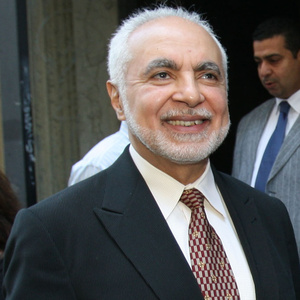
Not everyone in the Cairo lecture hall last February was buying the imam Feisal Abdul Rauf’s message. As he talked of reconciliation between America and Middle Eastern Muslims — his voice soft, almost New Agey — some questioners were so suspicious that he felt the need to declare that he was not an American agent.

Muslims need to understand and soothe Americans who fear them, the imam said; they should be conciliatory, not judgmental, toward the West and Israel.

But one young Egyptian asked: Wasn’t the United States financing the speaking tour that had brought the imam to Cairo because his message conveniently echoed United States interests?

“I’m not an agent from any government, even if some of you may not believe it,” the imam replied. “I’m not. I’m a peacemaker.”

That talk, recorded on video six months ago, was part of what now might be called Mr. Abdul Rauf’s prior life, before he became the center of an uproar over his proposal for a Muslim community center two blocks from the World Trade Center. He watched his father, an Egyptian Muslim scholar, pioneer interfaith dialogue in 1960s New York; led a mystical Sufi mosque in Lower Manhattan; and, after the Sept. 11 attacks, became a spokesman for the notion that being American and Muslim is no contradiction — and that a truly American brand of Islam could modernize and moderate the faith worldwide.

In recent weeks, Mr. Abdul Rauf has barely been heard from as a national political debate explodes over his dream project, including, somewhere in its planned 15 stories, a mosque. Opponents have called his project an act of insensitivity, even a monument to terrorism.

In his absence — he is now on another Middle East speaking tour sponsored by the State Department — a host of allegations have been floated: that he supports terrorism; that his father, who worked at the behest of the Egyptian government, was a militant; that his publicly expressed views mask stealth extremism. Some charges, the available record suggests, are unsupported. Some are simplifications of his ideas. In any case, calling him a jihadist appears even less credible than calling him a United States agent.

Growing Up in America

Mr. Abdul Rauf, 61, grew up in multiple worlds. He was raised in a conservative religious home but arrived in America as a teenager in the turbulent 1960s; his father came to New York and later Washington to run growing Islamic centers. His parents were taken hostage not once, but twice, by American Muslim splinter groups. He attended Columbia University, where, during the Six-Day War in 1967 between Israel and Arab states like Egypt, he talked daily with a Jewish classmate, each seeking to understand the other’s perspective.

He consistently denounces violence. Some of his views on the interplay between terrorism and American foreign policy — or his search for commonalities between Islamic law and this country’s Constitution — have proved jarring to some American ears, but still place him as pro-American within the Muslim world. He devotes himself to befriending Christians and Jews — so much, some Muslim Americans say, that he has lost touch with their own concerns.

“To stereotype him as an extremist is just nuts,” said the Very Rev. James P. Morton, of the Church of St. John the Divine, in Manhattan, who has known the family for decades.

Since 9/11, Mr. Abdul Rauf, like almost any Muslim leader with a public profile, has had to navigate the fraught path between those suspicious of Muslims and eager to brand them as violent or disloyal and a Muslim constituency that believes itself more than ever in need of forceful leaders.

One critique of the imam, said Omid Safi, a professor of religious studies at the University of North Carolina, was that he had not been outspoken enough on issues “near and dear to many Muslims,” like United States policy on Israel and treatment of Muslims after 9/11, “because of the need that he has had — whether taken upon himself or thrust upon him — to be the ‘American imam,’ to be the ‘New York imam,’ to be the ‘accommodationist imam.’ ”

Akbar Ahmed, chairman of Islamic studies at American University, said Mr. Abdul Rauf’s holistic Sufi practices could make more orthodox Muslims uncomfortable, and his focus on like-minded interfaith leaders made him underestimate the uproar over his plans.

“He hurtles in, to the dead-center eye of the storm simmering around Muslims in America, expecting it to be like at his mosque — we all love each other, we all think happy thoughts,” Mr. Ahmed said.

“Now he has set up, unwittingly, a symbol of this growing tension between America and Muslims: this mosque that Muslims see as a symbol of Islam under attack and the opponents as an insult to America,” he added. “So this mild-mannered guy is in the eye of a storm for which he’s not suited at all. He’s not a political leader of Muslims, yet he now somehow represents the Muslim community.”

Andrew Sinanoglou, who was married by Mr. Abdul Rauf last fall, said he was surprised that the imam had become a contentious figure. His greatest knack, Mr. Sinanoglou said, was making disparate groups comfortable. At the wedding, he brought together Mr. Sinanoglou’s family, descended from Greek Christians thrown out of Asia Minor by Muslims, and his wife’s conservative Muslim father.

“He’s an excellent schmoozer,” Mr. Sinanoglou said of the imam.

Mr. Abdul Rauf was born in Kuwait. His father, Muhammad Abdul Rauf, graduated from Cairo’s Al-Azhar University, the foremost center of mainstream Sunni Muslim learning. He was one of many scholars Egypt sent abroad to staff universities and mosques, a government-approved effort unlikely to have tolerated a militant. He moved his family to England, studying at Cambridge and the University of London; then to Malaysia, where he eventually became the first rector of the International Islamic University of Malaysia.

As a boy, Feisal absorbed his father’s talks with religious scholars from around the world, learning to respect theological debate, said his wife, Daisy Khan. He is also steeped in Malaysian culture, whose ethnic diversity has influenced an Islam different than that of his parents’ homeland.

In 1965, he came to New York. His father ran the Islamic Center of New York; the family lived over its small mosque in a brownstone on West 72nd Street, which served mainly Arabs and African-American converts. Like his son, the older imam announced plans for a community center for a growing Muslim population — the mosque eventually built on East 96th Street. It was financed by Muslim countries and controlled by Muslim diplomats at the United Nations — at the time a fairly noncontroversial proposition. Like his son, he joined interfaith groups, invited by Mr. Morton of St. John the Divine.

Hostage Crisis

Unlike his son, he was conservative in gender relations; he asked his wife, Buthayna, to not drive. But in 1977, he was heading the Islamic Center in Washington when he and Buthayna were taken hostage by a Muslim faction; it was his wife who challenged the gunmen on their lack of knowledge of Islam.

“My husband didn’t open his mouth, but I really gave it to them,” she told The New York Times then.

Meanwhile, the younger Mr. Abdul Rauf studied physics at Columbia. At first, he recalled in interviews last year, it was hard to adjust to American social mores. By 1967, he and a Yale student, Kurt Tolksdorf, had bonded at summer school over their shared taste in women and fast cars. But Mr. Tolksdorf said his friend never subscribed to the “free love” of the era.

When the 1967 war broke out in the Middle East, Mr. Tolksdorf said, Mr. Abdul Rauf reacted calmly when Israeli students tried to pick a fight. A classmate, Alan M. Silberstein, remembers debating each day’s news over lunch.

“He was genuinely trying to understand the interests of American Jews — what Israel’s importance was to me,” he said. “There was a genuine openness.”

In his 20s, Mr. Abdul Rauf dabbled in teaching and real estate, married an American-born woman and had three children. Studying Islam and searching for his place in it, he was asked to lead a Sufi mosque, Masjid al-Farah. It was one of few with a female prayer leader, where women and men sat together at some rituals and some women do not cover their hair. And it was 12 blocks from the World Trade Center.

Divorced, he met his second wife, Ms. Khan, when she came to the mosque looking for a gentler Islam than the politicized version she rejected after Iran’s revolution. Theirs is an equal partnership, whether Mr. Abdul Rauf is shopping and cooking a hearty soup, she said, or running organizations that promote an American-influenced Islam.

A similar idea comes up in the video of his visit to Cairo this year. Mr. Abdul Rauf, with Ms. Khan, unveiled as usual, beside him, tells a questioner not to worry so much about one issue of the moment — Switzerland’s ban on minarets — saying Islam has always adapted to and been influenced by places it spreads to. “Why not have a mosque that looks Swiss?” he joked. “Make a mosque that looks like Swiss cheese. Make a mosque that looks like a Rolex.”

In the 1990s, the couple became fixtures of the interfaith scene, even taking a cruise to Spain and Morocco with prominent rabbis and pastors.

Mr. Abdul Rauf also founded the Shariah Index Project — an effort to formally rate which governments best follow Islamic law. Critics see in it support for Taliban-style Shariah or imposing Islamic law in America.

Shariah, though, like Halakha, or Jewish law, has a spectrum of interpretations. The ratings, Ms. Kahn said, measure how well states uphold Shariah’s core principles like rights to life, dignity and education, not Taliban strong points. The imam has written that some Western states unwittingly apply Shariah better than self-styled Islamic states that kill wantonly, stone women and deny education — to him, violations of Shariah.

After 9/11, Mr. Abdul Rauf was all over the airwaves denouncing terrorism, urging Muslims to confront its presence among them, and saying that killing civilians violated Islam. He wrote a book, “What’s Right With Islam Is What’s Right With America,” asserting the congruence of American democracy and Islam.

That ample public record — interviews, writings, sermons — is now being examined by opponents of the downtown center.

Those opponents repeat often that Mr. Abdul Rauf, in one radio interview, refused to describe the Palestinian group that pioneered suicide bombings against Israel, Hamas, as a terrorist organization. In the lengthy interview, Mr. Abdul Rauf clumsily tries to say that people around the globe define terrorism differently and labeling any group would sap his ability to build bridges. He also says: “Targeting civilians is wrong. It is a sin in our religion,” and, “I am a supporter of the state of Israel.”

“If I were an imam today I would be saying, ‘What am I supposed to do?’ ” said John Esposito, a professor of Islamic studies at Georgetown University. “ ‘Can an imam be critical of any aspect of U.S. foreign policy? Can I weigh in on things that others could weigh in on?’ Or is someone going to say, ‘He’s got to be a radical!’ ”
Why The Mosque Needs To Be Built At Ground Zero

By Manzer Munir for Pakistanis for Peace

This is already my third article on the NYC Mosque controversy. When I started my Facebook group and website Pakistanis for Peace by the same name nearly two years ago, I did it in response to the tragic and callous terrorist attacks in Mumbai India in 2008 and my desire to see peace in that region and beyond. As a firm believer in God, but not a particularly religious person, I never would have imagined that I would end up making a big part of my focus not just peace between India and Pakistan, but also peace and understanding between the Muslim and non-Muslim worlds as well. Heaven knows I have my own questions and issues with certain Muslim laws and practices and I of all people am the least suitable to be one of its defenders. However, I am a strict constitutionalist and as mentioned in my previous articles on this subject, I have advocated the building of the mosque simply on First Amendment religious freedom grounds.

Now here I am in less than one month, I find myself already writing a third article on the mosque controversy. Much has been written already by others on this topic also, but I wanted to give a few more opinions from a rational, moderate and patriotic American Muslim perspective, one which is missing in the current dialogue.

We know that many people who are opposed to the building of the mosque in lower Manhattan simply ask “Why there?” “Why would “they” possibly want to build it there of all places? It is seen as an affront by them that Muslims should want to build an inter-faith mosque, community center and a planned outreach ministry in the heart of Manhattan two city blocks from the site of the World Trade Center and the attacks of September 11, nine year ago. In fact, last night, while watching CNN, I saw Rick Sanchez ask former Governor George Pataki of New York about the Ground Zero Mosque controversy and his views on the subject. “Why there of all places would you build a mosque?” asked Gov. Pataki.  Why there?  As if he had fully bought into a favorite point of right wing groups that “Muslims build mosques at places they conquer” and that this is somehow a celebration of their “victory” over us because of the deaths of so many of our fellow countrymen on 9/11. That statement is wrong on so many levels that normally I would not even waste energy answering a clearly misguided assumption, but I will make an exception to clear the air as that is precisely what this article aims to do.

First of all, the 9/11 attacks were not a result of the actions of mainstream Muslims or the collective billion plus adherents of the religion but instead by members of a terror group known as Al-Qaeda, whose leader, Osama Bin Laden, we were very familiar and friendly with during the Soviet Afghan War of the 1980’s as he had assisted us in stopping the Red Army from conquering Afghanistan at the height of the Cold War between the two superpowers. Also a mosque is a place of worship. It is not a place where bombs are made and terrorists are trained either in ideology or practical training. To equate the building of a mosque to a direct link to terrorism or some other nefarious activity is in itself a deeply offensive argument to any Muslim, if one must speak of insensitivities.

So are we at war with Islam? This really is the only question we must ask ourselves to understand the debate over the mosque controversy. Debra Burlingame, the co-founder of 9/11 Families for a Safe and Strong America, issued a statement saying that “Building a 15-story mosque at Ground Zero is a deliberately provocative act.” This is simply not true as it is not exclusively just a mosque, but rather a multi layered structure that will house an auditorium, restaurant, gymnasium, library, conference rooms and multi-faith prayer halls devoted to allowing non-Muslim visitors the chance to come explore the center and at the same time take time to meditate and pray according to their own customs.

The center, as its leader Imam Faisal Abdul Rauf pointed out recently, “will establish this community as the place where the moderate Muslim voice condemns terrorism and works for new, peaceful, and harmonious relationships with all New Yorkers and indeed all Americans.” Just the fact that this center will have a restaurant, conference rooms, a library and multi-faith dialogue and prayer rooms, already makes this proposed building the most uniquely American mosque in the world. Nowhere else will one find a mosque so devoted to understanding and bridge building between Islam and other religions and no other place and location will it be more sorely needed in the years to come than in New York City! Too often, many non-Muslims complain about the self segregation practices of Muslims and indeed a characteristic of all minority communities to be in their own bubble and for not having a lot of interaction between other communities or faiths.

Many times my own non-Muslim friends have been curious and inquired on how Muslims pray and what they believe in and what exactly goes on in a typical mosque. But typically a small, regular mosque does not have the sort of access and resources to satisfy this curiosity and neither the infrastructure nor the logistics to handle curious visitors of other faiths. Primarily mosques in this country have been built with Muslims as its sole audience and occupants. This is the first time a mosque and cultural center is being proposed that will eliminate the barriers that many non-Muslims feel when it comes to understanding Islam and Muslims and actually takes into considerations its non-Muslim visitors when planning the structure. For many years to come, many Americans and indeed tourists from around the world will be coming to the proposed complex now under construction at the site of the World Trade Centers that will house the 9/11 Memorial. What better place  will there be than a few blocks away from the 9/11 Memorial where visitors can be told about the Islam of the great boxer Muhammed Ali and hall of fame basketball player Kareem Abdul Jabbar and not that of evil individuals such as Mohammed Atta and Osama Bin Laden? Where else should they be told of the difference between the Islam that is practiced by comedian Dave Chappelle and Oprah’s Dr Mehemt Oz versus the one practiced by the backward barbarian murderers known as the Taliban in the mountains of Afghanistan? Where else can they come to know of the type of Islam practiced by patriotic Bronze Star and Purple Heart decorated deceased US soldier Kareem Rashad Sultan Khan or the one practiced by the deranged Major Nidal Malik Hasan, the accused perpetrator of the Fort Hood Army base who sadly killed 13 fellow soldiers almost 1 year ago?

Now in order to satisfy the opponents and critics of the center, I also believe that all the funding needs to be transparent, there needs to be a multi-faith board of directors, and the Muslim leadership needs to be cognizant that this is indeed a very special place for all Americans and a place of national mourning. This mosque needs to therefore address the attacks of 9/11 and also needs to be a reminder not just to non-Muslims of the tragedy that was 9/11 but more importantly it needs to  serve as a constant reminder to the rest of the Muslim world of the terrible actions some have committed in the name of Islam.

Why build it here of all places you may still ask? Why not here? What other place in America, nay, what other place in the world did Islam take the biggest blow to its reputation and image? It is Ground Zero and lower Manhattan itself where this religion of over a billion people got literally hijacked and its message of peace and tolerance got forever destroyed in the eyes of the world’s non-Muslims by events of 9/11 and the actions of a handful of radical extremists who were terrorists and part of a network known as Al-Qaeda. So, why not build a monument to tolerance and understanding for the very religion that took the biggest hit to its global credibility by events that happened in this area?  I believe that it is not out of any provocation or insensitivities that Muslims want to build a community center near Ground Zero, but rather because this is the one place in the world where truth about the religion needs to be told and the need to showcase the real Islam of the world’s Muslims rather than allow the story of the hatred and violence perpetrated by the terrorists to be the only story one hears when discussing the religion of Islam. This center needs to be a part of the healing process we must go through as a nation and will be a testament for the rest of the Muslim world outside our shores of the grandeur of our nation and for our acceptance of Muslims and for not allowing the stereotyping of a religion of hundreds of millions of people over the actions of 19 evildoers. 

Trust me, the terrorists will triumph if this mosque does not get built.  We must not forget who we’re fighting against, and what we are indeed fighting for. The Taliban, the terrorists and other radical Islamists do not respect religious freedom or tolerance. Their distorted and narrowly interpreted Wahhabi views of Islam leave no room for dissent, debate or disagreements. These terrorists are responsible for more deaths of dissenting and or differing Muslims than of any other religion at their hands. These terrorists are Islam’s biggest enemy and threat and we must remember that this is not a war between us and the Muslim world. It is a war between us and Al-Qaeda. And to prevent moderate, peace seeking, bridge building, and patriotic American Muslims from building a structure that will help ease the pain and misunderstanding of the events of that dark day 9 years ago in September will only play into the hands of those who hate us for our freedoms. To have Muslim Americans potentially lose these very freedoms due to all the pressure, in this land built on freedom and liberty, will only strengthen the hands of the terrorists and bolster their claims that this is truly a war on Islam and that they are second class citizens who do not even have the fundamental rights to worship that is afforded to all Americans. This is a battle for Islam itself, one where the forces of evil are attempting to commandeer the entire religion towards their narrow minded interpretation of the sacred texts. We must hold steadfast to our principles and ideals and support moderate Islam in taking back the religion from the extremists and allowing this mosque to be built will go a long ways in turning the tide of radicalism, and ensuring that we stand for our time tested principles, no matter how unpopular they may be in the current climate.

-Manzer Munir, founder of Pakistanis for Peace, a proud Pakistani American and peace activist, is a freelance journalist that writes for PakistanisforPeace.com and other publications.

Suicide Attack in NW Pakistan Kills 17 People

By Uaz Mohammad for The Associated Press

A Taliban suicide bomber detonated a car in an alley behind a police station in a strategically important town in northwestern Pakistan on Monday, killing at least 17 police and civilians in an explosion that shattered the station and neighboring homes.

About 40 people were wounded in the attack in Lakki Marwat, which sits on the main road between Punjab province, Pakistan’s largest and most prosperous, and the North and South Waziristan tribal regions.

A Pakistani army offensive pushed many militants out of South Waziristan in October. The militants still control much of North Waziristan, where U.S. drone aircraft have been conducting a campaign of targeted killings.

Hours after the attack, officials said a suspected U.S. missile strike had killed three alleged militants in North Waziristan, home to the Haqqani network, a militant group battling U.S. and NATO forces in Afghanistan.

Two Pakistani intelligence officials told The Associated Press that a missile hit a vehicle in the Datta Khel area on the Afghan border Monday evening. The officials spoke on condition of anonymity because they were not authorized to release the information

In Lakki Marwat, rescue workers and police officials were digging through rubble at the station, police official Ghulam Mohammad Khan said. Nine police officers, four adult civilians and four children going to school were slain in the attack.

Police official Liaquat Ali said 45 police were in the building when the bomber struck.

“I said my morning prayers and we went to sleep, then suddenly there was a big bang. All the debris fell on us,” police official Ikramullah Khan told The Associated Press from a bed in a nearby hospital, where many of the wounded lay wailing in pain as relatives comforted each other.

Emergency workers and local residents used cranes to move the rubble of the mostly destroyed police station. Books and a schoolbag could be seen in the wreckage and the twisted frames of a motorcycle and a car sat nearby. A neighborhood shop and mosque also were partly destroyed.

The Pakistani Taliban claimed responsibility for the attack, saying they targeted the police for encouraging residents to set up militias to fight the militants – known locally as lashkars. The group pledged to carry out additional attacks unless the militias disbanded.

“After the police, we will attack those active in forming anti-Taliban lashkars if they have not given up their activities,” Taliban spokesman Ahsanullah Ahsan told The Associated Press by telephone from an undisclosed location.

The police chief of Lakki Marwat district was killed in a suicide bombing several months ago and militants have carried out a string of attacks in the area since then.

In recent days, militants have launched attacks across the nation aimed at destabilizing the country and weakening a civilian government already struggling with a massive flooding that has displaced millions and caused widespread destruction.

The deadliest have targeted minority Shiite Muslims. A suicide bombing killed at least 43 Shiite Muslims at a procession in the southwestern city of Quetta on Friday. Two days earlier, a triple suicide attack killed 35 people at a Shiite ceremony in the eastern city of Lahore.

Both were claimed by the Pakistani Taliban, whose commander Qari Hussain Mehsud threatened Friday that his group would wage imminent attacks in the U.S. and Europe.

On the same day, Pakistani intelligence officials said two suspected U.S. missile strikes had killed at least seven people in North Waziristan, which is largely controlled by the Haqqani network, one of the main groups battling Americans in neighboring Afghanistan.

Bomb Strikes Shiite March in Pakistan

As Reported by The Associated Press

Three bombs ripped through a Shiite Muslim religious procession in the eastern Pakistani city of Lahore on Wednesday, killing 25 people and wounding about 150 others, officials said.

The explosions appeared to be the latest in a string of attacks by Sunni extremists against the minority Shiites they consider infidels. Allied with al-Qaida and the Taliban, the bombers are also seeking to destabilize Pakistan’s U.S.-backed government.

The blasts were the first major attacks since Pakistan was hit by devastating floods more than a month ago. Lahore, the country’s political capital and home to much of its military elite, has been regularly targeted by militants over the past two years.

The bombs exploded at three separate sites Wednesday evening as 35,000 Shiites marched through the streets of Lahore in their traditional mourning procession for the caliph Ali, one of Shiite Islam’s most respected holy men.

Prime Minister Yousuf Raza Gilani condemned the blasts in a statement and said the attackers would not escape justice.

After the blasts, the marchers erupted in fury, setting fire to a police station, another police facility, two police cars and three motorcycles, said Zulfiqar Hameed, a senior police officer. Police lobbed tear gas canisters at the crowd and fired shots in the air to disperse the assailants, he said.

The first blast was a time bomb that exploded in the street near a well-known Shiite building, Hameed said. Footage of that explosion shown on Geo television showed a small blast erupting amid a crowd of people on the street followed by a large plume of smoke. Hundreds of people fled from the blast, while others rushed to carry the wounded to safety.

Minutes later, with the streets in chaos, a male suicide bomber who appeared about 18 years old tried to force his way into an area where food was being prepared for the marchers to break the traditional Ramadan fast and exploded, Hameed said. Soon after, another suicide bomber detonated himself at an intersection near the end of the procession.

Abbas Kumaili, a prominent Shiite scholar as well as a senator, called for three days of mourning over the attack and lashed out at the bombers.

”They are our enemies, both Shiites and Sunnis should remain united and foil their evil designs,” he said.

The blasts killed 25 people and wounded about 150 others, said Sajjad Bhutta, a top local government official.

Hours earlier, three people were wounded in a shooting near a similar Shiite procession in the southern city of Karachi, but senior police officer Iqbal Mahmood said the incident did not target the march.

Islamist extremists have a history of attacking Shiites, non-Muslims and others they deem unacceptable.

In July, twin suicide attacks at Pakistan’s most popular Sufi shrine killed 42 people. Another suicide bomber wounded eight worshippers at a Shiite mosque in eastern Pakistan.

Meanwhile, a bomb exploded near a police vehicle in the town of Shabqadar in northwest Pakistan, killing one passer-by and wounding 15 people including one police officer, police officer Nisar Khan said.

The bombings came after Pakistan army jets and helicopters targeted militant hide-outs near the Afghan border, killing 60 people identified as insurgents or their family members, including children, said security officials and a witness.

The attacks occurred Tuesday and Wednesday in different parts of the region.

There was no independent confirmation of the casualty figures because the area is too dangerous for outsiders to visit.

The raids Tuesday took place in several villages in Teerah Valley in the Khyber region and killed 45 people, the officials said. One official said some vehicles rigged with explosives had also been destroyed. He could not say how many.

He described the dead as insurgents, but said it was possible that people living with them could also have been killed. Separately, an intelligence officer said some women and children had been killed in the attacks.

Jihad Gul, who lives near one of the villages, said he had seen the bodies of at least 20 women and children.

Army spokesman Maj. Gen. Athar Abbas said reports of civilian casualties were unconfirmed.

The security officials spoke on condition of anonymity because they were not authorized to speak to the media.

An air attack Wednesday in the adjoining district of Orakzai killed 15 suspected militants and wounded 10 others, according to local government official Jamil Khan and a brief army statement.

Pakistan’s army has been fighting Islamist militants in different parts of the northwest for more than two years.

Militants who fled major operations in the South Waziristan and Orakzai tribal regions are believed to have set up new bases in Khyber, about 60 miles (100 kilometers) northwest of the main city in the region, Peshawar.

No Change Seen in Pakistan’s View of India Threat

By Myra MacDonald for Reuters

The Pakistan army is unlikely to change its assessment of the threat from India despite heavy demands on its troops to provide flood relief while also fighting Islamist militants, a senior security official said.

The Wall Street Journal said this month Pakistan’s Inter-Services Intelligence (ISI) agency had decided — for the first time in the country’s history — that Islamist militants had overtaken India as the greatest threat to national security.

But the security official suggested this was a misinterpretation of the stance of the Pakistan army, which views the threat from militants and India in very different ways, rather than comparing them against each other.

“These are two mutually exclusive threats. The magnitude, the type, is quite different. One is an internal threat which is insidious, difficult to quantify. It is a clear and present danger. This is a very serious threat,” he said. “The other is a conventional threat. What has India done, politically and militarily, for this threat to have been reduced?”

Another official said the threat from India had if anything increased into both a conventional and unconventional threat, as it used its presence in Afghanistan to support those fighting against the Pakistani state in its western border regions.

India denies accusations by Islamabad that it backs separatists in Baluchistan province, which borders Afghanistan, saying it is interested only in promoting Afghan development.

With flooding which has uprooted some 6 million people further destabilizing a country already battling militants, the WSJ report raised the possibility the Pakistan army might revise its assessment of the threat from its much bigger neighbor.

It keeps the bulk of its troops on the Indian border.

INDIAN FLOOD RELIEF

India has promised Pakistan $5 million in flood relief and analysts there see no chance of it exploiting its nuclear rival’s current vulnerability by raising tensions on the border.

“At this time no one is thinking of anything other than how to help them get over the suffering and the damage,” said retired Brigadier Gurmeet Kanwal at the Center for Land Warfare Studies.

“The Pakistanis should feel free to pull out their troops for flood relief as and when they want. The Indian Army obviously cannot give any written guarantees but our DGMO (Director General of Military Operations) could reassure his counterpart that we have no intention of attacking them at such a time.”

The DGMO’s of the two countries talk by phone once a week, mainly to clear up misunderstandings over any ceasefire violations on the Line of Control dividing disputed Kashmir.

But the security official said that Pakistan’s military deployment was based on its assessment of India’s potential offensive strength. “The configuration of any defense force is based on enemy’s capabilities and not intentions,” he said.

Pakistan has taken more casualties in its battle with Islamist militants than in all its wars against India combined — the two countries have fought three full-scale wars since independence in 1947 along with other smaller conflicts.

Yet for Pakistan to drop its guard against India would require progress on political disputes, including over Kashmir, officials say.

India broke off a peace process with Pakistan after the 2008 attack on Mumbai by Pakistan-based militants and despite several attempts the two countries have been unable to get their talks back on track again.

And even while Pakistan fights militants on its western border with Afghanistan, it remains wary of sudden Indian retaliation should there be another Mumbai-style attack on India.

“This enforced attention to the western border has made the Pakistan army reassess its priorities,” said western military analyst Brian Cloughley, an expert on the Pakistan army.

“But it still does not wish to drop its guard to the east, especially as the there is still the threat of a swift and dramatic attack if a terrorist outrage in India is determined by India to have been planned in Pakistan.”

Pakistan has said it cannot guarantee there will be no more attacks on India, arguing that it too is a victim of bombings.

Aid Flooded Pak by Withdrawing Army

By Swaminathan S Anklesaria Aiyar for The Times of India

Pakistan is suffering its greatest human tragedy since Partition. The floodwaters of the Indus are an incredible 20 miles wide, sweeping away entire towns, villages and farms. Over 20 million people have been displaced, far more than the nine million displaced by Partition in 1947. The immediate death count of 1,500 will soon increase hugely through disease and deprivation. Rehabilitation could cost $100 billion.

Some Indians might be perverse enough to rejoice that an enemy has been hit by a natural disaster — an act of God, as it were — and will be crippled economically for years. But most Indians will surely want to help their neighbours. In these traumatic times, we need to think of Pakistanis as humans in distress, not foes.

Even those who cannot think beyond realpolitik should see that the floods are potentially a strategic disaster for India too. Flood damage will create a fertile breeding ground for Islamist militancy. Islamist NGOs with links to terrorist groups like the Lashkar-e-Taiba and Jaish-e-Mohammed are at the very forefront of flood relief efforts and hence are gaining popularity. Meanwhile, the civil administration is seen as corrupt and ineffective. President Asif Zardari has further ruined his low reputation by going on foreign junkets.

The Pakistani army has in the last year battled some, though by no means all, militant groups in Swat and FATA (federally administered tribal areas). But much of the infrastructure built to reach the remote tribal areas has been destroyed by the floods. Besides, the Pakistani army is redirecting its efforts in the region, from combating militants to combating flood damage. The militants are re-occupying the resultant political vacuum.

The ISI recently came out with a study suggesting that Islamist militants had become a greater threat to the country than India. Flood damage can only deepen that perception. True, the army wants to back the Afghan Taliban even while battling the Pakistani Taliban, and this results in muddled thinking and sabotage of peace initiatives. The resolution of these contradictions is not in sight.

One day, the Pakistani army and the ISI will have no choice but to confront the reality that Islamist militants are Frankensteins that threaten their own creator. The ISI’s assessment should bring that day somewhat closer.
In the light of both human and strategic considerations, how can India help Pakistan? Individual contributions from Indian citizens must be encouraged, and red tape thwarting contributions in cash and kind must be cut. But the Indian government should not offer more than a modest amount of food and financial aid. Pakistan requires billions of dollars for relief and rehabilitation, so anything India offers will be a drop in the ocean.

Besides, recipients are rarely grateful for alms: they resent being supplicants, and suspect the motives of the donors. The US saved India from mass starvation after the twin droughts of 1965 and 1966 by giving record food aid. But this won the US very few friends and stoked resentment from many who felt India’s independence was being compromised. The US will once again be the chief donor to Pakistan, but will gain virtually no popularity or gratitude.

If food and financial aid will not help much, how can India best help Pakistan? The best way will be for the Indian Army to unilaterally withdraw from the border in Punjab, Rajasthan and Gujarat. This will pose no military risk whatsoever: flood-stricken Pakistan cannot possibly embark on military adventures against India. But the withdrawal of Indian troops will mean that the Pakistan army loses all excuses to avoid diverting manpower and financial resources from the border to flood relief and rehabilitation. This will cost India nothing, yet will release very large resources within Pakistan. Its impact on the Pakistani psyche will be significant. Even analysts who distrust Pakistan agree widely that India has no alternative to diplomatic engagement: cutting off ties will not win any minds and hearts there. Unilateral withdrawal will itself be a form of engagement, and will encourage other forms.

The wrong strategy will be to try to negotiate a mutual withdrawal of troops. Withdrawal must be unilateral and immediate. Defence hawks will express dismay that India is so soft on an enemy that encourages terrorism. But unilateral withdrawal will be a flood relief measure, not a military surrender. In the bargain, it will oblige Pakistan to withdraw its own troops and redeploy them for flood relief: its public opinion will be outraged otherwise.

Dr Manmohan Singh, you say we must be proactive in the peace process with Pakistan. The tragic floods there have given you an opportunity to be proactive in a way that will not come again. Go for it.

U.S. Strategy in Pakistan Is Upended by Floods

By Mark Landler for The New York Times

WASHINGTON — The floods in Pakistan have upended the Obama administration’s carefully honed strategy there, confronting the United States with a vast humanitarian crisis and militant groups determined to exploit the misery, in a country that was already one of its thorniest problems.

While the administration has kept its public emphasis on the relief effort, senior officials are busy assessing the longer-term strategic impact. One official said the disaster would affect virtually every aspect of the relationship between the United States and Pakistan, and could have ripple effects on the war in Afghanistan and the broader American battle against Al Qaeda.

With Pakistan’s economy suffering a grievous blow, the administration could be forced to redirect parts of its $7.5 billion economic aid package for Pakistan to urgent needs like rebuilding bridges, rather than more ambitious goals like upgrading the rickety electricity grid.

Beyond that, the United States will be dealing with a crippled Pakistani government and a military that, for now, has switched its focus from rooting out insurgents to plucking people from the floodwaters. The Pakistani authorities, a senior American official said, have been “stretched to the breaking point” by the crisis. Their ragged response has fueled fears that the Taliban will make gains by stepping in to provide emergency meals and shelter.

“It certainly has security implications,” said another official who, like others interviewed for this article, spoke on the condition of anonymity because he was not authorized to discuss internal policy deliberations. “An army that is consumed by flood relief is not conducting counterinsurgency operations.”

On Thursday, the United Nations will convene a special meeting devoted to the floods, hoping to galvanize what has been a lackluster global response. Secretary of State Hillary Rodham Clinton is expected to announce that American public aid has surpassed $100 million, an official said.

“We’re obviously not oblivious to the political and strategic implications of this catastrophe, but right now, we are fully focused on the emergency relief effort and trying to get a good assessment of the needs,” said the administration’s special representative to the region, Richard C. Holbrooke.

Noting that several weeks remain in the monsoon season, Mr. Holbrooke said, “Worse may be yet to come.”

The disaster comes after a period in which the administration seemed to have made strides in repairing the American relationship with Pakistan. Mrs. Clinton visited Islamabad in July with a long list of pledges, including the upgrading of several power plants and a plan to promote Pakistani mangoes. Now, these projects seem almost beside the point.

“Before, there were power plants in need of refurbishment,” said Daniel S. Markey, senior fellow for India, Pakistan and South Asia at the Council on Foreign Relations. “Now there are power plants underwater.”

In recent days, the United States has sent 15 helicopters, rescuing nearly 6,000 people. On Wednesday, military cargo planes delivered 60,000 pounds of food and other relief supplies, bringing total deliveries to 717,000 pounds. The speed and scale of the effort, officials in both countries said, have helped bolster the checkered American image in Pakistan.

In another hopeful sign, officials said Pakistan and India had been in close touch about the floodwaters, some of which are flowing into Pakistan from India. Such communication, between historic archenemies, could augur reduced tension in other areas, one of the officials said.

Against that, however, are the staggering dimensions of the disaster. A senior Pakistani official told the administration on Tuesday that the next flood surge was likely to inundate much of Punjab, the densely populated region that borders India and produces much of Pakistan’s food.

So far, this official said, the greatest damage has been in regions that are also hotbeds for Islamic insurgents, which has set back the army’s fight against extremist groups. Local governments in those places have largely collapsed, leaving the army as the only source of authority.

With 20 million people displaced from their homes, the Pakistani authorities are girding themselves for an immense migration to the major cities, which they fear could sow further instability.

“Americans have not yet registered the enormity of the crisis,” Pakistan’s ambassador to the United States, Husain Haqqani, said in a telephone interview from Islamabad, the capital.

Pakistani and American officials said reports of hard-line Islamic charities providing relief were exaggerated. One pointed out that the floods had hurt the insurgents as well: there was a report of small arms and ammunition belonging to a militant group floating in the water.

Still, people in both countries warned that if rebuilding and rehabilitation efforts bogged down, the Taliban and other militant groups would try to take advantage of it. “The real test is, can their government provide the most fundamental services?” said an administration official.

Parallels to this crisis are hard to find. One official cited the example of the Indonesian province of Aceh, which had been racked by a three-decade insurgency fought by the separatist Free Aceh Movement. After the tsunami swept through in 2004, killing 170,000 people, the separatists and the Indonesian government quickly signed a peace treaty, in August 2005.

There are, however, big differences between a localized separatist group and an international jihadist movement.

“If the flood proves to tilt the balance of power in Pakistan, it’s more likely to tilt toward the militants than toward the government,” said Bruce Riedel, a former intelligence official who helped the administration formulate its initial policy for Pakistan and Afghanistan.

Already, Pakistan’s president, Asif Ali Zardari, has been exposed to withering criticism at home for going on a trip to Europe during the early days of the flood. American officials said they were determined not to get drawn into the dispute, noting that in any event, Mr. Zardari had been stripped of many of his powers in a recent constitutional change.

Decisions on how the flood will affect American economic aid may be influenced by a trip to Pakistan by Senator John Kerry, the Massachusetts Democrat who co-sponsored the five-year nonmilitary assistance package with Senator Richard G. Lugar, Republican of Indiana.

Senator Kerry, accompanied by Dan Feldman, a deputy to Mr. Holbrooke, is scheduled to tour the flooded areas on Thursday. Mr. Kerry has said he is open to redirecting aid money, though some analysts said they were skeptical that Congress would approve additional financing. Military aid may also come under scrutiny, according to administration officials.

“Every dimension of our relationship — politics, economics, security — is going to see major shifts as a result of this historic disaster,” said Lt. Gen. Douglas Lute, the White House coordinator for Afghanistan and Pakistan. “All the tools of diplomacy have to be examined in light of this new reality.”

What They Said: Pakistan Spies Downgrade India Threat

By Vibhuti Agarwal for The Wall Street Journal

The Wall Street Journal reportedTuesday that a report from the Pakistan’s chief spy agency, the Inter-Services Intelligence, said domestic militancy had overtaken the Indian army as the greatest threat to Pakistan’s national security. This is the first time since the ISI was founded in 1948 that the ISI has found a bigger threat than its neighbor. India Real Time presents a roundup of comments from readers and others below:

The Times of India newspaper reported Wednesday that Pakistan’s acknowledgment of its internal problems comes as the country is struggling with an image problem which may be affecting the flow of international aid to help the victims of the devastating floods there. “The unexpected downgrading of the threat perception from New Delhi and waking up to the scourge of home-grown terrorism comes even as foreign aid for the thousands affected in floods in Pakistan is yet to pick up,” wrote Chidanand Rajghatta for the Times of India.

The Hindustan Times newspaper quoted analysts saying the change of mindset makes sense. “I am not surprised that the ISI has changed its strategic thinking,” Talat Masood, a retired general and analyst on defense and security issues told the newspaper. Another analyst, Imtiaz Gul, was also quoted in the article. “The ground realities have changed and have forced allies into becoming enemies,” he said.

“At this point, the Pakistan government will say just about anything the world community wants it to,” wrote H. Jere. “After seeing the response to the aid request has been disappointing, it will agree to almost anything.”

Other readers called Pakistan’s latest admission “hogwash,” adding that it may be a trick to get more funds from the United States.

“It is sheer naiveté to consider Pakistan’s ISI and Islamic terrorists as two separate entities,” said Shri K. “ISI is the quintessence of rabid Islamic fascism and has been mercilessly exporting Islamic terror all over the world.”

Some readers said Pakistan’s admission came as a ray of hope for improving the long-estranged India-Pakistan relationship.

“I hope India take this opportunity to offer real assistance to the victims of the floods,” wrote Phillip Hwee. “It’s time for India and Pakistan to reconcile with one another. A détente is very necessary so that each of the two rivals can reallocate their resources to improve the standard of living of their respective citizens.”

David Almeida agreed, adding that “one can only hope that the military establishment in Pakistan is truly serious about abjuring terrorism, regardless of whether it is targeted at Indian or Pakistani state.”