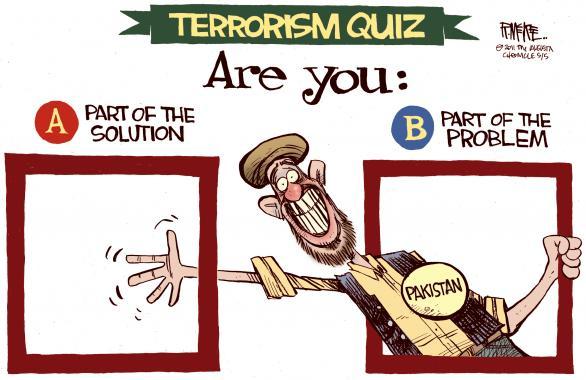
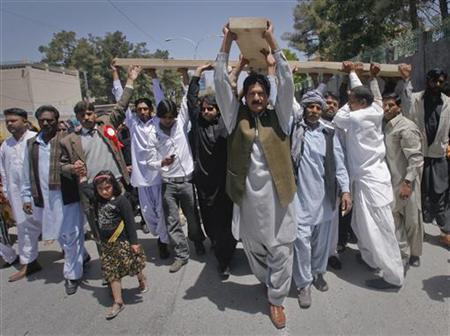
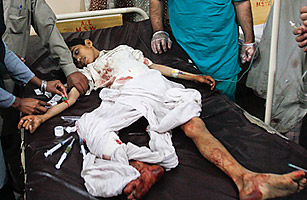
Archive for the ‘ blasphemy laws ’ Category

Satirical Song, a YouTube Hit, Challenges Extremism in Pakistan

By Salman Masood for The New York Times


A satirical song that takes a tongue-in-cheek swipe at religious extremism, militancy and contradictions in Pakistani society has become an instant hit here, drawing widespread attention as a rare voice of the country’s embattled liberals.

The song, “Aalu Anday,” which means “Potatoes and Eggs,” comes from a group of three young men who call themselves Beygairat Brigade, or A Brigade Without Honor, openly mocking the military, religious conservatives, nationalist politicians and conspiracy theorists.

Their YouTube video has been viewed more than 350,000 times since it was uploaded in mid-October. The song is getting glowing reviews in the news media here and is widely talked about — and shared — on social networking sites like Twitter and Facebook.

The name of the band is itself a satire of Pakistan’s nationalists and conservatives, who are often described in the local news media as the Ghairat Brigade, or Honor Brigade.

Local musicians have produced work in the past vilifying the West, especially the United States, but rarely do they ridicule the military or religious extremists, and none have had Beygairat Brigade’s kind of success.

Sung in Punjabi, the language of the most populous and prosperous province, the song delivers biting commentary on the current socio-political milieu of the country, in which religious radicalism and militancy have steadily risen over the years and tolerance for religious minorities is waning.

Just this year, a governor who opposed Pakistan’s contentious blasphemy law was killed by one of his guards. The assassin was then celebrated by many in the country, including lawyers who greeted him with rose petals and garlands.

The song rues the fact that killers and religious extremists are hailed as heroes in Pakistan, while someone like Abdus Salam, the nation’s only Nobel Prize-winning scientist, is often ignored because he belonged to the minority Ahmadi sect.

“Qadri is treated like a royal,” wonders the goofy-looking lead vocalist in the song, referring to Malik Mumtaz Qadri, the elite police guard who killed the governor of Punjab, Salman Taseer, in January after he challenged the blasphemy law.

Another line in the song, “where Ajmal Kasab is a hero,” makes a reference to the only surviving Pakistani gunman involved in the 2008 terrorist attacks in Mumbai, India. Still another line, “cleric tried to escape in a veil,” alludes to the head cleric of Islamabad’s Red Mosque — which was the target of a siege in 2007 by the Pakistani government against Islamic militants — who tried unsuccessfully to break the security cordon by wearing a veil.

The song even makes fun of the powerful army chief, Gen. Ashfaq Parvez Kayani, for extending his role for another three years.

Potatoes and eggs “never tasted so good,” wrote Fahd Husain in a commentary on Tuesday in The Daily Times, a newspaper based in Lahore. “They will always be credited for being politically incorrect when most needed, and giving voice to all those Pakistanis who live in fear.”

The popularity of the song on the Internet has made it a sensation across the border in India as well, surprising the band members, who have been incessantly asked whether they feel they have put their lives in danger by ridiculing the mighty.

There are certainly enough provocations to rile nationalists and conservatives. At one point in the music video, the lead singer holds a placard that reads, in English: “This video is sponsored by Zionists.”

The band members chose to upload the song on YouTube instead of handing it to television networks because they said the work was too offbeat and might be censored. Not surprisingly, some have criticized the song and its taunts as pedestrian and in bad taste.

“We were not expecting such a huge response,” said Ali Aftab Saeed, 27, the lead vocalist, who lives in Lahore, a city that is often considered the country’s cultural capital.

He said the assassination of Mr. Taseer was the inspiration for the song and its lyrics.

Resistance poetry and literature are not new to Pakistan, and they raised spirits during the somber years of military dictatorships.

During the protest rallies of the seminal lawyers movement in 2007, when they led the campaign to oust the president, Pervez Musharraf, the lawyers would sing and dance to a poem written by Faiz Ahmad Faiz, considered a giant of Urdu literature. Habib Jalib, another famous Pakistani poet, wrote several poems against Gen. Mohammad Zia ul-Haq, the military dictator in the 1980s.

But “Jalib is irrelevant to the generation of urban, young, middle-class kids that Beygairat Brigade is addressing,” said Nadeem Farooq Paracha, a culture critic based in Karachi.

“This band is offering an alternative narrative to the one this generation has grown up on, and provides a counternarrative to establishmentarian and conservative notions of politics, history and society advocated by televangelists, conspiracy theorists and, of course, the right-wing electronic media,” Mr. Paracha added. “And what better and more effective way to do this than by using satire and pop music.”

The band members, on the other hand, have no pretensions of being revolutionaries, activists or intellectuals, though they do feel that the song represents those who do not believe in extremism and want to live peacefully.

“At the end of the day,” said Mr. Saeed, the lead vocalist, “we are just musicians who raised some questions.”

Pakistan: More To Offer Than Bombs And Beards

By Asim Haneef for Al Jazeera

If you did not know anything about Pakistan and happened to pick up a newspaper or turn on the evening news, you might be forgiven for assuming that it is possibly the most broken, troubled and violent country on the face of the earth – a basket case just moments from imploding.

In the all-important arena of international public perception, Pakistan has taken an unprecedented battering in recent years, accumulating more bad headlines than nearly any other country and making places like Afghanistan and Iraq look relatively stable by comparison.

The list of challenges it faces is seemingly unending: terrorism, corruption, drone attacks, natural disasters, poverty, a deficit in leadership, discrimination against minorities, mistreatment of women, attacks on freedom of speech, mass tax evasion, match fixing, the murder of judges, politicians, union organisers and journalists – and that is just the tip of the iceberg.

So pervasive are the headlines pointing to a crisis in Pakistan that after a while they seem to blur into one another. Whether it is “hostages held in Karachi”, “al-Qaeda hideout discovered in Swat”, “floods bring pain to millions”, “suicide bomber explodes in market square”, “senior judge in blasphemy case shot dead” or “Pakistan’s ISI actively supporting Taliban in Afghan war” the message is uniformly bad news. The result is that for many the image of Pakistan is one of bombers, beards, shaking fists, distressed women and utter hopelessness. It makes for a pretty depressing picture.

I guess that is why the work of Syed Ali Abbas and his Pakistan Youth Alliance (PYA) featured in this week’s Activate, Pakistan: The New Radicals, is so refreshing. A courageous young social activist, Ali founded the PYA together with Maryam Kanwer when he was just 21 years old. It was born in the midst of severe political turmoil, as then-President Pervez Musharraf imposed emergency rule and fired the chief justice on national television, while the security forces brutally cracked down on dissenting lawyers.

Fed up with watching their country’s problems on the television, the PYA initially organised protests and rallies but quickly became more active. Its core premise and mission statement is to take a stand, to get as practically involved on the ground as possible and to exemplify the change they seek through their actions rather than merely proposing it on paper.

Their main goal is to create political and social awareness among the youth of Pakistan and to unite them irrespective of their religion, ethnicity, caste, race or language on an unbiased platform through which they can engage with one another and contribute practically to building a more progressive society in Pakistan – whether through protest, social and relief work or the arts.

Earlier this year, Ali was among a small group instrumental in organising counter protests to the hate filled ones celebrating and glorifying Mumtaz Qadri, the killer of Salman Taseer, the governor of Punjab who was murdered in January over his stance on Pakistan’s blasphemy laws and his ardent defence of religious minorities like Christians and Ahmadis. Ali says he did this because: “This is not what the founder of Pakistan and ‘Father of the Nation’ Quaid-i-Azam Muhammad Ali Jinnah would have wanted for this country today, especially as he repeatedly stressed the importance of inter-faith unity and religious harmony.”

Stories like these and others bring about something much needed in international news these days – a positive, hopeful narrative against the odds, showcasing some of the good news stories coming out of places like Pakistan, which often go unreported and deserve a spotlight too. So although we appear to have an extraordinary capacity to become fixated on negative headlines, there are also good things happening too and though progress and development is not as ‘sexy’ as a suicide bomber or a train-wreck, perhaps a little balance is in order, so that we do not become as, Ali says at the close of the film, “filled with dread, being hopeless about the future”.

So do good stories actually emanate from Pakistan? And, if so, where are they? Well an initiative by brothers and social entrepreneurs Majid and Mahmood Mirza aims to answer this. They set up a website simply titled Good News (www.goodnews.pk) , which focuses solely on positive developments coming out of the country. They describe the idea behind the website via Skype as being “to highlight amazing, awesome and inspirational news stories coming from Pakistan, as opposed to the usual negativities that steal the headlines”.

And they have plenty of examples ready. For instance, did you know that Pakistan has become only the sixth country in the world to map the human genome, joining the ranks of the US, the UK, China, Japan and India, which have all successfully sequenced it. Or, how about the fact that Pakistan has the largest volunteer ambulance organisation in the world started by “living saint” Abdul Sattar Edhi in 1948. Today, the radio-linked network includes 600 ambulances that work in every corner of the country. Or how about the recent news that Dr Umar Saif, an associate professor at the School of Science and Engineering in Lahore, has been recognised by MIT Technology Review as one of the top 35 innovators in the world – joining an elite group of researchers and entrepreneurs selected over the last decade, which includes Larry Page and Sergey Brin, the co-founders of Google, Mark Zuckerberg, the founder of Facebook, and Jonathan Ive, the chief designer at Apple. Now who has heard of those stories?

Then there are serial entrepreneurs like Monis Rahman, who just four years ago set-up Rozee.pk, which is now Pakistan’s largest jobs website, with 500,000 unique visitors a month; or Karachi-born freelance designer Vakas Siddiqui laying to rest the myth that Pakistani students are limited to excellence in science and the humanities by being selected as one of the top 28 designers in the world; or filmmaker Sharmeen Obaid Chinoy who has just been shortlisted for an Oscar in the ‘best documentary short’ category for her film Saving Face. Whether it be in music, fashion, academia, activism, technology, sports or science these are stories that people do not usually associate with Pakistan and which might just show that there is more to the country than just bombs and beards.

Some of these unreported positive stories, along with the courage and creativity shown by people like Syed Ali Abbas and the Pakistan Youth Alliance in challenging these problems, reflect a surprising shift in the country’s growing and increasingly switched-on, globally-minded youth. They are using outlets like social media platforms and blogs to become more aware, educated and informed about their rights and more savvy to the different methods they must perfect in order to stop their country peddling even further backwards than it already has and to lead it to a brighter day, free from the same old headlines we’re all universally tired of reading and hearing about.

Asim Haneef worked extensively on Activate, a new eight part series featuring grass-roots activists from across the globe who are challenging the status quo and bringing about a change in their society. You can follow him on Twitter @asimhaneef

Pakistan, Islam & Radicalism

By Syed Ali Abbas Zaidi for The Huffington Post

I was in Kasur, a small town near Lahore, Pakistan, where the celebrated mystic poet Bulleh Shah is buried. Thousands gathered for the 254th anniversary of his death. Slogans chanted on that occasion would be branded ‘blasphemous’ by extremist organisations in Pakistan.

Neither Hindu nor Muslim,
Sacrificing pride, let us sit together.
Neither Sunni nor Shia,
Let us walk the road of peace.

Bulleh Shah penned these verses challenging religious extremism and orthodoxy that plagued Muslim society hundreds of years ago. He was exiled from his home town and, history has it, he was denied a burial in Muslim cemetery. His advice has clearly gone unheeded as my country is still yet to find peace. Not even the founder of Pakistan, Muhammad Ali Jinnah has been spared being labelled ‘the great infidel’.

Incidentally, the same ilk of religio-political parties who now manipulate public discourse were at the forefront of using religious narrative for political point scoring before Pakistan came into being.

4 January 2011 is a day I cannot forget. Salmaan Taseer, the Governor of Pakistan’s biggest province Punjab, was gunned down by his bodyguard. He was killed for supporting a Christian woman accused of insulting the Prophet Muhammad. He was shot twenty six times.

For the entire week after the killing, I was scared. I don’t remember being in that state of mind since Benazir Bhutto was assassinated. It’s not a very heartening sight to see fellow ‘educated’ countrymen glorifying a murderer and justifying his actions based on ignorant rhetoric. Scores of fan pages popped up on Facebook, many of my friends changed their profile pictures to one of the killer, Mumtaz Qadri, exalting a murderer as hero.

Very few turned out to pay homage to the slain governor in days to come, as ‘liberals’ arranged vigils in his remembrance. Yet thousands poured on to the streets to defend Mumtaz Qadri, his assassin. The media, which has been a primary tool in fanning conspiracy theories in public, had again played a pivotal role in enticing ‘religious’ emotions on this issue.

The killer of Salman Taseer had confessed proudly. The brave judge who sentenced him to death has gone into hiding and will not be re-appearing anytime soon.

7 March 2011. The start of another week of gloom and, if I’m honest, I was ashamed to be a Pakistani. We had arranged a protest to condemn the killing of Shahbaz Bhatti, the Federal Minister for Minorities who was brutally assassinated on 2 March. He was an outspoken critic of Pakistan’s blasphemy laws and the only Christian in the cabinet. Only a few youngsters turned up.

When it comes to numbers, we can gather thousands but the ’cause’ has to be against India, Israel or America. Not many will show up if the demonstration is against radical organisations, or asking for introspection within.

Many who rallied for Gaza in early 2009 were not seen in protests condemning Taliban atrocities in Swat at the same time. Many who burnt down shops in anger at the Danish cartoons of the Prophet Muhammad never stood up for Parachinar, a small town near the border of Afghanistan where thousands have been killed in sectarian violence between Sunni’s and Shia’s.

9 October 2011. I was stuck on the Islamabad Highway, the main road that connects Islamabad with Rawalpindi as it was blocked by flash mobs protesting for the release of Mumtaz Qadri.

Two decades and 40,000 deaths later which includes top politicians, generals and clerics – not many things have changed when it comes to checking radicalism within Islam.

Many attacks on places of worship of minority sects within Islam, recurring violent brawls between followers of different schools of thought, reaction to the murder of Salman Taseer and Shahbaz Bhatti, recent acts of violence in Baluchistan and the tale of Parachinar are chapters in recent history which expose the extent of radicalisation in Pakistani society.

Soon, we as citizens of a country founded because a minority felt discriminated against and followers of the great religion of Islam, need to face up to the challenge of the radical minded and their extremist ideology.

This is a war of ideologies and is inevitably a war that must be fought with opinions and ideas; it must encourage discourse and exchange of reason. It is a war that must form the basic pillar of a new and improved national paradigm for Pakistan

We as a society cannot ignore an emerging threat from radicalism within our ranks, because if it gets too late, there might be no ‘music’ left to face.

Sharia Law Surprise for Secular-Minded Libyans

By Mary Fitzgerald for The Irish Times

ANALYSIS: The role of Islam could prove to be a contentious issue in the new Libya

LIBYA’S INTERIM authorities formally declared liberation yesterday with soaring speeches that praised their revolution’s victory over tyranny, paid tribute to the fallen and offered clues as to what kind of state might emerge from the ashes of Muammar Gadafy’s idiosyncratic rule.

The long-awaited declaration, made in front of tens of thousands of jubilant Libyans gathered in Benghazi, the eastern city where the uprising against Gadafy began in February, came more than two months after Tripoli fell to revolutionary forces, allowing them to seized control of most of the country.

It ushers in a process agreed by the interim body known as the National Transitional Council which will see the NTC move its headquarters from Benghazi to Tripoli and form a transitional government within 30 days. A 200-member national assembly is to be elected within 240 days, and this will appoint a prime minister a month later who will then nominate a cabinet. The national assembly will also be given deadlines to oversee the drafting of a new constitution – none existed under Gadafy – and the holding of parliamentary and presidential elections.

Already the process of forming a united and representative government promises to be fraught. With Gadafy dead, the fissures that always existed within the revolution, whether along regional or tribal lines or between Islamists and secular liberals, threaten to widen.

Even the fact that liberation was declared in Benghazi, rather than Tripoli, points to friction between leadership figures in the two cities – many of the NTC’s members, especially those from eastern Libya, have remained in Benghazi, the second-biggest city.

The question of who did what, whether during the war of the last eight months or during the four decades Gadafy was in power, will also determine much in the new order.

On Saturday, the de facto prime minister Mahmoud Jibril said progress would hinge on two things. “First what kind of resolve the NTC will show in the next few days, and the other thing depends mainly on the Libyan people – whether they differentiate between the past and the future,” he said. “I am counting on them to look ahead and remember the kind of agony they went through in the last 42 years.” Jibril also warned that Libya needed to swiftly find another source of income because the country had already consumed 62 per cent of its oil under Gadafy.

Those seeking hints as to what the new Libya may look like seized on particular sections of NTC head Mustafa Abdel Jalil’s speech in Benghazi yesterday, in which he went into some detail about the place of Islam in the post-Gadafy scenario.

“This revolution was blessed by God to achieve victory,” Jalil, who is considered devout but moderate, told the crowd. “And we must go on the right path.”

Libya, he said, would be a state where Sharia law would be the “fundamental source” of legislation and any existing legislation that contradicted Islamic principles would be immediately annulled.

It was not the first time Jalil had made such statements, and many other Arab countries have similar constitutional provisions, but Libyans of a more liberal bent may have baulked at what came next.

The new state “will not disallow polygamy” Jalil said, and charging interest will be forbidden. Some Libyans point out that polygamy was practised discreetly under Gadafy, while others interpreted Jalil’s remarks as a practical measure to address the issue of the thousands of women left widowed during the war.

These declarations, though met with cheers from the crowd, will have raised eyebrows among more secular-minded Libyans who would prefer to have such matters decided through a democratic process rather than presented almost as a fait accompli at such an early stage.

The Islamist tint to Jalil’s speech could be interpreted in different ways: it may have been an attempt to undercut the influence of more hardline elements while Libya finds its feet after Gadafy, or a bid to keep the grassroots on board as one of North Africa’s most conservative societies enters what will be a challenging period.

Either way, it shows that questions over what role Islam should play promise to be among the most pressing in the new Libya.

Pakistanis for Peace Editor’s Note– We are happy for the Libyan people for overthrowing a brutal and oppressive dictator. We condemn however his killing and not being brought to justice and the treatment of his corpse to not be treated to Islamic last rites and custom. We are also concerned by the announcement by the revolution’s leadership that Sharia Law will be the new form of law in Libya. This is not acceptable as a secular democracy is the form of government similar to Turkey that must be the model. We urge the US and other NATO benefactors that made the overthrow of Gaddafi possible to insist on a secular democratic government in Libya, otherwise all is for naught.

Pakistan Court Suspends Death Sentence of Governor’s Killer

By Shaan Khan For CNN

A Pakistani court has suspended the death sentence of Mumtaz Qadri, a security guard who killed a liberal politician over the latter’s remarks on the nation’s controversial blasphemy law.

“Qadri was provoked by the governor and should therefore be tried for murder, not an act of terror which is what he was tried for earlier” said his attorney Raja Shuja Ur Rehman in confirming the judge’s decision.

Earlier this month, a terror court in the garrison city of Rawalpindi, near Pakistan’s capital, sentenced Qadri to death. The Islamabad High Court suspended the sentence Tuesday until the appeals process is complete. The court did not say when it will meet again to consider the case.

Police said Qadri, a policeman serving as a security guard for Punjab Gov. Salman Taseer, fatally shot him in a market in Islamabad on January 4 because of Taseer’s remarks on Pakistan’s controversial blasphemy law. Police said Qadri confessed to gunning down the man he was supposed to be protecting. Qadri’s lawyer appealed the sentence imposed by the Anti-Terrorist Court, saying the court did not have the jurisdiction to make the death penalty decision.

Taseer, a successful businessman as well as politician, had said Pakistan’s controversial blasphemy law is too harsh. The law makes it a crime punishable by death to insult Islam, the Quran or the Prophet Mohammed. The legislation has been criticized by some as being used to entrap minorities.

Why Not Free Qadri?

By Ayesha Siddiqa for The Express Tribune

How about freeing Mumtaz Qadri for the simple reason that the state system has lost the capacity to execute punishment? The Anti-Terrorism Court (ATC) judge, who gave him the death sentence, is already on the run. It will be quite a cost to protect Justice Shah and his family or other judges that may be brave enough not to overturn the ATC’s decision.

Why bother with the idea of punishing Qadri when it is no longer in the realm of the possible. An olive branch that is offered to the Tehreek-i-Taliban (TTP) Pakistan and other killers can be extended to Qadri as well. Not to forget that the political leadership in the form of the recent All Parties Conference has surrendered to a peculiar agenda. So, forget about Jinnah’s August 11 speech now as the state has already transformed to a hybrid-theocracy. It has small liberal spaces, equally smaller spaces where Sharia is formally implemented, and larger spaces where the orthodox law is informally enforced. Try standing in front of a Jamaat-i-Islami/Jamaatud Dawa procession in support of Qadri to feel the melting away of the state and its changed character. Sadly, many of our post-modernists scholars will, yet again, call this as part of the secularising process through bringing religion into public sphere. Driven by personal ambitions to establish their scholarship, they won’t even question that the current discourse is not secularising as it condemns all other arguments as being against Islam. Are the protesters even willing to explore other religious arguments that may not save Qadri from the sentence given by the ATC judge?

There are no governments that are willing to stand up to the bullying and to establish the writ of the state. There is no intent to even deradicalise society because, in the words of a senior bureaucrat of the Punjab government, reputed to be close to the chief minister, there is no radicalisation in Punjab and even if there were, why should the state become an ideological warrior. Obviously, this CSS-qualified babu considered deradicalisation as anti-religion or against the tenets of Islam. This bureaucrat was a good example to debunk the argument that radicalisation results from lack of education. Here was a case of a literate man not willing to understand that deradicalisation is about creating sufficient space for all religions and sects to co-exist without fear of persecution, and increasing the state’s capacity to provide justice for all, irrespective of their cast, creed and religion. Thus, he presented the Punjab government’s development priorities as devoid of the goal of deradicalisation.

It was almost unbelievable to think that the bureaucrat’s plan had the sanction of his political bosses, especially someone like Mian Nawaz Sharif who made some bold pronouncements of building ties with regional neighbours and condemned parties with militant wings. Notwithstanding the goodness of Mian Sahib’s heart, one wonders how familiar is he with his own party’s support of militant outfits and if he considers this linkage equally condemnable? The fact of the matter is that no political party can claim to be above board as far as rising radicalism is concerned. The absence of the state in most provinces — Balochistan where people are being picked up and killed, Khyber-Pakhtunkhwa where the provincial government has willingly opted to share space with certain types of militants, Sindh, which is devastated by floods and a government that is almost invisible and Punjab where the government opts to burn down state infrastructure — is visible. Therefore, it is not surprising to see militant outfits becoming the new arbiters even replacing the old feudal class. They have and will exercise greater influence on the electoral process, especially ensuring that no parliamentarian challenges the writ of these militant outfits.

The militants of today are the new feudal lords that will adjudicate and dispense justice not on the basis of any higher religious law but their personal bias for things which are superficially religious. These people, who hold jirgas and dispense justice, are not fully aware or trained to interpret religious text or other sources. Surely, memorising the Holy Book cannot be the sole criterion. For those who believe that voting another party into power will solve the problem of radicalism, they will be disappointed to know that religious radicalism is the only game in town. It is now time to think of ways to grapple with the new reality.

A Monster Roaming The World

By Paul Mcgeough for The City Weekly
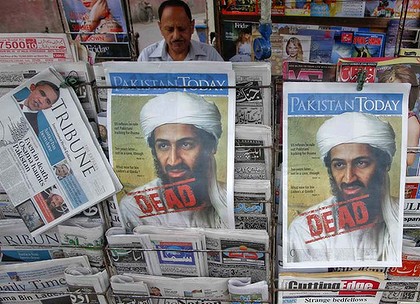
Search for a firm footing in Pakistan and there is none – all is quicksand … strategically, politically, morally.

Here in south Asia, strategically sandwiched between failing Afghanistan and the China and India powerhouses, is a country in which journalists are abducted in the night by agents of the state and murdered; in which the only advance after a decade in which Washington has tried to buy friendship with cheques for more than $20 billion, is the expansion of Pakistan’s nuclear arsenal – which is on the verge of surpassing Britain’s as the fifth biggest in the world.

In Pakistan, a 50-year-old woman is sentenced to death on a dubious blasphemy charge – and politicians who dare to speak in her defence are gunned down; and a woman is gang-raped and paraded naked through her village on the orders of a local council, over bogus claims that her 12-year-old brother has offended a 20-year-old woman from the clan of the men who defiled her.

But that’s village life. In the leafy garrison town of Abbottabad, an hour’s drive north of Islamabad, Osama bin Laden, mastermind of the attacks of September 11, 2001, was able to hide in plain sight for years. The location of his fortified bunker, a stone’s throw from a prestigious military academy, made it harder to give any credence to the generals’ repeated denials that significant elements of Pakistan’s extensive security apparatus sheltered the al-Qaeda chief and continue to give succour to the Taliban and other insurgency and terrorist movements.

In the south-west, in the wilds of provincial Baluchistan, there have been 150 ”kill and dump” operations this year. Most of the victims are Baluch nationalist rebels. Their killers are the Inter-Services Intelligence agency (ISI) and other elements of Pakistan’s national security forces – driven to brutality by a belief, which could be correct, that Pakistan’s arch foe, India, stirs the local nationalist pot. In turn, the Baluch nationalists are accused of running their own death squads – their victims are Punjabi ”settlers”, government workers brought in from other parts of the country.

Baluchistan is half Pashtun, which also makes it a sanctuary for the Taliban from adjoining Afghanistan, where Washington and the world still struggle, with little success, to impose a semblance of democracy on the bones of a fracturing, failing state. Here then is another of the ironies that puts a serious question mark over the bona fides of the Pakistani security forces: the leadership of the Afghanistan Taliban sequesters in Quetta, the provincial capital of Baluchistan, but the various Pakistani security services are so busy putting the Baluch nationalists through the mincer they don’t have time to take down the Taliban command-and-control centre. Instead, they reportedly socialise with the Taliban and sit in on their strategy meetings.

West from Baluchistan is the sprawling port city of Karachi, where the spiralling death toll in renewed ethnic turf-wars gives raw meaning to what local novelist Kamila Shamsie broaches obliquely, recounting how the city ”winks” at her. “Yes, the city said, I am a breeding ground for monsters, ” she writes, “but don’t think that is the full measure of what I am.”

This drab, chaotic home to 18 million people who account for 65 per cent of Pakistan’s economy is being carved up by bullets that this year have accounted for as many as 1000 ”wrong place, wrong time” deaths as gunmen randomly select their targets – sending messages to whole communities, not the individuals with whose blood they paint the rough pavements. As the suburbs seethe, police do little, because they are cowed by the systematic elimination of those in their ranks who intervened in the last iteration of these ethnic wars. Provincial and federal governments and the security forces only wring their hands.

In Karachi everyone lies. No one denies turf wars are being waged. They simply blame everyone else – all the political parties deny any links to the militias that prosecute their bloody agendas and to the crime, drug and land-development mafias that prosper in their wake. And the city’s once-dominant Urdu-speaking Mohajirs fight to maintain their control of corrupted city politics, amid an influx of Pashtuns fleeing upheavals along the Afghan border.

“Tension rises, we see killings and then scores must be settled,” an adviser to the provincial governor says. “We are at war – the political parties say they are not involved, but the mafias take shelter from the parties as they exploit the situation.”

In Islamabad, enter any of the city’s newsrooms, and see fear in the eyes of journalists who risk death and torture for going about assignments. Consider the words of their Karachi colleague Madiha Sattar – “a growth of intolerance has forged an extreme, murderous antipathy to freedom of expression.”

Most shocking in this campaign of fear and intimidation against one of the pillars of democracy was the disappearance in late May of Syed Saleem Shahzad, an investigative reporter for the respected, Hong Kong-based Asia Times Online. Two days after his abduction, Shahzad’s battered body was found at Mandi Bahauddin, 130 kilometres south-east of the capital. The reporter left detailed accounts of the threats he had received from the ISI; in Washington, senior officials unflinchingly confirming that Shahzad’s death had been ”sanctioned” by the Pakistani government.

Umar Cheema might just as easily have been their victim. Behind a door marked ”Investigation Cell” off a basement corridor in the Islamabad offices of The News, the 34-year-old father of two explains that the shock in his colleague Saleem Shahzad’s murder was a realisation it might just as easily have been him.

As Cheema drove home from a party in the early hours during Ramadan last year, 12 men who identified themselves as police commandos abducted him, he says. Informing him first that he was a suspect in a killing, they pulled a bag over his head and hauled him away.

“They took me to a building where the leader stripped off my clothes. Then I was ordered to lie on the floor and they beat me on the back and shoulders for 20 or 25 minutes with leather straps and wooden canes.

“I was writing about corruption in the government and the lack of accountability in the military and intelligence agencies – they said they were beating me because of my reporting. Then they shaved my head and eyebrows – that’s what is done to thieves in rural areas to humiliate them.

“Shahzad’s death left me speechless,” he says. “I was the second last victim before they took him. So I felt very much that this was a message for me – it was very, very personal.”

In Islamabad, the government of Prime Minister Yousaf Gillani is as overwhelmed as it is complicit in the nation’s failings. The economy is in crisis and the government has ceded control of more than half the country to the military or to extremist militias. “None of the cogs of state mesh to make it do what must be done,” Human Rights Commission of Pakistan’s Kamran Arif said.

Just south of Islamabad is Rawalpindi, a more typical Asian city than the sanitised and empty boulevards of Islamabad. As home and headquarters to the men and institutions that comprise Pakistan’s military and intelligence establishment, this is the centre of absolute power in Pakistan. And it is here that a deep-fried sense of humiliation over the American raid to kill Osama bin Laden, in May this year, is felt most acutely.

“After the bin Laden raid, it’s a question of the survival of the state,” the defence analyst and director of the South Asian Strategic Stability Institute, Maria Sultan, says. “The problem now is that by this very public humiliation, the US has lost its biggest supporter – it’s not the capability of the Pakistani military that is affected, it’s its credibility.”

A close reading of ”Getting Bin Laden”, The New Yorker’s inside account of the May 2 raid, reveals the mission was not just a single US incursion that managed to evade Pakistan’s air defences. On the night, there were effectively three separate American missions, none of which was detected by a military-security complex that demands indulgence by the people of Pakistan on the grounds that it is their only protection from the Indian hordes.

Pakistan’s generals faced a grim choice – they had to admit to deceiving the world in harbouring bin Laden, or to incompetence by not knowing he was lounging in their backyard. So supine were they in opting to plead incompetence there were fears of a mutiny in the middle ranks of the security services.

The US signal to the world of just how much it could not trust its south Asian ally came hard on the heels of serial embarrassments at the hands of the Taliban and other militant groups in Pakistan.

There have been a series of militant attacks on the most secure and sensitive defence establishments. The latest, which some observers concluded could not have been undertaken without inside help, saw a 10-man assault team storm the Mehran naval aviation base in Karachi. It took hundreds of Pakistani navy commandos, marines and paramilitaries to retake the base, but not before two aircraft were destroyed, hostages taken and the base had been occupied for the best part of a day.

But it takes a discerning Pakistani general to differentiate between militants – some are ”strategic assets” of the security apparatus and the generals refuse to go after them.

Dr Ayesha Agha, whose military and political commentaries appear in Pakistan’s Dawn newspaper, explains: “The military depends on these ‘assets’ – they are a cost-effective means to fighting wars that the Pakistani military wants to fight in India and Afghanistan.” Extrajudicial killings by the military now are counted in the hundreds.

When men in uniform were filmed recently murdering a detainee, the reckoning in human rights circles was that far from being a lapse of judgment, the recording had been allowed in the knowledge that its distribution on the internet would serve as a useful warning to the wider community.

A Karachi taxi driver becomes excited as he ferries us from the airport to a downtown hotel – “Pakistan lovely country,” he bellows. “Terrorism? No, no, no.”

But a single graphic in a 200-page study of Pakistan, published in May by the Washington-based Centre for Strategic and International Studies, reveals an impossible security challenge. Last year alone, 2113 terrorist attacks, 369 clashes between the security services and militants, 260 operational attacks by the security forces, 135 US drone attacks, 69 border clashes, 233 bouts of ethno-political violence and 214 inter-tribal clashes resulted in more than 10,000 dead and as many injured.

The death of bin Laden and the reported death of al-Qaeda’s new No. 2 figure, Atiyah Abd al-Rahman, in an American drone attack last week, are still being factored into a running debate among intelligence specialists on the extent to which al-Qaeda offshoots elsewhere in the world, especially the Yemen-based al-Qaeda in the Arabian Peninsula [AQAP], have taken the baton from the Pakistani organisation.

But a July study by the New America Foundation of 32 ”serious” jihadist terror plots against the West from 2004 to 2011, finds 53 per cent had operational or training links to jihadist groups in Pakistan – compared to just 6 per cent being linked to Yemen. And the rising tempo of the drone attacks has failed to dent the rising frequency of Pakistan-linked plots against the West, the study finds.

Implicit or explicit in any discussion on Pakistan’s volatile mix of militant violence and governmental chaos, is the level of anxiety around the world about the security of its nuclear arsenal. Confronted with claims such as that by bin Laden that acquiring a nuclear weapon was a ”religious duty” and the hope expressed by one of his lieutenants that such a weapon one day might be seized in Pakistan, officials in Islamabad invariably boast that all is tightly locked down.

But when we ask a Pakistani diplomat how secure were the weapons in the aftermath of the US mission to kill Osama bin Laden, he replies: “Less so, now that the Americans have revealed to the world that it is possible to sneak into Pakistan undetected, to take something that you really want.”

President Obama’s public appeal that Pakistan not become the world’s first ”nuclear-armed militant state” gives context to disclosures by The New Yorker’s Seymour Hersh of the existence of a US Special Operations rapid-response team which would be parachuted into Pakistan in the event of a nuclear crisis.

Rolf Mowatt-Larssen, a former director of intelligence and counter intelligence at the US Department of Energy, is boldest in setting out the fears of Washington, London and other capitals – some of which were disclosed without diplomatic varnish by Wikileaks last year.

Writing in Arms Control Today, Mowatt-Larssen, who served 20 years at the CIA, bills Pakistan as the most likely setting for terrorists bent on acquiring a nuclear device to co-opt a nuclear insider – of whom there are estimated to be as many as 70,000 in Pakistan.

“There is a lethal proximity between terrorists, extremists, and nuclear weapons insiders,” he writes. “Insiders have facilitated terrorist attacks. Suicide bombings have occurred at air force bases that reportedly serve as nuclear weapons storage sites. It is difficult to ignore such trends.

”Purely in actuarial terms, there is a strong possibility that bad apples in the nuclear establishment are willing to co-operate with outsiders for personal gain or out of sympathy for their cause.”

“Not possible,” says Maria Sultan. “About eight to 10,000 personnel working at the strategic level on security,” she says, ticking off seven or eight interlocking layers of complex security, the first of which she says would trip most intruders before they came within 80 kilometres of a nuclear facility. “The idea that a terrorist can walk in and get hold of a device is just not possible.”

Such is the bind in which Pakistanis find themselves. But if it is true feeble and corrupt civilian administrations make circumstances ripe for a military takeover, it is hardly surprising the generals have no respect for democratic fundamentals.

As revealed in one of the Wikileaks cables, Army chief General Ashfaq Parvez Kayani was ready to force President Asif Ali Zardari from office – save for the fact the general thought even less of Zardari’s likely civilian replacement. And historically, Washington has opted to connect with Pakistan through the military power of the generals, rather than the people power of the civilian leadership.

Bruce Riedel, a veteran CIA analyst, sets out the connections in Deadly Embrace: Pakistan, America and the Future of the Global Jihad. “…Richard Nixon turned a blind eye to the murder of hundreds of thousands of Bangladeshis to keep his friends in Pakistan’s army in power, a strategy that ultimately failed,” Riedel writes. “Ronald Reagan entertained Zia-ul-Haq even as Zia was giving succour to the Arab jihadists who would become al-Qaeda. George W. Bush allowed Pervez Musharraf to give the Afghan Taliban a sanctuary from which to kill American and NATO soldiers in Afghanistan.”

And in the judgment of Bushra Gohar, an elected MP from Pakistan’s troubled Swat Valley, Washington still prefers to deal with the military rather than the country’s civilian leadership. “That’s not a role that the military has under the constitution,” she says during a break in the business of the National Assembly in Islamabad. “There has been a democratic transition in this country and we expect the international community to support it.”

Power vacuums become ripe for exploitation, as was revealed with frightening clarity earlier this year when two of three elected figures who had dared to speak out against Pakistan’s draconian blasphemy laws were assassinated. In January, Punjab provincial governor Salman Taseer was gunned down by one of his state-provided security men; in March, the Minorities Minister and the only Christian in Gillani’s cabinet, Shahbaz Bhatti, died in a hail of gunfire as his car left his mother’s home in Islamabad.

Taseer’s killer confessed and became a national hero. His home is a shrine, he is garlanded with rose petals and, in the oddest twist of all, the young lawyers’ movement that effectively bundled Pervez Musharraf, the last dictator, from power in 2008, has taken the side of this cold-blooded murderer – not the principle for which his victim died.

A visitor leaves Pakistan wondering if anyone here speaks the truth. The dictators habitually resort to amping up religious parties – either to drown out secular ones that might be interested in the ideals of selfless democracy, or to further marginalise the country’s Shiia Muslim minority.

“And people like Musharraf have two faces,” Kamran Arif of the Human Rights Commission of Pakistan said. “He would say all the right things for the West and do just what he wanted to do at home.”

Some foreign analysts fall back on the seeming failure of Pakistan’s religious parties at the ballot box as a hopeful sign. But a sense of rising radicalisation, particularly in the military and the middle classes, suggests an asymmetric contest for control of a highly unstable society – the non-religious parties fight in the parliament, but the religious parties are street brawlers.

Sherry Rehman, the only elected figure in the country to defend the convicted blasphemer Aasia Bibi, makes the same point in explaining how that debate was lost. “The discourse shifted from the parliament to the street,” she says.

“We have to keep the agenda in the parliament, and not with the gun-toting thugs who make inflammatory speeches outside.”

Like the financial institutions in the 2008 global financial crisis, Pakistan is deemed by Washington to be ”too big to fail”. Between them, however, Washington and Islamabad have been unable in the past decade to make this relationship work – credibly or creditably.

Predictions of imminent collapse in Islamabad are exaggerated, but perhaps not overly so. “The government does not have the capacity to tackle any of the issues,” says the Human Rights Commission of Pakistan’s Arif. “Things will just keep getting bad … and I don’t discount the fact that we can fall into chaos.”

Like many other analysts, Bruce Riedel laboriously sets out the policy options by which Washington and Islamabad might work together to defeat the global jihadist movement – before he concludes that none is easy or guaranteed.

An adviser to several US administrations and now with the Brookings Institution, Riedel sees Pakistan under siege from a syndicate of radical terrorist groups unified by the notion that nuclear-armed Pakistan could be the extremist jihadist state they have never had.

“They want to hijack Pakistan and its weapons,” he says. Alluding to Islamabad’s role in creating a monster, as often as not with Washington’s sponsorship, he writes: “An extremely powerful jihadist Frankenstein is now roaming the world, with equally powerful protectors in Pakistani society, right up to the very top.

“Who cannot fear that the ‘long beards’ will prevail?”
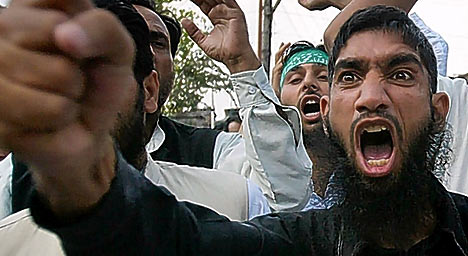
Rights Violations: Pakistan Maintains Discreet Silence Over Syria Protest

By Saba Imtiaz for The Express Tribune

As the chorus against the Syrian government grows louder, Pakistan remains silent on the issue of human rights abuses in Syria. According to Amnesty International, over 1,500 people have been killed since March in the protests against Syrian President Bashar alAssad’s regime. Pressure against Syria appeared to grow over the weekend from Arab states, as the Gulf Cooperation Council asked for an immediate end to bloodshed.

On Monday, Saudi Arabia’s King Abdullah issued a written statement on the situation. “What is happening in Syria is not acceptable for Saudi Arabia. Syria should think wisely before it is too late and issue and enact reforms that are not merely promises but actual reforms. Either it chooses wisdom on its own or it will be pulled down into the depths of turmoil and loss.” Soon enough, Saudi Arabia, Kuwait and Bahrain had recalled their ambassadors from Damascus for ‘consultations’.

In April, Pakistan joined China and Russia in voting against a resolution by the UN Human Rights Council condemning the violence in Syria. Pakistan’s ambassador to the UN Zamir Akram was quoted as saying, “My country has always believed that ‘naming and shaming’ is an approach which is counterproductive.”

Three months and over a thousand dead bodies later, no public statement has yet to be made on the situation in Syria. The Foreign Office spokesperson did not respond to a query till the filing of this report.
According to former foreign minister Khurshid Mahmud Kasuri, Pakistan’s silence is a product of “historical links between the Bhutto and alAssad families”.

President Bashar’s father, the late president Hafez alAssad, was believed to be a close ally of former prime minister Zulfikar Ali Bhutto. Murtaza and Shahnawaz Bhutto travelled to Syria in 1979 to seek support for their campaign to save Bhutto and were offered asylum by the elder alAssad. Murtaza spent several years in Syria before returning to Pakistan in 1993. In 1981, a Pakistan International Airlines flight was hijacked and forced to land in Kabul, and then Damascus. The hijacking is widely believed to be the work of the Al Zulfikar Organisation.
Kasuri said that given the high death toll, “the government of Pakistan needs to make its position clear [and say] that it stands with the people of Syria.”

Pakistan’s silence, according to former foreign secretary Shamshad Ahmad, shows lack of a foreign policy. “Foreign policy is a reflection of a country’s internal state of affairs. If the state is in disorder, it has no foreign policy. Forget Syria or any other Arab country – Pakistan has enough problems at home and has no time to focus on international issues. No one is going to pay any attention to what Pakistan says because it has no credibility. No country is looking to Pakistan for support.”

Pakistanis for Peace Editor’s Note– The writer makes some valid points about Pakistan’s foreign policy or lack thereof. Being complicit also in the suppression of the civilians in Bahrain by providing troops as illustrated in this article shows that the country is often found on the wrong side of terrorism, women and religious minorities rights, and democratic and human rights. Not a good equation and no excuse for any of it any way one looks at it.

Why My Father Hated India

By Aatish Taseer for The Wall Street Journal

Ten days before he was assassinated in January, my father, Salman Taseer, sent out a tweet about an Indian rocket that had come down over the Bay of Bengal: “Why does India make fools of themselves messing in space technology? Stick 2 bollywood my advice.”

My father was the governor of Punjab, Pakistan’s largest province, and his tweet, with its taunt at India’s misfortune, would have delighted his many thousands of followers. It fed straight into Pakistan’s unhealthy obsession with India, the country from which it was carved in 1947.

Though my father’s attitude went down well in Pakistan, it had caused considerable tension between us. I am half-Indian, raised in Delhi by my Indian mother: India is a country that I consider my own. When my father was killed by one of his own bodyguards for defending a Christian woman accused of blasphemy, we had not spoken for three years.

To understand the Pakistani obsession with India, to get a sense of its special edge—its hysteria—it is necessary to understand the rejection of India, its culture and past, that lies at the heart of the idea of Pakistan. This is not merely an academic question. Pakistan’s animus toward India is the cause of both its unwillingness to fight Islamic extremism and its active complicity in undermining the aims of its ostensible ally, the United States.

The idea of Pakistan was first seriously formulated by neither a cleric nor a politician but by a poet. In 1930, Muhammad Iqbal, addressing the All-India Muslim league, made the case for a state in which India’s Muslims would realize their “political and ethical essence.” Though he was always vague about what the new state would be, he was quite clear about what it would not be: the old pluralistic society of India, with its composite culture.

Iqbal’s vision took concrete shape in August 1947. Despite the partition of British India, it had seemed at first that there would be no transfer of populations. But violence erupted, and it quickly became clear that in the new homeland for India’s Muslims, there would be no place for its non-Muslim communities. Pakistan and India came into being at the cost of a million lives and the largest migration in history.

This shared experience of carnage and loss is the foundation of the modern relationship between the two countries. In human terms, it meant that each of my parents, my father in Pakistan and my mother in India, grew up around symmetrically violent stories of uprooting and homelessness.

But in Pakistan, the partition had another, deeper meaning. It raised big questions, in cultural and civilizational terms, about what its separation from India would mean.

In the absence of a true national identity, Pakistan defined itself by its opposition to India. It turned its back on all that had been common between Muslims and non-Muslims in the era before partition. Everything came under suspicion, from dress to customs to festivals, marriage rituals and literature. The new country set itself the task of erasing its association with the subcontinent, an association that many came to view as a contamination.

Had this assertion of national identity meant the casting out of something alien or foreign in favor of an organic or homegrown identity, it might have had an empowering effect. What made it self-wounding, even nihilistic, was that Pakistan, by asserting a new Arabized Islamic identity, rejected its own local and regional culture. In trying to turn its back on its shared past with India, Pakistan turned its back on itself.

But there was one problem: India was just across the border, and it was still its composite, pluralistic self, a place where nearly as many Muslims lived as in Pakistan. It was a daily reminder of the past that Pakistan had tried to erase.

Pakistan’s existential confusion made itself apparent in the political turmoil of the decades after partition. The state failed to perform a single legal transfer of power; coups were commonplace. And yet, in 1980, my father would still have felt that the partition had not been a mistake, for one critical reason: India, for all its democracy and pluralism, was an economic disaster.

Pakistan had better roads, better cars; Pakistani businesses were thriving; its citizens could take foreign currency abroad. Compared with starving, socialist India, they were on much surer ground. So what if India had democracy? It had brought nothing but drought and famine.

But in the early 1990s, a reversal began to occur in the fortunes of the two countries. The advantage that Pakistan had seemed to enjoy in the years after independence evaporated, as it became clear that the quest to rid itself of its Indian identity had come at a price: the emergence of a new and dangerous brand of Islam.

As India rose, thanks to economic liberalization, Pakistan withered. The country that had begun as a poet’s utopia was reduced to ruin and insolvency.

The primary agent of this decline has been the Pakistani army. The beneficiary of vast amounts of American assistance and money—$11 billion since 9/11—the military has diverted a significant amount of these resources to arming itself against India. In Afghanistan, it has sought neither security nor stability but rather a backyard, which—once the Americans leave—might provide Pakistan with “strategic depth” against India.

In order to realize these objectives, the Pakistani army has led the U.S. in a dance, in which it had to be seen to be fighting the war on terror, but never so much as to actually win it, for its extension meant the continuing flow of American money. All this time the army kept alive a double game, in which some terror was fought and some—such as Laskhar-e-Tayyba’s 2008 attack on Mumbai—actively supported.

The army’s duplicity was exposed decisively this May, with the killing of Osama bin Laden in the garrison town of Abbottabad. It was only the last and most incriminating charge against an institution whose activities over the years have included the creation of the Taliban, the financing of international terrorism and the running of a lucrative trade in nuclear secrets.

This army, whose might has always been justified by the imaginary threat from India, has been more harmful to Pakistan than to anybody else. It has consumed annually a quarter of the country’s wealth, undermined one civilian government after another and enriched itself through a range of economic interests, from bakeries and shopping malls to huge property holdings.

The reversal in the fortunes of the two countries—India’s sudden prosperity and cultural power, seen next to the calamity of Muhammad Iqbal’s unrealized utopia—is what explains the bitterness of my father’s tweet just days before he died. It captures the rage of being forced to reject a culture of which you feel effortlessly a part—a culture that Pakistanis, via Bollywood, experience daily in their homes.

This rage is what makes it impossible to reduce Pakistan’s obsession with India to matters of security or a land dispute in Kashmir. It can heal only when the wounds of 1947 are healed. And it should provoke no triumphalism in India, for behind the bluster and the bravado, there is arid pain and sadness.

—Mr. Taseer is the author of “Stranger to History: A Son’s Journey Through Islamic Lands.” His second novel, “Noon,” will be published in the U.S. in September

-Pakistanis for Peace Editor’s Note– Aatish Taseer’s brutally honest and forthright column is one of the best articles I have read in a long time.  As a Pakistani American, I find a lot of truth in what he is saying, no matter how ill received it may be back in Pakistan, I feel that Aatish does make some good points and it was well worth sharing with you readers.

‘Bol’ set for an Eid Release in India

By the Editors of BollySpice

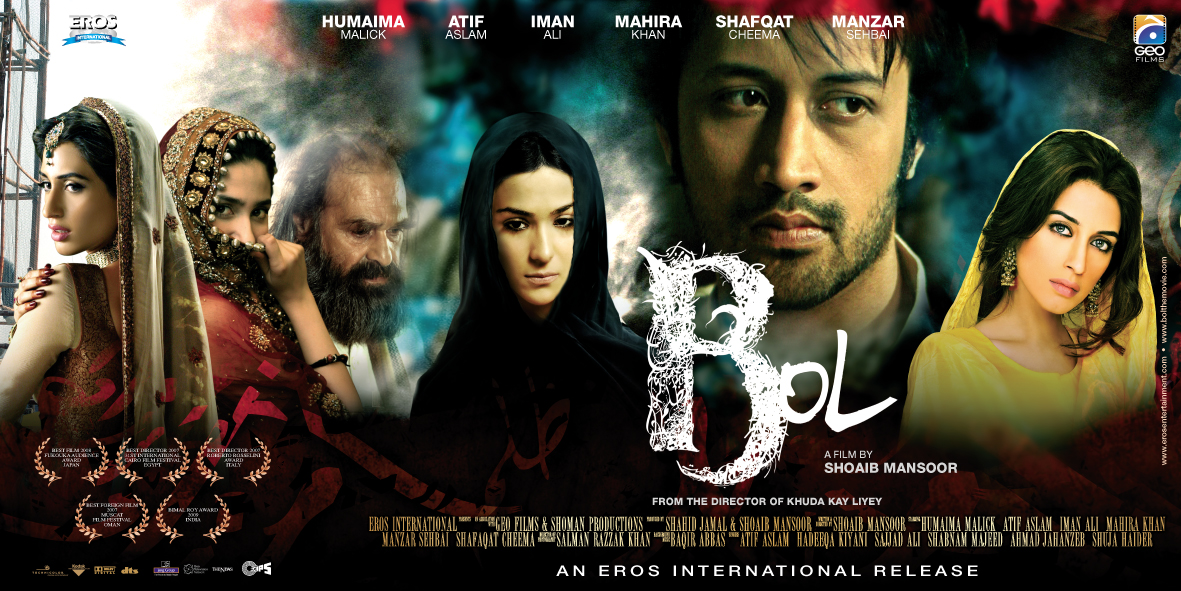
Talented director Shoaib Mansoor is back with a hard hitting social drama tittled ‘Bol’ after his critically acclaimed and award winning ‘Khuda Kay Liye’.

Eros International’s ‘Bol’, in association with Geo Films and Shoman Productions is the story of a girl, a daughter who stands up and challenges the age old societal norms of treating women as lesser beings.

The movie stars renowned Pakistani actress Humaima Malick in the lead and singing sensation Atif Aslam and Iman Ali along with many other renowned Pakistani actors.

The movie which released in Pakistan on 24th June along with Double Dhamaal has been declared a super hit as it has received a tremendous opening and grossed about 49 lacs on the first day beating many high grossers like Ready and My Name Is Khan. (Ready’s first day grossing was 40 lacs).

The movie has received outstanding reviews that talk about how the director Shoaib Mansoor who explores the rights of women and treads no-go areas like homosexuality and the life of eunuchs besides Shia-Sunni dynamics in a nation dominated by Sunnis.

Produced by Shahid Jamal and Shoaib Mansoor, ‘Bol’ is based in Lahore & aims at highlighting the sorry plight of women who are treated as a worthless burden to a family in most parts of the society.

‘Bol’ is slated for an Eid release on 31st August in India and rest of the world.

John Lennon- Imagine

Slain Pakistani’s Daughter Takes Up His Cause

By Nahal Toosi for The Associated Press

A day after her father was gunned down by an Islamist extremist, a grieving Shehrbano Taseer wrote on Twitter, “A light has gone out in our home today.” It wasn’t long before the 22-year-old realized something else: Her father’s death had lit a fire in her.

In the months since, the daughter of the late Punjab province Gov. Salmaan Taseer has emerged as one of Pakistan’s most outspoken voices for tolerance. Through her writing and speaking, she warns any audience who will listen of the threat of Islamist extremism, and impatiently waits for her father’s killer to be brought to justice.

And yes, sometimes she gets scared. She’s received threats from militants, who’ve warned her to remember her father’s fate.

“These extremists, they want to tell you how to think, how to feel, how to act,” says Taseer, a slim, elegant young woman with intense brown eyes. “It has made me more resolute that these people should never win.”

Salmaan Taseer was assassinated on Jan. 4 at a market in Islamabad by one of his own bodyguards. The confessed killer, Mumtaz Qadri, boasted that he’d carried out the slaying because the outspoken politician — a liberal in Pakistani terms — wanted to change blasphemy laws that impose the death sentence for insulting Islam.

To the horror of Taseer’s supporters, many Pakistanis praised the assassin. Islamist lawyers showered Qadri with rose petals, and major Muslim groups, even ones considered relatively moderate, said Taseer deserved to die because, in their view, speaking out against the blasphemy laws was tantamount to blasphemy itself.

Two months after Taseer’s killing, gunmen killed Shahbaz Bhatti, the sole Christian minister in the government and another opponent of the blasphemy laws, which have often been used against Pakistan’s Christian minority. Bhatti’s killers left a note promising to target others who pushed to change the laws.

Shehrbano Taseer still has trouble remembering those first moments and days after her father’s death — her brother telling her their father was gone, the rush of grief, the hundreds of people flooding her family’s home in the eastern city of Lahore. Mostly, it’s a blur.

“I’d never lost anyone in my life, not a friend or anyone,” she says. “For everyone else it was the governor and their leader and this man, and it was this big, sexy story and it was so sensationalist. But for me, it was my father.”

Taseer majored in government and film at Smith College in Northampton, Massachusetts, and is by profession a journalist. She spends much of her time now writing columns and traveling in and beyond Pakistan to speak about Islamist extremism.

Salmaan Taseer, a father of seven, was not afraid to be blunt — a trait that attracted both enmity and grudging respect. On Twitter, Salmaan Taseer openly taunted and trashed extremists, once tweeting that he’d never back down on the blasphemy issue, “even if I’m the last man standing.”

His daughter, who tweets under the handle shehrbanotaseer, is more gentle but just as firm. Her more than 9,000 followers on Twitter often receive notes that criticize Pakistan’s discriminatory laws, especially blasphemy claims that have reached the courts since her father’s death.

When she singles out a politically marginalized community, either on Twitter or her other outreach, Taseer recalls how well her father treated that group, how he was often the only public official to visit their homes after an attack or publicly speak on their behalf.

Once, Salmaan Taseer took his daughter along on a visit to meet Mukhtar Mai, a Pakistani woman whose case attracted international attention because of allegations that she was gang-raped on the orders of a village council. The governor asked Mai to put her hand on his daughter’s head, so that Shehrbano Taseer could gain the same courage to stand up for her rights.

Like her father and Bhatti, the Christian leader, Taseer wants the blasphemy laws amended to prevent their misuse.

The laws are vaguely written, and often used to persecute minorities or settle rivalries, rights activists say. The state has not executed anyone under the law, but the accused may spend years in custody. Some defendants have been killed by extremists after being freed by the courts.

But Taseer has found that many Muslims, even moderate, liberal ones, are extremely sensitive about blasphemy.

She recalls giving a speech in England when a woman in the audience suggested that her father deserved what he got because he was so blunt about the topic.

“I said, ‘I don’t care what he said, and I don’t care how he said it. He didn’t deserve to be shot and killed for it,'” Taseer says.

She’s dismayed at the toll extremism is taking on Pakistan by spawning violence or an intolerant mindset. She’s also disappointed at how few Pakistani leaders are willing to take a public stand against extremism or how many find some reason to excuse it.

She bemoans how for decades moderate or liberal leaders in Pakistan have appeased the religious right for short-lived political gains — whether it was by banning alcohol and nightclubs or passing laws that discriminate against certain religious sects.

Unlike many Pakistani politicians, she’s willing to criticize the role Saudi Arabia has played in funding numerous hardline Islamist schools in Pakistan. And she’s quick to note that the United States as well as Pakistan says little about it — after all, it needs Saudi Arabia’s oil.

Pakistan has a tradition of dynastic politics. The most famous political family has been that of the Bhuttos, which spawned former Prime Minister Benazir Bhutto, also assassinated by Islamist extremists. Salmaan Taseer was a member of the Bhutto-led Pakistan People’s Party.

Shehrbano Taseer says she views Pakistan as an enticing challenge akin to a Rubik’s Cube because of its many, convoluted problems. But she says she has no plans to run for office. “It’s such a dirty profession,” she says, laughing.

Sherry Rehman, a People’s Party lawmaker who also has been threatened for speaking out against the blasphemy laws, says Shehrbano Taseer will “chart her own future.”

“She’s found a torch to carry, and she will do it,” Rehman says. “It’s what her father would have wanted.”

Taseer is frustrated with the Pakistani justice system’s delays in processing the case of Qadri, her father’s confessed killer.

Pakistan’s courts have very low conviction rates, even in terrorism cases. Qadri’s confession may not be enough to persuade a court to punish him, considering the threats facing any judge who dares pass such a judgment.

Taseer wants the former bodyguard to spend his life in prison, in solitary confinement. A death sentence is “too easy,” and a conviction would send a warning to other would-be assassins, she says.

“In Pakistan, we have very few brave and honest leaders,” she says. “We need our heroes alive.”

With Friends Like Pakistan…

By Manzer Munir for Pakistanis for Peace

Many people in Pakistan these days are wondering why their nation often finds itself on the wrong side of recent history. First, there is the continued and unjust imprisonment of a Christian Pakistani woman named Asia Bibi who has been languishing in jail for nearly two years. She has been given a death sentence for allegedly making derogatory remarks about the prophet Muhammad.

Then there was the killing of Salman Taseer, who was the then sitting governor of Punjab, Pakistan’s most populous province, by one of his own bodyguards for his outspoken support for Asia’s rights and her freedom. Instead of swift punishment and public outcry at his actions, the killer, Malik Mumtaz Hussain Qadri, was showered with rose petals by some cheering members of the bar association of Lahore when he came to the courthouse for formal charges of murder. Yes, members of the judiciary were cheering his unilateral action of murdering another human being simply for his support towards a condemned non Muslim woman’s rights.

You can only imagine the warped sense of logic and justice in a country where lawyers cheer the cold blooded murder of an innocent man whose only crime was to come at the aid of a condemned Christian mother of two children.

Fast forward to a few months later, the extremists managed to assassinate the only Christian member of President Asif Ali Zardari’s government when the Minister for Minority Affairs, Shahbaz Bhatti, was killed in a hail of bullets by unknown gunmen who then managed to escape on their motorcycle. Bhatti being a Christian as well as a minister in the government, had campaigned for the release of Asia as well as for the repeal of the blasphemy laws in Pakistan that at help promote a culture of state sanctioned hatred against religious minorities in Pakistan.

The culture of fear and hatred as well as violence against the religious minorities has progressively gotten worse along with the security situation inside the country in the last ten years. If there is anything that has been proven by some of these recent events in Pakistan, it is only that the country has become the undisputed global hotbed of extremism, fanaticism, and Islamic militancy in the Muslim world. It has now morphed into a country where the Wahhabi and Salafi fanatics have successfully used fear and hate to silence the majority moderate Barelvi and Sufi Muslims of Pakistan.

When powerful moderate voices like those of Bhatti and Taseer are silenced despite having heavy protection, how safe can the common man feel about his life if he chooses to speak up against the radicals within Islam? To kill someone is against Islamic belief at its core, unless it is done in self defense but you would be hard pressed to hear that view from the religious fanatics in Pakistan. They have justified killing others over many insane reasons such as making derogatory remarks about Islam or the prophet Muhammad. They also rationalize the killing of someone over a family’s honor, thus honor killings where often young women are killed if they are deemed to have brought dishonor to their family. These radical Islamists will even want someone dead for simply uttering disparaging remarks against Islam or its prophet. It is both ironic and hypocritical to see that the same derogatory remarks towards other figures such as Jesus, Moses, Abraham or other prophets of the Quran do not meet the same outcry nor receive the same impassioned response from the masses as when Islam or its prophet Muhammad are criticized.

The seeds of this current fanaticism fanning the flames of hatred were planted during an earlier conflict, this one involving the Soviets against an under matched adversary in Afghanistan. It was during this time in the ‘80’s when the Pakistani dictator, General Zia ul Haq, was in power and he accepted American aid from the Reagan administration in thwarting the threat from the 1979 Soviet invasion of neighboring Afghanistan. At the time, Pakistan’s ISI worked very closely with these “freedom fighters” waging what many thought was a just jihad against a communist foe who disallowed all religious worship. In fact, a good movie to rent right now to put some of these current events in perspective would be Charlie Wilson’s War starring Tom Hanks which details this era of Pakistan-US relations and cooperation against a common enemy in the Soviets.

The trouble now however is that in this current uneasy alliance between Pakistan and the US, there is not a common enemy, at least not as how it is viewed by many in Pakistan, which recently was polled to be the most anti-American nation in the world. Even though radical Islam and fanaticism is as much a threat to Pakistan’s sovereignty and prosperity as it is to the United States, India has always been seen as the big threat by its army and rulers. Pakistan has long seen Afghanistan as a country offering it strategic depth in any future wars with India. Thus, its interests in Afghanistan do not coincide with those of the United States.

The Pakistani media also constantly feeds a steady news diet of bombings by the Taliban/Haqqani network as well as any one of the other fill-in-the-blank militants groups seemingly operating freely from within its borders. There is also the regular news reports of US drone attacks and NATO actions in the AfPak region, as well as the all ubiquitous and constant threat faced from India, who is still seething from the Mumbai bombings in 2008, which were blamed on Pakistani trained terrorists. To further add insult to their injury, not a single leader of the Lashkar E Taiba has been convicted in Pakistan for the attacks in Mumbai that claimed 174 deaths and seriously injured several hundred others.

To the Indians, the perpetrator of their version of 9/11 is not an Arab from Yemen named Osama, but rather a whole nation state with whom it has fought three wars in 60 years and who is a long time sworn enemy with which it shares a long border. Too often it is rightly assumed by many that Pakistan will not act against Lashkar E Taiba and other openly anti-Indian militant groups because these groups are seen as a strategic asset for use against India. Only the fear of an all out nuclear war between the two nations by a trigger happy Pakistan placated India enough so that New Delhi did not immediately take military action against Pakistan after the Mumbai attacks.

So this culture of fear from all enemies both foreign and domestic to Pakistan’s sovereignty is now at an all time high within the nation. With a several decade long war on its western border in Afghanistan as well as the constant threat from its arch enemy to the east in India, Pakistan has never felt more threatened or squeezed. This pressure is now only going to get ratcheted higher since last week’s killing of Osama Bin Laden at a compound in a suburb of Islamabad, Pakistan. Living for five years undetected in the compound, Bin Laden was less than a mile away from the Kakul Military Academy in Abbottabad, Pakistan’s version of the famed American military college of West Point, when he was killed by a US Navy Seal team.

For the world’s most wanted terrorist to hide in plain sight in such a manner and for so many years, rightly points a lot of suspicion on Pakistan. Long suspected by many intelligence analysts, elements within Pakistan’s spy agency, the ISI, naturally now attracts a lot of suspicion in their possible involvement in the whole affair. There are strong voices and calls within the US Congress to halt all aid to Pakistan in light of Bin Laden’s death. We certainly can assume that any other country in the world found to be harboring terrorists would already have been labeled a state sponsor of terrorism and would be facing immediate sanctions from the international community. “You are either with us or against us” were the words so famously uttered by then President Bush to Pakistan specifically after 9/11. But due to Pakistan’s importance for a successful pullout from Afghanistan of US troops, as well as its strategic position within the Islamic world, neither side can afford to cut off relations with each other.

Although the Obama administration stopped short of claiming that the corrupt civilian government of Zardari was directly involved in protecting and sheltering Bin Laden, all signs point to complicity to some extent by some segments within Pakistan’s hierarchy. There is near unanimous agreement among many in Washington, and this is true on both sides of the aisle, that there are many sympathizers of the Taliban and Al Qaeda within the ranks of the army and the intelligence agencies of Pakistan.

Having driven the Soviets out of the region with the help of militant jihadi groups like the Taliban, no doubt a cadre of army and intelligence officers must have come to espouse the belief that it is in Pakistan’s best interests to have a religiously frenzied force available to use as a weapon against India in a future conflict also. In fact, Pakistan has always had this policy of seeking strategic depth in Afghanistan against India.

The death of Osama Bin Laden in Pakistan by Special Forces of the American military illustrates just what a duplicitous game the country has been playing with the United States and more importantly with itself. In the war on terror America lost nearly 3,000 citizens in the attacks on 9/11. In that same period stretching the last ten years, Pakistan has lost nearly 31,000 citizens to terrorist attacks by the Taliban, Al Qaeda and other militant groups. So it has always been in Pakistan’s best interests to fight the militant threat brewing in its borders the last two decades that has claimed so many lives and caused so much instability.

The murders of Salman Taseer and Shahbaz Bhatti illustrates the dire situation within Pakistani society where many young underprivileged men gravitate towards Osama Bin Laden’s ideology of hate against the US, which is seen by many, as the aggressor in an already very anti-American country. Also western ideas, religious and political liberties, and freedoms, such as those for women in western society, are all seen by the Islamic clergy and religious establishment as being against Islamic doctrine and clashing with the Muslim way of life. Therefore, the madrassahs and the masjids continue to espouse rhetoric against the American and European way of life which is seen as contradicting the teachings of the Quran. Even moderate Muslims and their sites of worship have come under heavy attack by the militants as witnessed by a new strategy of attacking Sufi Muslim shrines and mosques. Pakistan may not want to admit it, but there is a raging war going on within itself for the control of Islam and the attack on moderate Islam by the extremists within the religion.

The Bin Laden killing makes Pakistan seem either highly incompetent about knowledge his whereabouts or at the very least appear to be deeply complicit in sheltering and keeping him hidden while the United States launched the biggest manhunt in US history. At this point, the United States justly feels betrayed and distrustful towards anyone in the Pakistani establishment. After all, how are they to know who now to trust in the army or the civilian government?

It is imperative that Pakistan mount an immediate and urgent investigation that has the full cooperation and assistance of the US so that both countries can discover the source of this support system that Bin Laden has had from within Pakistan. Certainly, some heads do need to roll in Islamabad over this. Whether those resignations be of the current ISI chief, Ahmad Shuja Pasha, head of the army, General Ashfaq Parvez Kayani, or Zardari and Gilani themselves, as some accountability needs to occur. This is important not just for the sake of American-Pakistani relations, but just as importantly for the benefit of the Pakistani populace who is both deeply embarrassed by breach of Pakistan’s sovereignty, but also for the intelligence failure by the government of Pakistan at Osama’s whereabouts. Until and unless Pakistan makes this investigation a top priority, USA and Pakistan relations will continue to slide downhill and will mire further in distrust.

Pakistan must realize that in this global war against religious Islamic fanaticism, it cannot continue to speak from both sides of its mouth. Not when everything, including its very existence is at stake. It cannot at once be both a front line ally in the war against terror and receive billions of dollars in US aid, and at the same time, be found to shelter or allow terrorists and militant organizations safe havens and allow them to operate within its territory.

It is up to Pakistan to salvage a quickly deteriorating situation. However at the time of publication of this article, it seems that President Asif Ali Zardari’s government is off to a horrible start in mending fences with the US. First the name and identity of the CIA station chief in Pakistan was leaked by someone in the ISI to members of the local press. This leak compromised his mission and even poses a danger to his life as the anonymity of all operatives is a necessary requirement in intelligence work.

Then later in the day, in remarks given by Pakistan’s Prime Minister Yousuf Raza Gilani to its Parliament, he defiantly stated that neither Pakistan’s army nor its intelligence agency should be suspected by the Obama administration for providing support to Bin Laden. Gilani also went as far as to say that any future unilateral action by the US or any other nation inside Pakistan’s territory will be met with like force. I thought to myself, did he really just that? Did Pakistan just threaten the United States? It is appalling to see the political posturing now being done by the Pakistani government and the long term negative consequences they will have on the nation.

For a country that is receiving nearly $3.5 billion in US aid yearly, these are very tough words that will undoubtedly only make the strained relations between the two countries worse. Pakistan should realize that United States wants to feel that it can trust it to be a full partner in the fight against militancy and extremism. And unless this distrustful and at times, very adversarial relationship changes, the United States cannot help but feel that with friends like Pakistan, it does not need enemies!

-Manzer Munir, a proud Pakistani American and peace activist, is the founder of Pakistanis for Peace and blogs at http://www.PakistanisforPeace.com as well at other websites as a freelance journalist and writer. 

Low-key Easter Preparations for Pakistan’s Christians

By Kamran Haider for Reuters

Christians in the small Pakistani town of Gojra are making low-key preparations for Easter this year.

Residents of the neighbourhood, known as Christian Colony, in the town in Punjab province, are haunted by memories of a 2009 attack by a Muslim mob in which seven members of a family were killed and dozens of houses torched.

A few days before Easter, which Christians believe marks the resurrection of Jesus Christ three days after his crucifixion, bare-foot children played cricket in the town’s dusty alleys while some men chatted on a bench under a tree.

“If we celebrate it with a fanfare, we fear somebody might get annoyed and attack us,” said Khalid Anjum, 45, the owner of a small snooker hall. The only sign of the approach of Easter was a few young men rehearsing hymns in St. Mary’s Catholic Church.

“Fear is there but we cannot give up our religion,” said Wilson Rafiq, the leader of the group of singers, who plays a traditional drum set known as a tabla.

Pakistan was founded in 1947 as a home for the Muslims of South Asia at the end of British colonial rule, with the country’s founding father, Mohammad Ali Jinnah, promising that all communities would be able to worship freely.

But today, Jinnah’s pledge of religious tolerance often seems hollow as religious violence increases. Religious minorities account for about 4 percent of Pakistan’s 170 million people, with about three quarters of members of religious minorities Christian.

The independent Human Rights Commission said at least 100 people from minority communities were killed in 2010. The bloodiest attack was on Ahmadis, a sect that mainstream Muslims consider heretical, when 86 people were killed.

This year, the liberal Muslim governor of Punjab province, Salman Taseer, and Christian Minorities Minister Shahbaz Bhatti, were killed in separate shootings for speaking out against a blasphemy law aimed at defending Islam.

Under the law, anyone who speaks ill of Islam and the Prophet Mohammad commits a crime and faces the death penalty but human rights activists say the law’s vague wording has led to its misuse, often against members of minority religions.

Compounding a climate of fear, Islamist militants, angered by Pakistan’s alliance with the United States since 2001, have carried periodic attacks on minorities as part of a campaign to destabilise the state.

“FEAR IN THEIR HEARTS”

In Gojra’s Christian Colony, the level of fear has increased since the sentencing Monday of a Muslim to death for shooting dead two Christians who had been accused of blasphemy.

Rather then welcoming what some people might see as justice, Christians fear that if the sentence is carried out, it will only mean more trouble for them. “Things will only get worse. If one is punished, someone else will stand up to take revenge for him,” said housewife Shahida Kashif.

“My kids still get scared whenever there’s a small disturbance. They says ‘mother, they’ve come. They’ll set fire to our houses again’. They still have fear in their hearts,” she said, referring to memories of the 2009 riot.

A mob of about 1,000 Muslims, incensed by rumours that a Christian had desecrated the Koran, rampaged through the neighborhood, firing guns and throwing petrol bombs.

Hameed Pannum Khan was shot dead and six members of his family, including two women and two children, were burnt to death when their hut was torched.

Authorities blamed militants linked to al Qaeda and the Taliban for the violence. Abdul Khaliq Kashmiri, a Muslim prayer leader, was locked up for 15 months on charges of inciting the attack.

He was recently released after Christians, fearing his continued detention would only make things worse for them, told authorities they had no proof of his involvement. Kashmiri denied any part in it and appealed for tolerance.

“Everybody should follow their own religion and should stop slinging mud at others,” he said. Christian Allah Rakha, a relative of the family killed in 2009 said the hatred had to stop for the sake of future generations.

“We all should get rid of this evil,” said Rakha, 70, sitting on a threadbare sofa in the drawing room of his single story home. “If we talk of revenge we’ll never have peace.”

Why Pakistan’s Taliban Target the Muslim Majority

By Omar Waraich for Time

Although Pakistan’s headlines are dominated by the violent excesses of Taliban extremists, the majority of Pakistanis subscribe to the more mystical Sufi tradition of the country’s Barelvi school of Islam. And attacks on their places of worship are becoming depressingly familiar. Last Sunday, two bombers attacked the 13th Century Sakhi Sarwar shrine, near the southern Punjabi town of Dera Ghazi Khan, slaughtering 50 people and injuring twice as many. Mercifully, two other bombers failed to detonate their devices, preventing even higher casualties. Still, it was the deadliest assault yet on a Sufi shrine in Pakistan — and the sixteenth in the last two years.

The Pakistani Taliban swiftly claimed responsibility for the attack, as they have done for each previous one. Pakistan’s Taliban claims the mantle of the hardline Deobandi tradition, with many beliefs in common with the austere Wahabism of Saudi Arabia. They regard the Barelvi, who comprise more than three quarters of Pakistan’s Sunni Muslims, as irredeemable heretics. The Barelvis favor a more tolerant approach to Islam, promoting a cult of the Prophet and incorporate folkloric traditions such as seeking intercession from rural saints. Sakhi Sarwar, a mystic who is also revered by some Hindus and Sikhs, is said to grant women a son — a local legend that rouses anger among Islam’s more literalist adherents, who ascribe such powers only to Allah.

Tensions between Deobandis and Barelvis have punctuated most of Pakistan’s history. But with the arrival of al-Qaeda in the country a decade ago, local militants forged links with the global jihadists, their sectarianism sharpened to accept al-Qaeda’s “takfiri” worldview that deems adherents of other strains of Islam as deviant apostates worthy of death.

One reason for the uptick in sectarian-based terror attacks may be that the militants’ ability to strike the high profile urban targets that once grabbed global headlines has been diminished by Pakistani military offensives in their strongholds over the past two years. “It has become harder for the militants to strike hard targets,” says security analyst Ejaz Haider. “Some lessons have been learned from the previous attacks.”

So, the militants have, over the past two years, more keenly focused on sectarian attacks. Traditional Shi’ite processions are now routinely targeted by suicide bombers. In May 2010, two mosques of the minority Ahmedi sect were targeted in Lahore, killing 93 people. And there’s been an escalation of bombings directed against the majority Barelvis. After attacks on two of their most prominent shrines, Data Darbar in Lahore’s old city and Abdullah Shah Ghazi in Karachi, Barelvis came out on to the streets, wielding weapons and vowing revenge against the Taliban. They did not extend blame to the broader spectrum of Deobandis, perhaps wisely evading the beginnings of a more gruesome sectarian conflict that Pakistan can ill-afford.

Not all Barelvis are the models of peace and tolerance that some have portrayed them to be. It was a Barelvi, Mumtaz Qadri, that assassinated Punjab Governor Salmaan Taseer in January, for his opposition to Pakistan’s prejudicial blasphemy laws. The assassination was applauded by 500 Barelvi scholars in a joint statement. And the Sunni Tehreek, a Barelvi militant outfit, rewarded Qadri’s family and threatened Taseer’s daughter. While they may favor a more permissive vision of Islam, certain Barelvis are quite capable of violence where they feel the Prophet has been dishonored.

The campaign to defend Pakistan’s blasphemy laws from reform has, in fact, united Barelvis and Deobandis since last November. Barelvi anti-Taliban rhetoric was also put on pause. “We had seen the Barelvis getting ready to organize a campaign against the Taliban,” observes analyst Nasim Zehra, “but they got sidetracked by the blasphemy issue and this was forgotten.” Until last month’s assassination of Minorities Minister Shahbaz Bhatti, the religious right was able to frequently draw tens of thousands on to the streets.

Sectarian hatred aside, rural shrines are a far easier terror target than the more heavily guarded state and economic targets in the cities. Suicide bombers, especially the teenage boys favored by militants, can often evade notice before they reach the target. A crowded space helps secure the militants’ aim of causing high casualties. In the case of the Sakhi Sarwar bombers, they only had travel to a relatively short and unimpeded distance from North Waziristan to the edge of Punjab.

The bombings may also be an attempt to relieve pressure from sporadic Army actions against militants in the northern tip of the tribal areas. “Just to remain alive there, the militants have to try and force the government’s hand into diminishing pressure,” says analyst Haider. “To counter that pressure, they mount attacks in the mainland in the hope of securing some deal back in the tribal areas.” By targeting shrines across the country, the militants are able to demonstrate their enduring geographical reach and expose the state’s vulnerabilities.

The bad news is that the state is in a poor position to respond. After the latest bombings, Barelvi leaders denounced the Punjab provincial government for failing to provide security at shrines. The Punjab government dismisses the charge. “It’s happening all over,” says Ahsan Iqbal, a leading politician from the Pakistan Muslim League-N, the ruling party in Punjab. “This is not something that is province-specific.” Iqbal casts blame on the federal government for failing to share intelligence. The federal government reverses the charge, and argues that the law and order is a provincial responsibility. What no one seems to be focusing on is the desperate need to enhance the police’s capacity, with better equipment, counterterrorism training and an intelligence gathering network that reaches deep into Pakistan’s remote areas.