Archive for the ‘ Desi ’ Category

India, Pakistan Try ‘Trade Diplomacy’

As Reported by AFP

India and Pakistan, still at loggerheads on Kashmir and no closer to a full peace deal, are channeling their efforts into increasing trade in the hope that business can bring them together.

31-year-old Karachi food trader Kashif Gul Memom is among those eager to seize the opportunities offered by easier links between the estranged neighbours, which have fought three wars since independence in 1947.

“This is a change for the good. It’s an exciting time,” said Memom, one of the generation born after the painful partition of the subcontinent that gave birth to India and the Islamic republic of Pakistan.

“My generation of business people is putting the past behind us. We’re looking to the future, India is such a huge market for us,” Memom told AFP while at the largest ever Pakistani trade fair held in India.

The improved relations between the nuclear-armed rivals stem from Pakistan’s decision to grant India “Most Favoured Nation (MFN)” status by year end, meaning Indian exports will be treated the same as those from other nations.

In further progress, the neighbours opened a second trading gate in April along their heavily militarised border, boosting the number of trucks able to cross daily to 600 from 150.

India now also says it is ready to end a ban on investment from Pakistan and the countries are planning to allow multiple-entry business visas to spur exchanges — a key demand by company executives.

The warming commercial ties underline the new relevance of the private sector in the peace process, with prospects still low for any swift settlement of the “core issue” of the nations’ competing claims to Kashmir. The divided Himalayan territory has been the trigger of two of their three wars since independence.

Indian and Pakistani officials have been looking at the so-called “China option” as a model, with deepening economic engagement seen by experts as crucial to establishing lasting peace in the troubled region.

Beijing and New Delhi have been pursuing stronger economic ties while resolving outstanding political issues, such as a festering border dispute that erupted into a brief, bloody war in the 1960s.

“There is no other option but economic partnership between India and Pakistan — this leads on to other partnerships,” Indian Commerce Minister Anand Sharma said at the April trade fair in Delhi, a follow-on to a similar venture in Lahore earlier in the year.

“We have to recognise our true trade potential and leave our children with a legacy that ensures prosperity, harmony and peace.”
Some Pakistani businesses have protested against the trade opening, fearing they may be swamped by cheaper Indian goods, especially in drugs, auto parts and consumer goods. But others eye the possibilities India’s market offers.

“India with 1.2 billion people gives us great potential,” Mian Ahad, one of Pakistan’s leading furniture designers, told AFP.
Indian businessmen are equally enthusiastic, saying there is an opportunity for trade in areas from agriculture, information technology, pharmaceuticals, and engineering to chemicals.

Official bilateral trade between India and Pakistan is just $2.7 billion and heavily tilted in New Delhi’s favour.
But Indian business chamber Assocham estimates up to $10 billion worth of goods are routed illicitly — carried by donkeys through Afghanistan or shipped by container from Singapore and the Gulf.

Indian commerce secretary Rahul Khullar told AFP that Pakistan’s decision to grant India MFN status by the end of the year was “the game-changer.”
MFN status will mean India can export 6,800 items to Pakistan, up from around 2,000 at present, and the countries aim to boost bilateral trade to $6 billion within three years.

“I’m cautiously optimistic. Commerce is an excellent way to bring countries together,” Indian strategic analyst Uday Bhaskar told AFP.
“Once you institutionalise trade, it becomes hard to slow the momentum for cross-border exchanges. People say if there are onions or cement or sugar available next door, why can’t I have them? And why can’t I travel there too?”

India and Pakistan: The Truth of the One Nation Theory

By Aakar Patel for FirstPost

The first time I came to Pakistan, I was taken aback at how good some of the infrastructure was. The airports at Karachi and Lahore were small, but they were efficient and well designed. I think my host told me the Japanese had built one or both of them, and those airports were a very different thing from the ones I had just taken off from in India.

This was when the government made the airports and as with all things the Indian government takes up, our airports were clumsy and barely functional. But a few years later this changed. Today the airports at Mumbai, Delhi and Bangalore are pretty good. They’re not world class (nothing in India can ever be), but they are not embarrassing as the earlier ones were.

The differences that I had thought were significant turned out not to be so.

This led me to think of how similar we were as nations. Not in the sense that Mohd Ali Jinnah meant. I think it is fairly obvious that the character of India and of Pakistan is different when we observe their constitutions. India’s secularism is fundamentally Hindu in its nature. Pakistans constitution is Islamic by design and in appearance.

Though this is an important aspect of nationhood, however, it is only one aspect.

What I mean is how we are one nation in all the negative aspects. Our neighbourhoods and streets are among the most shameful in the world, because we are selfish and blind to the concern of others. Delhi’s drivers are as terrible as those in Lahore (and the women of Delhi and Lahore would concur on the behaviour of the loutish men of those cities). Half of us are illiterate and the half who are literate don’t really read much. The comments sections of Indian and Pakistani websites are the most dreadful in the world, without qualification. Hateful and pedantic, the product of minds who are only functionally literate. We think time will bring some big change in our society but it isn’t easy to see where this change is going to come from.

I know of few other nations where people would not be embarrassed at the thought of keeping servants. Few cultures would be so unaffected, so uncaring of privacy to not mind the constant presence of the servant in the house. I am not even talking about the bestial manner in which we treat them, because every reader of this piece, whether Indian or Pakistani already knows what I mean.

We divide ourselves into nations based on things like which animal the other eats or does not eat. The outsider probably sees no difference between us, and rightly.

We produce very little of meaning to the outside world, and it is tough to think of what our contribution is to the nations from whom we take so much. In science and technology we have nothing to offer the West, despite the boasts of Indians that we gave the world Arabic numerals and zero (I agree with that; we have given the world zero).

Pakistanis stake claim to Islams golden age. Daily Jang columnist Hassan Nisar often takes up this point. He says that the Arabs laugh when Pakistanis owns Islams achievements. What aspect of the conquest of Spain or the scientific revolution in Baghdad did Punjabis and Sindhis participate in?
To the world we are one people in that sense.

My friend Col Iftikhar, from Musharrafs batch in the Pakistan Military Academy, said he discovered this horrifying fact when he went to Mecca a few decades ago for Haj. He met some Saudis, one of whom asked him where he was from. Lahore, said Ifti. Where’s that, the Saudi asked (this was in the 70s). Pakistan, said Ifti proudly. Where’s that, the puzzled Saudi asked. Ifti took out a map and pointed. Ah, said the Saudi to his friends, he’s Hindi.

Our problems are so primitive that they should make us stop and repair ourselves immediately. But they don’t seem to affect us at all. Our media carry on like we are normal people. Reading the militant bombast of the strategic affairs experts in the newspapers of these two nations, the outsider would never suspect that these were two nations unable to even keep their public toilets clean.

iPakistan- Rebranding Pakistan

About

iPakistan is simply an intitative to bring Pakistan to the world and the world to Pakistan.

WHO ARE THEY?

iPakistan ia a group of university students and young professionals who are done whining about Pakistan’s image and want to do something about it. Most of them are studying in foreign universities and so have first hand experience of various kinds of stereotypes that Pakistanis overseas face as well as the tarnished image of the nation is portrayed in other countries.

Sadly, terrorism has become synonymous with Pakistan. There was this one time when a team member of this group was asked as a serious question by a Chinese students : “Does your family have any Taliban?” IMAGINE!

So iPakistan and iLahore are collaborative efforts about changing this wrongly propagated image, and even if we the group members are only able to neutralize one person’s opinion, they will feel happy that they made a small difference.

THE TEAM

Founder – Rehman Ilyas

He is the guy most pissed about Pakistan’s image and hence the one who came up with iPakistan and iLahore. He studies Economics and Finance at the University of Hong Kong and is particularly interested in Development Economics. Reads up on Chinese economy a lot and plans to heavily promote Chinese recipe of economics success, and apply it to Pakistan with a few unique ingredients of his own, through the Business section of ilahore.

Mentor – Khalid Malik

Mr. Khalid Malik is a famous Business Studies A-Levels teacher in Lahore. He is a visiting lecturer at various top schools including LGS Defence, LGS Paragon, SICAS etc. Recently he has been gaining further acclaim for his efforts to get the beloved festival of Basant, back to the people of Lahore.

Mentor – Ali Murtaza

Mr. Murtaza is a visiting professor at Beacon House National University (BNU) where he teaches design and illustration. In addition he works for a social marketing company and does commercial web site designing. His awesome illustrations, animations & creations have earned him the prestigious

Fulbright scholarship recently.

Editor Health – Burhan Ahmad
MBBS
Founder & CEO Medicalopedia, LLC

Editor Tourism – Muhammad Zargam Arshad

“BBA Accounting and Finance student at University of Hong Kong. Zargam is fondly known as “Ziggy”. He has extensive travel experience: Saudi Arabia, Hong Kong, Austria, England and of course Pakistan! Fond of reading two diverse types of poetry: Modernist and Sufi poetry. Currently working with
“YES Network” on breaking down discrimination barriers in Hong Kong society. “

Editor Fashion – Khizra Wynne

Although i have crippled my four senses while Majoring in Economics and Finance but, the sense of sight still stands to fight because it’s all about living to look ravishing.

Editor Wisdom – Hassan Riaz

Hassan is an engineering student at the University of Hong Kong and claims to be very ‘Wisdomistic’.

Editor Religion – Syed Abrar Ahamd

Abar is an active member of the Muslim Scoiety at the University of Hong Kong and wants to share his passion for Islam and peace through ‘religion’ ilahore.

Editor HumourAli – Mohiudin Ahmad

There is no single description which fits Ali, and you will get to more about him andh is personality based on his upcoming awesome humour at iPakitsan.

Editor ‘Read’ – Hinna Malik

Hinna did her Masters in Mass Communication from the University of Surrey and has worked in RBS for several years.

Editor Music – Muhammad Hamza Bukhari

Hamza is a Biotechnology major in the University of Hong Kong and claims that there isn’t a single article/ blog on metal music that hasn’t passed through his eyes.

Editor Food – Mahnum and Mahnoor

The awesome duo loves dining out and usually are present at every restaurant opening.

Editors, Romancing the Border – Pulkit Saneja, Shirin Soni, Sonica Dunichand, Rehman Ilyas

Sonica and Rehman are from Pakistan, Shirin and pulpit from India and they are typicals, fighting and arguing over Kashmir, Sania Mirza and other crucial issues on a day to day basis.

Editor The world and Us – Mark Gray

“Mark is interested in issues of law and international relations. An American and a graduate from Princeton, he is currently living in Asia doing legal research, and plans to go to law school. He enjoys travel, photography, and music.”

Editor Business – Minahil Haroon

Completing her BBA in Wealth management at the University of Hong Kong. Loves Pakistan and is hoping to represent the real Pakistan through iLahore.
But they are different too, in the sense that they love each other and want to extend their love to the entire region!

Ambassadors

UK ambassador: Bilal Mustafa(Kings College)
India Ambassador: Shirin Soni ( HKU)
Karachi Ambassador: Minahil Haroon (HKU)
Multan Ambassador : Iqra Amjad (Punjab College)
Lahore School of Economics Ambassador: Mehreen Saba
LGS (JT) Ambassador: Ahmed Awais
Salamat School group Ambassador : Rahema Hassan
And counting…

Pakistanis for Peace Editor’s Note–  Groups like iPakistan and Friends Across LOC are attempting to do the same things that we here at Pakistanis for Peace are doing as well and that is to bring the people of India and Pakistan closer together. We feel that the only solution to Pakistan and India’s problems and indeed over a billion people of the sub-continent is through a dialogue and peace. The neighborhood can not suffer another war between the two, which surely would be nuclear. Let’s hope that the our vision of peace between India and Pakistan succeeds and Pakistan is able to rid itself of a terrible image globally that its wonderful people do not deserve.

More than 120 Pakistani Soldiers Lie Dead in the Snow for Nothing

By Mohammed Hanif for The Guardian

Two months before President Asif Zardari’s unexpected visit to India, a newly formed political alliance, the Council to Defend Pakistan, unveiled its slogan. “What is our relationship with India?” it asked. And then in a rickety Urdu rhyme it answered: of hatred, of revenge.

The council is an alliance between recovering jihadists, some one-person political parties and the kind of sectarian organisations whose declared aim is that Pakistan cannot fulfil its destiny until every single Shia has been killed or expelled from the country.

The council is not likely to have much impact on Pakistan’s electoral politics, but it is a clear reminder that there are strong forces within the country, which want a return to the days when India was Pakistan’s enemy No 1. Back then all you had to do to malign a Pakistani politician was to somehow prove that they were soft on India. Things have changed. When President Zardari went to India, his bitter political enemy and the opposition leader Nawaz Sharif welcomed the visit.

President Zardari’s visit on the one hand was a reminder that India is right next door. If you plan carefully, you can do a day trip, have lunch, visit a shrine and make the correct, polite noises that visitors make about their future intentions.

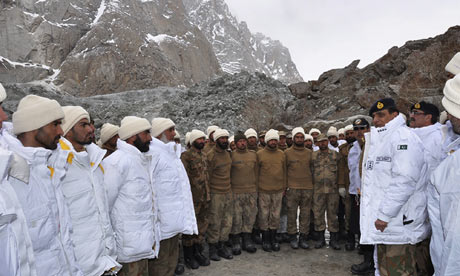
But the president’s visit was also set against a reminder that India and Pakistan have raised their animosity to a brutal art form. As the president’s plane landed in Delhi, rescue workers were trying to reach the Siachen glacier, where more than 120 Pakistani soldiers had been buried after an avalanche obliterated their military post. Siachen is often proclaimed the world’s highest battlefront – as if it’s a Guinness world record and not a monument to our mutual stupidity. As I write this, not a single survivor or body has been found. India offered help in rescue efforts. Pakistan politely declined, because that would compromise its military posts.

President Zardari’s visit was billed as a private one, but the pageantry surrounding it was state-visit like, complete with dozens of cameras broadcasting empty skies where the presidential plane was about to appear. And, of course, the media had scooped the menu for the state lunch a day in advance.

Did the visit achieve anything? An 80-year-old Pakistani prisoner in an Indian jail was released on bail. The leaders’ sons and probable heirs – Bilawal Bhutto Zardari and Rahul Gandhi – got to hang out.

There are peaceniks on both sides who have held endless candlelit vigils on the borders. They would like the borders to melt away, for all of us to come together in a giant hug and live happily ever after just like we did in a mythical past when we were all either little Gandhis or sufis and got along fine. There is another minority on both sides that would like us to live permanently in the nightmare that was partition. There are Pakistani groups who want to raise the green flag over the Red Fort in Delhi, and there are Indian hawks who go to sleep thinking of new ways to teach this pesky little country a lesson. But the vast majority – and given the size of population and ethnic diversity, that majority is really vast – would just be happy with cheaper onions from across the border.

There is another kind of coming together: Pakistani writers and artists can attend both Indian and Pakistani literary festivals and art expos, and although it’s great that they can peddle their wares to a curious audience, the rest of the population are denied that privilege. A Punjabi farmer, for example, can’t sell his often perishable produce in India, a couple of hours away, but is forced to transport it a thousand miles to southern Pakistan. If India and Pakistan could take tiny steps which weren’t just meant for the rulers and cultural tourists, it might make some difference. For instance, if there were only a couple of thousand Pakistani and Indian students studying in each others’ countries, the appetite for a war rhetoric might wane. At the moment it can’t happen because the security establishment fear infiltration. The same establishment forget that infiltrators usually don’t apply for a visa, and no suspects so far have been to an IT school in Bangalore or an arts college in Lahore.

I mention education because one in 10 children who doesn’t go to school lives in Pakistan. One in three children in the world who is malnourished lives in India. And these countries insist on sending young men to a frontline where there is no war, where there is nothing to fight over, and where 4,000 soldiers have died, mostly because it’s just too cold. Tens of thousands return with serious mental ailments because it’s so lonely and depressing. Twenty three years ago a withdrawal agreement had been agreed upon, but according to Indian defence analyst Srikant Rao, the then Indian prime minister Rajiv Gandhi backed out because withdrawing troops wouldn’t look very good in pictures. Well, troops buried under miles of snow don’t look very good either.

If India and Pakistan can’t leave each other alone, they should at least leave those mountains alone.

Pakistan Leader’s India Visit Hailed For Its Symbolism

By Mark Magnier for The Los Angeles Times

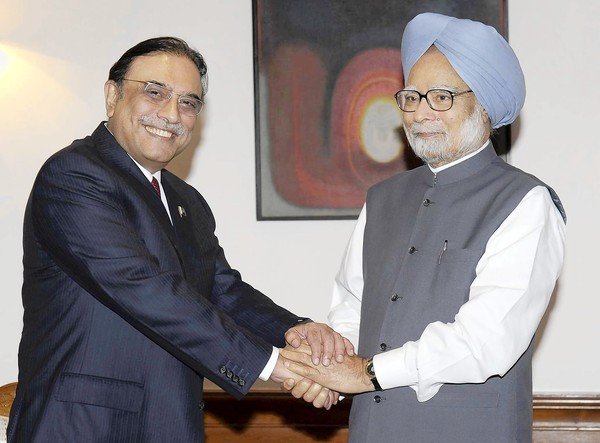
Pakistan’s president arrived in India on Sunday, the first official visit one leader of the wary neighbors has paid to the other nation in seven years. No breakthroughs were announced, but both sides hailed the meeting as a sign of easing tensions along one of the world’s most dangerous borders.

Spinmeisters on both sides worked overtime to lower public expectations of the “private” trip that saw Pakistani President Asif Ali Zardari and Indian Prime Minister Manmohan Singh discuss the 2008 terrorist attack on the Indian city of Mumbai, modest if expanding trade links, the disputed territory of Kashmir and efforts to bring various militants to justice.

The Pakistani president then visited a famous Muslim shrine for Sufi saint Moinuddin Chishti, offering a $1-million contribution.

“I am very satisfied with the outcome of this visit,” Singh said. “The relations between India and Pakistan should become normal — that is our common desire.”

The rapid-fire luncheon and shrine visit weren’t enough to overturn long-standing distrust between the nuclear neighbors, however, as summed up in a headline in India’s Mail Today tabloid newspaper: “Eat, Pray, No Love.”

The meeting is part of an apparent effort to follow the diplomatic model in place between India and China, which fought a war in 1962 over their disputed border: Put aside the most nettlesome issues for the time being and focus on building investment and trade links that benefit both sides.

This year, India and Pakistan approved a most-favored-nation agreement, lowering taxes that impede trade. Although India had offered this benefit to Pakistan in 1996, it wasn’t reciprocated until recently. Official two-way trade of about $2.6 billion is heavily weighted in India’s favor.

Sunday’s one-day visit was heavy on symbolism if not on substance. Zardari invited Singh for a reciprocal visit to Pakistan, which the Indian leader accepted, although no date was set. Zardari’s 23-year-old son, Bilawal, invited ruling Congress Party General Secretary Rahul Gandhi to Pakistan, which was also accepted, again with no date set.

On other fronts, both sides agreed in principle to ease visa restrictions. India offered its assistance in the wake of this weekend’s massive avalanche in the Siachen Glacier area, which buried about 130 people on the Pakistani-controlled side of the border in disputed Kashmir. And both sides did lots of glad-handing for the cameras.

“We had fruitful bilateral talks,” Zardari said. We “hope to meet on Pakistani soil very soon.”

But any bid to bring to justice those who planned the 2008 Mumbai attack that killed at least 166 people was sidestepped. India has long blamed Pakistani-based groups for plotting the attack.

Last week, Washington offered a $10-million reward for information leading to the capture of one Pakistani militant leader, Hafiz Muhammad Saeed, who enjoys widespread support in Pakistan.

Analysts on both sides of the divide welcomed the gradual thaw even as they acknowledged its slow pace. That no date was set for a return visit, and that Congress Party head Sonia Gandhi — characterized by some as India’s real leader behind the scenes — didn’t meet Zardari or attend the lunch, suggests the Indian government is wary of getting too far ahead of public opinion, some observers said.

“There have been some useful steps forward,” said B. Raman, director of Chennai’s Institute for Topical Studies and a former Indian intelligence officer on the Pakistan desk. “But the government has taken a cautious line.”

The fact that Zardari, 56, made the trip at all suggests that Pakistan’s military realizes improved relations are in its interest, added Talat Masood, an analyst and retired Pakistani general.

“They’re overstretched, realize the economy’s in a shambles and that you can’t have a genuine defense without a good economy,” Masood said. “It’s very sad in a way, that the process has been held hostage to jihadi groups and hard-rightists on both sides.”

Singh, 79, heading a weak government beset by corruption scandals, has pushed for improved ties with Pakistan in a bid to secure a legacy, analysts on both sides said. “Prime Minister Singh realizes he’s only going to be there a few more months,” said Masood. “He wants to do something positive so he’s remembered.”

Haley’s Comment

As Reported By Robert Walker for The Huffington Post

Like a comet streaking across the heavens, Governor Nikki Haley’s comment on The View about women not caring about contraception is drawing a lot of attention. And rightly so.

Poll after poll suggests that women do care about contraception. Case in point: Mitt Romney’s plan to shut down the family planning clinics run by Planned Parenthood has cost him dearly. His support among women has dropped precipitously in the past few months as voters learn more about his views on family planning.

When Haley and other Republican leaders opine about the lack of voter interest in contraception, it’s more wishful thinking than political insight. They recognize that the positions taken by the GOP presidential aspirants on family planning may help them in the primaries, but it will undoubtedly hurt them in the general election. As a result, they want to change the subject in the worst way.

Unfortunately for them, comments like those made by Governor Haley do nothing to shift voter attention to the issues they want to talk about, like deficits and the economy. To the contrary, they reinforce the idea that Republicans are tone-deaf on women’s issues.

Haley’s comment, in particular, appears to suggest that Republican leaders, even women like her, don’t care about a women’s access to contraception. Before making her claim, maybe she should have checked in with another Republican leader, Senator Olympia Snowe, who earlier this week said that the political attacks on contraception were “retro.”

What’s even more “retro,” however, is the unspoken half of Haley’s comment. By suggesting that women don’t really care about contraception, she’s suggesting that men could care even less. So much less that it’s not even worth discussing.

Polls, of course, suggest to the contrary. While men may feel less strongly than women do, they also care about contraception. Most men recognize that they also benefit when women are able to determine the number and timing of their pregnancies. Some men may want to keep women “barefoot and pregnant,” but it’s a pretty small minority. This is, after all, the 21st century.

As governor of South Carolina, Nikki Haley ought to appreciate the critical need for family planning services. Nearly half of all pregnancies in the United States are unintended. According to the Guttmacher Institute, South Carolina’s rate of unintended pregnancy is significantly higher than the national average. In 2006, 52,000 South Carolina residents had an unintended pregnancy, a rate of 58 per 1,000 women aged 15 to 44. Guttmacher report that births resulting from these unintended pregnancies cost the state and federal governments $254 million in 2006.

And South Carolina’s teenage pregnancy rate, while it’s been declining in recent years, is still about 25 percent higher than the national average according to the Centers for Disease Control.

A poll released earlier this year indicated that 95 percent of South Carolinians believe that teenage pregnancy is an important issue, with 85 percent supporting school-based sexuality education. Maybe, Governor Haley should go on a listening tour in South Carolina before declaring that women don’t care about contraception.

Many regard Governor Haley as a rising political star in the political firmament. She’s frequently mentioned as a possible vice presidential selection. Given Romney’s “gender gap,” adding a woman to the ticket might be a smart move, but, maybe he should find a woman who understands how women — and men — genuinely feel about contraception.

Governor Haley’s comment, like the famed Halley’s comet, will soon fade from public view, but the issue of contraception will not fade anytime soon. The war on contraception is real. State cutbacks, like those in Texas, are forcing family-planning clinics to close their doors, and if GOP leaders succeed in their efforts to eliminate Title X, the federal program that provides low-income women with improved access to family planning, more shutdowns will inevitably occur.

That’s why it’s so critically important that women — and men — pledge to speak out in support of reproductive health and rights. Don’t let the Governor Haleys of the world speak for you.

Pakistanis for Peace Editor’s Note– We profiled Governor Nikki Haley a few days before she was elected as the first Indian born female governor as well as minority woman governor of a US state and wished her well here. However, her party and ideals diametrically are opposed to ours as Democratic voters in the US elections as many Pakistani Americans now are. Thus, some of her ideas and beliefs are not necessarily our own, but we still wish her well as she is a fellow Desi~

Why President Zardari’s Visit Is A Small Bonus

By Soutik Biswas for The BBC

Hope is not a policy, but neither is despair, as South Asia expert Stephen Cohen says in a recent essay on Pakistan.

So it is with relations between India and Pakistan.

The past few days have shown how fragile the relationship can be – even as India welcomed President Asif Ali Zardari’s private trip to India on Sunday – the first by a Pakistani head of state for seven years – and PM Manmohan Singh invited him for lunch, the $10m US bounty for Hafiz Saeed, the founder of Pakistan-based militant group Lashkar-e-Taiba, provoked the cleric to openly launch a fresh attack against India (and the US).

But people live in hope, so Indian media is gung-ho about Mr Zardari’s visit.

They say the Pakistani president must be applauded for trying to end trade discrimination against India, easing petroleum imports from across the border, and moving towards a liberal visa deal.

“Under Mr Zardari’s watch, India and Pakistan are considering a sweeping agenda for economic co-operation for the first time in decades. The prime minister has every reason to welcome Mr Zardari warmly and consider the next steps in consolidating the unexpected movement in bilateral relations,” the Indian Express wrote.

Analyst C Raja Mohan believes Mr Singh must make an official trip to Pakistan after his meeting with Mr Zardari. “For his part,” he wrote, “Mr Singh should convey to Mr Zardari his readiness to move as fast and as far as the Pakistan president is willing to go.” Others like Jyoti Malhotra actually find Mr Zardari’s visit to the shrine of a famous Sufi Muslim saint in Rajasthan loaded with symbolism in these troubled times. “Clearly, Mr Zardari has stolen an imaginative moment from the bitter-sullen history of India-Pakistan, by asking to come to pay his respects to a cherished and much-beloved saint across the Indian subcontinent,” she wrote.

The relations between two neighbours remain complex. A 2010 Pew survey found 53% of the respondents in Pakistan chose India as the greater threat to their country, and only 26% chose the Taliban and al-Qaeda. At the same time 72% said it was important to improve relations with India, and about 75% wanted more trade relations and talks with India.

Pundits like Mr Cohen believe that it will “take the [Pakistan] army’s compliance, strong political leadership, and resolutely independent-minded foreign ministers to secure any significant shift of approach towards India”.

None of this appears to be in much evidence at the moment.

Both countries have seriously weakened governments that makes them unable to move towards any radical confidence building measures. In the current circumstances, President Zardari’s visit can only be a small bonus. And as scholars like Kanti Bajpai suggest, India must remain patient (even if faced with another Mumbai-style attack), continue to engage with Islamabad, help the civilian government in Pakistan politically, try to resolve a few outstanding disputes like Siachen and Sir Creek, build a relationship with the army and explore the possibility of cooperating with Islamabad on the future of Afghanistan. Despair does not help mend a stormy relationship.

Pakistan’s Deputy Attorney General Works Off Taliban’s Sins at Gurdwaras and Shrines

By Rakhi Chakrabarty for Aman Ki Asha

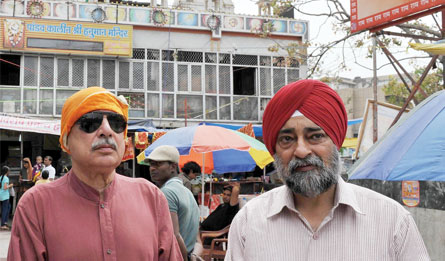
A man in a maroon kurta sits hunched on the floor on Sunday afternoon,polishing the shoes of devotees at a room in Delhi’s Gurdwara Rakabganj.
It’s a common sight in gurdwaras, except that this man is Pakistan’s deputy attorney general, Muhammad Khurshid Khan, who had requested he be allowed to perform seva (community service) at the shrine.

Khan, 62, is an eminent lawyer and a devout Muslim from Pakistan’s Peshawar province. He was recently in Delhi for a judicial conference. “I have been very keen to visit various places of worship here to promote harmony between India and Pakistan,” says Khan.
Khan’s tryst with temples and gurdwaras began in 2010 to “heal the wounds of minorities in Pakistan by becoming their sevadar (performer of service)”.

For him, it was a “penance” for crimes committed by the Taliban. In February that year, the Taliban had kidnapped three Sikhs from Peshawar and demanded a $235,000 ransom. Pakistan army rescued two of them, but the third, Jaspal Singh, was beheaded by the captors. It was after the killing, that Khan first performed service at a gurdwara in Peshawar. “I seek harmony among all religions,” says Khan, citing Pakistan’s pluralistic heritage.

“I am a Muslim, not a terrorist; I am a Khan, not a terrorist; I am from Pakistan, but not a terrorist.” This is Pakistani deputy attorney general Muhammad Khurshid Khan’s humble submission as he visits gurdwaras across New Delhi and performs seva (community service).
The Taliban, he says, has plundered Pakistan’s pluralistic heritage. “But I want to tell the world it’s unfair to tarnish a whole community for the sins of a few,” says the Pakhtoon who ran for Pakistan’s National Assembly twice.

In Delhi for a conference (along with some 200 members of the Supreme Court Bar Association of Pakistan), Khan, accompanied by Surinder Singh, a Delhi-based businessman whose father was a comrade of Subhas Chandra Bose, polished shoes at Gurdwara Sisganj and visited Birla Temple and Hanuman Mandir.

Khan told TOI that he turned to other faiths after the Taliban beheaded Jaspal Singh in Peshawar in February 2010. “When I visited the house of Jaspal, I was filled with remorse.” The killing weighed on his conscience.

He was perturbed that violence in the name of Islam brought a bad name not only to Muslims and Pakistan but also to his people, the Pakhtoons.
The next day, he went to Gurdwara Bhai Joga Singh in Peshawar and sat on the steps. He could hear the chants wafting out of the shrine. “I felt peace,” he says.The lawyer started reading about Guru Nanak and approached a member of the gurdwara management committee to allow him the opportunity for seva. After discussions, the gurdwara management committee allowed to perform seva.

“For two months, I went to the gurdwara daily before the maghrib azaan (call to prayer at sunset) and polished shoes of devotees. Sevadari is ibaadat (worship),” he says.In Delhi, Khan also went to Jantar Mantar in the hope of meeting Anna. He sent his visiting card and waited for close to an hour but could not meet Anna. But he left the place “charmed”. “It is amazing. This is democracy,” he said.
On his way back to Pakistan, he will visit the Golden Temple at Amritsar for the ‘Jora Ghar Seva (polishing shoes of devotees). He had written to PM Manmohan Singh last year to allow him a chance to perform seva at Amritsar.

“I am yet to get a reply,” he said.He has performed similar service at Hindu temples and joins church prayers every Sunday in Pakistan. “I live in a rigid society. But the ulema have never criticised me. The Hadees says anything good must be spread all around,” said Khan.
His gesture has been appreciated by Muslims and as well as religious minorities in Pakistan.

A touch of Inspiration Runs Both Ways as Sean Penn Visits Shrine and Edhi Home

By Saba Imtiaz for The Express Tribune

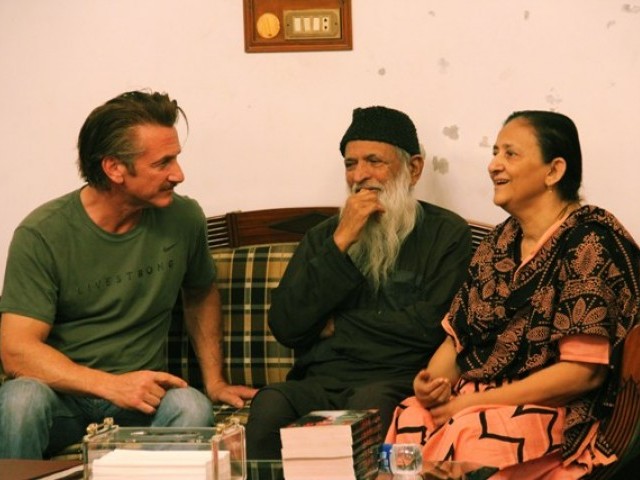
In a t-shirt, jeans and sneakers, the rather unassuming actor Sean Penn stepped out of his car to meet Pakistan’s iconic humanitarian worker Abdul Sattar Edhi and his wife, Bilquis Edhi, at their home for children on Saturday morning.

While the Academy Award-winning star of Dead Man Walking is instantly recognisable to film buffs, the Edhis were unaware of who their visitor was.
Penn, who was accompanied by US Consul General William J Martin and a slew of consular staff, told Edhi that it was a “great honour” to meet him. “Your name is brought up with reverential appreciation,” Penn said. In return, the Edhis were told about Penn’s philanthropic efforts to help the survivors of the earthquake in Haiti in 2010.

Penn toured the Bilquis Edhi Female Child Home in Clifton, dipping into classrooms where Montessori students sang the nursery rhyme ‘Are you Sleeping, Brother John?’ eliciting smiles from him and Martin. The school at the home has 250 students and offers classes till Matric or tenth grade.

“What are they working on?” he asked Ali Edhi, who was showing him around the eighth graders in the computer lab. “Word, PowerPoint, Excel,” a teacher responded. Penn was also told about the number of Edhi centres nationwide and how the organisation is open for ‘everyone – regardless of faith, class, identity.’

As the aroma of food being prepared for lunch wafted in from the kitchen, Penn stepped into a separate room to chat with the Edhis. Bilquis later told the media that Penn said he had wanted to meet them, and there had been no talk of donations or offers of help. “We get enough from Pakistanis, we do not take money from abroad,” Bilquis said. She said Penn had told them that he was happy to be there and that Pakistan was not as bad as people had made it out to be.

Consul General Martin explained: “On the Pakistan Day weekend, we brought Penn to meet Edhi, a great Pakistani who can inspire us all with his big heart and generosity.”

Penn’s first visit to Pakistan included travel to Badin and Karachi and he was expected to leave on Saturday. Before arriving at the Edhi centre, he also visited the nearby Abdullah Shah Ghazi shrine where he paid his respects.

Say Hello! to Pakistan’s Glamour Side

As Reported by The Associated Press

Pakistan is better known for bombs than bombshells, militant compounds than opulent estates. A few enterprising Pakistanis hope to alter that perception with the launch of a local version of the well-known celebrity magazine Hello!.

They plan to profile Pakistan’s rich and famous: the dashing cricket players, voluptuous Bollywood stars and powerful politicians who dominate conversation in the country’s ritziest private clubs and lowliest tea stalls. They also hope to discover musicians, fashion designers and other new talents who have yet to become household names.

“The side of Pakistan that is projected time and time again is negative,” said Zahraa Saifullah, CEO of Hello! Pakistan. “There is a glamorous side of Pakistan, and we want to tap into that.”

But celebrating the lives of Pakistan’s most prosperous citizens is not without its critics in a country where much of the population lives in poverty. Advertising one’s prosperity could be risky as well since kidnappings for ransom are on the rise and attracting attention from Islamist militants can mean death.

Wajahat Khan, a consulting editor at Hello! Pakistan, said they were cognizant of the sensitivity of publishing a glamour magazine in a conservative Muslim country where many people are struggling and planned to be “socially responsible and culturally aware.”

“We are trying to be happy in a war zone,” Khan said Saturday at a news conference with Saifullah and other members of the magazine’s editorial staff. “We are trying to celebrate what is still alive in a difficult country.”

Khan said they would do everything they could to protect the security of the people they profile, but he wasn’t overly concerned.

“I don’t think terrorist networks are going to be reading Hello! anytime soon,” he said.

Pakistan already has a series of local publications that chronicle the lives of the wellheeled in major cities like Islamabad, Lahore and Karachi, especially as they hop between lavish parties. But the producers of Hello! Pakistan hope the magazine’s international brand and greater depth will attract followers.

Hello! was launched in 1988 by the publisher of Spain’s Hola! magazine and is now published in 150 countries. It’s well-known for its extensive coverage of Britain’s royal family and once paid $14 million in a joint deal with People magazine for exclusive pictures of Brad Pitt and Angelina Jolie’s newborn twins.

The market for English-language publications in Pakistan is fairly small. Most monthly and weekly magazines sell no more than 3,000 copies, said Khan, the consulting editor. But they hope to tap into the large Pakistani expatriate markets in the United Kingdom and the Middle East as well.

Hello! Pakistan will be published once a month and will cost about $5.50, twice as much as what many poor Pakistanis earn in a day. The first issue will be published in mid-April and will focus on the Pakistani fashion scene.

Saifullah, who grew up watching her mother and grandmother read Hello! as she hopped between London and Karachi, said it took her two years to convince the magazine to publish a local version in Pakistan.

“They were concerned about whether Pakistan was ready for a magazine like this,” she said.

But Saifullah thinks the timing is perfect to showcase Pakistan’s too often hidden treasures, citing Sharmeen Obaid-Chinoy, who recently became the first Pakistani filmmaker to win an Oscar for a documentary about the plight of female victims of acid attacks in the country.

“We want to tap into the aesthetically beautiful, the athletic, the fashionable,” said Saifullah. “There is so much going on on a daily basis that nobody ever covers. It’s totally unexplored.”

Pakistanis for Peace Editor’s Note– Pakistan is much more than bombings, extremism, and terror. The launch of this magazine in Pakistan not only helps illustrate to the outside world of a modern 21st century Pakistan but also stands as a bulwark to the Talibanization of Pakistan by the extremists.

Pakistan’s Move on Trade With India Can Help in Wider Normalization of Ties

As Reported by The Economic Times

The reported move by the Pakistan government to phase out major restrictions on trade with India by switching to the negative list, and doing away with that too by the end of the year, is wholly welcome. Normalising trade relations with India will help establish a template of wider normalization of mutual ties.

An indication of deep-rooted animosities and suspicions which have stymied that goal can be seen in the opposition from quarters within Pakistan to Islamabad’s declared – and logical – aim of granting India the World Trade Organization-compliant Most Favoured Nation status next year.

But the arrangement to separate commerce from thornier issues like Kashmir and Pakistan’s actions against those accused of terror attacks against India can lay a foundation for minimising mutual distrust. For New Delhi, this would be in keeping with the idea of engaging various power centres in Pakistan, given the fractured power structure in that country.

While being perfectly aware that policy on India, like in other areas deemed to be ‘strategic’ by the military, is mostly determined by the latter, the aim should be to defang and isolate hardline elements by positing the real and tangible benefits enhanced mutual trade can offer Pakistan.

And there certainly is ample scope to do that: direct Indo-Pak trade is less than 1% of their global trade; annual mutual trade was around $2.7 billion through March 2011, which, despite being up 50% from the previous year is still measly compared to, say, India’s $60 billion annual trade with China or the potential.

But a beginning has been made with Pakistani industry backing the new move, which, in turn, can help allay fears that Indian goods will swamp Pakistani markets. What will happen is the ending of trade routed through third countries (mostly Dubai).

Legitimate mutual trade can lead to both countries envisaging cooperation in a wider trading entity comprising Afghanistan and Central Asia, with obvious benefits for regional stability. This might sound utopian for now, but mutually-beneficial commerce does have a way of tempering hostilities.

Pakistan Wins Its First Oscar

By Manzer Munir for Pakistanis for Peace

Pakistan won its first Oscar Sunday night when director Sharmeen Obaid Chinoy’s film, Saving Face, won at the 84th Academy Awards at the Kodak Theatre in Los Angeles, California.

The film was directed by Daniel Junge and Pakistani born Sharmeen Obaid Chinoy and won in its category for the Best Documentary (Short Subject), making it the first win for Chinoy and for Pakistan. Earlier in the evening, Asghar Farhadi of Iran won that country its first Oscar when his movie, A Separation, won in the Best Foreign Language Film category.

Sharmeen’s film, Saving Face, follows London-based Pakistani plastic surgeon, Dr Muhammad Jawad, on his travels to Pakistan where he performs reconstructive surgery on survivors of acid violence. The short film features two women who were attacked by acid and their struggles for justice as well as healing. It is estimated that over 100 such attacks occur each year in Pakistan and many more are feared unreported as under-reporting of this ‘acid violence‘ due to the many inequalities that women face in Pakistan.

Sharmeen Obaid-Chinoy earlier won an Emmy for her documentary, Pakistan: Children of the Taliban in 2010. “To all the women in Pakistan working for your dreams, this is for you”, Sharmeen said at her acceptance speech Sunday night in front of the packed star studded audience in the Kodak Theatre.

It is hoped by many in Pakistan that this Oscar win will bring more attention to the plight of women in their beleaguered country.

The Pornification of New India

By Damayanti Datta for India Today

On February 7, three Karnataka ministers were captured on television poring over a phone screen, watching a woman in a petticoat gyrating wildly. They lost their jobs for watching pornography in the sacred precincts of the Legislative Assembly. The incident is a high-profile sample of a definitive reality: porn is pervasive through the Internet across India, easily and freely available, not just to leery politicians but to children and adults in millions of ordinary homes.

It is a sign of the times that the most famous international porn star has Indian roots and was on Indian television. Sunny Leone, 30, appeared on the reality show Big Boss 5 and has now launched a clothes-on Bollywood career. Her fake breasts, that won the 2010 fame Award for Favourite Breasts in Los Angeles, have brought her the honour of being named among the 50 Most Desirable Women by the nation’s biggest daily this month.

The organised $12 billion (Rs.60,000 crore) American adult entertainment industry, to which Leone belongs, has bred explicit images beyond the limits of imagination. And they are free. Fuelled by the Internet and facilitated by high-speed data service, pornography, born in dozens of studio lofts around the world, has entered teenagers’ mobile phones with the force and sweep of a dangerous flood. It threatens to swamp conventional notions of morality, raise tensions in bedrooms, lure children into a world they do not understand, and initiate a culture that threatens the mores of family life as we know it.

The writing is on the wall. Google Trends show the search volume index for the word ‘porn’ has doubled in India between 2010 and 2012. With instant Net connectivity and flexible payment options, online porn is increasingly affordable, accessible and acceptable. Seven Indian cities are among the top 10 in the world on porn search, reports Google Trends, 2011. One out of five mobile users in India wants adult content on his 3G-enabled phone, according to an 2011 IMRB Survey. Over 47 per cent students discuss porn every day, says a public school survey by Max Hospital in Delhi. Porn tops the list of cyber crimes in India, according to the National Crime Records Bureau.

Rape, penetration, oral, anal, lesbian, gay or group porn are yesterday’s news. There is now a hectic crossover of porn subcultures on the World Wide Web. Consider MILF (or Mothers I Like to F***) porn. “Check out the most notorious hot, mature moms going crazy and getting f****d by young studs,” invites one of the 40,600,000 MILF websites. “A hot and sexy bride is getting raped brutally,” says a ‘ravished bride’ porn site. There is ‘pregnant porn’ (“Are you ready to see these moms-to-be in action?). There is ‘incest porn’ that welcomes you to sites with “xxx videos full of mother and son, dad and daughter”. Child porn blends with ‘teen porn’, promising “fascinating porn actions starring our young models”.

New jargon and innovative formats, borrowed from foreign cultures, are trendy on the web. For the uninitiated, chikan (“to grope” in Japanese) porn is all about public molestation in trains. ‘Bukkake’ parties involve repeated ejaculation on a woman by several men. Shemale and futanari porn mean “live action” with transsexuals. Anime and manga refer to Japanese formats of sexually-explicit comics and animation. A new focus is the service sector, with “shy massage girls” seducing clients, doctors and “hot babes in nurse uniforms” getting wild. In ‘corporate porn’ “busty secretaries” go down on their knees to pleasure their boss.

Sunny Leone (or Karen Malhotra) takes credit for the ‘pornification’ of India. “My presence on Bigg Boss has empowered a lot of people to be open about their sexuality,” she tells India Today. One of the richest adult actresses in the industry, with her SunLust Pictures in Los Angeles reporting a top line of over $1 million (Rs.5 crore), she is now getting ready to debut in filmmaker Mahesh Bhatt’s Jism 2, playing a professional body double. The most-searched Google celebrity-powered by India, Bangladesh and Pakistan-she has 1,47,326 Twitter followers.

Leone’s success indicates the greater acceptability of porn in daily life. Internet is the new tool, exploding every embarrassing sexual adventure of public personalities and making every lurid detail an item of private consumption. Coming after the midwife Bhanwri Devi’s sex cds with Rajasthan politician Mahipal Maderna in November 2011, public reaction to the Karnataka fiasco has ranged from indignation to amusement, but not shock: if political parties engaged in a morality-in-politics war, social activist Anna Hazare demanded the ministers be sent to jail and media professional Pritish Nandy summed up Bollywood’s reaction by calling them the “3 idiots”.

“A porn star doesn’t automatically mean prostitute,” says Leone, now seeking respectability. She talks about her parents’ initial shock turning into respect, how they taught her to be a “good person”, years of hard work, restrained personal life, professionalism and lack of regrets. Like the girl-next-door, she tweets how she is learning Hindi, cooking sabzi and massaging hair oil. Her endeavour will not be too difficult. Young adults, who grew up with cable TV, DVD players and the Internet, have been exposed to much more adult material than their parents. As filmmaker Pooja Bhatt points out, “Young people don’t respond negatively to Sunny because they have already logged on to her website.”

She is not wrong. Even school students discuss porn. Dr Samir Parikh, chief psychiatrist, Max Healthcare, calls it “risky indulgences”. In a survey on 1,000 children from top public schools in Delhi in 2010, he found 47 per cent boys and 29 per cent girls visiting porn sites and talking about it in school. “I understand sexual inquisitiveness and peer pressure around sexuality, but pornography on the Internet is fake, unreal, often violent and downright perverted,” he says. “Moreover, a new technology in young hands could lead to irresponsible behaviour and ruin their lives.” He obviously has in mind the stream of MMS scandals that have hit campuses across the country since 2004, when two Class XI students of a school in Delhi created a sensation. In many of these cases, either one partner was not aware of being filmed or did not anticipate the videos would get circulated-as in May 2011 when JNU student Janardan Kumar, 22, made a video of the girl he was intimate with and used it to blackmail her after being rejected.

Campus porn is a thriving subterranean culture. Try talking to students in various campuses of Delhi: “Have you ever heard of MMS videos of students being circulated on the campus?”

Diksha Singh, 20: “Every couple of months there is a fresh case. It’s so common, I don’t even blink.”

Raghav Verma, 19: “All the time. It’s shocking to see a classmate’s intimate details on video camera.”

Mehak Suri, 18: “My ex-boyfriend tried that with me, and when it didn’t work he sent me threatening emails and messages.”

Amaira Kapoor, 20: “You will be surprised to know how many cases go unreported and unaccounted for.”

Sakshi Wakhlu, 21: “A year ago, one girl got high, went with a group of boys and had sex with them. The men came back and talked.”

The arrival of smartphones is changing the country’s porn landscape further. India has the lowest penetration of smartphones, 10 per cent, among the youth globally. But with email, social networking, chatting, messaging and gaming, it is a device every youth craves for. And now there are even porn applications. Imagine a ‘pocket’ girlfriend or boyfriend, who can strip, talk dirty, make sexual noises. “These are some of the ‘apps’ that can be downloaded on smartphones,” says Pranesh Prakash, programme manager with Bangalore-based think-tank Centre for Internet and Society. “App download data shows the popularity of sex-themed apps on smartphones, apart from the adults-only stores,” he says. Age restrictions for applications? Mostly a pop-up asking if one is over 17. With over 50 per cent of all Internet users in the country accessing the web via mobile phones already, as estimated by TRAI, smartphones are the future of anytime-anywhere porn.

The threshold of what can be called ‘pornography’ is shifting. Mainstream and hardcore entertainment are coming closer. The Dirty Picture, biopic of south siren Silk Smitha, raked in Rs.50 crore in its very first week in December 2011, with its noisy orgasms, titillating cleavage and fiery dialogues. It’s also hard to draw the line between porn and art in raunchy item numbers, from Sheila ki Jawani to Munni Badnam Hui. “What heroines do in films today is what vamps did yesterday,” says filmmaker Mahesh Bhatt. Some item numbers are more obscene than nudity, he feels. “People tell me, how can someone who made Saaransh, Arth and Zakhm, make films like Jism and Murder” he adds. “I say, get off the high horse.”

Kolkata certainly is getting off the high horse. A city with the least taste for pornography, going by India Today Sex Surveys, is also one of the top seekers of porn online, reports Google Trends. Leone’s CDs are bestsellers here. Teenage boys creep up and ask, “Sunny Leone ka CD chahiye?” (Want Sunny Leone’s CDs?), at Chandni Chowk market in central Kolkata, the city’s piracy hub. Step inside the dingy alleys between shops selling electronic goods, and piles of pirated blue film come out of hiding-Rs.120 for just a CD and Rs.250 for one with Leone on the cover. Ask too many questions and they show you the door. The police are their friends, although motorcycles stand ready for sudden crackdowns. “Sunny’s CD is selling like hot cakes, 200 a day,” says one. Leone is not pleased. “If you are stealing my movies in Kolkata, that is flipping horrible,” she has tweeted. But who cares? A 33-year-old customer puts away her CD in his plastic bag with quiet satisfaction. “I will have to watch when the wife is not looking,” he grins.

If a married man watches porn,is it considered cheating??

My husband secretly watches porn. Why are men like this? He knows I hate porn.

My husband watches porn alone. He refuses to watch it with me.

My husband watches porn very often. Should I be worried?

I feel insulted whenever my boyfriend watches porn.

There are 2,690,000 such postings on Google, from wives and girlfriends globally, on a range of sites on the web-health, marriage, empowerment, agony.

Watching porn alone is a rising trend among men, thanks to the Internet. Check out India Today Sex Surveys: in 2009, with video as the most popular porn format, just 10 per cent men out of 2,661 watched porn alone. This year, with smarter access and gadgets, it zoomed to 44 per cent. “It is usually a sign of cybersex addiction,” says Dr Vijay Nagaswami, Chennai-based expert on sexual psychotherapy. “Compulsive pornwatchers often become dysfunctional. They stay up late for online porn to get active on instant messengers, webcams, demand more private time, neglect family, work and normal sexual activity.”

Even five years back, it was difficult to get locals to dub foreign porn films in Gujarati. But now, mobile shop owners in Ahmedabad do brisk business in porn, supplying primarily to youngsters. They download content on hard discs and then transfer those to the memory cards of eager youngsters-Rs.100 to Rs.200 for a 30-minute film. “It’s good business. Sometimes I get more than six customers, all boys,” says Rajesh Patel, a porn-provider.

It’s good business in Chennai, too. In a small shop opposite the high court in Burma Bazaar, the hub of pirated movies in Chennai, Ramu is doing his puja. He throws flowers at the gods, and looks at his customer. “English, Tamil also.” His voice goes an octave lower, “Triple.” Who cares for storylines? Many of these films are shot in the city or taken off the Net. Ramu sells at least 100 discs a day, mostly to distributors. The CDs are mostly of Indian couples having sex, sometimes verging on rape. “This business can’t be hit by recession,” Ramu says. “People will always buy porn.”

The buzz is, although the Karnataka ministers claimed they were watching clips of a real-life gang-rape at a rave party, they were either watching Indonesian hardcore ‘abik’ porn or model Poonam Pandey’s YouTube video, Bathroom Secrets. But what do most Indians watch? Google Trends indicates that the average Indian pornwatcher opts for more tame keywords, ‘sex’ and ‘how to kiss’, the most. New research by computational neuroscientists Ogi Ogas and Sai Gaddam from Boston University, US, on a billion porn and erotic web searches across the world, shows that the five most popular porn sites for men are webcam or video sites featuring anonymous graphic sex, with a monthly traffic of 7-16 million visitors. For women, the most popular is the “erotic” site fanfiction.net, which gets over 1.5 million visitors a month and has more than two million stories, 50 per cent being “romance”.

How big is pornography in India? Of the 500 top Indian websites this month ranked by the leading global web information company Alexa, at least 24 are porn sites. Nearly a dozen porn sites are more popular than some leading news sites and that of the Bombay Stock Exchange. Leone, one of the top five global porn stars, says 80 per cent of her web traffic and 60 per cent of her “high six figures” revenue come from India. The content, she says, is “everything and above”. “I can sell anything you want as long as you have a credit card.”

The only other major-league porn actor of Indian origin in the US, Priya Anjali Rai, also says she has a lot of fans in India, but not many paying customers. Adopted from New Delhi by American parents and brought up in Arizona, Rai keeps her Indian name for her work: “That’s what makes me different from everybody else.” Both Leone and Rai insist they only do “vanilla” porn, “boy-girl stuff”. The US, specifically the Los Angeles area, has the biggest porn industry in the world, followed by London and Budapest, estimated between $4 billion (Rs.20,000 crore) and $15 billion (Rs.75,000 crore) annually. Top porn stars easily earn a quarter of a million dollars annually.

Those who think production and distribution of pornography in India are not allowed, think again. “A lot of amateur videos are being produced,” says Namita Malhotra, author of Porn: Law, Video and Technology. “They have been there for long. But now from print they have gone digital. Amateur videos are a new phenomenon,” says a lawyer associated with Alternative Law Forum in Bangalore. “It’s unorganised,” says a Bangalore-based photographer involved with the porn industry. There are a few big houses who run multi-crore businesses. The small players use small video cameras so that they can be seen on mobile phones. “Ever since the mms scandal, we make false scandal videos, called kaand,” the photographer says. “It’s normal sex. Not like those foreign videos where they use horses and 10 men at the same time.” Do they go online? Sometimes they are sold, but always with the permission of the model, “No force,” he insists. “The money is good, so that we don’t tell anyone.” His best moment? When a model asked him to shoot her in different ways, to try to create a scandal and get noticed.

Has the battle against porn been lost? Anti-porn feminists in the US have admitted defeat. India is not quite there. Despite the hyper-sexualised climate, ministers do get thrown out over porn. To cyber law expert and senior associate of SNG & Partners Rahul Sud, India is on the right track. “Personal consumption of porn has never been an offence,” he points out. “Child pornography, publishing and transmitting are.” Press Council of India Chairperson Justice Markandey Katju has rolled out the red carpet for Leone, but not before comparing her to history’s “fallen women”, Amrapali or Mary Magdalene.

Does Leone care? She is busy stretching, bending and sweating. Not in a girl-boy-girl orgy online but on a Bikram Yoga mat in Hollywood. “OMG, I’m so tired,” she tweets. She has the same vital statistics as Marilyn Monroe, 36-24-34, and she is determined to look her best for those semi-nude scenes in Jism 2. “We Indians are proud of you!,” tweets one of her admirers. “Thank you,” she tweets back. She has every reason to be grateful.

– With Indira Kannan, Nishat Bari, Kiran Tare, Gunjeet Sra, Shravya Jain, Avantika Sharma, Lakshmi Kumaraswami, Uday Mahurkar and Tithi Sarkar contributing.

Pakistanis for Peace Editor’s Note– The porn phenomena is not isolated to just India in the subcontinent. Across the border, Pakistan was recently ranked as first in the world in terms of pornographic Google searches. This is a result of two conservative societies where sex is a taboo. One can only hope that these ancient and slow changing cultures can adapt to the new realities regarding sex.
Pakistan’s Sesame Street: Can an Urdu Elmo Aid a Blighted Nation?

By Aryn Baker for Time

For a 3-year-old who has yet to master the use of the personal pronoun, Elmo is a whiz at foreign languages. Already fluent in Chinese, German, Hindi, Spanish and Arabic, among others, the fluffy red icon has just picked up Urdu, the most common language in Pakistan. At a time when the U.S.-Pakistani relationship is at its worst in more than a decade, Sesame Street — the quintessential American children’s television program — has burst onto the Pakistani scene in a flurry of fake fur, feathers and infectious ditties about the letter alef, or A.

With its background of ripening wheat, banyan trees and a center stage that features a village snack shop overflowing with exotic fruits and vegetables, the set of Sim Sim Hamara, as it is called in Pakistan, may seem far removed from the urban street scene familiar to most Americans. But the lovable Muppets, child actors and messages of tolerance are pure Sesame. And they have all been brought to life in Pakistan with the help of a $20 million, five-year grant from USAID.

Developed in 1969 by TV producer and early-childhood-education advocate Joan Cooney, Sesame Street was designed to tap the addictive qualities of television to bring early literacy education to American preschoolers. The “quaint” American streetscape, as Cooney then called it, has since grown into the “longest street in the world,” with more than 20 unique programs worldwide, according to Sesame Workshop’s senior vice president of global education Charlotte Frances Cole. Some features dubbed segments lifted from the American version; others, like Sim Sim Hamara, which means Our Sesame, are created in partnership with local production teams to reflect native culture. In Pakistan, Big Bird and Oscar have been replaced by a self-involved crocodile and a donkey with rock-star ambitions. “Children have to be able to recognize their environment and their friends if they are going to learn,” says Faizaan Peerzada, who directs Sim Sim Hamara from a studio just outside the city of Lahore. “So we had to give Elmo Pakistani citizenship.”

On a tour of the workshop where the show’s Muppets are made, Peerzada, a master puppeteer with more than 40 years of experience directing educational puppet shows for Pakistani children for the Rafi Peer Theatre Workshop, slips his hand into a limp, feathered pocket of gray felt. Even without eyes, the unfinished puppet springs to life with the mannerisms of an owl, swiveling its head to listen as Peerzada expounds on Sim Sim’s potential with evangelical zeal. Underfunded and neglected for more than 30 years, Pakistan’s education system is in a parlous state. The recently released Annual Status of Education report in Pakistan reveals that nearly 60% of school-age children can’t read, or even do basic, two-digit subtraction problems. For a country where 35% of the population is under the age of 14, the consequences are enormous.

“As a nation, Pakistan has failed its children,” says Peerzada. If Sesame Street brought the joy of learning to generations of American preschoolers, why can’t it help teach Pakistan’s 66 million children under the age of 14 how to read? he asks. “Our children deserve this. All children deserve this,” he says. Obviously a television program that airs twice a week can’t compensate for missing teachers and limited school access, but it’s a start. “To me, Sim Sim Hamara is a gift to Pakistani children, and a window into homes that might think their children are better employed in the fields than at school,” says Peerzada.

Like the original, Sim Sim Hamara is a half-hour-long program divided into skits, song segments and celebrity appearances designed to appeal to a wide spectrum of Pakistani society. The Muppets caper with live actors on a set that combines features recognizable across the country, a kind of Pakistani Main Street that doesn’t stand out as belonging to any particular region. A dhaba, the ubiquitous snack-and-grocery shop that is the center of any Pakistani community, stands in for Mr. Hooper’s store, and is manned (or womanned) by a heavily made up Muppet auntie who anchors the show with amusing lessons about manners, safety and healthy eating. In an effort to promote tolerance in a country marked by ethnic divisions, the Muppets’ skin colors range from brown to pale orange.

Most striking, however, considering Pakistan’s male-dominated society, is the lead character, Rani, a 6-year-old female Muppet who captains the cricket team and who is passionate about science and reading. In a country where only 22% of Pakistani girls complete primary school, Rani is a model of female empowerment. But it doesn’t stop there. The rest of the show’s characters encourage Rani’s quest for knowledge — “Where does the sun go every evening?” was a recent one — modeling acceptance of women’s progress for a wider society. “You are not just teaching little girls that they can have dreams,” says Sesame Workshop executive vice president Sherrie Westin. “You are also teaching boys that it’s O.K. for girls to have those dreams.”

Of course progressive values in one culture can be interpreted as transgressive in another. Sim Sim Hamara has the added burden of being sponsored by the U.S. in a country where American meddling is viewed with increasing hostility. For that reason, the program’s authors have had to broach sensitive issues with subtle creativity. One recent segment opened with a despondent Baily, the would-be rock-star donkey, who decided he would never sing again because someone told him it would make him grow horns. “This is how we get at the idea of mullahs who are against singing,” explained one of the producers. The skit ended with the appearance of one of Pakistan’s most famous rock stars leading the whole cast in an uplifting song about believing in your self, entitled, fittingly, “Faith.”

Teachers who see it as a way to promote literacy at home have praised Sim Sim Hamara, as do children who have never really had a program to call their own. “I find that those who regularly watch Sim Sim Hamara know more about health and body parts and their functions,” says Islamabad school principal Masart Sadiq. “They get lots of ideas about careers, which they discuss with their teachers too.” Aniqa Khan, a 12-year-old from Rawalpindi, says she now wants to be a pilot, like Munna, Rani’s 5-year-old Muppet co-star. “He is excellent at math, which inspires me to spend more time on math.”

So far, and against fears in a country where the assassination of a governor accused of blasphemy was celebrated in the streets, there has been no negative response to Sim Sim Hamara. “I think my biggest fear was that the program would be misunderstood before it even aired,” says Peerzada. “People might have thought it was some kind of brain-washing project. But at the end of the day, all we are doing is teaching a child to count.”

The same could not be said of reactions to the program in the U.S., where Fox News in October dubbed Sim Sim Hamara a boondoggle for Elmo and conservative commentators quickly took up the cause. But as Sesame Workshop’s Westin points out, $20 million pays for a lot more than Elmo’s Urdu lessons and a plane ticket to Pakistan. It covers a state-of-the-art studio, high-definition digital-video equipment that won’t be obsolete in a few years, and the foundations of an educational institution that, if all goes to plan, will provide Pakistani children with the basic-literacy building blocks that have been the mainstay of early-childhood education in America for more than four decades. Current estimates say that Sim Sim Hamara is reaching more than 3.5 million Pakistani children who have no other access to preschool education. “This is a smart investment,” says Westin. “Early-childhood education is one of the most effective ways to build stability in any country. An investment like this is not only going to benefit Pakistan, but our children as well. If we can help to create a more peaceful world, that is a benefit to all of our children.” And that sounds like something Elmo would love, in any language.

Pakistanis for Peace Editor’s Note– We commend this great project by the United States government and the USAID program. The $20 million grant and this educational program will not only help the children of Pakistan who are not provided an adequate educational system by their own government but a program like this goes a long ways in the betterment of ties between the United States and Pakistan and leaves a lasting legacy for the area’s children for years to come.

Jeremy Lin: Where’s The Indian Version?

By Palash R Ghosh for International Business Times

I am as excited and thrilled with the sudden meteoric climb of New York Knicks point guard Jeremy Lin as anyone else. I am completely immersed in ‘Linsanity’ and hope he becomes a dominant superstar in the NBA over a nice long career.

Jeremy Lin is the greatest sports story I’ve seen in years, perhaps decades. As an Asian-American, Lin’s brilliant play has special meaning and significance to me.

However, I must admit, since I am neither Chinese nor Taiwanese, my appreciation of Lin is somewhat as an “outsider.” That is, I can’t quite reach the same level of excitement about No. 17 as my Chinese and Taiwanese friends have.

I have waited many years for an Indian boy in the United States to become a professional sports superstar. Thus far, such a thing hasn’t happened, and, sadly, I doubt it will in my lifetime.

The term “Asian-American” is impossibly vague, broad and diverse, encompassing everyone who claims descent from the Philippines to Afghanistan. Indeed, it’s a rather meaningless phrase, but, for the sake of simplicity, it really means Americans whose parents or ancestors immigrated from a handful of major Asian nations.

According to the 2010 U.S. Census, there were 17.3-million Americans of “Asian” descent, representing about 5.6 percent of the total population.

I found a breakdown of that population for 2008, which indicated that the Chinese formed the largest group among Asian-Americans at 3.6 million, followed by Filipinos (3.1 million), East Indians (2.7 million), Vietnamese (1.7 million), Koreans (1.6 million) and Japanese (1.3 million).

In the popular vernacular, Indians are sometimes not even considered “Asian” since they are sometimes more associated with Middle Eastern peoples, especially since 9-11.

No matter, I consider the people of India, Pakistan, Bangladesh, Sri Lanka, Nepal and Afghanistan as “Asians.”

So, with these large numbers, why are there no Indian star athletes in the United States?

To the best of my knowledge, no Indian lad has ever reached the NBA or Major League Baseball.

Sanjay Beach had a brief career as a wide receiver for the San Francisco 49ers and the Green Bay Packers; Brandon Chillar (whose father is Indian) played linebacker for the Green Bay Packers; and Manny Malhotra (an Indo-Canadian), plays for the Vancouver Canucks in NHL.

And that’s it — and none of them are exactly ‘household names’ or superstars.

Part of the problem is that Indian parents pressure their children to succeed in academics and to shun ‘frivolous’ pursuits like sports, arts and music. Hence, the large number of Indian-American doctors, engineers, accountants, mathematicians, scientists, corporate executives, and, uh, underpaid journalists.

Indeed, Indians (like Chinese and Koreans) are among the highest-earning, best-educated people in the U.S. The residue of being a dreaded “model minority.”

This is all fine and dandy… but, frankly, I’m rather tired of Indians in America being pigeonholed into dull, safe careers. I would be much happier if an Indian boy could pitch a 95-mile-an-hour fast-ball, or slam dunk a basketball or throw a football with pinpoint accuracy for 60 yards.

Realistically, an Indian reaching the NBA and NFL is probably beyond the realm of reality. But what about America’s grand old pastime, baseball?

After all, Indians have excelled at cricket – a sport that requires skills similar to baseball.

If Sachin Tendulkar had grown up in California, perhaps he would now be the starting centerfielder for the Los Angeles Dodgers. If Muttiah Muralitharan were raised in New Jersey, maybe he’d be a 20-game winning pitcher for the Philadelphia Phillies. They certainly have the ability to excel in baseball.

What about U.S. football? Indians are pretty good at soccer — surely some NFL club could find place for an Indian placekicker or punter, no? NFL teams have, over the years, employed a number of former European soccer players for such humble (non-violent) duties.

Will we see an Indian-American athletic superstar in my lifetime (I probably have about 30 years left on this earth)? My guess is no.

Most Indian parents compel their children to study subjects in school that will lead to good, solid, stable high-paying jobs. Sports are fine as long as they don’t become an obsession or, worse, a career goal.

Indian parents likely tell their children that becoming a professional athlete is the longest of long shots (even if one has great talent) — and indeed, they are right. Consider that in the NBA there are 30 teams with a roster of 12 players each.

That’s just 360 players.

Thus, for every NBA player, there are about 850,000 people in the United States.

It makes no logical sense to pursue a career in sports – unless your name is Jeremy Lin, of course.

And let me add that if a young Indian man rose to the top of any American sports leagues, he would likely become the number one celebrity on the planet, especially if he is telegenic.

He would not only enjoy the fame and wealth that is bestowed upon those lucky few that reach the zenith of pro sports in the western world, but he would also have about one-billion people on the Indian subcontinent as rabid, devoted followers. He would be like a combination of Michael Jordan, Tom Brady, Joe DiMaggio, Elvis Presley, John Wayne and Salman Khan.

It would be utterly incredible… but highly unlikely.