Archive for the ‘ Freedoms ’ Category

Valentine’s Day in Islam?

By Paul Salahuddin Armstrong Co-Director, Association of British Muslims

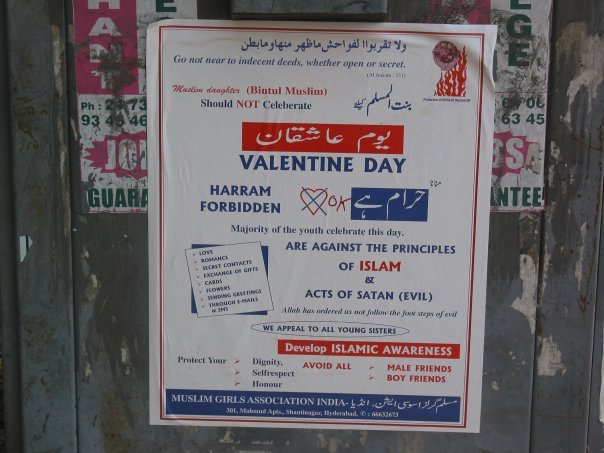
I was asked to share my views on Valentine’s Day. Personally, I really don’t see what’s the problem that some people seem to have with this celebration. The fact that it’s a Western, originally Christian festival is in all honesty, completely besides the point. We should celebrate Love everyday!

Many cultures have something similar, a day to celebrate love, to send a message of love to your beloved – a person whom you would like to marry or is already your husband or wife. Seriously, what’s wrong with that? What could possibly be wrong with that?
The only argument I’ve heard against Valentine’s Day, is the same one I hear about every other festival besides the two Eids – it’s not part of Islam. Well, sorry, if that’s the best these people can come up with, it’s a pathetic argument – cars and aeroplanes aren’t technically part of Islam either, but we still use them!

More to the point, a Muslim can celebrate any festival, even the social aspect of those of other religions, as long as this doesn’t mean they end up committing shirk – i.e. worshipping another deity besides God or associating partners with God – and this is the position of the mainstream scholars of Al-Azhar University in Egypt.

Indeed, for the vast majority of people who celebrate it, Valentine’s Day isn’t even that religious, rather it’s just a wonderful opportunity to show loved ones how much you appreciate them – which is something every Muslim should do anyway, even if they do not celebrate Valentine’s Day!

Pakistanis for Peace Editor’s Note– Finally, a Muslim perspective on Valentine’s Day that we can agree with! As compared to many other articles that decry Valentine’s Day as a pagan holiday and it is shirk to celebrate it, Paul has succinctly yet effectively given a great differing Muslim angle on this day as compared to the Orthodox Muslim view.

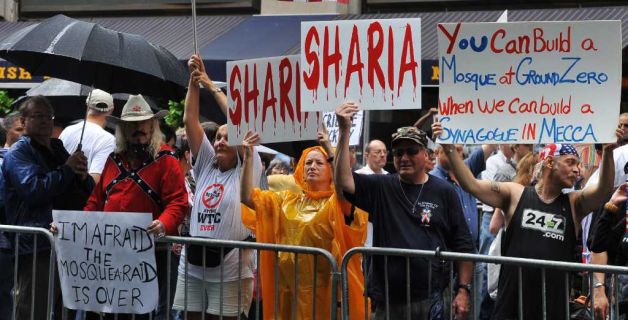
Study: US Muslims Don’t Want Shariah, Either

By Omar Sacirbey for The Houston Chronicle

North American Muslims are more than satisfied with the secular legal system and do not want a set of parallel courts for Islamic law, according to a new study of U.S. and Canadian Muslims by a Washington-based think tank.

The study, by University of Windsor law professor Judy Macfarlane for the Institute for Social Policy and Understanding, refutes critics’ claims that American Muslims want to impose Shariah, or Islamic law.

In fact, the study indicates that Muslims are just as unwilling to accept Islamic law as non-Muslims.

Macfarlane interviewed 212 Muslim Americans, including 41 imams and 70 community leaders who used aspects of Shariah in their daily lives. The other 101 interviewees were divorced Muslim men and women. About a quarter of the interviewees were from Canada, and the rest from the United States.

“Aside from formal religious observance, American Muslims relate to their Shariah responsibilities primarily through rituals of marriage and divorce,” Macfarlane wrote.

“They see these as compatible with the civil law – almost all the respondents in this study married and divorced twice, once in Islam and once in law – and will use the courts where they cannot agree outcomes, just like any other couple.”

When asked whether they thought American courts should apply Shariah to non-Muslims in the legal system, all of the respondents answered no. Just three of the 41 imams said they wanted parallel Shariah tribunals where Muslims could handle civil issues like marriage, divorce, and inheritance.

Macfarlane began her research after a Muslim group in Ontario petitioned the provincial government in 2003 to establish a separate Islamic family tribunal where Muslims could get binding legal decisions on family law issues. The Ontario government denied the request, and later that year abolished similar tribunals for Catholic and Jewish citizens that had been allowed in 1991.ˇ

The study follows a Jan. 10 decision by a federal appeals court that upheld a lower court’s ruling to overturn a 2010 Oklahoma constitutional amendment to prohibit judges from using Shariah in their deliberations.

Tennessee and Louisiana have passed similar laws, while 20 other states are considering such legislation.

For Many in Pakistan, a Television Show Goes Too Far

By Declan Walsh for The New York Times

One morning last week, television viewers in Pakistan were treated to a darkly comic sight: a posse of middle-class women roaming through a public park in Karachi, on the hunt for dating couples engaged in “immoral” behavior.

Panting breathlessly and trailed by a cameraman, the group of about 15 women chased after — sometimes at jogging pace — girls and boys sitting quietly on benches overlooking the Arabian Sea or strolling under the trees. The women peppered them with questions: What were they doing? Did their parents know? Were they engaged?

Some couples reacted with alarm, and tried to scuttle away. A few gave awkward answers. One couple claimed to be married. The show’s host, Maya Khan, 31, demanded to see proof. “So where is your marriage certificate?” she asked sternly.

This hourlong spectacle, broadcast live on Samaa TV on Jan. 17, set off a furious reaction in parts of Pakistan. Outrage sprang from the Internet and percolated into the national newspapers, where writers slammed Ms. Khan’s tactics as a “witch hunt.”

“Vigil-aunties,” read one headline, referring to the South Asian term “aunty” for older, bossy and often judgmental women.

Now, the protests are headed to court. On Friday, four local nongovernment organizations will file a civil suit against Samaa TV in Pakistan’s Supreme Court, hoping to galvanize the country’s top judges into action.

“Journalists don’t have the right to become moral police,” said Adnan Rehmat of Intermedia, a media development organization that is among the petitioners. “We need to draw a line.”

Images of moral vigilantes prowling the streets have an ominous resonance in Pakistan, where many still recall the dark days of the Islamist dictator Gen. Mohammad Zia ul-Haq in the 1980s, when the police could demand to see a couple’s nikkahnama — wedding papers — under threat of imprisonment.

But the strong reaction is also drawn from a pressing contemporary worry: that the budding television media, seen as a force for democracy and greater social freedom for much of the past decade, have lost their way as part of a cutthroat battle for ratings.

“It really aggravates me that the media is using their power to intrude and invade our privacy, often with no good reason,” said Mehreen Kasana, a 22-year-old American-educated blogger from Lahore, who wrote a widely circulated protest against the Samaa TV show.

The controversy has rekindled a debate about the direction of Pakistan’s TV industry. Since liberalization in 2000, the sector has exploded from one channel — the state-controlled one — to more than 80 today, 37 of which carry national or local current affairs.

The media revolution has transformed social and political boundaries: in 2007, feisty coverage played a central role in pushing Pervez Musharraf toward the exit; in recent weeks it helped guard against a possible military coup.

But television is also a lucrative business controlled by powerful, largely unaccountable tycoons. Last year Pakistan’s television stations had advertising revenues of more than $200 million, according to Aurora, an industry journal — 28 percent more than the previous year.

Amid stiff competition for viewers, channels have relied on populist measures — rowdy political talks shows and, in recent times, vigilante-style “investigative” shows modeled on programs in neighboring India.

Some have a noble objective: holding to account crooked public servants, police officers and even fellow journalists. But others have veered into territory that could be described as Pakistan’s answer to Jerry Springer — voyeuristic, mawkish and intrusive.

In recent months, one reporter screamed at a man accused of child rape as he awaited trial outside a courthouse; another hectored a man said to be a self-confessed necrophile inside a jail cell; and a TV reporter “raided” a gathering of whisky drinkers, even though alcohol flows freely at many media parties.

Abbas Nasir, a former head of Dawn News television, said he was “nauseated” by some coverage.

“Hosts are under pressure to bring in ratings, and there is carte blanche to do the most bizarre things,” he said.

Another critic derided such reporters as “pussycat vigilantes” because they avoided challenging rich or powerful Pakistanis, whose Western-style lifestyles go unexamined.

“They only go after the people they know will not bite back,” said Nadeem Farooq Paracha, a culture writer.

Ms. Khan’s show touched a raw nerve because it combined simmering concern over media ethics with wider fears about society’s conservative tilt. Even General Zia’s son was appalled. In answer to a question on Twitter, Ijaz ul-Haq, a politician from Punjab Province, said he was “still in shock by what I’ve heard about her show.”

In a telephone interview on Tuesday, Ms. Khan rejected her critics, calling them “an elite class that don’t even watch my show,” and said the show merely intended to highlight the dangers that unaccompanied youths face in Karachi.

She also denied that there was anything unusual about asking couples for their wedding certificate — even though she does not carry one. All of “Pakistan knows me and my wedding pictures,” she said. “So I don’t have to.”

But on Wednesday, Samaa TV issued a formal apology for her show, followed by a short clip of Ms. Khan, sitting on a bed, offering an apology of sorts. “I never intended to make you teary-eyed or hurt you,” she said.

The furor has renewed long-standing demands for media regulation. With the state-run Pakistan Media Regulatory Authority seen as ineffective, the organizations approaching the Supreme Court on Friday hope the judiciary can help. “We need to hold the media to account,” Mr. Rehmat said.

But others argue that involving the courts, with their history of heavy-handed interventions, could open the door to state licensing of free speech. “It could backfire,” said Beena Sarwar, a journalist who helped rally protests against Ms. Khan’s show. “The media needs to do this themselves.”

Amid the polemic, there is one bright spot: the use of Twitter and Facebook to stoke debate has shown how, even as social space contracts in a turbulent society, the virtual space is opening up new possibilities.

But so far, the use of social media has been largely confined to the country’s English-speaking minority. It was striking how little attention Ms. Khan’s show received in the Urdu media, which is read or watched by the vast majority of Pakistanis.

“My real worry is that Pakistan is moving rightwards, and this time the face won’t have a beard,” said Mr. Nasir, the former head of Dawn News television. “And before people know it, they won’t know what’s hit them.”

Pakistanis for Peace Editor’s Note- Samaa Tv and host Maya Khan ought to be ashamed of themselves for calling this program journalism. Vulture reporting is more appropriate. Highly intrusive and showing a complete disregard for private citizens who are meeting in a public place is no place for a TV channel.  This certainly strengthens the religious extremists in Pakistan, shoving their brand of austere Wahaabi Islam down the throats of the majority Barelvi/Sufi population of Pakistan.

Meanwhile the Pakistani Telecom Authority is curtailing freedom of speech by mandating mobile phone operators to ban certain ‘dirty’ words, as the Pakistan Electronic Media Regulatory Authority lacks the moral and legal mindset to stop a television channel on trampling citizen’s privacy and freedoms. They should shut this show immediately and get this so called ‘reporter’ off the air.

A Bronx Tale

By Ted Regencia and Lindsay Minerva for Tablet Mag
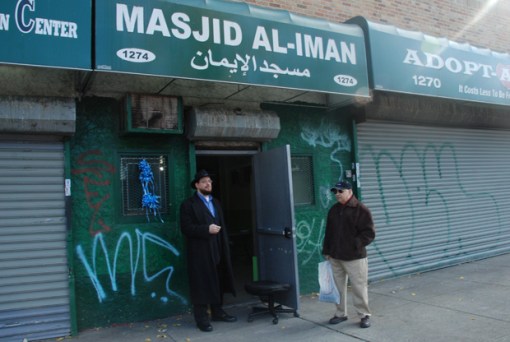
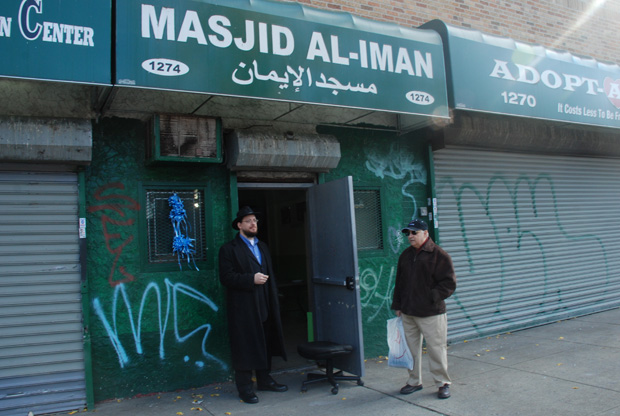
Near the corner of Westchester Avenue and Pugsley Street in Parkchester, just off the elevated tracks of the No. 6 train, Yaakov Wayne Baumann stood outside a graffiti-covered storefront on a chilly Saturday morning. Suited up in a black overcoat with a matching wide-brimmed black fedora, the thickly bearded 42-year-old chatted with elderly congregants as they entered the building for Shabbat service.

The only unusual detail: This synagogue is a mosque.

Or rather, it’s housed inside a mosque. That’s right: Members of the Chabad of East Bronx, an ultra-Orthodox synagogue, worship in the Islamic Cultural Center of North America, which is home to the Al-Iman mosque.

“People have a misconception that Muslims hate Jews,” said Baumann. “But here is an example of them working with us.”

Indeed, though conventionally viewed as adversaries both here and abroad, the Jews and Muslims of the Bronx have been propelled into an unlikely bond by a demographic shift. The borough was once home to an estimated 630,000 Jews, but by 2002 that number had dropped to 45,100, according to a study by the Jewish Community Relations Council. At the same time, the Muslim population has been increasing. In Parkchester alone, there are currently five mosques, including Masjid Al-Iman.

“Nowhere in the world would Jews and Muslims be meeting under the same roof,” said Patricia Tomasulo, the Catholic Democratic precinct captain and Parkchester community organizer, who first introduced the leaders of the synagogue and mosque to each other. “It’s so unique.”

The relationship started years ago, when the Young Israel Congregation, then located on Virginia Avenue in Parkchester, was running clothing drives for needy families, according to Leon Bleckman, now 78, who was at the time the treasurer of the congregation. One of the recipients was Sheikh Moussa Drammeh, the founder of the Al-Iman Mosque, who was collecting donations for his congregants—many of whom are immigrants from Africa. The 49-year-old imam is an immigrant from Gambia in West Africa who came to the United States in 1986. After a year in Harlem, he moved to Parkchester, where he eventually founded the Muslim center and later established an Islamic grade school. Through that initial meeting, a rapport developed between the two houses of worship, and the synagogue continued to donate to the Islamic center, among other organizations.

But in 2003, after years of declining membership, Young Israel was forced to sell its building at 1375 Virginia Ave., according to a database maintained by Yeshiva University, which keeps historical records of synagogues. Before the closing, non-religious items were given away; in fact, among the beneficiaries was none other than Drammeh, who took some chairs and tables for his center.

Meanwhile, Bleckman and the remaining members moved to a nearby storefront location, renting it for $2,000 a month including utilities. With mostly elderly congregants, Young Israel struggled to survive financially and, at the end of 2007, was forced to close for good. The remaining congregants were left without a place to pray. During the synagogue’s farewell service, four young men from the Chabad Lubavitch world headquarters in Crown Heights showed up. Three months earlier, Bleckman, then chairman of the synagogue’s emergency fund, had appealed for help from the Chabad.

“The boys from the Chabad said they came to save us,” said Bleckman. “We were crying.”

At this point, Chabad took over the congregational reins from Young Israel, with members officially adopting the new name Chabad of East Bronx. Still, for the next six to seven weeks, Bleckman said they could not even hold a service because they had nowhere to hold it.

When Drammeh learned of their plight, he immediately volunteered to accommodate them at the Muslim center at 2006 Westchester Ave.—for free.

“They don’t pay anything, because these are old folks whose income are very limited now,” said Drammeh, adding that he felt it was his turn to help the people who had once helped him and his community. “Not every Muslim likes us, because not every Muslim believes that Muslims and Jews should be like this,” Drammeh said, referring to the shared space. But “there’s no reason why we should hate each other, why we cannot be families.” Drammeh in particular admires the dedication of the Chabad rabbis, who walked 15 miles from Brooklyn every Saturday to run prayer services for the small Parkchester community.

For the first six months, congregants held Friday night Sabbath services inside Drammeh’s cramped office. As more people began joining the congregation, Drammeh offered them a bigger room where they could set up a makeshift shul. (When it’s not in use, students from the Islamic school use it as their classroom.) Inside the synagogue, a worn, beige cotton curtain separates the men and women who attend the service. A solitary chandelier hangs just above the black wooden arc that holds the borrowed Torah, which is brought weekly from the Chabad headquarters. A large table covered with prayer books stands in the center, and a picture of the Lubavitcher Rebbe is displayed prominently on a nearby wall. During Shabbat, when Jewish congregants are strictly prohibited from working, they have to rely on the Muslim workers at the center or on Drammeh to do simple chores such as turning on the light and switching on the heater.

At first, it did not make sense, said Hana Kabakow, wife of Rabbi Meir Kabakow. “I was surprised,” said the 26-year-old congregant who was born and raised in Israel. “But when I came here I understood.” The Kabakows have been coming to the service from Brooklyn for the last two years.

Harriet Miller, another congregant, said she appreciated the center’s accommodating the synagogue. “They are very sweet people,” said the 79-year-old Bronx native and long-time resident of Parkchester, who added that she welcomes the new Muslim immigrants in her neighborhood: “We were not brought up to hate.”

Drammeh also understands the importance of teaching tolerance more broadly, and for turning the school—which was itself founded at the nearby St. Helena Catholic Church on, of all days, Sept. 11, 2001—into a model of sorts for religious tolerance in New York.

“We’re not as divided as the media portrays us to be,” Drammeh said. “Almost 90 percent of Jewish, Muslim, and Christian teachings are the same.”

His latest project involves introducing fifth-grade Jewish and Islamic school students to each other’s religious traditions. Other participants of the program, now in its sixth year, include the Solomon Schechter School of Manhattan, the Al Ihsan Academy of Queens, and the Kinneret Day School of Riverdale. At the end of the program, students organize an exhibit that shows family artifacts of their respective cultures and religion. The principal of the Islamic school, who is also Sheik Drammeh’s wife, said that even after the program ended, the participants became “fast friends” and would visit each other’s homes.

“They would have birthday parties together,” Shireena Drammeh said. “When someone invites you to their house, I mean, that says it all right there and then.”

While the Jewish congregants are thankful for their new home, they hope that one day they can rebuild their own synagogue. That day may be far off: Even now that they have space to worship, they still struggle to operate. They don’t have proper heating inside, and the portable working heater could not reach the separate area where the elderly women are seated, forcing them to wear their jackets during the entire service. Congregants are appealing for financial support from the Jewish community and other congregations.

But Leon Bleckman and others say they now also have loftier goals, including reviving the Jewish presence in the neighborhood and reaffirming the positive relationship with their Muslim friends. “We are able to co-exist together side by side in the same building,” said Assistant Rabbi Avi Friedman, 42. “That’s sort of like a taste of the future world to come—the messianic future where all people live in peace.”

Ted Regencia is a digital media student at the Columbia Journalism School. His Twitter feed is at @tedregencia. Lindsay Minerva, a digital media student at the Columbia Graduate School of Journalism, is an intern at Newsweek. Her Twitter feed is at @lindsayminerva.


Pakistanis for Peace Editor’s Note– A story like this illustrates the good in all of us. A few months ago, we highlighted an article on Heartsong Church in Cordova, Tennessee where Christians in that part of the US welcomed a Muslim community that was undergoing construction of their mosque nearby. Now this kind deed is being passed forward to another flock of faithful when Muslims in New York are offering a helping hand to Jewish members of their community. This is the type of love for one another God of all religions wants and appreciates. May God bless them all.
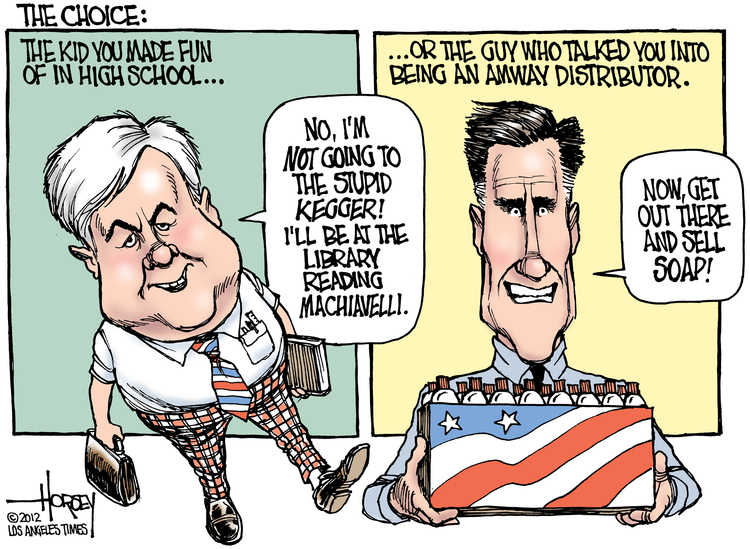
Newt Gingrich Creeping Up On Mitt Romney In A Creepy Way

By David Horsey for The Los Angeles Times

Newt Gingrich is surging and the guy ahead of him, Mitt Romney, as well the guy behind him, Rick Santorum, are rattled.

Only days ago, Romney was sitting on a comfortable lead in South Carolina’s Republican primary race. Santorum was anticipating a positive bump in his numbers, thanks to the endorsement he received from top Christian evangelical leaders and the good chance that a final, official count of votes in the Iowa caucuses would show he actually beat Romney in that state.

Instead, with Saturday’s vote just two days away, the portly, aloof, intellectually promiscuous and thrice-married ex-speaker of the House seems to be winning the minds, if not the hearts, of more and more staunch conservatives in the Palmetto State.

In fact, Gingrich was even getting a bit of love, as well as respect, from a crowd of several hundred jammed into the banquet hall of Bobby’s Bar-BQ Buffet in Warrenville on Wednesday. Every seat was filled; those without seats stood along the walls and those that couldn’t get inside craned their necks to get a peek through the front door.

Gingrich spoke in front of a Model T Ford – a car only a little more ancient than a great many members of the audience. Clever lines that fell flat when Gingrich delivered them at the tea party convention Tuesday got big laughs with this much-less-grim crowd — like his somewhat-stale knee-slapper about letting Barack Obama use a teleprompter when the two debate.

They loved the parts of his stump speech that are well worn – our rights come from God and cannot be taken away by government – and a new attack on Obama spun off the day’s news – the president’s refusal to approve the Keystone oil pipeline is stupidly driving Canada into the arms of China. And they loved Callista, Newt’s exquisitely coiffed wife.

One audience “question” was this: “I think your wife would make a beautiful first lady, don’t you?”  In the receiving line after the event, a Callista fan said, “I’m anxious to see how you do Christmas in the White House.” There seemed to be a lot of warmth for the once-controversial Callista and for her candidate husband, though he is not all that good at exhibiting warmth himself.

In campaign mode, Gingrich is the polar opposite of Mitt Romney. Reportedly a bit shy, Romney, nevertheless, dives in, shakes every hand, signs every autograph, banters with everyone and smiles, smiles, smiles. It may be rehearsed and straight from some “How to Succeed in Politics” primer, but he’s as good at it as any TV game show host.

Mitt’s even good with babies. At a rally on the outskirts of Columbia on Wednesday night, he held a baby for the cameras and then pretended to walk off with her, delighting the crowd – even the child’s mother. And the baby never cried.

In contrast, Gingrich seems more like the queen of England. On Monday afternoon, at the end of his remarks at Rioz Brazilian Steakhouse in Myrtle Beach, Gingrich remained on the speaker’s platform while the crowd lined up like kids waiting to see a department store Santa. They were shuffled through rapidly; the candidate barely made eye contact, offered the tiniest of smiles and made the briefest request for support.

Is he merely reserved? Awkward? Overly formal? Or simply a man with a busy mind and a lot to get done; sort of like a college professor who resents wasting attention on the undergrads who mob him after class.

Of course, Gingrich actually is a former college professor, and his campaign speech is a lively academic ramble. He interprets history, dives into interesting new economic theories, wickedly picks apart the fallacious ideas of competing practitioners of the political arts and uses terminology that tells you he’s oh-so-much smarter than your typical governor of Texas or Massachusetts.

Gingrich drops names of the intellectual and political elite he has known and boldly lays claim to a major share of the legacy of two presidents, Reagan and Clinton. He brags that his candidacy is so historically significant and so utterly different from any other that it is nearly incomprehensible to the dullards in the media. In front of the South Carolina Chamber of Commerce, after presenting a litany of intractable problems faced by the nation, he said of himself, “If you have a leader who knows what he is doing, we can turn this around in a year.”

Just one year? The guy seems so full of himself that it is surprising he has caught on with so many voters. He is not the cliche candidate Americans are supposed to prefer – somebody you’d want to have a beer with because he’s just like you. Yet, here he is, still very much in the race and on the verge of messing up smiling Mitt Romney’s big-money campaign.

Gandhi and King- Two Martyrs Who Will Never Die

By Manzer Munir for Pakistanis for Peace

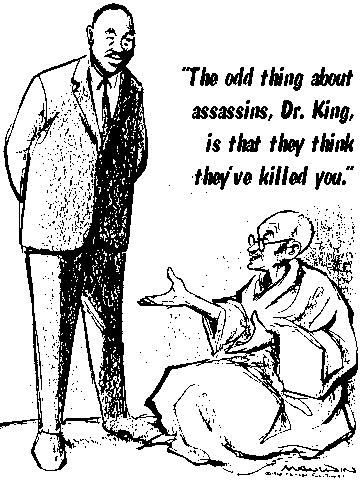
Today is MLK Day in the United States where it is a federal holiday commemorating the life and legacy of the Rev Dr Martin Luther King Jr, an icon who would have been 83 years old on January 15.

MLK was a great believer in the teachings of non-violence if Mohandas K Gandhi, the leader of India’s independence movement from Britain. King saw that Gandhi’s peaceful civil disobedience and non-violent methods of protest were very effective in bringing down the British Empire in India and as a result Pakistan and the rest of the Indian Subcontinent after some 300 years of direct and indirect rule. Gandhi had believed that people could resist immoral government action by simply refusing to cooperate. Gandhi adopted many peaceful resistance techniques in developing his concept of Satyagraha, which was a philosophy and practice of passive nonviolent resistance.

Gandhi had earlier used this resistance technique in his struggles for freedom and equality for blacks and Indians in South Africa where both minorities were subjected to second and third class citizenry. His methods and refusal to bow down to the injustices that Indians faced in colonial South Africa inspired Nelson Mandela several years later to start his own peaceful struggle that eventually led to the end of Apartheid in South Africa in 1990.

While at Morehouse College, King learned about Gandhi and became very excited about his ideas. He wanted to further educate himself and read many books on Gandhi and his life and beliefs. In his book, Stride Toward Freedom, King states that “Gandhi was probably the first person in history to lift the love ethic of Jesus above mere interaction between individuals to a powerful and effective social force on a large scale. He further writes in his book that “It was in this Gandhian emphasis on love and nonviolence that I discovered the method for social reform that I had been seeking. I came to feel that this was the only morally and practically sound method open to oppressed people in their struggle for freedom.”

King felt that he had finally found a way to where oppressed people could successfully unlock social protest through Jesus’ teachings of love. In fact Gandhi himself had said “What does Jesus mean to me? To me, he was one of the greatest teachers humanity has ever had.” He also once mentioned Jesus as the “most active resister known perhaps to history. His was non-violence par excellence” Therefore to the Christian minister living in the pre-civil rights era in the South in America, Gandhi appeared to King as a follower of Christ, someone who preached peace and love even at the expense of suffering. Martin Luther King once said of Gandhi “It is ironic yet inescapably true that the greatest Christian of the modern world was a man who never embraced Christianity.”

In 1959, King visited India and became fully convinced that Satyagraha could be effectively applied to the struggle by blacks in the United States for racial integration. He came back to the United States where he continued the struggle for freedom and equality for all Americans. Like Gandhi, King also talked about suffering as a path to self purification and spiritual growth. He not only experienced this suffering by being jailed, beaten and harassed by the authorities of the day, but he eventually ended up paying for this cause for freedom for all with his life.

Today there is a black man that sits in the White House, minorities are on the Supreme Court bench, and black heads of Fortune 500 companies who have reached the proverbial mountaintop in every possible endeavor. Yet there is little doubt that despite how far we have come as a nation, we still have a ways to go to achieve equality for minorities and women. Without Dr King’s struggle, leadership and personal sacrifice, the United States, and indeed the world, would be in far worse shape.

Mohandas K Gandhi and Martin Luther King Jr were arguably two of the greatest men of the last century. Both men believed that “injustice anywhere was a threat to justice everywhere.” They both led their people and millions of others out of slavery and servitude against seemingly insurmountable odds to freedom and salvation. On what would have been his 83rd birthday, let us recognize that in the greatest democracy in the history of the world, and despite an assassin’s bullet, the spirit and dream of a King still lives on.

Manzer Munir, a proud American of Pakistani descent, is a practicing Sufi Muslim and member of Muslims for Progressive Values, he is also the founder of Pakistanis for Peace and blogs at http://www.PakistanisforPeace.com as well at other websites as a freelance journalist and writer.

Early Elections Seen as Possible Solution to Pakistan’s Political Crisis

By Saeed Shah for The Miami Herald

Pakistan’s political crisis, which pits its president against determined opponents in foes in Parliament, the Supreme Court and the military, is likely to reach fever pitch on Monday with a confidence vote scheduled in Parliament and hearings scheduled in two critical court cases.

The crisis is so intense that President Asif Zardari’s administration may be willing to call elections for as soon as October, according to members of his ruling coalition and its advisers. But that may not be enough to mollify the opposition, which wants earlier elections, or the country’s powerful military establishment, which is believed to be trying to force a so-called “soft coup,” under which Zardari, a critic of the military’s traditional dominance of Pakistan, would be forced out by Parliament or the courts.

The threat of an outright coup also hangs over the crisis, if the politicians cannot find a way out or the court proceedings reach absolute stalemate.

Whether the government can reach agreement with opposition leader Nawaz Sharif is unclear. Zardari’s Pakistan Peoples Party doesn’t want to announce elections until after voting in March for a new Senate, which the PPP is widely expected to win. But Sharif would like the new elections to be in the summer, perhaps June, which would require an earlier announcement.

“There is no other option for the government to come out of the current crisis without elections,” said an adviser to the PPP leadership, who spoke on condition of anonymity because of the sensitivity of the issue, as did the other coalition members. “It is in the interests of the PPP to reach an agreement with Nawaz.”

The PPP rules with three major coalition partners, but the alliance is looking shaky. Two of the parties, the Muttahida Quami Movement (MQM) and the Pakistan Muslim League-Q, have distanced themselves somewhat from the government.

A senior member of the coalition said the parties so far have agreed internally only to a general election to be held in October. That would be just a few months before the February 2013 date when Parliament would complete its five-year term and elections would have to be held anyway.

An early election should also placate the courts and the military. A supposedly neutral caretaker government would have to be installed to oversee a three-month electioneering period.

Another coalition member said: “It is 100 percent certain that there will be elections in 2012. The only solution is elections. It doesn’t matter whether they are held in June or October.”

Zardari’s coalition itself brought Monday’s confidence vote resolution to Parliament, cleverly wording it so that it asks for support not for the prime minister or even the government, but for democracy. That makes it difficult to oppose.

But the PPP’s troubles in Parliament are only one of the fronts in its battle for survival. The courts and the military are both maneuvering against the party’s leaders, with two explosive cases coming up for hearings Monday.

The first stems from a 2007 decree by President Pervez Musharraf that granted immunity from prosecution to Zardari and other exiled PPP politicians in an effort to persuade them to return to Pakistan to participate in elections that Musharraf was being pressured by the United States to hold.

The Supreme Court later ruled, however, that the decree was illegal and demanded that the government reopen corruption charges against Zardari stemming from the time when his wife, the assassinated PPP leader Benazir Bhutto, was prime minister.

The government declined, however, and now the court has summoned the government to explain its actions. The court could declare Prime Minister Yousaf Raza Gilani in contempt of court, which would in effect remove him from office.

The other case involves the the scandal in which a judicial commission is investigating allegations that Husain Haqqani, a close Zardari adviser and former ambassador to the U.S., wrote a memo that was passed to U.S. officials in May. That memo offered to replace the Pakistan military’s top officials in return for U.S. support should the military attempt to push Zardari aside.

Haqqani, who was forced to resign, says he had nothing to do with the memo, which the military has said amounted to treason.

The judicial commission may take testimony this week from an American businessman, and occasional news commentator, Mansoor Ijaz, who claimed that he had delivered the memo to U.S. officials, in a column that appeared in the British newspaper the Financial Times in October. Ijaz has said he will show up as a witness, though he apparently has yet to receive a visa to enter Pakistan.

Sold Into Slavery As a Girl, Shyima Hall Becomes a U.S. Citizen

By Phil Willon, Los Angeles Times

A decade ago, Shyima Hall was smuggled into the United States as a 10-year-old slave, forced to cook and clean inside the home of a wealthy Irvine family and, at night, sleep on a squalid mattress in a windowless garage.

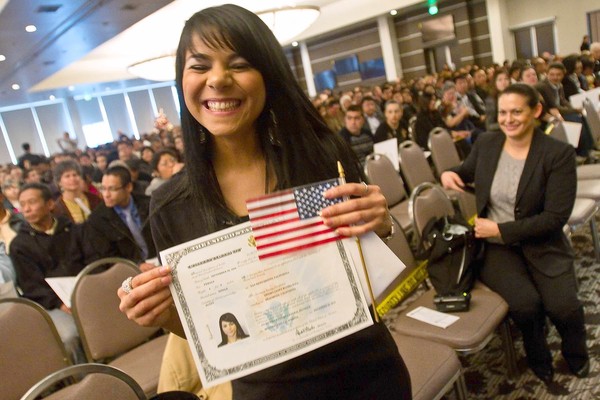
On Thursday, the Egyptian-born 22-year-old stood before a federal judge in Montebello with nearly 900 others and was sworn in as naturalized U.S. citizen. The ceremony capped a hard-scrabble journey that began with Hall’s rescue, wound through the foster care system and ended with her living on her own, working, and with ambitions to become a federal agent.

“I went through something terrible, but right now I’m in a great place,” Hall said after Thursday’s citizenship ceremony at the Quiet Cannon Country Club. “I can’t imagine anything greater than having my own life.”

Hall’s Egyptian parents sold her into slavery when she was 8 for $30 a month, according to authorities. The Cairo couple who bought her moved to Irvine two years later, smuggling Hall into the U.S. where she toiled for them and their five children until she was 13.

Hall said she worked 16 hour days, scrubbing floors, cooking meals and cleaning house, and was rarely allowed outside the spacious home. She was forced to wash her own clothes in a bucket and was forbidden from going to school. She never visited a doctor or dentist and didn’t speak a word of English.

Her captors, Abdel Nasser Eid Youssef Ibrahim and his former wife, Amal Ahmed Ewis-abd Motelib, berated her and occasionally slapped her around, authorities said.

“I didn’t know anything about what America was about. My only hope was to go back home and live a normal life with my family, my brothers and sisters,” she said. “That’s all I wanted.”

In 2002, acting on a tip from a concerned neighbor, child welfare authorities rescued her from the house. Her case was investigated by U.S. Immigration and Customs Enforcement, leading to the prosecution, federal imprisonment and, later, deportation of Ibrahim and Motelib.

Hall formed a tight bond with one of the lead federal agents, Mark Abend of ICE’s Homeland Security Investigations, who has served as a friend and mentor. He was at Hall’s citizenship ceremony Thursday.

“I’m really proud of her. Think of everything she’s been through. Being sold into slavery at an early age. Coming over here. Not having a family,” Abend said. “The resiliency she has is just amazing. The fortitude. Not falling apart. Not being a destroyed soul.”

Abend remembers interviewing Hall, then 13, with the help of an Arabic interpreter for the first time when she was being cared for at the Orangewood Children’s Home in Orange. Her captors told her to never speak to police, that officers would beat her. She stayed tight-lipped until she was allowed to call her parents in Egypt, and her father ordered her to go back with her captors.

“That’s when I saw a spark,” Abend said. “She stood up to her dad. She said, ‘No! This is not right. What they did to me was not right. You sold me into slavery.'”

At 13, Hall decided that she wanted to stay in the U.S. She hasn’t returned to Egypt or seen her family.

In recent years, Hall has spoken to groups across the country about combating human trafficking. She’s briefed ICE agents about the emotional and physical trauma victims face.

In 2010-11, federal immigration officials launched 651 investigations into human trafficking, arresting 300 people. According to the U.S. State Department, there are more than 12 million people entrapped in some form of slavery worldwide.

Hall said her dream now is to become a federal agent for ICE to help crack down on human trafficking and free the enslaved.

“That’s my top goal,” Hall said. “I’ve been through it. I know I can help.”

Los Angeles immigration attorney Angelo Paparelli, who represented Hall pro bono, said that her citizenship application was filed under a special provision for juvenile immigrants and that county officials from the outset supported her decision to stay in the U.S.

“She has literally gone through a living hell, and now she wants to give back,” said Paparelli, of the national law firm Seyfarth Shaw. “She’s there to give other people courage.”

For now, Hall is living in Beaumont in Riverside County and working at the Cabazon outlets as a store supervisor. She’s deciding whether to go back to college to finish a degree or to apply for the local police force.

“I’m very excited. I can start my career now,” she said. “I can start my life.”

Unhappy Anniversary, Guantanamo!

By Carlos Harrison for The Huffington Post

It’s been a troubled – some might say, tragic – 10 years for the detention camps at the Guantánamo Naval Base in Cuba. And as they slouch into their 11th year on January 11, there’s no end in sight.

“We say to ourselves, in sort of gallows humor: Guantánamo will close when the last detainee there dies of natural causes,” Jeremy Varon, an organizer with Witness Against Torture, told the Huffington Post on Wednesday.

Franz Kafka himself would have been hard-pressed to concoct a more bewildering and brutal contradictory reality. Allegations over the years have included sexual humiliation, waterboarding, and the use of dogs to scare detainees. Released detainees reported being locked in in sensory deprivation cells, beaten repeatedly, and forced to race while wearing leg shackles. If they fell, they were punished.

If it sounds like Abu Ghraib, it should. The U.S. Senate Armed Services Committee found that intelligence teams transported the “aggressive” interrogation techniques perfected at Guantánamo to Afghanistan and Iraq.

The link between Cuba and the war zones, the New York Times reported, was Maj. Gen. Geoffrey D. Miller, then the head of detention operations at Guantánamo. At his insistence, the Times wrote, the Defense Department sent training teams on 90-day tours in Iraq, showing the soldiers there the techniques utilized on the island. The timing, Amnesty International points out, happened to coincide with when the worst abuses occurred at Abu Ghraib.

Thanks to reports like those, the detention camps have become an international symbol of what democracy and justice are not. They’ve been plagued by suicide attempts by desperate detainees and condemned by the United Nations, human rights groups, even former U.S. Secretary of State Colin Powell, who called for the immediate closing of the camps in 2006.
“The value of holding prisoners there was unclear, but the price we were paying around the world for doing so was obvious,” Powell said.

The camps were created in 2002 as a deliberately “extraterritorial” place to extract information from captives in the “War on Terror.” By putting them at Guantanamo, the United States, meant to be beyond the jurisdiction of both the Geneva Conventions and U.S. courts.

That didn’t put them outside the range of public opinion. The camps sparked outrage on day one. Pictures flew around the world of shackled and handcuffed detainees on their knees on the ground with black hoods over their heads and mittens on their hands.

The indignation grew as the first 20 captives went into wire cages at Camp X-Ray, described by critics as “kennels.” Soon, though, the detainees were transferred to permanent cells, and Camp X-Ray was closed.

But the human rights complaints continued, even from some of America’s closest allies.
In 2006, speaking on BBC radio, British Foreign Secretary Jack Straw said:

“I am absolutely clear that the U.S. has no intention of maintaining a Gulag in Guantanamo Bay. They want to see the situation resolved and they would like it other than it is. However, that is the situation that they have.”

In all 779 detainees have been held in the camps. Eight have died there, including six suicides. One man died of colon cancer, another after an apparent heart attack.

And, in the 10 years since it opened, only six detainees have been convicted of war crimes.
The last 171 still there are caught at the conflicting conjunction where bureaucracy, politics, and military regulations collide – offering little chance, at least for the foreseeable future, of gaining their release.

Forty-six are classified as “indefinite detainees,” held without charges, but considered too dangerous to be released; 89 are eligible for release or transfer but in perpetual custody because there is no place to send them. Five more have been convicted of war crimes; and six face trial – perhaps this year – for the 9/11 attacks and the October 2000 U.S.S. Cole bombing.
That makes Guantanamo, as Carol Rosenberg of the Miami Herald described it in a piece for Foreign Affairs, “arguably the most expensive prison camp on earth, with a staff of 1,850 U.S. troops and civilians managing a compound that contains 171 captives, at a cost of $800,000 a year per detainee.”

But even the budget conscious Congress resists closing the base. In fact, it has used its spending oversight powers to thwart the president’s efforts to do just that. It has used that authority to prevent the trial of detainees on U.S. soil and to block the purchase of a dedicated prison facility in Illinois to house transferred detainees.
And no one wants to risk having a released captive later become involved in an act of terrorism or insurgency, which happened with at least one-fourth of the 500 detainees set free under President George W. Bush.

So, the captives remain in Guantanamo. Until when no one knows.
As Marc Thiessen, a fellow at the American Enterprise Institute, told CNN:

“We have the right to continue to hold them as long as al Qaeda is at war with us.”

Having the right, though, doesn’t make it right, said Geneve Mantri, government relations director for national security, Amnesty International.

Speaking to The Huffington Post on Wednesday, he said the 89 cleared for release by both the Bush administration and a review ordered by President Obama, “represent little or no threat.”

“This has always been sold as a question of the worst of the worst and the reality is that a large number of the people that have been picked up, I hate to say it are in the insignificant and rather pathetically sad story category,” he said.

“There is a minority of people (in the camps) that no one doubts are truly dangerous. That minority of people should be placed in front of a US court. Because we have the most efficient system, the fastest and cheapest and best system for looking at all the evidence. You produce it all in a court of law. Have a real defense — an internationally recognized defense. And then put them away forever.”

Pakistani Judges Press Premier to Defy President

By Salman Masood and Ismail Khan for The New York Times

The political and legal crisis in Pakistan took a new turn on Tuesday when the Supreme Court threatened to dismiss Prime Minister Yousaf Raza Gilani for failing to comply with court orders to reopen corruption cases against his political boss: President Asif Ali Zardari.

The latest pressure from the court compounds the problems of the governing Pakistan Peoples Party, already facing a political crisis over a controversial memo that sought United States support in thwarting a feared military coup.

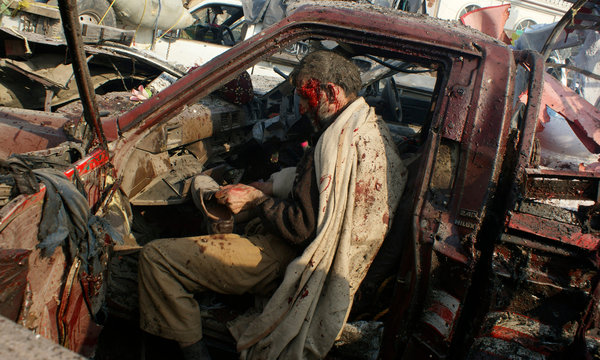
Adding to the government’s troubles is a steep increase in terrorist attacks. Another attack occurred early Tuesday, a truck bombing that the authorities said killed more than 25 people, including women and children, in northwestern Pakistan. A senior government official said the bombing appeared to be in retaliation for the recent killing of a militant leader.

Since December 2009, when the Supreme Court struck down an amnesty that nullified corruption charges against thousands of politicians, the court has insisted that the government reopen corruption cases against Mr. Zardari.

But the government has resisted court orders, and Mr. Zardari said last week that, “come what may,” officials from his party would not reopen the graft cases filed against him and his wife, Benazir Bhutto, in Switzerland. Ms. Bhutto was assassinated in 2007.

On Tuesday, a five-member panel of the Supreme Court, led by Justice Asif Saeed Khosa, ruled that the government was guilty of “willful disobedience” and said that Mr. Gilani was “dishonest” for failing to carry out the earlier court orders.

The judges laid out six options — including initiating contempt of court charges, dismissing the prime minister, forming a judicial commission and taking action against the president for violating his constitutional oath — and ordered the attorney general to explain the government’s position in court on Monday.

A three-member judicial commission that is investigating the controversial memo is scheduled to resume its hearing the same day. Apart from having an acrimonious relationship with the judiciary, the government has an uneasy relationship with the country’s top generals.

Mr. Zardari, who spent 11 years in prison on unproved corruption charges, says the corruption cases against him and Ms. Bhutto that date to the 1990s were politically motivated.

In an interview last week with GEO TV, a news network, Mr. Zardari said reopening those cases would be tantamount to “a trial of the grave” of his wife.

Mr. Zardari also claims immunity as president, but the judiciary, led by Chief Justice Iftikhar Muhammad Chaudhry, has resisted that claim and has aggressively pursued cases against Mr. Zardari’s party, leading many government officials to speculate that the judiciary was being used by the country’s powerful military to dismiss the government before the March elections for the Senate, in which the Pakistan Peoples Party is expected to win a majority.

Political analysts said the fate of Mr. Gilani, the prime minister, was in peril.

Mr. Zardari called a meeting of his party officials and coalition partners on Tuesday evening to chart strategy, and he was expected to get a statement of support from his allies.

“The situation is fast moving towards a head-on confrontation,” said Hasan Askari Rizvi, a political and military analyst based in Lahore. “It depends on what options are exercised by the Supreme Court.”

According to the Pakistani Constitution, a prime minister can be removed only by the Parliament, and the Supreme Court can disqualify the prime minister only indirectly, Mr. Rizvi said.

“If the court disqualifies the prime minister and the prime minister continues to enjoy the support of the Parliament, then the stage is set for a very dangerous confrontation,” he said.

The legal standoff is forcing the government to defer issues of greater importance, like rescuing a failing economy and fighting Taliban insurgents, as it focuses on its political survival, Mr. Rizvi said.

“The court, the military and the executive are trying to assert themselves,” he said. “It has become a free-for-all.”

There were no immediate claims of responsibility for the bombing on Tuesday, but it appeared to have been carried out by Tehrik-i-Taliban, an umbrella organization of Pakistani militant groups, against the Zakhakhel tribe, which has formed a militia in support of the government, said Mutahir Zeb, administrator for the Khyber tribal region.

Mr. Zeb said the Tehrik-i-Taliban sought to avenge the killing of Qari Kamran, a local Taliban commander, by security forces last week in an area occupied by the Zakhakhel.

Mr. Zeb said a pickup truck exploded in the middle of a bus terminal used by the Zakhakhel in the town of Jamrud.

The bomb destroyed several vehicles, damaged a nearby gasoline pump and shattered windows in the area. In addition to those killed, 27 people were reported wounded in the bombing and were taken to hospitals in Peshawar.

“I was on duty at the nearby checkpoint when I heard a big bang,” said Mir Gul, a security guard. “I rushed toward the spot and saw bodies lying around while the injured cried for help. It was devastating. There was blood everywhere.”

Pakistanis for Peace Editor’s Note-
The Pakistani people deserve better than this. The only solution to EVERYTHING that ails Pakistan is a true and long lasting peace with India. The sooner this dream becomes a reality, the sooner grim news of extremism and its grip on Pakistan will go away~

Moment Terror Suspect, 25, Arrested Over ‘Bomb Plot’ in Florida Was Caught on Camera Brawling With Christian Protesters

As Reported by The Daily Mail

A Muslim accused of plotting to bomb locations in the U.S. has apparently been identified as the same man assaulting Christian protesters in a video posted online.

Sami Osmakac, 25, an immigrant from Kosovo, was said to have been planning an attack in Tampa, Florida using a car bomb, machine guns and other explosives.

In the first video clip, a man who appears to be Osmakac, confronted Christian protesters and assaulted one outside the Tampa Bay Times Forum – leaving the man bleeding from the mouth. He was later arrested by police.

In the second video with the title ‘Convert to Islam NOW! To all Atheist Christian (Non-Muslims)’ a man who looks and sounds like Osmakac threatened members of other religions.

The message from Abdul Samia, believed to be one of Osmakac’s aliases, warns viewers to convert to Islam ‘before it is too late’.  The YouTube videos were posted in December 2010 and in April last year.

Sami Osmakac, a naturalized U.S. citizen, was charged yesterday with one count of attempted use of a weapon of mass destruction.

Osmakac, of Pinellas County, Florida, allegedly bought explosives and guns from an undercover FBI agent, which had been made unusable. He allegedly told the officer that he wanted to ‘die the Islamic way’ in attacks at locations in Ybor City and South Tampa.

After being tipped off in September, the five-month investigation culminated with a sting operation at the weekend. Shortly before his arrest he made a video of himself explaining his motives for carrying out the planned attack, authorities said.

In the eight-minute video he is seen cross-legged on the floor with a pistol in his hand and an AK-47 gun behind him. He said in the video that Muslim blood was more valuable than that of people who do not believe in Islam, according to a criminal complaint.

Osmakac allegedly added that he wanted ‘payback’ for wrong that was done to Muslims and bring terror to his ‘victims’ hearts’ in Tampa.

A confidential source allegedly told federal officials in September 2011 that Osmakac wanted Al Qaeda flags. Two months later he talked with the source and ‘discussed and identified potential targets in Tampa’ that he wanted to attack, authorities said.

Osmakac allegedly wanted help getting the firearms and explosives for the attacks, and was put in touch with an undercover FBI employee.

Last month Osmakac met with the agent and allegedly told him that he wanted to buy weapons including an AK-47-style machine gun. He also allegedly wanted Uzi submachine guns, high capacity magazines, grenades and explosive belt.

Osmakac gave the agent a $500 down payment for the items in a later meeting and outlined his intentions to build bombs, authorities said.

Osmakac allegedly said at another meeting earlier this month that he wanted to bomb night clubs, a business and the Operations Center of the Hillsborough County Sheriff’s Office. It is also believed he wanted to blow up an Irish pub and Starbucks coffee shop.

-Pakistanis for Peace Editor’s Note– We are glad that the authorities apprehended Sami Osmakac before he was able to allegedly carryout any of the attacks that he is accused of planning. Congratulations to the Hillsborough Police Department in Tampa along with the federal authorities. Loss of any life and certainly innocent loss of life goes against the fundamental nature of our being at Pakistanis for Peace. Bring a Pakistani American as well as a Muslim American, attacks attempted or carried out by other American Muslims such as Faisal Shahzad or even Maj. Nidal Hasan, and now Sam Osmakc, hits at the heart of our peaceful American dreams. As a result of the whacked out few, we as a whole are marginalized. But until these terrorists and wanna be terrorists are all taken off the street, the war on terror must go on~

The National Defense Authorization Act: Our Disappearing Rights and Liberties

By Alton Lu for The Huffington Post

Back in the beginning stages of the War on Terrorism, President Bush enacted the Patriot Act. This allowed the government to spy on citizens, monitoring their activities in order to discern whether or not someone is a terrorist. It brought about changes in law enforcement that allowed agencies to search phones, financial records, etc.

One of the most controversial aspects of the law is authorization of indefinite detention of non-U.S. citizens. Immigrants suspected of being terrorists would be detained without trial until the War on Terrorism finished.

On December 31, 2011, President Obama signed a law known as the National Defense Authorization Act for the 2012 fiscal year, or the H.R. 1540. Congress passes this act every year to monitor the budget for the Department of Defense. However, this year the NDAA bill has passed with new provisions that should have the entire country up with pitchforks.

Normally, this is just an act which details the monetary calls of the Department of Defense which is passed every year. However, the act passed for the 2012 fiscal year changes the bill and can be seen as an extension of the Patriot Act. Now, the indefinite detention has been extended to U.S. citizens as well. If people are spied on and suspected of being terrorists, they may be detained indefinitely without trial.

In a country famous for the belief that one is innocent until proven guilty, this is an upsetting change that is being foisted upon the American people with many unaware of what it means.

The provisions of the Patriot Act allow the government to spy upon U.S. citizens and the NDAA allows the government to whisk a citizen away for no reason other than being suspected of terrorism.

So why has this law been passed when it is very easily seen as unconstitutional? The Fourth Amendment grants liberty from unreasonable seizures, while the Sixth guarantees every U.S. citizen a trial in front of a jury. No matter what supporters of the bill might have said about the provisions being misunderstood, the simple fact is that it is unconstitutional.

Senator Lindsey Graham of South Carolina has made arguments for this provision, stating that the law would apply for US citizens’ turncoats who have aided Al-Qaeda or other associated organization. He gave a long-winded story of how a U.S. citizen might fly to Pakistan to receive terrorist training, then return home and shoot down fellow citizens a few miles from the airport.

It’s a disgusting show that Graham is pulling. He has made an example of how a single U.S. citizen might become a turncoat and because of that possible risk, the citizen’s right to a trial and jury has been abolished.

Supporter of the NDAA, Representative Tim Griffin stated in the Daily Caller:

Section 1022’s use of the word ‘requirement’ also has been misinterpreted as allowing U.S. citizens to be detained, but this provision does not in any way create this authority. This provision must be read in the context of Section 1022’s purpose, which is reflected in its title and relates solely to ‘military custody of foreign al Qaida terrorists.’ The term “requirement” does not mean that detention of U.S. citizens is optional under this provision.

He merely states that the people have ‘misinterpreted’ the provisions within the bill.

This is a situation in which they are able to detain U.S. citizens, but they won’t because that’s wrong. I will repeat: “They are allowed through the NDAA to detain U.S. citizens, but they won’t because that’s wrong.”

Similar to Griffin’s response, President Obama has released a statement regarding the H.R. 1540
(NDAA):

Moreover, I want to clarify that my Administration will not authorize the indefinite military detention without trial of American citizens. Indeed, I believe that doing so would break with our most important traditions and values as a Nation. My Administration will interpret section 1021 in a manner that ensures that any detention it authorizes complies with the Constitution, the laws of war, and all other applicable law.

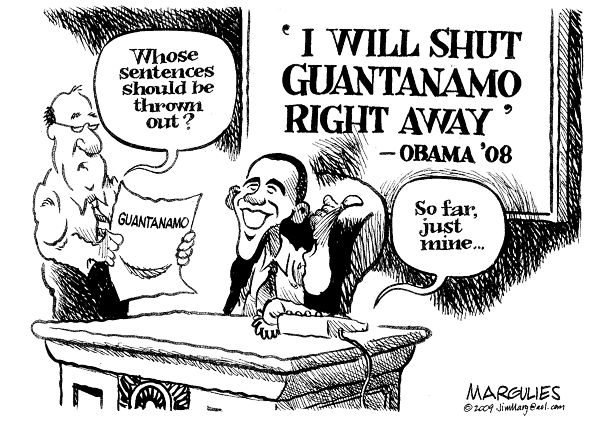
President Obama says that his administration will not authorize the indefinite detention of American citizens. Yet Obama also said that he would close Guantanamo Bay. Obama also said he would recall the troops from Iraq within 16 months of taking office. Obama also said he would end the Bush tax cuts.

It doesn’t matter the reason these promises were not kept. What matters is that they weren’t. Obama says his administration will not authorize the indefinite detention of citizens. But that could change. The interpretation of this bill can change on a dime. These politicians who say there is nothing to fear could quickly change whenever they see fit.

These implications grow larger as we know there is no single accepted definition of terrorism present in the United States. The State Department defines terrorism as “premeditated, politically motivated violence perpetrated against noncombatant targets by subnational groups or clandestine agents, usually intended to influence an audience.”

Under this definition, the entire United States can be seen as terrorists. The government had planned the operations in Iraq and has resulted in over 100,000 civilian deaths. It can also be said that the U.S. is changing views of terrorism throughout the world… influencing an audience. Terrorism cannot be specifically defined as attacks against the United States; therefore, the United States might have been terrorizing parts of the Middle East.

Senator Rand Paul of Kentucky has stated that there are laws regarding terrorist suspects in America in place by the Department of Justice. Issues such as having an armed weapon or having a food supply lasting at least seven days can be grounds for terrorism.

I look to my well-supplied pantry filled with foods my loving mother had purchased from Costco. I’m not one to count it all, but I’d say it would last my entire family over a week.

My father legally owns a handgun. There’s something about protecting his family that is important to him, so he keeps a gun nearby.

I am writing a story that is against what the politicians in Washington have voted for. Can I be seen as aiding Al-Qaeda because I am attempting to change the views of the public to something that is against government; because there is a gun in my home and we have a well-supplied pantry?

Can I be seen as a terrorist under the definition of terrorism? Yes I can. Will I? I hope not.

– Alton Lu is an 18 year old high school senior. Alton Lu: I see the name as the most uncommon thing about myself. I’m just a typical teenager in a stereotypical high school residing an in un-extraordinary town. I enjoy pretending that I’m a modern-day philosopher and political activist while still living out the generic high school experience. I am now embarking on the longest, most extensive campaign to the presidency. If you agree with my views, look forward to voting for me in about thirty years. If you disagree…I hope you’ll still vote for me.

All American Muslims Better Get Ready for a New Reality

By Nida Khan for The Huffington Post

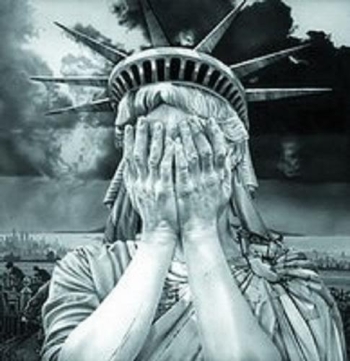
While many Muslims (and people outside the faith for that matter) were heavily embedded in a debate over the controversy surrounding hardware store Lowe’s and its recent decision to remove ads from TLC’s reality show All American Muslim, a more detrimental attack against their future was all but finalized. Reversing an earlier decision to veto provisions of the National Defense Authorization Act (NDAA) for 2012, President Obama made the disturbing announcement that he would sign this legislation into law and thereby solidify the ability of the military and other factions to indefinitely detain anyone they deem an enemy of the state. And on New Year’s Eve, the President unfortunately made good on this promise with the stroke of his pen. At a time when the United States is grossly engaged in both active combat and covert drone campaigns in a multitude of Muslim nations, and when loosely defined terms like ‘terrorist’ can be arbitrarily thrown about, Muslims specifically — and all of society generally — shouldn’t take this disturbing development lightly.

In post-9/11 America, many have sadly grown accustomed and tolerant to routine practices of racial profiling, bias and even attacks against Muslims and those perceived to be Muslim. But in addition to blatant violence, workplace discrimination and subliminal acts of racism, Muslims have also become aware of another nuance that other Americans may not even realize exists — hesitation to give to charity. Because of fear that any charitable Muslim organization or mosque could suddenly be called out for links to a lone extremist faction (whether it’s justified or not), many pulled their money and cut back on donations to the extent that long-established charities found it virtually impossible to survive. Usually without any valid reason, many stopped supporting Muslim aide groups for the simple notion that anyone, anywhere could at any moment single out that organization and in turn put all those who gave money out of goodwill at risk for associating with them. The victims in all this? The impoverished and destitute in many “third world” countries.

At the same time, tragically, other active Muslims who were entrenched in the community or worked in an organizing capacity (much like our president once did for the disenfranchised), ceased their activities over trepidation as to how their efforts towards equality could one day be misconstrued for something nefarious. The climate of society forced many followers of the Islamic faith to alter their involvement on a plethora of levels. Even today, as forces like the NYPD keep Muslims under intrusive surveillance and continued cases of FBI entrapment emerge, many have stopped attending mosques or interacting too much within the community out of sheer apprehension over unwarranted government action. It is an unfortunate reflection of how marginalized groups often times suffer under the radar without a representative voice in government and in the mainstream.

Throughout modern history, we’ve had other instances of outrageous fear mongering, bias and injustice against those whose patriotism we questioned. Though it is rarely covered in classrooms, the internment of hundreds of thousands of Japanese and those of Japanese ancestry during WWII is a perfect example. Literally rounded up and “excluded” from living in the cities and towns they resided in, these “suspicious” individuals were interned in camps because their allegiance to the country “could not be determined.”

In 1950, at the height of the great red scare, Congress passed the Internal Security Act which required the American Communist Party, affiliated organizations and all ‘subversives’ to get fingerprinted and officially register with the Attorney General. This draconian law was so outrageous that then-President Harry Truman even vetoed it (though Congress overruled his veto in the end). The truly tragic and troubling thing about today’s NDAA is that President Obama isn’t even attempting to veto it anymore; he is instead giving it his stamp of approval. Even though the president stated that he has “serious reservations” regarding the detention, interrogation and prosecution of suspected terrorists, and even though he emphasizes that his administration will not indefinitely militarily detain American citizens without trial, what happens after he is no longer in office? Future leaders of the free world, after all, have absolutely no obligation to honor Obama’s signing statement, nor follow in his footsteps.

Yes, our first African American president has changed much of the vitriolic language used when covering the topic of terrorism, and yes he has taken great caution to ensure that Muslims and terror itself are not juxtaposed together. For that, he should be commended. But by finalizing the ability of any president to deem persons — including U.S. citizens (if they so interpret this bill) — an enemy that could then be indefinitely detained without charge or without trial, he sets into motion a frightening precedent. As a former constitutional law professor, President Obama should be inherently aware of the impending ramifications.

During the struggle for civil rights, many journalists, activists and those vocal citizens working alongside Martin Luther King Jr., Malcolm X and other leaders suddenly found themselves targeted for their activities. Countless advocates became political prisoners and others saw their careers and lives ruined. Now at a time when we already have legislation like the Patriot Act renewed, and warrantless wiretapping is openly put into practice, this defense act not only indoctrinates AUMF (2001 Authorization for use of Military Force) and many activities that were previously in existence, but it also leaves open the possibility of silencing anyone on a level with which we never even imagined.

As American Muslims, we’re happy that some are starting to ease the negative imaging and stereotyping against us, and are instead open to learning more about what the Islamic faith truly stands for. As a routinely alienated group, we’re overly ecstatic when a program like All American Muslim actually portrays us in a light other than that of some extremist radical. But while we should embrace the boycott of Lowe’s for its open bigotry, and praise folks like Russell Simmons for stepping up to the plate to purchase ads for the program, we should put just as much focus into the potential of someone like a Newt Gingrich or Rick Santorum taking over the White House and having full reign to detain whomever he pleases. Just remember the Bush-era verbiage of “you’re either with us or against us” and the atmosphere of intolerance that permeated under his presidency, and couple that with the ability of someone with his mentality being able to willfully determine any one of us a “traitor,” lock us up and throw away the key.

If Muslims scaled back their activities in the community and their charitable donations out of paranoia over the unrealistic possibility of being tied to something suspicious, just imagine the fear that will ensue if anyone can be instantly and militarily detained over accusations where the burden of proof won’t even be on the accuser. It is indeed an alarming scenario that can (and in all likelihood will) give new meaning to the term reality — no TV required.

Nida Khan is an independent journalist and producer working in print, radio and TV. As a news correspondent for WRKS 98.7 Kiss FM NY, she has covered everything from Barack Obama’s presidential campaign to protests for the defense of Sean Bell.

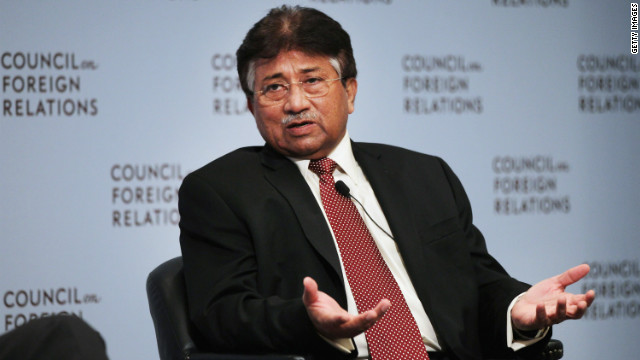
Musharraf Announces He Will Return to Pakistan Late This Month

By Nasir Habib for CNN

Former Pakistani President Pervez Musharraf pledged in a speech Sunday to return to his country later this month, despite word from authorities that he will be arrested when he does so.

“I am coming, Pakistan,” Musharraf told thousands of supporters via video link in the southern city of Karachi. “Attempts have been made to scare me, but I am not afraid of anything.”
He pledged to return between January 27 and 30.

When he does, Pakistani officials said, Musharraf will be arrested in connection with the assassination of former Prime Minister Benazir Bhutto in 2007. Chaudhry Zulfiqar Ali, a special public prosecutor in the assassination case, said a Rawalpindi court has already issued an arrest warrant for Musharraf.

“They are bound to execute the order unless a higher court sets aside the orders,” Ali said, adding that Musharraf is accused of conspiring in the assassination.

Musharraf’s attorney, Chaudry Faisal, said the threat of arrest is politically motivated and has no legal bearing. The warrant is being challenged in court, the attorney said.

He described the claim that Musharraf could be arrested at any time upon return as “absurd.” The former president said Sunday that he will return even at the risk of his life.

Musharraf, who resigned in 2008, is expected to fly into Pakistan from the United Arab Emirates later this month, accompanied by up to 500 supporters, said Jawed Siddiqi, spokesman for the former president’s All Pakistan Muslim League party.

“President Musharraf told me that although the possibility of arrest is there — there is no way of knowing what will happen, and how dangerous the situation is, until one jumps into the situation head first,” he said. Elections are set to take place in Pakistan next year; Musharraf intends to run.

On Sunday, he told Pakistanis that other politicians have failed leading the country, but “I succeeded 100%.”

“When I took charge of the country, it was surrounded in huge problems,” he said. “… Today, we have to decide whether we need change or we need the same faces.”

Terrorism in Pakistan, he said, “is at its peak. We are alone in the world.” He said he restored Pakistan’s economic development, increased its global standing and strengthened the armed forces.

Musharraf resigned in 2008 as the country’s ruling coalition began taking steps to impeach him. He was succeeded by Asif Zardari, Bhutto’s widower.
In 2010, the United Nations released a report that said Musharraf’s government had failed to protect Bhutto before her 2007 assassination. Musharraf has rejected such accusations, saying that Bhutto had police protection and took unnecessary risks.

Bhutto’s assassination turned public opinion strongly against Musharraf in 2008 and led to his resignation and self-exile in London. In 2010, Musharraf said the timing of his return to Pakistan would depend on the environment there.

“My going back is dependent, certainly, on an environment to be created in Pakistan and also, I would say, with certainty, that whenever the signs of the next election comes up, I will be there in Pakistan,” he said.

Pervez Musharraf to Announce Date for Return to Pakistan

By Duncan Gardham for The Telegraph

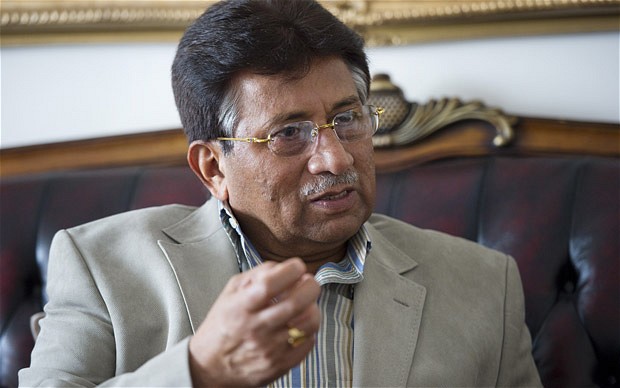
Mr Musharraf will announce his intention to return from London where has been living in exile despite facing arrest on treason charges. “His return will be announced by video link at a rally in Karachi on Sunday,” a source close to the former president told the Daily Telegraph.

He is planning to fly back to Pakistan by the end of January, plunging himself into a political crisis amid reports of an early general election and rumors the military is on the brink of mounting a coup.

The government and army are at loggerhead trading allegations over a memo allegedly sent to US military chiefs by senior officials asking for support to reduce military influence. Yusuf Gilani, the country’s prime minister, has said publicly Pakistan’s generals are behaving as though they were a “state within a state”.

As rumours of a coup gathered speed, Asif Zardari, the country’s president, has been forced to fly back to Pakistan from Dubai where he was receiving treatment for “stroke-like symptoms”.

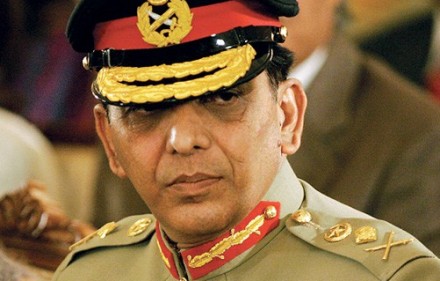
General Ashfaq Kayani, the head of the Pakistan army, rejected coup claims, insisting the army would “continue to support the democratic process”.
However the military distrusts both Mr Zardari and the rival Pakistan Muslim League-N, headed by Nawaz Sharif, the prime minister deposed by Mr Musharraf.

Political analysts believe the army command want to back an outside campaign in the elections but it is unclear if Mr Musharraf fits the bill.
While there has been some support to “bring back the general,” Mr Musharraf was deeply unpopular by the time he was forced out of power four years ago.

In order to stage a return he would need political support from Middle Eastern countries to help persuade the government to drop the charges against
him.

However, there have been reports that the army is backing Imran Khan, the former Pakistan cricket captain who leads Tehreek-e-Insaf [the Movement for Justice] and has staged a series of popular rallies.

Mr Khan is a former supporter of Mr Musharraf who has since become one of his fiercest critics. Ahmed Rashid, a political commentator, said the country was facing a “multi-faceted crisis”, particularly with the economy, but he doubted Mr Musharraf could make a comeback. “I don’t think he has enough people supporting him and he would probably be arrested,” he said.

Mr Musharraf launched his own political party, the All Pakistan Muslim League, in London in June 2010 and told the Daily Telegraph last year: “Pakistan is suffering. The people are extremely alive now that something has to be done in Pakistan. The youth is alive, the educated middle class is alive, they are in a state of shock and dismay over the governance in Pakistan.”

He promised a party that was “capable, viable, honest and deliverable internationally.” “I am a person who believes if I try and if I’m failing, I will quit,” he added. “I have no qualms and no ego. I have governed Pakistan for nine years, very successfully and I have no further ambitions, personal ambitions, my ambition is Pakistan.” But it is unlikely that Mr Musharraf would be able to claim victory on his own and he admitted: “I am trying to create an entity which can be the third political alternative, whether alone or in coalition with some other like-minded parties.” Mr Zardari took over from Mr Musharraf as the country’s first elected leader in nine years following the assassination of his wife, Benazir Bhutto in December 2007.

However his party, the Pakistan People’s Party, has become increasingly unpopular as Pakistan faces a economic depression and copes with one crisis after another. The next government is likely to be decided by smaller parties and Mr Musharraf could play a crucial role in that decision.