Archive for the ‘ Freedoms ’ Category

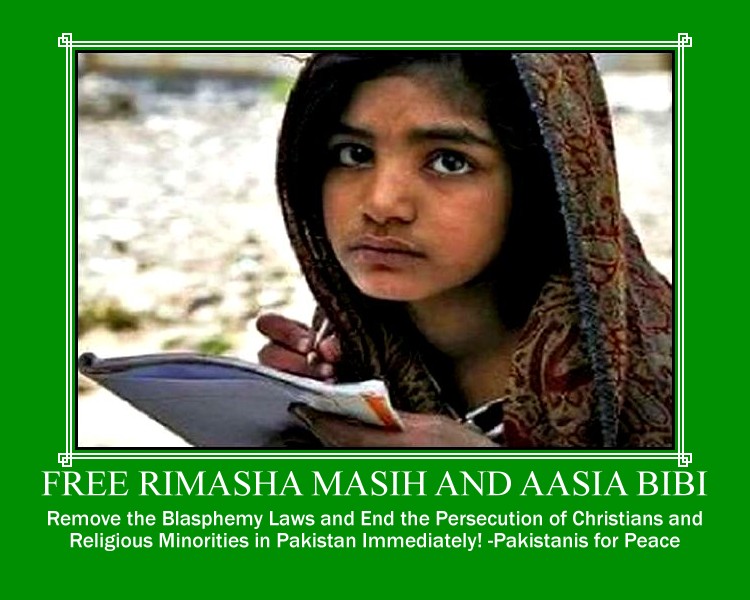
Free Rimsha Masih Now and End The Blasphemy Law Witch Hunts in Pakistan

The latest victim of Pakistan’s blasphemy laws, is an 11 year old girl suffering from Downs Syndrome. Rimshah Masih screamed pitifully as she was brutally snatched from her mother by an angry mob intent on killing her. Burnt religious texts had been mischievously planted in a bag she was carrying. We call on the Pakistani Government to take action to stop the ongoing discrimination, persecution and hatred towards minorities living there. We call on the Britisha Government the EU and the Un to intervene on behalf of this poor child and to bring about her freedom.

To bring an end to hatred towards minority faiths in conservative Pakistan and to defend otherwise helpless victims like Rimsha please sign the petition below: http://www.petitionbuzz.com/petitions/freerimshamasih

This petition will be sent to the Pakistan Government at the highest levels.

“Whilst the Burmese’s treatment of the Rohingya is indeed appalling and deserves condemnation, our minorities are living in their very own Burma right here in Pakistan.

“As the rest of the country goes about its way, having just celebrated another joyous Eid, spare a thought for a little girl with special needs, languishing in a juvenile jail.

“She is probably all alone, and scared. With her condition, she very well might not even know the reason she is in there.

“But ask her neighbours, some who are frothing at the teeth to have a go at her, and they will tell you that she deserves to die.

“Rimsha Masih, an 11-year-old Pakistani girl of the Christian faith, who reportedly suffers from Down Syndrome, was arrested on allegations that she had desecrated the Holy Quran.

“The girl and her mother were severely beaten by an enraged mob that had converged outside their house, while the rest of her family managed to flee. If the police had not intervened, there is no telling what else could have happened….”

Please sign the petition and help free Rimsha and Aasia Bibi and put an end to Pakistan’s Blasphemy Laws.

Pakistan Police Arrest Christian Girl After Angry Neighbors Accuse Her of Burning the Quran

By Munir Ahmed, Zarar Khan and Matthew Lee for The Associated Press

A Christian girl was sent to a Pakistani prison after being accused by her furious Muslim neighbors of burning pages of the Islamic holy book, the Quran, in violation of the country’s strict blasphemy laws.

A police official said Monday there was little evidence that pages of the book had been burned and that the case would likely be dropped. But hundreds of angry neighbors gathered outside the girl’s home last week demanding action in a case raising new concerns about religious extremism in this conservative Muslim country.

Some human rights officials and media reports said the girl was mentally handicapped. Police gave conflicting reports of her age as 11 and 16.

Under Pakistan’s blasphemy laws, anyone found guilty of insulting Islam’s Prophet Muhammad or defiling the holy book, or Quran, can face life in prison or even execution. Critics say the laws are often misused to harass non-Muslims or target individuals.

Police put the girl in jail for 14 days on Thursday after neighbors said they believed a Christian girl had burned pages of a Quran, gathering outside her house in a poor outlying district of Islamabad, said police officer Zabi Ullah. He suggested she was being held for her protection.

ā€œAbout 500 to 600 people had gathered outside her house in Islamabad and they were very emotional, angry and they might have harmed her if we had not quickly reacted,ā€ Ullah said.

Almost everyone in the girl’s neighborhood insisted she had burned the Quran’s pages, even though police said they had found no evidence of it. One police official, Qasim Niazi, said when the girl was brought to the police station, she had a shopping bag that contained various religious and Arabic-language papers that had been partly burned, but there was no Quran.

Some residents claimed they actually saw burnt pages of Quran — either at the local mosque or at the girl’s house. Few people in Pakistan actually speak or read Arabic, so often assume that anything they see with Arabic script is believed to be from the Quran, sometimes the only Arabic-language book people have seen.

But one police officer familiar with the girl’s case said the matter would likely be dropped once the investigation is completed and the atmosphere is defused, saying there was ā€œnothing much to the case.ā€ He did not want to be identified due to the sensitivity of the case.

A spokesperson for Pakistani President Asif Ali Zardari, Farhatullah Babar, said the president has taken ā€œserious noteā€ of reports of the girl’s arrest and has asked the Interior Ministry to look into the case.

In Washington, State Department spokeswoman Victoria Nuland called the case ā€œdeeply disturbingā€.

ā€œWe urge the government of Pakistan to protect not just its religious minority citizens but also women and girls,ā€ she said.

The Associated Press is withholding the girl’s name; the AP does not generally identify juveniles under 18 who are accused of crimes.

The case demonstrates the deep emotion that suspected blasphemy cases can evoke in a country where religion Many critics say the blasphemy laws are often abused.

ā€œIt has been exploited by individuals to settle personal scores, to grab land, to violate the rights of non-Muslims, to basically harass them,ā€ said the head of the Human Rights Commission of Pakistan, Zora Yusuf.

Those convicted of blasphemy can spend years in prison and often face mob justice by extremists when they finally do get out. In July, thousands of people dragged a man accused of desecrating the Quran from a police station in the central city of Bahawalpur, beat him to death and then set his body on fire.

Attempts to revoke or alter the blasphemy laws have been met with violent opposition. Last year, two prominent political figures who spoke out against the laws were killed in attacks that basically ended any attempts at reform.

The girl’s jailing terrified her Christian neighbors, many of whom left their homes in fear after the incident. One resident said Muslims used to object to the noise when Christians sang songs during their services. After the girl was accused he said senior members of the Muslim community pressured landlords to evict Christian tenants.

But Muslim residents insisted they treated their neighbors with respect, and said Christians needed to respect Islamic traditions and culture.

ā€œTheir priest should tell them that they should respect the call for prayer. They should respect the mosque and the Quran,ā€ said Haji Pervez, one of several Muslims gathered at the local mosque less than 100 yards (meters) from the grey concrete house where the Christian girl lived.

ā€œThis is what should have happened. We are standing in the house of God. This incident has happened and it is true. It was not good.ā€

ā€œEven a 3-year-old, 4-year-old child knows: ā€œThis is Muslim. This is Christian. This is our religion,ā€ said shopkeeper Mohammed Ilyas.

Pakistanis for Peace Editor’s Note– The case of this young Christian girl is reminiscent of the case of Aasia Bibi and many other lesser known unfortunate people who have been arrested under Pakistan’s ridiculous blasphemy laws. These laws are draconian and have no place in the country’s judicial system serving only to intimidate Pakistan’s religious minorities and giving the zealots an official tool to harass the country’s Christians, Hindus and other minorities. As we have done before, we call on the government of Pakistan to do the right thing and strike these absurd laws from the books and free the individuals who have been imprisoned under these laws.

For Surjeet Singh, Life Unfolds a Guessing Game

As Reported by The Hindustan Times

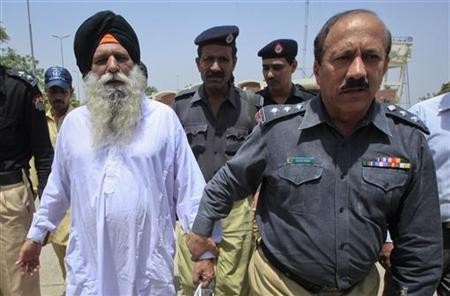
“Pehchanon ji ye kaun hai” (guess who this is), is what Surjeet Singh often hears, as he relaxes on a cot in the sweltering summer heat on a farm in this Punjab village. Surjeet, 69, now plays this ‘guessing game’ several times a day, ever since he arrived in his native village last week, after more than 30 years of incarceration in Pakistan.
“There are several people from villages and other places coming to meet me despite the heat. Sometimes, my family members ask me to guess who a particular person is. Most of them look so different and older, just like me. It is hard to guess every time and then I try to identify them by their names. I can re-collect some names though,” Surjeet Singh told IANS with several people sitting around him.

“Ye budhi kaun hai (who is this old woman)?” was a question Surjeet popped in Punjabi to his relatives as an elderly woman came to meet him. He was told that she was a relative and he gave her a warm hug.

Surjeet wears a pair of white kurta-payjama and slippers as he wanders through his daily life and receives scores of visitors or meets them around his village. He returned home Thursday to a tumultuous and teary welcome from family and friends.

Among the visitors Saturday was Gurbaksh Ram, a fellow prisoner in Pakistan who returned to India in June 2006.

“I was with Bapuji in the Lahore jail for several years. I was released in June 2006 after, spending over 20 years in Pakistani jails. When I read about his return, I wanted to meet him,” Gurbaksh told IANS.

Among the visitors were two Sikh gentlemen who asked if he could recognise them.

“I am Bhai Singh and he is Vikar Singh,” one of them said. Surjeet had a hearty laugh as he hugged the taller Vikar Singh and remarked: “Ehh taan baba baneya phirda hai (he has become an old man).”

Besides the people who knew him from over three decades back, there are others who come to him with hope to hear about their own missing ones.

“Some people get their files and photographs of missing family members who are believed to be in Pakistani jails. They show him (Surjeet) the photos to know if he has met that person in Lahore jail,” one of his relatives said.

“He is very happy to be back in his country and among his family members and friends. Even though we were forced to sell our old house (where Surjeet lived) and land, this new house is lucky for us as it has brought him back,” Surjeet’s wife Harbans Kaur said.

“In the (Pakistani) jail, he had some facilities like regular power supply which is not available here. He is back now and my tension is over. I will put the entire responsibility on him. He will take charge of things,” Harbans Kaur, who supported her children in adversity after Surjeet went missing in 1982, said with a smile.

Surjeet languished in Pakistani jails for over 30 years after being arrested on charges of spying there. He was sentenced to death but the sentence was later commuted to life imprisonment.

Surjeet was released from Lahore’s Kot Lakhpat jail early Thursday and made the road journey in a prison van to Wagah, on the Pakistan side of the border, before walking into India at the famous checkpost.

Imran Khan’s Strategy: End Corruption

By Azeem Ibrahim for The Express Tribune

Pakistan Tehreek-i-Insaf leader Imran Khan has pledged in his political manifesto to eliminate major corruption in Pakistan within his first 90 days as prime minister. This is a tall order and was being derided by Nawaz Sharif yesterday as impractical and naive.

Despite his tenure in office, Sharif has failed to understand the different modes and echelons of corruption in Pakistan. Khan intends to target specific government level corruption which is most damaging in a series of enforceable reforms based on forceful transparency and assertive accountability.

Imran Khan is right to see the fight against corruption as a priority and instead of criticism he should be receiving national support for the huge task ahead. Corruption in Pakistan is widespread, systemic and deeply entrenched at all levels of society and government and is a substantial obstacle to the country’s development.

With losses due to corruption in Pakistan being estimated at Rs8500 billion, it has been described as ā€œplunderā€ in a country where people still lack the most basic needs. Pakistan’s main anti-corruption body, the National Anti-Corruption Bureau (NAB) admitted in 2008 that Rs200 billion are wasted through corrupt practices at higher government levels with more billions locally. Petty corruption in the form of bribery is prevalent in law enforcement, procurement and the provision of public services; widespread financial and political corruption, nepotism and the misuse of power are rife.

Transparency International (TI), a Berlin-based organisation that puts out an annual Corruptions Perception Index (CPI), attributes corruption to autocratic governments, sprawling government bureaucracies of under-paid, under-trained civil servants and a lack of media freedom to keep track of fat government contracts and easy money. TI ranked Pakistan 139th among 180 countries in its 2009 CPI.

Pakistan has undertaken anti-corruption proceedings over the years but has avoided scrutiny of senior officials. The National Reconciliation Ordinance (NRO) issued by the former President of Pakistan, General Pervez Musharraf, on October 5, 2009, granted amnesty to politicians, political workers and bureaucrats who were accused of corruption, embezzlement, money laundering and even murder. A list of 8041 individuals who benefited from NRO included 34 politicians, further reducing public trust in leadership and encouraging the spread of corrupt practice at federal, provincial and local government level. It was declared unconstitutional by the Supreme Court of Pakistan on December 16, 2009, throwing the country into a continuing political crisis.

Pakistan’s citizens expect to pay bribes to obtain services such as electricity, health care and education and in dealings with the police. In the absence of a democratic and effective taxation authority, bribery can be seen as a form of illegal taxation in a country where the national budget is inadequate for the delivery of social services. This is damaging to the social fabric of society but it is low-level petty corruption nevertheless.

It is the illegal use of power by politicians and bureaucrats that deserves immediate attention and urgent scrutiny in Pakistan and Imran Khan recognises the need to put an end to these predatory practices that waste resources that should be invested for the good of the country.

Just one example of the direct impact of increased corruption is the rise in the prices of food commodities which according to the latest official data of Federal Bureau of Statistics, have increased up to 120 per cent in one year.

Lack of transparency and accountability have allowed the awarding of government contracts and licenses to one’s family, relatives or to corporations where one is a shareholder, allowing for private greed to overrule the public good. This type of corruption at a governmental level can be tackled relatively easily by enacting conflict of interest and transparency legislation – and enforcing it aggressively.

Imran Khan has already set an example and proposed that all politicians should also declare their assets.

A short blog like this is not the most effective medium to convey Imran Khan’s strategy in its entirety, but I can assure the naysayers that a comprehensive and effective policy is being developed alongside a strategic implementation plan. This is a powerful first step in clearing up corruption in Pakistan, vital for Pakistan’s survival as a democracy and hopefully the shape of government to come.

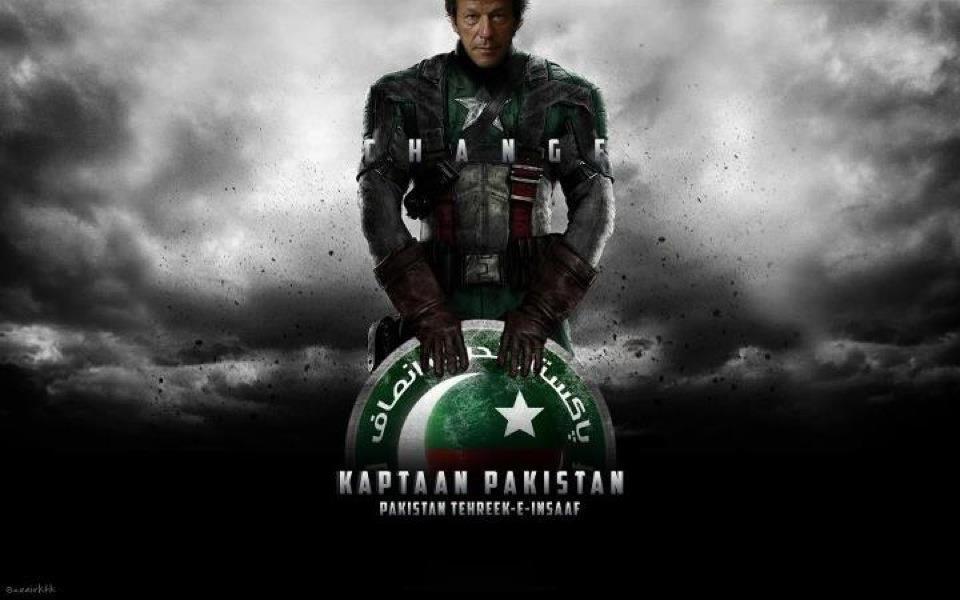
Pakistanis for Peace Editor’s Note– Although we do not agree with all the policies and proposals put forward by Imran Khan, we believe he represents the best hope for Pakistan and its world leading corrupt crony style feudal system of psudo-democratic and hyper military state. All other contenders are either too corrupt or too untrustworthy, unlike Khan, a hero for winning the 1992 Cricket World Cup as well as singlehandedly establishing a free state of the art cancer hospital for the country thru own money and largely through donations from the nation.

Let’s hope regardless of the outcome in the next elections, Pakistan finally gains a leader worthy of fixing all the ills of this nation and perhaps Kaptaan Imran Khan is the only hope.

Rural Tinkerer Builds The First Airplane Made in Afghanistan

By Tom A Peter for The Christian Science Monitor

Afghanistan’s rural Ghazni Province usually appears on the news radar only to herald a tragedy: Five Polish soldiers were killed by a roadside bomb days before Christmas. A group of armed men accused a widow and her daughter of adultery in November and stoned the pair before shooting them in front of their home.

In other words, it’s not the sort of place you’d expect to find a hobbyist aviator in his backyard building what he describes as the first airplane ever designed and constructed in Afghanistan.

Yet, over the past three years Ghazni-native Sabir Shah managed to fashion a one-man ā€œmicrolight,ā€ aircraft at his family home using instructions from the Internet and parts from the local market.

While impressive compared with a Wright Brothers’ creation, the plane is far from a marvel of modern aviation. But Mr. Shah hopes it’s enough to inspire government support or private investment in Afghan aviation.

So far though, aside from modest, but passing interest from a few government officials, he’s received little attention. Most Afghans, including his own family, have called him crazy and told him to get a regular job. Still, Shah remains determined to create a business building airplanes for Afghanistan.

ā€œI believe that if you want something, you can get it,ā€ he says.

Shah is an unlikely candidate to be Afghanistan’s aviation advocate. A high school graduate with no pilot training nor aeronautical engineering background, he’d never even traveled by airplane when he started building one.

For Afghans wishing to learn how to fly, the options are extremely limited. The country has a fledging air force, but there are no other practical opportunities for pilot training. The Ministry of Transportation and Aviation offers flight classes, but ministry officials admit that few students actually take the courses because Afghan airlines almost exclusively hire foreign pilots with better training and more experience.

After high school, Shah considered going on to college. Yet even though public universities are free, his family couldn’t afford losing the extra pair of hands.
Given his circumstances it’s easy to understand why people were skeptical when Shah announced his plans to build a microlight airplane after seeing one featured on a documentary and doing a bit of Internet research.

ā€œI didn’t have money and there was no one to help me,ā€ says Shah. ā€œEveryone was saying, ā€˜Have you studied about airplanes? Do you know anything about airplanes?’ I would say, ā€˜I have got some recommendations from the Internet.’ Nobody believed I could build it.ā€

Undeterred, Shah continued his research and worked a series of odd jobs to save up money for parts and equipment. As he progressed, friends and family donated money. An uncle in Australia gave him a vital $2,000 donation and even Afghan Vice President Abdul Karim Khalili contributed $1,000 when he learned of the project.

After three years, Shah had constructed a microlight airplane using a propeller he made himself, a small Toyota car engine, a homemade fiberglass body, a wing made of a metal frame and cloth, and some spare gauges he bought at the market for his instrument panel. The project cost Shah a total of $12,000, a small fortune here.

When it came time for his first test flight, the Afghan Ministry of Defense agreed to use a military helicopter to transport Shah and his plane to an airfield north of Kabul. The trip was the first time Shah had ever traveled by air. ā€œI was frightened a little when I was looking down,ā€ he says, recalling the trip.

Before Shah climbed into the pilot seat, a retired Afghan pilot who’d flown jets for the Soviets and now managed the airport gave him a few pointers. Otherwise, he was relying on manuals he’d collected on other microlight aircraft.

As his plane sped down the runway, his fear momentarily faded. The flight lasted less than a minute before he set it down on the runway again.

In a total of four takeoffs, his longest and last flight traveled about a quarter of a mile – nothing compared with professional tests, but 11 times farther than the original Wright Brothers’ flight. However, that final flight ended when he crash-landed just off the runway. Though he walked away from the crash, the plane was damaged beyond repair.

Considering that it’s been 64 years since a pilot first broke the sound barrier and 25 years since a plane circumnavigated the globe without stopping or refueling, Shah’s achievement may seem hardly worth mentioning. But his accomplishment is much less about the actual plane he built and more about his creativity and inventiveness in a country where innovation and ingenuity are in short supply after three decades of war.

ā€œInnovation doesn’t mean anything in this country,ā€ says Daoud Sultanzoy, a former member of parliament from Ghanzi, who has been a pilot since 1973 and is now starting his own airline. ā€œWe always look at the past and behind us instead of looking forward…. He’s a young man who must have used his own know-how to build his own airplane, which should be encouraged.ā€

Despite the challenges, Shah says he’ll keep working. If he can find a scholarship to study abroad he will, but he doesn’t know how to look for such an opportunity and doubts it will happen. For now, he hopes his initial success will attract investors as he endeavors to start his next project, an eight- to 10-seater airplane that he hopes can be used for domestic travel in Afghanistan.

Pakistanis for Peace Editor’s Note– What an amazing story of ingeunity and ambition that Sabir Shah demonstrates that should make all Afghans and Pakistanis proud. Just imagine what amazing talents could be nurtured with several billion dollars in seed money in start-ups in Kabul instead of all the money lost on wars~

Say Hello! to Pakistan’s Glamour Side

As Reported by The Associated Press

Pakistan is better known for bombs than bombshells, militant compounds than opulent estates. A few enterprising Pakistanis hope to alter that perception with the launch of a local version of the well-known celebrity magazine Hello!.

They plan to profile Pakistan’s rich and famous: the dashing cricket players, voluptuous Bollywood stars and powerful politicians who dominate conversation in the country’s ritziest private clubs and lowliest tea stalls. They also hope to discover musicians, fashion designers and other new talents who have yet to become household names.

“The side of Pakistan that is projected time and time again is negative,” said Zahraa Saifullah, CEO of Hello! Pakistan. “There is a glamorous side of Pakistan, and we want to tap into that.”

But celebrating the lives of Pakistan’s most prosperous citizens is not without its critics in a country where much of the population lives in poverty. Advertising one’s prosperity could be risky as well since kidnappings for ransom are on the rise and attracting attention from Islamist militants can mean death.

Wajahat Khan, a consulting editor at Hello! Pakistan, said they were cognizant of the sensitivity of publishing a glamour magazine in a conservative Muslim country where many people are struggling and planned to be “socially responsible and culturally aware.”

“We are trying to be happy in a war zone,” Khan said Saturday at a news conference with Saifullah and other members of the magazine’s editorial staff. “We are trying to celebrate what is still alive in a difficult country.”

Khan said they would do everything they could to protect the security of the people they profile, but he wasn’t overly concerned.

“I don’t think terrorist networks are going to be reading Hello! anytime soon,” he said.

Pakistan already has a series of local publications that chronicle the lives of the wellheeled in major cities like Islamabad, Lahore and Karachi, especially as they hop between lavish parties. But the producers of Hello! Pakistan hope the magazine’s international brand and greater depth will attract followers.

Hello! was launched in 1988 by the publisher of Spain’s Hola! magazine and is now published in 150 countries. It’s well-known for its extensive coverage of Britain’s royal family and once paid $14 million in a joint deal with People magazine for exclusive pictures of Brad Pitt and Angelina Jolie’s newborn twins.

The market for English-language publications in Pakistan is fairly small. Most monthly and weekly magazines sell no more than 3,000 copies, said Khan, the consulting editor. But they hope to tap into the large Pakistani expatriate markets in the United Kingdom and the Middle East as well.

Hello! Pakistan will be published once a month and will cost about $5.50, twice as much as what many poor Pakistanis earn in a day. The first issue will be published in mid-April and will focus on the Pakistani fashion scene.

Saifullah, who grew up watching her mother and grandmother read Hello! as she hopped between London and Karachi, said it took her two years to convince the magazine to publish a local version in Pakistan.

“They were concerned about whether Pakistan was ready for a magazine like this,” she said.

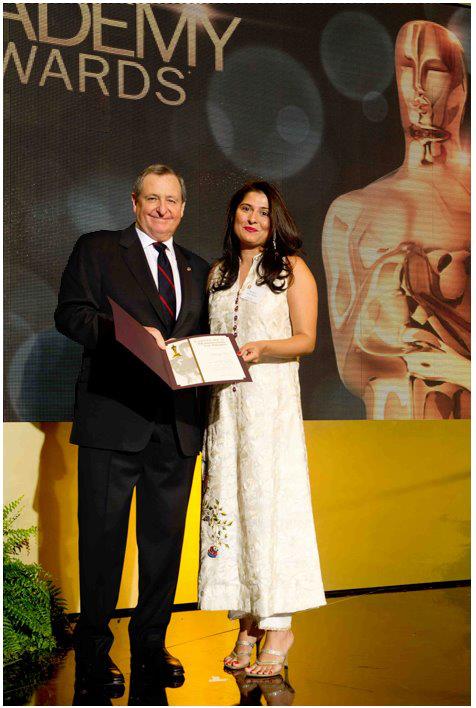
But Saifullah thinks the timing is perfect to showcase Pakistan’s too often hidden treasures, citing Sharmeen Obaid-Chinoy, who recently became the first Pakistani filmmaker to win an Oscar for a documentary about the plight of female victims of acid attacks in the country.

“We want to tap into the aesthetically beautiful, the athletic, the fashionable,” said Saifullah. “There is so much going on on a daily basis that nobody ever covers. It’s totally unexplored.”

Pakistanis for Peace Editor’s Note– Pakistan is much more than bombings, extremism, and terror. The launch of this magazine in Pakistan not only helps illustrate to the outside world of a modern 21st century Pakistan but also stands as a bulwark to the Talibanization of Pakistan by the extremists.

In wake of Trayvon Martin’s Death, America is Soul-searching

By Yamiche Alcindor, Marisol Bello and Larry Copeland to USA Today

Spurred by social media and community rallies, the shooting death of a 17-year-old Florida youth has become the latest flashpoint over how young black men are perceived in the United States.

Trayvon Martin’s death Feb. 26 at the hands of a Neighborhood Watch leader in this small, gated Florida community has rippled through many corners of the nation’s justice and political system and raised questions about the relationship between the black community and police in small towns.

In the past 48 hours, the case has:

•Sparked an investigation by the U.S. Department of Justice, the FBI and the Florida state attorney’s office.

Brought calls for changes in a Florida self-defense law that says a person being attacked has no duty to retreat and may return force;

Trayvon Martin was talking on his cell phone when he was shot and killed in February.
•Ignited protests, including a “Million Hoodie March” in New York City planned today, and a rally Thursday in Sanford led by civil rights activist Al Sharpton;

•Amassed more than 600,000 signatures in an online petition calling for charges to be filed against George Zimmerman, the Neighborhood Watch captain who said he shot Martin.

Zimmerman has not been arrested or charged with a crime.

The case has resonated for many who say Martin died because of stereotypes of young black men as violent criminals. The shooting is already being compared with high-profile and historic civil rights cases — for instance, a doctored photograph has circulated throughout many social media sites that compares Martin to Emmett Till, a young man lynched by white men in 1950s Mississippi.

“It’s not about these individual acts of racism,” said Mark Neal, a professor of African and African American Studies at Duke University. “It’s about the way that black males are framed in the larger culture … as being violent, criminal and threats to safety and property.”

The tragic case played out in Sanford, population 54,000, about 30 minutes north of Orlando, when Martin left his father’s home to buy candy and iced tea for his little brother at a nearby 7-Eleven.

He was on his way back in the rain when Zimmerman, 28, spotted him. Zimmerman was armed as he patroled the area in his car in response to several break-ins in the community.

Zimmerman called 911 to report a suspicious person, according to the call released by Sanford emergency dispatch. Against the advice of the 911 dispatcher, Zimmerman followed Martin, according to the 911 recording.

The two men fought and Trayvon Martin was left dead. Zimmerman told the Sanford police that he shot the teen in self-defense because he was fearful for his life. The police have said there is no evidence to contradict Zimmerman’s claims. Police say Zimmerman was bleeding from his nose and the back of his head.

Zimmerman has not spoken publicly. In a statement, his father, Robert, said, “The portrayal of George Zimmerman in the media, as well as the series of events that led to the tragic shooting are false and extremely misleading. … George is a Spanish-speaking minority with many black family members and friends. He would be the last to discriminate for any reason whatsoever.”

The fatal shooting touched a chord of community outrage in Sanford on Tuesday night. The killing was “a senseless murder as far as we are concerned,” Seminole County NAACP President Clayton Turner told a capacity crowd at the start of a town-hall-style meeting at Allen Chapel AME Church.

Clayton said the Sanford city manager and mayor were unable to attend because they had been “summoned” to Washington by Attorney General Eric Holder.

“The line has been drawn in the sand,” Clayton said. “We as people of color are going to stand our ground. We are going to do it in a non-violent way, and we are going to prevail.”

Before his son’s death, Tracy Martin warned son Trayvon that being a black man in America could be dangerous.

“I’ve always let him know we as African Americans get stereotyped,” Tracy Martin told USA TODAY. “I told him that society is cruel.”

Those warning messages have echoed in Tracy Martin’s head since his son died.

Martin family attorney Benjamin Crump said Tuesday that the young man was on the phone with his girlfriend when Zimmerman followed and approached him. He said the 16-year-old girl told a harrowing story that he says shows Martin did not attack Zimmerman.

The girl, whose family asked the attorney not to reveal her identity, told Crump that she and Martin were talking on the phone when he left the store, a bag of Skittles in his pocket. Crump said as Martin walked home, he told the girl, “This dude is following me.”

Crump said the girl told him that she told Martin to run. Martin ran, which coincided with Zimmerman’s comments to 911 in which he said the suspicious man was running, Crump said.

“Then she hears (Martin) say, ‘Why are you following me?’ and another voice say, ‘What are you doing in the neighborhood?’ ” Crump said.

Police actions questioned

The girl told Crump she then thought she could hear Trayvon was pushed and she heard a brief altercation, then the line went dead.

“This claim that Trayvon Martin was the aggressor is preposterous,” the attorney said.

Crump has questioned Sanford police actions after the shooting, noting that police did not run a blood-alcohol test or a background check on Zimmerman, but they ran both on Martin after he died. He said police took Zimmerman’s word without conducting a thorough investigation.

Tracy Martin says he wants Zimmerman arrested and tried in court.

“My child was profiled,” the father said. “He was stereotyped. We aren’t letting our son die in vain.”

The decision not to arrest Zimmerman was made by the responding officer who released the gunman after he claimed to have acted in self-defense, Sanford officials said Tuesday.

It was only after a growing public outcry expressing a lack of confidence in the police department’s actions that city leaders called on the Justice Department to review the shooting, City Manager Norton Bonaparte and Mayor Jeff Triplett said.

“We have a lot of strife in our community right now,” Triplett said at a Capitol Hill briefing where he and Bonaparte appeared with Rep. Corrine Brown, a Florida Democrat. “If we’ve made an error, I want someone to tell me. There will be no stone that won’t be overturned.”

Triplett said the Justice investigation would review all aspects of the case, including the police response and the decision not to arrest Zimmerman.

Bonaparte acknowledged Zimmerman was part of a network of local Neighborhood Watch groups trained by the Sanford Police Department and urged “not to engage” possible suspects or people they encounter. Brown said she was “not satisfied” with the initial handling of the case, agreeing that Zimmerman was not tested for possible substance abuse immediately after the incident and lamenting that proper steps were not taken to preserve possible evidence at the scene.

“People need to feel that the system is fair,” Brown said. “It just wasn’t handled right.”

In conversations with the Sanford police chief, Triplett said he believes the Florida law known as the “stand your ground” statute, which provides a broader interpretation of self-defense, played a role in the decision not to arrest and charge Zimmerman.

The law allows the use of force if the person “reasonably believes” it is necessary to protect the person’s own life, or the life of another or to prevent a forcible felony.

In the wake of Martin’s death, the law is getting a second look. State Sen. Oscar Braynon, who represents Miami Gardens where the teen lived with his mother, called for hearings or a select committee to clarify what constitutes self-defense under the law. He said that since the law was enacted in 2005, the number of justified homicides in the state has skyrocketed. In 2005, there were 43 such cases; in 2009, the last complete year available, there were 105, Braynon said.

“I think there is vigilante justice happening and I think people are getting shot,” he said. “This is an unintended consequence of the law.”

Social media’s role

Public activism has played a pivotal role in bringing national attention to the case and ultimately leading to a top-to-bottom review of what happened that day. A wellspring of social media grew by the day and became relentless, demanding that the spotlight return to Sanford. It’s the only way to galvanize people in such cases, says Neal, the Duke professor.

“If folks aren’t on Twitter tweeting stories and giving particular testimonies; if you don’t have artists doing videos on YouTube talking about what Trayvon might have experienced … I don’t think we get a moment where suddenly the Justice Department is saying we need to investigate this case,” Neal says.

Change.org spokeswoman Brianna Cayo Cotter said the petition calling for prosecution of Zimmerman was drawing the second-highest amount of traffic to the site since a petition was launched for Kyleigh’s Law, a measure passed in New Jersey in 2010 that requires drivers younger than 18 with permits or probationary licenses to display special decals on their vehicles. Kyleigh D’Alessio was 16 when she died in a 2006 car crash.

“We are seeing unprecedented traffic on our website,” Cayo Cotter said.

The attention is also focusing on the town of Sanford, which has a history of racial tensions.

“This case more than anything reminds me of Jena — of a small Southern town that played by its own rules,” Sharpton said. “Sanford authorities thought they could contain it. … Once it becomes national, they can’t contain and control the story and the outcome.”

The Jena 6 were black teens initially charged in 2006 with attempted murder for beating a white schoolmate in the town of Jena, La. After a national outcry, community rallies and online petitions, the charges were reduced.

Theo Shaw, 23, one of the Jena 6 who is preparing to attend law school in the fall, says, “This is another incident in which there is a presumption that a young black man has been guilty of something.”

Contributing: Melanie Eversley in New York; Kevin Johnson in Washington; Carolyn Pesce in McLean, Va.; Associated Press

Security Forces in Kashmir Charged With Rights Abuses

By Riyaz Masroor for The BBC

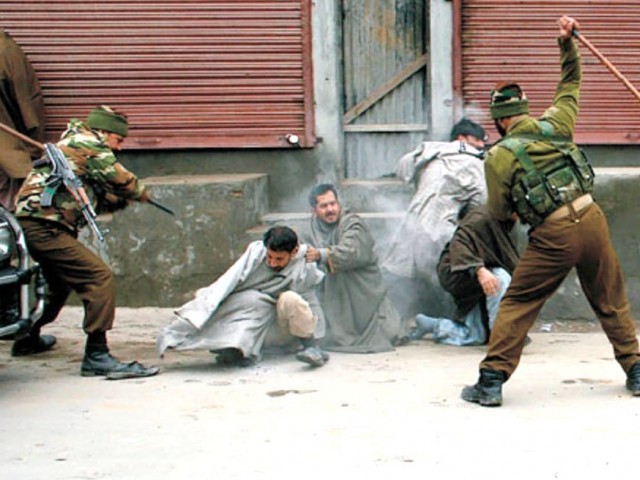
The authorities in Indian-administered Kashmir have launched more than 400 cases of alleged human rights abuses against security forces personnel. The region’s minister for internal security released the figures in the Jammu and Kashmir legislative assembly.

Kashmiri officials want to revoke the Armed Forces Special Powers Act, which prevents prosecution of security staff. There has been a rebellion against Indian rule in divided Kashmir, which is also claimed by Pakistan.

Thousands of people have been killed in the region since the rebellion began in 1989, though violence has dropped off recently. India’s defence ministry has resisted moves to revoke the Armed Forces Special Powers Act (AFSPA).

According to the state government of Indian-administered Kashmir, 444 soldiers, police and security officials have been charged in the past three years.

Nearly 300 cases have been seen in local courts, the government said on Monday in a written response to the Jammu and Kashmir assembly. Human rights activists say the Indian authorities are forcing the Kashmir government to move slowly on these cases.

Kashmiri officials have been pleading with Delhi to scrap the AFSPA so they can proceed with prosecuting security officials against whom cases are pending.

But army officials say it is needed to prevent militant groups based in Pakistan from focusing their resources on Kashmir.

Islam & the NYPD

By Dr Qanta A Ahmed for NY Post

The relentless campaign to paint the NYPD as Islamophobic is itself an offense to Islam. In fact, our faith compels American Muslims to stand with the NYPD — both to protect the faith, and by its direct dictates.

Let me be clear: By investigating Islamist sympathizers who seek to curtail the freedoms of all Americans, the NYPD is aggressively protecting the freedoms and privileges that Muslims enjoy in America (freedoms that aren’t available even in the birthplace of Islam).

Islamism is distinct from the beliefs the majority of Islam’s 1.6 billion followers hold dear. The cry of ā€œIslamophobiaā€ is often merely an effort to silence those of us who seek to communicate this distinction, or to express concerns about Islamism. Most Muslims are spiritually private, committed persons active in their societies without a subversive political agenda. Think of them as pluralistic Muslims.

Because America’s religious freedom is protected by constitutional ideals, Muslims can pursue this pluralistic life — an American life that makes private space for faith, in parallel to public roles. Indeed, Muslims in America are freer to do this than Muslims in Pakistan (where my family is from), Saudi Arabia (where I have lived) or even Indonesia, because each of these Muslim-majority countries imposes laws restricting the practice of religion.

In many ways, Muslims are best able to follow their Islam — to become Muslim in the fullest sense — here in America, because of this nation’s astonishing, constitutionally guaranteed freedoms.

Political Islamism — variously called radical Islam, jihadism or Islamic fundamentalism — is completely different. In contrast to our centuries-old faith, it’s a modern political project that seeks to return any society to a supposed ā€œscriptural foundationā€ of the Muslim community, removing existing forms of government and laws.

Sound like a war? Well, in the wider world and here in America, there is indeed a war afoot — a war of ideas, a ā€œBattle for the Soul of Islam,ā€ as my colleague, American Islamic Forum for Democracy president Zudhi Jasser, has termed it.

In this battle, the Islamist thrives — citing freedom of speech, claiming disadvantaged civil rights, exploiting the privileges that a liberal democracy accords him. Often operating via advocacy groups or ā€œIslamic societiesā€ that purport to represent mainstream Muslims, he or she truly serves a political agenda centered on replacing liberal democracy with fundamentalist theocracy.

In fact, the Koran is explicit on the loyalties a Muslim must accord his host nation, mandating a Muslim’s duty to be an unwavering and loyal patriot:
O ye who believe! Obey Allah, and obey His Messenger and those who are in authority from among you. (Ch.4: V.60).

That verse demands the Muslim express loyalty to any ruling authority. This isn’t a suggestion, this is mandated Islamic duty.
The Koran does not state leadership specified as Muslim. Leadership is whomsoever is empowered in the society where the Muslim finds himself. For us here, that includes loyalty to the NYPD, the FBI and their work to safeguard our highest authority — the principles of our liberal democracy.
Can any one group speak for the entire American Muslim community? Islam is diverse — especially in America. Islamism isn’t. The sooner we understand this, the better — because at stake are America’s ideals.

America’s extraordinary freedoms afford us an ability to define our own expressions of Islam as Muslims in a way that no Muslim-majority nation secures for any Muslim anywhere today. We must preserve these values, and join the NYPD, in understanding the Islamist threat to these values.
This means we must support, not vilify, our policemen and -women, our federal agents and our police commissioner — especially when they gather and interpret information they need to preserve us and our values.

How many devout Muslims were among the thousands killed on 9/11? Let us never forget that Islamists — moving among the broader Muslim and secular communities — have wrought atrocities in this city and around the world, and seek to do so again.
If you choose to smear the NYPD for its work to protect us and our society, so too you choose to smear me, a pluralistic patriotic Muslim in America, for demanding an honest discourse.

Dr. Qanta Ahmed practices medicine in New York. She is the author of ā€œIn the Land of Invisible Women.ā€
Twitter: @MissDiagnosis

Pakistan’s Hindu Girls Forced into Muslim Marriages

As Reported by IRIN

Sixteen-year-old Ameena Ahmed*, now living in the town of Rahim Yar Khan in Pakistan’s Punjab Province, does not always respond when her mother-in-law calls out to her. 


ā€œEven after a year of `marriage’ I am not used to my new name. I was called Radha before,ā€ she told IRIN on a rare occasion when she was allowed to go to the corner shop on her own to buy vegetables. 


Ameena, or Radha as she still calls herself, was abducted from Karachi about 13 months ago by a group of young men who offered her ice-cream and a ride in their car. Before she knew what was happening, she was dragged into a larger van, and driven to an area she did not know. 


She was then pressured into signing forms which she later found meant she was married to Ahmed Salim, 25; she was converted to a Muslim after being asked to recite some verses in front of a cleric. She was obliged to wear a veil. Seven months ago, Ameena, who has not seen her parents or three siblings since then and ā€œmisses them a lotā€, moved with her new family to southern Punjab. 


“The abduction and kidnapping of Hindu girls is becoming more and more common,” Amarnath Motumal, a lawyer and leader of Karachi’s Hindu community, told IRIN. ā€œThis trend has been growing over the past four or five years, and it is getting worse day by day.

Pakistan is one of several nations across Asia suffering from a shortage of females as sex-selective abortion has played growing role in the deficit. Portable ultrasound machines have made gender selection much easier. A 2005 study quoted by Wiki estimated that more than 90 million females were “missing” from the expected populations in Afghanistan, Bangladesh, China, India, Pakistan, South Korea and Taiwan alone.

He said there were at least 15-20 forced abductions and conversions of young girls from Karachi each month, mainly from the multi-ethnic Lyari area. The fact that more and more people were moving to Karachi from the interior of Sindh Province added to the dangers, as there were now more Hindus in Karachi, he said. 


ā€œThey come to search for better schooling, for work and to escape growing extremism,ā€ said Motumal who believes Muslim religious schools are involved in the conversion business. 


ā€œHindus are non-believers. They believe in many gods, not one, and are heretics. So they should be converted,ā€ said Abdul Mannan, 20, a Muslim student. He said he would be willing to marry a Hindu girl, if asked to by his teachers, ā€œbecause conversions brought big rewards from Allah [God]. But later I will marry a `real’ Muslim girl as my second wife,ā€ he said. 


According to local law, a Muslim man can take more than one wife, but rights activists argue that the law infringes the rights of women and needs to be altered. 


Motumal says Hindu organizations are concerned only with the ā€œforced conversionā€ of girls under 18. ā€œAdult women are of course free to choose,ā€ he said. 


ā€œLured awayā€

Sunil Sushmt, 40, who lives in a village close to the city of Mirpurkhas in central Sindh Province, said his 14-year-old daughter was ā€œlured awayā€ by an older neighbour and, her parents believe, forcibly converted after marriage to a Muslim. ā€œShe was a child. What choice did she have?ā€ her father asked. He said her mother still cries for her ā€œalmost dailyā€ a year after the event. 


Sushmat is also concerned about how his daughter is being treated. ā€œWe know many converts are treated like slaves, not wives,ā€ he said. 


According to official figures, Hindus based mainly in Sindh make up 2 percent of Pakistan’s total population of 165 million. ā€œWe believe this figure could be higher,ā€ Motumal said. 


According to media reports, a growing number of Hindus have been fleeing Pakistan, mainly for neighbouring India. The kidnapping of girls and other forms of persecution is a factor in this, according to those who have decided not to stay in the country any longer. 


ā€œMy family has lived in Sindh for generations,ā€ Parvati Devi, 70, told IRIN. ā€œBut now I worry for the future of my granddaughters and their children. Maybe we too should leave,ā€ she said. ā€œThe entire family is seriously considering this.ā€ 


Pakistanis for Peace Editor’s Note– This is an absolutely despicable practice that the Pakistani government needs to put an end to just like the blasphemy laws of the nation. The religious minorities of Pakistan deserve equal rights, protections and freedoms.

Pakistan Builds Web Wall Out in the Open

By Eric Pfannier for The New York Times

Many countries censor the Internet, but few spell out their intentions as explicitly as Pakistan.

In an effort to tighten its control over the Internet, the government recently published a public tender for the “development, deployment and operation of a national-level URL filtering and blocking system.”

Technology companies, academic institutions and other interested parties have until March 16 to submit proposals for the $10 million project, but anger about it has been growing both inside and outside Pakistan.

Censorship of the Web is nothing new in Pakistan, which, like other countries in the region, says it wants to uphold public morality, protect national security or prevent blasphemy. The government has blocked access to pornographic sites, as well as, from time to time, mainstream services like Facebook and YouTube.

Until now, however, Pakistan has done so in a makeshift way, demanding that Internet service providers cut off access to specific sites upon request. With Internet use growing rapidly, the censors are struggling to keep up, so the government wants to build an automatic blocking and filtering system, like the so-called Great Firewall of China.

While China and other governments that sanitize the Internet generally do so with little public disclosure, Pakistan is being surprisingly forthcoming about its censorship needs. It published its request for proposals on the Web site of the Information and Communications Technology Ministry’s Research and Development Fund and even took out newspaper advertisements to publicize the project.

“The system would have a central database of undesirable URL’s that would be loaded on the distributed hardware boxes at each POP and updated on daily basis,” the request for proposals says, referring to uniform resource locators, the unique addresses for specific Web pages, and points of presence, or access points.

“The database would be regularly updated through subscription to an international reputed company maintaining and updating such databases,” according to the request, which was published last month.

The tender details a number of technical specifications, including the fact that the technology “should be able to handle a block list of up to 50 million URL’s (concurrent unidirectional filtering capacity) with processing delay of not more than 1 milliseconds.”

Following the Arab Spring, which demonstrated the power of the Internet to help spread political and social change, Pakistan’s move to clamp down has set off a storm of protest among free-speech groups in the country and beyond.

Opponents of censorship say they are doubly appalled because they associated this kind of heavy-handed approach more with the previous regime of Gen. Pervez Musharraf than with the current government of President Asif Ali Zardari.

“The authorities here are big fans of China and how it filters the Internet,” said Sana Saleem, chief executive of Bolo Bhi, a group that campaigns against restrictions on the Internet. “They overlook the fact that China is an autocratic regime and we are a democracy.”

“What makes this kind of censorship so insidious is that they always use national security, pornography or blasphemy as an explanation for blocking other kinds of speech,” Ms. Saleem said, adding that her site had been blocked for several months in 2010 when it made reference to a ban on Facebook. Access to the social networking service had been restricted because of a page featuring a competition to draw the prophet Mohammed — something that is considered blasphemous by Muslims.

The Technology Ministry’s Research and Development Fund says in its tender that the Internet filtering and blocking system will be “indigenously developed,” but campaigners like Ms. Saleem say they think it is likely the agency will try to adapt Western technology for the purpose.

To try to prevent this from happening, Ms. Saleem wrote to the chief executives of eight international companies that make Net filtering technology, asking them to make a public commitment not to apply for the Pakistani grant.

On Friday, one of them, Websense, which is based in San Diego, responded, declaring in a statement on its Web site that it would not seek the contract.

“Broad government censorship of citizen access to the Internet is morally wrong,” Websense said. “We further believe that any company whose products are currently being used for government-imposed censorship should remove their technology so that it is not used in this way by oppressive governments.”

Websense had previously withdrawn the use of its technology from Yemen after facing accusations from the OpenNet Initiative, a U.S.-Canadian academic group, and other organizations that it had been used by the government of that country to stifle political expression on the Internet.

Governments around the world buy filtering and blocking technology to root out illegal content like child pornography. Some private companies employ it to restrict access to social networks and other distractions on company computers.

But the use of Western technology to rein in political speech in countries with repressive regimes has come under increasing scrutiny since the Arab Spring. The OpenNet Initiative said in a report last year that at least nine governments in the Middle East or North Africa had used such products, with the Western companies maintaining lists of sites to be blocked, including sites featuring skeptical views of Islam and even dating services.

Even before implementing its new system, Pakistan has been an active censor. The country was 151st, out of 179, on a ranking of media freedom by the Paris-based group Reporters Without Borders in 2011.

“Reporters Without Borders urges you to abandon this project, which would reinforce the arsenal of measures for communications surveillance and Internet censorship that have already been put in place by your government,” the group wrote in a letter Friday to Prime Minister Yousaf Raza Gilani.

To free-speech advocates in Pakistan, the government’s seeming insouciance about censorship is a particular cause for alarm.

“This is a case study,” said Ms. Saleem of Bolo Bhi, which is based in Karachi and whose name means “speak up.” “No government has ever done this so publicly.”

Saving Pakistan’s Face?

By Huma Yusuf for The New York Times

On Monday morning, Pakistanis awoke to news that their country had just won its first Oscar. Sharmeen Obaid-Chinoy and her co-director Daniel Junge received the award for best documentary in the short-subject category for ā€œSaving Face.ā€ The film chronicles the work of the British-Pakistani plastic surgeon Mohammad Jawad, who performs reconstructive surgery on women who were attacked with acid.

The media in Pakistan couldn’t get enough of the story. Television channels repeatedly broadcast footage of Obaid-Chinoy receiving her award. Fans posted on their Facebook pages pictures of the filmmaker on the red carpet. Her acceptance speech was tweeted and retweeted: ā€œTo all the women in Pakistan who are working for change, don’t give up on your dreams — this is for you.ā€

Politicians tried to share the limelight. Altaf Hussain, the head of the Karachi-based M.Q.M. party, congratulated Obaid-Chinoy publicly. Prime Minister Yousaf Raza Gilani announced that she would be given a civilian award for making Pakistan proud and catalyzing social change.

The chain restaurant Nando’s, which specializes in grilled chicken, even designed an advertising campaign riffing on the documentary’s name: ā€œFrom one hot chick to another: Thanks for Saving our Face.ā€

But Obaid-Chinoy’s triumph, a rare piece of good news out of Pakistan, also reveals the extent to which Pakistanis have become accustomed to feeling dejected.

For once, Pakistan is making headlines for a positive achievement, not another terrorist attack, political squabble or natural disaster. For Pakistanis who have been struggling to restore their country’s flailing image, it’s a relief to see a talented, young Pakistani woman receiving a coveted international award — and hobnobbing with George Clooney. As the cultural critic Nadeem F. Paracha put it in a tweet, ā€œViva la @sharmeenochiony! The pride of Pakistan is in their artistes & intellectuals. Not in bombs and bans!ā€

But what does it say about a country that it would rejoice at attracting global attention for rampant violations of women’s rights?

Pakistan is the world’s third-most dangerous country for women. Over 150 Pakistani women are the victims of acid attacks each year. Activists for women’s rights claim that only 30 percent of acid cases are reported and that this form of violence is extremely widespread because acid is easily available and inexpensive. Last year, the government passed the Acid Control and Acid Crime Prevention Bill, which imposes on attackers prison terms from 14 years to life and fines of up to one million rupees (about $11,000). But the new law has yet to be rigorously implemented, and attitudes toward women’s rights are far from reformed.

Obaid-Chinoy’s film highlights these problems — hardly a point of pride for Pakistanis.

Once the Oscar high subsides, Pakistanis will have to contend with the fact that their nation remains notorious for its challenges, violence against women included. Then the question will be, can the hundreds of thousands of Pakistanis who rooted for Obaid-Chinoy at the Academy Awards muster the same enthusiasm to tackle the problems that her work exposes?

Huma Yusuf is a columnist for the Pakistani newspaper Dawn and was the 2010-11 Pakistan Scholar at the Woodrow Wilson International Center for Scholars in Washington.

Rick Santorum, Meet Hamza Kashgari

By George Packer for The New Yorker

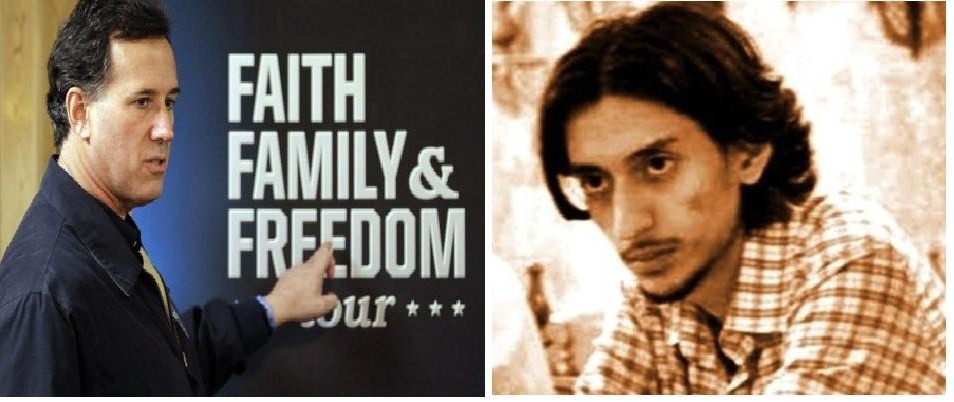
President Kennedy’s 1960 speech on religious freedom makes Rick Santorum ā€œthrow up.ā€ ā€œWhat kind of country do we live in that says only people of nonfaith can come into the public square and make their case?ā€ Santorum says. It’s a central part of his campaign strategy to distort such things as a Kennedy speech, or an Obama speech, to whip up outrage at the supposed war on religious people in America. Here’s what Kennedy said:

I believe in an America where the separation of church and state is absolute; where no Catholic prelate would tell the President—should he be Catholic—how to act, and no Protestant minister would tell his parishioners for whom to vote; where no church or church school is granted any public funds or political preference, and where no man is denied public office merely because his religion differs from the President who might appoint him, or the people who might elect him… I believe in a President whose religious views are his own private affair.

Kennedy said much more, but this is the strongest passage of that famous campaign speech to a group of ministers in Houston, in which he argued that the election of a Catholic President who believed in the Constitution shouldn’t concern any American who believed in the Constitution—and, Santorum says, ā€œThat makes me throw up.ā€ Santorum’s rhetorical eloquence is about equal to his analytical skill. Kennedy had nothing to say against believers entering public life, or believers bringing their religious conscience to bear on public policy. He spoke against any move to make religion official. The Constitution speaks against this, too—Article VI establishes an oath to the Constitution as the basis for public office, and explicitly prohibits a religious test, while the First Amendment forbids the official establishment of religion and protects its free practice. Santorum claims to be a constitutionalist, but that’s just rhetoric and opportunism. Santorum believes in a religious test—that may be all he believes in. (Mitt Romney believes in a religious test of a slimy, halfway, Romneyesque variety: in 2007, he reportedly dismissed the idea of appointing a Muslim to his Cabinet, saying, ā€œBased on the numbers of American Muslims [as a percentage] in our population, I cannot see that a Cabinet position would be justified.ā€ So does Newt Gingrich, who has made atheist-baiting a central part of his political business.)

Kennedy seemed to have someone like Santorum in mind when he warned, ā€œFor while this year it may be a Catholic against whom the finger of suspicion is pointed, in other years it has been—and may someday be again—a Jew, or a Quaker, or a Unitarian, or a Baptist. It was Virginia’s harassment of Baptist preachers, for example, that led to Jefferson’s statute of religious freedom. Today, I may be the victim, but tomorrow it may be you—until the whole fabric of our harmonious society is ripped apart at a time of great national peril.ā€ In 1960, it would have been hard to imagine how thoroughly religious sectarianism and intolerance would infect American politics, and especially one major party. The outcry over Obama’s policy on health insurance and contraception has almost nothing to do with that part of the First Amendment about the right to free religious practice, which is under no threat in this country. It is all about a modern conservative Kulturkampf that will not accept the other part of the religion clause, which prohibits any official religion.

Santorum, like most conservatives these days, says he is a constitutionalist. Jefferson wrote, and Madison worked to pass, the Commonwealth of Virginia’s Bill for Establishing Religious Freedom, which held that ā€œall men shall be free to profess, and by argument to maintain, their opinions in matters of religion, and that the same shall in no wise diminish, enlarge, or affect their civil capacities.ā€ Jefferson included an even stronger phrase that was eventually struck out by amendment: ā€œthe opinions of men are not the object of civil government, nor under its jurisdiction.ā€ Presumably, all of this originalist nonsense makes Rick Santorum heave, gag, vomit, and puke.

What makes me throw up is the story of Hamza Kashgari. It’s a shame that every American doesn’t know his name. He’s a young, slender, philosophical-minded columnist and blogger from Saudi Arabia who, earlier this month, dared to tweet phrases of an imagined conversation with the Prophet Mohammad: ā€œI have loved things about you and I have hated things about you and there is a lot I don’t understand about you…I loved the rebel in you…I will not pray for you.ā€ Within twenty-four hours, more than thirty thousand furious replies had been posted on Twitter. Within a few days, more than twenty thousand people had signed on to a Facebook page called ā€œSaudi People Want Punishment for Hamza Kashgari.ā€ (So much for Arab liberation by social media.) One commenter wrote, ā€œThe only choice is for Kashgari to be killed and crucified in order to be a lesson to other secularists.ā€

Kashgari backed down, apologized profusely, and continued to be attacked. He went into hiding. Clerics and government officials threatened him with execution for blasphemy. He fled to Malaysia, hoping to continue to fly to New Zealand, where he would ask for asylum. But Malaysian officials, behaving against law and decency, had him detained at the airport and sent back to Saudi Arabia, where he was promptly arrested. Since mid-February there’s been no word of Kashgari. The Saudis have said they will put him on trial. What a pity there’s no First Amendment to protect him.
If only he had more powerful friends—if only Christopher Hitchens were still alive—Hamza Kashgari would be called the Saudi Rushdie. There would be a worldwide campaign to pressure the Saudis into releasing him. The United States would offer him asylum and quietly push our friends the Saudis into letting him go. But we’ve come to expect these things from our friends the Saudis.

We’ve come to expect these things from the Muslim world. We expect Afghans to riot for days and kill Americans and each other because a few NATO soldiers were stupid enough to burn copies of the Koran along with other objects discarded from a prison outside Kabul. Yes, those soldiers were colossally, destructively insensitive. Yes, we should know by now. Yes, the reaction has a lot to do with ten years of war and occupation and civilian deaths and marines urinating on Taliban corpses. Still, can we have a little outrage at the outrage? Can we reaffirm that human lives are more sacred than books? Can we point out that every time something like this happens, there’s a manufactured and whipped-up quality to much of the hysteria, which has its own cold political calculation (not unlike the jihad against secularists by Sean Hannity and other Salafist mouthpieces)?

Saudi Arabia needs an absolute separation of religion and state so that Hamza Kashgari can say things that other people don’t like without having to flee for his life. Afghanistan needs it, too, and so does Pakistan, so that mob violence and political assassination can’t enjoy the encouragement of religious authorities and the tolerance or acquiescence of government officials. And America needs it so that our Presidents’ religious views remain their own private affairs, and Rick Santorum and his party can’t impose dominion of one narrow, sectarian, Bible-based idea of the public good over a vast, pluralist, heterodox, freedom-loving democracy.

Welcome To The First Annual Celebrity Religion Swap

By Wajahat Ali for Salon.com

Muslims worldwide groaned upon hearing the news that Oliver Stone’s son, Sean, converted to Islam while filming a documentary in Iran.

Although we — the collective 1.5 billion Muslims worldwide — assume Sean Stone is a fine, upstanding man and sincerely wish him spiritual contentment, we earnestly ask Allah why Islam only attracts controversial celebs (in this case, the son of a controversial celeb) who further tarnish our already toxic brand name?

We plead to the heavens for an answer as to why he converted in Iran, of all places, which is currently the most feared and loathed country in America and about as popular as herpes.

We have patiently endured, oh, Allah.

We miraculously survived Mike Tyson, who converted to Islam while incarcerated, and then angrily threatened Lennox Lewis in an infamous interview: ā€œI want your heart. I will eat his children. Praise be to Allah.ā€

Awesome.

Islam has the lowest favorability rating of any religion in America. If Islam were a world economy, it would be Greece. If it were a professional athlete, it would be San Francisco 49ers punt returner Kyle Williams, who muffed two critical punts, which helped the New York Giants reach the Super Bowl. If Islam went to the prom, it would be the ugly girl with freckles and an overbite standing in the corner with a bucket of pig’s blood teetering precariously over its head. If Islam were a Republican presidential candidate, it would be Newt Gingrich.

A diverse jirga of American Muslim leaders decided ā€œenough was enoughā€ and held an emergency meeting at Lowes’ Home Improvement store in Dearborn, Mich., to strategize how to bolster Islam’s faltering image.

A consensus emerged that we needed to draft popular, mainstream celebrities whose successful addition to our starting lineup would boost our international brand name. After all, 1,400 years of civilization and the religious practices of 1.5 billion solely rest on the tanned shoulders of the rich, famous and beautiful.

Inspired by comedian Dave Chappelle, one of the few Muslim converts who could be considered a net gain, the Muslims held a ā€œReligious Draftā€ this week, inviting major religions to participate on hallowed ground: McDonald’s.

The following is a summary of the proceedings.

THE FIRST ROUND PICK

Since it was universally accepted Islam was the 2011 Indianapolis Colts of world religions, they had first pick.

Predictably, the Muslims drafted free agent Liam Neeson, who recently said, ā€œThere are 4,000 mosques in [Istanbul]. Some are just stunning and it really makes me think about becoming a Muslim.ā€ The Irish actor is experiencing a pop cultural rebirth as the 21st century embodiment of uncompromising, kick-ass masculinity and sage paternalism. On behalf of Muslims, he took revenge against France, which recently caved into hysteria and banned the burqa. Neeson single-handedly destroyed the entire country with his bare fists in the blockbuster action film ā€œTaken.ā€ Muslims believe Neeson will help rebrand them as Jedi Knights, due to his portrayal of Jedi Qui-Gon in ā€œStar Wars: The Phantom Menace,ā€ and replace their current image as Dark Lords of the Sith.

Rumors circulated that many Evangelical Christians felt slighted by this pick since Muslims stole their digital Avatar of Jesus: Neeson voices ā€œAslan the Lionā€ from the ā€œNarniaā€ movies.

The rest of the day’s picks were organized according to different types of celebrity.

ATHLETES

In a surprise move, the Buddhists requested Mike Tyson from the Muslims. Exhausted from voluntarily suffering for the past 2,500 years, the Buddhists decided Tyson’s crushing right uppercut could ā€œreally eff up China.ā€

In turn, the Buddhists decided to offer the Beastie Boys — the aging, versatile, hip-hop trio from Brooklyn – sensing they peaked with their 1998 ā€œHello Nastyā€ album. The Muslims accepted, acknowledging the songs ā€œSabotageā€ and ā€œShake Your Rumpā€ as perennial favorites in Egypt and Lebanon.

The Buddhists selflessly threw in Richard Gere and DVD copies of ā€œAmerican Gigoloā€ to sweeten the deal.

The Jews intervened and said they wanted the Beastie Boys back on their team. They offered the Muslims Ben Roethlisberger, two-time Super Bowl champion quarterback of the Pittsburgh Steelers. Having read about Big Ben’s dubious history of sexual impropriety, the Muslims passed, but decided to donate Mike D of the Beastie Boys to the Jews as a truce offering. Allegedly, the Muslims could never forgive Mike D for the horribly weak rhyme ā€œEverybody rappin’ like it’s a commercial, acting like life is a big commercialā€ on the song ā€œPass the Mic.ā€

The Jews accepted the offer.

The Muslims, feeling emboldened, made an ambitious pitch to the Christians for Denver Broncos quarterback Tim Tebow, who ā€œjust wins.ā€

Muslims offered former NBA all-star Shaquille O’Neal, who fell from their graces after he acted as a giant genie in the box-office bomb ā€œKazaam.ā€ They also threw in Mahmoud Abdul-Rauf, the controversial Denver Nuggets star who converted to Islam and refused to stand for ā€œThe Star-Spangled Bannerā€ before games. The Christians were initially enticed, seeing this as a perfect ā€œborn-againā€ moment, but they passed.

The Muslims went aggressive and promised they wouldn’t supplant the Constitution with Shariah and replace the White House with minarets unless Tebow and Mel Gibson crossed over.

The Christians, anxious to excommunicate Gibson, agreed. For the 2012 NFL season, Tebowing will now consist of prostrating and praising Allah after every touchdown. The Christians asked the Muslims to preserve Tebow’s chastity and not introduce him to Miss USA Rima Fakih or hot Arab women from the reality TV show ā€œAll-American Muslimā€; the Muslims said they’d try, but they promised nothing.

COMEDIANS

The Jews made a play for comedian Dave Chappelle, a Muslim, citing his hit series on Comedy Central ā€œChappelle’s Showā€ as a creative juggernaut that still influences the masses — especially several rabbis, who apparently love saying, ā€œI’m Rick James, bitch!ā€ after performing circumcisions.

The Muslims immediately rejected the offer, saying Chappelle is perhaps the only living proof that Muslims can be intentionally funny.

Instead, they offered Iranian President Mahmoud Ahmadinejad as an example of an unintentional comedian and provocateur in exchange for Israel cooling down its dangerous rhetoric of a preemptive strike on Iran.

Furthermore, the Muslims offered the newly acquired Mel Gibson straight up for Jerry Seinfeld.

The Mormons tried to intercept Seinfeld by playing one of their highest cards: ā€œNapoleon Dynamiteā€ actor Jon Heder. The Jews pretended not to hear this mockery and allowed the Mormons to slink away with some shred of remaining dignity.

The Jews finalized a deal with the Muslims and rumors have circulated since that Mel and Ahmadinejad are under house arrest in Tel Aviv, forced to watch ā€œThe Chosenā€ and ā€œFiddler on the Roofā€ on repeat while listening to Jerry Lewis perform comedy.

MUSICIANS

Sensing friendly relations, the Jews humbly approached the Muslims for rapper Ice Cube, citing his immense street cred and respect from the hip-hop and African-American communities. The Jews conceded the Matisyahu experiment, although initially promising, had failed, as the Hasidic reggae rapper never lived up to his ā€œKing Without a Crownā€ potential.

The Muslims mulled it over for a considerable time. The jirga decided they would retain eternal rights to Cube’s 1993 hit single ā€œIt Was a Good Dayā€ from his multi-platinum album ā€œPredator,ā€ but ultimately release him because he inexplicably starred in the awful family comedy ā€œAre We There Yet?ā€

Muslims in return asked the Jews for Kabbalah-worshipping Madonna, sensing serious comeback potential after her excellent Super Bowl halftime show.

Catholics made a request for multi-talented actor and hip-hop artist Mos Def from the Muslims, who soundly rejected any and all future offers, stating the entirety of the Middle East and North Africa could never bear to part with Def’s song ā€œMs. Fat Booty.ā€

Instead, Muslims counter-offered with alternative rock artist Everlast, whose 1998 single ā€œWhat It’s Likeā€ has made a surprising comeback on radio stations due to the economic recession. The Catholics still remember Everlast as the lead singer of the hip-hop band House of Pain, who produced the classic party anthem ā€œJump Around,ā€ before his conversion to Islam. The Catholics accepted; South Asian Muslims danced to ā€œJump Aroundā€ one last time; and the Muslims in return received Taylor Swift and her legions of pubescent female fans, along with her former boyfriend Taylor Lautner, who played the ethnic werewolf in the ā€œTwilightā€ movies.

The Muslims had finally secured their most promising young-adult celebrity.

POLITICIANS

The Mormons halfheartedly offered Mitt Romney. The Evangelicals promised Michele Bachmann and her lifetime supply of blinks. The Catholics, out of sheer desperation and embarrassment, bartered Newt Gingrich and his third wife, Callista.

The Muslims decided to stick with their boy, Barack Hussein Obama, in hopes of retaining the White House in 2012.

MISCELLANEOUS

Muslims threw a Hail Mary and asked fundamentalist Christians for Chuck Norris, who so thoroughly kicked the Middle East’s entire ass during the ’80s. The Muslims respected Norris for his ability to fire an Uzi, perform a roundhouse kick and wave an American flag at the same time. In return, Muslims offered the infamous WWF wrestler the Iron Sheikh and even agreed to teach the Christians the impregnable camel clutch. Norris, humbled by the offer, respectfully declined, and admitted that although he enjoyed killing hordes of fictional Arabs in jingoistic action movies like ā€œDelta Force,ā€ he currently fancied himself an intellectual and activist committed to exposing the nonexistent threat of Shariah infiltrating America. The Muslims were saddened, but collectively agreed to watch Norris in the summer action film ā€œExpendables 2.ā€

The Hindus decided to play their strongest card, actress Julia Roberts, and made a request for journalist Lauren Booth, former British Prime Minister Tony Blair’s sister in law, who converted to Islam in 2010. The Hindus saw her as the perfect revenge and giant, henna-painted middle finger to England for the British Empire’s previous colonization and exploitation of India’s resources. The Muslims thought this was reasonable and now the ā€œPretty Womanā€ flashes her million-dollar smile behind a burqa.

THE CHOSEN ONE

Finally, the draft ended with all the religions coveting ā€œthe chosen one,ā€ who would single-handedly redeem their public image both at home and abroad.

The Mormons offered former Republican presidential candidate Jon Huntsman, highlighting his excellent Chinese and fine hair. The Muslims initially offered NBA Hall of Famer and current cultural ambassador Kareem Abdul Jabbar. They sweetened the deal and threw in President Obama. The Jews presented Steven Spielberg and his entire film library. The Hindus humbly offered Bollywood actors Amitabh Bachan, Aishwarya Rai and a picture of Gandhi signed by Ben Kingsley. The Buddhists presented Tina Turner, Herbie Hancock and Tiger Woods.

But, it was sadly to no avail.

The Christians and Church of New York decided to keep NBA superstar and New York Knicks point guard Jeremy Lin. Rumors circulated that they were talking to China about a potential trade to ensure the ambitious superpower does not ask the United States to repay its debt, thus financially crippling and utterly destroying our great nation.

All in all, ā€œit was a good dayā€ for the Muslims in the first Religious Draft.

Wajahat Ali is a playwright, attorney, journalist and essayist. His award winning play”The Domestic Crusaders,” was published by McSweeney’s in 2011. He is the lead author of “Fear Inc., Roots of the Islamophobia Network in America.” He is currently writing a pilot for HBO. He is co-editing the anthology “All American: 45 American Men on Being Muslim” published in June 2012. More Wajahat Ali

The Pornification of New India

By Damayanti Datta for India Today

On February 7, three Karnataka ministers were captured on television poring over a phone screen, watching a woman in a petticoat gyrating wildly. They lost their jobs for watching pornography in the sacred precincts of the Legislative Assembly. The incident is a high-profile sample of a definitive reality: porn is pervasive through the Internet across India, easily and freely available, not just to leery politicians but to children and adults in millions of ordinary homes.

It is a sign of the times that the most famous international porn star has Indian roots and was on Indian television. Sunny Leone, 30, appeared on the reality show Big Boss 5 and has now launched a clothes-on Bollywood career. Her fake breasts, that won the 2010 fame Award for Favourite Breasts in Los Angeles, have brought her the honour of being named among the 50 Most Desirable Women by the nation’s biggest daily this month.

The organised $12 billion (Rs.60,000 crore) American adult entertainment industry, to which Leone belongs, has bred explicit images beyond the limits of imagination. And they are free. Fuelled by the Internet and facilitated by high-speed data service, pornography, born in dozens of studio lofts around the world, has entered teenagers’ mobile phones with the force and sweep of a dangerous flood. It threatens to swamp conventional notions of morality, raise tensions in bedrooms, lure children into a world they do not understand, and initiate a culture that threatens the mores of family life as we know it.

The writing is on the wall. Google Trends show the search volume index for the word ‘porn’ has doubled in India between 2010 and 2012. With instant Net connectivity and flexible payment options, online porn is increasingly affordable, accessible and acceptable. Seven Indian cities are among the top 10 in the world on porn search, reports Google Trends, 2011. One out of five mobile users in India wants adult content on his 3G-enabled phone, according to an 2011 IMRB Survey. Over 47 per cent students discuss porn every day, says a public school survey by Max Hospital in Delhi. Porn tops the list of cyber crimes in India, according to the National Crime Records Bureau.

Rape, penetration, oral, anal, lesbian, gay or group porn are yesterday’s news. There is now a hectic crossover of porn subcultures on the World Wide Web. Consider MILF (or Mothers I Like to F***) porn. “Check out the most notorious hot, mature moms going crazy and getting f****d by young studs,” invites one of the 40,600,000 MILF websites. “A hot and sexy bride is getting raped brutally,” says a ‘ravished bride’ porn site. There is ‘pregnant porn’ (“Are you ready to see these moms-to-be in action?). There is ‘incest porn’ that welcomes you to sites with “xxx videos full of mother and son, dad and daughter”. Child porn blends with ‘teen porn’, promising “fascinating porn actions starring our young models”.

New jargon and innovative formats, borrowed from foreign cultures, are trendy on the web. For the uninitiated, chikan (“to grope” in Japanese) porn is all about public molestation in trains. ‘Bukkake’ parties involve repeated ejaculation on a woman by several men. Shemale and futanari porn mean “live action” with transsexuals. Anime and manga refer to Japanese formats of sexually-explicit comics and animation. A new focus is the service sector, with “shy massage girls” seducing clients, doctors and “hot babes in nurse uniforms” getting wild. In ‘corporate porn’ “busty secretaries” go down on their knees to pleasure their boss.

Sunny Leone (or Karen Malhotra) takes credit for the ‘pornification’ of India. “My presence on Bigg Boss has empowered a lot of people to be open about their sexuality,” she tells India Today. One of the richest adult actresses in the industry, with her SunLust Pictures in Los Angeles reporting a top line of over $1 million (Rs.5 crore), she is now getting ready to debut in filmmaker Mahesh Bhatt’s Jism 2, playing a professional body double. The most-searched Google celebrity-powered by India, Bangladesh and Pakistan-she has 1,47,326 Twitter followers.

Leone’s success indicates the greater acceptability of porn in daily life. Internet is the new tool, exploding every embarrassing sexual adventure of public personalities and making every lurid detail an item of private consumption. Coming after the midwife Bhanwri Devi’s sex cds with Rajasthan politician Mahipal Maderna in November 2011, public reaction to the Karnataka fiasco has ranged from indignation to amusement, but not shock: if political parties engaged in a morality-in-politics war, social activist Anna Hazare demanded the ministers be sent to jail and media professional Pritish Nandy summed up Bollywood’s reaction by calling them the “3 idiots”.

“A porn star doesn’t automatically mean prostitute,” says Leone, now seeking respectability. She talks about her parents’ initial shock turning into respect, how they taught her to be a “good person”, years of hard work, restrained personal life, professionalism and lack of regrets. Like the girl-next-door, she tweets how she is learning Hindi, cooking sabzi and massaging hair oil. Her endeavour will not be too difficult. Young adults, who grew up with cable TV, DVD players and the Internet, have been exposed to much more adult material than their parents. As filmmaker Pooja Bhatt points out, “Young people don’t respond negatively to Sunny because they have already logged on to her website.”

She is not wrong. Even school students discuss porn. Dr Samir Parikh, chief psychiatrist, Max Healthcare, calls it “risky indulgences”. In a survey on 1,000 children from top public schools in Delhi in 2010, he found 47 per cent boys and 29 per cent girls visiting porn sites and talking about it in school. “I understand sexual inquisitiveness and peer pressure around sexuality, but pornography on the Internet is fake, unreal, often violent and downright perverted,” he says. “Moreover, a new technology in young hands could lead to irresponsible behaviour and ruin their lives.” He obviously has in mind the stream of MMS scandals that have hit campuses across the country since 2004, when two Class XI students of a school in Delhi created a sensation. In many of these cases, either one partner was not aware of being filmed or did not anticipate the videos would get circulated-as in May 2011 when JNU student Janardan Kumar, 22, made a video of the girl he was intimate with and used it to blackmail her after being rejected.

Campus porn is a thriving subterranean culture. Try talking to students in various campuses of Delhi: “Have you ever heard of MMS videos of students being circulated on the campus?”

Diksha Singh, 20: “Every couple of months there is a fresh case. It’s so common, I don’t even blink.”

Raghav Verma, 19: “All the time. It’s shocking to see a classmate’s intimate details on video camera.”

Mehak Suri, 18: “My ex-boyfriend tried that with me, and when it didn’t work he sent me threatening emails and messages.”

Amaira Kapoor, 20: “You will be surprised to know how many cases go unreported and unaccounted for.”

Sakshi Wakhlu, 21: “A year ago, one girl got high, went with a group of boys and had sex with them. The men came back and talked.”

The arrival of smartphones is changing the country’s porn landscape further. India has the lowest penetration of smartphones, 10 per cent, among the youth globally. But with email, social networking, chatting, messaging and gaming, it is a device every youth craves for. And now there are even porn applications. Imagine a ‘pocket’ girlfriend or boyfriend, who can strip, talk dirty, make sexual noises. “These are some of the ‘apps’ that can be downloaded on smartphones,” says Pranesh Prakash, programme manager with Bangalore-based think-tank Centre for Internet and Society. “App download data shows the popularity of sex-themed apps on smartphones, apart from the adults-only stores,” he says. Age restrictions for applications? Mostly a pop-up asking if one is over 17. With over 50 per cent of all Internet users in the country accessing the web via mobile phones already, as estimated by TRAI, smartphones are the future of anytime-anywhere porn.

The threshold of what can be called ‘pornography’ is shifting. Mainstream and hardcore entertainment are coming closer. The Dirty Picture, biopic of south siren Silk Smitha, raked in Rs.50 crore in its very first week in December 2011, with its noisy orgasms, titillating cleavage and fiery dialogues. It’s also hard to draw the line between porn and art in raunchy item numbers, from Sheila ki Jawani to Munni Badnam Hui. “What heroines do in films today is what vamps did yesterday,” says filmmaker Mahesh Bhatt. Some item numbers are more obscene than nudity, he feels. “People tell me, how can someone who made Saaransh, Arth and Zakhm, make films like Jism and Murder” he adds. “I say, get off the high horse.”

Kolkata certainly is getting off the high horse. A city with the least taste for pornography, going by India Today Sex Surveys, is also one of the top seekers of porn online, reports Google Trends. Leone’s CDs are bestsellers here. Teenage boys creep up and ask, “Sunny Leone ka CD chahiye?” (Want Sunny Leone’s CDs?), at Chandni Chowk market in central Kolkata, the city’s piracy hub. Step inside the dingy alleys between shops selling electronic goods, and piles of pirated blue film come out of hiding-Rs.120 for just a CD and Rs.250 for one with Leone on the cover. Ask too many questions and they show you the door. The police are their friends, although motorcycles stand ready for sudden crackdowns. “Sunny’s CD is selling like hot cakes, 200 a day,” says one. Leone is not pleased. “If you are stealing my movies in Kolkata, that is flipping horrible,” she has tweeted. But who cares? A 33-year-old customer puts away her CD in his plastic bag with quiet satisfaction. “I will have to watch when the wife is not looking,” he grins.

If a married man watches porn,is it considered cheating??

My husband secretly watches porn. Why are men like this? He knows I hate porn.

My husband watches porn alone. He refuses to watch it with me.

My husband watches porn very often. Should I be worried?

I feel insulted whenever my boyfriend watches porn.

There are 2,690,000 such postings on Google, from wives and girlfriends globally, on a range of sites on the web-health, marriage, empowerment, agony.

Watching porn alone is a rising trend among men, thanks to the Internet. Check out India Today Sex Surveys: in 2009, with video as the most popular porn format, just 10 per cent men out of 2,661 watched porn alone. This year, with smarter access and gadgets, it zoomed to 44 per cent. “It is usually a sign of cybersex addiction,” says Dr Vijay Nagaswami, Chennai-based expert on sexual psychotherapy. “Compulsive pornwatchers often become dysfunctional. They stay up late for online porn to get active on instant messengers, webcams, demand more private time, neglect family, work and normal sexual activity.”

Even five years back, it was difficult to get locals to dub foreign porn films in Gujarati. But now, mobile shop owners in Ahmedabad do brisk business in porn, supplying primarily to youngsters. They download content on hard discs and then transfer those to the memory cards of eager youngsters-Rs.100 to Rs.200 for a 30-minute film. “It’s good business. Sometimes I get more than six customers, all boys,” says Rajesh Patel, a porn-provider.

It’s good business in Chennai, too. In a small shop opposite the high court in Burma Bazaar, the hub of pirated movies in Chennai, Ramu is doing his puja. He throws flowers at the gods, and looks at his customer. “English, Tamil also.” His voice goes an octave lower, “Triple.” Who cares for storylines? Many of these films are shot in the city or taken off the Net. Ramu sells at least 100 discs a day, mostly to distributors. The CDs are mostly of Indian couples having sex, sometimes verging on rape. “This business can’t be hit by recession,” Ramu says. “People will always buy porn.”

The buzz is, although the Karnataka ministers claimed they were watching clips of a real-life gang-rape at a rave party, they were either watching Indonesian hardcore ‘abik’ porn or model Poonam Pandey’s YouTube video, Bathroom Secrets. But what do most Indians watch? Google Trends indicates that the average Indian pornwatcher opts for more tame keywords, ‘sex’ and ‘how to kiss’, the most. New research by computational neuroscientists Ogi Ogas and Sai Gaddam from Boston University, US, on a billion porn and erotic web searches across the world, shows that the five most popular porn sites for men are webcam or video sites featuring anonymous graphic sex, with a monthly traffic of 7-16 million visitors. For women, the most popular is the “erotic” site fanfiction.net, which gets over 1.5 million visitors a month and has more than two million stories, 50 per cent being “romance”.

How big is pornography in India? Of the 500 top Indian websites this month ranked by the leading global web information company Alexa, at least 24 are porn sites. Nearly a dozen porn sites are more popular than some leading news sites and that of the Bombay Stock Exchange. Leone, one of the top five global porn stars, says 80 per cent of her web traffic and 60 per cent of her “high six figures” revenue come from India. The content, she says, is “everything and above”. “I can sell anything you want as long as you have a credit card.”

The only other major-league porn actor of Indian origin in the US, Priya Anjali Rai, also says she has a lot of fans in India, but not many paying customers. Adopted from New Delhi by American parents and brought up in Arizona, Rai keeps her Indian name for her work: “That’s what makes me different from everybody else.” Both Leone and Rai insist they only do “vanilla” porn, “boy-girl stuff”. The US, specifically the Los Angeles area, has the biggest porn industry in the world, followed by London and Budapest, estimated between $4 billion (Rs.20,000 crore) and $15 billion (Rs.75,000 crore) annually. Top porn stars easily earn a quarter of a million dollars annually.

Those who think production and distribution of pornography in India are not allowed, think again. “A lot of amateur videos are being produced,” says Namita Malhotra, author of Porn: Law, Video and Technology. “They have been there for long. But now from print they have gone digital. Amateur videos are a new phenomenon,” says a lawyer associated with Alternative Law Forum in Bangalore. “It’s unorganised,” says a Bangalore-based photographer involved with the porn industry. There are a few big houses who run multi-crore businesses. The small players use small video cameras so that they can be seen on mobile phones. “Ever since the mms scandal, we make false scandal videos, called kaand,” the photographer says. “It’s normal sex. Not like those foreign videos where they use horses and 10 men at the same time.” Do they go online? Sometimes they are sold, but always with the permission of the model, “No force,” he insists. “The money is good, so that we don’t tell anyone.” His best moment? When a model asked him to shoot her in different ways, to try to create a scandal and get noticed.

Has the battle against porn been lost? Anti-porn feminists in the US have admitted defeat. India is not quite there. Despite the hyper-sexualised climate, ministers do get thrown out over porn. To cyber law expert and senior associate of SNG & Partners Rahul Sud, India is on the right track. “Personal consumption of porn has never been an offence,” he points out. “Child pornography, publishing and transmitting are.” Press Council of India Chairperson Justice Markandey Katju has rolled out the red carpet for Leone, but not before comparing her to history’s “fallen women”, Amrapali or Mary Magdalene.

Does Leone care? She is busy stretching, bending and sweating. Not in a girl-boy-girl orgy online but on a Bikram Yoga mat in Hollywood. “OMG, I’m so tired,” she tweets. She has the same vital statistics as Marilyn Monroe, 36-24-34, and she is determined to look her best for those semi-nude scenes in Jism 2. “We Indians are proud of you!,” tweets one of her admirers. “Thank you,” she tweets back. She has every reason to be grateful.

– With Indira Kannan, Nishat Bari, Kiran Tare, Gunjeet Sra, Shravya Jain, Avantika Sharma, Lakshmi Kumaraswami, Uday Mahurkar and Tithi Sarkar contributing.

Pakistanis for Peace Editor’s Note– The porn phenomena is not isolated to just India in the subcontinent. Across the border, Pakistan was recently ranked as first in the world in terms of pornographic Google searches. This is a result of two conservative societies where sex is a taboo. One can only hope that these ancient and slow changing cultures can adapt to the new realities regarding sex.