Archive for the ‘ Freedoms ’ Category

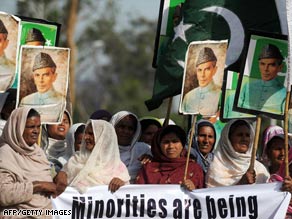
What motives led to Shahbaz Bhatti’s murder in Pakistan?

By Aamer Ahmed Khan for BBC

It is hard to find an immediate motive behind the murder of Pakistan’s Minorities Affairs Minister Shahbaz Bhatti.

The courageous battle he had vowed to fight against the country’s draconian blasphemy laws had already been abandoned by the government in the wake of Punjab governor Salman Taseer’s murder.

In fact, the final surrender had come from no less a person than Pakistan’s prime minister who had only last month pleaded with a large gathering of religious personalities to believe him when he said that his government had no intention of reviewing the blasphemy laws.

And unlike the slain governor – a veteran politician, a high profile socialite and one of the president’s many billionaire friends – Mr Bhatti neither had the status nor the political clout to influence the state’s agenda.

Some evidence of that also comes from the eerie silence on social media, from the extremists’ side.

All that one sees are some anguished rants from some of Pakistan’s best known liberals, many of whom are not even resident in the country.

Even hours after the assassination, we have seen none of the fierce onslaught against free speech that erupted on social media within minutes after Mr Taseer’s murder.

Nor have we seen eulogies of his killers mushrooming on Facebook as they did after Mr Taseer’s murder. It is a silence smug in the knowledge that their agenda is not at risk.

So why kill a man who considered himself – and was indeed considered by the world around him – to be so ineffective that he had not even bothered to seek proper security for himself, despite being constantly threatened by Pakistan’s millions of faceless fanatics?

The answer perhaps lies in the difference between the commitment of the government and the extremists to their respective agendas.

Politics v ideology

The government had unambiguously decided to lay off the blasphemy laws after Mr Taseer’s murder, its ministers hinting privately that it was a hornets’ nest best left untouched.

The country’s liberal political and social leadership had meekly followed suit and perhaps understandably so.

In their silence had rested a hope that by abandoning their agenda to rationalise any legislation-feeding extremism, they would perhaps be able to keep the extremists quiet.

It was never about any ideological commitment, just hard, cold politics that made tactical sense.

For the extremists though, it is all about ideology. It didn’t matter if Mr Bhatti’s battle had proved to be a non-starter or if he was an ineffective and powerless minister.

What mattered was that he had spoken against blasphemy laws in the past and was likely to do so again if a situation arose. That made him a legitimate target, not to be tolerated, not to be ignored.

Mr Taseer had said that he would continue to fight against blasphemy laws even if he was the last man standing. He could not stand for long.

And the ideology that led to his assassination has now sent another determined and deadly message to the state – that it will continue to fight till the last liberal falls.

This is how different the two commitments are. And for the liberals in Pakistan, this is how hopeless the situation seems to be.

Pakistan: Yet another Christian accused of blasphemy

By Speroforum for Spero News

A Christian woman, Agnes Nuggo, was accused of blasphemy and arrested in the Diocese of Faisalabad, in the Punjab province of Pakistan. The Catholic Church, which is handling the case, expressed “extreme concern”  over the affair.

The Commission for Justice and Peace in the diocese reported that Agnes (50) is married to Bashir Masih, has children and lives in the Christian quarter of Waris Pura. She was accused of blasphemy after a dispute over a piece of land that had already created controversy with his relatives. Some Muslim neighbours accused her of having made insulting statements against the Prophet Mohammed and against Islam. On 16 February, the local police registered a FIR (First Information Report) pursuant to art. 295/a of the Criminal Code and arrested her. Agnes professes her innocence and says the accusations are completely fabricated.

Fr. Nisar Barkat, Director of the Justice and Peace Commission in Faisalabad, reported “Bishop Joseph Coutts has become aware of the case and asked me to follow it closely.” Fr. Nisar was in court and obtained a copy of the complaint against Agnes, who will have her first court hearing in two weeks. The church will find her a lawyer and will take care of her family.

According to some sisters who know Agnes personally “the case is quite complicated: the woman was lured into a trap. Some people wanted to take revenge on her, because in the past Agnes had agreed to testify in court for money.””

Fr. Pascal Paulus, a Dominican priest in the Waris Pura area, said that “the situation is critical for us Christians. We need to be very careful. The Islamic radicals want to exploit these cases to attack the Christian minorities. We are exposed to spurious attacks, which have already been happening.”

Asia Bibi, another Christian woman accused of blasphemy, has been imprisoned for several months and has been condemend to death under Islamic law, Haroon Barket Masih of the Masihi Foundation said of Nuggo, “She is a new Asia Bibi. Agnes’ case is one of many cases of persecution that continue to occur. Most of the episodes don’t leave a trace and do not reach the clamour of the spotlight. Only when the victims’ families trust in the Churches, foundations and NGOs, then the injustices come to light. Families often keep silent for fear of retaliation. And institutions are absent: in this situation, what can Christians do?”

Rosemary Noel, head of the Pakistan Catholic Women’s Organisation said, “Being a Christian woman in Pakistan is a dual challenge. Even the status of women is itself exposed to discrimination, violence and abuse. Women struggle to gain access to education and the world of work. Those Christians are doubly discriminated against. They are considered as objects by Muslims and suffer all sorts of abuse and injustice to general indifference.”

According to data provided by the Justice and Peace Commission of the Pakistani Bishops, including Agnes, there have been 16 Christian women accused and imprisoned between 1987 and 2010 (in addition to a Muslim woman and a Hindu), but many other cases escape inclusion, because they did not end with a formal complaint.

Dig Deeper and You’ll Find the Other Oslo

By Rick Steves,Tribune Media Services

In the Norwegian capital of Oslo, a big statue of a tiger sits in front of the train station. A local once explained that Oslo is nicknamed the Tiger City because in the 19th century, when country boys visited the wild and crazy “New York City of Norway,” it made “a mark on their soul.”

I find Oslo more of a kitten than a tiger. Its mix of grand neoclassical facades, boxy 1960s-style modernism, pastoral parks and homogenous culture always have felt a bit tame for my taste. But by digging deeper, you can find more texture here, from gritty neighborhoods to troubled artists.

The city’s grand boulevard, Karl Johans Gate (street), cuts from the train station through the center of town to the Royal Palace. Lively with restaurants, parks and people, the street is lined with landmarks, including Oslo Cathedral, Parliament and Stortorvet Square, with its lively flower and produce market.

The boulevard also is the address of the Grand Cafe, once the meeting place of Oslo’s intellectual and creative elite. At the back of the cafe, a mural shows Norway’s literary and artistic clientele enjoying this fine hangout, from playwright Henrik Ibsen (who came in every day at 1 p.m.) to Edvard Munch, leaning against the window, looking drugged.

Munch is Norway’s most famous and influential painter. To see his most important work, head to the nearby National Gallery. Munch helped to pioneer a new style, expressionism, using lurid colors and bold lines to “express” inner turmoil and the angst of the modern world. His most iconic painting is The Scream, which he described as “the work of a madman.”

A few blocks down from the National Gallery is Oslo’s people-friendly harbor front, situated at the head of the 60-mile-long Oslofjord. As in many European cities, residents are reclaiming their waterfront area. In the past, you would have dodged several lanes of traffic to get to the harborfront, but now, most traffic has been diverted through tunnels under the city.

Facing the harbor, Oslo’s striking city hall is famous for hosting the Nobel Peace Prize ceremony. Completed in 1950 to celebrate the city’s 900th birthday, the building was an avant-garde thrill in its day. Entering here, I’m reminded that in this most highly taxed corner of Europe, city halls, rather than churches, are the dominant buildings. Though the state religion is Lutheranism, people rarely go to church. Instead, they seem to almost worship good government. The main hall actually feels like a temple.

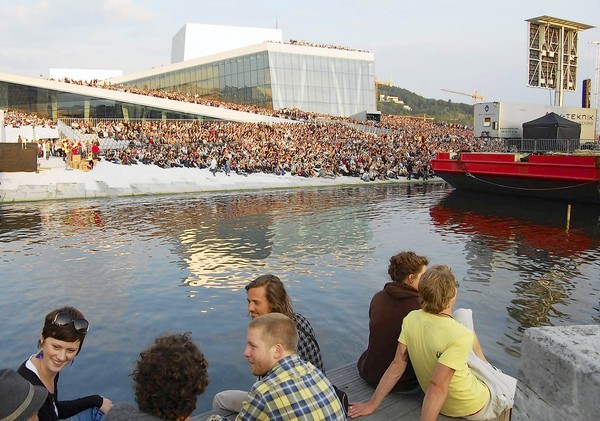
Along the eastern harbor, the marble Opera House seems to rise like an iceberg from the sea. This is the only opera house in the world that doubles as a public plaza, with a roof designed to be walked on. Opened in 2008, this cultural venue is a huge hit. On my last visit, I joined 8,000 people on the rooftop to watch a hot English group named Antony and the Johnsons (with a lead singer who looks like a cross between Meatloaf and Marilyn Manson) perform on a stage raft anchored just offshore.

In summer, Norwegians practically live outdoors. Frogner Park not only offers a great peek at Norwegians at play but also features a fine sculpture garden showcasing a lifetime of work by Norway’s greatest sculptor, Gustav Vigeland.

From 1924 to 1943, Vigeland created a world of bronze and granite statues — around 600 nude figures in all. The centerpiece is a teeming monolith of life, with 121 figures carved out of a single block of stone rocketing skyward. Like Munch, Vigeland was troubled. Those who know his life story can read it clearly in the granite and bronze, but I ignore it all and simply see his art as observations on the bittersweet cycle of life.

As much as I love Norway, goat cheese and my blond cousins, sometimes I need to inject some color into my days. At night, I head to two trendy multiethnic zones. Grunerlokka is the Greenwich Village of Oslo. A former working-class district, this neighborhood of funky shops, old hippies and bohemian cafes is a favorite of Oslo’s artsy set. Locals come here for its convivial night scene and colorful eateries.

Oslo’s rough and tumble immigrant zone is a stretch of a street called Gronland. This is where Turks, Indians, Pakistanis and the rest of Oslo’s immigrant community congregate. Colorful green grocer carts spill onto sidewalks. Various kebabs and spicy borek cost just $2 to go. Dueling tandoori restaurants offer meals for under $10, otherwise unheard of in Oslo.

I love dining street-side here. It’s cheap — and seeing a rainbow of people and a few rough edges makes the city feel less like Wonder bread. But that’s the beauty of Oslo. Just when you think you have it figured out, it gives you a taste of something different.

Rick Steves (ricksteves.com) writes European travel guidebooks and hosts travel shows on public television and public radio. E-mail him at rick@ricksteves.com and follow his Facebook blog.


It is The Women Who Have the Guts in Pakistan”

By Bina Shah for Dawn

In Pakistan, Salman Taseer’s assassination in early January has blown the lid off the seething cauldron that has been bubbling in Pakistan for the last several years: the divide between Pakistan’s extremist forces and its minority liberal community is now so wide that it seems nothing can bridge the gap anymore. Worse, the extremists greatly outnumber the liberals, endangering whatever advances have been made in the Pakistani society.

But the women intelligentsia of Pakistan is determined not to let the religious right gain any more ground in the struggle for Pakistan’s soul. They have responded to the onslaught of the right wing with such ferocity that a Pakistani man said on Twitter: “I definitely see more women out on the streets after Salman Taseer’s killing. Does this mean that it is the women that have the guts in this country?”

It all started with a woman: Aasia Bibi, the hapless Pakistani-Christian mother of five who made the mistake of getting on the wrong side of a group of malicious village women. One moment Aasia Bibi was offering her coworkers a cup of water; the next, she was facing the death penalty for having supposedly committed “blasphemy”. 

Activists and women’s rights groups, aghast at the blatant abuse of human rights that Aasia Bibi’s case represented, agitated for the country’s leaders to have her acquitted. Pakistan’s progressives, especially women, got in touch with the Governor of Punjab Salman Taseer through his Twitter account – one which he used mostly to tweak rival politicians’ noses, share his favorite Urdu poetry, and communicate with his daughters. They besieged him with 140-character-long appeals to save Aasia Bibi’s life, hoping against hope that he would listen.

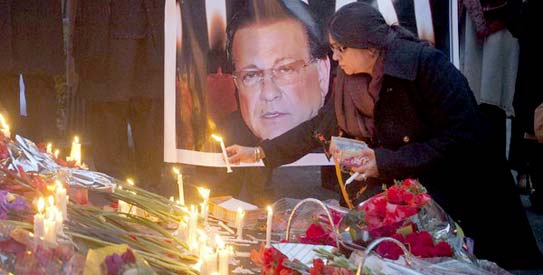
Taseer not only took Aasia Bibi under his protection, but he widened his scope to take aim at the blasphemy law itself. But Taseer’s strong voice was silenced on January 4, when his own bodyguard, Mumtaz Qadri, shot him 27 times with his state-issued Kalashnikov.

After the initial shock of the assassination, women activists vowed to use it as a rallying point: not just because they feel for Aasia Bibi, the first woman in Pakistan to face the death penalty for blasphemy, but because they know that women are the first to lose their freedoms when extremism takes over a nation. They are organising candlelight vigils, rallies, and media campaigns to defend their hard-won rights, despite knowing they are outnumbered by the other side.

One of the bravest women in today’s Pakistan is Shehrbano Taseer, daughter of the slain Governor, who wrote several pieces for the newspapers protesting the death of her father and the way in which his killer was showered with rose petals by lawyers who vowed to defend him in court. For this, she received threats from extremists: “She should remember the fate of her father and refrain from issuing statements.”

Taseer, a graduate of Smith College in the US, draws inspiration from other brave women in Pakistan who came up against the same forces: Asma Jehangir, Benazir Bhutto, Jugnu Mohsin, Sherry Rehman (who is now living under virtual house arrest in Karachi because of death threats she has received for her stance against the blasphemy law), Sharmeen Obaid Chinoy, Beena Sarwar, and Marvi Sirmed are some of the women whose struggles against injustice in Pakistani society have inspired her.

And of course, there is her father’s legacy: “My father’s fire has come inside me … I don’t wish for any other family to have suffered what mine has had to.”  Her father’s violent death has illustrated most vividly to her how both men and women in Pakistan have worked together for generations in the name of social activism. “Men and women have marched on the streets together and sacrificed a lot, so I don’t feel one sex is more dominant than the other in this regard.”

But it is not enough. The men in Pakistan need to step it up greatly when it comes to supporting women in social activism. Nuzhat Kidvai, a human rights activist in Karachi, says, “In general, men are more active in the left and labour movements – they will march for economic or political reasons. But when it comes to supporting women’s issues, they just aren’t there.” Her husband, Zaheer Kidvai, a long-time proponent of social activism in Pakistan, agrees that “women are certainly more engaged in this battle and despite bad attacks – lathis, jail, beating, and even rapes by the police! – they have moved this forward against all these odds. If there is any way for this society to evolve further, it’ll have to have even more women come out.”

So, back to the original question: is it really the women in Pakistan who have the guts? When it comes to fighting for their rights, definitely. Life in Pakistan is hard for women, but they don’t give up easily. Perhaps this is why they haven’t yet suffered the fates of their compatriots in Saudi Arabia, Afghanistan, and other supremely conservative Muslim countries in the region.

World Leaders React to Mubarak Resignation

By Henry Ridgewell for the Voice of America

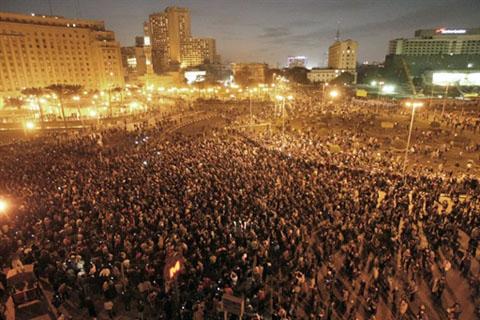
With the resignation of Hosni Mubarak as president of Egypt and the transition of presidential powers to the military, leaders across Europe have called for a quick transition from military to democratic rule. And in cities across the Middle East, celebrations erupted in support of Egypt’s anti-government protests that brought down the man who had ruled Egypt for three decades.

As the protesters who had been calling for Mubarak to resign celebrated their victory in Cairo’s Tahrir Square, leaders across the world marked this milestone in Middle East history.

Since the protests began late last month, Western leaders had walked a tightrope, calling for democratic reform, but stopping short of openly calling for Mubarak, a long-time ally in the region, to resign.

Barely an hour after the announcement of Mubarak’s resignation, British Prime Minister David Cameron had this message for Egypt’s new rulers. “We believe it must be a government that starts to put in place the building blocks of a truly open, free and democratic society.”

The call for a quick transition from military to democratic rule was echoed across the capitals of Europe.

The European Union’s foreign affairs chief, Catherine Ashton, said Europe stands with the people. “To say to those who are now charged with being the guardians of the transitional period that we have high expectations that they will deliver for the people, and that the European Union will be there to offer its support.”

German Chancellor Angela Merkel urged Egypt to honor its international obligations. She said that by resigning, Mubarak “did one last service to the people of Egypt.” She expressed hope that future Egyptian governments would continue with peace in the Middle East and honor the treaties with Israel, saying the safety of Israel must be guaranteed.

From the United Nations in New York, United Nations Secretary General Ban Ki-moon hailed the patience of the protesters. “The voice of the Egyptian people, particularly the youth, has been heard and it is for them to determine the future of their country.”

In Tunisia, where a wave of unrest just a few weeks ago forced the collapse of that country’s government and inspired Egyptians and others, few could believe the chain of events that has since swept through the region.

Tunis resident Safia Ruwees summed up the mood. He said he wanted to congratulate the Egyptian people and all Arabs. He said, “These are democracies that we are bringing with our hands, no one has brought them to us, not America, not France, no one.”

Across the Middle East, people are taking to the streets in solidarity with the Egyptian protesters.

In Jordan, which has witnessed its own anti-government protests on a smaller scale, Egyptian flags filled the night sky.

It was the same story in Gaza where the roads filled with people celebrating. Hamas, which controls the Gaza strip, offered its support through spokesman Sami Abu Zuhri.

Zuhri said the resignation announcement in Egypt was the start of “victory of the Egyptian revolution,” and that Hamas supported the demands of the Egyptian people.

And in Beirut, there were more fireworks and more celebrations. Egyptian expatriate Issam Allawi gave his view. “We are very happy today that we were able to overcome the dictator Hosni Mubarak,” he said. Tomorrow, he said, “the next dictators throughout the entire Arab world.”

That final sentiment likely will be on the minds of many world leaders. While they praise Egypt’s show of people power, governments across the Arab world and beyond are wondering where might be next.

U.S. Pressure on Mubarak Opens a Rift With Arab Allies

Adam Entous, Julian E. Barnes, and Jay Solomon for The Wall Street Journal

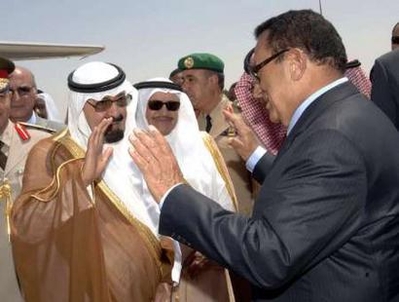
President Barack Obama’s attempt to abruptly push aside Egyptian President Hosni Mubarak in favor of a transition government has sparked a rift with key Arab allies Saudi Arabia and United Arab Emirates, which fear the U.S. is opening the door for Islamist groups to gain influence and destabilize the region.

Vying to influence the outcome of events, Saudi Arabia and the U.A.E. have sent public and private messages of solidarity to Mr. Mubarak and his vice president, longtime intelligence chief Omar Suleiman, diplomats said. The messages amount to support for the president and Mr. Suleiman to oversee the transition and to ensure that Islamists can’t fill any possible power vacuum.

The support from Arab states has provided a measure of comfort to Mr. Mubarak, who announced he wouldn’t take part in September’s election. It may in part explain why the Egyptian president rebuffed Mr. Obama’s call for an immediate transition that includes the opposition.

The backlash shows how the turmoil in Egypt is rapidly reshaping U.S. policy in the region. In deciding to set itself against Mr. Mubarak, a U.S. ally for decades, the United States is now facing the disquiet of other friendly Arab governments, who have long provided support for American policy goals. Meanwhile, Islamists in the region, including Hamas and Hezbollah, believe they are on the ascent as U.S. allies falter.

Such a scenario was one that defenders of the Middle East’s status quo warned was possible, and shows how Mr. Obama’s options were all, in some sense, unpalatable. The president was criticized early in the unrest for not clearly favoring antigovernment protesters. Now, having done so, he might have alienated key regional U.S. partners in the fight against al Qaeda and Iran. People familiar with the situation said Israel, the United States’ closest ally, has privately echoed Arab concerns about a U.S. push to kick out Mr. Mubarak, and worries Washington underestimates domestic Egyptian support for the Muslim Brotherhood and other Islamist parties.

It is unclear how much sway the Saudis have with Mr. Mubarak’s regime in Cairo, given that the extent of its financial aid to Egypt isn’t known. The United States gives Cairo about $2 billion a year. Egypt and Saudi Arabia are major trading partners, and experts say Saudi and Egyptian intelligence services have especially close ties.

Saudi King Abdullah bin Abdulaziz al-Saud has harshly criticized Egyptian protesters in a statement carried by the Saudi state news agency, describing them as “infiltrators” bent on destabilizing Egypt and the region, accusing them of “malicious sedition.”

“You don’t need to read between the lines too much to see [the Saudis] are in favor of stability,” said Richard Fontaine, an analyst with the Center for New American Security and a former adviser to Republican Sen. John McCain of Arizona.

Senior officials from the U.A.E., another key regional ally, have said in recent days that the unraveling of Mr. Mubarak’s government threatens to provide breathing room for Islamic extremists and Tehran. Egyptian security forces have been among the most aggressive in seeking to combat Hamas and Hezbollah, Palestinian and Lebanese militant groups that receive their arms from Iran and Syria.

“What hurts men and women as well as the leadership in Egypt hurts us all, and our standing with Egypt is an urgent need,” U.A.E. Foreign Minister Sheikh Abdullah bin Zayed Al Nahyan said on a visit to Iraq this week. “But our disapproval is of certain parties who might try to exploit the situation with an external agenda.”

Another Arab official from a government aligned with Washington said the Obama administration seems to be humiliating Mr. Mubarak, despite his close cooperation over the years. This could lessen the willingness of Arab states to cooperate with Washington in the future, said the official.

“[The Saudis] are at odds with the U.S. position, publicly pushing Mubarak out. And frankly so are we—this isn’t how you handle issues in region,” said the Arab official. “Egypt needs to be treated with respect.”

Mr. Obama took a calculated risk by aligning himself this week with the opposition, which includes the powerful Muslim Brotherhood, a group banned by Cairo and long shunned by Washington because of concerns about its ties to Islamist extremism.

U.S. officials acknowledge that Mr. Obama’s decision to turn on Mr. Mubarak has raised ire in Arab states, which fear the United States could turn up the pressure on them next.

The perception among key U.S. allies in the region is that the U.S. “threw Mubarak under the bus,” a senior U.S. official said. “It is fair to say there is definitely concern.”

Another U.S. official said the Obama administration understood Arab concerns that Islamists might try to take advantage of the Egyptian elections to win power, but said Arab states nonetheless needed to revamp their sclerotic political systems. Officials are reassessing the extent it could engage with Muslim Brotherhood.

White House spokesman Tommy Vietor said what really matters is the “voices of the Egyptian people.”

Anthony Cordesman, an influential defense analyst at the Center for Strategic and International Studies, played down the impact of outside influences on Mr. Mubarak, whether Saudi or U.S. Mr. Obama, he added, was “one voice among many” and argued that domestic considerations were the biggest factor for the regime in figuring out what to do next.

White House officials spent Thursday working on new language the U.S. president might use to make his demands on Mr. Mubarak more forceful, according to outside advisers. Much of the administration’s attention was on the treatment of journalists in Cairo. U.S. officials suspect regime element might have been behind the attacks.
Secretary of State Hillary Clinton urged Mr. Mubarak to “immediately” begin talks with opposition leaders on handing over power to a transitional government. “I urge the government and a broad and credible representation of Egypt’s opposition, civil society and political factions to begin immediately serious negotiations on a peaceful and orderly transition,” Mrs. Clinton said.

Middle East experts say the goal of creating a new transitional government is not yet in reach. The Egyptian military would have to become more assertive to “control the arena,” said Martin Indyk, a former U.S. ambassador to Israel.

“This will require the military to undergo an overnight conversion to democracy promoters. That’s more than a stretch in the current circumstances,” Mr. Indyk said.

Administration officials are anxiously awaiting events Friday, a traditional day of protest in the Muslim world. “Friday could be a ‘Tiananmen moment,’ ” said Mr. Indyk. “If that happens, there will be no orderly and peaceful transition, just a bloody and long confrontation.”

—Jonathan Weisman contributed to this article.

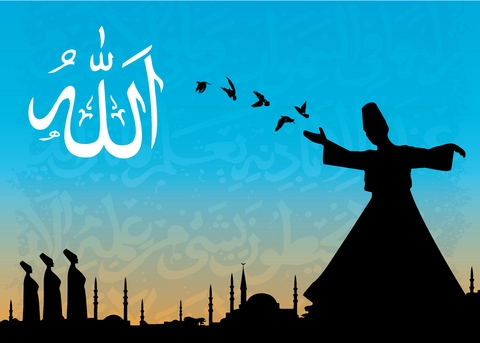
Who is behind the war on Sufism?

By Dr Ehsan Azari Stanizi for Eurasia Review News & Analysis

On October 25, 2010 an al-Qaida affiliated militant group turned a majestic Sufi shrine into a bloodbath in the Punjab province of Pakistan, by detonating bombs hidden in milk cans, killing and wounding scores of innocent people. This was the latest of a spate of gruesome attacks on Sufism and dead Sufi saints this year alone, leaving hundreds of innocent people killed or wounded. Such violence has brought a new upheaval to Islam, shaking its ethical and moral foundations and reducing it to a merely a radical political ideology.

The ideological driving force behind this violence is religious extremism which considers everyone outside its ideological league, Muslim or non Muslim, dead or alive, as an enemy and an infidel deserving to be killed. The fanatics blow up ancient relics, Sufi heritage, Sufi shrines and the Sufi way of life everywhere they can. They want to micromanage social, cultural and individual life. They condemn gatherings and ceremonies in Sufi saints’ graves, shaving beards, wearing charms, music and painting as heresy. All this is like the Chinese Cultural Revolution of the 1960s.

The history of Islam is not alien to violence against Sufism. The root of the current upheaval lies in Wahhabism, which has been gradually institutionalised from a tiny band of theologians into a political ideology by the Saudi ruling dynasty. The Wahhabi religious movement was originated by Mohammad Ibn Abdul Wahhab (1703-1792), essentially to challenge the influence of the Ottoman Empire in the Arabian Peninsula. The Saudi petrodollars and Pakistani military ruling elite have helped the spread of this fanatical form of Islam.

In addition, the vision of this ideology was empowered in the Middle East and South Asia by another extremist movement known as the Muslim Brotherhood which originally emerged in Egypt in the 1920s. The Brotherhood copied much of its ideological agenda, political structure, revolutionary features and a violent persuasion from Marxism. Like the latter during the Cold War era, the Brotherhood’s ultimate objective has been to topple the state by violent means and extend a radical ideology to the West. The Iranian revolution of late 1970s gave further impetus to this ideology, which began to justify the export of Islamic revolution as an Islamic obligation everywhere in the world.

Like Saudi rulers, the secular Pakistani cunning and sly generals began to use the most lethal religious radicals for domestic security and as a tool to promote its foreign policy in Afghanistan and India. Pakistan served also as a gateway for the spread of Wahhabism in the region. At present they are pinching American coins in return for carrying out the Pashtun genocide.

As it was hinted, war on Sufism is not a new phenomenon. Hussein Al-Halaj, a great Sufi poet and teacher was condemned for heresy when in a state of mystical trance he exclaimed, “I am the Truth”. He was cut to pieces and his remains were burnt by a mob in Baghdad in 922 AD. He was the first Sufi martyr.

During the 17th-century Persian Safavid Empire, Sufis were suppressed, during the Indian Moguls, it flourished but in the twentieth-century the die-hard Turkish secular leader Kamal Atatürk banned Sufi monasteries and Sufi rituals in Turkey.

Sufism (comes from Arabic noun, suf, literary meaning course wool and the Sufi is the one wearing woolen garments) is the name of Islamic mysticism. The word Sufism was coined in the West for the first time by the German scholar August Tholuck in 1821. It has been divided into two practical and theoretical parts: To those who practice it, Sufism means a quick spiritual foray into a space where the presence of the divine could be experienced. To those who are concerned with its theory, it is a mystical and spiritual theology, a body of knowledge and an epistemology interwoven with Islamic metaphysical texts.

The Sufi philosophy was developed and promoted by the medieval Muslim philosophers such as Ibn-Arabi, Averroës (known in Islamic world as Ibn-i-Rushd), Avicenna and Farabi, who, for their Islamic Aristotelianism, were often referred to as the Oriental Peripatetics. This school of thought was greatly saturated with Plato and Aristotelian metaphysics. The Sufis also have created a vast body of a literary and poetic heritage.

As an elixir of wisdom and an intellectual Yoga, Sufism has been known, cherished and even practised in the West since time immemorial. It is hard to find a single great Western poet or thinker who has not been inspired by Sufism. Dr Johnson loved Sufi Oneness and pantheism; Voltaire in Candid saw Sufi philosophy as an antidote to religious extremism of his time. Goethe loved Sufi poetry, Richard Burton and Robert Graves were keen on practicing Sufism.

Sufism was cherished by Australia’s greatest poet professor Alec Derwent Hope. Hegel draws on Sufi thought in his works. Danish fairy-tale writer Hans Christian Andersen was the first who brought the news about the Sufi music and dance known as “Whirling Dervishes” to Europe.

Nobel laureate, Doris Lessing is the doyen of contemporary Sufis in the West. She identifies Western admiration of Sufism since the 1960s as ‘a Sufi craze,’ and ‘Sufi bandwagon’. For Lessing, Sufism was a kind of universal feeling, emotion, a quick fix and an access with no intermediary. “Sufism is something one experiences on one’s own,” she would say. In my own lectures in Australia and Europe, I came across with an enormous interest in Sufi philosophy and literature.

The al-Qaida zealots and the Pakistani militants will never win over Sufism. They might destroy their tombs on earth but cannot steal away Sufism from the hearts of people in the East and the West.

The 13th-century great Sufi poet and the founder of the Whirling Dervishes, Rumi knew this. He believed that fanatics will never extinguish the Sufi torch or destroy Sufi tombs as he says “when we are dead, see not our tombs in the earth, but find it in the hearts of the people.” And the 17th-century Pashtun Sufi poet Rahman Baba, known in the West as the Nightingale-of-Peshawar to the vandals:

We are all one body, whoever tortures another, wounds himself.

Last spring (2010), his mausoleum was bombed by the Punjabi Taliban. Rumi declared the Sufi manifesto of universal love, tolerance of nonbelievers, pluralism and interfaith harmony in one of his quatrains:

Come, come whoever you are, An unbeliever, a fire or idol-worshiper, come, Our convent is not of desperation, Even if you have broken your vows a hundred time,
Come, come again.

Pakistan Observes Kashmir Solidarity Day Today

As Reported on Sify News, India

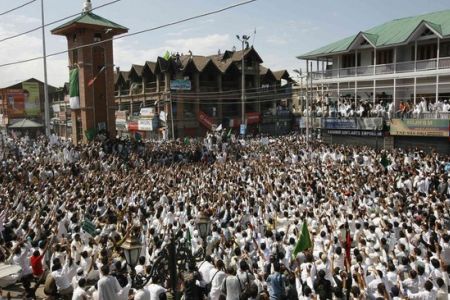
Pakistan is observing the Kashmir Solidarity Day on Saturday (today) to renew its pledge to provide full moral, political and diplomatic support to the Kashmiri people.

“We would not rest unless the people of Kashmir get their right to self-determination and win freedom from the Indian domination. We regard the Quaid-i-Azam’s dictum as our ideal wherein he said, “Kashmir is our jugular vein”. The day is not far when the Kashmiris would determine their own future,” The Nation quoted Prime Minister Syed Yousuf Raza Gilani, as saying in his message on the occasion.

The government and the people of Pakistan join their Kashmiri brothers and sisters in observing the Kashmir Solidarity Day, said Gilani, adding that the whole nation stands united in seeking a just and peaceful solution to the Jammu and Kashmir dispute in accordance with the legitimate aspirations of the Kashmiris as enshrined in relevant UN resolutions.

It will be a public holiday throughout Pakistan today, and special programmes will be broadcasted on television in this regard.

Apart from mass rallies, symposia, conventions meetings and speech declamations, a unique ceremony will be held at all six bridges linking Pakistan and PoK, where Pakistani and Kashmiri people will form a human chain.

It may be mentioned here that the day is observed every year in Pakistan, in continuation of the first call given by the then Prime Minister Zulfiqar Ali Bhutto in 1975.

Third World Thugs and Dictators- A History of Self Serving Interests

By Manzer Munir, Pakistanis for Peace

What is it about power and its hold on a person? Not just the common man, but even the most noblest and patriotic of men have let its allure defy the loyalty to their county’s best interests. They say that absolute power corrupts absolutely. The recent events in Egypt have proven this axiom quite aptly as we are witnessing history in the making with the protests against the regime of Hosni Mubarak.

There is a popular, grassroots, and mostly peaceful uprising against the repressive and longtime authoritative administration of President Hosni Mubarak. Only the fourth president in the history of the modern day republic of Egypt, Mubarak was a soldier in the Yom Kippur War against Israel and served as the Commander of the Air Force as well as the Deputy Minister of Defense.

Having served nearly 30 years, he is the only leader most people in Egypt have ever known where more than half the population is under 25. Long seen by the outside world as a model of stability in the volatile neighborhood of the Middle East, Mubarak’s policies of continuing the peace treaty with Israel signed by his predecessor Anwar Sadat, belied the fact that at home in Egypt he had employed many heavy handed and authoritarian tactics to quell dissent at various times in his 30 year rule.

But what may have appeared as strengths to the outside world were weaknesses at a domestic level. Mubarak came to be seen by the average Egyptians as presiding over policies that increased unemployment and also raised the cost of living for many already struggling people. For many, the economic reforms had come to be equated with corruption, as many political leaders were mixing  family business interests with their official roles, and corruption at the highest levels has fully become entrenched in all levels of Egyptian society, much like in many developing countries.

Another example of the measure of cronyism and despotic rule practiced in Mubarak’s Egypt that showed contempt for the democratic aspirations of the common man was his grooming of his son Gamal for eventual leadership of Egypt. It was no surprise in the international community that for the last 8 years Mubarak was exposing his son to more and more official state functions and visits, having most recently brought Gamal to Washington for the opening of Middle East peace talks in the fall of 2010.

Now in the last few weeks, after protests in another North African Arab country of Tunisia that saw the toppling of the 24 year reign of Zine El Abidine Ben Ali, Mubarak’s iron grip on power seems a lot less secure to Egyptians who have been bolstered by the ouster of Ali, another notoriously corrupt and dictatorial ruler of Mubarak’s ilk.

It has become common place to see time after time, in developing countries across the world, but especially in Africa and Asia, autocratic and corrupt rulers who either seize power in military coups or are initially elected in some democratic way, only to hold on to power any way they can. Whether the ruler be Robert Mugabe of Zimbabwe, who has held power of that country since 1980 and who despite having lost even the last few rigged elections, has remained defiantly in power. One could also point to another African leader, Laurent Gbagbo of the Ivory Coast who refuses to step down from power after having lost the elections of his country in November of 2010 to Alassane Ouattara. Despite losing the election he sits in the presidential palace in the capital Yamoussoukro, still refusing to listen to the world community and even personal pleas from President Obama to relinquish power to the victor of the Ivory Coast elections, Alassane Ouattara.

An Indonesian friend mentioned to me that what is happening in Egypt is exactly how the Indonesians got rid of Suharto, who had come to power and control over Indonesia 32 years prior in large part due to his service and rank in the military.

Examples of such greed for power, money and influence as well as the disregard for the health and well being of their nations are more commonplace in the developing world than in the industrialized nations. It is not to say that in European and western countries there have not been cases of greed and corruption.  However, when the stability and very health of a country’s political system was severely tested, as in my homeland of the United States, a president like Richard Nixon resigned from power, however embarrassingly and went off quietly into history, rather than hold on to the last vestiges of power and control over a sinking country and its national spirit.

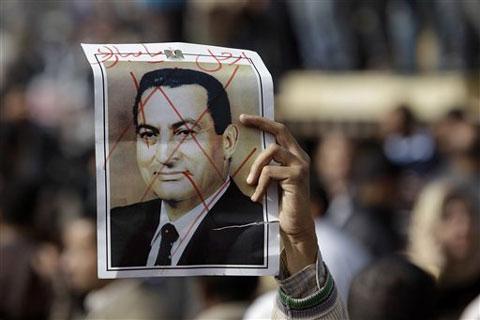
For Mubarak, the question should be asked how can this soldier of the uniform can look in the mirror the last few days knowing that every passing day that there are riots in the streets of Cairo, he is undermining the sovereignty, nationhood and the very peace of his motherland. A person like this obviously cares more about their place in history than the well being of their people, their institutions, and their country.

Sooner or later, the chants will get loud enough to be heard outside Mubarak’s residence in the presidential Heliopolis Palace and the people will undoubtedly ask: “Oh Mubarak can’t you see? Time to join Ben Ali.”

Manzer Munir is a proud Pakistani American and peace activist, who is a Sufi Muslim and is also the founder of Pakistanis for Peace and blogs at www.PakistanisforPeace.com and at other websites such as www.DigitalJournal.com, www.Allvoices.com, www.Examiner.com and www.open.salon.com as a freelance journalist and writer. He asks that you join the official Facebook Page of Pakistanis for Peace to be informed of the latest articles  here: http://www.facebook.com/home.php#!/pages/Pakistanis-for-Peace/141071882613054


Egypt Restores Internet as Turmoil Escalates

By Cecilia Kang for The Washington Post

Egypt restored Internet access on Wednesday, after a one-week blackout for Web and cell phone users to try to stem civil unrest.

The nation was the second ever to completely shut its citizens off of the Internet. Burma made a similar move in 1997. As the turmoil accelerates, experts say, the move has failed to affect what began as a Web campaign but continued even after the government block.

As of about 11:29 a.m. Cairo time, all major Egyptian Internet service providers appeared to have reopened connection to their domestic customer networks in a global routing table, network expert Renesys Group said in a blog.

Web sites such as the Egyptian State Information Service have been restored. The Wall Street Journal reports that cell phone service MobiNil also is back up.

U.S. Web sites such as social network Facebook were available again to Egyptians.

“We’re pleased that Internet service has been restored and the five million people who use Facebook in Egypt can continue using our service to connect, learn, and share,” said Andrew Noyes, spokesman for Facebook.

The restoration comes as opposition groups and supporters of President Hosni Mubarak have clashed in street confrontations Wednesday. Mubarak said he would not seek reelection, but anti-government protesters have called for him to step down immediately.

“One of big questions is does it work for a government to shut off the network entirely? I think the answer is no,” said John Palfrey, a co-director of Harvard University’s Berkman Center for Internet & Society.

Alaa Abd El Fattah, an Egyptian activist and blogger in South Africa, said at first people organized on social media sites such as the Facebook page “We are Khaled Said.” The page documented the brutal death of a Egyptian blogger who exposed police corruption. There, opposition groups organized initial demonstrations. But predicting a clampdown on networks, Fattah said that anti-government activists, many of whom were young and politically engaged for the first time, switched to proxy technology that would allow them to access the Internet without being identified. They used low-end Nokia phones with Opera browser, which automatically serves as a proxy for users. And they passed along demonstration plans with pamphlets and by word of mouth.

“This movement started online but continued through many other avenues,” said Fattah.

Andrew McLaughlin, former White House deputy chief technology officer, said the shutdown shocked nations who had seen Egypt as a proponent of mobile and Internet technology. It serves as a key regional hub that operates several critical underwater fiber cable systems used for communications for many neighboring nations.

“The implications of shutting down the Internet are huge from an economic point of view,” McLaughlin said. “The idea that transportation grid ground to halt, you couldn’t access your bank or move money around and the entire communications systems was shut down is insane.”

Rejoicing at being given a digital voice again, Egyptians burst back onto the Internet. On Twitter, human rights activist Dalia Ziada wrote that she had over 500 e-mails in her e-mail.

Numerous accounts on Twitter also show that social the networking site and others may still be blocked in Egypt. When the government began to target communications services, they first hit Twitter and Facebook on Jan. 25. Two days later, the Egyptian government, with an Internet adoption rate of about 30 percent, entirely shut down access. Cell phone services were blocked intermittently throughout the last week.

Reports from Twitter indicate that 3G, mobile Web and BlackBerry services are online again for some people. Vodafone Egypt, which released a statement about restoring mobile phone service on Jan. 31, has not commented on its mobile Web service.

With the service restored, Egyptians began to give personal reports of clashes between Mubarak supporters and dissenters, which turned violent in Cairo’s Tahrir Square.

Egypt Protests Continue as Government Resigns

By David Kirkpatrick for The New York Times
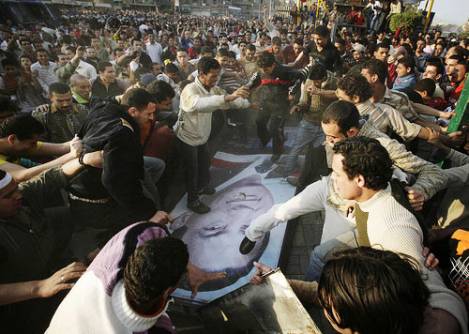
CAIRO — Egypt was engulfed in a fifth day of protests on Saturday but an attempt by President Hosni Mubarak to salvage his 30-year rule by firing his cabinet and calling out the army appeared to backfire as troops and demonstrators fraternized and called for the president himself to resign.

While some protesters clashed with police, army tanks expected to disperse the crowds in central Cairo and in the northern city of Alexandria instead became rest points and even, on occasion, part of the protests as anti-Mubarak graffiti were scrawled on them without interference from soldiers.

“Leave Hosni, you, your son and your corrupted party!” declared the graffiti on one tank as soldiers invited demonstrators to climb aboard and have their photographs taken with them.

“This is the revolution of all the people,” declared the side of a second tank in downtown Cairo. Egyptian men all serve in the army, giving it a very different relationship to the people from that of the police.

The feared security police had largely withdrawn from central Cairo to take up positions around the presidential palace, with their places taken up by the army.

Following Mr. Mubarak’s demand in his late-night speech, the Egyptian cabinet officially resigned on Saturday. But there was no sign of letup in the tumult. Reports from morgues and hospitals suggested that at least 50 people had been killed so far.

In Ramses Square in central Cairo Saturday midday, protesters commandeered a flatbed army truck. One protester was driving the truck around the square while a dozen others on the back were chanting for President Mubarak to leave office. Nearby, soldiers relaxed around their tanks and armored vehicles and chatted with protestors. There were no policemen in sight.

In another sign that the army was showing sympathy for the demonstrations, in a different central Cairo square on Saturday a soldier in camouflage addressed a crowd through a bullhorn declaring that the army would stand with the people.

“I don’t care what happens,” the soldier said. “You are the ones who are going to make the change.” The crowd responded, “The army and the people will purify the country.”

Workers at the Alexandria morgue said they had counted more than 20 bodies from the last 24 hours of violence. Meanwhile, protests had started up again in the city. But there too, the demonstrators and the soldiers showed sympathy for one another. Demonstrators brought tea to the troops and had their pictures taken with them. Protesters walked by armored carriers unmolested with few signs of animosity. People gathered outside the morgue looking for their relatives. In the main hospital, there were a number of people lying wounded from live fire.

Cell phone service, cut off by the government on Friday, was partially restored although other elements of the communication shut down remained in force. On Friday, with much of the nation in open revolt, Mr. Mubarak deployed the nation’s military and imposed a near-total blackout on communications to save his authoritarian government of nearly 30 years.

In the early hours of Saturday, protesters continued to defy a nationwide curfew as Mr. Mubarak, 82, breaking days of silence, appeared on national television, promising to replace the ministers in his government, but calling popular protests “part of bigger plot to shake the stability” of Egypt. He refused calls, shouted by huge, angry crowds on Friday in the central squares of Cairo, the northern port of Alexandria and the canal city of Suez, for him to resign.

“I will not shy away from taking any decision that maintains the security of every Egyptian,” he vowed.

Whether his infamously efficient security apparatus and well-financed but politicized military could enforce that order — and whether it would stay loyal to him even if it came to shedding blood — was the main question for many Egyptians.

It was also a pressing concern for the White House, where President Obama called Mr. Mubarak and then, in his own Friday television appearance, urged him to take “concrete steps” toward the political and economic reform that the stalwart American ally had repeatedly failed to deliver.

Whatever the fallout from the protests — be it change that comes suddenly or unfolds over years — the upheaval at the heart of the Arab world has vast repercussions for the status quo in the region, including tolerance for secular dictators by a new generation of frustrated youth, the viability of opposition that had been kept mute or locked up for years and the orientation of regional governments toward the United States and Israel, which had long counted Egypt as its most important friend in the region.

Many regional experts were still predicting that the wily Mr. Mubarak, who has outmaneuvered domestic political rivals and Egypt’s Islamic movement, the Muslim Brotherhood, for decades, would find a way to suppress dissent and restore control. But the apparently spontaneous, nonideological and youthful protesters also posed a new kind of challenge to a state security system focused on more traditional threats from organized religious groups and terrorists.

Friday’s protests were the largest and most diverse yet, including young and old, women with Louis Vuitton bags and men in galabeyas, factory workers and film stars. All came surging out of mosques after midday prayers headed for Tahrir Square, and their clashes with the police left clouds of tear gas wafting through empty streets.

For the first time since the 1980s, Mr. Mubarak felt compelled to call the military into the streets of the major cities to restore order and enforce a national 6 p.m. curfew. He also ordered that Egypt be essentially severed from the global Internet and telecommunications systems. Even so, videos from Cairo and other major cities showed protesters openly defying the curfew and few efforts being made to enforce it.

Street battles unfolded throughout the day Friday, as hundreds of thousands of people streamed out of mosques after noon prayers on Friday in Cairo, Alexandria, Suez and other cities around the country.

By nightfall, the protesters had burned down the ruling party’s headquarters in Cairo, and looters marched away with computers, briefcases and other equipment emblazoned with the party’s logo. Other groups assaulted the Interior Ministry and the state television headquarters, until after dark when the military occupied both buildings and regained control. At one point, the American Embassy came under attack.

Six Cairo police stations and several police cars were in flames, and stations in Suez and other cities were burning as well. Office equipment and police vehicles burned, and the police seemed to have retreated from Cairo’s main streets. Brigades of riot police officers deployed at mosques, bridges and intersections, and they battered the protesters with tear gas, water, rubber-coated bullets and, by day’s end, live ammunition.

With the help of five armored trucks and at least two fire trucks, more than a thousand riot police officers fought most of the day to hold the central Kasr al-Nil bridge. But, after hours of advances and retreats, by nightfall a crowd of at least twice as many protesters broke through. The Interior Ministry said nearly 900 were injured there and in the neighboring Giza area, with more than 400 hospitalized with critical injuries. State television said 13 were killed in Suez and 75 injured; a total of at least six were dead in Cairo and Giza.

The uprising here was also the biggest outbreak yet in a wave of youth-led revolts around the region since the Jan. 14 ouster of President Zine el-Abidine Ben Ali of Tunisia — a country with just half Cairo’s population of 20 million. “Tunis, Tunis, Tunis,” protesters chanted outside the Tunisian Embassy here.

“Egyptians right now are not afraid at all,” said Walid Rachid, a student taking refuge from tear gas inside a Giza mosque. “It may take time, but our goal will come, an end to this regime. I want to say to this regime: 30 years is more than enough. Our country is going down and down because of your policies.”

Mr. Mubarak, in his televised address, said he was working to open up democracy and to fight “corruption,” and he said he understood the hardships facing the Egyptian people. But, he said, “a very thin line separates freedom from chaos.”

David Kirkpatrick talks about the close call he had while with Nobel laureate, Mohamed ElBaradei, the kinds of police on the streets in Egypt and the possible prospects for the Mubarak government.
 

His offer to replace his cabinet is unlikely to be viewed as a major concession; Mr. Mubarak often changes ministers without undertaking fundamental reforms.

A crowd of young men who had gathered around car radios on a bridge in downtown Cairo to listen to the speech said they were enraged by it, saying that they had heard it before and wanted him to go. “Leave, leave,” they chanted, vowing to return to the streets the next day. “Down, down with Mubarak.”

A bonfire of office furniture from the ruling party headquarters was burning nearby, and the carcasses of police vehicles were still smoldering. The police appeared to have retreated from large parts of the city.

Protesters throughout the day on Friday spoke of the military’s eventual deployment as a foregone conclusion, given the scale of the uprising and Egyptian history. The military remains one of Egypt’s most esteemed institutions, a source of nationalist pride.

It was military officers who led the coup that toppled the British-backed monarch here in 1952, and all three Egypt’s presidents, including Mr. Mubarak, a former air force commander, have risen to power through the ranks of the military. It has historically been a decisive factor in Egyptian politics and has become a major player — a business owner — in the economy as well.

Some protesters seemed to welcome the soldiers, even expressing hopes that the military would somehow take over and potentially oust Mr. Mubarak. Others said they despaired that, unlike the relatively small and apolitical army in Tunisia, the Egyptian military was loyal first of all to its own institutions and alumni, including Mr. Mubarak.

“Will they stage a coup?” asked Hosam Sowilan, a retired general and a former director of a military research center here. “This will never happen.” He added: “The army in Tunisia put pressure on Ben Ali to leave. We are not going to do that here. The army here is loyal to this country and to the regime.”

One of the protesters leaving a mosque near Cairo was Mohamed ElBaradei, an Egyptian who won the Nobel Peace Prize for his work with the International Atomic Energy Agency and has since emerged as a leading critic of the government.

“This is the work of a barbaric regime that is in my view doomed,” he said after being sprayed by a water cannon.

Now, he said, “it is the people versus the thugs.”
Israel Fears Unrest in Egypt Could Jeopardize Peace Treaty

By Robert Berger for The Voice of America

The unrest in Egypt is sending shock waves throughout the Middle East, including in neighboring Israel.

Israel is extremely concerned about the situation in Egypt because President Hosni Mubarak has preserved the peace treaty between the two countries for 30 years. Israel considers the treaty a strategic asset, and it fears that a regime change in Egypt could put the peace agreement in danger.

Israeli analyst Yoni Ben-Menachem says an Egyptian government led by opposition groups or the Muslim Brotherhood would take a harder line on Israel.

“It might be a hostile regime to Israel that will not respect the peace treaty with Israel and will cancel it, abolish this agreement, and we will go back to a situation of hostility between Israel and Egypt,” said Ben-Menachem.

That would complicate Israel’s situation strategically, because it already shares two borders with hostile elements: Hezbollah in Lebanon and Hamas in Gaza.  And Ben-Menachem believes neighboring Jordan could be next.

“This can create the domino effect, and this fall of the regime in Egypt can also continue to Jordan, and also with Jordan we have another peace treaty,” added Ben-Menachem.  “And if this will happen, if there will be a strategic change in the Middle East, that will not be for the benefit of the State of Israel.”

While the treaty between Egypt and Israel is often described as a “cold peace,” Ben-Menachem says Israel values its relationship with President Mubarak and sees him as a bridge between Israel and the Arab world.

Arab Pundits Cheer the Tunisia, Egypt Protests

By Salameh Nematt for Newsweek

Following the political earthquake that removed Tunisia’s President Zine el-Abidine Ben Ali from power nearly two weeks ago, seismic waves have been shaking ruling regimes from Algeria to Egypt, and from Jordan to Yemen. But if political earthquakes could somehow be measured on a “political” Richter scale, the question would be: Is this a magnitude 3 mild tremor that will pass, leaving behind little damage to the region’s authoritarian regimes and dictatorships? Or will it prove to be a magnitude 7 shocker, causing serious damage to a number of regimes?

Watching and reading Arab pundits and political analysts offers no conclusive answer. Most of the pan-Arab press appears to be celebrating the “Jasmine Revolution” that brought down the Tunisian dictator, cheering on protesters in Egypt, Algeria, Yemen, and Jordan and the rest of the Arab world. Meanwhile, Arab leaders have been at pains not to appear opposed to “the will of the Tunisian people” while at the same time trying not to encourage the spread of the “democracy virus” to their own countries.

It is anybody’s guess how events will ultimately unfold in Tunisia, where a transitional government made up of remnants of the “ancien regime” and a group of opposition and independent figures is trying to appease the disorganized and still angry masses, promising sweeping political reforms and democratic elections within months. But so far Tunisia’s revolution has only gone halfway, removing a president and shaking the establishment but not gutting the entrenched regime that still holds considerable power. That regime includes a military-security establishment that might decide, at any moment, to take things into its own hands and decide the future of the country, for better or worse.

It would be naive to assume that Tunisia has already made the transition from dictatorship to democracy before the current standoff unfolds, a process that may take several months and could turn bloody at any moment.

But the events in the region have certainly dispelled a number of myths and offered a few lessons for governments and observers. Perhaps the most important myth is that the Arab regimes, most of which have been ruling for decades, are too resilient and cannot be toppled, except through foreign military intervention or an inside coup or seizure of power. The other myth now being seriously questioned throughout the Arab media is that Islamists are the only alternative to these secular or apparently secular regimes. In Tunisia, the Islamists appeared to have little visible influence in the popular uprising, while the Muslim Brotherhood in Egypt has deliberately kept a low profile, perhaps for tactical reasons, leaving the disorganized popular masses of protesters of various political shades to take the lead.

Elaph.com, the Arab world’s most popular online newspaper, argues that the recent events in the region have demonstrated that “people are capable of breaking the fear barrier,” despite the ruthlessness of the ruling regimes. The paper quoted Burhan Ghalyoun, the director of a Middle East research center, as expressing surprise that the Tunisians “have achieved massive change at lightning speed, which goes to prove that change is not as difficult as we previously thought.”

Understandably, most of the official and semi-official Arab media have recognized people’s “right to peaceful demonstration and freedom of expression,” echoing calls from Washington and the West, but warned, at the same time, against actions that may undermine stability and security. Wisely, many governments in the region, including that of Jordan, have moved quickly to reduce the prices of consumer goods and promise political reforms to preempt an escalation of popular anger.

But unlike previous protests in Egypt and other Arab countries, this time the region’s leaders and their governments have not rushed to blame “foreign forces,” namely the U.S. and other Western countries, for instigating the riots. Tunisia’s government had always adopted a pro-Western stance, but today the West, which had turned a blind eye to human rights violations in that country for decades, is now almost silently watching as that regime crumbles, without any sign of wanting to do anything to save it.

However, one might argue that this month’s protests are not only the product of worsening living conditions resulting from the global economic crisis and homegrown corruption and mismanagement. They are also the product of decades of political oppression and humiliation by regimes that are now beginning to realize they can no longer oppress their own people with impunity. Social media and other modern and widely accessible communications tools have stripped these regimes of their monopoly on information. And since knowledge is power, the power is now shifting from the ruling few to the unruly masses, and these masses, in turn, are challenging the status quo throughout the region. But it is certainly too early for pro-democracy advocates in the region and beyond to bring out the Champagne glasses. It isn’t over till it’s over, and it is definitely not over yet.

U.S. Companies Urged to Tap Into $170 Billion Muslim Consumer Market

By Brittany Hutson for The Atlanta Post

U.S. companies are loosing out by neglecting a rather attractive and overlooked consumer: American Muslims.

There is an estimate number of six to eight million Muslims in this country that possess an annual spending power between $170 and $200 billion. It is believed that two-thirds of Muslim households make more than $50,000 a year and a quarter earn over $100,000. Miles Young, chief executive officer of Ogilvy & Mather Worldwide, an international advertising, marketing and public relations agency, said in a speech at this past December’s second annual American Muslim Consumer Conference that Muslims are the best-educated religious group in America and over 40% have bachelors’ degrees. Clearly, this is a consumer that companies cannot afford to not attract.

According to the Associated Press, corporations in Europe have long been catering to Muslim communities there. Nestle has about 20 factories with halal-certified production lines and advertises to Western Muslims through its marketing campaign called “Taste of Home.”

So why is it that companies in Europe have been able to successfully attract and retain the interest of their Muslim consumers?

Part of it has to do with Muslims in Europe having lived there for multiple generations, said Ponn Sabra, founder and owner of the online blog community for American Muslim Moms, AmericanMuslimMom.com.  Also, “European Muslims are extremely strong in faith, very vocal, [and] much more confident in their practice of our faith than the majority of Muslims living in America.”

It also helps that Muslims in Europe are not stereotyped like Muslims in America, added Sabra. It’s only been recent that businesses in the U.S. have started to tap into the Muslim consumer market. McDonald’s and Wal-Mart have entered the halal arena and last August, Whole Foods began selling its first nationally distributed halal food product—frozen Indian entrees called Saffron Road. But because there is still intensified anti-Muslim feeling throughout the country, this is causing companies to worry that they will be attacked for going after this consumer.

But Muslims do not necessarily want companies to be their advocates against opposition, more so as they would appreciate that companies get to understand their values. Mohammed Abdullah, director of the 2009 Conference, said in a press release, “Muslims want to be acknowledged in mainstream media. You don’t need to change your product of show Muslims in your ads. Instead, consider advertising in a Muslim media outlet. Say Eid Mubarak or Ramadan Kareem during the holidays. The Muslim community will respond. When we see an ad we like we send it to our friends and share it with each other,” he said.

Of course, the worldwide market for Islamically permitted goods, also known as halal, is the best option for companies interested in attracting the American Muslim. The industry includes foods and seasoning that omit alcohol, pork products, cosmetics, finance and clothing. According to Young, the global halal market is worth $2.1 trillion dollars and it is growing at $500 billion dollars a year.

Muslims as entrepreneurs shouldn’t be underestimated either. For example, Tariq Farid developed and launched one of today’s successful and international companies in the floral industry that many know and love as Edible Arrangements.

“The American Muslim Consumer is extremely loyal, wealthy, educated and well-connected on and offline,” said Sabra. “Companies who jump at the opportunity have the potential for life-long happy customers who willfully recommend their products and services.”

Thou Shalt not Mock or It May Cost You Your Life!

By Manzer Munir for Pakistanis for Peace

In the wake of the murder of Salmaan Taseer, the Governor of Punjab a couple weeks back, I did a great deal of contemplation about the situation in Pakistan and the current state of affairs of Pakistan and indeed in much of the Muslim world.

The current situation, especially in Pakistan and when it concerns the rights of the non-Muslims, is apparently the worst of anywhere in the Muslim world. Indeed, the plight of Asia Bibi, (also known as Aasia, Ayesa Noreen) Islam and Islamic Blasphemy laws have come under rightful scrutiny as of late.

One question that tugs at the heart of the debate for me is why is it that Muslims seem to get so very offended to the point they want to KILL you over a remark or something that comes out of your mouth? As Americans, we wonder to ourselves, “Haven’t they ever heard of sticks and stones may break my bones, but words don’t hurt me?!

Sadly, what the fundamentalist preachers at all the podiums of their Friday sermon or khutbah, nor any of their brethren on the run and in caves like the Taliban and Al Qaeda fail to realize that we are all God’s children. And God, Allah, Yahweh, Jesus, or whatever name you assign him, he is One and the same God of all religions. He is too big to fit into just one religion, concept, version or story of him.

And we all are his creations. Not one of us is superior over the other in his eyes and he judges us all equally. To him, the children of these three religions and its offspring’s are all related to each other. Adam being the first man, then Eve, and then all the Biblical figures and names such as Noah, Abraham, Moses, Jesus, yes especially Jesus. He is their Messiah too!

Jesus, in fact is mentioned some 28 times in the Muslim holy book, Qu’ran whereas their own prophet Muhammad is mentioned only 4 times. And the fact that Jesus is also considered by Muslims to be the Messiah, it is sad that his followers should get such abject treatment in Pakistan and sadly, many Muslim countries.

If only the bad guys realized the connections between Christians and Jesus only then would a Pakistani Christian woman, suffering needlessly in a cell tonight going on 2 years away from her children in solitude, and constantly fearful for her life, would see her horrific ordeal come to an end.

These people are incapable of understanding basic rights, freedoms and even the unhindered concept of free will. No, they are primitive minded in their their spiritual and daily lives. They fail to see that a Christian’s God and a Muslim’s God are the one and the same. And he never would agree to laws like Pakistan’s Blasphemy laws at all. Why? Well because the Muslim God is known first and foremost as a Gracious, Merciful, Compassionate God.

In fact, the Arabic phrase Bismillah ir-Rahman ir-Rahim is a beautifully poetic phrase which offers both deep insight and brilliant inspiration to the average Muslim who says it countless times as he or she starts each day and till they rest their head to sleep. “ It has often been said that the phrase Bismillah ir-Rahman ir-Rahim contains the true essence of the entire Qur’an, as well as the true essence of all religions. Muslims often say this phrase when embarking on any significant endeavor and the phrase is considered by some to be a major pillar of Islam. This expression is so magnificent and so concise that all except one chapter of the Qur’an begins with the words Bismillah ir-Rahman ir-Rahim.”

The common translation:”In the name of God, most Gracious, most Compassionate” essentially is saying that God is compassionate, and full of grace. So how would this God punish Asia Bibi? What would he do if he is so full of compassion and mercy? Would he even punish her? And if he is such a gracious and a compassionate God, then wouldn’t he feel that nearly a two year jail sentence in solitary is already far more than her crime not to mention being away from husband and children and being worried about mob vengeance on her or the death penalty?

That God may act in a multitude of ways and we cannot ever know till said Judgment Day. That is what Judgment Day is all about after all. In fact, this is probably one day when the man upstairs works overtime judging all of us mankind, from the beginning with Adam to the last standing comes till Tribulation and the End of Days. It is only he, the Creator who will do the judging and this is something that the men with the loudspeakers who climb to the top of the minaret five times a day to call the faithful to prayers, just do not really understand, in my opinion. They apparently constantly seem to forget and pass judgment from the pulpit and this in turn helps set the “popular” opinion amongst the ultra-religious faithful of Pakistan’s society.

My only prayer to this Creator is that may he keep Asia Bibi safe tonight and continue to give her strength. And if God should call her home and have her die a death at the hands of the real savages those that not only kill but shockingly, in your name, then please Allah grant her heaven just as you should governor Salmaan Taseer, a man who was only defending the rights of all your children, including those of other faiths. He was being compassionate and gracious towards a fellow human being God, as he was only trying to emulate his creator, You Lord. Ameen.

And while you are at it Lord, will you also please let the imam at the microphone know that “Thou shall not mock, should not cost you your life.” Afterall, “Thou shall not kill is one of your top 10 commandments, whereas mocking prophets or religious figures does not make the list!

Manzer Munir, a proud Pakistani American and peace activist, is a Sufi Muslim who is also the founder of Pakistanis for Peace and blogs at www.PakistanisforPeace.com and at other websites such as www.DigitalJournal.com, www.Allvoices.com, www.Examiner.com and www.open.salon.com as a freelance journalist and writer. He asks that you like the Official Facebook Page of Pakistanis for Peace to get the latest articles as they publish here: http://www.facebook.com/home.php#!/pages/Pakistanis-for-Peace/141071882613054