Archive for the ‘ Muslims ’ Category

Religious Leaders Denounce Anti-Muslim ‘Bigotry’ in US

By Carla Babb for The Voice of America

As a pastor from a small church in the U.S. state of Florida plans to burn Korans on September 11, Christian, Jewish and Muslim leaders stood side by side at the National Press Club in Washington Tuesday to show their solidarity against anti-Muslim acts of discrimination in the U.S.

A group of religious leaders from Christian and Jewish faiths joined together with the Islamic Society of North America for an emergency meeting to discuss a recent increase in anti-Muslim rhetoric and intolerance.

Baptist Pastor Gerald Durley spoke for the group. “As religious leaders in this great country, we have come together in our nation’s capital to denounce categorically the derision, misinformation and outright bigotry being directed against America’s Muslim community,” he said.

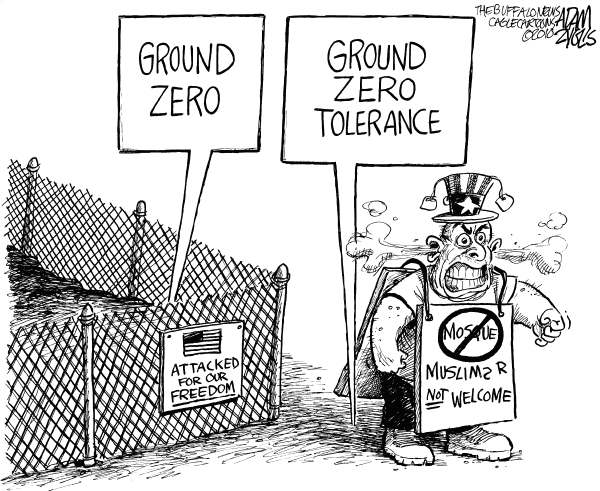
The group said people around the world have seen non-Muslim Americans show fear and contempt toward their Muslim neighbors–emotions that have generated from a national debate about a planned Islamic Center near the site of the September 11, 2001 terrorist attacks in New York City.

Catholic Cardinal Theadore McCarrick, Archbishop of Washington, said he wants the international community to understand that the U.S was built on the principle of valuing one another.

 “I have a great fear that the story of bigotry, the story of hatred, the story of animosity to others is going to be taken by some to be the story of the real America and it’s not. This is not our country and we have to make sure our country is known around the world as a place where liberty of religion, where respect for your neighbor, where love for your neighbor, where these things are the most prominent in our society,” he said.

A Christian pastor in Florida says his church will burn Korans on Saturday, the ninth anniversary of the terrorist attacks on the United States. He says the act serves as a protest against violent Islamist extremists. The local government has denied the church a permit to conduct the public burning. But the pastor of the Dove World Outreach Center has vowed to go ahead with his plan.

Rabbi Nancy Fuchs-Kreimer says the interfaith group strongly condemns the desecration of a sacred text. “We stand by the principle that to attack any religion in the United States is to do violence to the religious freedom of all Americans,” she said. Farhana Khera, president of the organization Muslim Advocates, was part of a separate group of religious leaders that met with U.S. Attorney General Eric Holder at the Justice Department. She said Holder also condemned the plan. “To quote the attorney general, he called the Gainesville plans, burning of Korans, idiotic and dangerous,” Khera said.

The plan has sparked protests in Indonesia and Afghanistan. Demonstrators in the Afghan capital burned the American flag and shouted “Death to America.” Islamic Society of North America President Ingrid Mattson says American Muslims must show the world that the U.S. is a place where all religions can live together in peace. “American Muslims have a unique ability to be this bridge and to show the Muslims who do not live in this kind of freedom that an open, pluralistic atmosphere where there are diverse religions together can really be good for everyone,” she said.

Tensions have heightened in America as the anniversary of the attacks approaches. In 2001, Islamist extremists killed nearly 3,000 people by ramming passenger planes into the twin towers of the World Trade Center in New York and the Pentagon.

For US Muslims, a 9/11 Anniversary Like No Other

By Rachel Zoll for The Associated Press

American Muslims are boosting security at mosques, seeking help from leaders of other faiths and airing ads underscoring their loyalty to the United States — all ahead of a 9/11 anniversary they fear could bring more trouble for their communities.

Their goal is not only to protect Muslims, but also to prevent them from retaliating if provoked. One Sept. 11 protest in New York against the proposed mosque near ground zero is expected to feature Geert Wilders, the aggressively anti-Islam Dutch lawmaker. The same day in Gainesville, Fla., the Dove World Outreach Center plans to burn copies of the Quran.

“We can expect crazy people out there will do things, but we don’t want to create a hysteria,” among Muslims, said Victor Begg of the Council of Islamic Organizations of Michigan. “Americans, in general, they support pluralism. It’s just that there’s a lot of misinformation out there that has created confusion.”

On Tuesday, the Islamic Society of North America will hold a summit of Christian, Muslim and Jewish leaders in Washington “to address the growing tide of fear and intolerance” in the furor over the planned New York mosque.

Islamic centers in many cities are intensifying surveillance and keeping closer contact with law enforcement. Adding to Muslim concern is a fluke of the lunar calendar: Eid al-Fitr, a joyous holiday marking the end of Ramadan, will fall around Sept. 11 this year. Muslim leaders fear festivities could be misinterpreted as celebrating the 2001 terror strikes.

“We’re telling everyone to keep their eyes open and report anything suspicious to authorities and call us,” said Ramzy Kilic of the Tampa, Fla., chapter of the Council on American Islamic Relations.

Other efforts around 9/11 aim to fight bigotry. Muslims will clean parks, feed the homeless, and give toys to sick children as part of Muslim Serve, a national campaign to demonstrate Islamic commitment to serving humanity.

Separately, groups are distributing ads to combat persistent suspicions about Islam. One spot, called “My Faith, My Voice,” features American Muslims saying, “I don’t want to take over this country.”

Sept. 11 anniversaries have always been challenging for U.S. Muslims, who have been under scrutiny since the attacks. This year, the commemoration follows a stunning summer in which opposition to a planned Islamic community center near the World Trade Center site escalated into a national uproar over Islam, extremism and religious freedom.

Islamic centers as far away as Tennessee and California faced protests and vandalism. In western New York, police said a group of teenagers recently yelled obscenities, set off a car alarm and fired a shotgun during two nights of drive-by harassment at a small-town mosque near Lake Ontario.

Usama Shami, board chairman for the Islamic Community Center of Phoenix, said a new mosque the congregation has been building for years drew little attention until recently, when some resistance emerged in the neighborhood and from some in city government. Recently, vandals broke into the new building, spilled paint on the floor and broke expensive windows.

Shami believes the ground zero dispute is partly to blame for the trouble, along with passions unleashed by Arizona’s strict new law that would require police to question people about their immigration status if there is reason to suspect they are in the country illegally.

“All of these issues came at the same time,” Shami said. “When things like that happen, I think they bring out the worst in some people.”

On Sept. 11 in Chicago, Zeenat Rahman, a 34-year-old native of the city, will visit a local nursing home with Muslim and non-Muslim friends to spend time with residents and help serve a meal.

“This is when people are going to look at our community, and when they do, what are they going to see?” said Rahman, a policy director for the Interfaith Youth Core, which promotes pluralism. “Sometimes, saying `Islam means peace,’ feels a little defensive and apologetic, whereas service is really core to our faith.”

Unity Productions Foundation, a Washington-area group that specializes in films about Islam and Muslim Americans, will hold an interfaith talk on Sept. 11 at the Washington Jewish Community Center.

Speakers include Monem Salam, the subject of a Unity Productions film titled, “On a Wing and a Prayer: An American Muslim Learns to Fly.” Unity recently launched groundzerodialogue.org, where visitors can view films and use them for community discussion about Islam in the U.S.

Salam, 38, of Bellingham, Wash., usually spends the Eid weekend with his wife and three young children, but said he persuaded his wife he had to participate in the event.

“I have to leave them and go across the country to answer questions about Islam,” said Salam, a portfolio manager who was 4 years old when his family left Pakistan for the U.S. “It’s unfortunate. It’s the time that we live in.”

Who is a Pakistani?

By Saleem H Ali for The Express Tribune

The recent exchange of polarised articles, following the Sialkot tragedy, have left me perplexed. Both sides have exhibited tremendous scorn for each other and questioned the authenticity of the ‘other’s’ commitment to Pakistan. The existential conflict which these articles exhibited remind me of a painting by the famous French artist Paul Gauguin which hangs in the Museum of Fine Arts in Boston titled: D’où Venons Nous? Que Sommes Nous? Où Allons Nous? Which translates as Where Do We Come From? What Are We? Where Are We Going? Gauguin painted this huge canvas in 1897 while living as a French expatriate in Tahiti.  He questioned his own identity in this colonial.

The crises that are befalling Pakistan are also leading the country to ask such similar questions. So what exactly does it mean to be a Pakistani? First, let us be clear that nationalism is an inherently synthetic phenomenon and there is nothing ‘natural’ about any form of nationalism. Those who suggest that somehow a larger Indian subcontinent was “natural nationalism” following colonial departure forget the motley assemblage of bitterly divided princely states that existed during much of the subcontinent’s history.

Human rights laws and international norms are increasingly critical of nationalism along ethnic lines. At a practical level, the most defining “natural” element of nationalism is language — because communication is the most essential element of human relations. We can look different and overcome our prejudices if we can communicate effectively.

Language is clearly a fracturing factor in Pakistani perceptions of their identity. Most of the readers of Pakistan’s English newspapers rarely read an Urdu daily. Gone are the days when poets like Faiz could be professors of English but write poetry in Urdu, allowing for an exchange of ideas across social strata that had been defined by language. A few veteran journalists such as Khaled Ahmed have to translate Urdu articles for the ‘Angraizi-walas’ who stumble through an occasional headline in the vernacular press. We are further divided by supremacist views about provincial languages. The only way out is for more Pakistanis to become multilingual at levels of proficiency that allow us to interact with the popular culture of communities across the nation.

Another fracture that is apparent regarding Pakistani identity is connection to the physical land and residence within the country. Often resident Pakistanis dismiss those of us who live abroad as being unauthentic “sell-outs” and somehow lesser citizens. Yet in a world of structural inequality, diaspora communities are a seminal way of development. Consider the citizens of Lebanon — 70 per cent of whom reside outside their country but share a passion for their homeland. No doubt empathy and connection are important and getting a good dose of load shedding and local angst is often needed for an expatriate’s reality check. However, we should not question each other’s commitment and sincerity in this regard.

Perhaps the most potent fracture in Pakistan’s identity crisis remains religion. Pakistan, Israel, and East Timor are the only three countries to have been formed in modern times on the primary basis of religious nationalism. This is where we need to exert the most effort in peace-building. Such action does not mean we disparage religion, but rather that embrace a more pluralistic understanding of our dominant faith.

Going back to Gauguin’s painting, we should move beyond his first two questions and spend more time in considering his third question: Where are we going? Let’s quell the cynicism, sarcasm and innuendo and work on clear solutions for the problems that will define the future of Pakistan.

-Saleem H Ali is a professor of environmental planning at the University of Vermont, USA

Bomb Strikes Shiite March in Pakistan

As Reported by The Associated Press

Three bombs ripped through a Shiite Muslim religious procession in the eastern Pakistani city of Lahore on Wednesday, killing 25 people and wounding about 150 others, officials said.

The explosions appeared to be the latest in a string of attacks by Sunni extremists against the minority Shiites they consider infidels. Allied with al-Qaida and the Taliban, the bombers are also seeking to destabilize Pakistan’s U.S.-backed government.

The blasts were the first major attacks since Pakistan was hit by devastating floods more than a month ago. Lahore, the country’s political capital and home to much of its military elite, has been regularly targeted by militants over the past two years.

The bombs exploded at three separate sites Wednesday evening as 35,000 Shiites marched through the streets of Lahore in their traditional mourning procession for the caliph Ali, one of Shiite Islam’s most respected holy men.

Prime Minister Yousuf Raza Gilani condemned the blasts in a statement and said the attackers would not escape justice.

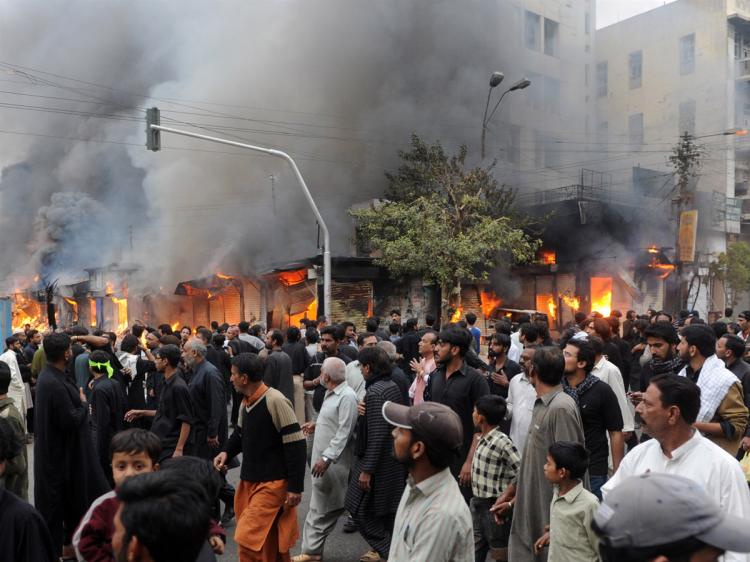
After the blasts, the marchers erupted in fury, setting fire to a police station, another police facility, two police cars and three motorcycles, said Zulfiqar Hameed, a senior police officer. Police lobbed tear gas canisters at the crowd and fired shots in the air to disperse the assailants, he said.

The first blast was a time bomb that exploded in the street near a well-known Shiite building, Hameed said. Footage of that explosion shown on Geo television showed a small blast erupting amid a crowd of people on the street followed by a large plume of smoke. Hundreds of people fled from the blast, while others rushed to carry the wounded to safety.

Minutes later, with the streets in chaos, a male suicide bomber who appeared about 18 years old tried to force his way into an area where food was being prepared for the marchers to break the traditional Ramadan fast and exploded, Hameed said. Soon after, another suicide bomber detonated himself at an intersection near the end of the procession.

Abbas Kumaili, a prominent Shiite scholar as well as a senator, called for three days of mourning over the attack and lashed out at the bombers.

”They are our enemies, both Shiites and Sunnis should remain united and foil their evil designs,” he said.

The blasts killed 25 people and wounded about 150 others, said Sajjad Bhutta, a top local government official.

Hours earlier, three people were wounded in a shooting near a similar Shiite procession in the southern city of Karachi, but senior police officer Iqbal Mahmood said the incident did not target the march.

Islamist extremists have a history of attacking Shiites, non-Muslims and others they deem unacceptable.

In July, twin suicide attacks at Pakistan’s most popular Sufi shrine killed 42 people. Another suicide bomber wounded eight worshippers at a Shiite mosque in eastern Pakistan.

Meanwhile, a bomb exploded near a police vehicle in the town of Shabqadar in northwest Pakistan, killing one passer-by and wounding 15 people including one police officer, police officer Nisar Khan said.

The bombings came after Pakistan army jets and helicopters targeted militant hide-outs near the Afghan border, killing 60 people identified as insurgents or their family members, including children, said security officials and a witness.

The attacks occurred Tuesday and Wednesday in different parts of the region.

There was no independent confirmation of the casualty figures because the area is too dangerous for outsiders to visit.

The raids Tuesday took place in several villages in Teerah Valley in the Khyber region and killed 45 people, the officials said. One official said some vehicles rigged with explosives had also been destroyed. He could not say how many.

He described the dead as insurgents, but said it was possible that people living with them could also have been killed. Separately, an intelligence officer said some women and children had been killed in the attacks.

Jihad Gul, who lives near one of the villages, said he had seen the bodies of at least 20 women and children.

Army spokesman Maj. Gen. Athar Abbas said reports of civilian casualties were unconfirmed.

The security officials spoke on condition of anonymity because they were not authorized to speak to the media.

An air attack Wednesday in the adjoining district of Orakzai killed 15 suspected militants and wounded 10 others, according to local government official Jamil Khan and a brief army statement.

Pakistan’s army has been fighting Islamist militants in different parts of the northwest for more than two years.

Militants who fled major operations in the South Waziristan and Orakzai tribal regions are believed to have set up new bases in Khyber, about 60 miles (100 kilometers) northwest of the main city in the region, Peshawar.

Muslims for Peace- A Public Service Announcement

This is an amazing Public Service Announcement by my friend Ani Zonneveld, founder of Muslims for Progressive Values, a peace activist and an award winning singer/songwriter as well as a great ambassador for moderate Muslims everywhere and a voice of reason within Islam during these difficult times. This video is a must watch for Muslims and non-Muslims alike for helping build bridges and understanding between moderate voices of Islam within and outside the Muslim world.

For more information, please visit http://www.mpvusa.org

If We Scrap Religious Freedom, Terrorists Win

By Sloan R Piva for South Coast Today

I must remind readers that this is the United States of America.

In the United States of America, the supreme law is the Constitution. The Constitution is the framework for the organization of the United States government. Within the Constitution, the first 10 amendments, known as the Bill of Rights, specify the inalienable rights afforded to all American citizens.

Among those rights is the freedom of speech, which allows me to write this letter. Freedom of the press allows publications like The Standard-Times to communicate news, and opinions like this, to communities. And of course there is freedom of religion, which protects each individual American citizen’s right to free exercise of religion.

This means that any American citizen, including the men and women behind the Islamic center in New York City, may practice their religion anywhere on American soil without prejudice or interference.

To interfere with these freedoms is to defy the laws of the land, shamelessly shunning the doctrines assembled by the nation’s forefathers.

America was attacked nine years ago by cowardly and radical religious zealots. It was a devastating tragedy that affected all of us. But the proposed mosque simply cannot be regarded as a “radical Islamic” center. To say that a small, radical percentage of a religion’s members represents the entire religion is unfair. To disallow American Muslims a place of worship, on any available land in the country we share, is unjust.

If Americans truly think it is acceptable to negate the Constitution because of 9/11, then the terrorists have already won. If the nation is divided, and the freedoms associated with our flag are abolished, then we too have become radical.

On Tuesday night, Aug. 24, a 21-year old white man attacked and stabbed a cabbie in New York after asking if he was Muslim. Maybe he thought he was following in the endless line of so-called Americans suddenly claiming that certain religions are allowed in certain places in this so-called “free country.” Ever think so-called debates like this send the younger generation mixed messages about religious tolerance in America?

And shame on the citizens attacking the president for supporting the freedoms of the land which he serves. It would be much more troubling if the president of the United States of America denounced the Constitution and dictated who is allowed where and what religions can be practiced.

To me, that sounds a bit like Nazi Germany. I’m so glad that we do not have a leader enforcing “no Muslims here!” because a group of radicals committed a horrendous crime against our nation. The answer is not to now disallow our citizens their rights. Just because the planners of the Islamic center are Muslim does not make them radical terrorists. Such an assumption would be ignorance and bigotry.

To combat a related issue, the president’s middle name is completely irrelevant to any debate regarding any subject! Here are the main facts: He was born in America, and he is our president. Stating his whole name in support of some ridiculous conspiracy theory is petty, naive, and downright un-American.

My grandfather’s name was John. My mother’s stepfather, whom I also call Grandpa, is named Lee. Does that mean that, because they share the same common first names of John Wilkes Booth and Lee Harvey Oswald, my grandfathers are presidential assassins? By the same theory that Barack Hussein Obama is a Muslim that supports terrorism, I suppose my grandfathers John and Lee are killers.

What about non-Muslim terrorists like Timothy McVeigh? He was Irish, and he came from an Irish Catholic family. Does that mean that Catholic churches are disallowed in the area of the Oklahoma City bombing, and Irishmen in the area may not practice their beliefs? No, because he did not act on behalf of all Irish-Americans, and his terrorist motives were not the motives shared by his family’s religion.

Again, this is the United States of America. It’s a land of freedoms. Go against those inherited freedoms, you’re un-American. Attack the president of the United States with slanderous fallacies, you’re out of line. I applaud my fellow Americans who have taken the right and just stance on these issues, and shake my head in shame at the bigots who are just as hypocritical as the cowardly and radical religious zealots.

-Ms Piva is a resident of Dartmouth and this is her letter to the editor for a local paper in Massachusetts.

The American Debate: Where Has All The Love Gone?

By Dick Polman for The Philadelphia Inquirer

As we navigate the waning days of our xenophobic August, with so many opportunists in high dudgeon about Muslims in our midst, perhaps it’d be wise to quote a notably tolerant Republican – somebody whose words might possibly shame the fearmongers who currently pervade his own party.

For instance: “America counts millions of Muslims amongst our citizens, and Muslims make an incredibly valuable contribution to our country. Muslims are doctors, lawyers, law professors, members of the military, entrepreneurs, shopkeepers, moms, and dads. And they need to be treated with respect. In our anger and emotion, our fellow Americans must treat each other with respect. . . . They love America just as much as I do.”

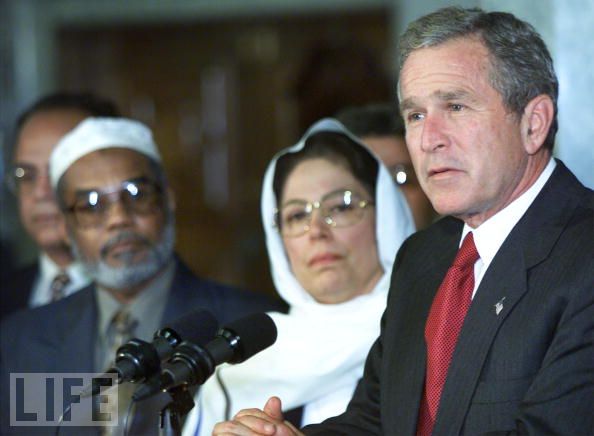
On Sept. 17, 2001, so said President George W. Bush.

Hey, I’m starting to miss the guy. Notwithstanding all the disastrous aspects of his presidency, his generous, inclusive attitude toward immigrants of color – particularly Muslim Americans in the wake of 9/11 – was always in the finest American tradition. We could use a sustained dose of his tone today.

Unfortunately, the conservative movement that he twice led to victory now seems to have shelved that pluralistic tradition, preferring instead to sow fear to reap short-term political gain. And not a single prominent Republican politician has had the courage – heck, it’s not even courage, it’s a duty – to step forward and denounce the roiling irrationality that currently infects our political discourse.

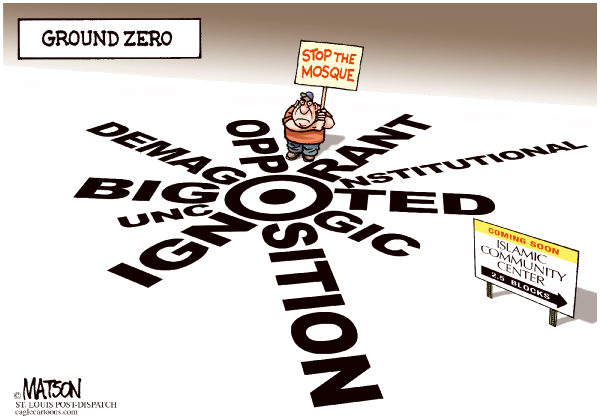
So we’re stuck with the faux issue of a “ground zero mosque” that’s actually not just a mosque (it’s a proposed community center with an interfaith board of directors) and not at ground zero; with Newt Gingrich equating all Muslims with Nazis; with myriad attacks on mosques in Florida (pipe bombs, bullets); with Sarah Palin Twittering her simplicities; with an evangelical pastor who plans to mark the 9/11 anniversary by burning copies of the Quoran (when asked what he knew about the Quoran, he replied, “I have no experience with it whatsoever”); with a tea party blogger who writes that all Muslims are “animals” who worship a “monkey god,” and whatever else the haters are doing in our name.

Since no elected Republican dares to utter a peep, let us try to quell the hatred, however briefly, by skimming the cream of the Bush ouevre. What you’re about to read was mainstream Republican thinking just a few scant years ago.

From the president’s second inaugural address, on Jan. 20, 2005:

“In America’s ideal of freedom, the public interest depends on private character – on integrity and tolerance toward others . . . . That edifice of character is built in families, supported by communities with standards, and sustained in our national life by the truths of Sinai, the Sermon on the Mount, the words of the Quoran . . . .”

From remarks on June 27, 2007, at the rededication of the Islamic Center in Washington:

“We come to express our appreciation for a faith that has enriched civilization for centuries. We come in celebration of America’s diversity of faith and our unity as free people. And we hold in our hearts the ancient wisdom of the great Muslim poet Rumi: ‘The lamps are different, but the light is the same.’ ”

From remarks on Sept. 17, 2001:

“Both Americans and Muslim friends and citizens, tax-paying citizens . . . were just appalled and could not believe what we saw on our TV screens. These acts of violence against innocents violate the fundamental tenets of the Islamic faith. And it’s important for my fellow Americans to understand that. The English translation is not as eloquent as the original Arabic, but let me quote from the Quoran itself: ‘In the long run, evil in the extreme will be the end of those who do evil. For that they rejected the signs of Allah and held them up to ridicule.’ The face of terror is not the true faith of Islam. That’s not what Islam is all about. Islam is peace.”

Compared with what we’re hearing on the Republican right these days, Bush sounds like a “Kumbaya” folkie in the tradition of Peter, Paul, and Mary. But even at the time, he was no starry-eyed naif. Aside from the fact that his calls for tolerance were in the best American tradition, there was also a dash of calculation. He and his advisers knew that al-Qaeda wanted to frame the war on terror as a clash of civilizations. Therefore, it ill-served America to behave as though it were at war with Islam. It was smarter to embrace the followers of Islam, as a way of isolating the violent extremists who had perverted its tenets. Basically, this was a national-security priority. It still is.

Bush’s former chief speechwriter, Michael Gerson, understands that. He’s one of the only Bush alumni who has spoken out; in a recent newspaper column, he reiterated the Bush credo: “A president not only serves Muslim citizens, not only commands Muslims in the American military, but also leads a coalition that includes Iraqi and Afghan Muslims who risk death every day fighting Islamic radicalism at our side.”

In other words, Americans who attack their fellow Muslim citizens – and politicians who inflame such attacks or remain mute – are weakening America. As Gerson put it, treating Muslims as bogeymen, and assailing their Lower Manhattan project, will “undermine the war on terrorism. A war on Islam would make a war on terrorism impossible.”

Of course, it’s easy to understand why the post-Bush GOP has done nothing to quell the Muslim-bashing. Its priorities are decidedly short-term. Forget the war on terror; this party is primarily focused on the war for control of Congress. Its conservative base is angry, fearful, and ginned up for November. Muslim American voters are far less numerous, and the liberals and moderates who lament the current hysteria aren’t likely to vote Republican anyway – or even to vote at all this year.

So it’s probably futile to wave the flag and quote George W. Bush again, but let’s give it one last try. Six days after 9/11, he warned his fellow citizens that Muslims “must be not intimidated in America. That’s not the America I know. That’s not the America I value.”

Is that really so hard to agree with?

Cordova Christians Put Out Welcome Mat For New Mosque

By Lindsay Melvin for The Commercial Appeal-Memphis, TN

When pastor Steve Stone initially heard of the mosque and Islamic center being erected on the sprawling land adjacent his church, his stomach tightened. Then he raised a 6-foot sign reading, “Welcome to the Neighborhood.” The issue for Stone and the 550-person Heartsong Church in Cordova, came down to one question: What would Jesus do if He were us? He would welcome the neighbor,” Stone said.

The Memphis Islamic Center, a nonprofit organization formed three years ago, is two weeks from breaking ground on the first phase of a multimillion-dollar complex. While plans for Islamic centers across the country and just miles away have triggered vitriolic responses and divided communities, here in Memphis it’s been a peaceful process.

On a 31-acre stretch at Humphrey Road and Houston Levee, Memphis Islamic Center leaders plan to build a massive gathering place during the next several years. It will include a mosque, youth center, day care center, indoor gym, sports fields, medical clinic and retirement home.

While the 4,000-square-foot worship hall is being completed, Heartsong has opened its doors to its neighbors throughout the monthlong observance of Ramadan. Under a gigantic cross constructed of salvaged wood, nearly 200 area Muslims have been gathering each night to pray.

“I think it’s helped break down a lot of barriers in both congregations,” said Islamic center board member Danish Siddiqui. Yet, only a four-hour drive east of Memphis, Murfreesboro saw intense protests, with billboards going up to try to block plans for a similar Murfreesboro Islamic Center.

Even televangelist Pat Robertson weighed in against it.

Elsewhere in Middle Tennessee, plans for a Brentwood mosque were defeated in May after residents mounted a campaign raising suspicion over mosque leaders having ties to terrorism. The most publicized of the debates has been the furor over an Islamic center proposed near ground zero in New York. “I’ve got fear and ignorance in me, too,” said Stone, referring to his and some of his congregants’ early apprehension toward the Memphis center.

But as members of the Christian congregation take the opportunity to sit in on Ramadan prayers and meet people at the nightly gatherings, much of that mystery and fear has dissipated.

“People in Memphis appreciate faith, even if it’s not their faith,” said Shaykh Yasir Qadhi, the Islamic center’s scholar in residence and a Rhodes College professor. The peaceful tone in the Bluff City has been refreshing for Qadhi, 35, who recently moved to Memphis from Connecticut, where early this month his Bridgeport mosque was descended on by angry protestors yelling slurs at families as they arrived for evening prayer. “We’re living in a climate of Islamophobia,” he said.

The Memphis project hasn’t been entirely free of criticism. Bloggers and religious publications have speculated that the Memphis group is receiving funding from Saudi Arabia, which the local Islamic board says is completely false.

“If the community can’t put it together, it’s not worth it,” said Siddiqui, a Germantown resident. Other accusations have been lobbed at Shaykh Qadhi for anti-Semitic comments made a decade ago.

“I made a very major mistake,” said Qadhi, adding that he has spent years apologizing for the statements he made as a young student discounting the importance of the Holocaust.

The Islamic scholar’s track record since has been one of promoting peace. He recently returned from a trip to Auschwitz concentration camp, where he joined other Islamic and Jewish leaders to draw awareness to the atrocities of the Holocaust.

“I’ve learned one of my biggest lessons since that time. We have to separate our theology from politics,” he said. The overarching fear being voiced in protests going on across the country is that Islamic centers will become hubs for teaching extremism.

But Islamic center board members say it’s to the contrary. Islamic community centers help form solid Muslim-American identities and keep young kids and adults from feeling marginalized, they said.

Without a place to call home, young Muslims are more likely to seek more radical interpretation of the Quran online, says Arsalan Shirwany, a board member and father of three.

When it is finished, the new facility will be a center for the whole community, and a place for interfaith cooperation, Shirwany said. “This is what we need to fight extremism,” he said.

Pakistanis for Peace Editor’s Note– Pastor Stone and The Heartsong Church in Cordova  Christians deserve applause and praise for their very generous acts of kindness to their fellow God fearing American citizens. And this especially at a time when the country is experiencing clearly an uptick in Islamophobia and acts of both violence and hatred towards a whole group of people over the handful few. On this weekend where a “popular'” cable TV host held a march on Washington asking to Restore America, it is important to remember that Dr Martin Luther King Jr  stated that we should be “judged not by the color of our skin, but by the content of our character.”

Judging the millions of patriotic, decent and hard working American Muslims by the content of their character rather than their religion or ethnicity is the true beauty of a wondrous place called America. This good neighborly act of kindness goes to show that despite all the hate and negative news one hears towards Muslim Americans recently, there are also acts of kindness and fellowship that illustrate the goodness in many every day Americans towards their fellow citizens of an alienated faith.

Aging Philanthropist is Pakistan’s Mother Teresa

By Chris Brummit for The Associated Press
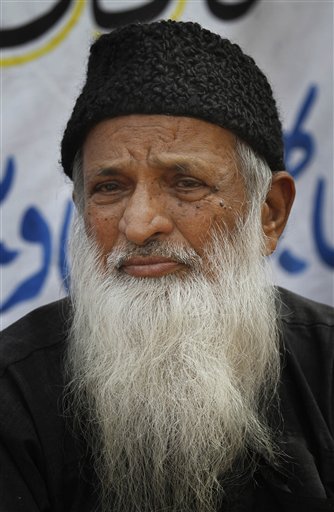
The aging man in mud-splattered, frayed clothes has barely lowered his body onto the sidewalk when the money starts piling up. Heeding his call for donations for flood victims, Pakistanis of all classes rush to hand over cash to Abdul Sattar Edhi, whose years of dedication to the poor have made him a national icon.

He thanks each donor, some of whom ask to have their photo taken next to him. Four hours later, the crowd remains — and the equivalent of $15,000 is overflowing from a pink basket in front of him.

Edhi has been helping the destitute and sick for more than 60 years, filling the hole left by a state that has largely neglected the welfare of its citizens. Part Mother Teresa, part Gandhi, with a touch of Marx, he is the face of humanitarianism in Pakistan.

Funded by donations from fellow citizens, his 250 centers across the country take in orphans, the mentally ill, unwanted newborns, drug addicts, the homeless, the sick and the aged. His fleet of ambulances picks up victims of terrorist bombings, gang shootings, car accidents and natural disasters.

Pakistan’s corruption-riddled government acknowledges Edhi and other charities do the work that in other nations the state performs. The country has no national health service, insurance program or welfare system, and few state-run orphanages or old people’s homes.

The foundation offers an alternative to charitable work performed by hardline Islamist groups in Pakistan, some with alleged links to terrorism. The spread of these organizations has triggered concerns in the West, including their work in the aftermath of this summer’s floods.

Edhi is a devout Muslim, but critical of Islamic clerics in general, not just extremists. He says they focus on ritual, preaching hellfire and defending the faith against imagined enemies, rather than helping the poor — which he says should be the cornerstone of all faiths.

The 80-something Edhi — he and his children disagree on his exact age — lives with his wife, herself a charity worker, in a tiny room in one of his welfare centers in Karachi, a bustling port city. His bed is a one-inch thick mattress on a piece of wood.

“I am a beggar for the poor,” he says, stained teeth showing in a wide smile, eyes sparkling after a week touring flood-hit areas. “Serving humanity is the biggest jihad. It is the real thing.”

___

Edhi deals with birth and death, and almost everything in between.

Just above his bedroom, a maternity ward and an orphanage are home to 18 children, many of them abandoned by their mothers in cradles left outside his centers. They wear hand-me-downs from the city’s rich. Edhi’s wife, Bilquis, tries to get the children adopted, but few Pakistanis want to take girls or older children, she says.

On a recent afternoon, the kids shouted out English nursery rhymes and danced. They then sat cross-legged on the floor, drinking tea from plastic mugs and eating spicy pastries and sticky sweets that an anonymous benefactor had dropped off.

The home was clean and bright, with plenty of toys and loving staff. But there was no place to play outside, and the roar of motorbikes from the lanes below was a constant backdrop.

Across town, workers at the Edhi morgue were dealing with latest influx of bodies. They receive around 25 a day, half of which are never claimed — the city’s unloved and unknown.

Working quickly but carefully, they cut the clothes from the bodies, lather them with a bar of soap from head to toe, rinse them with water from a jug, then wrap them in a white sheet. The bodies are bussed across town, prayed over and buried in unmarked graves.

The body of American journalist Daniel Pearl, killed by al-Qaida terrorists in Karachi in 2002, was picked up by an Edhi ambulance and taken to the morgue, the largest in the city of 14 million people.

The morgue is attached to a hospital for the homeless, a dispensary, a shelter for boys and women and children, even a wedding hall for the marriages arranged for children who have been looked after by the foundation. The smell of baking bread from an oven that churns out 9,000 loaves a day fills the air.

“The poor can come here and get a solution to all their problems,” says Ejal Hassan Zaidi, who had accompanied a neighbor to the morgue to collect the body of his 3-year-old daughter, killed in a hit-and-run incident hours earlier. “From the cradle to the grave.”

___

Born in what is now India, Edhi and his parents moved to Pakistan in 1947 when that country was created as a Muslim state at the end of British colonial rule. The family was quite well off — his father was a traveling salesman — and socially progressive.

In his biography, Edhi credits his mother for setting him on a humanitarian path. She urged him to give half his pocket money to someone poor every day and rebuked him if he didn’t.

“‘You have a selfish heart, one that has nothing to give,'” he remembers her saying. “‘What kind of human being are you? Look at the greed in your eyes. Already you have started robbing the poor. How much more will you rob from them in your lifetime?”

When she was dying, he looked after her, bathing her emaciated body and washing and braiding her hair — experiences that would also shape his life.

“The first night she spent in the grave, I dedicated my life to the service of mankind,” he says.

Edhi started small. In 1951, he bought an eight-foot-square shop in a slum neighborhood in Karachi that he converted into a dispensary. Seven years later he bought a van that he used as an ambulance, writing “Poor Man’s Van” on both sides.

He became intimately involved in the business of caring for the sick and dying. He would drive the ambulance to the scene of an accident to pick up the bodies, administer injections during a flu outbreak and travel across the country to help after earthquakes and other natural disasters.

Edhi’s record of round-the-clock service and frugal lifestyle attracted donations, and he soon had a fleet of 14 ambulances. In the 1980s and 90s, he opened centers and ambulance services throughout the country. He donated $200,000 to releif efforts after Hurricane Katrina, and his workers have also helped out in disasters in Asia and the Middle East.

___

Pakistanis are a generous people, required by their Muslim faith to give away 2.5 percent of their wealth each year. The last nationwide survey done in 1998 showed that Pakistanis gave the then equivalent of $820 million to charity, around the same as the government’s health and education budget at the time. There are no numbers on how rising terrorism and a poor economy have affected this philanthropy.

Edhi does not accept donations from international organizations or governments, including Pakistan’s, saying he doesn’t need outside help and it is important for Pakistanis to help each other. He and his wife live simply of the interest from some savings.

The foundation does not produce detailed financial statements or annual reports. Edhi points to a wall of files in one office in which he says everything is accounted for. Donors do not seem to mind, such is their trust in him.

“You ask any Pakistani on the streets, Edhi is total credible with them,” says Anjum Haque, the executive director of the Pakistan Centre for Philanthropy. “The success of the trust is down to Edhi himself.”

Last year, donations to Edhi-run charities totaled around $5 million, according to Faisal Edhi, the founder’s son and trust member. A significant chunk of the funds comes from overseas Pakistanis, who want to donate to their homeland.

The lack of transparency has caused some concern among others in the charity sector in Pakistan. Faisal Edhi acknowledges that some of their 13,000 employees — who receive very modest salaries — might skim money off donations. There have also been questions raised about the lack of professionalism and efficiency, specially as the foundation has grown.

Edhi Village, a 65-acre complex in the undulating hills beyond the northern slums of Karachi, is home to 300 children, many picked up off the streets, and 900 adults, many elderly or suffering from mental disabilities.

Most wear clean, ironed clothes, and the food is fresh. Yet there are also signs of neglect. One naked youth dragged himself through a puddle. Some had no shoes and begged visitors to buy them a pair.

The adults live in rooms around the size of three tennis courts, bare except for raised sections for sleeping. They are locked inside for part of the day. There are two doctors, four nurses and two ward boys looking after them.

“We do the most we can do with our resources,” says Billal Mohammad, a regional Edhi manager. “They would be living on the pavement under the sky. We give them shelter, food and treatment. You must not see this place throughout Western eyes.”

___

Edhi has made no secret of his dislike of Pakistan’s ruling class. So it was a surprise to see a gaggle of politicians using one of his orphanages in Karachi as a venue to mark the recent birthday of President Asif Ali Zardari.

The visitors spooned cake into the mouths of the children, shouted political slogans for television cameras and asked Edhi to be photographed next to them. He said he only let the politicians in so the children would have a party to enjoy.

“So what if the politicians are using me? They even use God,” said Edhi, who sat by himself for most of the event. “Landowners, clerics, politicians. They are all looters. There is no fear in telling the truth.”

Hardline Islamist groups have criticized Edhi for his progressive views on women and the secular nature of his work. Some have said that by accepting newly-born babies from unmarried mothers, he is promoting premarital sex.

“We meet them and we read their newspapers. They say we are non-Muslims, unbelievers and communists,” says Faisal Edhi. “The jihadi groups don’t like us. They don’t believe in humanity.”

There are questions about what will happen to the foundation when Edhi dies. He says his two sons and three daughters will take over, though without him at the helm, people may not give as generously.

For now, his children appear more concerned about their father’s health. Apart from an afternoon nap, he works just as hard as he did when he was in his 30s, they say.

“We tell him to take it easy, but he doesn’t listen,” says daughter Almas Edhi. “He wants to keep busy.”

On the Net:

  • http://www.edhifoundation.com/
  • http://www.pcp.org.pk/
  •  

    Pakistanis for Peace Editor’s Note– At a time when the Pakistani nation is in turmoil and dismay due to the epic floods, endless bombings and violence, vast corruption amongst the government, the Sialkot killings, and even the match fixing disappointment from the once cherished national cricket team, Abdul Sattar Edhi and his lifelong service to the people of Pakistan is a testament to the awesome goodness found in one Pakistani man. His service to the orphans, the destitute, homeless, and the generally downtrodden of the country make him a shining role model and a beacon of what is good about the Pakistani people. If there is anyone more deserving of a Nobel Peace Prize than Edhi, then we have not found them as of yet. May he continue to inspire not just the Pakistani people, but all people everywhere with his selflessness and humanity.

    Ground Zero Mosque Controversy Helps Give Rise to Islamophobia Across the US

    By Manzer Munir for Pakistanis for Peace

    A man was accused of attempted murder for his vicious knife attack on a Muslim New York City Cab driver Tuesday evening in what is being described as a hate crime by the authorities.

    Michael Enright, a college student who also did some volunteer work in Afghanistan, was being held without bail on charges of assault and attempted murder as hate crimes.

    In a criminal complaint filed by the New York Police Department, Michael Enright allegedly asked the driver if he was a Muslim. The cab driver, Ahmed H Sharif, an immigrant from Bangladesh, replied that yes he was indeed a Muslim. At this point, Mr. Enright is alleged to have uttered the customary Arabic greeting of “Aslaam-a-laikum” (Peace be with you) and brutally attacked the cab driver with a knife, slashing him badly on the face, hands and neck. During the attack, Mr Enright also uttered “Consider this a checkpoint” to the cab driver, all the while brutally attacking him with his knife.

     Besides a serious neck wound, the cab driver, Mr Sharif, suffered cuts on his forearms, face, and hands while trying to defend himself from the attacker.

    Inexplicably, Einright had volunteered with Intersections International, a group that promotes interfaith dialogue between religions and an organization that has also supported the plans for the Islamic center and mosque 2 blocks from Ground Zero. He had also recently returned from Afghanistan where he volunteered to be embedded with a combat battalion so that he could document their experiences as soldiers that Einright wanted to showcase in an upcoming documentary.

    Police stated that Einright was drunk and intoxicated at the time of the attack on Mr Sharif and it is not clear what his motive was for perpetrating the violence on the cab driver. There is growing speculation however amongst members of the American Muslim community as well as several civil rights organizations such as the ACLU and CAIR that the attack is a result of the growing Islamophobia and fear amongst the American public as a direct result of the Ground Zero Mosque controversy that has been brewing for weeks and has been front and center in the media and the American public for some time now.

    The plan to build an Islamic community center and mosque two blocks from the 9/11 tragedy and the site of the World Trade Center towers became controversial as right wing groups seized on what they believed to be “an insensitive provocation towards the American public”. Muslim groups demanded their First Amendment rights of freedom of religion and pointed to the New York City council vote allowing them the permit to build as reasons for what they are doing as legal and in fact an effort to build bridges between Islam and other faiths following the events of September 11. However, the issue became nationally prominent and controversial by then as fanned by right wing blogs and ad campaigns, the majority of the American public became against the building of the mosque, according to recent polls.

    Thankfully, the voice of reason in this whole debate has been none other than the billionaire Jewish mayor of New York, Mayor Michael Bloomberg. His stance and views in support of the mosque as a constitutionally protected right has been welcomed by Muslims as well as civil rights organizations and he should be commended for standing up for what is constitutionally the right thing to do. Briefly, President Obama also came out in support of the group’s right to build the mosque as being a constitutional right, before making statements the next day that “questioned the wisdom” of building it there.

    Nonetheless, a link has been made by the right wing, no matter how unfairly, that Islam promotes terror and violence. This can be seen in the fact that the vast majority of Americans now have a negative and unfavorable view of Muslims. For the country to be even having a debate whether a group of Americans can build a house of worship is a testament to how far things have regressed.

    No one would ever have thought that a constitutionally protected right such as that of freedom of religion would ever seem controversial. Many have argued that only the area around Ground Zero is off limits to Muslims and they are free to build their mosques elsewhere. This does not appear to be the case as mosques thousands of miles away from Ground Zero in California, Tennessee, Ohio and elsewhere across the country have now come under heavy opposition by local zoning boards and people in those communities. The fear and hatred of Muslims is becoming a growing problem as the Ground Zero Mosque controversy has began to fuel acts of violence against Muslims as seen in the attack on the NYC cab driver. It is a message that is being sent to the American public that Muslims in the United States do not deserve the same rights and privileges enjoyed by all others. In fact, there is an attempt to link all mosques to terror somehow, which is very offensive to millions of peaceful Muslims who abhor violence and who live decent hard working lives in their communities.

    At first I was not happy to learn that Muslims planned to build a mosque near Ground Zero as I knew that this would become controversial. But as the opposition to mosques has grown across the nation, and not just for building near Ground Zero, but hundreds and thousands of miles away, it has become clear that this anti-mosque movement is not just about that hallowed area near the World Trade Center site but is in fact becoming an opposition to the religion of Islam as a whole.

    This idea by the opponents of the mosque and the right wingers that somehow it is perverted and insensitive to build a mosque several blocks from Ground Zero is in reality only true if we buy into the belief that Muslims and Islam brought down the towers and not a handful of radical extremists of the religion of Islam. If we believe that mainstream Islam itself was responsible for all those deaths on American soil and not Osama Bin Laden and his Al-Qaida network, only then would building the mosque there be insensitive. But for us to somehow associate the whole religion of Islam of over 1.5 billion people by the actions of 19 terrorists is ridiculous.

    It is my fear that attacks similar to the one a few days ago on the NYC cab driver will continue to grow as we allow an environment of hate to perpetuate and grow against a group of people. At the very least, this opposition to mosques across the country will certainly grow and continue to spread the notion that ALL Muslims are violent and terrorists. This is simply not true as the 5-7 million American Muslims and the 1.5 billion Muslims around the world will attest.

    We must remember that we have a war on terror and not a war on Islam. Far away from Ground Zero in cities across the US as more and more mosques come under opposition in their communities, we must hold steadfast to our ideals, principles and to the US Constitution. As the best nation in the world, we have to defend our ideal and the basis of what makes us the best and that is the US Constitution. Speaking as an American and not even as a Muslim, I know that if we stop defending it for fear of being distasteful, insensitive, or inconsiderate, then we lose what makes us who we are as the freest nation in the world and we must not ever let that happen!

    -Manzer Munir, a peace activist, and the founder of Pakistanis for Peace, is a freelance journalist who writes for www.PakistanisforPeace.com and other online journals.

    Mayor Bloomberg on Mosque: ‘A Test of Our Commitment to American Values’

    As Reported By The Wall Street Journal

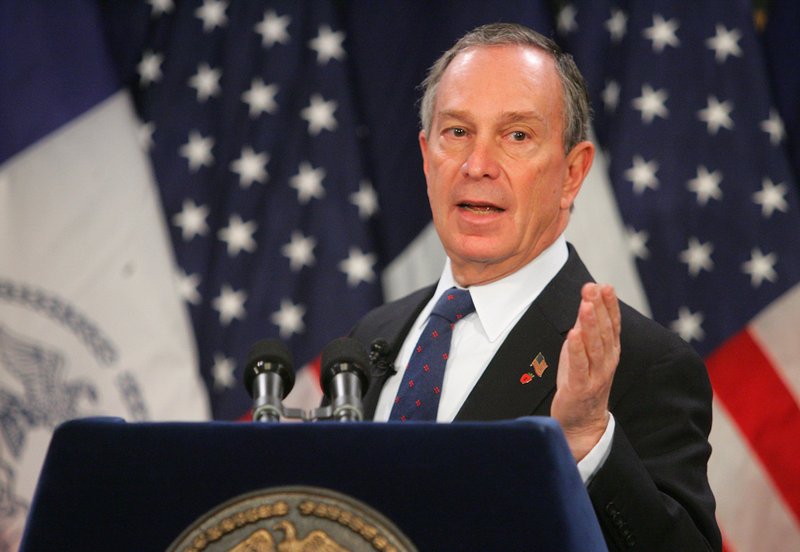
    In a speech at a Ramadan Iftar dinner at Grace Mansion Tuesday, Mayor Michael Bloomberg offered an extended defense of the proposed Islamic community center and mosque near the World Trade Center site. Those who say the center should not be built “would compromise our commitment to fighting terror with freedom,” the mayor said. “There is nowhere in the five boroughs that is off limits to any religion.”

    Below, the full transcript of Bloomberg’s prepared remarks.

    Good evening, and Ramadan Kareem. I want to welcome everyone to our annual Ramadan Iftar at Gracie Mansion.

    We call this ‘The People’s House,’ because it belongs to all 8.4 million New Yorkers who call this city home. People of every race and religion, every background and belief. We celebrate that diversity here in this house with gatherings like this.

    And for me, whether it’s marking St. Patrick’s Day or Harlem Week or any other occasion, these gatherings are always a powerful reminder of what makes our city so strong and our country so great.

    America is a nation of immigrants, and no place opens its doors more widely to the world than New York City. America is the land of opportunity, and no place offers its residents more opportunity to pursue their dreams than New York City. America is beacon of freedom, and no place defends those freedoms more fervently, or has been attacked for those freedoms more ferociously, than New York City.

    In recent weeks, a debate has arisen that I believe cuts to the core of who we are as a city and a country. The proposal to build a mosque and community center in Lower Manhattan has created a national conversation on religion in America, and since Ramadan offers a time for reflection, I’d like to take a few minutes to reflect on the subject.

    There are people of good will on both sides of the debate, and I would hope that everyone can carry on the dialogue in a civil and respectful way. In fact, I think most people now agree on two fundamental issues: First, that Muslims have a constitutional right to build a mosque in Lower Manhattan and second, that the site of the World Trade Center is hallowed ground. The only question we face is: how do we honor that hallowed ground?

    The wounds of 9/11 are still very much with us. And I know that is true for Talat Hamdani, who is here with us tonight, and who lost her son, Salman Hamdani, on 9/11. There will always be a hole in our hearts for the men and women who perished that day.

    After the attacks, some argued – including some of those who lost loved ones – that the entire site should be reserved for a memorial. But we decided – together, as a city – that the best way to honor all those we lost, and to repudiate our enemies, was to build a moving memorial and to rebuild the site.

    We wanted the site to be an inspiring reminder to the world that this city will never forget our dead and never stop living. We vowed to bring Lower Manhattan back – stronger than ever – as a symbol of our defiance and we have. Today, it is more of a community neighborhood than ever before, with more people than ever living, working, playing and praying there.

    But if we say that a mosque and community center should not be built near the perimeter of the World Trade Center site, we would compromise our commitment to fighting terror with freedom.

    We would undercut the values and principles that so many heroes died protecting. We would feed the false impressions that some Americans have about Muslims. We would send a signal around the world that Muslim Americans may be equal in the eyes of the law, but separate in the eyes of their countrymen. And we would hand a valuable propaganda tool to terrorist recruiters, who spread the fallacy that America is at war with Islam.

    Islam did not attack the World Trade Center – Al-Qaeda did. To implicate all of Islam for the actions of a few who twisted a great religion is unfair and un-American. Today we are not at war with Islam – we are at war with Al-Qaeda and other extremists who hate freedom.

    At this very moment, there are young Americans – some of them Muslim – standing freedoms’ watch in Iraq and Afghanistan, and around the world. A couple here tonight, Sakibeh and Asaad Mustafa, has children who have served our country overseas and after 9/11, one of them aided in the recovery efforts at Ground Zero. I’d like to ask them to stand, so we can show our appreciation. Thank you.

    The members of our military are men and women at arms – battling for hearts and minds. And their greatest weapon in that fight is the strength of our American values, which have always inspired people around the world. But if we do not practice here at home what we preach abroad – if we do not lead by example – we undermine our soldiers. We undermine our foreign policy objectives. And we undermine our national security.

    In a different era, with different international challenges facing the country, President Kennedy’s Secretary of State, Dean Rusk, explained to Congress why it is so important for us to live up to our ideals here at home. He said, ‘The United States is widely regarded as the home of democracy and the leader of the struggle for freedom, for human rights, for human dignity. We are expected to be the model.’

    We are expected to be the model. Nearly a half-century later, his words remain true. In battling our enemies, we cannot rely entirely on the courage of our soldiers or the competence of our diplomats. All of us must do our part.

    Just as we fought communism by showing the world the power of free markets and free elections, so must we fight terrorism by showing the world the power of religious freedom and cultural tolerance. Freedom and tolerance will always defeat tyranny and terrorism – that is the great lesson of the 20th century, and we must not abandon it here in the 21st.

    I understand the impulse to find another location for the mosque and community center. I understand the pain of those who are motivated by loss too terrible to contemplate. And there are people of every faith – including, perhaps, some in this room – who are hoping that a compromise will end the debate.

    But it won’t. The question will then become, how big should the ‘no-mosque zone’ around the World Trade Center be? There is already a mosque four blocks away. Should it too, be moved?

    This is a test of our commitment to American values. We must have the courage of our convictions. We must do what is right, not what is easy. And we must put our faith in the freedoms that have sustained our great country for more than 200 years.

    I know that many in this room are disturbed and dispirited by the debate. But it is worth keeping some perspective on the matter. The first colonial settlers came to these shores seeking religious liberty and the founding fathers wrote a constitution that guaranteed it. They made sure that in this country the government would not be permitted to choose between religions or favor one over another.

    Nonetheless, it was not so long ago that Jews and Catholics had to overcome stereotypes and build bridges to those who viewed them with suspicion and less than fully American. In 1960, many Americans feared that John F. Kennedy would impose papal law on America. But through his example, he taught us that piety to a minority religion is no obstacle to patriotism. It is a lesson that needs updating today, and it is our responsibility to accept the challenge.

    Before closing, let me just add one final thought: Imam Rauf, who is now overseas promoting America and American values, has been put under a media microscope. Each of us may strongly agree or strongly disagree with particular statements he has made. And that’s how it should be – this is New York.

    And while a few of his statements have received a lot of attention, I would like to read you something that he said that you may not have heard. At an interfaith memorial service for the martyred journalist Daniel Pearl, Imam Rauf said, ‘If to be a Jew means to say with all one’s heart, mind, and soul: Shma` Yisrael, Adonai Elohenu Adonai Ehad; Hear O Israel, the Lord our God, the Lord is One, not only today I am a Jew, I have always been one. If to be a Christian is to love the Lord our God with all of my heart, mind and soul, and to love for my fellow human being what I love for myself, then not only am I a Christian, but I have always been one.’

    In that spirit, let me declare that we in New York are Jews and Christians and Muslims, and we always have been. And above all of that, we are Americans, each with an equal right to worship and pray where we choose. There is nowhere in the five boroughs that is off limits to any religion.

    By affirming that basic idea, we will honor America’s values and we will keep New York the most open, diverse, tolerant, and free city in the world. Thank you.

    Crisis in Kashmir

    By Ashok K Metha for The Wall Street Journal

    A few months ago, Pakistan was virtually begging India to restart the dialogue process between the two governments, suspended after the 2008 Mumbai terrorist attack. Now Pakistani spokesman Abdul Basit asserts that Pakistan will not agree to “any preconditions for resuming the dialogue process.” Why did Islamabad’s attitude change?

    The answer lies in two cities: Srinagar and Kabul.

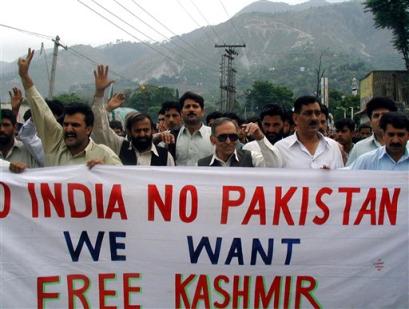
    With 62 civilian deaths in the ongoing rioting in the capital city Srinagar and two districts, over the past couple months Kashmir has witnessed a fresh uprising against the symbols of the state. Kashmiris are using every avenue they have—from stones to the Internet—to demand azaadi, or freedom. The mostly spontaneous upheaval involves young men, women and even children. Kashmiris want freedom from corruption, bad governance and the overbearing presence of soldiers.

    For decades Pakistan has been trying to wrest Kashmir away from India by sponsoring insurgency. But today, thanks to the ineffective administration in Srinagar, Pakistan doesn’t have to try very hard. After the security forces managed to restore law and order three years ago, India failed to take the political initiative, and frittered away its gains. The result is widespread disillusionment. At a ceremony commemorating India’s Independence Day this month, a local policeman threw a shoe at Omar Abdullah, chief minister of Jammu and Kashmir, whose grandfather Sheikh Abdullah ratified the state’s accession to India.

    Up until 2008, the state had a lot going for it: several round-table meetings for self rule and confidence-building measures, periodic release of economic packages, annual visits by Prime Minister Manmohan Singh, conferences connecting the people and quiet dialogue with moderate and hardline separatist leaders. The ceasefire on the Line of Control was holding, and a four-point formula for resolving the Kashmir dispute hammered out with Pakistan through back channels seemed as good as done.

    Indian security personnel beat detained Kashmiri Muslim protesters in Srinagar, India.
    Mysteriously, the peace process then ground to a halt. The India-Pakistan dialogue began unraveling soon after Gen. Pervez Musharraf left the scene. The new Pakistani Army Chief, Gen. Ashfaq Kayani, a Fort Leavenworth graduate and favorite of the U.S. establishment, reversed the process of reconciliation. The ceasefire has become shaky, and the Pakistani government’s rhetoric on Kashmir has returned to the rights of the people to self determination and “diplomatic and moral support to Kashmir in their legitimate struggle no matter how brutally Indian forces try to suppress it.”

    The reason Gen. Kayani feels emboldened to take a harder line is easy to discern. Tensions deepened after the U.S. elevated Pakistan from “major non-NATO ally” to the linchpin of its Afghan exit strategy, and excluded India from a political solution in Afghanistan. Despite the denials of U.S. Af-Pak point man Richard Holbrooke, the Afghanistan-Pakistan free trade agreement has only underscored India’s irrelevance to Kabul.

    Civilian strife in the Kashmir Valley will only strengthen Pakistan’s case that resumption of a dialogue on Kashmir alone will enable a more focused fight against the Taliban on the Western frontier. This is not entirely true, as the Pakistan Army has already redeployed to the west 52% of its offensive and 45% of its defensive forces previously devoted to facing down India.

    The priority for Delhi is to stop the stone-throwing in Kashmir. Every death—one recent fatality was a child of eight years old—is fresh cause for protests. On an hour’s notice, 10,000 people will come out on the streets to join the funeral procession of someone they don’t know. Further, Kashmir’s moderate Islam is being radicalized by the hardline Jamaat-e-Islami, which has made even separatist leaders irrelevant. No one is willing to talk unconditionally anymore.

    Delhi will have to start from scratch in rolling back alienation by reaching out to youth. Yet Rahul Gandhi, India’s prime-minister-in-waiting and supposedly its youth leader, has not reached out to his favorite constituency in Kashmir. Neither has Congress President Sonia Gandhi or Prime Minister Manmohan Singh visited Srinagar since the troubles began in June. Until a few months back, Kashmir was the most violence-free state in India, as security forces had significantly marginalized insurgent and terrorist groups over the last three years.

    Islamabad is not about to take over Kashmir—according to a survey by London-based think tank Chatham House last month, just 2% of the population favors joining Pakistan. But as the cry for azaadi grows louder, no one has a clue when this uprising is going to stop. Even as the faithful observe Ramadan, Delhi needs to do something before U.S. President Barack Obama’s scheduled visit in November.

    Mosque Near Ground Zero Divides Sept. 11 Relatives

    By Samantha Gross for The Associated Press

    Talat Hamdani traveled to Mecca to pray that her missing son, an EMT, was safe in the days after 9/11. She held out hope that his Muslim background had led to his detention as a suspect, considering it better than the alternative.

    When part of his body was returned to her — his lower half shattered into 34 pieces — it was final proof he had indeed been killed when Islamic extremists brought down the World Trade Center. As Americans take sides over plans to build an Islamic cultural center and mosque blocks away, Hamdani says it feels personal.

    “Why are we paying the price? Why are we being ostracized? Our loved ones died,” she said at her Lake Grove, N.Y., home. “America was founded on the grounds of religious freedom,” and opposition to the cultural center “is un-American. It’s unethical. And it is wrong.”

    The thousands of relatives of the 2,976 victims have no single representative and no unified voice, even as another 9/11 anniversary approaches. The conflict is dividing a group that in many ways has never been united, with some saying the cultural center would reopen old wounds too close to hallowed ground and others saying that opposing it is tantamount to bigotry.
    And some, like Vandna Jain, walk a middle ground.

    “It is unfair to persecute the group, however, in turn, there should be some respect for the feelings of the people that are forever attached to this site due to their losses,” the New City, N.Y., resident, whose father, Yudh, died in the north tower, wrote in an e-mail. “I think people have a right to be upset about it, just as much as people have a right to build a mosque.” Jim Riches, a former New York Fire Department deputy chief whose son, Jimmy, was killed at the trade center, believes the dispute has nothing to do with religious freedom.

    “We’re not telling them not to practice their religion. … It’s about location, location, location,” he said, asking why the mosque couldn’t be built farther away from the land that he still considers a cemetery. “It’s disrespectful. You wouldn’t put a Japanese cultural center at Pearl Harbor.”

    Liza Murphy feels differently. Her brother, Charlie, died at ground zero, but she says she doesn’t lay claim to the sprawling, 16-acre site. “It’s a place where a terrible tragedy took place, but I don’t see what makes it sacred,” said the Brooklyn resident. “Nine years later, that now belongs to the public. And my brother and his death are private and belong to me.” Murphy says she has no objection to the planned mosque and wouldn’t want to judge one group of Muslims based on the actions of another.

    But Peter Gadiel says he owes no apologies for singling one group out. Since his son, James, was killed at the trade center, Gadiel has argued publicly that all Muslims should share some collective guilt for what happened on 9/11.

    “The fact is that Islam does not coexist well with other religions, and you can’t separate that from Islam,” the Kent, Conn., resident said, explaining his stand against the mosque. “If that sounds intolerant on my part, that’s too bad.” The families’ impassioned responses to the prospect of the mosque have influenced the public debate.

    Gov. David Paterson has suggested moving the project further away from the trade center site out of respect for opponents’ feelings, while Mayor Michael Bloomberg came out in support of the mosque, calling it a test of the separation of church and state.
    President Barack Obama has said he believes Muslims have the right to build the Islamic center as a matter of religious freedom, though he’s also said he won’t take a position on whether they should actually build it.

    The imam leading plans for the center on Friday called extremism a security threat in both the West and the Muslim world. Feisal Abdul Rauf made his comments to Associated Press Television News in Bahrain during a Mideast tour funded by the U.S. State Department, but he wouldn’t discuss the uproar over the Islamic center.

    Relatives of those slain on Sept. 11 have made their diverging voices heard on a number of issues over the years — from whether to try the suspects in a civilian court to the location of a proposed freedom museum at ground zero that is no longer planned for the site.

    Charles Wolf, who lost his wife, Katherine, at the trade center, says emotions among family members are especially raw right now.
    “This is anniversary season. It’s really, really hard,” the Manhattanite said. “Passions are up and this is bringing up a lot of hurt in people.”

    He says he worries that any decision to respond to public pressure and move the mosque would be used by extremists to paint Americans as intolerant.

    “The powers of evil were piloting those airplanes,” he said of the Sept. 11 attackers. Now, with the mosque dispute, “here is where we’re falling into the terrorists’ trap … trying to tear each other apart. Good people fighting other good people — does that sound like evil at work?”

    Keith Olbermann – Special Comment, Muslim Community Center

    “THEY CAME FIRST for the Communists,
    and I didn’t speak up because I wasn’t a Communist.

    THEN THEY CAME for the trade unionists,
    and I didn’t speak up because I wasn’t a trade unionist.

    THEN THEY CAME for the Jews,
    and I didn’t speak up because I wasn’t a Jew.

    THEN THEY CAME for me
    and by that time no one was left to speak up.”
    -Martin Niemöller

    “This is America damn it! And in America when somebody comes for your neighbor, or his Bible, or his Torah, or his Athiest Manifesto, or his Koran, you and I do what our fathers did and our grandmothers did, and our founders did, you and I SPEAK UP!”
    – Keith Olbermann

    NYC Mosque Should Be Seen As a Reconciliation Not a Provocation

    By Manzer Munir for Pakistanis for Peace

    A New York City panel cleared the way Tuesday for an Islamic Center and mosque to be built several blocks from Ground Zero and the tragedy of September 11, 2001. The New York City Landmarks Preservation Commission voted unanimously to deny historic status to a 19th century building near Ground Zero. By doing so, it paves the way for the old building’s demolition and the construction of a 15 story Muslim community center, a mere two blocks from the World Trade Center site. The controversy has brewed for months over the creation of a mosque and an Islamic center so close to the site of the World Trade Centers where nearly 3,000 Americans died in terrorist attacks blamed on Muslim terrorists affiliated with the terrorist group Al-Qaeda.

    Opponents of the mosque have argued that the creation of it so close to the site of the 9/11 terrorist attacks disrespects the memory of those killed. They also question who is behind the funding and bankrolling of the proposed structure, Cordoba House, which is estimated to cost nearly $100 million. Many prominent members of the Republican Party such as Newt Gingrich and Sarah Palin have come out strongly against the building of the mosque and Muslim center so close to the site of the attacks. Gingrich argued that “that the Ground Zero mosque is all about conquest and thus an assertion of Islamist triumphalism which we should not tolerate.”

    Seemingly directed at peace seekers such as myself, Sarah Palin posted the following message on her Twitter page “Peace-seeking Muslims, please understand. Ground Zero Mosque is UNNECESSARY provocation; it stabs hearts. Please reject it in the interest of healing.”

    Some of the relatives of the victims of the 9/11 attacks have come out and said that the mosque and Islamic center would amount to a monument for terrorists as the extremists would see it as a celebration of their destruction of an American monument and lives lost. According to them, the building of the Muslim structure gives an impression that the Islamic extremists won and we Americans lost, not just in terms of lives lost but also in terms of lost and lowered morale.

    The proponents of the Cordoba House have advocated the building of the structure especially since they see the center as an organization that promoted tolerance and inter faith dialogue, reflecting the rich diversity of New York City. They say that the “center will be community-driven, serving as a platform for inter-community gatherings and cooperation at all levels, providing a space for all New Yorkers to enjoy.”

    Their website further states that the Cordoba House project is “about promoting integration, tolerance of difference and community cohesion through arts and culture. Cordoba House will provide a place where individuals, regardless of their backgrounds, will find a center of learning, art and culture; and most importantly, a center guided by Islamic values in their truest form – compassion, generosity, and respect for all.”

    In fact the name Cordoba House, takes its name from the medieval Spanish city where Christians, Jews and Muslims lived in peace and harmony under the Moors of Spain for over 800 years. Mayor Michael Bloomberg was right in supporting the construction of the Cordoba House not just on the basis that religious freedom is enshrined in our constitution, but because it was the right thing to do. Denying the building of this structure would have been a blatant admission on the part of the city and indeed the entire country that there is absolutely no difference in the twisted misinterpretation of Islam practiced by the hijackers and the Taliban and the one practiced by the rest of the 1.5 billion Muslims worldwide. As if a mere 19 deranged, misguided, yet determined adolescent men could change the fact that the vast majority of the adherents of Islam are peaceful, hardworking, average people like you and me who want nothing more than to live a good life, raise their kids, and worship their creator.

    No, the opponents of the Cordoba House and their hate wagering backers and right wing politicians like Palin and Gingrich want nothing more than to incite people into believing that Islam in general is bad and evil and to suspect anything that goes on in a mosque. Oddly enough, it seems that much like their enemy, the Taliban and Muslim fundamentalists, the right wing politicians in the GOP want nothing more than “Clash of Civilizations” to come about between Islam and the West. Preachers like the Pastor Terry Jones in Gainesville, Florida who is organizing an “Everybody burn a Quran Day” as well as mainstream evangelicals like Pat Robertson also condone this view and treatment of Islam and Muslims.

    Little do these so called “leaders” realize that scores of Muslim Americans also perished that day on September 11, 2001. The hate and fear mongers will not want you to know the story of Salman Hamdani, a NYPD police cadet, who was a part time ambulance driver, an incoming medical student, and devout Muslim whose remains were found at the North Tower, with his EMT medical bag beside him, presumably trying his best to help those at the site of the attacks. Or the Muslim waiter at the Windows of the World restaurant, who never got to see his wife give birth to their son two days after the attacks. I wonder if Gingrich, Palin or any of the others could look US Army Specialist Kareem Rashad Sultan Khan’s mother in the eye and tell her that although her son died in an American uniform fighting in Iraq under the American flag, his religion and his beliefs system are evil and have no place in American life. The deceased Purple Heart and Bronze Star recipient would turn in his grave at Arlington National Cemetery if he knew how his faith was being disrespected and marginalized by politicians and right wing blowhards like Rush Limbaugh and Glenn Beck, individuals who never served this country or risked their life as had Specialist Khan.

    It is heartening to see that good sense prevailed by the New York City panel that had the tough job of deciding on this issue and this heavily watched story. Although there promises to be a further fight and appeal by the opponents of the Islamic center, one hopes that the ruling would stand as denying it would clearly violate the freedom of religion that all faiths should get in America, regardless of the actions of some of their members. After all, one should not punish and ostracize the many for the actions of a few.

    -Manzer Munir, founder of Pakistanis for Peace, is a freelance journalist who writes for PakistanisforPeace.com and other online journals.