Archive for the ‘ Nuclear ’ Category

Chicago Trial To Put heat On Pakistan Spy Agency

As Reported by CBS News

The federal trial of Tahawwur Rana begins Monday in Chicago, in which the Pakistan-born Canadian citizen who has lived in the Midwest for many years stands accused of providing cover for a former classmate who scouted sites for the 2008 Mumbai terror attacks in India. He is also accused of providing support for attempted attacks in Denmark that were never carried out.

Rana has pleaded not guilty, and while the trial may be about Rana’s alleged abetting of international terrorism, the court proceedings are gaining international attention because they are expected to finger Pakistan’s ISI spy agency for helping a terror group carry out the attacks, the Associated Press reports.

Lashkar-e-Taiba, a Pakistani militant group, has been blamed for the 3-day siege in Mumbai that killed more than 160 people, including six Americans. David Headley, a Pakistani-American businessman who has confessed to his involvement in the attacks and has turned government informant, is expected to testify that Pakistan ISI agents helped the militant group carry out the Mumbai attacks, The Guardian reports.

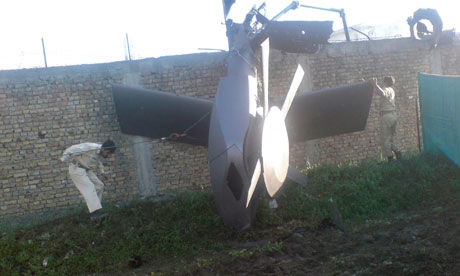
The trial comes at a particularly tense time for U.S.-Pakistan relations, because U.S. Navy SEALs recently found and killed Osama bin Laden in Pakistan after he had been hiding in plain sight there for several years.

Headley, a former informant for DEA, has already pleaded guilty to aiding in the attacks, and he has also already told an Indian inquiry into the attacksthat ISI officers helped Lashkar-e-Taiba plot the commando-style attacks on several sites in Mumbai, India’s largest city, The Guardian reports.

The 12 jurors selected for the federal trial of Rana are mostly minorities and mainly women, the AP reports.

Eight women and four men were sworn in for the trial, and opening statements are planned for Monday.

The AP writes: “Few biographical details have been available about the jurors or the six alternates chosen, whose identities are being kept secret. More than half of the 12 jurors are black. Questions in open court focused on the jurors’ understanding and views of Islam, citizenship and terrorism, issues that experts predict will come up at trial.”

Pakistan’s Nuclear Surge

By Andrew Bast for Newsweek

Even in the best of times, Pakistan’s nuclear-weapons program warrants alarm. But these are perilous days. At a moment of unprecedented misgiving between Washington and Islamabad, new evidence suggests that Pakistan’s nuclear program is barreling ahead at a furious clip.

According to new commercial-satellite imagery obtained exclusively by NEWSWEEK, Pakistan is aggressively accelerating construction at the Khushab nuclear site, about 140 miles south of Islamabad. The images, analysts say, prove Pakistan will soon have a fourth operational reactor, greatly expanding plutonium production for its nuclear-weapons program.

“The buildup is remarkable,” says Paul Brannan of the Institute for Science and International Security. “And that nobody in the U.S. or in the Pakistani government says anything about this—especially in this day and age—is perplexing.”

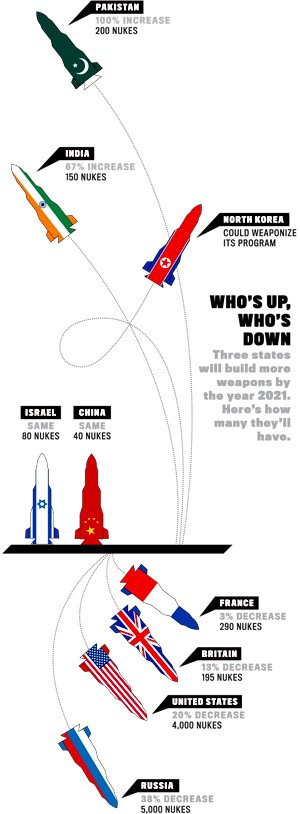
Unlike Iran, which has yet to produce highly enriched uranium, or North Korea, which has produced plutonium but still lacks any real weapons capability, Pakistan is significantly ramping up its nuclear-weapons program. Eric Edelman, undersecretary of defense in the George W. Bush administration, puts it bluntly: “You’re talking about Pakistan even potentially passing France at some point. That’s extraordinary.”

Pakistani officials say the buildup is a response to the threat from India, which is spending $50 billion over the next five years on its military. “But to say it’s just an issue between just India and Pakistan is divorced from reality,” says former senator Sam Nunn, who co-chairs the Nuclear Threat Initiative. “The U.S. and Soviet Union went through 40 years of the Cold War and came out every time from dangerous situations with lessons learned. Pakistan and India have gone through some dangerous times, and they have learned some lessons. But not all of them. Today, deterrence has fundamentally changed. The whole globe has a stake in this. It’s extremely dangerous.”

It’s dangerous because Pakistan is also stockpiling fissile material, or bomb fuel. Since Islamabad can mine uranium on its own territory and has decades of enrichment know-how—beginning with the work of nuclear scientist A. Q. Khan—the potential for production is significant.
Although the White House declined to comment, a senior U.S. congressional official who works on nuclear issues told NEWSWEEK that intelligence estimates suggest Pakistan has already developed enough fissile material to produce more than 100 warheads and manufacture between eight and 20 weapons a year. “There’s no question,” the official says, “it’s the fastest-growing program in the world.”

What has leaders around the world especially worried is what’s popularly known as “loose nukes”—nuclear weapons or fissile material falling into the wrong hands. “There’s no transparency in how the fissile material is handled or transported,” says Mansoor Ijaz, who has played an active role in back-channel diplomacy between Islamabad and New Delhi. “And the amount—they have significant quantities—is what’s so alarming.”

That Osama bin Laden was found in a Pakistani military community, and that the country is home to such jihadi groups as Lashkar-e-Taiba, only heightens concerns. “We’ve looked the other way from Pakistan’s growing program for 30 years,” says Sharon Squassoni, a director at the Center for Strategic and International Studies. What we’re facing, she says, is “a disaster waiting to happen.”

A Defense Department official told NEWSWEEK that the U.S. government is “confident that Pakistan has taken appropriate steps toward securing its nuclear arsenal.” But beyond palliatives, few in Washington want to openly discuss the nightmare scenario of terrorists getting hold of nuclear material or weapons. “The less that is said publicly, the better,” says Stephen Hadley, national-security adviser to President George W. Bush. “But don’t confuse the lack of public discussion for a lack of concern.”

The bomb lends the Pakistanis a certain diplomatic insouciance. Nukes, after all, are a valuable political tool, ensuring continued economic aid from the United States and Europe. “Pakistan knows it can outstare” the West, says Pakistani nuclear physicist Pervez Hoodbhoy. “It’s confident the West knows that Pakistan’s collapse is too big a price to pay, so the bailout is there in perpetuity. It’s the one thing we’ve been successful at.”

Pakistani leaders defend their weapons program as a strategic necessity: since they can’t match India’s military spending, they have to bridge the gap with nukes. “Regretfully, there are several destabilizing developments that have taken place in recent years,” Khalid Banuri of Pakistan’s Strategic Plans Division, the nuclear arsenal’s guardian, wrote in response to NEWSWEEK questions. Among his country’s concerns, Banuri pointed to India’s military buildup and the U.S.’s -civilian nuclear deal with India.

“Most Pakistanis believe the jihadist scenario is something that the West has created as a bogey,” says Hoodbhoy, “an excuse, so they can screw us, defang, and denuclearize us.”

“Our program is an issue of extreme sensitivity for every man, woman, and child in Pakistan,” says former Pakistani president Pervez Musharraf, adding that the nukes are “well dispersed and protected in secure locations.” When asked whether the U.S. has a role to play in securing the arsenal, Musharraf said: “A U.S. role to play? A U.S. role in helping? Zero role. No, sir. It is our own production?.?.?.?We have not and cannot now have any intrusion by any element in the U.S.” To guard its “strategic assets,” Pakistan employs two Army divisions—about 18,000 troops—and, as Musharraf drily puts it, “If you want to get into a firefight with the forces guarding our strategic assets, it will be a very sad day.”

For now, the White House appears to have made a tacit tradeoff with Islamabad: for your cooperation in Afghanistan, we’ll leave you to your own nuclear devices. “People bristle at the suggestion, but it follows, doesn’t it?” says Rolf Mowatt-Larssen, formerly the CIA’s chief officer handling terrorism and weapons of mass destruction. “The irony is that the U.S. presence in Afghanistan and Pakistan, and the money we’re giving them to fight terrorism, could inadvertently aggravate the very problem we’re trying to stop. After all, terrorism and nukes is the worst-case scenario.”

With this fourth nuclear facility at Khushab coming online as early as 2013, and the prospect of an accelerated nuclear-weapons program, the U.S. is facing a diplomatic dilemma. “The Pakistanis have gone through a humiliation with the killing of Osama bin Laden,” says Nunn. “That’s never a time to corner somebody. But with both recent and preexisting problems, we are in a race between cooperation and catastrophe. Both sides need to take a deep breath, count to 10, and find a way to cooperate.”

The Power of Pakistani Conspiracy Theories

By Ahmed Rashid for The New Republic

Pakistan is not a failed state, or as yet a failing one, even though it may be in a state of chaos or meltdown. Unlike really failed states, it has a powerful army and a corrupt, run-down, but still functioning bureaucracy, judiciary, and police force. Pakistanis perform outstandingly well in the realm of culture: in the arts, television, fashion design, pop music, and of course cricket. What is missing are adequate social services, such as health care, education, population-control programs, and jobs for a population that is nearing 200 million people. Like many Arab countries, Pakistan faces a youth bulge, with an estimated 60 percent of its people under twenty-five years old.

For these young people without adequate education and employment, who have to deal with a corrupt system that offers no panacea to the poor, joining an Islamic extremist group is not at all unusual. It is the norm. For this reason, a replay of an “Arab awakening” in Pakistan would not lead to the dawn of true democracy, but rather to a mass movement whose leadership would swiftly fall into the hands of Islamic extremists, who would then try to overthrow the state.

What Pakistanis desperately need is a new narrative by their leaders—a narrative that does not blame the evergreen troika of India, the United States, and Israel for all of the country’s ills, that breaks the old habit of blaming outsiders and instead looks at itself more honestly and more transparently. Pakistanis as a nation seem incapable of self-analysis, of apportioning blame according to logic and reason rather than emotion.

Along with the causes that I listed above, the wave of intolerance sweeping the country is also due substantially to the conspiracy theories put about by the ruling establishment and their allies in the media. These various hallucinations paint Pakistan as the victim, maligned and wronged at the hands of foreign powers—especially the United States and India. In the imagination of many Pakistanis, the country is regularly used for some geopolitical aim by the Americans and then discarded in favor of India. These sinister outsiders want to subvert, destroy, and undermine Pakistan—but no logical reason is offered as to why. And few will publicly argue that in fact it is the selective state sponsorship of extremism that is destroying the country.

The narrative that has been peddled by the state for much of the past decade is that Pakistan is being undermined by the presence of American forces in Afghanistan, and that if they were to leave the Pakistani Taliban would go home, the suicide bombings would cease, and everything would go back to normal. The ultimate aim of the United States in Afghanistan—so the narrative continues—is to capture Pakistan’s nuclear weapons, even as India is busily dismembering Pakistan by funding Baloch separatists and the Pakistani Taliban. But if that is so, why on earth did the state allow the revival of the Afghan Taliban in 2003, which has only delayed the American withdrawal from Afghanistan? And for those demanding higher military budgets, the most self-serving conspiracy theory is that Pakistan is locked in an interminable conflict with India, which cannot be resolved.

After Bin Laden Raid, Might US-Pakistan Cooperation Get Better?

By Howard LaFranchi for The Christian Science Monitor

The United States launched a drone strike targeting militants in the North Waziristan region of Pakistan Friday, raising tantalizing questions in the aftermath of Osama bin Laden’s death.

And does the drone strike suggest, despite official Pakistani protests to the contrary, that cooperation between the two countries not only continues but may in fact end up enhanced by Sunday’s operation, which was an embarrassment for Pakistan?

It was impossible to know if the strike, which reportedly killed at least eight suspected militants gathered in a house in North Waziristan, resulted from any information seized Sunday, since word of the strike came from Pakistani military officials.

But the drone attack appeared to bolster the argument, voiced by a wide range of regional and intelligence experts, that the US would be able to use Sunday’s raid to pressure Pakistani officials to side more unequivocally with the US in battling Islamist extremists.

Also on Friday, Yemeni officials reported that a drone strike there killed two Al Qaeda operatives.

Drone strikes have been a contentious issue in US-Pakistan relations. But it is also true that a considerable increase over the past year in US strikes inside Pakistan by the unmanned aircraft has not led to a breach in the bilateral relationship.

“It was proper for Obama not to publicly rub Pakistan’s nose in” the embarrassment of having bin Laden discovered in the country, says Paul Pillar, who now directs security studies at Georgetown University in Washington after a long career in US intelligence. “But in private, they owe us something…. We do expect more cooperation.”

That perspective is riding high in Washington – especially among those security analysts and former officials who consider the relationship with Pakistan, difficult as it is, too vital for the US to simply throw up its hands and leave.

If anything, the bin Laden operation should pave the way for the US to develop closer intelligence and military ties to Pakistan, says Pete Hoekstra, a former Republican congressman from Michigan and former chairman of the House Permanent Select Committee on Intelligence.

An advantage for the US coming out of the successful raid, he says, is that America looks competent and like it may be a good friend to have in the battle with extremism.

“For the people sitting on the fence, it’s like, ‘They [the US] may be really getting good at this, and maybe now is the time to make a decision to get closer,’” said Mr. Hoekstra, speaking Thursday at a discussion on Pakistan at the American Enterprise Institute in Washington.

Dov Zakheim, a former deputy Defense secretary under President George W. Bush, agrees that the enhanced US stature after the raid should be leveraged to win stronger cooperation from countries like Pakistan that have hedged their bets about America’s staying power.

The successful operation against bin Laden “tells the world we’re not a spent power, we’re not a declining power,” said Mr. Zakheim, speaking Tuesday at a Center for the National Interest forum in Washington. “There’s a message there about US military power that is terribly important.”

Few experts in the bilateral relationship believe that Pakistan knew absolutely nothing about bin Laden’s whereabouts. But Mr. Pillar of Georgetown guesses that in the end, it may be learned that Pakistani officials simply didn’t want to know about something that existed right under their noses.

“My guess is … there was no effort to try to find things out,” said Pillar, speaking at the National Interest forum. “My guess would be, it’s not a matter of [Pakistani Army Chief] Gen. [Ashfaq Parvez] Kayani or the head of the ISI [Pakistani intelligence agency] knowing who was in that compound – but more the inquiries to find out just never having taken place.”

Kayani this week warned the US that Pakistan would not tolerate another raid like Sunday’s. But similar categorical statements have been made before about US drone attacks, some officials and experts have noted – and the attacks continue, if Friday’s strike is any indication.

Despite the bluster at both ends about the US-Pakistan relationship, a difficult but essential partnership will continue because, with Al Qaeda still in Pakistan and the US still next door in Afghanistan, there is no alternative, some say.

“What’s the alternative strategy in regards to Pakistan? We can’t overreact; we can’t back off the relationship if you don’t have a new strategy,” says Hoekstra, addressing in particular members of Congress who are calling for reduced foreign aid and cooperation. “We’ve got enough relations in the world to worry about right now, rather than adding to the list.”

With Friends Like Pakistan…

By Manzer Munir for Pakistanis for Peace
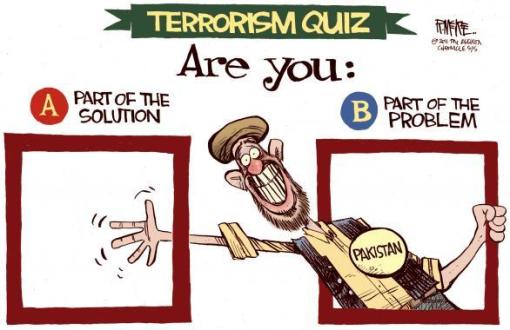
Many people in Pakistan these days are wondering why their nation often finds itself on the wrong side of recent history. First, there is the continued and unjust imprisonment of a Christian Pakistani woman named Asia Bibi who has been languishing in jail for nearly two years. She has been given a death sentence for allegedly making derogatory remarks about the prophet Muhammad.

Then there was the killing of Salman Taseer, who was the then sitting governor of Punjab, Pakistan’s most populous province, by one of his own bodyguards for his outspoken support for Asia’s rights and her freedom. Instead of swift punishment and public outcry at his actions, the killer, Malik Mumtaz Hussain Qadri, was showered with rose petals by some cheering members of the bar association of Lahore when he came to the courthouse for formal charges of murder. Yes, members of the judiciary were cheering his unilateral action of murdering another human being simply for his support towards a condemned non Muslim woman’s rights.

You can only imagine the warped sense of logic and justice in a country where lawyers cheer the cold blooded murder of an innocent man whose only crime was to come at the aid of a condemned Christian mother of two children.

Fast forward to a few months later, the extremists managed to assassinate the only Christian member of President Asif Ali Zardari’s government when the Minister for Minority Affairs, Shahbaz Bhatti, was killed in a hail of bullets by unknown gunmen who then managed to escape on their motorcycle. Bhatti being a Christian as well as a minister in the government, had campaigned for the release of Asia as well as for the repeal of the blasphemy laws in Pakistan that at help promote a culture of state sanctioned hatred against religious minorities in Pakistan.

The culture of fear and hatred as well as violence against the religious minorities has progressively gotten worse along with the security situation inside the country in the last ten years. If there is anything that has been proven by some of these recent events in Pakistan, it is only that the country has become the undisputed global hotbed of extremism, fanaticism, and Islamic militancy in the Muslim world. It has now morphed into a country where the Wahhabi and Salafi fanatics have successfully used fear and hate to silence the majority moderate Barelvi and Sufi Muslims of Pakistan.

When powerful moderate voices like those of Bhatti and Taseer are silenced despite having heavy protection, how safe can the common man feel about his life if he chooses to speak up against the radicals within Islam? To kill someone is against Islamic belief at its core, unless it is done in self defense but you would be hard pressed to hear that view from the religious fanatics in Pakistan. They have justified killing others over many insane reasons such as making derogatory remarks about Islam or the prophet Muhammad. They also rationalize the killing of someone over a family’s honor, thus honor killings where often young women are killed if they are deemed to have brought dishonor to their family. These radical Islamists will even want someone dead for simply uttering disparaging remarks against Islam or its prophet. It is both ironic and hypocritical to see that the same derogatory remarks towards other figures such as Jesus, Moses, Abraham or other prophets of the Quran do not meet the same outcry nor receive the same impassioned response from the masses as when Islam or its prophet Muhammad are criticized.

The seeds of this current fanaticism fanning the flames of hatred were planted during an earlier conflict, this one involving the Soviets against an under matched adversary in Afghanistan. It was during this time in the ‘80’s when the Pakistani dictator, General Zia ul Haq, was in power and he accepted American aid from the Reagan administration in thwarting the threat from the 1979 Soviet invasion of neighboring Afghanistan. At the time, Pakistan’s ISI worked very closely with these “freedom fighters” waging what many thought was a just jihad against a communist foe who disallowed all religious worship. In fact, a good movie to rent right now to put some of these current events in perspective would be Charlie Wilson’s War starring Tom Hanks which details this era of Pakistan-US relations and cooperation against a common enemy in the Soviets.

The trouble now however is that in this current uneasy alliance between Pakistan and the US, there is not a common enemy, at least not as how it is viewed by many in Pakistan, which recently was polled to be the most anti-American nation in the world. Even though radical Islam and fanaticism is as much a threat to Pakistan’s sovereignty and prosperity as it is to the United States, India has always been seen as the big threat by its army and rulers. Pakistan has long seen Afghanistan as a country offering it strategic depth in any future wars with India. Thus, its interests in Afghanistan do not coincide with those of the United States.

The Pakistani media also constantly feeds a steady news diet of bombings by the Taliban/Haqqani network as well as any one of the other fill-in-the-blank militants groups seemingly operating freely from within its borders. There is also the regular news reports of US drone attacks and NATO actions in the AfPak region, as well as the all ubiquitous and constant threat faced from India, who is still seething from the Mumbai bombings in 2008, which were blamed on Pakistani trained terrorists. To further add insult to their injury, not a single leader of the Lashkar E Taiba has been convicted in Pakistan for the attacks in Mumbai that claimed 174 deaths and seriously injured several hundred others.

To the Indians, the perpetrator of their version of 9/11 is not an Arab from Yemen named Osama, but rather a whole nation state with whom it has fought three wars in 60 years and who is a long time sworn enemy with which it shares a long border. Too often it is rightly assumed by many that Pakistan will not act against Lashkar E Taiba and other openly anti-Indian militant groups because these groups are seen as a strategic asset for use against India. Only the fear of an all out nuclear war between the two nations by a trigger happy Pakistan placated India enough so that New Delhi did not immediately take military action against Pakistan after the Mumbai attacks.

So this culture of fear from all enemies both foreign and domestic to Pakistan’s sovereignty is now at an all time high within the nation. With a several decade long war on its western border in Afghanistan as well as the constant threat from its arch enemy to the east in India, Pakistan has never felt more threatened or squeezed. This pressure is now only going to get ratcheted higher since last week’s killing of Osama Bin Laden at a compound in a suburb of Islamabad, Pakistan. Living for five years undetected in the compound, Bin Laden was less than a mile away from the Kakul Military Academy in Abbottabad, Pakistan’s version of the famed American military college of West Point, when he was killed by a US Navy Seal team.

For the world’s most wanted terrorist to hide in plain sight in such a manner and for so many years, rightly points a lot of suspicion on Pakistan. Long suspected by many intelligence analysts, elements within Pakistan’s spy agency, the ISI, naturally now attracts a lot of suspicion in their possible involvement in the whole affair. There are strong voices and calls within the US Congress to halt all aid to Pakistan in light of Bin Laden’s death. We certainly can assume that any other country in the world found to be harboring terrorists would already have been labeled a state sponsor of terrorism and would be facing immediate sanctions from the international community. “You are either with us or against us” were the words so famously uttered by then President Bush to Pakistan specifically after 9/11. But due to Pakistan’s importance for a successful pullout from Afghanistan of US troops, as well as its strategic position within the Islamic world, neither side can afford to cut off relations with each other.

Although the Obama administration stopped short of claiming that the corrupt civilian government of Zardari was directly involved in protecting and sheltering Bin Laden, all signs point to complicity to some extent by some segments within Pakistan’s hierarchy. There is near unanimous agreement among many in Washington, and this is true on both sides of the aisle, that there are many sympathizers of the Taliban and Al Qaeda within the ranks of the army and the intelligence agencies of Pakistan.

Having driven the Soviets out of the region with the help of militant jihadi groups like the Taliban, no doubt a cadre of army and intelligence officers must have come to espouse the belief that it is in Pakistan’s best interests to have a religiously frenzied force available to use as a weapon against India in a future conflict also. In fact, Pakistan has always had this policy of seeking strategic depth in Afghanistan against India.

The death of Osama Bin Laden in Pakistan by Special Forces of the American military illustrates just what a duplicitous game the country has been playing with the United States and more importantly with itself. In the war on terror America lost nearly 3,000 citizens in the attacks on 9/11. In that same period stretching the last ten years, Pakistan has lost nearly 31,000 citizens to terrorist attacks by the Taliban, Al Qaeda and other militant groups. So it has always been in Pakistan’s best interests to fight the militant threat brewing in its borders the last two decades that has claimed so many lives and caused so much instability.

The murders of Salman Taseer and Shahbaz Bhatti illustrates the dire situation within Pakistani society where many young underprivileged men gravitate towards Osama Bin Laden’s ideology of hate against the US, which is seen by many, as the aggressor in an already very anti-American country. Also western ideas, religious and political liberties, and freedoms, such as those for women in western society, are all seen by the Islamic clergy and religious establishment as being against Islamic doctrine and clashing with the Muslim way of life. Therefore, the madrassahs and the masjids continue to espouse rhetoric against the American and European way of life which is seen as contradicting the teachings of the Quran. Even moderate Muslims and their sites of worship have come under heavy attack by the militants as witnessed by a new strategy of attacking Sufi Muslim shrines and mosques. Pakistan may not want to admit it, but there is a raging war going on within itself for the control of Islam and the attack on moderate Islam by the extremists within the religion.

The Bin Laden killing makes Pakistan seem either highly incompetent about knowledge his whereabouts or at the very least appear to be deeply complicit in sheltering and keeping him hidden while the United States launched the biggest manhunt in US history. At this point, the United States justly feels betrayed and distrustful towards anyone in the Pakistani establishment. After all, how are they to know who now to trust in the army or the civilian government?

It is imperative that Pakistan mount an immediate and urgent investigation that has the full cooperation and assistance of the US so that both countries can discover the source of this support system that Bin Laden has had from within Pakistan. Certainly, some heads do need to roll in Islamabad over this. Whether those resignations be of the current ISI chief, Ahmad Shuja Pasha, head of the army, General Ashfaq Parvez Kayani, or Zardari and Gilani themselves, as some accountability needs to occur. This is important not just for the sake of American-Pakistani relations, but just as importantly for the benefit of the Pakistani populace who is both deeply embarrassed by breach of Pakistan’s sovereignty, but also for the intelligence failure by the government of Pakistan at Osama’s whereabouts. Until and unless Pakistan makes this investigation a top priority, USA and Pakistan relations will continue to slide downhill and will mire further in distrust.

Pakistan must realize that in this global war against religious Islamic fanaticism, it cannot continue to speak from both sides of its mouth. Not when everything, including its very existence is at stake. It cannot at once be both a front line ally in the war against terror and receive billions of dollars in US aid, and at the same time, be found to shelter or allow terrorists and militant organizations safe havens and allow them to operate within its territory.

It is up to Pakistan to salvage a quickly deteriorating situation. However at the time of publication of this article, it seems that President Asif Ali Zardari’s government is off to a horrible start in mending fences with the US. First the name and identity of the CIA station chief in Pakistan was leaked by someone in the ISI to members of the local press. This leak compromised his mission and even poses a danger to his life as the anonymity of all operatives is a necessary requirement in intelligence work.

Then later in the day, in remarks given by Pakistan’s Prime Minister Yousuf Raza Gilani to its Parliament, he defiantly stated that neither Pakistan’s army nor its intelligence agency should be suspected by the Obama administration for providing support to Bin Laden. Gilani also went as far as to say that any future unilateral action by the US or any other nation inside Pakistan’s territory will be met with like force. I thought to myself, did he really just that? Did Pakistan just threaten the United States? It is appalling to see the political posturing now being done by the Pakistani government and the long term negative consequences they will have on the nation.

For a country that is receiving nearly $3.5 billion in US aid yearly, these are very tough words that will undoubtedly only make the strained relations between the two countries worse. Pakistan should realize that United States wants to feel that it can trust it to be a full partner in the fight against militancy and extremism. And unless this distrustful and at times, very adversarial relationship changes, the United States cannot help but feel that with friends like Pakistan, it does not need enemies!

-Manzer Munir, a proud Pakistani American and peace activist, is the founder of Pakistanis for Peace and blogs at http://www.PakistanisforPeace.com as well at other websites as a freelance journalist and writer. 

Pakistan’s Man in Washington

 By Chris Frates for Politico

 As Pakistan’s top Washington lobbyist, it’s Mark Siegel’s job to convince U.S. officials not to take out their anger on the country despite the fact that Osama bin Laden spent at least five years living in relative comfort outside Islamabad.

It’s not an easy sell.

Lawmakers from across the political spectrum wonder aloud how the world’s No. 1 terrorist could be living in plain sight unbeknownst to the Pakistanis. Siegel has to make the pitch that it’s in America’s national security interests to continue its relationship with Pakistan and to keep the billions of dollars in foreign aid flowing.

It’s a message that Siegel’s firm, Locke Lord, is getting paid good money to sell; the firm brings in almost $1 million a year representing Pakistan.

In addition to Siegel, the firm has about half a dozen lobbyists representing the country including Harriet Miers, an aide to former President George W. Bush and a one-time U.S. Supreme Court nominee.

Siegel is uniquely positioned to make the country’s case to skeptics on the Hill. He’s been friends with Pakistani President Asif Ali Zardari’s family for almost three decades and has a direct line to Islamabad.

“The Pakistanis insist to me that they were not aware that Osama bin Laden was at that venue. The president made that very clear to me,” Siegel told POLITICO after speaking with Zardari this week. “I think if they had known, they would have been happy to nab him themselves.”

His connection to Zardari isn’t lost on those he lobbies, like House Homeland Security Chairman Peter King, who met with Siegel on Tuesday.

“It wasn’t so much what Mark was saying to me on Tuesday, it was what I was saying to him knowing, or feeling confident that it was going to go directly back to the president,” said King (R-N.Y.). “There is a real question of credibility and trust and faith. You can’t have the No. 1 mass murderer of Americans living in plain view in Pakistan all these years while Pakistan is claiming to be our ally and getting $3 billion a year.”

Pakistan, King said, must investigate and credibly explain how bin Laden was able to go undected and demonstrate that its intelligence services and military have not been penetrated by al Qaeda.

“Mark’s basic job is almost to tread water, to keep everything afloat until something can be done,” King said. “I think he’s trying to prevent something from happening too quickly to have the relationship severed. He wants to make sure that he keeps it together and so you can have extensive talks between the two governments.”

But King’s not the only one critical of Pakistan these days.

The Obama administration – which didn’t give its ally a heads up that Americans would be swooping into their country to take out bin Laden for fear of leaks – has been describing the relationship between the two countries with the ambiguous “it’s complicated” tag usually reserved for Facebook profiles.

And Senate Armed Services Chairman Carl Levin told ABC News Thursday that he thinks high-level Pakistani intelligence knew of bin Laden’s whereabouts and he has “no doubt” the country knows the location of other top-level targets.

“None of the people on the Hill are suggesting to me that anybody in the civilian government knew that Osama was there,” Siegel said, drawing a distinction between Zardari and the country’s military and intelligence branches.

Tony Podesta, a lobbyist who represents Egypt, knows something of representing a vilified client that is nevertheless a U.S. military ally in an unstable part of the world.

“You want to take it back to the long term strategic interests of the U.S. and to facts rather than supposition. It makes no long term strategic sense for any kind of reckless decisions to be made at this moment,” Podesta said. “That’s where he’ll leave it.”

Siegel has been friends with Zardari’s family for almost three decades, having met Zardari’s late wife, Benazir Bhutto, in 1984 when a mutual friend asked him to host a dinner party for her. The two would go on to write a book together and when Bhutto became prime minister, Siegel represented her government.

This week, Siegel said he has been reminding lawmakers that Pakistan has been a strong ally and that President Barack Obama and other administration officials have praised the country’s cooperation in fighting al Qaeda and terrorism. Pakistan itself has been a victim of terrorism – 30,000 civilians have been killed by terrorists in the last decade, he added.

Even before this week’s killing of bin Laden, Locke Lord has been active on the Hill. In February and March, firm lobbyists accompanied the Pakistani Ambassador Husain Haqqani on meetings with House Speaker John Boehner, Senate Foreign Relations Committee Chairman John Kerry, House Armed Services Committee Chairman Buck McKeon, House Intelligence Committee Chairman Mike Rogers, and Kay Granger, chairwoman of the House appropriations subcommittee on state-foreign operations.

Last year, the firm successfully lobbied for $1.5 billion in economic and social aid over the next five years — a sum that has to be reauthorized each year. The firm is also lobbying to secure foreign aid and create duty-free “reconstruction opportunity zones” inside Pakistan’s tribal lands and Afghanistan.

Pakistan Questions Legality of U.S. operation that killed bin Laden

By Karen Bulliard for The Washington Post

Pakistan’s foreign minister on Thursday appeared to question the legality of the U.S. operation that killed Osama bin Laden, and again denied that his country had knowingly sheltered the world’s most-wanted terrorist.

The comments by Foreign Secretary Salman Bashir came as Pakistani officials faced rising domestic backlash about the helicopter-borne assault in a sleepy neighborhood of a military garrison city, which they have acknowledged they did not know about in advance and — once they became aware of it — could not prevent.

The preservation of national sovereignty, particularly against incursions by U.S. troops, is a highly sensitive issue in nuclear-armed Pakistan, and both the presence of bin Laden and the dramatic American raid that killed him have greatly embarrassed the military here.

Bashir, citing United Nations Security Council resolutions on counter-terror operations, told reporters that the “modalities for combating terrorism raises certain legal and moral issues” and said that “everyone concerned ought to be mindful of their international obligations.”

On Tuesday, the foreign ministry in a statement expressed “deep concerns and reservations” that the U.S. carried out the mission in the city of Abbottabad unilaterally, without Pakistan’s knowledge or permission.

Such comments differ considerably from Pakistan’s measured statements in the hours after the killing, when Prime Minister Yousaf Raza Gillani called bin Laden’s death a “great victory.”

But though clearly directed at the United States, the suggestions that the operation might have breached international law also appeared to be a warning to Pakistan’s archenemy, India, which has been targeted in terror bombings and attacks by Pakistani militants.

On Wednesday, India’s army chief said his forces were capable of carrying out a similar raid — a notion Bashir called “bravado.”

“We feel that sort of misadventure or miscalculation could result in a terrible catastrophe,” Bashir told reporters here, while also vowing that Pakistan’s nuclear arsenal is safe. Pakistan and India, which also possesses nuclear weapons, have fought three wars.

Bashir indicated that there would be little introspection inside Pakistan about how and why bin Laden was able to reside here, under the nose of the military. Some Pakistani officials in recent days have said there would be an inquiry into intelligence failures, but Bashir played down that, saying questions about bin Laden were “for historians.”

“I would call it a ‘view,’ ” rather than an inquiry, Bashir said. “I think we are in a constant process of viewing at every level. … This is a routine. So I think we should not try to give it a slant in terms of an inquiry. There’s no such thing as an inquiry.”

Bashir provided additional details about Pakistan’s role in the years-long search for bin Laden, and about its actions the morning of the raid, when he said two Pakistani F-16 fighter jets were deployed in response to the U.S. operation. By the time the jets reached the compound, the raid was over.

He said a cellphone number for bin Laden’s trusted courier was discovered by Pakistan’s top spy agency and provided to the CIA, which used it to locate bin Laden’s compound.

U.S. officials have said they were monitoring the courier’s phone and e-mail communications and found him when he contacted a family member.

Bashir contradicted previous Pakistani statements that Abbottabad was under “sharp focus” since 2003 — a year when, a Pakistani intelligence official said earlier this week, the construction site for what would become the bin Laden compound was first raided.

Satellite images provided by U.S. officials, however, show there was no building happening on the property at that time.

On Thursday, Bashir said Abbottabad first surfaced on Pakistan’s radar as an al-Qaeda hideout in 2004, when the driver of Faraj al-Libbi, an al-Qaeda operative who would be arrested by Pakistan in 2005, was traced to the garrison city.

Fight Against Extremists Stretches Pakistan’s Military

By Jim Garamone for The American Forces Press Service

Just as two wars over the last decade have stretch the U.S. Army thin, the Pakistani military is stretched by its fight against extremist groups along the country’s western border, senior defense officials said here today.

At any given time, roughly one-third of the Pakistani army is deployed along the border region. Another third is along Pakistan’s border with India, and the rest is in garrison training and re-equipping.

“There are units along the border that have been in the fight for two years,” said a senior defense official, speaking on background. “That’s a long time. They are stretched.”

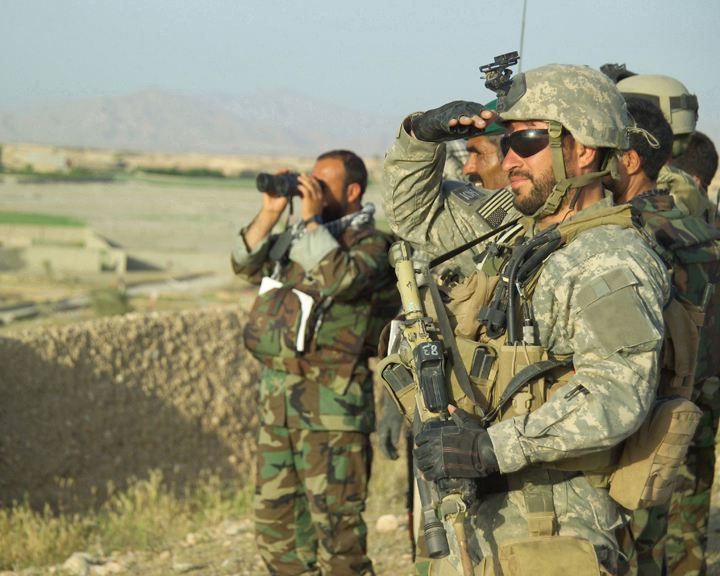
While many in the United States want the Pakistani military to do more against terrorist groups in North Waziristan, the truth is it may not be able to do much more, the official said. Pakistani troops – including members of the Frontier Corps – are in Khyber province, South Waziristan and other areas of Pakistan’s federally administered tribal areas. North Waziristan, specifically, is a safe haven for many senior Taliban leaders launching attacks in Afghanistan.

The military has launched a campaign against terrorists in Mohmond province – an area they cleared once, but where extremists have re-emerged. And that’s the problem, the official said: once the army clears an area – “and they do that quite well,” he said – the soldiers don’t have a force to turn it over to, and they’re forced to police the region. “The civil capacity does not exist in the region to hold the area,” the official said.

The civil capacity also does not exist to rebuild areas, and the army is stepping into the breach. “They are building schools and roads and water projects,” the official said. “This should be the job of civilian agencies, but they are not available.”

If Pakistan’s army could turn over the policing and development duties, troops would be available for further operations against the extremists, the official said, but they cannot.

The Pakistani military could deploy troops from the border with India to step up the fight against extremists, but Pakistan sees India – a nation with which it has fought four wars– as the foe. India and Pakistan have troops facing each other in Kashmir province. A solution to the dispute over Kashmir, which goes back to the founding of the two nations in 1947, could “unlock solutions” for Pakistan, Navy Adm. Mike Mullen, chairman of the Joint Chiefs of Staff, said in an interview with Pakistani reporters.

It was a major move to deploy the Pakistani forces from the Indian border in 2008, and U.S. officials do not expect that to happen again.

Meanwhile, Pakistani officials are worried about the spread of radicalism in the nation. While most incidents still are centered on the western border, many incidents have occurred in Balochistan, Sindh and even the Pakistani heartland of Punjab. “They even use the term Punjabi Taliban,” the official said. “And it concerns them.”

The United States is set to provide roughly $3 billion in aid to the Pakistani military in fiscal 2012, the defense official noted.

India Continues to Dominate Pakistan’s Strategic Thinking: US

As Reoported By The Times of India

Pakistan’s efforts to launch a comprehensive fight against terrorism are greatly hampered by its perceived threat perception against India, US President Barack Obama has said in a new report to Congress.

“As India continues to dominate their strategic threat perception, large elements of Pakistan’s military remain committed to maintaining a ratio of Pakistani to Indian forces along the eastern border,” Obama said in the third-quarterly report to the Congress on Afghanistan and Pakistan sent yesterday.

“This deprives the Pakistani COIN (counter-insurgency) fight of sufficient forces to achieve its ‘clear’ objectives and support the ‘hold’ efforts and causing available Army forces to be bogged down with ‘hold’ activities because there are insufficient trained civilian law enforcement personnel to assume that responsibility,” Obama said in his 38-page unclassified (rpt) unclassified version of the report.

Due to flood in Pakistan last year the offensive military operations Pakistan had envisioned for KP (Khaibar Pakhtoonwah) and the Federally Administered Tribal Areas (FATA) in the second half of 2010 were overtaken by events, he said.

“Militants were impacted by the floods as well, so we did not observe significant offensive actions on their side, but as Pakistani forces ceased offensive operations, extremists extended their control to areas without sufficient Pakistani central government-provided security and governance,” he wrote.

Between October 1 and December 31, 2010, Obama said Pakistani security forces remained largely static, generally focusing on maintaining the security of previously cleared areas in the FATA and KP and continuing to support flood relief operations.

There were small but notable security operations in November and December in Orakzai Agency and Dir District, but no major operations.

National attention during the reporting period focused on the need for continued flood relief and the start of early recovery efforts, he said.

“The military served as a force of stability during the monsoons, ensuring that Pakistani and international emergency resources were available for rescue and relief operations. The Pakistan Army, Air Force, and Navy committed large numbers of personnel and resources to the flood relief operations throughout October and November,” he said.

The civilian government’s response suffered from a lack of coordination and reflected broader shortcomings in the government’s ability to execute the civilian “hold” and “build” phases of COIN.

The last quarter of 2010 saw no progress on effectively executing the COIN cycle in KP and the FATA.

A Nation Overloaded with Religion

By Tanzeel for Tanzeelism

Frequent assassinations of Pakistan People’s Party leaders have not only shaken the ideology of this country but left a clear cut message for Government to avoid any confrontation against strengthening religious lobby in Pakistan.

The Tehreek e Taliban and Al Qaeda backed groups in Pakistan especially in Punjab are after the ruling party and eradicating its moderate forces one by one. As a result the PPP systematically takes back seat, and gets blackmailed by the religious forces.
Government’s evident policy shift from the party manifesto of ensuring religious harmony among all faiths in the wake of doctrine of necessity further pushes nation in the hands of extremists.

From the assassination of Benazir Bhutto to Shehbaz Bhatti, the message is clear. Let Taleban pursuit their agenda of violent Islam and whoever comes in between will become history.

In such horrific circumstances when even the ruling party leaders are not safe how unarmed liberal forces would dare voice their opinion seems to be a big ask. As a result the clouds of insanity steadily prevailing and a common man is reluctant to counter them not because of being blithe but for his own safety resulting mass surrender of journalists, civil society, liberal political forces and minority rights groups against religious forces.

A common Pakistani despite wanting to express deep displeasure is suppressed by the bearded gun totted black sheep who are gelled up in the society to take necessary ‘religious measures’ against those who prefer humanity over religion.

Salman Taseer’s assassination by his own security guard Mumtaz Qadri and the subsequent showering of rose petals by lawyers’ community is one of the shocking examples of deep rooted religious fanaticism within our society. Be it media, armed forces, politics (not to mention the historical speech of Punjab Chief Minister Shehbaz Shareef during which he proudly endorsed the agenda of Taleban), judiciary, education or even sports.

In my view the traces of religious terrorism can be found back during partition campaign when the voices of independent ‘Muslim Land’ were on rise.

At that time some of the Muslims might had opted the idea of migrating to separate land due to vested interests but by and large it was the dominating religious sentiment that caused division with the objective of turning Pakistan into the “Fort of Islam” comprised by majority of Muslims.

Two- Nation Theory which clearly rejects any of idea co existence of Muslims with Hindus is a true depiction of Pakistan’s current situation where Muslims are unable to coexist with other sects let alone religions and ethnicities.

Today, I being a moderate Muslim who is deeply concerned about his country’s image foresee not only the bleak future of Pakistan but raises the doubts whether creation of Pakistan was really an apt approach.

Japan’s Disaster Toll Rises With 18,000 Deaths

By Eric Talmadge and Mari Yamaguchi for The Associated Press

The toll of Japan’s triple disaster came into clearer focus Monday after police estimates showed more than 18,000 people died, the World Bank said rebuilding may cost $235 billion and more cases of radiation-tainted vegetables and tap water turned up.

Japanese officials reported progress over the weekend in their battle to gain control over a nuclear complex that began leaking radiation after suffering quake and tsunami damage, though the crisis was far from over, with a dangerous new surge in pressure reported in one of the plant’s six reactors.

The announcement by Japan’s Health Ministry late Sunday that tests had detected excess amounts of radioactive elements on canola and chrysanthemum greens marked a low moment in a day that had been peppered with bits of positive news: First, a teenager and his grandmother were found alive nine days after being trapped in their earthquake-shattered home. Then, the operator of the overheated nuclear plant said two of the six reactor units were safely cooled down.

“We consider that now we have come to a situation where we are very close to getting the situation under control,” Deputy Cabinet Secretary Tetsuro Fukuyama said.

Still, serious problems remained at the Fukushima Dai-ichi nuclear complex. Pressure unexpectedly rose in a third unit’s reactor, meaning plant operators may need to deliberately release radioactive steam. That has only added to public anxiety over radiation that began leaking from the plant after a monstrous earthquake and tsunami devastated northeastern Japan on March 11 and left the plant unstable. As day broke Monday, Japan’s military resumed dousing of the complex’s troubled Unit 4.

The World Bank said in report Monday that Japan may need five years to rebuild from the catastrophic disasters, which caused up to $235 billion in damage, saying the cost to private insurers will be up to $33 billion and that the government will spend $12 billion on reconstruction in the current national budget and much more later.

The safety of food and water was of particular concern. The government halted shipments of spinach from one area and raw milk from another near the nuclear plant after tests found iodine exceeded safety limits. Tokyo’s tap water, where iodine turned up Friday, now has cesium. Rain and dust are also tainted.

Early Monday , the Health Ministry advised Iitate, a village of 6,000 people about 30 kilometers (19 miles) northwest of the Fukushima plant, not to drink tap water due to elevated levels of iodine. Ministry spokesman Takayuki Matsuda said iodine three times the normal level was detected there — about one twenty-sixth of the level of a chest X-ray in one liter of water.

In all cases, the government said the radiation levels were too small to pose an immediate health risk.

But Tsugumi Hasegawa was skeptical as she cared for her 4-year-old daughter at a shelter in a gymnasium crammed with 1,400 people about 80 kilometers (50 miles) from the plant.

“I still have no idea what the numbers they are giving about radiation levels mean. It’s all so confusing,” said Hasegawa, 29, from the small town of Futuba in the shadow of the nuclear complex. “And I wonder if they aren’t playing down the dangers to keep us from panicking. I don’t know who to trust.”

All six of the nuclear complex’s reactor units saw trouble after the disasters knocked out cooling systems. In a small advance, the plant’s operator declared Units 5 and 6 — the least troublesome — under control after their nuclear fuel storage pools cooled to safe levels. Progress was made to reconnect two other units to the electric grid and in pumping seawater to cool another reactor and replenish it and a sixth reactor’s storage pools.

But the buildup in pressure inside the vessel holding Unit 3’s reactor presented some danger, forcing officials to consider venting. The tactic produced explosions of radioactive gas during the early days of the crisis.

“Even if certain things go smoothly, there would be twists and turns,” Chief Cabinet Secretary Yukio Edano told reporters. “At the moment, we are not so optimistic that there will be a breakthrough.”

Growing concerns about radiation add to the overwhelming chain of disasters Japan has struggled with since the 9.0-magnitude quake. The resulting tsunami ravaged the northeastern coast. All told, police estimates show more than about 18,400 died. More than 15,000 deaths are likely in Miyagi, the prefecture that took the full impact of the wave, said a police spokesman.

“It is very distressing as we recover more bodies day by days,” said Hitoshi Sugawara, the spokesman.

Police in other parts of the disaster area declined to provide estimates, but confirmed about 3,400 deaths. Nationwide, official figures show the disasters killing more than 8,600 people, and leaving more than 12,800 people missing, but those two lists may have some overlap.

The disasters have displaced another 452,000, who are living in shelters.

Fuel, food and water remain scarce. The government in recent days acknowledged being caught ill-prepared by an enormous disaster that the prime minister has called the worst crisis since World War II.

Bodies are piling up in some of the devastated communities and badly decomposing even amid chilly rain and snow.

“The recent bodies — we can’t show them to the families. The faces have been purple, which means they are starting to decompose,” says Shuji Horaguchi, a disaster relief official setting up a center to process the dead in Natori, on the outskirts of the tsunami-flattened city of Sendai. “Some we’re finding now have been in the water for a long time, they’re not in good shape. Crabs and fish have eaten parts.”

Contamination of food and water compounds the government’s difficulties, heightening the broader public’s sense of dread about safety. Consumers in markets snapped up bottled water, shunned spinach from Ibaraki — the prefecture where the tainted spinach was found — and overall expressed concern about food safety.

Experts have said the amounts of iodine detected in milk, spinach and water pose no discernible risks to public health unless consumed in enormous quantities over a long time. Iodine breaks down quickly, after eight days, minimizing its harmfulness, unlike other radioactive isotopes such as cesium-137 or uranium-238, which remain in the environment for decades or longer.

High levels of iodine are linked to thyroid cancer, one of the least deadly cancers if treated. Cesium is a longer-lasting element that affects the whole body and raises cancer risk.

Rain forecast for the Fukushima area also could further localize the contamination, bringing the radiation to the ground closer to the plant.

Edano tried to reassure the public for a second day in a row. “If you eat it once, or twice, or even for several days, it’s not just that it’s not an immediate threat to health, it’s that even in the future it is not a risk,” Edano said. “Experts say there is no threat to human health.”

No contamination has been reported in Japan’s main food export — seafood — worth about $1.6 billion a year and less than 0.3 percent of its total exports.

Amid the anxiety, there were moments of joy on Sunday. An 80-year-old woman and her teenage grandson were rescued from their flattened two-story house after nine days, when the teen pulled himself to the roof and shouted to police for help.

Other survivors enjoyed smaller victories. Kiyoshi Hiratsuka and his family managed to pull his beloved Harley Davidson motorcycle from the rubble in their hometown of Onagawa. The 37-year-old mechanic said he knows it will never work anymore. “But I want to keep it as a memorial.”


Dialogue Key to Peace with Pakistan, Says India

By Anjana Pasricha for The Voice of America

As India and Pakistan get ready to restart peace talks after more than two years, Prime Minister Manmohan Singh says dialogue is the only way to resolve their differences.  The embattled Indian leader is also vowing to tackle inflation and punish those guilty of corruption — two issues which have put his government on the ropes at home.

Speaking to parliament Thursday, Prime Minister Singh said South Asia will not realize its potential unless India-Pakistan relations are normalized. India is willing to discuss all outstanding issues with Pakistan, he said.

But, striking a cautious note, he expressed hope that Islamabad will give up allowing its territory to be used for terrorist activity directed at India.

“I sincerely hope and believe that the new ruling classes of Pakistan would grasp the hands of our friendship and recognize that whatever our differences, terror as an instrument of state policy, is something no civilized society ought to be using,” he said. “I am not saying that we have today an atmosphere in which negotiations can go forward, but there are hopeful signs.”

Earlier this month, both countries decided to restart a peace process, which New Delhi had put on hold after blaming Pakistan-based Islamic militants for mounting the 2008 terror attacks in Mumbai. The foreign secretaries of the two countries will meet in the Indian capital in March. Their foreign ministers are to meet by July.

Singh’s comments on the peace talks with Pakistan came during an address to parliament, in which he outlined the priorities facing his government.

He pledged to lower inflation from 10 percent to seven percent by the end of the year. Food inflation is even higher and has emerged as a major worry in a country with millions of poor people.

Singh has promised to bring a new food security bill in parliament to ensure that poor people are protected from rising food prices.

Inflation has to be tackled in a manner that it does not hurt the economy, which the prime minister says is growing well.

“If we had a ham-handed [heavy] approach, we could have killed the growth process which is the only source of providing jobs for our youth. So, this delicate balance has to be preserved between control of inflation and protection of employment,” he said.

The Indian leader also vowed to crack down on those guilty of corruption in connection with sale of telecom spectrum, in 2008, and the organization of the Commonwealth Games in New Delhi, last year. Allegations that officials siphoned off billions of dollars have put the spotlight on corrupt practices in government contracts.

With the two corruption scandals dominating headlines in recent months, Singh expressed fears that the wrong impression may be going out.

“The message should not go out that India is adrift, that India has lost its way, that the enthusiasm for getting this country moving forward is something that is no longer in evidence,” he said.

The Congress-led government was voted back to power in 2009, but is facing a rising wave of discontent both becauseof high food prices and the high-profile graft scandals.

Difficult Outlook for India-Pakistan Talks

By Tom Wright for The Wall Street Journal 

The Times of India reported today that India and Pakistan may try to rekindle peace talks in early February.

The paper says Pakistan Foreign Minister Shah Mehmood Qureshi could meet his Indian counterpart, S.M. Krishna, informally after a regional meeting in Bhutan on Feb. 8.

The report suggests that the idea is to set the ground rules for an official visit to India by Mr. Qureshi sometime later this year in a bid to normalize relations that have soured since a major terror attack in Mumbai in 2008.

Given the disastrous outcome of Mr. Krishna’s last formal visit to Pakistan – in July of last year – those ground rules will be important.

At that meeting, Mr. Qureshi became incensed during a press conference over India’s claims that Pakistan’s military intelligence services had orchestrated the Mumbai attacks in November 2008, during which 10 Pakistani gunmen killed more than 160 people over three days.

Mr. Krishna arrived back in India to criticism of being made to look a fool by Mr. Qureshi and a peace talks process begun in 2004 was put on hold amid mutual recriminations. The slow-moving (and now stalled) dialogue is an attempt to normalize relations that have been rocky ever since the two nations were created out of British India in 1947.

India has stuck to its claims of official Pakistan involvement in the Mumbai attacks and says Islamabad is not doing enough to prosecute the perpetrators and rein in India-focused militants in general.

Pakistan retorts that it is committed to fighting terrorism. It also has called on India to broaden the agenda for peace talks to include other topics, such as the disputed Himalayan territory of Kashmir, which both countries claim in its entirety.

It is uncertain whether talks at this stage can produce anything meaningful

India is set against any wider peace talks until Pakistan sentences seven militants that it has charged for involvement in the Mumbai attacks.

But the atmosphere in Pakistan right now means it is unlikely that any politician will want to be seen vigorously cracking down on Islamist groups.

The killing earlier this month of Salmaan Taseer, governor of Pakistan’s Punjab province, by one of his own police guards has uncovered the extent to which hardline religious views have permeated many layers of society.

The police guard admitted he was angered by Mr. Taseer’s defense of a Christian woman sentenced to death by a Pakistani court in November for blasphemy.

In recent days, scores of Pakistanis, including lawyers and clerics, have publicly rallied in support of the police officer.

Pakistan, India Swap Nuclear Sites Lists

By Zhang Xiang for Xinhua News

Pakistan and India exchanged lists of nuclear installations and facilities on Saturday in spite of a tension over the 2008 Mumbai attacks that has disrupted the dialogue process between the two countries, the Foreign Ministry said.

The two countries exchange the lists of nuclear sites on the first day of the new year under an agreement signed in 1988 and came into force in January 1991.

“The government of Pakistan and India today exchanged lists of their respective nuclear installations and facilities in accordance with Article-II of the Agreement on Prohibition of Attacks against Nuclear Installations and Facilities between Pakistan and India of Dec. 31, 1988,” a Foreign Ministry statement said.

The statement said the Ministry of Foreign Affairs handed over the list of Pakistan’s nuclear installations and facilities to an officer of the Indian High Commission in Islamabad at the Foreign Office on Saturday morning.

The Indian side also handed over their list to an officer of the Pakistan High Commission at the Ministry of External Affairs in New Delhi, it said.

After the agreement was signed the first exchange took place Jan. 1, 1992.

Sources said it is the 20th consecutive list exchange between the two countries.

Pakistan and India conducted tit-for-tat nuclear tests in 1998. India conducted its first nuclear test in 1974, followed by five more in 1998. Pakistan conducted its six nuclear tests in 1998. Neither India nor Pakistan is a signatory to the Nuclear Non- Proliferation Treaty (NPT).

India considers the NPT discriminatory, while Pakistan has indicated that it won’t join the international agreement till its neighbor does so.

Neither of the two rival neighbors have signed the Comprehensive Test Ban Treaty.

In 2004 they launched a peace process, but that is now on hold following the Mumbai attacks, with New Delhi pressuring Islamabad to do more to punish those responsible for the carnage and to crack down on anti-India groups.

Meanwhile, both countries also exchanged Lists of Prisoners in the two countries, the Foreign Ministry said.

According to the Agreement on Consular Access signed between Pakistan and India on May 21, 2008, both countries are required to exchange lists of prisoners in each other’s custody on Jan. 1 and July 1 every year, the statement said.

“Consistent with the provisions of this Agreement, the Ministry of Foreign Affairs handed over the list of Indian prisoners in Pakistan to the Indian High Commission in Islamabad today,” it said.

The Illiteracy of Hate

A News and Opinion Special Report by Manzer Munir for Paksitanis for Peace

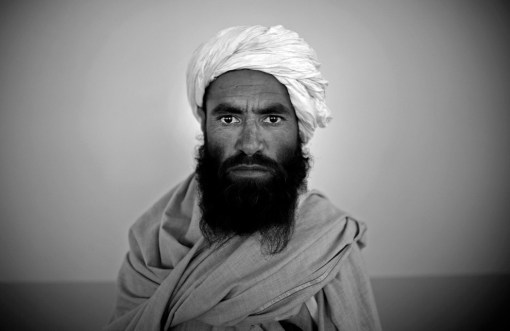
Alleged Taliban Member pic courtsey of Boston Globe

The Taliban are not just simply a bunch of illiterate thugs and bullies for they too often prove to be even worse than animals and barbarians.

Nowhere else in the world has a country experienced a more tragic and callous attack as the one on Christmas day, the birth day of Jesus, the Prince of Peace, than the one Pakistan experienced. In an attack described by President Obama as an “affront on humanity”, the cowards attacked helpless women, children and men while they queued up in food and aid distribution site such as the WFP depot, people who mind you are already suffering from the ongoing war, once in a lifetime floods, and the poverty and radicalism of a generation of desperate, hopeless and increasingly uneducated young men brainwashed by the Taliban and other radical Muslim extremists.

I am still disturbed by the disdain for basic human life that this new attack proves about this radical and extreme enemy. I imagine another one of their brain washed ‘walking zombies’, this time purportedly a woman suicide bomber, a first, even for Pakistan, killed in excess of 43 people in Bajur Pakistan at a World Food Program rations and aid storage and distribution center.

The Pakistani authorities and several domestic and foreign NGO’s who provide food aid at various centers in the area are temporarily closing these centers in order to have increased security. This means that aid distribution will come to a crawl and up to several hundred thousand people will now have to suffer at the hands of the attacker and their backers, the Taliban who have claimed responsibility. The authorities will have to ensure the safety of aid organizations and their personnel for both Pakistani and non Pakistanis relief workers involved in getting food, water and medicine to many people who are either suffering from the war or from the floods.

This catastrophe, although not of near Biblical proportions, does present both a security and humanitarian problem to both the government of Pakistan as well the suffering citizens in the northwest areas of the country where; Taliban fighters take sanctuary from the war in Afghanistan to regroup and return to the fight in warmer weather after the winter months as we have seen in years past. In fact, the reach of the Taliban in Pakistan is now not only reputed to be in the headquartered areas such as in Quetta Pakistan among the restive Baluchi population, now they are so often found to be in major cities like Karachi, Lahore, Rawalpindi, Peshawar and many points in between as they use their religious cover to endear themselves to certain impressionable, weakened or illiterate individuals that are so commonly found in throughout the country. 

Here are the some of the depressing facts. Pakistan, a nation approaching 180 million people at current estimates, perhaps only boasts to having about 60-65% of the male population at a literate level and at best, the females to be only at 40-45% of the total female population. Sadly, what this means is that 4 out of 10 Pakistani males are completely illiterate while up to as many as 6 out of 10 women are not able to read or write. Poverty breeds extremism since there is no support from any government programs or hope for any solution.

Time and time again throughout history and not just of Pakistan’s, we can see that the role of the church, synagogue or mosque in building the community is deeper than that of any government initiatives or other measures. The poverty for these young men along with the lack of jobs like for those individuals who are either very poorly paid construction site workers, household labor or servants, or beggars and sewer workers, a job sadly almost seems to have been reserved for Pakistan’s Christian community members as many can attest in Pakistan of their unfortunate and depressing state. One does not need to remind the reader of the plight of Asia Bibi (also Aasia and Ayesa), the Christian Pakistani woman who is still awaiting her fate in Pakistani courts after more than a year and a half since first being accused of a BS blasphemy charge and being in jail ever since. 

The medieval mentality of these radical extremists is not something that needs to be described as the evidence is here in this latest attack . Certainly anyone alive in any part of the world outside Pakistan and Afghanistan with eyes, TV, radio or newspaper within their reach can see plenty of near daily reminders of the carnage that many natives of these lands see, and to what they have painfully become accustomed.

 The Pakistani and Afghani Talibans have by all the various reports in newspapers and media sources over the last several years have pointed out to the fact that these groups all have too often similar goals. Not only that, these groups all share the same characteristics. The anti-Americanism, the pro-Wahaabi or Orthodox version of Islam, the need for justice for the ‘suffering of the Palestinian people’ , and the anti-colonial and often times anti western sentiment amongst these groups. The radicalization of certain Muslim groups be they Hamas and Hezbollah in the Mideast or Lashkar e taiba, or any other militant outfit operating in this part of the world as mentioned in this quote a few days before he passed, the late Richard Holbrooke of the US State department said that there are a range of militant groups such as the Afghan Taliban, the Pakistani Taliban, the Haqqani Network, Lashkar-e-Taiba, and that “an expert could add another 30.” His exact words are in quotations. 

The radical Muslim groups who take prey of the weaker, cannot think for themselves because they are scions of those abjectly illiterate segments of the society who are only educated in the madrassahs of Pakistan. This is the de facto way of educating Pakistan’s poorer children in little mosque schools which consist of nothing but Qu’ranic surahs and words of ‘wisdom’ or ‘interpretation’ by the local mullah of the said mosque/school. Most probably these children in many Pakistani madrassahs, especially the ones who live near the border areas within the NWFP or North West Frontier Province of Pakistan as this is the part of the country most affected by its close proximity to Afghanistan.

The people in this area of Pakistan, as well as their cousins in Afghanistan have been fighting one enemy or another for the better part of 100 years now. Whether to them the enemy be the British, during the height of the British Raj rule in India, or to the Soviets and the Red army and the Cold War, then in chronological order came the infighting after the Russian withdrawal as various Tajik, Afghani, Uzbek, Pakistani warlords came in to try and consolidate power to now us Americans and the Pakistanis who are our allies in this war.

Granted we do often hear that the Pakistanis can be doing more. By all accounts, the Pakistani government can do more in terms of fighting this war on terror. Numerous western reports and articles in respected dailies have alleged that small elements within both Pakistan’s Army as well as the spy agency, the ISI, have sympathizers to either the Taliban’s cause or they want to be on favorable terms with a powerful entity that most in Pakistan’s establishment believes that Pakistan will be dealing with and not a weakened Karzai once the US begins to draw down troops and end the war by 2014. If this is indeed true, then these ‘officers’ and supposed ‘leaders’ of Pakistan should realize that the colluding with the enemy, which in this case is the Taliban, is tantamount to treason, and the members of the armed forces of Pakistan as well as the intelligence community should not be assisting the enemies of all concerned: Afghanistan, Pakistan and the United States. 

Of course we must not kid ourselves and assume that only alleviating the illiteracy and poverty of the Pakistani youth will and bettering the education system of the Pakistani poor, particularly that of the refugees and residents of the northwest areas near the Afghan border. No there needs to be a study and introspection by the people of these two countries where this hatred breeds. To to get out of this darkness, the population needs be provided not only safety when delivering food aid and or medicine but aldo most importantly give them a book, a pen, and a paper. And teach them how to fish for knowledge with basic comprehension and deductive reasoning skills that can reject a radical and violent view of Islam too often manipulated by the clergy. This is the only way we can come to end this illiteracy of hate.

–Manzer Munir, is a proud and patriotic Pakistani American, an author, who plans to write a book on Pakistan, who is also a blogger and journalist, and as the Founder of Pakistanis for Peace  can be found at www.PakistanisforPeace.com, www.DigitalJournal.com ,www.Open.Salon.com, www.Examiner.com, as well at other websites as a freelance journalist and writer.