Archive for the ‘ Nuclear ’ Category

11/26/2008: How India Debated a War With Pakistan that November

By Pranab Dhal Samantha for Express India
The last of the 26/11 terrorists had been killed only a few hours back when Prime Minister Manmohan Singh presided over an urgently called meeting of the country’s security top brass. Present at that meeting on November 29, 2008, were Defence Minister A K Antony, the then National Security Advisor M K Narayanan, heads of both intelligence agencies and the three service chiefs — the Army was represented by its Vice-Chief Lt Gen M L Naidu as Army Chief Gen Deepak Kapoor was overseas — among other high-ranking officials. The key issue on the agenda — India’s response.

By then, there was no doubt among any of those present at this meeting, which lasted for over two hours at the PM’s residence, that the entire attack had been controlled, coordinated and plotted by the Lashkar-e-Toiba and its handlers in Pakistan. An undeniable body of evidence had already piled up from the calls monitored between the terrorists and their handlers in the course of the attack. More evidence was pouring in by the hour. There was no way any government in New Delhi could drag its feet — the Prime Minister knew he had to ask the dreaded question to all those responsible for the defence of India.

He started with the words that the people of India “will not forgive us” for what had happened and that the government had indeed failed them. This was not an empty comment. About 10 days before, US intelligence had intercepted a phone call from “somewhere in the Arabian Sea” to Pakistan-occupied-Kashmir. The input with coordinates of the boat’s position had been passed on to Indian agencies and then disseminated but not with the immediacy and urgency it deserved. Coast Guard authorities carried out reconnaissance sorties but by then it was too late. They found nothing on those coordinates except for scores of fishing boats that looked alike. The boat had obviously moved on. The Coast Guard filed a report that it needed the latest coordinates. And that’s where matters lay until the night of November 26 when the 10 terrorists surfaced in the heart of Mumbai.

Yet, the Prime Minister kept his calm and turned to the three service chiefs. He asked them whether they had any options in mind. In the same breath, he preemptively made it clear that he did not favour another Operation Parakram. That option was off the table from day one, recall sources. The then Navy Chief Admiral Sureesh Mehta chose to remain quiet. After all, the Navy was carrying out exercises in the area when the 10 terrorists slipped in without raising an alarm. The Army Vice-Chief wanted to wait for Gen Kapoor to return before they could crystallise their thoughts.

It was Air Chief Marshal Fali Major who eventually spoke up and suggested striking terror camps in PoK. The Air Chief was sure that his planes and pilots could do the job but the intelligence agencies would have to provide the coordinates. There was no further discussion on the subject that day, but it was also not the last conversation.

So, how close did India and Pakistan come to war? The views range from “very close” to “fleetingly close” but the fact which all key players confirm is that the military option was indeed on the table. It was subsumed by only a larger question of how would Pakistan react?

IN the days that followed, the military top brass went aboutnworking on the options. The Air Force, in particular, did go into the finer aspects of conducting a limited air strike in PoK but the political decision-making never moved any further.

However, the Defence Minister did hold a meeting with the three service chiefs after the PM’s first meet. At that point, the Army Chief was asked whether limited ground strikes could be carried out. Gen Kapoor is said to have responded that an operation was possible but he would need a week’s notice and that it would be a “highly risky” affair. He is said to have added that any political approval on this must include flexibility for the Army to respond anywhere along the LoC or for that matter, even the international border. In the Army’s assessment, any strike would definitely lead to an escalated military conflict and the government ought to prepared for it. The Air Force agreed that a strong Pakistani reaction was certain but was not willing to predict the levels of escalation.

While this continued, the Army proposed that it would like to prolong the stay of two of its brigades involved in a scheduled peacetime military exercise on the Rajasthan border. The go-ahead was given and the two brigades overstayed for about two weeks.

Much later, in early January, when then Foreign Secretary Shivshankar Menon, who is now the National Security Advisor, visited the US, his eloquent assertion in all his meetings about how India had not provoked Pakistan was only once challenged. Gen David Petraeus is learnt to have told him that this was not true because Indian troops had overstayed after finishing their military exercise. To Pakistan, he felt, this was a provocation to which it gave a disproportionate response by placing troops on alert and moving its fighters closer to the border.

There was also another incident about an Indian plane violating Pakistan airspace which apparently led to a F-16 scramble on the Pakistan side. Islamabad lodged a strong diplomatic protest. India denied with equal conviction. But at the same time the Air Force was asked to carry out an investigation.

The result was that there was indeed some violation by a reconnaissance plane of the Aviation Research Centre, RAW’s air wing, that was conducting a sortie along the LoC. This aircraft, perhaps, went too close to the LoC, violating the rule that both sides will not send their aircraft that near.

A few days later, a meeting was held in the nuclear bunker where the top leadership of the government is to be rushed in case of a nuclear strike. This was not provoked by 26/11. It was scheduled much before the attacks with the objective of familiarising the PM and other ministers of the emergency drill. But in the backdrop of the Mumbai attacks, the meeting could not have ignored the security environment of the day.

The PM is believed to have asked how would one distinguish a nuclear strike from any other non-nuclear, yet devastating attack. This was important because like many in the bunker, he too wanted to be sure that sufficient safeguards were in place to prevent a mistaken response. A long explanation was given. The PM then wanted to know if there was a chance Pakistan could misjudge a conventional strike by India and trigger a nuclear response.

There was near silence. Pakistan, by then, had already created “war hysteria” which many felt was unprovoked. The larger consensus was that you could not be sure about Pakistan’s response. It’s reliably learnt that it was this uncertainty which halted Indian strategists from fully backing any military response.

Under considerable pressure to show some response, the Prime Minister had independently tasked Menon to draw up a list of India’s options. Menon did carry out the exercise like a professional and gave an unsigned note that started with extreme measures like a limited military strike to less effective but dramatic steps like scaling down diplomatic relations, stopping cricketing ties, visa restrictions among others. He and Narayanan met regularly, at the PM’s instructions, to discuss the question of options in the days and weeks after the attacks.

In the wake of all the uncertainty over how Pakistan would respond, there was also talk about the “deniable option”. One which would involve covert operatives carrying out a sensational strike in Pakistan or in PoK. It’s learnt that RAW and the Army were specifically asked this question. RAW’s response to the NSA stunned all except, perhaps, Narayanan himself who is among the doyens of Indian intelligence. India’s premier external intelligence agency admitted that it had no assets in Pakistan to carry out such an action. It was explained that India lost all the meagre local support it had in pockets of Pakistan after the Babri Masjid attack and what little was left, was shut down by a prime ministerial diktat during I K Gujral’s tenure.

The Army said it had the ability to carry out commando operations but the government had to be clear what would be the approach if anyone was apprehended. Also, the Army let it be known that it was not sure how Pakistan would react if it found out.

This discussion headed nowhere after this because the ground realities were clear that India had consciously not cultivated this option. Some others felt it was pointless to discuss the “deniable option” because the whole idea of a response should be that the “other side” should know who did it.

Just as Singh deliberated these issues here, on November 29 itself, then US President George W Bush held a meeting with his security advisors and also on the video link with his missions in India and Pakistan. He told them that the last time something like this happened in the United States, “we went to war”. Prime Minister Singh, he added, was also under immense pressure and that the United States must do all it can to help him so that he does not go to war.

That eased matters a bit as Bush made it clear to Pakistan that it needed to “roll up and crush” the terror outfit behind the attack. US assistance was unprecedented, forcing Pakistan to accept that the attack was carried out from its soil.

But when the dust settled, all agreed that the unpredictability on the Pakistan side and the fear that its decision makers could opt for a disproportionate response, including the nuclear option, stymied any possible chance of military action on India’s behalf after 26/11.

After the first two weeks following the attack, the question that overtook everyone’s mind was what if there is another terror strike? Would India be able to hold back then?

Two years later, when asked if that phase is now over, a high-ranking security official remarked: “I can’t say, but I think that the question is still as serious. Can we keep quiet if there is another Mumbai? No, this question is still relevant.”
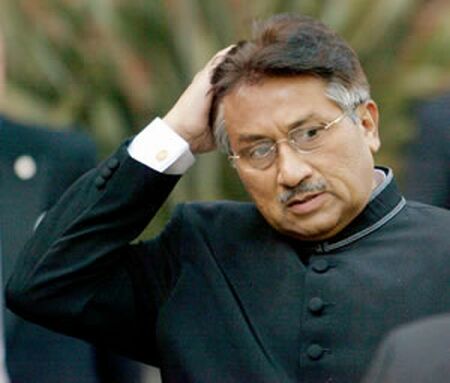
India, Pak Almost Agreed on K-deal: Musharraf

 As Reported by The Press Trust of India

Former military ruler Pervez Musharraf on Friday said India and Pakistan were “moving forward towards drafting an agreement” on Kashmir during his tenure and that Prime Minister Manmohan Singh was genuinely committed to peace in the region. “I was certainly trying for it (peace).

And we were reaching success. I have always praised Prime Minister (of India) for his sincerity to reach peace,” said Musharraf, in an interview with NPR. Manmohan Singh and we almost reached peace on all the three issues…the third one, Kashmir, we had made some certain parameters and we were moving forward towards drafting an agreement,” he added. “Unfortunately, that was not to be, but I tried my best.”

Noting that peace is the only way forward, Musharraf noted that the deadlock on Kashmir was rendering the South Asian Association for Regional Cooperation (SAARC) useless.

“And I think the way forward is peace for the sake of world, which thinks that this is a nuclear flash point; for the sake of SAARC, which is impotent because of the conflict because of India and Pakistan,” said the former president.

“And for the sake of bilateral Pakistan-India advantages socio-economic advantages which will flow from peace between the two countries,” he noted.

Musharraf is in the US to drum up support for his comeback, which he announced earlier this year by launching a new political party — the All Pakistan Muslim League that would contest elections in 2013. Earlier this week, he accused India of trying to create an “anti-Pakistan Afghanistan.” “If I’m allowed to be very, very frank, India’s role in Afghanistan is to create an anti-Pakistan Afghanistan, said Musharraf, speaking at the Council on Foreign Relations on Tuesday.

Today, he characterised the narrative of the Indo-Pak dispute as “impartial”. “So, unfortunate reality, why I have to be so emotional about it, is every time it is Pakistan who is a rogue,” he said.

“Indian bomb is not a Hindu bomb. Pakistan bomb is a Islamic bomb. I think we are being very impartial, we are being very unfair to Pakistan…”

Obama Calls for India – Pakistan Peace

By Andrew Buncombe for NZ Hearald

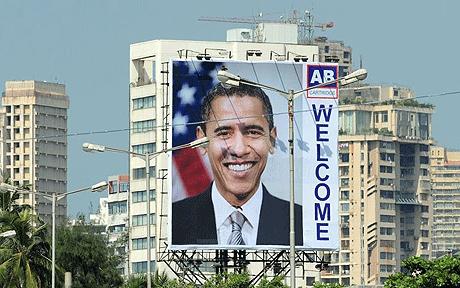
Barack Obama has called on India and Pakistan to renew their efforts to find peace, even as he said Islamabad was not moving quickly enough to counter militants operating from inside its borders.

In comments that appeared to underscore the high-wire act of diplomacy the US president is trying to pull off while on the three-day visit to India, Mr Obama said Washington would not act as an intermediary between the two countries.

However, he told a group of students in Mumbai: “My hope is that over time, trust develops between the two countries, that dialogue begins, perhaps on less controversial issues, building up to more controversial issues. There are more Pakistanis who’ve been killed by terrorists inside Pakistan than probably anywhere else.”

The president has received criticism from some opposition parties in India after he failed to directly mention Pakistan when he arrived in India on Saturday and spoke of the 2008 attacks at the Taj Hotel and other locations in Mumbai, that left more than 160 people dead.

In the aftermath of the attacks, the so-called “composite dialogue” peace process between India and Pakistan was put on hold and while there have been a series of high-level meetings, the relationship between the two remains tense.

The president, who stayed at the seafront hotel in what aides said was a clear sign of solidarity, had talked about the militants and the terror they wrought, but was criticised by the right-wing Bharatiya Janata Party (BJP) for failing to attribute the blame to Pakistan.

Asked why he had not done so, Mr Obama reflected a reality in which the US is paying billions of dollars to Pakistan in aid as it pushes it to do more against militants responsible for cross-border strikes in Afghanistan.

“Pakistan is a strategically important country, not just for America, but for the world,” he said. “India and Pakistan can prosper and live side by side. This can happen and this should be the ultimate goal. The US can be a partner but cannot impose this process. India and Pakistan have to arrive at an understanding.”

Mr Obama started his visit to India, one of four countries he is including on a tour through Asia, by announcing more than 20 deals he said were worth up to $10bn and would help support 50,000 US jobs.

He also said the US was to relax export controls over sensitive technology, a demand of India’s that will help deepen ties between the two countries. The president is to hold formal talks today with India’s prime minister, Manmohan Singh.

On a domestic level, Mr Obama also recognised he needed to make “midcourse corrections” in the aftermath of last week’s mid-term elections if he is going to win over a frustrated and divided electorate.

America and India: The Almost-Special Relationship

By Jim Yardley for The New York Times

At a panel discussion last week on relations between India and the United States, Strobe Talbott, the former American diplomat, told an audience of Indian business leaders that he had learned a valuable lesson about India: Do not hyphenate it. As in Indo-Pak. (Or, in a close cousin of a hyphen, as in Chindia.) The audience smiled at his epiphany: India matters because it is India.

In a nutshell, President Obama is trying to deliver the same message during his three-day visit to India, the first stop on a broader Asian tour. Both countries are eager to build on their improved ties and set up a unique, special relationship, given that together they represent the world’s richest and largest democracies. Faced with a rising authoritarian China, and an economically wounded Europe, a weakened United States is casting about for global partners. India would seem a nice fit.

“This is the time to be ambitious about this relationship,” said Shivshankar Menon, India’s national security adviser, speaking on the panel with Mr. Talbott.

And yet eliminating the hyphen is not easy, especially given India’s fraught relations with its neighbors in what is perhaps the most politically complicated region on earth, one in which American lives and treasure are at stake in Pakistan and Afghanistan. And India’s evolving relationship with another neighbor, China, is also a prime concern for America. Indeed, the decision to focus Mr. Obama’s India trip on India was itself not easily achieved; some senior administration officials lobbied the president to put pressure on Indian leaders for a conciliatory gesture toward Pakistan, in hope that such a carrot might entice the Pakistanis to do more to help America against the Taliban.

These sorts of political equations have long tangled the U.S.-India relationship: The Americans, at different times, have pushed the Indians to cut a deal with Pakistan over the disputed region of Kashmir, but the Indians have bristled at any interference. The Indians still want the Americans to sponsor India for a permanent seat on the United Nations Security Council. Not such an easy thing, the Americans reply, since America alone can’t do this and it creates issues between America and China. It has sometimes seemed like a relationship built around one country asking the other to do something it considers against its self-interest.

Moreover, the economic relationship between the two countries often has been a source of friction. High unemployment in America has renewed complaints that outsourcing to India hurts American workers. Indians complain that American protectionism is hurting Indian companies and that American export restrictions on technologies that can have both military and civil uses are outdated and unnecessary in a relationship between putative allies.

Mr. Obama’s trip is an attempt to reboot or refocus the relationship away from these disputes and de-emphasize the tangible goodies (for example, contracts) that politicians call “deliverables.” Instead, the two sides are discussing how they can partner on education, clean energy, agriculture, technological development and military cooperation. The thematic emphasis of the visit is on shared democratic values — a pointed dig at China — and what the two countries say are shared opportunities. American officials say that an expected $4 billion deal for India to buy military transport aircraft — yes, a goodie — will provide thousands of American jobs. Indian officials emphasize that trade between the two countries is basically balanced — unlike with China — and that the anger over outsourcing is misplaced, especially since some Indian companies are investing and creating jobs in the United States.

Some Indian commentators have groused that all the diplospeak about shared opportunities obscures the fact that the trip lacks a “big idea” to excite or elevate the relationship, even as big, unavoidable problems are seemingly being avoided. In 2000, former President Bill Clinton spent five days in India on a door-opening visit that was credited with righting what had been a stalled relationship. Then former President George W. Bush made the most dramatic gesture by pushing through an agreement to cooperate on civilian nuclear projects; the move effectively legitimized India as a nuclear power and lifted a 30-year moratorium on nuclear trade with India even though India had not signed the Nuclear Nonproliferation Treaty. By comparison, Mr. Obama seems not to be offering much.

“The jury is out,” said Shekhar Gupta, editor of The Indian Express, speaking of how India’s political establishment views Mr. Obama.

But Ronen Sen, who recently retired from India’s diplomatic corps after serving as ambassador to the United States, says the focus on a “big idea” is misplaced. Given the litany of difficult problems between the two countries, Mr. Sen said, Mr. Obama’s approach was a reasonable way to build trust and broaden a bilateral relationship that, while greatly improved, had not yet fully matured.

“It has not yet reached a critical mass where it can be self sustaining,” Mr. Sen said.

Indeed, even the landmark civil nuclear deal remains a subject of dispute as the two sides still squabble over fine details of how American suppliers could begin doing business in the lucrative Indian market. The Americans say that rules recently approved by India are inconsistent with accepted global practice, which exempts foreign suppliers from liability in cases of accidents, leaving it solely with local operators. A senior American official said “intense discussions” were underway to find a solution. If one is found, Mr. Obama may get a nice “deliverable” — an open door through which American firms, as originally expected, can sell nuclear equipment to India and provide jobs at home.

There is less talk of the chances of solving bigger problems, like differences between America and India in global negotiations on global warming climate change and trade. And the uncertainty over the most problematic hyphens — Afghanistan and Pakistan — looms over the visit. Even as Mr. Obama seeks a way to stabilize Afghanistan and get out, Indian officials dread the day America leaves. They worry about what will be left behind, since India cannot leave the neighborhood.

“Quite obviously, we have strategic stakes there,” said Brig. Gurmeet Kanwal, director of the Center for Land Warfare Studies, a military research institute. “We do not wish to have a government in Afghanistan or a government in Kabul that is inimical to Indian interests.”

He added: “We see the United States as a stabilizing influence in Asia.”

And so a political courtship will continue, problems and all. Governmental ties already lag far behind the people-to-people relationships. America remains the premier destination for Indian students studying abroad, and Indian immigrants in America have achieved disproportionate success in business, medicine and many other fields. It is this backchannel closeness that serves as a cattle prod nudging the governments to become closer, too.

K. Subrahmanyam, a leading Indian defense analyst, believes that India and the United States represent the inevitable and necessary partnership of the 21st century because China’s rise represents a threat to a global order based on democratic principles. He said that demographic trends, too, should bind the two countries together.

“If America needs a partner, Europe is aging, Japan is aging and China is going to age,” he said. “The only two major nations in the world who will not be aging, at least for the next 30 years, are the United States and India.”

Arundhati’s Statement From Srinagar: Full Text

By Arundhati Roy
October 26, 2010
Noted Indian Hindu writer Arundhati Roy Tuesday said her speeches supporting the call for azadi were what “millions” in Kashmir say every day and were “fundamentally a call for justice”. Following is the full text of the statement that she has issued.
 
“I write this from Srinagar, Kashmir. This morning’s papers say that I may be arrested on charges of sedition for what I have said at recent public meetings on Kashmir. I said what millions of people here say every day. I said what I, as well as other commentators have written and said for years. Anybody who cares to read the transcripts of my speeches will see that they were fundamentally a call for justice. I spoke about justice for the people of Kashmir who live under one of the most brutal military occupations in the world; for Kashmiri Pandits who live out the tragedy of having been driven out of their homeland; for Dalit soldiers killed in Kashmir whose graves I visited on garbage heaps in their villags in Cuddalore; for the Indian poor who pay the price of this occupation in material ways and who are now learning to live in the terror of what is becoming a police state.  

“Yesterday I traveled to Shopian, the apple-town in South Kashmir which had remained closed for 47 days last year in protest against the brutal rape and murder of Asiya and Nilofer, the young women whose bodies were found in a shallow stream near their homes and whose murderers have still not been brought to justice. I met Shakeel, who is Nilofer’s husband and Asiya’s brother. We sat in a circle of people crazed with grief and anger who had lost hope that they would ever get ‘insaf’—justice—from India, and now believed that Azadi—freedom— was their only hope. I met young stone pelters who had been shot through their eyes. I traveled with a young man who told me how three of his friends, teenagers in Anantnag district, had been taken into custody and had their finger-nails pulled out as punishment for throwing stones.

“In the papers some have accused me of giving ‘hate-speeches’, of wanting India to break up. On the contrary, what I say comes from love and pride. It comes from not wanting people to be killed, raped, imprisoned or have their finger-nails pulled out in order to force them to say they are Indians. It comes from wanting to live in a society that is striving to be a just one. Pity the nation that has to silence its writers for speaking their minds. Pity the nation that needs to jail those who ask for justice, while communal killers, mass murderers, corporate scamsters, looters, rapists, and those who prey on the poorest of the poor, roam free.”

Arundhati Roy is a novelist, essayist and human rights activist. She won a Booker Prize in 1997 for her novel, The God of Small Things. For more on her read http://en.wikipedia.org/wiki/Arundhati_Roy

Pakistanis for Peace Editor’s Note– Arundhati Roy’s courageous plea to her country is to be lauded. Although branded a traitor by many in India and within the government, she knows that she stands for peace, justice and fairness for all humanity. She wants self determination for all Kashmiris, be they Muslim, Hindu, Buddhist or Christian.

We at Pakistanis for Peace want nothing more than peace between India and Pakistan and therefore understand that Kashmir is the one and single most important issue between the two countries. Solve it and you do not have the threat of cross border attacks, friction, animosity, perpetual war and a tense border between two neighbors of nearly 2,000 miles. If we continue to ignore it then it will eventually be the crisis that starts a 4th and possibly nuclear war between the two neighbors. A war that neither the neighborhood nor the world can afford.

Pakistan Urges US to Intervene in Kashmir Dispute

As Reported by The Associated Press

Pakistan called Friday for President Barack Obama to intervene in its longstanding dispute with India over the Himalayan region of Kashmir, the cause of two of the three wars the nuclear-armed rivals have fought.

Pakistani Foreign Minister Shah Mahmood Qureshi made the unusually blunt appeal for Obama to seek a resolution of the dispute when he visits India next month, saying he should “redeem the pledge” he made as a candidate.

The conflict over Kashmir has been the main source of friction between India and Pakistan since they won independence from Britain in 1947. Pakistan has frequently sought outside intervention to resolve it but India vehemently opposes such involvement and the United States has traditionally stayed above the fray.

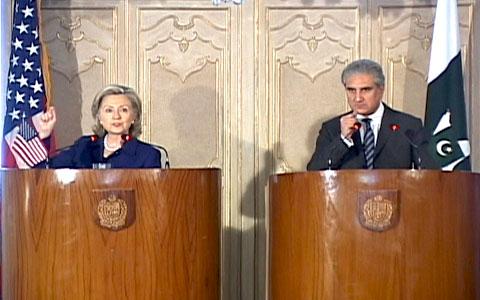
Qureshi, speaking next to Secretary of State Hillary Rodham Clinton at the closing day of three days of U.S.-Pakistan talks, said Obama must get involved because a crackdown against suspected Muslim militants in Indian-controlled Kashmir threatens the entire region.

“It is in the U.S. strategic interest to work for peace, stability and resolution of the disputes in South Asia,” he said. “The starting point in this quest is justice for the Kashmiri people.”

“President Obama has always understood the importance of a Kashmir solution,” Qureshi said. “His coming visit to the region is the time to begin to redeem the pledge that he made earlier.”

As a presidential candidate in 2008, Obama suggested that the U.S. should encourage India and Pakistan to resolve the Kashmir dispute so Pakistan could better focus on fighting extremists on its own territory and Afghanistan. Although he did not advocate direct mediation, his comments were met with disdain in India.

Obama will not visit Pakistan on his upcoming trip but he plans to spend several days in India, which has cracked down on violent anti-Indian protests in Kashmir since June. The violence has killed at least 111 people, mostly teenage boys and young men in their 20s. Authorities have imposed off-and-on curfews in an attempt to halt the unrest.

Quershi expressed astonishment that the U.S. and other major powers had said little about India’s response to the protests.

“People of conscience have protested the use of force against the defenseless people of Kashmir, in particular the targeting of the Kashmiri youth,” he said. “But the Kashmiri mothers are baffled by the deafening silence of the world’s leadership. History has proved that the force of arms cannot suppress the legitimate aspirations of the Kashmiri people.”

India and Pakistan fought two wars for control of Muslim-majority Kashmir, where rebels have sought independence from India or incorportation with neighboring Pakistan.

More than 68,000 people, most of them civilians, have been killed in Kashmir since fighting began in earnest in 1989.

Meeting Pakistanis, U.S. Will Try to Fix Relations

By Mark Landler and Eric Schmitt for The New York Times

WASHINGTON — As Pakistani civilian and military leaders arrive here this week for high-level meetings, the Obama administration will begin trying to mend a relationship badly damaged by the American military’s tough new stance in the region.

Among the sweeteners on the table will be a multiyear security pact with Pakistan, complete with more reliable military aid — something the Pakistani military has long sought to complement the five-year, $7.5 billion package of nonmilitary aid approved by Congress last year. The administration will also discuss how to channel money to help Pakistan rebuild after its ruinous flood.

But the American gestures come at a time of fraying patience on the part of the Obama administration, and they will carry a familiar warning, a senior American official said: if Pakistan does not intensify its efforts to crack down on militants hiding out in the tribal areas of North Waziristan, or if another terrorist plot against the United States were to emanate from Pakistani soil, the administration would find it hard to persuade Congress or the American public to keep supporting the country.

“Pakistan has taken aggressive action within its own borders. But clearly, this is an ongoing threat and more needs to be done,” the State Department spokesman, Philip J. Crowley, said Monday. “That will be among the issues talked about.”

The Pakistanis will come with a similarly mixed message. While Pakistan is grateful for the strong American support after the flood, Pakistani officials said, it remains frustrated by what it perceives as the slow pace of economic aid, the lack of access to American markets for Pakistani goods and the administration’s continued lack of sympathy for the country’s confrontation with India.

Other potentially divisive topics are likely to come up, too, including NATO’s role in reconciliation talks between President Hamid Karzai of Afghanistan and the Taliban. Pakistani officials say they are nervous about being left out of any political settlement involving the Taliban.

Still, in a relationship suffused by tension and flare-ups — most recently over a NATO helicopter gunship that accidentally killed three Pakistani soldiers and Pakistan’s subsequent decision to close a supply route into Afghanistan — this regular meeting, known here as the strategic dialogue, serves as a lubricant to keep both countries talking.

At this meeting, Secretary of State Hillary Rodham Clinton will formally introduce the new American ambassador to Pakistan, Cameron Munter. Mr. Munter, who recently served in Iraq, replaces Anne W. Patterson, who just wrapped up her tour of duty in Islamabad.

“No country has gotten more attention from Secretary Clinton than Pakistan,” said Richard C. Holbrooke, the administration’s special representative for Afghanistan and Pakistan. Pakistan’s delegation will be led by its foreign minister, Shah Mahmood Qureshi, but much of the attention will be on another official, the military chief, Gen. Ashfaq Parvez Kayani, who is viewed by many as the most powerful man in Pakistan.

White House and Pentagon officials said one immediate goal of this meeting was to ease the tensions that led Pakistan to close the border crossing at Torkham, halting NATO supplies into Afghanistan. Officials on both sides said that acrimony from the border flare-up had already receded, soothed by the multiple apologies that American officials made to Pakistan last week.

Last week, Adm. Mike Mullen, the chairman of the Joint Chiefs of Staff, said that General Kayani had assured him that Pakistan’s army would tackle the North Waziristan haven, but on Pakistan’s timetable. In an interview, Pakistan’s ambassador to the United States, Husain Haqqani, said, “Our American partners understand that we have 34,000 troops in North Waziristan. Our soldiers have been engaged in flood relief after history’s worst floods. It is not a question of lack of will.”

The new security pact would have three parts: the sale of American military equipment to Pakistan, a program to allow Pakistani military officers to study at American war colleges and counterinsurgency assistance to Pakistani troops.

Currently, the United States spends about $1.5 billion a year to provide this same assistance, but it is doled out year by year. The new agreement, if endorsed by Congress, would approve a multiyear plan assuring stability and continuity in the programs, although Congress would continue to appropriate the financing on a yearly basis. “This is designed to make our military and security assistance to Pakistan predictable and to signal to them that they can count on us,” said a senior official.

At the last dialogue in Islamabad in July, Mrs. Clinton presented more than $500 million in economic aid, including plans to renovate hospitals, upgrade hydroelectric dams, improve water distribution and help farmers export mangoes. But the floods upended those plans, and officials said they now planned to redirect funds to more urgent needs.

This week’s meeting will also be shadowed by a new eruption of political instability in Pakistan: the government of President Asif Ali Zardari is locked in a confrontation with the Supreme Court over the court’s demand that senior ministers be fired on corruption charges. Analysts said they were less worried about the atmospherics than the underlying differences in perspective. The administration’s public contrition for the cross-border attack has largely resolved that issue, said Daniel S. Markey, senior fellow for India, Pakistan and South Asia at the Council on Foreign Relations.

But Mr. Markey said he saw potential friction stemming from the American openness to reconciliation with the Taliban. With the United States facilitating rather than guiding the talks, he said, there could be poor coordination between the Afghans, NATO and others — all of which would rattle the Pakistanis.

“Washington is opening the door to a range of negotiations with groups that it has discouraged Pakistan against working with in the past,” he said. “This sends a mixed signal, and cannot help but encourage hedging on Islamabad’s part.”

Another potential bone of contention is one of President Obama’s nuclear objectives: a global accord to end the production of new nuclear fuel. Pakistan has led the opposition to the accord. And without its agreement, the treaty would be basically useless.

Mr. Qureshi blamed the United States for the situation, saying Washington signed a civilian nuclear accord with India that discriminated against Pakistan. “You have disturbed the nuclear balance,” he said in a recent interview in New York, “and we have been forced to develop a new strategy.”

China and India: Contest of the Century

As reported by The Economist

A HUNDRED years ago it was perhaps already possible to discern the rising powers whose interaction and competition would shape the 20th century. The sun that shone on the British empire had passed midday. Vigorous new forces were flexing their muscles on the global stage, notably America, Japan and Germany. Their emergence brought undreamed-of prosperity; but also carnage on a scale hitherto unimaginable.

Now digest the main historical event of this week: China has officially become the world’s second-biggest economy, overtaking Japan. In the West this has prompted concerns about China overtaking the United States sooner than previously thought. But stand back a little farther, apply a more Asian perspective, and China’s longer-term contest is with that other recovering economic behemoth: India. These two Asian giants, which until 1800 used to make up half the world economy, are not, like Japan and Germany, mere nation states. In terms of size and population, each is a continent—and for all the glittering growth rates, a poor one.

Not destiny, but still pretty important

This is uncharted territory that should be seen in terms of decades, not years. Demography is not destiny. Nor for that matter are long-range economic forecasts from investment banks. Two decades ago Japan was seen as the main rival to America. Countries as huge and complicated as China can underachieve or collapse under their own contradictions. In the short term its other foreign relationships may matter more, even in Asia: there may, for instance, be a greater risk of conflict between rising China and an ageing but still powerful Japan. Western powers still wield considerable influence.

So caveats abound. Yet as the years roll forward, the chances are that it will increasingly come down once again to the two Asian giants facing each other over a disputed border (see article). How China and India manage their own relationship will determine whether similar mistakes to those that scarred the 20th century disfigure this one.

Neither is exactly comfortable in its skin. China’s leaders like to portray Western hype about their country’s rise as a conspiracy—a pretext either to offload expensive global burdens onto the Middle Kingdom or to encircle it. Witness America’s alliances with Japan and South Korea, its legal obligation to help Taiwan defend itself and its burgeoning friendships with China’s rivals, notably India but also now Vietnam.

This paranoia is overdone. Why shouldn’t more be asked from a place that, as well as being the world’s most-populous country, is already its biggest exporter, its biggest car market, its biggest carbon-emitter and its biggest consumer of energy (a rank China itself, typically, contests)? As for changing the balance of power, the People’s Liberation Army’s steady upgrading of its technological capacity, its building of a blue-water navy and its fast-developing skills in outer space and cyberspace do not yet threaten American supremacy, despite alarm expressed this week about the opacity of the PLA’s plans in a Pentagon report. But China’s military advances do unnerve neighbours and regional rivals. Recent weeks have seen China fall out with South Korea (as well as the West) over how to respond to the sinking in March, apparently by a North Korean torpedo, of a South Korean navy ship. And the Beijing regime has been at odds with South-East Asian countries over its greedy claim to almost all of the South China Sea.

India, too, is unnerved. Its humiliation at Chinese hands in a brief war nearly 50 years ago still rankles. A tradition of strategic mistrust of China is deeply ingrained. India sees China as working to undermine it at every level: by pre-empting it in securing supplies of the energy both must import; through manoeuvres to block a permanent seat for India on the United Nations Security Council; and, above all, through friendships with its smaller South Asian neighbours, notably Pakistan. India also notes that China, after decades of setting their border quarrels to one side in the interests of the broader relationship, has in recent years hardened its position on the disputes in Tibet and Kashmir that in 1962 led to war. This unease has pushed India strategically closer to America—most notably in a controversial deal on nuclear co-operation.

Autocrats in Beijing are contemptuous of India for its messy, indecisive democracy. But they must see it as a serious long-term rival—especially if it continues to tilt towards America. As recently as the early 1990s, India was as rich, in terms of national income per head. China then hurtled so far ahead that it seemed India could never catch up. But India’s long-term prospects now look stronger. While China is about to see its working-age population shrink (see article), India is enjoying the sort of bulge in manpower which brought sustained booms elsewhere in Asia. It is no longer inconceivable that its growth could outpace China’s for a considerable time. It has the advantage of democracy—at least as a pressure valve for discontent. And India’s army is, in numbers, second only to China’s and America’s: it has 100,000 soldiers in disputed Arunachal Pradesh (twice as many as America will soon have in Iraq). And because India does not threaten the West, it has powerful friends both on its own merits and as a counterweight to China.

A settlement in time

The prospect of renewed war between India and China is, for now, something that disturbs the sleep only of virulent nationalists in the Chinese press and retired colonels in Indian think-tanks. Optimists prefer to hail the $60 billion in trade the two are expected to do with each other this year (230 times the total in 1990). But the 20th century taught the world that blatantly foreseeable conflicts of interest can become increasingly foreseeable wars with unforeseeably dreadful consequences. Relying on prosperity and more democracy in China to sort things out thus seems unwise. Two things need to be done.

First, the slow progress towards a border settlement needs to resume. The main onus here is on China. It has the territory it really wants and has maintained its claim to Arunachal Pradesh only as a bargaining chip. It has, after all, solved intractable boundary quarrels with Russia, Mongolia, Myanmar and Vietnam. Surely it cannot be so difficult to treat with India?

That points to a second, deeper need, one that it took Europe two world wars to come close to solving: emerging Asia’s lack of serious institutions to bolster such deals. A regional forum run by the Association of South-East Asian Nations is rendered toothless by China’s aversion to multilateral diplomacy. Like any bully, it prefers to pick off its antagonists one by one. It would be better if China and India—and Japan—could start building regional forums to channel their inevitable rivalries into collaboration and healthy competition.

Globally, the rules-based system that the West set up in the second half of the 20th century brought huge benefits to emerging powers. But it reflects an out-of-date world order, not the current global balance, let alone a future one. China and India should be playing a bigger role in shaping the rules that will govern the 21st century. That requires concessions from the West. But it also requires commitment to a rules-based international order from China and India. A serious effort to solve their own disagreements is a good place to start.

For Better or Worse, White House Bets on Pakistan’s Civilian Government

Reported by Josh Rogin for Foreign Policy magazine

The Obama administration has always been clear that the path to winning the war in Afghanistan goes through Pakistan. But if Bob Woodward’s new book is accurate, the White House considers its war effort much more dependent on the success and survival of Pakistan’s civilian government than was previously known.

Woodward’s “Obama’s Wars,” which hit bookstores Monday, sheds new light on the Obama administration’s vast outreach to the Pakistani civilian government led by President Asif Ali Zardari. It paints a picture of an administration working hard to court the Pakistanis while remaining somewhat confused about Pakistani thinking on a range of issues.

Obama himself was confused about the nature of Pakistani intentions during two crucial decision points in his administration’s Afghan policy — the March 2009 strategy rollout and the deliberations in November 2009, which resulted in a troop surge and a huge expansion of covert operations in Pakistan. However, based on advice from the majority of his key advisers, he nonetheless tried to entice Pakistan to commit to a deep and long-term partnership with the United States by offering the Zardari government incentive after incentive, with relatively few pressures.

According to Woodward’s account, the centrality of Pakistan was championed early on by Bruce Riedel, the Brookings scholar who was brought on as a key figure in the Obama administration’s March 2009 Afghanistan strategy review.

Riedel, who referred to Islamist extremists in Pakistan as the “real, central threat” to U.S. national security, personally convinced Obama, only two months after he took office, that Pakistan needed to be the centerpiece of his new strategy. Riedel’s plan involved arming the Pakistani military for counterinsurgency and increasing economic and other forms of aid to the civilian government. This marked the beginning of the term “Af-Pak,” which drove the administration’s belief that stability in Afghanistan and Pakistan were inextricably linked.

Riedel’s Pakistan focus was not due to his confidence that the civilian government could control the military and intelligence services. In fact, he referred to Army Chief of Staff Gen. Ashfaq Parvez Kayani as a “liar” with regards to the activities of the secretive Inter Services Intelligence agency (ISI), which is widely suspected of aiding the Taliban insurgency. Then Director of National Intelligence Dennis Blair reportedly echoed Riedel’s views on this matter.

Inside the administration, Blair argued that Obama was approaching Pakistan with too many carrots and not enough sticks. He at one point advocated bombing inside Pakistan and conducting raids there without the Pakistani government’s approval. “I think Pakistan would be completely, completely pissed off and they would probably take actions against us … but they would probably adjust,” he once told Obama.

Obama, however, opted to pursue a less confrontational path. He concluded the central task would be convincing the Pakistani leadership to throw its lot in with the United States He said at the time of the initial strategy review in March 2009, “that we had to have a serious heart-to-heart with Pakistani civilian, military and intelligence leaders.”

Later that year, when making the decision to send an additional 30,000 “surge” troops to Afghanistan, Obama knew that his plans to also expand the U.S. military presence in Pakistan and widen drone strikes would be a hard sell to the Zardari government. In an attempt to sweeten the deal, Obama framed the policy as a new “strategic partnership” with Pakistan, even tying the success of the U.S. mission in Afghanistan to the survival of Zardari and the legacy of his deceased wife Benazir Bhutto.

“I know that I am speaking to you on a personal level when I say that my commitment to ending the ability of these groups to strike at our families is as much about my family’s security as it is about yours,” Obama wrote in a letter to Zardari delivered by National Security Advisor Jim Jones and counterterrorism advisor John Brennan.

Zardari’s response to that letter reinforced what many in the administration already suspected: Pakistan’s government was in the grips of an internal struggle over whether to embrace the United States. Zardari’s initial response focused heavily on India, though the Pakistani president only referred obliquely to his country’s strategic rival. Woodward reports that the White House believed the letter was written by the Pakistani military and the ISI. However, the Zardari government did end up accepting Obama’s offer.

Obama’s top advisors told the U.S. president that he would have to accept something short of complete success in convincing Pakistan to turn away from its longstanding obsession with the military threat it perceives from India.

When Obama had a meeting with Zardari in May 2009, he told the Pakistani president the he did not want U.S. taxpayers to be funding Pakistan’s military buildup against India “We are trying to change our world view,” Zardari told Obama, “but it’s not going to happen overnight.”

At times, Obama was downright puzzled by his advisors’ advice regarding Pakistan. For example, intelligence reports confirmed that Pakistani officials were afraid that the United States would leave Afghanistan too early, as they believed had occurred after the end of the resistance to the Soviet regime in the 1980s. On the other hand, Pakistan worried that if the United States was too involved in Afghanistan, it might aid in the establishment of a larger Afghan army than Islamabad was comfortable with.

“What am I to believe?” Obama asked his senior staff. Secretary of State Hillary Clinton, Special Representative Richard Holbrooke, and Defense Secretary Robert Gates all told him these were the types of contradictions that were commonplace when dealing with Pakistan.

For its part, the Pakistani government was just as confused and puzzled by the Obama administration. Woodward recounts one anecdote, in which Zardari tells the former U.S. Ambassador to Afghanistan Zalmay Khalilzad that he believed the United States was involved in orchestrating attacks by the Pakistani Taliban against the Pakistani civilian government.

Pakistan’s Ambassador to Washington Husain Haqqani, a key go-between, tried several times to explain to the Obama administration how to court Pakistani leaders, comparing the dynamic to “a man who is trying to woo a woman.”

“We all know what he wants from her. Right?” Haqqani said in a meeting with Jones, Deputy National Security Advisor Tom Donilon and the NSC’s Gen. Doug Lute.

“But she has other ideas. She wants to be taken to the theater. She wants that nice new bottle of perfume,” Haqqani told them. “If you get down on one knee and give the ring, that’s the big prize. And boy, you know, it works.”

Haqqani said the “ring” was official U.S. recognition of Pakistan’s nuclear program as legitimate. He also warned that the Pakistanis would always ask for the moon as a starting point in negotiations. He compared it to the salesmanship of rug merchants.

“The guy starts at 10,000 and you settle for 1,200,” Haqqani told the Obama team. “So be reasonable, but never let the guy walk out of the shop without a sale.”

Although the Obama administration has had some success improving the relationship between the two governments, Pakistan’s civilian leadership still faces a series of difficulties in its goal of exerting control over its entire national security structure. Stability has also been threatened by the enormous pressures resulting from the war that it is waging inside its own borders, and political attacks leveled against it from the media and the courts. Zardari’s perceived sluggish response to the devastating flood crisis has cost him even more credibility among the Pakistani public.

But while the end of Zardari regime has often been predicted, it appears that he will remain in place for the foreseeable future. The Obama administration, meanwhile, is aware of how crucial his cooperation remains for the success of the mission in Afghanistan.

When Woodward sat down for his interview with Obama earlier this year, he asked the president if the situation was still that Pakistan is the centerpiece of the U.S. strategy. “It continues to this day,” Obama replied.

The Next Nuclear Arms Race

By Tim Sullivan and Michael Mazza for The Wall Street Journal

India and Pakistan are the two countries most likely to engage in nuclear war, or so goes the common wisdom. Yet if recent events are any indication, the world’s most vigorous nuclear competition may well erupt between Asia’s two giants: India and China.

Both countries already house significant and growing arsenals. China is estimated to have approximately 450 warheads; India, roughly 100. Though intensifying as of late, Sino-Indian nuclear competition has a long history: India’s pursuit of a weapons program in the 1960s was triggered in part by China’s initial nuclear tests, and the two have eyed one another’s arsenals with mounting concern ever since. The competition intensified in 2007, when China began to upgrade missile facilities near Tibet, placing targets in northern India within range of its forces.

Yet the stakes have been raised yet again in recent months. Indian defense minister A.K. Antony announced last month that the military will soon incorporate into its arsenal a new intermediate-range missile, the Agni-III, which is capable of reaching all of China’s major cities. Delhi is also reportedly considering redeploying survivable, medium-range Agni-IIs to its northeastern border. And just last month, India shifted a squadron of Su-30MKI fighters to a base just 150 kilometers from the disputed Sino-Indian border. An Indian Air Force official told Defense News these nuclear-armed planes could operate deep within China with midflight refueling.

For its part, China continues to enhance the quality, quantity and delivery systems of its nuclear forces. The Pentagon reported last month that the People’s Liberation Army has replaced older, vulnerable ballistic missiles deployed in Western China with modern, survivable ones; this transition has taken place over the last four years. China’s Hainan Island naval base houses new, nuclear-powered ballistic-missile submarines and affords those boats easy access to the Indian Ocean. China’s military is also developing a new, longer range submarine-launched ballistic missile which will allow its subs to strike targets throughout India from the secure confines of the South China Sea.

No single event has stoked this rise in tensions. China, already concerned about India’s growing strength and its desire to play a greater role in Asia, is even less enthused about the burgeoning strategic partnership between Delhi and Washington. While Beijing has learned to live with American forces on its eastern periphery, the possibility of an intimate U.S.-India military relationship has generated fears of encirclement. The ongoing Sino-Indian border dispute, as well as India’s position astride China’s key maritime shipping lanes, has made the prospect of a Washington-Delhi axis appear particularly troubling.

India’s surface-to-surface missile Agni-II launches off Wheelers island in Orissa state, India, on May 17, 2010.

India likewise feels encircled by China’s so-called “string of pearls”—a series of Chinese-built, ostensibly commercial port facilities in the Bay of Bengal, Indian Ocean and Arabian Sea. Beijing’s military ties to Pakistan, interference in the Kashmir dispute and references to Arunachal Pradesh, an Indian state, as “Southern Tibet” have done little to reassure New Delhi of Chinese intentions. The rapid growth of China’s conventional military might in recent years—between 2000 and 2009, China’s military spending more than tripled—and the lack of clarity as to its intentions, has spurred India to pursue its own military modernization.

These shifts in India’s and China’s nuclear force postures thus represent only the latest and most serious efforts to constrain and convey dissatisfaction with the other’s perceived regional ambitions. But they are more troubling than conventional redeployments.

First, these developments suggest that neither country has confidence in the other’s “no first use” policy. India has good reason for concern: The number of missions attributed to China’s deterrent—responding to nuclear attacks, deterring conventional attacks against nuclear assets, providing Beijing freedom from nuclear coercion and otherwise “reinforcing China’s great power status”—were enough to make the authors of the Pentagon’s annual report on China’s military power last year question the country’s commitment to its “no first use” policy. India, for its part, relies on its nuclear forces to offset gaps and imbalances between its conventional military capabilities and those of China.

Second, there is a point at which efforts to enhance deterrence can foster an arms race. Any attempt on the part of China to increase its own defenses necessarily weakens, or is perceived to weaken, the security of India, thus spurring further defense build-ups; the opposite is true as well. Shifts in nuclear force posture can be particularly disruptive, and have been known to precipitate crises. Upon the discovery of Soviet efforts to deploy missiles to Cuba in 1962, for example, the U.S. responded militarily with a naval “quarantine” of the island, bringing Washington and Moscow as close as they have ever come to a nuclear war.

Finally, the redeployments of India’s and China’s nuclear forces suggest that there is deep-seated and growing discord between the two Asian giants. This is troubling news for a region whose future peace and prosperity depends heavily on continued comity between Delhi and Beijing. It is only a matter of time before the China-India military competition begins to affect neighboring states. China’s nuclear force modernization, for instance, stands to threaten not only India, but also Korea, Japan and other U.S. partners in Asia. A dramatic defense buildup in India, meanwhile, will no doubt leave Pakistan feeling less secure.

Tensions are unlikely to ease any time soon. The two countries appear much closer to the brink of an all-out arms race than they do to any resolution of their differences. While each profits from the other’s economic growth, it is that very growth—which finances military modernization and which is so dependent on potentially vulnerable overseas trade—that creates the conditions for heightened insecurity.

Mr. Sullivan is research fellow and program manager at the American Enterprise Institute’s Center for Defense Studies. Mr. Mazza is a senior research associate at AEI.

U.N. Speakers Urge Pakistan to Free Up Arms Talks

By Patrick Worsnip for Reuters

Heaping pressure on Pakistan, a high-level U.N. meeting called on Friday for talks to start immediately on a treaty to ban production of fissile material used as fuel for nuclear weapons.

But Pakistan has insisted it will continue to block such talks, arguing that a ban would put it at a permanent disadvantage to its nuclear rival India. The dispute has led to deadlock at the 65-nation Conference on Disarmament in Geneva.

At the U.N. meeting of some 70 states to discuss the paralysis at the conference, speakers avoided openly naming Pakistan, but several referred to “one country” that was causing the problem.

In a closing summary of the views expressed, U.N. Secretary-General Ban Ki-moon said there was “broad agreement on the need to immediately start negotiations on a … treaty banning the production of fissile material.”

Continued impasse could result in states going outside the Geneva conference, known as the “CD,” to tackle the issue, Ban warned.

Support has appeared to be growing in Geneva to find another approach — possibly small-group talks in parallel to CD sessions. A precedent was set when Canada and Norway moved talks on a landmine ban out of the forum, eventually clinching the landmark 1997 Ottawa Treaty.

At Friday’s U.N. meeting, Western powers sharply attacked Pakistan’s blockage of the CD, which requires consensus for its actions.

“It strikes us as unwarranted for a single country to abuse the consensus principle and thereby frustrate everyone else’s desire to resume serious disarmament efforts,” said U.S. delegate Gary Samore, a special adviser to President Barack Obama.

Washington understood that all countries needed to protect their security interests, and with that principle in place, “no country need fear the prospect of (fissile material) negotiations,” Samore said.

NO CONSENSUS

British junior foreign minister Alistair Burt said blocking the negotiations was “damaging for multilateral arms control.”

Launched in 1978, the CD has clinched treaties banning biological and chemical weapons as well as underground nuclear tests. Its members include all five official nuclear powers — the United States, Russia, Britain, France and China.

But it has been unable to reach consensus on substantive work for the past 12 years. Pakistan’s refusal since January to launch negotiations on fissile material like plutonium and highly enriched uranium is the latest obstacle.

Zamir Akram, Pakistan’s ambassador to the United Nations in Geneva, said earlier this month his country would continue to hold out, arguing that India has an unfair advantage with bigger fissile material stockpiles and “discriminatory” nuclear cooperation deals with the United States.

“Pakistan’s security concerns can be addressed only once we have developed sufficient capacity to ensure our deterrent is credible in the face of growing asymmetry,” he told Reuters. “My instructions are, ‘We continue to maintain our position.'”

Pakistan did not speak at Friday’s meeting in New York. No decisions were made, but Ban said he would ask a panel of advisers to review the issues raised.

Separately, French delegate Jacques Audibert said Paris would host a meeting of the five official nuclear powers next year to discuss their obligations stemming from a May conference on nuclear non-proliferation.

The conference called on the powers to pursue negotiations ultimately aimed at the total abolition of nuclear weapons.

China, Pakistan Discuss Another Nuclear Plant

By Jeremy Page for The Wall Street Journal

BEIJING—China’s main nuclear power company announced that it is in talks to build a one-gigawatt nuclear power plant in Pakistan, even as the two countries face U.S. and Indian concerns over their cooperation to build other plants in Pakistan.

Pakistan has not signed the Nuclear Non-Proliferation Treaty, and U.S. and Indian officials worry that nuclear material might fall into the hands of al Qaeda and Taliban militants based near the Afghan border in northwestern Pakistan.

The state-run China National Nuclear Corp. has already helped Pakistan build its main nuclear power facility at Chashma in Punjab province, is completing a second reactor there and has contracts to build two more 300-megawatt reactors.

Qiu Jiangang, vice president of CNNC, told a meeting in Beijing on Monday that the first reactor was operating safely, the second one was now being tested and expected to start formal operations by the end of the year. “Both sides are in discussions over the CNNC exporting a one-gigawatt nuclear plant to Pakistan,” he added, without giving details.

There was no immediate reaction from the U.S. or India. Officials from both countries expressed concern after China signed a deal in February to build the additional two 300-MW reactors. U.S. officials said such plans required special exemption from the 46-nation Nuclear Suppliers Group, which China joined in 2004, and which is supposed to regulate the global nuclear trade.

Vann H. Van Diepen, the U.S. acting assistant secretary of state for international security and nonproliferation, suggested before the House Foreign Affairs Committee in July that the U.S. would vote against such an exemption.

The U.S. and many other NSG members have long had concerns about nuclear proliferation from Pakistan, especially since A.Q. Khan, its top nuclear scientist, confessed in 2004 to selling nuclear secrets to North Korea, Iran and Libya.

Abdul Basit, a Pakistani Foreign Ministry spokesman, declined to comment on the one-gigawatt plant, but said Pakistan’s nuclear cooperation with China was for civilian purposes. “The nuclear cooperation between the two countries are in accordance with international obligations and comes under IAEA safeguards,” he said, referring to the International Atomic Energy Agency.

China and Pakistan argue that the U.S. set a precedent by sealing a landmark deal to sell civilian nuclear fuel and technology to India in 2006 even though New Delhi had yet to sign the NPT.

That agreement, which lifted a U.S. ban imposed after India tested its first nuclear device in 1974, is seen as the cornerstone of a new partnership with New Delhi designed to counterbalance China’s influence in Asia.

Critics, however, say it undermined the global non-proliferation regime by recognizing India as a global nuclear power, but not Pakistan, even though the South Asian rivals developed nuclear bombs simultaneously.

What Are Chinese Troops Doing in Kashmir?

By Randeep Ramesh for The Guardian

The claim that more than 7,000 Chinese troops have been handed “de facto control” of Gilgit-Baltistan, a northern part of Kashmir, by Islamabad, has set alarm bells ringing in Delhi. India – which, like its nuclear-armed rival Pakistan, claims the entire state – has long been worried that the People’s Liberation Army was working on roads and railway projects in the Karakoram mountains.

What is true is that China plans a massive highway linking western China to the port it is building at Gwadar, Pakistan, on the shore of the Arabian Sea. The benefits are obvious: the journey time from factory gate in, say, China’s wild west, to container ships bound for the Gulf will be cut from weeks to a few days. Eventually it may even become a key energy supply route.

All of this troubles Delhi, which has long asked for China to keep its nose out of Kashmiri affairs. However, the rise of the Middle Kingdom and its need to secure passage through its own troublesome provinces of Xinjiang and Tibet through to Pakistan make this unlikely. But India suspects, too, that China is intent on becoming the hegemon of much of the eastern hemisphere – able to dictate to smaller powers the rules of the game.

In Kashmir this had led to a round of tit-for-tat diplomatic incidents. So when India refuses to allow a Chinese diplomat to visit its troubled north-eastern state of Manipur for a talk, China responds by blocking the visa of a top Indian general because it appears his command includes Kashmir.

The Himalayan state is a piece of real estate whose sovereignty has long been contested. With its demography as varied as its topography, its various peoples have long been imbued with a stubborn streak of independence.

So it may be unsurprising that when heavy rains washed away villages in the Pakistan’s “Northern Areas” and Islamabad’s response was to sit on its hands, the simmering revolt against Pakistani rule flared again. In response Pakistan, so the claim goes, turned to its all-weather friend China, which was more than happy to send boots flying.

All this is dismissed in Beijing but only after referring to Gilgit as a “northern part of Pakistan”, which simply angered Delhi further. While Pakistan’s problem in its part of Kashmir has been of too little government action, India’s rule in its portion of the state has been heavy-handed and self-defeating.

Faced with a largely nonviolent revolt which began in 2008, the Indian authorities have provoked a much larger crisis with a regime of curfews and the killings of teenagers shot dead with nothing but slogans in their mouths and rocks in their hands. It is time for India to admit that its political and military strategy has failed to stabilise Kashmir.

The actions of both Pakistan and India vitiate claims that somehow either could keep the entire state happy. China has little sympathy with separatist claims – and holds sway over large chunks of the former Kashmiri kingdom.

The only way out of this mess is for Islamabad and Delhi to start rebuilding a peace process that will eventually lead to self-governance on both sides of the de facto border and a withdrawal of substantial numbers of Indian, Pakistani and, yes, even Chinese troops from Kashmir.

Clinton Reaffirms US Commitment to Pakistan

By Ayaz Gul for The Voice of America

Concluding a second round of the so-called U.S.-Pakistan strategic dialogue in Islamabad, Secretary of State Hillary Clinton on Monday announced more than $500 million in several new aid programs for Pakistan.

The string of new projects unveiled by Clinton during a joint press conference with Pakistani Foreign Minister Shah Memood Qureshi are designed to help Pakistan meet its energy needs and boost power generation, health and agricultural development. The programs are the first to be launched under U.S legislation passed last year tripling civilian aid for Pakistan to $7.5 billion during the next five years.

Secretary Clinton said the United States hopes the new aid will translate into real life improvements for families and communities, describing them as long-term investments in Pakistan’s future.

“We are committed to building a partnership with Pakistan that of course strengthens security and protects the people of Pakistan, but goes far beyond security,” Clinton said. “We want to help you drive economic growth and prosperity, strengthen your democratic government institutions and expand access to the tools of opportunity.”

Pakistan is playing a key role in the international fighting against Taliban insurgents in Afghanistan. But public opinion in Pakistan still views U.S. motives with a considerable amount of suspicion. The skepticism stems from the U.S decision to abandon support for Pakistan after Soviet forces withdrew from Afghanistan.

But Secretary Clinton says she can see positive change resulting from what she called deeper and broader bilateral engagements in recent years.

“We have moved beyond a standoff of our misunderstandings that were allowed to fester and not addressed… to a position where we are engaged in the most open dialogue that I think our two countries have ever had,” she said.

Foreign minister Qureshi also agreed that the enhanced U.S cooperation in various fields such as energy, power, health, agricultural and education sector is critical for changing the public perception in Pakistan.

“The opinion of the United States will change when the people of Pakistan see that their lives have changed,” said Mr. Qureshi.

Sunday, Clinton attended the signing of a landmark trade deal reached by Pakistan and Afghanistan, after years of negotiations. The United States has been pushing Afghan and Pakistani leaders to improve bilateral relations it says will contribute to the fight against extremists.

Secretary Clinton’s next stop as part of her Asia trip will be Kabul, where she will attend an international conference on Tuesday.

At the news conference in Islamabad, she reiterated that insurgents who wish to reconcile must lay down their arms, renounce partnership with al-Qaida and accept Afghanistan’s constitution.

“It seems to us that there will be some who are willing to meet those conditions and others who are not. And we would strongly advise our friends in Afghanistan to deal with those who are committed to a peaceful future where their ideas can compete in the political arena through the ballot box, not through the force of arms.”

Taliban insurgents have stepped up attacks against Afghan and U.S-led coalition forces in recent months. More than 50 foreign troops have died in July while the previous month was the deadliest for international forces since the war against Taliban and its allies began nine years ago.

Clinton, With Initiatives in Hand, Arrives in Pakistan

By Mark Landler for The New York Times

Secretary of State Hillary Rodham Clinton arrived here Sunday for high-level deliberations with Pakistani leaders, the latest in a series of encounters that the Obama administration hopes will chip away at decades of suspicion between Pakistan and the United States.

Hillary Rodham ClintonMrs. Clinton will announce a raft of initiatives to help Pakistan in public health, water distribution and agriculture, to be funded by $500 million in American economic aid. Among other things, the United States will build a 60-bed hospital in Karachi and help farmers export their mangoes.

Yet these projects, however beneficial to this economically fragile country, do not disguise several nagging sources of friction between the two sides. American officials still question Pakistan’s commitment to root out Taliban insurgents in its frontier areas, its motives in reaching out to war-torn Afghanistan and its determination to expand its own nuclear program.

Pakistan plans to buy two nuclear reactors from China — a deal that alarms the United States because it is cloaked in secrecy and is being conducted outside the global nonproliferation regime. Administration officials said they did not know if Mrs. Clinton planned to raise the purchase.

Relations could be further tested if the Obama administration decides to place a major Pakistani insurgent group, the Haqqani network, on the State Department’s list of terrorist organizations. Islamabad maintains ties to the group through its intelligence service, and it is seeking to exploit those connections as a way to extend its influence over Afghanistan.

For all that, tensions between the two sides have ebbed since Mrs. Clinton’s last visit here in October, when she was peppered with hostile questions in public meetings and bluntly suggested that people in the Pakistani government know the whereabouts of Osama bin Laden and Mullah Omar.

“We needed to change the core of the relationship with Pakistan,” said Richard C. Holbrooke, the special representative to Afghanistan and Pakistan. “The evolution of the strategic dialogue, and the fact that we are delivering, is producing a change in Pakistani attitudes.”

Mr. Holbrooke noted a U-turn in Pakistan’s policy on issuing visas to American diplomats. For months, Pakistani officials had held up those applications, creating a huge backlog and frustrating the United States. But Pakistan issued 450 visas in the last five days, he said.

Mr. Holbrooke conceded that public-opinion polls toward the United States had yet to show much of a change. Mrs. Clinton may receive more criticism on Monday at a town-hall meeting in Islamabad. Her visit, which was not announced due to security concerns, is being conducted under tight security.

Vali Nasr, a senior advisor to Mr. Holbrooke, said it was unrealistic to expect “to change 30 years of foreign policy of Pakistan on a dime.” But he said, “On foreign policy issues, we’re seeing a lot more convergence.”

The United States is encouraged by the burgeoning dialogue between President Hamid Karzai of Afghanistan and Pakistani leaders, including the chief of the staff of the army, Gen. Ashfaq Parvez Kayani. Any resolution of the war, Mr. Holbrooke said, must involve Pakistan.

While American officials would like to see a more aggressive Pakistani military push in North Waziristan, the stronghold of the Haqqani network, they praise the military’s campaigns in South Waziristan and the Swat Valley, where Taliban insurgents had also made gains.

Pakistan’s battle against insurgents has exacted a fearful civilian toll. Last week, a suicide bomber killed 45 people, and injured 175, in an attack on a 1,000-year-old Sufi shrine in Lahore. Many Pakistanis blame the American-led war in Afghanistan for fomenting anti-Pakistan terrorism.

A coalition of protest groups issued a statement Sunday, timed to Mrs. Clinton’s arrival, which calls for an end to the war in Afghanistan and for Americans and Pakistanis who are involved in clandestine air strikes on Pakistani targets to be tried for war crimes.

Mrs. Clinton is to meet General Kayani on Monday, after meetings on Sunday with President Asif Ali Zardari and Prime Minister Yousaf Raza Gillani. She was also scheduled to meet Pakistani business leaders and the head of the Pakistani opposition, Nawaz Sharif.

Mrs. Clinton has brought a shopping-bag full of commitments for Pakistan, drawn from the $7.5 billion in non-military aid, over five years, pledged by Congress last year. The emphasis is on basic services like electricity and water, politically-charged issues in this country, particularly during the hot summer.

“Our commitment is broad and deep,” said Rajiv Shah, the administrator of the United States Agency for International Development, who is with Mrs. Clinton. “We will not do what we’ve done in the past.”

Administration officials said the project to upgrade Pakistan’s creaky power grid, which involves building hydroelectric dams and rehabilitating power plants, had helped reduce chronic power outages. But on the day Mrs. Clinton landed, television reports here warned of further outages.