Archive for the ‘ Nuclear ’ Category

Obama Refrains From a Formal ‘I’m Sorry’ to Pakistan

By Helene Cooper and Mark Mazzetti for The New York Times

The White House has decided that President Obama will not offer formal condolences — at least for now — to Pakistan for the deaths of two dozen soldiers inNATO airstrikes last week, overruling State Department officials who argued for such a show of remorse to help salvage America’s relationship with Pakistan, administration officials said.

On Monday, Cameron Munter, the United States ambassador to Pakistan, told a group of White House officials that a formal video statement from Mr. Obama was needed to help prevent the rapidly deteriorating relations between Islamabad and Washington from cratering, administration officials said. The ambassador, speaking by videoconference from Islamabad, said that anger in Pakistan had reached a fever pitch, and that the United States needed to move to defuse it as quickly as possible, the officials recounted.

Defense Department officials balked. While they did not deny some American culpability in the episode, they said expressions of remorse offered by senior department officials and Secretary of State Hillary Rodham Clinton were enough, at least until the completion of a United States military investigation establishing what went wrong.

Some administration aides also worried that if Mr. Obama were to overrule the military and apologize to Pakistan, such a step could become fodder for his Republican opponents in the presidential campaign, according to several officials who declined to be named because they were not authorized to speak publicly.

On Wednesday, White House officials said Mr. Obama was unlikely to say anything further on the matter in the coming days.

“The U.S. government has offered its deepest condolences for the loss of life, from the White House and from Secretary Clinton and Secretary Panetta,” said Tommy Vietor, spokesman for the National Security Council, referring to Defense Secretary Leon E. Panetta, “and we are conducting an investigation into the incident. We cannot offer additional comment on the circumstances of the incident until we have the results.”

The American and Pakistani accounts of the NATO strikes vary widely. A former senior American official briefed on the exchange said Wednesday that the airstrikes came in the last 15 to 20 minutes of a running three-hour skirmish, presumably with Taliban fighters on one or both sides of the border. That is at odds with the Pakistani account that its troops were in a two-hour firefight with the Americans.

Pakistan, rejecting the American account, has blocked all NATO logistical supplies that cross the border into Afghanistan, given the Central Intelligence Agency 15 days to vacate the Shamsi air base from which it has run drone strikes into Pakistani tribal areas and announced that it will boycott an international conference on Afghanistan’s security and development next week in Bonn, Germany.

With everything at stake in the relationship with Pakistan, which the United States sees as vital as it plans to exit from Afghanistan, some former Obama administration officials said the president should make public remarks on the border episode, including a formal apology.

“Without some effective measures of defusing this issue, Pakistan will cooperate less rather than more with us, and we won’t be able to achieve our goals in Afghanistan,” said Vali Nasr, a former State Department official who specialized in Pakistan.

But David Rothkopf, a former Clinton administration official and the author of “Running the World: The Inside Story of the National Security Council and the Architects of American Power,” said Pakistani officials need to understand that in the next year, the Obama administration will be less accommodating to Pakistani sensibilities.

“I do think that it’s important for them to recognize that political dynamics in the United States will lead to a hardening of U.S. positions, and the president will have less and less flexibility to accept the kind of behavior that he has in the past,” Mr. Rothkopf said. “The prognosis for U.S.-Pakistani relations is bleak.”

America’s strained ties with Pakistan have been buffeted by crises this year, from the killing of two Pakistanis by a C.I.A. contractor to the raid inside Pakistan that killed Osama bin Laden.

The headaches of the relationship have meant that Pakistan has few friends inside the administration. As one former senior United States official who has been briefed on the administration’s recent deliberations put it, “Right now there are no Pakistan friendlies” at the White House.

But the administration desperately needs Pakistan’s cooperation in the American plan to withdraw militarily from Afghanistan by 2014. Several senior American officials have said Pakistani help is essential to persuade the Taliban to negotiate for peace.

Twice recently, the administration has solicited help from Senator John Kerry, Democrat of Massachusetts, to deliver messages to Islamabad to help defuse crises in the relationship.

On Wednesday, Mr. Kerry was guarded in his comments about the border episode. “We all appreciate how deeply this tragedy has affected the Pakistani people, and we have conveyed our heartfelt condolences through multiple channels,” Mr. Kerry said in an e-mail. “Ultimately, the only way to move the ball forward is to focus on areas where our interests align and where we can really make progress. Our two countries need each other.”

U.S.-Pakistan Ties Further Strained by Air Strike

By Saeed Shah and Nancy A. Youssef for McClatchy Newspapers

Tension between Pakistan and the United States rose Sunday over a U.S. air strike that killed 24 Pakistani soldiers, as the two sides offered widely disparate accounts of what might have happened.

NATO officials said Afghan and U.S. troops operating inside Afghanistan early Saturday had been fired on from the Pakistani side of the border and had requested close air support to help defend themselves. What happened next is still under investigation, officials said.

But Pakistan’s chief military spokesman said he did not believe that there had been any fire directed at the Americans from Pakistan, and said he did not believe the attack could have been inadvertent.

Major Gen. Athar Abbas said the military outpost on a mountain top at Salala in the Mohmand part of Pakistan near the Afghan border was well-marked on maps that both Pakistan and NATO have, and that the U.S. air assault lasted for more than an hour.

“I cannot rule out the possibility that this was a deliberate attack by ISAF,” Abbas said, referring to NATO’s International Security Assistance Force. “This was a visible, well-made post, on top of ridges, made of concrete. Militants don’t operate from mountaintops, from concrete structures.”

The incident sent U.S.-Pakistani relations to their lowest point since the May raid on Osama bin Laden’s hideout, when U.S. troops entered Pakistan without notifying Pakistani officials and killed the al Qaeda leader. U.S. officials believe bin Laden had lived for years in Abbottabod, the site of Pakistan’s premier military academy.

NATO Secretary General Anders Fogh Rasmussen said in a prepared statement that Saturday’s events were a “tragic unintended incident.” But NATO provided no details on what happened. U.S. Army Col. Greg Julian, a NATO spokesman, said officials are still investigating.

The Pakistan positions hit are about 300 yards inside Pakistan, Abbas said, and ISAF troops made “no attempt” to contact the Pakistani side using the established border coordination system. He said that the map references to the Pakistani positions had been previously passed to ISAF.

Taliban fighters often use Pakistan’s tribal area as a sanctuary, from which to launch artillery or rockets, or as a place to retreat under fire from NATO.

Pakistan announced Saturday that it would “review” all military, intelligence and diplomatic cooperation with the United States and ISAF forces in response to the incident.

Pakistan also closed its border with Afghanistan to trucks carrying supplies for ISAF, and announced that American forces would be expelled from Shamsi, a remote air base in Pakistan that was turned over to U.S. forces after the Sept. 11, 2001, attacks and used as a launching point for the U.S.’ controversial drone program.

On Sunday, Pakistan raised the possibility that it would also boycott a conference next month in Bonn, Germany, on Afghanistan’s future. Pakistan’s cooperation is considered vital for stabilizing Afghanistan and bringing the Taliban into negotiations.

Republicans Sharply Criticize Pakistan in Debate

By Arshad Mohammed for Reuters

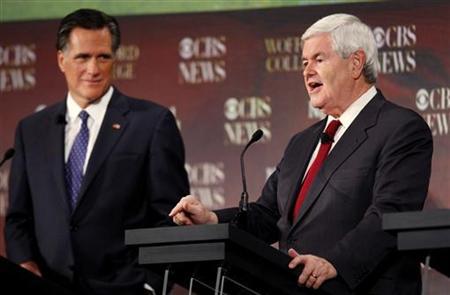
Pakistan took a lot of criticism in Saturday’s Republican presidential debate, with a leading candidate saying it was nearly a failed state and another suggesting the United States cut its foreign aid to zero.

But it is unclear whether any of their ideas is likely to be imposed on a country that has nuclear weapons and whose cooperation is seen as vital to stabilizing Afghanistan as the United States prepares to pull out from there by the end of 2014.

Former Massachusetts Governor Mitt Romney said Pakistan has multiple centers of power including the relatively weak civilian leadership, the military and the powerful intelligence agency know as the Inter-Services Intelligence Directorate.

“The right way to deal with Pakistan is to recognize that Pakistan is not a country, like other countries, with a strong political center that you can go to and say, ‘Gee, can we come here, will you take care of this problem?'” Romney said.

“This is instead a nation which is close to being a failed state. I hope it doesn’t reach that point, but it’s really a fragile nation,” he said.

Polls point to Romney as the Republican who would be the most likely among the party’s crop of candidates to defeat President Barack Obama, a Democrat, in the November 2012 U.S. presidential election. The Republicans begin choosing their nominee in state contests beginning in January.

Texas Governor Rick Perry suggested that every country, including Pakistan, should see its U.S. aid eliminated each year and then should convince the United States why it deserves any money at all.

“Then we’ll have a conversation in this country about whether or not a penny of our taxpayer dollars needs to go into those countries,” Perry said in response to a question about whether Islamabad was playing a double game with Washington.

“Pakistan is clearly sending us messages … that they don’t deserve our foreign aid … because they’re not being honest with us,” he added.

“American soldiers’ lives are being put at jeopardy because of that country … and it’s time for us as a country to say no to foreign aid to countries that don’t support the United States of America,” he said.

‘FRIEND OR FOE’

Businessman Herman Cain had difficulty offering a direct response when asked whether Pakistan was ultimately an ally or adversary. “There isn’t a clear answer as to whether or not Pakistan is a friend or foe,” Cain said.”

U.S. officials have long argued that the Taliban and other militants enjoy safe havens in Pakistan from which they attack U.S. soldiers in neighboring Afghanistan.

They privately argue Pakistan plays a double game, taking billions of dollars in U.S. aid while elements of its government tolerate militant groups such as the Haqqani network blamed for a September attack on the U.S. embassy in Kabul.

Pakistan says it has made more sacrifices than any other country in the war against militancy, losing about 10,000 members of its military and security forces.

There have been growing questions in Washington about whether U.S. troops should to go after Taliban safe havens in Pakistan, an idea sure to be deeply unpopular in a population already embittered by U.S. drone strikes.

Some Republican candidates argued that the United States has little choice but to nurture relations with Pakistan, citing the fact that it has nuclear arms and that it has to be part of the solution in Afghanistan.

“Pakistan must be a friend of the United States for the reason that Michele (Bachmann) outlined. Pakistan is a nuclear power,” said former Pennsylvania Senator Rick Santorum, referring to fellow Republican candidate Bachmann.

“It’s important for us, with a nuclear power with a very vast number of people in Pakistan who are radicalizing, that we keep a solid and stable relationship and work through our difficulties,” he added.

Trust Deficit with Pakistan Shrinking: Singh

As Reported by The Express-Tribune via AFP


The leaders of India and Pakistan will meet on the sidelines of a regional summit this week, as the nuclear-armed rivals seek to push a tentative rapprochement in their fractious relationship.

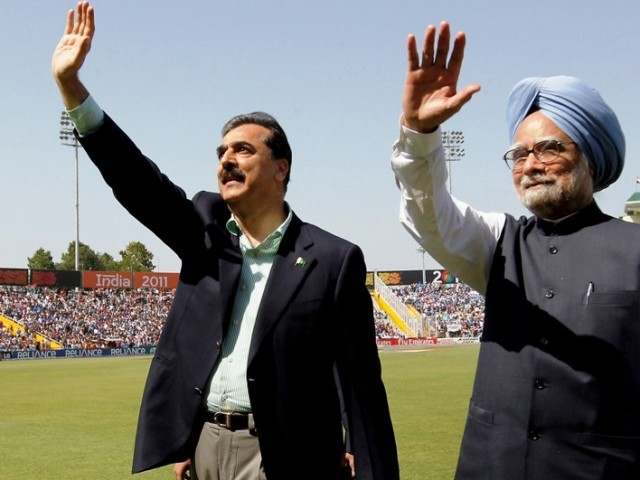
Talks between Indian Prime Minister Manmohan Singh and Pakistani counterpart Yousuf Raza Gilani will take place at the summit of South Asian Association for Regional Cooperation (SAARC) nations that opens Thursday in the Maldives.

India’s foreign minister said Wednesday that a “trust deficit” with Pakistan was shrinking as he headed for a regional summit, in a clear sign of warming relations between the neighbours.

“The trust deficit with Pakistan is shrinking,” S.M. Krishna said on board his flight to the South Asian Association for Regional Cooperation (SAARC) summit in the Maldives, the Press Trust of India news agency reported.

He also said that it was necessary for Pakistan and India to develop a joint strategy to fight terror in the region, the agency reported.

Their meeting follows what Indian Foreign Secretary Ranjan Mathai described as “positive indicators” from Pakistan in recent weeks that it is serious about reducing tensions.

An Indian military helicopter which strayed into Pakistani territory last month was promptly released along with its crew and returned to India, avoiding what in the past could easily have escalated into a diplomatic row.

And last week the Pakistani cabinet approved a proposal to grant India the status of “most favoured nation” in a move towards normalising trade relations.

“These are I would say indications of forward movement,” Mathai said, adding that “all aspects” of the India-Pakistan relationship would be discussed during the Singh-Gilani talks.

The two prime ministers last met in March when Gilani accepted Singh’s invitation to watch the India-Pakistan cricket World Cup semi-final. They last held formal talks at the 2010 SAARC summit in Bhutan.

Talks between the neighbours’ foreign ministers in July failed to produce a major breakthrough, but both sides signalled a warming of ties, with Pakistan’s Foreign Minister Hina Rabbani speaking of a “new era of cooperation.”

But efforts to reduce tensions have been complicated by the increasing influence of Afghanistan in the bilateral equation.

Indian involvement in Afghanistan is sensitive, with Pakistan vehemently opposed to its arch foe meddling in what it considers its backyard. Islamabad’s suspicions were fuelled when Afghanistan and India signed a strategic partnership pact last month.

Afghan President Hamid Karzai will also attend the SAARC summit, along with the leaders of other member nations Bangladesh, Bhutan, the Maldives, Nepal and Sri Lanka. Previous summits of the regional body have been largely overshadowed by the India-Pakistan dynamic — a fact that Mathai acknowledged with regret.

“We would like the focus to remain essentially on the common business of SAARC … and hope that the focus will not be diverted to one single event,” he said. The summit is being held in Addu, on the southern Maldives’ island of Gan.

A Monster Roaming The World

By Paul Mcgeough for The City Weekly
Search for a firm footing in Pakistan and there is none – all is quicksand … strategically, politically, morally.

Here in south Asia, strategically sandwiched between failing Afghanistan and the China and India powerhouses, is a country in which journalists are abducted in the night by agents of the state and murdered; in which the only advance after a decade in which Washington has tried to buy friendship with cheques for more than $20 billion, is the expansion of Pakistan’s nuclear arsenal – which is on the verge of surpassing Britain’s as the fifth biggest in the world.

In Pakistan, a 50-year-old woman is sentenced to death on a dubious blasphemy charge – and politicians who dare to speak in her defence are gunned down; and a woman is gang-raped and paraded naked through her village on the orders of a local council, over bogus claims that her 12-year-old brother has offended a 20-year-old woman from the clan of the men who defiled her.

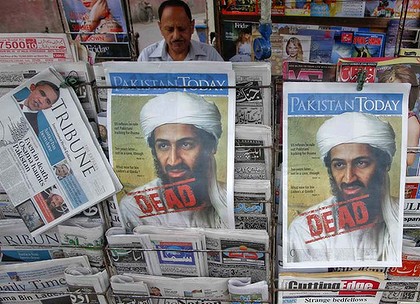
But that’s village life. In the leafy garrison town of Abbottabad, an hour’s drive north of Islamabad, Osama bin Laden, mastermind of the attacks of September 11, 2001, was able to hide in plain sight for years. The location of his fortified bunker, a stone’s throw from a prestigious military academy, made it harder to give any credence to the generals’ repeated denials that significant elements of Pakistan’s extensive security apparatus sheltered the al-Qaeda chief and continue to give succour to the Taliban and other insurgency and terrorist movements.

In the south-west, in the wilds of provincial Baluchistan, there have been 150 ”kill and dump” operations this year. Most of the victims are Baluch nationalist rebels. Their killers are the Inter-Services Intelligence agency (ISI) and other elements of Pakistan’s national security forces – driven to brutality by a belief, which could be correct, that Pakistan’s arch foe, India, stirs the local nationalist pot. In turn, the Baluch nationalists are accused of running their own death squads – their victims are Punjabi ”settlers”, government workers brought in from other parts of the country.

Baluchistan is half Pashtun, which also makes it a sanctuary for the Taliban from adjoining Afghanistan, where Washington and the world still struggle, with little success, to impose a semblance of democracy on the bones of a fracturing, failing state. Here then is another of the ironies that puts a serious question mark over the bona fides of the Pakistani security forces: the leadership of the Afghanistan Taliban sequesters in Quetta, the provincial capital of Baluchistan, but the various Pakistani security services are so busy putting the Baluch nationalists through the mincer they don’t have time to take down the Taliban command-and-control centre. Instead, they reportedly socialise with the Taliban and sit in on their strategy meetings.

West from Baluchistan is the sprawling port city of Karachi, where the spiralling death toll in renewed ethnic turf-wars gives raw meaning to what local novelist Kamila Shamsie broaches obliquely, recounting how the city ”winks” at her. “Yes, the city said, I am a breeding ground for monsters, ” she writes, “but don’t think that is the full measure of what I am.”

This drab, chaotic home to 18 million people who account for 65 per cent of Pakistan’s economy is being carved up by bullets that this year have accounted for as many as 1000 ”wrong place, wrong time” deaths as gunmen randomly select their targets – sending messages to whole communities, not the individuals with whose blood they paint the rough pavements. As the suburbs seethe, police do little, because they are cowed by the systematic elimination of those in their ranks who intervened in the last iteration of these ethnic wars. Provincial and federal governments and the security forces only wring their hands.

In Karachi everyone lies. No one denies turf wars are being waged. They simply blame everyone else – all the political parties deny any links to the militias that prosecute their bloody agendas and to the crime, drug and land-development mafias that prosper in their wake. And the city’s once-dominant Urdu-speaking Mohajirs fight to maintain their control of corrupted city politics, amid an influx of Pashtuns fleeing upheavals along the Afghan border.

“Tension rises, we see killings and then scores must be settled,” an adviser to the provincial governor says. “We are at war – the political parties say they are not involved, but the mafias take shelter from the parties as they exploit the situation.”

In Islamabad, enter any of the city’s newsrooms, and see fear in the eyes of journalists who risk death and torture for going about assignments. Consider the words of their Karachi colleague Madiha Sattar – “a growth of intolerance has forged an extreme, murderous antipathy to freedom of expression.”

Most shocking in this campaign of fear and intimidation against one of the pillars of democracy was the disappearance in late May of Syed Saleem Shahzad, an investigative reporter for the respected, Hong Kong-based Asia Times Online. Two days after his abduction, Shahzad’s battered body was found at Mandi Bahauddin, 130 kilometres south-east of the capital. The reporter left detailed accounts of the threats he had received from the ISI; in Washington, senior officials unflinchingly confirming that Shahzad’s death had been ”sanctioned” by the Pakistani government.

Umar Cheema might just as easily have been their victim. Behind a door marked ”Investigation Cell” off a basement corridor in the Islamabad offices of The News, the 34-year-old father of two explains that the shock in his colleague Saleem Shahzad’s murder was a realisation it might just as easily have been him.

As Cheema drove home from a party in the early hours during Ramadan last year, 12 men who identified themselves as police commandos abducted him, he says. Informing him first that he was a suspect in a killing, they pulled a bag over his head and hauled him away.

“They took me to a building where the leader stripped off my clothes. Then I was ordered to lie on the floor and they beat me on the back and shoulders for 20 or 25 minutes with leather straps and wooden canes.

“I was writing about corruption in the government and the lack of accountability in the military and intelligence agencies – they said they were beating me because of my reporting. Then they shaved my head and eyebrows – that’s what is done to thieves in rural areas to humiliate them.

“Shahzad’s death left me speechless,” he says. “I was the second last victim before they took him. So I felt very much that this was a message for me – it was very, very personal.”

In Islamabad, the government of Prime Minister Yousaf Gillani is as overwhelmed as it is complicit in the nation’s failings. The economy is in crisis and the government has ceded control of more than half the country to the military or to extremist militias. “None of the cogs of state mesh to make it do what must be done,” Human Rights Commission of Pakistan’s Kamran Arif said.

Just south of Islamabad is Rawalpindi, a more typical Asian city than the sanitised and empty boulevards of Islamabad. As home and headquarters to the men and institutions that comprise Pakistan’s military and intelligence establishment, this is the centre of absolute power in Pakistan. And it is here that a deep-fried sense of humiliation over the American raid to kill Osama bin Laden, in May this year, is felt most acutely.

“After the bin Laden raid, it’s a question of the survival of the state,” the defence analyst and director of the South Asian Strategic Stability Institute, Maria Sultan, says. “The problem now is that by this very public humiliation, the US has lost its biggest supporter – it’s not the capability of the Pakistani military that is affected, it’s its credibility.”

A close reading of ”Getting Bin Laden”, The New Yorker’s inside account of the May 2 raid, reveals the mission was not just a single US incursion that managed to evade Pakistan’s air defences. On the night, there were effectively three separate American missions, none of which was detected by a military-security complex that demands indulgence by the people of Pakistan on the grounds that it is their only protection from the Indian hordes.

Pakistan’s generals faced a grim choice – they had to admit to deceiving the world in harbouring bin Laden, or to incompetence by not knowing he was lounging in their backyard. So supine were they in opting to plead incompetence there were fears of a mutiny in the middle ranks of the security services.

The US signal to the world of just how much it could not trust its south Asian ally came hard on the heels of serial embarrassments at the hands of the Taliban and other militant groups in Pakistan.

There have been a series of militant attacks on the most secure and sensitive defence establishments. The latest, which some observers concluded could not have been undertaken without inside help, saw a 10-man assault team storm the Mehran naval aviation base in Karachi. It took hundreds of Pakistani navy commandos, marines and paramilitaries to retake the base, but not before two aircraft were destroyed, hostages taken and the base had been occupied for the best part of a day.

But it takes a discerning Pakistani general to differentiate between militants – some are ”strategic assets” of the security apparatus and the generals refuse to go after them.

Dr Ayesha Agha, whose military and political commentaries appear in Pakistan’s Dawn newspaper, explains: “The military depends on these ‘assets’ – they are a cost-effective means to fighting wars that the Pakistani military wants to fight in India and Afghanistan.” Extrajudicial killings by the military now are counted in the hundreds.

When men in uniform were filmed recently murdering a detainee, the reckoning in human rights circles was that far from being a lapse of judgment, the recording had been allowed in the knowledge that its distribution on the internet would serve as a useful warning to the wider community.

A Karachi taxi driver becomes excited as he ferries us from the airport to a downtown hotel – “Pakistan lovely country,” he bellows. “Terrorism? No, no, no.”

But a single graphic in a 200-page study of Pakistan, published in May by the Washington-based Centre for Strategic and International Studies, reveals an impossible security challenge. Last year alone, 2113 terrorist attacks, 369 clashes between the security services and militants, 260 operational attacks by the security forces, 135 US drone attacks, 69 border clashes, 233 bouts of ethno-political violence and 214 inter-tribal clashes resulted in more than 10,000 dead and as many injured.

The death of bin Laden and the reported death of al-Qaeda’s new No. 2 figure, Atiyah Abd al-Rahman, in an American drone attack last week, are still being factored into a running debate among intelligence specialists on the extent to which al-Qaeda offshoots elsewhere in the world, especially the Yemen-based al-Qaeda in the Arabian Peninsula [AQAP], have taken the baton from the Pakistani organisation.

But a July study by the New America Foundation of 32 ”serious” jihadist terror plots against the West from 2004 to 2011, finds 53 per cent had operational or training links to jihadist groups in Pakistan – compared to just 6 per cent being linked to Yemen. And the rising tempo of the drone attacks has failed to dent the rising frequency of Pakistan-linked plots against the West, the study finds.

Implicit or explicit in any discussion on Pakistan’s volatile mix of militant violence and governmental chaos, is the level of anxiety around the world about the security of its nuclear arsenal. Confronted with claims such as that by bin Laden that acquiring a nuclear weapon was a ”religious duty” and the hope expressed by one of his lieutenants that such a weapon one day might be seized in Pakistan, officials in Islamabad invariably boast that all is tightly locked down.

But when we ask a Pakistani diplomat how secure were the weapons in the aftermath of the US mission to kill Osama bin Laden, he replies: “Less so, now that the Americans have revealed to the world that it is possible to sneak into Pakistan undetected, to take something that you really want.”

President Obama’s public appeal that Pakistan not become the world’s first ”nuclear-armed militant state” gives context to disclosures by The New Yorker’s Seymour Hersh of the existence of a US Special Operations rapid-response team which would be parachuted into Pakistan in the event of a nuclear crisis.

Rolf Mowatt-Larssen, a former director of intelligence and counter intelligence at the US Department of Energy, is boldest in setting out the fears of Washington, London and other capitals – some of which were disclosed without diplomatic varnish by Wikileaks last year.

Writing in Arms Control Today, Mowatt-Larssen, who served 20 years at the CIA, bills Pakistan as the most likely setting for terrorists bent on acquiring a nuclear device to co-opt a nuclear insider – of whom there are estimated to be as many as 70,000 in Pakistan.

“There is a lethal proximity between terrorists, extremists, and nuclear weapons insiders,” he writes. “Insiders have facilitated terrorist attacks. Suicide bombings have occurred at air force bases that reportedly serve as nuclear weapons storage sites. It is difficult to ignore such trends.

”Purely in actuarial terms, there is a strong possibility that bad apples in the nuclear establishment are willing to co-operate with outsiders for personal gain or out of sympathy for their cause.”

“Not possible,” says Maria Sultan. “About eight to 10,000 personnel working at the strategic level on security,” she says, ticking off seven or eight interlocking layers of complex security, the first of which she says would trip most intruders before they came within 80 kilometres of a nuclear facility. “The idea that a terrorist can walk in and get hold of a device is just not possible.”

Such is the bind in which Pakistanis find themselves. But if it is true feeble and corrupt civilian administrations make circumstances ripe for a military takeover, it is hardly surprising the generals have no respect for democratic fundamentals.

As revealed in one of the Wikileaks cables, Army chief General Ashfaq Parvez Kayani was ready to force President Asif Ali Zardari from office – save for the fact the general thought even less of Zardari’s likely civilian replacement. And historically, Washington has opted to connect with Pakistan through the military power of the generals, rather than the people power of the civilian leadership.

Bruce Riedel, a veteran CIA analyst, sets out the connections in Deadly Embrace: Pakistan, America and the Future of the Global Jihad. “…Richard Nixon turned a blind eye to the murder of hundreds of thousands of Bangladeshis to keep his friends in Pakistan’s army in power, a strategy that ultimately failed,” Riedel writes. “Ronald Reagan entertained Zia-ul-Haq even as Zia was giving succour to the Arab jihadists who would become al-Qaeda. George W. Bush allowed Pervez Musharraf to give the Afghan Taliban a sanctuary from which to kill American and NATO soldiers in Afghanistan.”

And in the judgment of Bushra Gohar, an elected MP from Pakistan’s troubled Swat Valley, Washington still prefers to deal with the military rather than the country’s civilian leadership. “That’s not a role that the military has under the constitution,” she says during a break in the business of the National Assembly in Islamabad. “There has been a democratic transition in this country and we expect the international community to support it.”

Power vacuums become ripe for exploitation, as was revealed with frightening clarity earlier this year when two of three elected figures who had dared to speak out against Pakistan’s draconian blasphemy laws were assassinated. In January, Punjab provincial governor Salman Taseer was gunned down by one of his state-provided security men; in March, the Minorities Minister and the only Christian in Gillani’s cabinet, Shahbaz Bhatti, died in a hail of gunfire as his car left his mother’s home in Islamabad.

Taseer’s killer confessed and became a national hero. His home is a shrine, he is garlanded with rose petals and, in the oddest twist of all, the young lawyers’ movement that effectively bundled Pervez Musharraf, the last dictator, from power in 2008, has taken the side of this cold-blooded murderer – not the principle for which his victim died.

A visitor leaves Pakistan wondering if anyone here speaks the truth. The dictators habitually resort to amping up religious parties – either to drown out secular ones that might be interested in the ideals of selfless democracy, or to further marginalise the country’s Shiia Muslim minority.

“And people like Musharraf have two faces,” Kamran Arif of the Human Rights Commission of Pakistan said. “He would say all the right things for the West and do just what he wanted to do at home.”

Some foreign analysts fall back on the seeming failure of Pakistan’s religious parties at the ballot box as a hopeful sign. But a sense of rising radicalisation, particularly in the military and the middle classes, suggests an asymmetric contest for control of a highly unstable society – the non-religious parties fight in the parliament, but the religious parties are street brawlers.

Sherry Rehman, the only elected figure in the country to defend the convicted blasphemer Aasia Bibi, makes the same point in explaining how that debate was lost. “The discourse shifted from the parliament to the street,” she says.

“We have to keep the agenda in the parliament, and not with the gun-toting thugs who make inflammatory speeches outside.”

Like the financial institutions in the 2008 global financial crisis, Pakistan is deemed by Washington to be ”too big to fail”. Between them, however, Washington and Islamabad have been unable in the past decade to make this relationship work – credibly or creditably.

Predictions of imminent collapse in Islamabad are exaggerated, but perhaps not overly so. “The government does not have the capacity to tackle any of the issues,” says the Human Rights Commission of Pakistan’s Arif. “Things will just keep getting bad … and I don’t discount the fact that we can fall into chaos.”

Like many other analysts, Bruce Riedel laboriously sets out the policy options by which Washington and Islamabad might work together to defeat the global jihadist movement – before he concludes that none is easy or guaranteed.

An adviser to several US administrations and now with the Brookings Institution, Riedel sees Pakistan under siege from a syndicate of radical terrorist groups unified by the notion that nuclear-armed Pakistan could be the extremist jihadist state they have never had.

“They want to hijack Pakistan and its weapons,” he says. Alluding to Islamabad’s role in creating a monster, as often as not with Washington’s sponsorship, he writes: “An extremely powerful jihadist Frankenstein is now roaming the world, with equally powerful protectors in Pakistani society, right up to the very top.

“Who cannot fear that the ‘long beards’ will prevail?”

Panetta: ‘No Choice’ in US Relations with Pakistan

By David Gollust for Voice of America

Defense Secretary Leon Panetta said Tuesday that the United States has no choice but to maintain close relations with Pakistan, despite government links with Islamic militants including the Haqqani network. The State Department, meanwhile, put sanctions on another Haqqani network commander.

Panetta, who took over as defense secretary in June after two years of heading the CIA, declined comment on news reports that Pakistan allowed China to inspect the wreckage of an advanced U.S. helicopter lost in the raid that killed Osama bin Laden.

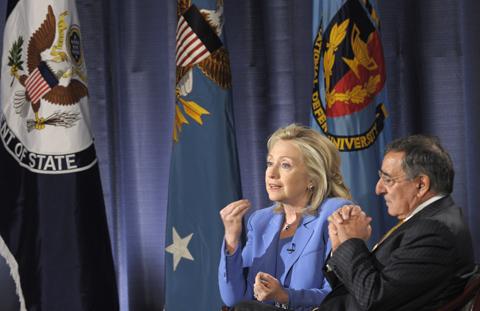
But at a public forum with Secretary of State Hillary Clinton at Washington’s National Defense University, the defense chief was unusually candid about U.S. problem issues with Pakistan.

Panetta said Pakistan has “relationships” with the Haqqani network – militants based in western Pakistan who conduct cross-border attacks on U.S. forces in Afghanistan, and with Lashkar-e-Taiba militants who have attacked India.

Both groups are listed by the United States as terrorist organizations. Despite complaints that Pakistan has withheld visas for U.S. citizens being posted there, Panetta said the relationship remains essential.

“There is no choice but to maintain a relationship with Pakistan,” said Panetta. “Why? Because we are fighting a war there. We are fighting al-Qaida there. And they do give us some cooperation in that effort. Because they do represent an important force in that region. Because they do happen to be a nuclear power that has nuclear weapons, and we have to be concerned about what happens with those nuclear weapons. So for all of those reasons, we’ve got to maintain a relationship with Pakistan.”

Secretary of State Clinton said the Obama administration considers relations with Pakistan to be of “paramount importance.”

She said there have been “challenges” in bilateral ties for decades with valid complaints on both sides, and that she credits the Islamabad government with lately recognizing its shared interest with Washington in confronting terrorism.

“I was very pleased when the Pakistanis moved into [the] Swat [Valley] and cleaned out a lot of what had become a kind of Pakistani Taliban stronghold,” said Clinton. “And then they began to take some troops off their border with India, to put more resources into the fight against the Pakistani Taliban. Now, as Leon [Panetta] says, we have some other targets that we discuss with them – the Haqqanis, for example. And yet it’s been a relatively short period of time, two-and-a-half years, when they have begun to reorient themselves militarily against what is, in our view, an internal threat to them.”

The State Department on Tuesday designated a key Haqqani network commander – Mullah Sangeen Zadran – a terrorist under a 2001 White House executive order, freezing any U.S. assets he has and barring Americans from business dealings with him.

At the same time, Sangeen was designated a terrorist by the U.N. sanctions committee, which will subject him to a global travel ban, an asset freeze and an arms embargo.

A State Department statement said Sangeen, is a “shadow governor” of Afghanistan’s southeast Paktika province and a senior lieutenant of network leader Sirajuddin Haqqani. It said Sangeen has coordinated the movement of hundreds of foreign fighters into that country and that he is linked to numerous bomb attacks and kidnappings.

Amir Khan, A Son of Pakistan

By Manzer Munir for Pakistanis for Peace

Amir Khan is a British boxer. Let’s first get that straight. He represented Britain in the 2004 Olympics in Athens, Greece where he was the only British boxer in the contingent. In those Olympics, the British flag was raised and a medal counted towards their overall tally due to Amir’s performance. At the age of 17, he brought home the silver in his lightweight boxing class and became the youngest British boxer to represent the United Kingdom since Colin Jones in 1976.

Since then, an impressive professional career has blossomed to where presently Khan is the current WBA Super Lightweight champion of the world. He has a record of 26 wins and only one loss with 17 of those wins coming by way of a knockout. That sole loss to Briedis Prescott, where Khan was knocked out in the first round, is the only blemish in his otherwise stellar career. Since that bout in 2008 against Prescott, Khan has gone on to defeat such notable fighters as Marcos Antonio Barrera, Marcos Maidana and Paul McCloskey. Today he is considered one of the best pound for pound British fighters in the world.

Standing in his way to even bigger fame and glory was tonight’s fight against Zab Judah, the IBF light welterweight champion of the world and a fighter who had won five world titles in different weight classes. The fight was thought to be very interesting as Judah is considered a very experienced fighter and someone who was capable of knocking out the lightening quick Khan. The winner of tonight’s fight also would go on to unify the Light Welterweight titles as he would be the IBF and WBA Light Welterweight champion of the world.

In the boxing circles there was also a lot of talk of a potential fight in the near future with the undefeated Floyd Mayweather Jr. prior to Kans’s fight against Judah. Mayweather is considered as one of the best boxers in history due to his impressive undefeated fighting record of 41 wins and 0 losses. In an interesting note, Amir Khan is trained by Freddie Roach who also happens to be the trainer for Manny Pacquiao, the seven division world champion and also arguably one of the best fighters of all time. Pacquiao is the only boxer that Mayweather has refused to fight due to one reason or another. A fight that boxing fans around the world have been salivating at for several years now. A potential fight between Khan and Mayweather will need to suffice the fight fans until and if the Mayweather vs Pacquiao fight ever materializes. Therefore saying that the ramifications of tonight’s fight are big would be an understatement in the boxing community.

As for me, my love for boxing must have started at an early age when I learned that my father, on a training trip to the United States, met and had a lengthy meeting with the greatest of all time, Muhammad Ali. At that time my dad had gone to America in the 70’s on a training course on behalf of his company. While staying at the Hilton hotel in Memphis, Tennessee, he ran into the world heavyweight champion Ali in the lobby where a crowd was hounding the champion.

Instantly recognizing Ali, who surely must be one of the most famous people the world has ever known, my dad reached out to shake his hand and at the same time uttered “Asalaam-alikum” to Ali. Grabbing my father’s hand, Ali replied with “Walikum Asalaam” and asked where my father was from, to which he replied Pakistan.

Intrigued with meeting a Muslim from the East as he later stated to my father, Ali invited him to his penthouse suite where my dad proceeded to spend close to two hours with Ali and his entourage during which time the champ asked him many questions about Pakistan and Islam. In particular, he was interested in how the religion was practiced as compared to the way practiced by the Muslims of the Nation of Islam in America, an organization that Ali was influenced by.

Having heard numerous accounts of his story growing up along with seeing countless pictures of my dad and Ali during their encounter so many years ago, not only endeared me to the champ but also to the sport of boxing. Since then I have always followed boxing and seen many great fights and boxers. But for the first time, my interests in boxing along with many people of Pakistani origins has piqued further by the arrival on the world stage of Amir Khan.

Although he is known as the pride of Bolton in England where he was born, his Pakistani origins are never far away as they are a big part of his life and spirituality since his family hails from Kahuta in Rawalpindi, Pakistan. Kahuta which was previously famous for being the site of Pakistan’s main nuclear facility is now also known as the area of Pakistan where Amir’s family originates.

This nation of Pakistan has in the last few years perhaps become synonymous with terrorism, instability, bombings, religious intolerance and extremism. But for one night, the Pakistani people can raise their head with pride and claim Amir as one of their own. He is a product of their soil who is making the country proud during a difficult time in their history. It is also a credit to his native England that promoted an environment for him to train and succeed. There is no limit to the amount of other talent in Pakistan that would have a chance to succeed if only there were such facilities and opportunities in Pakistan or even stability and security that was provided to Khan in England.

There is no doubt that to many people both inside and outside the nation of his forefathers, Amir Khan represents the best of every Pakistani. To these people. whether they are Pakistani Canadians in Toronto, or a youth in the inner streets of Birmingham, UK or a Pakistani American eating paan on Devon St in Chicago, Amir Khan is one of their own.

As he fought and defeated Judah in Las Vegas Saturday night, Amir Khan looked up and saw the thousands of British fans in attendance who had traveled from the UK and were proudly waiving the Union Jack. Deep inside, he must have known that many more millions in Pakistan and across the world were praying and hoping for even greater future success for him as the hopes and dreams of an entire nation are squarely on his able shoulders.

–Manzer Munir, a proud American of Pakistani descent, is the founder of Pakistanis for Peace and blogs at www.PakistanisforPeace.com as well at other websites as a freelance journalist and writer.

Clinton Says US Encouraged by India-Pakistan Talks

By Matthew Lee and Ravi Nessman for The Associated Press

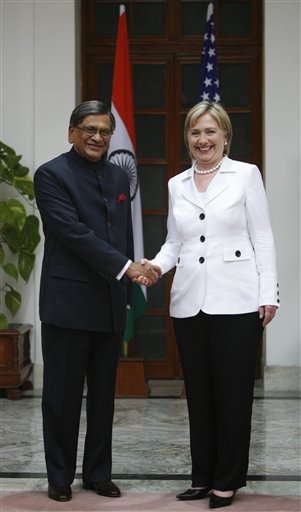
U.S. Secretary of State Hillary Rodham Clinton said Tuesday that the United States was “encouraged” by the ongoing talks between nuclear-armed rivals India and Pakistan and promised to give full support to Indian efforts to protect itself from terror.

Clinton’s visit to India came less than a week after a triple bombing killed 20 people in India’s financial capital of Mumbai, the worst terror strike in the country since 10 Pakistan-based gunmen rampaged through the city in 2008.

Her meetings with top Indian officials Tuesday focused on fighting terror, the U.S. withdrawal plans from Afghanistan and ways to broaden economic and security ties between the United States and India.

She also called for a swift resolution to their dispute over investments in nuclear energy, calling on India to ratify by the end of the year the Convention on Supplementary Compensation for Nuclear Damage and to adapt its liability laws to conform with the treaty.

The U.S. views India’s new nuclear liability law as too stringent on nuclear plant suppliers, making it difficult for private U.S. companies to compete against state-owned companies in India’s multibillion dollar nuclear reactor market.

Clinton’s trip here is part of a new round of U.S.-India strategic dialogue established last year to deepen ties between the world’s oldest and largest democracies.

S.M. Krishna, India’s foreign minister, expressed concerns that the planned U.S. troop withdrawal from Afghanistan that began this month could lead to a resurgence in Islamic extremism.

“It is in the larger interests of the region that it is necessary for the United States to work very closely with (Afghan) President (Hamid) Karzai and the government of Afghanistan and thereby create conditions where terrorists do not take any more advantage in Afghanistan,” Krishna said after 2 1/2 hours of talks with Clinton.

Clinton said she had outlined the drawdown strategy and stressed that the United States will not support Afghan reconciliation with insurgents unless it is inclusive and protects the rights of minority groups, religions and women.

Clinton also assured India of U.S. support in the fight against terror.

“We are allies in the fight against violent extremist networks. And homeland security is a high priority and a source of increasing partnership,” Clinton said.

While the U.S. and India have already signed agreements to cooperate in counterterrorism efforts, “the events in Mumbai have driven home how important it is that we get results,” she said.

Though India has not blamed Pakistan for last week’s attack, it has accused its neighbor of harboring violent extremist groups responsible for other attacks in India and of not doing enough to crack down on those responsible for the 2008 Mumbai siege.

For its part, U.S. officials fear Pakistan is not fully committed to combatting radical plots, such as the failed 2010 Times Square bombing in New York.

“We have made it clear to the Pakistani government that confronting violent extremists of all sorts is in its interest,” Clinton said.

India recently resumed peace talks with Pakistan that broke off following the 2008 Mumbai siege, and the two countries’ foreign ministers are expected to meet next week.

The U.S. is eager for the fragile talks to pick up steam, in part to allow Pakistan to focus its forces on the chaotic Afghan border.

“We are encouraged by the dialogue between India and Pakistan,” Clinton said, calling talks “the most promising approach” to build more confidence between them.

During the meeting Tuesday, Clinton and Krishna agreed to strengthen their countries’ ties in energy, security, education, the economy, science and promoting stability across the region. The two countries also signed an agreement promoting closer cooperation in cybersecurity.

Once frosty relations between India and the United States have warmed considerably in recent years as Washington has looked to India as stable ally in the turbulent South Asia region and its growing economy as a valuable market for U.S. goods.

President Barack Obama hosted Prime Minister Manmohan Singh at his first state dinner and visited India for three days last year, praising it as a new regional power. Clinton was to meet with Singh later Tuesday.

Growing business ties were among the top issues in the talks.

Western officials have looked to India’s rising economy and its 1.2 billion people as a coveted market to help stimulate growth in their own troubled economies.

“Each of our countries can do more to reduce barriers, open our markets, and find new opportunities for economic partnership,” Clinton said. “Taking these steps is in our mutual interest. We can improve millions of lives and increase both of our nations’ economic competitiveness.”

She praised India’s fight against piracy, and pushed for greater sales of U.S. arms to India — the world’s largest arms importer —as a way of deepening security cooperation between the two nations.

U.S. officials were annoyed earlier this year when Indian officials chose two European companies as finalists for an $11 billion order for 126 fighter jets. However, last month India signed an agreement to buy 10 Boeing C-17 cargo and troop-carrying aircraft for more than $4 billion.

From New Delhi, Clinton on Wednesday will move on to the southeastern port of Chennai, where she plans to deliver a speech on the importance of U.S.-Indian relations, the benefits of enhanced bilateral commercial ties and India’s role in South Asia and the greater Asia-Pacific region.

Clinton is in India on the third leg of a 12-day, around-the-world diplomatic tour that has already taken her to Turkey and Greece. After India, she will visit Indonesia, Hong Kong and southern mainland China before returning home July 25.

John Lennon- Imagine

The End of AfPak

By Scott Malcomson for The New York Times

Remember how after 9/11, Osama bin Laden’s attacks on us could be linked to almost anything, from shopping habits to the rediscovery of Western values to carbon-pricing schemes? Something similar appears to be happening with Bin Laden’s death. Jihadism sure isn’t what it used to be. After 10 years, it seems, the time has come to go home. Troops are and will be coming back to the United States from Iraq and Afghanistan. The military budget will be cut. The outgoing secretary of defense feels able to openly mock NATO because, presumably, he thinks he can afford to — because it doesn’t matter all that much. The global war on terror is being downgraded from Armageddon to something more out of Leviticus: a tricked-out police action, just as John Kerry, in this magazine, always said it should be. On Sunday, Helene Cooper and Mark Landler reported that “American success in the counterterrorism campaign would seem to bolster arguments for a swift withdrawal from Afghanistan.” By Tuesday morning, they were reporting that President Obama would announce his withdrawal plans on Wednesday. Meanwhile, a Harris poll revealed that 51 percent of Americans and 54 percent of Britons believed “the death of Bin Laden meant it was time to bring troops from their countries home.”

That isn’t quite how it looked when I was in Washington a few weeks ago and spoke with about a dozen current and former American officials and with Pakistanis. The impression they each gave was that American withdrawal would be speeded not because of Bin Laden’s death but because of Pakistan’s reaction to it. After the initial shock, Pakistan’s (government-influenced) press latched onto a narrative of “national humiliation” as a result of the American raid, rather than, say, one of jubilation at the demise of a killer whose fantasies have brought Pakistan nothing but misery. A younger generation of military officers — Pakistan is dominated by its military — seemed at times about to revolt in reaction to the insult to Pakistan’s sovereignty. And the Inter Services Intelligence (I.S.I.), Pakistan’s ubiquitous military intelligence outfit, reacted, as was subsequently reported, by scouring the neighborhood around Bin Laden’s house for … evidence of how the C.I.A. found out he was there, and to determine who had been helping the Americans.

Finally, the Pakistan government did not respond to the Bin Laden raid by pressing its new advantage and rolling up terrorist networks across the land. No, it did not do that at all. So Secretary of State Hillary Rodham Clinton and Admiral Mike Mullen, chairman of the joint chiefs of staff, went to Islamabad and on May 27 presented a list of demands. These included the arrest or elimination of Ayman al-Zawahiri (of Al Qaeda), Ilyas Kashmiri (a long-sought semi-free-agent and former Pakistani military man), Sirajuddin Haqqani (of the AfPak-border based Haqqani network) and Atiya Abdur Rahman (Al Qaeda), and the shutting down of bomb factories in Pakistan.

By June 3, Kashmiri was dead. But this promising start now seems isolated. The other wanted men are still at large. The bomb-makers might well be getting tipped off. The revolt by younger Pakistani officers seemed only to get worse.

In short, the U.S. and Pakistan are really not getting along. Among members of Congress, beating up Pakistan has become ritualized; Senators McCain and Rogers were doing it again on the Sunday programs. I wondered: How many times can Pakistan be abandoned? As Bruce Riedel, a former C.I.A. officer and the head of President Obama’s first major AfPak review, shows in his excellent new book, “Deadly Embrace: Pakistan, America and the Future of Islamist Jihad,” embrace and abandonment have formed the pattern of American-Pakistani relations since the majority-Muslim nation was formed out of the breakup of British India in 1947. Harry Truman’s lack of interest yielded to Dwight Eisenhower’s enthusiasm for Pakistan as an anti-Communist bulwark and a base for spying on the Soviets. The relationship was and remained built around security and intelligence. Lyndon Johnson reversed course when India and Pakistan went to war in 1965; he cut off both, but Pakistan had, unlike India, been a strong ally, and it felt betrayed. This set the pattern: ultimately, Pakistan was tactical and India was strategic.

Now, after almost 10 years of intense engagement, Pakistan and the U.S. appear set for another split; at least that was the consensus among the officials I spoke with. There was a pervasive sadness in these conversations. It was due in part to the sheer human effort that has gone into the U.S.-Pakistan relationship. A lot of spies and soldiers and diplomats and politicians have put years of their lives into making “AfPak” work, which requires making Pak work. A lot (not all) of that effort seems to be going down the drain, along with much of the billions of taxpayer dollars that financed it.

There is also personal sadness in that the AfPak effort was associated toward the end with Richard Holbrooke, whose death late last year brought the foreign-policy world up short. Holbrooke did not take great care of himself, so objectively his death could not be entirely a surprise, and among people over 70 the reactions I heard were more of the well-what-did-you-expect variety. But in the 35-to-65 range it was different. Holbrooke represented, very attractively, the assertion of youth and hope against experience. Even at 69 he had a distinct eagerness, even boyishness, alongside the baritone gravitas. He attracted bright young people. He could be young and old at the same time. Once he was gone, that sort of generational bridging disappeared. (Older figures are few in this administration.) The sense of continuity (as well as of optimism) is weakening. There’s something missing now.

There was also a sense of ideological loss of direction. For all their differences, Bill Clinton and George W. Bush shared a tangible optimism about American governmental involvement abroad. President Obama is different, and even if he weren’t the national mood is. The people’s representatives in Congress are vying to bring troops home faster, and if there is an internationalist remaining in the House he or she is keeping quiet. The Republican candidates for president seem to have settled on anti-war isolationism as a winning position. Obama’s great strength in foreign policy — his ability to repackage, and optimize, American power in a multipolar world — is the strategy that dare not speak its name, or it will bring accusations of “declinism.”

Finally, there is the tremendous sadness of Pakistan itself. The country doesn’t have enough water. It lacks the electricity to develop its industries. Literacy, by some reckonings, is actually declining. Democracy has been restored but the government is hardly stable. The one truly semi-stable institution, the military, is struggling against itself, just as Pakistanis are dividing, and attacking each other on an increasing scale (which is saying something).

But, in a way, the saddest thing of all, from a foreign-policy point of view — Pakistani or American — is that the one great card Pakistan has to play is to make itself a problem. Pakistan formed itself into a regional player through building its army, running terrorist proxies in Kashmir and Afghanistan, indulging in enough Islamist millenarianism to make itself frightening, and developing nuclear weapons. None of these strategies have a good future. But in the absence of a long-term committed relationship — what Holbrooke promoted as a “strategic partnership” — with the United States or, perhaps, with China, Pakistan is left with fear as its most successful export.

There was some discussion in Washington as to whether Mullah Omar’s name was on that list that Clinton and Mullen presented in Islamabad. It almost doesn’t matter. The doubt itself is the message: Pakistan stays valuable because it has terrorist “ties” or “links” or “proxies” or whatever. As national existential dilemmas go, Pakistan’s is particularly nightmarish. The U.S. will leave them to it — abandonment again — and choose the happier relationship with India. Secretary Clinton will be at the regional forum of the Association of Southeast Asian Nations in late July, helping to take her longtime initiative of eastward Indian engagement, and the integration of the United States into East Asian political structures, to a new level. This is part of a long-term strategy of accommodating the rise of China and of India.

And Pakistan, after 10 years, will be left behind; as the line in Washington goes, “There is no good solution.”

U.S., Pakistan, Through Thick and Thin

By Gerald F Seib for The Wall Street Journal

One diplomat long involved in the tempestuous U.S.-Pakistan relationship likens it to a Catholic marriage: There may be problems, but divorce isn’t an option.

And so it is that, almost a month after U.S. Navy SEALs entered Pakistan to kill Osama bin Laden, the two troubled partners find themselves not in divorce court but in an awkward but unmistakable process of reconciliation.

Signs of healing are popping up. Despite its anger and embarrassment at being left in the dark about the bin Laden raid, Pakistan’s intelligence service has begun cooperating again on a series of sensitive matters. Meanwhile, Secretary of State Hillary Clinton and Joint Chiefs of Staff Chairman Mike Mullen have just held the obligatory kiss-and-make-up talks in Pakistan, which U.S. officials describe as blunt but useful in moving forward.

And despite widespread anger in Congress over Pakistan’s harboring, either willfully or unknowingly, the world’s leading terrorist, Obama administration officials seem to be squelching the desire to extract revenge by cutting Pakistan’s aid.

There remains the danger of a rupture, and there still could be long-term damage. Street-level anger on both sides means the relationship can’t stand too many more shocks just now.

In particular, it seems likely that one result of the trauma will be a scaling back of the drone wars—America’s use of armed drones to launch strikes inside Pakistan to attack operatives of the Taliban movement fighting U.S. forces next door in Afghanistan.

The drones likely will continue to be used against top Taliban leaders when found, but less often against lower-priority targets, and probably under new and clearer rules of cooperation with the Pakistanis, say those familiar with the effort.

Still, the reality is that the two countries don’t have much choice but to move on. Regardless of how much love is flowing at any moment, they simply need each other.

The American war against al Qaeda globally and against Taliban insurgents in Afghanistan simply can’t be won without the cooperation of Pakistan. Much as Americans are infuriated by the way elements of Pakistan’s government and intelligence service hedge their bets by playing both sides in the struggle against extremism, there’s no doubt that Pakistani intelligence has been crucial in the fight.

For its part, Pakistan has, in its fit of pique over the bin Laden raid, made its best show of playing the China card to demonstrate to the U.S. that Pakistanis can find good, powerful friends in Beijing if Americans don’t treat them better. By coincidence, this has been proclaimed, officially by the two countries, the year of China-Pakistan friendship, which is a useful card for Pakistan to play right now.

But Pakistan’s post-raid overture showed the limits of the China option as much as anything else. Pakistani Prime Minister Yousuf Raza Gilani made a four-day trip to China soon after the bin Laden operation, and came away with a Chinese pledge to speed up delivery of some previously promised fighter jets.

Mr. Gilani’s other takeaway from his visit promptly proved dubious. His defense minister announced that Pakistan had invited China to take over management of a big Pakistani port at Gwadar, and to build a new naval base there. In response, the Chinese said, essentially, “We have no idea what you’re talking about.” Whatever was discussed, it appears to be less than originally advertised.

Pakistanis as well as Americans know China has its limits as an alternative big-power friend for Islamabad. American aid can’t easily be replaced, and China doesn’t tend to dole out assistance easily. Meanwhile, the U.S. is the top market for Pakistani exports, while China ranks fifth. China’s big textile industry actually is a key international competitor to Pakistan’s own textile sector.

Ultimately, the Chinese are less likely to be helpful to Pakistan in the war against extremism than will the U.S. China tends to use partnerships abroad to solve its problems, not to help friends solve theirs.

In the meantime, real and meaningful steps have resumed in the U.S.-Pakistani intelligence relationship. Pakistan has allowed American officials to speak with the bin Laden wives found in his compound. It has returned the tail section of a U.S. helicopter lost in the raid; there was stealth technology embedded in it—technology the U.S. feared an angry Pakistan might instead share with China.

And Pakistan has agreed to allow American officials into the bin Laden compound to search for more intelligence on al Qaeda operations run from there.

The U.S. now seeks more help in fighting the Taliban inside Pakistan, and there will be a three-way American-Afghan-Pakistani meeting to discuss Afghanistan next month.

All isn’t bliss between Washington and Islamabad—not by a long shot—but those aren’t the actions of partners headed their separate ways.

India and Pakistan Discuss Demilitarisation of Siachen

As Reported by The Economic Times

India and Pakistan today discussed demilitarisation of Siachen, a mountainous region where borderline is not demarcated, in a “constructive framework”, picking up the threads of the issue after a gap of three years.

The issue came up for discussion during the 12th round of two-day Defence Secretary level talks between the two sides.

“The talks were held in a constructive framework. Both sides apprised each other of their perception about the Siachen issue and also discussed the surrounding issues,” Defence Ministry officials said.

Defence Secretary Pradeep Kumar led the Indian delegation at the talks with his Pakistani counterpart Lt General (Retd) Syed Ather Ali.

The decision to resume the talks between the two countries was taken last year during the meeting of Prime Minister Manmohan Singh and his Pakistani counterpart Yousuf Raza Gilani in Thimpu when they decided to take forward the dialogue process.

While the Pakistani delegation has two civilian officials and four military officers, the Indian side includes Special Secretary R K Mathur, Director General of Military Operations (DGMO) Lt General A M Verma and Surveyor General S Subha Rao.

The Pakistani Defence Secretary met Defence Minister A K Antony in the afternoon for over 20 minutes.

The two sides may come up with a joint statement tomorrow after the talks, the officials said.

Pakistan has been asking for demilitarisation of the Siachen glacier and raised the issue of climate change there due to presence of troops from both sides and its effects on the environment.

Siachen, with an area of over 2500 sq km, the world’s highest militarised zone, has been a long pending issue between India and Pakistan over differences on the location of the 110-km long Actual Ground Position Line (AGPL) which passes through the Soltoro Ridge and Siachen Glacier.

U.S.-Pakistan Ties And The Curse of Secrecy

By Myra MacDonald for Reuters

When President Barack Obama telephoned Pakistan’s president to say U.S. forces had found and killed bin Laden, he offered him a choice. He could say Pakistan helped find bin Laden, or that it knew nothing, according to a senior western official. Pakistan initially chose to stress the former – that it had helped – but later shifted to condemning what it called the U.S. violation of its sovereignty.

The story illustrates the complicity between the United States and Pakistan in their deliberately ambiguous relationship. This ambiguity has its uses. It allows Washington to keep working with Pakistan in the face of angry questions at home about why Osama bin Laden was living there. And it lets Pakistan cooperate with the United States, for example on drone attacks, while trying — not particularly successfully — to minimize the domestic backlash.

But the result of that ambiguity has been a disconnect between the leadership of both the United States and Pakistan and their own people, who have little knowledge of the understandings being reached in the many high-level meetings between the two countries (and which will continue despite the deep distrust on both sides.)

As Christine Fair says in her interview with NBR, ”the Obama administration has had no illusions about Pakistan.” When it took office, it had full knowledge of Pakistan’s reluctance to eradicate militant groups, and indeed of the rapid expansion of its nuclear programme. But she added, “the Obama administration, like past administrations, has been willing to look the other way when it deems necessary.”

And for all the furious debate in both countries about the state of U.S.-Pakistan relations, “the leaderships of both countries know that they need each other in ways that are both humiliating and difficult to explain to publics that are ever more outraged and appalled by the perfidy of the other.”

The problem with this pattern of public fury and private reconciliation is that it leaves very little room to build trust between the two countries and almost no scope for properly informed public debate. Some secrecy is of course needed in war and diplomacy. But with the United States and Pakistan, it has become the automatic default position.

This secrecy and complicity did not just start with bin Laden and drone strikes. It goes way back to U-2 spy planes flying over the Soviet Union – Gary Powers, shot down in Russia in 1960, took off from Peshawar. It goes back to the jihad against the Soviet occupation of Afghanistan from 1979-1989, when Washington knew Pakistan would be forced to lie to the Soviet Union about its involvement for fear of inviting Russian retaliation on its own soil. It goes back to the United States turning a blind eye to Pakistan’s expanding nuclear weapons programme in the 1980s.

The United States is now talking about establishing new ground rules for the U.S.-Pakistan relationship. So how about introducing some openness into those new ground rules?

Consider one example where transparency just might be less damaging than secrecy.

The United States, which has begun tentative direct talks with representatives of the Taliban, wants Pakistan to facilitate the process of reconciliation. So does Pakistan (though they may not see eye-to-eye on how it should work.) As far as I understand from conversations with officials from various countries, including from Pakistan, these talks are not about reaching a straight-forward power-sharing agreement with the Taliban that would allow U.S. troops to leave Afghanistan. Rather they are one part of a wider and complex process meant eventually to bring all Afghan parties into a broad political settlement.

Yet such is the secrecy around the talks that there is a serious risk that if enough people believe the Taliban are about to return to power, their opponents will prepare for civil war, building up arms and funding in a way that makes this a self-fulfilling prophecy.

As Ronald Neumann, a former U.S. ambassador to Afghanistan, writes here about his visit to the country in March, “there is a desperate need to clarify U.S. intentions. From President Hamid Karzai to his opponents to non-political Afghans, I found everyone asking what our long-term goals are. Afghanistan is a traumatized nation after 30 years of conflict. Doubts about American intentions lead to conspiracy theories, hedging strategies and even talk of civil war if too much haste to reach a political settlement means the Taliban could be returned to power — something that many Afghans who suffered under the Taliban’s savage rule are determined to resist at all costs. ”

I have written before that there is rather greater strategic convergence between the United States and Pakistan than appears on the surface. Both want stability in Afghanistan. Pakistan – rather than wanting to reinstall a Taliban government in Kabul – has been insisting for a while it wants a stable and neutral Afghanistan. Both the United States and Pakistan want stability in Pakistan- such a statement of the obvious that it is often overlooked.

Meanwhile, India – always the elephant in the room in discussions about Pakistan – has begun a slow but steady attempt at peace-making – its focus nowadays being very much on doing what it takes to build its economy. Pakistan desperately needs to salvage its own economy – a view, analysts say, also promoted by army chief General Ashfaq Pervez Kayani, who sees the country’s security as coming from its economic strength. If a political settlement in Afghanistan and an India-Pakistan thaw were to open up trade across the region, all three countries would benefit and the gain of one would not necessarily be at the expense of the other (this idea at the moment is largely aspirational – but the fact that it is on the table at all shows how much times have changed.)

So arguably, both the United States and Pakistan are roughly on the same page on what needs to happen. Yet their relations are a tactical and emotional disaster. Those long decades of secrecy have not helped. As Najam Sethi wrote in his column, the “carefully contrived and mutually agreed ambiguity has now run aground.”

If something needs to change in the U.S.-Pakistan relationship, there is one approach that has not been tried yet. Try breaking that habit of confining neary everything to secret understandings between military and political leaderships, and instead trusting the people of the countries affected — and that includes Afghanistan — to have a properly informed debate about what is the best way to bring stability to the region.

Pakistan Shuts Down U.S. ‘Intelligence Fusion’ Cells

By David S Cloud for The Los Angeles Times

In a clear sign of Pakistan’s deepening mistrust of the United States, Islamabad has told the Obama administration to reduce the number of U.S. troops in the country and has moved to close three military intelligence liaison centers, setting back American efforts to eliminate insurgent sanctuaries in largely lawless areas bordering Afghanistan, U.S. officials said.

The liaison centers, also known as intelligence fusion cells, in Quetta and Peshawar are the main conduits for the United States to share satellite imagery, target data and other intelligence with Pakistani ground forces conducting operations against militants, including Taliban fighters who slip into Afghanistan to attack U.S. and allied forces.

U.S. special operations units have relied on the three facilities, two in Peshawar and one in Quetta, to help coordinate operations on both sides of the border, senior U.S. officials said. The U.S. units are now being withdrawn from all three sites, the officials said, and the centers are being shut down.

It wasn’t immediately clear whether the steps are permanent. Adm. Mike Mullen, chairman of the Joint Chiefs of Staff, flew Thursday to Pakistan for a hastily arranged meeting with Gen. Ashfaq Kayani, the head of the Pakistani army. A Pentagon official said the two will probably discuss Pakistan’s demands for a smaller U.S. military presence.

The closures, which have not been publicly announced, remove U.S. advisors from the front lines of the war against militant groups in Pakistan. U.S. Army Gen. David Petraeus spearheaded the effort to increase the U.S. presence in the border areas two years ago out of frustration with Pakistan’s failure to control the militants.

The collapse of the effort will probably hinder the Obama administration’s efforts to gradually push Pakistan toward conducting ground operations against insurgent strongholds in North Waziristan and elsewhere, U.S. officials said.

The Pakistani decision has not affected the CIA’s ability to launch missiles from drone aircraft in northwest Pakistan. Those flights, which the CIA has never publicly acknowledged, receive assistance from Pakistan through intelligence channels separate from the fusion centers, current and former officials said.

The move to close the three facilities, plus a recent written demand by Pakistan to reduce the number of U.S. military personnel in the country from approximately 200, signals mounting anger in Pakistan over a series of incidents.

In January, Raymond Davis, a CIA contractor, shot dead two men in Lahore who he said were attempting to rob him. He was arrested on charges of murder but was released and left the country in mid-March, prompting violent protests in several cities.

Soon after, Pakistan ordered several dozen U.S. special operations trainers to leave the country in what U.S. officials believe was retaliation for the Davis case, according to a senior U.S. military officer.

Then, on May 2, five U.S. helicopters secretly entered Pakistani airspace and a team of U.S. Navy SEALs killed Osama bin Laden and four others at a compound in Abbottabad, a military garrison city near the capital, Islamabad. The raid deeply embarrassed Pakistan’s military and inflamed anti-U.S. sentiment across the country.

Javed Hussain, a retired Pakistani brigadier, blamed the decision to close the three intelligence centers on the mistrust that has plagued U.S.-Pakistani relations in recent months. Washington’s decision to carry out the raid against Bin Laden without informing Pakistan’s security establishment brought that mistrust to a new low, he said.

“There is lot of discontent within Pakistan’s armed forces with regard to the fact they’ve done so much in the war on terror, and yet they are not trusted,” Hussain said. “Particularly after the Abbottabad raid … the image of the armed forces in the eyes of the people has gone down. And they hold the U.S. responsible.”

The two intelligence centers in Peshawar were set up in 2009, one with the Pakistani army’s 11th Corps and the other with the paramilitary Frontier Corps, which are both headquartered in the city, capital of the troubled Khyber-Pakhtunkhwa province.

The third fusion cell was opened last year at the Pakistani army’s 12th Corps headquarters in Quetta, a city long used by Taliban fighters to mount attacks in Afghanistan’s southern provinces. U.S. troops have staffed the Quetta facility only intermittently, U.S. officials said.

The closures have effectively stopped the U.S. training of the Frontier Corps, a force that American officials had hoped could help halt infiltration of Taliban and other militants into Afghanistan, a senior U.S. military officer said.

The Frontier Corps’ facility in Peshawar, staffed by a handful of U.S. special operations personnel, was located at Bala Hissar, an old fort, according to a classified U.S. Embassy cable from 2009 that was recently made public by WikiLeaks.

The cable, which was first disclosed by Pakistan’s Dawn newspaper, hinted at U.S. hopes that special operations teams would be allowed to join the paramilitary units and the Special Services Group, a Pakistani army commando unit, in operations against militants.

“We have created Intelligence Fusion cells with embedded U.S. Special Forces with both the SSG and Frontier Corps” at Bala Hissar, Peshawar, the 2009 cable says. “But we have not been given Pakistani military permission to accompany the Pakistani forces on deployments as yet. Through these embeds, we are assisting the Pakistanis [to] collect and coordinate existing intelligence assets.”

Another U.S. Embassy cable said that a “U.S. Special Operations Command Force” was providing the Frontier Corps with “imagery, target packages and operational planning” in a campaign against Taliban insurgents in Lower Dir, an area of northwest Pakistan considered an insurgent stronghold.

In September 2009, then U.S. ambassador, Anne W. Patterson, wrote in another classified message that the fusion cells provided “enhanced capacity to share real-time intelligence with units engaged in counter-insurgency operations” and were “a significant step forward for the Pakistan military.”

The intelligence fusion cell in Quetta was not nearly as active as the facilities in Peshawar, current and former U.S. officials said. Pakistan has long resisted pressure to intensify operations against Taliban militants in Quetta. The city, capital of Baluchistan, is outside the tribal area, which explains Pakistan’s reluctance to permit a permanent U.S. military presence, a U.S. official said.

Despite the ongoing tensions, Pakistani authorities have agreed to allow a CIA team to inspect the compound where Bin Laden was killed, according to a U.S. official. The Pakistanis have signaled they will allow U.S. intelligence analysts to examine documents and other material that Pakistani authorities found at the site.

A U.S. official briefed on intelligence matters said the reams of documents and electronic data that the SEALs seized at the compound have sparked “dozens” of intelligence investigations and have produced new insights into schisms among Al Qaeda leaders.

We Should Hold Our Nose And Remain Engaged In Pakistan

By Joel Brinkley for Tribune Media Services

America’s involvement in Pakistan and Afghanistan may be the most complex foreign-policy dilemma the nation has ever faced. With the death of Osama bin Laden, along with Pakistan’s furious response, the knot is more tangled.

Right now, Afghan officials are reviling their Pakistani counterparts. Pakistan is flirting with China. American officials are threatening to curtail aid to Islamabad. Afghanistan is establishing what it calls the High Peace Council for reconciliation talks with the Taliban, while the United States is already saying the peace talks will almost certainly fail.

Meantime, Afghan Taliban leaders are trying to talk nice. Oh, we’re happy to let girls go to school, they are cooing through thin smiles. Just let us back into the government. At the same time, their fighters opened fire on an unarmed roadwork crew, massacring 36 workers and wounding 20 others.

Pakistani soldiers fired on a U.S. military helicopter flying along the Pakistan-Afghan border. But the government did display a small flash of grace. It gave the U.S. permission to haul away the ruined tail of the helicopter that crashed just outside Osama bin Laden’s home.

Think back to previous conflicts. Even the decisions behind the Vietnam War, one of the most traumatic events in American history, seem relatively simple by comparison. Now we are dealing with two nations led by perfidious, double-dealing scoundrels who take pleasure in disparaging us.

In a chorus over the last few days, President Hamid Karzai and other Afghan officials have been declaiming: You’re fighting the wrong war in the wrong place. They have their own self-interested motivations for saying that. Actually, though, they are correct.

Most analysts believe bin Laden left the tribal areas of Pakistan and moved to a compound just outside the capital to escape the rain of American drone missiles that were killing some of his minions.

Does it make any sense to believe that bin Laden would pull out all by himself, leaving behind his key aides and allies, like Mullah Omar, the Taliban leader? Of course not. Sooner or later we will learn that a half-dozen of them, at least, are hiding in full sight inside Pakistan, in their own high-walled compounds.

One frequent Afghan observation is well-taken, that all of the al-Qaeda and Taliban leaders of note are in Pakistan, not Afghanistan. The United States acknowledged years ago that few if any al-Qaeda operatives remained in Afghanistan.

But now Pakistani leaders are insulting and reviling the U.S., and senior members of Congress are threatening to withhold aid. As Sen. James Risch, an Idaho Republican, put it during a recent Foreign Relations Committee hearing, “Why are we spending our kids’ and our grandkids’ money to do this in a country that really doesn’t like us?

“It’s a hard sell to the American people.”

But the United States can’t stop providing aid to Pakistan and pull out of the country. For one thing, most of the supplies for the 100,000 American troops in Afghanistan are trucked in from Pakistan, and Pakistanis have already shown their eagerness, if provoked, to attack these caravans and torch the trucks. Look at the map, and you won’t find another politically possible supply route.

Pakistan is an extremely unstable country. Its leaders hold onto their pathological obsession with India and refuse to recognize the dire threat that the Taliban and other militants pose from within. What would happen if the government fell, and Islamic militants seized Pakistan’s 100-plus nukes?

Meanwhile, the Afghan war continues, to deprive al-Qaeda of a home there once again. But if the U.S. pulled out and al-Qaeda returned, they’d be doing the U.S. military a great favor. We’ve been trying to get at them in North Waziristan for a decade now with limited success at best. Move back to Afghanistan and they would be easy targets.

What could Karzai do about it?

This summer, President Obama is going to announce the first troop withdrawals from Afghanistan. The number being bandied about now is roughly 5,000 troops. He should ramp it up, withdraw faster. After all, now we are caught in the middle of a civil war between the previous and the present governments.

As for Pakistan, we have to hold our noses and remain engaged. The possible alternatives are simply too ugly to imagine. As Defense Secretary Robert Gates put it at the height of the rancor last week, like it or not, “we need them, and they need us.”