Archive for the ‘ Pakistan ’ Category

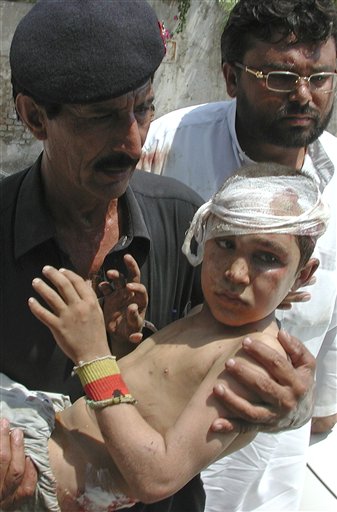
Pakistan Suicide Bombing Death Toll Jumps to 102

By Riaz Khan and Nahal Toosi for The Associated Press

The death toll from twin suicide bombings in Pakistan jumped to 102 with 115 people wounded on Saturday, making it the deadliest attack this year in the country.

Authorities continued to remove debris from the site of the attack in the village of Yakaghund in a northwest tribal region, after two bombers struck seconds apart Friday near a government office.

One of the bombs appeared fairly small but the other was huge, officials said. At least one bomber was on a motorcycle.

The attackers detonated their explosives near the office of Rasool Khan, a deputy Mohmand administrator who escaped unharmed. Tribal elders, including those involved in setting up militias to fight the Taliban, were in the building, but none was hurt, according to Mohmand chief administrator Amjad Ali Khan.

Video footage showed dozens of men searching through piles of yellow brick and mud rubble for survivors. Women and children were among the victims.

Mohmand is one of several areas in Pakistan’s lawless tribal belt where Taliban and al-Qaida members are believed to be hiding.

Abdul Wadood, 19, was sitting in a vehicle at the time of the bombings.

“I only heard the deafening blast and lost consciousness,” said Wadood, who was being treated for head and arm wounds in Peshawar, the main city in the northwest, about 15 miles (25 kilometers) away. “I found myself on a hospital bed after opening my eyes. I think those who planned or carried out this attack are not humans.”

Some 70 to 80 shops were damaged or destroyed, while damage to a prison building allowed 28 prisoners — ordinary criminals, not militants — to flee, said Rasool Khan, who gave the casualty figures.

Friday’s was the deadliest attack this year in Pakistan. On New Year’s Day, a suicide car bomber struck a sports event near a meeting of tribesmen who supervise an anti-Taliban militia near the South Waziristan tribal area, killing 96 people.

Near the attack site, officials had been distributing wheelchairs Friday to disabled people and equipment to poor farmers, Amjad Ali Khan said. It was unclear how many participants in that event were among the victims.

Pakistani Taliban spokesmen could not be immediately reached after the attack. There were scattered reports the militant group’s branch in Mohmand had claimed responsibility and said it was targeting the elders.

The Pakistani army has carried out operations in Mohmand, but it has been unable to extirpate the militants. Its efforts to rely on citizen militias to take on the militants have had limited success there.

Nevertheless, there have been fewer attacks in Pakistan this year than in previous years — most notably in the northwest. In the last three months of 2009, more than 500 people were killed in a surge of attacks in the country.

ā€œThis Passport is valid for all the countries of the World, except Israelā€

By Junaid Ghumman for Mideast Youth
The world Zionist movement should not be neglectful of the dangers of Pakistan to it. And Pakistan now should be its first target, for this ideological State is a threat to our existence. And Pakistan, the whole of it, hates the Jews and loves the Arabs. This lover of the Arabs is more dangerous to us than the Arabs themselves. For that matter, it is most essential for the world Zionism that it should now take immediate steps against Pakistan.ā€ Ben-Gurion, the Prime Minister of Israel.

This speech was first published in Jewish Chronicles on 9th August 1967. This statement risen many controversies bloggers like me have quoted it many times; various explanations were also given to disprove this statement, but still we read it on every article related to Pakistan and Israel.

Pakistan and Israel do share some history and ideology. These are only two countries in the world created in the name of Religion; Pakistan for Islam, Israel for Judaism and both countries have taken independence from same British Empire after World War II.

Then why my passport still says, ā€œThis Passport is valid for all the countries of the World, except Israelā€?

Pakistan claimed its independence from foreign invaders after two centuries of struggle. In 1757 after Battle of Plessey, East India Company started ruling Indian Sub-continent. The first armed resistance was Battle of Independence in 1857 after which the power was transferred to British government. In 1885 the political movement of independence started as Indian National Congress. Some of the Muslim leaders soon separated and launched new movement in 1906 as All India Muslim League for separate Muslim state which led to the creation of independent Islamic state Pakistan on 14th August 1947, which then became Islamic Republic of Pakistan in 1973.

For Israel the timings was same and the rulers were also same as of Indian sub-continents, but events and circumstances were totally different. Israel declared its independence on 14th May 1948 from British Mandate of Palestine. But Israel independence movement was not against British Occupation; rather it was a movement of creating a Jewish State by silently invading the markets, trades and areas to make Jewish settlements. Hovevei Zion or Hibbat Zion refers to organizations that are considered the foundations of the modern Zionist movement. These movements led to creation of Rishon LeZion in 1882 which is the first Jewish settlement in Palestine; which was at that time under Ottoman Empire. First Zionist Congress held in 1897 started the unified Zionist Movement which was converted to World Zionist Organization in 1960. This movement was successful in legalizing its demand of separate Jewish state in Palestine after Balfour Declaration 1917, in which British Mandate of Palestine’s (1917 – 1948) foreign Secretary Arthur James Balfour wrote letter to the leader of British Jewish Community Baron Rothschild, pledging British Empire support of creation of Jewish State in Palestinian Land.

So what kind of relationship does Pakistan and Israel has over period of 60 years?

While writing this blog I also tried to ask couple Pakistanis; their view points about Pakistan-Israel Relationship. Yousaf is Pakistani Engineer living and working in Saudi Arabia. Being in the region, Pakistanis here are emotionally and regionally attached to Middle East crisis. I asked him what kind of relationship both countries have. ā€œRelationship between Pakistan and Israel are tied to the fact that how Israel government treats the Palestinians. In general, as Jerusalem is considered as one of the holiest places in Islam; this fact serves as a thorn in the eyes of Pakistanis.ā€ Yousaf said.

Pakistan is among those 20 UN member nations which do not recognize Israel as an independent state. These 20 countries also include Afghanistan, Algeria, Bahrain, Bangladesh, Chad, Cuba, Indonesia, Iran, Iraq, Kuwait, Lebanon, Libya, Malaysia, North Korea, Saudi Arabia, Sudan, Syria, United Arab Emirates and Yemen. Unofficial media reports say that first Prime Minister of Israel David Ben-Gurion send secret message to Muhammad Ali Jinnah to formally accept its existence, but no response was given back to him. At the time of independence of Pakistan, it was reported that some 2,000 Jews remained in Pakistan, mostly Bene Yisrale Jews. Many left to Israel after its declaration of independence. Jews from Karachi, Pakistan, now live in Ramla, Israel, and they also built a synagogue they named Magen Shalome after the Pakistani Synagogue which was demolished in 1980.

60s, 70s and beginning of 80s were the decades when for the first time both countries came face to face when Arab-Israel war started. In ā€œSix-day Arab Israeli Warā€ of 1967; Royal Jordanian Air Force (RJAF) and Pakistan Air Force (PAF) were flying under a joint command. PAF pilot Flt. Lt. Saiful Azam became the only pilot from the Arab side to have shot down 3 IDF/AF aircraft within 72 hours.

In 1973 Arab-Israeli Yom Kippur War, 16 PAF pilots volunteered to support Syria and Egypt. On 23 October 1973 Flt. Lt. M. Hatif shot down the Israeli Phantom. On 26 April 1974, PAF pilot Flt. Lt. A. Sattar Alvi became the first Pakistani pilot, during the Yom Kippur War; to shoot down an Israeli Mirage in air combat. He was honoured by the Syrian government. Nur Khan, who was the Wing Commander received praised from Israeli President Ezer Weizman who wrote in his autobiography that: ā€œHe was a formidable fellow and I was glad that he was Pakistani and not Egyptianā€. Pakistan also sent medical ambulances to Egypt and Syria.

After the Israeli attack on Iraq’s under-construction French-built nuclear Osirak-type reactor, Tammuz-I, south of Baghdad on 7 June 1981, Pakistan’s then President President Zia-ul-Haq directed PAF Air Headquarters (AHQ) to make contingency plans for a possible Israeli attack on Kahuta. Kahuta is noted for its nuclear research studies and nuclear development technologies in Kahuta Research Laboratories. On 10 July 1982, a special contingency plan was issued. In the event of an Israeli attack on Pakistan’s strategic installations, plans were drawn up for a retaliatory Pakistani strike on Negev Nuclear Research Centre. The Negev Nuclear Research Centre is an Israeli nuclear installation located in the Negev desert, about thirteen kilometres to the south-east of the city of Dimona.

On political level many statements were given. As chair of the Second Islamic Summit in 1974, then Pakistan’s Prime Minister Zulfiqar Ali Bhutto said: ā€œTo Jews as Jews we bear no malice; to Jews as Zionists, intoxicated with their militarism and reeking with technological arrogance, we refuse to be hospitable.ā€

In of his speeches in National Assembly of Pakistan, before Zulfiqar Ali Bhutto was hanged in 1979, he said, ā€œMr. Speaker Sir! This is not Desi (local) conspiracy, it’s an international conspiracy. Let me make it quite clear for the history, whatever the future and fate of this individual will be; that doesn’t matter, but let me tell you again this is not a desi (local) conspiracy, this is not PNA conspiracy, this is massive, huge and colossal international conspiracy against the Islamic State of Pakistan.ā€ (PNA was Pakistan National Alliance against the ruling Pakistan Peoples Party). Nowadays people like to refer this international controversy as Zionist or Israeli Conspiracy.

A controversial book was published in 2003, named Charlie’s Wilson war which conspire about use of Israeli weapons supplied to General Zia ul Haq to fight Soviets in Afghanistan (1979 – 1989). Famous Hollywood movie Charlie’s Wilson War was also released in 2007. After that the back door politics started between Pakistan and Israel.

The President of Pakistan General Zia ul Haq was assassinated in plane crash on 17 August 1988. Among the conspiracy theories; Mossad (Israeli Intelligence Agency) involvement is also believed to exist. In the fall 2005 World Policy Journal, John Gunther Dean, a former US ambassador to India, blamed the Mossad for orchestrating Zia’s assassination in retaliation for Pakistan developing a nuclear weapon to counteract India and Israel.

Ali is my friend living in Middle East. I asked him, can there ever be any friendship or peace between Pakistan and Israel, to which he replied, ā€œYes there can be, Israel is a small country with a group of people belonging to a group of faith. And also it is in its interest that it should be at peace with every country, and especially those countries that it feels can threaten its existence.ā€

It is believed that, at the time of Benazir Bhutto’s Government both countries had very strong relationship especially in countering terrorism. In 1993 Benazir Bhutto, along with her then-Director-General of Military Operations, Pervez Musharraf, intensified the ISI’s liaison with Mossad in 1993, and she too began to cultivate the American Jewish lobby. Bhutto is said to have had a secret meeting in New York with a senior Israeli diplomat, who flew to the U.S. during her visit to Washington, D.C. in 1995.

In 1996, Pakistan’s Intelligence Agency, FIA, started a secret war against Extremist in Pakistan under Rehman Malik. According to sources, FIA also contacted Israeli intelligence agency Mossad to help and send its officers to investigate the extremism. Even after these strong ties, controversies never left the scenario. Benazir Bhutto was assassinated on 27 December 2007 in one political rally. This was considered to be typical Mossad Assassination style. It is believed that she was the one knowing the reality of 9/11 being inside job and death of Osama Bin Laden, which she also publicly stated in David Frost TV program. That program was edited before telecasting. But Jewish Journals and Media still believed in the opposite way. According to Jewish media, Miss Bhutto asked for Mossad help to protect her on her return to Pakistan as she was afraid she will be killed.

In 1998 Pakistan and Israel were again on the verge of war. On 27 May 1998, day before Pakistan conducted its nuclear test in Chaghi, Southern Province of Baluchistan, Pakistan; unidentified F-16 was found hovering around skies on border areas of Pakistan. Pakistan Air Force; taking is as repetition of Israeli Conspiracy similar to 1981, Air Bourne its fighters to foil any attack. But Pakistan and Israeli UN delegation met in UN soon after Pakistan Nuclear tests in 1998 to give assurance that Pakistan will not transfer its technologies to Iran, the arch enemy of Israel.

Musharraf’s nine years of rule was also golden times for both countries. In 2003, General Pervaiz Musharraf said on television interview, ā€œMainly Muslim Pakistan must seriously take up the issue of recognizing Israel and avoid dealing with it on emotional groundsā€. This statement gave birth to local opposition, esp. among Religious Parties in Pakistan. ā€œJerusalem is not just an Arab issue, it is linked to the faith of every Muslimā€ said Qazi Hussain Ahmed, chief of Jamaat-i-Islami Pakistan, the largest and oldest religious political party. ā€œPresenting Palestine as a sole Arab issue is a heinous conspiracy of the imperialists and colonists aimed at disintegrating the Muslims and shattering the concept of Muslim unity. It is for the same reason the colonist forces are trying to portray every Muslim issue as regional or bilateralā€ said Qazi.

In 2005 Pakistani Foreign Minister Khurshid Kasuri and his Israeli counterpart Silvan Shalom met in Istanbul after Israel withdrew its forces from Gaza, Palestine hoping to start peace talks. However, following the meeting Musharraf said, ā€œPakistan will not recognize the state of Israel until an independent Palestinian state is establishedā€.

An unofficial Pakistan-Israel Peace Forum was created the next day of the meeting. It was created by 3 friends Waleed Ziad (Pakistan), Dror Topf (Israel), and Michael Berenhaus (US), all currently based in Washington, DC. This forum was an unsuccessful attempt to lobby in UN, US, Israel and Pakistani political establishments, hoping that Pakistani might accept Israel as independent legal state.

Pakistan and Israel are also secretly involved in Weapons and Arms Development Race. Close ties between India and Israel, and arms business between them forces Pakistan to keep an eye on Israel’s weapons industry. Like for example; Pakistan Ordinance Factory (POF) developed POF Eye Gun and exhibited in 2008 to counter the Israeli made Cornershot Rifle which is also known as Jews Gun in Arab World.

Shall Pakistan recognize Israel as an independent state to which Yousaf and Ali shared the same answer, ā€œPakistan should only consider recognizing Israel if it gives an independent state to the Palestinians with Jerusalem at its capital. And completely cut off itself from the internal affairs of that state, only then Pakistan should even start to consider recognizing them.ā€

I thought why not to ask some of Palestinians who have been living in exile for almost six decades. Abdul-Rahman is originally from Nabulus, West Bank and Qasim is from Gaza. I asked them what role Pakistan can play any role in solving Middle East Crisis, to which Abdul Rahman replied, ā€œMay be or may be not. Pakistan has its own problems with India, in Kashmir and in Afghanistan.ā€ And Qasim said, ā€œPakistan cannot play any role especially with the current government which is only thinking of business but not Islam or Muslims.ā€ Which actually hit me hard but truth is truth. On inquiring the Pakistan’s nuclear threat to Israel, Abdul Rahman said, ā€œIsraelis are even scared of stones so obviously Israel want end to Pakistan’s Nuclear technology, the Islamic Bomb.ā€ But Qasim stuck to his same point, ā€œIf Pakistani government wants it can use nuclear technology against Israel, not in war or something but also to play politics.ā€ Then in the end I asked, shall Pakistan Recognize Israel as independent country. Both of them came up with different and interesting answers. Abdul Rahman said, ā€œThere is should be a procedure of acceptance. Israel should balance the power and control of every city between themselves and Palestinians, then Pakistan can recognize Israel.ā€ Whereas Qasim said, ā€œPakistan should recognize Israel. Sitting outside and ending any communication will not resolve the Middle East problem. We need to enter the region to solve the problem and if Pakistan wants it can do that by taking first step of recognizing Israel.ā€

It was interesting journey going through all the historic events which Pakistan and Israel share and knowing different ideas and opinions. All these events which I have mentioned above, cannot be confirmed from any credible or authentic source as all this happened back stage, behind the camera. But whatever governments’ relationship may be it is true that people of Pakistan still want to call every conspiracy as Zionist conspiracy and this will keep on going until some peaceful solution is devised to Middle East crisis between Muslim Palestinians and Jewish Israelis
3 Arrested in Norway al-Qaida Bombing Plot

By Ian Macdougall, Matt Apuzzo, and Adam Goldman for The Associated Press

Three suspected al-Qaida members were arrested Thursday for what Norwegian and U.S. officials said was a terrorist plot linked to similar plans to bomb New York’s subway and blow up a shopping mall in England.

Officials believe the men were planning attacks with portable but powerful bombs like the ones at the heart of last year’s failed suicide attack in the New York City subway, an attack U.S. Attorney General Eric Holder has called one of the most serious plots since 9/11. On Wednesday, U.S. prosecutors revealed the existence of a related plot in Manchester, England.

The plots underscore al-Qaida’s interest in smaller-level attacks that don’t require the intricate planning and coordination of the Sept. 11, 2001 attacks in which airplanes were hijacked and flown into the World Trade Center towers in New York City and the Pentagon in Arlington, Va. And they follow a trend in which the terrorist group has used operatives inside potential target countries, rather than trying to sneak people across increasingly secure borders.

The three men, whose names were not released, had been under surveillance for more than a year. Two were arrested in Norway and one in Germany. Officials would not say what country or site was the target of the latest terror threat, or even whether they believed the men had selected a target.

Those arrested in Norway included a 39-year-old Norwegian of Uighur origin who has lived in the country since 1999 and a 31-year-old citizen of Uzbekistan who had a permanent Norwegian residency permit, said Janne Kristiansen, head of Norway’s Police Security Service. The man arrested in Germany was a 37-year-old Iraqi with a Norwegian residency permit, Kristiansen said.

She did not say exactly where the arrests took place but said all three men “had connections to Oslo.”

Norwegian and U.S. officials believe the Norway plan was organized by Salah al-Somali, al-Qaida’s former chief of external operations who is in charge of plotting attacks worldwide. Al-Qaida usually keeps its plots compartmentalized, and officials do not believe the suspects in Norway knew about the other plots. The officials spoke on condition of anonymity because they were not authorized to discuss the case.

Al-Somali, who was killed in a CIA drone airstrike last year, has been identified in U.S. court documents as one of the masterminds of the New York subway plot. Two men have pleaded guilty in that case, admitting they planned to detonate explosives during rush hour. A third man awaits trial.

Officials said the men were attempting to make peroxide bombs, the powerful homemade explosives that prosecutors say were attempted in both New York and England. Norwegian and U.S. officials said it was unclear whether the men ever perfected the recipe for the bomb and said investigators had contained the plot.

“According to our evaluation, the public has never been at risk,” Kristiansen said.

The Associated Press learned of the investigation in recent weeks and approached U.S. and Norwegian officials. Authorities told the AP that reporting on the case could jeopardize public safety and allow dangerous suspects to go free. The AP agreed not to report on the investigation until arrests were made.

“AP’s knowledge of the case was only one of several factors that was taken into consideration when deciding on the timing of the arrests,” Police Security Service spokesman Trond Hugubakken said. “It was not the decisive factor.”

U.S. and Norwegian counterterrorism officials worked closely together to unravel the Norwegian plot, officials said. Kristiansen traveled to the U.S. this spring to discuss the closely held intelligence gathered in the case.

Norwegian Prime Minister Jens Stoltenberg urged Norwegians not to judge large groups of people because of the arrests.

“These are separate individuals that are responsible for criminal acts,” Stoltenberg said. “It is always bad to judge a whole group of people from what individuals are doing and that is independently of what group these people belong to.”

Even though it was not clear if Norway was a target, Al-Qaida’s No. 2 leader, Ayman al-Zawahri, has called for attacks on Norway, among other countries.

Magnus Norell, a terrorism expert at the Swedish Defense Research Agency, said Norway’s 500 troops in Afghanistan could be a factor, as could the 2006 controversy sparked by a Danish newspaper’s publication of 12 cartoons depicting the Prophet Muhammad.

Norell said the controversy has extended to neighboring Norway and Sweden after newspapers there republished the cartoons and later published similar cartoons. Images of Muhammad, even favorable ones, are considered blasphemous by many Muslims.

British police and security officials have never provided details of the alleged target of the purported English plot, but said it was likely focused on a major shopping center in northern England. Media speculation centered on Manchester’s Arndale shopping center.

A judge said last year the gang was plotting a “mass casualty” attack in northern England.

Two Die in Gunfire at India-Pakistan Border

By Augustine Anthony for Reuters

An exchange of fire at the Indian-Pakistan border near Pakistan’s Punjab province has killed two Indian troops and wounded a Pakistani soldier and several villagers, officials said Wednesday.

The neighbours have in the past exchanged almost daily fire across what is known as the Line of Control separating the two armies in Kashmir, but the latest incident occurred in the Sialkot sector of Pakistan which rarely experiences trouble.

A spokesman for the Pakistan Rangers said Indian border security forces fired automatic weapons and mortars at a village along the Sialkot working boundary, north of the Pakistani city of Lahore.

“First they fired yesterday morning and then again in the evening and the firing continued sporadically throughout the night until Wednesday morning,” said Nadeem Raza.

“One of our soldiers and several villagers have been wounded in the Indian firing.” A senior Indian border official confirmed the incident but said Indian forces retaliated for “unprovoked firing” from the Pakistani side.

“We were facing unprovoked firing from the Pakistani side for the last two days, resulting in the death of two of our men. We were forced to retaliate,” said K. Srinivasan. “The firing was precise, but at this stage we cannot say for sure who fired at us.”

The flare-up comes ahead of Indian Foreign Minister S.M. Krishna’s trip to Pakistan next week to meet with his counterpart in a renewed bid to normalise ties.

Relations between the nuclear-armed neighbours, who have fought three wars since 1947, were frozen when Pakistan-based militants attacked the Indian city of Mumbai in 2008, killing 166 people.

A late 2003 cease-fire between the two sides across the cease-fire line in Kashmir has largely held although there have been several exchanges of fire over the past year. Raza said Pakistani forces returned fire after Indian forces “did not respond to the call for a flag-meeting” and continued firing.

The Director General of Pakistan Rangers in Punjab, Major General Yaqub Khan, said a protest had been lodged with Indian forces. “In future, a strong reply will be given by Rangers and loss of civilian lives and property will not be tolerated at any cost,” he was quoted as saying in a statement issued after visiting the area.

This was the third violation of a cease-fire in that area in the last two weeks, according to the statement. India has long accused Pakistan of backing militants fighting Indian security forces in the Himalayan region of Kashmir.

Pakistan supports what it calls a freedom struggle by the people of Kashmir against what it sees as the brutal and illegitimate Indian occupation of the region. But it denies arming the guerrillas, who have been fighting Indian forces since 1989.

Pakistani Student Britain Couldn’t Deport was ‘Involved in Planning Attack in US’

By Duncan Gardham for The Daily Telegraph

A suspected terrorist who Britain is unable to deport has been arrested on suspicion of plotting to bomb New York’s underground system. A US warrant was issued for Abid Naseer, who is accused of helping an al-Qaeda cell planning suicide bomb attacks in the city. Naseer was arrested on Wednesday in Middlesbrough, sources said, and the US authorities have requested he is extradited for trial.

He was among a group of 12 men arrested in Manchester last year accused of plotting to blow up shopping centres, but was never charged. Naseer, 24, was subsequently released and is thought to have been put under a control order and electronically tagged. In May the Special Immigration and Appeals Commission ruled that he was connected to al-Qaeda but could not be deported back to Pakistan on human rights grounds.

However, US authorities believe he stockpiled July 7-style bomb making materials for the planned attack in Manchester. The same type of material was to be used in the thwarted bomb attacks on the New York Metro.

He is also believed to have been in touch with the same senior al-Qaeda commanders.

The US Department of Justice (USDoJ) said the American plot was ā€œdirectly related to a scheme by al-Qaeda plotters in Pakistan to use Western operatives to attack a target in the United Kingdom.ā€

Naseer is accused of providing material support to al-Qaeda and conspiracy to use a firearm in New York and elsewhere. According to a US statement, ā€œlarge quantities of flour and oil were foundā€ when Naseer’s address in Cheetham Hill, Manchester was raided by police.

The operation, codenamed Pathway, had to be brought forward 24 hours after Assistant Commissioner Bob Quick was photographed entering Downing Street to brief the Prime Minister with details of the raids visible.

Two members of the US cell, Najibullah Zazi and Zarein Ahmedzay have pleaded guilty to planning to conduct suicide bombings in New York using improvised explosive devices made from supplies such as hydrogen peroxide, acetone, flour and oil – ingredients similar to those used in the July 7 attacks five years ago.

In other addresses, Greater Manchester Police allegedly found surveillance photographs of public areas in Manchester – thought to be the Arndale shopping centre – and maps of Manchester’s city centre posted on the wall with one of the locations from the surveillance photographs highlighted.

Another student called Tariq ur-Rehman who returned to Pakistan after he was released from British custody, was allegedly recruited at the same time. The US Department of Justice said ur-Rehman was not in custody.

A US indictment says Naseer and ur-Rehman were members of a terrorist cell coordinated by Rashid Rauf – a British al-Qaeda commander who was also involved in the July 7 attacks of 2005.

Rauf is thought to have been killed in Pakistan by a missile from a US drone in November 2008 but according to the indictment the plot was also allegedly directed by Adnan el-Shukrijumah, known as ā€œHamadā€, a 34-year-old Saudi citizen with a $5m price on his head from the FBI, and Saleh al-Somali, another al-Qaeda commander.

All three were said by the US to be leaders of al-Qaeda’s ā€œexternal operations programmeā€.

The students were allegedly recruited in Peshawar, Pakistan in November 2008 along with the leader of the US plot, Najibullah Zazi.

After returning to Britain, Naseer allegedly sent emails to the same account that a man calling himself Sohaib, but also known as Ahmad and Zahid, was using to communicate with the US cell on behalf of al-Somali.

The Daily Telegraph previously reported that MI5 tipped off the FBI about the US plot and published the emails that used the names of girls as code words for bomb-making ingredients and a wedding to refer to the planned attack between April 15 and 20 last year.

Zazi had agreed a similar code, the Americans say, and emailed Sohaib that the ā€œmarriage is readyā€ just before he left Colorado for New York City in early September last year.

Son Pleads for Help as Mother Awaits Stoning in Iran

By Gena Somra for CNN

Sajjad Mohammedie Ashtiani travels to a Tabriz jail in Iran every Monday to see his mother. And for 15 minutes each week, he speaks to his mother, Sakine Mohammedie Ashtiani, through the prison glass that divides them. Neither mother nor son ever know if the visit will be their last

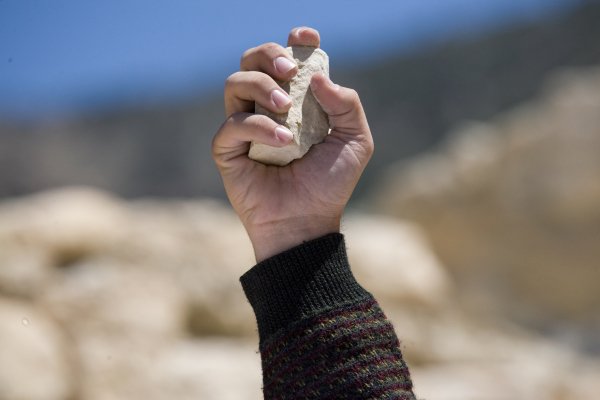
Convicted of adultery in 2006, Ashtiani has been sentenced to be stoned to death for her alleged crime. Originally sentenced to 99 lashes for her alleged “illicit relationship outside of marriage,” Ashtiani endured that punishment in front of her then 17-year-old son. “The authorities asked if I wanted to wait outside. I said no. I could not leave my mother alone.”

Sajjad says it is a day he will never forget. But, he says, that day he thought the worst was over. “I was thinking, OK, they hit her, now it’s finished. They told me this process was finished. She’s done. She’s free to go. “But then a judges’ panel in Tabriz suspected Ashtiani of being involved in her husband’s murder and re-opened her case. She was cleared of the murder charges, but the panel re-examined Ashtiani’s adultery sentence, and based on unspecified “judges’ knowledge,” decided she should be put to death for the alleged affair.

“At that time it should have been finished. They should have punished her only once,” says her son. “Her documents say she is innocent. She paid for the crime five years ago.” Human rights activist Mina Ahadi, herself forced to flee a death sentence in Iran almost 30 years ago, has also taken up Ashtiani’s cause, working with Sajjad and his sister Farideh to get their message out. She says pressure from outside Iran can make a difference.

“Legally, it’s all over, and we have no chance. It’s a done deal. Sakine can be stoned at any minute. But we have experienced again and again that when we organize events world-wide, when we protest world-wide, and in particular when we contact European governments and these governments put pressure on the Islamic regime in Iran, sometimes we have a chance.” So far, there has been no response from Iranian officials about the Ashtiani case.

And with all legal appeals virtually exhausted, Sajjad says the Tabriz court has told him there is only one thing that can stop his mother’s imminent execution. “They told me if supreme leader Ayatollah Khamenei … or Judiciary Chairman Sadegh Larijani grant my mother a letter of pardon, she will go free.”

Sajjad says he traveled to Tehran six times to obtain that letter, but has been unable to gain an audience with either man. Ā But he refuses to give up. He is turning to the international community in hopes the Iranian government will hear his voice. “It is crucial I tell these men what I have to say. “Dear Mr. Khamenei, Mister Ahmadinejad, and Mister Larijani:

“All I ask for is a letter. I want a letter for my dear mother. Please write this letter of pardon because she is innocent, 100 percent innocent. If you do not have respect for what I am saying, just take look at her file. You will see she is innocent.

“To the people of the world, I want to say, for this situation we are in: Help us. Whoever can tell the government to stop this, please do. If you can pressure Ayatollah Khamenei or Sadegh Larijani to give my family a letter, please get them to send it to us.” Sajjad knows he is taking a risk by speaking out so publicly, but says he is not afraid for his own safety. Ā “I am just fighting for what is right,” he says. “My mother is a housewife, a good person, a caring mother,” Sajjad says. And she has grown weary of what seems to be a punishment without end. On his last visit with her she told him, “I can’t stay in this prison any longer.”

And so Sajjad and his sister Farideh are reaching out in any way they can to try and save their mother’s life. In their open letter to the international community circulated on websites, Facebook pages and through human rights organizations late last week their anguish is clear. “Today we stretch out our hands to the people of the whole world,” the letter reads. “It is now five years that we have lived in fear and in horror, deprived of motherly love. Is the world so cruel that it can watch this catastrophe and do nothing about it? “We resort to the people of the world, no matter who you are and where in the world you live. Help to prevent this nightmare from becoming reality. Save our mother.”We are unable to explain the anguish of every moment, every second of our lives. Words are unable to articulate our fear.”

Full-Body Security Scanners Scrapped at Dubai Airports, Officials Say the Device “Contradicts Islam”

By Aliyah Shahid for The NY Daily News

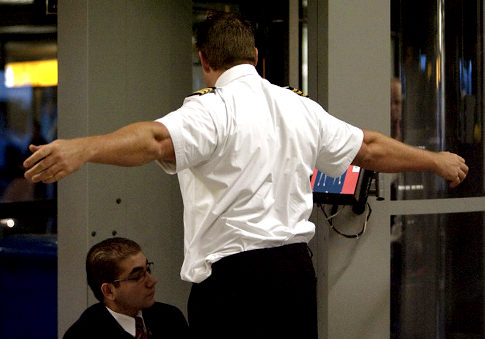
Forget about London and France — in Dubai, airport screeners won’t be able to see your underpants.

Dubai police said full-body security scanners will not be used at the airports because the devices do not correspond with national customs and ethics, according to local press reports on Tuesday.

The scanners “contradict Islam,” said Ahmad Mohammad Bin Thani, head of airport security. He said the idea was scrapped”out of respect for the privacy of individuals and their personal freedom.”

The scanners will be replaced with other inspection systems that protect passengers’ privacy, Thani said. He told the Gulf News that police are considering the use of face-recognition cameras.

Recently, American officials have been encouraging use of the full-body scanners.

Authorities say the scanners could have stopped a Nigerian man who planted explosives in his underwear in an attempt to bring down a plane bound for the U.S. last Christmas.

Several European countries have tested the technology, including the Netherlands, Britain and France. South Korea andĀ Japan have begun test programs.

But the machines have remained controversial. Critics have argued the scanners violate passenger privacy by producing”naked” pictures and liken the procedure to”virtual strip searches.”

Government in Pakistan Calls Meeting on Terrorism

By Jane Perlez for The New York Times

In an unusual sign of accord between the two major political parties, Prime Minister Yousaf Raza GilaniĀ announced over the weekend that the government and the opposition would hold a national conference on ways to combat terrorism.

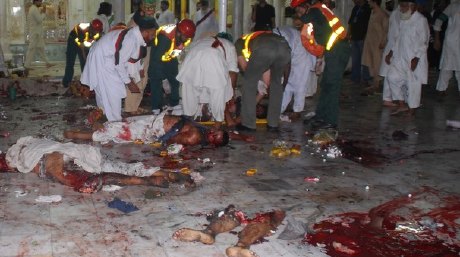
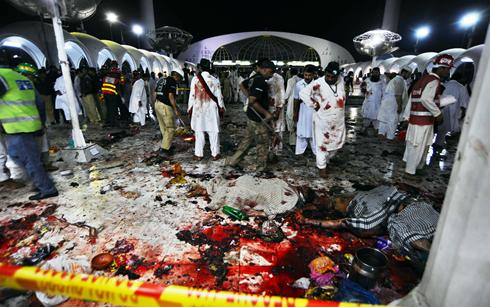
The announcement came days after 42 people were killed and hundreds were wounded when two suicide bombers struck the famed Sufi shrine Data Darbar on Thursday night in Lahore, the capital of Punjab Province.

The attack incited street protests in Lahore on Saturday, and it provoked complaints that law enforcement was not doing enough to protect holy sites from sectarian militant groups.

Nawaz Sharif, the leader of the main opposition party, Pakistan Muslim League-N,Ā  deplored the attack at a news conference on Saturday. It is time, he said, for the government to hold a national conference on terrorism and open talks with the Pakistani Taliban, ā€œwho are ready to talk and ready to listen.ā€

Mr. Sharif, whose brother Shahbaz SharifĀ  is the chief minister of Punjab, did not specify which TalibanĀ figures such talks should include.

Prime Minister Gilani agreed late Saturday to the proposal for a national conference, though it appeared unlikely that it would involve representatives of any militant groups. The conference will discuss how to better fight back against the militants, and show concern for the problem, politicians said.

The creation of such a conference was interpreted as an encouraging step by politicians who have called for greater leadership by the civilian government against terrorism. Until now the army has mostly led the effort against the Pakistani Taliban, fighting the militants in the tribal areas adjacent to Afghanistan.

The Pakistani Taliban denied responsibility for the Data Darbar attack. The shrine, one of the most popular in Lahore, is considered un-Islamic by followers of the Wahhabi and Salafi schools of Islamic thought that Taliban fighters generally adhere to.

Some religious scholars were so outraged by the attack on the shrine that they called for the resignations of Chief Minister Sharif and the Punjab law minister, Rana Sanaullah.

Earlier this year, Chief Minister Sharif was criticized by the national government, led by the more secular Pakistan Peoples Party, when he appealed to the Taliban to stop attacking Punjab on the grounds that the Muslim League and the Taliban had a common enemy in the United States. Since then, he has been accused of not doing enough to crack down on militant groups that have coalesced under the umbrella of the Punjabi Taliban.

The federal Interior Ministry said after the assault on the shrine that it had warned Punjab authorities of a possible terrorist attack in Lahore last week.

A rare joint statement by the prime minister and Nawaz Sharif on Sunday said now was ā€œnot the time for blame games.ā€

A similar conference on terrorism by the two main political parties was held in Islamabad two years ago, but those talks petered out and responsibility for tackling terrorism was handed to the army.

An effective national strategy by the civilian government would need stronger and more cohesive leadership and more money for the poorly financed police forces in the major cities, according to law enforcement officials.

Sectarianism Has Poisoned Pakistan

By Basim Usmani for The Guardian

The recent attacks on a prominent shrine in Lahore demonstrate how the unrest in Pakistan is caused by a minority of few who cannot tolerate the plurality of beliefs in Pakistan. The Tehrik-e-Taliban are lying through their teeth when they claim that they do not attack public places. It’s becoming more and more apparent that these militants aren’t resisting American hegemony; this a war to determine Pakistan’s future and, by proxy, the future of Islam.

Whether the Tehrik-e-Taliban actually arranged the bombers’ suicide belts is irrelevant; they have created a domino effect that’s likely to spread from commercial capitals such as Lahore to cities with historic shrines and Pakistani historical sites, such as Multan, or Taxila.

Unlike Baghdad, where violence between Islamic sects is a product of the war America is waging, the onus of last Thursday’s blasts falls squarely on us, the citizens of Pakistan. We have been complacent about sectarianism for too long.

A good friend who works for a transportation company told me in 2007 that in villages along the highways to Waziristan where the Taliban had seized control were the bodies of butchered Shia Muslims. That year, Lahore’s public was too busy mobilising about the judiciary and President Musharraf to pay the violence any mind.

Sectarianism has a brutal history in Pakistan that existed long before militants in Afghanistan began calling themselves the Taliban. I remember as a child in Lahore the broadcasts of gun violence outside Shia houses of worship during the early 1990s.

Many Pakistanis feel that the attacks on two Ahmadiyya mosques last May, where gunmen unloaded bullets and grenades on Friday prayer-goers, were unprecedented. Certainly the Ahmadiyya community doesn’t think they are.

To have a Pakistani passport requires citizens to assert that they are not part of the Ahmadiyya community. In a sense, holding that passport also makes you complicit in the blasts that killed dozens in Lahore’s most famous Sufi shrine last week. Our inability to understand that this war is about national identity is rooted in the same complacency.

We are OK with the state deciding for us who is or isn’t Muslim. In this regard, the Pakistani government has the weakest moral fibre in taking on this growing strand of extremism. It is hypocritical to fight the Taliban in Waziristan if we are okay about denying citizenship to millions of Muslims born in Pakistan.

It may sound extreme of me, but we should be jailing clerics in Pakistan that give edicts declaring believers to be non-Muslim or anti-Pakistani. It may seem extreme to an American that writers who deny the Holocaust are imprisoned in Europe, but extreme contexts call for extreme measures.

Pakistanis must stress how being born or raised in their country is enough to be Pakistani; laws preventing Ahmadis from referring to themselves as Muslims were amended to the constitution by Zulfikar Ali Bhutto in the 1970s.

I remember being uneasy at my desk in middle school when I was studying at Aitchison College in Lahore, and some of my classmates were getting bullied for having marks on them after returning from Shia processions during Muharram. Pakistanis themselves are the only ones capable of stamping out this discriminatory culture.

Some proactiveness is necessary on our part to make it clear that mystics, Shias, Ahmadis and Christians are all fellow Pakistanis. When you are pulled over by street police in any major Pakistani city, the first bit of information the police ask for is your family name. From one name your caste, religious beliefs and affluence is determined.

This came as a shock to all of my family who have emigrated away: that collectively our stock in our own nationhood has plummeted so. In a sense, these problems are all accrued debt we’ve accumulated for being so complacent. In the light of our bigoted constitution and deterministic culture we have to – for ourselves – decide that being Pakistani is enough to make us all countrymen. Otherwise, we might as well just refer to ourselves as Taliban, Muslim extremists, Islamic militants, and so forth.

A Pakistani American Celebrates July 4

By Manzer Munir for Pakistanis for Peace

Thousands of Pakistani Americans celebrate the July 4 Independence Day holiday with their friends and families across the United States today. As different as Pakistan and the United States may be as countries and societies, one thing they both have in common is that both countries were founded on religious reasons. Unfortunately, that is where their similiarites end as the religious freedom experienceĀ in these present day countriesĀ varies greatly.

The earliest settlers of these United States were in fact Europeans who felt persecuted in the old countries of Europe for their religious beliefs. Many of these Puritans came to America in search of religious freedom.Ā  Their hope was to escape the religious persecution they were facing in their countries and so the United States was founded on religious grounds.

Pakistan too is a country that sees the basis of its founding for a religious purpose. The nationalist movement for an independent India from British rule also caused communal conflicts between the Hindus and Muslims as there were calls by many Muslim leaders for a separate country for the Muslims of India since many felt being a minority in a Hindu dominated country would come at the expense of their rights. So a separate country for the Muslims of India and for their right to practice their religion gained momentum and indeed on August 14, 1947, the Islamic Republic of Pakistan became independent, a country founded on religious freedom for the Muslims of India.

This is not to deny the fact that Muslims still exist in India and are free to practice their religion under a Hindu dominated country. In fact, there are more Muslims in India than there are in present day Pakistan. However, many Muslims at the time of partition felt that they would be freer to practice Islam in a Muslim country rather than a Hindu one. It is an open debate whether people in Pakistan today have more freedom to practice their religion. If you are a member of either a minority Muslim group as Shiite or if you happen to be a Christian, Hindu, Sikh or Jew In Pakistan today, you have far less freedom of religion than a comparable religious group in present day India. There is absolutely a very low level of tolerance in Pakistan today for other religions or ways of life different than the majority group.

The promise of religious freedom that saw the founding of both Pakistan and the United States has seen the two countries go separate ways in realizing the dream of each countries forefathers. While the American Founding Fathers dream of a nation that respects freedom of religion and honors a separation between church and state held true, Pakistan unfortunately Ā has become a country thatĀ has becomeĀ intolerant of other religions. Many religious minorities such as Christians, Hindus, and even Muslim Ahmadis are routinely persecuted or attacked by Muslims who see these groups as infidels and heathens and not merely as human beings with different religious beliefs. The influx of Taliban and religious extremists inside Pakistan has further made life difficult for anyone who is not a devout Sunni Muslim. On many occasions, the police does not investigate or prosecute attacks on religious minorities by various extremist groups leading to a constant fear of their lives and properties.

As Pakistani as well as Muslim Americans across the United States today celebrate the the July 4 holiday, they are keenly awareĀ  that their brethren back in their original countries are not as free to practice their religion, speak their minds, and or protest peacefully as they are able to do in the United States. For this nation indeed guarantees freedom and liberty for all and not just a certain religious or ethnic group.

That is why Pakistani Americans such as myself and Muslim Americans across the US are appreciative of the fact that in this, our adopted country, our religious and civic freedoms are safe guarded in that greatest of living documents, the US Constitution. I have long felt that after the three great religious books of the Torah, the Bible, and the Koran, the US Constitution is the next best thing that man ever wrote down on paper. The Founding Fathers of America were indeed some of the greatest minds in history for crafting a document that continues to make the United States the freest country in the world and one that stayed true to its founding of liberty and freedom for all. Happy Birthday America, May you have many more!

–Manzer Munir, a proud Pakistani American plans to celebrate the July 4 Independence Day with family and friendsĀ at a picnic with fireworks and by watching a parade.

China, Pakistan Reach Nuclear Energy Deal

As reported by United Press International

The Pakistani government has finalized a deal with China to build two new nuclear power plants in the country, the Pakistani foreign minister said.

Pakistani Foreign Minister Mehmood Qureshi said Pakistan was working with its Chinese counterparts on more than 120 different projects, including two nuclear power facilities in Pakistan, the Associated Press of Pakistan reports.

Despite concerns over the proliferation of nuclear material, the foreign minister said his country was moving ahead with its nuclear activity in line with international expectations

“We have no objections on inspections by the International Atomic Energy Agency because we are proceeding ahead in a transparent manner,” he said. Pakistan is facing a looming energy crisis that is creating rolling blackouts in parts of the country.

The energy deal comes as Pakistani President Asif Ali Zardari accepted the credentials of Liu Jian, the new Chinese envoy to Islamabad. Zardari said trade relations with China fell well short of their potential.

“Strengthening and enhancing cooperation with China in all sectors is one of the key principles guiding Pakistan’s foreign policy,” said the Pakistani president.

Deadly blasts hit Sufi shrine in Lahore

By Syed Shoaib Hasan for The BBC

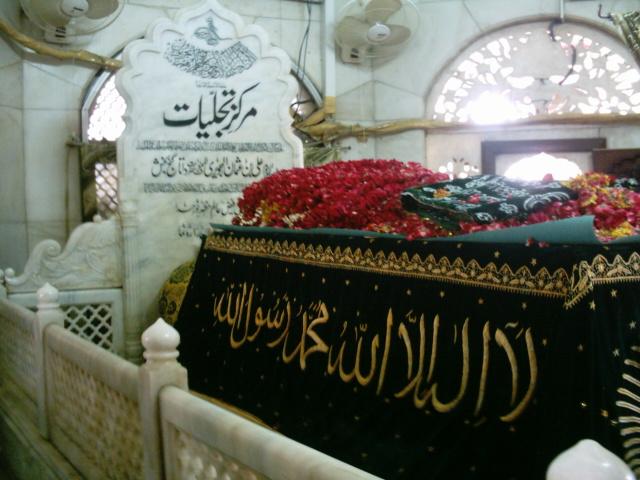
Suicide bombers have launched a deadly attack on a Sufi shrine in the eastern Pakistani city of Lahore. At least 35 people died in the blasts at the popular Data Darbar shrine late on Thursday evening, officials say. At least 175 other people were hurt in the blasts, believed to be the first targeting a shrine in Lahore. Thousands of people were visiting the shrine at the time, officials say. It holds the remains of a Persian Sufi saint, Abul Hassan Ali Hajvery.

Although no-one has yet said they carried out the attack, Taliban militants and their Punjabi jihadi allies have been involved in several such bombings in the northern Khyber Pakhtoonkhwa province. The shrine is largely frequented by members of the majority Barelvi sect, who are seen as heretics by the Taliban. Most of the Taliban belong to the rival Deoband Sunni sect, which strongly disapproves of worship at shrines. Many are also allied to the Sipah-e-Sahaba, and its armed splinter group, Lashkar-e-Jhangvi, which seeks to turn Pakistan into a Deoband Sunni state.

The shrine is visited by hundreds of thousands of people each year from both Sunni and Shia traditions of Islam. At least two attackers were involved, although police initially said three explosions had been heard. Ā The impact of the blasts ripped open the courtyard of the shrine. Rescue workers could be seen clambering over the rubble as they carried out the victims. Khusro Pervez, commissioner of Lahore, said two of the attacks took place in the main courtyard and one in the lower level of the shrine.

The first attacker struck in the underground area where visitors sleep and prepare themselves for prayer, he said. As people fled, a second bomber detonated his explosives in the upstairs area. Officials say they believe the bombers used devices packed with ball-bearings to maximise the impact of their attack. Ā A volunteer security guard at the shrine described scenes of devastation.

“It was a horrible scene,” said Mohammed Nasir. “There were dead bodies all around with blood and people were crying.” The attack is the biggest on a Sufi shrine in Pakistan since militant attacks began in 2001. Ā No group has said it carried out the attack, but correspondents say the attacks continue a growing trend among militants to target members of other sects as well as minorities.

Lahore has been hit by a series of bomb attacks, including a suicide blast at anti-terrorist offices in March, when at least 13 people died. In May, more than 90 people were killed in a double attack on the minority Ahmadi sect in the city.

Earlier, security chiefs had been congratulating themselves after what was the first month in two years in which there had been no suicide bombings in Pakistan, the BBC’s Aleem Maqbool reports from Islamabad.

They said it was proof the militant networks had been disrupted. Most Pakistanis knew the battle against militancy in this country was far from over, he adds. Last year Pakistan launched a major military offensive against militant strongholds in South Waziristan. Ā In December the military said they had achieved victory, but subsequent reports have suggested the militants remain active in the region.

Vengeful New Militant Group Emerges in Pakistan

By Kathy Gannon for The Associated Press

Pakistani authorities now believe a dangerous new militant group, out to avenge a deadly army assault on a mosque in Islamabad three years ago, has carried out several major bombings in the capital previously blamed on the Taliban.

The emergence of the Ghazi Force was part of the outrage among many deeply religious Pakistani Muslims over the July 2007 attack by security forces against the Lal Masjid, or Red Mosque, a stronghold of Islamic militants.

The fierce attack, in which scores of young, heavily armed religious students died, inspired a new generation of militants. These Pakistanis have turned against a government they felt has betrayed them and, to their dismay, backed the U.S. role in neighboring Afghanistan.

The brief but bloody history of the Ghazi Force illustrates the unintended results of Pakistan’s policy of promoting Islamic extremists to fight India in the disputed area of Kashmir. That policy — which Pakistan denies it pursues — now threatens regional stability as the U.S. and Pakistan’s other Western partners pour billions of dollars into the country to stop the rise of Islamic militancy.

The new group is made up of relatives of students who died in the Red Mosque assault. It is named after the students’ leader, Maulana Abdul Rashid Ghazi, who was also killed. The mosque’s religious school, or madrassa, had been a sanctuary for militants opposed to Pakistan’s support of the U.S.-run war in Afghanistan.

Private television stations broadcast vivid scenes of the assault — commandos in black fatigues rapelling down ropes, the crackle of gunfire, bodies of black-shrouded girls carried out through the smoldering gates. Those images stunned the nation, especially families of the students and Pakistanis with deep religious feelings.

“Before the Lal Masjid, militants hadn’t yet declared war on the state of Pakistan. That changed with Lal Masjid,” said Zahid Hussain, author and terrorism expert who has written extensively about Pakistan.

Islamabad’s inspector general of police, Kalim Imam, told The Associated Press that the Ghazi Force was behind most of the deadliest attacks in the capital during the last three years. The attacks targeted the military, the Inter-Services Intelligence agency or ISI — which had ties to a number of militants — and a five-star hotel frequented by foreigners and the Pakistani elite.

The Ghazi Force helped recruit a security official who blew himself up inside the office of the World Food Program last October, killing five people, according to Imam. The force also sent a suicide bomber in September 2007 into the mess hall of the commando unit that attacked the Red Mosque, killing 22 people, he said.

Ghazi Force members may also have been involved in the audacious June 9 attack north of the capital that killed seven people and destroyed 60 vehicles ferrying supplies to NATO and U.S. soldiers next door in Afghanistan, Imam said.

Many of those attacks had been attributed to the Pakistani Taliban, which operates in the remote tribal areas of the northwest along the border with Afghanistan. There is evidence of close ties between the Ghazi Force and the Pakistani Taliban, which the government has vowed to crush.

The Ghazi Force is believed to be headquartered in the Orakzai region of the border area, where the leader of the Pakistan Taliban, Hakimullah Mehsud, held sway for years. The leader of the Ghazi Force is believed to be Maulana Niaz Raheem, a former student at the Red Mosque.

Anger over the bloodshed at the mosque was all the greater because many of the militants and their supporters felt betrayed by a government that had once supported them. Both Ghazi and his brother Maulana Abdul Aziz Ghazi, who was freed on bail this year after two years in jail, were widely believed to have been on the payrolls of both the government and the ISI intelligence service.

Their father, Maulana Mohammed Abdullah, enjoyed a close relationship with the late President Mohammad Zia ul-Haq, and the mosque was a center for recruiting volunteers to fight against the Soviets in Afghanistan in the 1980s.

As opposition grew to Pakistan’s support of the U.S. role in Afghanistan, the mosque became a center of religious agitation against the government, with armed students taking over the complex and police laying siege.

A former senior official in the Interior Ministry told The Associated Press that the police wanted to storm the mosque and end the siege at its outset, send the students home and shut down the religious school and a neighboring library until tempers cooled.

President Gen. Pervez Musharraf refused, the official said, even though police knew that members of al-Qaida’s affiliate organization Jaish-e-Mohammed, which is banned in Pakistan, were bringing in weapons for the students.

Musharraf relented and ordered the assault after militants kidnapped several Chinese nationals running a massage parlor in Islamabad, accusing them of prostitution. The death toll remains in dispute. Red Mosque officials say hundreds died. The government says fewer than 100 were killed.

In a rare interview, Abdul Aziz Ghazi told AP he warned the government that an assault on the mosque would unleash forces that no one could control.

“I have been in jail. I did not form this force and I don’t condone the violence but they are angry at the injustices done,” he said this week.

Although the assault turned many Islamic hard-liners against the government, Pakistan remains unwilling to break all ties to the militants, instead following a high-risk strategy of coddling “good militants” while fighting those deemed “bad militants,” analysts say.

“The military and the ISI have given importance to these militants as assets. But those who have openly declared war, and there is no chance of them returning back to the state, the army is going after them,” said Manzar Jameel, a terrorism expert and researcher on the growth of extremism in Pakistan. “Yet they still believe that some are still assets and that they can keep control of the assets. It’s a failure of strategy.”

Army spokesman Maj. Gen. Athar Abbas denies any assistance to militant groups, saying past ties have long since been severed. He says the Ghazi Force is among the groups the 120,000 Pakistani soldiers waging war in the tribal regions are fighting.

Yet Anatol Lieven, a terrorism expert with the Department of War Studies at London’s King College, said it’s clear that the ISI continues to protect some militant groups, even if it has broken with others.

In a June report, the Rand Corporation think tank also alleged that Pakistan’s military and intelligence still support some militant groups “as a tool of its foreign and domestic policy.”

“A key objective of U.S. policy must be to alter Pakistan’s strategic calculus and end its support to militant groups,” the report said.

Christine Fair, a co-author of that report and an assistant professor at Georgetown University’s Center for Peace and Security Studies, said the battle against extremists in Pakistan is mired in layers of subterfuge by Pakistani intelligence and a “mystifying” acceptance by the CIA of Pakistan’s “good-militant, bad-militant” policy.

She said U.S. intelligence knows Pakistan protects one group — Lashkar-e-Taiba, which India blames for the 2008 Mumbai assault and Afghanistan accuses of masterminding deadly attacks against the Indian Embassy in Kabul.

“Lashkar-e-Taiba remains intact. I have had conversations with … officials in Washington. It is not their priority. Lashkar-e-Taiba is not an issue,” she said in an interview. “Yet Lashkar-e-Taiba has been attacking us in Afghanistan since 2004.”

Imran Khan Moves Supreme Court Against Drone Attacks

As reported on Despardes.com

Cricketing legend-turned politician Imran Khan has filed a lawsuit in Pakistan’s apex court asking it to declare drone attacks as war crimes.

According to published reports, the Pakistan Tehrik-i-Insaf (PTI) chief on Wednesday filed a petition in the Supreme Court asking it to declare drone attacks as attacks on the sovereignty and defence of Pakistan and a war crime.

The petition, filed by Imran Khan’s lawyer Shaukat Aziz Siddiqui, argues that the provisions of logistics and facilities to any foreign country or alliance for mass destruction through drone strikes inside the territory of Pakistan resulting into killings of Pakistani citizen is illegal, unwarranted, unconstitutional, in violation the United Nations Charter, universal declaration of human rights, international law as well as the international humanitarian law, a war crime and an attack on the sovereignty, solidarity, integrity and defence of Pakistan.

Imran Khan’s petition was filed today after a Lahore court Lahore cort ruled against drone strikes and called on the government to take appropriate measures to halt strikes by unmanned drones in Pakistan if they aren’t approved by Islamabad.

Federal authorities should take measures to stop drone attacks in Pakistan if they are carried out without formal approval, the court said on Wednesday. The court was responding to a petition that said drone strikes were a violation of national sovereignty.

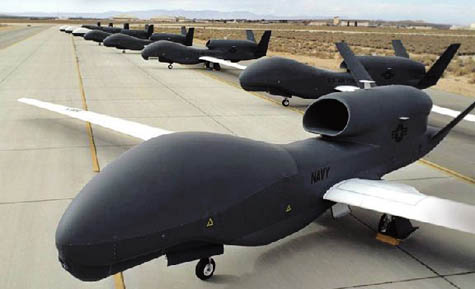
Drone attacks have increased under the authority of U.S. President Barack Obama, notably inside Pakistan. The CIA, a civilian entity, said it is acting according to the code of law in carrying out the strikes.

Pakistan’s government publicly objects to the attacks, saying they violate its sovereignty. But it is widely thought there is a tacit agreement between the U.S. intelligence agency, the CIA, and Islamabad to allow such strikes, reported Voice of America on its website today.(http://www1.voanews.com/english/news/asia/Suspected-US-Missile-Strike-Kills-10-in-Pakistan-97396999.html)

Two missiles believed fired Tuesday by an unmanned drone struck a village in the tribal regions of Pakistan, killing militants including Hamza al-Jufi, an Egyptian allied with al-Qaida.

Aisam-Rohan Reach Wimbledon Quarter-Finals: Next Stop, Wagah

By Sehar Tariq for All Things Pakistan

Pakistan’s stellarlyĀ good-looking tennis champ Aisam-ul-Haq Qureshi became the first Pakistani to reach the quarter-finals at Wimbledon when along with his Indian partner Rohan Bopannahe beat Lucas Lacko of Slovakia and Sergiy Stakhovsky of Ukraine in straight sets in the Mens’ Double. Their straight set victory – 7-5, 7-6 (7-4), 6-2- in the Round of 16 now take them to the Mens’ Doubles Quarterfinals, and already place them in the top-8.

It was only two years ago that Aisam – who is Pakistan No. 1 and World No. 43 for Men’s Doubles –Ā  became the first Pakistani to play at Wimbledon since 1976. Since then he has been steadily improving his game, including beating a doubles duo with Roger Federer in it last year. The news report in Dawn points out that ā€œthe Pakistani number one and world number 42 is a grass-court specialist and has been improving his performance at the world’s most prestigious tennis tournament in the last few years.ā€

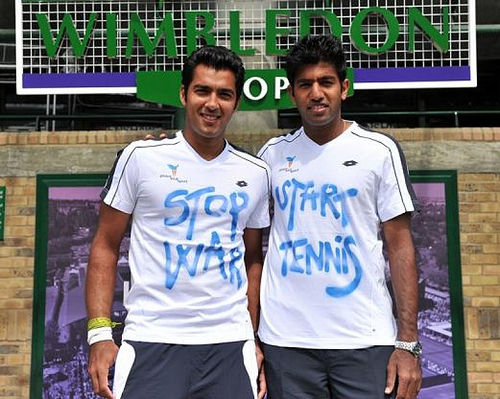
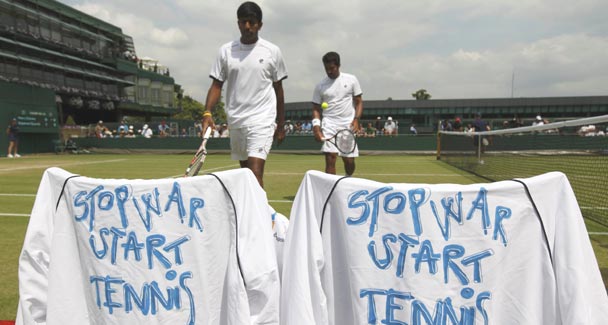
But Pakistani Aisam-ul-HaqĀ Qureshi andĀ hisĀ doubles partner RohanĀ Bopanna from India are also attracting a lot of attention for where they come from, and what they are doing together. The unlikely Indo-Pak pair have been playing as one team and they have been sporting tennis jackets that say ā€œStop War Start Tennis.ā€ Now they have suggested a novel idea of a tennis match played at the Wagah border.

The world is not used to seeing India and Pakistan step onto any field as one team soĀ the unlikely duo have been making headlines. And they are making full and good use of it by promoting the game of Tennis in the cricket dominated subcontinent and spreading the message of peace. AisamĀ and Rohan met at the age of 16 at a tennis camp and they have been good friends ever since. They are a good example of how friendship can overcome barriers or race, religion and nationality. While their international tennis playing status has allowed them to remain friends and see each other frequently, there are thousands of people on both sides of the border who long and yearn to see the people and places they once loved and knew as home but have been unable to see for over 60 years due to cruel visa regimes andĀ heartless politicians who drive wedges deeper and wider between India and Pakistan for personal gain.

According to a report in the Guardian , the two tennis players want to play a tennis match at Wagah, the border separating India and Pakistan. The border will serve as the net. AisamĀ will play on the Indian side and RohanĀ will play on the Pakistani side of the border. I want very much for the two to win the Quarter-Finals at Wimbledon, but maybe even more than that I want to see them playing at Wagah Border Crossing!

The tennis stars are trying to turn this fantastic idea into reality. And at this point in time, I think that is exactly what the two countries need. Their performance at Wimbledon and the recent positive vibes coming from the governments as well as civil society in both India and Pakistan makes this a very good time to pursue this idea.

I don’t know much about tennis but I really want this match to happen! I will go to watch. And I promise to read up everything I can and ask anyone I can to help me understand the game better so I am prepared to watch the war of tennis at the border. And I’m sure a lot of other Pakistanis will too. As will many Indians. We all love a little bit of healthy competition with the Indians!

I don’tĀ know how one goes about organizing a tennis match at an international border. But I wish I knew how to do it. So if any of you have ideas, please help.

I would like to see some Indo-PakĀ tennis and also some regional peace and good will. And while I watch this match, I will put aside my intensely competitive patriotic feelings and cheer loudly for Rahul Bopanna. So Rohan, you try to make this tennis match happen – and we the 170 million people of Pakistan will cheer you on with all our might!

As both Aisam and Rohan have been saying: Its time to ā€œStop War Start Tennis!ā€