Archive for the ‘ Pakistani Taliban ’ Category

Meeting Pakistanis, U.S. Will Try to Fix Relations

By Mark Landler and Eric Schmitt for The New York Times

WASHINGTON — As Pakistani civilian and military leaders arrive here this week for high-level meetings, the Obama administration will begin trying to mend a relationship badly damaged by the American military’s tough new stance in the region.

Among the sweeteners on the table will be a multiyear security pact with Pakistan, complete with more reliable military aid — something the Pakistani military has long sought to complement the five-year, $7.5 billion package of nonmilitary aid approved by Congress last year. The administration will also discuss how to channel money to help Pakistan rebuild after its ruinous flood.

But the American gestures come at a time of fraying patience on the part of the Obama administration, and they will carry a familiar warning, a senior American official said: if Pakistan does not intensify its efforts to crack down on militants hiding out in the tribal areas of North Waziristan, or if another terrorist plot against the United States were to emanate from Pakistani soil, the administration would find it hard to persuade Congress or the American public to keep supporting the country.

“Pakistan has taken aggressive action within its own borders. But clearly, this is an ongoing threat and more needs to be done,” the State Department spokesman, Philip J. Crowley, said Monday. “That will be among the issues talked about.”

The Pakistanis will come with a similarly mixed message. While Pakistan is grateful for the strong American support after the flood, Pakistani officials said, it remains frustrated by what it perceives as the slow pace of economic aid, the lack of access to American markets for Pakistani goods and the administration’s continued lack of sympathy for the country’s confrontation with India.

Other potentially divisive topics are likely to come up, too, including NATO’s role in reconciliation talks between President Hamid Karzai of Afghanistan and the Taliban. Pakistani officials say they are nervous about being left out of any political settlement involving the Taliban.

Still, in a relationship suffused by tension and flare-ups — most recently over a NATO helicopter gunship that accidentally killed three Pakistani soldiers and Pakistan’s subsequent decision to close a supply route into Afghanistan — this regular meeting, known here as the strategic dialogue, serves as a lubricant to keep both countries talking.

At this meeting, Secretary of State Hillary Rodham Clinton will formally introduce the new American ambassador to Pakistan, Cameron Munter. Mr. Munter, who recently served in Iraq, replaces Anne W. Patterson, who just wrapped up her tour of duty in Islamabad.

“No country has gotten more attention from Secretary Clinton than Pakistan,” said Richard C. Holbrooke, the administration’s special representative for Afghanistan and Pakistan. Pakistan’s delegation will be led by its foreign minister, Shah Mahmood Qureshi, but much of the attention will be on another official, the military chief, Gen. Ashfaq Parvez Kayani, who is viewed by many as the most powerful man in Pakistan.

White House and Pentagon officials said one immediate goal of this meeting was to ease the tensions that led Pakistan to close the border crossing at Torkham, halting NATO supplies into Afghanistan. Officials on both sides said that acrimony from the border flare-up had already receded, soothed by the multiple apologies that American officials made to Pakistan last week.

Last week, Adm. Mike Mullen, the chairman of the Joint Chiefs of Staff, said that General Kayani had assured him that Pakistan’s army would tackle the North Waziristan haven, but on Pakistan’s timetable. In an interview, Pakistan’s ambassador to the United States, Husain Haqqani, said, “Our American partners understand that we have 34,000 troops in North Waziristan. Our soldiers have been engaged in flood relief after history’s worst floods. It is not a question of lack of will.”

The new security pact would have three parts: the sale of American military equipment to Pakistan, a program to allow Pakistani military officers to study at American war colleges and counterinsurgency assistance to Pakistani troops.

Currently, the United States spends about $1.5 billion a year to provide this same assistance, but it is doled out year by year. The new agreement, if endorsed by Congress, would approve a multiyear plan assuring stability and continuity in the programs, although Congress would continue to appropriate the financing on a yearly basis. “This is designed to make our military and security assistance to Pakistan predictable and to signal to them that they can count on us,” said a senior official.

At the last dialogue in Islamabad in July, Mrs. Clinton presented more than $500 million in economic aid, including plans to renovate hospitals, upgrade hydroelectric dams, improve water distribution and help farmers export mangoes. But the floods upended those plans, and officials said they now planned to redirect funds to more urgent needs.

This week’s meeting will also be shadowed by a new eruption of political instability in Pakistan: the government of President Asif Ali Zardari is locked in a confrontation with the Supreme Court over the court’s demand that senior ministers be fired on corruption charges. Analysts said they were less worried about the atmospherics than the underlying differences in perspective. The administration’s public contrition for the cross-border attack has largely resolved that issue, said Daniel S. Markey, senior fellow for India, Pakistan and South Asia at the Council on Foreign Relations.

But Mr. Markey said he saw potential friction stemming from the American openness to reconciliation with the Taliban. With the United States facilitating rather than guiding the talks, he said, there could be poor coordination between the Afghans, NATO and others — all of which would rattle the Pakistanis.

“Washington is opening the door to a range of negotiations with groups that it has discouraged Pakistan against working with in the past,” he said. “This sends a mixed signal, and cannot help but encourage hedging on Islamabad’s part.”

Another potential bone of contention is one of President Obama’s nuclear objectives: a global accord to end the production of new nuclear fuel. Pakistan has led the opposition to the accord. And without its agreement, the treaty would be basically useless.

Mr. Qureshi blamed the United States for the situation, saying Washington signed a civilian nuclear accord with India that discriminated against Pakistan. “You have disturbed the nuclear balance,” he said in a recent interview in New York, “and we have been forced to develop a new strategy.”
Pakistan is Not America’s Enemy

 By Ryan Crocker for The Wall Street Journal

 The news from Pakistan is grim. NATO helicopters engage suspected militants inside Pakistan, killing three, only to discover they are Pakistani soldiers. The angry Pakistani government blocks NATO fuel shipments at the Khyber Pass, and militants attack the stalled trucks. An Obama administration report to Congress charges that the Pakistanis aren’t doing enough against the Taliban and al Qaeda. Press accounts quote unnamed officials asserting that elements in Pakistani intelligence are encouraging the Taliban to step up attacks on NATO forces. And Bob Woodward cites President Obama as saying “the cancer is in Pakistan.”

One could easily conclude that we are describing an enemy, not an ally. Many in Pakistan feel the same way. And yet the prospects for stabilizing Afghanistan, defeating al Qaeda and preventing further attacks on the United States are a direct function of that strained alliance. It is time for a collective deep breath.

Pakistan’s historical narrative focuses on how the U.S. worked with Pakistanis and Afghans to drive the Soviets from Afghanistan in the 1980s: We succeeded—and then we left. And on our way out, we slapped sanctions on Pakistan, ending all security and economic assistance because of the country’s nuclear program, which we had known about since 1974 when Pakistan’s prime minister announced it publicly. We left Pakistan alone to deal with a destabilizing civil war in Afghanistan, and when the Taliban emerged as a dominant force in the mid-1990s, Islamabad supported them as a means of ending the conflict.

Then came 9/11 and the U.S. was back. Pakistanis welcomed the renewed assistance. But a constant question I heard while serving as ambassador to Pakistan from 2004-2007 was “How long will you stay this time, and what mess will you leave us with when you go?” For a fragile state with innumerable problems, including a vicious internal insurgency, these are existential questions.

Never in Pakistan’s six decades of existence has the U.S. sustained a long-term, strategic commitment in the country. The Bush administration recognized this and enacted security and economic assistance programs designed to make a long-term difference in education, health care and governance. In 2006, I argued successfully for a five-year assistance package for Pakistan’s Federally Administered Tribal Areas (FATA), which are notable both for chronic underdevelopment and extremism. The Obama administration has built on this, and last year’s Kerry-Lugar bill provided $7.5 billion in assistance over five years. So we have the architecture in place to build a strategic relationship.

Still, short-term pressures risk undermining long-term strategy. When I was ambassador, voices in Congress, the media and even the administration were constantly calling for the U.S. to get tough on Pakistan, make Pakistanis do more, threaten them with consequences. Such exhortations were—and remain—generally counterproductive, as they fuel fears that the U.S. will again abandon Pakistan.

The U.S. can better work with Pakistan if we improve our understanding of history: Given its rivalry with India and its organic disunity, which dates back to its founding, Pakistan fears for its basic survival. The country has always had a difficult relationship with Afghanistan, not least because in the 19th century the British deliberately drew the Pakistani-Afghan border, the so-called Durand Line, in order to divide the Pashtun people. Today Pashtuns make up Afghanistan’s largest community, but there are more Pashtuns in Pakistan.

The Durand Line also set the groundwork for the tribal areas, which are legally distinct from the rest of Pakistan because the British could never exert direct control over them. No central authority ever has. Winston Churchill’s first published work, “The Story of the Malakand Field Force,” is about fierce tribesmen declaring jihad against a Western army. It could be a contemporary account.

So what does this mean in concrete terms?

First, the U.S. should appreciate Pakistan’s challenges and support its government in dealing with them. This summer’s devastating floods have disappeared from the U.S. media but will continue to wreak havoc in Pakistan for a long time to come. In 2005 and 2006, after an earthquake in Kashmir killed almost 80,000 Pakistanis, the U.S. organized the largest relief operation since the Berlin Airlift. The floods’ death toll is lower, but their long-term damage will be far greater. U.S. support should be commensurate.

Second, the U.S. should not carry out cross-border military actions, which I strongly resisted as ambassador. They are clearly counterproductive, and not just because we hit the wrong target. If NATO can carry out military actions in Pakistan from the west, Pakistanis wonder, what stops India from doing the same from the east? There are other options, including drone strikes, which the U.S. is now coordinating more closely with Pakistanis.

Third, with Pakistan’s government (as with Afghanistan’s), we must be private in our criticism and public in our support

Private talks should deepen regarding challenges like the insurgent Haqqani network in North Waziristan, and we need to listen at least as much as we lecture.Fourth, any talks between the U.S. or Afghanistan and the Taliban must be transparent to the Pakistanis. A nightmare for Islamabad is the prospect that the Americans and Afghans come to some accommodation with Taliban elements that would leave them hostile to Pakistan. If Pakistan is not part of the process, we will be working at cross-purposes and only the Taliban will benefit.

Pakistan’s arrest of Taliban leader Abdul Ghani Baradar—at a time when he had begun reconciliation talks with Afghan authorities—underscored the risks of leaving Islamabad out of the loop. Going forward, the timing and nature of talks with the Taliban should be set by Afghans, Pakistanis and Americans working together.

None of this will be easy, but it is essential. A sustained U.S.-Pakistani partnership after the Soviet withdrawal from Afghanistan could have produced a very different history than the one we wrestle with today. Writing a different future requires making long-term commitments—on both sides of the Durand Line.

Mr. Crocker, the dean of Texas A&M’s George Bush School of Government and Public Service, was U.S. ambassador to Pakistan from 2004 to 2007 and U.S. ambassador to Iraq from 2007 to 2009.

How to End the War in Afghanistan

As Reported on CNN

New York (CNN) — Afghan President Hamid Karzai has started talks with representatives of the Taliban, a move that analyst Fareed Zakaria says could bring an end to the nine-year-long war.

Karzai convened a meeting Thursday with the Afghan Peace Council, which was formed to help negotiate with the Taliban. Referring to the militants, Karzai said, “I call on them once again to use this opportunity and say ‘yes’ to this endeavor. I want them to come and bring peace to this land.”

The author and host of CNN’s “Fareed Zakaria GPS” spoke to CNN on Thursday. Here is an edited transcript:

CNN: Hamid Karzai has launched a council to help negotiate with the Taliban? What’s the significance of that step?

Fareed Zakaria: I think it’s about time. If you look at any good study of civil wars, what you find is that most of them end in a negotiated settlement. Maybe because Americans have the memory of our civil war in which the North crushes the South, we somehow think that that’s how civil wars end. But that’s actually is very unusual.

What normally happens is some kind of settlement that is negotiated in which the losers are reintegrated into the political order. Civil wars are unlike normal wars, because the winners and losers are going to have to live with one another.

CNN: How does that apply to Afghanistan?

Zakaria: The Taliban, which is mounting this insurgency, is not a foreign element within the body politic. The Taliban is basically the political representative of the conservative elements of the Pashtun community.

The Pashtuns are 50 percent of Afghanistan. … It is a political force in Afghanistan. Coming to terms with it politically and seeing if there’s some way it can be reintegrated into the political order makes sense. You’re not going to kill every member of the Taliban. They’re not going to be exiled to a foreign land. They’re going to be there at the end of the day so it’s better to to have them in the tent.

CNN: The U.S. military view seems to be that the talks haven’t yielded progress so far, and a senior defense official told CNN, “We don’t think the Taliban believe that they’re losing to the degree that they’d come to terms in large numbers.” Are the talks premature because the effects of the U.S. military buildup haven’t been felt yet?

Zakaria: First the very fact that the Taliban are coming to the table in a way they had not been willing to before suggests that they are feeling some pressure.

But I also think you can’t get too hung up with this idea that you have to negotiate from a position of strength. Ideally we would have them totally prostrate on the floor and that would be the time to negotiate. But the reality is that this is a very mixed military campaign. I don’t know if it’s going to be dramatically better one year from now or three years from now.

This is a little like somebody who owns a stock, who says, it’s at six now, I need to sell it, but I’m going to wait till it goes to eight. Well maybe it will go to eight, maybe it will go to four.

You might as well start talking at this point. First of all you learn a lot in the process of negotiations. And secondly, the military campaign could move in many different directions. If the surge starts succeeding even more, that will be reflected in our negotiating posture.

CNN: Is there an idea yet of what a negotiated settlement might involve?

Zakaria: It seems as though the Taliban demands are that they want all foreign troops out. They don’t want to accept the Afghan constitution and they don’t want to lay down their arms.

Now those are obviously their opening demands. Foreign troops aren’t going to be out, but one could point out that President Obama has said there is going to be a reduction of foreign forces next year.

On the Afghan constitution, there is a compromise there where there could be a few amendments to the constitution. But on laying down their arms, that it seems to me you can’t really compromise, they would have to lay down their arms. Could some elements be integrated into the militia, or the Afghan national army? Perhaps — that’s what happened in Iraq.

CNN: Isn’t there also a clashing conception of society, with the Taliban being a closed society that doesn’t recognize an elevated role for women as opposed to a potentially democratic kind of society that’s envisioned by the Afghan constitution?

Zakaria: Yes, it is the kind of society envisioned by the Afghan constitution. But Afghanistan is a fairly conservative society. While the extreme elements of the Taliban have draconian visions which are obviously not supported by the Afghans — the polls bear this out — it’s also true that on issues of women’s rights and some of the more progressive elements of the Afghan constitution, the Karzai government is in a minority and those rights are not popularly supported.

There are clashing visions, but there is probably a reality of Afghanistan which is a lot more progressive and open than the Taliban believe but is still a society that is somewhat conservative, and often tribal, and with very traditional views on something like women’s rights.

The key is creating a situation where these rights are guaranteed but not fetishizing it. For example, one of the things the Afghan constitution has is a requirement for 25 percent representation of women in parliament. We don’t have such a requirement either in the U.S. Constitution or in the amendments. Many European countries don’t.

Is it conceivable that something like that could be compromised? Perhaps, and that’s the kind of thing where we’d have to be creative in coming up with a solution that moderates and some elements of the Taliban could live with.

CNN: Is this an honorable exit for the United States?

Zakaria: I think so, and it’s not really an exit, it’s a reduction in our forces and in our role. And I think it would be appropriate. We’ve been there for nine years. It’s not the only battleground, the only place where al Qaeda operates. There are many more members of al Qaeda in Pakistan than in Afghanistan.

You’re trying to create a political settlement, and a self-sustaining political framework in Afghanistan that can survive the departure of American troops. And finally you’re leaving enough troops in there where you could still prosecute a fairly vigorous counterterrorism operation against those elements of the Taliban or al Qaeda that continue to plot and plan to do violence to civilians, foreigners, westerners.

And I do think, if we could get this kind of a settlement, it would be an honorable way for the United States to begin reducing its exposure in Afghanistan.

Fareed Zakaria is an author and foreign affairs analyst who hosts “Fareed Zakaria GPS” on CNN

Sufi Shrine in Pakistan Is Hit by a Lethal Double Bombing

By Huma Imtiaz for The New York Times

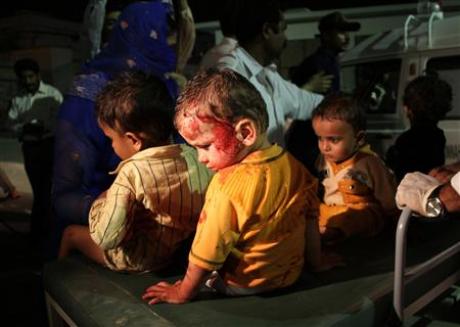
KARACHI, Pakistan — A nearly simultaneous double explosion that may have been the work of suicide bombers struck a crowded Sufi shrine in Pakistan’s main port city of Karachi on Thursday evening, killing at least 7 people and wounding 65, officials and rescue workers said. Pakistani women mourn the death of a child killed in an attack on the shrine Sufi Saint Abdullah Shah Ghazi.

It was the first attack on the shrine, the grave of the Sufi saint Abdullah Shah Ghazi, and it appeared to be an effort by hard-line militants in Pakistan to strike at the heart of Sufism, the moderate, more flexible blend of Islam practiced by most Pakistanis.

The attack came three months after militants struck one of the country’s most important Sufi shrines in the city of Lahore, which left at least 42 people dead.

The first blast at the Karachi shrine occurred at the main gate. Police officials said that within 25 seconds, the second blast hit the steps leading up to the saint’s grave.

Rescuers said three children were among the dead.

Dr. Seemi Jamali, deputy director of the emergency ward at Jinnah Hospital in Karachi, where the wounded were taken, said “many of them have severe injuries, trauma to the head and neck.”

Television channels showed body parts strewn at the site and chaotic scenes of unnerved, sobbing survivors.

The home minister of Sindh Province, Zulfiqar Mirza, told reporters that the severed heads of two suspected suicide bombers had been recovered from the site. Police officials were more circumspect, saying it was premature to conclude that the attack was by suicide bombers.

Local TV channels reported later that Tehreek-e-Taliban, or Movement of Taliban, an umbrella group of militants, had claimed responsibility for the attack. The group is known to have trained cohorts of suicide bombers for attacks in Pakistan and Afghanistan.

The attackers apparently chose Thursday night because it is one of the most crowded times of the week at the shrine, when hundreds throng to seek blessings from the saint and to receive free food.

The government closed all shrines in the city after the bombings.

Envoy Insists Pakistan Will Tackle Terrorists As Attack Kills 3

By Nasir Habib for Cnn

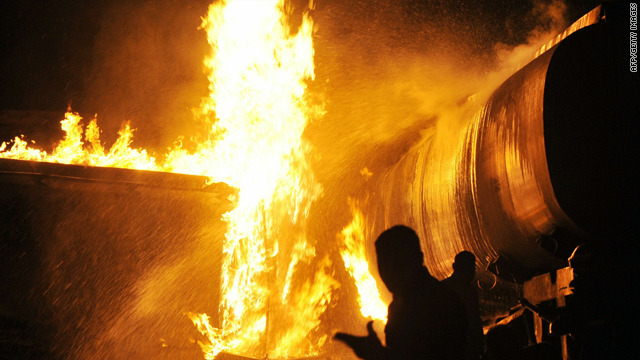
Islamabad, Pakistan (CNN) — Gunmen in Pakistan opened fire on oil trucks bound for NATO forces in Afghanistan, setting some 20 vehicles on fire and killing three, police said Monday. The attack came shortly after Pakistan’s ambassador to the United States vowed his country would go after terrorists on its soil.

Naeem Iqbal, a police spokesman, said five people were wounded in the attack on tankers parked on a main road outside a housing complex near the capital city of Islamabad. Efforts to put out the blaze are ongoing, he said.

Bin Yamin, a deputy police chief, said eight gunmen entered the area on Monday around 12:15 a.m. local time. He said they told people near the trucks to run away and that most did. Then they opened fire.

The tankers were parked in the vicinity of an oil refinery where they were going to go to pick up fuel for NATO forces in Afghanistan, Yamin said. Video images of the scene showed firefighters working to put out flames that stood out in the night against the overturned trucks.

On Sunday, Pakistan’s ambassador to the United States insisted his country would go after terrorists on its soil and needed only “technical” help from Washington, not U.S. troops on the ground.

Husain Haqqani, told CNN’s “State of the Union” that Pakistan would reopen a NATO supply route into Afghanistan “relatively quickly,” probably in less than a week.

Pakistan halted the convoys Thursday after officials blamed cross-border NATO helicopter fire for the deaths of three Pakistani soldiers. Haqqani said the United States and Pakistan were investigating the killings together. He said Pakistan will move against militants on its own schedule, not Washington’s.

“Pakistan is saying we will take care of all terrorists on the Pakistani side of the border, but we will do it on our timeline,” Haqqani said Sunday. “We cannot always follow a timeline that our allies set for us, because we are allies, not a satellite.”

Pakistan has lodged protests against NATO helicopter incursions into its territory — which the International Security Assistance Force says its rules of engagement permit — and is very sensitive about reported U.S. drone strikes in Pakistan.

There were a record number of drone strikes last month, according to a CNN count. On Saturday, three suspected drone strikes killed 18 people.

Pakistani intelligence officials said 10 people died in one drone strike targeting a militant hideout, four people died when a vehicle was struck, and four others were killed when another hideout was targeted.

All three occurred in the Data Khel area of North Waziristan. The intelligence officials did not want to be named because they are not authorized to speak to the media.

Security analysts have described North Waziristan as a haven for various factions of Afghan and Pakistani Taliban and al Qaeda militants. The majority of reported strikes this year have hit targets in the district, a mountainous tribal area on Pakistan’s border with Afghanistan, analysts said.

The United States does not officially acknowledge that it has unmanned aircraft firing missiles at suspected militants in Pakistan, but it is the only country operating in the area that is known to have the ability to do so.

Ambassador Haqqani also said Pakistan couldn’t do everything Washington wants “because sometimes we don’t have the capacity and sometimes we don’t have the means.” He said Pakistan’s geography makes it hard to hit militants.

“Sometimes people in the U.S. think … that it’s all flat land with everything visible. Not even the drones can identify everyone in North Waziristan because of the complexity of terrain,” Haqqani said.

Haqqani also argued that Pakistani politicians, just like U.S. counterparts, are constrained by public opinion. “All politics is local and the local situation in Pakistan is that the United States is not very popular amongst our public,” he said. “The fact remains that an elected democratic government in Pakistan is limited by public opinion to the extent of what it can do,” he said.

For Better or Worse, White House Bets on Pakistan’s Civilian Government

Reported by Josh Rogin for Foreign Policy magazine

The Obama administration has always been clear that the path to winning the war in Afghanistan goes through Pakistan. But if Bob Woodward’s new book is accurate, the White House considers its war effort much more dependent on the success and survival of Pakistan’s civilian government than was previously known.

Woodward’s “Obama’s Wars,” which hit bookstores Monday, sheds new light on the Obama administration’s vast outreach to the Pakistani civilian government led by President Asif Ali Zardari. It paints a picture of an administration working hard to court the Pakistanis while remaining somewhat confused about Pakistani thinking on a range of issues.

Obama himself was confused about the nature of Pakistani intentions during two crucial decision points in his administration’s Afghan policy — the March 2009 strategy rollout and the deliberations in November 2009, which resulted in a troop surge and a huge expansion of covert operations in Pakistan. However, based on advice from the majority of his key advisers, he nonetheless tried to entice Pakistan to commit to a deep and long-term partnership with the United States by offering the Zardari government incentive after incentive, with relatively few pressures.

According to Woodward’s account, the centrality of Pakistan was championed early on by Bruce Riedel, the Brookings scholar who was brought on as a key figure in the Obama administration’s March 2009 Afghanistan strategy review.

Riedel, who referred to Islamist extremists in Pakistan as the “real, central threat” to U.S. national security, personally convinced Obama, only two months after he took office, that Pakistan needed to be the centerpiece of his new strategy. Riedel’s plan involved arming the Pakistani military for counterinsurgency and increasing economic and other forms of aid to the civilian government. This marked the beginning of the term “Af-Pak,” which drove the administration’s belief that stability in Afghanistan and Pakistan were inextricably linked.

Riedel’s Pakistan focus was not due to his confidence that the civilian government could control the military and intelligence services. In fact, he referred to Army Chief of Staff Gen. Ashfaq Parvez Kayani as a “liar” with regards to the activities of the secretive Inter Services Intelligence agency (ISI), which is widely suspected of aiding the Taliban insurgency. Then Director of National Intelligence Dennis Blair reportedly echoed Riedel’s views on this matter.

Inside the administration, Blair argued that Obama was approaching Pakistan with too many carrots and not enough sticks. He at one point advocated bombing inside Pakistan and conducting raids there without the Pakistani government’s approval. “I think Pakistan would be completely, completely pissed off and they would probably take actions against us … but they would probably adjust,” he once told Obama.

Obama, however, opted to pursue a less confrontational path. He concluded the central task would be convincing the Pakistani leadership to throw its lot in with the United States He said at the time of the initial strategy review in March 2009, “that we had to have a serious heart-to-heart with Pakistani civilian, military and intelligence leaders.”

Later that year, when making the decision to send an additional 30,000 “surge” troops to Afghanistan, Obama knew that his plans to also expand the U.S. military presence in Pakistan and widen drone strikes would be a hard sell to the Zardari government. In an attempt to sweeten the deal, Obama framed the policy as a new “strategic partnership” with Pakistan, even tying the success of the U.S. mission in Afghanistan to the survival of Zardari and the legacy of his deceased wife Benazir Bhutto.

“I know that I am speaking to you on a personal level when I say that my commitment to ending the ability of these groups to strike at our families is as much about my family’s security as it is about yours,” Obama wrote in a letter to Zardari delivered by National Security Advisor Jim Jones and counterterrorism advisor John Brennan.

Zardari’s response to that letter reinforced what many in the administration already suspected: Pakistan’s government was in the grips of an internal struggle over whether to embrace the United States. Zardari’s initial response focused heavily on India, though the Pakistani president only referred obliquely to his country’s strategic rival. Woodward reports that the White House believed the letter was written by the Pakistani military and the ISI. However, the Zardari government did end up accepting Obama’s offer.

Obama’s top advisors told the U.S. president that he would have to accept something short of complete success in convincing Pakistan to turn away from its longstanding obsession with the military threat it perceives from India.

When Obama had a meeting with Zardari in May 2009, he told the Pakistani president the he did not want U.S. taxpayers to be funding Pakistan’s military buildup against India “We are trying to change our world view,” Zardari told Obama, “but it’s not going to happen overnight.”

At times, Obama was downright puzzled by his advisors’ advice regarding Pakistan. For example, intelligence reports confirmed that Pakistani officials were afraid that the United States would leave Afghanistan too early, as they believed had occurred after the end of the resistance to the Soviet regime in the 1980s. On the other hand, Pakistan worried that if the United States was too involved in Afghanistan, it might aid in the establishment of a larger Afghan army than Islamabad was comfortable with.

“What am I to believe?” Obama asked his senior staff. Secretary of State Hillary Clinton, Special Representative Richard Holbrooke, and Defense Secretary Robert Gates all told him these were the types of contradictions that were commonplace when dealing with Pakistan.

For its part, the Pakistani government was just as confused and puzzled by the Obama administration. Woodward recounts one anecdote, in which Zardari tells the former U.S. Ambassador to Afghanistan Zalmay Khalilzad that he believed the United States was involved in orchestrating attacks by the Pakistani Taliban against the Pakistani civilian government.

Pakistan’s Ambassador to Washington Husain Haqqani, a key go-between, tried several times to explain to the Obama administration how to court Pakistani leaders, comparing the dynamic to “a man who is trying to woo a woman.”

“We all know what he wants from her. Right?” Haqqani said in a meeting with Jones, Deputy National Security Advisor Tom Donilon and the NSC’s Gen. Doug Lute.

“But she has other ideas. She wants to be taken to the theater. She wants that nice new bottle of perfume,” Haqqani told them. “If you get down on one knee and give the ring, that’s the big prize. And boy, you know, it works.”

Haqqani said the “ring” was official U.S. recognition of Pakistan’s nuclear program as legitimate. He also warned that the Pakistanis would always ask for the moon as a starting point in negotiations. He compared it to the salesmanship of rug merchants.

“The guy starts at 10,000 and you settle for 1,200,” Haqqani told the Obama team. “So be reasonable, but never let the guy walk out of the shop without a sale.”

Although the Obama administration has had some success improving the relationship between the two governments, Pakistan’s civilian leadership still faces a series of difficulties in its goal of exerting control over its entire national security structure. Stability has also been threatened by the enormous pressures resulting from the war that it is waging inside its own borders, and political attacks leveled against it from the media and the courts. Zardari’s perceived sluggish response to the devastating flood crisis has cost him even more credibility among the Pakistani public.

But while the end of Zardari regime has often been predicted, it appears that he will remain in place for the foreseeable future. The Obama administration, meanwhile, is aware of how crucial his cooperation remains for the success of the mission in Afghanistan.

When Woodward sat down for his interview with Obama earlier this year, he asked the president if the situation was still that Pakistan is the centerpiece of the U.S. strategy. “It continues to this day,” Obama replied.

India, Pakistan Can’t Break the Ice, Even in Hour of Tragedy

Reported by Sanjeev Miglani for Reuters

Pakistan’s catastrophic flood continues to boggle the mind, both in terms of the human tragedy and the scale of the damage it has wrought, and even more so over the longer term. One official has likened the disaster to the cyclone that devastated what was once East Pakistan, setting off a chain of events that eventually led to its secession and the birth of Bangladesh.

Not even that spectre, raised by Pakistan’s ambassador to Britain, can however dent the steadfast hostility between India and Pakistan. For a full three weeks as the floods worked their way through the spine of Pakistan from the turbulent northwest to Sindh in the south, Islamabad made frantic appeals to the international community not ignore the slow-moving disaster, and help it with emergency aid, funds. But next-door India, best-placed to mount a relief effort probably more because of the geography than any special skill at emergency relief, was kept at arm’s length. An Indian aid offer of $5 million, which itself came after some hesitation and is at best modest,was lying on the table for days before Pakistan accepted it. ”There are a lot of sensitivities between India and Pakistan … but we are considering it very seriously,” a Pakistani embassy spokesman told our reporter in New Delhi earlier this week. Things appeared to have moved faster only after Indian Prime Minister Manmohan Singh called his Pakistani counterpart Yusuf Raza Gilani expressing sympathy and reminding him of the offer of aid. Millions of Pakistans meanwhile continued to struggle for food.

To some extent, Pakistan’s hesitation in accepting aid from India is understandable. India is the traditional enemy. It is also the bigger country of the two. And over the last two decades it has become easily the more prosperous entity, courted by the world’s industrialists while Pakistan is “haunted by the world’s terrorists”, as columnist Vir Sanghvi writes in the Hindustan Times. A Pew poll that we wrote about a few weeks ago showed how deep-seated these Pakistani fears are: a majority of those polled said they considered India to be the bigger threat than al Qaeda or the Taliban, despite the violence they have suffered at the hands of the militant groups over the past few years.

As Sanghvi writes:

But, to be fair to the Pakistanis, let us accept the position that decades of hostility between our two countries have led to a situation where the Pakistanis simply do not trust us. Let us also accept that they are so resentful of India that even in their hour of greatest crisis when thousands of people have died and millions are homeless, they will still spurn India’s hand of friendship. And let us grant them their claim that given our history, they are justified in being suspicious of India.

But then, you have to wonder, if the two nations cannot even keep up basic neighbourly ties such as offering aid and commiseration at times of natural crises, what chances they can ever come to a peace deal that will demand much more from them ?

It was pretty much the same in 2005 when the earthquake struck Pakistani Kashmir and the authorities struggled to provide aid to the affected. And Indian aid offer was initially ignored, later blankets from India were accepted. But even then Pakistan had people cut out the label that read ‘made in India’ on each blanket.

Indeed, some Pakistani writers are already criticising the government of bringing dishonour to the country by accepting Indian assistance. Commentator Shireen M. Mazari in a piece entitled “What Have We Become” says the Pakistani government accepted the Indian offer for help under pressure from the United States and that it was a matter of shame. By taking Indian aid, Pakistan had let the people of Kashmiri down just when they had risen in revolt against Indian forces.

“This money has the blood of Kashmiris on it and one wonders how our Kashmiri brethren must be feeling as they face the bullets of Indian forces every day and see us taking Indian “aid”,” Mazari wrote.

Kashmir, then, can’t be far from any discourse relating to India and Pakistan. It is the core dispute at the heart of 60 years of difficult ties, says Pakistan and must be resolved before any normalcy can take place. India doesn’t even consider the territory to be disputed, so the argument, at least in public, hasn’t changed much in over half a century.

For the 20 million affected by the flooding in Pakistan, and facing a future that would daunt any of us, Kashmir must, at the moment, be a distant thought.

U.S. Strategy in Pakistan Is Upended by Floods

By Mark Landler for The New York Times

WASHINGTON — The floods in Pakistan have upended the Obama administration’s carefully honed strategy there, confronting the United States with a vast humanitarian crisis and militant groups determined to exploit the misery, in a country that was already one of its thorniest problems.

While the administration has kept its public emphasis on the relief effort, senior officials are busy assessing the longer-term strategic impact. One official said the disaster would affect virtually every aspect of the relationship between the United States and Pakistan, and could have ripple effects on the war in Afghanistan and the broader American battle against Al Qaeda.

With Pakistan’s economy suffering a grievous blow, the administration could be forced to redirect parts of its $7.5 billion economic aid package for Pakistan to urgent needs like rebuilding bridges, rather than more ambitious goals like upgrading the rickety electricity grid.

Beyond that, the United States will be dealing with a crippled Pakistani government and a military that, for now, has switched its focus from rooting out insurgents to plucking people from the floodwaters. The Pakistani authorities, a senior American official said, have been “stretched to the breaking point” by the crisis. Their ragged response has fueled fears that the Taliban will make gains by stepping in to provide emergency meals and shelter.

“It certainly has security implications,” said another official who, like others interviewed for this article, spoke on the condition of anonymity because he was not authorized to discuss internal policy deliberations. “An army that is consumed by flood relief is not conducting counterinsurgency operations.”

On Thursday, the United Nations will convene a special meeting devoted to the floods, hoping to galvanize what has been a lackluster global response. Secretary of State Hillary Rodham Clinton is expected to announce that American public aid has surpassed $100 million, an official said.

“We’re obviously not oblivious to the political and strategic implications of this catastrophe, but right now, we are fully focused on the emergency relief effort and trying to get a good assessment of the needs,” said the administration’s special representative to the region, Richard C. Holbrooke.

Noting that several weeks remain in the monsoon season, Mr. Holbrooke said, “Worse may be yet to come.”

The disaster comes after a period in which the administration seemed to have made strides in repairing the American relationship with Pakistan. Mrs. Clinton visited Islamabad in July with a long list of pledges, including the upgrading of several power plants and a plan to promote Pakistani mangoes. Now, these projects seem almost beside the point.

“Before, there were power plants in need of refurbishment,” said Daniel S. Markey, senior fellow for India, Pakistan and South Asia at the Council on Foreign Relations. “Now there are power plants underwater.”

In recent days, the United States has sent 15 helicopters, rescuing nearly 6,000 people. On Wednesday, military cargo planes delivered 60,000 pounds of food and other relief supplies, bringing total deliveries to 717,000 pounds. The speed and scale of the effort, officials in both countries said, have helped bolster the checkered American image in Pakistan.

In another hopeful sign, officials said Pakistan and India had been in close touch about the floodwaters, some of which are flowing into Pakistan from India. Such communication, between historic archenemies, could augur reduced tension in other areas, one of the officials said.

Against that, however, are the staggering dimensions of the disaster. A senior Pakistani official told the administration on Tuesday that the next flood surge was likely to inundate much of Punjab, the densely populated region that borders India and produces much of Pakistan’s food.

So far, this official said, the greatest damage has been in regions that are also hotbeds for Islamic insurgents, which has set back the army’s fight against extremist groups. Local governments in those places have largely collapsed, leaving the army as the only source of authority.

With 20 million people displaced from their homes, the Pakistani authorities are girding themselves for an immense migration to the major cities, which they fear could sow further instability.

“Americans have not yet registered the enormity of the crisis,” Pakistan’s ambassador to the United States, Husain Haqqani, said in a telephone interview from Islamabad, the capital.

Pakistani and American officials said reports of hard-line Islamic charities providing relief were exaggerated. One pointed out that the floods had hurt the insurgents as well: there was a report of small arms and ammunition belonging to a militant group floating in the water.

Still, people in both countries warned that if rebuilding and rehabilitation efforts bogged down, the Taliban and other militant groups would try to take advantage of it. “The real test is, can their government provide the most fundamental services?” said an administration official.

Parallels to this crisis are hard to find. One official cited the example of the Indonesian province of Aceh, which had been racked by a three-decade insurgency fought by the separatist Free Aceh Movement. After the tsunami swept through in 2004, killing 170,000 people, the separatists and the Indonesian government quickly signed a peace treaty, in August 2005.

There are, however, big differences between a localized separatist group and an international jihadist movement.

“If the flood proves to tilt the balance of power in Pakistan, it’s more likely to tilt toward the militants than toward the government,” said Bruce Riedel, a former intelligence official who helped the administration formulate its initial policy for Pakistan and Afghanistan.

Already, Pakistan’s president, Asif Ali Zardari, has been exposed to withering criticism at home for going on a trip to Europe during the early days of the flood. American officials said they were determined not to get drawn into the dispute, noting that in any event, Mr. Zardari had been stripped of many of his powers in a recent constitutional change.

Decisions on how the flood will affect American economic aid may be influenced by a trip to Pakistan by Senator John Kerry, the Massachusetts Democrat who co-sponsored the five-year nonmilitary assistance package with Senator Richard G. Lugar, Republican of Indiana.

Senator Kerry, accompanied by Dan Feldman, a deputy to Mr. Holbrooke, is scheduled to tour the flooded areas on Thursday. Mr. Kerry has said he is open to redirecting aid money, though some analysts said they were skeptical that Congress would approve additional financing. Military aid may also come under scrutiny, according to administration officials.

“Every dimension of our relationship — politics, economics, security — is going to see major shifts as a result of this historic disaster,” said Lt. Gen. Douglas Lute, the White House coordinator for Afghanistan and Pakistan. “All the tools of diplomacy have to be examined in light of this new reality.”

What They Said: Pakistan Spies Downgrade India Threat

By Vibhuti Agarwal for The Wall Street Journal

The Wall Street Journal reportedTuesday that a report from the Pakistan’s chief spy agency, the Inter-Services Intelligence, said domestic militancy had overtaken the Indian army as the greatest threat to Pakistan’s national security. This is the first time since the ISI was founded in 1948 that the ISI has found a bigger threat than its neighbor. India Real Time presents a roundup of comments from readers and others below:

The Times of India newspaper reported Wednesday that Pakistan’s acknowledgment of its internal problems comes as the country is struggling with an image problem which may be affecting the flow of international aid to help the victims of the devastating floods there. “The unexpected downgrading of the threat perception from New Delhi and waking up to the scourge of home-grown terrorism comes even as foreign aid for the thousands affected in floods in Pakistan is yet to pick up,” wrote Chidanand Rajghatta for the Times of India.

The Hindustan Times newspaper quoted analysts saying the change of mindset makes sense. “I am not surprised that the ISI has changed its strategic thinking,” Talat Masood, a retired general and analyst on defense and security issues told the newspaper. Another analyst, Imtiaz Gul, was also quoted in the article. “The ground realities have changed and have forced allies into becoming enemies,” he said.

“At this point, the Pakistan government will say just about anything the world community wants it to,” wrote H. Jere. “After seeing the response to the aid request has been disappointing, it will agree to almost anything.”

Other readers called Pakistan’s latest admission “hogwash,” adding that it may be a trick to get more funds from the United States.

“It is sheer naiveté to consider Pakistan’s ISI and Islamic terrorists as two separate entities,” said Shri K. “ISI is the quintessence of rabid Islamic fascism and has been mercilessly exporting Islamic terror all over the world.”

Some readers said Pakistan’s admission came as a ray of hope for improving the long-estranged India-Pakistan relationship.

“I hope India take this opportunity to offer real assistance to the victims of the floods,” wrote Phillip Hwee. “It’s time for India and Pakistan to reconcile with one another. A détente is very necessary so that each of the two rivals can reallocate their resources to improve the standard of living of their respective citizens.”

David Almeida agreed, adding that “one can only hope that the military establishment in Pakistan is truly serious about abjuring terrorism, regardless of whether it is targeted at Indian or Pakistani state.”

Pakistan Fight Stalls for U.S.

By Julian Barnes for The Wall Street Journal

The U.S. military has stopped lobbying Pakistan to help root out one of the biggest militant threats to coalition forces in Afghanistan, U.S. officials say, acknowledging that the failure to win better help from Islamabad threatens to damage a linchpin of their Afghan strategy.

Until recently, the U.S. had been pressing Islamabad to launch major operations against the Haqqani network, a militant group connected to al Qaeda that controls a key border region where U.S. defense and intelligence officials believe Osama bin Laden has hidden.

The group has been implicated in the Dec. 30 bombing of a CIA base in Khost, a January assault on Afghan government ministries and a luxury hotel in Kabul, and in the killing of five United Nations staffers in last year’s raid on a U.N. guesthouse.

But military officials have decided that pressing Pakistan for help against the group—as much as it is needed—is counterproductive.

U.S. officials believe elements of Pakistan’s intelligence agency, Inter-Services Intelligence, are continuing to protect the Haqqani network to help it retain influence in Afghanistan once the U.S. military eventually leaves the country. U.S. officials say the support includes housing, intelligence and even strategic planning,

During a trip to Pakistan last month, Adm. Michael Mullen, chairman of the Joint Chiefs of Staff, chose not to raise the issue of an offensive against the Haqqani network—a departure from the message U.S. defense officials delivered earlier this year.

The U.S. also had intensified the pressure for Pakistani operations in North Waziristan in May after the attempted bombing of New York’s Times Square was linked to militants in Pakistan.

Pakistan officials reject the U.S. conclusions about their efforts. They say they are taking significant action against militants in North Waziristan. They say their intelligence service has severed all ties with the Haqqani network. Islamabad points to a series of surgical strikes the Pakistani military has executed in North Waziristan, and say they have ratcheted up those efforts in recent months in a precursor toward more aggressive moves.

Pakistan’s operations complement a Central Intelligence Agency drone campaign targeting militants in North Waziristan, a Pakistani official said.

Defense Secretary Robert Gates praised the Pakistani effort to rout al Qaeda and other militants from Swat and South Waziristan. “Are they doing a lot to help us? The answer is yes,” Mr. Gates said Thursday.

U.S. officials acknowledged the recent Pakistani operations, but discounted their value against the Haqqani network.

A U.S. defense official said that most of the raids have been against the Pakistani Taliban, a militant group that poses no direct threat to U.S. forces in Afghanistan, but opposes the Pakistani government.

Pakistan has failed to act on detailed intelligence about the Haqqanis provided in recent months, said a senior military official. “Our forces have put a significant dent in the Haqqani network,” said the official. “It would be good if the [Pakistanis] would do the same on their side.”

U.S. officials say they have concluded that making more demands, public or private, on Islamabad to start a military offensive against the Haqqani network will only strain U.S.-Pakistani relations.

The Haqqani network has decades-long ties with al Qaeda leaders that date back to their days of fighting the Soviets in Afghanistan prior to al Qaeda’s formation.

The network now is believed to provide al Qaeda with protection, shelter and support in North Waziristan. The group’s historic base is in Afghanistan’s Khost province and it remains the most potent insurgent force in the eastern part of the country and is closely aligned with the Taliban.

The number of al Qaeda fighters in Afghanistan is thought to be very small, under 100; Haqqani network fighters number in the thousands.

The U.S. shift partly is in recognition that the Pakistanis simply may not have the military capacity to expand operations enough to secure the North Waziristan area, one U.S. official acknowledged.

Pakistani efforts in North Waziristan so far are too small to have a significant impact, said Bruce Riedel, a former CIA analyst who headed the Obama administration’s first review of U.S. policy toward Afghan and Pakistan.

“It is mostly show to keep the Americans happy,” he said.

In the wake of Pakistan’s recent flooding, U.S. officials also are concerned the Pakistanis may ratchet back counterterrorism operations as they redeploy troops to help respond to a burgeoning humanitarian crisis.

U.S. defense officials now argue the only way to convince Pakistan to take action in North Waziristan is to weaken the Haqqani network so much that Pakistan sees little value in maintaining an alliance with the group—though they acknowledge that will be harder without Pakistani help.

The U.S. military has stepped up its own operations against the Haqqani network since April, and most significantly in the last two weeks, according to military officials. Strikes have significantly reduced the Haqqani network’s ability to mount attacks in Kabul and outside their traditional tribal areas of eastern Afghanistan, said senior U.S. military officials.

In eastern Afghanistan, a task force of elite troops assigned to target the Haqqani network conducted 19 operations in April, 11 in May, 20 in June and 23 in July. The high pace continued in the first week of August with seven operations.

The Haqqanis threatened to disrupt an international conference in Kabul last month, but were not able to make good on the threat.

U.N. Appeals for Pakistan Aid as Rains Threaten More Flooding

By Saeed Shah for The McClatchy Newspapers

The United Nations appealed Wednesday for $459 million in emergency aid for Pakistan as fresh monsoon rains raised fears that new flooding could drive more people from their homes, deepening the humanitarian catastrophe.

Storms lashed the mountainous northwest, close to the border with Afghanistan, and the northeastern Gilgit region, swelling rivers that empty into the central Indus River before it reaches the city of Sukkur in southern Sindh province, which already is full of people displaced from surrounding areas.

More flooding would prevent vital repairs to Indus River embankments and dikes that protect farmland, allowing water to spread even further when the fresh flows reach Sukkur sometime next week, officials warned.

“Once this peak passes, another flood is being formed in the mountains and then a third,” Sindh’s irrigation minister, Saifullah Dharejo, said in an interview. “If we cannot plug the breaches (in the embankments), the water will keep expanding out.”

“This is a grave situation,” he said.

Sindh is now the focus of the worst floods in Pakistan’s history. They reached the province after washing down the Indus River Valley, powered by unusually fierce monsoon rains that began in northern areas of the country some three weeks ago.

The deluge has left a trail of devastation, destroying roads, bridges and other infrastructure and overwhelming the government’s ability to cope. It’s affected some 14 million people, of whom an estimated 1,600 have been killed and about 2 million left homeless.

The overwhelmingly Muslim country of 170 million, a key U.S. ally in the fight against terrorism, already had been struggling to cope with an economic crisis and Islamic militants allied with al-Qaida when the disaster hit.

The United Nations appealed Wednesday for emergency aid, warning that even those who had been saved from drowning were threatened with sickness and hunger.

“If we don’t act fast enough, many more people could die,” John Holmes, the U.N. humanitarian aid chief, said in New York. He called the disaster “one of the most challenging that any country has faced in recent years.”

In Sukkur, the head of Sindh’s provincial government, Qaim Ali Shah, dismissed the amount of international aid pledged so far as “peanuts.”

The U.S. will be beefing up its assistance to the relief effort with 19 helicopters from the U.S.S. Peleliu, an amphibious assault vessel that is deploying off the Pakistani port city of Karachi, Secretary of Defense Robert Gates announced Wednesday in Tampa, Fla. The helicopters will be used to distribute food aid and ferry displaced people.

The ship’s aircraft will replace six U.S. military helicopters that were diverted from missions in Afghanistan.

At the Sukkur Barrage, 1.13 million cubic feet of water per second was rushing through the 66 gates of the mile-wide flood-control barrier, which the former British colonial government built on the Indus River in 1932.

Experts think that the flooding at Sukkur probably will ebb Thursday, but with more rain falling in the north, the water will remain high and the next onslaught of flooding could push it even higher, they said.

“Rainfall (in the north) takes about a week to reach Sukkur,” said Muzammil Qureshi, a retired engineer formerly in charge of irrigation for Sindh. “All five rivers converge before Sukkur.”

The onslaught has burst dike banks, drowning hundreds of thousands of acres of farmland in Sindh alone.

Only from the air do the scale of the disaster and the remoteness of the affected villages become apparent.

A McClatchy Newspapers reporter toured the region around Sukkur on a Pakistani army helicopter and saw mile after mile of water, swamp-like in some places, like the open sea in others. Thatched roofs and the tops of trees rose above the water. The outlines of abandoned villages were just visible beneath the surface.

The helicopter pilots had been diverted from battling Taliban militants in the Waziristan region bordering Afghanistan. Around 60,000 Pakistani troops are participating in rescue efforts, raising concerns about the country’s anti-terrorism campaign.

When the helicopter swooped low, it became apparent that there were people struggling to survive in the watery landscape, marooned in dozens of villages on slightly raised ground. Women, men and children could be seen in waist-high water, their buffaloes wallowing in groups.

Hundreds of people had taken refuge on raised embankments, built to hold irrigation channels or dirt roads, but they were stranded without food or shelter from the ferocious sun. Goats, donkeys and trunks of possessions kept them company.

While the military continues to rescue people, many others are refusing to leave their villages, hoping for the water to recede. However, the fresh onslaught that’s on its way from the north could make survival all but impossible.

Slain American Volunteers Were Devoted to Service

By Laura King and Ashley Powers for The Los Angeles Times

They were a disparate group of American altruists who had long cared for the poor and ailing, thrown together on a mission to provide medical help in the most daunting and needy of places.

Last week, the six Americans were among 10 volunteers shot to death in a remote swath of Afghanistan while returning from an aid mission, a tragic end to their years of risk-laden service in the war-ravaged and impoverished nation.

Tom Little, for one, remained in Afghanistan through its brutal civil war in the 1990s, talking his way through checkpoints manned by various ethnic militias, and saving the lives of co-workers who might otherwise have been dragged from the car and killed.

Colorado dentist Thomas Grams often traveled with a bodyguard and told friends how he’d persuaded a tribal leader to bring his mother in for a dental exam by agreeing that she’d peel back as little of her burka as possible.

“He was just there out of kindness,” Katy Shaw, a friend of Grams, said Sunday, her voice catching. “I can’t get my arms around why someone would do that to a group of people trying to be helpful.”

The Taliban has claimed responsibility for the ambush in a rugged, isolated valley, which also killed two Afghan men, a German woman and a British woman working with the International Assistance Mission. The Taliban accused the Christian group’s volunteers of proselytizing and spying for Western military forces, which the charity vehemently denied.

The charity team, which had been providing eye care and other health services to villagers, had hiked over a steep mountain pass into neighboring Nuristan province, where insurgents had been battling Afghan and Western forces. Police theorized that the assailants might have followed them back from there.

Two other Afghan members of the group escaped the massacre: an interpreter who had left before the ambush and a driver who told police he recited verses from the Koran as he pleaded for his life. Afghan authorities are still questioning the driver about his account of the incident, and police said it would take two days for investigators to reach the scene of the killings.

The Western military condemned the attack as part of a pattern of insurgent behavior that exacerbated the suffering of Afghan civilians.

“This is something the Afghan population has to face,” said Brig. Gen. Josef Blotz, a spokesman for NATO’s International Security Assistance Force. “Because of these brutal, indiscriminate and absolutely deranged tactics and activities of the Taliban, international aid workers and nongovernmental organizations can’t do their job, which is so necessary for this country.”

The bodies of the slain American volunteers were flown by helicopter to the Afghan capital on Sunday from Badakhshan province, in Afghanistan’s northeast, the U.S. Embassy said. FBI agents in Kabul helped identify the victims and aid groups released most of their names. One American had not yet been publicly identified.

“We are heartbroken by the loss of these heroic, generous people,” U.S. Secretary of State Hillary Rodham Clinton said in Washington.

Even before deplaning in Afghanistan, the team’s members had devoted themselves to helping the world’s most destitute. Grams, 51, was a prime example.

In 2001, he became the first dentist to join a volunteer group in Denver that whisks teams of dentists around the world. At weeklong clinics, they provided children free cleanings, fillings, extractions and tooth-brushing lessons — always without toothpaste, in case the villagers ran out.

Tall, blondish “Doctor Tom,” who usually manned the first of six chairs, stuck out among his thousands of Indian and Nepalese patients. But he’d put them at ease by pulling down his mask and sharing a toothy grin.

“In America, the view is that the dentist gives you pain,” said Laurie Mathews, Global Dental Relief’s director. “In these countries, he only relieves pain.”

Grams so enjoyed aid work that, a few years back, he gave up his dental practice. He’d also started traveling to Afghanistan periodically with other charity groups. It was no surprise to Mathews that Grams ended up in one of the country’s far-flung corners: Once, to treat patients on Mt. Everest, they’d hauled dental equipment to a Buddhist monastery on rented yaks.

“His life mattered,” Mathews said. “He is defined by more than how it ended.”

Another victim, Cheryl Beckett, 32, was a former senior class president in Ohio with a sharp sense of humor and a strong Christian faith, said her grandmother Jean Fink. Both characteristics helped the aid worker power through the last six years, with Beckett educating Afghan villagers in nutritional gardening and mother-child health, and herself in the local languages.

She had this love for the people and she immersed herself in their culture,” Fink said. “Cheryl was as beautiful inside as she was outside.”

Since 2008, Glen Lapp, a former nurse and real estate agent from Pennsylvania, had helped manage a program that delivered eye care to Afghanistan’s remote areas. In a report for the Christian aid group Mennonite Central Committee, he’d written that workers must continue “treating people with respect and with love and trying to be a little bit of Christ in this part of the world.”

“He just had a real sense of peace … toward the Afghan people,” said John Williamson, a fellow relief worker who talked to Lapp last month. Lapp, 40, told Williamson that he believed the country’s security situation was improving, and that he had high hopes for peace.

The British victim, Karen Woo, had given up a private medical practice in London to work in Afghanistan on mother-child health.

The deaths rattled the tightknit world of Afghanistan aid groups, which had already been struggling to weigh a deteriorating security situation against enormous humanitarian needs.

“People would walk long distances, sometimes carrying the old and sick on their backs, to see the doctors, getting glasses, treatment and minor surgery,” Kate Clark of the Afghanistan Analysts Network wrote in a eulogy for the victims. “And many considered blind, literally getting their sight back.”

Two of the victims — Little, a 61-year-old optometrist, and his longtime associate Dan Terry, 64 — were both fathers of three, and both had worked in Afghanistan for decades and were fluent in Dari. The men told friends that, over time, they’d made peace with the battle-scarred country’s inherent dangers.

In the dingy halls of the Kabul eye hospital where the bespectacled Little spent much of his working life, the sorrow was palpable. Co-workers and patients paid emotional tribute to a man they described as kind, caring and determined to aid Afghans whose eye ailments might otherwise have condemned them to a lifetime of misery and poverty.

“God only knows why anyone would hurt them,” said a woman named Bibi Sheerrin, who was recovering from cataract surgery. “They were trying to help us.”

What Can Happen in a War

By Andrea Woo for The Vancouver Sun

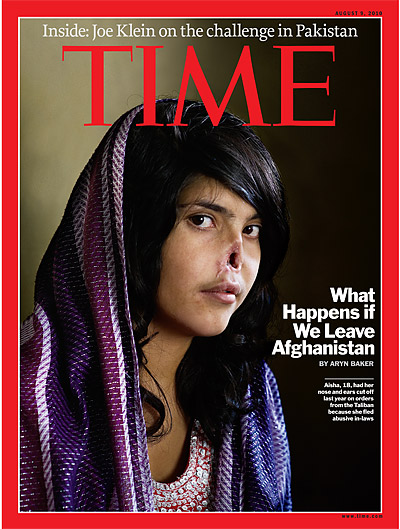
She looks back from the cover with an inscrutable gaze, her dark eyes intensified by the black hair that spirals out in thick curls from under her patterned purple head scarf. Her top is red and sequined; her mouth expressionless and slightly agape.

Where 18-year-old Aisha’s nose should be, however, is a hole: After attempting to flee abusive family members in Afghanistan, a Taliban commander sentenced Aisha to have her nose and ears cut off.

The powerful portrait is the front cover of the Aug. 9 Time magazine, accompanied by a story titled, “What Happens if We Leave Afghanistan.” In it, author Aryn Baker argues that the withdrawal of the U.S. military and its allies could result in a revival of the Taliban at a devastating cost to the nation’s women.

Christopher Schneider, an assistant professor of sociology at the University of B.C. whose research includes media studies, said the image is an obvious — and effective — attempt to garner attention.

“Things like sex and violence, our culture is so saturated with these kinds of images and symbols that people have become somewhat accustomed to them,” Schneider said.

“Something like this would probably tend to capture people’s perspectives or views in a way that, say, scantily clad woman on the cover of Time magazine might.” Photographer Jodi Bieber said in a video posted on the magazine’s website that Aisha’s beauty struck her.

“I said to her, ‘You know, you are really such a beautiful woman, and I could never understand or know how you’re feeling by having your nose and ears cut off,'” Bieber said.

“‘But what I can do is show you as beautiful in this photograph.’ I could have made a photograph with her looking or being portrayed more as the victim, and I thought, ‘No. This woman is beautiful.'”

In an accompanying editorial, managing editor Richard Stengel defended the image selection, saying he thought “long and hard” about whether to use it for the cover. “Bad things do happen to people, and it is part of our job to confront and explain them,” he wrote.

“In the end, I felt that the image is a window into the reality of what is happening — and what can happen — in a war that affects and involves all of us. I would rather confront readers with the Taliban’s treatment of women than ignore it. I would rather people know that reality as they make up their minds about what the U.S. and its allies should do in Afghanistan.”

Donald Gutstein, an adjunct professor at Simon Fraser University’s school of communications, whose research includes media analysis, said the image is unquestionably powerful, but its message misleading.

“It says that if Canada and the U.S. leave Afghanistan, this [mutilation] will be happening all over the place,” Gutstein said. “However, it happened while the U.S. and Canada were there, so what does that really tell us?”

Aisha is now in a secret women’s shelter in Kabul and is protected by armed guards, Stengel noted in his editorial. She will soon head to the U.S. for reconstructive surgery sponsored by the Grossman Burn Foundation.

With Friends Like These…

By Ron Moreau for Newsweek

The Afghan Taliban say they have one thing in common with the Americans: they’re both getting played by Pakistan. 

The Afghan Taliban logistics officer laughs about the news he’s been hearing on his radio this past week. The story is that a Web site known as WikiLeaks has obtained and posted thousands of classified field reports from U.S. troops in Afghanistan, and hundreds of those reports mention the Americans’ suspicions that Pakistan is secretly assisting the Taliban—a charge that Pakistan has repeatedly and vehemently denied. “At least we have something in common with America,” the logistics officer says. “The Pakistanis are playing a double game with us, too.”

Pakistan’s ongoing support of the Afghan Taliban is anything but news to insurgents who have spoken to NEWSWEEK. Requesting anonymity for security reasons, many of them readily admit their utter dependence on the country’s Directorate for Inter-Services Intelligence (ISI) not only for sanctuary and safe passage but also, some say, for much of their financial support. The logistics officer, speaking at his mud-brick compound near the border, offers an unverifiable estimate that Pakistan provides roughly 80 percent of the insurgents’ funding, based on his conversations with other senior Taliban. He says the insurgents could barely cover their expenses in Kandahar province alone if not for the ISI. Not that he views them as friends. “They feed us with one hand and arrest and kill us with the other,” he says.

The militants say that most often they’re dealing with middlemen who appear to be merchants, money-changers, or businessmen, although the assumption is that they’re working for Pakistani intelligence. Some provide money, some motorbikes; others supply contacts for sources who can provide weapons. One smuggler who funnels much of his profits to the insurgency claims that Pakistani forces reserve one remote border crossing in Baluchistan for the Taliban and force civilians to divert to far-off posts.

But many insurgents still blame the Pakistani government for its cooperation in the U.S. invasion of Afghanistan after 9/11. “We can’t forget or forgive Pakistan for turning against us nine years ago,” says a senior Taliban intelligence operative, also speaking with NEWSWEEK along the remote border. And the betrayals didn’t stop there. Every Taliban can recite a long list of insurgent leaders who have been arrested in Pakistan or who were killed in Afghanistan with assumed Pakistani complicity. One of the biggest losses was Mullah Akhtar Mohammad Osmani, a driving force in the Taliban’s revival whose hideout near Quetta was raided by Pakistani forces in 2006. He fled across the border, where he was killed in a U.S. airstrike. Another was Mullah Dadullah Akhund, one of the insurgency’s most feared commanders, who died in a coalition raid in Helmand—with the help of the ISI, the Taliban suspects. The insurgents say he was too brazen, too independent, and too close to Al Qaeda for Pakistan’s comfort.

Some leading Taliban even suspect that Mullah Mohammed Omar, the leader and symbol of their jihad, may also be in ISI custody. He has appeared in no videos and issued no verifiable audio messages or written statements since he disappeared into the Kandahar mountains on the back of Baradar’s motorcycle in late 2001. “I wouldn’t be surprised if the ISI arrested us all in one day,” says a former cabinet minister. “We are like sheep the Pakistanis can round up whenever they want.”

On top of the years of grudges, there’s a persistent strain of ethnic animosity between the Taliban’s overwhelmingly Pashtun membership and its mostly Punjabi patrons from Pakistan’s security forces. The insurgents refer contemptuously to the ISI as “blacklegs,” for their supposedly darker skin. “Any commander who is more or less self-sufficient and independent of Pakistan becomes more popular with his fighters,” the intelligence officer says. Nevertheless, the insurgents see little choice about accepting any help they can get from Pakistan.

The Pakistanis, for their part, continue to resist U.S. pressure for strikes against Taliban sanctuaries. “Their aim seems to be to prolong the war in Afghanistan by aiding both the Americans and us,” says the logistics officer. “That way Pakistan continues to receive billions from the U.S., remains a key regional player, and still maintains influence with [the Taliban].” And which side is Pakistan on? “That’s a foolish question,” says Anatol Lieven, a professor in the Department of War Studies at King’s College London. “Pakistan is on Pakistan’s side, just as America is on America’s.” Nobody knows that better than the Taliban.

What is Wikileaks?

By Jonathan Fildes for The BBC News

Whistle-blowing website Wikileaks is once again at the centre of attention as it makes public more than 90,000 secret records of incidents and intelligence reports from the US military about the war in Afghanistan. It is the latest in a long list of “leaks” published by the secretive site, which has established a reputation for publishing sensitive material from governments and other high-profile organizations. 

In April 2010, for example, it posted a video on its website that shows a US Apache helicopter killing at least 12 people – including two Reuters journalists – during an attack in Baghdad in 2007. A US military analyst is currently awaiting trial, on charges of leaking the material along with other sensitive military and diplomatic material.

In October 2009, it posted a list of names and addresses of people it claimed belonged to the British National Party (BNP). The BNP said the list was a “malicious forgery”.

And during the 2008 US elections, it published screenshots of the e-mail inbox, pictures and address book of vice-presidential candidate Sarah Palin.

Other controversial documents hosted on the site include a copy of the Standard Operating Procedures for Camp Delta, a document that detailed restrictions placed on prisoners at Guantanamo Bay.  It provoked controversy when it first appeared on the net in December 2006 and still splits opinion. For some it is lauded as the future of investigative journalism. For others it is a risk.

In mid-March 2010 the site’s director, Julian Assange, published a document purportedly from the US intelligence services, claiming that Wikileaks represented a “threat to the US Army”.  The US government later confirmed to the BBC that the documents were genuine. To keep our sources safe, we have had to spread assets, encrypt everything, and move telecommunications and people around the world”  “The unauthorised publication of Army and DoD sensitive documents on Wikileaks provides foreign intelligence services access to information that they may use to harm Army and DoD interests,” a spokesperson told BBC News.

The site now claims to host more than one million documents. Anyone can submit to Wikileaks anonymously, but a team of reviewers – volunteers from the mainstream press, journalists and Wikileaks staff – decides what is published.  “We use advanced cryptographic techniques and legal techniques to protect sources,” Mr Assange told the BBC in February. 

The site says that it accepts “classified, censored or otherwise restricted material of political, diplomatic or ethical significance” but does not take “rumour, opinion or other kinds of first hand reporting or material that is already publicly available”. “We specialise in allowing whistle-blowers and journalists who have been censored to get material out to the public,” said Mr Assange.

It is operated by an organisation known as the Sunshine Press and claims to be “funded by human rights campaigners, investigative journalists, technologists and the general public”.  Since it appeared on the net, it has faced various legal challenges to take it offline.

In 2008, for example, the Swiss Bank Julius Baer won a court ruling to block the site after Wikileaks posted “several hundred” documents about its offshore activities. However, various “mirrors” of the site – hosted on different servers around the world – continued to operate. The order was eventually overturned Wikileaks claims to have fought off more than “100 legal attacks” in its life, in part because of what is described as its “bulletproof hosting” The site is primarily hosted by Swedish ISP PeRiQuito (PRQ), which became famous for hosting file-sharing website The Pirate Bay.

“If it is legal in Sweden, we will host it, and will keep it up regardless of any pressure to take it down,” the ISP’s site says.  The site also hosts documents in other jurisdictions, including Belgium. Its experience of different laws around the world meant that it was drafted to help Icelandic MPs draw up plans for its Icelandic Modern Media Initiative (IMMI). The plan calls on the country’s government to adopt laws protecting journalists and their sources.

“To keep our sources safe, we have had to spread assets, encrypt everything, and move telecommunications and people around the world to activate protective laws in different national jurisdictions,” Mr Assange said at the time.

“We’ve become good at it, and never lost a case, or a source, but we can’t expect everyone to go through the extraordinary efforts that we do.”  Despite its notoriety, the site has faced financial problems. In February, it suspended operations as it could not afford its own running costs.  Donations from individuals and organisations saved the site.

Mr Assange told the BBC that the site had recently gone through “enormous growth” and had received an “extraordinary amount of material”.  “It exceeds our ability to get it out to [the] public at the moment,” he said in February.

As a result, he said, the site was changing and hoped to set up a number of “independent chapters around the world” as well as to act as a middle-man between sources and newspapers.   “We take care of the source and act as a neutral intermediary and then we also take care of the publication of the material whilst the journalist that has been communicated with takes care of the verification.”

“It provides a natural… connection between a journalist and a source with us in the middle performing the function that we perform best.” The latest documents – released in partnership with the New York Times, the Guardian and the German news magazine Der Spiegel – appear to be the first high-profile example of this new tactic.