Archive for the ‘ Pakistanis ’ Category

Growing Hope for Trade Ties Between India and Pakistan

By Shahzeb Jillani

Business leaders from India and Pakistan say there’s new optimism about the efforts their governments are making to improve trade ties. But critics warn that overcoming decades of mistrust may not be that easy.

For the first time in 35 years, a Pakistani commerce minister led a business delegation to India last week. The entourage included nearly 80 leading industrialists, traders and high-ranking officials.

Peace talks between the two nuclear-armed neighbours broke down in 2008 after the attacks in the Indian city of Mumbai, which India blamed on Pakistan-based militants.

Nearly three years on, as if to emphasise a sense of normalcy, the Pakistani Commerce Minister, Makhdoom Amin Fahim, stayed at the city’s Taj Mahal Hotel – which was one of the main targets of the 2008 attacks.

There, leading Pakistani traders got a chance to mingle with their equally eager-for-business Indian counterparts.

Between them, they spoke not just of the profits their individual businesses could make if their governments removed the long standing hurdles in their way. But also of how much the people of their two countries, and indeed the wider region, stand to benefit from freer movement of goods, money and commodities.

The only way I see realisation of trade potential between our two countries is for India to remove its non-tariff trade barriers and for Pakistan to reciprocate by granting the MFN status to India”

Vijay Kalantri, president of All India Association of Industries, said traders on both sides feel business between India and Pakistan is a win-win situation for everyone.

“Why are Indians and Pakistanis forced to trade unofficially via third countries like Dubai or Sri Lanka?” he tells the BBC from Mumbai.

“All we are asking is, let there be direct business-to-business contact between us.”

After the talks in Delhi, ministers from the two sides announced their agreement to boost their annual bilateral trade from current $2.7bn (£1.7bn) to $6bn by 2015.

They also pledged to ease business travel and promote bilateral trade through the land route.

For Pakistan, a significant announcement was a pledge by India to drop its opposition to the European Union’s plan to grant Pakistan tariff waiver on select commodities to help it recover from the devastation of 2010 floods.

There was hope that Pakistan might reciprocate and grant India the Most Favoured Nation status (India granted Pakistan MFN status way back in the 1990s).

Even though no such announcement came, Pakistan committed itself to a road map to implement preferential trade ties with India, as prescribed under the South Asia Free Trade Agreement (Safta).

Trade barriers
There are a number of explanations why Pakistan has so far withheld the MFN status from India.

At present there are a number of barriers to prevent trade between Indian and Pakistan
First is political. Pakistani leaders have often linked it to the resolution of the core issue of Kashmir.

It’s a stance which has long been propagated for mainly domestic consumption.

But there is a sense in Pakistan that while the country should continue to push for a negotiated settlement of the Kashmir issue, trade and commerce should not be held hostage to resolution of political disputes.

The second is protectionism. For years, domestic industry in Pakistan has feared it would be swamped by imports from India. But even there, the mood appears to have shifted.

Senator Haji Ghulam Ali, president of Federation of Pakistan Chambers of Commerce and Industry, says there’s a consensus that Pakistan should open up to Indian business.

“Everyone now recognises it will be beneficial for both sides. It’s just a matter of time before it’s done,” he tells the BBC from Delhi.

Business leaders say that less trade barriers would benefit firms in both countries, However, the last, and more plausible, obstacle is the issue of non-tariff barriers.

“In my experience, India has one of the most restrictive trade regimes in the region,” asserts Dr Ashfaq Hasan Khan, a former advisor to Pakistan’s Ministry of Finance. His view matters, given has decades of dealings with South Asian governments on trade liberalization.

He explains that despite granting Pakistan the MFN status, India has a variety of non-tariff barriers in place – such as, stringent certification codes, customs rules, security clearances and movement restrictions – which make it virtually impossible for Pakistani traders to do business in India.

“The only way I see realisation of trade potential between our two countries is for India to remove its non-tariff trade barriers and for Pakistan to reciprocate by granting the MFN status to India,” says Mr Khan.

He adds: “Unless there’s political will to do that, everything else is just talk and photo op.”

CIA Contractor Charged in Pakistan Deaths Arrested in Colorado

By Jim Spellman for CNN

Raymond Davis, who was charged with killing two men in Pakistan as a CIA contractor but was later released, was arrested Saturday after a fistfight at a shopping center in Colorado, authorities said.

Davis was charged with misdemeanor assault and disorderly conduct after allegedly getting into a fight over a parking space at a suburban Denver mall, according to Lt. Glenn Peitzmeier of the Douglas County Sheriff’s Office.

The incident at the Highlands Ranch Town Center began as an argument between 37-year-old Davis and 50-year-old Jeff Maes and then turned physical, Peitzmeier said. Davis was released after posting $1,750 bond, Peitzmeier said.

Davis’ wife, Rebecca, declined a CNN request for comment. Davis was charged with killing two men in Lahore, Pakistan, in January. He was released in March after compensation was paid to their families.

U.S. officials originally said Davis was a diplomat and tried to claim diplomatic immunity but then revealed that he was a CIA contractor.
Davis said he killed the two men in self-defense, though Lahore authorities called the case “clear-cut murder.”

Death Sentence in Slaying of Pakistani Governor

By Salman Masood for The New York Times

A court on Saturday sentenced to death an elite police guard who assassinated a leading secular politician he had been charged with protecting, a slaying that sent shockwaves throughout Pakistan and was seen as a clear marker of the growing religious intolerance and extremism in the country.

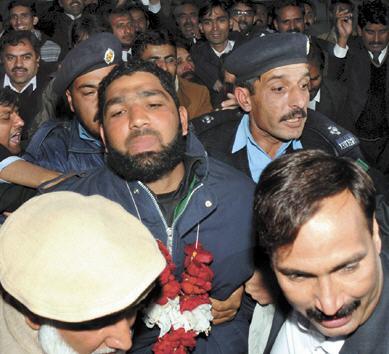
The news made international headlines not just because of the prominence of the politician killed, Salman Taseer, but because the killer was celebrated by many in Pakistan, including lawyers who showered him with rose petals and garlands at a court appearance.

Judge Syed Pervez Ali Shah announced the sentence for the guard, Malik Mumtaz Qadri, in an antiterrorism court at Adiala Jail in Rawalpindi. “Nobody can be given a license to kill on any pretext,” the judge was quoted as saying after the conclusion of the trial, which was held under tight security.

The ruling was unusual in Pakistan; frightened justices in recent years have been cowed into releasing Islamic militants or letting them off with light sentences. The judgment was especially noteworthy in such a high-profile case against a man whose popularity only grew with his confession and defense of the killing on religious grounds.

Mr. Taseer was the governor of Punjab Province and one of the country’s most outspoken opponents of the country’s controversial blasphemy laws, which mandate a death sentence for anyone convicted of insulting Islam.

Liberals and rights activists were encouraged by the verdict, but noted that it could be overturned in appeals that can drag on for years.

“Today’s judgment is a positive development whereby norms of justice have prevailed,” said Raza Rumi, a political analyst and columnist in the eastern city of Lahore. “Pakistan cannot be allowed to become a vigilante society, and the state — its judges and prosecutors — need to uphold the law.”

No matter what happens with the case, however, Mr. Taseer’s death cast a pall over discussions of the blasphemy laws — which had become something of a test case for broader debate of how religion and politics mix in Pakistan. That trend continued Saturday. The usually voluble Pakistani press dutifully covered the story, but news broadcasts were mainly devoid of the normal commentary or debate.

“Local media’s muted coverage of the sentence is reflective of the fear factor and the polarization within the society which includes media personnel,” Mr. Rumi said.

Mr. Qadri, 26, was convicted of murder and committing an act of terrorism, and was handed two life sentences.

No date for the execution has been announced, and Mr. Qadri has a right to appeal within seven days. Raja Shuja-ur-Rahman, a lawyer for Mr. Qadri, told the DAWN television channel that an appeal would be filed.

Mr. Qadri killed Mr. Taseer in a hail of bullets on Jan. 4, shooting at close range as Mr. Taseer was getting into his car.

Mr. Taseer, a businessman and a liberal politician, had emerged as a leader in a fight against the blasphemy law, which rights groups say has been used to persecute minorities, especially Christians.

The law was introduced in the 1980s under the military dictatorship of Gen. Mohammad Zia ul-Haq as part of a policy of promoting Islam to unite Pakistan’s deeply fractious society.

Mr. Qadri was hailed as a hero by Islamist lawyers, several mainstream politicians and religious leaders.

On Saturday, dozens of supporters of Mr. Qadri gathered outside the jail and chanted slogans against the sentence, while the judge slipped out a back door.

“We will free you! We will die for you!” 20-year-old Mohamemd Aslam was quoted as saying by The Associated Press. Others yelled: “Long live Qadri, long live Qadri!”

“By punishing one Mumtaz Qadri, you will produce a thousand Mumtaz Qadris!” shouted another man.

The ruling Pakistan Peoples Party, to which Mr. Taseer belonged, has been accused of distancing itself from the cause of repealing the blasphemy law since the assassination.

U.S. Refrains From Declaring Haqqani Terrorist Group on Pakistan Concerns

By John Walcott and Viola Gienger for Bloomberg News

The Obama administration isn’t ready to declare the Haqqani group in Pakistan a “foreign terrorist organization” even after Admiral Mike Mullen, chairman of the Joint Chiefs of Staff, said the group attacked the U.S. embassy and American troops in Afghanistan.

“We are continuing to review whether to designate” the Haqqani organization, State Department spokeswoman Victoria Nuland said yesterday.
Mullen’s declaration in Senate testimony last week that Haqqani operatives acted as a “proxy” for Pakistan’s intelligence service may have further complicated the question.

Taking the first step — adding the Haqqani group to the list of terrorist organizations — would lead to demands that Pakistan be declared a state sponsor of terrorism. That would put at risk Pakistan’s cooperation as the U.S. tries to snuff out al-Qaeda’s core and other militants in the country’s tribal areas.

For now, the U.S. has designated the Haqqani network’s founder and other leaders. It has made clear to Pakistan that clamping down on the group “is job one, that we want to do it together, and that’s the conversation that we’re having now,” Nuland said.
Designating Pakistan a state sponsor of terrorism would put it in the company of only four other countries — Cuba, Iran, Sudan and Syria — and might trigger a nationalist backlash in Pakistan. It would require halting U.S. aid to Pakistan, force the U.S. to oppose World Bank loans to Pakistan, and end cooperation between the two countries in fighting terrorism and trying to stabilize Afghanistan.

Pariah State

Naming Pakistan a sponsor of terrorism “would turn it into a pariah state,” Robert Lamb, a senior fellow at the Center for Strategic and International Studies in Washington, said in a telephone interview. “That would complicate a lot of aspects of the relationship, which is complicated enough already. It’s ugly, but it’s not unsalvageable.”

The administration is under new pressure to designate the Haqqanis a terrorist organization alongside 49 others, including al-Qaeda, Lebanon’s Hezbollah, and Hamas, the Palestinian Islamist group that controls the Gaza Strip.

After Mullen testified to the Senate Armed Services Committee, Senator Dianne Feinstein, a California Democrat and chairman of the Senate Intelligence Committee, wrote Secretary of State Hillary Clinton that the Haqqani group “meets the standards for designation” as a terrorist organization. So far, said congressional officials, Clinton hasn’t responded.

Congressional Pressure

“I think there’s going to be increasing congressional pressure on them to list the Haqqani network as a foreign terrorist organization,” said Lisa Curtis, a former CIA analyst and now a senior research fellow at the Heritage Foundation policy group in Washington.
“If we know that the Haqqani network is behind these major attacks on U.S. interests and we fail to confront them, that is a signal of weakness and it simply invites more attacks,” she said.

Nuland and other administration and military officials signaled a reluctance to sanction Pakistan.
Pentagon Press Secretary George Little said yesterday that the U.S. wants to “maintain a relationship with Pakistan that’s grounded in common interests, to include going after terrorists that threaten both countries.”
“There are differences from time to time,” Little told reporters at the Pentagon. “Those differences have been made public, and we continue to discuss those differences in private. We look forward to working with the Pakistanis to try to resolve them.”

Stretched Thin

Pakistani military officials told reporters in Islamabad on Sept. 25 that they had decided not to take action against the Haqqani group because their forces are stretched too thin.

If tensions escalated, Pakistan might again, as it did in a previous diplomatic confrontation, cut supply lines to U.S., NATO and Afghan forces in Afghanistan from its port city of Karachi. Alternative land or air routes are more costly and difficult.
The Pakistanis, said two U.S. intelligence officials, also might abandon secret agreements that permit unmanned U.S. drones to collect intelligence and attack targets in designated areas of Pakistan.

The U.S. already is restricted from operating over the Haqqanis’ suspected base in North Waziristan or the border city of Quetta, home to the main Afghan Taliban group. They also might expel some or all of the classified number of U.S. intelligence officers and special operations forces who are training Pakistani troops and helping target drone attacks, the officials said.

ISI Role

Designating the Haqqani network a terrorist organization would do little to stop the group, said Curtis of the Heritage Foundation. The Haqqanis, she said, probably still would be able to garner financial support from their allies in the Persian Gulf region and backing from the Pakistan spy agency, the Directorate of Inter-Services Intelligence, known as ISI.
A U.S. designation of the Haqqanis isn’t likely to change Pakistani policy either, said Christine Fair, a Pakistan expert at Georgetown University in Washington.

The ISI and the Pakistani military regard the Haqqani network and other militants as allies in their campaign to maintain Pakistani influence in Afghanistan and prevent arch- rival India from getting a toehold on Pakistan’s western border, said Fair and other specialists.
“They believe that the Haqqanis would protect Pakistan’s interest in any future setup in Afghanistan,” Curtis said.
Rejecting the charges that his government uses the Haqqanis as a proxy, Pakistani Prime Minister Yousuf Raza Gilani said in a Sept. 25 statement that U.S. policy on Afghanistan shows “confusion and policy disarray.”

“We may just let this ride,” said Marvin Weinbaum, a former Afghanistan and Pakistan intelligence analyst at the State Department and director of the Center for Pakistan Studies at the Middle East Institute in Washington. “We know what direction the U.S.-Pakistan relationship is going, and now we have no idea what the bottom looks like.”

Pakistani Commanders Meet After US Criticism

By Sebastian Abbot for The Asssociated Press

Pakistan’s army chief convened a special meeting of senior commanders Sunday following U.S. allegations that the military’s spy agency helped militants attack American targets in Afghanistan, the army said.

The government also summoned home the country’s foreign minister early from a trip to the United States to attend a meeting of all major political parties to discuss the American allegations of support for the militant Haqqani network.

Senior Pakistani officials have lashed out against the allegations, accusing the U.S. of trying to make Pakistan a scapegoat for its troubled war in Afghanistan. The public confrontation has plunged the already troubled U.S.-Pakistan alliance to new lows.

Pakistan’s leaders have shown no indication they plan to act on renewed American demands to attack the Haqqani network in its main base in Pakistan, even at the risk of further conflict with Washington, which has given the country billions in aid.

U.S. officials have implied that American forces could carry out unilateral raids inside Pakistan against the Haqqani network, operations that could have explosive implications in a country where anti-American sentiment is widespread.

Pakistanis were outraged by the covert U.S. commando raid that killed al-Qaida chief Osama bin Laden in a garrison town not far from Islamabad in May. The U.S. did not tell the Pakistani government about the operation beforehand for fear bin Laden would be tipped off.

Pakistani Interior Minister Rehman Malik warned the U.S. on Sunday against sending troops into Pakistan.

“Any aggression will not be tolerated,” Malik told reporters in Islamabad. “The nation is standing united behind the armed forces, which is the front line of Pakistan’s defense.”

The top U.S. military officer, Adm. Mike Mullen, last week accused Pakistan’s Inter-Services Intelligence agency of supporting Haqqani insurgents in planning and executing a 22-hour assault on the U.S. Embassy in Afghanistan on Sept. 13 as well as a truck bomb that wounded 77 American soldiers days earlier.

Pakistan’s army chief, Gen. Ashfaq Pervez Kayani, widely considered the most powerful man in Pakistan, has dismissed the allegations, saying they were baseless and part of a public “blame game” detrimental to peace in Afghanistan.

Pakistan army spokesman Maj. Gen. Athar Abbas said Kayani presided over Sunday’s commanders meeting but would not provide detail on the discussions.

Later in the day, Prime Minister Yousuf Raza Gilani’s office issued a statement saying Foreign Minister Hina Rabbani Khar was summoned back to attend a meeting of all major political parties on “threats emanating from outside the country.”

Gilani slapped down the U.S. allegations in a separate statement issued late Saturday.

“We strongly reject assertions of complicity with the Haqqanis or of proxy war,” Gilani said in a statement. “The allegations betray a confusion and policy disarray within the U.S. establishment on the way forward in Afghanistan.”

Pakistan claimed to have severed its ties with Afghan militants after the 9/11 attacks and supported America’s campaign in Afghanistan, but U.S. officials have long suspected it maintained links. The comments by Mullen, who is chairman of the Joint Chiefs of Staff, were the most serious yet accusing Pakistan of militant ties, although he didn’t cite any specific evidence.

Despite the seriousness of the U.S. claims, which appear to accuse Pakistan of state-sponsored terrorism, Mullen and other U.S. officials have said Washington needs to keep engaging with Islamabad, a reflection of its limited options in dealing with the country. Washington is also concerned about the danger of further instability in the nuclear-armed state.

The head of U.S. Central Command, Gen. James Mattis, called for continued cooperation after a meeting with Kayani in Islamabad. In a statement issued Sunday by the U.S. Embassy, Mattis emphasized “the need for persistent engagement among the militaries of the U.S., Pakistan and other states in the region.”

Mattis also met with the Pakistani military’s chief of staff, Gen. Khalid Wynne, who expressed his concern about “negative statements emanating from the U.S.” and stressed the need to address “the irritants in the relationship,” according to a statement issued by the military.

Around half of the U.S. war supplies to Afghanistan are trucked over Pakistani soil, and even as it accuses Islamabad of complicity with Afghan insurgents, Washington knows that it will likely need Islamabad’s cooperation in bringing them to the negotiating table.

Gilani also called for greater cooperation.

“Let’s avoid mutual recrimination and recommit ourselves to working together for eliminating terrorism and for reconciliation and peace in Afghanistan,” he said.

Pakistan Warns U.S. Against Hot Pursuit On Its Soil

As Reported by The Detroit Free Press

Pakistan’s foreign minister today warned the United States against sending ground troops to her country to fight an Afghan militant group that America alleges is used as a proxy by Pakistan’s top intelligence agency for attacks in neighboring Afghanistan.

The warning came as a top U.S. military commander was in Pakistan for talks with the army chief at a time of intense strain between the two countries. The U.S. Embassy said Gen. James Mattis, head of U.S. Central Command, arrived in Pakistan late Friday, and that he will meet the army chief, Gen Ashfaq Parvez Kayani.

Ties between Islamabad and Washington are in crisis after American officials stepped up accusations that Pakistan’s Inter Services Intelligence was aiding insurgents in neighboring Afghanistan, including those who took part in an attack on the U.S. Embassy last week in Kabul.

Pakistan’s Foreign Minister Hina Rabbani Khar said in an interview today that there are red lines and rules of engagement with America, which should not be broken.

“It opens all kinds of doors and all kinds of options,” she told Pakistan’s private Aaj News TV from New York. The comment was in response to a question about the possibility of U.S. troops coming to Pakistan.

Khar, however, insisted that Pakistan’s policy was to seek a more intensive engagement with the U.S. and that she would like to discourage any blame game.

“If many of your goals are not achieved, you do not make someone a scapegoat,” she said, addressing the U.S.

The U.S. allegations have seen a strong reaction from Pakistan.

Kayani, the Pakistani army chief, said on Friday that the charges were baseless and part of a public “blame game” detrimental to peace in Afghanistan. Other Islamabad officials urged Washington to present evidence for such a serious allegation. Khar warned the United States is risking losing an ally in the war on terror.

The row began when Adm. Mike Mullen, chairman of the Joint Chiefs of Staff, on Thursday accused the ISI agency of supporting Haqqani insurgents in planning and executing last week’s 22-hour assault on the U.S. Embassy and a truck bombing that wounded 77 American soldiers days earlier.

Kayani said the allegations were “very unfortunate and not based on facts.”

The claims were the most serious yet by an American official against nuclear-armed Pakistan, which Washington has given billions in civilian and military aid over the last 10 years to try to secure its cooperation inside Afghanistan and against al-Qaida.

The Haqqani insurgent network is widely believed to be based in Pakistan’s North Waziristan tribal area along the Afghan border. The group has historical ties to Pakistani intelligence, dating back to the war against the Soviets in Afghanistan in the 1980s.

The relationship between the two countries has never been smooth, but it took one of its hardest hits when U.S. commandos slipped into Pakistan on May 2 without informing the Pakistanis of their mission and killed al-Qaida chief Osama bin Laden in a garrison town not far from Islamabad.

Pakistanis for Peace Editorial Note– We hope that the United States and Pakistan can get through this incredibly difficult period in their long and close relationship. The United States should present the concrete evidence that it has that there is collusion on the part of individuals in the Pakistani government with the terrorists and the Pakistanis for their part must do a lot more to end terror networks within their borders, and this certainly includes sending troops into North Waziristan, Quetta and any other city in the country where the terrorists are based. The already unstable and dangerous neighborhood that is South Asia can not afford further deterioration in US-Pakistan relations.

Anna’s Trip to Pakistan: Should He Or Shouldn’t He

By Akshaya Mishra for Firstpost

Should he or shouldn’t he?

The supporters of Anna Hazare are in a bind. Two days after the Gandhian accepted the invitation of a human rights delegation from Pakistan to visit that country, the public opinion in India stands divided.

The Shiv Sena was first off the block opposing Anna’s move. Its argument follows the usual political theme. Islamabad must stop sponsoring terrorist activities in India first. The anti-corruption crusader should have taken cognisance of the sentiments of people before even considering such an invitation, it said.

Others are likely follow the Sena’s line soon. The hard line Hindutva followers, who have been silent so far, may erupt in anger, putting a communal spin to the visit.

Anna might just have put his feet in uncharted territory, and a minefield of potential controversies. Pakistan is not an easy proposition even for seasoned politicians to handle. He could be risking his reputation.

So, should he or should not he? There are no easy answers.

Anna is not just an individual, he is a phenomenon. He is an idea that easily transcends boundaries. The massive support to his anti-corruption movement across the social spectrum was a pointer to the fact.

“I will go to Pakistan. In fact, I will go anywhere for the sake of peace and poor people,” he said while meeting the Pakistani delegation, which included former judge of Supreme Court of Pakistan Nasir Aslam Zahid and founder of Pakistan India Forum for Peace and Democracy Karamat Ali.

Anna might just have put his feet in uncharted territory, and a minefield of potential controversies. PTI
“I believe in the religion of humanity, and humanity should begin with your neighbour. Like Indians, Pakistanis too are suffering due to widespread corruption in their country,” he added.

The statements reflect the man as he is — simple, honest and innocent of concerns that bother others so much. It’s possible he would not have given a serious thought to the troubled India-Pakistan equations. It is possible he would be worried about people and their happiness only, not issues or borders.

Isn’t corruption a big issue in Pakistan too? Don’t people suffer because of that? That would be his line of thinking. He would be oblivious to the fact that any movement there guided by him would amount to challenging the rulers in Islamabad and that any intention to help the country would inflame passions in India.

Sena chief Bal Thackeray has sounded the warning note. “Be it Anna or anyone else, they should first speak to kin of those killed in the Mumbai and Delhi blasts, before anointing themselves Nishan-e-Pakistan (Pakistan’s highest civilian award),” he wrote in the party mouthpiece Saamna today.

“Whether Anna goes to Pakistan or not is another matter, but it would have been better had he given a thought to the country’s sentiments on the issue,” he added.

Earlier, the party’s spokesperson Sanjay Raut had made his disapproval clear. “Anna should have told the visiting delegation to go back to Pakistan and create awareness among the people about the Pak-sponsored terrorism in India. The entire world may have praised the anti-corruption movement in India, but Anna cannot ignore sentiments of the people in his own country vis-a vis Pakistan,” he had said.

Anna is likely to lose most of his following in India if he goes ahead with his Pakistan trip, which for all practical purposes would be a symbolic one. Worse, notwithstanding the nature of his visit he would turn a political entity, without intending to be so.

His biggest achievement so far has been that he has managed to stay apolitical despite the desperate efforts from parties to align with him. He represents the common Indian and the other India, which stays out of the power circle that rules the country.

But the other India hates Pakistan too. This is where Anna is likely to run into a problem. Questions could be raised about his intention — the ordinary follower is not expected to understand and appreciate the nuances of his high thinking. The adulation for him is likely to shrink.

Anna should not let that happen. Pakistan can wait.

India, Pakistan To Open New Trade Check-Post

By Tom Wright for The Wall Street Journal

While India and Pakistan trade barbs over terrorism, the country’s trade officials are making small but notable steps toward opening up their economies to one another.

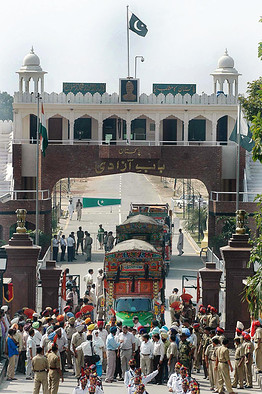
In October, authorities plan to open a second trade check-post at the Wagah border in Punjab state, the only land-crossing between the two hostile neighbors, in an attempt to boost trade volumes. The commerce ministers of both countries are expected to formally announce the new check-post at a meeting in New Delhi later this month.

It might look like a baby step in normalizing frozen trade relations. But with so much else going wrong in India-Pakistan ties, it’s a welcome bit of positive news and one that is energizing Indian businessmen who work close to the border.

Currently, trucks that carry the meager flow of trade between India and Pakistan have to stop unloading at 3 p.m. because that’s when tourists from both sides start arriving at the Wagah border for the evening “Beating Retreat” ceremony – a display of nationalistic bravado that precedes the formal closing of the gates between the countries each evening.

The new terminal will allow trade to continue until 7 p.m. and hopefully increase volumes passing through the check-post.

Some business groups in Amritsar, a city near the Indian side of the border,  are betting on an expansion of trade. Suneet Kochhar, director of a paper company based in Amritsar, is involved with a group of investors who have accumulated land to develop a freight terminal near the second trade check-post.

“Once it’s operational, things will change,” Mr. Kocchar says. Land near the border has doubled in value in the past two years, he adds.

To be sure, Pakistan and India have looked like moving ahead on trade in the past but things have gotten nowhere. Another attack like the one carried out by Pakistani militants on Mumbai in 2008, killing over 160 people, could easily nip the current optimism in the bud.

Two-way India-Pakistan trade was a paltry $1.8 billion in the year ended March 31, 2010, basically unchanged over the past five years, while India’s trade with China has skyrocketed to $60 billion.

Indian Prime Minister Manmohan Singh has said that India won’t be able to fulfill its economic potential unless it normalizes relations with Pakistan, which is a gateway to the Central Asian republics and beyond. For Pakistan, India is a huge potential market of 1.2 billion people. For now, businesses that want to get around restrictions have to ship goods at extra cost via ports like  Dubai.

The new check-post is a good start. Indian officials estimate two-way trade could easily jump to $2.7 billion in the short term. But there won’t be a seismic shift in trade volumes until both countries make serious efforts to expand the list of products that they can trade with one another. The current list encompasses just over 1,000 items.

That has frustrated some business people. Sunil Behal, director at Poplon Chemie, an Amritsar-based company that makes chemicals to treat leather, says some of its key products are not on the list. The company currently exports only $7,000 worth of products to Pakistan each month out of its total global exports of over $180,000 in the same period, he says.

But like many businesspeople in the area, he’s hopeful that politicians really mean to make progress this time. The check-post, he say, “will definitely boost business.”

There are tentative signs of seriousness. Ahead of the commerce ministers’ meeting later this month, officials from both sides met in New Delhi and thrashed out their differences. The minutes of the meeting  are here.

The officials were candid about the challenges. The new check-post, they agreed, will only be effective if both sides take other measures like simplifying customs procedures.

Pakistan officials complained they were not even aware of the customs rules followed by India, and faced a number of non-tariff barriers to trade such as cumbersome testing of products by Indian authorities that can take weeks, according to the minutes.

India lamented that Pakistan continues to put blocks in the way of trade, including proscribing a number of goods that aren’t allowed to enter Pakistan by road but instead have to come by rail. Mr. Kochhar, the paper company director, says he would export newsprint to Pakistan, but it’s uneconomical at the moment to ship via rail.

Both sides complain about the difficulty of getting business visas and have promised to remove bureaucratic obstacles.

The key, though, might be plans that India and Pakistan have to allow trade in most products, only protecting weak and strategic industries. The two countries are currently drawing up a list of these industries – known as a negative list – to submit to the other side.

Don’t expect these issues to be ironed out overnight. Still, there’s movement which both nations are trying to build on.

US Links Militant Group to Pakistan Government

As Reported by ABC News

The United States says there is evidence linking the Pakistani government to the militant group that carried out last week’s attack on the US embassy in Kabul.

The US ambassador to Pakistan, Cameron Munter, claims there are links between the Pakistani government and high-profile terrorist group the Haqqani network.

In blunt comments broadcast by state-run Radio Pakistan, Mr Munter said: “Let me tell you that the attack that took place in Kabul a few days ago that was the work of the Haqqani network,” he said, referring to a deadly miltant attack in on Tuesday.

“There is evidence linking the Haqqani network to the Pakistan government. This is something that must stop.

“We have to make sure that we work together to fight terrorism.”

Asked to provide evidence of the link with the Pakistani government, Mr Munter said only “we believe that to be the case”.

The Haqqani network, which is closely allied to the Taliban, has been blamed for several high-profile attacks against Western, Indian and government targets in Afghanistan.

The group is believed to be based in Pakistan but Islamabad has consistently denied links with militant groups.

The US has long urged Pakistan to take action against the Haqqani network and suspected the group had support within the Islamabad administration.

Strained ties
Acknowledging that the past year had been tough, Mr Munter urged joint action against terrorism and said that the United States and Pakistan were “fundamentally on the same side”.

But the public comments are a mark of strained ties between the fragile anti-terrorism allies, with relations fractious since the US raid on Pakistani soil that killed Al Qaeda leader Osama bin Laden in May.

The Haqqani network is thought to have been behind a number of attacks in Afghanistan, where NATO plans a gradual withdrawal of troops after a gruelling 10-year war.

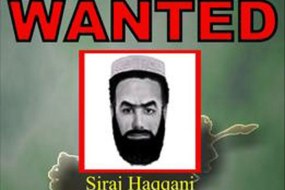
Jalaluddin Haqqani, founder of the network, and his son Sirajuddin, who now runs the group, have both been designated “global terrorists” by Washington.

Mr Munter’s remarks follow a warning by US defence secretary Leon Panetta, who said after the Kabul attack that the US would retaliate against Pakistan-based insurgents.

“Time and again we’ve urged the Pakistanis to exercise their influence over these kinds of attacks from the Haqqanis and we’ve made very little progress in that area,” Mr Panetta said Wednesday, a day after the Kabul siege.

“I’m not going to talk about how we’re going to respond. I’ll just let you know that we’re not going to allow these kinds of attacks to go on,” he said.

Pakistan’s foreign ministry condemned those remarks as “out of line”, saying that “terrorism and militancy is a complex issue”.

Pakistan’s Floods: Deja Vu, All Over Again

By Ishaan Tharoor for Time

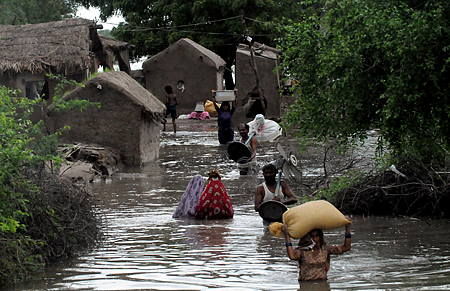
These days when it rains in South Asia, it doesn’t just pour — it floods. A month of monsoon squalls has deluged hundreds of towns and villages in northwest India and Pakistan. The latter has seen the most acute flooding, and, on all evidence, has been the least prepared for it. At least 233 people have already died and 300,000 are now stranded or in makeshift camps — a figure that will surely grow. Officials in Pakistan claim some 5.5 million people so far have been affected by rising waters. That’s still only a fraction of the 20 million hit by last year’s catastrophic rains, but the forecast looks ominous.

Neva Khan, Oxfam’s Pakistan country director, spelled out the dimensions of the crisis on the relief agency’s website:
There is an urgent need to provide immediate and life saving relief to the millions affected. It hasn’t stopped raining in Sindh for the last 10 days. Large swathes of land are underwater and people are desperately awaiting relief. They have lost their crops, homes and livestock for the second time – and been pushed from last year’s disaster to this one.

Sindh, the vast, fertile province abutting the Arabian Sea, appears the worst affected. Across Pakistan, some 900 villages have been wholly submerged and millions of hectares of arable land — some still irrevocably damaged by last year’s floods — are under water.
What’s most depressing about the situation now is how keenly it echoes the 2010 calamity. Omar Waraich, TIME’s Islamabad correspondent, wrote this excellent piece a year ago for the magazine’s international editions. As the waters rise, Pakistan faces a familiar cocktail of maladies from last summer.

Then, the civilian government headed by the unpopular President Asif Zardari was hampered by political infighting and its fundamental subservience to the real power of Pakistan’s influential military. Now, not much has changed (though Zardari is still in his position, a surprise to some). Then, militants and terrorists were exposing the fragility of the Pakistani state with cold-blooded strikes on some of country’s major cities. Now, after a rancorous summer of barb-flinging with the U.S., not much has changed either — not least when suspected al-Qaeda allied militants raided a prominent naval base in Karachi earlier this year. Then, the cash-strapped government pleaded for foreign assistance. Now similar calls are being issued, with similar notes of desperation.

In the weeks to come, inquests will be made into whether enough had been done to shore up riverbanks, provide shelter and food for the hundreds of thousands left destitute for over a year, and prepare for the next season’s rains. Already, there are reports of angry civilians blockading roads — like last year — demanding outside intervention and aid. Cities like Karachi, which this summer has seen a spasm of internecine blood-letting, will be further strained by refugees fleeing the countryside.

On many levels, though, the disaster is not man-made. The floodplain of the great Indus river, home to over 100 million people, birthed one of the world’s first ancient civilizations. But the river likely also swallowed it up. Because of its own particular ecology, the Indus can’t be controlled by similar mechanisms of levees prevalent in the West. And climate change has made weather patterns more unpredictable and volatile. This BBC story from a year ago cites the research of an Indian scientist: Professor Rajiv Sinha, from the Indian Institute of Technology in Kanpur, who has had first hand experience of Asian river floods, takes a more strident position.

“What all the climate models predict is that the distribution of monsoon rains will become more uneven in the future,” he told BBC News.
“Total rainfall stays the same, but it comes in shorter more intense bursts.”

In August 2010, more than half of the normal monsoon rain fell in only one week. Typically it is spread over three months.
Professor Sinha remarked: “Rivers just can’t cope with all that water in such a short time. It was five times, maybe 10 times, more than normal.”
So, if the unusually intense 2010 monsoon is the shape of things to come – and that is uncertain – the future may hold more flood misery for the people of Pakistan.

It’s a closing sentence that has proven sadly prophetic.

Pakistan Struggles to Curb Dengue Fever

As Reported By Reuters

Pakistani authorities, already under pressure to help hundreds of thousands of flood victims, are struggling to contain dengue fever which has killed at least eight people, officials said on Wednesday.

Around 4,400 cases of the mosquito-borne disease have been reported in the central Punjab province over the past two months, forcing the provincial government on Tuesday to close down schools for 10 days.

Most of the cases have been reported in Lahore, the provincial capital, where about 2,950 people tested positive.

“So far, eight people have died of dengue. We are trying our best to control this epidemic,” Jehanzeb Khan, secretary of the provincial health department, told Reuters.

Health experts say the illness is spreading across the Punjab because of poor hygiene conditions, and heavy monsoon rain provides ideal conditions for dengue-carrying mosquitoes to thrive in stagnant waters.

The first case of dengue was reported in Pakistan in 1994.

Those who died included Ataullah Siddiqui, head of the provincial department of minerals and natural resources.

Khan said the government had launched a fumigation drive to kill mosquitoes.

Sri Lanka is sending a team of experts to Pakistan to help fight the disease, the Sri Lankan High Commission said in a statement.

Pakistan’s weak civilian government, struggling to deal with floods that have killed 266 people, has been criticised by the media for dragging its feet on the dengue issue.

“The response to dengue has been adhoc, ex post, and therefore reactionary at best,” The News daily said in its editorial.

The disease is a threat to nearly half of the world’s population. Of the estimated 220 million people infected each year, two million — mostly children in Latin America and Asia — develop a severe form called dengue hemorrhagic fever.

There is currently no cure or vaccine for dengue fever.

Pakistan WSJ Ad Unlikely to Change Narrative

By Tom Wright for The Wall Street Journal

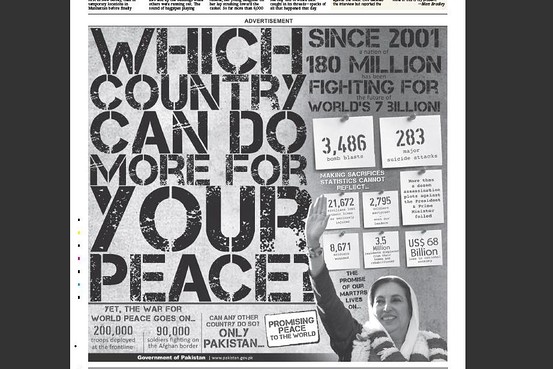
Pakistan has taken out a half-page advertisement in The Wall Street Journal to coincide with the 10th anniversary of the Sept. 11 attacks in an attempt to shift what Islamabad feels is an anti-Pakistan narrative in the American media.

“Which country can do more for your peace?” the ad asks, sitting below a story on page A10 of the U.S. Journal’s Saturday/Sunday edition titled “When the Towers Came Down.”

“Since 2001 a nation of 180 million has been fighting for the future of world’s 7 billion!” it continues.”Can any other country do so? Only Pakistan…Promising peace to the world.”

Pakistani army and civilian officials complain that in the U.S. their country is often portrayed in the media and by members of Congress as a double-dealing ally that takes billions of dollars in U.S. aid but secretly helps the Taliban kill U.S. soldiers.

Pakistan’s leaders have been publicly trying to promote a competing narrative, but with almost no success.

In their telling, Pakistan did foster Islamist militant groups, first to fight Soviet troops in Afghanistan and then Indian soldiers in Kashmir. Pakistan military and civilian officials point out the U.S. was all for the Mujahideen war against Moscow in the 1980s. But in the past decade, Pakistan’s army has severed its links with militants, who have unleashed a bloody war against Pakistan’s army and government, according to Islamabad’s narrative.

Pakistani officials regularly tell this version of events in public speechs and to visiting U.S. officials and journalists. The military has even made a local TV drama featuring real soldiers to publicize its sacrifices in the war against militants.

The advert in the Journal seeks to give the message to a wider audience.

To underline its point, the ad carries a picture of Benazir Bhutto, Pakistan’s former prime minister who was assassinated by Islamist militants in 2007, next to the slogan, “The promise of our martyrs lives on…”

The ad cites a series of statistics. Almost 22,000 Pakistani civilians have died or been seriously injured in the fight against terrorism, the ad said. The army has lost almost 3,000 soldiers. More than 3.5 million people have been displaced by the fighting and the damage to the economy over the past decade is estimated at $68 billion, it added.

People will quibble with these statistics from a country where reporters often find it difficult to get basic data.

It was not clear whether the ad was carried in other U.S. publications. Pakistan’s government also tried to place it in the New York Times. The Times asked for “more clarity in the ad about who was placing it,” according to a spokeswoman for the newspaper. The Times did not hear back from the government and so has not yet run the ad, she said.

The ad as printed in the Journal carries a line at the bottom in small font saying “Government of Pakistan” next to a web address for the government. A spokeswoman for the Journal declined to comment.

Will the advertisement be effective in shifting the narrative? It’s unlikely.

The points raised are all fair enough. Pakistan has been hammered by suicide bombings by Islamist militants against civilian and army targets. It’s perhaps fair to say that many in the U.S. have failed to recognize the changes in Pakistan, especially in the past few years, that have led to its domestic war against militancy.

Still, many in the U.S. and elsewhere are likely to shrug their shoulders. In the U.S. and India, where Pakistani-based militants are viewed as a daily threat to security, many politicians, analysts and ordinary citizens blame Pakistan for failing to stop the export of terrorism and being selective in which Islamist militant groups they go after.

Pakistan has waged a war against homegrown Pakistan Taliban militants for the past three years, suffering large casualties. But U.S. defense officials say publicly they are concerned that the country continues to protect Afghan Taliban fighters that don’t attack inside Pakistan. It’s these fighters who use Pakistan soil as a base from which to launch attacks on U.S. forces in Afghanistan, they say.

Some U.S. officials say they believe Pakistan’s argument that it’s too stretched fighting the Pakistan Taliban to open new fronts in its war against militants. But many members of Congress and U.S. defense officials say Islamabad wants to keep ties strong with the Afghan Taliban so it can influence politics over the border once the U.S. pulls out its troops by 2014.

India blames Pakistan for failing to crack down on Lashkar-e-Taiba, the militant group which carried out the attacks on Mumbai in 2008, killing over 160 people, and has hit Indian targets in Afghanistan. LET has not carried out any attacks against the Pakistan state.

Decade After 9/11, Afghans Languish in Pakistan

By Qasim Nauman and Rebecca Conway for Reuters

When Ghulum Nabi’s father heard U.S.-backed troops toppled Afghanistan’s Taliban after the September 11, 2001, attacks, he rushed to their family home in an Afghan refugee camp in Pakistan to spread the news.

Perhaps, one day they could all return to a peaceful and prosperous Afghanistan supported by a Western superpower.

After 10 years of U.S.-led efforts to pacify one of the world’s most turbulent countries, Afghan refugees in Pakistan have little hope for stability in their homeland.

“I grew up here and Pakistan is my country. When my father pushes me to go back to visit, I end up having a fight with him. I’m never going to live there. I want to get Pakistani nationality. This is my home,” said Nabi, 22, who runs a crockery shop.

“It doesn’t matter if it is America or anyone else trying to watch over Afghanistan. I will still be looking around to see if anyone is pointing a gun at me.”

Afghan President Hamid Karzai would welcome a return of the millions of Afghans living in Pakistan.

It would be a vote of confidence in his administration, which faces many problems, from widespread allegations of state corruption, to a resilient Taliban.

SOVIET INVASION TRIGGERED LIFE OF UNCERTAINTY

Many of the refugees are skilled labourers who could boost reconstruction and help revive a weak economy if they return. But it’s unlikely to happen.

Most of the refugees in Pakistan arrived after the Soviet invasion of Afghanistan in 1979. The conflict that followed consumed their homeland. After the mujahideen warriors defeated the Russians, warlords turned on each other and tore Afghanistan apart.

Many refugees fear a repeat of that chaos as a U.S. troop withdrawal looms.

Some would like to go home but feel they can’t. Others regard Pakistan as home despite its many disadvantages. Without proper Pakistani identification cards, Afghans can’t open bank accounts or buy or lease property.

Many are openly mistreated by Pakistanis who have little fear of being held to account.

On August 14, the anniversary of Pakistan’s independence, Saeed Anwar’s landlord showed up with three men armed with AK-47 assault rifles at his clothing shop at a busy bazaar in the city of Haripur, home to 80,000 Afghan refugees who live in camps.

“They threw around my merchandise and said I need to pay them a 300,000 Pakistani rupees ($3,450) advance on the rent. I had already paid the rent,” said Anwar, wearing traditional, loose Pakistani trousers.

“I went to the police to register a case. But when they see a dispute between a Pakistani and an Afghan, they automatically assume the Afghan has done something wrong.”

Still, many Afghans believe its wiser, and safer, to just accept the frequent humiliation than return to a homeland still shattered, despite a long U.S.-led military campaign against militancy and billions of dollars in Western aid.

Afghans — from elders who vividly remember the first Soviet gunship helicopters in Afghanistan, to teenagers who have only visited a few times — work for Pakistanis as welders or carpenters and tailors in Haripur and other cities.

Most of them prefer to run their own small businesses, from food carts to car dealerships. It’s the only sense of independence they have in the camps which consist of small cement and mud housing units near a reservoir.

The elders have set up a jirga, or tribal gathering, to settle internal disputes, as is done in much of Afghanistan. Cricket games are the only form of entertainment and leisure activity for most youths.

Two years ago Pakistan agreed to let displaced Afghans stay until the end of 2012, after a resurgence of militant violence along the Pakistan-Afghanistan border hindered repatriation.

Still, people like Sherullah, whose nine children were born in Pakistan, feel vulnerable. What if Pakistan asks them to leave one day?

“There is a lot of confusion. If there’s one thing I want, it’s for this confusion to go away, for us to know if we will be staying or not,” said Sherullah, who was cutting women’s clothing in his tailor shop.

“There are many people living here that can afford to build a proper house but don’t want to. They think ‘what if next year we are told to leave?’. So they continue to live in mud houses.”

Aside from 1.7 million officially registered Afghans in Pakistan, there are an additional 800,000 with no documentation.

According to the United Nations, Pakistan is home to the world’s largest refugee population, mostly Afghans, who strain the country’s troubled economy.

Pakistan would like to repatriate them.

There are, however, few incentives for refugees to head back to Afghanistan. So life in camps may drag on for many years.

Even though the U.S. disengagement is gradual, it brings back painful memories of what was widely seen as American abandonment of Afghanistan after the Soviet exit in 1989. Warlords soon took over and bloodshed returned.

Haji Aslam, 65, an elder in one of the camps, has seen conflict in Afghanistan over the last 30 years — from the battlefields where he fought the Soviets to what he sees today on his television screen. He is betting on the Taliban to prevail once the Americans leave.

“Even if just 10 Taliban show up, the Afghan government will flee Kabul,” said Aslam, a man with a white beard wearing a traditional flat Afghan cap. “In Pakistan, I am at peace. I know my children are safe.”

Jinnah’s Pakistan

By Ziyad Faisal for The Friday Times
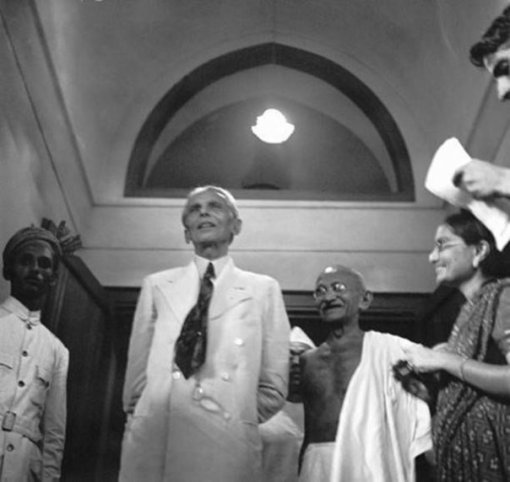
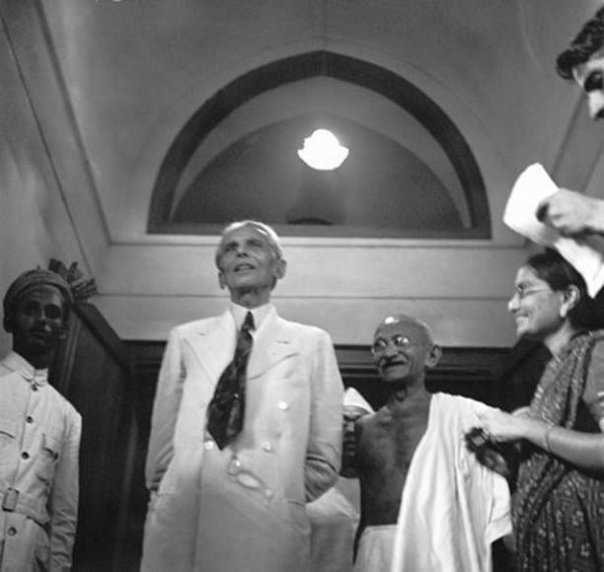
When a suicide-bomber targets a market-place, a rabid Islamist kills a figure who is not pious enough or Independence Day comes, we are reminded of the psychosis of the Pakistani state. We are reminded that in addition to shaky material foundations, the Pakistani state rests upon highly flimsy and contested ideological grounds. At such times, there is almost always a chorus from the literate urban middle-classes of the country: they want “Jinnah’s Pakistan”. For the more conservative sections of our urban middle-class, the Pakistan they long for is the “laboratory” which Jinnah claimed he sought, to implement Islamic values. For the more liberal sections of the urban middle-class, the Pakistan they want was described by a secular Jinnah in his speech on August 11, 1947. The more perceptive reader will already realize that while every historical figure can be interpreted in a wide variety of ways, if a single leader can be held up by secularists, conservatives, nationalists and Islamists alike, perhaps the leader himself was not so sure about certain things.

But what exactly was Mr Jinnah’s own vision for Pakistan, and how did it interact with the nature of the Pakistan Movement and the realities of post-1947 Pakistan? To understand the yearning for “Quaid-e-Azam ka Pakistan”, one must look at the founding myths of Pakistan and Jinnah’s place therein.

Almost any child who goes to school in Pakistan learns a certain story. The story involves a young man, burning the proverbial midnight oil as he studied at night, trying to shield the light he was using with cardboard sheets, so as not to disturb his siblings. When asked by his sister as to why he would not simply go to bed, he said something along the lines of how important this hard work was, for him to become a great man. The Pakistani reader will recognize immediately the young man we are talking about: the Quaid-e-Azam, Muhammad Ali Jinnah.

Most modern nation-states actively propagate their foundational myths: based on a kernel of truth but embellished greatly with fantasy, exaggeration and historical omissions. It is only natural that such myths centre around the integrity, heroism or ambition of one or more “founding fathers” who were instrumental in creating the state it in its modern, institutional form. So, for instance, Israel has its Bar Kochba and its Ben Gurion. Turkey has its Attaturk leading the fight for independence from barren Anatolia. The United States has its George Washington, who supposedly would not lie to his father about cutting a cherry tree, even as a boy. Latin American countries have their Simon Bolivar, Italy has its Garibaldi, Ireland has its Michael Collins. The Indian state has its own pantheon of founding fathers, from Asoka to the Rani of Jhansi, all the way down to Gandhi and Subhas Chandra Bose. Even Saudi Arabia has its epic tale of Bedouin raiders from the sand-dunes of Najd turning into majestic kings and defenders of the Holy Kaabah.

As for the foundational myths of Pakistan, let us bear in mind the following: every modern nation-state is ultimately a very artificial social construct, and the more artificial a state, the more artificial its founding myths.

And what is the Pakistani child taught about the founding fathers of the country? Well, if we put aside the valuable nation-building efforts of Muhammad bin Qasim and Mahmud of Ghazni, what we are left with is essentially Allama Muhammad Iqbal and, of course, the Quaid-e-Azam. Iqbal, as a brilliant poet and an aspiring philosopher, who dreamt of Pakistan. Mr Jinnah, the great political leader who brought this vision to fruition. Such is the clichéd narrative we are given.

In that famous story about the hard-working youthful Jinnah, the Pakistani student is being taught that a boy in his mid-to-late teens had already within him a young Quaid-e-Azam: the Great Leader. He would go on to study the legal system of the British colonialists, gain the respect of the British and the adulation of the Muslim masses of South Asia and eventually this epic tale culminates in the heroic Muslim League’s achievements of Partition and its accompanying bloodbath.

The historical record suggests that the budding Leader was not exactly convinced about the need for communal Muslim politics until at least the early 1920s. He was, after all, the chief architect of the Lucknow Pact of 1916: the “ambassador of Hindu-Muslim unity” as Sarojni Naidu famously described him. Even as late as 1946, Jinnah as a practical politician could entertain the possibility of some sort of compromise with the Congress leadership and the British. The Muslim League leadership would have been satisfied with adequate guarantees of limited autonomy for Muslim-majority regions of Punjab, Sindh and Bengal. The Pashtun leaders of the north-western Frontier, of course, were not to be taken on board, because their loyalty to the Congress amounted to some sort of treachery. As for the Baloch, one imagines, it was assumed that they need not be considered in any calculations: they would somehow automatically be convinced to join the new nation-state and forget centuries of distinct history.

The Muslim League itself, founded in 1905-06 by disinherited and disgruntled members of the former Muslim elite of South Asia, was not committed to mass politics or independence from British rule – and certainly not an independent Pakistan. Unlike the populist appeals of Congress leaders like Gandhi, Nehru and others, the Muslim League’s political programme was for a long time directed towards the Aligarh-educated ex-nobility among Muslims. In the 1940s, were it not for a last-minute alliance with Muslim feudal lords in Punjab and some urban elements from Sindh, the Muslim League could never have mustered the political resources to make their demand for an independent Pakistan into a reality.

Conservative nationalists and Islamists in Pakistan are likely to be disappointed by the real Mr Jinnah. He was an intelligent, British-educated barrister, and had little time for the discourse of village mullahs. Steeped in the traditions of British liberalism, Jinnah could bring only a tiny minority of the Muslim clergy to his side even in the 1940s. It is obvious that he was looking for some form of constitutional liberal democracy, no matter how inspiring the pan-Islamic yearnings of Allama Iqbal might have been.

But perhaps our secular liberals are even more likely to be disappointed, notwithstanding the fact that Mr Jinnah laid out a set of principles for a secular Pakistani state in his speech to our first Constituent Assembly, on the 11th of August, 1947. To quote his memorable words on that occasion:

“You are free; you are free to go to your temples, you are free to go to your mosques or to any other place or worship in this State of Pakistan. You may belong to any religion or caste or creed that has nothing to do with the business of the State. ”

While these are admirable sentiments, perhaps we can be forgiven for pointing out the glaring contradiction here. If a citizen’s religion is not the business of the state, how does one explain the creation of Pakistan as a separate state? If it were not differences in religion with the Hindus and other religious communities of India, what else was it that motivated the Muslim League to demand Pakistan?

Allow me go one step further and remind the reader of the many occasions on which Mr Jinnah invoked Islamic rhetoric in his various speeches to justify the idea of Pakistan. With apologies beforehand, allow me to recall that it was the same Mr Jinnah who would not accept his daughter marrying a non-Muslim man, even though he himself had married a non-Muslim woman. One is reminded of the typical mindset of the contemporary Pakistani Muslim father or brother.

For years, Mr Jinnah brilliantly argued for federal autonomy in Muslim-majority provinces…until Partition happened and the Pashtuns, Bengalis, Baloch and other nationalities within Pakistan demanded the same autonomy. For years, Mr Jinnah pointed out the distinct cultural identity of South Asian Muslims…until Partition happened and Bengalis asked for their language to be given the status of a national language. Urdu and Urdu alone, Mr Jinnah firmly reminded them.

I understand that quite a few readers ought to be exasperated by now. What am I trying to say? What exactly was Muhammad Ali Jinnah? Was he socially liberal or conservative? Was he secular or not? What future did he envision for Pakistan?

The historical record shows that Mr Jinnah was himself has given us adequate arguments for just about any side we choose. Despite the personal integrity, intelligence and political skill of Mr Jinnah, it has to be recognized that the Muslim League was not exactly what it claimed to be. It was supposed to speak for the Muslims of South Asia, but its actual representative credentials were not very credible, even in the “moth-eaten and truncated” (to quote Mr Jinnah) Pakistan of 1947.

To limit ourselves to an imagined version of what Mr Jinnah wanted would mean limiting our political vision and perhaps the very frontiers of our political morality.

What sort of Pakistan does the hari from Sindh want? What sort of Pakistan does the silenced rape victim want? What sort of Pakistan does the tortured body of the young Baloch student want? What sort of Pakistan does the textile worker from Faisalabad want, considering he is paid some 6000 rupees a month? What sort of Pakistan does the terrified Ahmadi want? What sort of Pakistan do you want? What sort of Pakistan do I want?

You see, perhaps the real question is not what our founding father(s) wanted, but what today’s unfortunate Pakistanis want.

Perhaps it is time to consider a possibility: that the laboratory for implementing Islamic teachings was created, and the experiment went horribly wrong. And perhaps it is time to consider another possibility: given the many different interpretations which Mr Jinnah left himself open to, might we be forgiven for concluding that this is it? That this, where we live today, is Jinnah’s Pakistan in all its glory?

No Evidence Pakistan Helped Osama Bin Laden: U.S. Security Adviser

As Reported by The International Business Times

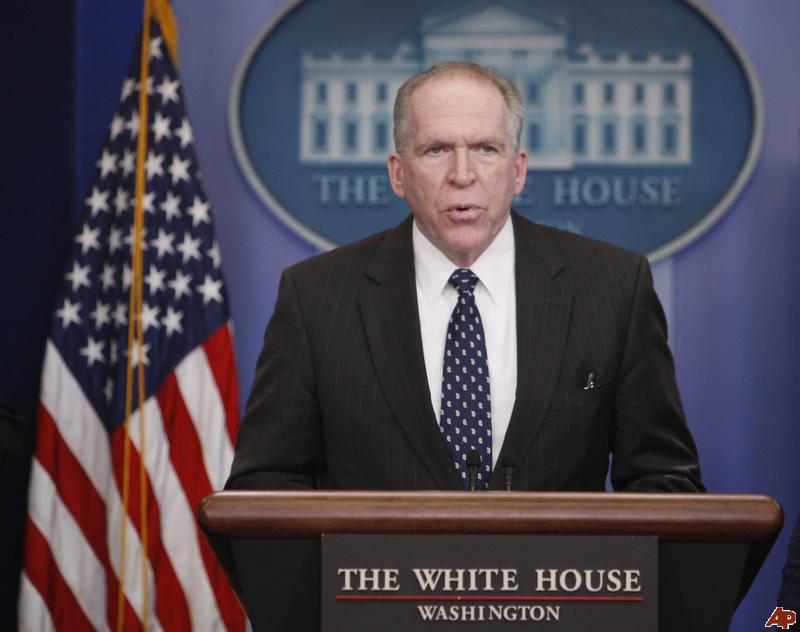
There is no evidence that Pakistan government officials helped and protected Osama bin Laden, claimed John Brennan, Deputy National Security adviser and President Barack Obama’s chief counter-terrorism adviser.

Brennan, speaking to reporters at a morning briefing said “I have not seen anything that the Pakistanis were aiding his refuge there.”

In May, Osama was found and killed by U.S. Navy SEALS in a large compound in the town of Abbottabad in northern Pakistan, near the capital Islamabad. Since that time, rumors have swirled that Pakistani intelligence officials had been aiding the former al-Qaeda terror chief as well as many other militants.

Brennan also said that based on examination of documents and data found and seized at Osama’s compound, it became apparent that bin Laden was “a little out of touch about how debilitated his organization was” after fighting for almost a decade against the U.S.

“It did reveal an organization in distress,” Brennan said.

Brennan also reportedly praised Pakistan’s offensive against terrorist groups operating the country and that Washington has a close working relationship with Islamabad in this joint effort.

He cited the recent arrest in Pakistan of Younis al-Mauritani, a senior al-Qaeda official, is proof that Islamabad is taking its responsibilities seriously.

He noted that al-Qaeda “has taken it on the chin” and has been “degraded significantly over the past couple of years.”

Brennan’s latest comments dramatically contradict assertions he made in May (just after the killing of Osama) when he declared that it was “inconceivable” that bin Laden did not have the support of officials within Pakistan.