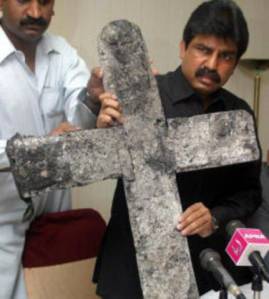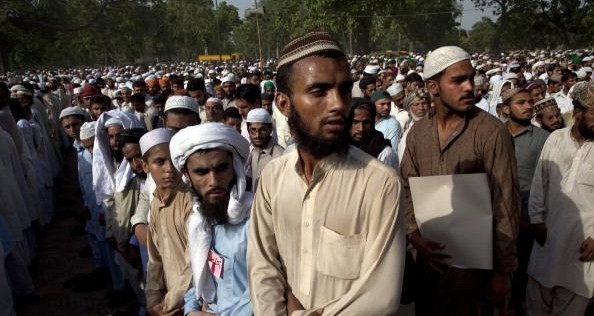
Archive for the ‘ terrorism ’ Category

Pakistan Questions Legality of U.S. operation that killed bin Laden

By Karen Bulliard for The Washington Post

Pakistan’s foreign minister on Thursday appeared to question the legality of the U.S. operation that killed Osama bin Laden, and again denied that his country had knowingly sheltered the world’s most-wanted terrorist.

The comments by Foreign Secretary Salman Bashir came as Pakistani officials faced rising domestic backlash about the helicopter-borne assault in a sleepy neighborhood of a military garrison city, which they have acknowledged they did not know about in advance and — once they became aware of it — could not prevent.

The preservation of national sovereignty, particularly against incursions by U.S. troops, is a highly sensitive issue in nuclear-armed Pakistan, and both the presence of bin Laden and the dramatic American raid that killed him have greatly embarrassed the military here.

Bashir, citing United Nations Security Council resolutions on counter-terror operations, told reporters that the “modalities for combating terrorism raises certain legal and moral issues” and said that “everyone concerned ought to be mindful of their international obligations.”

On Tuesday, the foreign ministry in a statement expressed “deep concerns and reservations” that the U.S. carried out the mission in the city of Abbottabad unilaterally, without Pakistan’s knowledge or permission.

Such comments differ considerably from Pakistan’s measured statements in the hours after the killing, when Prime Minister Yousaf Raza Gillani called bin Laden’s death a “great victory.”

But though clearly directed at the United States, the suggestions that the operation might have breached international law also appeared to be a warning to Pakistan’s archenemy, India, which has been targeted in terror bombings and attacks by Pakistani militants.

On Wednesday, India’s army chief said his forces were capable of carrying out a similar raid — a notion Bashir called “bravado.”

“We feel that sort of misadventure or miscalculation could result in a terrible catastrophe,” Bashir told reporters here, while also vowing that Pakistan’s nuclear arsenal is safe. Pakistan and India, which also possesses nuclear weapons, have fought three wars.

Bashir indicated that there would be little introspection inside Pakistan about how and why bin Laden was able to reside here, under the nose of the military. Some Pakistani officials in recent days have said there would be an inquiry into intelligence failures, but Bashir played down that, saying questions about bin Laden were “for historians.”

“I would call it a ‘view,’ ” rather than an inquiry, Bashir said. “I think we are in a constant process of viewing at every level. … This is a routine. So I think we should not try to give it a slant in terms of an inquiry. There’s no such thing as an inquiry.”

Bashir provided additional details about Pakistan’s role in the years-long search for bin Laden, and about its actions the morning of the raid, when he said two Pakistani F-16 fighter jets were deployed in response to the U.S. operation. By the time the jets reached the compound, the raid was over.

He said a cellphone number for bin Laden’s trusted courier was discovered by Pakistan’s top spy agency and provided to the CIA, which used it to locate bin Laden’s compound.

U.S. officials have said they were monitoring the courier’s phone and e-mail communications and found him when he contacted a family member.

Bashir contradicted previous Pakistani statements that Abbottabad was under “sharp focus” since 2003 — a year when, a Pakistani intelligence official said earlier this week, the construction site for what would become the bin Laden compound was first raided.

Satellite images provided by U.S. officials, however, show there was no building happening on the property at that time.

On Thursday, Bashir said Abbottabad first surfaced on Pakistan’s radar as an al-Qaeda hideout in 2004, when the driver of Faraj al-Libbi, an al-Qaeda operative who would be arrested by Pakistan in 2005, was traced to the garrison city.

Raid Sparks Question: Is Pakistan Doing Enough?

As Reported By CNN

The United States wants answers from Pakistan about how Osama Bin Laden could have lived in that country — near a major military base not far from the capital — without the government knowing.

The United States is asking Pakistan for information on who built and owned the compound where bin Laden lived, two senior U.S. officials said Wednesday. The United States also wants to know about security at the compound, in the city of Abbottabad.

Pakistani government officials have insisted that they did not know Bin Laden’s whereabouts. They reacted angrily to news that CIA Director Leon Panetta told U.S. legislators in a closed-door hearing that “either they (the Pakistanis) were involved or incompetent. Neither place is a good place to be.”

“What worse statement can come than that we heard from Panetta?” a senior Pakistani intelligence official said. “I am afraid this statement is totally regrettable. (Panetta) of all people knows how much we have been doing.”

The official, who did not want to be named, said his country had been generously sharing intelligence with their American counterparts.

“We have been sharing everything with them, but they have been selectively sharing with us,” the official said. “They are entirely dependent on what we provided them. Why were details (of the operation to kill bin Laden) not shared with us?”

Pakistan has argued that it has provided valuable intelligence information and worked with the United States to capture or kill numerous al Qaeda members and other Islamic extremists.

Yet the questions around bin Laden’s presence in Pakistan has exacerbated an already rocky relationship between the two nations.

Many Obama administration officials, lawmakers and observers from across the political spectrum want to know how bin Laden — based at a compound in the military garrison city of Abbottabad — could have eluded Pakistani capture, or whether the government or elements of it harbored bin Laden.

They want to know whether Pakistan is firmly backing the fight against terror or is supportive of militants fighting against troops in Afghanistan.

In Islamabad Tuesday, Marc Grossman, the special U.S. representative on Afghanistan and Pakistan, met with Pakistan’s president Asif Ali Zardari, the head of the ISI military intelligence Gen. Ahmed Pasha, and military chief Gen. Ashfaq Kayani. During that visit, which was scheduled before the killing of bin Laden, Grossman discussed the operation with the officials, the State Department confirms.

Those officials say the Pakistani officials expressed surprise that bin Laden was living at the compound and the U.S. officials tell CNN they are taking that at face value until more information is available.

The United States has a “complicated but important relationship” with Pakistan, White House press secretary Jay Carney said Tuesday.

Carney told reporters that U.S. officials need to learn more about the “support network” that sustained bin Laden in Pakistan. But he also warned against “tarring” everyone in Pakistan’s government because of the revelation that bin Laden had been living so close to Islamabad.

There has also been “a great deal of important cooperation” in the fight against Islamic extremism, he said. “The idea that these kinds of complications exist is not new.”

But Rep. Peter King, the New York Republican who is chairman of the Committee on Homeland Security, said “this can’t be allowed to go on.”

In comments Tuesday at a House subcommittee hearing on Pakistan, King noted that bin Laden’s compound was near a headquarters for the Pakistani intelligence services.

“There are two possibilities and one answer,” King said. “One is that it was a direct facilitation by elements of the Pakistani government, or Pakistani intelligence is entirely inept, and that has not proven to be the case over the years.”

According to two sources who were in the closed-door briefing with Panetta Tuesday on Capitol Hill, the CIA director echoed King’s concerns.

Panetta made clear, the sources said, that he and other administration officials are trying to get to the bottom of which it was — involvement or incompetence — on the part of the Pakistanis.

In an interview with TIME magazine, Panetta explained why the Pakistanis were not told of the bin Laden mission “It was decided that any effort to work with the Pakistanis could jeopardize the mission,” he said. “They might alert the targets.”

At King’s hearing, Seth Jones of the Rand Corporation told the panel that bin Laden’s presence in Pakistan showed that “at the very least, there has not been a high priority in targeting senior al Qaeda leaders” in the country.

“Based on the threat streams coming from this area, those interests have to change in my view,” Jones said. Another terrorism expert, Frederick Kagan of the American Enterprise Institute, said mistrust between the United States and Pakistan runs both ways, with Pakistani officials fearful that the United States will abandon the region after eliminating bin Laden.

“It is essential that we find ways not only to communicate our frustration to Pakistan,” Kagan said, but also to say “we’re not leaving.”

The United States has regarded Pakistan as a top ally in the fight against the Taliban, al Qaeda, the Haqqani Network and other Pakistan-based militants who have launched attacks against international and Afghan troops in Afghanistan. At Tuesday’s hearing, experts also identified Lashkar-e-Taiba as a major emerging threat from Pakistan to the Indian subcontinent and beyond.

According to the U.S. Government Accountability Office, the United States has provided $18 billion in foreign assistance and reimbursements to Pakistan, two-thirds of which are security-related.

The administration and lawmakers have praised the Pakistanis for their anti-terrorism efforts, but at the same time some lawmakers suspect the country hasn’t been robust enough in going after terrorists. Some say elements of Pakistan’s intelligence services — the Inter-Services Intelligence or ISI — have close ties with militants.

Sen. Dianne Feinstein, the California Democrat and chairwoman of the Senate Intelligence Committee, agrees that they have been “good at going after some terrorists” but have “very subtly walked both sides of the street.”

“That’s of concern to many of us, I think, because you have to declare yourself,” she told reporters, noting that the issue of Pakistan will be addressed by her committee.

Denis McDonough, who is President Barack Obama’s deputy national security adviser, told CNN that despite legitimate questions about what Pakistani authorities knew, the United States needed to maintain the relationship.

“We obviously recognize that nobody has sacrificed more in this war against al Qaeda than the Pakistanis,” McDonough said. “Al Qaeda had declared war, in fact, on the Pakistani government, have threatened and continues to threaten to try to get their hands on nuclear material in that country. … So they obviously have a lot at stake in this fight. So we’re going to continue to work with them and continue to try to partner with them against al Qaeda, because we recognize that it’s not only in our interests, but in their interests.”

Asked if the U.S. funding to Pakistan should continue, McDonough said such investments bolster U.S. security.

“We’ll continue to try to work with them to train, to try to target the common threat that we face from al Qaeda,” McDonough said, adding: “Nobody has greater concern about our ability to … carry out the fight against al Qaeda than the president. We’re going to continue to do that, either with our Pakistani friends or alone. But this is too big a fight for us to give it up.”

McDonough also said he agreed with the reported quote by Panetta that the United States decided not to share intelligence with Pakistan in the run-up to the Monday raid that led to bin Laden’s death because of fears of a leak. Sen. Richard Lugar, the top Republican on the Senate Foreign Relations Committee, also cited concern that some Pakistani officials might alert bin Laden.

“This is one reason we did not inform the Pakistanis of our actions,” Lugar said, while noting “there were probably many who were very uncomfortable about the presence likewise.”

The Pakistani government on Tuesday “categorically” denied reports that its leadership “had any prior knowledge” of the U.S. operation against bin Laden

One ISI official denied any complicity in hiding bin Laden, saying one failure and embarrassment doesn’t negate its “track record” of capturing more al Qaeda members than anyone else.

“Yes, we did fail to locate him. Yes, we are embarrassed. But that does not mean we are incompetent and straddling the fence,” the official said. “Had we known that OBL was there we would have raided it and handed him over to the U.S. to silence the critics talking about the complicity of the ISI.”

The United States is reviewing intelligence seized in the compound to determine whether bin Laden received support inside Pakistan, a senior U.S. official told CNN. This comes amid discussions in Washington over the extent of the Pakistani intelligence service’s knowledge of his whereabouts and whether it provided him sanctuary.

Lugar was asked in Washington why taxpayers should support money for Pakistan.

“It’s a very complex country. A very complex set of officials,” the Indiana senator said. “To try to obtain perfection in terms of who the recipients ought to be is out of the question. It’s a question of if there are goals we can achieve if we have some accountability of the money.”

Former Secretary of State Condoleezza Rice told CNN on Tuesday that Pakistan has been an “important partner in counterterrorism cooperation and we’ve had very important cooperation from them.”

But she questions how bin Laden could “hide in plain sight in that kind of compound without the knowledge of high-ranking officials.”

“We have captured many, many al Qaeda operatives in Pakistan, including Khalid Sheikh Mohammed, so Pakistan has been a cooperating counterterrorism partner,” Rice said, making reference to the mastermind of the 9/11 attacks. “But everyone knows that there are elements within Pakistan that are still tied to extremism, that has been a concern, and it is very important now that the Pakistanis take a hard look at how this possibly could have happened,”

Mark Quarterman, director of the Program on Crisis, Conflict, and Cooperation at the Center for Strategic and International Studies and an expert on Pakistan, said there have been strong differences between Washington and Islamabad over U.S. drone strikes in the tribal region and calls to remove CIA operatives in the country. The bin Laden operation and the issues surrounding it add to the tension, he said.

“I would not be surprised if there are questions on Capitol Hill about continued level of support to Pakistan, about the U.S. relationship with Pakistan and the consideration of the nature of that relationship and how we handle it going forward,” he said.

The Pakistan government and the ISI supported the Taliban when it controlled Afghanistan during the 1990s, but the government broke ties with the Taliban after the 9/11 attacks. American officials have consistently indicated that there are rogue ISI elements supportive of militants.

One reason Pakistanis also have supported militants in the tribal region is that the fighters are seen as serving as a bulwark for Pakistani interests. That includes a focus against the influence of longtime rival India in Afghanistan, Quarterman said.

“The Pakistanis are hedging their bets,” he said. “They know the United States isn’t there to stay.”

Jamie Metzl, executive vice president of the Asia Society, said the onus will be on Pakistan to do a thorough investigation to assess what happened with bin Laden.

“If Pakistan denies any official involvement with bin Laden, it will be difficult to prevent a backlash among members of the U.S. Congress who will believe that Pakistan is playing a double game,” Metzl said.

Metzl also says Pakistan’s fear is that India will increase influence in Afghanistan and surround Pakistan, and that calculation has led Pakistan to keep militants under its sway.

Mike Rogers, a Michigan Republican who is chairman of the House Select Intelligence Committee, said Pakistan and the United States have “a very funny relationship.”

Pakistan dispatched “troops into the tribal areas at our request” and “took thousands and thousands of casualties trying to fight Taliban and al Qaeda elements,” Rogers said on CNN’s “American Morning.”

“There are some concerns about their ISI being penetrated, their intelligence services being penetrated, but at the same time,” he said, “we’ve got to have them.”


-CNN’s Joe Sterling, Jill Dougherty, Elise Labott, Zain Verjee, Ted Barrett, Elise Labott, Alan Silverleib, Tom Cohen and Nick Paton Walsh contributed to this report

Pakistan’s president denies harboring bin Laden

By Nahal Toosi and Zarar Khan for The Associated Press

Pakistan’s leader denied suggestions that his country’s security forces sheltered Osama bin Laden as Britain demanded Tuesday that Islamabad answer for how the al-Qaida chief lived undetected for six years in a large house in a garrison town close to the capital.

But in a nod to the complexities of dealing with a nuclear-armed, unstable country that is crucial to success in the war in neighboring Afghanistan, British Prime Minister David Cameron said having “a massive row” with Islamabad over the issue would not be in Britain’s interest.

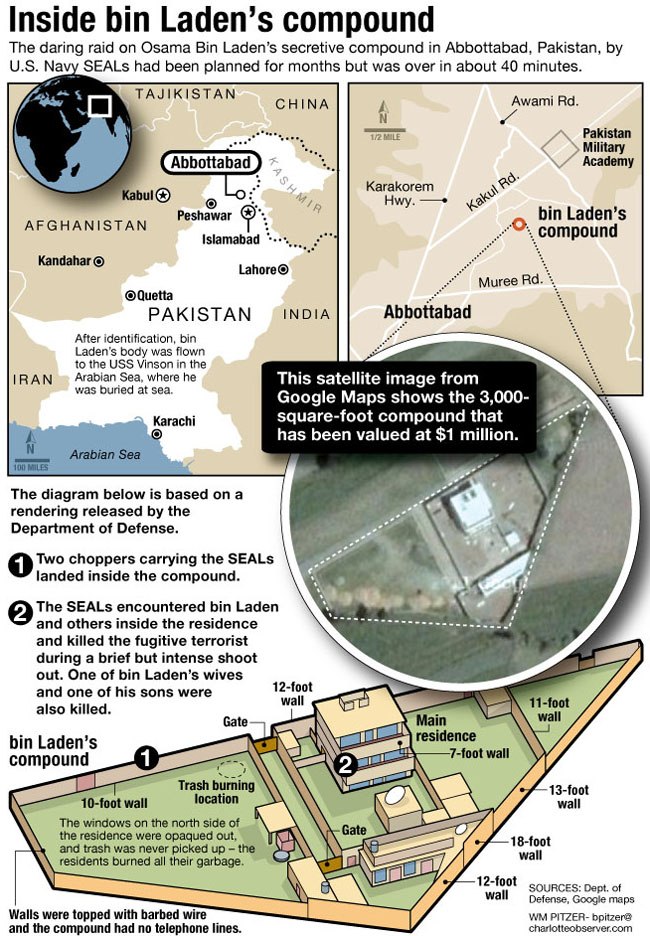
A day after U.S. commandos killed bin Laden, reporters were allowed within the 15-foot, barbed-wire-topped walls of the compound for the first time. But the doors of the house were sealed shut and police were in no mood to open them.

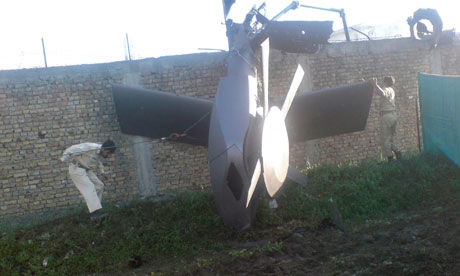
Local residents showed off small parts of what appeared to be a U.S. helicopter that Washington said malfunctioned and was disabled by the American strike team as they retreated. A small servant’s room outside the perimeter showed signs of violent entry and had been briskly searched, clothes and bedding tossed to the ground. Its wall clock was on the floor, the time stuck at 2:20, when the U.S. team would have been on the ground in the early hours of Monday.

Asif Ali Zardari’s comments, in a Washington Post opinion piece Monday, were Pakistan’s first formal response to suspicions raised by U.S. officials and others. Those suspicions could further sour relations between Islamabad and its Western backers at a key point in the war in Afghanistan.

Bin Laden was killed close to a military academy in the bustling northwestern town of Abbottabad, not in the remote Afghan border region where intelligence assessments had assumed he had been holed up. That was quickly taken as a sign of possible collusion with the country’s powerful security establishment, which Western officials have long regarded with a measure of suspicion despite several notable al-Qaida arrests in the country since 2001.

“Some in the U.S. press have suggested that Pakistan lacked vitality in its pursuit of terrorism, or worse yet that we were disingenuous and actually protected the terrorists we claimed to be pursuing. Such baseless speculation may make exciting cable news, but it doesn’t reflect fact,” Zardari wrote.

Ties between the two nominal allies were already strained amid U.S. accusations that the Pakistanis are supporting militants in Afghanistan and Pakistani anger over American drone attacks and spy activity on its soil. They came to head in late January after a CIA contractor shot and killed two Pakistan’s, in what Washington said was self-defense.

Senior U.S. officials did not directly accuse Pakistan of collusion, but made it clear they had concerns.

“People have been referring to this as hiding in plain sight,” Obama’s counterterrorism chief John Brennan told reporters Monday. “Clearly, this was something that was considered as a possibility. Pakistan is a large country. We are looking right now at how he was able to hold out there for so long and whether or not there was any type of support system within Pakistan that allowed him to stay there.”

Lawmakers were more direct.

U.S. Senate Armed Services Committee Chairman Carl Levin said Pakistan’s intelligence and army have “got a lot of explaining to do,” given that bin Laden was holed up in such a large house with surrounding buildings, the fact that its residents took the unusual step of burning their garbage and avoiding any trash collection.

“It’s hard to imagine that the military or police did not have any ideas what was going on inside of that,” Levin said.

Cameron, who has also made supporting Pakistan a major foreign policy commitment, echoed those concerns.

“Those are questions we have to ask, those are questions we will want answered and we will be asking that question of everyone in Pakistan and the Pakistani government,” Cameron told BBC radio before acknowledging the West’s limited leverage against Islamabad.

“We could go down the route of having some massive argument, massive row with Pakistan, but I assess our relationship with Pakistan and it is my very clear view that it is in out interests to work with the government and people of Pakistan to combat terrorism, combat extremism and help development in that country.”

Suspicions were also aired in many Pakistan’s media and on the street Tuesday.

“That house was obviously a suspicious one,” said Jahangir Khan, who was buying a newspaper in Abbottabad. “Either it was a complete failure of our intelligence agencies or they were involved in this affair.”

Pakistan’s security establishment has yet to explain how bin Laden was able to live there undetected, and given that it is rarely transparent about what it does, it might never do so. Asked about the raid, Pakistani Foreign Secretary Salman Bashir said it was time to move on.

“The issue of Osama bin Laden is history and I think we do now want to keep ourselves mired in the past,” he told reporters.

U.S. officials have said that Pakistani officials were not told about the early morning helicopter raid until the strike team had killed bin Laden had returned to Afghanistan from where they took off from, citing security reasons.

Many Pakistanis were surprised at how this was possible, especially when initial reports stated that the choppers took off from a Pakistani air base. Some were angry that the country’s sovereignty had been violated — an especially sensitive issue given the unpopularity of America here.

Zardari said it “was not a joint operation” — the kind of which has been conducted in the past against lesser terror suspects in Pakistan — but that Pakistani cooperation, in a general sense, had helped lead them to bin Laden.

“A decade of cooperation and partnership between the United States and Pakistan led up to the elimination of Osama bin Laden as a continuing threat to the civilized world,” he said.

President Barack Obama also said the country’s anti-terror alliance had helped in the run-up to the operation, but did not thank Pakistan when he announced the death of bin Laden.

The death has raised fears of revenge attacks, both in Pakistan — which has seen hundreds of suicide attacks by al-Qaida and its allies since 2007 — and internationally. The U.S Embassy said its missions in Pakistan would remain closed to the public until further notice.

Osama Bin Laden Hunted Down And Killed By US

By Brad Norington for The Australian

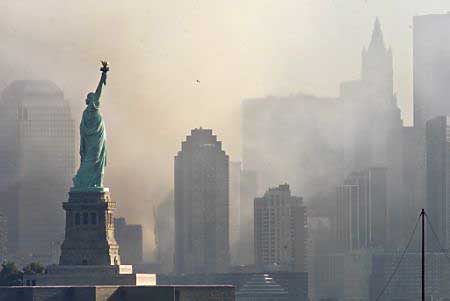
Bin Laden was killed in Pakistan and his body retrieved by a US strike team nearly 10 years after the September 11 terror attacks on the World Trade Centre in New York and the Pentagon killed more than 3000 people.

Announcing “justice has been done”, Mr Obama said bin Laden had been found hiding in Pakistan and a targeted operation launched today by a small US team.

“After a firefight they killed Osama bin Laden and took custody of his body,” Mr Obama said, adding that no Americans were harmed in the assault.

“The death of bin Laden marks the most significant achievement to date in our nation’s efforts to defeat al-Qa’ida,” the President said. “His demise should be welcomed by all that believe in peace and human dignity.

“It’s important to note our counter terrorism cooperation with Pakistan helped lead us to bin Laden and the compound where he had been hiding.” “Yet his death does not mark the end of our effort.

“There is no doubt that al-Qa’ida will continue to pursue attacks against us. “We must and will remain vigilant at home and abroad.”

Despite the decade that has elapsed since the September 11 attacks, the event, one of the most traumatic in US history, still stirs raw emotions, and his demise will be celebrated across the United States.

Chants of “USA, USA” rang out from tourists outside the White House as the news of bin Laden’s death sent an electric charge through Washington.

Hundreds of people gathered outside the fence of the presidential mansion and sang the US national anthem and started shouting and cheering. Mr Obama said the United States people understood the cost of war, but would not stand by if threatened.

“As a country we will never tolerate our security being threatened nor stand idly by when our people have been killed,” he said. “We will be relentless in defence of our citizens and our friends and allies.

“We will be true to the values that make us who we are. “And on nights like this one we can say to those families who have lost loved ones to al-Qa’ida terror, justice has been done.”

The location of bin Laden and his family confirms recent speculation that he was hiding in comfortable surroundings and close to civilisation, not in the remote mountains dividing Pakistan and Afghanistan.

US armed forces have been hunting the Saudi terror kingpin for years, an effort that was redoubled following the 2001 terror attacks on the World Trade Centre in New York and the Pentagon which killed 3000 people. But bin Laden always managed to evade US armed forces and a massive manhunt.

The death of bin Laden will raise huge questions about the future shape of al-Qa’ida and also have steep implications for US security and foreign policy 10 years into a global anti-terror campaign. It will also raise fears that the United States and its allies will face retaliation from supporters of bin Laden and other Islamic extremist groups.

Osama bin Mohammed bin Awad bin Laden was a member of the wealthy Saudi bin Laden family and the founder of the jihadist organisation al-Qa’ida, most widely recognised for the September 11 attacks on the US and numerous other mass-casualty attacks against civilian and military targets.

As a result of his dealings in and advocacy of violent extremist jihad, bin Laden lost his Saudi citizenship and was disowned by his billionaire family.

Bin Laden evaded US capture in Afghanistan after the 9/11 attacks and since then he and his organisation have been major targets of the US war on terror.

Bin Laden and fellow al-Qa’ida leaders are believed to have been hiding near the border of Afghanistan and Pakistan, in tribal areas that lie outside government control.

Pakistan’s Hypocrisy Has Run Its Course; It Needs A New Relationship With U.S.

By Ahmed Humayun
Best Defense department of frenemy relations

The U.S.-Pakistan relationship has long been volatile, but recent weeks have witnessed an unprecedented level of open discord between the two countries. On April 11, Lt. Gen. Ahmad Pasha, the head of Pakistan’s ISI, met with American officials and demanded that the United States sharply limit its counterterrorism efforts inside Pakistan. Just two days later the CIA launched drone strikes in Pakistan’s tribal areas, provoking angry protests from Pakistani officials. And in a sign that Washington is determined not to back down, last week Admiral Mullen, chairman of the Joint Chiefs, publicly chastised the ISI for its “longstanding relationship” with the Haqqani network, one of the prime targets of the drone campaign.

Pakistan’s recent criticisms are partially a response to the rising public backlash against America’s counterterrorism operations. Till now, Pakistan has tacitly cooperated with the drone campaign while reluctantly permitting a few CIA agents and special operations forces to enter the country. At the same time, Islamabad has publicly denied cooperating with Washington due to domestic political sensitivities. In the aftermath of the Raymond Davis incident, however, this always-fragile pretence has become untenable. (Raymond Davis, a CIA contractor, killed two Pakistanis with possible links to the ISI in broad daylight in January. Three months later, the subsequent media frenzy has not diminished. )

No state wants its territory to be a hunting ground for covert foreign operatives. Still, the fulminations of some in Pakistan omit critical context. The Pakistani state’s ambivalent attitude towards extremist groups — acting against some while tolerating or supporting others — has forced the United States to take proactive action. The rights of sovereignty also come with duties: if Pakistan is indulgent of or incapable of acting against anti-American terrorist groups, then foreign preventive counterterrorism should be assessed more soberly by Pakistanis.

To complicate matters further, elements in Pakistan’s security establishment have deliberately stoked public sentiment. Extensive leaks to the Pakistani press about the government’s demands to the United States hint at a desire to exert pressure on Washington through exploiting populist anger. For the ISI, this diplomatic crisis is a unique opportunity to obtain long desired strategic concessions from the United States. Among other things, the ISI does not want militant groups favored by Islamabad under America’s microscope — especially those perceived to defend Pakistani interests in Afghanistan.

This is a dangerous strategy. It is premised on the mistaken assumption that the United States is unwilling to increase pressure on Pakistan. If the Pakistani government faces domestic political constraints, this is no less true of the United States. Sentiment in the U.S. Congress is already heavily tilted against Pakistan. If reports about Pakistan’s entanglement with extremist groups persist, or in the worst case scenario, an attack on the United States by a Pakistan-based terror group succeeds, Washington will find it difficult to avoid taking harsh actions. Loose talk by some Pakistani politicians about cutting off supply routes to U.S. forces in Afghanistan is similarly self-defeating. It is in Pakistan’s long-term interests to prevent an irrevocable rupture with the United States.

At the same time, Washington should appraise the scope of its direct counterterrorism drive within the broader effort to stabilize Pakistan. According to U.S. officials, the drone campaign has been remarkably successful in weakening militant networks; in private, some Pakistani military and political leaders also acknowledge the program’s efficacy. That may be the case, but displays of U.S. coercive force on Pakistani soil — especially those involving U.S. personnel on the ground — have also accentuated the most extreme tendencies in that country’s public discourse. They have empowered those in Pakistan who maintain that the war on terror is America’s war, not Pakistan’s struggle, and that the United States has fundamentally hostile aims towards Pakistan.

Policymakers might shrug their shoulders at conspiracy theories. That would be short-sighted. The fact is that the United States cannot directly extinguish the threat posed by Pakistan-based terrorism. U.S. forces can certainly kill a few extremists through drone strikes or ground operations. But the militant threat is geographically dispersed: not only do insurgent sanctuaries infest the isolated border regions, terrorist networks are also embedded in the heavily populated areas of the Punjabi heartland. Some of these groups have deep roots stretching back decades and enjoy local political cover. Kinetic action by a deeply unpopular foreign power will not uproot them.

The single most decisive factor in disrupting Pakistani militancy will be the willingness of the state and society to commit to a long-term struggle. Only Pakistan can overcome the jihadi Frankenstein it has spawned through a combination of stepped up military force, political dialogue, and local governance. The impact of U.S. policies on the internal Pakistani debate about militancy should therefore be factored heavily into Washington’s policymaking calculus.

Pakistan is making progress — however halting or incomplete — in adopting a more robust anti-militant posture. Since 2009, its military offensives in the tribal areas have degraded insurgent sanctuaries at a heavy price in blood and treasure. Pakistani intelligence has also helped the United States capture numerous high-level al Qaeda operatives. The Obama administration’s economic assistance to Pakistan and its diplomatic efforts to stabilize the country’s fractious politics have contributed to these advances. Going forward, the core policy challenge is to generate the political will inside Pakistan that will expand these activities. Right now, Washington’s ability to do so is vitiated by Pakistani paranoia.

In the short term, Islamabad and Washington need to negotiate a new counterterrorism relationship. The old strategy of ambiguous private compromise veiled by public dissembling has run its course. Pakistan’s legitimate concerns should be weighed against the immediate threat to the American homeland and to U.S. forces in Afghanistan. This is a herculean task given the underlying strategic differences, but the alternative is likely to be much starker.

Ahmed Humayun is a fellow at the Institute for Social Policy and Understanding (ISPU) and senior analyst at Georgetown University’s Emerging Threats Project. He can be reached at ahmed.a.humayun@gmail.com .

Why Pakistan’s Taliban Target the Muslim Majority

By Omar Waraich for Time

Although Pakistan’s headlines are dominated by the violent excesses of Taliban extremists, the majority of Pakistanis subscribe to the more mystical Sufi tradition of the country’s Barelvi school of Islam. And attacks on their places of worship are becoming depressingly familiar. Last Sunday, two bombers attacked the 13th Century Sakhi Sarwar shrine, near the southern Punjabi town of Dera Ghazi Khan, slaughtering 50 people and injuring twice as many. Mercifully, two other bombers failed to detonate their devices, preventing even higher casualties. Still, it was the deadliest assault yet on a Sufi shrine in Pakistan — and the sixteenth in the last two years.

The Pakistani Taliban swiftly claimed responsibility for the attack, as they have done for each previous one. Pakistan’s Taliban claims the mantle of the hardline Deobandi tradition, with many beliefs in common with the austere Wahabism of Saudi Arabia. They regard the Barelvi, who comprise more than three quarters of Pakistan’s Sunni Muslims, as irredeemable heretics. The Barelvis favor a more tolerant approach to Islam, promoting a cult of the Prophet and incorporate folkloric traditions such as seeking intercession from rural saints. Sakhi Sarwar, a mystic who is also revered by some Hindus and Sikhs, is said to grant women a son — a local legend that rouses anger among Islam’s more literalist adherents, who ascribe such powers only to Allah.

Tensions between Deobandis and Barelvis have punctuated most of Pakistan’s history. But with the arrival of al-Qaeda in the country a decade ago, local militants forged links with the global jihadists, their sectarianism sharpened to accept al-Qaeda’s “takfiri” worldview that deems adherents of other strains of Islam as deviant apostates worthy of death.

One reason for the uptick in sectarian-based terror attacks may be that the militants’ ability to strike the high profile urban targets that once grabbed global headlines has been diminished by Pakistani military offensives in their strongholds over the past two years. “It has become harder for the militants to strike hard targets,” says security analyst Ejaz Haider. “Some lessons have been learned from the previous attacks.”

So, the militants have, over the past two years, more keenly focused on sectarian attacks. Traditional Shi’ite processions are now routinely targeted by suicide bombers. In May 2010, two mosques of the minority Ahmedi sect were targeted in Lahore, killing 93 people. And there’s been an escalation of bombings directed against the majority Barelvis. After attacks on two of their most prominent shrines, Data Darbar in Lahore’s old city and Abdullah Shah Ghazi in Karachi, Barelvis came out on to the streets, wielding weapons and vowing revenge against the Taliban. They did not extend blame to the broader spectrum of Deobandis, perhaps wisely evading the beginnings of a more gruesome sectarian conflict that Pakistan can ill-afford.

Not all Barelvis are the models of peace and tolerance that some have portrayed them to be. It was a Barelvi, Mumtaz Qadri, that assassinated Punjab Governor Salmaan Taseer in January, for his opposition to Pakistan’s prejudicial blasphemy laws. The assassination was applauded by 500 Barelvi scholars in a joint statement. And the Sunni Tehreek, a Barelvi militant outfit, rewarded Qadri’s family and threatened Taseer’s daughter. While they may favor a more permissive vision of Islam, certain Barelvis are quite capable of violence where they feel the Prophet has been dishonored.

The campaign to defend Pakistan’s blasphemy laws from reform has, in fact, united Barelvis and Deobandis since last November. Barelvi anti-Taliban rhetoric was also put on pause. “We had seen the Barelvis getting ready to organize a campaign against the Taliban,” observes analyst Nasim Zehra, “but they got sidetracked by the blasphemy issue and this was forgotten.” Until last month’s assassination of Minorities Minister Shahbaz Bhatti, the religious right was able to frequently draw tens of thousands on to the streets.

Sectarian hatred aside, rural shrines are a far easier terror target than the more heavily guarded state and economic targets in the cities. Suicide bombers, especially the teenage boys favored by militants, can often evade notice before they reach the target. A crowded space helps secure the militants’ aim of causing high casualties. In the case of the Sakhi Sarwar bombers, they only had travel to a relatively short and unimpeded distance from North Waziristan to the edge of Punjab.

The bombings may also be an attempt to relieve pressure from sporadic Army actions against militants in the northern tip of the tribal areas. “Just to remain alive there, the militants have to try and force the government’s hand into diminishing pressure,” says analyst Haider. “To counter that pressure, they mount attacks in the mainland in the hope of securing some deal back in the tribal areas.” By targeting shrines across the country, the militants are able to demonstrate their enduring geographical reach and expose the state’s vulnerabilities.

The bad news is that the state is in a poor position to respond. After the latest bombings, Barelvi leaders denounced the Punjab provincial government for failing to provide security at shrines. The Punjab government dismisses the charge. “It’s happening all over,” says Ahsan Iqbal, a leading politician from the Pakistan Muslim League-N, the ruling party in Punjab. “This is not something that is province-specific.” Iqbal casts blame on the federal government for failing to share intelligence. The federal government reverses the charge, and argues that the law and order is a provincial responsibility. What no one seems to be focusing on is the desperate need to enhance the police’s capacity, with better equipment, counterterrorism training and an intelligence gathering network that reaches deep into Pakistan’s remote areas.

Teen says 400 Pakistan suicide bombers in training

As Reported by The Deccan Chronicleďťż

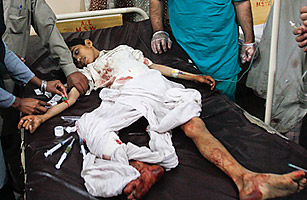
A teenager arrested as an accomplice to Pakistan’s deadliest suicide bombing of the year has said that up to 400 suicide bombers are being groomed to wage carnage in the nuclear-armed nation.

Umar Fidayee, 14, said the would-be bombers were being trained in North Waziristan, the premier Al-Qaeda and Taliban fortress in Pakistan’s tribal belt where US officials want Pakistan to flush out militant strongholds.

He made the remarks in an interview aired Friday from his hospital bedside, where he is being treated after detonating a hand grenade in the April 4 attack that killed 50 people at a 13th-century Sufi shrine.

It was Pakistan’s deadliest bomb attack since November.

Police arrested Fidayee as an alleged accomplice and said they removed his own suicide vest, which he failed to detonate in a crowd of hundreds in Dera Ghazi Khan just minutes after two other bombers blew themselves up.

Shown covered in tubes and bandages, the teen appeared to express remorse and lifted the lid on harrowing details of his training at the camp in the Mir Ali district of North Waziristan, which lies on the border with Afghanistan.

“Three hundred and fifty to 400 would-be suicide bombers are getting training in Mir Ali in North Waziristan,” he said in the interview broadcast by Pakistani television channels Samaa, Express, ARY and Geo.

“I was trained for two months and saw many boys being trained there,” he said, going on to appeal on Pakistanis to “please forgive me”.

“God has given me a new life but I am sad that we killed innocent people, innocent children,” he said.

Fidayee said he was initially recruited on the understanding that he would be smuggled into Afghanistan to kill non-Muslims.

“But they brought me here to Dera Ghazi Khan. I told them ‘there is no kafir (non-believer) here’,” he said.

“They told me these people are worse than kafirs,” Fidayee said.

Exposing an apparently disturbing recruitment at the gates of an ordinary school in North Waziristan, the teenager claimed a man he identified as Qari Zafar convinced him to begin a life of militancy.

“He told me that all this education is useless and said ‘become a fighter and you will go to heaven’,” Umar told the reporters.

He said he was told to attack the shrine 30 minutes after the other two detonated their bombs, in order to cause maximum carnage among those rushing to aid casualties of the first two blasts.

In a message to other potential suicide bombers he said: “Please refuse to carry suicide attacks. Such attacks are forbidden in Islam.”

Islamist militants have increasingly targeted Sufi worshippers, who follow a mystical strain of Islam, in Muslim-majority Pakistan.

Dera Ghazi Khan is close to Pakistan’s tribal belt which is described by Washington as the most dangerous place on Earth and an Al-Qaeda headquarters.

More than 4,200 people have been killed across Pakistan in attacks blamed on homegrown Taliban and other Islamist extremist networks since government troops stormed a radical mosque in Islamabad in July 2007.

India Continues to Dominate Pakistan’s Strategic Thinking: US

As Reoported By The Times of India

Pakistan’s efforts to launch a comprehensive fight against terrorism are greatly hampered by its perceived threat perception against India, US President Barack Obama has said in a new report to Congress.

“As India continues to dominate their strategic threat perception, large elements of Pakistan’s military remain committed to maintaining a ratio of Pakistani to Indian forces along the eastern border,” Obama said in the third-quarterly report to the Congress on Afghanistan and Pakistan sent yesterday.

“This deprives the Pakistani COIN (counter-insurgency) fight of sufficient forces to achieve its ‘clear’ objectives and support the ‘hold’ efforts and causing available Army forces to be bogged down with ‘hold’ activities because there are insufficient trained civilian law enforcement personnel to assume that responsibility,” Obama said in his 38-page unclassified (rpt) unclassified version of the report.

Due to flood in Pakistan last year the offensive military operations Pakistan had envisioned for KP (Khaibar Pakhtoonwah) and the Federally Administered Tribal Areas (FATA) in the second half of 2010 were overtaken by events, he said.

“Militants were impacted by the floods as well, so we did not observe significant offensive actions on their side, but as Pakistani forces ceased offensive operations, extremists extended their control to areas without sufficient Pakistani central government-provided security and governance,” he wrote.

Between October 1 and December 31, 2010, Obama said Pakistani security forces remained largely static, generally focusing on maintaining the security of previously cleared areas in the FATA and KP and continuing to support flood relief operations.

There were small but notable security operations in November and December in Orakzai Agency and Dir District, but no major operations.

National attention during the reporting period focused on the need for continued flood relief and the start of early recovery efforts, he said.

“The military served as a force of stability during the monsoons, ensuring that Pakistani and international emergency resources were available for rescue and relief operations. The Pakistan Army, Air Force, and Navy committed large numbers of personnel and resources to the flood relief operations throughout October and November,” he said.

The civilian government’s response suffered from a lack of coordination and reflected broader shortcomings in the government’s ability to execute the civilian “hold” and “build” phases of COIN.

The last quarter of 2010 saw no progress on effectively executing the COIN cycle in KP and the FATA.

Pakistan Rejects US Taliban Report

As Reported by The BBC

The Pakistani military has dismissed the findings of a US report that says it has no clear plans to defeat the Taliban insurgency.

The report assessing the war against militants in Pakistan and Afghanistan has been submitted by the Obama administration to the US congress.

But a senior Pakistan security official told the BBC that operations against militants have been a great success.

The official said that Pakistan should be proud of the progress it had made.

The White House report said that Pakistan still has no “clear path” to defeat militants on its soil.

But the senior official – who wished to remain anonymous – said that Pakistan’s plate was full enough already.

“Instead of pushing us to do more, the other side should carry out an introspection of its own operations,” he said.

“We are quite satisfied with our counter-insurgency campaign in the Swat and Malayan regions and parts of the tribal areas. We can safely say this has been a great success story.”

The BBC’s Shoaib Hasan in Pakistan says that the White House report has been released at a time when relations between the security establishments of the two countries have been strained.

Our correspondent says that the report is likely to raise the ire of the Pakistan military – which says it has lost more men than any other country in the fight against militancy in the region.

‘Vexing’

The White House report said that in spite of “tremendous human sacrifices” made by Pakistani security forces and increased military co-operation between Pakistan and US in the last three months, the fight against militancy was making little progress.

Pakistan claims to have lost more men than any other country in the fight against militancy It cited the example of the this January’s third operation in two years to clear insurgents from Mohmand and Bajaur tribal agencies.

The Pakistani military’s efforts have been hobbled by resistance from the militants, bad weather and the need to settle internally displaced people.

“What remains vexing is the lack of any indication of ‘hold’ and ‘build’ planning or staging efforts to complement ongoing clearing operations,” the White House report said.

“As such there remains no clear path to defeating the insurgency in Pakistan, despite the unprecedented and sustained deployment of over 147,000 forces.”

The report said that Pakistan and Afghanistan needed to co-operate more to destroy insurgent havens on both sides of the border.

The US has long expressed frustration about Pakistan’s reluctance to take on militants in the tribal areas.

A Nation Overloaded with Religion

By Tanzeel for Tanzeelism

Frequent assassinations of Pakistan People’s Party leaders have not only shaken the ideology of this country but left a clear cut message for Government to avoid any confrontation against strengthening religious lobby in Pakistan.

The Tehreek e Taliban and Al Qaeda backed groups in Pakistan especially in Punjab are after the ruling party and eradicating its moderate forces one by one. As a result the PPP systematically takes back seat, and gets blackmailed by the religious forces.
Government’s evident policy shift from the party manifesto of ensuring religious harmony among all faiths in the wake of doctrine of necessity further pushes nation in the hands of extremists.

From the assassination of Benazir Bhutto to Shehbaz Bhatti, the message is clear. Let Taleban pursuit their agenda of violent Islam and whoever comes in between will become history.

In such horrific circumstances when even the ruling party leaders are not safe how unarmed liberal forces would dare voice their opinion seems to be a big ask. As a result the clouds of insanity steadily prevailing and a common man is reluctant to counter them not because of being blithe but for his own safety resulting mass surrender of journalists, civil society, liberal political forces and minority rights groups against religious forces.

A common Pakistani despite wanting to express deep displeasure is suppressed by the bearded gun totted black sheep who are gelled up in the society to take necessary ‘religious measures’ against those who prefer humanity over religion.

Salman Taseer’s assassination by his own security guard Mumtaz Qadri and the subsequent showering of rose petals by lawyers’ community is one of the shocking examples of deep rooted religious fanaticism within our society. Be it media, armed forces, politics (not to mention the historical speech of Punjab Chief Minister Shehbaz Shareef during which he proudly endorsed the agenda of Taleban), judiciary, education or even sports.

In my view the traces of religious terrorism can be found back during partition campaign when the voices of independent ‘Muslim Land’ were on rise.

At that time some of the Muslims might had opted the idea of migrating to separate land due to vested interests but by and large it was the dominating religious sentiment that caused division with the objective of turning Pakistan into the “Fort of Islam” comprised by majority of Muslims.

Two- Nation Theory which clearly rejects any of idea co existence of Muslims with Hindus is a true depiction of Pakistan’s current situation where Muslims are unable to coexist with other sects let alone religions and ethnicities.

Today, I being a moderate Muslim who is deeply concerned about his country’s image foresee not only the bleak future of Pakistan but raises the doubts whether creation of Pakistan was really an apt approach.

Shahbaz Bhatti, Modern Day Martyr in Pakistan

By Terry Mattingly for The Pocono Record

In the early days of Christianity, martyrs often gave their final testimonies of faith to Roman leaders before they were crucified, burned or fed to lions.
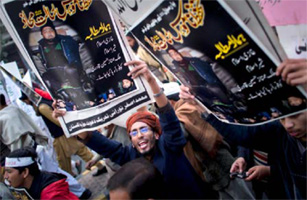
Times being what they are, Shahbaz Bhatti turned to Al-Jazeera and YouTube. The only Christian in Pakistan’s Cabinet knew it was only a matter of time before his work as minister for minority affairs got him killed. Threats by the Taliban and al-Qaida kept increasing.

“I want to share that I believe in Jesus Christ, who has given his own life for us. I know what is the meaning of the cross and I follow him on the cross,” said Bhatti, in a startlingly calm video recorded several weeks before his assassination on March 2.

“When I’m leading this campaign against the sharia laws for the abolishment of blasphemy law, and speaking for the oppressed and marginalized persecuted Christian and other minorities, these Taliban threaten me. … I’m living for my community and suffering people and I will die to defend their rights. So these threats and these warnings cannot change my opinion and principles.”

The last straw was almost certainly the Catholic statesman’s defense of Asia Bibi, a Christian mother of five who was sentenced to death last November for the crime of blasphemy after she publicly defended her faith in a village argument. The verdict — which must be upheld by a higher court — further polarized a tense nation and sparked a global firestorm.

Then again, in 2009 Bhatti received the U.S. Commission on International Religious Freedom’s first medallion for the promotion of religious freedom. A year later, he met with Pope Benedict XVI to discuss interfaith work and religious liberty in Pakistan. Bhatti was not hiding his convictions.

The blasphemy laws in question went into effect in 1986, during the dictatorship of Gen. Muhammad Zia-ul-Haq. They ban, among other actions, the use of “derogatory remarks, etc; in respect of the Holy Prophet. Whoever by words, either spoken or written or by visible representation, or by any imputation, innuendo or insinuation, directly or indirectly, defiles the sacred name of the Holy Prophet Mohammed (PBUH) shall be punished with death, or imprisonment for life, and shall also be liable to fine.”

These blasphemy laws have been used against hundreds of Muslim dissenters and Ahmadi sect members, whose approach to Islam is specifically attacked in the laws. In practice, conversion from Islam to another faith is considered blasphemy, as are attempts to advocate or defend minority faiths, such as Christianity or Hinduism.

Vigilantes often kill those formally or informally accused of blasphemy — making trials irrelevant.

This was the case with Bhatti’s death in a wave of machine-gun fire into his unarmored car. Pakistani officials had denied his request for an armored car, despite the constant threat of drive-by shootings.

Formalities were also irrelevant on Jan. 4, when Salmaan Taseer, the governor of Pakistan’s Punjab Province, was assassinated by one of his bodyguards. This outspoken Muslim also defended Bibi and called for reform in the use of blasphemy laws.

Adoring crowds showered Taseer’s assassin with rose petals and garlands as he arrived to face a magistrate, while moderate Muslim leaders remained silent. Pakistan’s legislators observed a moment of silence for Bhatti, since it probably would have been fatal for anyone to offer a prayer in his honor.

After all, pamphlets left by those who killed Bhatti warned that they would keep fighting “all the world’s infidels, crusaders, Jews and their operatives within the Muslim brotherhood. … This is the fate of that cursed man. And now, with the grace of Allah, the warriors of Islam will pick you out one by one and send you to hell, God willing.”

Apparently, many radicals in Pakistan have concluded — a perfect Catch-22 — that it is blasphemy to oppose the blasphemy laws.

Meanwhile, the Pakistani conference of Catholic bishops is preparing to render a judgment of its own. Later this month the bishops will review a proposal to ask the Vatican to designate Bhatti as a martyr.

“Bhatti is a man who gave his life for his crystalline faith in Jesus Christ,” Bishop Andrew Francis of Multan told a Vatican news agency. “It is up to us, the bishops, to tell his story and experience to the church in Rome, to call for official recognition of his martyrdom.”

-Terry Mattingly is director of the Journalism Center at the Council for Christian Colleges and Universities.

Islamophobia and Radicalization

By James Zogby for Counter Punch

Let me state quite directly: Islamophobia and those who promote it are a greater threat to the United States than Anwar Al-Awlaqi and his rag-tag team of terrorists.

On one level, Al-Awlaqi, from his cave hide out in Yemen, can only prey off alienation where it exists. Adopting the persona of a latter-day Malcolm X (though he seems not to have read the last chapters of the “Autobiography” or learned the lessons of Malcolm’s ultimate conversion), he appears street-smart, brash, self- assured and assertive — all of the assets needed to attract lost or wounded souls looking for certainty and an outlet for their rage. Like some parasites, Al-Awlaqi cannot create his own prey. He must wait for others to create his opportunities, which until now have been isolated and limited: a disturbed young man here, an increasingly deranged soldier there.

Islamophobia, on the other hand, if left unchecked, may serve to erect barriers to Muslim inclusion in America, increasing alienation, especially among young Muslims. Not only would such a situation do grave damage to one of the fundamental cornerstones of America’s unique democracy, it would simultaneously and rapidly expand the pool of recruits for future radicalisation.

I have often remarked that America is different, in concept and reality, from our European allies. Third generation Kurds in Germany, Pakistanis in the UK, or Algerians in France, for example, may succeed and obtain citizenship, but they do not become German, British or French. Last year, I debated a German government official on this issue. She kept referring to “migrants” — a term she used to describe all those of Turkish descent living in her country — regardless of the number of generations they had been there. Similarly, following their last election, a leading British newspaper commented on the “number of immigrants” who won seats, without noting that many of those “immigrants” were third generation citizens.

America has prided itself on being different. Being “American” is not the possession of a single ethnic group, nor does any group define “America”. Not only do new immigrants become citizens, they also secure a new identity. More than that, as new groups become American and are transformed, the idea of “America” itself has also changed to embrace these new cultures.

Within a generation, diverse ethnic and religious groups from every corner or the globe have become Americans, dramatically changing America in the process. Problems remain and intolerant bigots, in every age, have reared up against new groups, but history demonstrates that, in the end, the newcomers have been accepted, incorporated and absorbed into the American mainstream.

This defines not only our national experience, but our defining narrative as well. When immigrant school children in Europe learn French, German or British history, they are learning their host’s history. In the US, from the outset, we are taught that this is “our new story” — that it includes all of us, and has included us all, from the beginning.

It is because new immigrants and diverse ethnic and religious communities have found their place and acceptance in the American mainstream that the country, during the last century, survived and prospered despite being sorely tested with world wars, economic upheaval and bouts with internal strife. During this time we had to contend with anti-black, anti-Asian, anti-Catholic, anti-Jewish, anti-immigrant, and anti-Japanese movements. In the end, after creating their moment of pain, these efforts have always lost.

They lose, but they don’t always go away. The Islamophobia we are witnessing today is the latest campaign by bigots to tear apart the very fabric of America. We know the groups promoting it. First, there is the well-funded “cottage industry”, on the right, of groups and individuals with a long history of anti-Arab or anti-Muslim activity. Some of the individuals associated with these efforts have been given legitimacy as commentators on “terrorism”, “radicalisation” or “national security concerns”, despite their obvious bias and even obsession with all things Arab or Muslim (in this, they remind me of good old-fashioned anti-Semites who never tired of warning of Jewish threats or conspiracies or who while always claiming to like individual Jews rallied against any and all Jewish organisations).

If these “professional bigots” have provided the grist, the mill itself was run by the vast network of right-wing talk radio and TV shows and websites, and prominent preachers who have combined to amplify the anti-Muslim message nationwide. Their efforts have done real damage. They have tormented decent public servants, created protests that have shuttered legitimate institutions, fomented hate crimes, and produced fear in the Muslim community.

In just the past two years, we have seen a dramatic upsurge in the activity of these bigots. More ominously, their cause has been embraced by national political leaders and by elements in the Republican Party, who appear to have decided, in 2010, to use “fear of Islam” as a base-building theme and a wedge issue against Democrats for electoral advantage.

In the past, only obscure or outrageous members of congress (like North Carolina’s Sue Myrick who expressed nervousness and insecurity because of “who was owning all those 7/11’s”; or Colorado’s Tom Tancredo who once warned that he “would bomb Mecca”) were outspoken Islamophobes. After the National Republican Congressional Campaign Committee embraced opposition to Park 51 as a campaign theme, it is hard to find a leading Republican who has not railed on some issue involving Islam or Muslims in the US.

The net impact here is that this current wave of Islamophobia has both played to the Republican base while firming up that base around this agenda. The polling numbers are striking and deeply disturbing. Some 54 per cent of Democrats have a favourable attitude towards Muslims, while 34 per cent do not. Among Republicans, on the other hand, only 12 per cent hold a favourable view of Muslims, with 85 per cent saying they have unfavourable views. Additionally, 74 per cent of Republicans believe “Islam teaches hate” and 60 per cent believe that “Muslims tend to be religious fanatics”.

The danger here is that to the degree that this issue has become a partisan — and in some cases a proven vote getter — issue for the Republican Party, it will not go away any time soon. The longer we are plagued by this bigotry, and the displays of intolerance it breeds (the anti-mosque building demonstrations or the anti-Sharia law efforts now spreading across the country) the longer young Muslims will feel that the “promise of America” does not include them, and they will feel like aliens in their own country.

It is this concern that has prompted many inter-faith religious groups and leaders and a diverse coalition of ethnic and civil rights organisations to so vigorously oppose Congressman Peter King’s (R-NY) hearings that will deal with the radicalisation of American Muslims later this week. They know, from previous statements made by King, of his personal hostility to American Muslims. They also know that what King is doing will only aggravate an already raw wound, creating greater fear and concern among young Muslims who have already witnessed too much bigotry and intolerance.

What they should also know is that in the process of targeting a religion in this way, and engaging in this most “un-American activity”, King and company are, in fact, opening the door for increased alienation and future radicalisation. Al-Awlaqi must be smiling from inside his cave.

-Dr James Zogby is president of the Arab American Institute and is a Roman Catholic of Lebanese descent and brother of prominent American political pollster and founder of Zogby Polls, John Zogby.

In Pakistan, Justifying Murder for Those Who Blaspheme

By Aryn Baker for Time

“I believe in Jesus Christ who has given his own life for us,” the doomed man said, staring straight into the video camera. “And I am ready to die for a cause.” Shahbaz Bhatti had no hesitation in his voice as he responded to a question about threats from the Taliban and al-Qaeda. “I’m living for my community … and I will die to defend their rights.” It was his last answer in a four-month-old self-produced video that was to be broadcast in the event of his death. But the radicals had the final say. On March 2, Bhatti, Pakistan’s Minister for Minority Affairs, was shot dead in Islamabad. Pamphlets scattered on the ground claimed the act for a new alliance of “the organization of al-Qaeda and the Punjabi Taliban” and asserted that other infidels and apostates would meet the same fate.

Bhatti’s death had been foretold not just by himself but also in the nation’s response to a previous assassination, that of Punjab governor Salmaan Taseer on Jan. 4. Taseer, a self-made millionaire, had turned his largely ceremonial post into a platform for a campaign to amend Pakistan’s blasphemy laws. Bhatti, the only Christian in the Cabinet, refused to be a token and swore to battle intolerance. Both men supported clemency for Aasia Noreen, a Christian woman who had been accused of blasphemy and sentenced to death. Taseer’s stance on the issue infuriated a large part of the population that, thanks to religious leaders and school curriculums, believes that blasphemy is a sin deserving of execution. In the weeks leading up to his assassination, Taseer had been denounced at Friday prayers, excoriated in the media and largely abandoned by his Pakistan People’s Party (PPP) for fears that his campaign would prove politically toxic. The witch hunt culminated in a bodyguard’s pumping 27 rounds into his head and chest in the parking lot of a popular Islamabad shopping center.

Within hours of Taseer’s death, telephone text messages celebrating his assassination made the rounds. “Justice has been done,” read one. “If you love the Prophet, pass this on.” A Facebook fan page for assassin Malik Mumtaz Hussain Qadri garnered more than 2,000 members before site administrators shut it down. Even the leaders of state-funded mosques refused to say funeral prayers for the slain governor. When Qadri was transferred to a local jail, he was garlanded with roses by hundreds of lawyers — the vanguard of a movement that in 2008 helped unseat a military dictator — offering to take on his case for free.

At his court appearance a few days later, Qadri told the judge that he believed in a Pakistan where loyalty to the Prophet eclipses all other rights. According to Taseer’s daughter Shehrbano, her father “wanted an egalitarian society where open debate is protected and people are not killed for speaking out.” And Bhatti dreamed of a nation true to founder Muhammad Ali Jinnah’s vision, one where “you are free to go to your temples, you are free to go to your mosques or to any other place of worship.” Which vision prevails — Qadri’s or Taseer and Bhatti’s — will decide the future of the country.

The Roots of Extremism

 
It is not news that Pakistan has a lunatic fringe. What is disturbing is that after Taseer’s murder, when the silent majority finally spoke up, it praised Qadri, not his victim. The public reaction exploded the myth of Pakistan’s moderate Islam; Qadri belongs to a mainstream sect that routinely condemns the Taliban. “The Pakistan we saw in the wake of Taseer’s killing is the real Pakistan,” says Amir Muhammad Rana of the Pak Institute for Peace Studies. For the past two years, Rana’s organization has conducted in-depth interviews with a broad spectrum of Pakistani citizens. “They might dress Western and eat at McDonald’s, but when it comes to religion, most Pakistanis have a very conservative mind-set.”

Pakistan’s religious parties rarely do well at the polls — a fact often cited by those countering concerns that the country is going fundamentalist — but their street power is considerable. The furor over blasphemy appears to be partly in response to significant losses for the religious right in the 2008 elections. With the current government on the verge of collapse and popular sentiment against the PPP mounting, the religious parties are betting on significant gains if fresh elections are called. The case of Raymond Davis, a CIA contractor accused of killing two Pakistanis during what appears to have been a botched attempt to rob him, demonstrates the state of Pakistan’s politics. It has gone virtually unremarked in Pakistan that Qadri, a confessed murderer, has been hailed as a national hero, while Davis — who, whatever his background, seems to have been acting in self-defense — is considered worthy of the death penalty. Over the past few weeks, street rallies led by the religious right have simultaneously called for the release of Qadri and the hanging of Davis. (Read: “Pakistan’s Christians Mourn, and Fear for Their Future.”)

Using religion to shore up political support is nothing new in Pakistan. Founded as a Muslim nation carved from a newly independent India in 1947, Pakistan has long struggled to unite a diverse population divided by language, culture and ethnicity. Islam was the common denominator, but Jinnah was famously enigmatic about its role in government.

Then, in 1977, Muhammad Zia-ul-Haq, an Islamist military general, overthrew the democratically elected government of Zulfikar Ali Bhutto, who was already retrenching his secular vision of Pakistan in an effort to win religious support. To further appease Muslim religious leaders, Zia-ul-Haq strengthened the colonial-era blasphemy laws, mandating that breaches should be answered by the death penalty. Since then, more than 1,274 cases have been lodged. As repeating blasphemous words could be considered to be perpetuating the crime, many cases are accepted without evidence, a system well primed for the pursuit of vendettas. That nobody has yet been executed by court order is hardly reassuring: 37 of the accused have been killed by vigilantes. (In 1929, Jinnah famously defended an illiterate carpenter who shot to death a Hindu publisher accused of blasphemy. The plea failed, and after the carpenter was hanged, Taseer’s father was one of the pallbearers.)

The Uses of Blasphemy
When a nation rises up in support of a murderer instead of his victim, it’s hard not to believe it is heading down a dangerous path. “What is happening now won’t matter in five years,” says Shehrbano Taseer. “It will matter in 25 years. What we are seeing now is the fruit of what happened 30 years ago. If people had stood up against [Zia-ul-Haq], we would not be here today. Because of that silence we have madrasahs spewing venom, a true Islam threatened by the same people who claim to serve it, and a cowed majority too afraid to speak.”

President Asif Ali Zardari, an old friend of Taseer’s, condemned the murders but didn’t go to either funeral. After paying his respects to Taseer’s family, Interior Minister Rehman Malik gave an impromptu press conference outside Taseer’s house during which he announced that he too would kill any blasphemer “with his own hands.” A few days later, the Prime Minister announced that he would drop the issue of the blasphemy laws altogether. Meanwhile, the government is under pressure to go through with Aasia’s sentence, and now her two champions are dead.

Reaction to Bhatti’s murder has been muted, characterized mostly by denial. What little newspaper coverage there was focused on security lapses or the role of the country’s Christian community rather than on the motives of the killer. On television talk shows, members of the religious parties and right-wing commentators spun a conspiracy theory that alleged that Bhatti’s murder had been “a plot” hatched by “outside forces” to “divert attention from the Raymond Davis affair.” There was no mention of the fact that Bhatti was campaigning alongside Taseer on the issue of blasphemy.

The PPP was founded in 1967 with the goal of bringing secular democracy to a nation under military rule. It vowed to give power to the people and promised to protect the nation’s downtrodden. That Pakistan’s most progressive party — one that has already endured the assassination of former Prime Minister Benazir Bhutto — should cave in the face of religious fundamentalism speaks volumes about the strength of the religious right. A candlelight vigil promoting a progressive Pakistan a few days after Taseer’s assassination drew nearly 1,000 supporters; a religious rally in Karachi the same day had 40,000 in the street chanting Qadri’s name. “Taseer’s murderer was tried in the court of public opinion, and he has emerged a hero,” says a woman shopping for vegetables in the same market where the governor was killed. “If someone kills me because I criticize Qadri, will he too be called a hero?” She declined to give her name. (Read: “Murder in Islamabad: Pakistan’s Deepening Religious Divide.”)

Of course, few Pakistanis would ever go as far as Taseer’s or Bhatti’s killers. But their ambivalence can easily be manipulated. “Just because we are religious does not mean we will all be reaching for guns the next time someone says something wrong,” says Malik Khan, a university student who spent a recent afternoon at a shrine in Lahore dedicated to a revered Islamic saint. “But Salmaan Taseer was an extremist as well. He should not have touched the blasphemy law.” Khan received a text message praising Qadri and exhorting him to pass it along. It posed a moral quandary: “I don’t agree with the message,” he says. “But I love the Prophet. My thumb hesitated a long time over the delete button.” In the end, he passed the hate along.

Qadri himself was the religious-minded youngest son of a family just stepping into the middle class. Like his brother, he joined the special-forces branch of the Punjab police in 2002. He had been flagged as a security risk because of his strong religious leanings but was nevertheless appointed to Taseer’s security detail when he visited Islamabad. In his confession, Qadri said he had been inspired by the teachings of his local mullah, Hanif Qureshi. At a rally a few days later, Qureshi claimed credit for motivating Qadri. “He would come to my Friday prayers and listen to my sermons,” he said. Then he repeated his point: “The punishment for a blasphemer is death.”

But is it? Two weeks after Taseer’s murder, I visited Qari Muhammad Zawar Bahadur, the head of one of Pakistan’s mainstream religious groups and a co-signer of a statement that advised Muslims not to show “grief or sympathy on the death of the governor, as those who support blasphemy of the Prophet are themselves indulging in blasphemy.” For more than an hour, he justified his group’s stance, telling me that the Koran was clear on the issue. I asked Bahadur to show me the exact verse that detailed the punishments for blasphemy. He mumbled that “there are several passages,” as if there were so many, he couldn’t decide which one to quote. When pressed further, he consulted a Koran and read aloud a passage that spoke of killing a man who had once harmed the Prophet.

That verse has routinely been dismissed by leading Islamic scholars as referring to a specific case and having nothing to do with blasphemy. They say there is no definition of blasphemy in the Koran, nor any prescription for its punishment. “Nobody challenges these mullahs, and that is our problem,” says Omar Fazal Jamil, who runs a p.r. firm in Lahore. “We can’t invoke liberal secular values anymore. I have to have the knowledge to contradict these men who distort our religion for their own political gain. I have to be able to say, ‘No, this did not happen, this is not right, and show me where it says in the Koran that blasphemers should be shot on sight.’ ”

The Sin of Silence
In the absence of such challenges, those favoring religious intolerance will continue to have things go their way. In late 2007, Benazir Bhutto released an updated manifesto for her father’s party. “The statutes that discriminate against religious minorities and are sources of communal disharmony will be reviewed,” it said. Less than a month later she was dead, killed in a bomb attack just 13 km from where both Taseer and Bhatti were murdered. Her death was an opportunity to rally the nation against the forces of extremism. Instead the party focused on consolidating power. The manifesto remains an empty promise, and two more voices of tolerance have been silenced. For evil to prevail, goes the old aphorism, all that is required is for good men to do nothing.

— With reporting by Ershad Mahmud / Lahore and Omar Waraich / Rawalpindi

The Myth of ‘Moderate Pakistan’

By Sadanand Dhume for The Wall Street Journal

It’s time to bury the myth of moderate Pakistan. You know the one: the notion, repeated ad nauseam in magazine articles, think-tank reports and congressional testimony—as though saying it often enough will make it true—that Pakistan is an essentially tolerant country threatened by a rising tide of fundamentalism. Here’s a news flash: The tide has risen.

The most recent reminder of this came last Wednesday in Islamabad, when suspected Taliban militants shot dead Shahbaz Bhatti, Pakistan’s 42-year-old minister for minority affairs and the only Christian in the overwhelmingly Muslim nation’s cabinet. His crime? Supporting the repeal of a barbaric blasphemy law that makes insulting the prophet Muhammad punishable by death.

The law is often used to settle scores with hapless religious minorities, especially Christians such as Asia Bibi, an illiterate peasant sentenced to hang last year after she allegedly badmouthed the prophet during a row with Muslim coworkers. Bhatti’s assassination comes two months after a bodyguard murdered Punjab Gov. Salmaan Taseer for visiting Ms. Bibi in jail and speaking out against abuse of the law.

To be fair, Pakistan’s claim to relative moderation has been kept alive thus far by more than just wishful thinking. Overtly Islamist parties such as the Jamaat-e-Islami have rarely commanded more than a fraction of the national vote. Women enjoy freedoms in the public square that their counterparts in Saudi Arabia and Iran could only dream of. At great personal risk, a small but courageous group of activists, intellectuals and politicians speak out publicly against bigotry and religious intolerance.

Scratch the surface, however, and a bleaker picture emerges. Islamist parties may not garner large-scale electoral support, but Islamist ideas are widely tolerated by mainstream political parties. The major opposition party, former Prime Minister Nawaz Sharif’s Pakistan Muslim League, flaunts its closeness to sundry Islamists, including Jamaat-ud-Dawa, the parent organization of the international terrorist group Lashkar-e-Taiba.

Ostensibly secular, the ruling Pakistan Peoples Party supported both Kashmiri militancy and the Afghan Taliban in the past. In its current incarnation it appears permanently cowed by the country’s legion of vocal fundamentalists. President Asif Ali Zardari failed to attend the funerals of either Taseer or Bhatti. His government has made it clear that it will not touch the controversial blasphemy law. Interior Minister Rehman Malik declared that he would personally kill anyone who dared blaspheme Muhammad’s name.

As for Pakistan’s undeniably brave activists and intellectuals, unfortunately they appear to have more admirers overseas than among their compatriots. Hand-wringing in the pages of Dawn and the Friday Times, two of the country’s leading English-language newspapers, has not prevented Mumtaz Qadri, Taseer’s murderer, from becoming a national hero.

Not surprisingly, anti-American sentiment—often a reliable shorthand for a society’s paranoia and self-loathing—is rampant. According to the Pew Global Attitudes Project, American favorability ratings stood at 17% last year, the lowest of all countries surveyed. On the streets, bloodcurdling yells for the execution of alleged Central Intelligence Agency operative Raymond Davis, accused of killing two Pakistanis in January, have prevented the government from granting Mr. Davis the diplomatic immunity that the U.S. claims he is entitled to. This despite personal pleas by President Barack Obama and Sen. John Kerry.

By now the reasons for Pakistan’s predicament are well known. They include the intolerance embedded in the nation’s founding idea of a separate “land of the pure” for Indian Muslims, the malign shadow of Saudi Arabia on religious life, blowback from the anti-Soviet jihad of the 1980s, and the overwhelming influence that the army and its thuggish intelligence wing, the Inter-Services Intelligence, wield on national life. The army’s very motto, Jihad-fi-Sabilillah, or jihad in the path of Allah, is an exhortation to holy war.

For the international community, the long road to fixing Pakistan begins with the simple recognition that the country’s true face is not the urbane intellectual making reasoned arguments, but the frenzied mob showering rose petals on a murderer for his services to the faith. Over time, Pakistan can only be saved by re- arranging the basic building blocks of the country.

This means backing provincial autonomy and linguistic identity as an alternative to the centralized pan-Islamism used by the military and its supporters to weld the country together. It means deploying social networks and satellite television to open the door to reasonable discourse about religion. It means channeling aid to ensure that children are no longer taught to glorify Islamic conquest and reflexively mistrust the West and India. It means accepting that the most poisonous madrassas—such as Jamia Binoria in Karachi and Darul Uloom Haqqania outside Peshawar—must be shuttered if they can’t be reformed.

Needless to say, none of this will be easy. But the consequences of the alternative—pandering to fundamentalists while blaming outsiders for all the country’s ills—can be seen in the freshly turned soil of Bhatti’s grave.

-Sadanand Dhume is a resident fellow at the American Enterprise Institute and a columnist for WSJ.com.

Sindh Saves the Day

By Nadeem F Paracha for Dawn

Plans are afoot to build the world’s first ever international Sufi university near Bhit Shah in Sindh. The main purpose of the institution would be to promote interfaith and intercultural education to tackle extremism in the country.

Such a thought and project could only have come about in Sindh. Especially in the context of what Pakistan has beengoing through in the last many years.

Not only have the country’s other provinces – especially the Punjab and Khyber Pakhtunkhwa (KP) – become central targets of horrid terrorist attacks by extremist organisations, the Punjab in particular has also been witnessing a steady growth of faith-based conservatism within its urban middle and lower middle-classes.

When extremists (calling themselves ‘Punjabi Taliban’) attacked the famous Sufi shrine, Data Darbar in Lahore late last year, economist and political analyst, Asad Sayeed, made a rather insightful observation.

He said that had such an attack on the Darbar taken place twenty years ago, thousands of Lahorites would have poured out to protest.

But not anymore. The attack on one of Punjab’s most popular Sufi shrines was simply treated as just another terrorist attack.

Though it is now clear that the Wahabi/Deobandi extremists have been going around blowing up Sufi shrines frequented by the majority Barelvi Muslims, the Barelvi leadership has looked elsewhere, putting the blame on the ever-elusive ‘foreign hands.’

Journalist and intellectual Khaled Ahmed once wrote a telling tongue-in-cheek article about the annual gathering of the Dawat-i-Islami in Multan.

The Dawat is the Barelvi equivalent of the Deobandi Tableeghi Jamat. Both these outfits are considered to be non-political organisations who are more interested in evangelizing their respective versions of Islam and its rituals. One should also mention that both these (sub-continental) strains of Islam accuse one another of being ‘flawed Muslims.’

Ahmed wrote how after Dawat’s huge congregation in Multan, when police found some bullet-riddled bodies of Dawat members, the outfit’s main leadership simply refused to acknowledge the glaring evidence that pointed towards the involvement of an opposing Sunni sect’s organisation in the murders.

Ahmed adds that Dawat leaders began babbling about ‘outside forces (RAW, CIA, Mossad)’ who wanted to create disharmony between Pakistan’s Barelvi majority and the Deobandi and Wahabi sects.

Barelvis: From moderate to militant

One can understand the above-mentioned episode as an example of the confusion Barelvi spiritual leadership has gone through since the 1980s.

From its inception in the 18th century and until about the mid-1980s, the Barelvi sect was largely apolitical in orientation, non-Jihadist and followers of some of the most relaxed dictates of the Hanafi madhab – the first of the four main Islamic schools of law that is also considered to be the most moderate.

‘Barelvi Islam’ (as it is sometimes called) is purely a sub-continental phenomenon that fuses elements of Indian Sufism with the folk and populist strains of various cultures that exist in the sub-continent.

It is also called the ‘folk Islam’ of the region in which a high degree of tolerance exists between various faiths, sects, classes and ethnicities and in which the puritanical aspects of other Islamic sects are eschewed and even rejected.

The Sufi shrine and an intense reverence of the Prophet (PBUH) play a central role in Barelvi Islam. Its populist and moderate make-up helped it become the majority Sunni sect amongst the Muslims of the sub-continent.

Two of its leading opponents have been the Sunni Deobandi sect (also a product of the subcontinent) and the Saudi-inspired Wahabism.

Both have accused Barelvis of ‘adopting Hindu rituals and practices’ and assorted ‘heresies.’

In spite of being the majority sect amongst Sunni Muslims in Pakistan, ‘Barelvi Islam’ hardly ever had a coherent political expression in shape of a mass-based political party or organisation.

Its spiritual leadership remained pro-Jinnah (unlike Deobandi organizations of undivided India), and various Pakistani political leaders have continued to appeal to the symbolism and lingo associated with various populist aspects of Barelvi-ism.

Zulfikar Ali Bhutto and his Pakistan Peoples Party (PPP) was the most successful in this respect.

Bhutto was also one of the first leading Pakistani political figures to undertake the act of regularly visiting various famous Sufi shrines in Sindh and Punjab.

Barelvis are in the majority in Sindh and the Punjab, whereas Deobandis are largely centred in Khyber Pakthunkhwa and in the Pushtun-dominated areas of Balochistan.

Until the 1970s Barelvi-ism also prevailed among many of Sindh and Punjab’s urban middle-classes, especially those who considered themselves to be progressive and likely supporters of secular politics.

However, the arrangement in this context was suddenly disturbed with the arrival of the Ziaul Haq dictatorship in 1977.

Dipped in the political Islam of scholar and Jamat-i-Islami (JI) chief Abul Ala Mauddudi, Zia soon moved towards infiltrating the spiritual and political nerve centres of Barelvi-ism in an attempt to ‘reform’ them.

Barelvi dominance across the country’s religious landscape reminded him of Z A. Bhutto’s populism (which he, like JI, considered to be ‘vulgar’ and ‘un-Islamic’), and from 1979 onwards Pakistan under Zia also became one of the leading client states of Saudi-generated Wahabi propaganda and aid.

Stunned by the ‘Islamic revolution’ in the Shia-dominated Iran in 1979, Saudi Arabian monarchy and its Wahabi Sunni religious elite began seeing Pakistan’s Barelvi-dominated make-up as venerable to Shia-ism’s revolutionary symbolism and also of socialist propaganda, especially with the arrival of Soviet forces in Afghanistan.

At least that was one of the reasons used by Zia and his Saudi allies to draw the United States into giving Pakistan billions of dollars worth of aid and arms.

With the aid also came Wahabi propaganda literature and preachers who along with Pakistani Deobandi and Wahabi spiritual and political groups began setting up madressas and mosques.

These madressas operated as institutions that would indoctrinate young Pakistanis – most of whom were immersed in the non-Jihadi traditions of Barelvi-ism – and prepare them for Jihad against Soviet forces in Afghanistan.

Bralevi tradition had also not been very kind to the ulema and the clergy.

To address this, Zia also began describing famous Sufi saints as ulema and banned (in the media) all criticism and humour aimed at the clergy.

The Afghan war, Saudi propaganda, the mushrooming of Deobandi and Wahabi madressas and televangelists, and a concentrated campaign by the Zia regime to equate the dictatorship’s capitalist-Islamist makeup as something in accordance with the Shariah and with ‘Jinnah and Iqbal’s vision,’ had a telling impact on Pakistan’s religious sociology.

In the Khyber-Pakhtunkhwa many moderate and progressive Deobandi strains that had prevailed in the province began sliding into the sect’s more radical dictates, coming closer to the puritanical Wahabi and Salafi ideas about faith.

This slide was celebrated by the Punjab-dominated military as a successful blow to the secular and ‘treacherous’ Pukhtun separatist tendencies.

In the Punjab, the province benefited the most from Zia’s Punjab-centric capitalist maneuvers. This coupled with unprecedented remittances coming from Pakistanis who had begun going to Arab Gulf states to work from the 1970s onwards, gave birth to new moneyed classes.

Many from the petty-bourgeoisie and bourgeoisie sections began moving away from their Barelvi heritage and towards more puritanical strains of faith.

Their Barelvi past now reminded them of their lower status and economic modesty, whereas they began relating their enhanced economic standing with the adoption of the more puritanical strains of Islam.

That’s why the growth of puritanical Islamist and sectarian organizations that Punjab saw under Zia, a lot of their local funding came from Punjab’s nouveau-riche and petty-bourgeois trader classes.

Interestingly, it was also the same classes that also pushed the Barelvi leadership to become more conservative and radical. Those sections of the Punjabi petty-bourgeoisie that stuck to Barelvi-ism encouraged their spiritual leadership to compete with the Puritanism and radicalism of the growing number of Deobandi and Wahabi groups.

This trend saw the first ever emergence of radical Barelvi groups. In the early 1980s, the Dawat-i-Islami was formed to counterbalance the growth of the Deobandi Tableeghi Jamaat that had begun making deep inroads into Punjab’s bourgeoisie and the military.

The Dawat discouraged the Barelvis from indulging in antics associated with the region’s folk Islam, emphasising an increased reverence of holy personalities and encouraging holding of recitals of naats and milads instead of quwalis and dhamals. The last two became associated with the practices of the lower-class Barelvis.

In 1992, emerged the Sunni Thereek (ST). A Barelvi outfit that emerged from the splintering of the oldest Barelvi Islamic political party, the Jamiat Ulema Pakistan (JUP).

Such occurrences did not really help the Barelvi sect defend its traditions in the face of the state-sponsored Deobandi and Wahabi onslaught –  rather, these organisations began turning Barelvi-ism into an equally anti-pluralistic and militant political phenomenon.

Sindh saves the day?

By the 1990s, Zia’s manoeuvres and Saudi involvement in reshaping Pakistan’s religious tradition had seen Khyber Pakhtunkhwa and Punjab become hostage to various violent Deobandi/Wahabi outfits and new-born Barelvi reactionary-ism.

The Punjab also saw a rise in the use of reactionary political and religious narratives within its lower-middle and middle-classes, whereas in Balochistan attempts were being made (by intelligence agencies) to neutralize secular Baloch nationalist militancy with the help of puritanical evangelical outfits. The agencies had already done this successfullyin Khyber Pakhtunkhwa in the 1980s.

But what happened in Sindh? Barelvi-ism in Sindh (outside Karachi) has always been a lot more secular and pluralistic than the Bareilvi-ism in the Punjab.

Its  sociology  in Sindh heavily revolves around the staunchly secular historicity that the province’s famous scholar, GM Syed’s literary work generated.

He described a highly pluralistic and secular reading of Sufism as being the cultural and religious make-up of the Sindhis and it is this narrative that still rules the roost in the province’s social and religious psyche.

This is one of the reasons why Zia completely failed to impose his version of Islam here. Also, just like the majority of the Baloch who equate puritanical Islam with the ‘Punjabi civil-military elite,’ so does the socio-political discourse in Sindh.

On the other hand, in Karachi, though Zia-backed Deobandi and Wahabi radical outfits did manage to find a foothold, two things have always worked against these outfits here.

The first is the fact that the sprawling ethnic, sectarian and religious diversity found in Karachi actually absorbs and neutralizes any attempt by an outfit to impose its version of Islam.

Secondly, MQM, a party that first emerged as a mohajir nationalist group, adopted almost the same populist Barelvi symbolism and lingo as Bhutto did in the 1970s.

Also, the other two big political parties in the city too are secular: the PPP and ANP.

Though the Sunni Thereek (ST) has managed to infiltrate some sections of MQM’s support, ST is Barelvi and anti-Taliban (albeit reactionary).

In spite of the rampant crime and ethnic tensions that are a constant in Karachi, it will not be an overstatement to claim that Karachi along with the rest of Sindh today stands to be perhaps the only (ragged) sanctuaries in present-day Pakistan that are (comparatively-speaking) largely free of the factors that have created opportunities in the Punjab and KP for violent extremist activity as well as for reactionary conservatism to now become a mainstay in Punjab’s bourgeois psyche.