Archive for the ‘ United States ’ Category

Haley’s Comment

As Reported By Robert Walker for The Huffington Post

Like a comet streaking across the heavens, Governor Nikki Haley’s comment on The View about women not caring about contraception is drawing a lot of attention. And rightly so.

Poll after poll suggests that women do care about contraception. Case in point: Mitt Romney’s plan to shut down the family planning clinics run by Planned Parenthood has cost him dearly. His support among women has dropped precipitously in the past few months as voters learn more about his views on family planning.

When Haley and other Republican leaders opine about the lack of voter interest in contraception, it’s more wishful thinking than political insight. They recognize that the positions taken by the GOP presidential aspirants on family planning may help them in the primaries, but it will undoubtedly hurt them in the general election. As a result, they want to change the subject in the worst way.

Unfortunately for them, comments like those made by Governor Haley do nothing to shift voter attention to the issues they want to talk about, like deficits and the economy. To the contrary, they reinforce the idea that Republicans are tone-deaf on women’s issues.

Haley’s comment, in particular, appears to suggest that Republican leaders, even women like her, don’t care about a women’s access to contraception. Before making her claim, maybe she should have checked in with another Republican leader, Senator Olympia Snowe, who earlier this week said that the political attacks on contraception were “retro.”

What’s even more “retro,” however, is the unspoken half of Haley’s comment. By suggesting that women don’t really care about contraception, she’s suggesting that men could care even less. So much less that it’s not even worth discussing.

Polls, of course, suggest to the contrary. While men may feel less strongly than women do, they also care about contraception. Most men recognize that they also benefit when women are able to determine the number and timing of their pregnancies. Some men may want to keep women “barefoot and pregnant,” but it’s a pretty small minority. This is, after all, the 21st century.

As governor of South Carolina, Nikki Haley ought to appreciate the critical need for family planning services. Nearly half of all pregnancies in the United States are unintended. According to the Guttmacher Institute, South Carolina’s rate of unintended pregnancy is significantly higher than the national average. In 2006, 52,000 South Carolina residents had an unintended pregnancy, a rate of 58 per 1,000 women aged 15 to 44. Guttmacher report that births resulting from these unintended pregnancies cost the state and federal governments $254 million in 2006.

And South Carolina’s teenage pregnancy rate, while it’s been declining in recent years, is still about 25 percent higher than the national average according to the Centers for Disease Control.

A poll released earlier this year indicated that 95 percent of South Carolinians believe that teenage pregnancy is an important issue, with 85 percent supporting school-based sexuality education. Maybe, Governor Haley should go on a listening tour in South Carolina before declaring that women don’t care about contraception.

Many regard Governor Haley as a rising political star in the political firmament. She’s frequently mentioned as a possible vice presidential selection. Given Romney’s “gender gap,” adding a woman to the ticket might be a smart move, but, maybe he should find a woman who understands how women — and men — genuinely feel about contraception.

Governor Haley’s comment, like the famed Halley’s comet, will soon fade from public view, but the issue of contraception will not fade anytime soon. The war on contraception is real. State cutbacks, like those in Texas, are forcing family-planning clinics to close their doors, and if GOP leaders succeed in their efforts to eliminate Title X, the federal program that provides low-income women with improved access to family planning, more shutdowns will inevitably occur.

That’s why it’s so critically important that women — and men — pledge to speak out in support of reproductive health and rights. Don’t let the Governor Haleys of the world speak for you.

Pakistanis for Peace Editor’s Note– We profiled Governor Nikki Haley a few days before she was elected as the first Indian born female governor as well as minority woman governor of a US state and wished her well here. However, her party and ideals diametrically are opposed to ours as Democratic voters in the US elections as many Pakistani Americans now are. Thus, some of her ideas and beliefs are not necessarily our own, but we still wish her well as she is a fellow Desi~

Why President Zardari’s Visit Is A Small Bonus

By Soutik Biswas for The BBC

Hope is not a policy, but neither is despair, as South Asia expert Stephen Cohen says in a recent essay on Pakistan.

So it is with relations between India and Pakistan.

The past few days have shown how fragile the relationship can be – even as India welcomed President Asif Ali Zardari’s private trip to India on Sunday – the first by a Pakistani head of state for seven years – and PM Manmohan Singh invited him for lunch, the $10m US bounty for Hafiz Saeed, the founder of Pakistan-based militant group Lashkar-e-Taiba, provoked the cleric to openly launch a fresh attack against India (and the US).

But people live in hope, so Indian media is gung-ho about Mr Zardari’s visit.

They say the Pakistani president must be applauded for trying to end trade discrimination against India, easing petroleum imports from across the border, and moving towards a liberal visa deal.

“Under Mr Zardari’s watch, India and Pakistan are considering a sweeping agenda for economic co-operation for the first time in decades. The prime minister has every reason to welcome Mr Zardari warmly and consider the next steps in consolidating the unexpected movement in bilateral relations,” the Indian Express wrote.

Analyst C Raja Mohan believes Mr Singh must make an official trip to Pakistan after his meeting with Mr Zardari. “For his part,” he wrote, “Mr Singh should convey to Mr Zardari his readiness to move as fast and as far as the Pakistan president is willing to go.” Others like Jyoti Malhotra actually find Mr Zardari’s visit to the shrine of a famous Sufi Muslim saint in Rajasthan loaded with symbolism in these troubled times. “Clearly, Mr Zardari has stolen an imaginative moment from the bitter-sullen history of India-Pakistan, by asking to come to pay his respects to a cherished and much-beloved saint across the Indian subcontinent,” she wrote.

The relations between two neighbours remain complex. A 2010 Pew survey found 53% of the respondents in Pakistan chose India as the greater threat to their country, and only 26% chose the Taliban and al-Qaeda. At the same time 72% said it was important to improve relations with India, and about 75% wanted more trade relations and talks with India.

Pundits like Mr Cohen believe that it will “take the [Pakistan] army’s compliance, strong political leadership, and resolutely independent-minded foreign ministers to secure any significant shift of approach towards India”.

None of this appears to be in much evidence at the moment.

Both countries have seriously weakened governments that makes them unable to move towards any radical confidence building measures. In the current circumstances, President Zardari’s visit can only be a small bonus. And as scholars like Kanti Bajpai suggest, India must remain patient (even if faced with another Mumbai-style attack), continue to engage with Islamabad, help the civilian government in Pakistan politically, try to resolve a few outstanding disputes like Siachen and Sir Creek, build a relationship with the army and explore the possibility of cooperating with Islamabad on the future of Afghanistan. Despair does not help mend a stormy relationship.

Pakistani militant taunts US: ‘I will be in Lahore tomorrow’

By Sebastian Abbot for The Associated Press

One of Pakistan’s most notorious extremists mocked the United States during a defiant media conference close to the country’s military headquarters Wednesday, a day after the US slapped a $10 million bounty on him.

“I am here, I am visible. America should give that reward money to me,” said Hafiz Mohammad Saeed, referring to the fact that the bounty was given to a man whose whereabouts are not a mystery. “I will be in Lahore tomorrow. America can contact me whenever it wants to.”

Analysts have said Pakistan is unlikely to arrest Saeed, founder of the militant group Lashkar-e-Taiba, because of his alleged links with the country’s intelligence agency and the political danger of doing Washington’s bidding in a country where anti-American sentiment is rampant.

Saeed, 61, has been accused of orchestrating the 2008 attacks in the Indian city of Mumbai that killed 166 people, including six American citizens. But he operates openly in Pakistan, giving public speeches and appearing on TV talk shows.

He has used his high-profile status in recent months to lead a protest movement against US drone strikes and the resumption of NATO supplies for troops in Afghanistan sent through Pakistan. The supplies were suspended in November in retaliation for American airstrikes that accidentally killed 24 Pakistani soldiers.

Hours before Saeed spoke, US Deputy Secretary of State Thomas Nides met Pakistani Foreign Minister Hina Rabbani Khar in the nearby capital, Islamabad, for talks about rebuilding the two nation’s relationship. In a brief statement, Nides did not mention the bounty offer but reaffirmed America’s commitment to “work through” the challenges bedeviling ties.

Increasingly ‘brazen’ appearances
The US said Tuesday it issued the bounty for information leading to Saeed’s arrest and conviction in response to his increasingly “brazen” appearances. It also offered up to $2 million for Lashkar-e-Taiba’s deputy leader, Hafiz Abdul Rahman Makki, who is Saeed’s brother-in-law.

The rewards marked a shift in the long-standing US calculation that going after the leadership of an organization used as a proxy by the Pakistani military against archenemy India would cause too much friction with the Pakistani government.

This shift has occurred as the US-Pakistani relationship steadily deteriorated over the last year, and as the perception of Lashkar-e-Taiba’s potential threat to the West increased.

Bounty backfire?
The US may be hoping the bounty will force Pakistan to curb Saeed’s activities, even if it isn’t willing to arrest him. But the press conference he called at a hotel in the garrison city of Rawalpindi on Wednesday was an indication that is unlikely, and the bounty may even help him by boosting his visibility.

At the hotel, located near the Pakistani army’s main base and only a half hour drive from the US Embassy in Islamabad, Saeed was flanked by more than a dozen right-wing politicians and hardline Islamists who make up the leadership of the Difa-e-Pakistan, or Defense of Pakistan, Council. The group has held a series of large demonstrations against the US and India in recent months.

Some in the media have speculated the movement has the tacit support of the Pakistani military, possibly to put pressure on Washington.

“I want to tell America we will continue our peaceful struggle,” said Saeed. “Life and death is in the hands of God, not in the hands of America.”

Denies involvement in Mumbai massacre
He denied involvement in the Mumbai attacks and said he had been exonerated by Pakistani courts.

Pakistan kept Saeed under house arrest for several months after the attacks but released him after he challenged his detention in court. It has also resisted Indian demands to do more, saying there isn’t sufficient evidence.

The bounty offers could complicate US efforts to get the NATO supply line reopened. Pakistan’s parliament is currently debating a revised framework for ties with the US that Washington hopes will get supplies moving again. But the bounties could be seen by lawmakers and the country’s powerful army as a provocation and an attempt to gain favor with India.

Origins in the Kashmir dispute
Saeed founded Lashkar-e-Taiba in the 1980s allegedly with ISI support to pressure India over the disputed territory of Kashmir. The two countries have fought three major wars since they were carved out of the British empire in 1947, two of them over Kashmir.

Pakistan banned the group in 2002 under US pressure, but it operates with relative freedom under the name of its social welfare wing Jamaat-ud-Dawwa — even doing charity work using government money.

The US has designated both groups foreign terrorist organizations. Intelligence officials and terrorism experts say Lashkar-e-Taiba has expanded its focus beyond India in recent years and has plotted attacks in Europe and Australia. Some have called it “the next Al Qaeda” and fear it could set its sights on the US

* Associated Press writer Asif Shahzad contributed to this report from Islamabad.

Ornate, but not lavish: Another bin Laden home located in Pakistan

By Kathy Gannon for The Associated Press

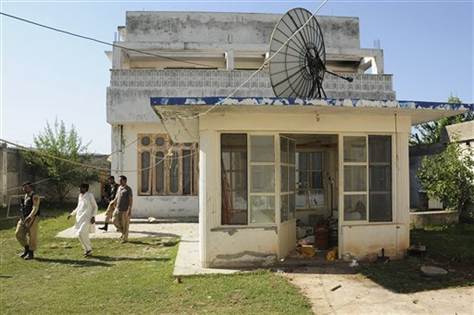
It’s an ornate but not lavish two-story house tucked away at the end of a mud clogged street. This is where Pakistan’s intelligence agency believes Osama bin Laden lived for nearly a year until he moved into the villa in which he was eventually killed.

The residence in the frontier town of Haripur was one of five safe houses used by the slain Al Qaeda leader while on the run in Pakistan according to information revealed by his youngest wife, who has been detained.

Retired Pakistani Brig. Shaukat Qadir, who has spent the last eight months tracking bin Laden’s movements, told The Associated Press that he was taken to the Haripur house last November by intelligence agents who located it from a description they got from Amal Ahmed Abdel-Fatah al-Sada.

Al-Sada, a 30-year-old Yemeni, has been in Pakistani custody since May 2 when US Navy SEALs overran the Abbottabad compound, killing bin Laden and four other people inside. Since then, Pakistan’s intelligence agency, known as the ISI, has been trying to uncover the trail that brought him to Abbottabad villa in the summer of 2005.

The best information appears to have come from al-Sada, who was believed to be his favorite and who traveled with bin Laden since his escape from Afghanistan’s eastern Tora Bora mountain range in 2001.

Qadir, a 35-year army veteran who is now a security consultant, was given rare access to transcripts of Pakistani intelligence’s interrogation of al-Sada and access to other documents on bin-Laden’s movements. He provided the AP with details in a recent interview.

The details of bin Laden’s life as a fugitive — which were first published by the Pakistani newspaper Dawn — raise fresh questions over how bin Laden was able to remain undetected for so long in Pakistan after the Sept. 11, 2001 attacks, despite being the subject of a massive international manhunt.

Yet a senior US official, who is familiar with the contents recovered in bin Laden’s Abbottabad house, said there was no evidence that Pakistani officials were aware of bin Laden’s presence. “There was no smoking gun. We didn’t find anything,” he said on condition of anonymity because he was not authorized to speak about the contents of the Abbottabad house

According to the interrogation report, bin Laden lived in five safe houses and fathered four children — the two youngest born in a public hospital in Abbotabad. But investigators have only located the houses in Abbottabad and Haripur.

Al-Sada’s descriptions of the homes have been vague and the Haripur house was found only after a series of hits and misses.

She knew only that it was located on the edge of Haripur, it was two stories and it had a basement. It apparently was used by bin Laden while he waited for construction crews to finish his new home Abbottabad, a garrison town just 20 miles away.

Investigators scoured the area looking for properties until they found the Haripur house in Naseem Town, a chaotic suburb where relatively affluent houses bump up against sun-baked mud huts that belong to nomadic Afghans.

Like the CIA, the Pakistani agency also tracked the movements of bin Laden’s Pakistani courier who used the pseudonym Abu Ahmed al-Kuwaiti and his brother. The two were ethnic Pashtuns from Pakistan’s Khyber Pukhtunkhwa province on the border with Afghanistan. They were bin Laden’s front men.

The ISI discovered that the Haripur house, like the land on which bin Laden’s Abbottabad villa was built, was rented by two Pashtun brothers claiming to be from Charsadda, a Pashtun dominated town about 80 miles away.

The AP located the Haripur house that Qadir said ISI agents had taken him to last November and found the real estate broker, Pir Mohammed, who rented the four-bedroom house to the two brothers, Salim and Javed Khan from Charsadda, for $150 a month.

At the time Pir Mohammed ran a small real estate firm called Mashallah. He said his meeting with the brothers was random.

“They must have seen my sign and come in,” Mohammed said, adding that he had met the brothers only three times — when they signed the contract, when they moved into the house, and when they moved out 11 months later.

Two months ago several ISI agents took all the records of the house and its tenants since its construction in 2000, said Qasi Anis Rahman, the brother of the widow who owns the house.

“All they said was that it was for ‘security purposes,'” said Rahman.

Al-Sada is currently in Pakistani custody, along with bin Laden’s two other wives and several children. They were arrested after the raid. The US Navy SEALs shot al-Sada in the leg during the operation.

Mohammed Amir Khalil, a lawyer for the three widows, said the women would be formally charged for illegally staying in Pakistan on April 2. That charge carries a maximum five-year prison sentence.

U.S. and Pakistan Take Step to Mend Relations

By Salman Masood and Declan Walsh for The New York Times

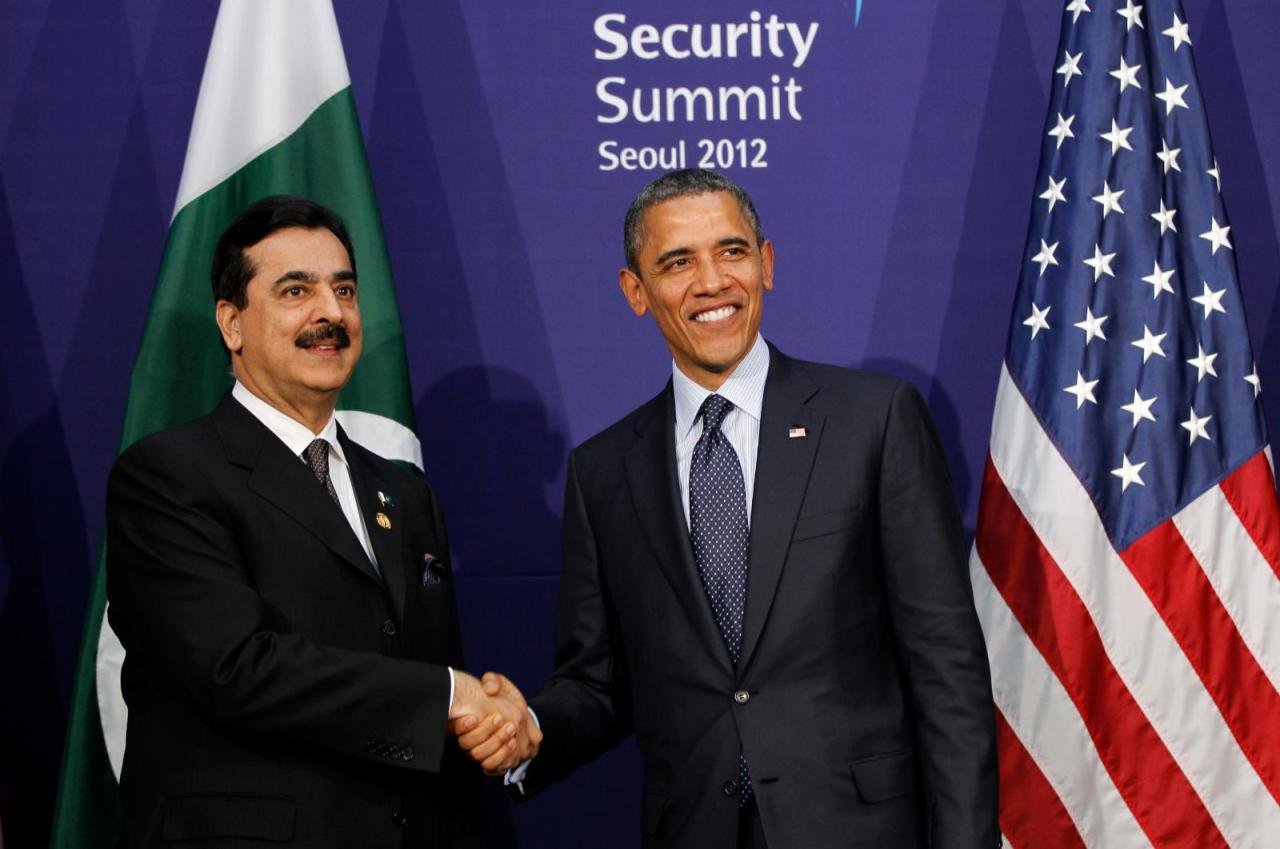
President Obama took a symbolic step toward improving ties with Pakistan on Tuesday when he met with Prime Minister Yousaf Raza Gilani on the sidelines of a nuclear summit meeting in South Korea.

But even as the two leaders made polite, if freighted, comments about improved cooperation, harsh debate in Pakistan’s Parliament on Tuesday made clear that there may be very little political upside for any Pakistani warming toward Washington.

Speaking in Seoul, President Obama acknowledged “strains” in the relationship and voiced his support for a parliamentary review process in Pakistan that aims to get the relationship back on its feet. “I think it’s important for us to get it right,” he said at a joint news conference.

But Mr. Obama added that Pakistan must also respect pressing American security concerns centered on “national security and our needs to battle terrorists who have targeted us in the past.”

Mr. Gilani replied that he would help work with Mr. Obama “to have all the peace, prosperity and progress of the whole world.”

Relations between the two countries plunged steeply after the American commando raid that killed Osama bin Laden last May, then worsened further after American warplanes fired airstrikes that killed 24 Pakistani soldiers along the border with Afghanistan in November.

The border strikes caused Pakistan to close NATO supply routes into Afghanistan and expel American officials from a remote air based used by the C.I.A. to launch drone strikes against militants from Al Qaeda and the Taliban in the northwestern Pakistani tribal belt. More recently, a Pakistani parliamentary committee on national security demanded an end to drone strikes and an unconditional American apology for the airstrikes.

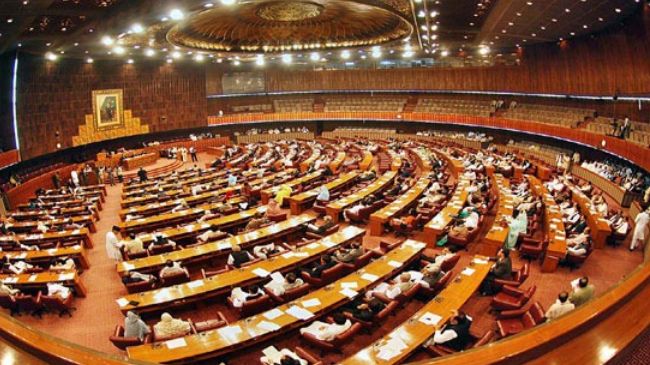
In Islamabad on Tuesday, Parliament was supposed to start a long-awaited debate that would pave the way toward re-engaging diplomatically with the United States. But the opposition stalled the debate, with some lawmakers expressing fury at news reports that the government had already promised to reopen the NATO supply lines.

Ayaz Amir, an influential lawmaker with the opposition Pakistan Muslim League-N party, questioned why Pakistan even bothered blocking the supply routes if it was assumed they would start right back up again. “We are fooling ourselves, and we are also fooling the Pakistani people,” he said.

The most scathing criticism came from Maulana Fazalur Rehman, an influential religious politician, who warned that if the government failed to win broad political backing for its review of American ties, he would take his protests onto the streets.

“We will not let such a decision to be implemented in the field,” he said.

Mr. Rehman asserted that given urgent efforts by the Americans to start negotiations with the Taliban in Afghanistan, American weapons transported through NATO supply lines could ultimately be turned back on Pakistan, earning loud applause from fellow lawmakers. And he asked how the government intended to bring covert American operations in Pakistan under the law of the land.

Raza Rabbani, a senior government lawmaker, responded that the parliamentary committee’s recommendations on American policy were “broad policy guidelines” and not a final decision.

The session was adjourned until Wednesday evening, when the formal debate is due to begin. Meanwhile, outside Parliament, a newly formed alliance of religious parties and extremist groups, the Defense of Pakistan Council, held a large street rally against the reopening of the supply routes.

“If Parliament compromises on the security and sovereignty of the country, then we cannot guarantee the security of the lawmakers,” said Maulana Sami ul-Haq, head of the alliance, as hundreds of protesters chanted anti-American slogans.

In wake of Trayvon Martin’s Death, America is Soul-searching

By Yamiche Alcindor, Marisol Bello and Larry Copeland to USA Today

Spurred by social media and community rallies, the shooting death of a 17-year-old Florida youth has become the latest flashpoint over how young black men are perceived in the United States.

Trayvon Martin’s death Feb. 26 at the hands of a Neighborhood Watch leader in this small, gated Florida community has rippled through many corners of the nation’s justice and political system and raised questions about the relationship between the black community and police in small towns.

In the past 48 hours, the case has:

•Sparked an investigation by the U.S. Department of Justice, the FBI and the Florida state attorney’s office.

Brought calls for changes in a Florida self-defense law that says a person being attacked has no duty to retreat and may return force;

Trayvon Martin was talking on his cell phone when he was shot and killed in February.
•Ignited protests, including a “Million Hoodie March” in New York City planned today, and a rally Thursday in Sanford led by civil rights activist Al Sharpton;

•Amassed more than 600,000 signatures in an online petition calling for charges to be filed against George Zimmerman, the Neighborhood Watch captain who said he shot Martin.

Zimmerman has not been arrested or charged with a crime.

The case has resonated for many who say Martin died because of stereotypes of young black men as violent criminals. The shooting is already being compared with high-profile and historic civil rights cases — for instance, a doctored photograph has circulated throughout many social media sites that compares Martin to Emmett Till, a young man lynched by white men in 1950s Mississippi.

“It’s not about these individual acts of racism,” said Mark Neal, a professor of African and African American Studies at Duke University. “It’s about the way that black males are framed in the larger culture … as being violent, criminal and threats to safety and property.”

The tragic case played out in Sanford, population 54,000, about 30 minutes north of Orlando, when Martin left his father’s home to buy candy and iced tea for his little brother at a nearby 7-Eleven.

He was on his way back in the rain when Zimmerman, 28, spotted him. Zimmerman was armed as he patroled the area in his car in response to several break-ins in the community.

Zimmerman called 911 to report a suspicious person, according to the call released by Sanford emergency dispatch. Against the advice of the 911 dispatcher, Zimmerman followed Martin, according to the 911 recording.

The two men fought and Trayvon Martin was left dead. Zimmerman told the Sanford police that he shot the teen in self-defense because he was fearful for his life. The police have said there is no evidence to contradict Zimmerman’s claims. Police say Zimmerman was bleeding from his nose and the back of his head.

Zimmerman has not spoken publicly. In a statement, his father, Robert, said, “The portrayal of George Zimmerman in the media, as well as the series of events that led to the tragic shooting are false and extremely misleading. … George is a Spanish-speaking minority with many black family members and friends. He would be the last to discriminate for any reason whatsoever.”

The fatal shooting touched a chord of community outrage in Sanford on Tuesday night. The killing was “a senseless murder as far as we are concerned,” Seminole County NAACP President Clayton Turner told a capacity crowd at the start of a town-hall-style meeting at Allen Chapel AME Church.

Clayton said the Sanford city manager and mayor were unable to attend because they had been “summoned” to Washington by Attorney General Eric Holder.

“The line has been drawn in the sand,” Clayton said. “We as people of color are going to stand our ground. We are going to do it in a non-violent way, and we are going to prevail.”

Before his son’s death, Tracy Martin warned son Trayvon that being a black man in America could be dangerous.

“I’ve always let him know we as African Americans get stereotyped,” Tracy Martin told USA TODAY. “I told him that society is cruel.”

Those warning messages have echoed in Tracy Martin’s head since his son died.

Martin family attorney Benjamin Crump said Tuesday that the young man was on the phone with his girlfriend when Zimmerman followed and approached him. He said the 16-year-old girl told a harrowing story that he says shows Martin did not attack Zimmerman.

The girl, whose family asked the attorney not to reveal her identity, told Crump that she and Martin were talking on the phone when he left the store, a bag of Skittles in his pocket. Crump said as Martin walked home, he told the girl, “This dude is following me.”

Crump said the girl told him that she told Martin to run. Martin ran, which coincided with Zimmerman’s comments to 911 in which he said the suspicious man was running, Crump said.

“Then she hears (Martin) say, ‘Why are you following me?’ and another voice say, ‘What are you doing in the neighborhood?’ ” Crump said.

Police actions questioned

The girl told Crump she then thought she could hear Trayvon was pushed and she heard a brief altercation, then the line went dead.

“This claim that Trayvon Martin was the aggressor is preposterous,” the attorney said.

Crump has questioned Sanford police actions after the shooting, noting that police did not run a blood-alcohol test or a background check on Zimmerman, but they ran both on Martin after he died. He said police took Zimmerman’s word without conducting a thorough investigation.

Tracy Martin says he wants Zimmerman arrested and tried in court.

“My child was profiled,” the father said. “He was stereotyped. We aren’t letting our son die in vain.”

The decision not to arrest Zimmerman was made by the responding officer who released the gunman after he claimed to have acted in self-defense, Sanford officials said Tuesday.

It was only after a growing public outcry expressing a lack of confidence in the police department’s actions that city leaders called on the Justice Department to review the shooting, City Manager Norton Bonaparte and Mayor Jeff Triplett said.

“We have a lot of strife in our community right now,” Triplett said at a Capitol Hill briefing where he and Bonaparte appeared with Rep. Corrine Brown, a Florida Democrat. “If we’ve made an error, I want someone to tell me. There will be no stone that won’t be overturned.”

Triplett said the Justice investigation would review all aspects of the case, including the police response and the decision not to arrest Zimmerman.

Bonaparte acknowledged Zimmerman was part of a network of local Neighborhood Watch groups trained by the Sanford Police Department and urged “not to engage” possible suspects or people they encounter. Brown said she was “not satisfied” with the initial handling of the case, agreeing that Zimmerman was not tested for possible substance abuse immediately after the incident and lamenting that proper steps were not taken to preserve possible evidence at the scene.

“People need to feel that the system is fair,” Brown said. “It just wasn’t handled right.”

In conversations with the Sanford police chief, Triplett said he believes the Florida law known as the “stand your ground” statute, which provides a broader interpretation of self-defense, played a role in the decision not to arrest and charge Zimmerman.

The law allows the use of force if the person “reasonably believes” it is necessary to protect the person’s own life, or the life of another or to prevent a forcible felony.

In the wake of Martin’s death, the law is getting a second look. State Sen. Oscar Braynon, who represents Miami Gardens where the teen lived with his mother, called for hearings or a select committee to clarify what constitutes self-defense under the law. He said that since the law was enacted in 2005, the number of justified homicides in the state has skyrocketed. In 2005, there were 43 such cases; in 2009, the last complete year available, there were 105, Braynon said.

“I think there is vigilante justice happening and I think people are getting shot,” he said. “This is an unintended consequence of the law.”

Social media’s role

Public activism has played a pivotal role in bringing national attention to the case and ultimately leading to a top-to-bottom review of what happened that day. A wellspring of social media grew by the day and became relentless, demanding that the spotlight return to Sanford. It’s the only way to galvanize people in such cases, says Neal, the Duke professor.

“If folks aren’t on Twitter tweeting stories and giving particular testimonies; if you don’t have artists doing videos on YouTube talking about what Trayvon might have experienced … I don’t think we get a moment where suddenly the Justice Department is saying we need to investigate this case,” Neal says.

Change.org spokeswoman Brianna Cayo Cotter said the petition calling for prosecution of Zimmerman was drawing the second-highest amount of traffic to the site since a petition was launched for Kyleigh’s Law, a measure passed in New Jersey in 2010 that requires drivers younger than 18 with permits or probationary licenses to display special decals on their vehicles. Kyleigh D’Alessio was 16 when she died in a 2006 car crash.

“We are seeing unprecedented traffic on our website,” Cayo Cotter said.

The attention is also focusing on the town of Sanford, which has a history of racial tensions.

“This case more than anything reminds me of Jena — of a small Southern town that played by its own rules,” Sharpton said. “Sanford authorities thought they could contain it. … Once it becomes national, they can’t contain and control the story and the outcome.”

The Jena 6 were black teens initially charged in 2006 with attempted murder for beating a white schoolmate in the town of Jena, La. After a national outcry, community rallies and online petitions, the charges were reduced.

Theo Shaw, 23, one of the Jena 6 who is preparing to attend law school in the fall, says, “This is another incident in which there is a presumption that a young black man has been guilty of something.”

Contributing: Melanie Eversley in New York; Kevin Johnson in Washington; Carolyn Pesce in McLean, Va.; Associated Press

Pakistani Panel Demands End to US Drone Attacks, Apology for NATO Air Strike

As Reported By The Voice Of America

A Pakistani parliamentary committee — tasked with laying out new terms of engagement with the United States and NATO — on Tuesday demanded an end to U.S. drone strikes and an apology from Washington for a NATO strike last year that mistakenly killed 24 Pakistani troops.

The report, read to a joint session of both houses of parliament by committee chairman Mian Raza Rabbani, calls on the United States to review its activities and cease all drone attacks inside Pakistan.

Rabbani said that “drone strikes are counterproductive, cause loss of valuable lives and property, radicalize the local population, create support for terrorists and fuel anti-American sentiments.”

U.S. lawmakers, however, are rejecting those calls. Independent Senator Joe Lieberman told VOA the drone strikes are critically important to America’s national security, adding he does not believe they should stop.

Democratic Senator Dianne Feinstein, chairwoman of the Senate Intelligence Committee, said the drones are needed due to the lack of a more aggressive effort by Pakistan to root out terrorists and radical militants along its border with Afghanistan.

Republican Senator Lindsey Graham said that although sovereignty is a big issue for any country, he would like to see Pakistan embrace the idea that extremism has no welcome home in Pakistan. He said drone strikes have been effective and that, in his words, “it is not in Pakistan’s long-term interest to be seen by the world-at-large as a safe haven for terrorists.”

Rabbani also demanded an unconditional U.S. apology for the NATO airstrike in November that killed the 24 Pakistani soldiers. He said “the condemnable and unprovoked NATO/ISAF attack” represents “a breach of international law and constitutes a blatant violation of Pakistan’s sovereignty and territorial integrity.”

Washington has expressed regret for the loss of life and accepted partial responsibility for the airstrike, but has so far refused to apologize, saying NATO forces acted in self-defense.

Pakistani lawmakers are expected to eventually approve the panel’s recommendations. But, ultimately, Pakistan’s government and powerful army have the final say in the U.S.-Pakistani relationship.

U.S. State Department spokeswoman Victoria Nuland Tuesday said she would not comment on the issue until the process is completed.
Pakistani Foreign Minister Hina Rabbani Khar told reporters outside of Parliament that Pakistan needs to balance good diplomatic relations with its own interests.

Afghan Village Massacre Will Compound US Problem

By Amin Saikal for The Sydney Morning Herald

US forces are stumbling from one disaster to another in Afghanistan. The latest is the killing of at least 16 Afghan civilians by an American soldier in Kandahar province, the spiritual seat of the Taliban.

It comes shortly after the American burning of copies of the Koran that set off a week of riots across Afghanistan in which some 30 Afghans were killed. This latest incident is set to heighten anti-American sentiment in the country, with serious repercussions for the international forces and their Afghan partners.

President Barack Obama and the commander of the International Security Assistance Force, General John Allen, have profusely apologised and promised an immediate investigation. The perpetrator is described as a rogue soldier, who recently had a nervous breakdown. This is unlikely to placate many Afghans, especially in the ethnic Pashtun-dominated areas of southern and eastern Afghanistan, where the Taliban-led insurgency is at its peak. Nor will it deter the Taliban from capitalising on the incident to once again castigate the US and its allies as infidel occupiers, and the Karzai government as their stooge.

It is also bound to add to the complexity of the new strategic partnership that Washington and Kabul are currently negotiating to establish the parameters for US military-security involvement in Afghanistan after the US and its allies have withdrawn most of their troops from Afghanistan by 2014. While Karzai will find it expedient to become more demanding in the negotiations to show that he is not an American lackey, the Obama administration may need to make more concessions to Karzai, despite the fact that he has proved to be an incompetent and untrustworthy partner, who has continued to preside over a corrupt and dysfunctional government for more than a decade.

Rogue actions in conflicts are not unusual. There were many during the Vietnam War and the Soviet occupation of Afghanistan. The present US-led military involvement in Afghanistan has not been free of them either. An American soldier has just been convicted of premeditated murder of three Afghans two years ago.

American and ISAF troops have also been killed by rogue Afghan soldiers for one reason or another. However, what makes the latest incident alarming is that it has been enacted by a soldier who had a nervous breakdown, and yet was still on duty. He committed a massacre in a zone of insurgency where the Taliban had not been active for six months. Inhabitants across the region now will become more receptive to the Taliban than ever before.

All this does not augur well for a smooth withdrawal of foreign troops from Afghanistan, and the current efforts by Washington, and, for that matter, the Karzai government, to reach a political settlement with the Taliban as part of the US-led NATO exit strategy. As the anti-US and anti-Karzai government feelings escalate, the more they will play into the hands of the Taliban and their supporters, most importantly Pakistan’s notorious military intelligence, ISI, to drive a hard bargain. The Taliban and ISI have never found the situation more conducive to their belief that the final victory is ultimately theirs. All they now need to do is await the substantial drawdown of foreign troops and further ineffectiveness and humiliation of the Karzai government. As one Taliban commander joked: ”We have the time and the Americans have the watch.”

It is most unfortunate that after some $450 billion in military expenditure, more than $60 billion in reconstruction costs, and 3000 foreign troops, mostly American, killed, and thousands of Afghans sacrificed, stability, security and good governance still elude most Afghans. The biggest question that will confront the US and its allies by 2014 is: what was that all about?

If it was for the purpose of destroying al-Qaeda and its harbourers, the Taliban, this objective has not been achieved. Osama bin Laden is dead, as are many of his ranking operatives, but the network remains operative, especially in Pakistan, Iraq, Yemen, and Somalia. As for the Taliban, the US now wants to negotiate a political deal with the militia.

If it was for rebuilding and securing Afghanistan, this goal is nowhere near fruition. The country continues to teeter on the verge of the return of the Taliban to power and civil war, with the prospects of Afghanistan’s neighbours intensifying their scramble for influence.

Amin Saikal is professor of political science and director of the Centre for Arab and Islamic Studies at the Australian National University and the author of Modern Afghanistan.

Islam & the NYPD

By Dr Qanta A Ahmed for NY Post

The relentless campaign to paint the NYPD as Islamophobic is itself an offense to Islam. In fact, our faith compels American Muslims to stand with the NYPD — both to protect the faith, and by its direct dictates.

Let me be clear: By investigating Islamist sympathizers who seek to curtail the freedoms of all Americans, the NYPD is aggressively protecting the freedoms and privileges that Muslims enjoy in America (freedoms that aren’t available even in the birthplace of Islam).

Islamism is distinct from the beliefs the majority of Islam’s 1.6 billion followers hold dear. The cry of “Islamophobia” is often merely an effort to silence those of us who seek to communicate this distinction, or to express concerns about Islamism. Most Muslims are spiritually private, committed persons active in their societies without a subversive political agenda. Think of them as pluralistic Muslims.

Because America’s religious freedom is protected by constitutional ideals, Muslims can pursue this pluralistic life — an American life that makes private space for faith, in parallel to public roles. Indeed, Muslims in America are freer to do this than Muslims in Pakistan (where my family is from), Saudi Arabia (where I have lived) or even Indonesia, because each of these Muslim-majority countries imposes laws restricting the practice of religion.

In many ways, Muslims are best able to follow their Islam — to become Muslim in the fullest sense — here in America, because of this nation’s astonishing, constitutionally guaranteed freedoms.

Political Islamism — variously called radical Islam, jihadism or Islamic fundamentalism — is completely different. In contrast to our centuries-old faith, it’s a modern political project that seeks to return any society to a supposed “scriptural foundation” of the Muslim community, removing existing forms of government and laws.

Sound like a war? Well, in the wider world and here in America, there is indeed a war afoot — a war of ideas, a “Battle for the Soul of Islam,” as my colleague, American Islamic Forum for Democracy president Zudhi Jasser, has termed it.

In this battle, the Islamist thrives — citing freedom of speech, claiming disadvantaged civil rights, exploiting the privileges that a liberal democracy accords him. Often operating via advocacy groups or “Islamic societies” that purport to represent mainstream Muslims, he or she truly serves a political agenda centered on replacing liberal democracy with fundamentalist theocracy.

In fact, the Koran is explicit on the loyalties a Muslim must accord his host nation, mandating a Muslim’s duty to be an unwavering and loyal patriot:
O ye who believe! Obey Allah, and obey His Messenger and those who are in authority from among you. (Ch.4: V.60).

That verse demands the Muslim express loyalty to any ruling authority. This isn’t a suggestion, this is mandated Islamic duty.
The Koran does not state leadership specified as Muslim. Leadership is whomsoever is empowered in the society where the Muslim finds himself. For us here, that includes loyalty to the NYPD, the FBI and their work to safeguard our highest authority — the principles of our liberal democracy.
Can any one group speak for the entire American Muslim community? Islam is diverse — especially in America. Islamism isn’t. The sooner we understand this, the better — because at stake are America’s ideals.

America’s extraordinary freedoms afford us an ability to define our own expressions of Islam as Muslims in a way that no Muslim-majority nation secures for any Muslim anywhere today. We must preserve these values, and join the NYPD, in understanding the Islamist threat to these values.
This means we must support, not vilify, our policemen and -women, our federal agents and our police commissioner — especially when they gather and interpret information they need to preserve us and our values.

How many devout Muslims were among the thousands killed on 9/11? Let us never forget that Islamists — moving among the broader Muslim and secular communities — have wrought atrocities in this city and around the world, and seek to do so again.
If you choose to smear the NYPD for its work to protect us and our society, so too you choose to smear me, a pluralistic patriotic Muslim in America, for demanding an honest discourse.

Dr. Qanta Ahmed practices medicine in New York. She is the author of “In the Land of Invisible Women.”
Twitter: @MissDiagnosis

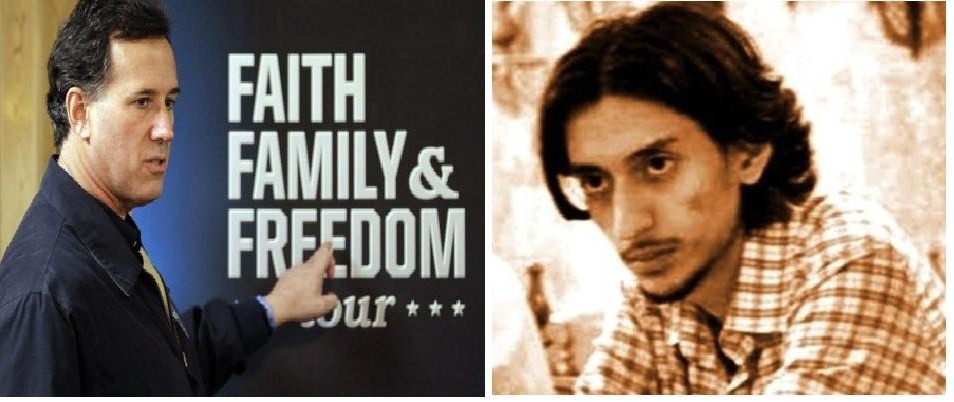
Rick Santorum, Meet Hamza Kashgari

By George Packer for The New Yorker

President Kennedy’s 1960 speech on religious freedom makes Rick Santorum “throw up.” “What kind of country do we live in that says only people of nonfaith can come into the public square and make their case?” Santorum says. It’s a central part of his campaign strategy to distort such things as a Kennedy speech, or an Obama speech, to whip up outrage at the supposed war on religious people in America. Here’s what Kennedy said:

I believe in an America where the separation of church and state is absolute; where no Catholic prelate would tell the President—should he be Catholic—how to act, and no Protestant minister would tell his parishioners for whom to vote; where no church or church school is granted any public funds or political preference, and where no man is denied public office merely because his religion differs from the President who might appoint him, or the people who might elect him… I believe in a President whose religious views are his own private affair.

Kennedy said much more, but this is the strongest passage of that famous campaign speech to a group of ministers in Houston, in which he argued that the election of a Catholic President who believed in the Constitution shouldn’t concern any American who believed in the Constitution—and, Santorum says, “That makes me throw up.” Santorum’s rhetorical eloquence is about equal to his analytical skill. Kennedy had nothing to say against believers entering public life, or believers bringing their religious conscience to bear on public policy. He spoke against any move to make religion official. The Constitution speaks against this, too—Article VI establishes an oath to the Constitution as the basis for public office, and explicitly prohibits a religious test, while the First Amendment forbids the official establishment of religion and protects its free practice. Santorum claims to be a constitutionalist, but that’s just rhetoric and opportunism. Santorum believes in a religious test—that may be all he believes in. (Mitt Romney believes in a religious test of a slimy, halfway, Romneyesque variety: in 2007, he reportedly dismissed the idea of appointing a Muslim to his Cabinet, saying, “Based on the numbers of American Muslims [as a percentage] in our population, I cannot see that a Cabinet position would be justified.” So does Newt Gingrich, who has made atheist-baiting a central part of his political business.)

Kennedy seemed to have someone like Santorum in mind when he warned, “For while this year it may be a Catholic against whom the finger of suspicion is pointed, in other years it has been—and may someday be again—a Jew, or a Quaker, or a Unitarian, or a Baptist. It was Virginia’s harassment of Baptist preachers, for example, that led to Jefferson’s statute of religious freedom. Today, I may be the victim, but tomorrow it may be you—until the whole fabric of our harmonious society is ripped apart at a time of great national peril.” In 1960, it would have been hard to imagine how thoroughly religious sectarianism and intolerance would infect American politics, and especially one major party. The outcry over Obama’s policy on health insurance and contraception has almost nothing to do with that part of the First Amendment about the right to free religious practice, which is under no threat in this country. It is all about a modern conservative Kulturkampf that will not accept the other part of the religion clause, which prohibits any official religion.

Santorum, like most conservatives these days, says he is a constitutionalist. Jefferson wrote, and Madison worked to pass, the Commonwealth of Virginia’s Bill for Establishing Religious Freedom, which held that “all men shall be free to profess, and by argument to maintain, their opinions in matters of religion, and that the same shall in no wise diminish, enlarge, or affect their civil capacities.” Jefferson included an even stronger phrase that was eventually struck out by amendment: “the opinions of men are not the object of civil government, nor under its jurisdiction.” Presumably, all of this originalist nonsense makes Rick Santorum heave, gag, vomit, and puke.

What makes me throw up is the story of Hamza Kashgari. It’s a shame that every American doesn’t know his name. He’s a young, slender, philosophical-minded columnist and blogger from Saudi Arabia who, earlier this month, dared to tweet phrases of an imagined conversation with the Prophet Mohammad: “I have loved things about you and I have hated things about you and there is a lot I don’t understand about you…I loved the rebel in you…I will not pray for you.” Within twenty-four hours, more than thirty thousand furious replies had been posted on Twitter. Within a few days, more than twenty thousand people had signed on to a Facebook page called “Saudi People Want Punishment for Hamza Kashgari.” (So much for Arab liberation by social media.) One commenter wrote, “The only choice is for Kashgari to be killed and crucified in order to be a lesson to other secularists.”

Kashgari backed down, apologized profusely, and continued to be attacked. He went into hiding. Clerics and government officials threatened him with execution for blasphemy. He fled to Malaysia, hoping to continue to fly to New Zealand, where he would ask for asylum. But Malaysian officials, behaving against law and decency, had him detained at the airport and sent back to Saudi Arabia, where he was promptly arrested. Since mid-February there’s been no word of Kashgari. The Saudis have said they will put him on trial. What a pity there’s no First Amendment to protect him.
If only he had more powerful friends—if only Christopher Hitchens were still alive—Hamza Kashgari would be called the Saudi Rushdie. There would be a worldwide campaign to pressure the Saudis into releasing him. The United States would offer him asylum and quietly push our friends the Saudis into letting him go. But we’ve come to expect these things from our friends the Saudis.

We’ve come to expect these things from the Muslim world. We expect Afghans to riot for days and kill Americans and each other because a few NATO soldiers were stupid enough to burn copies of the Koran along with other objects discarded from a prison outside Kabul. Yes, those soldiers were colossally, destructively insensitive. Yes, we should know by now. Yes, the reaction has a lot to do with ten years of war and occupation and civilian deaths and marines urinating on Taliban corpses. Still, can we have a little outrage at the outrage? Can we reaffirm that human lives are more sacred than books? Can we point out that every time something like this happens, there’s a manufactured and whipped-up quality to much of the hysteria, which has its own cold political calculation (not unlike the jihad against secularists by Sean Hannity and other Salafist mouthpieces)?

Saudi Arabia needs an absolute separation of religion and state so that Hamza Kashgari can say things that other people don’t like without having to flee for his life. Afghanistan needs it, too, and so does Pakistan, so that mob violence and political assassination can’t enjoy the encouragement of religious authorities and the tolerance or acquiescence of government officials. And America needs it so that our Presidents’ religious views remain their own private affairs, and Rick Santorum and his party can’t impose dominion of one narrow, sectarian, Bible-based idea of the public good over a vast, pluralist, heterodox, freedom-loving democracy.

“Saving Face” Pakistan’s first Academy Award Nomination

By Mudassar Ali Khan for The Washington Times

On 26th February 2012, the world will discover three different faces of Pakistan during the 84th Academy Awards, with the nomination of a Pakistani documentary ‘Saving Face’ for the best documentary (short subject).

The first face is the Pakistani filmmaker who is contending for the Oscar, the second is the internationally acclaimed British-Pakistani plastic surgeon who traveled to his motherland to heal victims of acid attacks, and last but not the least is of the heroic survivors of acid attacks who are struggling to deal with the consequences of their disfigurement.

‘Saving Face’ tells the story of a British-Pakistani plastic surgeon, Dr. Muhammad Jawad, who traveled to Pakistan to treat acid attack victims. Jawad has made several trips to Pakistan with surgical teams to work with the victims. He also organized a major medical relief effort to help earthquake survivors in Pakistan in 2005. In 2008, he received widespread public and international media attention when he performed his pioneering treatment on British model and television presenter Katie Piper, whose ex-boyfriend threw acid on her face.

Central characters of this documentary are two women, Zakia and Rukhsana, from southern Punjab who survived acid attacks and have been fighting for justice ever since. Instead of only portraying the misery of the victims, the film focuses on the vigor with which they endure the process of emotional and physical healing.

Sharmeen Obaid-Chinoy is the first Pakistani filmmaker to win an Oscar nomination for co-directing this film with Daniel Junge. Obaid-Chinoy previously won an Emmy award for her film Pakistan’s Taliban Generation. This film was also the recipient of the Alfred Dupont Award and the Association for International Broadcasting Award. Obaid-Chinoy is the first non-American to receive the Livingston Award for best international reporting. In 2007, she received the broadcast journalist of the year award in the UK from One World Media for her work in a series of documentary films. For her work on other films, she also received the Overseas Press Club Award, the American Women in Radio and Television Award, the Cine Golden Eagle Award and the Banff Rockie Award.

Above all, this documentary, along with its accolades, is truly a testimony of the devotion and fervor with which Sharmeen, Dr. Jawad, Zakia and Rukhsana are pursuing their individual goals. Saving Face brings together the hard work and creativity of an ambitious documentarian, the dedication of a passionate doctor, and determination of valiant victims of acid attacks.

The film also emerges as a face-saver for Pakistan, amid growing negative perceptions about the country worldwide.

The Oscar nod for Saving Face recognizes of a Pakistani filmmaker and sends message to all the ambitious Pakistanis and the world that hard work pays off, no matter where you live and your passion to prevail over the crisis can take you places whether you are a filmmaker, a doctor or a survivor.

Welcome To The First Annual Celebrity Religion Swap

By Wajahat Ali for Salon.com

Muslims worldwide groaned upon hearing the news that Oliver Stone’s son, Sean, converted to Islam while filming a documentary in Iran.

Although we — the collective 1.5 billion Muslims worldwide — assume Sean Stone is a fine, upstanding man and sincerely wish him spiritual contentment, we earnestly ask Allah why Islam only attracts controversial celebs (in this case, the son of a controversial celeb) who further tarnish our already toxic brand name?

We plead to the heavens for an answer as to why he converted in Iran, of all places, which is currently the most feared and loathed country in America and about as popular as herpes.

We have patiently endured, oh, Allah.

We miraculously survived Mike Tyson, who converted to Islam while incarcerated, and then angrily threatened Lennox Lewis in an infamous interview: “I want your heart. I will eat his children. Praise be to Allah.”

Awesome.

Islam has the lowest favorability rating of any religion in America. If Islam were a world economy, it would be Greece. If it were a professional athlete, it would be San Francisco 49ers punt returner Kyle Williams, who muffed two critical punts, which helped the New York Giants reach the Super Bowl. If Islam went to the prom, it would be the ugly girl with freckles and an overbite standing in the corner with a bucket of pig’s blood teetering precariously over its head. If Islam were a Republican presidential candidate, it would be Newt Gingrich.

A diverse jirga of American Muslim leaders decided “enough was enough” and held an emergency meeting at Lowes’ Home Improvement store in Dearborn, Mich., to strategize how to bolster Islam’s faltering image.

A consensus emerged that we needed to draft popular, mainstream celebrities whose successful addition to our starting lineup would boost our international brand name. After all, 1,400 years of civilization and the religious practices of 1.5 billion solely rest on the tanned shoulders of the rich, famous and beautiful.

Inspired by comedian Dave Chappelle, one of the few Muslim converts who could be considered a net gain, the Muslims held a “Religious Draft” this week, inviting major religions to participate on hallowed ground: McDonald’s.

The following is a summary of the proceedings.

THE FIRST ROUND PICK

Since it was universally accepted Islam was the 2011 Indianapolis Colts of world religions, they had first pick.

Predictably, the Muslims drafted free agent Liam Neeson, who recently said, “There are 4,000 mosques in [Istanbul]. Some are just stunning and it really makes me think about becoming a Muslim.” The Irish actor is experiencing a pop cultural rebirth as the 21st century embodiment of uncompromising, kick-ass masculinity and sage paternalism. On behalf of Muslims, he took revenge against France, which recently caved into hysteria and banned the burqa. Neeson single-handedly destroyed the entire country with his bare fists in the blockbuster action film “Taken.” Muslims believe Neeson will help rebrand them as Jedi Knights, due to his portrayal of Jedi Qui-Gon in “Star Wars: The Phantom Menace,” and replace their current image as Dark Lords of the Sith.

Rumors circulated that many Evangelical Christians felt slighted by this pick since Muslims stole their digital Avatar of Jesus: Neeson voices “Aslan the Lion” from the “Narnia” movies.

The rest of the day’s picks were organized according to different types of celebrity.

ATHLETES

In a surprise move, the Buddhists requested Mike Tyson from the Muslims. Exhausted from voluntarily suffering for the past 2,500 years, the Buddhists decided Tyson’s crushing right uppercut could “really eff up China.”

In turn, the Buddhists decided to offer the Beastie Boys — the aging, versatile, hip-hop trio from Brooklyn – sensing they peaked with their 1998 “Hello Nasty” album. The Muslims accepted, acknowledging the songs “Sabotage” and “Shake Your Rump” as perennial favorites in Egypt and Lebanon.

The Buddhists selflessly threw in Richard Gere and DVD copies of “American Gigolo” to sweeten the deal.

The Jews intervened and said they wanted the Beastie Boys back on their team. They offered the Muslims Ben Roethlisberger, two-time Super Bowl champion quarterback of the Pittsburgh Steelers. Having read about Big Ben’s dubious history of sexual impropriety, the Muslims passed, but decided to donate Mike D of the Beastie Boys to the Jews as a truce offering. Allegedly, the Muslims could never forgive Mike D for the horribly weak rhyme “Everybody rappin’ like it’s a commercial, acting like life is a big commercial” on the song “Pass the Mic.”

The Jews accepted the offer.

The Muslims, feeling emboldened, made an ambitious pitch to the Christians for Denver Broncos quarterback Tim Tebow, who “just wins.”

Muslims offered former NBA all-star Shaquille O’Neal, who fell from their graces after he acted as a giant genie in the box-office bomb “Kazaam.” They also threw in Mahmoud Abdul-Rauf, the controversial Denver Nuggets star who converted to Islam and refused to stand for “The Star-Spangled Banner” before games. The Christians were initially enticed, seeing this as a perfect “born-again” moment, but they passed.

The Muslims went aggressive and promised they wouldn’t supplant the Constitution with Shariah and replace the White House with minarets unless Tebow and Mel Gibson crossed over.

The Christians, anxious to excommunicate Gibson, agreed. For the 2012 NFL season, Tebowing will now consist of prostrating and praising Allah after every touchdown. The Christians asked the Muslims to preserve Tebow’s chastity and not introduce him to Miss USA Rima Fakih or hot Arab women from the reality TV show “All-American Muslim”; the Muslims said they’d try, but they promised nothing.

COMEDIANS

The Jews made a play for comedian Dave Chappelle, a Muslim, citing his hit series on Comedy Central “Chappelle’s Show” as a creative juggernaut that still influences the masses — especially several rabbis, who apparently love saying, “I’m Rick James, bitch!” after performing circumcisions.

The Muslims immediately rejected the offer, saying Chappelle is perhaps the only living proof that Muslims can be intentionally funny.

Instead, they offered Iranian President Mahmoud Ahmadinejad as an example of an unintentional comedian and provocateur in exchange for Israel cooling down its dangerous rhetoric of a preemptive strike on Iran.

Furthermore, the Muslims offered the newly acquired Mel Gibson straight up for Jerry Seinfeld.

The Mormons tried to intercept Seinfeld by playing one of their highest cards: “Napoleon Dynamite” actor Jon Heder. The Jews pretended not to hear this mockery and allowed the Mormons to slink away with some shred of remaining dignity.

The Jews finalized a deal with the Muslims and rumors have circulated since that Mel and Ahmadinejad are under house arrest in Tel Aviv, forced to watch “The Chosen” and “Fiddler on the Roof” on repeat while listening to Jerry Lewis perform comedy.

MUSICIANS

Sensing friendly relations, the Jews humbly approached the Muslims for rapper Ice Cube, citing his immense street cred and respect from the hip-hop and African-American communities. The Jews conceded the Matisyahu experiment, although initially promising, had failed, as the Hasidic reggae rapper never lived up to his “King Without a Crown” potential.

The Muslims mulled it over for a considerable time. The jirga decided they would retain eternal rights to Cube’s 1993 hit single “It Was a Good Day” from his multi-platinum album “Predator,” but ultimately release him because he inexplicably starred in the awful family comedy “Are We There Yet?”

Muslims in return asked the Jews for Kabbalah-worshipping Madonna, sensing serious comeback potential after her excellent Super Bowl halftime show.

Catholics made a request for multi-talented actor and hip-hop artist Mos Def from the Muslims, who soundly rejected any and all future offers, stating the entirety of the Middle East and North Africa could never bear to part with Def’s song “Ms. Fat Booty.”

Instead, Muslims counter-offered with alternative rock artist Everlast, whose 1998 single “What It’s Like” has made a surprising comeback on radio stations due to the economic recession. The Catholics still remember Everlast as the lead singer of the hip-hop band House of Pain, who produced the classic party anthem “Jump Around,” before his conversion to Islam. The Catholics accepted; South Asian Muslims danced to “Jump Around” one last time; and the Muslims in return received Taylor Swift and her legions of pubescent female fans, along with her former boyfriend Taylor Lautner, who played the ethnic werewolf in the “Twilight” movies.

The Muslims had finally secured their most promising young-adult celebrity.

POLITICIANS

The Mormons halfheartedly offered Mitt Romney. The Evangelicals promised Michele Bachmann and her lifetime supply of blinks. The Catholics, out of sheer desperation and embarrassment, bartered Newt Gingrich and his third wife, Callista.

The Muslims decided to stick with their boy, Barack Hussein Obama, in hopes of retaining the White House in 2012.

MISCELLANEOUS

Muslims threw a Hail Mary and asked fundamentalist Christians for Chuck Norris, who so thoroughly kicked the Middle East’s entire ass during the ’80s. The Muslims respected Norris for his ability to fire an Uzi, perform a roundhouse kick and wave an American flag at the same time. In return, Muslims offered the infamous WWF wrestler the Iron Sheikh and even agreed to teach the Christians the impregnable camel clutch. Norris, humbled by the offer, respectfully declined, and admitted that although he enjoyed killing hordes of fictional Arabs in jingoistic action movies like “Delta Force,” he currently fancied himself an intellectual and activist committed to exposing the nonexistent threat of Shariah infiltrating America. The Muslims were saddened, but collectively agreed to watch Norris in the summer action film “Expendables 2.”

The Hindus decided to play their strongest card, actress Julia Roberts, and made a request for journalist Lauren Booth, former British Prime Minister Tony Blair’s sister in law, who converted to Islam in 2010. The Hindus saw her as the perfect revenge and giant, henna-painted middle finger to England for the British Empire’s previous colonization and exploitation of India’s resources. The Muslims thought this was reasonable and now the “Pretty Woman” flashes her million-dollar smile behind a burqa.

THE CHOSEN ONE

Finally, the draft ended with all the religions coveting “the chosen one,” who would single-handedly redeem their public image both at home and abroad.

The Mormons offered former Republican presidential candidate Jon Huntsman, highlighting his excellent Chinese and fine hair. The Muslims initially offered NBA Hall of Famer and current cultural ambassador Kareem Abdul Jabbar. They sweetened the deal and threw in President Obama. The Jews presented Steven Spielberg and his entire film library. The Hindus humbly offered Bollywood actors Amitabh Bachan, Aishwarya Rai and a picture of Gandhi signed by Ben Kingsley. The Buddhists presented Tina Turner, Herbie Hancock and Tiger Woods.

But, it was sadly to no avail.

The Christians and Church of New York decided to keep NBA superstar and New York Knicks point guard Jeremy Lin. Rumors circulated that they were talking to China about a potential trade to ensure the ambitious superpower does not ask the United States to repay its debt, thus financially crippling and utterly destroying our great nation.

All in all, “it was a good day” for the Muslims in the first Religious Draft.

Wajahat Ali is a playwright, attorney, journalist and essayist. His award winning play”The Domestic Crusaders,” was published by McSweeney’s in 2011. He is the lead author of “Fear Inc., Roots of the Islamophobia Network in America.” He is currently writing a pilot for HBO. He is co-editing the anthology “All American: 45 American Men on Being Muslim” published in June 2012. More Wajahat Ali

Pakistan’s Sesame Street: Can an Urdu Elmo Aid a Blighted Nation?

By Aryn Baker for Time

For a 3-year-old who has yet to master the use of the personal pronoun, Elmo is a whiz at foreign languages. Already fluent in Chinese, German, Hindi, Spanish and Arabic, among others, the fluffy red icon has just picked up Urdu, the most common language in Pakistan. At a time when the U.S.-Pakistani relationship is at its worst in more than a decade, Sesame Street — the quintessential American children’s television program — has burst onto the Pakistani scene in a flurry of fake fur, feathers and infectious ditties about the letter alef, or A.

With its background of ripening wheat, banyan trees and a center stage that features a village snack shop overflowing with exotic fruits and vegetables, the set of Sim Sim Hamara, as it is called in Pakistan, may seem far removed from the urban street scene familiar to most Americans. But the lovable Muppets, child actors and messages of tolerance are pure Sesame. And they have all been brought to life in Pakistan with the help of a $20 million, five-year grant from USAID.

Developed in 1969 by TV producer and early-childhood-education advocate Joan Cooney, Sesame Street was designed to tap the addictive qualities of television to bring early literacy education to American preschoolers. The “quaint” American streetscape, as Cooney then called it, has since grown into the “longest street in the world,” with more than 20 unique programs worldwide, according to Sesame Workshop’s senior vice president of global education Charlotte Frances Cole. Some features dubbed segments lifted from the American version; others, like Sim Sim Hamara, which means Our Sesame, are created in partnership with local production teams to reflect native culture. In Pakistan, Big Bird and Oscar have been replaced by a self-involved crocodile and a donkey with rock-star ambitions. “Children have to be able to recognize their environment and their friends if they are going to learn,” says Faizaan Peerzada, who directs Sim Sim Hamara from a studio just outside the city of Lahore. “So we had to give Elmo Pakistani citizenship.”

On a tour of the workshop where the show’s Muppets are made, Peerzada, a master puppeteer with more than 40 years of experience directing educational puppet shows for Pakistani children for the Rafi Peer Theatre Workshop, slips his hand into a limp, feathered pocket of gray felt. Even without eyes, the unfinished puppet springs to life with the mannerisms of an owl, swiveling its head to listen as Peerzada expounds on Sim Sim’s potential with evangelical zeal. Underfunded and neglected for more than 30 years, Pakistan’s education system is in a parlous state. The recently released Annual Status of Education report in Pakistan reveals that nearly 60% of school-age children can’t read, or even do basic, two-digit subtraction problems. For a country where 35% of the population is under the age of 14, the consequences are enormous.

“As a nation, Pakistan has failed its children,” says Peerzada. If Sesame Street brought the joy of learning to generations of American preschoolers, why can’t it help teach Pakistan’s 66 million children under the age of 14 how to read? he asks. “Our children deserve this. All children deserve this,” he says. Obviously a television program that airs twice a week can’t compensate for missing teachers and limited school access, but it’s a start. “To me, Sim Sim Hamara is a gift to Pakistani children, and a window into homes that might think their children are better employed in the fields than at school,” says Peerzada.

Like the original, Sim Sim Hamara is a half-hour-long program divided into skits, song segments and celebrity appearances designed to appeal to a wide spectrum of Pakistani society. The Muppets caper with live actors on a set that combines features recognizable across the country, a kind of Pakistani Main Street that doesn’t stand out as belonging to any particular region. A dhaba, the ubiquitous snack-and-grocery shop that is the center of any Pakistani community, stands in for Mr. Hooper’s store, and is manned (or womanned) by a heavily made up Muppet auntie who anchors the show with amusing lessons about manners, safety and healthy eating. In an effort to promote tolerance in a country marked by ethnic divisions, the Muppets’ skin colors range from brown to pale orange.

Most striking, however, considering Pakistan’s male-dominated society, is the lead character, Rani, a 6-year-old female Muppet who captains the cricket team and who is passionate about science and reading. In a country where only 22% of Pakistani girls complete primary school, Rani is a model of female empowerment. But it doesn’t stop there. The rest of the show’s characters encourage Rani’s quest for knowledge — “Where does the sun go every evening?” was a recent one — modeling acceptance of women’s progress for a wider society. “You are not just teaching little girls that they can have dreams,” says Sesame Workshop executive vice president Sherrie Westin. “You are also teaching boys that it’s O.K. for girls to have those dreams.”

Of course progressive values in one culture can be interpreted as transgressive in another. Sim Sim Hamara has the added burden of being sponsored by the U.S. in a country where American meddling is viewed with increasing hostility. For that reason, the program’s authors have had to broach sensitive issues with subtle creativity. One recent segment opened with a despondent Baily, the would-be rock-star donkey, who decided he would never sing again because someone told him it would make him grow horns. “This is how we get at the idea of mullahs who are against singing,” explained one of the producers. The skit ended with the appearance of one of Pakistan’s most famous rock stars leading the whole cast in an uplifting song about believing in your self, entitled, fittingly, “Faith.”

Teachers who see it as a way to promote literacy at home have praised Sim Sim Hamara, as do children who have never really had a program to call their own. “I find that those who regularly watch Sim Sim Hamara know more about health and body parts and their functions,” says Islamabad school principal Masart Sadiq. “They get lots of ideas about careers, which they discuss with their teachers too.” Aniqa Khan, a 12-year-old from Rawalpindi, says she now wants to be a pilot, like Munna, Rani’s 5-year-old Muppet co-star. “He is excellent at math, which inspires me to spend more time on math.”

So far, and against fears in a country where the assassination of a governor accused of blasphemy was celebrated in the streets, there has been no negative response to Sim Sim Hamara. “I think my biggest fear was that the program would be misunderstood before it even aired,” says Peerzada. “People might have thought it was some kind of brain-washing project. But at the end of the day, all we are doing is teaching a child to count.”

The same could not be said of reactions to the program in the U.S., where Fox News in October dubbed Sim Sim Hamara a boondoggle for Elmo and conservative commentators quickly took up the cause. But as Sesame Workshop’s Westin points out, $20 million pays for a lot more than Elmo’s Urdu lessons and a plane ticket to Pakistan. It covers a state-of-the-art studio, high-definition digital-video equipment that won’t be obsolete in a few years, and the foundations of an educational institution that, if all goes to plan, will provide Pakistani children with the basic-literacy building blocks that have been the mainstay of early-childhood education in America for more than four decades. Current estimates say that Sim Sim Hamara is reaching more than 3.5 million Pakistani children who have no other access to preschool education. “This is a smart investment,” says Westin. “Early-childhood education is one of the most effective ways to build stability in any country. An investment like this is not only going to benefit Pakistan, but our children as well. If we can help to create a more peaceful world, that is a benefit to all of our children.” And that sounds like something Elmo would love, in any language.

Pakistanis for Peace Editor’s Note– We commend this great project by the United States government and the USAID program. The $20 million grant and this educational program will not only help the children of Pakistan who are not provided an adequate educational system by their own government but a program like this goes a long ways in the betterment of ties between the United States and Pakistan and leaves a lasting legacy for the area’s children for years to come.

Guns And Androids: Pakistan Air Force Making iPads

By Chris Brummitt for The Associated Press

Inside a high-security air force complex that builds jet fighters and weapons systems, Pakistan’s military is working on the latest addition to its sprawling commercial empire: a homegrown version of the iPad.

It’s a venture that bundles together Pakistani engineering and Chinese hardware, and shines a light on the military’s controversial foothold in the consumer market. Supporters say it will boost the economy as well as a troubled nation’s self-esteem. It all comes together at an air force base in Kamra in northern Pakistan, where avionics engineers — when they’re not working on defense projects — assemble the PACPAD 1.

“The original is the iPad, the copy is the PACPAD,” said Mohammad Imran, who stocks the product at his small computer and cell phone shop in a mall in Rawalpindi, a city not far from Kamra and the home of the Pakistani army.

The device runs on Android 2.3, an operating system made by Google and given away for free. At around $200, it’s less than half the price of Apple or Samsung devices and cheaper than other low-end Chinese tablets on the market, with the bonus of a local, one-year guarantee.

The PAC in the name stands for the Pakistan Aeronautical Complex, where it is made. The PAC also makes an e-reader and small laptop.
Such endeavors are still at the pilot stage and represent just a sliver of the military’s business portfolio, which encompasses massive land holdings, flour and sugar mills, hotels, travel agents, even a brand of breakfast cereal.

The military is powerful, its businesses are rarely subject to civilian scrutiny, and it has staged three coups since Pakistan became a state in 1947. Many Pakistanis find its economic activities corrupting and say it should focus on entirely on defense.

“I just can’t figure it out,” said Jehan Ara, head of Pakistan’s Software Houses Association, said of the PACPAD. “Even if they could sell a billion units, I can’t see the point. The air force is supposed to be protecting the air space and borders of the country.”

Supporters say the foray into information technology is a boost to national pride for a country vastly overshadowed by archrival India in the high-tech field. Tech websites in the country have shown curiosity or cautious enthusiasm, but say it’s too early to predict how the device will perform. Skeptics claim it’s a vanity project that will never see mass production.

Only a few hundred of each products has been made so far, though a new batch will be completed in the next three months. “The defense industry is trying to justify its presence by doing more than just produce weapons,” said Ayesha Siddiqa, author of Military Inc., a critical study of military businesses. “Some smart aleck must have thought we can make some money here.”

PAC’s website at http://www.cpmc.pk says the goal is “strengthening the national economy through commercialization” and lauds the collaboration with China — something that likely resonates among nationalists.

China is regarded as a firm ally by Pakistan’s security establishment, whereas the U.S., despite pouring billions of dollars in aid into the country, is seen as fickle and increasingly as an enemy.

These perceptions have heightened as the U.S. intensifies drone attacks on militants based in the Pakistani borderlands. But the military is also a target of those militants. In 2007 the base at Kamra, home to 12,000 workers and their families, nine people died when a cyclist blew himself up at the entrance.

PAC officials suggested the program that produces the PACPAD was modeled in part on the Chinese military’s entry into commercial industry, which lasted two decades until it was ordered to cut back lest it become corrupted and lose sight of its core mission.

The tablet and other devices are made in a low-slung facility, daubed in camouflage paint, near, a factory that produces J-17 Thunder fighter jets with Chinese help.

“It’s about using spare capacity. There are 24 hours in a day, do we waste them or use them to make something?” said Sohail Kalim, PAC’s sales director. “The profits go to the welfare of the people here. There are lots of auditors. They don’t let us do any hanky-panky here.”

PAC builds the PACPAD with a company called Innavtek in a Hong Kong-registered partnership that also builds high-tech parts for the warplanes.
But basic questions go unanswered. Maqsood Arshad, a retired air force officer who is one of the directors, couldn’t say how much money had been invested, how many units the venture hoped to sell and what the profit from each sale was likely to be.

The market for low-cost Android tablets is expanding quickly around the world, with factories in China filling most of the demand. Last year, an Indian company produced the “Aakash” tablet, priced at $50, and sold largely to schoolchildren and students.

Arshad said a second-generation PACPAD would be launched in the next three months, able to connect to the Internet via cell phone networks and other improved features. He said the Kamra facility could produce up to 1,000 devices a day.

During a brief test, The tablet with its 7-inch screen appeared to run well and the screen responsiveness was sharp. “It seems good, but operation-wise I have to look into it,” said Mohammad Akmal, who had come to the store in Rawalpindi to check the product out. “Within a month or so, we will know.”

Peace Effort Takes Karzai to Pakistan .

By Yaroslav Trofimov, Tom Wright and Adam Entous for The Wall Street Journal

Afghan President Hamid Karzai on Thursday met with Pakistan’s leaders, trying to gain Islamabad’s support for his peace outreach to the Taliban, as U.S. officials worked to keep expectations in check about the strategy’s prospects for yielding direct peace talks with the Islamic militant group.

The Taliban, meanwhile, denied Mr. Karzai’s claim that they have been negotiating with the Afghan government.On the first day of his three-day visit to Pakistan, Mr. Karzai met with Pakistani Prime Minister Yousuf Raza Gilani, who promised Pakistani cooperation in investigating the September assassination of the chief Afghan peace negotiator and voiced support for an Afghan-led peace process. Pakistan’s Army Chief of Staff Gen. Ashfaq Kayani, who wields considerable influence over the country’s foreign policy, also took part in the talks.

In Islamabad, Mr. Karzai reiterated that respect for the Afghan constitution and for women’s rights remain his “crucial conditions” for any future deal with the Taliban.

Defense Secretary Leon Panetta, who has been skeptical of reconciliation efforts in the past, at a Thursday news conference lauded Mr. Karzai’s remarks—made in a Wall Street Journal interview—about Kabul’s willingness to engage with the Taliban.

“What President Karzai’s statement confirmed is that Afghanistan is very much involved in the process of reconciliation and that is extremely helpful and important to determining whether or not we are ultimately going to be able to succeed with reconciliation or not,” Mr. Panetta said. “The news that Afghanistan has joined those reconciliation discussions is important.”

Mr. Panetta said he didn’t know whether additional three-way sessions between the U.S., the Afghan government and the Taliban have been planned.

Another senior Obama administration official remained cautious about whether such confidence-building contacts would translate into direct peace talks, calling the process “complicated and precarious.”

A day after Mr. Karzai told the Journal that Afghan government representatives have had contacts with U.S. and Taliban officials in an attempt to end the 10-year war, the Taliban said they had no intention of negotiating with “the powerless Kabul administration.”

“If someone met the Karzai administration representing the Islamic Emirate, he is an impostor,” said a statement by the Taliban leadership, which calls itself the Islamic Emirate of Afghanistan. The Taliban in the past denied reports of peace talks with the U.S., only to confirm them in recent months.

U.S. officials have confirmed Mr. Karzai’s remarks, saying at least one three-way negotiating session occurred in recent weeks.

Admitting negotiations with Kabul would be fraught will political risks for the insurgent leadership, possibly undermining the morale of Taliban fighters, and weakening the militants’ resolve amid coalition offensives.

The intensity of the conflict already declined dramatically in recent months, Afghan and coalition officials say, though it is unclear whether this drop is due to the spreading news about peace talks, unusually harsh winter weather, or a strategic decision by the Taliban to hold their fire as foreign forces withdraw.

Pakistan, which U.S. officials say provides shelter and support to the Taliban leadership, plays a crucial role in Afghanistan’s peace outreach.

Mr. Karzai’s relations with Pakistan neared a rupture point after the September assassination of former President Burhanuddin Rabbani, the peace negotiator, by purported Taliban peace emissaries. At the time, Afghan officials blamed the killing on Pakistan, something that Pakistani officials denied. Two suspects have since been arrested in Pakistan.

The White House wants to show progress on the reconciliation track before a May summit of North Atlantic Treaty Organization leaders in Chicago. There, NATO leaders are expected to announce plans to shift to a train-and-assist mission in Afghanistan in 2013, giving Mr. Karzai’s security forces the lead role in combat operations before most U.S. and NATO troops pull out at the end of 2014.

Where Pakistan fits into tentative peace talks with the Taliban remains unclear. The U.S. has not kept Islamabad informed about developments in the peace process, Pakistan civilian and military leaders claim.

U.S. and Afghan officials say they are concerned Pakistan might try to undermine peace talks. In January 2010, Pakistan detained a senior Taliban leader, Mullah Abdul Ghani Baradar. Afghan and U.S. officials claim Pakistan arrested him for contacting the U.S. and Mr. Karzai’s government without Pakistan’s knowledge, a claim denied by Pakistan.

Afghanistan has asked for Pakistan to transfer Mr. Baradar to Kabul, but this hasn’t happened so far. Pakistani officials deny they back the Taliban.

Pakistan will stay on the sidelines in the tentative peace process as long as the U.S. remains distrustful of Islamabad, said Imtiaz Gul, director of the Islamabad-based Center for Research and Security Studies.

“We’re not sure to what extent the U.S. wants Pakistan to play a role,” Mr. Gul said. “The Pakistani role at this moment seems very limited.”

Pakistan’s ability to play a meaningful part in talks has further been hampered by a deterioration in relations with U.S. after an American helicopter strike in November mistakenly killed 26 Pakistani soldiers along the Afghan border.

U.S. officials say they are still trying to hammer out an agreement with Taliban representatives on a sequence of confidence-building measures aimed at laying the ground for any future direct negotiations on ending the war.

In addition to the establishment of a political office for the Taliban in Qatar, the U.S. wants the Taliban to issue a statement distancing itself from international terrorism and to agree to stop fighting in certain areas of the country.

The U.S., in turn, would transfer of up to five Taliban militants held at the U.S. military prison in Guantanamo Bay, Cuba, to Qatar. Key U.S. lawmakers have raised objections to the prospective prisoner transfers.

Officials have identified the five Guantanamo detainees who may be transferred to Qatar as Muhammad Fazl, a former senior Taliban defense official; two former local governors, Khairullah Khairkhwa and Noorullah Nori; former Taliban intelligence official Abdul Haq Wasiq; and top Taliban financier Muhammad Nabi.

Messrs. Haq Wasiq, Fazl and Nori were among the first 20 detainees who arrived at Guantanamo Bay 10 years ago, when the prison was opened on Jan. 11, 2002.

The U.S. has received assurances from Qatar that the five militants, if transferred, won’t be released by the government or handed over to the Taliban. But officials said the men could be freed later as part of a future Afghan-Taliban peace deal.