Posts Tagged ‘ Barack Obama ’

Pakistan’s president denies harboring bin Laden

By Nahal Toosi and Zarar Khan for The Associated Press
Pakistan’s leader denied suggestions that his country’s security forces sheltered Osama bin Laden as Britain demanded Tuesday that Islamabad answer for how the al-Qaida chief lived undetected for six years in a large house in a garrison town close to the capital.

But in a nod to the complexities of dealing with a nuclear-armed, unstable country that is crucial to success in the war in neighboring Afghanistan, British Prime Minister David Cameron said having “a massive row” with Islamabad over the issue would not be in Britain’s interest.

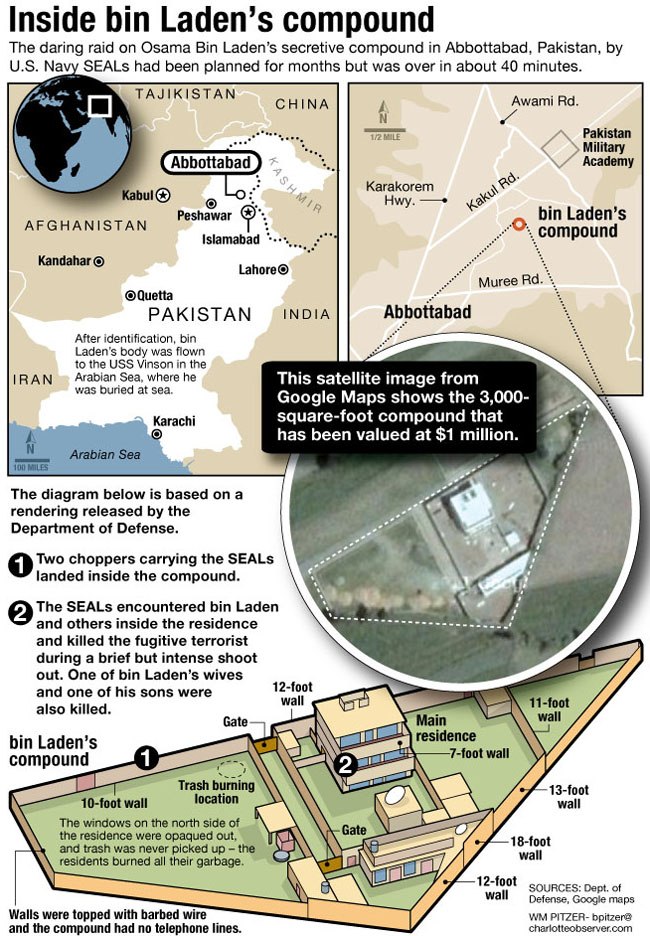
A day after U.S. commandos killed bin Laden, reporters were allowed within the 15-foot, barbed-wire-topped walls of the compound for the first time. But the doors of the house were sealed shut and police were in no mood to open them.

Local residents showed off small parts of what appeared to be a U.S. helicopter that Washington said malfunctioned and was disabled by the American strike team as they retreated. A small servant’s room outside the perimeter showed signs of violent entry and had been briskly searched, clothes and bedding tossed to the ground. Its wall clock was on the floor, the time stuck at 2:20, when the U.S. team would have been on the ground in the early hours of Monday.

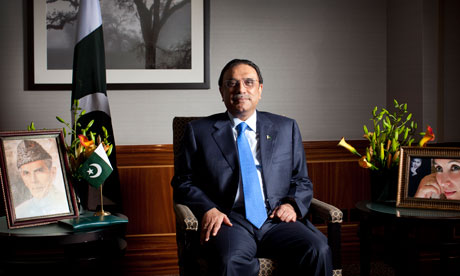
Asif Ali Zardari’s comments, in a Washington Post opinion piece Monday, were Pakistan’s first formal response to suspicions raised by U.S. officials and others. Those suspicions could further sour relations between Islamabad and its Western backers at a key point in the war in Afghanistan.

Bin Laden was killed close to a military academy in the bustling northwestern town of Abbottabad, not in the remote Afghan border region where intelligence assessments had assumed he had been holed up. That was quickly taken as a sign of possible collusion with the country’s powerful security establishment, which Western officials have long regarded with a measure of suspicion despite several notable al-Qaida arrests in the country since 2001.

“Some in the U.S. press have suggested that Pakistan lacked vitality in its pursuit of terrorism, or worse yet that we were disingenuous and actually protected the terrorists we claimed to be pursuing. Such baseless speculation may make exciting cable news, but it doesn’t reflect fact,” Zardari wrote.

Ties between the two nominal allies were already strained amid U.S. accusations that the Pakistanis are supporting militants in Afghanistan and Pakistani anger over American drone attacks and spy activity on its soil. They came to head in late January after a CIA contractor shot and killed two Pakistan’s, in what Washington said was self-defense.

Senior U.S. officials did not directly accuse Pakistan of collusion, but made it clear they had concerns.

“People have been referring to this as hiding in plain sight,” Obama’s counterterrorism chief John Brennan told reporters Monday. “Clearly, this was something that was considered as a possibility. Pakistan is a large country. We are looking right now at how he was able to hold out there for so long and whether or not there was any type of support system within Pakistan that allowed him to stay there.”

Lawmakers were more direct.

U.S. Senate Armed Services Committee Chairman Carl Levin said Pakistan’s intelligence and army have “got a lot of explaining to do,” given that bin Laden was holed up in such a large house with surrounding buildings, the fact that its residents took the unusual step of burning their garbage and avoiding any trash collection.

“It’s hard to imagine that the military or police did not have any ideas what was going on inside of that,” Levin said.

Cameron, who has also made supporting Pakistan a major foreign policy commitment, echoed those concerns.

“Those are questions we have to ask, those are questions we will want answered and we will be asking that question of everyone in Pakistan and the Pakistani government,” Cameron told BBC radio before acknowledging the West’s limited leverage against Islamabad.

“We could go down the route of having some massive argument, massive row with Pakistan, but I assess our relationship with Pakistan and it is my very clear view that it is in out interests to work with the government and people of Pakistan to combat terrorism, combat extremism and help development in that country.”

Suspicions were also aired in many Pakistan’s media and on the street Tuesday.

“That house was obviously a suspicious one,” said Jahangir Khan, who was buying a newspaper in Abbottabad. “Either it was a complete failure of our intelligence agencies or they were involved in this affair.”

Pakistan’s security establishment has yet to explain how bin Laden was able to live there undetected, and given that it is rarely transparent about what it does, it might never do so. Asked about the raid, Pakistani Foreign Secretary Salman Bashir said it was time to move on.

“The issue of Osama bin Laden is history and I think we do now want to keep ourselves mired in the past,” he told reporters.

U.S. officials have said that Pakistani officials were not told about the early morning helicopter raid until the strike team had killed bin Laden had returned to Afghanistan from where they took off from, citing security reasons.

Many Pakistanis were surprised at how this was possible, especially when initial reports stated that the choppers took off from a Pakistani air base. Some were angry that the country’s sovereignty had been violated — an especially sensitive issue given the unpopularity of America here.

Zardari said it “was not a joint operation” — the kind of which has been conducted in the past against lesser terror suspects in Pakistan — but that Pakistani cooperation, in a general sense, had helped lead them to bin Laden.

“A decade of cooperation and partnership between the United States and Pakistan led up to the elimination of Osama bin Laden as a continuing threat to the civilized world,” he said.

President Barack Obama also said the country’s anti-terror alliance had helped in the run-up to the operation, but did not thank Pakistan when he announced the death of bin Laden.

The death has raised fears of revenge attacks, both in Pakistan — which has seen hundreds of suicide attacks by al-Qaida and its allies since 2007 — and internationally. The U.S Embassy said its missions in Pakistan would remain closed to the public until further notice.
Osama Bin Laden Hunted Down And Killed By US

By Brad Norington for The Australian

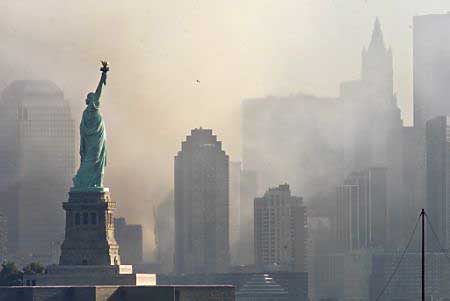
Bin Laden was killed in Pakistan and his body retrieved by a US strike team nearly 10 years after the September 11 terror attacks on the World Trade Centre in New York and the Pentagon killed more than 3000 people.

Announcing “justice has been done”, Mr Obama said bin Laden had been found hiding in Pakistan and a targeted operation launched today by a small US team.

“After a firefight they killed Osama bin Laden and took custody of his body,” Mr Obama said, adding that no Americans were harmed in the assault.

“The death of bin Laden marks the most significant achievement to date in our nation’s efforts to defeat al-Qa’ida,” the President said. “His demise should be welcomed by all that believe in peace and human dignity.

“It’s important to note our counter terrorism cooperation with Pakistan helped lead us to bin Laden and the compound where he had been hiding.” “Yet his death does not mark the end of our effort.

“There is no doubt that al-Qa’ida will continue to pursue attacks against us. “We must and will remain vigilant at home and abroad.”

Despite the decade that has elapsed since the September 11 attacks, the event, one of the most traumatic in US history, still stirs raw emotions, and his demise will be celebrated across the United States.

Chants of “USA, USA” rang out from tourists outside the White House as the news of bin Laden’s death sent an electric charge through Washington.

Hundreds of people gathered outside the fence of the presidential mansion and sang the US national anthem and started shouting and cheering. Mr Obama said the United States people understood the cost of war, but would not stand by if threatened.

“As a country we will never tolerate our security being threatened nor stand idly by when our people have been killed,” he said. “We will be relentless in defence of our citizens and our friends and allies.

“We will be true to the values that make us who we are. “And on nights like this one we can say to those families who have lost loved ones to al-Qa’ida terror, justice has been done.”

The location of bin Laden and his family confirms recent speculation that he was hiding in comfortable surroundings and close to civilisation, not in the remote mountains dividing Pakistan and Afghanistan.

US armed forces have been hunting the Saudi terror kingpin for years, an effort that was redoubled following the 2001 terror attacks on the World Trade Centre in New York and the Pentagon which killed 3000 people. But bin Laden always managed to evade US armed forces and a massive manhunt.

The death of bin Laden will raise huge questions about the future shape of al-Qa’ida and also have steep implications for US security and foreign policy 10 years into a global anti-terror campaign. It will also raise fears that the United States and its allies will face retaliation from supporters of bin Laden and other Islamic extremist groups.

Osama bin Mohammed bin Awad bin Laden was a member of the wealthy Saudi bin Laden family and the founder of the jihadist organisation al-Qa’ida, most widely recognised for the September 11 attacks on the US and numerous other mass-casualty attacks against civilian and military targets.

As a result of his dealings in and advocacy of violent extremist jihad, bin Laden lost his Saudi citizenship and was disowned by his billionaire family.

Bin Laden evaded US capture in Afghanistan after the 9/11 attacks and since then he and his organisation have been major targets of the US war on terror.

Bin Laden and fellow al-Qa’ida leaders are believed to have been hiding near the border of Afghanistan and Pakistan, in tribal areas that lie outside government control.

War in Afghanistan is Destabilising Pakistan, Says President

By Simon Tisdall for The Guardian

The war in Afghanistan is destabilising Pakistan and seriously undermining efforts to restore its democratic institutions and economic prosperity after a decade of military dictatorship, Pakistan’s president, Asif Ali Zardari, has told the Guardian.

Speaking during an exclusive interview in the imposing presidential residence in Islamabad, Zardari also pointed to widespread concern in Pakistan at the slow pace of efforts to end the Afghan conflict, and said some US politicians showed limited understanding of the impact of American policies.

“Just as the Mexican drug war on US borders makes a difference to Texas and American society, we are talking about a war on our border which is obviously having a huge effect. Only today a suicide bomber has attacked a police compound in Baluchistan. I think it [the Afghan war] has an effect on the entire region, and specially our country,” Zardari said.

Asked about harsh criticism of Pakistan’s co-operation in the “war on terror” published in a White House report last week, Zardari said Pakistan always listened to Washington’s views. But he suggested some members of Congress and the US media did not know what they were talking about when it came to Pakistan.

“The United States has been an ally of Pakistan for the last 60 years. We respect and appreciate their political system. So every time a new parliament comes in, new boys come in, new representatives come in, it takes them time to understand the international situation. Not Obama, but the Congress, interest groups and the media get affected by ‘deadline-itis’ [over ending the Afghan war],” Zardari said.

“I think it is maybe 12 years since America has become engaged in Afghanistan and obviously everybody’s patience is on edge, especially the American public, which is looking for answers. There are no short-term answers and it is very difficult to make the American taxpayer understand.”

With less than three months left before Barack Obama has promised to begin withdrawing US troops from Afghanistan, the White House recriminations reflected the growing pressures on all three governments to agree a workable, long-term strategy. The report complained bitterly that after years of US funding of the Pakistani military, “there remains no clear path towards defeating the insurgency” inside Pakistan.

It criticised as ineffectual Pakistani army operations in some areas of the western tribal belt bordering Afghanistan, which are believed to be used as safe havens by Afghan Taliban and al-Qaida elements.

A congressional panel also weighed in this week, urging the Obama administration to abandon Pakistan in favour of India. “Pakistan is about to go broke or collapse,” said Gary Ackerman, a New York Democrat.

Zardari suggested that if that assertion were true, the interventionist policies of the US and other foreign governments in south Asia would be a significant contributory factor. Pakistan had been in a state of “security alert” for several decades, he said.

“Our emphasis has been on security rather than our commerce and we need commerce for our survival.

“We have all the gas in the world waiting to go through to markets in India and the Red Sea but it cannot be brought in until Afghanistan is settled. So Afghanistan is a growth issue for us. I think most of the time, the quantification of the effect of the war is not calculated [by the US].

“Prices are going up, obviously we are a high fuel-importing country, and fuel prices are going up. Because of the war situation, the industry in one of our provinces has practically closed down … When one whole sector is not working, there is an effect on the other sectors.”

According to senior intelligence officials, the “war on terror” has cost the Pakistani economy approximately $68bn (£42bn) since 2001.

More than 33,300 Pakistani civilians and military personnel have been killed or seriously injured. Last year’s record-breaking floods added to the strain on the economy.

Zardari said the security situation was also undercutting efforts to strengthen democratic institutions bypassed or overturned during the military rule of his predecessor, General Pervez Musharraf. “Democracy is evolving. It’s a new democracy. It takes time to bring institutions back. Destroying institutions during a decade of dictatorial regime is easy … So there is a political impact as well as an economic impact.”

Pakistani officials say relations with the US reached a “low ebb” following the recent row over Raymond Davis, a CIA contractor who shot dead two Pakistanis; a CIA drone attack in Pakistan’s tribal areas last month that accidentally killed dozens of civilian elders meeting in a jirga (council), and Pakistan’s suspicions that it is being excluded from discussions about an Afghan peace deal.

Zardari, who is expected to visit Washington next month, said he would ask Obama to share drone technology with Pakistan so future attacks could be planned and directed under a “Pakistani flag”. Although this request had been turned down in the past, he said he was hopeful the Americans would be more receptive this time, given the huge anger and rising anti-American feeling that the drone attacks were causing.

Zardari and other senior government officials said all parties felt a sense of growing urgency about forging an inclusive peace settlement in Afghanistan, but the process must be “Afghan-led”. Pakistan was ready to play its part, consistent with its national interest, they said.

Salman Bashir, Pakistan’s foreign secretary, said: “Everybody is gradually coming round to our point of view that this requires greater diplomatic pressure. There is no military solution in Afghanistan.”

India Continues to Dominate Pakistan’s Strategic Thinking: US

As Reoported By The Times of India

Pakistan’s efforts to launch a comprehensive fight against terrorism are greatly hampered by its perceived threat perception against India, US President Barack Obama has said in a new report to Congress.

“As India continues to dominate their strategic threat perception, large elements of Pakistan’s military remain committed to maintaining a ratio of Pakistani to Indian forces along the eastern border,” Obama said in the third-quarterly report to the Congress on Afghanistan and Pakistan sent yesterday.

“This deprives the Pakistani COIN (counter-insurgency) fight of sufficient forces to achieve its ‘clear’ objectives and support the ‘hold’ efforts and causing available Army forces to be bogged down with ‘hold’ activities because there are insufficient trained civilian law enforcement personnel to assume that responsibility,” Obama said in his 38-page unclassified (rpt) unclassified version of the report.

Due to flood in Pakistan last year the offensive military operations Pakistan had envisioned for KP (Khaibar Pakhtoonwah) and the Federally Administered Tribal Areas (FATA) in the second half of 2010 were overtaken by events, he said.

“Militants were impacted by the floods as well, so we did not observe significant offensive actions on their side, but as Pakistani forces ceased offensive operations, extremists extended their control to areas without sufficient Pakistani central government-provided security and governance,” he wrote.

Between October 1 and December 31, 2010, Obama said Pakistani security forces remained largely static, generally focusing on maintaining the security of previously cleared areas in the FATA and KP and continuing to support flood relief operations.

There were small but notable security operations in November and December in Orakzai Agency and Dir District, but no major operations.

National attention during the reporting period focused on the need for continued flood relief and the start of early recovery efforts, he said.

“The military served as a force of stability during the monsoons, ensuring that Pakistani and international emergency resources were available for rescue and relief operations. The Pakistan Army, Air Force, and Navy committed large numbers of personnel and resources to the flood relief operations throughout October and November,” he said.

The civilian government’s response suffered from a lack of coordination and reflected broader shortcomings in the government’s ability to execute the civilian “hold” and “build” phases of COIN.

The last quarter of 2010 saw no progress on effectively executing the COIN cycle in KP and the FATA.

Will India Win Coveted UN Seat?

By Sunil Sharan for The Huffington Post

Indian foreign secretary Nirupama Rao says Pakistan is hypnotically obsessed with India but she and her bosses too are fixated on a coveted prize, a permanent seat at the United Nations Security Council. The mandarins of New Delhi must be pleased as punch to have had over to visit leaders of all five permanent member countries in quick succession. Inexorable appears the march but will India find the pot of gold at the end of the rainbow? And, if it does, what are the implications for itself as well as for Pakistan?

First in was David Cameron of Britain, who arrived during the summer and offered unstinting support, whetting local appetite for the main American course. And, did he fail to disappoint? No sir, Barack Obama set the cat amongst the pigeons by endorsing India for the seat, the first time ever by the US. India rejoiced while Pakistan recoiled.

But a careful examination shows him adhering closely to what he told Bob Woodward in the book, Obama’s Wars. In lieu of the seat, he expects India to resolve Kashmir. At a press conference with Manmohan Singh, Obama characterized Kashmir as a long-standing dispute making the latter stutter that the K-word was not scary. Only then did Obama hand over the endorsement in India’s Parliament but couched in such diplomatese that countless local hair were split over when “the years ahead” would dawn.

Next waltzed in Nicolas Sarkozy of France. The French, like the British, have consistently seen merit in India’s case. Sarkozy though, true to type, proved an enigma. He first tagged on the applications of Africa, the Arabs and pretty much the rest of the world onto India’s, befuddling his hosts, who are willing to concede as equal aspirants only “self-appointed frontrunners” Germany, Japan and Brazil. Just as they were about to give up on him, Sarkozy warmed the cockles of India’s heart by throwing in 2011 as early as when it could make it.

But soon came the caveat. Sarkozy, just like Obama before him, cautioned that with great power status came great responsibilities. Whereas Obama wanted India to be more mindful of human rights violations of countries such as Iran and Myanmar, Sarkozy wanted India to send military forces to keep world peace. With India already being one of the foremost contributors to UN peacekeeping missions throughout the world, the mandarins of New Delhi must have been left wondering what more was being asked of them.

No matter, three down, two to go. By now the state jets were landing at Delhi airport almost on top of one another. Wen Jiabao, the leader India was least looking forward to, came with the master key to entry. Shortly before his visit, WikiLeaks revealed China’s opposition to any council expansion. Indian hopes were up nevertheless but Wen remained inscrutable, willing only to acknowledge an understanding of India’s aspirations. No one in India knew quite what to make of him and since Wen was off to Pakistan next, all the country could do was wait with clenched teeth to hear what he would say there.

Rounding off the passage to India was Dmitry Medvedev. Relations between Russia and India have frayed considerably since the heady days of the cold war, so much so that Russia has waffled on India’s bid. Medvedev signaled that the waffle still needed baking, voicing support for India while reiterating that reforming the council was tough and required consensus.

All the while Pakistan protested vociferously against what it deemed an indulgence of Indian hegemonism. But what will India gain with a permanent UN seat? Could it block Pakistani claims on Kashmir? True a permanent member wielding veto power can stonewall but the veto seems unattainable for seekers since they themselves have forsaken it. And, while India sees red when the K-word is uttered in the UN by Pakistan, no ascension to permanency can make it strangle the latter. Nor can it efface any past security council resolutions.

So then, what is it? Nothing comes to mind but the obvious, the acceptance that any arriviste craves. Even that appears a false hankering because ever since its early years, Gandhi’s legacy and Nehru’s charisma burnished the country with global influence disproportionate to its economic and military capabilities. A bee once in one’s bonnet is hard to get rid of though. And, as every journey must have a fitting end, India has found a destination to its liking.

Flush with cash, New Delhi wants to beef up its military. All of the recent visitors bar China are major suppliers of defence equipment to India. As bees flock to honey, they arrived armed with catalogues of the most terrifying stuff. Inherent was a delicate diplomatic quid-pro-quo. The more arms you buy from us, the more we will push your candidacy. As Islamabad keeps raising the bar for India’s seat, so too will India have to up its arms binge.

Lost in Pakistan’s current rhetoric was its vote in October to put India in the security council for two years beginning January 1, 2011. Once on, we will never get off is the new mantra of India’s brave. India seemingly returned the favor by taking in stride the sale of Chinese nuclear reactors to Pakistan. Is there more afoot than meets the eye?

Every country is entitled to its obsession. Pakistan’s is obvious. By continually thumbing its nose at a NATO mired in Afghanistan, it has put the K-word in spotlight, albeit on the backstage. A deal has been blessed by the powers that be. Both the seat and Srinagar are not far away.

The writer edits a website on India: http://www.scooptime.com.

UN Halts Aid After Female Suicide Bomber Kills 46 in Pakistan

By Anwar Shaikh for Businessweek

A female suicide bomber carried out a Christmas Day attack in northwest Pakistan that killed 46 people, a local official said, as the UN food agency caught up in the blast closed centers that had fed 41,000 families.

The burqa-clad woman aged between 18 and 22 lobbed grenades and detonated an explosive vest near a World Food Programme distribution center after being stopped by security personnel, Mustaqeem Khan, a government official in the tribal region of Bajaur, said by phone today. At least 96 people were injured in what Dawn newspaper said was Pakistan’s first suicide bombing known to have been carried out by a woman.

The device was detonated at about 8:30 a.m. local time on Dec. 25 as officials were handing out food to victims of this year’s floods, said Gull Rehman, a spokesman for the government of the area. Khan said officials had collected body parts of the female attacker, who had attempted to join a line of men queuing for aid.

Prime Minister Yousuf Raza Gilani condemned the attack and said his government’s fight against militants will “continue till their complete elimination,” according to an e-mailed statement issued by the Information Ministry in the capital, Islamabad. Operations at four WFP centers in the region will likely restart this week once security improves, program spokesman Amjad Jamal said by phone from Islamabad.

The death toll eclipsed the 43 people killed Dec. 6 in a suicide bombing outside a government office in the northwest tribal region of Mohmand. Four days later, 25 people died in a similar attack in the town of Hangu.

U.S. President Barack Obama condemned what he called the “outrageous attack” in Bajaur. “Killing innocent civilians outside a World Food Program distribution point is an affront to the people of Pakistan, and to all humanity,” Obama said in a written statement. “The United States stands with the people of Pakistan in this difficult time, and will strongly support Pakistan’s efforts to ensure greater peace, security and justice for its people.”

UN Secretary General Ban Ki-moon condemned an “abhorrent act of terrorism aimed at innocent people.”

Pakistan’s government blames Taliban militants based in the country’s tribal region for terrorist attacks in the country. The army last year began offensives in the Taliban stronghold of South Waziristan, after a similar operation against guerrillas in the Swat Valley.

Militants have stepped up attacks as the government is struggling to rehabilitate 17 million people who lost homes and livelihoods during floods in August. The deluge threatened to cripple Pakistan’s economy with a surge in unemployment, an increase in inflation and damage to billions

India Urged to Revive Pakistan Talks

By James Lamont and Edward Luce for The Financial Times

Barack Obama, the US president, has urged India to step up its dialogue with Pakistan to help to secure the region’s stability, warning that efforts to combat extremism in India’s nuclear-armed neighbour have not progressed as quickly as Washington had hoped.

Mr Obama, on a three-day visit to India, called on Sunday for New Delhi to revive a dialogue with Islamabad badly set back by the 2008 terror attacks on Mumbai by Pakistani militants.

His comments at a town hall event with students in Mumbai were a sharp break from his initial emphasis on creating jobs in the US and gaining more access to the fast-growing Indian economy for US companies.

“My hope is that over time trust develops between the two countries, that dialogue begins,” he told students at St Xavier’s College. “Ultimately India and Pakistan have to arrive at their own understandings”.

Mr Obama cautioned that the economic success that India was enjoying would be imperilled by an unstable region where militant insurgencies raged in Pakistan and Afghanistan, where US troops are fighting the Taliban.

“The country that has the biggest stake in Pakistan’s success is India. I think that if Pakistan is unstable that is bad for India. If Pakistan is stable and prosperous that’s good,” he said.

Mr Obama recommended the two rivals start talking about the “less controversial issues” and then build up to tougher issues, such as the disputed territory of Kashmir, over which the two have fought three wars over the past 63 years.

Manmohan Singh, India’s prime minister, believes the two countries have shared destinies, and has stressed that India poses no threat to Pakistan in an effort to scale down military forces on the border.

Yet Mr Obama’s emphasis of linkages between Pakistan and India, which were separated at the end of British rule in 1947, is highly sensitive. Many Indian leaders gauge the growing maturity of New Delhi’s relationship with Washington by what they call the “de-hyphenation” of India and Pakistan in recognition of India as a global power and vibrant economy.

New Delhi is suspicious of US military assistance to Pakistan and is uneasy about Washington identifying any role for Islamabad in bringing stability to Afghanistan and brokering talks with the Taliban.

Mr Obama warned that Pakistan was confronted by a “profound problem” and that its progress towards eradicating extremism was “not as quick as we would like”. He said that his administration was “engaging aggressively” with the Pakistani government to bring peace and stability.

“There’s a need to look for practical steps . . . Living in the past simply won’t work,” said Stephen Cohen, a senior fellow at the Brookings Institution, in Washington.

“I see a 100 years of conflict between India and Pakistan looking ahead.”

Pakistan Urges US to Intervene in Kashmir Dispute

As Reported by The Associated Press

Pakistan called Friday for President Barack Obama to intervene in its longstanding dispute with India over the Himalayan region of Kashmir, the cause of two of the three wars the nuclear-armed rivals have fought.

Pakistani Foreign Minister Shah Mahmood Qureshi made the unusually blunt appeal for Obama to seek a resolution of the dispute when he visits India next month, saying he should “redeem the pledge” he made as a candidate.

The conflict over Kashmir has been the main source of friction between India and Pakistan since they won independence from Britain in 1947. Pakistan has frequently sought outside intervention to resolve it but India vehemently opposes such involvement and the United States has traditionally stayed above the fray.

Qureshi, speaking next to Secretary of State Hillary Rodham Clinton at the closing day of three days of U.S.-Pakistan talks, said Obama must get involved because a crackdown against suspected Muslim militants in Indian-controlled Kashmir threatens the entire region.

“It is in the U.S. strategic interest to work for peace, stability and resolution of the disputes in South Asia,” he said. “The starting point in this quest is justice for the Kashmiri people.”

“President Obama has always understood the importance of a Kashmir solution,” Qureshi said. “His coming visit to the region is the time to begin to redeem the pledge that he made earlier.”

As a presidential candidate in 2008, Obama suggested that the U.S. should encourage India and Pakistan to resolve the Kashmir dispute so Pakistan could better focus on fighting extremists on its own territory and Afghanistan. Although he did not advocate direct mediation, his comments were met with disdain in India.

Obama will not visit Pakistan on his upcoming trip but he plans to spend several days in India, which has cracked down on violent anti-Indian protests in Kashmir since June. The violence has killed at least 111 people, mostly teenage boys and young men in their 20s. Authorities have imposed off-and-on curfews in an attempt to halt the unrest.

Quershi expressed astonishment that the U.S. and other major powers had said little about India’s response to the protests.

“People of conscience have protested the use of force against the defenseless people of Kashmir, in particular the targeting of the Kashmiri youth,” he said. “But the Kashmiri mothers are baffled by the deafening silence of the world’s leadership. History has proved that the force of arms cannot suppress the legitimate aspirations of the Kashmiri people.”

India and Pakistan fought two wars for control of Muslim-majority Kashmir, where rebels have sought independence from India or incorportation with neighboring Pakistan.

More than 68,000 people, most of them civilians, have been killed in Kashmir since fighting began in earnest in 1989.

Meeting Pakistanis, U.S. Will Try to Fix Relations

By Mark Landler and Eric Schmitt for The New York Times

WASHINGTON — As Pakistani civilian and military leaders arrive here this week for high-level meetings, the Obama administration will begin trying to mend a relationship badly damaged by the American military’s tough new stance in the region.

Among the sweeteners on the table will be a multiyear security pact with Pakistan, complete with more reliable military aid — something the Pakistani military has long sought to complement the five-year, $7.5 billion package of nonmilitary aid approved by Congress last year. The administration will also discuss how to channel money to help Pakistan rebuild after its ruinous flood.

But the American gestures come at a time of fraying patience on the part of the Obama administration, and they will carry a familiar warning, a senior American official said: if Pakistan does not intensify its efforts to crack down on militants hiding out in the tribal areas of North Waziristan, or if another terrorist plot against the United States were to emanate from Pakistani soil, the administration would find it hard to persuade Congress or the American public to keep supporting the country.

“Pakistan has taken aggressive action within its own borders. But clearly, this is an ongoing threat and more needs to be done,” the State Department spokesman, Philip J. Crowley, said Monday. “That will be among the issues talked about.”

The Pakistanis will come with a similarly mixed message. While Pakistan is grateful for the strong American support after the flood, Pakistani officials said, it remains frustrated by what it perceives as the slow pace of economic aid, the lack of access to American markets for Pakistani goods and the administration’s continued lack of sympathy for the country’s confrontation with India.

Other potentially divisive topics are likely to come up, too, including NATO’s role in reconciliation talks between President Hamid Karzai of Afghanistan and the Taliban. Pakistani officials say they are nervous about being left out of any political settlement involving the Taliban.

Still, in a relationship suffused by tension and flare-ups — most recently over a NATO helicopter gunship that accidentally killed three Pakistani soldiers and Pakistan’s subsequent decision to close a supply route into Afghanistan — this regular meeting, known here as the strategic dialogue, serves as a lubricant to keep both countries talking.

At this meeting, Secretary of State Hillary Rodham Clinton will formally introduce the new American ambassador to Pakistan, Cameron Munter. Mr. Munter, who recently served in Iraq, replaces Anne W. Patterson, who just wrapped up her tour of duty in Islamabad.

“No country has gotten more attention from Secretary Clinton than Pakistan,” said Richard C. Holbrooke, the administration’s special representative for Afghanistan and Pakistan. Pakistan’s delegation will be led by its foreign minister, Shah Mahmood Qureshi, but much of the attention will be on another official, the military chief, Gen. Ashfaq Parvez Kayani, who is viewed by many as the most powerful man in Pakistan.

White House and Pentagon officials said one immediate goal of this meeting was to ease the tensions that led Pakistan to close the border crossing at Torkham, halting NATO supplies into Afghanistan. Officials on both sides said that acrimony from the border flare-up had already receded, soothed by the multiple apologies that American officials made to Pakistan last week.

Last week, Adm. Mike Mullen, the chairman of the Joint Chiefs of Staff, said that General Kayani had assured him that Pakistan’s army would tackle the North Waziristan haven, but on Pakistan’s timetable. In an interview, Pakistan’s ambassador to the United States, Husain Haqqani, said, “Our American partners understand that we have 34,000 troops in North Waziristan. Our soldiers have been engaged in flood relief after history’s worst floods. It is not a question of lack of will.”

The new security pact would have three parts: the sale of American military equipment to Pakistan, a program to allow Pakistani military officers to study at American war colleges and counterinsurgency assistance to Pakistani troops.

Currently, the United States spends about $1.5 billion a year to provide this same assistance, but it is doled out year by year. The new agreement, if endorsed by Congress, would approve a multiyear plan assuring stability and continuity in the programs, although Congress would continue to appropriate the financing on a yearly basis. “This is designed to make our military and security assistance to Pakistan predictable and to signal to them that they can count on us,” said a senior official.

At the last dialogue in Islamabad in July, Mrs. Clinton presented more than $500 million in economic aid, including plans to renovate hospitals, upgrade hydroelectric dams, improve water distribution and help farmers export mangoes. But the floods upended those plans, and officials said they now planned to redirect funds to more urgent needs.

This week’s meeting will also be shadowed by a new eruption of political instability in Pakistan: the government of President Asif Ali Zardari is locked in a confrontation with the Supreme Court over the court’s demand that senior ministers be fired on corruption charges. Analysts said they were less worried about the atmospherics than the underlying differences in perspective. The administration’s public contrition for the cross-border attack has largely resolved that issue, said Daniel S. Markey, senior fellow for India, Pakistan and South Asia at the Council on Foreign Relations.

But Mr. Markey said he saw potential friction stemming from the American openness to reconciliation with the Taliban. With the United States facilitating rather than guiding the talks, he said, there could be poor coordination between the Afghans, NATO and others — all of which would rattle the Pakistanis.

“Washington is opening the door to a range of negotiations with groups that it has discouraged Pakistan against working with in the past,” he said. “This sends a mixed signal, and cannot help but encourage hedging on Islamabad’s part.”

Another potential bone of contention is one of President Obama’s nuclear objectives: a global accord to end the production of new nuclear fuel. Pakistan has led the opposition to the accord. And without its agreement, the treaty would be basically useless.

Mr. Qureshi blamed the United States for the situation, saying Washington signed a civilian nuclear accord with India that discriminated against Pakistan. “You have disturbed the nuclear balance,” he said in a recent interview in New York, “and we have been forced to develop a new strategy.”

The West is Being ‘Outmanoeuvred’ by Violent Islamist Extremists: Tony Blair

By John Swaine for The Telegraph

In a speech in New York, the former prime minister said that warnings over the past week of new terrorist plots against Europe should remind people that they remain under threat.

Mr Blair said a “narrative” that Muslims were under attack from the US and its allies, who act out of support for Israel, had been allowed to take hold, aided by “websites and blogs”.

A fresh confrontation is needed because it will be impossible to defeat extremism “without defeating the narrative that nurtures it”, he said.

“The practitioners of extremism are small in number. The adherents of the narrative stretch far broader into parts of mainstream thinking,” Mr Blair told the Washington Institute for Near East Policy.

“It is a narrative that now has vast numbers of assembled websites, blogs and organizations.” Mr Blair said it was “absurd” that some people were surprised at how powerful Islamist extremist groups were, given the amount of funding they received and indoctrination they spread.

“Measure, over the years, the paucity of our counter-attack in the name of peaceful coexistence,” he said. “We have been outspent, outmaneuvered and out-strategized.”

Mr Blair said a tendency to “sympathize” with extremism was not only dangerous but also disempowering for moderate Muslims, because it made people resent them as much as extremists.

He said he was “intrigued” by the fact that western leaders, including Barack Obama, the US President, felt the need to condemn Terry Jones, a pastor who threatened to burn a Koran.

“Suppose an Imam, with thirty followers, in Karachi was to burn a bible,” he said. “I can barely imagine a murmur of protest. It wouldn’t be necessary for the President of Pakistan to condemn it because no one here would remotely consider he supported it.”

The former prime minister also called on the west to make it “crystal clear” to Iran that their acquisition of a nuclear bomb would be unacceptable to the entire “civilized world”.

“Go and read the speech of Iran’s President to the United Nations just days ago here in New York, and tell me that is someone you want with a nuclear bomb,” he told those who disagree.

He stressed that the achievement of a peace settlement between Israel and Palestine would remove “much of the poison which the extremists use”.

And he defended his decision to invade Iraq and Afghanistan, saying: “whatever you think of the original action, we enabled the people to choose their Government”.

Mr. Blair last night appeared on the Late Show with David Letterman on American television. He said that satirists like Letterman had been wrong to paint George W. Bush as unintelligent. “You don’t get to this position by being a fool,” he said.

For Better or Worse, White House Bets on Pakistan’s Civilian Government

Reported by Josh Rogin for Foreign Policy magazine

The Obama administration has always been clear that the path to winning the war in Afghanistan goes through Pakistan. But if Bob Woodward’s new book is accurate, the White House considers its war effort much more dependent on the success and survival of Pakistan’s civilian government than was previously known.

Woodward’s “Obama’s Wars,” which hit bookstores Monday, sheds new light on the Obama administration’s vast outreach to the Pakistani civilian government led by President Asif Ali Zardari. It paints a picture of an administration working hard to court the Pakistanis while remaining somewhat confused about Pakistani thinking on a range of issues.

Obama himself was confused about the nature of Pakistani intentions during two crucial decision points in his administration’s Afghan policy — the March 2009 strategy rollout and the deliberations in November 2009, which resulted in a troop surge and a huge expansion of covert operations in Pakistan. However, based on advice from the majority of his key advisers, he nonetheless tried to entice Pakistan to commit to a deep and long-term partnership with the United States by offering the Zardari government incentive after incentive, with relatively few pressures.

According to Woodward’s account, the centrality of Pakistan was championed early on by Bruce Riedel, the Brookings scholar who was brought on as a key figure in the Obama administration’s March 2009 Afghanistan strategy review.

Riedel, who referred to Islamist extremists in Pakistan as the “real, central threat” to U.S. national security, personally convinced Obama, only two months after he took office, that Pakistan needed to be the centerpiece of his new strategy. Riedel’s plan involved arming the Pakistani military for counterinsurgency and increasing economic and other forms of aid to the civilian government. This marked the beginning of the term “Af-Pak,” which drove the administration’s belief that stability in Afghanistan and Pakistan were inextricably linked.

Riedel’s Pakistan focus was not due to his confidence that the civilian government could control the military and intelligence services. In fact, he referred to Army Chief of Staff Gen. Ashfaq Parvez Kayani as a “liar” with regards to the activities of the secretive Inter Services Intelligence agency (ISI), which is widely suspected of aiding the Taliban insurgency. Then Director of National Intelligence Dennis Blair reportedly echoed Riedel’s views on this matter.

Inside the administration, Blair argued that Obama was approaching Pakistan with too many carrots and not enough sticks. He at one point advocated bombing inside Pakistan and conducting raids there without the Pakistani government’s approval. “I think Pakistan would be completely, completely pissed off and they would probably take actions against us … but they would probably adjust,” he once told Obama.

Obama, however, opted to pursue a less confrontational path. He concluded the central task would be convincing the Pakistani leadership to throw its lot in with the United States He said at the time of the initial strategy review in March 2009, “that we had to have a serious heart-to-heart with Pakistani civilian, military and intelligence leaders.”

Later that year, when making the decision to send an additional 30,000 “surge” troops to Afghanistan, Obama knew that his plans to also expand the U.S. military presence in Pakistan and widen drone strikes would be a hard sell to the Zardari government. In an attempt to sweeten the deal, Obama framed the policy as a new “strategic partnership” with Pakistan, even tying the success of the U.S. mission in Afghanistan to the survival of Zardari and the legacy of his deceased wife Benazir Bhutto.

“I know that I am speaking to you on a personal level when I say that my commitment to ending the ability of these groups to strike at our families is as much about my family’s security as it is about yours,” Obama wrote in a letter to Zardari delivered by National Security Advisor Jim Jones and counterterrorism advisor John Brennan.

Zardari’s response to that letter reinforced what many in the administration already suspected: Pakistan’s government was in the grips of an internal struggle over whether to embrace the United States. Zardari’s initial response focused heavily on India, though the Pakistani president only referred obliquely to his country’s strategic rival. Woodward reports that the White House believed the letter was written by the Pakistani military and the ISI. However, the Zardari government did end up accepting Obama’s offer.

Obama’s top advisors told the U.S. president that he would have to accept something short of complete success in convincing Pakistan to turn away from its longstanding obsession with the military threat it perceives from India.

When Obama had a meeting with Zardari in May 2009, he told the Pakistani president the he did not want U.S. taxpayers to be funding Pakistan’s military buildup against India “We are trying to change our world view,” Zardari told Obama, “but it’s not going to happen overnight.”

At times, Obama was downright puzzled by his advisors’ advice regarding Pakistan. For example, intelligence reports confirmed that Pakistani officials were afraid that the United States would leave Afghanistan too early, as they believed had occurred after the end of the resistance to the Soviet regime in the 1980s. On the other hand, Pakistan worried that if the United States was too involved in Afghanistan, it might aid in the establishment of a larger Afghan army than Islamabad was comfortable with.

“What am I to believe?” Obama asked his senior staff. Secretary of State Hillary Clinton, Special Representative Richard Holbrooke, and Defense Secretary Robert Gates all told him these were the types of contradictions that were commonplace when dealing with Pakistan.

For its part, the Pakistani government was just as confused and puzzled by the Obama administration. Woodward recounts one anecdote, in which Zardari tells the former U.S. Ambassador to Afghanistan Zalmay Khalilzad that he believed the United States was involved in orchestrating attacks by the Pakistani Taliban against the Pakistani civilian government.

Pakistan’s Ambassador to Washington Husain Haqqani, a key go-between, tried several times to explain to the Obama administration how to court Pakistani leaders, comparing the dynamic to “a man who is trying to woo a woman.”

“We all know what he wants from her. Right?” Haqqani said in a meeting with Jones, Deputy National Security Advisor Tom Donilon and the NSC’s Gen. Doug Lute.

“But she has other ideas. She wants to be taken to the theater. She wants that nice new bottle of perfume,” Haqqani told them. “If you get down on one knee and give the ring, that’s the big prize. And boy, you know, it works.”

Haqqani said the “ring” was official U.S. recognition of Pakistan’s nuclear program as legitimate. He also warned that the Pakistanis would always ask for the moon as a starting point in negotiations. He compared it to the salesmanship of rug merchants.

“The guy starts at 10,000 and you settle for 1,200,” Haqqani told the Obama team. “So be reasonable, but never let the guy walk out of the shop without a sale.”

Although the Obama administration has had some success improving the relationship between the two governments, Pakistan’s civilian leadership still faces a series of difficulties in its goal of exerting control over its entire national security structure. Stability has also been threatened by the enormous pressures resulting from the war that it is waging inside its own borders, and political attacks leveled against it from the media and the courts. Zardari’s perceived sluggish response to the devastating flood crisis has cost him even more credibility among the Pakistani public.

But while the end of Zardari regime has often been predicted, it appears that he will remain in place for the foreseeable future. The Obama administration, meanwhile, is aware of how crucial his cooperation remains for the success of the mission in Afghanistan.

When Woodward sat down for his interview with Obama earlier this year, he asked the president if the situation was still that Pakistan is the centerpiece of the U.S. strategy. “It continues to this day,” Obama replied.

BP Stands for Let’s Blame Palin for the Recklessness of “Drill Baby Drill!”

By Manzer Munir for Pakistanis for Peace

As the BP Oil Spill passes into its 61st day, I began to wonder what the BP in British Petroleum could also stand for. Here is a list of things that I and some friends have come up with that could be the abbreviation for BP.
BP= Bad Planning- The Bad Planning and lack of a coherent emergency response in the event of a rig collapse such as the one that caused the BP Oil Spill and has made a bad situation worse as the company, now still in charge 61 days after a disaster of their own causing, struggles to find a way to stop the leak.

BP= Barely Plugging- More than 6 weeks after the spill started, BP was able to attach a pipe to the well at the bottom of the ocean and is able to siphon 250,000 gallons a day (one tenth of what is estimated to be spilling into the Gulf each day). This clearly is not a solution as this is Barely Plugging the oil spill that continues to poison the ocean and all that live in and around it.

BP= Beach Pollution= See also Bathing Prohibited. The oil from the spill has caused Beach Pollution in Louisiana, Mississippi, Alabama, Texas, and Florida. The loss of revenue by the towns and cities in these states that would normally welcome millions of tourists in the summer months is going to have a very damaging effect to many of these states already reeling from the worst recession since the Great Depression.

BP= Bankrupt Probably- Many experts are saying that BP will not be able to financially survive this disaster and most likely will go Bankrupt Probably. If that happens, will the American public foot the bill as we did for the Wall Street failure? One thing is for sure, the company is looking at a very bleak future both criminally and financially.

BP= Be Prepared- This disaster shows the lack of planning for events such as these and underscores the reason for oil companies as well as government agencies such as the Minerals Management Service to Be Prepared in the event of disasters such as this spill. A lack of an emergency plan both by BP and the government is also at fault for making this disaster as bad as it has been.

BP= Bad People- Are the executives at BP Bad People for being at the helm of a company that caused the greatest disaster in history and worse yet for calling the residents of the Gulf “Small People” and showing great indifference to the plight of the residents of the Gulf and to the American public?

BP= Barren Planet- The oil spill is causing irreparable damage to the environment and to the ecology of the ocean and its long term effects are unknown by scientists at this point. One thing is for sure, water is the source of all life on the planet and as we kill the ocean and all living creatures in it with this oil spill, we are guaranteeing ourselves future where life will be hard to sustain on a Barren Planet.

BP= Behemoth Plume- The oil spill has created a Behemoth Plume that is at least 15 miles wide and 3 miles long and growing. This plume is a dead zone with no oxygen and a place where no living creature can survive. As the oil continues to flow and goes unchecked the size of this plume grows and there are reports of second and third oil plumes now forming in the Gulf.

BP= Beyond Pathetic- 61 days and counting and the leak has not been stopped. This is beyond pathetic for BP, and the government’s oversight departments.

BP= Be Patient- How long can the people of the Gulf of Mexico as well as the American people wait for BP and the government to fix the spill and stop the oil leak, not to mention clean up the gulf? And is that even a possibility?

BP= Barely Progressing- 61 days into the oil spill and it seems we are Barely Progressing as oil continues to spill into the Gulf at alarming rates.

BP= Bad Publicity- No amount of new splashy television or print advertisements will replace the Bad Publicity that the company of BP has received. Rarely in the annals of corporate history has a company ever faced such a public relations nightmare as has BP and it will be interesting to see if it ever recovers from this or ends up going under, much like the rig.

BP= Big Problems- The BP Oil Spill is perhaps the biggest of the Big Problems facing the Obama administration and the American people. The economy can be eventually fixed, the housing prices will come back up, people will eventually get rehired, wars will eventually be won or lost and will come to an end, but an ecological and environmental disaster such as this spill we will never fully recover from as a planet.

BP= Birds Poisoned- Tens of thousands of Birds Poisoned as a result of the oil spill. Many birds and animals that are unique to the Gulf region are feared irreparably harmed due to the disaster.

BP= Black Plague- The oil spilled into the Gulf of Mexico and continuing to do so each day means that this spill has become the Black Plague of death not just to the people and the animals of the area, but indeed quite possibly for marine life and perhaps eventually for the planet as no one knows the true effects of this unprecedented disaster on the ecology of the planet.

BP= Broken Pipeline- The Broken Pipeline at the bottom of the Deepwater Horizon rig in the Gulf of Mexico continues to spill as much as an estimated 1.5 million to 2.5 million gallons of oil a DAY into the ocean!

BP= Blood Pressure- Blood pressure was further raised for those living along the Gulf of Mexico as the administration imposed a ban on all new offshore oil drilling and exploration. This has caused many workers in the area who rely on this industry to feed their families, to be laid off by other oil companies as the government assesses the situation and the safety of offshore drilling.

BP= Boiling Point= The Americans affected by the oil spill that rely on the fishing, boating, and tourism in the area have long reached a Boling Point in their patience with BP and with the government’s response.

BP= Better Prosecute= Attorney General Eric Holder is assigned by President Obama to investigate the BP Oil Spill and into criminal charges against the company are now a certainty, especially given the deaths of 11 workers in the explosion that caused the Deepwater Horizon rig to collapse and start the spill on April 20.

BP= Black Pelicans= Pictures of Black Pelicans and other animals as environmentalists worry that number of dead and affected animals is in the tens of thousands. The animal and sea creatures of the Gulf region are expected to be devastated for many years to come.

BP= Billions Paid- This stands for the billions and billions of dollars already paid by BP and the untold billions that will be paid by them in the future and possibly all of us tax payers if the company goes under and becomes bankrupt

BP= Barack’s Problem- This disaster has become President Barack Obama’s Katrina. But at least with hurricane Katrina, the calamity passed within hours and the government started the clean up and rescue, whereas with the BP Oil Spill this is a disaster that keeps on spewing and keeps on polluting as today is the 61st day the spill has continued to flow. How he has handled himself at the onset of this disaster and its continuation could be the defining moment of his presidency as this is squarely Barack’s Problem, unlike the economy, Iraq, and Afghanistan, which all he inherited.

BP=Bankruptcy Protection- See also bankruptcy probably. The amount of damages and compensation that BP will have to pay out in claims and also in penalties could wipe out the company and it may have to seek Bankruptcy Protection.

BP= Brand Problems- See also Bad Publicity. The BP brand has been damaged forever and no amount of advertisements will change the public image and Brand Problems that the spill has created for BP.

BP= Bleeding Planet- The unchecked, endless, and prolonged seepage of the thick crude oil into the ocean is causing death to millions of wildlife and is making earth a Bleeding Planet which one wonders whether we can survive this catastrophe.

BP= Bathing Prohibited- See also Beach Polluted, hence bathing prohibited. And if no beach visitors, no revenue for many states like Florida from tourists and many other places in and around the Gulf of Mexico that depend on the billions of revenue dollars from the fishing and tourism.

BP= Blame Palin- Probably one of the most poignant points of this article and one ignored by major media publications is that there is a correlation to the BP Oil Spill and Palin’s “Drill Baby Drill” slogan during the presidential campaign. Her proposals of allowing the oil drilling everywhere during the 2008 campaign, including in some of America’s most pristine places such as Alaska, galvanized the oil industry and revved them up into a “Gold Rush” mentality where short cuts were taken and oversight lost by the government in a greedy push for more oil saw sloppiness and Bad Planning cause the worst environmentalist disaster in history.

BP= Bye Planet- If the oil spill continues to go on and spill up to 2.5 million gallons into the ocean each day, how long before it engulfs all our oceans and kills a large portion of plant and animal life on the planet? Would that mean the end of the world when that happens?

So in conclusion, BP stands for The Black Plague, because of the Bad Planning,  now let’s Blame Palin, for the Beach Pollution casued by Broken Pipes, with Billions Paid, now it’s Beyond Pathetic, as we’re Barely Progressing, while Black Pelicans, become Barack’s Problem, and the Behomoth Plumes, mean bye Bye Planet!

Obama, Karzai Strive To Project Unity, Deny Serious Differences

By Jonathan Landay for The Kansas City Star

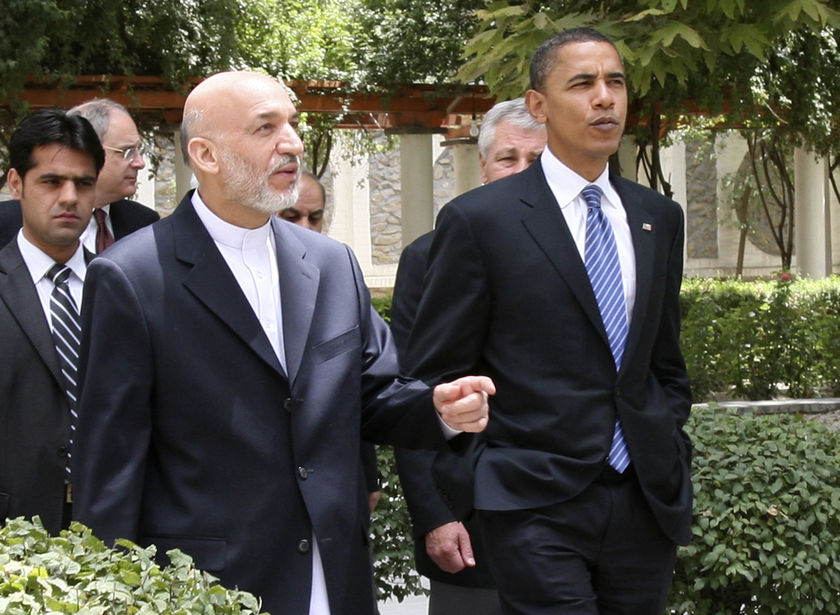
President Barack Obama and Afghan President Hamid Karzai asserted Wednesday that progress is being made toward crushing the Taliban-led insurgency, but new studies on the Afghan army and police raise serious doubts about whether the strategy can succeed before a U.S. troop drawdown begins in July 2011.

Flanked by Karzai at a White House news conference, Obama urged Americans to have patience with the “joint strategy” that he unveiled in December to stabilize Afghanistan, defeat the insurgency and prevent the country’s reversion to a Qaida sanctuary. He warned, however, that “there is going to be some hard fighting over the next couple of months.”

He apparently was referring to the summer “fighting season” that’s traditionally racked Afghanistan and that this year will see a drive to clear the Taliban from the southern city of Kandahar that’s being supplemented by an additional 30,000 U.S. troops.

The joint news conference was the public high point of a tightly scripted four-day visit in which Karzai was feted, praised and lavished with the full red-carpet treatment by the U.S. administration, which is determined to reset a relationship scarred by feuding and anti-American tirades by the Afghan leader amid record bloodshed.

The administration concluded that the tensions were an obstacle to Afghan cooperation on a number of fronts central to Obama’s strategy, especially the operations to drive the Taliban from their strongholds in the southern provinces of Helmand and Kandahar, turn them over to government control and jump-start economic development.

Moreover, U.S. officials want to reassure Karzai and ordinary Afghans – as well as regional powers that already are jockeying for influence – that the U.S. troop drawdown doesn’t mean that the United States will abandon Afghanistan as it did after the 1979-89 Soviet occupation, which was followed by a vicious 12-year civil war.

“We are not suddenly as of July 2011 finished with Afghanistan,” Obama said. “This is a long-term partnership that is not simply defined by our military presence.”

Obama and Karzai sought to present a portrait of unity, saying that progress is being made by the U.S.-led counterinsurgency campaign, by an American effort to avert civilian casualties and by Karzai on his vows to clean up narcotics-fueled corruption and boost public services, the rule of law and good governance.

“Our solidarity today sends an unmistakable message to those who would stand in the way of Afghanistan’s progress,” Obama said. “They will try to drive us apart, but we will partner with the Afghan people for the long term, toward a future of greater security, prosperity, justice and progress. And I am absolutely convinced we will succeed.”

Obama conceded that “there are going to be tensions in such a complicated and difficult environment and in a situation in which, on the ground, both Afghans and Americans are making enormous sacrifices.”

However, he said, a lot of “perceived tensions” between the sides “were simply overstated.”

“It’s a real relationship,” Karzai agreed. “It’s based on some very hard realities. We are in a campaign against terrorism together. There are days that we are happy. There are days that we are not happy.

“The bottom line is that we are much more strongly related to each other than we ever were before. That is a good message that I will take back to the Afghan people.”

U.S.-led international efforts have made considerable progress in helping to bring stability, education, health care and development to many parts of the country of 32 million people since the 2001 invasion drove the Taliban and al-Qaida leadership into neighboring Pakistan.

However, the Taliban and allied groups – aided by al-Qaida and the former Bush administration’s diversion of U.S. forces, time and money to Iraq – staged a major comeback that’s surged as U.S. commanders struggle to implement Obama’s strategy.

New reports on the Afghan army and police – each a crucial element of Obama’s plan to transfer responsibility for districts cleared of insurgents to Afghan government control as the U.S. troop drawdown begins – underscore the enormous hurdles that persist.

A report released Wednesday by the International Crisis Group, a respected conflict-prevention organization, says that the Afghan army is suffused with corruption, desertions, ethnic tensions and disputes between its highest leaders.

The report warns that Obama’s plan to expand the Afghan National Army to 240,000 troops from 90,000 by 2013 could worsen those problems and “risk the army’s disintegration after the withdrawal of international forces.”

A report by the Rand Corp. research center on the Afghan Civil Order Police, an elite unit that’s playing a key role in Helmand and Kandahar, found that the contingent is infected with the same problems of corruption and ineptitude that plague other police forces.

ANCOP members have set up checkpoints to shake down residents, been kicked out of the unit for drug use and been shunned in some areas as outsiders, according to U.S. officials briefed on the Rand Corp. analysis, who spoke to McClatchy only on the condition of anonymity because of the sensitivity of the issue.

Relations between Kabul and Washington have been brittle since Obama took office last year, shaken by U.S. criticism of Karzai’s failure to crack down on official corruption, his dubious dependability, his reliance on a patronage network of warlords and family members, and the massive fraud that marred his re-election to another term last August.

For his part, Karzai has complained about civilian casualties caused by U.S. military operations and launched tirades against the United States and his other international backers, reflecting his unpopularity among ordinary Afghans, who are angry that the war is still raging nearly nine years after the U.S.-led invasion.

“We have an interest in reducing civilian casualties not because it’s a problem for President Karzai. We have an interest in reducing civilian casualties because I don’t want civilians killed,” said Obama, who noted that the Taliban have killed more civilians.

A Pentagon report last month said the overall level of violence in Afghanistan rose 87 percent from February 2009 to March 2010. More than 1,760 international troops – including 1,068 Americans – have been killed, according to iCasualties.org, a website that tracks casualties in Iraq and Afghanistan.

Tens of thousands of Afghan security forces, officials and civilians have been killed and wounded. There are currently 102,000 troops from 46 nations, including the United States, in Afghanistan. There will be 98,000 U.S. troops there when the surge is completed later this summer.