Posts Tagged ‘ China ’

China’s Wen, India’s Singh Make Little Progress at Summit

By Mark Magnier, Los Angeles Times

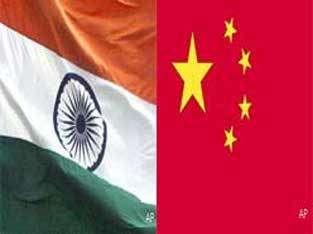
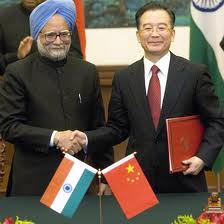
Chinese Premier Wen Jiabao and Indian Prime Minister Manmohan Singh met Thursday in New Delhi, the main event of a three-day summit aimed at building trust and reducing long-standing irritants. But they announced no substantive breakthrough and little progress on border disputes, access to shared water resources or security issues.

Nor was there any apparent progress on India’s bid to open Chinese markets to its software, pharmaceuticals and farm products. New Delhi also remains wary of Beijing’s regional ambitions and its ties with Pakistan, India’s nuclear adversary.
The two rising Asian superpowers made some modest progress on the economic front, pledging to expand trade to $100 billion by 2015 from $60 billion at present and try to reduce the trade gap. China is India’s largest trading partner, but trade flows are heavily weighted in Beijing’s favor.

The two leaders also agreed to set up a hotline, and both sides spoke about the need for improved ties.

“I hope that my visit will help increase our cooperation in a wide range of fields and raise our friendship and cooperation to an even higher level,” Wen told reporters on leaving a welcoming ceremony at the presidential palace.

“A strong partnership between India and China will contribute to long-term peace, stability, prosperity and development in Asia and the world,” Singh added.

But any move to turn the regional cooperation rhetoric into reality will quickly run into roadblocks, analysts said, given the nations’ differences over Iran’s nuclear ambitions, North Korea’s long-standing conflict with the international community and continued warfare in Afghanistan.

China appeared keen to outdo the recent visit to India by President Obama. Chinese officials brought a contingent of 400 business executives, compared with the 250 American business men and women who accompanied the U.S. leader. And they signed $16 billion worth of business deals, compared with America’s $10 billion.

Singh and Wen reportedly discussed many of their nations’ core differences, including Pakistan; divided Kashmir; and the Dalai Lama, the exiled Tibetan spiritual leader based in northern India and considered by Beijing to be a “splittist” enemy of a unified China. But neither side made any significant concessions.

The two nations agreed to keep working on peacefully resolving their lingering border disputes, the focus of a brief war in 1962. Talks have languished for years.

China claims much of the Indian state of Arunachal Pradesh, whereas India wants China to back away from a slice of territory it controls in Kashmir, the disputed region largely divided between India and Pakistan.

“It will not be easy to completely resolve this question,” Wen said in a speech. “It requires patience and will take a fairly long period of time. Only with sincerity, mutual trust and perseverance can we eventually find a fair, reasonable and a mutually acceptable solution.”

In other words, said analysts: Don’t hold your breath. Add it up, they said, and this meeting — the 11th between the two leaders in five years — accomplished relatively little.

“Issues that fuel mutual mistrust, such as Kashmir for the Indians and Tibet for the Chinese, were addressed, but not substantially,” said Srikanth Kondapalli, a professor of Chinese studies at New Delhi’s Jawaharlal Nehru University. “The boundary dispute has not been resolved. There’s no road map.”


Pakistan Consider Pitching up in China

As Reported by Reuters

The Pakistan Cricket Board (PCB) is considering using China as a neutral venue for its international cricket events, Chinese state media said today. The official Xinhua news agency cited sources as saying that the board’s director Javed Miandad had submitted a report to the PCB suggesting its management “take special steps to finalise China as a neutral venue.”

“We should take immediate and solid steps to decide this issue soon before the time passes away,” Miandad was quoted as saying.

Pakistan became a no-go area for cricket’s leading nations after an armed attack on the Sri Lanka team bus in Lahore in March last year killed eight people, and injured seven Sri Lankan players and their assistant coach.

Pakistan was due to host matches in next year’s World Cup. But the attack on the Sri Lanka bus saw the tournament restricted to the three remaining Asian Test nations of India, Bangladesh and Sri Lanka.

Even before the Lahore incident, countries such as Australia had refused to tour Pakistan, where thousands have died in a decade of conflict.

The security situation led Pakistan to play its “home” series against Australia in England this year. In the last two years, the nation’s “home” games have also been staged in the United Arab Emirates and New Zealand.

According to Xinhua, Pakistan will support China in its bid to host the 2012 Asia Cup in the southern city of Guangzhou, where the Asian Games recently concluded successfully with their first-ever cricket tournament.

Pakistani authorities say China’s hosting of its first major international cricket event would pave the way for making it a neutral venue.

Afghan Coach Says He Used India Example To Inspire Team

As Reprted by ESPN CricInfo

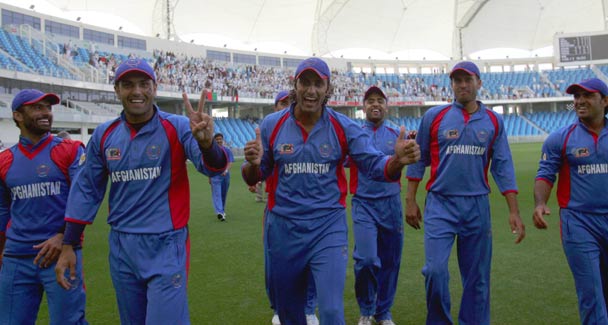
Afghanistan coach Rashid Latif has said he inspired his team for the Asian Games final against Bangladesh by narrating how underdogs India beat the all-conquering West Indies to win the 1983 World Cup. “The Indians were not as fit as their rivals, nor was their skill superior to the West Indies, yet on that day they played better and won,” Latif told AFP. “My team here was the fittest and they had good skills too, but I warned the boys not to take Bangladesh lightly.”

Having stunned favourites Pakistan in the semi-final yesterday, Afghanistan proved worthy opponents against Bangladesh, taking the final to the last over before losing by five wickets.

Latif, the former Pakistan wicketkeeper, said Afghanistan’s ultimate aim was to play Test cricket. “The result proved me right, but I am happy we are on the right path. We will improve further if we play the big teams regularly. The aim is to be a Test nation soon and play against the best. I want to bring youngsters into the game so the sport continues to grow in Afghanistan.”

Afghanistan have made rapid strides, rising through the ranks from the lower divisions of the World Cricket League. They played in the World Twenty20 in the Caribbean earlier this year and narrowly missed qualifying for the 2011 World Cup.

Mohammad Nabi, the Afghanistan captain, said passion for the game kept the players going. “The war has been going on for three decades, but we have been playing cricket there for the last 10 years despite the lack of proper facilities or grounds. Cricket has caught on back home. More people are playing the game or following it on radio and TV.”

Nabi was disappointed to lose the final, but said the silver medal had buoyed his team for the five-day Intercontinental Cup final against Scotland in Dubai from December 2. “We want to play as much as possible, wherever possible. The aim is to join the big league.”

Afghanistan received backing from Bangladesh, who won their country’s first ever Asian Games gold medal. “We are celebrating, but I hope Afghanistan will celebrate too because they deserve the silver medal,” Imran Sarwar, the Bangladesh coach, said. “They are a very good side and I am sure they will become a top team in the near future. Their rise has been remarkable.

“This was not an easy win at all. We expected them to make around 100 or 110, but they went to 118 and then kept us under pressure till the end.”

Pakistanis for Peace Editor’s Note– Congratulations to the Afghan Cricket team for winning the Silver medal at the Asian Games in China. Along the way, they beat traditional cricket playing teams such as Pakistan and Sri Lanka and proved to be worthy competitors. In a country ravaged by over 30 years of war and conflict, the Afghani people should be proud of the accomplishments of their team and build upon this success in uniting their fractured nation.

Wave of Joy Sweeps the Nation

As Reported by Dawn

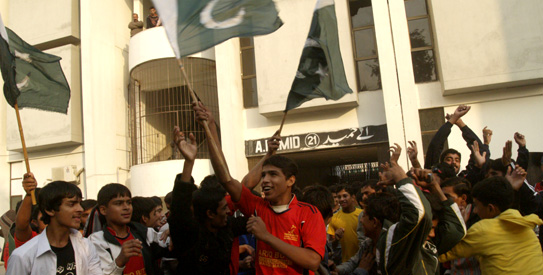
A wave of joy swept across Pakistan as it overcame a lackluster Malaysia in the final of the 16th Asian Games hockey. The win secured for Pakistan its first gold at the Games in 20 years and in the process an automatic berth at the 2012 Olympics in London.

The historic moment was witnessed by a large group of supporters that had thronged the various hockey centers across Pakistan to watch the final on the large screens that had been set up for the day. And the fans weren’t disappointed as their team put up a clinical performance to record a 2-0 win over Malaysia.

“It’s really a huge success for us and it’s extremely good news for the entire nation,” said Nawaz Ali as he waved national flag at a busy intersection of the capital Islamabad with scores of other Green Shirts supporters.

“It is good to see our team winning. We are happy because this is our national game,” said another man waving hockey sticks in joy. He said the victory would boost players’ morale and help them get more victories in future.

In Peshawar, people came out from their homes after the win and performed traditional dance moves to celebrate the moment.

“Hats off to Pakistan hockey players for their memorable win by giving joy and pleasure to 170million people,” a young hockey fan and resident of Qisakhwani, Abdur Rahim said. “The moment when our national anthem was played in China was historic and it would be remembered for a long time.

There were similar scenes in Lahore and Karachi where people even crowded the small TV screens at the international airports to catch a glimpse of the final.

There were also reports that many people at various workplaces extended their lunch to fit in the game that ended around 15:30 pst. The people in question, however, chose to remain anonymous.

Also brimming with delight was the Sports Minister of Pakistan Mir Ejaz Hussain Jakhrani who announced a cash award of Rs 5 million for the gold medal winning hockey team. He also paid glowing tributes to the squash team which also won gold in the team event beating their highly touted Malaysian opponents.

Pakistan Women’s Cricket Team Relishes Spotlight in Guangzhou

As Reported by The China Daily

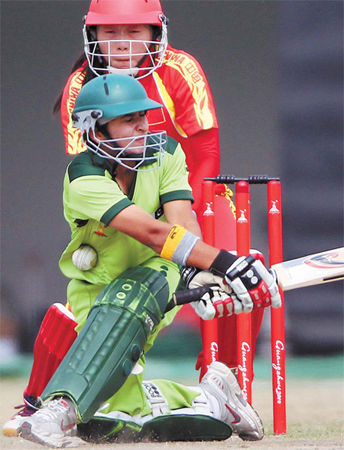
The Guangzhou Asian Games have made Sana Mir, Captain of the Pakistan Women’s Cricket Team, feel like a big-screen star.

Pakistan, the tournament’s No 1 seed, easily won its game against newcomer China by nine wickets on Monday, but that sparkling effort was not what truly impressed Mir.

“We never get this kind of media coverage back at home. I am just so glad the sport made it to the Asian Games,” said the 26-year-old. “There is always TV coverage when the Men’s Cricket Team plays in Pakistan because it is huge, but you never see us playing on big screens or TVs,” she said.

Although Pakistan has 500 to 600 professional women players under the age of 19, and about 1,000 to 1,200 playing at the senior level, they are overshadowed by the men’s game, said Ayesha Ashhar, Manager of the Women’s Team.

“Our earnings can’t compare with what the men make. It’s the love of the sport that keeps us going,” said Mir. “We would like to be treated and rewarded just like the Men’s Team.”

Unlike some of the women players whose families are against them playing due to strict traditions, Mir’s family is happy for her to play the game. “I have to thank my parents and brother for their support, otherwise I couldn’t have made it this far.”

Meanwhile, Ashhar said women’s cricket in Pakistan has improved rapidly over the past two to three years, thanks to an effective domestic structure which helps players to train and progress at a young age.

“The team’s performance at the international level wouldn’t be as good as it is now without that.”

She also said China definitely gave the No 1 seed a surprise in Monday’s match – the first between the two countries.

“For a young team that only has three years’ of history, what China did on the field was excellent – especially the bowling,” the manager said.

Currently all of the Chinese players are converts from other sports, including Rugby, Softball, Volleyball and Athletics.

“Cricket needs many years to become established in a country. For China, the challenge is to attract enough talented players and coaches. But I believe when China chooses to develop a sport, it succeeds,” Ashhar said.

“All we need now is time,” said Liu Rongyao, Manager of China Women’s Team. “In ten years’ time, China will be among the top three women’s teams in Asia.”

The Nexus of US-India-Pakistan Relations

By Manzer Munir for Pakistanis for Peace

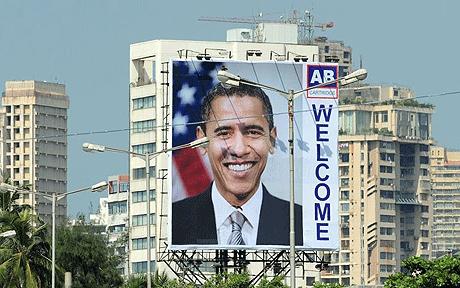
As President Obama wraps up his visit to India in the next day, a couple of things are important to point out about relations between the United States and India as well as how Pakistan fits into the equation.

The balance of power between India and the US still lies with the United States, however, India is set to make more and more gains in becoming more influential as its economy grows and as the United States looks to it to counter China in Asia.

The strategic partnership between the two countries and the importance of India for the United States is going to become vital as America uses India to contain China’s influence in the region and around the world.

We do believe that President Obama is correct in stating that relations between the two countries warrant being called the defining relationship of the century as there is no other country that compliments the United States presently in the world as does India. Not only do both countries share democratic ideals and a multiethnic population, but both countries are also increasingly dependent on each other’s economies. Add to this the nuclear cooperation as well as America’s support for India to get a permanent seat on the UN Security Council, and it becomes evident that this relationship will continue to grow over time.

President Obama has offered criticism on Pakistan already but is careful in trying to walk the tight rope act that is India-Pakistan relations. There are certainly more behind the scene steps taking place that will chide Pakistan into doing more. But in our view, the single most important thing that the US and the Obama administration can do is to help India and Pakistan come back to the table to get the peace process moving along. There is widespread agreement with the President’s assessment that a prosperous and stable Pakistan is in the best interests of India, Afghanistan and the region. In this effort, we believe there needs to be done more by all parties involved.

India’s argument has always been that the terrorist infrastructure and support for some anti-India militant groups needs to end before New Delhi will resume the peace process with Pakistan.

India should not refuse extensive trade relationships with the US due to American support of Pakistan as it does not do anything to help India. India realizes the situation both inside Pakistan and America’s dependency of the Pakistan Army’s support in flushing out the Taliban. It would go against India’s interests if it put its relationship and advancement with the United States as being dependent on American support for Pakistan and its vital assistance in the war in Afghanistan and on terror.

Peace between India and Pakistan and in the Kashmir valley is the only solution to both the conflict between the two nations as well as it is in America’s interests for both countries and the region. Furthermore, peace between the two countries will allow both Pakistan’s full focus on the Afghan border in helping American troops against the Taliban as well as the elimination of anti-India militant groups within Pakistan, many of whom are alleged to still be receiving support from elements within Pakistan’s ISI spy agency, much to India’s chagrin.

America and India: The Almost-Special Relationship

By Jim Yardley for The New York Times

At a panel discussion last week on relations between India and the United States, Strobe Talbott, the former American diplomat, told an audience of Indian business leaders that he had learned a valuable lesson about India: Do not hyphenate it. As in Indo-Pak. (Or, in a close cousin of a hyphen, as in Chindia.) The audience smiled at his epiphany: India matters because it is India.

In a nutshell, President Obama is trying to deliver the same message during his three-day visit to India, the first stop on a broader Asian tour. Both countries are eager to build on their improved ties and set up a unique, special relationship, given that together they represent the world’s richest and largest democracies. Faced with a rising authoritarian China, and an economically wounded Europe, a weakened United States is casting about for global partners. India would seem a nice fit.

“This is the time to be ambitious about this relationship,” said Shivshankar Menon, India’s national security adviser, speaking on the panel with Mr. Talbott.

And yet eliminating the hyphen is not easy, especially given India’s fraught relations with its neighbors in what is perhaps the most politically complicated region on earth, one in which American lives and treasure are at stake in Pakistan and Afghanistan. And India’s evolving relationship with another neighbor, China, is also a prime concern for America. Indeed, the decision to focus Mr. Obama’s India trip on India was itself not easily achieved; some senior administration officials lobbied the president to put pressure on Indian leaders for a conciliatory gesture toward Pakistan, in hope that such a carrot might entice the Pakistanis to do more to help America against the Taliban.

These sorts of political equations have long tangled the U.S.-India relationship: The Americans, at different times, have pushed the Indians to cut a deal with Pakistan over the disputed region of Kashmir, but the Indians have bristled at any interference. The Indians still want the Americans to sponsor India for a permanent seat on the United Nations Security Council. Not such an easy thing, the Americans reply, since America alone can’t do this and it creates issues between America and China. It has sometimes seemed like a relationship built around one country asking the other to do something it considers against its self-interest.

Moreover, the economic relationship between the two countries often has been a source of friction. High unemployment in America has renewed complaints that outsourcing to India hurts American workers. Indians complain that American protectionism is hurting Indian companies and that American export restrictions on technologies that can have both military and civil uses are outdated and unnecessary in a relationship between putative allies.

Mr. Obama’s trip is an attempt to reboot or refocus the relationship away from these disputes and de-emphasize the tangible goodies (for example, contracts) that politicians call “deliverables.” Instead, the two sides are discussing how they can partner on education, clean energy, agriculture, technological development and military cooperation. The thematic emphasis of the visit is on shared democratic values — a pointed dig at China — and what the two countries say are shared opportunities. American officials say that an expected $4 billion deal for India to buy military transport aircraft — yes, a goodie — will provide thousands of American jobs. Indian officials emphasize that trade between the two countries is basically balanced — unlike with China — and that the anger over outsourcing is misplaced, especially since some Indian companies are investing and creating jobs in the United States.

Some Indian commentators have groused that all the diplospeak about shared opportunities obscures the fact that the trip lacks a “big idea” to excite or elevate the relationship, even as big, unavoidable problems are seemingly being avoided. In 2000, former President Bill Clinton spent five days in India on a door-opening visit that was credited with righting what had been a stalled relationship. Then former President George W. Bush made the most dramatic gesture by pushing through an agreement to cooperate on civilian nuclear projects; the move effectively legitimized India as a nuclear power and lifted a 30-year moratorium on nuclear trade with India even though India had not signed the Nuclear Nonproliferation Treaty. By comparison, Mr. Obama seems not to be offering much.

“The jury is out,” said Shekhar Gupta, editor of The Indian Express, speaking of how India’s political establishment views Mr. Obama.

But Ronen Sen, who recently retired from India’s diplomatic corps after serving as ambassador to the United States, says the focus on a “big idea” is misplaced. Given the litany of difficult problems between the two countries, Mr. Sen said, Mr. Obama’s approach was a reasonable way to build trust and broaden a bilateral relationship that, while greatly improved, had not yet fully matured.

“It has not yet reached a critical mass where it can be self sustaining,” Mr. Sen said.

Indeed, even the landmark civil nuclear deal remains a subject of dispute as the two sides still squabble over fine details of how American suppliers could begin doing business in the lucrative Indian market. The Americans say that rules recently approved by India are inconsistent with accepted global practice, which exempts foreign suppliers from liability in cases of accidents, leaving it solely with local operators. A senior American official said “intense discussions” were underway to find a solution. If one is found, Mr. Obama may get a nice “deliverable” — an open door through which American firms, as originally expected, can sell nuclear equipment to India and provide jobs at home.

There is less talk of the chances of solving bigger problems, like differences between America and India in global negotiations on global warming climate change and trade. And the uncertainty over the most problematic hyphens — Afghanistan and Pakistan — looms over the visit. Even as Mr. Obama seeks a way to stabilize Afghanistan and get out, Indian officials dread the day America leaves. They worry about what will be left behind, since India cannot leave the neighborhood.

“Quite obviously, we have strategic stakes there,” said Brig. Gurmeet Kanwal, director of the Center for Land Warfare Studies, a military research institute. “We do not wish to have a government in Afghanistan or a government in Kabul that is inimical to Indian interests.”

He added: “We see the United States as a stabilizing influence in Asia.”

And so a political courtship will continue, problems and all. Governmental ties already lag far behind the people-to-people relationships. America remains the premier destination for Indian students studying abroad, and Indian immigrants in America have achieved disproportionate success in business, medicine and many other fields. It is this backchannel closeness that serves as a cattle prod nudging the governments to become closer, too.

K. Subrahmanyam, a leading Indian defense analyst, believes that India and the United States represent the inevitable and necessary partnership of the 21st century because China’s rise represents a threat to a global order based on democratic principles. He said that demographic trends, too, should bind the two countries together.

“If America needs a partner, Europe is aging, Japan is aging and China is going to age,” he said. “The only two major nations in the world who will not be aging, at least for the next 30 years, are the United States and India.”

Flood Relief: A US Helicopter Pilot’s Tale

By John Bockmann for The Express Tribune

I am an American helicopter pilot in Pakistan.  My colleagues and I came because Pakistan and its people are enduring the aftermath of a devastating flood.  We were ordered to be here, and we miss our homes, but most of us are glad to help because we believe it’s the right thing to do.

I did not know much about Pakistan before I arrived here.  I knew of the food.  I knew of monsoons and Mohenjo Daro, Karachi and the Khyber Pass, but I had no concept of what Pakistan looked, felt, or sounded like. I even thought many Pakistanis would want us to leave.

I had no idea what the people would be like in person.  I wondered if they would resemble the images I’d seen on TV – would they protest our presence in the streets?  Would they tolerate us?  Or would they simply ignore us and go about their business?

After a few weeks of packing and planning, we were ready to deploy.  Full of excitement and some anxiety, I kissed my wife, took one last picture and was gone. We flew on a cargo jet from Alaska to Islamabad and the flight took so long I hardly knew whether it was day or night when we finally arrived.  Shouldering my gear, I headed to the terminal, weaving among Pakistani military and civilians on the tarmac.  A US Marine captain guided my group inside where we filled out information cards and relaxed in the cool quietness, surveying our area; smooth stone floors, low-slung furniture, and ceiling fans spinning high above.  The captain was talking to a Pakistani man who had been helping us.  Before we left, the man shook my hand and looked me in the eyes. “Thank you for coming to my poor country,” he said quietly.

I wanted to convey the depth of my feelings toward him and his homeland, but all I said was, “You would probably do the same for us” as I walked away.

That was my first interaction with a Pakistani here.

The days since arriving have passed quickly.  Every day we take rice, flour, blankets, housing materials, cooking oil – anything – up and down the Swat and Indus River Valleys.  We also bring sick, injured, and displaced people to hospitals and hometowns.

My first mission took us up the Indus river valley, and I embarrassed myself by constantly exclaiming its beauty.  Below me was the Karakorum Highway – the old Silk Road into China – and the valley itself, with terraced farmland overshadowed by majestic, snow-capped mountains.

Along with the beauty, though, I see reminders of the flood, bridges that are broken or missing and roads and fields that have been washed away.  I am beginning to see widespread reconstruction now as well and feel hope for the people in these villages.  They will soon have another way to get help.

I realize that some who read this will question our intentions and some may even wish us ill.  I certainly did not imagine that cheering throngs would greet us at each village though – we are always welcomed.  I did not expect our goodwill to be taken at face value by all of Pakistan, but we have received immense support.

I have learned in my time here that Pakistani people are truly gracious.  Strangers have invited me for chai and conversation.  Almost anyone will shake my hand and ask my name, inquire about my health and how I am getting along.  Instead of a handshake at our first meeting, I have sometimes been embraced.  “Strangers shake hands,” my new friend Mahmood explained, “but brothers hug each other.”

This warms my heart.  My mission, our mission, is straightforward, noble, and good.  I am deeply grateful to those who support us here, for we need all the help we can get in order to help those in need.   I am honored to do this work. I feel at home here beyond anything I could have expected.

Ah, home!  I miss my home, my wife and family; each day I wonder when I will see them again. But we have a humanitarian mission to accomplish.  Since I must be away, I’m glad that I am here, doing work that’s needed and good.

When I do return home, I will bring with me hundreds of pictures, dozens of journal entries, six duffel bags, and several recipes for local dishes that I have enjoyed, but I will also bring innumerable memories that I will treasure for life — memories of Pakistan and its people.  They have surprised me with friendship.  I hope that through our work of compassion we may surprise them with friendship as well.

How to Restore the American Dream

By Fareed Zakaria for Time

The American dream for me, growing up in India in the 1970s, looked something like the opening credits of Dallas. The blockbuster TV series began with a kaleidoscope of big, brassy, sexy images — tracts of open land, shiny skyscrapers, fancy cars, cowboy businessmen and the very dreamy Victoria Principal. We watched bootlegged copies of the show, passed around on old Betamax cassettes. America (certainly the CBS soap-opera version of America) seemed dazzling and larger than life, especially set against the stagnant backdrop of India in the 1970s. Everyone I knew was fascinated by the U.S., whether they admitted it or not. Politicians who denounced the country by day would go home in the evenings and plot to send their kids to college in “the States.”

Of course, the 1970s were actually tough times in America — stagflation, malaise, the aftermath of Vietnam and Watergate — but they were brutal in the rest of the world. Hyperinflation racked most third-world countries; coups and martial law were familiar occurrences, even affecting staunchly democratic India, where emergency rule was enforced from 1975 to 1977. Set against this atmosphere of despair, the U.S. looked like a shining city on a hill.

A few years later, when I got to America on a college scholarship, I realized that the real American Dream was somewhat different from Dallas. I visited college friends in their hometowns and was struck by the spacious suburban houses and the gleaming appliances — even when their parents had simple, modest jobs. The modern American Dream, for me, was this general prosperity and well-being for the average person. European civilization had produced the great cathedrals of the world. America had the two-car garage. And this middle-class contentment created a country of optimists. Compared with the fatalism and socialist lethargy that was pervasive in India those days, Americans had a sunny attitude toward life that was utterly refreshing.

But when I travel from America to India these days, as I did recently, it’s as if the world has been turned upside down. Indians are brimming with hope and faith in the future. After centuries of stagnation, their economy is on the move, fueling animal spirits and ambition. The whole country feels as if it has been unlocked. Meanwhile, in the U.S., the mood is sour. Americans are glum, dispirited and angry. The middle class, in particular, feels under assault. In a Newsweek poll in September, 63% of Americans said they did not think they would be able to maintain their current standard of living. Perhaps most troubling, Americans are strikingly fatalistic about their prospects. The can-do country is convinced that it can’t.

Americans have good reasons to worry. We have just gone through the worst recession since the Great Depression. The light at the end of the tunnel is dim at best. Sixteen months into the recovery, the unemployment rate is higher than it was in the depths of all but one of the postwar recessions. And as government spending is being pared back, the economy is showing new signs of weakness.

Some experts say that in every recession Americans get gloomy and then recover with the economy. This slump is worse than most; so is the mood. Once demand returns, they say, jobs will come back and, with them, optimism. But Americans are far more apprehensive than usual, and their worries seem to go beyond the short-term debate over stimulus vs. deficit reduction. They fear that we are in the midst of not a cyclical downturn but a structural shift, one that poses huge new challenges to the average American job, pressures the average American wage and endangers the average American Dream. The middle class, many Americans have come to believe, is being hollowed out. I think they are right.

Going Global
For a picture of the global economy, look at America’s great corporations, which are thriving. IBM, Coca-Cola, PepsiCo, Google, Microsoft, Apple, Intel and Caterpillar are all doing well. And they share a strategy that is becoming standard for success. First, technology has produced massive efficiencies over the past decade. Jack Welch explained the process succinctly on CNBC last September. “Technology has changed the game in jobs,” he said. “We had technology bumping around for years in the ’80s and ’90s, and [we were] trying to make it work. And now it’s working … You couple the habits [of efficiency] from a deep recession [with] an exponential increase in technology, and you’re not going to see jobs for a long, long time.” Welch gave as an example a company owned by the private-equity firm with which he is affiliated. In 2007 the business had 26,000 employees and generated $12 billion in revenue. It will return to those revenue numbers by 2013 but with only 14,000 employees. “Companies have learned to do more with less,” Welch said.

Next, companies have truly gone global. The companies on the S&P 500 generate 46% of their profits outside the U.S., and for many of the biggest American names, the proportion is much higher. You might think of Coca-Cola as the quintessentially American company. In fact it is a vast global enterprise, operating in 206 countries. “We have a factory in Ramallah that employs 2,000 people. We have a factory in Afghanistan. We have factories everywhere,” explains Muhtar Kent, the CEO of Coke. Nearly 80% of Coca-Cola’s revenue comes from outside the U.S., and an even greater percentage of its employees are in foreign countries. “We are a global company that happens to be headquartered in Atlanta,” says Kent.

America’s great corporations access global markets, easy credit, new technologies and high-quality labor at a low price. Many have had to cut jobs at home, where demand is weak, and have added them in the emerging markets that are booming. They are not “outsourcing” jobs. That word makes little sense anymore. They simply invest in growth areas and cut back in places where the economy is weak. None of them will ever give up on the American market — it is too large, too profitable and too central to their businesses — but the marginal dollar is more likely to be invested abroad than in the U.S.

While businesses have a way to navigate this new world of technological change and globalization, the ordinary American worker does not. Capital and technology are mobile; labor isn’t. American workers are located in America. And this is a country with one of the highest wages in the world, because it is one of the richest countries in the world. That makes it more difficult for the American middle-class worker to benefit from technology and global growth in the same way that companies do.

At this point, economists will protest. Historically, free trade has been beneficial to rich and poor. By forcing you out of industries in which you are inefficient, trade makes you strengthen those industries in which you are world-class. That’s right in theory, and it has been right in practice. As countries have traded with one another over the past two centuries, they have prospered, and average living standards in those countries (primarily in the Western world) have soared. Those places that kept themselves protected (mostly communist and third-world nations) found that they had crappy industries, shoddy goods, massive corruption and slow growth.

And yet something feels different this time. Technology and globalization are working together at warp speed, creating a powerful new reality. Many more goods and services can now be produced anywhere on the globe. China and India have added literally hundreds of millions of new workers to the global labor pool, producing the same goods and services as Western workers at a fraction of the price. Far from being basket-case economies and banana republics, many developing economies are now stable and well managed, and companies can do business in them with ease. At some point, all these differences add up to mean that global competition is having quite a new impact on life in the U.S.

Two weeks ago, for example, I sat in a Nano, the revolutionary car being produced by Tata Motors in India. It’s a nice, comfortable midgetmobile, much like Mercedes-Benz’s Smart car, except that rather than costing $22,000, it costs about $2,400. Tata plans to bring it to the U.S. in two to three years. Properly equipped with air bags and other safety features, it will retail at $7,000. Leave aside the car itself, whose price will surely put a downward pressure on U.S. carmakers. Just think about car parts. Every part in the Nano is made to global standards but manufactured in India at about a tenth of what it would cost in America. When Ford orders its next set of car parts, will they be made in Michigan or Mumbai?

This is not a hypothetical. Steven Rattner, who helped restructure the automobile industry, tells the story of getting a new General Motors plant online in Michigan by bringing management and unions together. “The unions agreed to allow 40% of the new plant to operate at $14-an-hour wages,” he says, “which is half of GM’s normal wages. The management agreed to invest in this new plant. But here’s the problem: workers at GM’s Mexican operations make $7 an hour, and today they are as productive as American workers. And think of this: $14 an hour translates into about $35,000 a year. That’s below the median family income. The whole experience left me frightened about the fate of the American worker.”

Alan Blinder is also worried. A distinguished economist and Princeton professor, Blinder is a former vice chairman of the board of governors of the Federal Reserve. In a now famous essay in Foreign Affairs, he argues that while we recognize the pressures placed on manufacturing jobs by international competition, technology ensures that service jobs are now similarly exposed. Since the service sector is a much larger part of the economy, Blinder estimates that 28 million to 42 million jobs will be “susceptible” to being shipped offshore — jobs such as customer-service representative and stock analyst, which we tend to think of as local. Blinder understands the benefits of free trade but worries that the new wave of offshoring is so big and fast that Western societies will have difficulty adjusting. The crucial distinction for the future, he argues, might be not between highly educated and less educated workers but between those jobs that can be done abroad and those — such as nurse or pilot — that cannot.

You can divide the American workforce in many ways, but any way you slice it, you see the same trend. People who get paid a decent wage for skilled but routine work in manufacturing or services are getting squeezed by a pincer movement of technology and globalization. David Autor, an MIT economist, has done an important study on what he calls “the polarization of job opportunities” in America. Autor finds that job growth divides neatly into three categories. On one side are managerial, professional and technical occupations, held by highly educated workers who are comfortable in the global economy. Jobs have been plentiful in this segment for the past three decades. On the other end are service occupations, those that involve “helping, caring for or assisting others,” such as security guard, cook and waiter. Most of these workers have no college education and get hourly wages that are on the low end of the scale. Jobs in this segment too have been growing robustly.

In between are the skilled manual workers and those in white collar operations like sales and office management. These jobs represent the beating heart of the middle class. Those in them make a decent living, usually above the median family income ($49,777), and they mostly did fine in the two decades before 2000. But since then, employment growth has lagged the economy in general. And in the Great Recession, it has been these middle-class folks who have been hammered. Why? Autor is cautious and tentative, but it would seem that technology, followed by global competition, has played the largest role in making less valuable the routine tasks that once epitomized middle-class work.

Recapturing the Dream
So what is the solution? It’s easier to identify the wrong answer than the right one. It would be pointless and damaging to try to go down a protectionist route, though polls show a stunning drop of support for free trade, even among college-educated professionals, its usual cheerleaders. But technology is a much larger driver of the hollowing out than trade. You cannot shut down this new world. How would you stop people from sending one another e-mails, which is what a lot of offshoring comes down to these days? Nor can you help a modern economy by shielding industries from world-class competitors, which just encourages greater inefficiency. I grew up in an economy made up of those kinds of industries, all tightly protected from “foreign exploitation and domination.” It added up to stagnation and backwardness.

There are solutions, but they are hard and involve painful changes — in companies, government programs and personal lifestyles. For more than a generation, Americans have been unwilling to make these adjustments. Instead, we found an easier way to goose the economy: expand consumption. During the early 1950s, personal consumer expenditures made up 60% to 65% of the U.S.’s GDP. But starting in the early 1980s, facing slower growth, we increased our personal spending substantially, giving rise to new economic activity in the country. Consumption grew to 70% of GDP by 2001 and has stayed there ever since. Unfortunately, this rise in consumption was not triggered by a rise in income. Wages have been largely stagnant. It was facilitated, rather, by an increase in credit, so that now the average American family has no fewer than 13 credit cards. Household debt rose from $680 billion in 1974 to $14 trillion in 2008. This pattern repeated itself in government, except on a much larger scale. People everywhere — from California to New Jersey — wanted less taxes but more government. Local, state and federal governments obliged, taking on massive debts. A generation’s worth of economic growth has been generated by an unsustainable expansion of borrowing.

That is why the current economic debate between another stimulus and deficit reduction is frustrating. Right now, there is a strong case for government stimulus, since no one else is doing much spending. But then what? What happens after another year of federal spending? Consumers still might be cautious; do we really want them to spend like they did in the old days? Is the strategy simply to reinflate the housing bubble? In recent years, the left and the right in America have conspired in feeding consumption spending. The left expands government, much of which means more consumption (pensions, health care). The right focuses obsessively on tax cuts, which have a similar effect. The political system, pandering to today’s constituents, encourages both tendencies. But when will we invest for our children’s economy?

What We Need to Do Now
Ultimately American jobs are created from the bottom up by companies, not from the top down by government fiat. But there are measures we can take that will encourage the process. Here are the key ones:

Shift from consumption to investment. Fundamentally, America needs to move from consumption to investment. Everyone agrees that the best way to create good jobs in the U.S. is to create new industries and companies and to innovate within old ones. This means large investments in research, technology and development. As a society, this needs to become our strongest focus.

Despite substantial increases and important new projects under the Obama Administration, the federal government is still not spending as much on R&D as a percentage of GDP as it did in the 1950s. I would argue that it should be spending twice that level, which would be 6% of GDP. In the 1950s, the U.S. had a huge manufacturing base that could absorb millions of semiskilled workers. Today, manufacturing is a small part of the economy and faces intense global competition. The only good jobs that will stay in the U.S. are jobs related to knowledge and innovation. Additionally, in the 1950s, America was the only research lab in town, accounting for the vast majority of global scientific spending. Today, countries around the world are entering the arena. Two weeks ago, South Korea — a country of just 50 million people! — announced plans to invest $35 billion in renewable-energy projects. We should pay for this with a 5% national sales tax — call it an American innovation tax — which would be partly offset by a small reduction in income taxes. This would have the twin benefits of tamping down consumption and yielding some additional funds. All the proceeds from the tax should be focused on future generations, because we need to invest massively in growth.

The often overlooked aspect of investment is investment in people. America has been able to create the future in large measure because it has tapped into the energies and work of immigrants. It has managed to invest in human capital by taking smart, motivated people from around the globe, educating them in the planet’s best higher-education system and then unleashing them in a dynamic economy. In this crucial realm, the U.S. is now disinvesting. After training the world’s best and brightest — often at public expense — we don’t find ways to make sure they stay here by giving them a green card but rather insist that they leave and take their knowledge to another country, where they will invent, inspire, build and pay taxes. Every year, we send tens of thousands of the smartest Indians and Chinese back home, which is a great investment — in the future of those countries.

Training and education. “Most jobs that will have good prospects in the future will be complicated,” says Louis Gerstner, the former CEO of American Express and IBM. “They will involve being able to juggle data, symbols, computer programs in some way or the other, no matter what the task. To do this, workers will need to be educated and often retrained.” We need more and better education at every level, especially job retraining. So far, most retraining efforts in the U.S. have not worked very well. But they have worked in countries that have been able to retain a manufacturing base, like Germany and parts of Northern Europe. There, some of the most successful programs are apprenticeships — which cover only 0.3% of the total U.S. workforce.

There are advantages to the U.S. system. We don’t stream people too early in their lives, and we allow for more creative thinking. But the path to good jobs for the future is surely to expand apprenticeship programs substantially so industry can find the workers it needs. This would require a major initiative, a training triangle in which the government funds, the education system teaches and industry hires — though to have an effect, the program would have to be on the scale of the GI Bill.

Fiscal sanity. To pay for such initiatives, the government needs to get its house in order. The single most important aspect of this is getting health care costs under control, followed by other entitlement programs, especially pensions at the state level. Government today spends vast sums of money on current consumption — health care and pensions being a massive chunk of it — which leaves little money for anything else. We need a radical rebalancing of American government so it can free up resources to fund future growth.

Benchmark, benchmark, benchmark. There is now global competition for growth, which means the U.S. has to constantly ask itself what other countries are doing well and how it might adapt — looking, for example, at what other countries are doing with their corporate tax rates or their health care systems and asking why and where we fall short. Americans have long resisted such an approach, but if someone else is doing tax policy, tort litigation, health care or anything else better, we have to ask why.

There are things the U.S. does well. Most new jobs in America are created by start-ups and small companies, so the ease of doing business is crucial — and there’s good news there. The World Bank has a ranking of countries measured by the “ease of doing business,” and the U.S. is No. 4. That’s very good, but there’s a catch. Those rankings are divided into several categories. In most, like “starting a business,” the U.S. does well. But in one category it’s only 61st in the world, and that is “paying taxes.”

The American tax code is a monstrosity, cumbersome and inefficient. It is 16,000 pages long and riddled with exemptions and loopholes, specific favors to special interests. As such, it represents the deep, institutionalized corruption at the heart of the American political process, in which it is now considered routine to buy a member of Congress’s support for a particular, narrow provision that will be advantageous for your business.

The Work Ahead
My proposals are inherently difficult because they ask the left and right to come together, cut some spending, pare down entitlements, open up immigration for knowledge workers, rationalize the tax code — and then make large investments in education and training, research and technology, innovation and infrastructure. But the fact that it is a solution that crosses political borders should make it more palatable, not less. And time is crucial. The U.S. has considerable advantages, but every day other countries try to find ways to attract growth within their borders. People often note that America’s political system is broken. Perhaps the truth is more awkward: America needs radical change, and it has an 18th century system determined to check and balance the absolute power of a monarchy. It is designed for gridlock at a moment when quick and large-scale action is our only hope.

When I left India, the marginal tax rate was 97.5%, corporate taxation was punitive, and business was stifled or went underground. Were I to move from New York City to Mumbai today, my personal tax rate would drop, as would every other rate, from corporate to capital-gains taxes. (The long-term capital-tax rate in India is zero.) Singapore now ranks as the No. 1 country for ease of doing business, with a top tax rate of 20%. I know permanent residents working in the U.S. who are thinking of giving up their green cards to move to Singapore. To an Indian of my generation, this would have been unthinkable. The green card was a passport to the American Dream. But for young Indians, there are many new dreams out there, and new passports.

But there are reasons for optimism. The U.S. faces huge challenges, but it also has enormous advantages. “I’ve always been bullish on America,” says Coke’s Kent. “It’s the largest, richest market in the world. Look at the demographics alone. North America is the only part of the industrialized world that will be growing in people. It now has a higher birthrate than Mexico, for the first time in history.” Or listen to Alcoa’s German-born Klaus Kleinfeld, previously the head of Siemens: “I know the things that America has that are unique. The openness, the diversity, the dynamism — you don’t have it anywhere else. If you keep all these things, build on them, I still believe in the American Dream.”

The term American Dream was coined during the Great Depression. The historian James Truslow Adams published The Epic of America in 1931, in an atmosphere of even greater despair than today’s. He wanted to call his book The American Dream, but his publishers objected. No one will pay $3.50 for a book about a “dream,” they said. Still, Adams used the phrase so often that it entered the lexicon. The American Dream, he said, was of “a better, richer and happier life for all our citizens of every rank, which is the greatest contribution we have made to the thought and welfare of the world. That dream or hope has been present from the start. Ever since we became an independent nation, each generation has seen an uprising of ordinary Americans to save the American Dream from the forces which appear to be overwhelming it.”

Today, those forces really do look overwhelming. But challenges like them have been beaten back before — and can be again.

Fareed Zakaria is a journalist, author and host of his show on CNN. His special Restoring the American Dream: A Fareed Zakaria GPS Special will air on CNN at 9 p.m. E.T. and P.T. on Saturday, Oct. 30, and at 10 a.m. E.T. and P.T. on Sunday, Oct. 31.
Playboy Son of Norh Korean Leader Raps Succession Plan

By Anita Chang for The Assoicated Press

BEIJING – The casino-loving eldest son of North Korea’s Kim Jong Il — once tipped to succeed him before trying to sneak into Japan to go to Disneyland — says he opposes a hereditary transfer of power to his youngest half-brother.

It’s the first public sign of discord in the tightly choreographed succession process, though analysts said Kim Jong Nam spends so much time outside his native land that his opinion carries little weight.

The chubby 39-year-old Kim, the oldest of three brothers who were in the running to take over secretive North Korea, is the closest thing the country has to a playboy.

Unlike many of his countrymen back home who lack the resources and connections to travel overseas, Kim travels freely and spends much of his time in China or the country’s special autonomous region of Macau — the center of Asian gambling with its Las Vegas-style casinos.

He sports the family pot belly and favors newsboy caps and an unshaven face, while frequenting five-star hotels and expensive restaurants. In June, he was photographed in Macau wearing blue Ferragamo loafers.

Speaking in Korean, he told Japan’s TV Asahi, in an interview from Beijing aired late Monday and Tuesday, that he is “against third-generation succession,” but added, “I think there were internal factors. If there were internal factors, (we) should abide by them.”

“I have no regrets about it. I wasn’t interested in it and I don’t care,” Kim said, when asked whether he is OK with the succession plan.

Kim said he hopes his brother will do his best to bring abundance to the lives of North Koreans and that he stands ready to help from abroad, according to a dubbed Japanese-language version of his remarks.

Kim Jong Un, believed to be 26, appeared with his father at Pyongyang celebrations on Sunday marking the 65th anniversary of the ruling Workers’ Party, saluting troops marching past in a massive military parade and waving to the crowd. The appearance was less than two weeks after he was named to a top political post and promoted to four-star general.

Andrei Lankov, a Russian expert on North Korea at Seoul’s Kookmin University, said Kim Jong Nam’s remarks were “almost a challenge,” but noted he has little influence due to the considerable time he spends abroad and lacks military support.

“I don’t see them rallying to Kim Jong Nam,” he added, emphasizing that key generals who run the military far prefer Kim Jong Un, who they see as young, inexperienced and thus easy to control.

Kim Jong Il is known to have three sons — one from his second wife and two from his third. He favors his youngest, Jong Un, who looks and is said to act like his father, according to the leader’s former sushi chef. He studied at a Swiss school and learned to speak English, German and French, news reports have said.

In contrast, Kim often derided the middle son, Jong Chul, as “girlish,” the chef, who goes by the pen name Kenji Fujimoto, said in a 2003 memoir. Little is publicly known about the brother, except that he also studied in Switzerland and is a fan of U.S. professional basketball.

Jong Nam is widely believed to have fallen out of favor after embarrassing the government in 2001 by being caught trying to enter Japan on a fake passport, saying he wanted to visit Tokyo Disneyland.

Experts said Kim Jong Nam will most likely continue living abroad, with fewer reasons than ever to return to Pyongyang.

“In the future Kim Jong Nam will have little influence on the political situation in North Korea. It’s very unlikely he will go back. His force within the country is now almost nonexistent,” said Cai Jian, deputy director of the Center for Korean Studies in Shanghai’s Fudan University.

China and India: Contest of the Century

As reported by The Economist

A HUNDRED years ago it was perhaps already possible to discern the rising powers whose interaction and competition would shape the 20th century. The sun that shone on the British empire had passed midday. Vigorous new forces were flexing their muscles on the global stage, notably America, Japan and Germany. Their emergence brought undreamed-of prosperity; but also carnage on a scale hitherto unimaginable.

Now digest the main historical event of this week: China has officially become the world’s second-biggest economy, overtaking Japan. In the West this has prompted concerns about China overtaking the United States sooner than previously thought. But stand back a little farther, apply a more Asian perspective, and China’s longer-term contest is with that other recovering economic behemoth: India. These two Asian giants, which until 1800 used to make up half the world economy, are not, like Japan and Germany, mere nation states. In terms of size and population, each is a continent—and for all the glittering growth rates, a poor one.

Not destiny, but still pretty important

This is uncharted territory that should be seen in terms of decades, not years. Demography is not destiny. Nor for that matter are long-range economic forecasts from investment banks. Two decades ago Japan was seen as the main rival to America. Countries as huge and complicated as China can underachieve or collapse under their own contradictions. In the short term its other foreign relationships may matter more, even in Asia: there may, for instance, be a greater risk of conflict between rising China and an ageing but still powerful Japan. Western powers still wield considerable influence.

So caveats abound. Yet as the years roll forward, the chances are that it will increasingly come down once again to the two Asian giants facing each other over a disputed border (see article). How China and India manage their own relationship will determine whether similar mistakes to those that scarred the 20th century disfigure this one.

Neither is exactly comfortable in its skin. China’s leaders like to portray Western hype about their country’s rise as a conspiracy—a pretext either to offload expensive global burdens onto the Middle Kingdom or to encircle it. Witness America’s alliances with Japan and South Korea, its legal obligation to help Taiwan defend itself and its burgeoning friendships with China’s rivals, notably India but also now Vietnam.

This paranoia is overdone. Why shouldn’t more be asked from a place that, as well as being the world’s most-populous country, is already its biggest exporter, its biggest car market, its biggest carbon-emitter and its biggest consumer of energy (a rank China itself, typically, contests)? As for changing the balance of power, the People’s Liberation Army’s steady upgrading of its technological capacity, its building of a blue-water navy and its fast-developing skills in outer space and cyberspace do not yet threaten American supremacy, despite alarm expressed this week about the opacity of the PLA’s plans in a Pentagon report. But China’s military advances do unnerve neighbours and regional rivals. Recent weeks have seen China fall out with South Korea (as well as the West) over how to respond to the sinking in March, apparently by a North Korean torpedo, of a South Korean navy ship. And the Beijing regime has been at odds with South-East Asian countries over its greedy claim to almost all of the South China Sea.

India, too, is unnerved. Its humiliation at Chinese hands in a brief war nearly 50 years ago still rankles. A tradition of strategic mistrust of China is deeply ingrained. India sees China as working to undermine it at every level: by pre-empting it in securing supplies of the energy both must import; through manoeuvres to block a permanent seat for India on the United Nations Security Council; and, above all, through friendships with its smaller South Asian neighbours, notably Pakistan. India also notes that China, after decades of setting their border quarrels to one side in the interests of the broader relationship, has in recent years hardened its position on the disputes in Tibet and Kashmir that in 1962 led to war. This unease has pushed India strategically closer to America—most notably in a controversial deal on nuclear co-operation.

Autocrats in Beijing are contemptuous of India for its messy, indecisive democracy. But they must see it as a serious long-term rival—especially if it continues to tilt towards America. As recently as the early 1990s, India was as rich, in terms of national income per head. China then hurtled so far ahead that it seemed India could never catch up. But India’s long-term prospects now look stronger. While China is about to see its working-age population shrink (see article), India is enjoying the sort of bulge in manpower which brought sustained booms elsewhere in Asia. It is no longer inconceivable that its growth could outpace China’s for a considerable time. It has the advantage of democracy—at least as a pressure valve for discontent. And India’s army is, in numbers, second only to China’s and America’s: it has 100,000 soldiers in disputed Arunachal Pradesh (twice as many as America will soon have in Iraq). And because India does not threaten the West, it has powerful friends both on its own merits and as a counterweight to China.

A settlement in time

The prospect of renewed war between India and China is, for now, something that disturbs the sleep only of virulent nationalists in the Chinese press and retired colonels in Indian think-tanks. Optimists prefer to hail the $60 billion in trade the two are expected to do with each other this year (230 times the total in 1990). But the 20th century taught the world that blatantly foreseeable conflicts of interest can become increasingly foreseeable wars with unforeseeably dreadful consequences. Relying on prosperity and more democracy in China to sort things out thus seems unwise. Two things need to be done.

First, the slow progress towards a border settlement needs to resume. The main onus here is on China. It has the territory it really wants and has maintained its claim to Arunachal Pradesh only as a bargaining chip. It has, after all, solved intractable boundary quarrels with Russia, Mongolia, Myanmar and Vietnam. Surely it cannot be so difficult to treat with India?

That points to a second, deeper need, one that it took Europe two world wars to come close to solving: emerging Asia’s lack of serious institutions to bolster such deals. A regional forum run by the Association of South-East Asian Nations is rendered toothless by China’s aversion to multilateral diplomacy. Like any bully, it prefers to pick off its antagonists one by one. It would be better if China and India—and Japan—could start building regional forums to channel their inevitable rivalries into collaboration and healthy competition.

Globally, the rules-based system that the West set up in the second half of the 20th century brought huge benefits to emerging powers. But it reflects an out-of-date world order, not the current global balance, let alone a future one. China and India should be playing a bigger role in shaping the rules that will govern the 21st century. That requires concessions from the West. But it also requires commitment to a rules-based international order from China and India. A serious effort to solve their own disagreements is a good place to start.

Female Imams Blaze Trail Amid China’s Muslims

By Louisa Lim for National Public Radio

It is 5:50 in the morning, and dark shadows scurry through narrow alleys to the mosque, as the call to prayer echoes from a minaret in Kaifeng. This city in central China’s Henan province has an Islamic enclave, where Muslims have lived for more than 1,000 years.

In an alleyway called Wangjia hutong, women go to their own mosque, where Yao Baoxia leads prayers. For 14 years, Yao has been a female imam, or ahong as they are called here, a word derived from Persian.

As she leads the service, Yao stands alongside the other women, not in front of them as a male imam would. But she says her role is the same as a male imam. “The status is the same,” Yao says confidently. “Men and women are equal here, maybe because we are a socialist country.”                                        

Yao Baoxia is a female ahong, or imam, at Wangjia Hutong Women’s Mosque in Kaifeng, in central China. She sits alongside believers during prayers, not in front of them like male imams. She believes male and female imams are equal in their role as teachers and leaders of prayers. Yao Baoxia is a female ahong, or imam, at Wangjia Hutong Women’s Mosque in Kaifeng, in central China. She sits alongside believers during prayers, not in front of them like male imams. She believes male and female imams are equal in their role as teachers and leaders of prayers.

China has an estimated 21 million Muslims, who have developed their own set of Islamic practices with Chinese characteristics. The biggest difference is the development of independent women’s mosques with female imams, something scholars who have researched the issue say is unique to China.

Yao studied to become an imam for four years, after being laid off from her job as a factory worker. First she studied under a female imam, then with a male imam alongside male students.

Her main role is as a teacher, she says. “When people come to pray, they don’t know how to chant the Quran, so my job is teaching people about Islam, helping them to study one line at a time and leading the prayers,” she says.

Mosques Began As Quranic Schools

The modest courtyard of Wangjia Hutong Women’s Mosque contains within it the entire history of China’s mosques for females. It’s the oldest surviving women’s mosque in China, with one gray plaque high up on a wall dating back to 1820.

Like other women’s mosques, it began as a Quranic school for girls. These sprang up in the late 17th century in central China, including Shanxi and Shandong provinces. They morphed into women’s mosques about 100 years ago, starting in Henan province. Remembering her own childhood, 83-year-old Tang Guiying says even then the women’s mosque was the only place a girl could receive education.

“I didn’t go to school when I was small,” she chuckles. “We were all too poor; none of us girls studied. But I came here to play and study. The old imam was very, very old — she was 80-something, and she had bound feet.”

Tang is sitting in the mosque’s washroom as she talks. This is where women conduct ritual ablutions before prayer. This space — and the mosque itself — doubles as a social center for these women, the heart of a community. In Kaifeng, there are 16 women’s mosques, one-third the number of mosques for males.

A Unique Chinese Tradition

Shui Jingjun, of the Henan Academy of Social Sciences and co-author of a book on the phenomenon, says that so far there are no women’s mosques in other countries. In most of the Muslim world, women pray behind a partition or in a separate room, but in the same mosque as men.

Shui points out that the women’s mosques in China are administered independently, by women for women, in addition to being legally separate entities in some cases. “After reform and opening up [in 1979], some female mosques registered independently, which shows the equality of male and female mosques,” she explains.

Controversy still rages in the Muslim world about whether women can be imams. In 2006, Morocco became the first country in the Arab world to officially sanction the training of female religious leaders.

China is the only country to have such a long history of female imams. However, there are things that, according to the customary practices of Chinese Muslims, female imams can’t do.

They can’t, for instance, lead funeral rituals or wash male corpses. Forty miles away in the provincial capital of Zhengzhou, white-sashed mourners wail as they process through the streets carrying the coffin from a mosque. No female imams are participating.

Opposition Still Exists To Women’s Roles

In central China, most Muslims support the female mosques, but there is some resistance closer to China’s border with Pakistan and Afghanistan, closer to the harder-line Wahhabi and Salafi influences.

“Historically in northwestern China, there were no female mosques,” says Shui, the researcher. “There was resistance because people thought that building female mosques was against the rules of religion. But in central China and most provinces, people think it’s a good innovation for Islam.”

In the past decade, some women’s mosques have been established in northwest China. The phenomenon appears to be spreading, helped politically by the Islamic Association of China, a state-controlled body that regulates Islam and issues licenses to practice to male and female imams alike.

This is part of the anomaly that is religion in China — the atheist Chinese authorities are endorsing a practice some Muslims find unacceptable. While there is broad support among Kaifeng’s Muslims for female mosques and imams, there is also some opposition.

“The education of Islamic women is a very important job,” says Guo Baoguang, of the Islamic Association of Kaifeng. But he admits that he has been criticized for organizing religious education forums for Muslim men and women to take part in together.

“There were some criticisms that women ought to be in the home, and ought not take part in social activities. I think these criticisms are too conservative, and don’t account of the importance of women’s education in Islam,” he says.

Guo believes that when it comes to female imams, China is leading the way.”Given the fast development of China’s economy, and as its political status rises, I think Chinese Islam will become more important in the Islamic world,” Guo says. “The developments Chinese Islam has made, like the role played by Chinese women, will be more accepted by Muslims elsewhere in the world.”

Greatest Challenge Is Economic

In the women’s mosques, most of the faithful are elderly. Young women with families often don’t have the time to worship, especially given the lengthy purification rituals several times a day.

Third-generation imam Sun Chengying, who has been practicing for 21 years, worries about the future.

“I haven’t had any students since 1996,” she says, shaking her head. “Women don’t want be imams anymore, because the salaries in the mosques are too low. No one is willing to do it.”

Female imams sometimes earn as little as $40 a month, one-third of what can be earned in other jobs. Younger women need to earn more to support their families. And so it appears the future of female imams in China is threatened — not by the state, not by resistance from inside Islam, but by the forces of market economics.

-Pakistanis for Peace Editor’s Note- Chinese Muslim female imams are unique to China but this practice of allowing female imams is one that should be encouraged throughout the Muslim world. Female imams as well as increased rights for women in Islam across the board will only help strengthen Muslim societies.

The Next Nuclear Arms Race

By Tim Sullivan and Michael Mazza for The Wall Street Journal

India and Pakistan are the two countries most likely to engage in nuclear war, or so goes the common wisdom. Yet if recent events are any indication, the world’s most vigorous nuclear competition may well erupt between Asia’s two giants: India and China.

Both countries already house significant and growing arsenals. China is estimated to have approximately 450 warheads; India, roughly 100. Though intensifying as of late, Sino-Indian nuclear competition has a long history: India’s pursuit of a weapons program in the 1960s was triggered in part by China’s initial nuclear tests, and the two have eyed one another’s arsenals with mounting concern ever since. The competition intensified in 2007, when China began to upgrade missile facilities near Tibet, placing targets in northern India within range of its forces.

Yet the stakes have been raised yet again in recent months. Indian defense minister A.K. Antony announced last month that the military will soon incorporate into its arsenal a new intermediate-range missile, the Agni-III, which is capable of reaching all of China’s major cities. Delhi is also reportedly considering redeploying survivable, medium-range Agni-IIs to its northeastern border. And just last month, India shifted a squadron of Su-30MKI fighters to a base just 150 kilometers from the disputed Sino-Indian border. An Indian Air Force official told Defense News these nuclear-armed planes could operate deep within China with midflight refueling.

For its part, China continues to enhance the quality, quantity and delivery systems of its nuclear forces. The Pentagon reported last month that the People’s Liberation Army has replaced older, vulnerable ballistic missiles deployed in Western China with modern, survivable ones; this transition has taken place over the last four years. China’s Hainan Island naval base houses new, nuclear-powered ballistic-missile submarines and affords those boats easy access to the Indian Ocean. China’s military is also developing a new, longer range submarine-launched ballistic missile which will allow its subs to strike targets throughout India from the secure confines of the South China Sea.

No single event has stoked this rise in tensions. China, already concerned about India’s growing strength and its desire to play a greater role in Asia, is even less enthused about the burgeoning strategic partnership between Delhi and Washington. While Beijing has learned to live with American forces on its eastern periphery, the possibility of an intimate U.S.-India military relationship has generated fears of encirclement. The ongoing Sino-Indian border dispute, as well as India’s position astride China’s key maritime shipping lanes, has made the prospect of a Washington-Delhi axis appear particularly troubling.

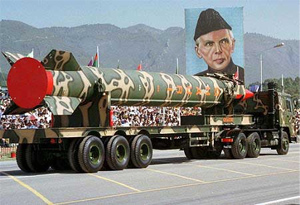
India’s surface-to-surface missile Agni-II launches off Wheelers island in Orissa state, India, on May 17, 2010.

India likewise feels encircled by China’s so-called “string of pearls”—a series of Chinese-built, ostensibly commercial port facilities in the Bay of Bengal, Indian Ocean and Arabian Sea. Beijing’s military ties to Pakistan, interference in the Kashmir dispute and references to Arunachal Pradesh, an Indian state, as “Southern Tibet” have done little to reassure New Delhi of Chinese intentions. The rapid growth of China’s conventional military might in recent years—between 2000 and 2009, China’s military spending more than tripled—and the lack of clarity as to its intentions, has spurred India to pursue its own military modernization.

These shifts in India’s and China’s nuclear force postures thus represent only the latest and most serious efforts to constrain and convey dissatisfaction with the other’s perceived regional ambitions. But they are more troubling than conventional redeployments.

First, these developments suggest that neither country has confidence in the other’s “no first use” policy. India has good reason for concern: The number of missions attributed to China’s deterrent—responding to nuclear attacks, deterring conventional attacks against nuclear assets, providing Beijing freedom from nuclear coercion and otherwise “reinforcing China’s great power status”—were enough to make the authors of the Pentagon’s annual report on China’s military power last year question the country’s commitment to its “no first use” policy. India, for its part, relies on its nuclear forces to offset gaps and imbalances between its conventional military capabilities and those of China.

Second, there is a point at which efforts to enhance deterrence can foster an arms race. Any attempt on the part of China to increase its own defenses necessarily weakens, or is perceived to weaken, the security of India, thus spurring further defense build-ups; the opposite is true as well. Shifts in nuclear force posture can be particularly disruptive, and have been known to precipitate crises. Upon the discovery of Soviet efforts to deploy missiles to Cuba in 1962, for example, the U.S. responded militarily with a naval “quarantine” of the island, bringing Washington and Moscow as close as they have ever come to a nuclear war.

Finally, the redeployments of India’s and China’s nuclear forces suggest that there is deep-seated and growing discord between the two Asian giants. This is troubling news for a region whose future peace and prosperity depends heavily on continued comity between Delhi and Beijing. It is only a matter of time before the China-India military competition begins to affect neighboring states. China’s nuclear force modernization, for instance, stands to threaten not only India, but also Korea, Japan and other U.S. partners in Asia. A dramatic defense buildup in India, meanwhile, will no doubt leave Pakistan feeling less secure.

Tensions are unlikely to ease any time soon. The two countries appear much closer to the brink of an all-out arms race than they do to any resolution of their differences. While each profits from the other’s economic growth, it is that very growth—which finances military modernization and which is so dependent on potentially vulnerable overseas trade—that creates the conditions for heightened insecurity.

Mr. Sullivan is research fellow and program manager at the American Enterprise Institute’s Center for Defense Studies. Mr. Mazza is a senior research associate at AEI.

U.N. Speakers Urge Pakistan to Free Up Arms Talks

By Patrick Worsnip for Reuters

Heaping pressure on Pakistan, a high-level U.N. meeting called on Friday for talks to start immediately on a treaty to ban production of fissile material used as fuel for nuclear weapons.

But Pakistan has insisted it will continue to block such talks, arguing that a ban would put it at a permanent disadvantage to its nuclear rival India. The dispute has led to deadlock at the 65-nation Conference on Disarmament in Geneva.

At the U.N. meeting of some 70 states to discuss the paralysis at the conference, speakers avoided openly naming Pakistan, but several referred to “one country” that was causing the problem.

In a closing summary of the views expressed, U.N. Secretary-General Ban Ki-moon said there was “broad agreement on the need to immediately start negotiations on a … treaty banning the production of fissile material.”

Continued impasse could result in states going outside the Geneva conference, known as the “CD,” to tackle the issue, Ban warned.

Support has appeared to be growing in Geneva to find another approach — possibly small-group talks in parallel to CD sessions. A precedent was set when Canada and Norway moved talks on a landmine ban out of the forum, eventually clinching the landmark 1997 Ottawa Treaty.

At Friday’s U.N. meeting, Western powers sharply attacked Pakistan’s blockage of the CD, which requires consensus for its actions.

“It strikes us as unwarranted for a single country to abuse the consensus principle and thereby frustrate everyone else’s desire to resume serious disarmament efforts,” said U.S. delegate Gary Samore, a special adviser to President Barack Obama.

Washington understood that all countries needed to protect their security interests, and with that principle in place, “no country need fear the prospect of (fissile material) negotiations,” Samore said.

NO CONSENSUS

British junior foreign minister Alistair Burt said blocking the negotiations was “damaging for multilateral arms control.”

Launched in 1978, the CD has clinched treaties banning biological and chemical weapons as well as underground nuclear tests. Its members include all five official nuclear powers — the United States, Russia, Britain, France and China.

But it has been unable to reach consensus on substantive work for the past 12 years. Pakistan’s refusal since January to launch negotiations on fissile material like plutonium and highly enriched uranium is the latest obstacle.

Zamir Akram, Pakistan’s ambassador to the United Nations in Geneva, said earlier this month his country would continue to hold out, arguing that India has an unfair advantage with bigger fissile material stockpiles and “discriminatory” nuclear cooperation deals with the United States.

“Pakistan’s security concerns can be addressed only once we have developed sufficient capacity to ensure our deterrent is credible in the face of growing asymmetry,” he told Reuters. “My instructions are, ‘We continue to maintain our position.'”

Pakistan did not speak at Friday’s meeting in New York. No decisions were made, but Ban said he would ask a panel of advisers to review the issues raised.

Separately, French delegate Jacques Audibert said Paris would host a meeting of the five official nuclear powers next year to discuss their obligations stemming from a May conference on nuclear non-proliferation.

The conference called on the powers to pursue negotiations ultimately aimed at the total abolition of nuclear weapons.

U.S. Walks Out as Iran Leader Speaks

By Neil MacFarquhar for The New York Times

UNITED NATIONS — President Mahmoud Ahmadinejad of Iran made a series of incendiary remarks in his speech to the United Nations General Assembly on Thursday, notably the claim that the United States orchestrated the Sept. 11 attacks to rescue its declining economy, to reassert its weakening grip on the Middle East and to save Israel.

Those comments prompted at least 33 delegations to walk out, including the United States, Canada, Australia, New Zealand, Costa Rica, all 27 members of the European Union and the union’s representative, diplomats said.

The annual General Assembly started formally on Thursday, with scores of presidents, kings and ministers expected to address the gathering over the coming week. The speeches often fail to break new ground or lack electricity, so the occasional theatrics inevitably attract considerable attention.

Mr. Ahmadinejad rarely disappoints on that scale, although he seemed to go out of his way to sabotage any comments he made previously this week about Iran’s readiness for dialogue with the United States. The theme of his often flowery speech was that the capitalist world order was collapsing and he cited three examples: the attacks of Sept. 11, 2001, the Israeli occupation of Palestinian lands, and the pressure on Iran over its nuclear program.

He said there were three theories about the origins of the Sept. 11 attacks, including “that some segments within the U.S. government orchestrated the attack to reverse the declining American economy and its grips on the Middle East in order also to save the Zionist regime.”

The United States Mission to the United Nations swiftly issued a terse response. “Rather than representing the aspirations and goodwill of the Iranian people, Mr. Ahmadinejad has yet again chosen to spout vile conspiracy theories and anti-Semitic slurs that are as abhorrent and delusional as they are predictable,” it said in a statement.

It was not the first time Mr. Ahmadinejad espoused the theory, but never before so publicly. “The majority of the American people as well as other nations and politicians agree with this view,” he said.

Mr. Ahmadinejad obviously delights in being provocative during his annual visit to the United Nations. He framed his comments about Sept. 11 as an examination of opinions, an approach he has used repeatedly in questioning the Holocaust.

But his assertion that the majority of Americans agree with him surely lacked any factual basis. As did his claim that reviving the American economy was the motive behind the devastating attacks on the World Trade Center and the Pentagon; the United States economy declined significantly after the attacks. In his interviews with journalists, much like during his debates with opponents in the disputed Iranian presidential election last year, Mr. Ahmadinejad has often been accused of making up statements wholesale.

But analysts noted that his remarks should be viewed through the prism of domestic politics in Iran, where conservatives try to outflank him. They said that during a recent Friday prayer sermon, Ayatollah Ahmad Jannati said that 84 percent of Americans believed their own government was behind the attacks.

Iran also cultivates an image as the voice of all Muslims in confronting the United States, and the idea that Americans rather than Islamic extremists carried out the 2001 attacks has long resonated among Arabs. “This is very helpful to Ahmadinejad’s desire for greatness in the Arab world,” said Ali Mirsepassi, a professor of Middle Eastern studies and sociology at New York University.

The other two theories on the attacks presented by Mr. Ahmadinejad were that terrorists who penetrated American security were responsible, and that terrorists carried out the attacks but then the American government took advantage of the situation. He even suggested that the United Nations create a fact-finding panel to study the theories.

Farideh Farhi, an Iran expert at the University of Hawaii, said, “Apparently now he has decided that by going to the core of American sensitivities — in the same way he did with Israel by questioning the legitimacy of that country’s existence — he can continue to keep himself at the center of global attention while deflecting attention away from his dismal domestic record.”

Mr. Ahmadinejad also lambasted those Americans who had threatened to burn the Koran. “The truth could not be burned,” he said, hefting a green Koran aloft with his one hand and a black Bible with another, saying he respected both of them. “We should wisely avoid playing into the hands of Satan.”

The other speeches Thursday followed more traditional lines, although not without moments of passion.

Prime Minister Wen Jiabao of China focused his speech exclusively on China’s domestic accomplishments, with a brief global reference at the end when he suggested a vital, peaceful China was good for the world’s peace and prosperity.

The speech, entitled “Getting to Know the Real China,” lauded the country’s economic progress while recognizing that it had a way to go with 150 million people still living in poverty. Mr. Wen said China was determined to forge even greater progress through education, science and technology.

The Turkish president, Abdullah Gul, endorsed American efforts to negotiate peace in the Middle East, but criticized Israel both for its presumed nuclear arsenal and for attacking a Turkish-organized humanitarian convoy at sea in May during which nine people were killed.

“We hope that this new engagement can take us closer to a viable and fair settlement,” Mr. Gul said. “On the other hand, it would be very difficult to make progress toward permanent peace unless we put an end to the humanitarian tragedy in Gaza.”

Mr. Gul called the attack a violation of international law, and he welcomed a report released Wednesday by United Nations Human Rights Council, which endorsed that viewpoint.President Bingu wa Mutharika of Malawi, speaking on behalf of the African Union, urged the General Assembly to defer for one year the war crimes charges brought by the International Criminal Court against President Omar Hassan al-Bashir of Sudan. He said that would avoid jeopardizing the outcome of a referendum scheduled for January on independence for southern Sudan.