Posts Tagged ‘ China ’

Analysis: Pakistan’s Double-Game: Treachery or Strategy?

By John Chalmers for Reuters
Washington has just about had it withPakistan.

“Turns out they are disloyal, deceptive and a danger to the United States,” fumed Republican Representative Ted Poe last week. “We pay them to hate us. Now we pay them to bomb us. Let’s not pay them at all.”

For many in America, Islamabad has been nothing short of perfidious since joining a strategic alliance with Washington 10 years ago: selectively cooperating in the war on extremist violence and taking billions of dollars in aid to do the job, while all the time sheltering and supporting Islamist militant groups that fight NATO troops in Afghanistan.

Pakistan has angrily denied the charges, but if its critics are right, what could the explanation be for such duplicity? What strategic agendas might be hidden behind this puzzling statecraft?

The answer is that Pakistan wants to guarantee for itself a stake in Afghanistan’s political future.

It knows that, as U.S. forces gradually withdraw from Afghanistan, ethnic groups will be competing for ascendancy there and other regional powers – from India to China and Iran – will be jostling for a foot in the door.

Islamabad’s support for the Taliban movement in the 1990s gives it an outsized influence among Afghanistan’s Pashtuns, who make up about 42 percent of the total population and who maintain close ties with their Pakistani fellow tribesmen.

In particular, Pakistan’s powerful military is determined there should be no vacuum in Afghanistan that could be filled by its arch-foe, India.

INDIA FOCUS

Pakistan has fought three wars with its neighbor since the bloody partition of the subcontinent that led to the creation of the country in 1947, and mutual suspicion still hobbles relations between the two nuclear-armed powers today.

“They still think India is their primary policy,” said Talat Masood, a retired Pakistani general and prominent political analyst. “India is always in the back of their minds.”

In an interview with Reuters on Tuesday, Pakistani Prime Minister Yusuf Raza Gilani – unprompted – complained that Washington’s failure to deal even-handedly with New Delhi and Islamabad was a source of regional instability.

Aqil Shah, a South Asia security expert at the Harvard Society of Fellows, said Islamabad’s worst-case scenario would be an Afghanistan controlled or dominated by groups with ties to India, such as the Tajik-dominated Northern Alliance, which it fears would pursue activities hostile to Pakistan.

“Ideally, the military would like Afghanistan to become a relatively stable satellite dominated by Islamist Pashtuns,” Shah wrote in a Foreign Affairs article this week.

Although Pakistan, an Islamic state, officially abandoned support for the predominantly Pashtun Taliban after the 9/11 attacks on the United States in 2001, elements of the military never made the doctrinal shift.

Few doubt that the shadowy intelligence directorate, the Inter-Services Intelligence (ISI), has maintained links to the Taliban that emerged from its support for the Afghan mujahideen during the 1979-1989 Soviet occupation of Afghanistan.

Until recently, there appeared to be a grudging acceptance from Washington that this was the inevitable status quo.

That was until it emerged in May that al Qaeda leader Osama bin Laden – who was killed in a U.S. Navy SEALs raid – had been hiding out in a Pakistani garrison town just two hours up the road from Islamabad, by some accounts for up to five years.

Relations between Pakistan and the United States have been stormy ever since, culminating in a tirade by the outgoing U.S. joint chiefs of staff, Mike Mullen, last week.

Mullen described the Haqqani network, the most feared faction among Taliban militants in Afghanistan, as a “veritable arm” of the ISI and accused Islamabad of providing support for the group’s September 13 attack on the U.S. embassy in Kabul.

The reaction in Islamabad has been one of stunned outrage.

Washington has not gone public with evidence to back its accusation, and Pakistani officials say that contacts with the Haqqani group do not amount to actual support.

However, Imran Khan, a Pakistani cricketer-turned-populist-politician, said this week that it was too much to expect that old friends could have become enemies overnight.

He told Reuters that, instead of demanding that Pakistan attack the Haqqanis in the mountainous border region of North Waziristan, the United States should use Islamabad’s leverage with the group to bring the Afghan Taliban into negotiations.

“Haqqani could be your ticket to getting them on the negotiating table, which at the moment they are refusing,” Khan said. “So I think that is a much saner policy than to ask Pakistan to try to take them on.”

REGIONAL GAME

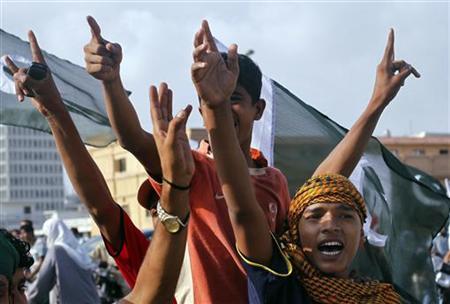
The big risk for the United States in berating Islamabad is that it will exacerbate anti-American sentiment, which already runs deep in Pakistan, and perhaps embolden it further.

C. Raja Mohan, senior fellow at New Delhi’s Center for Policy Research, said Pakistan was probably gambling that the United States’ economic crisis and upcoming presidential elections would distract Washington.

“The real game is unfolding on the ground with the Americans. The Pakistan army is betting that the United States does not have too many choices and more broadly that the U.S. is on the decline, he said.

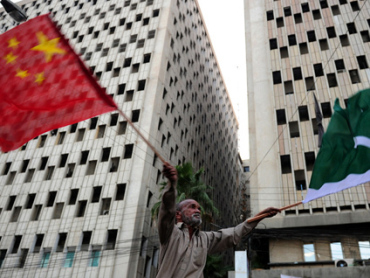
It is also becoming clear that as Pakistan’s relations with Washington deteriorate, it can fall back into the arms of its “all-weather friend,” China, the energy-hungry giant that is the biggest investor in Afghanistan’s nascent resources sector.

Pakistani officials heaped praise on Beijing this week as a Chinese minister visited Islamabad. Among them was army chief General Ashfaq Kayani, arguably the country’s most powerful man, who spoke of China’s “unwavering support.”

In addition, Pakistan has extended a cordial hand to Iran, which also shares a border with Afghanistan.

Teheran has been mostly opposed to the Taliban, which is dominated by Sunni Muslims while Iran is predominantly Shi’ite. But Iran’s anti-Americanism is more deep-seated.

“My reading is the Iranians want to see the Americans go,” said Raja Mohan, the Indian analyst. “They have a problem with the Taliban, but any American retreat will suit them. Iran in the short term is looking at the Americans being humiliated.”

ARMY CALLS THE SHOTS

The supremacy of the military in Pakistan means that Washington has little to gain little from wagging its finger about ties with the Taliban at the civilian government, which is regularly lashed for its incompetence and corruption.

“The state has become so soft and powerless it can’t make any difference,” said Masood, the Pakistani retired general. “Any change will have to come from the military.”

Daniel Markey, a senior fellow for South Asia at the U.S. Council on Foreign Relations, said the problem lies with a security establishment that continues to believe that arming and working – actively and passively – with militant groups serves its purposes.

“Until … soul-searching takes place within the Pakistani military and the ISI, you’re not likely to see an end to these U.S. demands, and a real shift in terms of the relationship,” Markey said in an online discussion this week. “This is the most significant shift that has to take place.”
Analysts: China Unlikely to Replace US in Pakistan

By William Idle for The Voice of America

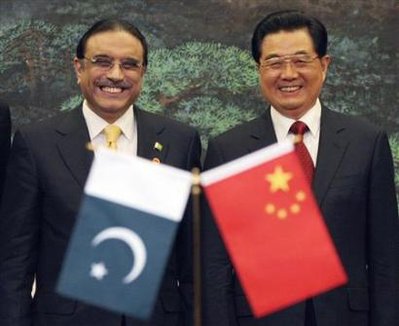
Pakistan’s President Asif Ali Zardari made a three-day visit to China this week at a time when relations between Islamabad and Beijing appear to be growing stronger. Regional analysts say that while China is of growing importance to Pakistan, it is unlikely to replace the U.S. role as a dominant influence there.

The opening ceremony at the first China Eurasia Expo was full of pomp and fanfare. Greeted with applause and smiles, Pakistan President Asif Ali Zardari ended his visit to China standing on stage next to the man who is widely expected to be the country’s next leader – Vice Premier Li Keqiang.

Ties have long been strong between Pakistan and China, a country Islamabad endearingly calls its “all-weather friend.” Mr. Zardari has visited China twice since the raid on Osama bin Laden’s compound – seven times since becoming president.

Some regional analysts say the recent deterioration of U.S.-Pakistan ties has pushed Pakistan into Beijing’s arms. They argue the combination of repeated drone strikes in Pakistani territory, the raid on Osama bin Laden’s compound, and suspension of $800-million in military American aid to Pakistan has brought Beijing and Islamabad closer together.

But regional analyst Tarique Niazi, an associate professor at the University of Wisconsin Eau Claire, says Mr. Zardari’s most recent visit to China is part of an ongoing effort by Pakistan to seek help to address its urgent needs and boost trade. And not necessarily a sign of shifting alliances.

“Pakistan is short of energy resources. It has about 4,000 megawatts of electrical shortage. So, China is helping Pakistan meet that shortage of electricity,” Niazi said.

One of the ways that China is doing that is by building massive hydropower projects in both Pakistan’s northern region of Gilgit-Baltistan and Pakistani-controlled Kashmir.

Niazi notes that representatives from both regions traveled to China this week with Mr. Zardari. Pakistan’s president is constantly focused on three things, he adds: investment, trade and economic development.

“President Zardari, especially I must say, that he is the first leader of Pakistan whose focus is almost entirely on economic development and developing business relationships with not only the public sector and the government sector of China, but the private sector also,” Niazi said.

When Mr. Zardari stepped into office, he pledged to visit China every three months – and for the most part has kept that promise. Since then, analysts say he has inked deals that will raise China’s overall investment in Pakistan from $20-billion to more than $50-billion.

China is eager to boost trade and investment in the region too.

At the opening ceremony of the China Eurasia Expo, Commerce Minister Chen Deming highlighted how China was reaching out to Asian and European countries at a time when the world economy has yet to recover from the global financial crisis.

Chen says China is moving faster in opening its western region and border areas to promote regional development. He says China is taking a big step forward to deepening development and cooperation between Asian and European countries.

And the benefits flow both ways.

“I would say that the best way to think about the current situation is that China is expanding in all directions, its power is growing, and it is looking north, south, east and west. And when it looks to Pakistan it sees potential in terms of access to Central Asia, Central Asia energy markets. It sees access to the Arabian Sea, the Indian Ocean,” said Daniel Markey, a senior fellow at the Council on Foreign Relations for India, Pakistan and South Asia.

Markey says that while Pakistan has been reaching out recently to China, in part to show Washington it has options, he is not convinced Beijing is interested in seeing a real rupture between Islamabad and Washington.

“My sense is that, yes, over the long term, China would like to be the dominant influence in Pakistan and really expand its influence throughout the region, which would probably mean a lesser influence for the United States. But, in the short time, China has been very comfortable essentially free-riding off of whatever stability and security the United States has provided and that they do not want to change,” Markey said.

He says one reason for that is because a rupture in ties between Pakistan and the United States could trickle over into relations between Beijing and Washington, and there the two already have enough to deal with as it is.

China launches communications satellite for Pakistan

As Reported by The South Asian News Agency

The year 2011 marks 60 years of diplomatic relationship between China and Pakistan. This all-weather relationship has largely withstood ‘the test of time’.

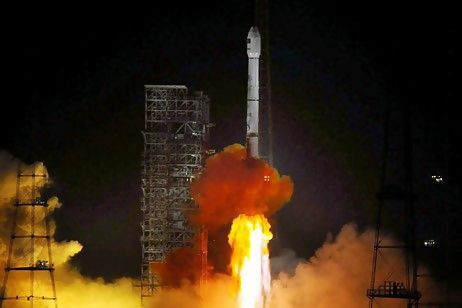
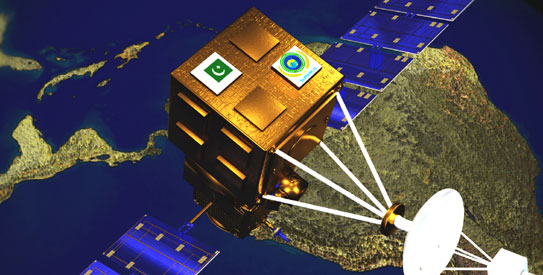
Both states recognize the relevance of their cooperation in areas like security, trade and culture. All these years China has mostly followed the ‘friend of Pakistan policy’. From the Indian perspective the focus of their cooperation, which has mostly revolved around security issues, has been a source of anxiety. Apart from the question of direct military aid, India must also take note of China’s assistance to Pakistan in the field of science and technology as well since it has long-term strategic implications. China launched Pakistan’s first communications satellite (PAKSAT-1R) on August 12, 2011 on a Long March-3B carrier rocket. This event demonstrates the deepening in technological cooperation between these two states. For China this was also an event to display the capabilities of its rapidly growing commercial satellite industry.

Over the years Pakistan has largely demonstrated a copycat syndrome (with reference to India) as far as programmes of strategic importance are concerned. Pakistan’s technological and industrial base is not well-established in comparison with India. Therefore, to match India, Pakistan has relied on foreign (overt or covert) help. In certain cases Pakistan also developed underground networks to ‘manage’ hardware/technology. However, Pakistan’s investments in space technologies have been minimal. This is somewhat surprising particularly, because it has a reasonably well-developed missile programme which, in fact, could have helped at least partially to build up an indigenous space programme.

Pakistan’s lack of interest in space technology could be due to three reasons. Firstly, the Pakistani focus on long-term investments in technology has predominantly been military specific over the years. The use of technology for social, educational and scientific needs was not the prime focus. Secondly, Pakistan appears to have failed to anticipate the long-term strategic importance of space technologies. What is more surprising is the failure to understand the importance of space technologies particularly, in the background of the country’s nuclear ambitions. Thirdly, because of superfluous investments in military hardware, Pakistan was unable to make investments in space technology. Also, the state appears to have failed to realise the future commercial relevance of a space programme.

Against this backdrop the launch of the made in China PAKSAT-1R with 30 transponders for the purposes of communications services marks a new beginning. This satellite would take care of broadband Internet, telecom and broadcasting services. It is expected to cover South Asia, Europe, West Asia and eastern Africa and is also likely to help in weather monitoring. Being a communication satellite its dual-use nature could offer strategic defence applications as well. Pakistan has been collaborating with China in the space arena since the 1990s. Its first satellite Badr-1 was launched by China on July 16, 1990 (on a Long March 2E rocket). However, during the span of the last two decades, Pakistan’s space programme has not made any significant progress baring two more satellite launches with outside help. Pakistan’s space agency called Space and Upper Atmosphere Research Commission (SUPARCO) was established in 1961 as a committee. It was upgraded into a Commission in 1981. But it has failed to make any significant progress.

The August 2011 launch of a communication satellite opens a new chapter in Pakistan’s space history. Today, Pakistan has no launch vehicle of its own to launch satellites of any type. It has a long way to go in developing expertise in this arena as well as in satellite manufacture though the very first satellite was developed indigenously. Pakistan also needs to invest in the development of Spaceport and ground stations. All this will take time and its dependence on China is expected to increase in coming years.

Since their border settlement pact of March 3, 1963 the relationship between these two neighbours of India has been steadily growing. In the field of space there was a pause for almost two decades particularly, in the high-end projects like satellite launches. However, during these years a certain degree of collaboration was underway for personnel training and infrastructure development. Pakistan’s inadequacy in the space field offers China an opportunity to take their strategic partnership to a higher plane and also simultaneously maintain its own commercial interests.

For the last couple of years China has been using space technology to further its geopolitical as well as commercial interests. Now, Pakistan offers it an opportunity to use space engagement for strategic purposes as well. China has begun to help states like Nigeria and Venezuela with their satellite programmes. Also, recently China signed a deal with Bolivia for building and launching a satellite. In comparison with the western space agencies, China offers better commercial deals. Also, China has earned a prestige for its space programme with various successful space launches. Naturally, various developing states in the world are looking towards China.

China’s space programme is surging ahead at a much faster rate than India’s. Pakistan’s space programme is likely to remain in infancy for some more time to come. However, nuclear Pakistan is likely to pursue its space agenda (with China’s help) with more vigour in the future. On the military front, it is bound to benefit from various Chinese programmes like the navigational programme (COMPASS constellation). India needs to look at these developments seriously. Till date Pakistan’s space capabilities were probably not factored into India’s strategic planning, but that must change

Pakistan Partnership Raches For the Stars

By Syed Fazl-e-Haider for The National

By teaming up with China on a satellite launch, Pakistan has taken a bold step forward with its space programme. And there are mutual benefits to the arrangement, Syed Fazl-e-Haider writes. The recent launch of the advanced communication satellite Paksat-1R was not only a big stride forward for Pakistan’s 2040 space programme, but also Sino-Pakistan space collaboration.

Last week, China launched Paksat-1R with the Long March-3B carrier rocket from Xichang Satellite Launch Centre in south-west Sichuan province. The new satellite will replace Paksat-1, which will complete its useful life this year.

Critics have questioned whether Pakistan can really take the credit for the development of a satellite that was made by China, financed by China and ultimately launched by and from China. But Pakistan is now able to achieve several strategic objectives through Paksat-IR, including serving an expanding client base, which includes the military. With the launch of the satellite, the country has entered into a long-term relationship with its manufacturer towards acquiring the know-how to produce satellites in the future, with the ultimate aim of achieving self-reliance. Now it is also able to establish and maintain ground control stations for operating Paksat-1R from Pakistan.

Pakistan’s space programme owes its existence to China’s cooperation that spans from climate science, clean energy technologies, clean water technologies, cyber security and basic space, to atmospheric, Earth and marine sciences. It was China that launched the country’s first low-orbit satellite Badr-A in July 1990. In 2006, China committed to work with Pakistan to launch three earth resource satellites.

Islamabad sought more than US$200 million (Dh734.5m) financing from China for Paksat-1’s replacement. The two countries signed the procurement contract during the first state visit by Asif Ali Zardari, the president of Pakistan, to Beijing in 2008.

Paksat-1, Pakistan’s first geostationary satellite, was launched in February 1996. It served TV broadcasters, telecommunications companies, data and broadband internet service providers, and government organisations.

With a lifespan of 15 years, Paksat-1R will have great economic implications for the country. The satellite will provide high-power communication and weather monitoring facilities, besides strategic defence applications. The Space and Upper Atmosphere Research Commission will operate it from its ground control stations in Karachi and Lahore. With advance communication antennas, it will cover some regions of Europe, South Asia, the Middle East and eastern Africa. It will facilitate the introduction of new services including broadband internet, digital TV broadcasting, rural telephony, emergency communications, tele-education and tele-medicine.

Pakistan is also making efforts to get space technology from China. It plans to launch the Pakistan Remote Sensing Satellite (PRSS) in the near future with the technical and financial assistance of China. Launching PRSS is now the first priority for Pakistan, because such a satellite can help it in cartographic studies. China has not only achieved the capability of placing its satellites in space, but is also developing rockets. It has created a powerful carrier rocket with military capabilities that can launch multiple satellites into space.

China is conquering new frontiers in space technology. Shenzhou 7, the third manned spaceflight, has established a new threshold for China. It has already planned Shenzhou 8, which will be docked with the Tiangong-1 space module that will place the first portion of China’s planned space laboratory in orbit.

China’s space technology industrial base is rapidly expanding, and its sales overseas have so far focused on its traditional allies including Pakistan. Space and rocket technology from China would help Pakistan achieve its ambitious goals of economic progress and impregnable defence. While China can transfer space technology to Pakistan, in return Pakistan could assist China in space by establishing a station on its soil to track Chinese satellites.

Syed Fazl-e-Haider is a development analyst in Pakistan. He is the author of many books, including The Economic Development of Balochistan, published in May 2004

U.S. Says Pakistan Let China See Copter

By Mark Mazzetti for The Seattle Times

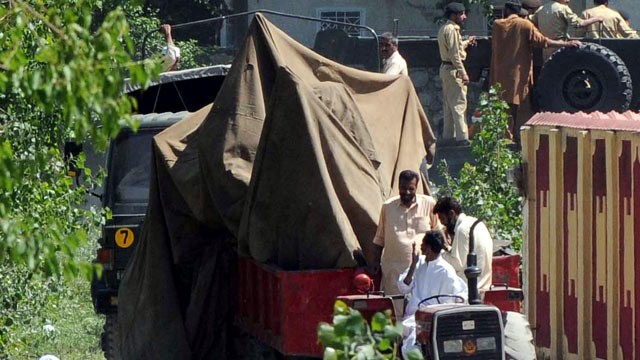
In the days after the raid that killed Osama bin Laden, Pakistan’s intelligence service probably allowed Chinese military engineers to examine the wreckage of a stealth American helicopter that crashed during the May operation, according to U.S. officials and others familiar with the classified assessments.

Such cooperation with China would be provocative, providing further evidence of the depths of Pakistan’s anger over the bin Laden raid, which was carried out without Pakistan’s approval.

U.S. spy agencies have concluded it is likely that Chinese engineers took detailed photographs of the severed tail of the Black Hawk helicopter equipped with classified technology designed to elude radar, the officials said.

The members of the Navy SEALs team who conducted the raid had tried to destroy the helicopter after it crashed at bin Laden’s compound in Abbottabad, but the tail section remained largely intact.

U.S. officials cautioned they did not yet have definitive proof the Chinese were allowed to visit Abbottabad. They said Pakistani officials had denied they showed the technology to other foreign governments.

One person with knowledge of the intelligence assessments said the U.S. case was based mostly on intercepted conversations in which Pakistani officials discussed inviting the Chinese to the crash site.

He characterized intelligence officials as being “certain” that Chinese engineers were able to photograph the helicopter and even walk away with samples of the wreckage. The tail has been shipped back to the U.S., according to American officials.

The U.S. assessments were disclosed Sunday by The Financial Times. The newspaper cited Pakistani officials who denied the accusations.

Rights Violations: Pakistan Maintains Discreet Silence Over Syria Protest

By Saba Imtiaz for The Express Tribune

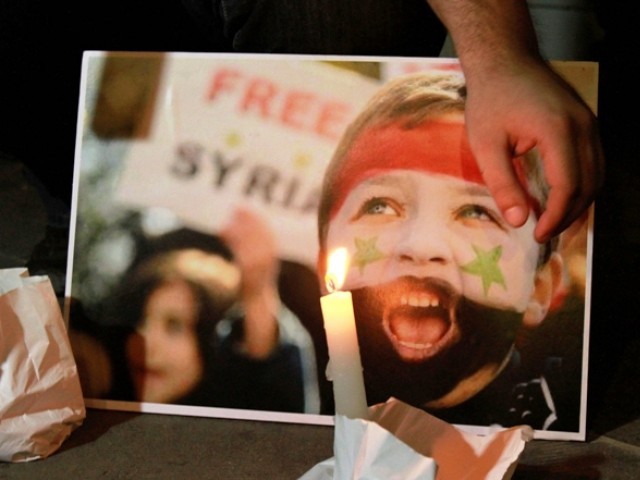
As the chorus against the Syrian government grows louder, Pakistan remains silent on the issue of human rights abuses in Syria. According to Amnesty International, over 1,500 people have been killed since March in the protests against Syrian President Bashar alAssad’s regime. Pressure against Syria appeared to grow over the weekend from Arab states, as the Gulf Cooperation Council asked for an immediate end to bloodshed.

On Monday, Saudi Arabia’s King Abdullah issued a written statement on the situation. “What is happening in Syria is not acceptable for Saudi Arabia. Syria should think wisely before it is too late and issue and enact reforms that are not merely promises but actual reforms. Either it chooses wisdom on its own or it will be pulled down into the depths of turmoil and loss.” Soon enough, Saudi Arabia, Kuwait and Bahrain had recalled their ambassadors from Damascus for ‘consultations’.

In April, Pakistan joined China and Russia in voting against a resolution by the UN Human Rights Council condemning the violence in Syria. Pakistan’s ambassador to the UN Zamir Akram was quoted as saying, “My country has always believed that ‘naming and shaming’ is an approach which is counterproductive.”

Three months and over a thousand dead bodies later, no public statement has yet to be made on the situation in Syria. The Foreign Office spokesperson did not respond to a query till the filing of this report.
According to former foreign minister Khurshid Mahmud Kasuri, Pakistan’s silence is a product of “historical links between the Bhutto and alAssad families”.

President Bashar’s father, the late president Hafez alAssad, was believed to be a close ally of former prime minister Zulfikar Ali Bhutto. Murtaza and Shahnawaz Bhutto travelled to Syria in 1979 to seek support for their campaign to save Bhutto and were offered asylum by the elder alAssad. Murtaza spent several years in Syria before returning to Pakistan in 1993. In 1981, a Pakistan International Airlines flight was hijacked and forced to land in Kabul, and then Damascus. The hijacking is widely believed to be the work of the Al Zulfikar Organisation.
Kasuri said that given the high death toll, “the government of Pakistan needs to make its position clear [and say] that it stands with the people of Syria.”

Pakistan’s silence, according to former foreign secretary Shamshad Ahmad, shows lack of a foreign policy. “Foreign policy is a reflection of a country’s internal state of affairs. If the state is in disorder, it has no foreign policy. Forget Syria or any other Arab country – Pakistan has enough problems at home and has no time to focus on international issues. No one is going to pay any attention to what Pakistan says because it has no credibility. No country is looking to Pakistan for support.”

Pakistanis for Peace Editor’s Note– The writer makes some valid points about Pakistan’s foreign policy or lack thereof. Being complicit also in the suppression of the civilians in Bahrain by providing troops as illustrated in this article shows that the country is often found on the wrong side of terrorism, women and religious minorities rights, and democratic and human rights. Not a good equation and no excuse for any of it any way one looks at it.

Killing of infants on the rise in Pakistan

By Raza Sayah for CNN

At a morgue in Pakistan’s largest city, five linen pouches — each the size of a loaf of bread — line the shelf of a walk-in freezer.
Wrapped inside each small sack is the corpse of an infant.

The babies are victims of what one relief agency calls Pakistan’s worst unfolding tragedy: the killing and dumping of newborns.
“Sometimes they hang them, and sometimes they kill by the knife, and sometimes we find bodies which have been burned,” said Anwar Kazmi, a manager at Edhi Foundation, Pakistan’s largest privately run social service and relief agency.

Records at Edhi Foundation show that more than 1,200 newborns were killed and dumped in Pakistan last year, an increase of about 200 from the previous year.

Families view many of these children as illegitimate in a culture that condemns those born outside of marriage.
Statistics show that roughly nine out of 10 are baby girls, which families may consider too costly to keep in a country where women frequently are not allowed to work.

The babies are usually just days old. Their corpses are often dumped in Karachi’s sprawling garbage dumps, where they’re sometimes mutilated by street animals, Kazmi said. He estimates that hundreds of baby corpses are never found.

The head of Edhi Foundation, 83-year-old Abdul Sattar Edhi, blames Pakistan’s crippling poverty and a government that, for decades, has failed to educate the masses, generate jobs and provide citizens with the most basic needs.

“The distribution of resources by the government is wrong,” Edhi said. “Many people don’t pay taxes; there’s no charity, and what you get from the government is all based on your wealth.”

The Pakistani government has said it’s improving education, but 55 million Pakistanis remain illiterate, according to the United Nations. And the government is billions of dollars in debt while entangled in a costly fight against the Taliban and other Islamic militant groups. The killing of newborns gets little attention in Pakistan, and rarely are they investigated by a police force that’s often poorly trained, lacks resources and stays focused on what’s perceived to be more important crimes.

In many parts of the world, female infanticide is still practiced through direct violence but also by intentional neglect, according to the World Health Organization.

In some Asian countries, infanticide of girls is enough to skew the population figures in favor of males. The United Nations found, for example, that there are 130 boys to 100 girls in parts of Asia, especially in countries with extreme poverty and overpopulation such as China and India.
“Girls are seen as a burden, seen as a property which belongs to somebody else so people see that as a waste of money and the wasting of an education of a girl,” said Bhagyashri Dengle, executive director of Plan India, a nonprofit for children. “Then when the girl gets married, the families have a big, heavy dowry. So that is one of the reasons here.”

Dengle said awareness and education at the grass-roots level are ways to combat this practice. “I think we really need to reach out to young people (to) create an awareness, to change attitudes and dispel the notion that having a boy is better than a girl,” she said. “We launched this program ‘Let Girls Be Born’ — that campaign is reaching out to masses using televisions, through newspapers and through (the) Internet. What we are trying to do is positive messaging on the girls. That girls aren’t a sect; they are as good as boys.”

In Pakistan, until things improve, the Edhi Foundation said, it will keep more than 300 cradles in front of its offices throughout Pakistan where families can drop off unwanted newborns. The foundation cares for them and puts them up for adoption, no questions asked.
“It’s for awareness — that please don’t kill your innocent babies,” Kazmi said.

Can Pakistan Understand China?

By Khaled Ahmed for the South Asian News Agency

We look at South Asia as a region where we will hold India accountable for its injustices and force it to cede Kashmir to us. We have jihad as our guiding doctrine. Justice demands that we be the agents of instability. We are the revisionists determined to change the status quo.

India is too big, so we think China should do the job of cutting India down to size. India believes this strange figment of our imagination and criticises China for partly giving Pakistan its military muscle, the sort of thing the US used to do in the past. But was the US able to make Pakistan win against India? Was Kashmir ceded to Pakistan by an India felled and writhing on the ground?

Some in the US think of China as a global rival, but eight American presidents one after the other have resisted the old instinct of looking at the world through military goggles and have treated China instead as a ‘strangely behaving’ trading partner. And one person who doesn’t want America to think in terms of military equations is Henry Kissinger.

Henry Kissinger, in his latest book On China (The Penguin Press 2011), tells us things about China that we have ignored in our decades of ‘all-weather’ friendship. He says the Chinese mind hates policies of instability and disharmony. It did not grab Hong Kong but waited for the British lease on it to run out. Seeing Portugal in decline, India didn’t wait in the case of Goa; China waited in the case of Macao.

The presiding philosopher in China is Confucius who, unlike Machiavelli, was concerned more with the cultivation of social harmony than with the machinations of power (p.15). For him, mankind’s central spiritual task was to recreate proper order, already on the verge of being lost. Spiritual fulfilment was a task not so much of revelation as patient recovery of forgotten principles of self-restraint (p.14).

China doesn’t want victory, therefore it doesn’t go to war. The philosopher of China’s realpolitik is Sun Tzu who has written Art of War. According to Kissinger, “A turbulent history has taught Chinese leaders that not every problem has a solution and that too great an emphasis on total mastery over specific events could upset the harmony of the universe. There were too many potential enemies for the empire ever to live in total security. If China’s fate was relative security, it also implied relative insecurity — the need to learn the grammar of over a dozen neighbouring states with significantly different histories and aspirations” (p.23).

On the other hand, the western tradition prizes the decisive clash of forces emphasising feats of heroism. The Chinese ideal stresses subtlety, indirection and the patient accumulation of relative advantage. Writes Kissinger: “Chinese thinkers developed strategic thought that placed a premium on victory through psychological advantage and preached the avoidance of direct conflict” (p.35).

Kissinger gives us another contrast: “Chinese diplomacy has learned from millennia of experience that, in international issues, each apparent solution is generally an admission ticket to a new set of related problems. Hence Chinese diplomats consider continuity of relationships an important task and perhaps more important than formal documents. By comparison, American diplomacy tends to segment issues into self-contained units to be dealt with on their own merits” (p.245).

India is intellectually better placed to understand China than jihad-obsessed, warlike Pakistan. After India lost Aksai Chin to China in 1962, it could have become revisionist like Pakistan and fought losing wars to regain the territory, but it decided that Aksai Chin was strategically ‘unimportant’. Today, it hopes to take its bilateral trade with China to $200 billion while Pakistan languishes at $9 billion.

U.S., Pakistan, Through Thick and Thin

By Gerald F Seib for The Wall Street Journal

One diplomat long involved in the tempestuous U.S.-Pakistan relationship likens it to a Catholic marriage: There may be problems, but divorce isn’t an option.

And so it is that, almost a month after U.S. Navy SEALs entered Pakistan to kill Osama bin Laden, the two troubled partners find themselves not in divorce court but in an awkward but unmistakable process of reconciliation.

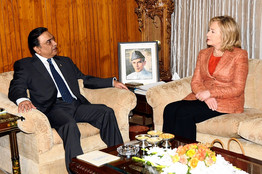
Signs of healing are popping up. Despite its anger and embarrassment at being left in the dark about the bin Laden raid, Pakistan’s intelligence service has begun cooperating again on a series of sensitive matters. Meanwhile, Secretary of State Hillary Clinton and Joint Chiefs of Staff Chairman Mike Mullen have just held the obligatory kiss-and-make-up talks in Pakistan, which U.S. officials describe as blunt but useful in moving forward.

And despite widespread anger in Congress over Pakistan’s harboring, either willfully or unknowingly, the world’s leading terrorist, Obama administration officials seem to be squelching the desire to extract revenge by cutting Pakistan’s aid.

There remains the danger of a rupture, and there still could be long-term damage. Street-level anger on both sides means the relationship can’t stand too many more shocks just now.

In particular, it seems likely that one result of the trauma will be a scaling back of the drone wars—America’s use of armed drones to launch strikes inside Pakistan to attack operatives of the Taliban movement fighting U.S. forces next door in Afghanistan.

The drones likely will continue to be used against top Taliban leaders when found, but less often against lower-priority targets, and probably under new and clearer rules of cooperation with the Pakistanis, say those familiar with the effort.

Still, the reality is that the two countries don’t have much choice but to move on. Regardless of how much love is flowing at any moment, they simply need each other.

The American war against al Qaeda globally and against Taliban insurgents in Afghanistan simply can’t be won without the cooperation of Pakistan. Much as Americans are infuriated by the way elements of Pakistan’s government and intelligence service hedge their bets by playing both sides in the struggle against extremism, there’s no doubt that Pakistani intelligence has been crucial in the fight.

For its part, Pakistan has, in its fit of pique over the bin Laden raid, made its best show of playing the China card to demonstrate to the U.S. that Pakistanis can find good, powerful friends in Beijing if Americans don’t treat them better. By coincidence, this has been proclaimed, officially by the two countries, the year of China-Pakistan friendship, which is a useful card for Pakistan to play right now.

But Pakistan’s post-raid overture showed the limits of the China option as much as anything else. Pakistani Prime Minister Yousuf Raza Gilani made a four-day trip to China soon after the bin Laden operation, and came away with a Chinese pledge to speed up delivery of some previously promised fighter jets.

Mr. Gilani’s other takeaway from his visit promptly proved dubious. His defense minister announced that Pakistan had invited China to take over management of a big Pakistani port at Gwadar, and to build a new naval base there. In response, the Chinese said, essentially, “We have no idea what you’re talking about.” Whatever was discussed, it appears to be less than originally advertised.

Pakistanis as well as Americans know China has its limits as an alternative big-power friend for Islamabad. American aid can’t easily be replaced, and China doesn’t tend to dole out assistance easily. Meanwhile, the U.S. is the top market for Pakistani exports, while China ranks fifth. China’s big textile industry actually is a key international competitor to Pakistan’s own textile sector.

Ultimately, the Chinese are less likely to be helpful to Pakistan in the war against extremism than will the U.S. China tends to use partnerships abroad to solve its problems, not to help friends solve theirs.

In the meantime, real and meaningful steps have resumed in the U.S.-Pakistani intelligence relationship. Pakistan has allowed American officials to speak with the bin Laden wives found in his compound. It has returned the tail section of a U.S. helicopter lost in the raid; there was stealth technology embedded in it—technology the U.S. feared an angry Pakistan might instead share with China.

And Pakistan has agreed to allow American officials into the bin Laden compound to search for more intelligence on al Qaeda operations run from there.

The U.S. now seeks more help in fighting the Taliban inside Pakistan, and there will be a three-way American-Afghan-Pakistani meeting to discuss Afghanistan next month.

All isn’t bliss between Washington and Islamabad—not by a long shot—but those aren’t the actions of partners headed their separate ways.

We Should Hold Our Nose And Remain Engaged In Pakistan

By Joel Brinkley for Tribune Media Services

America’s involvement in Pakistan and Afghanistan may be the most complex foreign-policy dilemma the nation has ever faced. With the death of Osama bin Laden, along with Pakistan’s furious response, the knot is more tangled.

Right now, Afghan officials are reviling their Pakistani counterparts. Pakistan is flirting with China. American officials are threatening to curtail aid to Islamabad. Afghanistan is establishing what it calls the High Peace Council for reconciliation talks with the Taliban, while the United States is already saying the peace talks will almost certainly fail.

Meantime, Afghan Taliban leaders are trying to talk nice. Oh, we’re happy to let girls go to school, they are cooing through thin smiles. Just let us back into the government. At the same time, their fighters opened fire on an unarmed roadwork crew, massacring 36 workers and wounding 20 others.

Pakistani soldiers fired on a U.S. military helicopter flying along the Pakistan-Afghan border. But the government did display a small flash of grace. It gave the U.S. permission to haul away the ruined tail of the helicopter that crashed just outside Osama bin Laden’s home.

Think back to previous conflicts. Even the decisions behind the Vietnam War, one of the most traumatic events in American history, seem relatively simple by comparison. Now we are dealing with two nations led by perfidious, double-dealing scoundrels who take pleasure in disparaging us.

In a chorus over the last few days, President Hamid Karzai and other Afghan officials have been declaiming: You’re fighting the wrong war in the wrong place. They have their own self-interested motivations for saying that. Actually, though, they are correct.

Most analysts believe bin Laden left the tribal areas of Pakistan and moved to a compound just outside the capital to escape the rain of American drone missiles that were killing some of his minions.

Does it make any sense to believe that bin Laden would pull out all by himself, leaving behind his key aides and allies, like Mullah Omar, the Taliban leader? Of course not. Sooner or later we will learn that a half-dozen of them, at least, are hiding in full sight inside Pakistan, in their own high-walled compounds.

One frequent Afghan observation is well-taken, that all of the al-Qaeda and Taliban leaders of note are in Pakistan, not Afghanistan. The United States acknowledged years ago that few if any al-Qaeda operatives remained in Afghanistan.

But now Pakistani leaders are insulting and reviling the U.S., and senior members of Congress are threatening to withhold aid. As Sen. James Risch, an Idaho Republican, put it during a recent Foreign Relations Committee hearing, “Why are we spending our kids’ and our grandkids’ money to do this in a country that really doesn’t like us?

“It’s a hard sell to the American people.”

But the United States can’t stop providing aid to Pakistan and pull out of the country. For one thing, most of the supplies for the 100,000 American troops in Afghanistan are trucked in from Pakistan, and Pakistanis have already shown their eagerness, if provoked, to attack these caravans and torch the trucks. Look at the map, and you won’t find another politically possible supply route.

Pakistan is an extremely unstable country. Its leaders hold onto their pathological obsession with India and refuse to recognize the dire threat that the Taliban and other militants pose from within. What would happen if the government fell, and Islamic militants seized Pakistan’s 100-plus nukes?

Meanwhile, the Afghan war continues, to deprive al-Qaeda of a home there once again. But if the U.S. pulled out and al-Qaeda returned, they’d be doing the U.S. military a great favor. We’ve been trying to get at them in North Waziristan for a decade now with limited success at best. Move back to Afghanistan and they would be easy targets.

What could Karzai do about it?

This summer, President Obama is going to announce the first troop withdrawals from Afghanistan. The number being bandied about now is roughly 5,000 troops. He should ramp it up, withdraw faster. After all, now we are caught in the middle of a civil war between the previous and the present governments.

As for Pakistan, we have to hold our noses and remain engaged. The possible alternatives are simply too ugly to imagine. As Defense Secretary Robert Gates put it at the height of the rancor last week, like it or not, “we need them, and they need us.”

Beijing Agrees to Operate a Key Port, Pakistan Say

By Jeremy Page for The Wall Street Journal

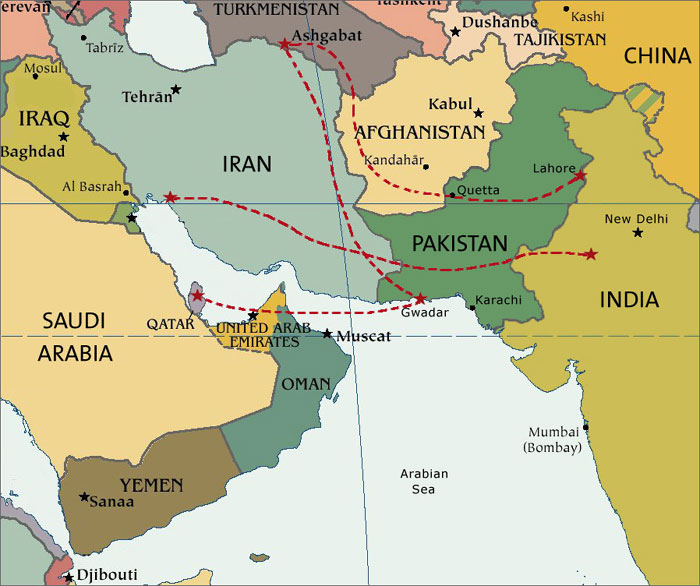
Pakistan’s defense minister said China has agreed to take over operation of the strategically positioned but underused port of Gwadar, and that Islamabad would like the Chinese to build a base there for the Pakistani navy.

Ahmad Mukhtar gave no clear timetable on the possible change at Gwadar, on Pakistan’s western coast, which is currently managed by a Singaporean government company. But his statement Saturday is the latest illustration of how Pakistan is portraying China as a powerful alternative ally and aid source if the U.S. scales down military assistance for Islamabad in the aftermath of Osama bin Laden’s killing.

China is eager to expand its influence in Pakistan over the long term, but is wary of the country’s chronic instability, which was highlighted late Sunday when a Pakistani naval base was attacked in the western port of Karachi, about 300 miles southeast of Gwadar.

Mr. Mukhtar made the announcement after accompanying Prime Minister Yusuf Raza Gilani on a visit to China last week. During that visit, Pakistani officials say, Beijing agreed to expedite delivery of a second batch of 50 jointly developed JF-17 fighter jets to Pakistan, possibly within six months.

The fighter agreement prompted India’s defense minister, A.K. Antony, to express serious concern in a meeting with reporters late Friday about the growing defense ties between China and Pakistan, and to assert that India’s only possible response was to build up its own military arsenal.

Attempts on Sunday to contact Mr. Antony and other Indian officials for comment about Gwadar were unsuccessful. In the past, Indian officials have expressed concern that China plans to use Gwadar as a staging post for naval operations in the Indian Ocean, the Arabian Sea and beyond.

China’s Foreign Ministry didn’t immediately respond to a request to comment.

China—Pakistan’s biggest arms supplier—provided 80% of the initial $248 million funding for the construction of Gwadar, a former fishing village in the southwestern province of Baluchistan whose 47-foot-deep port is the only one in Pakistan capable of handling the biggest cargo ships.

Pakistani officials say Gwadar will be a trade hub for Central Asia and a transit point for Chinese oil imports, most of which are now shipped via the Malacca Strait, making them vulnerable to piracy or naval blockades.

China and Pakistan also have discussed plans to build an oil pipeline from Gwadar to northwestern China, and two new stretches of railway extending the Pakistani network to Gwadar at one end, and to the Chinese border at the other.

Some U.S. and Indian military officials see Gwadar more as part of a so-called “string of pearls” naval strategy, wherein China has also funded construction or upgrades of ports in Sri Lanka, Bangladesh and Myanmar.

China, however, says its involvement in these ports is only commercial. Some experts question the commercial and military value of Gwadar because of a long-running separatist insurgency in Baluchistan and the high cost of building and maintaining a pipeline and railway.

Construction of Gwadar started in 2002 and finished in 2007. Since then it has been operated by Singapore’s PSA International under a 40-year contract, for which a Chinese company also had bid.

But the port has attracted far less traffic than it is designed for over the last four years, due in large part to opposition from politicians in Baluchistan, who say local people get insufficient benefit from the port and other commercial projects, relative to the central government.

PSA’s contract has been challenged in Pakistan’s courts and in September, Adm. Noman Bashir, the country’s naval chief, called for it to be reviewed. Pakistani officials also say the Singaporean government hasn’t pushed hard enough for Pakistan to become a full dialogue partner within the Association of Southeast Asian Nations, as India is, taking part in some talks and meetings.

Mr. Mukhtar’s statement said the Chinese government had agreed to Pakistan’s request that it take over operation of Gwadar when PSA’s “term of agreement” expired, according to the state-run Associated Press of Pakistan.

“We are grateful to the Chinese government for constructing Gwadar Port. However, we will be more grateful to the Chinese government if a naval base is being constructed at the site of Gwadar for Pakistan,” Mr. Mukhtar was quoted as saying.

A spokesman for PSA declined to comment.

While hailing its close ties with Pakistan last week, China was more reserved in its public statements to avoid antagonizing the U.S. and India and becoming too embroiled in Pakistan’s problems, political analysts say.

But sSome analysts also say China sees an opportunity in the aftermath of bin Laden’s death and the expected drawdown of U.S. troops in Afghanistan to expand its influence in Pakistan as part of a long-term plan to contain India, open new trade routes, and enable its navy to operate further afield.

“China is trying to undercut the U.S.’s numerous interests in Pakistan,” said Brahma Chellaney, professor of strategic studies at the Centre for Policy Research in New Delhi. “Gwadar was the linchpin of [the] ‘string of pearls’ strategy and the latest news adds to that. India faces a unique challenge that no other country does. Its two nuclear armed neighbors are closely aligned and are stepping up joint military programs. India will have to step up its deterrent capabilities.”

Mr. Mukhtar said in his statement Saturday that Pakistan had also asked for an unspecified number of 4,400-ton frigates on a “credit basis” from China, and for the Chinese government to train Pakistani personnel on submarines.

He also asked China to induct the JF-17 into the Chinese air force in order to encourage overseas sales of the relatively cheap, multipurpose fighter jet. He said that China “subscribed” to Pakistan’s request to buy a more advanced Chinese fighter jet called the FC-20, also known as the J10, but didn’t give further details.

China Ramps Up Pressure Over Kashmir

By Sudha Ramachandran The Asia Times

BANGALORE – A recent report in the Chinese media describing the Sino-Indian border as being 2,000 kilometers long, roughly 1,500 km shorter than that defined by India, has evoked an alarmed response among sections of the Indian strategic community.

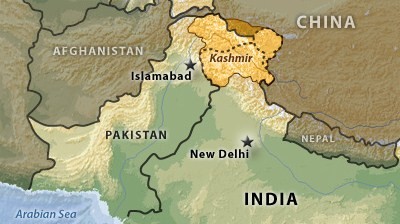
The “missing 1,500 km” from the definition of the Sino-Indian border is seen to be a clear pointer to Beijing’s hardening position, not only on its long-standing boundary dispute with India but also on Jammu and Kashmir (J&K). While India holds about 45% of J&K territory and Pakistan controls 35%, China occupies about 20% (including Aksai Chin and the Shaksgam Valley, ceded by Pakistan to China in 1963).

A Beijing-datelined Xinhua news agency report of an official briefing by China’s Assistant Foreign Minister Hu Zhengyue on the eve of Prime Minister Wen Jiabao’s recent visit to India triggered the flap. “China and India share a 2,000-km-long border that has never been formally demarcated,” the report said. India describes the border as being 3,488 km.

The different positions were made even more explicit by the Global Times, an English-language newspaper published by the People’s Daily, the official mouthpiece of the ruling Chinese Communist Party. In an interview with Global Times, India’s ambassador to China, Subrahmanyam Jaishankar, spoke of the “long common border of 3,488 kilometers” between the two countries. But a comment by the editors of Global Times in parentheses said: “There is no settled length of the common border. The Chinese government often refers to the border length as being ‘about 2,000 kilometers’.”

Reports in state-owned media have been describing the border as being 2,000 km for at least a year now.

The roughly 1,500 km-long shortfall in the Chinese perception is believed to refer to the Sino-Indian boundary in J&K. “China apparently no longer treats the line of nearly 1,600 km separating Jammu and Kashmir on the one hand and Xinjiang and Tibet on the other as a border with India,” strategic affairs expert C Raja Mohan wrote in the Indian Express. That is, it does not recognize Kashmir to be part of India.

Beijing is questioning India’s locus standi to discuss J&K’s border with China, observes B Raman, a retired director in India’s external intelligence agency, the Research and Analysis Wing (RAW). In essence, it is seeking to exclude discussion of the western sector of the disputed Sino-Indian boundary with India. The western sector includes the large chunk of Indian territory, Aksai Chin, in the Ladakh region of Jammu and Kashmir that China occupied in 1962.

Besides, China “wants to change the format of the border talks in order to keep it confined bilaterally to the eastern and middle sectors and expand it to a trilateral issue involving India, China and Pakistan in the western sector,” Raman wrote recently.

China has become increasingly assertive in its questioning of India’s sovereignty over J&K. Since 2008, it has been issuing visas on a separate sheet of paper to residents of Jammu and Kashmir rather than stamping the visa in their passports, as is the norm with other Indian citizens. In August last year, China also denied a visa to Lieutenant General B S Jaswal – commander of the Indian army’s Northern Command, which includes Kashmir – for an official visit to China, on the grounds that he “controlled” a “disputed area”.

Besides, over the past year, Beijing has been reaching out to the Hurriyat Conference, an umbrella organization of Kashmiri separatist outfits. In March 2010, for instance, Chinese Foreign Affairs director Ying Gang met with Hurriyat leader Mirwaiz Umar Farooq in Geneva on the sidelines of the 13th session of the UN Human Rights Council. Besides questioning India’s sovereignty over Kashmir, China has been endorsing Islamabad’s control over the part of Kashmir it has administered since 1947.

It was with India that the Maharajah of Jammu and Kashmir, Hari Singh, signed an Instrument of Accession in October 1947. However, only 45% of the territory of the former princely state is in India’s hands today, roughly 35% remaining under Pakistani administration and another 20% under Chinese control. The territory under Chinese occupation includes Aksai Chin and the Shaksgam Valley that Pakistan gifted to China in 1963.

In the Northern Areas of Pakistan-administered Kashmir, China is involved in the construction of several infrastructure projects, including roads, hydroelectric power projects, dams, expressways, bridges and telecommunication facilities. During Wen’s recent visit to Pakistan, the two countries signed a US$275 million agreement for repair and expansion of the Karakoram Highway. Earlier in September, Beijing underlined its support to Islamabad’s territorial claims over parts of Pakistan-administered Kashmir when it described the Northern Areas as “a northern part of Pakistan”.

The India-Pakistan dispute over Kashmir predates the People’s Republic of China (PRC). India and Pakistan had already fought their first war over Kashmir when the PRC came into being. Initially, China took its cues from the Soviet Union on the issue. It described the conflict as a Western creation and maintained that the US and Britain were hoping to make Kashmir a Western base.
China took a “neutral position” in the 1950s. It opposed foreign arbitration on the Kashmir issue, which pleased India. At the same time, it did not endorse Delhi’s claims over Kashmir. Fraying Sino-Soviet relations and Moscow’s overt support to Jammu and Kashmir as “an inalienable part of the Republic of India”, as well as concerns that its backing of India would push Pakistan into a closer embrace of the US, seem to have prompted it to adopt a more “neutral position” between India and Pakistan on Kashmir.

With Sino-Indian relations deteriorating from 1959 onwards, China began tilting towards Pakistan. It signed a border agreement with Pakistan. Since this dealt with areas that constituted Pakistan-administered Kashmir, the agreement amounted to a de facto Chinese recognition of Pakistan’s control over this area. Although it subsequently denied such recognition, describing this as “provisional” and “pending settlement of the Kashmir dispute”, a joint communique issued at the end of prime minister Zhou Enlai’s visit to Pakistan in February 1964 was a strong endorsement of the Pakistani position. It urged a solution of the dispute “in accordance with the wishes of the people of Kashmir”. India is opposed to a plebiscite in Kashmir.

By the mid/late 1970s, China began advocating a status quo on Kashmir. Support for the Kashmiris’ right to self-determination was toned down. In 1976, in his speech before the UN General Assembly, Chinese foreign minister Chia Kuan-Hua omitted naming Kashmir in a list of territories where the right to self-determination had not been exercised. It is believed that China’s own troubles with separatism and improving ties with India prompted its shrinking support on self-determination.

With Sino-Indian rapprochement gathering momentum in the 1990s, China began describing Kashmir as a bilateral matter to be resolved by India and Pakistan through peaceful means. On his visit to India in 1996, president Ziang Zemin called on India and Pakistan to set aside contentious issues and build a cooperative relationship. During the brief Kargil conflict in 1999, China called on India and Pakistan to respect the Line of Control that separates Pakistani- and Indian-administered Kashmir. These were seen as signs of Beijing taking a neutral position on Kashmir again.

China has never accepted India’s sovereignty over Jammu and Kashmir, even over the part that is under its control. After all, if it did it would mean giving up the roughly 43,180 square kilometers of territory that is currently under its control. However, it had avoided provoking India on the matter publicly. This has changed in recent years, with Beijing being “deliberately provocative” on Kashmir.

India is not letting the repeated provocations go unchallenged. After all, the territorial integrity of the country is a core concern of the Indian state. A couple of months ago, in his talks with Chinese Foreign Minister Yang Jiechi, India’s External Affairs Minister S M Krishna did some tough talking. According to officials quoted by the Hindu, for the first time India drew a parallel between “the territorial red lines” of the two countries.

Krishna reportedly told Yang that just as India had been sensitive to its concerns over Tibet and Taiwan, Beijing too should be mindful of Indian sensitivities on Jammu and Kashmir. The message that India is sending is that if China questions India’s sovereignty over Kashmir, India will question Beijing’s sovereignty over Tibet and Taiwan.

Delhi has indicated that Krishna’s warning was to be taken seriously. The joint communique issued at the end of Wen’s visit to India made no reference to India’s commitment to a “one china policy”. This is the first time since 1988 that a summit-level joint communique has made no mention of the policy. Instead, both sides agreed to show “mutual respect and sensitivity for each other’s concerns and aspirations”.

-Sudha Ramachandran is an independent journalist/researcher based in Bangalore.

Will India Win Coveted UN Seat?

By Sunil Sharan for The Huffington Post

Indian foreign secretary Nirupama Rao says Pakistan is hypnotically obsessed with India but she and her bosses too are fixated on a coveted prize, a permanent seat at the United Nations Security Council. The mandarins of New Delhi must be pleased as punch to have had over to visit leaders of all five permanent member countries in quick succession. Inexorable appears the march but will India find the pot of gold at the end of the rainbow? And, if it does, what are the implications for itself as well as for Pakistan?

First in was David Cameron of Britain, who arrived during the summer and offered unstinting support, whetting local appetite for the main American course. And, did he fail to disappoint? No sir, Barack Obama set the cat amongst the pigeons by endorsing India for the seat, the first time ever by the US. India rejoiced while Pakistan recoiled.

But a careful examination shows him adhering closely to what he told Bob Woodward in the book, Obama’s Wars. In lieu of the seat, he expects India to resolve Kashmir. At a press conference with Manmohan Singh, Obama characterized Kashmir as a long-standing dispute making the latter stutter that the K-word was not scary. Only then did Obama hand over the endorsement in India’s Parliament but couched in such diplomatese that countless local hair were split over when “the years ahead” would dawn.

Next waltzed in Nicolas Sarkozy of France. The French, like the British, have consistently seen merit in India’s case. Sarkozy though, true to type, proved an enigma. He first tagged on the applications of Africa, the Arabs and pretty much the rest of the world onto India’s, befuddling his hosts, who are willing to concede as equal aspirants only “self-appointed frontrunners” Germany, Japan and Brazil. Just as they were about to give up on him, Sarkozy warmed the cockles of India’s heart by throwing in 2011 as early as when it could make it.

But soon came the caveat. Sarkozy, just like Obama before him, cautioned that with great power status came great responsibilities. Whereas Obama wanted India to be more mindful of human rights violations of countries such as Iran and Myanmar, Sarkozy wanted India to send military forces to keep world peace. With India already being one of the foremost contributors to UN peacekeeping missions throughout the world, the mandarins of New Delhi must have been left wondering what more was being asked of them.

No matter, three down, two to go. By now the state jets were landing at Delhi airport almost on top of one another. Wen Jiabao, the leader India was least looking forward to, came with the master key to entry. Shortly before his visit, WikiLeaks revealed China’s opposition to any council expansion. Indian hopes were up nevertheless but Wen remained inscrutable, willing only to acknowledge an understanding of India’s aspirations. No one in India knew quite what to make of him and since Wen was off to Pakistan next, all the country could do was wait with clenched teeth to hear what he would say there.

Rounding off the passage to India was Dmitry Medvedev. Relations between Russia and India have frayed considerably since the heady days of the cold war, so much so that Russia has waffled on India’s bid. Medvedev signaled that the waffle still needed baking, voicing support for India while reiterating that reforming the council was tough and required consensus.

All the while Pakistan protested vociferously against what it deemed an indulgence of Indian hegemonism. But what will India gain with a permanent UN seat? Could it block Pakistani claims on Kashmir? True a permanent member wielding veto power can stonewall but the veto seems unattainable for seekers since they themselves have forsaken it. And, while India sees red when the K-word is uttered in the UN by Pakistan, no ascension to permanency can make it strangle the latter. Nor can it efface any past security council resolutions.

So then, what is it? Nothing comes to mind but the obvious, the acceptance that any arriviste craves. Even that appears a false hankering because ever since its early years, Gandhi’s legacy and Nehru’s charisma burnished the country with global influence disproportionate to its economic and military capabilities. A bee once in one’s bonnet is hard to get rid of though. And, as every journey must have a fitting end, India has found a destination to its liking.

Flush with cash, New Delhi wants to beef up its military. All of the recent visitors bar China are major suppliers of defence equipment to India. As bees flock to honey, they arrived armed with catalogues of the most terrifying stuff. Inherent was a delicate diplomatic quid-pro-quo. The more arms you buy from us, the more we will push your candidacy. As Islamabad keeps raising the bar for India’s seat, so too will India have to up its arms binge.

Lost in Pakistan’s current rhetoric was its vote in October to put India in the security council for two years beginning January 1, 2011. Once on, we will never get off is the new mantra of India’s brave. India seemingly returned the favor by taking in stride the sale of Chinese nuclear reactors to Pakistan. Is there more afoot than meets the eye?

Every country is entitled to its obsession. Pakistan’s is obvious. By continually thumbing its nose at a NATO mired in Afghanistan, it has put the K-word in spotlight, albeit on the backstage. A deal has been blessed by the powers that be. Both the seat and Srinagar are not far away.

The writer edits a website on India: http://www.scooptime.com.

China’s Growing Influence on Pakistan Worries U.S.

By Farhan Bokhari for CBS news

China’s premier Wen Jiabao concluded a high profile visit to Pakistan on Sunday, promising to lay the foundation for a “deeper” relationship to a country which is central to U.S. efforts for stabilizing Afghanistan.

Wen sought to broaden a relationship which has traditionally been driven by Beijing’s role as a key supplier of military hardware to Islamabad. Pakistan’s government officials said that during Wen’s visit, China signed business deals between the governments and private businesses of the two countries worth at least $29 billion, with a possibility of another $6 billion worth of contracts. These contracts were the largest ever signed during a visit by a foreign leader to Pakistan, underlining the growing importance of the country to China.

The Chinese premier also used a speech to a joint session of Pakistan’s upper and lower houses of parliament to commend the country for its efforts against terrorism. It was an apparent effort to negate criticism from the western world, including the U.S., which has urged Islamabad to take further steps against Al-Qaeda and the Taliban.

“Pakistan has given great sacrifices and made great efforts in the fight against terrorism. It is a reality and the international community should respect Pakistan’s efforts,” Wen said.

While the U.S. has poured billions of dollars into Pakistan to assist in combating terrorist groups, Pakistan’s military and civilian leaders remain committed to retaining a close alliance with China. “Let’s stand together, with a new confidence, and begin a new era of progress and prosperity, by jointly confronting all challenges,” Wen said in his speech on Sunday. To the applause of Pakistan’s ruling and opposition politicians, the Chinese continued that “China and Pakistan are all-weather strategic partners and share the sorrows and joys of each other as close brothers.”

A senior Pakistani official told CBS News that the deals signed during Wen’s visit included contracts for the development of a road and train network linking the two countries, for mineral resources, for gas and oil fields and for facilities to produce electronics.

“China is beginning to launch an important new phase to help Pakistan transform itself economically,” said the official, who spoke anonymously because he was not authorized to talk to journalists. “Unlike our western friends such as the U.S., China remains a true friend of Pakistan,” he added.

Western diplomats in Islamabad who spoke to CBS News, also on condition of anonymity, said Pakistan’s relations with China remain of concern to Washington in some areas, notably China’s continued support for Pakistan’s nuclear energy program and signs that China is stepping up its supply of conventional military hardware to Pakistan.

In the past decade, the two countries have jointly developed their first fighter plane for the Pakistan Air Force (PAF), known as the JF-17, or “Thunder.” The PAF plans to buy up to 250 of the JF-17s, making it the largest-ever purchase by the PAF of a single type of aircraft. On the other hand, Pakistani leaders frequently speak of the trust factor in their country’s relations with China, an oblique reference to the lack thereof in the country’s ties with the U.S.

In the 1990s, the U.S. sanctioned Pakistan on suspicions that the country was preparing to produce nuclear weapons, which reversed the two sides’ close cooperation when they confronted the occupation of Afghanistan by the former Soviet Union. While those sanctions were lifted after 9/11, which prompted a new partnership against terrorism, many Pakistanis remain skeptical of ties to the U.S. But a Pakistani foreign ministry official who spoke to CBS News said a growing economic relationship with China “will not come at the expense of our relations with the U.S. We want to establish and maintain a close partnership with the U.S. Our relations with China must never be seen as a replacement for our relations with the U.S.”

Chinese Premier Visits Pakistan to Reinforce Ties

By Salman Masood for The New York Times

ISLAMABAD, Pakistan — Chinese Prime Minister Wen Jiabao arrived in Islamabad on Friday for a three-day visit that Pakistani officials said was aimed at strengthening the strategic partnership and economic cooperation between the two neighboring countries.

Prime Minister Yusuf Raza Gilani and members of his cabinet welcomed Mr. Wen at Chaklala Air Base in neighboring Rawalpindi on Friday afternoon. A red carpet was rolled out and elaborate ceremonies were held to signify the importance Pakistan attaches to China, which is considered a close ally.

“Friendship with China is a matter of pride for our nation,” Mr. Gilani was quoted as saying by local media as he welcomed his Chinese counterpart.

Apart from holding meetings with Mr. Gilani and President Asif Ali Zardari, Mr. Wen was scheduled to address a special joint session of the Parliament on Sunday.

Pakistan’s military ties with China are strong and China has assisted Pakistan in tank production, fighter aircraft manufacturing and naval technology. But since the late 1990s, economic concerns have gained increased importance. Trade and energy have taken precedence in Pakistan’s relations with China.

Mr. Wen was accompanied by 260 business executives.

Pakistani officials say there is a need to enhance trade between the countries that stands around $7 billion a year. But there also are concerns here that the trade deficit is growing heavily in favor of China.

“The relationship is undergoing a qualitative change,” said Mansoor Ahmad, an independent security analyst based in Islamabad. “This change is manifested in China’s relationship with emerging markets and developing countries, which is essentially based on forging and enhancing trade linkages and securing new markets for Chinese investment.”

The Chinese are also cooperating with Pakistan in developing its civil nuclear energy program despite discontent from Washington and New Delhi.

Mr. Wen, the Chinese prime minister, arrived here after completing a two-day tour of India, the estranged neighbor of Pakistan.

China would have to undertake a fine balancing act regarding enhancing its cooperation with both India and Pakistan, said Mr. Ahmad. China and India would forge economic ties despite their continuing territorial disputes, given India’s huge market, he said. Tensions between India and Pakistan worsened after the terrorist attacks in Mumbai in 2008, which India and the United States blamed on Lashkar-e-Taiba, a militant Islamic group based in Pakistan.

The Pakistan government sees China as a counterweight to India, and officials said that closer Chinese cooperation with India would not affect Pakistani ties with China.

Nonetheless, Mr. Wen’s visit to India this week yielded greater immiediate progress on the economic front than toward resolving the more complicated geostrategic issues.

“In Pakistan’s case, we have already had a longstanding strategic partnership which is now being supplemented by increasing Chinese investment in infrastructural development, civil nuclear cooperation and establishing rail and road linkages between the two countries,” Mr. Ahmad said.