Posts Tagged ‘ United Nations ’

Pakistan Floods: World Bank to Lend $900m For Recovery

As Reported by the BBC
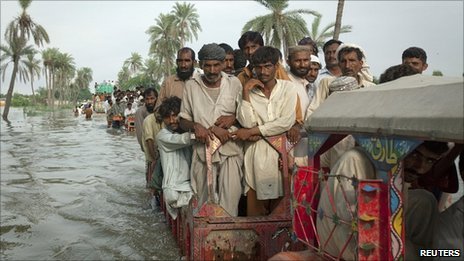
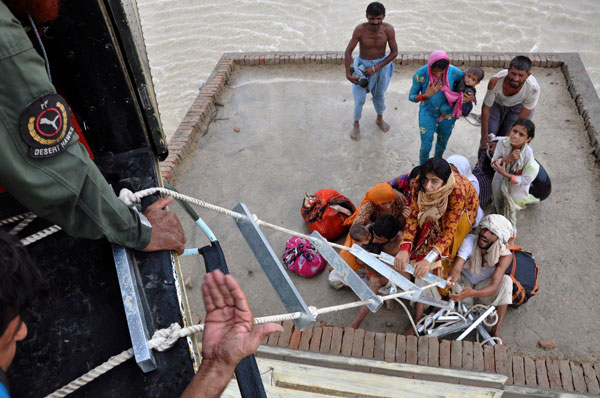
The World Bank is to loan $900m (£574m) to Pakistan to help it recover from its worst ever flooding. The devastating floods have affected up to 20 million people and left some 2,000 dead, say officials.

But the UN says international aid has been slow and that it has raised only a third of the $460m (£294m) needed for emergency relief.

Pakistan’s High Commissioner to Britain said it could take five years and $15bn (£9.6bn) for the country to recover. The World Bank funds will come through the reprogramming of planned projects and the reallocation of money, a World Bank spokesman said.

“We are reprioritising to make the funds immediately available,” he told Reuters news agency.

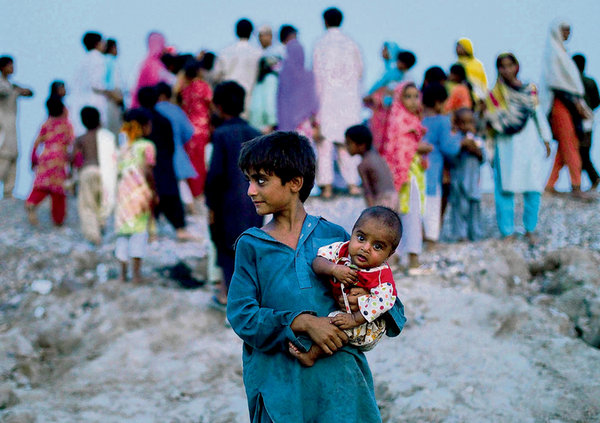
Health officials have warned that disease could spread quickly among the millions of displaced people and that 3.5m children are at risk.

Maurizio Giuliano, of the UN Office for the Coordination of Humanitarian Affairs (OCHA), warned that Pakistan would face “a second wave of deaths” from water-borne diseases and food shortages unless more aid arrived soon.

He estimated the number of people at risk from such diseases was six million.

Meanwhile, rival political groups in Sindh province have been accusing each other of creating breaches in embankments and dykes to save their own towns and property.

Many of the breaches were reportedly made to divert flood waters away from military garrisons in the area.

Jacobabad city, for example, has been saved, but low-lying areas around it, including Dera Allahyar and some other towns in Balochistan province, have been inundated.

In India, Prime Minister Manmohan Singh has promised more funds to help areas affected by the recent devastating floods in Ladakh, a remote mountain region in Indian-administered Kashmir.

During a visit to the heavily damaged town of Leh, he said all the destroyed homes would be rebuilt within the next two-and-a-half months with money from a government relief fund.

The flash floods over 10 days ago killed more than 80 people and caused heavy damage to property. Many people are still missing.

‘Marshall Plan’

Pakistan’s High Commissioner to Britain Wajid Shamsul Hasan told the AFP news agency that 2,000 people had now been killed by the floods – previous estimates have put the number of dead at around 1,500. He said it would take at least five years for the country to recover, and put the reconstruction bill at “more than $10 to $15bn”.

He warned that a failure to provide sufficient relief and rebuilding assistance could lead to an increase in extremism and instability in the wider region.

He called for a new Marshall Plan, referring to the extensive US development programme in Europe after World War II.

Not only have the floods affected around one-fifth of the country, they have also caused considerable damage to roads, bridges and communications, says the BBC’s Mike Wooldridge in Islamabad.

Thousands of homes and other buildings including schools and hospitals have been swept away, and crops for domestic food consumption and for export have been lost.

One of the key questions is whether farmers will be able to use their land to plant their winter wheat crop in September, our correspondent adds.

‘Image deficit’

The UN has so far only received about a third of its appeal amount – the US has made the biggest contribution so far, followed by the UK.

Aid agencies have blamed Pakistan’s “image deficit” for the shortfall, as potential donors fear the funds would be diverted into extremism in the country.

A spokeswoman for Care International told AFP the UN had to do more to convince donors that the money was “not going to go to the hands of the Taliban”.

“The victims are the mothers, the farmers, children. But in the past, information linked to Pakistan has always been linked to Taliban and terrorism,” said Melanie Brooks.

Bill Berger, USAID’s principal regional adviser for South Asia, told the BBC it had been difficult to communicate the scale of the disaster to the rest of the world:

“Remember that this flood has built up over time… I just don’t think the world has realised the magnitude of this now, because this story has just been slowly increasing. It doesn’t have the drama of an earthquake that impacts a huge number of people all at once.”

The floods began more than two weeks ago in the mountainous north-west and has swept south across a quarter of the country, including its agricultural heartland.

How The Rest of the World Has So Far Responded To Pakistan Crisis

By James Burton and David Randall for The Independent

The world is now beginning to respond in a significant way to the almost bottomless pit of need in Pakistan. Whether – with some 20 million affected and the nation’s ability to feed itself ruined for years to come – it will be enough is very doubtful.

So far, according to the UN, some $93m (unofficial reports say $150m) has been given or promised, in cash or kind; with a further $366m needed immediately. That number is likely to increase, and the UN estimates that billions will be required to rebuild once waters have receded.

But criticisms of the British response (one newspaper called it “tight-fisted”) are ill-judged. The Government has already allocated £17m (out of £31.3m earmarked), and the public has donated £12m to the Disasters Emergency Committee appeal. In terms of money given, as opposed to pledged, Britain is one of the world’s most generous givers.

All kinds of comparisons have been made between the response to this disaster and those to the Haiti earthquake, the Boxing Day tsunami, and the 2005 Pakistan earthquake, all of which raised far more from the public. But appeals for single cataclysms, such as earthquakes and tsunamis, always do better than the more creeping – but often more serious in terms of need – disasters such as food crises and floods. One aid agency source said: “What stirs people to give are high death tolls – even though nothing can help the dead – and arresting images of people amid destruction.”

By the standards of previous “creeping disaster” appeals, the DEC’s for Pakistan 2010 is doing well – £12m in only a week. And a lot of British giving is not being logged. Members of our large Pakistan-origin diaspora are sending money, with money transfers from Britain to Pakistan up 36 per cent in the past seven days. And many mosques and community groups are organising aid. Overall, using figures supplied by the UN, international wire services and London’s Pakistan High Commission, these are the aid donations so far:

Australia: $9m plus $30m pledged; two C-17 freight aircraft.

Azerbaijan: $1m; embassy staff in Pakistan gave two days’ salary.

Belgium: $655,000.

Brazil: $700,000.

Canada: $2m; $30m pledged.

China: $1.5m; $7.4m pledged.

Denmark: $10m; $50m pledged; $771,000 provided for immediate aid.

Estonia: $84,000 for food assistance.

Finland: $1.5m.

France: $1.4m; money for water sanitisation.

Germany: $2.4m; pledged $13m for improving water, sanitation and hygiene.

Greece: $131,000.

India: Offered $5m; Pakistan considering response.

Italy: $1.8m; $3.3m pledged. Silvio Berlusconi gave $7m of own money.

Ireland: $260,000; $1.1m pledged.

Japan: $230,000 for emergency relief; $3m for aftermath.

Kuwait: $5m; plus aid flights.

Luxembourg: $327,000.

Malaysia: $1m; plus private donations.

Netherlands: $1.3m; $2.6m pledged.

New Zealand: $1.5m pledged.

Nigeria: $1m.

Norway: $16m.

Saudi Arabia: pledged $100m, plus air transport.

Spain: $855,000; plus relief plane.

Sri Lanka: $26,709.

Sweden: $3m; plus water purification.

Switzerland: $1.6m; plus relief workers.

Thailand: $75,000.

Turkey: $5m; 115 tons of aid.

UAE: $1.5m; Sheikha Fatima bint Mubarak personally donated $1.4m.

UK: £17m ($26m); provided RAF C-17 heavy freight aircraft, which has already delivered 2,500 tents; the Queen donated an undisclosed amount through the British Red Cross; DEC total reached £12m ($19m) last Friday.

USA: $22m; pledged $40m; provided 56,000 ready meals, 12 temporary bridges and two water filtration plants; 1,000 US marines; 25 Chinook helicopters.

Flood-Ravaged Pakistan Cancels Independence Day Events

As reported by CNN

Pakistan canceled independence day celebrations Saturday as a second wave of floods continued to put millions in peril, the nation’s prime minister said.

Prime Minister Yousaf Raza Gilani said the devastating floods had affected 20 million people, a figure much larger than officials had given earlier. Gilani said some religious events connected to Ramadan were also canceled.

“In solidarity with the flood victims, all independence day celebrations have been canceled and moreover, all Iftar dinner events and celebration of eid by government ministries have been canceled so that these resources can be utilized in the affected areas,” Gilani said.

A second wave of floodwater is expected to wash through southern Pakistan this weekend, adding hundreds of thousands of people to the number already stranded by a first wave earlier this month, Pakistani officials said.

At least 1,384 people have died and 1,630 more have been injured by flooding that has damaged or destroyed 8,300 Pakistani villages so far, according to Ahmed Kamal, spokesman for the National Disaster Management Authority.

The United Nations said it was racing against time to reach the suffering.

“Relief supplies must reach women, men and children as soon as possible, in order to avoid further death caused by waterborne diseases and food shortages,” said Martin Mogwanja, the United Nations’ humanitarian coordinator for Pakistan.

“The death toll has so far been relatively low compared with other major natural disasters, and we want to keep it that way,” he said.

Pakistan emergency officials predicted the second wave could reach Sukkar on Saturday evening.

Hundreds of thousands of people living along the Indus River in northern Sindh could be stranded, along with the tens of thousands stranded by the first wave, said Lt. Cmdr. Jawad Khawaja of the Pakistani navy.

Many residents have ignored government warnings to evacuate the area, causing a big concern, Khawaja said.

It estimated that 723,950 homes have been damaged or destroyed.

The Scope of Pakistan’s Floods: By the Numbers

By David Knowles for AOL News

Dubbed Pakistan’s “flood of the century,” heavy monsoon rains have washed out upward of one-fourth of the area of the country. The scope of the ongoing devastation is on a scale that is difficult to comprehend, especially to those far away and unfamiliar with the territory. Still it is alarming to consider the estimate given by concerned officials on Wednesday — that up to one-fifth of the entire landmass is now underwater.

The flooding has largely been located in the center of the country and is being caused by overflow from the Indus and Chenab rivers. Surge Desk has been rounding up the figures from the tragedy and has the following context.

Area
Some 150,000 square kilometers, or approximately 93,000 square miles, have been affected by the rising waters, Voice of America reported. That’s a little smaller than the size of the state of Michigan.

Fatalities
So far, at least 1,600 have been killed in the floods.

Agricultural losses
The floods have so far destroyed 2 million bales of cotton, BusinessWeek reported, nearly one-seventh of the country’s yearly target. In addition, 500,000 tons of wheat have been ruined, The New York Times said.

U.S. military response
One thousand U.S. Marines and 24 military helicopters have been deployed to Pakistan to help with relief efforts, The Associated Press reported.

Pakistanis displaced

According to the United Nations, 7 million citizens of Pakistan have been left homeless because of the floodwaters. Furthermore, the U.N. estimates that 14 million Pakistanis, roughly 8 percent of the country’s population, have been adversely affected by the floods. According to UNICEF, 6 million of those are children. All told, approximately 4,700 villages have been wiped out, Voice of America news reported.

Effect on war with the Taliban
Some 60,000 Pakistani troops that had recently been fighting the Taliban have now been put on flood assistance, The Telegraph reports.

Foreign aid
The United Nations is seeking foreign contributions of $460 million to tend to immediate needs, such as food, water and temporary shelters. The United States has pledged $71 million in aid, the biggest amount offered by any country so far, The New York Times reports.

Pakistan Fight Stalls for U.S.

By Julian Barnes for The Wall Street Journal

The U.S. military has stopped lobbying Pakistan to help root out one of the biggest militant threats to coalition forces in Afghanistan, U.S. officials say, acknowledging that the failure to win better help from Islamabad threatens to damage a linchpin of their Afghan strategy.

Until recently, the U.S. had been pressing Islamabad to launch major operations against the Haqqani network, a militant group connected to al Qaeda that controls a key border region where U.S. defense and intelligence officials believe Osama bin Laden has hidden.

The group has been implicated in the Dec. 30 bombing of a CIA base in Khost, a January assault on Afghan government ministries and a luxury hotel in Kabul, and in the killing of five United Nations staffers in last year’s raid on a U.N. guesthouse.

But military officials have decided that pressing Pakistan for help against the group—as much as it is needed—is counterproductive.

U.S. officials believe elements of Pakistan’s intelligence agency, Inter-Services Intelligence, are continuing to protect the Haqqani network to help it retain influence in Afghanistan once the U.S. military eventually leaves the country. U.S. officials say the support includes housing, intelligence and even strategic planning,

During a trip to Pakistan last month, Adm. Michael Mullen, chairman of the Joint Chiefs of Staff, chose not to raise the issue of an offensive against the Haqqani network—a departure from the message U.S. defense officials delivered earlier this year.

The U.S. also had intensified the pressure for Pakistani operations in North Waziristan in May after the attempted bombing of New York’s Times Square was linked to militants in Pakistan.

Pakistan officials reject the U.S. conclusions about their efforts. They say they are taking significant action against militants in North Waziristan. They say their intelligence service has severed all ties with the Haqqani network. Islamabad points to a series of surgical strikes the Pakistani military has executed in North Waziristan, and say they have ratcheted up those efforts in recent months in a precursor toward more aggressive moves.

Pakistan’s operations complement a Central Intelligence Agency drone campaign targeting militants in North Waziristan, a Pakistani official said.

Defense Secretary Robert Gates praised the Pakistani effort to rout al Qaeda and other militants from Swat and South Waziristan. “Are they doing a lot to help us? The answer is yes,” Mr. Gates said Thursday.

U.S. officials acknowledged the recent Pakistani operations, but discounted their value against the Haqqani network.

A U.S. defense official said that most of the raids have been against the Pakistani Taliban, a militant group that poses no direct threat to U.S. forces in Afghanistan, but opposes the Pakistani government.

Pakistan has failed to act on detailed intelligence about the Haqqanis provided in recent months, said a senior military official. “Our forces have put a significant dent in the Haqqani network,” said the official. “It would be good if the [Pakistanis] would do the same on their side.”

U.S. officials say they have concluded that making more demands, public or private, on Islamabad to start a military offensive against the Haqqani network will only strain U.S.-Pakistani relations.

The Haqqani network has decades-long ties with al Qaeda leaders that date back to their days of fighting the Soviets in Afghanistan prior to al Qaeda’s formation.

The network now is believed to provide al Qaeda with protection, shelter and support in North Waziristan. The group’s historic base is in Afghanistan’s Khost province and it remains the most potent insurgent force in the eastern part of the country and is closely aligned with the Taliban.

The number of al Qaeda fighters in Afghanistan is thought to be very small, under 100; Haqqani network fighters number in the thousands.

The U.S. shift partly is in recognition that the Pakistanis simply may not have the military capacity to expand operations enough to secure the North Waziristan area, one U.S. official acknowledged.

Pakistani efforts in North Waziristan so far are too small to have a significant impact, said Bruce Riedel, a former CIA analyst who headed the Obama administration’s first review of U.S. policy toward Afghan and Pakistan.

“It is mostly show to keep the Americans happy,” he said.

In the wake of Pakistan’s recent flooding, U.S. officials also are concerned the Pakistanis may ratchet back counterterrorism operations as they redeploy troops to help respond to a burgeoning humanitarian crisis.

U.S. defense officials now argue the only way to convince Pakistan to take action in North Waziristan is to weaken the Haqqani network so much that Pakistan sees little value in maintaining an alliance with the group—though they acknowledge that will be harder without Pakistani help.

The U.S. military has stepped up its own operations against the Haqqani network since April, and most significantly in the last two weeks, according to military officials. Strikes have significantly reduced the Haqqani network’s ability to mount attacks in Kabul and outside their traditional tribal areas of eastern Afghanistan, said senior U.S. military officials.

In eastern Afghanistan, a task force of elite troops assigned to target the Haqqani network conducted 19 operations in April, 11 in May, 20 in June and 23 in July. The high pace continued in the first week of August with seven operations.

The Haqqanis threatened to disrupt an international conference in Kabul last month, but were not able to make good on the threat.

U.N. Appeals for Pakistan Aid as Rains Threaten More Flooding

By Saeed Shah for The McClatchy Newspapers

The United Nations appealed Wednesday for $459 million in emergency aid for Pakistan as fresh monsoon rains raised fears that new flooding could drive more people from their homes, deepening the humanitarian catastrophe.

Storms lashed the mountainous northwest, close to the border with Afghanistan, and the northeastern Gilgit region, swelling rivers that empty into the central Indus River before it reaches the city of Sukkur in southern Sindh province, which already is full of people displaced from surrounding areas.

More flooding would prevent vital repairs to Indus River embankments and dikes that protect farmland, allowing water to spread even further when the fresh flows reach Sukkur sometime next week, officials warned.

“Once this peak passes, another flood is being formed in the mountains and then a third,” Sindh’s irrigation minister, Saifullah Dharejo, said in an interview. “If we cannot plug the breaches (in the embankments), the water will keep expanding out.”

“This is a grave situation,” he said.

Sindh is now the focus of the worst floods in Pakistan’s history. They reached the province after washing down the Indus River Valley, powered by unusually fierce monsoon rains that began in northern areas of the country some three weeks ago.

The deluge has left a trail of devastation, destroying roads, bridges and other infrastructure and overwhelming the government’s ability to cope. It’s affected some 14 million people, of whom an estimated 1,600 have been killed and about 2 million left homeless.

The overwhelmingly Muslim country of 170 million, a key U.S. ally in the fight against terrorism, already had been struggling to cope with an economic crisis and Islamic militants allied with al-Qaida when the disaster hit.

The United Nations appealed Wednesday for emergency aid, warning that even those who had been saved from drowning were threatened with sickness and hunger.

“If we don’t act fast enough, many more people could die,” John Holmes, the U.N. humanitarian aid chief, said in New York. He called the disaster “one of the most challenging that any country has faced in recent years.”

In Sukkur, the head of Sindh’s provincial government, Qaim Ali Shah, dismissed the amount of international aid pledged so far as “peanuts.”

The U.S. will be beefing up its assistance to the relief effort with 19 helicopters from the U.S.S. Peleliu, an amphibious assault vessel that is deploying off the Pakistani port city of Karachi, Secretary of Defense Robert Gates announced Wednesday in Tampa, Fla. The helicopters will be used to distribute food aid and ferry displaced people.

The ship’s aircraft will replace six U.S. military helicopters that were diverted from missions in Afghanistan.

At the Sukkur Barrage, 1.13 million cubic feet of water per second was rushing through the 66 gates of the mile-wide flood-control barrier, which the former British colonial government built on the Indus River in 1932.

Experts think that the flooding at Sukkur probably will ebb Thursday, but with more rain falling in the north, the water will remain high and the next onslaught of flooding could push it even higher, they said.

“Rainfall (in the north) takes about a week to reach Sukkur,” said Muzammil Qureshi, a retired engineer formerly in charge of irrigation for Sindh. “All five rivers converge before Sukkur.”

The onslaught has burst dike banks, drowning hundreds of thousands of acres of farmland in Sindh alone.

Only from the air do the scale of the disaster and the remoteness of the affected villages become apparent.

A McClatchy Newspapers reporter toured the region around Sukkur on a Pakistani army helicopter and saw mile after mile of water, swamp-like in some places, like the open sea in others. Thatched roofs and the tops of trees rose above the water. The outlines of abandoned villages were just visible beneath the surface.

The helicopter pilots had been diverted from battling Taliban militants in the Waziristan region bordering Afghanistan. Around 60,000 Pakistani troops are participating in rescue efforts, raising concerns about the country’s anti-terrorism campaign.

When the helicopter swooped low, it became apparent that there were people struggling to survive in the watery landscape, marooned in dozens of villages on slightly raised ground. Women, men and children could be seen in waist-high water, their buffaloes wallowing in groups.

Hundreds of people had taken refuge on raised embankments, built to hold irrigation channels or dirt roads, but they were stranded without food or shelter from the ferocious sun. Goats, donkeys and trunks of possessions kept them company.

While the military continues to rescue people, many others are refusing to leave their villages, hoping for the water to recede. However, the fresh onslaught that’s on its way from the north could make survival all but impossible.

Ramadan or Not, Hunger Hits Pakistan Flood Victims

By Mahmood Farooq for The Associated Press

Pakistani flood survivors already short on food and water began the fasting month of Ramadan on Thursday, a normally festive, social time marked this year by misery and fears of an uncertain future.

The U.S. announced a navy ship with 19 helicopters and 1,000 Marines on board was close to the southern coast of the country and relief flights would soon begin. The U.N. launched an emergency appeal for international assistance for Pakistan after the already-poor nation was hit with one of its worst-ever natural disasters.

Damage to crops, roads and bridges have caused food prices to triple in some parts of the country, adding to the pain of those marking the fasting month.

“Ramadan or no Ramadan, we are already dying of hunger,” said Mai Hakeema, a 50-year-old who sat alongside her ailing husband in a tent outside the city of Sukkur. “We are fasting forcibly, and mourning our losses.”

Observant Muslims fast from dawn to dusk each day for a month each year to control their desires and show empathy for the poor. The month is marked by increased attendance at mosques, a rise in charitable giving and family gatherings that coincide with the evening breaking of the fast.

While millions of flood-affected people were performing the fast, Mufti Muneebur Rehman, one of the country’s top religious scholars, said victims living in difficult conditions dependent on charity could skip the fast and perform later in the year.

“I am sad to miss the first day of fasting,” said Ghullam Fareed of Gormani village in eastern Punjab province. “Later, when we reach home, we will compensate for this.”

In the northwest, where many are especially devout, many refugees said flood or no flood, they would fast.

“I cannot disobey God, so I am fasting as it is part of my faith no matter what the conditions are,” said Fazal Rabi, 47, who was staying in a tent village in Akbarpura.

The floods hit the country more than two weeks ago, beginning in the northwest before spreading down the country and inundating thousands of villages. Around 1,500 people have been killed, and the U.N. estimates up to 7 million people need emergency assistance.

On Wednesday, the U.N. appealed for $460 million to provide immediate help, including shelter, food, clean water, sanitation and medical care.

“Make no mistake, this is a major catastrophe,” U.N. humanitarian chief John Holmes told diplomats from several dozen countries in launching the appeal in New York. “We have a huge task in front of us. The death toll has so far been relatively low compared to other major natural disasters, but the numbers affected are extraordinarily high.”

The United States said it was more than doubling the number of helicopters it is providing to help.

Defense Secretary Robert Gates said the USS Peleliu was off the coast near Karachi, carrying 19 helicopters and about 1,000 Marines. The helicopters will help rescue people and deliver food and other supplies.

The Pakistani government’s response to the crisis has been criticized by many as too slow and patchy, and the civilian leaders have struggled to rally public opinion in their favor.

Pakistani Prime Minister Yousuf Raza Gilani flew to southwestern Baluchistan province Thursday to see flood-hit areas. He told The Associated Press that Pakistan still needs more helicopters to assist in the relief work.

“We will try our best to reach millions of people to ensure that they get food and other basic items during and after the month of Ramadan,” he said while aboard a military plane.

Pakistan Flood Crisis Bigger Than Tsunami, Haiti: UN

As reported by The Associated Press

ISLAMABAD: The number of people suffering from the massive floods in Pakistan could exceed the combined total in three recent megadisasters – the 2004 Indian Ocean tsunami, the 2005 Kashmir earthquake and the 2010 Haiti earthquake – the United Nations said Monday.

The death toll in each of those three disasters was much higher than the 1,500 people killed so far in the floods that first hit Pakistan two weeks ago. But the Pakistani government estimates that over 13 million people have been affected – two million more than the other disasters combined.

The comparison helps frame the scale of the crisis, which has overwhelmed the Pakistani government and has generated widespread anger from flood victims who have complained that aid is not reaching them quickly enough or at all.

”It looks like the number of people affected in this crisis is higher than the Haiti earthquake, the tsunami or the Pakistan earthquake, and if the toll is as high as the one given by the government, it’s higher than the three of them combined,” Maurizio Giuliano, spokesman for the UN Office for the Coordination of Humanitarian Affairs, told The Associated Press.

The UN has provided a lower number of people who have been affected in Pakistan, about 6 million, but Giuliano said his organization does not dispute the government’s figure. The UN number does not include the southern province of Sindh, which has been hit by floods in recent days, and the two sides have slightly different definitions of what it means to be affected.

The total number of people affected in the three other large disasters that have hit in recent years is about 11 million – 5 million in the tsunami and 3 million in each of the earthquakes – said Giuliano.

Many of the people affected by the floods, which were caused by extremely heavy monsoon rains, were located in Pakistan’s northwestern province of Khyber Pakhtunkhwa.

Rescue workers have been unable to reach up to 600,000 people marooned in the province’s Swat Valley, where many residents were still trying to recover from an intense battle between the army and the Taliban last spring, said Giuliano. Bad weather has prevented helicopters from flying to the area, which is inaccessible by ground, he said.

”All these people are in very serious need of assistance, and we are highly concerned about their situation,” said Giuliano.

Hundreds of thousands of people have also had to flee rising floodwaters in recent days in the central and southern provinces of Punjab and Sindh as heavy rains have continued to pound parts of the country.

One affected resident, Manzoor Ahmed, said Monday that although he managed to escape floods that submerged villages and destroyed homes in Sindh, the total lack of government help meant dying may have been a better alternative.

”It would have been better if we had died in the floods as our current miserable life is much more painful,” said Ahmed, who fled with his family from the town of Shikarpur and spent the night shivering in the rain that has continued to lash the country.

”It is very painful to see our people living without food and shelter,” he said.

Thousands of people in the neighboring districts of Shikarpur and Sukkur camped out on roads, bridges and railway tracks – any dry ground they could find – often with nothing more than the clothes on their backs and perhaps a plastic sheet to keep off the rain.

”I have no utensils. I have no food for my children. I have no money,” said Hora Mai, 40, sitting on a rain-soaked road in Sukkur along with hundreds of other people. ”We were able to escape the floodwaters, but hunger may kill us.”

A senior government official in Sukkur, Inamullah Dhareejo, said authorities were working to set up relief camps in the district and deliver food to flood victims.

But an Associated Press reporter who traveled widely through the worst-hit areas in Sindh over the past three days saw no sign of relief camps or government assistance.

The worst floods in Pakistan’s history hit the country at a time when the government is already struggling with a faltering economy and a brutal war against Taliban militants that has killed thousands of people.

The US and other international partners have stepped in to support the government by donating tens of millions of dollars and providing relief supplies and assistance.

But the UN special envoy for the disaster, Jean-Maurice Ripert, said Sunday that Pakistan will need billions of dollars more from international donors to recover from the floods, a daunting prospect at a time when the financial crisis has shrunk aid budgets in many countries. – AP

Officials: Pakistan Flood Deaths Top 1100‎

As Reported By CNN

The devastating floods in Pakistan have killed more 1,100 people, Pakistani government officials told CNN on Sunday. Another 30,000 people were stuck on their rooftops and in higher areas as they tried to escape rushing floodwaters, a United Nations official said Sunday.

“We’ve got the government sending boats and helicopters to try to reach people and bring them to safety at the same time as trying to deliver emergency relief,” said Nicki Bennett, a senior humanitarian affairs officer for the U.N.

Damaged roads and bridges have made rescuing stranded residents difficult, she said, noting that even a U.N. warehouse where the organization stores food, blankets, soaps and bucks is partially underwater. “As we are trying to reach people, we have to battle with the ongoing access problems,” she said. The rescue and recovery efforts of the Pakistan flooding could become more complicated as weather officials predict more monsoon rains starting Monday.

The Pakistan Meteorological Department said Sindh, Punjab, Kashmir, eastern parts of Khyber-Pakhtunkhwa and eastern parts of Balochistan would receive monsoon rains. Areas along the Indus River would be badly affected due to extremely high flood conditions.

The number reflects those killed only in Khyber Pakhtunkhwa province, previously known as the North West Frontier Province, said spokesman Mian Iftikhar Hussain. Flooding has also been reported in Pakistani-controlled Kashmir. Twenty-five deaths were recorded there Friday, Hussain said.

A Pakistani Red Crescent official told CNN that the number of people affected by the floods has risen to nearly 2.5 million people, with infrastructure receiving major damage. Rushing water also has washed away thousands of acres of crops, government buildings, businesses, schools, bridges and homes, officials said.

The United States will assist in relief efforts by bringing in 50,000 meals, rescue boats and helicopters, 12 pre-fabricated steel bridges and water filtration units, the embassy in Islamabad said.

According to Geo TV, 150 people are missing in a northwestern province, and 3,700 homes were swept away. Forty-seven bridges in Swat have been destroyed or damaged.

Geo TV also said 3,000 are in a camp in Nowshera and are without enough water and food. Displaced residents are unhappy with the government response, Geo TV said. Trains have also been delayed, frustrating commuters.

“They have made this a joke,” a commuter told the network. “There are young children here, but there is no water, nor is there any seating. They have taken our ticket money. Yet after every few minutes they change the train timings. They are playing a game of lies and deceit.”

Pakistani Interior Minister Rehman Malik visited Khyber Pakhtunkhwa on Saturday and found tourists and local residents trapped because of the heavy floods, the state-run Associated Press of Pakistan reported.

President Asif Ali Zardari said all available resources would be used to help those stranded by the waters, the APP reported.

Many of the victims died when flood waters swept away hundreds of mud houses in parts of Swat Valley and the districts of Shangla and Tank, according to Bashir Ahmed Bilour, a provincial minister in Khyber Pakhtunkhwa.

Hussain said flooding has cut off the Swat Valley and the districts of Shangla and Peshawar. There is no way to get to these areas by road, he said.

The Pakistani Air Force has been helping with rescue efforts, spokesman Tariq Yazdanie said in an interview on Pakistani TV. The recent torrential rains have broken all previous records of rainfall in the country, he said.

The United Nations said there is a need for help in providing emergency shelter, food, drinking water and sanitation facilities. Its agencies are geared to help with these issues.

The European Commission is providing 30 million euros ($39 million) to help the people affected by the flooding.

U.S. Embassy officials in Pakistan said the United States has committed $10 million to support flood relief priorities, four inflatable rescue boats, two water filtration units that can fulfill the daily water requirements of up to 10,000 people, and 12 pre-fabricated steel bridges to temporarily replace damaged bridges.

U.S. officials have also provided more than 51,000 halal meals (military rations tailored for people of Islamic faith) and another 62,000 will arrive Sunday.

In addition, the U.S. provided helicopters to support the Ministry of Interior’s rescue operations.

The same weather system is also responsible for flooding in bordering Afghanistan, where 65 people have died, and 61 were injured since Thursday, according to Abdul Matin Adrak, head of disaster management for Afghanistan.

The flooding started Thursday and continued for more than six hours. Rescue teams were able to access all the flooded villages using ministry of defense helicopters. Food and equipment was donated and transferred to the affected people by ISAF and Afghan Security forces.

U.S. Air Force Lt. Col. Greg “Boomer” Roberts, adviser to the Afghan Air Force, told CNN Sunday morning that the Afghan air force rescued about 2,000 villagers who were stranded. Roberts accompanied the air force during their rescue mission in the Kunar province — a known insurgent stronghold.

“They knew they could accomplish their mission. When we came into the area and the Taliban made their presence known, they continued … and picked up 2,000 people who were definitely overcome by the floods. And they did it right there in full view of the Taliban.

“There’s not a doubt in my mind that some of the folks we picked up are Taliban,” he said, adding that most were probably looking for employment with the organization. He said the rescue mission is the type of move that could sway people away from the Taliban and toward the Afghan government.

Analysis: Turkey Looks East, Snarling Key US Goals

By Steven R Hurst for The Associated Press                                                                                                                                                                                                                                                    President Barack Obama scored two key foreign policy victories this week _ a new round of U.N. sanctions on Iran even as he kept Israeli-Palestinian talks on life support after the Israeli attack on Turkish ship carrying aid to Gaza.  The unintended costs may be heavy.

Both issues threaten key alliances with Muslim Turkey. And both test the ability of the U.S. and Israeli to cope with Ankara’s move out of the Western and NATO orbit toward largely Islamic regions of the Middle East and Central Asia. That matters because the United States is losing sway with its longtime NATO anchor, a democracy that bridges Europe to Asia and the Middle East.

Israel too is struggling to avoid Turkey’s threatened estrangement _ a break that would cost the Jewish state its only Muslim military ally. Turkey was one of the first countries to recognize Israel after its establishment more than six decades ago. The widening fissures in both alliances likely carry heavier psychological than strategic implications for the time being, particularly for Israel.

Here’s why. Turkish Prime Minister Recep Tayyip Erdogan “suddenly is the most popular politician in the Arab world and he doesn’t speak a word of Arabic,” asserts Henri Barkey of the Carnegie Endowment for International Peace.

Erdogan’s popularity grew exponentially after the Israeli commando raid on a Turkish-sanction flotilla of aid ships bound for Gaza. Muslims across the Middle East are holding him up as a hero for his tough talk against the Jewish state in their midst. That’s a stunning reversal. Turks, who migrated into modern day Turkey from Central Asia centuries ago, had always been seen in the Arab world as heirs to the Ottoman empire that had oppressed Arabs for 400 years.

Erdogan received a thunderous reception from fellow Muslim leaders Thursday at the Turkish-Arab Economic Forum that opened with calls for an international investigation of the May 31 Israeli raid that killed eight Turkish activists and a Turkish-American teenager. Erdogan’s Islamic-rooted Justice and Development Party came to power in 2002 in a landslide victory, a clear shift away from Turkey’s secular traditions that were established in the modern state, the post World War I and shrunken remnant of the Ottoman Empire.

The political shift was a clear precursor of Turkey’s move toward a more comfortable and powerful place in the Muslim world, despite continued efforts for membership in the European Union. Erdogan has since taken to championing the Palestinians’ cause, often more loudly than their fellow Arabs. That had badly strained Israeli-Turkish relations even before the crisis that blew up around the Gaza aid flotilla.

Then there was Turkey’s insertion of itself into the effort to move Iran away from uranium enrichment and its alleged program to build a nuclear weapon. After Iran rejected a deal to swap nuclear fuel last fall, the United States was determined to impose a fourth round of U.N. sanctions on Tehran. Washington had the backing of fellow U.N. Security Council members France and Britain all along and was on the verge of announcing that Russia and China also were on board.

Turkey, with help from Brazil, suddenly announced that it had revived the swap deal and that Iran had agreed. That agreement, more than a half year after initially rejected by Iran, was deeply flawed.

And the next day the United States said a new sanctions package had unanimous support from all five permanent Security Council members. It thanked Turkey for its efforts but said the train had already left the station. When the council voted earlier this week, only Turkey and Brazil cast no votes. Those did little but register protest since neither country holds a veto.

In spite of its rhetoric and obstructionism, Turkey does not appear ready any time soon the break fully from the West. It has vast interests intricately woven into NATO and the European Union. Turkey has a customs union agreement with its top trading partner, Europe, and wants to become part of the EU. But there is no doubt that the tone in Turkey’s foreign policy is changing.

Although the United States has been its chief ally since the Cold War, Turkey opposed the U.S. invasion of Iraq through Turkish soil, triggering tensions with Washington. Until the late 1990s, Turkish relations with Iran were tense, with its secular, westernized government accusing Tehran of trying to export its radical Islamic regime to this predominantly Muslim but secular country. Today, Turkey wants to build deeper trade ties with Iran.

Erdogan also is building support for next year’s election by playing the Islam card _ one that appeals heavily to traditionalist, rural and Muslim voters who make up the vast majority of the electorate. “This is not being driven by foreign affairs,” said Jonathan Adelman, professor at the University of Denver. “Erdogan is winning points at home _ going back to the country’s Muslim roots.”

Hamid Karzai Is Losing All His Marbles and His Credibility

By Manzer Munir for Pakistanis for Peace

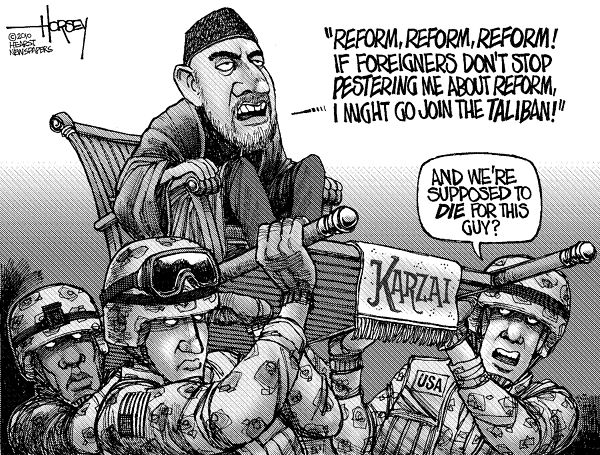
Kabul, Afghanistan- President Hamid Karzai’s troubling remarks this past Saturday that he would join the Taliban if he continues to come under pressure to reform by the United States and other “outsiders” has caused a stir in Washington DC.  Karzai’s comments came a week after President Obama’s surprise visit to Afghanistan at the end of March to pressure Karzai’s government to reform the political system, end corruption, and do a better job of fighting the Taliban.

Instead, what Karza delivered was a threat of the worse kind and quite possibly the most offensive and troubling thing one can say to a country that is risking countless soldiers lives daily to secure the country from the Taliban and other militant warlords in Afghanistan. In 8 short years, Hamid Karzai has gone from being the special guest of honor at George Bush’s State of the Union address to a leader who threatened to join our worst enemy. All because he feels that the US needs to stop badgering him to be a more responsible, fair, and an equitable leader as well as an effective partner in fighting the Taliban.

Karzai apparently made these unusual comments at a closed door meeting of lawmakers on Saturday, just days after accusing “foreigners” presumably the Unites States of being behind the fraud of the disputed elections of 2009. “He said that if I come under foreign pressure, I might join the Taliban”, said Farooq Marenai, a lawmaker from the eastern province of Nangarhar.  Mareni also stated that Karzai appeared nervous and demanded to know why parliament last week rejected legal reforms that would have strengthened Karzai’s authority over the country’s electoral institutions. Several other lawmakers confirmed that Karzai twice threatened to join the insurgency and the Taliban.

Karzai’s comments are troubling on many levels. First and foremost, he gives legitimacy and strength to the Taliban as his comments present the Taliban as an alternative option to American support or view on the situation. Karzai’s statement will no doubt have traveled the length and breadth of Afghanistan as word will spread that there is a weakness in the American-Afghan coalition that has been fighting and hunting the Taliban since October of 2001, post 9-11. The remarks by Karzai also puts every American, NATO, and Pakistani soldier at risk as instead of liberators, the foreign armies would be thought of as invaders, literally overnight. Lastly, Karzai’s remarks prove to the fact that Karzai is no longer an ally nor a credible partner for the US , NATO, and Pakistani army that have been fighting the Taliban with all their might.

There are reports of widespread nepotism, corruption, fraud, looting of the treasuries, and even drug trafficking, as Karzai’s brother, Ahmed Wali Karzai, has been alleged to be a prominent figure in Afghanistan’s world leading illegal heroin production, cultivation and its global distribution. These facts along with his inability to rule effectively and assist the United States in its exit strategy out of Afghanistan by end of 2011 has made the Obama administration weary of dealing with Karzai. Also his typically slow response in instituting political and social freedoms along with a renewed focus in fighting the Taliban, has also been a factor in displeasure from Washington.

The Obama administration has refocused on the Afghan war with 30,000 additional troops to help with the war effort and that initial surge has helped the commanders on the ground in running the Taliban out of certain areas. There have also been great recent victories by the Pakistani army to go after the Taliban militants on its side of the border and in helping cut down the bases of support for the Afghan Taliban from the Pakistani tribal areas sympathetic to their cause. So these comments come at the worst possible time when the Taliban are on the run both in Afghanistan and Pakistan and a strong coalition of US-Afghan-Pakistan resistance against them could help eliminate or destroy the militants for good. But instead, the US and its allies are left wondering what to do with Karzai and how much he could be trusted in this tenuous partnership against the Taliban.

A Victory For Obama, From An Unlikely Quarter-Pakistan

By Fareed Zakaria for Newsweek

President Obama gets much credit for changing America’s image in the world—he was probably awarded the Nobel Prize for doing so. But if you asked even devoted fans to cite a specific foreign-policy achievement, they would probably hesitate. “It’s too soon for that,” they would say. But in fact, there is a place where Barack Obama’s foreign policy is working, and one that is crucial to U.S. national security—Pakistan.

There has been a spate of good news coming out of that complicated country, which has long promised to take action against Islamic militants but rarely done so. (The reason: Pakistan has used many of these same militants to destabilize its traditional foe, India, and to gain influence in Afghanistan.) Over the past few months, the Pakistani military has engaged in serious and successful operations in the militant havens of Swat, Malakand, South Waziristan, and Bajaur. Some of these areas are badlands where no Pakistani government has been able to establish its writ, so the achievement is all the more important. The Pakistanis have also ramped up their intelligence sharing with the U.S. This latter process led to the arrest a month ago of Mullah Abdul Ghani Baradar, the deputy leader of the Afghan Taliban, among other Taliban figures.

Some caveats: most of the Taliban who have been captured are small fish, and the Pakistani military has a history of “catching and releasing” terrorists so that they can impress Americans but still maintain their ties with the militants. But there does seem to be a shift in Pakistani behavior. Why it’s taken place and how it might continue is a case study in the nature and limits of foreign-policy successes.

First, the Obama administration de-fined the problem correctly. Senior ad-ministration officials stopped referring to America’s efforts in Afghanistan and instead spoke constantly of “AfPak,” to emphasize the notion that success in Afghanistan depended on actions taken in Pakistan. This dismayed the Pakistanis but they got the message. They were on notice to show they were part of the solution, not the problem.

Second, the administration used both sticks and carrots. For his first state dinner, Obama pointedly invited Indian Prime Minister Manmohan Singh—clearly not Pakistan’s first choice. Obama made clear that America would continue to pursue the special relationship forged with India under the Bush administration, including a far-reaching deal on nuclear cooperation. But at the same time, the White House insisted it wanted a deep, long-term, and positive relationship with Pakistan. Sens. John Kerry and Dick Lugar put together the largest nonmilitary package of U.S. assistance for the country ever. Aid to the Pakistani military is also growing rapidly.

Third, it put in time and effort. The administration has adopted what Central Command’s Gen. David Petraeus calls a “whole of government” approach to Pakistan. All elements of U.S. power and diplomacy have been deployed. Pakistan has received more than 25 visits by senior administration officials in the past year, all pushing the Pakistani military to deliver on commitments to fight the militants.

Finally, as always, luck and timing have played a key role. The militants in Pakistan, like those associated with Al Qaeda almost everywhere, went too far, brutally killing civilians, shutting down girls’ schools, and creating an atmosphere of medievalism. Pakistan’s public, which had tended to downplay the problem of terrorism, now saw it as “Pakistan’s war.” The Army, reading the street, felt it had to show results.

These results are still tentative. Pakistan’s military retains its obsession with India—how else to justify a vast budget in a small, poor nation? It has still not acted seriously against any of the major militant groups active against Afghanistan, India, or the United States. The Afghan Taliban, the Haqqani group, Gulbuddin Hekmatyar, Lashkar-e-Taiba, and many smaller groups all operate with impunity within Pakistan. But the Pakistani military is doing more than it has before, and that counts as success in the world of foreign policy.

Such success will endure only if the Obama administration keeps at it. There are some who believe that Pakistan has changed its basic strategy and now understands that it should cut its ties to these groups altogether. Strangely this naive view is held by the U.S. military, whose top brass have spent so many hours with their counterparts in Islamabad that they’ve gone native. It’s up to Obama and his team to remind the generals that pressing Pakistan is a lot like running on a treadmill. If you stop, you move backward, and, most likely, you fall down.

American United Nations Diplomat kidnapped by militants in Quetta Pakistan


Quetta, Pakistan- On the heels of our recent report regarding an up tick in Taliban and militant activity in the Pakistani city of Quetta comes word that the head of the UN Agency for Refugees in Quetta Pakistan has been kidnapped by militants. American diplomat John Solecki, was seized by gunmen and taken hostage and his Pakistani driver was shot and killed Friday as he was headed in the morning to his UN agency office.

His United Nations labeled SUV was found rammed against the wall and at least one bullet hole was found on the vehicle. When the Pakistani police reached the vehicle, they found the driver shot and dead at the steering wheel and Mr. Solecki missing. The US expressed “extreme shock and dismay” at the abduction and the Pakistani government called his kidnapping and the killing of the driver a “dastardly terrorist act.”

The city of Quetta in Pakistan borders Afghanistan and the UN High Commissioner for Refugees has been involved for at least 30 years in the area helping the Afghani refugees from the war with the Soviets and then the internal conflict between the warlords and eventually the Taliban and now fleeing the war on terror between the American forces and the militants.

Police has increased patrols in the region and are fearing that Solecki may have been taken to the Afghani side of the region or he may very well even be hidden in a house in and around Quetta. Local police has confirmed that the American citizen Solecki has been working in Quetta for at least the last two years. He did not have a police escort and it is known that he did not like to have an escort with him on his way to the office.

A few hours after his abduction, a video was released by the kidnappers who identified themselves as being with the little known Baluchistan Liberation United Front, suggesting a link to local separatist groups who have waged an insurgency against Pakistan’s government. This suggests that the persons responsible may not be Al-Qaeda or even Taliban militants but rather local insurgents who are seeking an independent Baluchistan from Pakistan.

In the 20 second video, Solecki appears blindfolded and has a shawl draped over his shoulders and states that his message is addressed to the United Nations. “I am not feeling well. I am sick and in trouble. Please help solve the problem soon so I can gain my release,” he says. The kidnappers have threatened to kill Solecki within 72 hours if their demands of the immediate release of 141 women it says were held by the authorities. The militants recently beheaded a Polish engineer in the area after negogations for his release last week failed. It is feared that they intend to carryout their threat on Solecki if their demands are not met.

Pakistanis for Peace and the majority of the peace loving people of Pakistan and Afghanistan are extremely disturbed and saddened by the death of the Pakistani driver and of the abduction of Mr John Solecki. A committed humanitarian and diplomat interested in solving the refugee problem for the Afghani people in the area, all he was doing in the region was helping the people of Afghanistan and Pakistan. He and his agency’s work in this violent and volatile region is of paramount importance in providing assistance and relief to many thousands of people in the area. At risk to his life and liberty he happily worked in this part of the world as he believed in the cause of the UN Refugee agency. We are tremendously saddened by these turn of events and pray that there is a peaceful solution to the situation and that Mr Solecki be released immediately. The cowards responsible for his abduction should realize that individuals such as Mr Solecki are doing nothing but helping the people of Afghanistan and Pakistan and for them to threaten his life goes against everything the religion of Islam and the hospitable nature of the people of the area in how their custom is to treat visitors and guests in their country. We Pray that he is released safely and immediately and that the terrorists responsible for his abduction be caught and brought to justice.

This is an image from mobile phone footage released by Online Photos Friday Feb.
Reported for www.PakistanisforPeace.com by Manzer Munir