Posts Tagged ‘ United Nations ’

Aasia Bibi and Impurities in the Land of the Pure

By Manzer Munir for Pakistanis for Peace

The case of Aasia Noreen aka Aasia Bibi illustrates how far Pakistan has to go to secure freedoms for its religious minorities. Christians and Hindus are not the only minorities who are persecuted for their beliefs but it is also Muslim minorities such as the Ismailis, Ahmadis, and Shiites who are routinely harassed, discriminated and also killed. Sadly, it is the case of Aasia Bibi that has brought some much needed attention to Pakistan’s sad state of affairs towards the treatment of its religious minorities.

Several sections of Pakistan’s Criminal Code consist of its blasphemy laws and of all the Muslim countries of the world that have anti-blasphemy laws, Pakistan’s anti-blasphemy laws are by far the strictest. There is section 295 that forbids damaging or defiling a place of worship or a sacred object. Then there is section 295-A that “forbids outraging religious feelings.” There is also 295-B which prohibits defiling the Qu’ran and was originally punishable by life imprisonment but has since been amended to up to three years imprisonment.

No section of the blasphemy law is more controversial or harder to prove than Article 295-C, the law that Aasia Bibi is allegedly charged with having broken. In respect to prophet Muhammad, this statute states that ” Whoever by words, either spoken or written, or by visible representation, or by any imputation, innuendo, or insinuation, directly or indirectly defiles the sacred name of the Holy Prophet Muhammad shall be punished with death, or imprisonment for life and shall also be liable to a fine.”

Aasia’s case and charges against her started almost a year and a half ago when there was a quarrel over a bowl of water in a dusty village in the heart of Pakistan’s Punjab province. A group of women were working the fields in the heat of the Pakistani sun when one of them, Aasia Bibi, dipped her glass in the communal bucket of drinking water to fetch herself and others a glass of water to drink and immediately was rebuffed by the other women who claimed that the water was now unclean as it had been touched by a non-Muslim. According to witnesses, instead of quietly bowing her head and taking the indignities, Aasia’s crime was that she mounted a strong defense of her faith and remained steadfast in her demeanor that she did nothing wrong. Too often in Pakistan, the blasphemy laws are used against religious minorities to settle personal vendettas and old scores according to Pakistan’s Human Rights Watch, a watchdog group monitoring the case.

The news traveled fast in Aasia’s village of Ittan Wali, in Punjab’s Sheikhupura district that a Christian woman had insulted the prophet. The local mullah got on the mosque loudspeakers, urging the “faithful” to take action against Aasia Bibi. In sad but familiar pattern, her defense of her faith was somehow twisted into an accusation of blasphemy, according to her family and others familiar with the case. Soon as a mob gathered outside her home ready to take the law into their own hands and handing out vigilante justice, the police moved in and took her into custody. But instead of protecting her, they charged her with insulting Islam and its prophet under the blasphemy laws.

And then on Nov. 8, after suffering 18 months in prison, Aasia Bibi was sentenced to death by a district court, making her the first person to be handed the death penalty in Pakistan under the blasphemy laws. Many before her over the years have been charged, but punishment had been commuted to lesser penalties than the death sentence imposed on Aasia Bibi. No concrete evidence was ever presented against Aasia, according to Pakistan’s Human Rights Watch. Instead, the district judge relied on the testimonies of three other women, all of whom were hostile towards her.

Unfortunately this is a common insult hurled at many of Pakistan’s 2 million Christians who make up just 1.59% of the total population. Often, Christians in Pakistan are discriminated and persecuted and many times only get the lowest of the low jobs such as street sweepers, janitorial and sanitation workers. In fact, in Pakistan, the term ‘Chura‘ has become synonym with the Christian community as it relates to an unclean person akin to how the untouchables or Dalit community is seen in India. In India however, the Dalits are not subjected to arcane state blasphemy laws geared towards religious minorities as in Pakistan or are threatened with their lives at the hands of the Hindu majority.

As discussed in a couple of my previous articles, Taliban 1o1, History and Origins and Taliban 201, The Rise of the Pakistani Taliban, the Islamization of Pakistan started under the late General Zia ul Haq of Pakistan who took over the leadership of the country through a military coup in 1977 when he hung the deposed and democratically elected Prime Minister Zulfiqar Ali Bhutto. Earlier in 1973, the 1973 Constitution of Pakistan had declared that “Islam shall be the religion of the Pakistan” and had systematically begun the process of restricting the participation of religious minorities in government and politics.

Before General Zia, there were only two reported cases of blasphemy. Since the death sentence was inserted in 1986 into the Penal Code for the blasphemy laws, this number has now reached 962 — including 340 members of the Ahmadi Muslim community, 119 Christians, and 14 Hindus. A close examination of the cases reveals the blasphemy laws are often invoked to settle personal scores, or they are used by Islamist extremists as cover to persecute religious minorities, sadly with the help of the state under these laws.

General Zia began this policy of Islamization of Pakistan in conjunction with his support for the war against the Russians and assistance to the Afghan Mujahedeen as well as the building of thousands of madrassahs or religious schools across Afghanistan and Pakistan which nurtured the young men into what later became the Taliban. Many of these blasphemy laws fully came into being under his reign, although some were around since as early as more than 100 years prior when the British drew up the Indian Penal Code of 1860 which was initially an ill foreseen aim at keeping the peace among the many fractured faiths of the subcontinent. For instance, section 295-A, which “forbids outraging religious feelings”, could have been applied against a Muslim who insulted a Hindu or a Hindu who taunted a Sikh or Christian or vice versa. However under Zia, the blasphemy laws were expanded and almost exclusively applied against Muslim minorities such as the Ahmadis, Islamilis and Shiites as well as against the Christian and Hindu populations.

Recently, a religious ‘leader’ came out and has offered over $6000 to anyone who can kill Aasia Bibi while she awaits her punishment in police custody. Outrage and denunciations on this case are coming from across the world as many people are appalled at the sad state of rights for religious minorities in Pakistan. The Pope has intervened also asking for clemency for Aasia Bibi from Pakistan’s President Asif Ali Zardari. Against all manner of reason and justice, Lahore’s High Court recently issued an order on November 29, 2o1o, preventing Zardari from exercising his constitutional authority to pardon Aasia Bibi.

In a country rife with violence and chaos and one that has become synonymous with terror the world over, the case of Aasia Bibi is yet another dark stain on the country’s image around the world. The Taliban and the extremist groups ravaging Pakistan can be explained as being a violent minority and do not and should not reflect on the nation as a whole as the majority of people in Pakistan are opposed to them and their views of Islam. But the blasphemy laws, for as long as they have stayed on the books in Pakistan and in the constitution, cannot and should not be excused in any shape or form. These laws need to be repealed and the constitution needs to be amended in an emergency manner so that Aasia Bibi and other religious minority citizens of Pakistan are not subjected to cruel and subjective laws that are almost exclusively used against minorities to settle scores, personal vendettas, and instill terror in less than 3 percent of the country that is not part of the religious majority of Sunni Muslims.

There needs to be international pressure placed on Pakistan from the United Nations, the United States, Europe and others to modify the constitution immediately and to pardon this 45 year old mother of five children. It is ironic that in a country where many people sympathize with Osama’s Al Qaeda and profess to hate the west with one hand, they decry with the other why not enough western aid has came to their country when it recently saw the worst flooding in its history. Can you blame the American citizens, the Europeans or citizens of any other Christian nation from hesitating to give aid to a country that not only plays a duplicitous game when it comes to terrorists and terror havens but also treats Christians and other religious minorities in the manner as in the case of Aasia Bibi?

The name Pakistan literally translates into “The Land of the Pure”. And as a child growing up I was told that the meaning of Pakistan’s flag is this: “The green is a traditional Islamic color and the crescent moon and star are also Islamic symbols. The white stripe represents the non-Muslim minority and religious groups of Pakistan and there place in the country.” In my view, as long as the nation sanctions and tolerates these utterly unjust and biased blasphemy laws, the religious minorities of Pakistan clearly have no place in this land of the ‘pure’.

-Manzer Munir, a proud Pakistani American and peace activist, is the founder of Pakistanis for Peace and blogs at www.PakistanisforPeace.com as well at other websites as a freelance journalist and writer.

China and India: Contest of the Century

As reported by The Economist

A HUNDRED years ago it was perhaps already possible to discern the rising powers whose interaction and competition would shape the 20th century. The sun that shone on the British empire had passed midday. Vigorous new forces were flexing their muscles on the global stage, notably America, Japan and Germany. Their emergence brought undreamed-of prosperity; but also carnage on a scale hitherto unimaginable.

Now digest the main historical event of this week: China has officially become the world’s second-biggest economy, overtaking Japan. In the West this has prompted concerns about China overtaking the United States sooner than previously thought. But stand back a little farther, apply a more Asian perspective, and China’s longer-term contest is with that other recovering economic behemoth: India. These two Asian giants, which until 1800 used to make up half the world economy, are not, like Japan and Germany, mere nation states. In terms of size and population, each is a continent—and for all the glittering growth rates, a poor one.

Not destiny, but still pretty important

This is uncharted territory that should be seen in terms of decades, not years. Demography is not destiny. Nor for that matter are long-range economic forecasts from investment banks. Two decades ago Japan was seen as the main rival to America. Countries as huge and complicated as China can underachieve or collapse under their own contradictions. In the short term its other foreign relationships may matter more, even in Asia: there may, for instance, be a greater risk of conflict between rising China and an ageing but still powerful Japan. Western powers still wield considerable influence.

So caveats abound. Yet as the years roll forward, the chances are that it will increasingly come down once again to the two Asian giants facing each other over a disputed border (see article). How China and India manage their own relationship will determine whether similar mistakes to those that scarred the 20th century disfigure this one.

Neither is exactly comfortable in its skin. China’s leaders like to portray Western hype about their country’s rise as a conspiracy—a pretext either to offload expensive global burdens onto the Middle Kingdom or to encircle it. Witness America’s alliances with Japan and South Korea, its legal obligation to help Taiwan defend itself and its burgeoning friendships with China’s rivals, notably India but also now Vietnam.

This paranoia is overdone. Why shouldn’t more be asked from a place that, as well as being the world’s most-populous country, is already its biggest exporter, its biggest car market, its biggest carbon-emitter and its biggest consumer of energy (a rank China itself, typically, contests)? As for changing the balance of power, the People’s Liberation Army’s steady upgrading of its technological capacity, its building of a blue-water navy and its fast-developing skills in outer space and cyberspace do not yet threaten American supremacy, despite alarm expressed this week about the opacity of the PLA’s plans in a Pentagon report. But China’s military advances do unnerve neighbours and regional rivals. Recent weeks have seen China fall out with South Korea (as well as the West) over how to respond to the sinking in March, apparently by a North Korean torpedo, of a South Korean navy ship. And the Beijing regime has been at odds with South-East Asian countries over its greedy claim to almost all of the South China Sea.

India, too, is unnerved. Its humiliation at Chinese hands in a brief war nearly 50 years ago still rankles. A tradition of strategic mistrust of China is deeply ingrained. India sees China as working to undermine it at every level: by pre-empting it in securing supplies of the energy both must import; through manoeuvres to block a permanent seat for India on the United Nations Security Council; and, above all, through friendships with its smaller South Asian neighbours, notably Pakistan. India also notes that China, after decades of setting their border quarrels to one side in the interests of the broader relationship, has in recent years hardened its position on the disputes in Tibet and Kashmir that in 1962 led to war. This unease has pushed India strategically closer to America—most notably in a controversial deal on nuclear co-operation.

Autocrats in Beijing are contemptuous of India for its messy, indecisive democracy. But they must see it as a serious long-term rival—especially if it continues to tilt towards America. As recently as the early 1990s, India was as rich, in terms of national income per head. China then hurtled so far ahead that it seemed India could never catch up. But India’s long-term prospects now look stronger. While China is about to see its working-age population shrink (see article), India is enjoying the sort of bulge in manpower which brought sustained booms elsewhere in Asia. It is no longer inconceivable that its growth could outpace China’s for a considerable time. It has the advantage of democracy—at least as a pressure valve for discontent. And India’s army is, in numbers, second only to China’s and America’s: it has 100,000 soldiers in disputed Arunachal Pradesh (twice as many as America will soon have in Iraq). And because India does not threaten the West, it has powerful friends both on its own merits and as a counterweight to China.

A settlement in time

The prospect of renewed war between India and China is, for now, something that disturbs the sleep only of virulent nationalists in the Chinese press and retired colonels in Indian think-tanks. Optimists prefer to hail the $60 billion in trade the two are expected to do with each other this year (230 times the total in 1990). But the 20th century taught the world that blatantly foreseeable conflicts of interest can become increasingly foreseeable wars with unforeseeably dreadful consequences. Relying on prosperity and more democracy in China to sort things out thus seems unwise. Two things need to be done.

First, the slow progress towards a border settlement needs to resume. The main onus here is on China. It has the territory it really wants and has maintained its claim to Arunachal Pradesh only as a bargaining chip. It has, after all, solved intractable boundary quarrels with Russia, Mongolia, Myanmar and Vietnam. Surely it cannot be so difficult to treat with India?

That points to a second, deeper need, one that it took Europe two world wars to come close to solving: emerging Asia’s lack of serious institutions to bolster such deals. A regional forum run by the Association of South-East Asian Nations is rendered toothless by China’s aversion to multilateral diplomacy. Like any bully, it prefers to pick off its antagonists one by one. It would be better if China and India—and Japan—could start building regional forums to channel their inevitable rivalries into collaboration and healthy competition.

Globally, the rules-based system that the West set up in the second half of the 20th century brought huge benefits to emerging powers. But it reflects an out-of-date world order, not the current global balance, let alone a future one. China and India should be playing a bigger role in shaping the rules that will govern the 21st century. That requires concessions from the West. But it also requires commitment to a rules-based international order from China and India. A serious effort to solve their own disagreements is a good place to start.

Pakistan Should Celebrate Gandhi’s Life, Legacy and Contributions

By Manzer Munir for Pakistanis for Peace

Mohandas Karamchand Gandhi, who was born 141 years ago today on October 2, 1869, is a revered figure in India as well as in many countries around the world for his peaceful civil disobedience techniques that succeeded in granting India its independence from Britain. He is also credited by Martin Luther King Jr., the American civil rights leader, as an inspiration in using similar peaceful protests to change unjust laws against blacks and other minorities in the United States. These protests and opposition eventually led to the Civil Rights Act of 1965 being passed granting all Americans of every ethnicity equal freedoms and protection in the eyes of the law.

Gandhi’s birthday, October 2nd, is celebrated by the United Nations as International Day of Non-Violence. He is an admired figure in India where his contributions for the freedom of his countrymen is celebrated on stamps, currency, and folklore. Gandhi is also appreciated in many other countries outside the Indian subcontinent. Statues of him are found in such disparate places like New York’s Union Square, Gandhi Square in Moscow, the Johannesburg city center in South Africa, and even as far away as Waikiki Hawaii where a statue to the leader stands in Kapiolani Park in Honolulu.  

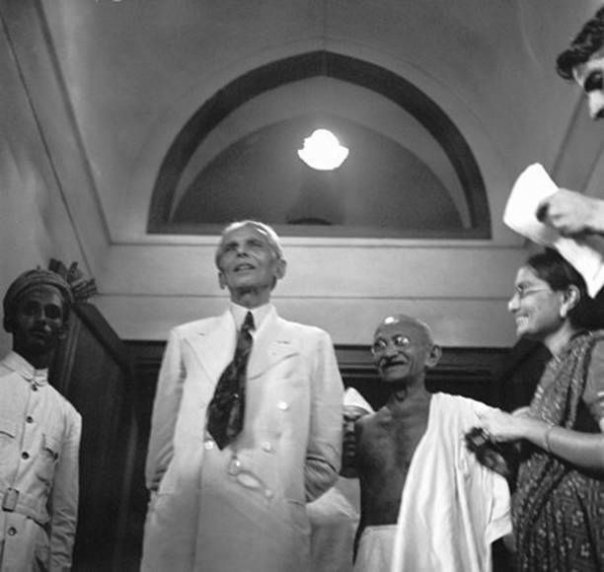
Yet in Pakistan, a country that also benefitted from Gandhi’s movement for independence, he is vilified and not thought of highly. Many in Pakistan blame Gandhi for his failing to prevent the deaths of thousands of Muslims during the religious violence the precipitated the independence of both countries. In many Pakistani books he is depicted as a villain; however few people know that he died because of his great favour for Pakistan and that he was seen by right wing Hindu groups as someone who was concerned with the appeasement of the Muslims of India.

India’s first prime minister, Jawaharlal Nehru, had refused to give Pakistan their share of the money that was due to them after partition. But Gandhi went on a fast till death to protest against this injustice against the newly created Pakistani state and this pressure led to Nehru’s agreeing to pay the money so direly needed by the new Muslim nation.

He was assassinated by a young Hindu fanatical, Nathuram Godse, who felt that M.K. Gandhi was more of a hindrance to India than an asset. Godse, like many fanatical right wing Hindus felt that Gandhi was solely responsible for the partition of India into a country for Hindus and one country for the Muslims and he felt that he was a traitor to other Hindus.

Sadly, this man who ultimately gave his life in the cause of others is not very appreciated in Pakistan and neither are his contributions for freedom and independence from the British colonizers taught to today’s school children. In a country rife with violence, intolerance and instability, many Pakistanis can learn a great deal in the lessons of brotherhood and peaceful co-existence preached by Mahatma, the great soul. He would be the perfect anti-Taliban in today’s Pakistan, a country inflamed by animosity and hatred between all ethnic and religious groups. His ideas of tolerance and harmony with others would go a long way against the barbaric views of the Taliban, the enemies of man.

His belief that violence was not a solution towards any objective would benefit today’s Pakistani society if his message was given importance and taught at an early age. His reasoning towards peace and nonviolence lead him to once say that “An eye for an eye leaves the whole world blind.”  In today’s chaotic and violent Pakistan, there is a lot that my fellow Pakistanis can learn from this man and how he lived his life with humility, simplicity and non-violence as well as towards his service of others. More people inside Pakistan should be taught about Gandhi as he is as much responsible for Pakistan’s independence from Britain as was Jinnah, the founder of the country.

-Manzer Munir, a proud Pakistani American and peace activist, is the founder of Pakistanis for Peace and blogs at www.PakistanisforPeace.com as well at other websites as a freelance journalist and writer.
U.N. Speakers Urge Pakistan to Free Up Arms Talks

By Patrick Worsnip for Reuters

Heaping pressure on Pakistan, a high-level U.N. meeting called on Friday for talks to start immediately on a treaty to ban production of fissile material used as fuel for nuclear weapons.

But Pakistan has insisted it will continue to block such talks, arguing that a ban would put it at a permanent disadvantage to its nuclear rival India. The dispute has led to deadlock at the 65-nation Conference on Disarmament in Geneva.

At the U.N. meeting of some 70 states to discuss the paralysis at the conference, speakers avoided openly naming Pakistan, but several referred to “one country” that was causing the problem.

In a closing summary of the views expressed, U.N. Secretary-General Ban Ki-moon said there was “broad agreement on the need to immediately start negotiations on a … treaty banning the production of fissile material.”

Continued impasse could result in states going outside the Geneva conference, known as the “CD,” to tackle the issue, Ban warned.

Support has appeared to be growing in Geneva to find another approach — possibly small-group talks in parallel to CD sessions. A precedent was set when Canada and Norway moved talks on a landmine ban out of the forum, eventually clinching the landmark 1997 Ottawa Treaty.

At Friday’s U.N. meeting, Western powers sharply attacked Pakistan’s blockage of the CD, which requires consensus for its actions.

“It strikes us as unwarranted for a single country to abuse the consensus principle and thereby frustrate everyone else’s desire to resume serious disarmament efforts,” said U.S. delegate Gary Samore, a special adviser to President Barack Obama.

Washington understood that all countries needed to protect their security interests, and with that principle in place, “no country need fear the prospect of (fissile material) negotiations,” Samore said.

NO CONSENSUS

British junior foreign minister Alistair Burt said blocking the negotiations was “damaging for multilateral arms control.”

Launched in 1978, the CD has clinched treaties banning biological and chemical weapons as well as underground nuclear tests. Its members include all five official nuclear powers — the United States, Russia, Britain, France and China.

But it has been unable to reach consensus on substantive work for the past 12 years. Pakistan’s refusal since January to launch negotiations on fissile material like plutonium and highly enriched uranium is the latest obstacle.

Zamir Akram, Pakistan’s ambassador to the United Nations in Geneva, said earlier this month his country would continue to hold out, arguing that India has an unfair advantage with bigger fissile material stockpiles and “discriminatory” nuclear cooperation deals with the United States.

“Pakistan’s security concerns can be addressed only once we have developed sufficient capacity to ensure our deterrent is credible in the face of growing asymmetry,” he told Reuters. “My instructions are, ‘We continue to maintain our position.'”

Pakistan did not speak at Friday’s meeting in New York. No decisions were made, but Ban said he would ask a panel of advisers to review the issues raised.

Separately, French delegate Jacques Audibert said Paris would host a meeting of the five official nuclear powers next year to discuss their obligations stemming from a May conference on nuclear non-proliferation.

The conference called on the powers to pursue negotiations ultimately aimed at the total abolition of nuclear weapons.

Arabs Must Recognize Israel’s Right to Exist

By Manzer Munir for Pakistanis for Peace

New York – President Obama delivered his speech to the United Nations General Assembly Thursday in New York and it focused largely on his desire to see the Middle East peace process proceed ahead despite all the difficulties. 

Mr. Obama stated that he wanted it to succeed in accomplishing the peace that has eluded the Arabs and the Israelis for over 60 years. Realizing that there are many obstacles and hurdles ahead during tough negotiations for diplomats from both sides, he stated his concerns and his hopes for the road ahead.

“I hear those voices of skepticism, but I ask you to consider the alternative,” Obama said. If no peace agreement is reached, he added, “then the hard realities of demography will take hold. More blood will be shed. This Holy Land will remain a symbol of our differences, instead of our common humanity.”

“I refuse to accept that future,” he added. “And we all have a choice to make. Each of us must choose the path of peace. …We can say that this time will be different – that this time we will not let terror, or turbulence, or posturing, or petty politics stand in the way.”

“If we do, when we come back here next year, we can have an agreement that will lead to a new member of the United Nations – an independent, sovereign state of Palestine, living in peace with Israel,” Obama said to a loud applause by the delegates of all the countries at the United Nations.

In order for this to happen, the Arabs must first recognize Israel’s right to exist and the right of the Jewish people to claim specifically a part of the Holy Land as theirs. I know, it sounds so basic and a no- brainer. But surprisingly a large portion of the Arab world does not believe in Israel’s right to exist and specifically their right to exist in the southern Levant area which makes up the majority of the area for present day Israel. They want to ignore history and all the Biblical and historical evidence of Jewish settlement and claims to the land. They point to the migration of many Jews all over the world the last few hundred years as reason enough as to why they no longer can call Israel home.

Some Arabs demand that the Jewish homeland should be in Germany. After all, they claim, it is where so many of them were killed by Hitler and the main reason that precipitated the need to allow the Zionists of Europe and America, post World War II, to demand a home for the Jews. Why should the Palestinians pay for the crimes of the Europeans they argue?

Others have blamed the British and the Balfour Declaration when in 1917 the British Foreign Secretary, Arthur James Balfour, declared in a letter to Baron Rothschild, a leader of the British Jewish community for a need for a home for the Jews when he stated: “His Majesty’s government view with favor the establishment in Palestine of a national home for the Jewish people, and will use their best endeavors to facilitate the achievement of this object, it being clearly understood that nothing shall be done which may prejudice the civil and religious rights of existing non-Jewish communities in Palestine, or the rights and political status enjoyed by Jews in any other country.”

Quite simply, no other place makes any sense whatsoever. First of all, there is extensive mentioning of the land of Israel that is promised to the Jews in the Bible as well as the Hebrew texts, not to mention the Qur’an. All three identify geographic areas in present day Israel that has historically been identified as the homeland of the Jews. Jewish people do not even make up more than 1% of any country’s overall population other than in United States (2.2% of overall population), Canada (1.2% of population), France (1% of population) and Israel (75% of population). That means that for the rest of the world, each country’s Jewish population is not even one half of one percent of the overall population of that nation! Where else would the Arabs have them go? Certainly not Germany where many claim that they should be settled since that is where over 6 million of them were killed in the holocaust. The United States actually has more Jews in its boundaries than are currently residing in all of Israel. So they cannot very well say that they should go there as over half the population already lives here.

Most people do not realize that the Jewish population of the world is very small compared to Christianity or Islam. There are an estimated 15 million Jews around the world including in Israel. By comparison, there are over 2.1 billion Christians and nearly 1.5 billion Muslims. Nearly 105 countries of the world are majority Christian nations while there are perhaps at best 55 majority Muslim countries on the planet. Did you ever wonder how many majority Jewish countries of the world are there?  There is just one. Israel.

This is one of the great religions of the world and also one of the oldest monotheistic beliefs aside from Zoroastrianism, and came at a time when polytheistic beliefs were more prevalent as a human concept of divinity. No doubt, both Christianity and Islam owe a great deal of their religious thoughts and laws to the early Hebrew laws and traditions. In fact, large parts of both the Bible and the Qur’an constitute the Old Testament, also known as the Torah, the Jewish holy book and the scriptures revealed to Moses.

Jewish contributions to humanity have been disproportionate and staggering when one realizes that as less than one half of one percent of the world’s populations, the Jews have made immense advances in nearly every field that has benefitted the whole world. We can go from Albert Einstein’s advances in physics to Jonas Salk’s polio vaccine, discuss Galileo’s contributions in astronomy to Freud’s understanding of the mind. We could illustrate how Baruch Spinoza’s rationalist ideas and philosophies laid the groundwork for The Enlightenment of the 18 century or marvel at the brilliant filmmaking of 21st century Jews like Steven Spielberg and Oliver Stone. The list of Jewish contributions and the value of their culture to man’s history cannot be ignored.

What also cannot be ignored is that historically these are a persecuted people. The troubles that they faced in ancient Egypt as illustrated in the Bible as well as the deaths and expulsions during the Spanish Inquisition are part of their sad history. They faced persecution at the hands of both Christians and Muslims during the Crusades and at the time of the Papal States as well as during Muslim rule when they were subjected to the jizya (a per capita tax imposed on free adult non-Muslim males). The worst crimes nonetheless happened in the 20th century leading up to World War II when millions were killed in the Holocaust in Germany by Hitler’s Nazism and by Stalinist Russia.

So as the Israelis and Palestinians, as well as the other Arab countries, sit down over the next couple of weeks to resolve once and for all the Middle East conflict, the Arab street and indeed the entire Muslim world, must come to a realization and acceptance of the fact that the state of Israel has a right to exist; and has a right to exist in this ancient land as much as the Palestinians, who also have the rights to parts of this holy soil that is so important to all three religions. No doubt, historically and Biblically, the Palestinians can make similar claims also. Except, in Israel’s case, there is no other nation for the Jews, whereas, there are 55 others for Muslims. It is only with this undeniable understanding that true and lasting peace will ever be achieved and it can clear the way for a two state solution that President Obama envisions and one that will allow the normalization of relations between Israel, the Arab and the entire Muslim world. 

As perhaps the most famous Jew of all time, Jesus, once said, “Greet ye one another with a kiss of charity and may peace be with you.” Indeed, Shalom and Salaam equal peace and that can finally be achieved once there is mutual respect and acceptance of the right of the other to exist.

–Manzer Munir, a proud Pakistani American and peace activist, looks forward to a day when there will be peace between Israel and all the Muslim countries of the world, including Pakistan. He is the founder of Pakistanis for Peace and blogs at www.PakistanisforPeace.com as well at other websites as a free lance journalist and writer.

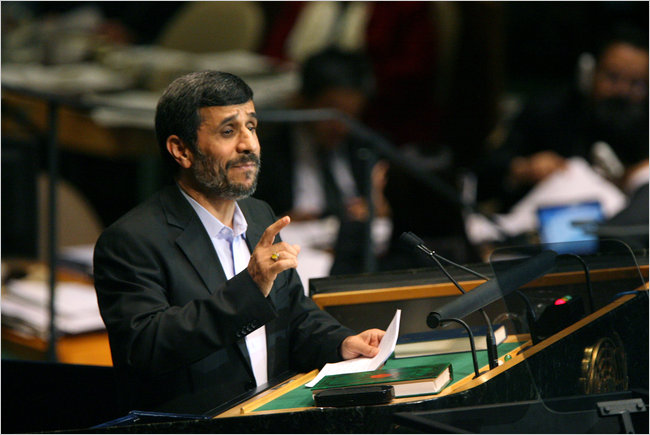
U.S. Walks Out as Iran Leader Speaks

By Neil MacFarquhar for The New York Times

UNITED NATIONS — President Mahmoud Ahmadinejad of Iran made a series of incendiary remarks in his speech to the United Nations General Assembly on Thursday, notably the claim that the United States orchestrated the Sept. 11 attacks to rescue its declining economy, to reassert its weakening grip on the Middle East and to save Israel.

Those comments prompted at least 33 delegations to walk out, including the United States, Canada, Australia, New Zealand, Costa Rica, all 27 members of the European Union and the union’s representative, diplomats said.

The annual General Assembly started formally on Thursday, with scores of presidents, kings and ministers expected to address the gathering over the coming week. The speeches often fail to break new ground or lack electricity, so the occasional theatrics inevitably attract considerable attention.

Mr. Ahmadinejad rarely disappoints on that scale, although he seemed to go out of his way to sabotage any comments he made previously this week about Iran’s readiness for dialogue with the United States. The theme of his often flowery speech was that the capitalist world order was collapsing and he cited three examples: the attacks of Sept. 11, 2001, the Israeli occupation of Palestinian lands, and the pressure on Iran over its nuclear program.

He said there were three theories about the origins of the Sept. 11 attacks, including “that some segments within the U.S. government orchestrated the attack to reverse the declining American economy and its grips on the Middle East in order also to save the Zionist regime.”

The United States Mission to the United Nations swiftly issued a terse response. “Rather than representing the aspirations and goodwill of the Iranian people, Mr. Ahmadinejad has yet again chosen to spout vile conspiracy theories and anti-Semitic slurs that are as abhorrent and delusional as they are predictable,” it said in a statement.

It was not the first time Mr. Ahmadinejad espoused the theory, but never before so publicly. “The majority of the American people as well as other nations and politicians agree with this view,” he said.

Mr. Ahmadinejad obviously delights in being provocative during his annual visit to the United Nations. He framed his comments about Sept. 11 as an examination of opinions, an approach he has used repeatedly in questioning the Holocaust.

But his assertion that the majority of Americans agree with him surely lacked any factual basis. As did his claim that reviving the American economy was the motive behind the devastating attacks on the World Trade Center and the Pentagon; the United States economy declined significantly after the attacks. In his interviews with journalists, much like during his debates with opponents in the disputed Iranian presidential election last year, Mr. Ahmadinejad has often been accused of making up statements wholesale.

But analysts noted that his remarks should be viewed through the prism of domestic politics in Iran, where conservatives try to outflank him. They said that during a recent Friday prayer sermon, Ayatollah Ahmad Jannati said that 84 percent of Americans believed their own government was behind the attacks.

Iran also cultivates an image as the voice of all Muslims in confronting the United States, and the idea that Americans rather than Islamic extremists carried out the 2001 attacks has long resonated among Arabs. “This is very helpful to Ahmadinejad’s desire for greatness in the Arab world,” said Ali Mirsepassi, a professor of Middle Eastern studies and sociology at New York University.

The other two theories on the attacks presented by Mr. Ahmadinejad were that terrorists who penetrated American security were responsible, and that terrorists carried out the attacks but then the American government took advantage of the situation. He even suggested that the United Nations create a fact-finding panel to study the theories.

Farideh Farhi, an Iran expert at the University of Hawaii, said, “Apparently now he has decided that by going to the core of American sensitivities — in the same way he did with Israel by questioning the legitimacy of that country’s existence — he can continue to keep himself at the center of global attention while deflecting attention away from his dismal domestic record.”

Mr. Ahmadinejad also lambasted those Americans who had threatened to burn the Koran. “The truth could not be burned,” he said, hefting a green Koran aloft with his one hand and a black Bible with another, saying he respected both of them. “We should wisely avoid playing into the hands of Satan.”

The other speeches Thursday followed more traditional lines, although not without moments of passion.

Prime Minister Wen Jiabao of China focused his speech exclusively on China’s domestic accomplishments, with a brief global reference at the end when he suggested a vital, peaceful China was good for the world’s peace and prosperity.

The speech, entitled “Getting to Know the Real China,” lauded the country’s economic progress while recognizing that it had a way to go with 150 million people still living in poverty. Mr. Wen said China was determined to forge even greater progress through education, science and technology.

The Turkish president, Abdullah Gul, endorsed American efforts to negotiate peace in the Middle East, but criticized Israel both for its presumed nuclear arsenal and for attacking a Turkish-organized humanitarian convoy at sea in May during which nine people were killed.

“We hope that this new engagement can take us closer to a viable and fair settlement,” Mr. Gul said. “On the other hand, it would be very difficult to make progress toward permanent peace unless we put an end to the humanitarian tragedy in Gaza.”

Mr. Gul called the attack a violation of international law, and he welcomed a report released Wednesday by United Nations Human Rights Council, which endorsed that viewpoint.President Bingu wa Mutharika of Malawi, speaking on behalf of the African Union, urged the General Assembly to defer for one year the war crimes charges brought by the International Criminal Court against President Omar Hassan al-Bashir of Sudan. He said that would avoid jeopardizing the outcome of a referendum scheduled for January on independence for southern Sudan.

Pakistan’s Strange Response Towards Indian Aid offer

by Omer Farooq Khan for The Times of India

The worst floods in Pakistan’s history provided a good opportunity for both the South Asian nations to come closer. Accepting Indian aid offers half-heartedly and that too after US insistence, Pakistan has given an impression that it is convinced that its policy on India cannot change.

Pakistan’s initial response to the Indian offer of five million dollars was a positive one but then it was unsure how to respond. It took several days for Pakistan to finally accept the offer, saying that the aid had to come through the UN. Now, a total of $25 million Indian assistance for flood relief efforts in Pakistan has to be spent by the UN.

Pakistan’s foreign minister Shah Mehmood Qureshi had said that the delay was due to the sensitivities involved in the relationship with India. Even, a section of policymakers, conspiracy theorists in media and some India-centric elements within the Pakistani establishment blamed India for opening floodgates of its dam to inundate Pakistan’s cities and towns. While building public opinion, they did not care that their contention was technically wrong. The fact is that the rivers that caused destruction in Pakistan do not originate in India.

Some defence analysts argue that Pakistan’s strange response towards India’s aid offer was meant not to get obliged. “Pakistan reacted politically towards Indian humanitarian gesture. The destruction is so colossal that petty politics must be avoided. Pakistan asks for help and when it is offered by a neighbour, its ego comes its way. The main hurdle was that Pakistan did not want to be obliged,” argues defence analyst General Talat Masood.

Kamran Shafi, Dawn’s columnist says that Indian-centric approach within the security establishment and intelligence agencies was the main predicament that the government accepted Indian offer half heartedly. “Values and wisdom demand that politics must be kept aside at time of tragedy. Pakistan needed to have warmly welcomed neighbour’s goodwill gesture.”

India and Pakistan have made major efforts in recent months to build confidence in their relations, which were badly strained by the Mumbai 2008 terror attacks that India blamed on militants from Pakistan. If Indian civil society, volunteers and NGO’s were allowed to do relief work in the flood affected areas, this could have been an ideal confidence building measure in the relations of the two countries.

Certainly, it would have served the spirit of Thimphu where Pakistani PM Yusuf Raza Gilani and his Indian counterpart Manmohan Singh tasked their top diplomats to create CBMs. An opportunity is still not lost if governments, media and civil societies in both the countries come forward and create enough space to use this calamity into an opportunity.

-Editor’s Note for Pakistanis for Peace- The writer is spot on with his analysis of Pakistan’s aid offer from India. During times of a humanitarian crisis of biblical proportions, its political response was petty and irresponsible to its citizens. Furthermore, half heartedly accepting several days after the response does little to build on the goodwill. Either accept it right away with gratitude (our advice) or reject it outright. It did neither and so was ineffective in either cause. The politicians of Pakistan continue to show their incompetence by ineffectively managing the affairs of the country both domestically and internationally.

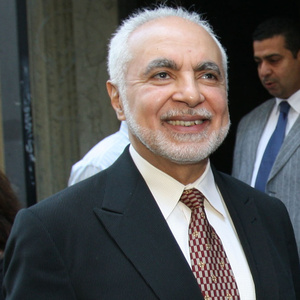
For Imam in Muslim Center Furor, a Hard Balancing Act

By Anne Barnard for The New York Times

Not everyone in the Cairo lecture hall last February was buying the imam Feisal Abdul Rauf’s message. As he talked of reconciliation between America and Middle Eastern Muslims — his voice soft, almost New Agey — some questioners were so suspicious that he felt the need to declare that he was not an American agent.

Muslims need to understand and soothe Americans who fear them, the imam said; they should be conciliatory, not judgmental, toward the West and Israel.

But one young Egyptian asked: Wasn’t the United States financing the speaking tour that had brought the imam to Cairo because his message conveniently echoed United States interests?

“I’m not an agent from any government, even if some of you may not believe it,” the imam replied. “I’m not. I’m a peacemaker.”

That talk, recorded on video six months ago, was part of what now might be called Mr. Abdul Rauf’s prior life, before he became the center of an uproar over his proposal for a Muslim community center two blocks from the World Trade Center. He watched his father, an Egyptian Muslim scholar, pioneer interfaith dialogue in 1960s New York; led a mystical Sufi mosque in Lower Manhattan; and, after the Sept. 11 attacks, became a spokesman for the notion that being American and Muslim is no contradiction — and that a truly American brand of Islam could modernize and moderate the faith worldwide.

In recent weeks, Mr. Abdul Rauf has barely been heard from as a national political debate explodes over his dream project, including, somewhere in its planned 15 stories, a mosque. Opponents have called his project an act of insensitivity, even a monument to terrorism.

In his absence — he is now on another Middle East speaking tour sponsored by the State Department — a host of allegations have been floated: that he supports terrorism; that his father, who worked at the behest of the Egyptian government, was a militant; that his publicly expressed views mask stealth extremism. Some charges, the available record suggests, are unsupported. Some are simplifications of his ideas. In any case, calling him a jihadist appears even less credible than calling him a United States agent.

Growing Up in America

Mr. Abdul Rauf, 61, grew up in multiple worlds. He was raised in a conservative religious home but arrived in America as a teenager in the turbulent 1960s; his father came to New York and later Washington to run growing Islamic centers. His parents were taken hostage not once, but twice, by American Muslim splinter groups. He attended Columbia University, where, during the Six-Day War in 1967 between Israel and Arab states like Egypt, he talked daily with a Jewish classmate, each seeking to understand the other’s perspective.

He consistently denounces violence. Some of his views on the interplay between terrorism and American foreign policy — or his search for commonalities between Islamic law and this country’s Constitution — have proved jarring to some American ears, but still place him as pro-American within the Muslim world. He devotes himself to befriending Christians and Jews — so much, some Muslim Americans say, that he has lost touch with their own concerns.

“To stereotype him as an extremist is just nuts,” said the Very Rev. James P. Morton, of the Church of St. John the Divine, in Manhattan, who has known the family for decades.

Since 9/11, Mr. Abdul Rauf, like almost any Muslim leader with a public profile, has had to navigate the fraught path between those suspicious of Muslims and eager to brand them as violent or disloyal and a Muslim constituency that believes itself more than ever in need of forceful leaders.

One critique of the imam, said Omid Safi, a professor of religious studies at the University of North Carolina, was that he had not been outspoken enough on issues “near and dear to many Muslims,” like United States policy on Israel and treatment of Muslims after 9/11, “because of the need that he has had — whether taken upon himself or thrust upon him — to be the ‘American imam,’ to be the ‘New York imam,’ to be the ‘accommodationist imam.’ ”

Akbar Ahmed, chairman of Islamic studies at American University, said Mr. Abdul Rauf’s holistic Sufi practices could make more orthodox Muslims uncomfortable, and his focus on like-minded interfaith leaders made him underestimate the uproar over his plans.

“He hurtles in, to the dead-center eye of the storm simmering around Muslims in America, expecting it to be like at his mosque — we all love each other, we all think happy thoughts,” Mr. Ahmed said.

“Now he has set up, unwittingly, a symbol of this growing tension between America and Muslims: this mosque that Muslims see as a symbol of Islam under attack and the opponents as an insult to America,” he added. “So this mild-mannered guy is in the eye of a storm for which he’s not suited at all. He’s not a political leader of Muslims, yet he now somehow represents the Muslim community.”

Andrew Sinanoglou, who was married by Mr. Abdul Rauf last fall, said he was surprised that the imam had become a contentious figure. His greatest knack, Mr. Sinanoglou said, was making disparate groups comfortable. At the wedding, he brought together Mr. Sinanoglou’s family, descended from Greek Christians thrown out of Asia Minor by Muslims, and his wife’s conservative Muslim father.

“He’s an excellent schmoozer,” Mr. Sinanoglou said of the imam.

Mr. Abdul Rauf was born in Kuwait. His father, Muhammad Abdul Rauf, graduated from Cairo’s Al-Azhar University, the foremost center of mainstream Sunni Muslim learning. He was one of many scholars Egypt sent abroad to staff universities and mosques, a government-approved effort unlikely to have tolerated a militant. He moved his family to England, studying at Cambridge and the University of London; then to Malaysia, where he eventually became the first rector of the International Islamic University of Malaysia.

As a boy, Feisal absorbed his father’s talks with religious scholars from around the world, learning to respect theological debate, said his wife, Daisy Khan. He is also steeped in Malaysian culture, whose ethnic diversity has influenced an Islam different than that of his parents’ homeland.

In 1965, he came to New York. His father ran the Islamic Center of New York; the family lived over its small mosque in a brownstone on West 72nd Street, which served mainly Arabs and African-American converts. Like his son, the older imam announced plans for a community center for a growing Muslim population — the mosque eventually built on East 96th Street. It was financed by Muslim countries and controlled by Muslim diplomats at the United Nations — at the time a fairly noncontroversial proposition. Like his son, he joined interfaith groups, invited by Mr. Morton of St. John the Divine.

Hostage Crisis

Unlike his son, he was conservative in gender relations; he asked his wife, Buthayna, to not drive. But in 1977, he was heading the Islamic Center in Washington when he and Buthayna were taken hostage by a Muslim faction; it was his wife who challenged the gunmen on their lack of knowledge of Islam.

“My husband didn’t open his mouth, but I really gave it to them,” she told The New York Times then.

Meanwhile, the younger Mr. Abdul Rauf studied physics at Columbia. At first, he recalled in interviews last year, it was hard to adjust to American social mores. By 1967, he and a Yale student, Kurt Tolksdorf, had bonded at summer school over their shared taste in women and fast cars. But Mr. Tolksdorf said his friend never subscribed to the “free love” of the era.

When the 1967 war broke out in the Middle East, Mr. Tolksdorf said, Mr. Abdul Rauf reacted calmly when Israeli students tried to pick a fight. A classmate, Alan M. Silberstein, remembers debating each day’s news over lunch.

“He was genuinely trying to understand the interests of American Jews — what Israel’s importance was to me,” he said. “There was a genuine openness.”

In his 20s, Mr. Abdul Rauf dabbled in teaching and real estate, married an American-born woman and had three children. Studying Islam and searching for his place in it, he was asked to lead a Sufi mosque, Masjid al-Farah. It was one of few with a female prayer leader, where women and men sat together at some rituals and some women do not cover their hair. And it was 12 blocks from the World Trade Center.

Divorced, he met his second wife, Ms. Khan, when she came to the mosque looking for a gentler Islam than the politicized version she rejected after Iran’s revolution. Theirs is an equal partnership, whether Mr. Abdul Rauf is shopping and cooking a hearty soup, she said, or running organizations that promote an American-influenced Islam.

A similar idea comes up in the video of his visit to Cairo this year. Mr. Abdul Rauf, with Ms. Khan, unveiled as usual, beside him, tells a questioner not to worry so much about one issue of the moment — Switzerland’s ban on minarets — saying Islam has always adapted to and been influenced by places it spreads to. “Why not have a mosque that looks Swiss?” he joked. “Make a mosque that looks like Swiss cheese. Make a mosque that looks like a Rolex.”

In the 1990s, the couple became fixtures of the interfaith scene, even taking a cruise to Spain and Morocco with prominent rabbis and pastors.

Mr. Abdul Rauf also founded the Shariah Index Project — an effort to formally rate which governments best follow Islamic law. Critics see in it support for Taliban-style Shariah or imposing Islamic law in America.

Shariah, though, like Halakha, or Jewish law, has a spectrum of interpretations. The ratings, Ms. Kahn said, measure how well states uphold Shariah’s core principles like rights to life, dignity and education, not Taliban strong points. The imam has written that some Western states unwittingly apply Shariah better than self-styled Islamic states that kill wantonly, stone women and deny education — to him, violations of Shariah.

After 9/11, Mr. Abdul Rauf was all over the airwaves denouncing terrorism, urging Muslims to confront its presence among them, and saying that killing civilians violated Islam. He wrote a book, “What’s Right With Islam Is What’s Right With America,” asserting the congruence of American democracy and Islam.

That ample public record — interviews, writings, sermons — is now being examined by opponents of the downtown center.

Those opponents repeat often that Mr. Abdul Rauf, in one radio interview, refused to describe the Palestinian group that pioneered suicide bombings against Israel, Hamas, as a terrorist organization. In the lengthy interview, Mr. Abdul Rauf clumsily tries to say that people around the globe define terrorism differently and labeling any group would sap his ability to build bridges. He also says: “Targeting civilians is wrong. It is a sin in our religion,” and, “I am a supporter of the state of Israel.”

“If I were an imam today I would be saying, ‘What am I supposed to do?’ ” said John Esposito, a professor of Islamic studies at Georgetown University. “ ‘Can an imam be critical of any aspect of U.S. foreign policy? Can I weigh in on things that others could weigh in on?’ Or is someone going to say, ‘He’s got to be a radical!’ ”

Aisam-Ul-Haq Qureshi Delivers Message of Peace at U.S. Open After Indo-Pak Express Suffers Defeat

By Stefan Bondy for NY Daily News

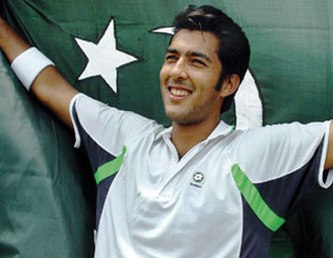
Aisam-Ul-Haq Qureshi delivered his message loud and peacefully, and it had nothing to do with forehands or backhands, or even the doubles title he failed to win.

As a Muslim from Pakistan playing in the U.S. Open doubles final, he said New York needed his words the most, as post-9/11 counsel. So the 30-year-old grabbed the microphone and addressed the estimated 15,000 at Arthur Ashe Stadium – probably the biggest crowd to watch a Grand Slam doubles final – and made sure the moment wasn’t lost.

“I want to say something on behalf of all Pakistanis,” he said following Friday’s 7-6 (5), 7-6 (4) defeat to the Bryan brothers, Bob and Mike. “Every time I come here, there’s a wrong perception about the people of Pakistan.

“They are very friendly, very loving people. We want peace in this world as much as you guys.”

The crowd cheered. By now, such poignancy is expected from Qureshi and, to a lesser extent, his doubles partner, Rohan Bopanna of India. Together, they’ve formed the politically charged tandem known as the Indo-Pak Express, breaking down barriers with their kinship and jettisoning expectations with their recent play.

Their respective neighboring countries have warred with and terrorized each other since the 1940s, citing religion as their great chasm. But Qureshi and Bopanna, a Hindu, represent peace, both on and off the court. Indian and Pakistani fans filled pockets of Arthur Ashe Friday, arriving as early as two hours before the match. U.N. ambassadors from both countries sat side-by-side in the President’s Box – the second straight match they’ve attended together – cheering the same unexpected struggle their team brought to the greatest doubles team of all time, the Bryan brothers. The 16th-seeded Qureshi and Bopanna followed up their run to the Wimbledon quarterfinals with five wins in Flushing.

“They’ve proven that when Indians and Pakistanis get together we can raise fire,” Pakistan ambassador Abdullah Hussain Haroon said. “I think on a people-to-people basis, they’re setting an example that the politicians should follow.”

Prize money and rankings were never a motivating factor, Qureshi said, only good news for his flood-stricken countrymen and a platform to express his message of American misunderstanding. He also defended the decision to build a mosque near the World Trade Center site.

“For me, as a Muslim, that’s what makes America the greatest country in the world – freedom of religion, freedom of speech,” Qureshi said. “If the mosque is built, I think it’s a huge gesture to all the Muslim community out there in the world. I would really appreciate it.”

Pakistan, which borders Afghanistan, has long been considered a headquarters of Al Qaeda.

Qureshi said he’s been stopped at airport immigration “every time” in New York – three hours at a time – including after his latest flight for the Open. And on the eve of the ninth anniversary of the 9/11 attacks, he wanted to defend his country’s masses.

“Since September 11, every time I come to the States or western countries I feel people have the wrong impression about Pakistan as a terrorist nation,” Qureshi said. “I just wanted to declare that we are very friendly, loving and caring people, and we want peace in this world as much as Americans and the rest of the world wants.

“There are extremists in every religion, but just because of them you cannot judge the whole country as a terrorist nation. I just wanted to get this message across as a Pakistani.”

Angelina Jolie Meets Flood Victims in Pakistan

By Inamur Rehman for The Associated Press

American movie star Angelina Jolie met flood victims in northwestern Pakistan on Tuesday and appealed to the international community to provide aid needed to help the country recover from its worst natural disaster.

The flow of aid money has stalled in recent days, and officials expressed hope the two-day visit by Jolie — who serves as a “goodwill ambassador” for the U.N.’s refugee agency — will convince foreign countries and individuals to open their wallets.

The 35-year-old actress said she met with many people whose lives have been devastated by the floods, including mothers who lost their children and an elderly Pakistani couple who feared they would never be able to rebuild the home they lost.

“I am very moved by them and I hope that I am able to, today and tomorrow, be able to do something to help bring attention to the situation for all of the people in need in Pakistan,” Jolie told reporters after visiting a refugee camp in the Jalozai area.

She toured the area wearing a long black robe and a black headscarf adorned with a thin red stripe — the kind of conservative clothing worn by many Muslim women in Pakistan.

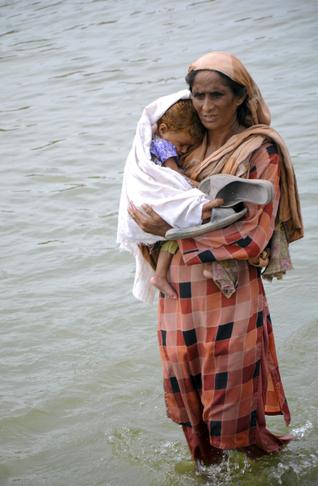
The floods began in the northwest at the end of July after extremely heavy monsoon rains and slowly surged south along the Indus River, swallowing up hundreds of villages and towns and killing more than 1,700 people. Another 17 million have been affected by the floods, and many will need emergency assistance to survive.

The United Nations issued an appeal for $460 million in emergency funds on Aug. 11, but only $294 million, or 64 percent, has been received so far, and donations have more or less dried up in recent days.

Ajay Chhibber, a U.N. assistant secretary general, said he hopes Jolie’s visit will have “a very big impact” on the inflow of aid money and will keep people focused on the crisis.

“We need more … well-known figures who can keep the spotlight and focus because people tend to forget internationally,” said Chhibber, who is also the U.N. development agency’s regional director for Asia. He spoke to reporters during a visit to Islamabad.

Grandsons of Mahatma Gandhi and Sir Abdullah Haroon Appeal for Pakistan Flood Relief

As reported by The United Nations

Miseries of millions unleashed by unprecedented floods in Pakistan brought together grandsons of two famous men in the Indian sub-continent to raise money for the sufferers.

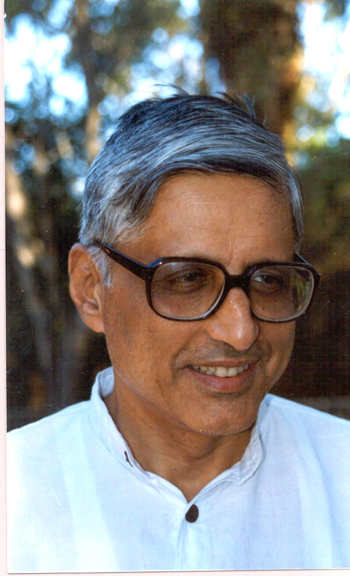
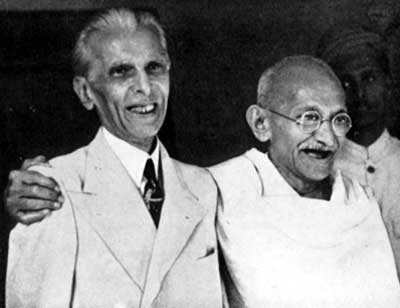
Rajmohan Gandhi, grandson of Mahatma Gandhi and Abdullah Hussain Haroon, Pakistani ambassador to the UN, reached across the lines of history to make a joint appeal here to people to open their wallets to help the flood devastated people of Pakistan.

Acknowledging the gesture of Gandhi’s grandson, Hussain Haroon said Mahatma Gandhi was not only the father of nation to Indians, but also for Pakistanis and the people of entire sub-continent.

Appearing in a joint appeal at the UN headquarters, the Pakistani ambassador introduced Rajmohan saying “Mahatma Gandhi had a very special relationship with all of the Indian sub-continent and also the Muslims” and noted that their grandfathers were very personal friends.

Hussain’s grandfather Sir Abdullah Haroon was a close associate of Mohammad Ali Jinnah, whom the founder of Pakistan described as one of the strongest pillars of Muslim League.

But Haroon acknowledged that though Gandhi and his grandfather were on opposite side of the political spectrum, yet they had immense strength and respect for each other.

“My grandfather Sir Abdullah Haroon was a very personal friend of his (Gandhi), and when my grandfather passed away, we still have Gandhi’s letter where he said to my grandmother, I would have trusted your husband with a blank check,” Haroon said, making reference to the history.

And many a time Mahatma Gandhi proved his selflessness, he asserted.

“When I remember the fledgling Pakistani state did not receive its share from the then newly formed Indian government, the Mahatma went on a fast unto death in Delhi, and the Indian government had to buckle down and pay Pakistan its share,” the Pakistani ambassador acknowledged.

“When the Hindu-Muslim riots took place in Calcutta, he not only went there with Huseyn Shaheed Suhrawardy, he brought together both elements, and the rioting stopped in the city because he was fasting until it would stop. And people realised that it had to stop,” he said, adding it was because of one of these very reasons that he was assassinated.

Adding his voice to the appeal for generous support for the people of Pakistan, Rajmohan Gandhi said, “Now, in this catastrophe, as in all wars and conflicts, the poorest are once more the prime sufferers, losing not a portion of what they had, but all they had. Their sorrows are unrecorded, their heroism unsung, their pain unremembered. I pray that this flood will help us in South Asia to reorder our priorities.”

Millions of Pakistani Kids Risk Waterborne Disease

By Asif Shahzad for The Associated Press

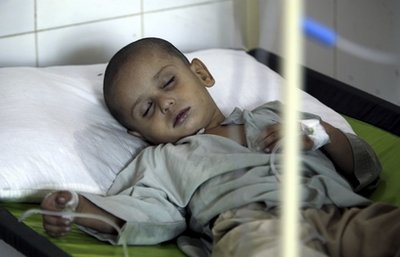
Five-year-old Shahid Khan struggled to remain conscious in his hospital bed as severe diarrhea threatened to kill him. His father watched helplessly, stricken at the thought of losing his son — one of the only things the floods had not already taken.

The young boy is one of millions of children who survived the floods that ravaged Pakistan over the last month but are now vulnerable to a second wave of death caused by waterborne disease, according to the United Nations.

Khan’s father, Ikramullah, fled Pabbi just before floods devastated the northwestern town about a month ago, abandoning his two-room house and all his possessions to save his wife and four children.

“I saved my kids. That was everything for me,” said Ikramullah, whose 6-year-old son, Waqar, has also battled severe diarrhea in recent days. “Now I see I’m losing them. We’re devastated.”

Ten other children lay in beds near Khan at the diarrhea treatment center run by the World Health Organization in Pabbi, two of whom were in critical condition.

Access to clean water has always been a problem in Pakistan, but the floods have worsened the situation significantly by breaking open sewer lines, filling wells with dirty water and displacing millions of people who must use the contaminated water around them.

Children are more vulnerable to diseases such as diarrhea and dysentery because they are more easily dehydrated. Many children in Pakistan also were malnourished before the floods, weakening their immune systems.

The Pakistani government and international aid groups have worked to get clean water to millions of people affected by the floods and treat those suffering from waterborne diseases. But they have been overwhelmed by the scale of the disaster, which has displaced a million more people in recent days.

The floods started in the northwest in late July after extremely heavy monsoon rains and surged south along the Indus River, killing more than 1,600 people, damaging or destroying more than 1.2 million homes and inundating one-fifth of the country — an area larger than England.

Some 3.5 million children are at imminent risk of waterborne disease and 72,000 are at high risk of death, according to the United Nations.

The World Health Organization set up the diarrhea treatment center in Pabbi about a week ago with the help of several other aid groups. Workers have already treated more than 500 patients, mostly children, said Asadullah Khan, one of the doctors.

Some of the patients have been treated multiple times because broken sewer lines have contaminated the water in the town’s wells and pipes, said the doctor. “It is circulating the disease again and again,” he said.

The aid groups set up a similar treatment facility several days ago in Nowshera, a city adjacent to Pabbi that was also engulfed by the floods. Residents who have begun to return in recent days have encountered a scene of total destruction: caved-in houses and streets covered with mud and debris.

Most of the population lacks access to clean water, and mosquitoes have proliferated in stagnant floodwater around the city, raising the risk of malaria. Government help is nowhere to be found.

“It is trash, dirt, germs and odd smells everywhere,” said Zahid Ullah, whose 3-year-old and 10-year-old sons were being treated for gastroenteritis at the facility in Nowshera. “It is a big danger.”

Even at the hospitals where the diarrhea treatment centers have been set up, mobs of flies hovered around the patients despite attempts by staff to kill them.

The World Health Organization and the United Nations Children’s Fund appealed to the world on Saturday to provide water purification units, family hygiene kits and other items needed to increase access to clean water in Pakistan.

Guido Sabatinelli, the head of the World Health Organization in Pakistan, said the international community’s help was critical to help Pakistan avoid a second wave of death from waterborne disease.

“We are fearing the epidemic of disease,” said Sabatinelli. “Access to safer water, potable water” is critical, he said.

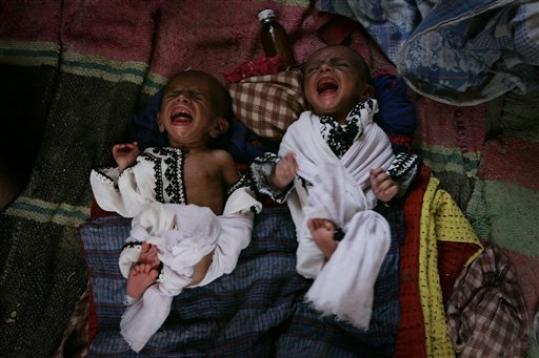
Asma Bibi couldn’t agree more. The young mother searched in vain for clean water on the outskirts of Nowshera as her feverish 2-month-old son, Ehtesham, sweltered in a tent set up for flood victims. They had run out of water the day before.

“My son is sick. He hasn’t breast-fed in two days,” she said. “He needs milk. He needs water.”

Pakistan Accepts Flood Aid Money From Rival India

By Issam Ahmed for The Christian Science Monitor

Pakistan has accepted an offer of $5 million of flood aid from neighbor and longtime rival India, in a move that could spark a political backlash at home.

In an interview with Indian news channel NDTV, Pakistani Foreign Minister Shah Mehmood Qureshi described the offer of aid, made last week, as a “very welcome initiative” which the government of Pakistan has agreed to accept, after taking some time to decide.

But it would have been better to say “thanks, but no thanks,” according to Liaqat Baloch, secretary general of Pakistan’s second-largest religious party, the Jamaat-e-Islami.

“Pakistan has many disputes with India, with reference to Kashmir, and the Indian Army engaging in brutality in occupied Kashmir,” he says. “In the past, when Pakistan tried to support India after their natural disasters, India never accepted. Therefore it would be better if our government refused the aid with a big thank you.”

Al Khidmet foundation, Jamaat-e-Islami’s charitable wing, has been one of the most visible aid organizations in the flood-affected areas.

The two countries have made efforts in recent months to repair bilateral relations, which took a plunge following the 2008 Mumbai attacks. India blames those attacks on Pakistan-backed militants. The two countries have fought three full-scale wars, most recently in 1999.

The United States had urged Pakistan to accept India’s offer of aid earlier this week. When Indian Prime Minister Manmohan Singh called his Pakistani counterpart to offer his condolences following the worst natural disaster in Pakistan’s history, it was an event widely reported in the Pakistan media.

“In such times of natural disasters, all of South Asia should rise to the occasion and extend every possible help to the people of Pakistan affected by the tragedy,” Mr. Singh said, according to a statement released by his office.

According to Badar Alam, editor of Pakistan’s Herald magazine, the amount of aid pledged is “symbolic, but its effect is immense. It’s a good confidence building measure between the two countries.”

But, he warns, Pakistan’s religious parties will try to spin the move “as a sign of weakness.”

“They will see it as a capitulation to India, that our own government is so weak we have been forced to accept help from the historic enemy,” says Mr. Alam.

Mosharraf Zaidi, a columnist for Pakistan’s The News, termed the decision brave: “It’s a tremendous gesture, very mature. India should be commended for donating it and Pakistan should be commended for accepting it.”

“The whole idea in an emergency is you’ll have the Jamat ud Dawas [the charitable wing of banned militant outfit Lashkar-e-Taiba] and you’ll have competing powers working almost in tandem to support people. It shows that no matter what our value systems, we have to work together right now,” he adds.

Some 20 million people are affected by Pakistan’s worst flooding in recent memory; Pakistan’s government estimates around 1,600 deaths and millions homeless or displaced. The United Nations appealed to the international community to donate $460 million in emergency assistance last week, and has met half of that goal. Yesterday the US increased its flood aid to Pakistan from $80 million to $150 million.

-Pakistanis for Peace Editor’s Note- It is a good decision by the Pakistani government to accept the aid offer from India. Not only will this be a confidence building measure between the two nations, it will save countless lives, and no nation is too proud to save the lives of its citizens.

U.S. Strategy in Pakistan Is Upended by Floods

By Mark Landler for The New York Times

WASHINGTON — The floods in Pakistan have upended the Obama administration’s carefully honed strategy there, confronting the United States with a vast humanitarian crisis and militant groups determined to exploit the misery, in a country that was already one of its thorniest problems.

While the administration has kept its public emphasis on the relief effort, senior officials are busy assessing the longer-term strategic impact. One official said the disaster would affect virtually every aspect of the relationship between the United States and Pakistan, and could have ripple effects on the war in Afghanistan and the broader American battle against Al Qaeda.

With Pakistan’s economy suffering a grievous blow, the administration could be forced to redirect parts of its $7.5 billion economic aid package for Pakistan to urgent needs like rebuilding bridges, rather than more ambitious goals like upgrading the rickety electricity grid.

Beyond that, the United States will be dealing with a crippled Pakistani government and a military that, for now, has switched its focus from rooting out insurgents to plucking people from the floodwaters. The Pakistani authorities, a senior American official said, have been “stretched to the breaking point” by the crisis. Their ragged response has fueled fears that the Taliban will make gains by stepping in to provide emergency meals and shelter.

“It certainly has security implications,” said another official who, like others interviewed for this article, spoke on the condition of anonymity because he was not authorized to discuss internal policy deliberations. “An army that is consumed by flood relief is not conducting counterinsurgency operations.”

On Thursday, the United Nations will convene a special meeting devoted to the floods, hoping to galvanize what has been a lackluster global response. Secretary of State Hillary Rodham Clinton is expected to announce that American public aid has surpassed $100 million, an official said.

“We’re obviously not oblivious to the political and strategic implications of this catastrophe, but right now, we are fully focused on the emergency relief effort and trying to get a good assessment of the needs,” said the administration’s special representative to the region, Richard C. Holbrooke.

Noting that several weeks remain in the monsoon season, Mr. Holbrooke said, “Worse may be yet to come.”

The disaster comes after a period in which the administration seemed to have made strides in repairing the American relationship with Pakistan. Mrs. Clinton visited Islamabad in July with a long list of pledges, including the upgrading of several power plants and a plan to promote Pakistani mangoes. Now, these projects seem almost beside the point.

“Before, there were power plants in need of refurbishment,” said Daniel S. Markey, senior fellow for India, Pakistan and South Asia at the Council on Foreign Relations. “Now there are power plants underwater.”

In recent days, the United States has sent 15 helicopters, rescuing nearly 6,000 people. On Wednesday, military cargo planes delivered 60,000 pounds of food and other relief supplies, bringing total deliveries to 717,000 pounds. The speed and scale of the effort, officials in both countries said, have helped bolster the checkered American image in Pakistan.

In another hopeful sign, officials said Pakistan and India had been in close touch about the floodwaters, some of which are flowing into Pakistan from India. Such communication, between historic archenemies, could augur reduced tension in other areas, one of the officials said.

Against that, however, are the staggering dimensions of the disaster. A senior Pakistani official told the administration on Tuesday that the next flood surge was likely to inundate much of Punjab, the densely populated region that borders India and produces much of Pakistan’s food.

So far, this official said, the greatest damage has been in regions that are also hotbeds for Islamic insurgents, which has set back the army’s fight against extremist groups. Local governments in those places have largely collapsed, leaving the army as the only source of authority.

With 20 million people displaced from their homes, the Pakistani authorities are girding themselves for an immense migration to the major cities, which they fear could sow further instability.

“Americans have not yet registered the enormity of the crisis,” Pakistan’s ambassador to the United States, Husain Haqqani, said in a telephone interview from Islamabad, the capital.

Pakistani and American officials said reports of hard-line Islamic charities providing relief were exaggerated. One pointed out that the floods had hurt the insurgents as well: there was a report of small arms and ammunition belonging to a militant group floating in the water.

Still, people in both countries warned that if rebuilding and rehabilitation efforts bogged down, the Taliban and other militant groups would try to take advantage of it. “The real test is, can their government provide the most fundamental services?” said an administration official.

Parallels to this crisis are hard to find. One official cited the example of the Indonesian province of Aceh, which had been racked by a three-decade insurgency fought by the separatist Free Aceh Movement. After the tsunami swept through in 2004, killing 170,000 people, the separatists and the Indonesian government quickly signed a peace treaty, in August 2005.

There are, however, big differences between a localized separatist group and an international jihadist movement.

“If the flood proves to tilt the balance of power in Pakistan, it’s more likely to tilt toward the militants than toward the government,” said Bruce Riedel, a former intelligence official who helped the administration formulate its initial policy for Pakistan and Afghanistan.

Already, Pakistan’s president, Asif Ali Zardari, has been exposed to withering criticism at home for going on a trip to Europe during the early days of the flood. American officials said they were determined not to get drawn into the dispute, noting that in any event, Mr. Zardari had been stripped of many of his powers in a recent constitutional change.

Decisions on how the flood will affect American economic aid may be influenced by a trip to Pakistan by Senator John Kerry, the Massachusetts Democrat who co-sponsored the five-year nonmilitary assistance package with Senator Richard G. Lugar, Republican of Indiana.

Senator Kerry, accompanied by Dan Feldman, a deputy to Mr. Holbrooke, is scheduled to tour the flooded areas on Thursday. Mr. Kerry has said he is open to redirecting aid money, though some analysts said they were skeptical that Congress would approve additional financing. Military aid may also come under scrutiny, according to administration officials.

“Every dimension of our relationship — politics, economics, security — is going to see major shifts as a result of this historic disaster,” said Lt. Gen. Douglas Lute, the White House coordinator for Afghanistan and Pakistan. “All the tools of diplomacy have to be examined in light of this new reality.”

Rescuing Pakistan’s Flood Survivors

Recovery efforts are underway in Pakistan where monsoon rains and severe flooding washed away tens of thousands of homes, killing thousands and leaving millions homeless.

How you can help? A number of charities are mobilizing medical, shelter and humanitarian aid, responding to the great need for flood survivors’ immediate needs.

AmeriCares emergency relief experts are working to send medical assistance and other aid to the flood-affected region in Pakistan. They are accepting online donations as well as phone donations at  1-800-486-HELP (4357)

British Red Cross is accepting donations of goods to the Pakistan Flood Appeal. Monetary donations in pounds can also be made online or by calling 0845 054 7206 in England.

CARE is supporting the distribution of emergency supplies and providing aid to health teams and mobile clinics in the affected communities in Pakistan. You can help by making an online donation.

Catholic Relief Services is currently organizing shipments of humanitarian aid to Balochistan, one of the affected areas. They are also sending emergency shelter kits and hygiene supplies to other flood-affected regions in Pakistan. Donations to their Emergency Relief fund are being accepted online and by phone at   1-800-736-3467.       

Concern Worldwide US is responding by sending emergency teams to the region, and they have launched their Pakistan Emergency Flood Appeal. They are working to provide about 9,000 families with kitchen sets and hygiene kits, clean water, temporary sanitation, and dry rations of food. Online donations can be made dollars, euros and pounds.

Church World Service is distributing food packages and shelter material for flood-affected families in Balochistan, Khan and Khyber Pakhtunkhwa, as well as mobilizing a health unit to offer emergency medical assistance in Mansehra. Your donation can be made online and by phone at  1-800.297-1516        

Direct Relief International is providing emergency medical aid to healthcare partners responding to disaster in Pakistan. Donations to their Emergency Response fund can me made online and by calling  1-800-676-1638    

Doctor’s Without Borders is supporting basic health units in the flood-affected areas of Pakistan. The organization is also helping with water distribution to health structures, as well as hygiene products, cooking sets and other supplies. They are planning to send additional personnel and mobilizing resources to assist relief efforts. Contributions can be made online and by phone at 1-888-392-0392      

International Committee of the Red Cross continues to distribute relief supplies to over 7,000 flood victims in Balochistan. The ICRC and its partners are finalizing medical contingency plans for flood-affected areas, and for repairing critical water infrastructure. You contribute by making a donation in numerous currencies online.

International Federation of Red Cross and Red Crescent Societies are performing rapid needs assessments in affected areas and distributing food coupons and other relief items including tents, hygiene kits, tarpaulin sheets and kerosene stoves. They have also set up a medical camp in Sultan to offer immediate medical aid to affected families. You can help now by making an online donation.

Islamic Relief USA is providing food and water for 700 families In Noshara, distributing emergency supplies and working with the United Nations World Food Program to distribute food to 2,000 families in Bakhtiarabad. Islamic Relief has launched a campaign to aid the victims of the floods, which you can support by making an online donation.

Mercy Corps is accepting donations to provide flood victims in the hard-hit Swat Valley with water, food and tools to clean up and rebuild. You can donate online.

Oxfam Great Britain is looking to provide the needed temporary shelter, clean drinking water and toilets to help avert a public health catastrophe. They are accepting online donations in pounds, euros and dollars, and can be reached by telephone internationally at  +44 (0) 1865 47 2602. In England, you can text ‘DONATE’ to 70066 to make a donation of 5 pounds to their Pakistan Floods Appeal.

ShelterBox distributed hundreds of ShelterBoxes to families rescued from the flood in the Punjab and Khyber Pukhtunkhwa (KPK) regions. Find out how to become part of the ShelterBox Team or help the efforts by making an online donation in the UK and the US.

SOS Children’s Villages supports the children of Pakistan through different programs across the country and offers care of lone children following the disaster, as they did after the Kashmir Earthquake. You can make a direct donation in dollars or pounds and you can sponsor a child in Pakistan here.

UNICEF‘s Pakistan office is providing assistance for water and sanitation, health, and nutrition. They are distributing clean water and water purification tablets to prevent water-borne diseases and will continue to asses the situation to determine if further fundraising appeal is needed. If you are interested in becoming a UNICEF volunteer click here or support flood-relief efforts by making an online donation.

World Food Programme is making food distributions to 35,000 families affected by the flooding in Northwestern Pakistan. WFP Pakistan plans to assist up to 150,000 families over the next few months as access to the affected areas improves. You can help by making an online donation in either euros, dollars, pounds or yens.

World Vision is working to distribute food and clean water to the affected communities in Pakistan. They have created the World Vision’s Flood Relief Fund which you can support it by making an online donation.

Operation Blessing International is sending emergency medical relief teams to Peshawar, Pakistan. Working with their disaster relief partner charity Humedica, OBI will offer medical treatment and distribute food, clean drinking water and emergency building supplies to thousands in need from this flood. Support for OBI’s disaster relief efforts can be made online or by calling 1-800-730-2537  

Save the Children is providing food and water, shelter, sanitation and other immediate needs for the families and communities affected by this disaster. They are accepting donations to their Pakistan Children in Emergency Fund online as well as by phone by calling in the US    1-800-728-3843