Archive for the ‘ Afghanistan ’ Category

Wake up Pakistan

By Najam Sethi for The Friday Times

US- PAK relations have broken down. The United States has “ suspended” military aid and all but closed the Kerry- Lugar- Berman tap of funds for the civilians. Proud Pakistanis have puffed up their chests and vowed to eat grass, if necessary, in order to defend their country’s “sovereignty”. What’s the big deal, they aver, US aid was peanuts anyway, and our traditional friends like China and Saudi Arabia can bail us out of our problems.

To be sure, our relationship with the US has been no small disaster.

In the 1950s, we begged the US to befriend us instead of India, cheerily going along with the US into the Cold War against the USSR when it wasn’t our war at all. In consequence, the military became the dominant theme of our life and wrecked the budding impulse of democracy. Once again, in the 1980s and 2000s, we tripped over ourselves to rent out our services to the US in Afghanistan.

Today we are reaping the terrorist whirlwind of our greed and opportunism.

But a little introspection is in order to prove that we don’t need the US as an enemy because we are our own worst enemies.

More Pakistanis are eating “ grass” now than ever before. The number of Pakistanis below the poverty line has increased from 27 per cent five years ago to 33 per cent in 2011. And this has nothing to do with the US. The growth rate of the economy has fallen from 6.5 per cent five years ago to 3 per cent now. The fiscal deficit is yawning at 7.5 per cent of the GDP today compared to 4.5 per cent five years ago. And this has nothing to do with the US. The Rupee has fallen from 77 to the dollar five years ago to 90 today. General inflation is running at 15% and food inflation at 25%. And this has nothing to do with the US. The tax to GDP ratio is down to 8.7% in 2011 from 11.5% five years ago. And this has nothing to do with the US. Floods continue to devastate the lives and produce of millions of poor people across the country.

And this has nothing to do with the US. Sunni extremists are rampaging, killing Shias. Ethnic parties continue to mow down people in Karachi. And this has nothing to do with the US. Power breakdowns have made the lives of tens of millions wretched and miserable while rendering millions of others jobless.

And this has nothing to do with the US. Instead of rooting for Pakistani nationalism, we are proud to undermine it as Muslims first, or Sindhis, Muhajirs, Baloch, Pakhtun, Punjabi, Seraiki, Hazarajat, Kashmiri, Sunni, Shia, Deobandi, Barelvi. And this has nothing to do with the US. We are counted amongst the most corrupt countries of the world. We have waged four wars with India and lost each of them, in the bargain losing half of Pakistan.

And this has nothing to do with the US. As if this litany of self- induced failures isn’t enough, there is the hypocrisy of double standards to contend with too. Of course, the US has violated our sovereignty by raining drones on FATA. But so have the Afghan Taliban and Al- Qaeda who have established safe havens there too. But we are quick to blast the US and quicker still to pretend that Al- Qaeda doesn’t exist and the Taliban are innocent refugees for whom our traditional hospitality is on offer.

The story doesn’t end here.

The IMF is not welcome. How dare it demand that we tax the rich, plug the bleeding in public sector corporations, stop the theft of power, and spend according to our means. US aid is dispensable.

We don’t need to build dams and reservoirs for managing our natural resources, we don’t need schools and teachers for our children and hospitals for the poor.

Our all- weather friends are China and Saudi Arabia. Never mind that China doesn’t help us much when we are ravaged by earthquakes and floods or when we are short of cash to pay our foreign bills.

NEVER MIND that Saudi Arabia treats our migrant workers like slaves, rents our military to crack down on Shia majorities in Bahrain and exports extremist “ Islam” to our lands.

At the end of the day, who eats grass when we rise to defend our sovereignty? Not our pot- bellied traders and businessmen. Not our golf- playing generals. Not our Defence Housing Society residents.

Not our foreign- asset holding politicians whose kids go to English- medium private schools at home and abroad. Not our self righteous media Mughals who berate our slavish black- skins and white masks. Not our corrupt judges and civil servants. It’s the wretched of the earth, the poorest of the poor, who eat grass.

For too long we have made foreign scapegoats for our own failures and corruptions. It is time to wake up and set our house in order without begging or berating the US.

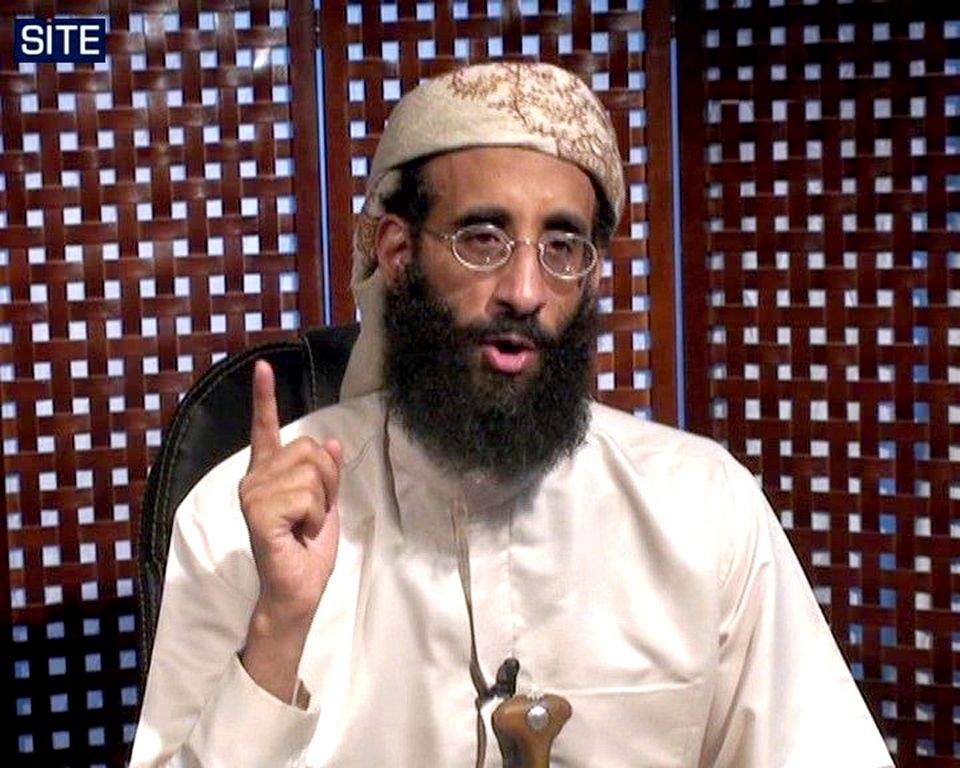
U.S.: Al-Awlaki Believed Dead in Attack

As reported by the Detroit News

American forces targeted al-Qaida cleric Anwar al-Awlaki’s convoy with a drone and jet attack and believe he’s been killed, a U.S. counterterrorism official said Friday.

The U.S.-born cleric known for fiery anti-American rhetoric has been suspected of ties to the Fort Hood attack and the attempted Christmas Day airliner bombing in 2009.

The counterterrorism official was not authorized to speak publicly and spoke on condition of anonymity.

Word from the U.S. comes after the government of Yemen reported that al-Awlaki was targeted and killed Friday about five miles from the town of Khashef, some 87 miles from the capital Sanaa. He would be the most prominent al-Qaida figure to be killed since Osama bin Laden.

U.S. officials have said they believe al-Awlaki directed, led and planned attempted attacks on the U.S. He was believed to have inspired the Fort Hood shooter, Army psychiatrist Maj. Nidal Hasan, and to have played a more direct role in the Christmas 2009 attempted bombing of a Detroit-bound airliner. Hasan is charged with 13 counts of premeditated murder and 32 counts of attempted premeditated murder in the November 2009 attack at Fort Hood, Texas.

On Sept. 13, an FBI Special Agent testified in Detroit that al-Awlaki played a key role in the radicalization of so-called “underwear bomber” Umar Farouk Abdulmutallab.

Abdulmutallab spent hours listening to al-Awlaki’s video clips posted on the Internet, Special Agent Timothy Waters testified.

Abdulmutallab faces up to life in prison if convicted of a host of charges stemming from his alleged attempt to blow up the plane from Amsterdam to Detroit on Christmas Day 2009.

Al-Awlaki’s death “will especially impact the group’s ability to recruit, inspire and raise funds as al-Awlaki’s influence and ability to connect to a broad demographic of potential supporters was unprecedented,” said terrorist analyst Ben Venzke of the private intelligence monitoring firm, the IntelCenter.

But Venzke said the terror group al-Qaida in the Arab Peninsula will remain the most dangerous regional arm “both in its region and for the direct threat it poses to the U.S. following three recent failed attacks,” with AQAP leader Nasir al-Wahayshi still at large.

Venzke said al-Awlaki was due to release a new article in the next issue of AQAP’s Inspire magazine justifying attacking civilians in the West.

“The article, which may already have been completed, was announced by AQAP on Tuesday as being entitled, ‘Targeting Populations of Countries at War with Muslims,'” he said.

Analysis: Pakistan’s Double-Game: Treachery or Strategy?

By John Chalmers for Reuters

Washington has just about had it withPakistan.

“Turns out they are disloyal, deceptive and a danger to the United States,” fumed Republican Representative Ted Poe last week. “We pay them to hate us. Now we pay them to bomb us. Let’s not pay them at all.”

For many in America, Islamabad has been nothing short of perfidious since joining a strategic alliance with Washington 10 years ago: selectively cooperating in the war on extremist violence and taking billions of dollars in aid to do the job, while all the time sheltering and supporting Islamist militant groups that fight NATO troops in Afghanistan.

Pakistan has angrily denied the charges, but if its critics are right, what could the explanation be for such duplicity? What strategic agendas might be hidden behind this puzzling statecraft?

The answer is that Pakistan wants to guarantee for itself a stake in Afghanistan’s political future.

It knows that, as U.S. forces gradually withdraw from Afghanistan, ethnic groups will be competing for ascendancy there and other regional powers – from India to China and Iran – will be jostling for a foot in the door.

Islamabad’s support for the Taliban movement in the 1990s gives it an outsized influence among Afghanistan’s Pashtuns, who make up about 42 percent of the total population and who maintain close ties with their Pakistani fellow tribesmen.

In particular, Pakistan’s powerful military is determined there should be no vacuum in Afghanistan that could be filled by its arch-foe, India.

INDIA FOCUS

Pakistan has fought three wars with its neighbor since the bloody partition of the subcontinent that led to the creation of the country in 1947, and mutual suspicion still hobbles relations between the two nuclear-armed powers today.

“They still think India is their primary policy,” said Talat Masood, a retired Pakistani general and prominent political analyst. “India is always in the back of their minds.”

In an interview with Reuters on Tuesday, Pakistani Prime Minister Yusuf Raza Gilani – unprompted – complained that Washington’s failure to deal even-handedly with New Delhi and Islamabad was a source of regional instability.

Aqil Shah, a South Asia security expert at the Harvard Society of Fellows, said Islamabad’s worst-case scenario would be an Afghanistan controlled or dominated by groups with ties to India, such as the Tajik-dominated Northern Alliance, which it fears would pursue activities hostile to Pakistan.

“Ideally, the military would like Afghanistan to become a relatively stable satellite dominated by Islamist Pashtuns,” Shah wrote in a Foreign Affairs article this week.

Although Pakistan, an Islamic state, officially abandoned support for the predominantly Pashtun Taliban after the 9/11 attacks on the United States in 2001, elements of the military never made the doctrinal shift.

Few doubt that the shadowy intelligence directorate, the Inter-Services Intelligence (ISI), has maintained links to the Taliban that emerged from its support for the Afghan mujahideen during the 1979-1989 Soviet occupation of Afghanistan.

Until recently, there appeared to be a grudging acceptance from Washington that this was the inevitable status quo.

That was until it emerged in May that al Qaeda leader Osama bin Laden – who was killed in a U.S. Navy SEALs raid – had been hiding out in a Pakistani garrison town just two hours up the road from Islamabad, by some accounts for up to five years.

Relations between Pakistan and the United States have been stormy ever since, culminating in a tirade by the outgoing U.S. joint chiefs of staff, Mike Mullen, last week.

Mullen described the Haqqani network, the most feared faction among Taliban militants in Afghanistan, as a “veritable arm” of the ISI and accused Islamabad of providing support for the group’s September 13 attack on the U.S. embassy in Kabul.

The reaction in Islamabad has been one of stunned outrage.

Washington has not gone public with evidence to back its accusation, and Pakistani officials say that contacts with the Haqqani group do not amount to actual support.

However, Imran Khan, a Pakistani cricketer-turned-populist-politician, said this week that it was too much to expect that old friends could have become enemies overnight.

He told Reuters that, instead of demanding that Pakistan attack the Haqqanis in the mountainous border region of North Waziristan, the United States should use Islamabad’s leverage with the group to bring the Afghan Taliban into negotiations.

“Haqqani could be your ticket to getting them on the negotiating table, which at the moment they are refusing,” Khan said. “So I think that is a much saner policy than to ask Pakistan to try to take them on.”

REGIONAL GAME

The big risk for the United States in berating Islamabad is that it will exacerbate anti-American sentiment, which already runs deep in Pakistan, and perhaps embolden it further.

C. Raja Mohan, senior fellow at New Delhi’s Center for Policy Research, said Pakistan was probably gambling that the United States’ economic crisis and upcoming presidential elections would distract Washington.

“The real game is unfolding on the ground with the Americans. The Pakistan army is betting that the United States does not have too many choices and more broadly that the U.S. is on the decline, he said.

It is also becoming clear that as Pakistan’s relations with Washington deteriorate, it can fall back into the arms of its “all-weather friend,” China, the energy-hungry giant that is the biggest investor in Afghanistan’s nascent resources sector.

Pakistani officials heaped praise on Beijing this week as a Chinese minister visited Islamabad. Among them was army chief General Ashfaq Kayani, arguably the country’s most powerful man, who spoke of China’s “unwavering support.”

In addition, Pakistan has extended a cordial hand to Iran, which also shares a border with Afghanistan.

Teheran has been mostly opposed to the Taliban, which is dominated by Sunni Muslims while Iran is predominantly Shi’ite. But Iran’s anti-Americanism is more deep-seated.

“My reading is the Iranians want to see the Americans go,” said Raja Mohan, the Indian analyst. “They have a problem with the Taliban, but any American retreat will suit them. Iran in the short term is looking at the Americans being humiliated.”

ARMY CALLS THE SHOTS

The supremacy of the military in Pakistan means that Washington has little to gain little from wagging its finger about ties with the Taliban at the civilian government, which is regularly lashed for its incompetence and corruption.

“The state has become so soft and powerless it can’t make any difference,” said Masood, the Pakistani retired general. “Any change will have to come from the military.”

Daniel Markey, a senior fellow for South Asia at the U.S. Council on Foreign Relations, said the problem lies with a security establishment that continues to believe that arming and working – actively and passively – with militant groups serves its purposes.

“Until … soul-searching takes place within the Pakistani military and the ISI, you’re not likely to see an end to these U.S. demands, and a real shift in terms of the relationship,” Markey said in an online discussion this week. “This is the most significant shift that has to take place.”

Bacha Khan, Anti-Partition Hero Who Can Help Pakistan Today

By Mauro Vaiani for Pakistanis for Peace

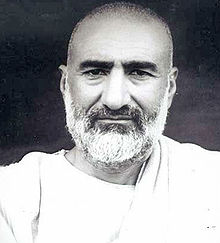
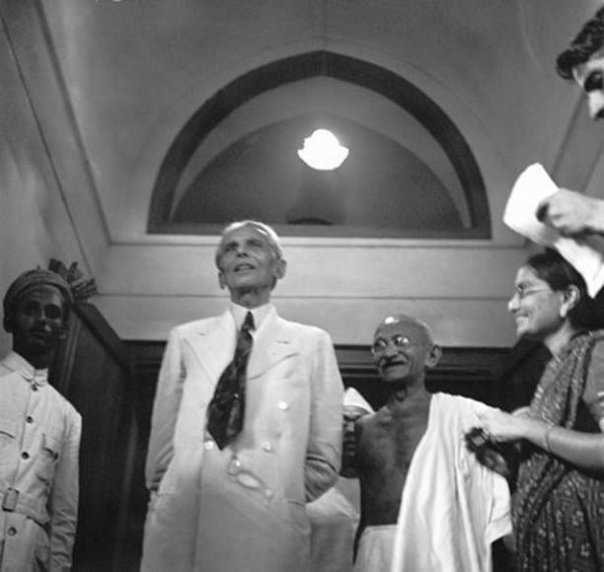
A person once stigmatized as an enemy of Pakistan, has something important to say in the contemporary public discourse in the second Islamic country in the world. His name is Abdul Ghaffar Khan (in the picture), a Pakhtun patriot, social reformer, charismatic leader. He was a lifelong activist in favour of his fellows Pathans living North and South the frontier Durand Line. He became a very close friend of the Mahatma and he himself was called the “Frontier Gandhi”.

Anti-Partition apostle of nonviolence
He was born on 1890 in Utmanzai, a town in Charsadda District, in the North-West Frontier Province, today Khyber Pakhtunkhwa Province in Pakistan. He was an apostle of nonviolence, that he considered a form of spiritual jihad for his time and for the future of his people. He founded a nonviolent movement which arrived to count 100,000 members. As he wrote in his 1969 autobiography, “My life and struggle”, “in 1929 we were able to found the kind of organisation we wanted. We decided to call it the Khudai Khidmatgar movement (Servants of God movement). Our motive for choosing that name was that we wanted to awaken in the Pathans the idea of service and the desire to serve their country and their people in the name of God, an idea and a desire which was sadly lacking among them”. The Khudai Khidmatgars were also known, for the color of their uniforms, “Red Shirts”. The founder was called by his followers, as a mark of esteem, Badshah Khan, also spelled Baacha Khan, or more commonly Bacha Khan, that means “king of our nobles”.

Baacha Khan fostered free education for all, women rights, religious freedom, judicial reform. He also was a pioneer of ecology and sustainable development. He believed in self-government for both the settled and the tribal Pakhtuns. He strongly opposed the Partition of India, proposing autonomous provinces in a unified Indian federal framework. When the Partition became inevitable, he renounce to oppose it with riots or violence. He and his Khidmatgars accepted, reluctantly, Pakistan as their new country and decided to be loyal. They hoped the new regime would have given the Pakhtuns a chance to live united in their territory, free to self-govern their own province. The autonomy of the federal units in Pakistan was instead nipped in the bud and their movement was declared illegal.
For the freedom fighter, a new cycle of imprisonment started. Baacha Khan spent one-third of his life in prison, but, more precisely, he spent more time, about 15 years, in Pakistani prisons than he had spent in the prisons of the British Raj, “only” 12.

He also went in exile in Afghanistan, where he supported local Pashtun cultural, social and economical development, fighting backwardness, clanism, family feuds. He gave in Afghanistan many speeches in favor of “Pakhtunistan”, which were free of every kind of chauvinism, fostering freedom and self-government of his people, within the Pakistani federation, firmly anchored to a commitment for peace in all South Asia, all over the world.
“I am looking forward to the time when free, general elections will be possible again in Pakistan. – he wrote in his 1969’s autobiography – For only then will the world know which way my people are going and whom do they follow. This is the main conflict between me and the rulers of Pakistan.”. This champion of Pakhtun patriotism remained unheeded. He won’t see general and local fair election either under the dictatorship of Ayub Khan, nor under Yahya Khan, nor under the civil but still authoritarian rule of Zulfiqar Ali Bhutto, nor under Zia Ul-Haq.
He couldn’t see the general elections of December 1988, when Benazir Bhutto, daughter of Zulfiqar Ali, became Prime Minister, for he died in Peshawar on January 20.

He had requested to be buried in Jalalabad, Afghanistan. He hoped this way to witness the need of friendship, and mutual understanding, among all Pakhtuns, between Afghanistan and Pakistan. His last wish succeeded in leaving a footprint in the heart of many throughout South Asia. As one can read in Rajmohan Gandhi’s biography of Bacha Khan (New Delhi, 2004) his funeral resulted a mammoth rally: “Though the Afghan struggle was not yet over, the Kabul government and the mujahedin both announced a ceasefire for the event. Tens of thousands of the Frontier’s mourning Pakhtuns accompanied the coffin and crossed the Durand Line. Pakistan’s military ruler, Zia-ul Haq (who would be killed in a plane crash later in the year), and India’s Prime Minister, Rajiv Gandhi (also destined for a violent death), were present for the last rites.” (see Gandhi R., Ghaffar Khan, 2004, p. 263).

Political heritage

After decades of oblivion, his political heritage are now again gaining momentum among Pakhtuns. An important political player in the re-established Pakistani democracy, the Awami National Party (ANP), wrote in its manifesto that it “draws its inspiration from the example and teachings of Khan Abdul Ghaffar Khan, affectionately known to his people as Baacha Khan. He spent his entire life in the struggle for freedom and justice. He and his Khudai Khidmatgars offered great sacrifices in the fight against colonialism, imperialism and all other forms of oppression. In a broader sense, Baacha Khan saw politics as the highest form of public service and often described himself as only a social worker. His objective was to liberate the masses of South Asia and, particularly, his own people, the Pakhtuns, from the shackles of ignorance and poverty, so that they could rise to their full potential.” (cf http://awaminationalparty.org/).
The ANP was led in the past by Bacha Khan’s son, Abdul Wali Khan, and today the most prominent figure is his grandson, Asfandyar Wali Khan. In the 2008 elections, the Awami National Party won the majority in Khyber Pakhtunkhwa and elected its first Chief Minister since the independence, in coalition with the Pakistan People’s Party. ANP is allied with PPP also in other provinces and at the federal level.
The parable of the Taliban regime and the political violence that still sets fire through the area, has been a terrifying experience for everybody but especially for Pakhtuns. Baacha Khan is being rediscovered, as a source of inspiration for a better future. He was a devout Muslim believer, but he refused terror and was also alien from any bigotry. His political action was centered on peace and social reformation. He sacrificed as a satyagrahi in nonviolent campaign of civil disobedience, firstly against the British Raj, but later also against Pakistan authoritarianism and military rule.
His spiritual heritage helped ANP to defeat the Muttahida Majlis-e-Amal, the Islamist coalition, which was in power in Pakhtunkhwa before 2008. It was a highly symbolic victory. In the name of Baacha Khan, the modern ANP defeated the Islamists, as well as the ancient Khudai Khidmatgars had always defeated the Muslim League in both the elections hold in the province, under the British rule, on 1936 and 1946. Many hope that this political change could represent the end of a cycle, dominated by a tangle of Islamist and nationalist ideologies, which have painfully marked the history of the Frontier, of all Pakistan, Afghanistan.

Several notable cultural foundations and charities are working in South Asia to promote peace and human rights through the rediscover of Badshah Khan’s life, thought and action. We must nominate the Baacha Khan Trust (see http://www.baachakhantrust.org/), whose chief aim is propagation of Ghaffar Khan’s philosophy, his vision of renaissance for the oppressed and marginalized Pakhtuns communities, and for peace in Pakistan, Afghanistan, the whole South Asia.
Nowadays efforts to make the public opinion and new generations aware of the figure and the teachings of Baacha Khan would certainly help the stabilization of the so called Afpak area. After 60 years of political authoritarianism and violence in Pakistan and 40 years of civil war in Afghanistan, it’s probably time to know something more about Bacha Khan.

Self-government

His Red Shirts were able to provide “local leadership for education and development, and stood up for the dignity and rights of their community. They balanced affirmations of the rights and dignity of all people with teachings about responsibility and sacrifices needed to serve those same communities.” – Ali Gohar, founder and guide at the Just Peace International center, in Peshawar, recently wrote, adding that the beauty of this kind of nonviolent struggle is again alive in 2011 Arab Spring heroes cf http://www.khyberwatch.com/index.php?mod=article&cat=MediaWatch&article=391).

“You all know that I believe in the principles of non‱violence. – he said on August 31, 1966, talking in Afghanistan on the Pakhtunistan Day, as reported in his 1969’s autobiography – I am convinced that there will be no peace in the world till the problem of the Pakhtuns has been solved. I am telling both the Russians and the Americans the same thing: if they really want peace, they should solve the problem of the Pakhtuns. What do we want? We keep on telling Pakistan to consider us their brothers and not to make us their slaves. We were never the slaves of the British and you should not expect us to be your slaves.”. Heared today, these words are somehow prophetic and should encourage a serious reflection.

The Pathans, both in Afghanistan and in Pakistan, still need an accountable local self-government, in order to take on full responsibility of their own territories. They can hardly be governed from Kabul, or from Islamabad. May be they can resolve their own way their problems, included terror-related and security’s ones.

The recent Pakistani devolution can be seen as a historical accomplishment on the way indicated by Baacha Khan. This is what many political leaders, not only ANP’s ones, strongly believe. Federalism was part of the independence struggle and the only way to make the idea of Pakistan into a lasting reality.

Unfortunately, the centralized, bigoted and corrupt, republic chosen by Afghani Pashtun leadership, after the fall of the Taliban regime, is much farer from Baacha Khan’s ideal of decentralized responsible and accountable self-government. The present solution resembles too much like the 1973 republic. It may be not reveal the right solution for the future of such a vast, diverse, and bitterly divided, country.

Don’t let anybody deceive you in the name of Islam

Abdul Ghaffar Khan, along all his existence, advocated for reforms, social justice, change through education, and, last but not least, peaceful coexistence of all communities, without any kind of ethnic, religious, caste, clan, social discrimination.
He strongly demanded his fellow Pakhtuns, to strive against ignorance, bigotry, prejudices, family feud and political violence. His message, which follows the furrow of modern nonviolent revolutions, which have already brought down more than an empire, can drive the Islamist factions and wider Muslim public opinion to a radical rethinking.

His teaching was prescient and it is today more relevant than ever: “And you, misguided Pathans, you do not even stop to think whether this is Islam or not, you just swallow anything you are told… I want you to promise me that you will never let anybody deceive you in the name of Islam.” (from Baacha Khan’s speech in Afghanistan, on Pakhtunistan Day, 31 August 1967, as reported in Baacha Khan’s autobiography, 1969).

-Mauro Vaiani is a Geopolitics PhD Candidate at the University of Pisa in Italy and is a Facebook group member and contributor of Pakistanis for Peace. His page at the university is at http://www.sp.unipi.it/hp/vaiani and he can be reached via email at mauro.vaiani@sp.unipi.it

U.S. Refrains From Declaring Haqqani Terrorist Group on Pakistan Concerns

By John Walcott and Viola Gienger for Bloomberg News

The Obama administration isn’t ready to declare the Haqqani group in Pakistan a “foreign terrorist organization” even after Admiral Mike Mullen, chairman of the Joint Chiefs of Staff, said the group attacked the U.S. embassy and American troops in Afghanistan.

“We are continuing to review whether to designate” the Haqqani organization, State Department spokeswoman Victoria Nuland said yesterday.
Mullen’s declaration in Senate testimony last week that Haqqani operatives acted as a “proxy” for Pakistan’s intelligence service may have further complicated the question.

Taking the first step — adding the Haqqani group to the list of terrorist organizations — would lead to demands that Pakistan be declared a state sponsor of terrorism. That would put at risk Pakistan’s cooperation as the U.S. tries to snuff out al-Qaeda’s core and other militants in the country’s tribal areas.

For now, the U.S. has designated the Haqqani network’s founder and other leaders. It has made clear to Pakistan that clamping down on the group “is job one, that we want to do it together, and that’s the conversation that we’re having now,” Nuland said.
Designating Pakistan a state sponsor of terrorism would put it in the company of only four other countries — Cuba, Iran, Sudan and Syria — and might trigger a nationalist backlash in Pakistan. It would require halting U.S. aid to Pakistan, force the U.S. to oppose World Bank loans to Pakistan, and end cooperation between the two countries in fighting terrorism and trying to stabilize Afghanistan.

Pariah State

Naming Pakistan a sponsor of terrorism “would turn it into a pariah state,” Robert Lamb, a senior fellow at the Center for Strategic and International Studies in Washington, said in a telephone interview. “That would complicate a lot of aspects of the relationship, which is complicated enough already. It’s ugly, but it’s not unsalvageable.”

The administration is under new pressure to designate the Haqqanis a terrorist organization alongside 49 others, including al-Qaeda, Lebanon’s Hezbollah, and Hamas, the Palestinian Islamist group that controls the Gaza Strip.

After Mullen testified to the Senate Armed Services Committee, Senator Dianne Feinstein, a California Democrat and chairman of the Senate Intelligence Committee, wrote Secretary of State Hillary Clinton that the Haqqani group “meets the standards for designation” as a terrorist organization. So far, said congressional officials, Clinton hasn’t responded.

Congressional Pressure

“I think there’s going to be increasing congressional pressure on them to list the Haqqani network as a foreign terrorist organization,” said Lisa Curtis, a former CIA analyst and now a senior research fellow at the Heritage Foundation policy group in Washington.
“If we know that the Haqqani network is behind these major attacks on U.S. interests and we fail to confront them, that is a signal of weakness and it simply invites more attacks,” she said.

Nuland and other administration and military officials signaled a reluctance to sanction Pakistan.
Pentagon Press Secretary George Little said yesterday that the U.S. wants to “maintain a relationship with Pakistan that’s grounded in common interests, to include going after terrorists that threaten both countries.”
“There are differences from time to time,” Little told reporters at the Pentagon. “Those differences have been made public, and we continue to discuss those differences in private. We look forward to working with the Pakistanis to try to resolve them.”

Stretched Thin

Pakistani military officials told reporters in Islamabad on Sept. 25 that they had decided not to take action against the Haqqani group because their forces are stretched too thin.

If tensions escalated, Pakistan might again, as it did in a previous diplomatic confrontation, cut supply lines to U.S., NATO and Afghan forces in Afghanistan from its port city of Karachi. Alternative land or air routes are more costly and difficult.
The Pakistanis, said two U.S. intelligence officials, also might abandon secret agreements that permit unmanned U.S. drones to collect intelligence and attack targets in designated areas of Pakistan.

The U.S. already is restricted from operating over the Haqqanis’ suspected base in North Waziristan or the border city of Quetta, home to the main Afghan Taliban group. They also might expel some or all of the classified number of U.S. intelligence officers and special operations forces who are training Pakistani troops and helping target drone attacks, the officials said.

ISI Role

Designating the Haqqani network a terrorist organization would do little to stop the group, said Curtis of the Heritage Foundation. The Haqqanis, she said, probably still would be able to garner financial support from their allies in the Persian Gulf region and backing from the Pakistan spy agency, the Directorate of Inter-Services Intelligence, known as ISI.
A U.S. designation of the Haqqanis isn’t likely to change Pakistani policy either, said Christine Fair, a Pakistan expert at Georgetown University in Washington.

The ISI and the Pakistani military regard the Haqqani network and other militants as allies in their campaign to maintain Pakistani influence in Afghanistan and prevent arch- rival India from getting a toehold on Pakistan’s western border, said Fair and other specialists.
“They believe that the Haqqanis would protect Pakistan’s interest in any future setup in Afghanistan,” Curtis said.
Rejecting the charges that his government uses the Haqqanis as a proxy, Pakistani Prime Minister Yousuf Raza Gilani said in a Sept. 25 statement that U.S. policy on Afghanistan shows “confusion and policy disarray.”

“We may just let this ride,” said Marvin Weinbaum, a former Afghanistan and Pakistan intelligence analyst at the State Department and director of the Center for Pakistan Studies at the Middle East Institute in Washington. “We know what direction the U.S.-Pakistan relationship is going, and now we have no idea what the bottom looks like.”

Pakistani Commanders Meet After US Criticism

By Sebastian Abbot for The Asssociated Press

Pakistan’s army chief convened a special meeting of senior commanders Sunday following U.S. allegations that the military’s spy agency helped militants attack American targets in Afghanistan, the army said.

The government also summoned home the country’s foreign minister early from a trip to the United States to attend a meeting of all major political parties to discuss the American allegations of support for the militant Haqqani network.

Senior Pakistani officials have lashed out against the allegations, accusing the U.S. of trying to make Pakistan a scapegoat for its troubled war in Afghanistan. The public confrontation has plunged the already troubled U.S.-Pakistan alliance to new lows.

Pakistan’s leaders have shown no indication they plan to act on renewed American demands to attack the Haqqani network in its main base in Pakistan, even at the risk of further conflict with Washington, which has given the country billions in aid.

U.S. officials have implied that American forces could carry out unilateral raids inside Pakistan against the Haqqani network, operations that could have explosive implications in a country where anti-American sentiment is widespread.

Pakistanis were outraged by the covert U.S. commando raid that killed al-Qaida chief Osama bin Laden in a garrison town not far from Islamabad in May. The U.S. did not tell the Pakistani government about the operation beforehand for fear bin Laden would be tipped off.

Pakistani Interior Minister Rehman Malik warned the U.S. on Sunday against sending troops into Pakistan.

“Any aggression will not be tolerated,” Malik told reporters in Islamabad. “The nation is standing united behind the armed forces, which is the front line of Pakistan’s defense.”

The top U.S. military officer, Adm. Mike Mullen, last week accused Pakistan’s Inter-Services Intelligence agency of supporting Haqqani insurgents in planning and executing a 22-hour assault on the U.S. Embassy in Afghanistan on Sept. 13 as well as a truck bomb that wounded 77 American soldiers days earlier.

Pakistan’s army chief, Gen. Ashfaq Pervez Kayani, widely considered the most powerful man in Pakistan, has dismissed the allegations, saying they were baseless and part of a public “blame game” detrimental to peace in Afghanistan.

Pakistan army spokesman Maj. Gen. Athar Abbas said Kayani presided over Sunday’s commanders meeting but would not provide detail on the discussions.

Later in the day, Prime Minister Yousuf Raza Gilani’s office issued a statement saying Foreign Minister Hina Rabbani Khar was summoned back to attend a meeting of all major political parties on “threats emanating from outside the country.”

Gilani slapped down the U.S. allegations in a separate statement issued late Saturday.

“We strongly reject assertions of complicity with the Haqqanis or of proxy war,” Gilani said in a statement. “The allegations betray a confusion and policy disarray within the U.S. establishment on the way forward in Afghanistan.”

Pakistan claimed to have severed its ties with Afghan militants after the 9/11 attacks and supported America’s campaign in Afghanistan, but U.S. officials have long suspected it maintained links. The comments by Mullen, who is chairman of the Joint Chiefs of Staff, were the most serious yet accusing Pakistan of militant ties, although he didn’t cite any specific evidence.

Despite the seriousness of the U.S. claims, which appear to accuse Pakistan of state-sponsored terrorism, Mullen and other U.S. officials have said Washington needs to keep engaging with Islamabad, a reflection of its limited options in dealing with the country. Washington is also concerned about the danger of further instability in the nuclear-armed state.

The head of U.S. Central Command, Gen. James Mattis, called for continued cooperation after a meeting with Kayani in Islamabad. In a statement issued Sunday by the U.S. Embassy, Mattis emphasized “the need for persistent engagement among the militaries of the U.S., Pakistan and other states in the region.”

Mattis also met with the Pakistani military’s chief of staff, Gen. Khalid Wynne, who expressed his concern about “negative statements emanating from the U.S.” and stressed the need to address “the irritants in the relationship,” according to a statement issued by the military.

Around half of the U.S. war supplies to Afghanistan are trucked over Pakistani soil, and even as it accuses Islamabad of complicity with Afghan insurgents, Washington knows that it will likely need Islamabad’s cooperation in bringing them to the negotiating table.

Gilani also called for greater cooperation.

“Let’s avoid mutual recrimination and recommit ourselves to working together for eliminating terrorism and for reconciliation and peace in Afghanistan,” he said.

Pakistan Warns U.S. Against Hot Pursuit On Its Soil

As Reported by The Detroit Free Press

Pakistan’s foreign minister today warned the United States against sending ground troops to her country to fight an Afghan militant group that America alleges is used as a proxy by Pakistan’s top intelligence agency for attacks in neighboring Afghanistan.

The warning came as a top U.S. military commander was in Pakistan for talks with the army chief at a time of intense strain between the two countries. The U.S. Embassy said Gen. James Mattis, head of U.S. Central Command, arrived in Pakistan late Friday, and that he will meet the army chief, Gen Ashfaq Parvez Kayani.

Ties between Islamabad and Washington are in crisis after American officials stepped up accusations that Pakistan’s Inter Services Intelligence was aiding insurgents in neighboring Afghanistan, including those who took part in an attack on the U.S. Embassy last week in Kabul.

Pakistan’s Foreign Minister Hina Rabbani Khar said in an interview today that there are red lines and rules of engagement with America, which should not be broken.

“It opens all kinds of doors and all kinds of options,” she told Pakistan’s private Aaj News TV from New York. The comment was in response to a question about the possibility of U.S. troops coming to Pakistan.

Khar, however, insisted that Pakistan’s policy was to seek a more intensive engagement with the U.S. and that she would like to discourage any blame game.

“If many of your goals are not achieved, you do not make someone a scapegoat,” she said, addressing the U.S.

The U.S. allegations have seen a strong reaction from Pakistan.

Kayani, the Pakistani army chief, said on Friday that the charges were baseless and part of a public “blame game” detrimental to peace in Afghanistan. Other Islamabad officials urged Washington to present evidence for such a serious allegation. Khar warned the United States is risking losing an ally in the war on terror.

The row began when Adm. Mike Mullen, chairman of the Joint Chiefs of Staff, on Thursday accused the ISI agency of supporting Haqqani insurgents in planning and executing last week’s 22-hour assault on the U.S. Embassy and a truck bombing that wounded 77 American soldiers days earlier.

Kayani said the allegations were “very unfortunate and not based on facts.”

The claims were the most serious yet by an American official against nuclear-armed Pakistan, which Washington has given billions in civilian and military aid over the last 10 years to try to secure its cooperation inside Afghanistan and against al-Qaida.

The Haqqani insurgent network is widely believed to be based in Pakistan’s North Waziristan tribal area along the Afghan border. The group has historical ties to Pakistani intelligence, dating back to the war against the Soviets in Afghanistan in the 1980s.

The relationship between the two countries has never been smooth, but it took one of its hardest hits when U.S. commandos slipped into Pakistan on May 2 without informing the Pakistanis of their mission and killed al-Qaida chief Osama bin Laden in a garrison town not far from Islamabad.

Pakistanis for Peace Editorial Note– We hope that the United States and Pakistan can get through this incredibly difficult period in their long and close relationship. The United States should present the concrete evidence that it has that there is collusion on the part of individuals in the Pakistani government with the terrorists and the Pakistanis for their part must do a lot more to end terror networks within their borders, and this certainly includes sending troops into North Waziristan, Quetta and any other city in the country where the terrorists are based. The already unstable and dangerous neighborhood that is South Asia can not afford further deterioration in US-Pakistan relations.

US Links Militant Group to Pakistan Government

As Reported by ABC News

The United States says there is evidence linking the Pakistani government to the militant group that carried out last week’s attack on the US embassy in Kabul.

The US ambassador to Pakistan, Cameron Munter, claims there are links between the Pakistani government and high-profile terrorist group the Haqqani network.

In blunt comments broadcast by state-run Radio Pakistan, Mr Munter said: “Let me tell you that the attack that took place in Kabul a few days ago that was the work of the Haqqani network,” he said, referring to a deadly miltant attack in on Tuesday.

“There is evidence linking the Haqqani network to the Pakistan government. This is something that must stop.

“We have to make sure that we work together to fight terrorism.”

Asked to provide evidence of the link with the Pakistani government, Mr Munter said only “we believe that to be the case”.

The Haqqani network, which is closely allied to the Taliban, has been blamed for several high-profile attacks against Western, Indian and government targets in Afghanistan.

The group is believed to be based in Pakistan but Islamabad has consistently denied links with militant groups.

The US has long urged Pakistan to take action against the Haqqani network and suspected the group had support within the Islamabad administration.

Strained ties
Acknowledging that the past year had been tough, Mr Munter urged joint action against terrorism and said that the United States and Pakistan were “fundamentally on the same side”.

But the public comments are a mark of strained ties between the fragile anti-terrorism allies, with relations fractious since the US raid on Pakistani soil that killed Al Qaeda leader Osama bin Laden in May.

The Haqqani network is thought to have been behind a number of attacks in Afghanistan, where NATO plans a gradual withdrawal of troops after a gruelling 10-year war.

Jalaluddin Haqqani, founder of the network, and his son Sirajuddin, who now runs the group, have both been designated “global terrorists” by Washington.

Mr Munter’s remarks follow a warning by US defence secretary Leon Panetta, who said after the Kabul attack that the US would retaliate against Pakistan-based insurgents.

“Time and again we’ve urged the Pakistanis to exercise their influence over these kinds of attacks from the Haqqanis and we’ve made very little progress in that area,” Mr Panetta said Wednesday, a day after the Kabul siege.

“I’m not going to talk about how we’re going to respond. I’ll just let you know that we’re not going to allow these kinds of attacks to go on,” he said.

Pakistan’s foreign ministry condemned those remarks as “out of line”, saying that “terrorism and militancy is a complex issue”.

Pakistan WSJ Ad Unlikely to Change Narrative

By Tom Wright for The Wall Street Journal

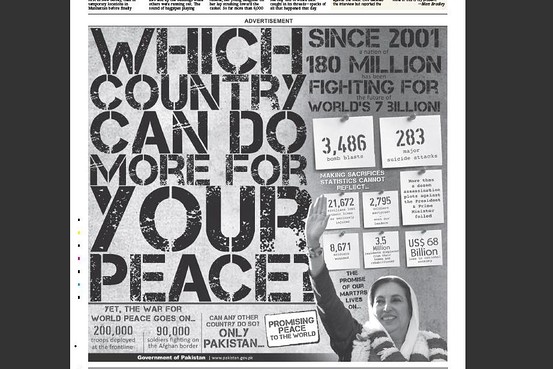
Pakistan has taken out a half-page advertisement in The Wall Street Journal to coincide with the 10th anniversary of the Sept. 11 attacks in an attempt to shift what Islamabad feels is an anti-Pakistan narrative in the American media.

“Which country can do more for your peace?” the ad asks, sitting below a story on page A10 of the U.S. Journal’s Saturday/Sunday edition titled “When the Towers Came Down.”

“Since 2001 a nation of 180 million has been fighting for the future of world’s 7 billion!” it continues.”Can any other country do so? Only Pakistan
Promising peace to the world.”

Pakistani army and civilian officials complain that in the U.S. their country is often portrayed in the media and by members of Congress as a double-dealing ally that takes billions of dollars in U.S. aid but secretly helps the Taliban kill U.S. soldiers.

Pakistan’s leaders have been publicly trying to promote a competing narrative, but with almost no success.

In their telling, Pakistan did foster Islamist militant groups, first to fight Soviet troops in Afghanistan and then Indian soldiers in Kashmir. Pakistan military and civilian officials point out the U.S. was all for the Mujahideen war against Moscow in the 1980s. But in the past decade, Pakistan’s army has severed its links with militants, who have unleashed a bloody war against Pakistan’s army and government, according to Islamabad’s narrative.

Pakistani officials regularly tell this version of events in public speechs and to visiting U.S. officials and journalists. The military has even made a local TV drama featuring real soldiers to publicize its sacrifices in the war against militants.

The advert in the Journal seeks to give the message to a wider audience.

To underline its point, the ad carries a picture of Benazir Bhutto, Pakistan’s former prime minister who was assassinated by Islamist militants in 2007, next to the slogan, “The promise of our martyrs lives on
”

The ad cites a series of statistics. Almost 22,000 Pakistani civilians have died or been seriously injured in the fight against terrorism, the ad said. The army has lost almost 3,000 soldiers. More than 3.5 million people have been displaced by the fighting and the damage to the economy over the past decade is estimated at $68 billion, it added.

People will quibble with these statistics from a country where reporters often find it difficult to get basic data.

It was not clear whether the ad was carried in other U.S. publications. Pakistan’s government also tried to place it in the New York Times. The Times asked for “more clarity in the ad about who was placing it,” according to a spokeswoman for the newspaper. The Times did not hear back from the government and so has not yet run the ad, she said.

The ad as printed in the Journal carries a line at the bottom in small font saying “Government of Pakistan” next to a web address for the government. A spokeswoman for the Journal declined to comment.

Will the advertisement be effective in shifting the narrative? It’s unlikely.

The points raised are all fair enough. Pakistan has been hammered by suicide bombings by Islamist militants against civilian and army targets. It’s perhaps fair to say that many in the U.S. have failed to recognize the changes in Pakistan, especially in the past few years, that have led to its domestic war against militancy.

Still, many in the U.S. and elsewhere are likely to shrug their shoulders. In the U.S. and India, where Pakistani-based militants are viewed as a daily threat to security, many politicians, analysts and ordinary citizens blame Pakistan for failing to stop the export of terrorism and being selective in which Islamist militant groups they go after.

Pakistan has waged a war against homegrown Pakistan Taliban militants for the past three years, suffering large casualties. But U.S. defense officials say publicly they are concerned that the country continues to protect Afghan Taliban fighters that don’t attack inside Pakistan. It’s these fighters who use Pakistan soil as a base from which to launch attacks on U.S. forces in Afghanistan, they say.

Some U.S. officials say they believe Pakistan’s argument that it’s too stretched fighting the Pakistan Taliban to open new fronts in its war against militants. But many members of Congress and U.S. defense officials say Islamabad wants to keep ties strong with the Afghan Taliban so it can influence politics over the border once the U.S. pulls out its troops by 2014.

India blames Pakistan for failing to crack down on Lashkar-e-Taiba, the militant group which carried out the attacks on Mumbai in 2008, killing over 160 people, and has hit Indian targets in Afghanistan. LET has not carried out any attacks against the Pakistan state.

Ten Years After 9/11, We’re Still in the Dark

By Omar S. Ashmawy for The Washington Post

I joined the U.S. military after law school to help my country defend itself against the threat of Islamic extremism. My final assignment in my eight years in the Air Forcewas as a war crimes prosecutor in Guantanamo Bay, Cuba. With access to our nation’s most intimate secrets, I shuttled between Guantanamo and the Pentagon from the summer of 2007 to the winter of 2009. I learned many lessons, but on the anniversary of the Sept. 11 attacks, the most important lesson I can share is the most alarming: After so many years and so much sacrifice, nothing has changed.

Our greatest weakness remains today what it was 10 years ago, and what it was eight years before that, when the World Trade Center was bombed in 1993. We don’t understand Islam or Arab culture, and that ignorance prevents us from accurately predicting our relationship with Arab and Muslim countries and identifying our enemies.

From our government to the front lines, individuals are making decisions based on inaccurate, biased information. The White House’s August announcement on combating radical Islam acknowledged this reality. Our soldiers, agents and analysts don’t have the facts they need to make informed decisions about whom to trust, what to believe and how to keep the threat at bay.

Whether it’s the FBI recommending its agents read books by a known anti-Muslim author, misplaced anxiety over “sharia law,” the near absence of linguistic and cultural training in the military, or our government’s collective surprise at the Arab Spring, the effect of what we don’t know reverberates through U.S. policy. But the result is the same: We are caught off guard by events we should have anticipated or, worse, we confuse our enemy’s propaganda with knowledge.

As an American Muslim born and raised in New Jersey, I am frustrated that America still struggles with the basics: We don’t understand the difference between Islam and Islamic extremism, or that Arab culture is not the same as the religion. We divide Muslims into secularists and extremists and can’t tell the devout from the radical, the sympathizer from the opportunist.

Two of the most enduring examples are the military commissions and Guantanamo Bay — intractable problems that will never be resolved to anyone’s satisfaction. They’re once and future disasters built by people who should have known better — people America trusted to know more. Both were operated and sustained by individuals so uninformed of our enemy’s religion, language and culture that they could not accurately process the information available to them. Attorneys couldn’t tell good cases from bad ones, and the agents assigned to the commissions didn’t know what questions to ask detainees.

I saw it firsthand. From lawyers to interrogators, the vacuum was enormous. It filled Guantanamo Bay with men who did not need to be there and barred their release. It was fuel on a fire set by a legal process that initially conflated the mutually exclusive missions of intelligence-gathering and the rendering of justice. The absence of knowledge and leadership permitted the worst of what happened — reports of the abuse of prisoners, the desecration of holy books, the legal pantomimes — and continues to prevent a resolution to the human drama playing out on that island.

We cannot close Guantanamo because the trials of the detainees who remain would be tainted by evidence from botched interrogations and because the men there are now radicalized — the result of decisions based in an ignorance tantamount to racism.

This ignorance is a degenerative disease that debilitates our efforts to protect our nation. It was tempting to think that with Osama bin Laden’s death we could end this conflict, if only we could end the wars in Iraq and Afghanistan. While those wars must be concluded, neither their end nor the death of any individual terrorist will secure us against another attack by Islamic extremists. We’re not fighting a single enemy but a decentralized patchwork of groups that adhere to the same twisted, bankrupt ideology. Whether it is Jemaah Islamiah in Southeast Asia or al-Shabab in Somalia, our enemies are motivated and wait — patiently — until we forget.

As we honor the past, we must also commit to the future. This commitment must include an expectation that all Americans responsible for protecting us possess the education and knowledge to do so and be committed to accuracy and learning. A good place to start would be language and culture training for our soldiers, and training in Islam and Arab culture and history for policymakers. Similar education should be made available to local law enforcement and community leaders. At the height of the Cold War, we encouraged our best and brightest to study Russian language and history. Ten years after Sept. 11, this is a basic but necessary step. Ignorance is our vulnerability, and we must begin somewhere. Those individuals we remember Sunday deserve better. We all do.

The writer is a former Air Force officer and war crimes prosecutor. He prosecuted U.S. v. Hamdan and U.S. v. Al Bahlul, the first two litigated cases to be brought before a military tribunal since the Nuremberg trials after World War II.

Decade After 9/11, Afghans Languish in Pakistan

By Qasim Nauman and Rebecca Conway for Reuters

When Ghulum Nabi’s father heard U.S.-backed troops toppled Afghanistan’s Taliban after the September 11, 2001, attacks, he rushed to their family home in an Afghan refugee camp in Pakistan to spread the news.

Perhaps, one day they could all return to a peaceful and prosperous Afghanistan supported by a Western superpower.

After 10 years of U.S.-led efforts to pacify one of the world’s most turbulent countries, Afghan refugees in Pakistan have little hope for stability in their homeland.

“I grew up here and Pakistan is my country. When my father pushes me to go back to visit, I end up having a fight with him. I’m never going to live there. I want to get Pakistani nationality. This is my home,” said Nabi, 22, who runs a crockery shop.

“It doesn’t matter if it is America or anyone else trying to watch over Afghanistan. I will still be looking around to see if anyone is pointing a gun at me.”

Afghan President Hamid Karzai would welcome a return of the millions of Afghans living in Pakistan.

It would be a vote of confidence in his administration, which faces many problems, from widespread allegations of state corruption, to a resilient Taliban.

SOVIET INVASION TRIGGERED LIFE OF UNCERTAINTY

Many of the refugees are skilled labourers who could boost reconstruction and help revive a weak economy if they return. But it’s unlikely to happen.

Most of the refugees in Pakistan arrived after the Soviet invasion of Afghanistan in 1979. The conflict that followed consumed their homeland. After the mujahideen warriors defeated the Russians, warlords turned on each other and tore Afghanistan apart.

Many refugees fear a repeat of that chaos as a U.S. troop withdrawal looms.

Some would like to go home but feel they can’t. Others regard Pakistan as home despite its many disadvantages. Without proper Pakistani identification cards, Afghans can’t open bank accounts or buy or lease property.

Many are openly mistreated by Pakistanis who have little fear of being held to account.

On August 14, the anniversary of Pakistan’s independence, Saeed Anwar’s landlord showed up with three men armed with AK-47 assault rifles at his clothing shop at a busy bazaar in the city of Haripur, home to 80,000 Afghan refugees who live in camps.

“They threw around my merchandise and said I need to pay them a 300,000 Pakistani rupees ($3,450) advance on the rent. I had already paid the rent,” said Anwar, wearing traditional, loose Pakistani trousers.

“I went to the police to register a case. But when they see a dispute between a Pakistani and an Afghan, they automatically assume the Afghan has done something wrong.”

Still, many Afghans believe its wiser, and safer, to just accept the frequent humiliation than return to a homeland still shattered, despite a long U.S.-led military campaign against militancy and billions of dollars in Western aid.

Afghans — from elders who vividly remember the first Soviet gunship helicopters in Afghanistan, to teenagers who have only visited a few times — work for Pakistanis as welders or carpenters and tailors in Haripur and other cities.

Most of them prefer to run their own small businesses, from food carts to car dealerships. It’s the only sense of independence they have in the camps which consist of small cement and mud housing units near a reservoir.

The elders have set up a jirga, or tribal gathering, to settle internal disputes, as is done in much of Afghanistan. Cricket games are the only form of entertainment and leisure activity for most youths.

Two years ago Pakistan agreed to let displaced Afghans stay until the end of 2012, after a resurgence of militant violence along the Pakistan-Afghanistan border hindered repatriation.

Still, people like Sherullah, whose nine children were born in Pakistan, feel vulnerable. What if Pakistan asks them to leave one day?

“There is a lot of confusion. If there’s one thing I want, it’s for this confusion to go away, for us to know if we will be staying or not,” said Sherullah, who was cutting women’s clothing in his tailor shop.

“There are many people living here that can afford to build a proper house but don’t want to. They think ‘what if next year we are told to leave?’. So they continue to live in mud houses.”

Aside from 1.7 million officially registered Afghans in Pakistan, there are an additional 800,000 with no documentation.

According to the United Nations, Pakistan is home to the world’s largest refugee population, mostly Afghans, who strain the country’s troubled economy.

Pakistan would like to repatriate them.

There are, however, few incentives for refugees to head back to Afghanistan. So life in camps may drag on for many years.

Even though the U.S. disengagement is gradual, it brings back painful memories of what was widely seen as American abandonment of Afghanistan after the Soviet exit in 1989. Warlords soon took over and bloodshed returned.

Haji Aslam, 65, an elder in one of the camps, has seen conflict in Afghanistan over the last 30 years — from the battlefields where he fought the Soviets to what he sees today on his television screen. He is betting on the Taliban to prevail once the Americans leave.

“Even if just 10 Taliban show up, the Afghan government will flee Kabul,” said Aslam, a man with a white beard wearing a traditional flat Afghan cap. “In Pakistan, I am at peace. I know my children are safe.”

Jinnah’s Pakistan

By Ziyad Faisal for The Friday Times

When a suicide-bomber targets a market-place, a rabid Islamist kills a figure who is not pious enough or Independence Day comes, we are reminded of the psychosis of the Pakistani state. We are reminded that in addition to shaky material foundations, the Pakistani state rests upon highly flimsy and contested ideological grounds. At such times, there is almost always a chorus from the literate urban middle-classes of the country: they want “Jinnah’s Pakistan”. For the more conservative sections of our urban middle-class, the Pakistan they long for is the “laboratory” which Jinnah claimed he sought, to implement Islamic values. For the more liberal sections of the urban middle-class, the Pakistan they want was described by a secular Jinnah in his speech on August 11, 1947. The more perceptive reader will already realize that while every historical figure can be interpreted in a wide variety of ways, if a single leader can be held up by secularists, conservatives, nationalists and Islamists alike, perhaps the leader himself was not so sure about certain things.

But what exactly was Mr Jinnah’s own vision for Pakistan, and how did it interact with the nature of the Pakistan Movement and the realities of post-1947 Pakistan? To understand the yearning for “Quaid-e-Azam ka Pakistan”, one must look at the founding myths of Pakistan and Jinnah’s place therein.

Almost any child who goes to school in Pakistan learns a certain story. The story involves a young man, burning the proverbial midnight oil as he studied at night, trying to shield the light he was using with cardboard sheets, so as not to disturb his siblings. When asked by his sister as to why he would not simply go to bed, he said something along the lines of how important this hard work was, for him to become a great man. The Pakistani reader will recognize immediately the young man we are talking about: the Quaid-e-Azam, Muhammad Ali Jinnah.

Most modern nation-states actively propagate their foundational myths: based on a kernel of truth but embellished greatly with fantasy, exaggeration and historical omissions. It is only natural that such myths centre around the integrity, heroism or ambition of one or more “founding fathers” who were instrumental in creating the state it in its modern, institutional form. So, for instance, Israel has its Bar Kochba and its Ben Gurion. Turkey has its Attaturk leading the fight for independence from barren Anatolia. The United States has its George Washington, who supposedly would not lie to his father about cutting a cherry tree, even as a boy. Latin American countries have their Simon Bolivar, Italy has its Garibaldi, Ireland has its Michael Collins. The Indian state has its own pantheon of founding fathers, from Asoka to the Rani of Jhansi, all the way down to Gandhi and Subhas Chandra Bose. Even Saudi Arabia has its epic tale of Bedouin raiders from the sand-dunes of Najd turning into majestic kings and defenders of the Holy Kaabah.

As for the foundational myths of Pakistan, let us bear in mind the following: every modern nation-state is ultimately a very artificial social construct, and the more artificial a state, the more artificial its founding myths.

And what is the Pakistani child taught about the founding fathers of the country? Well, if we put aside the valuable nation-building efforts of Muhammad bin Qasim and Mahmud of Ghazni, what we are left with is essentially Allama Muhammad Iqbal and, of course, the Quaid-e-Azam. Iqbal, as a brilliant poet and an aspiring philosopher, who dreamt of Pakistan. Mr Jinnah, the great political leader who brought this vision to fruition. Such is the clichéd narrative we are given.

In that famous story about the hard-working youthful Jinnah, the Pakistani student is being taught that a boy in his mid-to-late teens had already within him a young Quaid-e-Azam: the Great Leader. He would go on to study the legal system of the British colonialists, gain the respect of the British and the adulation of the Muslim masses of South Asia and eventually this epic tale culminates in the heroic Muslim League’s achievements of Partition and its accompanying bloodbath.

The historical record suggests that the budding Leader was not exactly convinced about the need for communal Muslim politics until at least the early 1920s. He was, after all, the chief architect of the Lucknow Pact of 1916: the “ambassador of Hindu-Muslim unity” as Sarojni Naidu famously described him. Even as late as 1946, Jinnah as a practical politician could entertain the possibility of some sort of compromise with the Congress leadership and the British. The Muslim League leadership would have been satisfied with adequate guarantees of limited autonomy for Muslim-majority regions of Punjab, Sindh and Bengal. The Pashtun leaders of the north-western Frontier, of course, were not to be taken on board, because their loyalty to the Congress amounted to some sort of treachery. As for the Baloch, one imagines, it was assumed that they need not be considered in any calculations: they would somehow automatically be convinced to join the new nation-state and forget centuries of distinct history.

The Muslim League itself, founded in 1905-06 by disinherited and disgruntled members of the former Muslim elite of South Asia, was not committed to mass politics or independence from British rule – and certainly not an independent Pakistan. Unlike the populist appeals of Congress leaders like Gandhi, Nehru and others, the Muslim League’s political programme was for a long time directed towards the Aligarh-educated ex-nobility among Muslims. In the 1940s, were it not for a last-minute alliance with Muslim feudal lords in Punjab and some urban elements from Sindh, the Muslim League could never have mustered the political resources to make their demand for an independent Pakistan into a reality.

Conservative nationalists and Islamists in Pakistan are likely to be disappointed by the real Mr Jinnah. He was an intelligent, British-educated barrister, and had little time for the discourse of village mullahs. Steeped in the traditions of British liberalism, Jinnah could bring only a tiny minority of the Muslim clergy to his side even in the 1940s. It is obvious that he was looking for some form of constitutional liberal democracy, no matter how inspiring the pan-Islamic yearnings of Allama Iqbal might have been.

But perhaps our secular liberals are even more likely to be disappointed, notwithstanding the fact that Mr Jinnah laid out a set of principles for a secular Pakistani state in his speech to our first Constituent Assembly, on the 11th of August, 1947. To quote his memorable words on that occasion:

“You are free; you are free to go to your temples, you are free to go to your mosques or to any other place or worship in this State of Pakistan. You may belong to any religion or caste or creed that has nothing to do with the business of the State. ”

While these are admirable sentiments, perhaps we can be forgiven for pointing out the glaring contradiction here. If a citizen’s religion is not the business of the state, how does one explain the creation of Pakistan as a separate state? If it were not differences in religion with the Hindus and other religious communities of India, what else was it that motivated the Muslim League to demand Pakistan?

Allow me go one step further and remind the reader of the many occasions on which Mr Jinnah invoked Islamic rhetoric in his various speeches to justify the idea of Pakistan. With apologies beforehand, allow me to recall that it was the same Mr Jinnah who would not accept his daughter marrying a non-Muslim man, even though he himself had married a non-Muslim woman. One is reminded of the typical mindset of the contemporary Pakistani Muslim father or brother.

For years, Mr Jinnah brilliantly argued for federal autonomy in Muslim-majority provinces…until Partition happened and the Pashtuns, Bengalis, Baloch and other nationalities within Pakistan demanded the same autonomy. For years, Mr Jinnah pointed out the distinct cultural identity of South Asian Muslims…until Partition happened and Bengalis asked for their language to be given the status of a national language. Urdu and Urdu alone, Mr Jinnah firmly reminded them.

I understand that quite a few readers ought to be exasperated by now. What am I trying to say? What exactly was Muhammad Ali Jinnah? Was he socially liberal or conservative? Was he secular or not? What future did he envision for Pakistan?

The historical record shows that Mr Jinnah was himself has given us adequate arguments for just about any side we choose. Despite the personal integrity, intelligence and political skill of Mr Jinnah, it has to be recognized that the Muslim League was not exactly what it claimed to be. It was supposed to speak for the Muslims of South Asia, but its actual representative credentials were not very credible, even in the “moth-eaten and truncated” (to quote Mr Jinnah) Pakistan of 1947.

To limit ourselves to an imagined version of what Mr Jinnah wanted would mean limiting our political vision and perhaps the very frontiers of our political morality.

What sort of Pakistan does the hari from Sindh want? What sort of Pakistan does the silenced rape victim want? What sort of Pakistan does the tortured body of the young Baloch student want? What sort of Pakistan does the textile worker from Faisalabad want, considering he is paid some 6000 rupees a month? What sort of Pakistan does the terrified Ahmadi want? What sort of Pakistan do you want? What sort of Pakistan do I want?

You see, perhaps the real question is not what our founding father(s) wanted, but what today’s unfortunate Pakistanis want.

Perhaps it is time to consider a possibility: that the laboratory for implementing Islamic teachings was created, and the experiment went horribly wrong. And perhaps it is time to consider another possibility: given the many different interpretations which Mr Jinnah left himself open to, might we be forgiven for concluding that this is it? That this, where we live today, is Jinnah’s Pakistan in all its glory?

Al Qaeda’s Roots Grow Deeper in Pakistan’

As Reported in Zee News

Ten years after the 9/11 terrorist attacks and the subsequent “war on terror” launched by United Stated-led forces against al Qaeda, the terrorist outfit “continues to pose a serious threat to the world as it keeps surviving and thriving mainly on the Pakistan-Afghanistan tribal belt”, a senior Pakistani journalist and author has said.

“In these rugged areas, it [al Qaeda] has established an effective jihadi network that increasingly exploits its Pakistani affiliates to carry on the global jihadi agenda of Osama bin Laden, despite his May 02 killing in a United States military raid in Abbottabad in Pakistan,” Amir Mir wrote in a piece for Asia Times Online.

Until recently, analysts have been mostly focusing on the dangers posed by the growing Talibanisation of Pakistan, he noted.

“Yet, it has now become abundantly clear that the time has come to pay more attention to the bigger dangers posed by the Pakistanisation of al Qaeda,” he added.

Mir, who has written several books on the subject of militant Islam and terrorism, the latest being ‘The Bhutto murder trail: From Waziristan to GHQ’, said that the al Qaeda leadership’s choice of using the FATA region, especially the North and South Waziristan tribal agencies as their hideout, has enabled the terror outfit to build a new power base, separate from Afghanistan.

“As a result, despite Pakistan’s extensive contribution to the “war on terror”, many questions persist about the extent to which al Qaeda and its allied groups are operating within Pakistan,” he observed.

He said that al Qaeda’s success in forging close ties to Pakistani jihadi groups has given it an increasingly secure haven in Pakistan’s mountainous tribal areas, which have “replaced Afghanistan as the key training and indoctrination grounds for al Qaeda recruits to be used in operations abroad and for training those indoctrinated and radicalised elsewhere.”

The journalist also said it appears that al Qaeda not only remains in business in its traditional stronghold in the Waziristan tribal region, it has “also clearly advanced to the urban areas in all four provinces of Pakistan”.

“This is confirmed by the growing belief of the Barack Obama administration that if there is one country that matters most to the future of al Qaeda, it is Pakistan,” he added.

No Evidence Pakistan Helped Osama Bin Laden: U.S. Security Adviser

As Reported by The International Business Times

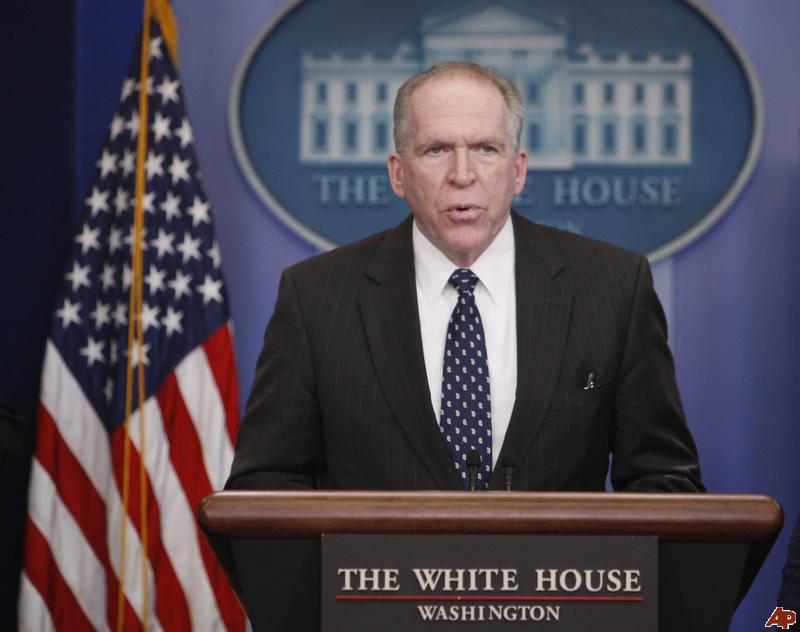
There is no evidence that Pakistan government officials helped and protected Osama bin Laden, claimed John Brennan, Deputy National Security adviser and President Barack Obama’s chief counter-terrorism adviser.

Brennan, speaking to reporters at a morning briefing said “I have not seen anything that the Pakistanis were aiding his refuge there.”

In May, Osama was found and killed by U.S. Navy SEALS in a large compound in the town of Abbottabad in northern Pakistan, near the capital Islamabad. Since that time, rumors have swirled that Pakistani intelligence officials had been aiding the former al-Qaeda terror chief as well as many other militants.

Brennan also said that based on examination of documents and data found and seized at Osama’s compound, it became apparent that bin Laden was “a little out of touch about how debilitated his organization was” after fighting for almost a decade against the U.S.

“It did reveal an organization in distress,” Brennan said.

Brennan also reportedly praised Pakistan’s offensive against terrorist groups operating the country and that Washington has a close working relationship with Islamabad in this joint effort.

He cited the recent arrest in Pakistan of Younis al-Mauritani, a senior al-Qaeda official, is proof that Islamabad is taking its responsibilities seriously.

He noted that al-Qaeda “has taken it on the chin” and has been “degraded significantly over the past couple of years.”

Brennan’s latest comments dramatically contradict assertions he made in May (just after the killing of Osama) when he declared that it was “inconceivable” that bin Laden did not have the support of officials within Pakistan.

A Monster Roaming The World

By Paul Mcgeough for The City Weekly
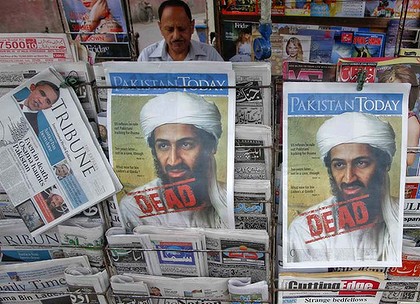
Search for a firm footing in Pakistan and there is none – all is quicksand 
 strategically, politically, morally.

Here in south Asia, strategically sandwiched between failing Afghanistan and the China and India powerhouses, is a country in which journalists are abducted in the night by agents of the state and murdered; in which the only advance after a decade in which Washington has tried to buy friendship with cheques for more than $20 billion, is the expansion of Pakistan’s nuclear arsenal – which is on the verge of surpassing Britain’s as the fifth biggest in the world.

In Pakistan, a 50-year-old woman is sentenced to death on a dubious blasphemy charge – and politicians who dare to speak in her defence are gunned down; and a woman is gang-raped and paraded naked through her village on the orders of a local council, over bogus claims that her 12-year-old brother has offended a 20-year-old woman from the clan of the men who defiled her.

But that’s village life. In the leafy garrison town of Abbottabad, an hour’s drive north of Islamabad, Osama bin Laden, mastermind of the attacks of September 11, 2001, was able to hide in plain sight for years. The location of his fortified bunker, a stone’s throw from a prestigious military academy, made it harder to give any credence to the generals’ repeated denials that significant elements of Pakistan’s extensive security apparatus sheltered the al-Qaeda chief and continue to give succour to the Taliban and other insurgency and terrorist movements.

In the south-west, in the wilds of provincial Baluchistan, there have been 150 ”kill and dump” operations this year. Most of the victims are Baluch nationalist rebels. Their killers are the Inter-Services Intelligence agency (ISI) and other elements of Pakistan’s national security forces – driven to brutality by a belief, which could be correct, that Pakistan’s arch foe, India, stirs the local nationalist pot. In turn, the Baluch nationalists are accused of running their own death squads – their victims are Punjabi ”settlers”, government workers brought in from other parts of the country.

Baluchistan is half Pashtun, which also makes it a sanctuary for the Taliban from adjoining Afghanistan, where Washington and the world still struggle, with little success, to impose a semblance of democracy on the bones of a fracturing, failing state. Here then is another of the ironies that puts a serious question mark over the bona fides of the Pakistani security forces: the leadership of the Afghanistan Taliban sequesters in Quetta, the provincial capital of Baluchistan, but the various Pakistani security services are so busy putting the Baluch nationalists through the mincer they don’t have time to take down the Taliban command-and-control centre. Instead, they reportedly socialise with the Taliban and sit in on their strategy meetings.

West from Baluchistan is the sprawling port city of Karachi, where the spiralling death toll in renewed ethnic turf-wars gives raw meaning to what local novelist Kamila Shamsie broaches obliquely, recounting how the city ”winks” at her. “Yes, the city said, I am a breeding ground for monsters, ” she writes, “but don’t think that is the full measure of what I am.”

This drab, chaotic home to 18 million people who account for 65 per cent of Pakistan’s economy is being carved up by bullets that this year have accounted for as many as 1000 ”wrong place, wrong time” deaths as gunmen randomly select their targets – sending messages to whole communities, not the individuals with whose blood they paint the rough pavements. As the suburbs seethe, police do little, because they are cowed by the systematic elimination of those in their ranks who intervened in the last iteration of these ethnic wars. Provincial and federal governments and the security forces only wring their hands.

In Karachi everyone lies. No one denies turf wars are being waged. They simply blame everyone else – all the political parties deny any links to the militias that prosecute their bloody agendas and to the crime, drug and land-development mafias that prosper in their wake. And the city’s once-dominant Urdu-speaking Mohajirs fight to maintain their control of corrupted city politics, amid an influx of Pashtuns fleeing upheavals along the Afghan border.

“Tension rises, we see killings and then scores must be settled,” an adviser to the provincial governor says. “We are at war – the political parties say they are not involved, but the mafias take shelter from the parties as they exploit the situation.”

In Islamabad, enter any of the city’s newsrooms, and see fear in the eyes of journalists who risk death and torture for going about assignments. Consider the words of their Karachi colleague Madiha Sattar – “a growth of intolerance has forged an extreme, murderous antipathy to freedom of expression.”

Most shocking in this campaign of fear and intimidation against one of the pillars of democracy was the disappearance in late May of Syed Saleem Shahzad, an investigative reporter for the respected, Hong Kong-based Asia Times Online. Two days after his abduction, Shahzad’s battered body was found at Mandi Bahauddin, 130 kilometres south-east of the capital. The reporter left detailed accounts of the threats he had received from the ISI; in Washington, senior officials unflinchingly confirming that Shahzad’s death had been ”sanctioned” by the Pakistani government.

Umar Cheema might just as easily have been their victim. Behind a door marked ”Investigation Cell” off a basement corridor in the Islamabad offices of The News, the 34-year-old father of two explains that the shock in his colleague Saleem Shahzad’s murder was a realisation it might just as easily have been him.

As Cheema drove home from a party in the early hours during Ramadan last year, 12 men who identified themselves as police commandos abducted him, he says. Informing him first that he was a suspect in a killing, they pulled a bag over his head and hauled him away.

“They took me to a building where the leader stripped off my clothes. Then I was ordered to lie on the floor and they beat me on the back and shoulders for 20 or 25 minutes with leather straps and wooden canes.

“I was writing about corruption in the government and the lack of accountability in the military and intelligence agencies – they said they were beating me because of my reporting. Then they shaved my head and eyebrows – that’s what is done to thieves in rural areas to humiliate them.

“Shahzad’s death left me speechless,” he says. “I was the second last victim before they took him. So I felt very much that this was a message for me – it was very, very personal.”

In Islamabad, the government of Prime Minister Yousaf Gillani is as overwhelmed as it is complicit in the nation’s failings. The economy is in crisis and the government has ceded control of more than half the country to the military or to extremist militias. “None of the cogs of state mesh to make it do what must be done,” Human Rights Commission of Pakistan’s Kamran Arif said.

Just south of Islamabad is Rawalpindi, a more typical Asian city than the sanitised and empty boulevards of Islamabad. As home and headquarters to the men and institutions that comprise Pakistan’s military and intelligence establishment, this is the centre of absolute power in Pakistan. And it is here that a deep-fried sense of humiliation over the American raid to kill Osama bin Laden, in May this year, is felt most acutely.

“After the bin Laden raid, it’s a question of the survival of the state,” the defence analyst and director of the South Asian Strategic Stability Institute, Maria Sultan, says. “The problem now is that by this very public humiliation, the US has lost its biggest supporter – it’s not the capability of the Pakistani military that is affected, it’s its credibility.”

A close reading of ”Getting Bin Laden”, The New Yorker’s inside account of the May 2 raid, reveals the mission was not just a single US incursion that managed to evade Pakistan’s air defences. On the night, there were effectively three separate American missions, none of which was detected by a military-security complex that demands indulgence by the people of Pakistan on the grounds that it is their only protection from the Indian hordes.

Pakistan’s generals faced a grim choice – they had to admit to deceiving the world in harbouring bin Laden, or to incompetence by not knowing he was lounging in their backyard. So supine were they in opting to plead incompetence there were fears of a mutiny in the middle ranks of the security services.

The US signal to the world of just how much it could not trust its south Asian ally came hard on the heels of serial embarrassments at the hands of the Taliban and other militant groups in Pakistan.

There have been a series of militant attacks on the most secure and sensitive defence establishments. The latest, which some observers concluded could not have been undertaken without inside help, saw a 10-man assault team storm the Mehran naval aviation base in Karachi. It took hundreds of Pakistani navy commandos, marines and paramilitaries to retake the base, but not before two aircraft were destroyed, hostages taken and the base had been occupied for the best part of a day.

But it takes a discerning Pakistani general to differentiate between militants – some are ”strategic assets” of the security apparatus and the generals refuse to go after them.

Dr Ayesha Agha, whose military and political commentaries appear in Pakistan’s Dawn newspaper, explains: “The military depends on these ‘assets’ – they are a cost-effective means to fighting wars that the Pakistani military wants to fight in India and Afghanistan.” Extrajudicial killings by the military now are counted in the hundreds.

When men in uniform were filmed recently murdering a detainee, the reckoning in human rights circles was that far from being a lapse of judgment, the recording had been allowed in the knowledge that its distribution on the internet would serve as a useful warning to the wider community.

A Karachi taxi driver becomes excited as he ferries us from the airport to a downtown hotel – “Pakistan lovely country,” he bellows. “Terrorism? No, no, no.”

But a single graphic in a 200-page study of Pakistan, published in May by the Washington-based Centre for Strategic and International Studies, reveals an impossible security challenge. Last year alone, 2113 terrorist attacks, 369 clashes between the security services and militants, 260 operational attacks by the security forces, 135 US drone attacks, 69 border clashes, 233 bouts of ethno-political violence and 214 inter-tribal clashes resulted in more than 10,000 dead and as many injured.

The death of bin Laden and the reported death of al-Qaeda’s new No. 2 figure, Atiyah Abd al-Rahman, in an American drone attack last week, are still being factored into a running debate among intelligence specialists on the extent to which al-Qaeda offshoots elsewhere in the world, especially the Yemen-based al-Qaeda in the Arabian Peninsula [AQAP], have taken the baton from the Pakistani organisation.

But a July study by the New America Foundation of 32 ”serious” jihadist terror plots against the West from 2004 to 2011, finds 53 per cent had operational or training links to jihadist groups in Pakistan – compared to just 6 per cent being linked to Yemen. And the rising tempo of the drone attacks has failed to dent the rising frequency of Pakistan-linked plots against the West, the study finds.

Implicit or explicit in any discussion on Pakistan’s volatile mix of militant violence and governmental chaos, is the level of anxiety around the world about the security of its nuclear arsenal. Confronted with claims such as that by bin Laden that acquiring a nuclear weapon was a ”religious duty” and the hope expressed by one of his lieutenants that such a weapon one day might be seized in Pakistan, officials in Islamabad invariably boast that all is tightly locked down.

But when we ask a Pakistani diplomat how secure were the weapons in the aftermath of the US mission to kill Osama bin Laden, he replies: “Less so, now that the Americans have revealed to the world that it is possible to sneak into Pakistan undetected, to take something that you really want.”

President Obama’s public appeal that Pakistan not become the world’s first ”nuclear-armed militant state” gives context to disclosures by The New Yorker’s Seymour Hersh of the existence of a US Special Operations rapid-response team which would be parachuted into Pakistan in the event of a nuclear crisis.

Rolf Mowatt-Larssen, a former director of intelligence and counter intelligence at the US Department of Energy, is boldest in setting out the fears of Washington, London and other capitals – some of which were disclosed without diplomatic varnish by Wikileaks last year.

Writing in Arms Control Today, Mowatt-Larssen, who served 20 years at the CIA, bills Pakistan as the most likely setting for terrorists bent on acquiring a nuclear device to co-opt a nuclear insider – of whom there are estimated to be as many as 70,000 in Pakistan.

“There is a lethal proximity between terrorists, extremists, and nuclear weapons insiders,” he writes. “Insiders have facilitated terrorist attacks. Suicide bombings have occurred at air force bases that reportedly serve as nuclear weapons storage sites. It is difficult to ignore such trends.

”Purely in actuarial terms, there is a strong possibility that bad apples in the nuclear establishment are willing to co-operate with outsiders for personal gain or out of sympathy for their cause.”

“Not possible,” says Maria Sultan. “About eight to 10,000 personnel working at the strategic level on security,” she says, ticking off seven or eight interlocking layers of complex security, the first of which she says would trip most intruders before they came within 80 kilometres of a nuclear facility. “The idea that a terrorist can walk in and get hold of a device is just not possible.”

Such is the bind in which Pakistanis find themselves. But if it is true feeble and corrupt civilian administrations make circumstances ripe for a military takeover, it is hardly surprising the generals have no respect for democratic fundamentals.

As revealed in one of the Wikileaks cables, Army chief General Ashfaq Parvez Kayani was ready to force President Asif Ali Zardari from office – save for the fact the general thought even less of Zardari’s likely civilian replacement. And historically, Washington has opted to connect with Pakistan through the military power of the generals, rather than the people power of the civilian leadership.

Bruce Riedel, a veteran CIA analyst, sets out the connections in Deadly Embrace: Pakistan, America and the Future of the Global Jihad. “
Richard Nixon turned a blind eye to the murder of hundreds of thousands of Bangladeshis to keep his friends in Pakistan’s army in power, a strategy that ultimately failed,” Riedel writes. “Ronald Reagan entertained Zia-ul-Haq even as Zia was giving succour to the Arab jihadists who would become al-Qaeda. George W. Bush allowed Pervez Musharraf to give the Afghan Taliban a sanctuary from which to kill American and NATO soldiers in Afghanistan.”

And in the judgment of Bushra Gohar, an elected MP from Pakistan’s troubled Swat Valley, Washington still prefers to deal with the military rather than the country’s civilian leadership. “That’s not a role that the military has under the constitution,” she says during a break in the business of the National Assembly in Islamabad. “There has been a democratic transition in this country and we expect the international community to support it.”

Power vacuums become ripe for exploitation, as was revealed with frightening clarity earlier this year when two of three elected figures who had dared to speak out against Pakistan’s draconian blasphemy laws were assassinated. In January, Punjab provincial governor Salman Taseer was gunned down by one of his state-provided security men; in March, the Minorities Minister and the only Christian in Gillani’s cabinet, Shahbaz Bhatti, died in a hail of gunfire as his car left his mother’s home in Islamabad.

Taseer’s killer confessed and became a national hero. His home is a shrine, he is garlanded with rose petals and, in the oddest twist of all, the young lawyers’ movement that effectively bundled Pervez Musharraf, the last dictator, from power in 2008, has taken the side of this cold-blooded murderer – not the principle for which his victim died.

A visitor leaves Pakistan wondering if anyone here speaks the truth. The dictators habitually resort to amping up religious parties – either to drown out secular ones that might be interested in the ideals of selfless democracy, or to further marginalise the country’s Shiia Muslim minority.

“And people like Musharraf have two faces,” Kamran Arif of the Human Rights Commission of Pakistan said. “He would say all the right things for the West and do just what he wanted to do at home.”

Some foreign analysts fall back on the seeming failure of Pakistan’s religious parties at the ballot box as a hopeful sign. But a sense of rising radicalisation, particularly in the military and the middle classes, suggests an asymmetric contest for control of a highly unstable society – the non-religious parties fight in the parliament, but the religious parties are street brawlers.

Sherry Rehman, the only elected figure in the country to defend the convicted blasphemer Aasia Bibi, makes the same point in explaining how that debate was lost. “The discourse shifted from the parliament to the street,” she says.

“We have to keep the agenda in the parliament, and not with the gun-toting thugs who make inflammatory speeches outside.”

Like the financial institutions in the 2008 global financial crisis, Pakistan is deemed by Washington to be ”too big to fail”. Between them, however, Washington and Islamabad have been unable in the past decade to make this relationship work – credibly or creditably.

Predictions of imminent collapse in Islamabad are exaggerated, but perhaps not overly so. “The government does not have the capacity to tackle any of the issues,” says the Human Rights Commission of Pakistan’s Arif. “Things will just keep getting bad 
 and I don’t discount the fact that we can fall into chaos.”

Like many other analysts, Bruce Riedel laboriously sets out the policy options by which Washington and Islamabad might work together to defeat the global jihadist movement – before he concludes that none is easy or guaranteed.

An adviser to several US administrations and now with the Brookings Institution, Riedel sees Pakistan under siege from a syndicate of radical terrorist groups unified by the notion that nuclear-armed Pakistan could be the extremist jihadist state they have never had.

“They want to hijack Pakistan and its weapons,” he says. Alluding to Islamabad’s role in creating a monster, as often as not with Washington’s sponsorship, he writes: “An extremely powerful jihadist Frankenstein is now roaming the world, with equally powerful protectors in Pakistani society, right up to the very top.

“Who cannot fear that the ‘long beards’ will prevail?”