Archive for the ‘ Afghanistan ’ Category

Analysts: China Unlikely to Replace US in Pakistan

By William Idle for The Voice of America
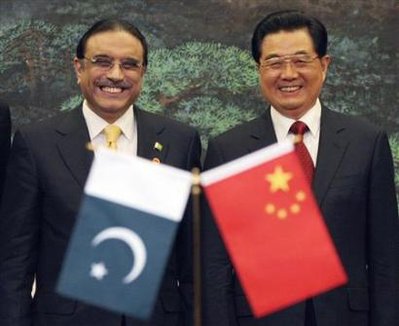
Pakistan’s President Asif Ali Zardari made a three-day visit to China this week at a time when relations between Islamabad and Beijing appear to be growing stronger. Regional analysts say that while China is of growing importance to Pakistan, it is unlikely to replace the U.S. role as a dominant influence there.

The opening ceremony at the first China Eurasia Expo was full of pomp and fanfare. Greeted with applause and smiles, Pakistan President Asif Ali Zardari ended his visit to China standing on stage next to the man who is widely expected to be the country’s next leader – Vice Premier Li Keqiang.

Ties have long been strong between Pakistan and China, a country Islamabad endearingly calls its “all-weather friend.” Mr. Zardari has visited China twice since the raid on Osama bin Laden’s compound – seven times since becoming president.

Some regional analysts say the recent deterioration of U.S.-Pakistan ties has pushed Pakistan into Beijing’s arms. They argue the combination of repeated drone strikes in Pakistani territory, the raid on Osama bin Laden’s compound, and suspension of $800-million in military American aid to Pakistan has brought Beijing and Islamabad closer together.

But regional analyst Tarique Niazi, an associate professor at the University of Wisconsin Eau Claire, says Mr. Zardari’s most recent visit to China is part of an ongoing effort by Pakistan to seek help to address its urgent needs and boost trade. And not necessarily a sign of shifting alliances.

“Pakistan is short of energy resources. It has about 4,000 megawatts of electrical shortage. So, China is helping Pakistan meet that shortage of electricity,” Niazi said.

One of the ways that China is doing that is by building massive hydropower projects in both Pakistan’s northern region of Gilgit-Baltistan and Pakistani-controlled Kashmir.

Niazi notes that representatives from both regions traveled to China this week with Mr. Zardari. Pakistan’s president is constantly focused on three things, he adds: investment, trade and economic development.

“President Zardari, especially I must say, that he is the first leader of Pakistan whose focus is almost entirely on economic development and developing business relationships with not only the public sector and the government sector of China, but the private sector also,” Niazi said.

When Mr. Zardari stepped into office, he pledged to visit China every three months – and for the most part has kept that promise. Since then, analysts say he has inked deals that will raise China’s overall investment in Pakistan from $20-billion to more than $50-billion.

China is eager to boost trade and investment in the region too.

At the opening ceremony of the China Eurasia Expo, Commerce Minister Chen Deming highlighted how China was reaching out to Asian and European countries at a time when the world economy has yet to recover from the global financial crisis.

Chen says China is moving faster in opening its western region and border areas to promote regional development. He says China is taking a big step forward to deepening development and cooperation between Asian and European countries.

And the benefits flow both ways.

“I would say that the best way to think about the current situation is that China is expanding in all directions, its power is growing, and it is looking north, south, east and west. And when it looks to Pakistan it sees potential in terms of access to Central Asia, Central Asia energy markets. It sees access to the Arabian Sea, the Indian Ocean,” said Daniel Markey, a senior fellow at the Council on Foreign Relations for India, Pakistan and South Asia.

Markey says that while Pakistan has been reaching out recently to China, in part to show Washington it has options, he is not convinced Beijing is interested in seeing a real rupture between Islamabad and Washington.

“My sense is that, yes, over the long term, China would like to be the dominant influence in Pakistan and really expand its influence throughout the region, which would probably mean a lesser influence for the United States. But, in the short time, China has been very comfortable essentially free-riding off of whatever stability and security the United States has provided and that they do not want to change,” Markey said.

He says one reason for that is because a rupture in ties between Pakistan and the United States could trickle over into relations between Beijing and Washington, and there the two already have enough to deal with as it is.
Eid ul-Fitr 2011

Pakistan’s 10 Years of Chaos

As Reported by Jennie Matthew for AFP

The 9/11 attacks that thrust Pakistan into the war on terror have brought the nuclear-armed state to its knees, fighting Islamist radicals at home and risking pariah status abroad.

It was already evening in Pakistan when television channels, recently deregulated by then president General Pervez Musharraf, began broadcasting the terrifying scenes from the twin towers in New York.

Few slept that night, realising immediately that the world had changed forever and that Pakistan was in the eye of the storm after spending years fostering extremist movements for its own ends.

“My immediate thought was ‘oh my God, more trouble coming onto Pakistan’,” said author Imtiaz Gul, who has written extensively about the subsequent war and its fallout at home.

“My fears have been borne out… The 9/11 events shocked Pakistan into an unprecedented crisis of insecurity,” he said.
It didn’t take long for Musharraf to weigh up conditions imposed by Washington and announce on September 19 that Pakistan would offer its airspace, territory and capabilities to help the United States defeat terrorism.

But as America put the finishing touches to its war plans, Pakistan desperately tried to persuade its Taliban allies in Afghanistan to give up Osama bin Laden and avert catastrophic military action, to no avail.

Within weeks, bin Laden, his future successor Ayman al-Zawahiri and Taliban leaders had fled the American invasion into Pakistan.

And there in the northwestern tribal belt, which no government has been able to subjugate, they found refuge among an extremist support network dating back to the 1990s jihad against the Soviets in Afghanistan.

They regrouped, forming bases used by the Taliban to direct the insurgency in Afghanistan and training camps for Al-Qaeda to brainwash young extremists from all over the world into carrying out terror attacks.

As a result, the last decade has made the only Muslim nuclear power more unstable than ever before in its bloody and chaotic 64-year existence.

The watershed came in July 2007 when government troops cleared out extremists preaching hate from the Red mosque in the heart of the capital Islamabad.

The militants declared war and in the past four years, around 500 bomb attacks have killed 4,600 people, according to an AFP tally.
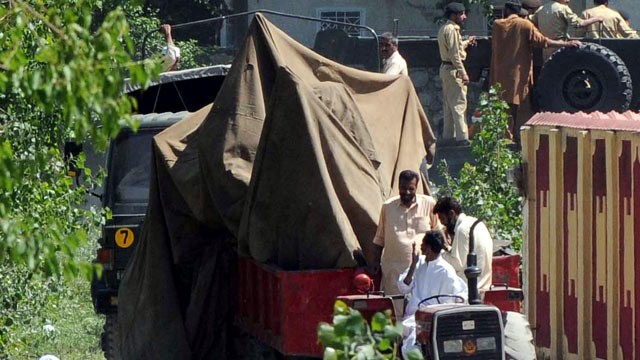
Just when it appeared things couldn’t get worse, this year the US discovered bin Laden living close to Pakistan’s equivalent of West Point, sending in Navy SEALs to kill him and sinking already fractured US-Pakistani relations.

“No doubt that this is absolutely the worst time for the country,” said Pakistani journalist Ahmed Rashid, whose book “Taliban” became an international bestseller after 9/11.

Rashid describes Pakistan as “completely isolated” by a war that “brought terrorism, sectarianism, a weakening of the state (and) much greater ethnic insurgencies” within the country.

But the blame — he says — is Pakistan’s for frittering away American aid money and refusing to realign its national security priorities.
“Politically, the most far-reaching mistake was the hosting and relaunching of the Afghan Taliban by the military and the intelligence agencies. That was enormously detrimental and led to the growth of the Pakistani Taliban.” Pakistan routinely proclaims to have sacrificed the most of any country fighting terror.

The government claims that 35,000 people have been killed. The army confirms the deaths of 3,019 soldiers since 2001 — more than the 2,684 Western soldiers to have died in Afghanistan.

More than three million people have been displaced by violence and counter-terrorism activities in Pakistan since 9/11, according to International Crisis Group figures released in 2010.

The army says 147,000 troops are deployed in the northwest compared to 35,000 in October 2001, a drastic reversal from the previous concentration along the Indian border in the east.

Yet extremism has increased. An average of one US drone strike every four days against militants in the tribal belt is raising fears that the campaign is recruiting a new generation of insurgents and suicide bombers.

Jihadist groups — fostered by Pakistan’s security establishment to fight India in Kashmir and maintain Afghanistan as a strategic asset — have splintered, and increasingly turned the guns on their old allies in the state.

“Pakistan is a lot less secure country now than 10 years ago, because it has become a battleground, an extension of the Afghan war. Pakistan is now facing a serious threat for its stability,” said journalist Zahid Hussain.

Yet the public discourse concentrates less on how to defeat militancy than debating the merits of the hugely unpopular US alliance.
Trust between Islamabad and Washington is at an all-time low. Cooperation between the CIA and Pakistan’s ISI spy agency is poor. Blame games on both sides are played out in the media.

Compounding the sense of crisis is the country’s economic meltdown. Pakistan says losses related to the war are $68 billion. Critics say the country has squandered up to $20 billion in aid given by the United States. “The biggest mistake was the failure to really address strategic issues in the economy. Pakistan could have changed its very weak economic structure at that point in time,” said Rashid.

Instead crippling inflation, rampant unemployment and an energy crisis with power cuts of up to 16 hours a day have left millions wondering how to fill the void.

C.I.A. Drone Is Said to Kill Al Qaeda’s No. 2

By Mark Mazzetti for The New York Times


A drone operated by the CIA killed Al Qaeda’s second-ranking figure in the mountains of Pakistan on Monday, American and Pakistani officials said Saturday, further damaging a terrorism network that appears significantly weakened since the death of Osama bin Laden in May.

An American official said that the drone strike killed Atiyah Abd al-Rahman, a Libyan who in the last year had taken over as Al Qaeda’s top operational planner. Mr. Rahman was in frequent contact with Bin Laden in the months before the terrorist leader was killed on May 2 by a Navy Seals team, intelligence officials have said.

American officials described Mr. Rahman’s death as particularly significant as compared with other high-ranking Qaeda operatives who have been killed, because he was one of a new generation of leaders that the network hoped would assume greater control after Bin Laden’s death.

Thousands of electronic files recovered at Bin Laden’s compound in Abbottabad, Pakistan, revealed that Bin Laden communicated frequently with Mr. Rahman. They also showed that Bin Laden relied on Mr. Rahman to get messages to other Qaeda leaders and to ensure that Bin Laden’s recorded communications were broadcast widely.

After Bin Laden was killed, Mr. Rahman became Al Qaeda’s No. 2 leader under Ayman al-Zawahri, who succeeded Bin Laden.

There were few details on Saturday about the strike that killed Mr. Rahman. In the months since Bin Laden’s death, the C.I.A. has maintained a barrage of drone missile strikes on mountainous redoubts in Pakistan, a bombing campaign that continues to strain America’s already turbulent relationship with Pakistan.

The C.I.A almost never consults Pakistani officials in advance of a drone strike, and a Pakistani government official said Saturday that the United States had told Pakistan’s government that Mr. Rahman had been the target of the strike only after the spy agency confirmed that he had been killed.

The drone strikes have been the Obama administration’s preferred means of hunting and killing operatives from Al Qaeda and its affiliate groups. Over the past year the United States has expanded the drone war to Yemen and Somalia.

Some top American officials have said publicly that they believe Al Qaeda is in its death throes, though many intelligence analysts are less certain, saying that the network built by Bin Laden has repeatedly shown an ability to regenerate.

Yet even as Qaeda affiliates in places like Yemen and North Africa continue to plot attacks against the West, most intelligence analysts believe that the remnants of Al Qaeda’s leadership in Pakistan have been weakened considerably. Mr. Rahman’s death is another significant blow to the group.

“Atiyah was at the top of Al Qaeda’s trusted core,” the American official said. “His combination of background, experience and abilities are unique in Al Qaeda — without question, they will not be easily replaced.”

The files captured in Abbottabad revealed, among other things, that Bin Laden and Mr. Rahman discussed brokering a deal with Pakistan: Al Qaeda would refrain from mounting attacks in the country in exchange for protection for Qaeda leaders hiding in Pakistan.

American officials said that they found no evidence that either of the men ever raised the idea directly with Pakistani officials, or that Pakistan’s government had any knowledge that Bin Laden was hiding in Abbottabad.

Mr. Rahman also served as Bin Laden’s liaison to Qaeda affiliates. Last year, American officials said, Mr. Rahman notified Bin Laden of a request by the leader of Al Qaeda’s affiliate in Yemen to install Anwar al-Awlaki, the radical American-born cleric, as the leader of the group in Yemen.

That group, known as Al Qaeda in the Arabian Peninsula, apparently thought Mr. Awlaki’s status as an Internet celebrity, for his popular video sermons, and his knowledge of the United States might help the group’s fund-raising efforts. But according to the electronic files in Abbottabad, Bin Laden told Mr. Rahman that the group’s leadership should remain unchanged.

After Bin Laden’s death, some intelligence officials saw a cadre of Libyan operatives as poised to assume greater control inside Al Qaeda, which at times has been fractured by cultural rivalries.

Libyan operatives like Mr. Rahman, they said, had long bristled at the leadership of an older generation, many of them Egyptian like Mr. Zawahri and Sheikh Saeed al-Masri.

Mr. Masri was killed last year by a C.I.A. missile, as were several Qaeda operations chiefs before him. The job has proved to be particularly deadly, American officials said, because the operations chief has had to transmit the guidance of Bin Laden and Mr. Zawahri to Qaeda operatives elsewhere, providing a way for the Americans to track him through electronic intercepts.

Mr. Rahman assumed the role after Mr. Masri’s death. Now that Mr. Rahman has died, American officials said it was unclear who would take over the job.

Pakistan’s Bitter, Little-Known Ethnic Rebellion

By Carlotta Gall for The New Times

A slim figure in a dark suit, Brahumdagh Bugti, 30, could pass for a banker in the streets of this sedate Swiss city. But in truth he is a resistance leader in exile, a player in an increasingly ugly independence war within Pakistan.

He has been on the run since 2006, when he narrowly escaped a Pakistani Army operation that killed his grandfather and dozens of his tribesmen in the southwestern province of Baluchistan. And since then, the government’s attempt to stamp out an uprising by the Baluch ethnic minority has only intensified, according to human rights organizations and Pakistani politicians.

The Baluch insurgency, which has gone on intermittently for decades, is often called Pakistan’s Dirty War, because of the rising numbers of people who have disappeared or have been killed on both sides. But it has received little attention internationally, in part because most eyes are turned toward the fight against the Taliban and Al Qaeda in Pakistan’s northwestern tribal areas.

Mr. Bugti insists that he is a political leader only, and that he is not taking a role in the armed uprising against the government. He was caught up in a deadly struggle between his grandfather, Nawab Akbar Khan Bugti, a former minister and a leader of the Bugti tribe, and Pakistan’s military leader at the time, Gen. Pervez Musharraf, over control of Baluchistan’s rich natural resources and the establishment of military bases in the province.

Baluch nationalists have never accepted being part of Pakistan and have fought in five uprisings since the country’s formation in 1948. Their demands range from greater control over Baluchistan’s gas and natural resources, fairer distribution of wealth (Baluchistan suffers from the lowest health, education and living standards in the country), to outright independence.

When the Pakistani Army shelled their ancestral home in Dera Bugti in December 2005, Mr. Bugti took to the hills with his grandfather, who was 80 and partly disabled, and they camped for months in mountain caves. Then, in August 2006, the military caught up with them. “I escaped, but he could not,” Mr. Bugti said.

From a hide-out two miles away, he watched the military assault, a furious three-day bombardment by attack jets, helicopter gunships and airborne troops. On the evening of the third day, the government triumphantly announced that Nawab Bugti had been killed. Thirty-two tribesmen died with him, Mr. Bugti said. The day after learning of his grandfather’s death, Mr. Bugti gathered his closest tribal leaders, and they urged him to leave and save himself, he said.

Pakistan and neighboring Iran were hostile to the Baluch, and the only place to go was Afghanistan, though it was consumed by the war with the Taliban. It took 19 days, on foot, to trek from a mountain base near Sibi to the Afghan border. But he had an armed tribal force and scouts with him and made the escape without incident, crossing into Afghanistan along a mountain trail, he said.

Although he had few contacts there, tribal links and traditions of hospitality assured him a welcome. He sent for his wife, his two children — a third was born in Afghanistan — and his mother, and after an elaborate dance to confuse government watchers, they crossed the border to join him days later.

Yet Afghanistan was not a safe haven. The family moved about 18 times over the next 18 months, and despite never going outside, he said, they became the target of repeated suicide bomb attacks by the Taliban and Qaeda militants, who they believe were sent by the Pakistani military. At least one bomb attack, in the upscale residential Kabul neighborhood of Wazir Akbar Khan, was specifically aimed at Mr. Bugti, a Western diplomat and an Afghan intelligence official said.

The Pakistani government has branded Mr. Bugti a terrorist, the leader of the militant Baluch Republican Army, and has made no secret of its desire to kill or capture him. It has repeatedly demanded that Afghanistan hand him over and has accused India of supporting Baluch rebels through its consulates in Afghanistan.

Pakistan’s remonstrations over Mr. Bugti became so insistent that the United States and other NATO members urged Afghanistan to move Mr. Bugti elsewhere, Western diplomats and Afghan officials said, speaking on condition of anonymity because of the politics involved. In October 2010, he and his family arrived in Switzerland and sought political asylum.

Though Mr. Bugti says he supports only peaceful political activism rather than armed resistance, he does share the rebels’ demand for independence for the Baluch. “I support the political struggle and the idea for liberation because the Baluch people demand it,” he said.

He formed a political party shortly after his grandfather’s death, distancing himself from the established parties. The manner of his grandfather’s death, his call for political opposition to the government and his youth have won him broad support beyond his own Bugti tribe, among the educated Baluch middle class and student movements and appointed representatives in every district.

“We got a very good response from all the Baluch,” he said.

It proved to him that people in Baluchistan still hoped and believed in political change, he said. Yet government retribution was swift. Eight members of his political party in Baluchistan have been killed, five members of its central committee are missing since its formation in 2007 and the top leaders have been forced into exile. Even the party’s 76-year-old secretary general, Bashir Azeem, was detained for two months in 2009 and tortured — including being beaten and hung upside down, in a case documented by Human Rights Watch.

It is part of an increasingly deadly government crackdown on political and student nationalist leaders in the province over the last 18 months, politicians and human rights officials say. “They are trying to kill the activists, anyone who is speaking out,” Mr. Bugti said.

Amnesty International and Human Rights Watch have documented a rising number of abuses by the Pakistani security forces in Baluchistan. Amnesty International describes the use of “kill and dump” tactics, under which activists, teachers, journalists and lawyers, even teenagers, have been detained and their bullet-ridden bodies dumped on roadsides at a rate of about 20 a month in recent months.

Human Rights Watch says hundreds of people have disappeared since 2005 in Baluchistan, and it has documented 45 cases of enforced disappearances and torture by Pakistani security forces in the province in 2009 and 2010. Human Rights Watch has also reported a growing trend of retaliation by armed rebels on non-Baluch settlers, including the targeted killings of 22 teachers.

Despite the end of General Musharraf’s rule and Pakistan’s return to a democratic government in 2008, military repression of the Baluch has only increased, Mr. Bugti and others say. Members of the civilian government say they have no power over the military, and the army is obsessed with crushing an uprising that it sees as an effort by India to undermine Pakistani sovereignty.

Mr. Bugti has called on the United States to end aid to the Pakistani Army, which, he said, was diverting resources from intended counterterrorism goals and using them to suppress the Baluch. “If the U.S. stopped the military and financial assistance, they could not continue their operations for long,” he said.

The increased violence has pushed the Baluch far beyond their original demands for greater autonomy and recognition of their rights and toward an armed independence movement. “Ninety-nine percent of the Baluch now want liberation,” Mr. Bugti said.

“The people are more angry and they will go to the side of those using violence, because if you close all the peaceful ways of struggle, and you kidnap the peaceful, political activists, and torture them to death and throw their bodies on roadsides, then definitely they will go and join the armed resistance groups,” he said.

He sees little hope of change from within Pakistan and seeks intervention by the United Nations and Western nations. “We have to struggle hard, maybe for 1 year, 2 years, 20 years,” he said. “We have to hope.”

Kidnapped US National Was Doing Humanitarian Work in Pakistan

By Hussain Kashif

The abducted US expert Warren Weinstein was doing large scale humanitarian work in different public sectors including small and medium industries, agriculture and infrastructure development, which was responsible for bringing significant foreign investment and development in Pakistan.

He was a country director of JE Austin Associates Incorporation, Arlington, Virginia, US, which is a development contractor that works with the aid arm of the US government. Weinstein had also worked on a dairy project in Pakistan and imported dairy chillers to boost the productivity of rural farms in the country, resulting in $63 million in new investment to Pakistan, at least 2,150 new jobs, and a 25 percent boost in producer productivity.

His company is working here on US Agency for International Development (USAID) projects, including one to set up small businesses and create jobs in the restive Tribal Areas in Pakistan. Warren Weinstein was recognised by his company as an expert in international development of industries but they have removed his profile from their website after his kidnapping. The company also worked on helping small businesses in the gem and marble trade in the lower districts of the Federally Administered Tribal Areas (FATA).

According to Daily Times sources, he had worked on a multimillion-dollar USAID project to improve dairy, horticulture and mining in Pakistan, including the terrorist-infiltrated Tribal Areas. Sources said that his projects had finished here in Pakistan and that his contract with his Virginia-based company, JE Austin Associates Incorporation, ended on August 15 and that he was planning to return his home in the US.

A California-based website states, “Warren had been managing an office in Pakistan for over four years, building a strategic reputation in the dairy, furniture, marble and leather sectors, which led to projects for the Pakistani government. He was granted an African Affairs Certificate from Columbia University and he is also a Fulbright Scholar. A former political science associate professor, Weinstein is an expert on international development, experienced in bilateral and multilateral organisations, as well as NGOs. Highly experienced in designing and implementing training programmes, and fluent in seven languages, Dr Warren Weinstein is well known within international banking and finance circles.”

According to media reports, Dr Warren Weinstein celebrated his 70th birthday last month at his US residence in Rockville, Maryland. Weinstein was linked with the global community through the Internet on the social media website ‘LinkedIn’, where a complete profile of him was available, along with some personal and professional data.

According to his profile, he is a Jewish American and his full name is Dr Warren Weinstein, which was confirmed by the US Embassy in Pakistan. A PhD in International Law and Economics and a Masters of International Relations, Warren is also fluent in at least seven languages, including Urdu, and has authored and edited around 13 books on African development since 1966. His wife’s name is Elaine who is living at Weinstein’s home in Rockville with other family members. According to his friends and colleagues, “He’s a short, funny man with a quick wit”. A local journalist who last saw Weinstein about a year ago said he could speak a fair amount of Urdu and was a laid-back guy not too worried about security issues.

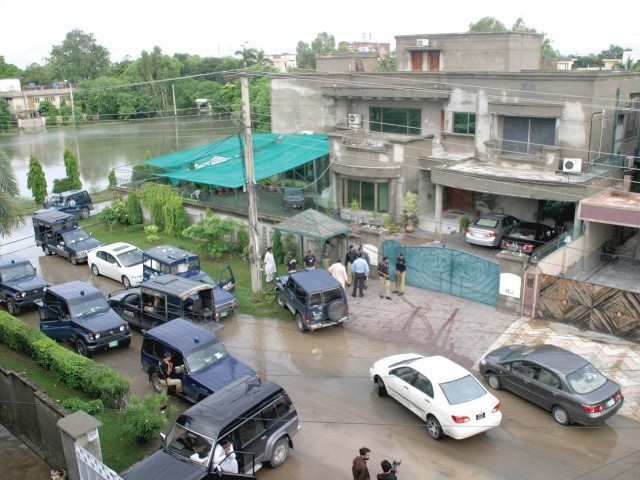
Weinstein has lived in Pakistan for seven years and maintains a principal residence in Islamabad, but also has a home in Lahore where he was living alone. Warren Weinstein was living in a rental residence in Model Town. His double-storey house has two gates and walls that are about 1.8 metres high. The street on which his house is situated contains private security checkpoints, which are usually unmanned during the day. At night, watchmen hired by neighbours are on duty from dusk till dawn. There are around five security cameras installed in his house, but they have been inactive for a year. He was kidnapped by unidentified armed men late on last Saturday. Police have taken his security guards and a driver into custody for questioning, but no clue has been found as to the identity of his captors and the motive behind his kidnapping.

He had eight servants in his Lahore residence, including five guards from a Defence-based security company who were retired commandos of the army’s Special Services Group and a driver, a cook and a housekeeper who was responsible for maintenance of the house and ironing his cloths. One of his security guards named Muhammad Aurangzeb from Sargodha was court-martialled from the army. The second guard, Muhammad Abbas, belonged to Chichawatni, the third, Muhammad Sarwar was from Sheikhupura, while the fourth guard, Fazal Elahi, was from Charsadda and ran away from his military service. Police sources further said that his company had requested local police to provide security to Warren Weinstein, but that he personally refused, saying that he did not want to stand out. About Weinstein’s driver, sources said that his name is Israr and he belonged to Swabi district of Khyber Pukhtunkhwa and had been working with JE Austin Associates for the last four years, while his cook was also from FATA.

The FBI is also investigating the case along with local police investigators. According to sources, investigators were informed by Weinstein’s employees that he never received any threat from any side in Pakistan as far as they knew.

It is worth mentioning that the security guards’ mobile phones, which the kidnappers snatched, remained active for around 45 minutes after the kidnapping and that the last connectivity was detected on the motorway. Kidnappers later switched off the phones. No one has yet claimed responsibility for the kidnapping. The police, with the help of the guards and the driver, have developed sketches of the suspects, who were wearing shirts and trousers and were speaking Urdu. Sources said that a laptop, cellphones and other items found in the victim’s room were being thoroughly examined.

Panetta: ‘No Choice’ in US Relations with Pakistan

By David Gollust for Voice of America

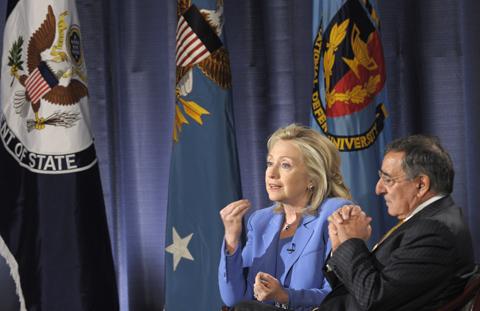
Defense Secretary Leon Panetta said Tuesday that the United States has no choice but to maintain close relations with Pakistan, despite government links with Islamic militants including the Haqqani network. The State Department, meanwhile, put sanctions on another Haqqani network commander.

Panetta, who took over as defense secretary in June after two years of heading the CIA, declined comment on news reports that Pakistan allowed China to inspect the wreckage of an advanced U.S. helicopter lost in the raid that killed Osama bin Laden.

But at a public forum with Secretary of State Hillary Clinton at Washington’s National Defense University, the defense chief was unusually candid about U.S. problem issues with Pakistan.

Panetta said Pakistan has “relationships” with the Haqqani network – militants based in western Pakistan who conduct cross-border attacks on U.S. forces in Afghanistan, and with Lashkar-e-Taiba militants who have attacked India.

Both groups are listed by the United States as terrorist organizations. Despite complaints that Pakistan has withheld visas for U.S. citizens being posted there, Panetta said the relationship remains essential.

“There is no choice but to maintain a relationship with Pakistan,” said Panetta. “Why? Because we are fighting a war there. We are fighting al-Qaida there. And they do give us some cooperation in that effort. Because they do represent an important force in that region. Because they do happen to be a nuclear power that has nuclear weapons, and we have to be concerned about what happens with those nuclear weapons. So for all of those reasons, we’ve got to maintain a relationship with Pakistan.”

Secretary of State Clinton said the Obama administration considers relations with Pakistan to be of “paramount importance.”

She said there have been “challenges” in bilateral ties for decades with valid complaints on both sides, and that she credits the Islamabad government with lately recognizing its shared interest with Washington in confronting terrorism.

“I was very pleased when the Pakistanis moved into [the] Swat [Valley] and cleaned out a lot of what had become a kind of Pakistani Taliban stronghold,” said Clinton. “And then they began to take some troops off their border with India, to put more resources into the fight against the Pakistani Taliban. Now, as Leon [Panetta] says, we have some other targets that we discuss with them – the Haqqanis, for example. And yet it’s been a relatively short period of time, two-and-a-half years, when they have begun to reorient themselves militarily against what is, in our view, an internal threat to them.”

The State Department on Tuesday designated a key Haqqani network commander – Mullah Sangeen Zadran – a terrorist under a 2001 White House executive order, freezing any U.S. assets he has and barring Americans from business dealings with him.

At the same time, Sangeen was designated a terrorist by the U.N. sanctions committee, which will subject him to a global travel ban, an asset freeze and an arms embargo.

A State Department statement said Sangeen, is a “shadow governor” of Afghanistan’s southeast Paktika province and a senior lieutenant of network leader Sirajuddin Haqqani. It said Sangeen has coordinated the movement of hundreds of foreign fighters into that country and that he is linked to numerous bomb attacks and kidnappings.

U.S. Says Pakistan Let China See Copter

By Mark Mazzetti for The Seattle Times

In the days after the raid that killed Osama bin Laden, Pakistan’s intelligence service probably allowed Chinese military engineers to examine the wreckage of a stealth American helicopter that crashed during the May operation, according to U.S. officials and others familiar with the classified assessments.

Such cooperation with China would be provocative, providing further evidence of the depths of Pakistan’s anger over the bin Laden raid, which was carried out without Pakistan’s approval.

U.S. spy agencies have concluded it is likely that Chinese engineers took detailed photographs of the severed tail of the Black Hawk helicopter equipped with classified technology designed to elude radar, the officials said.

The members of the Navy SEALs team who conducted the raid had tried to destroy the helicopter after it crashed at bin Laden’s compound in Abbottabad, but the tail section remained largely intact.

U.S. officials cautioned they did not yet have definitive proof the Chinese were allowed to visit Abbottabad. They said Pakistani officials had denied they showed the technology to other foreign governments.

One person with knowledge of the intelligence assessments said the U.S. case was based mostly on intercepted conversations in which Pakistani officials discussed inviting the Chinese to the crash site.

He characterized intelligence officials as being “certain” that Chinese engineers were able to photograph the helicopter and even walk away with samples of the wreckage. The tail has been shipped back to the U.S., according to American officials.

The U.S. assessments were disclosed Sunday by The Financial Times. The newspaper cited Pakistani officials who denied the accusations.

Pakistan May Be Standing in Way of Polio’s Eradication

By Uri Friedman for The Atlantic Wire

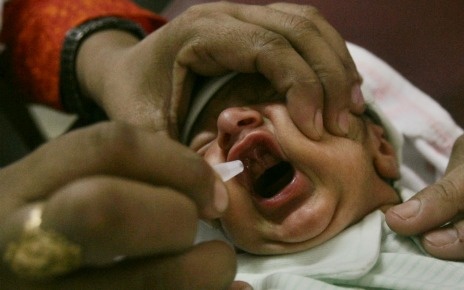
Several Pakistani news outlets today are dissecting a troubling finding from the U.N. Children’s Fund: the 63 cases of polio diagnosed in the country so far this year are nearly double the 36 detected during the same period last year. The highly contagious viral disease, which attacks the nervous system and can cause paralysis or even death, is most evident in the province of Balochistan and has now spread to other areas that haven’t been infected for the past five years. The U.N., which is trying to eradicate the disease by delivering oral vaccines to children, says that these findings suggest Pakistan could be the “last polio reservoir worldwide”–the country standing in the way of eliminating only the second global epidemic disease after smallpox.

This isn’t the first time Unicef has made the claim. In a 2003 report, for example, the organization called Pakistan “polio’s last frontier.” But what’s particularly troubling now is that while the number of cases is dropping in India, Nigeria, and Afghanistan–which, along with Pakistan account for over 90 percent of cases–the disease is spreading in Pakistan (in fact Pakistani President Asif Ali Zardari has declared polio a national emergency). Pakistan’s Express-Tribune cites administrative blunders, resistance of local populations, security challenges for vaccination teams, and Pakistan’s proximity to polio-infected Afghanistan as reasons why the country appears to be losing a battle against polio that “we can simply not afford to lose.” Other reports say anti-vaccine messages from radical clerics and the absence of a national ministry of health are also to blame. The recent revelation that the CIA set up a fake vaccination program in Pakistan to collect DNA from Osama bin Laden’s family members, Reuters notes, may only make immunization drives more difficult.

All that being said, Pakistan isn’t the only obstacle preventing the international community from finally eradicating polio. In an April report, the Global Polio Eradication Initiative announced that the project, which was launched by Unicef and other organizations, didn’t have the funding necessary to reach its goal of stamping out the last remnants of the disease by 2012. The report also noted that polio had reappeared in four disease-free countries–Chad, Angola, Democratic Republic of Congo and South Sudan–and called the state of Kano in northern Nigeria, where rumors were circulating that the polio vaccine would sterilize children, “a smouldering risk that could yet undermine the whole eradication effort.”

Poetry Soothes the Pain in Pakistan

By Nahal Toosi for The Associated Press

The outrage was swift after Pakistani security forces shot dead an unarmed young man in the southern city of Karachi, an incident caught on videotape and broadcast widely. Editorial writers demanded justice. Television talking heads decried the brutality of the men in uniform.

And then, a few poets got to work.

“No regard of life! No fear of Allah! Animals in jungle are better than you,” one English-language poem posted on YouTube rails at the culprits in the June incident. Another, in Urdu and circulated on Facebook, mourned victim Sarfraz Shah, who had “told his mom he will return home early.”

Pakistan is a country that reveres poetry, gently weaving it into daily life, and the last decade has provided no shortage of material. The rise and fall of a military ruler, the demands of a foreign superpower, the devastation of Taliban bombs — these themes and more have crept into Pakistani poems.

Some of the resulting verses carry overt messages about specific events. Often, though, the approach is more subtle, and occasionally, it’s tinged with humor.

“Of course, everything which is happening around a poet, it has an effect,” said Shahzad Nayyar, a published poet based in the eastern city of Lahore. “Such … events, which are causing destruction, which are causing loss to man, material and property, they are affecting poets a lot.”

Although Pakistan is just 64 years old, its people’s poetic tradition is centuries old and is intertwined with that of the rest of South Asia, while also influenced by the Persians. Urdu is the most widely used language, but even regional languages, such as Pashto and Sindhi, have notable poetic histories.

Today in Pakistan, one can find poetic verses on the back windows of taxis, on the sides of delivery trucks and atop gravestones. Newspapers regularly publish poetry, while Pakistani politicians, such as the country’s ambassador to the U.S., post verses on their Twitter feeds or use them in speeches.

Poetry recitals — known as “mushairas” — can draw thousands of spectators and last deep into the night, with audiences shouting encouragement to the men and women onstage. Sometimes, mushairas are part of larger gatherings, such as weddings or trade conferences; others are intimate affairs.

The country even has a national holiday dedicated to a poet-philosopher, Allama Muhammad Iqbal. Iqbal’s writings were seen as an inspirational force toward the creation of Pakistan as a Muslim homeland in 1947, though he died in 1938.

Of the 1,000 books published each year in Pakistan, there are some 50 books of poetry, said Saleem Malik, vice chairman of the Pakistan Publishers and Booksellers Association. While a handful of poets may earn enough to live on writing alone, at least for a while, most are engaged in other professions.

Many of the poetry books are self-published and distributed for free among friends. Still, that doesn’t account for the poetry that appears in other forums, such as magazines or websites such as Facebook, a popular setting for younger poets who can’t afford to publish their own books.

Perhaps the most popular form of poetry in Pakistan is the ghazal, which is made up of five or more units of two lines each and often sung.

Some of the most well-known Pakistani poets say that despite the material provided by the turmoil of recent years, they are careful about how they word their poems and often prefer to use indirect language and symbolism. This is in part to avoid being labeled a “propagandist.”

“It loses your emotional power when you are direct — it becomes like a slogan,” said Farhat Abbas Shah, a poet especially popular with younger Pakistanis.

Iftikhar Arif — a poet so famed in Pakistan that one section of his many, teeming bookshelves is devoted just to academic tracts written about him — said poets should aspire to write in a universal manner that can be appreciated beyond national borders and withstand the test of time.

There are poems written from other periods of turmoil in Pakistani history that are still relevant today because of this approach. “There is a history, perhaps more honest, more correct, more sincere, written by poets,” Arif said.

The line between direct and indirect is a fine one, however, and over the decades, some of Pakistan’s most popular poets have gone back and forth.

The late Habib Jalib, often described as a “revolutionary” or “the People’s Poet” raged against political tyranny, and even referred specifically to former U.S. president Jimmy Carter in his famed collection called “Ten Poems.”

Kishwar Naheed, a spry 71-year-old who is considered one of Pakistan’s pre-eminent feminist poets, is among those who occasionally embraces the direct approaches. In “A Mourning Poem for Bajaur,” Naheed decries the violence gripping Pakistan’s northwest regions bordering Afghanistan:

“Coffins have become so numerous, That the city is shrinking,” the poem begins.

A later verse: “We have the same court-yards, the same threshers. But bullets jump through them, Riddle holes in my fields, and in the bodies of my children.”

Naheed, who has published more than a dozen books of poetry, says every couple of months she receives threats because of her poems.

“They may say, ‘If you continue like this, you may have an accident in your car,'” she said, with a grin. “But I don’t mind having such reaction. If you don’t have a reaction, that means you have no appeal.”

Pakistani poets insist that their community is largely a peace-loving, liberal bunch — though many point out that they may feel just as much ire for U.S. actions toward Pakistan as they do for religious extremists.

Still, militant movements and their sympathizers also use poetry as a tool. After the U.S. killed Osama bin Laden in a nighttime raid in May, a group at Punjab University in Lahore advertised a poem and essay contest dedicated to glorifying the al-Qaida chief.

Taliban operating on both sides of the Pakistan-Afghan border, where the Pashtun ethnic group dominates, often use poems and chants, shared by way of CDs and cell phone recordings, to reach out to a largely illiterate population and persuade ordinary citizens to resist foreign troops.

Much of the poetry of Pakistan is not high art, but rather street-level verses exchanged by text messages, often with anonymous authors. Much of it is laced with the bitter, resigned humor of a people beset by poverty and downtrodden by corrupt elitists.

One popular Punjabi-language poem chastised former military ruler Pervez Musharraf, who was eventually ousted in 2008.

“You rush to Washington all the time, and please Bush again and again,” it says. “Beg at his feet all the time, and threaten the oppressed. Why don’t you confront the oppressors?”

Rights Violations: Pakistan Maintains Discreet Silence Over Syria Protest

By Saba Imtiaz for The Express Tribune

As the chorus against the Syrian government grows louder, Pakistan remains silent on the issue of human rights abuses in Syria. According to Amnesty International, over 1,500 people have been killed since March in the protests against Syrian President Bashar alAssad’s regime. Pressure against Syria appeared to grow over the weekend from Arab states, as the Gulf Cooperation Council asked for an immediate end to bloodshed.

On Monday, Saudi Arabia’s King Abdullah issued a written statement on the situation. “What is happening in Syria is not acceptable for Saudi Arabia. Syria should think wisely before it is too late and issue and enact reforms that are not merely promises but actual reforms. Either it chooses wisdom on its own or it will be pulled down into the depths of turmoil and loss.” Soon enough, Saudi Arabia, Kuwait and Bahrain had recalled their ambassadors from Damascus for ‘consultations’.

In April, Pakistan joined China and Russia in voting against a resolution by the UN Human Rights Council condemning the violence in Syria. Pakistan’s ambassador to the UN Zamir Akram was quoted as saying, “My country has always believed that ‘naming and shaming’ is an approach which is counterproductive.”

Three months and over a thousand dead bodies later, no public statement has yet to be made on the situation in Syria. The Foreign Office spokesperson did not respond to a query till the filing of this report.
According to former foreign minister Khurshid Mahmud Kasuri, Pakistan’s silence is a product of “historical links between the Bhutto and alAssad families”.

President Bashar’s father, the late president Hafez alAssad, was believed to be a close ally of former prime minister Zulfikar Ali Bhutto. Murtaza and Shahnawaz Bhutto travelled to Syria in 1979 to seek support for their campaign to save Bhutto and were offered asylum by the elder alAssad. Murtaza spent several years in Syria before returning to Pakistan in 1993. In 1981, a Pakistan International Airlines flight was hijacked and forced to land in Kabul, and then Damascus. The hijacking is widely believed to be the work of the Al Zulfikar Organisation.
Kasuri said that given the high death toll, “the government of Pakistan needs to make its position clear [and say] that it stands with the people of Syria.”

Pakistan’s silence, according to former foreign secretary Shamshad Ahmad, shows lack of a foreign policy. “Foreign policy is a reflection of a country’s internal state of affairs. If the state is in disorder, it has no foreign policy. Forget Syria or any other Arab country – Pakistan has enough problems at home and has no time to focus on international issues. No one is going to pay any attention to what Pakistan says because it has no credibility. No country is looking to Pakistan for support.”

Pakistanis for Peace Editor’s Note– The writer makes some valid points about Pakistan’s foreign policy or lack thereof. Being complicit also in the suppression of the civilians in Bahrain by providing troops as illustrated in this article shows that the country is often found on the wrong side of terrorism, women and religious minorities rights, and democratic and human rights. Not a good equation and no excuse for any of it any way one looks at it.

India and Pakistan, Talking

As reported by The New York Times

With a relationship as combustible as that between India and Pakistan, it’s progress just to get the two sides in a room. Last week’s meeting was better. Their foreign ministers announced modest, but very welcome, agreements concerning the bitterly disputed region of Kashmir.

They promised to double the number of days when cross-border trade between the two parts of Kashmir — one controlled by India, the other by Pakistan — is allowed and to expand and expedite travel permits for Kashmiris who want to cross the border for family visits, tourism and religious purposes. India and Pakistan have fought three wars since 1947, two over Kashmir. Even these small steps could help chip away at their visceral mistrust.

Three weeks ago, some doubted the meeting would even happen after three explosions ripped through Mumbai, killing 24 people. The Mumbai attacks in 2008 that killed 160 people were blamed on Pakistani terrorists and sent relations with India into the deep freeze. So far, suspicion for the recent attacks has fallen on Indian terrorists.

Prime Minister Manmohan Singh of India deserves huge credit for staying engaged despite Pakistan’s failure to prosecute those responsible for the 2008 horrors. And he deserves credit for not shooting first and asking questions later after the recent attacks.

We wish we could say the same of Pakistan’s leaders. Before there can be a true reconciliation, and stability in the region, Pakistan’s Army must realize that using militants to try to counter Indian influence in Kashmir and Afghanistan is self-destructive — and that homegrown extremism, not India, is the real threat to Pakistan’s survival.

India and Pakistan have more to talk about, including cooperation on water, expanded trade and their joint stake in a stable Afghanistan. President Obama’s drawdown of American troops will go easier if India and Pakistan are part of the solution, not fighting over the spoils. New Delhi insists that it will accept no outside mediation. Washington needs to keep pressing the two to work together.

The United States and its allies are planning a conference in Bonn in December and hope to rally international support for a broad regional strategy that includes a peace deal for Afghanistan, trade agreements and ambitious energy projects. India and Pakistan need to be full participants. The payoff could be huge if their leaders muster the courage to resolve their differences.

US Charges Iran with al-Qaeda Links

By Anna Fifield for The  Financial Times

The US government has accused Iran of allowing al-Qaeda operatives to funnel a “significant” amount of money through its territory to the group’s leaders in Pakistan and Afghanistan, making the strongest allegation yet of a link between Tehran and the terrorist network.
The Treasury Department on Thursday imposed sanctions on six men that it says are operating through Iran as part of a “critical funding and facilitation network for al-Qaeda”.

Please respect FT.com’s ts&cs and copyright policy which allow you to: share links; copy content for personal use; & redistribute limited extracts. Email ftsales.support@ft.com to buy additional rights or use this link to reference the article – http://www.ft.com/cms/s/0/43c235e8-b936-11e0-b6bb-00144feabdc0.html#ixzz1TUnJnl8U

The designation was also a direct hit at the theocratic regime in Iran, said David Cohen, the Treasury’s undersecretary for terrorism and financial intelligence.

“Our sense is that this network is operating through Iranian territory with the knowledge of and at least the acquiescence of the Iranian authorities,” Mr Cohen said. “They are not operating in secret. It is pursuant to an agreement.”

The Treasury targeted Ezedin Abdel Aziz Khalil, a senior al-Qaeda facilitator who it said has been living and operating in Iran since 2005 under an agreement between the network and the Tehran regime.

It said that the Iranian authorities were allowing Mr Khalil to move both money and recruits from across the Middle East through Iran to Pakistan. He required each operative to deliver $10,000 to al-Qaeda in Pakistan, it said.

The Treasury also designated five others who were linked to former al-Qaeda leader Osama bin Laden or to al-Qaeda in Iraq, or who had helped deliver money or extremists to the network’s base in Pakistan.

They include Atiyah abd al-Rahman, a Libyan who is the network’s overall commander in Pakistan’s tribal areas. The US is also offering a $1m reward for information leading to his arrest.

The designations ban Americans from financial dealings with the men, and freeze any assets that they might have in the US.
The actions expose “Iranian support for international terrorism,” Mr Cohen said. It is the first time the US has identified signs of agreement between Iran and al-Qaeda.

Suggestions of links between Iran and al-Qaeda are often questioned because Iran’s theocratic regime is from the Shia sect of Islam while the terrorist network is entirely Sunni. Iran is said to have detained Bin Laden’s oldest son, Saad, for several years before releasing him in 2009.
But there have been persistent reports of co-operation between the two given that they share a mutual enemy: the US.
A report for the congressional anti-terrorism caucus in May said that Iran’s elite Al-Quds force, part of the Islamic Revolutionary Guard Corps, was offering support to al-Qaeda, including helping it “counter” American interests.

In taking the action, the Treasury criticised Kuwait and Qatar for being “substantial facilitators for al-Qaeda” and for having “permissive” financial environments that allowed money to flow from both Gulf countries to Iran.

“There is a substantial amount of money flowing out of Kuwait and Qatar through Iran to al-Qaeda’s or their leadership in Pakistan for all of their activities in the Afghanistan/Pakistan area,” Mr Cohen said.

The US would work with the UN’s al-Qaeda sanctions committee to push for multilateral sanctions.

Musharraf Moves to Mend US-Pakistan Relations

By Lydia Mulvany for The Mimami Hearld

Former Pakistani President Pervez Musharraf said Thursday that his country wasn’t complicit in hiding Osama bin Laden but was “extremely negligent” for not knowing that the al-Qaida leader was living a 75-mile drive from the Pakistani capital.

Speaking in Washington, the former military dictator sought to heal a U.S.-Pakistani relationship that’s become badly strained since the American raid May 2 that killed bin Laden, saying mutual interests in the global war on terrorism bound the countries and that blaming each other was counterproductive.

“The United States and Pakistan must restore trust,” Musharraf told an audience at the Woodrow Wilson International Center for Scholars. “Confrontation would be most unwise.”

The bin Laden incident pushed U.S.-Pakistani relations to their lowest point in years. American officials weren’t happy when, after a decade-long hunt, they found al-Qaida’s leader living in a garrison town so close to Islamabad. Pakistani officials were outraged that they weren’t told about the unilateral raid beforehand.

Since the raid, Pakistan has restricted visas for American officials and expelled military trainers. The U.S. has cut off $800 million, about one-third of its aid to Pakistan’s military. The U.S. has long complained of ties between Pakistan’s military and insurgent groups that have attacked American-led forces in neighboring Afghanistan.

But Musharraf said that if Pakistani intelligence had colluded with bin Laden, it also would have known that the CIA was operating a safe house nearby and whisked the al-Qaida leader away. He described bin Laden’s high-walled compound in the town of Abbottabad as a normal dwelling that wouldn’t have raised suspicion.

He also claimed that Abbottabad – which is home to a major military college that’s been described as Pakistan’s West Point, as well as other military installations – wasn’t a garrison town but a touristy resort area with many colleges.

The recent raid was a “violation of sovereignty,” Musharraf said, echoing a widespread Pakistani complaint. He added that Pakistani antipathy toward the U.S. also stems from the American campaign of drone strikes on militant targets, which reportedly have caused civilian casualties, as well as lingering bitterness over U.S. sanctions for developing nuclear weapons in the 1990s.

The way forward for Pakistan, Musharraf said, is to show that it isn’t complicit with terrorists and to deal with domestic extremism. It also needs to establish an honest, stable government in the 2013 elections, said the former leader, who’s expected to mount a run for president.

Musharraf, who seized power in a military coup in 1999 and resigned in 2008, embodied the frustration and contradictions of American policy toward Pakistan.

Mark Quarterman, a senior adviser at the Center for Strategic and International Studies, a nonpartisan Washington research center, said that many wanted to see Musharraf as a modern, progressive leader: He wasn’t an extremist, his wife and daughter didn’t wear veils and the family even had a dog, an animal many Muslims view as impure. Ultimately, however, Musharraf’s rule was a military dictatorship and, according to many experts, he didn’t do enough to rein in Taliban militants who were operating in remote corners of Pakistan.

Clinton Says US Encouraged by India-Pakistan Talks

By Matthew Lee and Ravi Nessman for The Associated Press

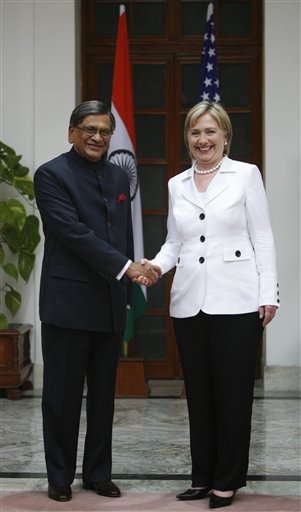
U.S. Secretary of State Hillary Rodham Clinton said Tuesday that the United States was “encouraged” by the ongoing talks between nuclear-armed rivals India and Pakistan and promised to give full support to Indian efforts to protect itself from terror.

Clinton’s visit to India came less than a week after a triple bombing killed 20 people in India’s financial capital of Mumbai, the worst terror strike in the country since 10 Pakistan-based gunmen rampaged through the city in 2008.

Her meetings with top Indian officials Tuesday focused on fighting terror, the U.S. withdrawal plans from Afghanistan and ways to broaden economic and security ties between the United States and India.

She also called for a swift resolution to their dispute over investments in nuclear energy, calling on India to ratify by the end of the year the Convention on Supplementary Compensation for Nuclear Damage and to adapt its liability laws to conform with the treaty.

The U.S. views India’s new nuclear liability law as too stringent on nuclear plant suppliers, making it difficult for private U.S. companies to compete against state-owned companies in India’s multibillion dollar nuclear reactor market.

Clinton’s trip here is part of a new round of U.S.-India strategic dialogue established last year to deepen ties between the world’s oldest and largest democracies.

S.M. Krishna, India’s foreign minister, expressed concerns that the planned U.S. troop withdrawal from Afghanistan that began this month could lead to a resurgence in Islamic extremism.

“It is in the larger interests of the region that it is necessary for the United States to work very closely with (Afghan) President (Hamid) Karzai and the government of Afghanistan and thereby create conditions where terrorists do not take any more advantage in Afghanistan,” Krishna said after 2 1/2 hours of talks with Clinton.

Clinton said she had outlined the drawdown strategy and stressed that the United States will not support Afghan reconciliation with insurgents unless it is inclusive and protects the rights of minority groups, religions and women.

Clinton also assured India of U.S. support in the fight against terror.

“We are allies in the fight against violent extremist networks. And homeland security is a high priority and a source of increasing partnership,” Clinton said.

While the U.S. and India have already signed agreements to cooperate in counterterrorism efforts, “the events in Mumbai have driven home how important it is that we get results,” she said.

Though India has not blamed Pakistan for last week’s attack, it has accused its neighbor of harboring violent extremist groups responsible for other attacks in India and of not doing enough to crack down on those responsible for the 2008 Mumbai siege.

For its part, U.S. officials fear Pakistan is not fully committed to combatting radical plots, such as the failed 2010 Times Square bombing in New York.

“We have made it clear to the Pakistani government that confronting violent extremists of all sorts is in its interest,” Clinton said.

India recently resumed peace talks with Pakistan that broke off following the 2008 Mumbai siege, and the two countries’ foreign ministers are expected to meet next week.

The U.S. is eager for the fragile talks to pick up steam, in part to allow Pakistan to focus its forces on the chaotic Afghan border.

“We are encouraged by the dialogue between India and Pakistan,” Clinton said, calling talks “the most promising approach” to build more confidence between them.

During the meeting Tuesday, Clinton and Krishna agreed to strengthen their countries’ ties in energy, security, education, the economy, science and promoting stability across the region. The two countries also signed an agreement promoting closer cooperation in cybersecurity.

Once frosty relations between India and the United States have warmed considerably in recent years as Washington has looked to India as stable ally in the turbulent South Asia region and its growing economy as a valuable market for U.S. goods.

President Barack Obama hosted Prime Minister Manmohan Singh at his first state dinner and visited India for three days last year, praising it as a new regional power. Clinton was to meet with Singh later Tuesday.

Growing business ties were among the top issues in the talks.

Western officials have looked to India’s rising economy and its 1.2 billion people as a coveted market to help stimulate growth in their own troubled economies.

“Each of our countries can do more to reduce barriers, open our markets, and find new opportunities for economic partnership,” Clinton said. “Taking these steps is in our mutual interest. We can improve millions of lives and increase both of our nations’ economic competitiveness.”

She praised India’s fight against piracy, and pushed for greater sales of U.S. arms to India — the world’s largest arms importer —as a way of deepening security cooperation between the two nations.

U.S. officials were annoyed earlier this year when Indian officials chose two European companies as finalists for an $11 billion order for 126 fighter jets. However, last month India signed an agreement to buy 10 Boeing C-17 cargo and troop-carrying aircraft for more than $4 billion.

From New Delhi, Clinton on Wednesday will move on to the southeastern port of Chennai, where she plans to deliver a speech on the importance of U.S.-Indian relations, the benefits of enhanced bilateral commercial ties and India’s role in South Asia and the greater Asia-Pacific region.

Clinton is in India on the third leg of a 12-day, around-the-world diplomatic tour that has already taken her to Turkey and Greece. After India, she will visit Indonesia, Hong Kong and southern mainland China before returning home July 25.