Archive for the ‘ Pakistan Army ’ Category

The Tangled Reality of US/Pakistan Relations

By Mark Urban for The BBC

WASHINGTON – The current crisis in US/Pakistan relations is not the first – but it is the most difficult one since 9/11, and it could easily be aggravated further by the intelligence arising from the raid on Osama Bin Laden’s compound.

For this reason, Washington insiders are not so sure that diplomatic moves to ease the problem will succeed.

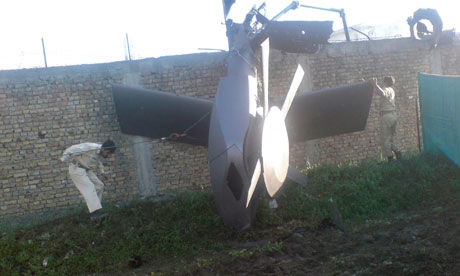
Senator John Kerry has just been in Islamabad asking for “action not words” from the Pakistani authorities. He says he has gained some agreement for practical steps but, apart from gaining the return of remnants of the US helicopter that was destroyed at the compound, has not yet specified what these might be.

This morning he and other members of the US Senate Committee on Foreign Relations will be holding hearings on Pakistan, including the question of how the billions given in aid could be used more effectively to buy the kind of counter terrorist cooperation that the Americans are after.

Juan Zarate, counter terrorist adviser to President George W Bush, argues that the kind of benchmarks that congressmen have advocated in the past for linking aid to performance on specific actions against militant groups could prove counter-productive in the short term because the Pakistanis consider this “humiliating”.

He poses the further question, “what happens tomorrow if we have to go after Ayman al-Zawahiri?”, referring to the former Al Qaeda number two and presumed leader after Bin Laden’s death.

The question of what leads are thrown up by the intelligence trove from the raided Abottabad compound is now in itself a key factor in whether Mr Kerry and members of President Barack Obama’s administration are able to soothe the relationship. Myriad questions arise from the material seized on flash drives and laptops.

Pakistani officials insist there was no contact between their Inter-Services Intelligence (ISI) and Bin Laden – but what about possible ties with the courier who owned the house and was the key figure in sheltering him?

Will phone numbers leading to ISI officials be found in Bin Laden’s effects? Will there be intelligence that allows the CIA to quickly pinpoint Dr al-Zawahiri or other key figures who might now take control of Al Qaeda?

John McLaughlin, deputy director of the CIA until 2004, argues that even in this current difficult moment for US/Pakistan relations, America will reserve the right to act unilaterally against terrorist targets in Pakistan.

He believes though that ties can slowly be re-built with Pakistan, despite the fact that the raid, mounted without their leaders’ foreknowledge, gave them their “biggest shock for a generation”.

At previous moments of tension between the two countries, accommodations have been found. Intelligence about Al Qaeda suspects has flowed or the army has been sent in to one of the restive tribal areas on the Pakistan border. The US has signed off on new aid payments.

What tends to happen though is that within months, the Americans again accuse the Pakistanis of foot dragging in the fight against militancy, and Islamabad for its part counters with arguments that the US routinely violates its sovereignty.

The tangled reality of the situation is made worse by the fact that Pakistani ministers, mindful of anti-American sentiment in their country, will often not admit publicly to their agreement to drone strikes or other steps. Many people I have spoken to here compare the relationship to a dysfunctional marriage in which both sides need one another but find the reality of daily life increasingly unbearable.

There are those who see ways though in which the two countries might navigate their way through the perfect storm of recrimination and resentment that the Bin Laden operation has produced.

Juan Zarate and some others believe that if the materials seized in the raid produce some nugget of intelligence that leads to the discovery of Dr al-Zawahiri or other key figures, the US may chose to trust the Pakistanis with this knowledge, and make them partners in acting upon it.

If the exploitation of the intelligence went wrong and a leak was suspected the US could use this to place further pressure on Pakistani ministers. But if it all went well, trust might be re-built. The problem is though that there are many within the secret side of US counter terrorism who, because of the way that Osama Bin Laden hid for years where he did, are no longer prepared to take that risk.

Pakistan must stop treating India as ‘biggest enemy’: Nawaz Sharif

As Reported by The Economic Times

As Pakistan’s powerful military held out threats to India, former Prime Minister Nawaz Sharif has called for reappraisal of ties with its neighbour to move forward and progress, saying Islamabad must stop treating New Delhi as its “biggest enemy”.

Sharif, who was earlier involved in talks with India when the Kargil crisis erupted, also sought a probe into the 1999 conflict with India.

The former Prime Minister, who is the chief of main opposition PML-N party, is currently on a three-day visit to southern Sindh province where he made the remarks during an interaction with the media in Karachi yesterday.

He called on the government to also conduct an inquiry into the 2006 killing of Baloch leader Nawab Akbar Bugti in a military operation and the carnage in Karachi on May 12, 2007 that killed over 40 people who tried to rally in support of then-deposed Supreme Court Chief Justice Iftikhar Chaudhry.

Sharif, whose government was deposed in a military coup led by former President Pervez Musharraf in 1999, reiterated his demand for the budgets of the military and the ISI to be placed before Parliament for scrutiny in line with the practice in other democracies.

He said one of his biggest regrets was not taming the powerful military when he was Prime Minister in the 1990s.

The Parliamentary resolution calling for an independent commission to investigate the killing of al-Qaeda leader Osama bin Laden in a US raid on May 2 was the first step towards making Parliament a sovereign body, Sharif said.

“We need structural changes and this inquiry has provided an opportunity to move forward and put the country on the right track, correct its direction by putting our house in order, establish the rule of law and bring all institutions under civilian control,” Sharif said.

If the government fixes responsibility for the Abbottabad incident and punishes those found guilty, a message will go out to the world that the people of Pakistan will not brook another embarrassment like the US raid, he said.

Sharif spoke out against the recent alliance forged by the ruling PPP and the PML-Q, both of which are rivals of his PML-N in Punjab and at the centre.

Pakistan’s Nuclear Surge

By Andrew Bast for Newsweek

Even in the best of times, Pakistan’s nuclear-weapons program warrants alarm. But these are perilous days. At a moment of unprecedented misgiving between Washington and Islamabad, new evidence suggests that Pakistan’s nuclear program is barreling ahead at a furious clip.

According to new commercial-satellite imagery obtained exclusively by NEWSWEEK, Pakistan is aggressively accelerating construction at the Khushab nuclear site, about 140 miles south of Islamabad. The images, analysts say, prove Pakistan will soon have a fourth operational reactor, greatly expanding plutonium production for its nuclear-weapons program.

“The buildup is remarkable,” says Paul Brannan of the Institute for Science and International Security. “And that nobody in the U.S. or in the Pakistani government says anything about this—especially in this day and age—is perplexing.”

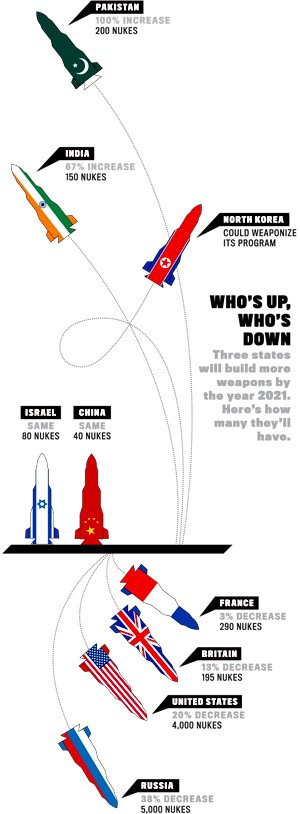
Unlike Iran, which has yet to produce highly enriched uranium, or North Korea, which has produced plutonium but still lacks any real weapons capability, Pakistan is significantly ramping up its nuclear-weapons program. Eric Edelman, undersecretary of defense in the George W. Bush administration, puts it bluntly: “You’re talking about Pakistan even potentially passing France at some point. That’s extraordinary.”

Pakistani officials say the buildup is a response to the threat from India, which is spending $50 billion over the next five years on its military. “But to say it’s just an issue between just India and Pakistan is divorced from reality,” says former senator Sam Nunn, who co-chairs the Nuclear Threat Initiative. “The U.S. and Soviet Union went through 40 years of the Cold War and came out every time from dangerous situations with lessons learned. Pakistan and India have gone through some dangerous times, and they have learned some lessons. But not all of them. Today, deterrence has fundamentally changed. The whole globe has a stake in this. It’s extremely dangerous.”

It’s dangerous because Pakistan is also stockpiling fissile material, or bomb fuel. Since Islamabad can mine uranium on its own territory and has decades of enrichment know-how—beginning with the work of nuclear scientist A. Q. Khan—the potential for production is significant.
Although the White House declined to comment, a senior U.S. congressional official who works on nuclear issues told NEWSWEEK that intelligence estimates suggest Pakistan has already developed enough fissile material to produce more than 100 warheads and manufacture between eight and 20 weapons a year. “There’s no question,” the official says, “it’s the fastest-growing program in the world.”

What has leaders around the world especially worried is what’s popularly known as “loose nukes”—nuclear weapons or fissile material falling into the wrong hands. “There’s no transparency in how the fissile material is handled or transported,” says Mansoor Ijaz, who has played an active role in back-channel diplomacy between Islamabad and New Delhi. “And the amount—they have significant quantities—is what’s so alarming.”

That Osama bin Laden was found in a Pakistani military community, and that the country is home to such jihadi groups as Lashkar-e-Taiba, only heightens concerns. “We’ve looked the other way from Pakistan’s growing program for 30 years,” says Sharon Squassoni, a director at the Center for Strategic and International Studies. What we’re facing, she says, is “a disaster waiting to happen.”

A Defense Department official told NEWSWEEK that the U.S. government is “confident that Pakistan has taken appropriate steps toward securing its nuclear arsenal.” But beyond palliatives, few in Washington want to openly discuss the nightmare scenario of terrorists getting hold of nuclear material or weapons. “The less that is said publicly, the better,” says Stephen Hadley, national-security adviser to President George W. Bush. “But don’t confuse the lack of public discussion for a lack of concern.”

The bomb lends the Pakistanis a certain diplomatic insouciance. Nukes, after all, are a valuable political tool, ensuring continued economic aid from the United States and Europe. “Pakistan knows it can outstare” the West, says Pakistani nuclear physicist Pervez Hoodbhoy. “It’s confident the West knows that Pakistan’s collapse is too big a price to pay, so the bailout is there in perpetuity. It’s the one thing we’ve been successful at.”

Pakistani leaders defend their weapons program as a strategic necessity: since they can’t match India’s military spending, they have to bridge the gap with nukes. “Regretfully, there are several destabilizing developments that have taken place in recent years,” Khalid Banuri of Pakistan’s Strategic Plans Division, the nuclear arsenal’s guardian, wrote in response to NEWSWEEK questions. Among his country’s concerns, Banuri pointed to India’s military buildup and the U.S.’s -civilian nuclear deal with India.

“Most Pakistanis believe the jihadist scenario is something that the West has created as a bogey,” says Hoodbhoy, “an excuse, so they can screw us, defang, and denuclearize us.”

“Our program is an issue of extreme sensitivity for every man, woman, and child in Pakistan,” says former Pakistani president Pervez Musharraf, adding that the nukes are “well dispersed and protected in secure locations.” When asked whether the U.S. has a role to play in securing the arsenal, Musharraf said: “A U.S. role to play? A U.S. role in helping? Zero role. No, sir. It is our own production?.?.?.?We have not and cannot now have any intrusion by any element in the U.S.” To guard its “strategic assets,” Pakistan employs two Army divisions—about 18,000 troops—and, as Musharraf drily puts it, “If you want to get into a firefight with the forces guarding our strategic assets, it will be a very sad day.”

For now, the White House appears to have made a tacit tradeoff with Islamabad: for your cooperation in Afghanistan, we’ll leave you to your own nuclear devices. “People bristle at the suggestion, but it follows, doesn’t it?” says Rolf Mowatt-Larssen, formerly the CIA’s chief officer handling terrorism and weapons of mass destruction. “The irony is that the U.S. presence in Afghanistan and Pakistan, and the money we’re giving them to fight terrorism, could inadvertently aggravate the very problem we’re trying to stop. After all, terrorism and nukes is the worst-case scenario.”

With this fourth nuclear facility at Khushab coming online as early as 2013, and the prospect of an accelerated nuclear-weapons program, the U.S. is facing a diplomatic dilemma. “The Pakistanis have gone through a humiliation with the killing of Osama bin Laden,” says Nunn. “That’s never a time to corner somebody. But with both recent and preexisting problems, we are in a race between cooperation and catastrophe. Both sides need to take a deep breath, count to 10, and find a way to cooperate.”

The Power of Pakistani Conspiracy Theories

By Ahmed Rashid for The New Republic

Pakistan is not a failed state, or as yet a failing one, even though it may be in a state of chaos or meltdown. Unlike really failed states, it has a powerful army and a corrupt, run-down, but still functioning bureaucracy, judiciary, and police force. Pakistanis perform outstandingly well in the realm of culture: in the arts, television, fashion design, pop music, and of course cricket. What is missing are adequate social services, such as health care, education, population-control programs, and jobs for a population that is nearing 200 million people. Like many Arab countries, Pakistan faces a youth bulge, with an estimated 60 percent of its people under twenty-five years old.

For these young people without adequate education and employment, who have to deal with a corrupt system that offers no panacea to the poor, joining an Islamic extremist group is not at all unusual. It is the norm. For this reason, a replay of an “Arab awakening” in Pakistan would not lead to the dawn of true democracy, but rather to a mass movement whose leadership would swiftly fall into the hands of Islamic extremists, who would then try to overthrow the state.

What Pakistanis desperately need is a new narrative by their leaders—a narrative that does not blame the evergreen troika of India, the United States, and Israel for all of the country’s ills, that breaks the old habit of blaming outsiders and instead looks at itself more honestly and more transparently. Pakistanis as a nation seem incapable of self-analysis, of apportioning blame according to logic and reason rather than emotion.

Along with the causes that I listed above, the wave of intolerance sweeping the country is also due substantially to the conspiracy theories put about by the ruling establishment and their allies in the media. These various hallucinations paint Pakistan as the victim, maligned and wronged at the hands of foreign powers—especially the United States and India. In the imagination of many Pakistanis, the country is regularly used for some geopolitical aim by the Americans and then discarded in favor of India. These sinister outsiders want to subvert, destroy, and undermine Pakistan—but no logical reason is offered as to why. And few will publicly argue that in fact it is the selective state sponsorship of extremism that is destroying the country.

The narrative that has been peddled by the state for much of the past decade is that Pakistan is being undermined by the presence of American forces in Afghanistan, and that if they were to leave the Pakistani Taliban would go home, the suicide bombings would cease, and everything would go back to normal. The ultimate aim of the United States in Afghanistan—so the narrative continues—is to capture Pakistan’s nuclear weapons, even as India is busily dismembering Pakistan by funding Baloch separatists and the Pakistani Taliban. But if that is so, why on earth did the state allow the revival of the Afghan Taliban in 2003, which has only delayed the American withdrawal from Afghanistan? And for those demanding higher military budgets, the most self-serving conspiracy theory is that Pakistan is locked in an interminable conflict with India, which cannot be resolved.

After Bin Laden Raid, Might US-Pakistan Cooperation Get Better?

By Howard LaFranchi for The Christian Science Monitor

The United States launched a drone strike targeting militants in the North Waziristan region of Pakistan Friday, raising tantalizing questions in the aftermath of Osama bin Laden’s death.

And does the drone strike suggest, despite official Pakistani protests to the contrary, that cooperation between the two countries not only continues but may in fact end up enhanced by Sunday’s operation, which was an embarrassment for Pakistan?

It was impossible to know if the strike, which reportedly killed at least eight suspected militants gathered in a house in North Waziristan, resulted from any information seized Sunday, since word of the strike came from Pakistani military officials.

But the drone attack appeared to bolster the argument, voiced by a wide range of regional and intelligence experts, that the US would be able to use Sunday’s raid to pressure Pakistani officials to side more unequivocally with the US in battling Islamist extremists.

Also on Friday, Yemeni officials reported that a drone strike there killed two Al Qaeda operatives.

Drone strikes have been a contentious issue in US-Pakistan relations. But it is also true that a considerable increase over the past year in US strikes inside Pakistan by the unmanned aircraft has not led to a breach in the bilateral relationship.

“It was proper for Obama not to publicly rub Pakistan’s nose in” the embarrassment of having bin Laden discovered in the country, says Paul Pillar, who now directs security studies at Georgetown University in Washington after a long career in US intelligence. “But in private, they owe us something…. We do expect more cooperation.”

That perspective is riding high in Washington – especially among those security analysts and former officials who consider the relationship with Pakistan, difficult as it is, too vital for the US to simply throw up its hands and leave.

If anything, the bin Laden operation should pave the way for the US to develop closer intelligence and military ties to Pakistan, says Pete Hoekstra, a former Republican congressman from Michigan and former chairman of the House Permanent Select Committee on Intelligence.

An advantage for the US coming out of the successful raid, he says, is that America looks competent and like it may be a good friend to have in the battle with extremism.

“For the people sitting on the fence, it’s like, ‘They [the US] may be really getting good at this, and maybe now is the time to make a decision to get closer,’” said Mr. Hoekstra, speaking Thursday at a discussion on Pakistan at the American Enterprise Institute in Washington.

Dov Zakheim, a former deputy Defense secretary under President George W. Bush, agrees that the enhanced US stature after the raid should be leveraged to win stronger cooperation from countries like Pakistan that have hedged their bets about America’s staying power.

The successful operation against bin Laden “tells the world we’re not a spent power, we’re not a declining power,” said Mr. Zakheim, speaking Tuesday at a Center for the National Interest forum in Washington. “There’s a message there about US military power that is terribly important.”

Few experts in the bilateral relationship believe that Pakistan knew absolutely nothing about bin Laden’s whereabouts. But Mr. Pillar of Georgetown guesses that in the end, it may be learned that Pakistani officials simply didn’t want to know about something that existed right under their noses.

“My guess is … there was no effort to try to find things out,” said Pillar, speaking at the National Interest forum. “My guess would be, it’s not a matter of [Pakistani Army Chief] Gen. [Ashfaq Parvez] Kayani or the head of the ISI [Pakistani intelligence agency] knowing who was in that compound – but more the inquiries to find out just never having taken place.”

Kayani this week warned the US that Pakistan would not tolerate another raid like Sunday’s. But similar categorical statements have been made before about US drone attacks, some officials and experts have noted – and the attacks continue, if Friday’s strike is any indication.

Despite the bluster at both ends about the US-Pakistan relationship, a difficult but essential partnership will continue because, with Al Qaeda still in Pakistan and the US still next door in Afghanistan, there is no alternative, some say.

“What’s the alternative strategy in regards to Pakistan? We can’t overreact; we can’t back off the relationship if you don’t have a new strategy,” says Hoekstra, addressing in particular members of Congress who are calling for reduced foreign aid and cooperation. “We’ve got enough relations in the world to worry about right now, rather than adding to the list.”

With Friends Like Pakistan…

By Manzer Munir for Pakistanis for Peace

Many people in Pakistan these days are wondering why their nation often finds itself on the wrong side of recent history. First, there is the continued and unjust imprisonment of a Christian Pakistani woman named Asia Bibi who has been languishing in jail for nearly two years. She has been given a death sentence for allegedly making derogatory remarks about the prophet Muhammad.

Then there was the killing of Salman Taseer, who was the then sitting governor of Punjab, Pakistan’s most populous province, by one of his own bodyguards for his outspoken support for Asia’s rights and her freedom. Instead of swift punishment and public outcry at his actions, the killer, Malik Mumtaz Hussain Qadri, was showered with rose petals by some cheering members of the bar association of Lahore when he came to the courthouse for formal charges of murder. Yes, members of the judiciary were cheering his unilateral action of murdering another human being simply for his support towards a condemned non Muslim woman’s rights.

You can only imagine the warped sense of logic and justice in a country where lawyers cheer the cold blooded murder of an innocent man whose only crime was to come at the aid of a condemned Christian mother of two children.

Fast forward to a few months later, the extremists managed to assassinate the only Christian member of President Asif Ali Zardari’s government when the Minister for Minority Affairs, Shahbaz Bhatti, was killed in a hail of bullets by unknown gunmen who then managed to escape on their motorcycle. Bhatti being a Christian as well as a minister in the government, had campaigned for the release of Asia as well as for the repeal of the blasphemy laws in Pakistan that at help promote a culture of state sanctioned hatred against religious minorities in Pakistan.

The culture of fear and hatred as well as violence against the religious minorities has progressively gotten worse along with the security situation inside the country in the last ten years. If there is anything that has been proven by some of these recent events in Pakistan, it is only that the country has become the undisputed global hotbed of extremism, fanaticism, and Islamic militancy in the Muslim world. It has now morphed into a country where the Wahhabi and Salafi fanatics have successfully used fear and hate to silence the majority moderate Barelvi and Sufi Muslims of Pakistan.

When powerful moderate voices like those of Bhatti and Taseer are silenced despite having heavy protection, how safe can the common man feel about his life if he chooses to speak up against the radicals within Islam? To kill someone is against Islamic belief at its core, unless it is done in self defense but you would be hard pressed to hear that view from the religious fanatics in Pakistan. They have justified killing others over many insane reasons such as making derogatory remarks about Islam or the prophet Muhammad. They also rationalize the killing of someone over a family’s honor, thus honor killings where often young women are killed if they are deemed to have brought dishonor to their family. These radical Islamists will even want someone dead for simply uttering disparaging remarks against Islam or its prophet. It is both ironic and hypocritical to see that the same derogatory remarks towards other figures such as Jesus, Moses, Abraham or other prophets of the Quran do not meet the same outcry nor receive the same impassioned response from the masses as when Islam or its prophet Muhammad are criticized.

The seeds of this current fanaticism fanning the flames of hatred were planted during an earlier conflict, this one involving the Soviets against an under matched adversary in Afghanistan. It was during this time in the ‘80’s when the Pakistani dictator, General Zia ul Haq, was in power and he accepted American aid from the Reagan administration in thwarting the threat from the 1979 Soviet invasion of neighboring Afghanistan. At the time, Pakistan’s ISI worked very closely with these “freedom fighters” waging what many thought was a just jihad against a communist foe who disallowed all religious worship. In fact, a good movie to rent right now to put some of these current events in perspective would be Charlie Wilson’s War starring Tom Hanks which details this era of Pakistan-US relations and cooperation against a common enemy in the Soviets.

The trouble now however is that in this current uneasy alliance between Pakistan and the US, there is not a common enemy, at least not as how it is viewed by many in Pakistan, which recently was polled to be the most anti-American nation in the world. Even though radical Islam and fanaticism is as much a threat to Pakistan’s sovereignty and prosperity as it is to the United States, India has always been seen as the big threat by its army and rulers. Pakistan has long seen Afghanistan as a country offering it strategic depth in any future wars with India. Thus, its interests in Afghanistan do not coincide with those of the United States.

The Pakistani media also constantly feeds a steady news diet of bombings by the Taliban/Haqqani network as well as any one of the other fill-in-the-blank militants groups seemingly operating freely from within its borders. There is also the regular news reports of US drone attacks and NATO actions in the AfPak region, as well as the all ubiquitous and constant threat faced from India, who is still seething from the Mumbai bombings in 2008, which were blamed on Pakistani trained terrorists. To further add insult to their injury, not a single leader of the Lashkar E Taiba has been convicted in Pakistan for the attacks in Mumbai that claimed 174 deaths and seriously injured several hundred others.

To the Indians, the perpetrator of their version of 9/11 is not an Arab from Yemen named Osama, but rather a whole nation state with whom it has fought three wars in 60 years and who is a long time sworn enemy with which it shares a long border. Too often it is rightly assumed by many that Pakistan will not act against Lashkar E Taiba and other openly anti-Indian militant groups because these groups are seen as a strategic asset for use against India. Only the fear of an all out nuclear war between the two nations by a trigger happy Pakistan placated India enough so that New Delhi did not immediately take military action against Pakistan after the Mumbai attacks.

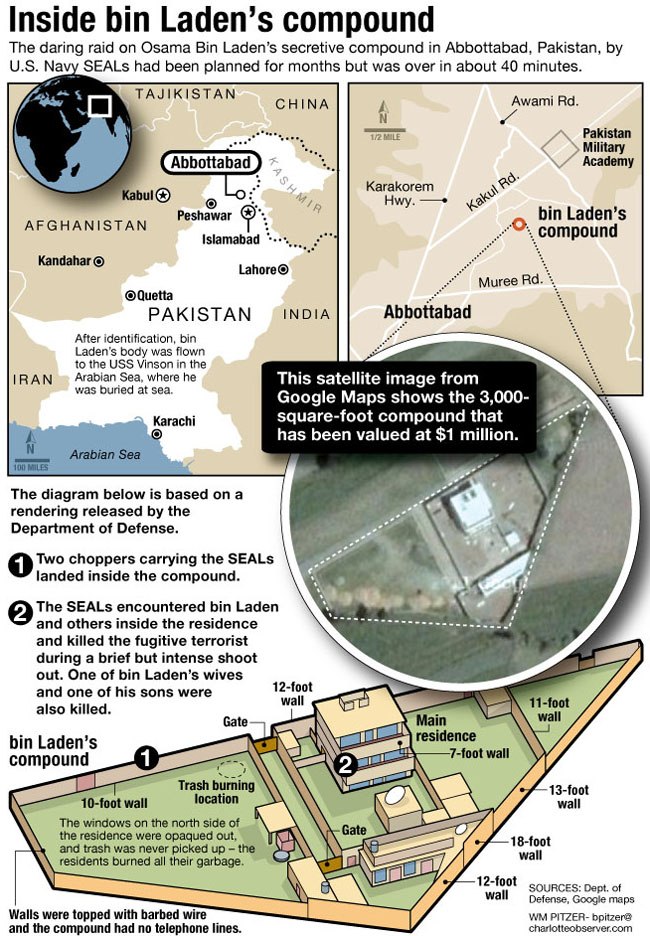
So this culture of fear from all enemies both foreign and domestic to Pakistan’s sovereignty is now at an all time high within the nation. With a several decade long war on its western border in Afghanistan as well as the constant threat from its arch enemy to the east in India, Pakistan has never felt more threatened or squeezed. This pressure is now only going to get ratcheted higher since last week’s killing of Osama Bin Laden at a compound in a suburb of Islamabad, Pakistan. Living for five years undetected in the compound, Bin Laden was less than a mile away from the Kakul Military Academy in Abbottabad, Pakistan’s version of the famed American military college of West Point, when he was killed by a US Navy Seal team.

For the world’s most wanted terrorist to hide in plain sight in such a manner and for so many years, rightly points a lot of suspicion on Pakistan. Long suspected by many intelligence analysts, elements within Pakistan’s spy agency, the ISI, naturally now attracts a lot of suspicion in their possible involvement in the whole affair. There are strong voices and calls within the US Congress to halt all aid to Pakistan in light of Bin Laden’s death. We certainly can assume that any other country in the world found to be harboring terrorists would already have been labeled a state sponsor of terrorism and would be facing immediate sanctions from the international community. “You are either with us or against us” were the words so famously uttered by then President Bush to Pakistan specifically after 9/11. But due to Pakistan’s importance for a successful pullout from Afghanistan of US troops, as well as its strategic position within the Islamic world, neither side can afford to cut off relations with each other.

Although the Obama administration stopped short of claiming that the corrupt civilian government of Zardari was directly involved in protecting and sheltering Bin Laden, all signs point to complicity to some extent by some segments within Pakistan’s hierarchy. There is near unanimous agreement among many in Washington, and this is true on both sides of the aisle, that there are many sympathizers of the Taliban and Al Qaeda within the ranks of the army and the intelligence agencies of Pakistan.

Having driven the Soviets out of the region with the help of militant jihadi groups like the Taliban, no doubt a cadre of army and intelligence officers must have come to espouse the belief that it is in Pakistan’s best interests to have a religiously frenzied force available to use as a weapon against India in a future conflict also. In fact, Pakistan has always had this policy of seeking strategic depth in Afghanistan against India.

The death of Osama Bin Laden in Pakistan by Special Forces of the American military illustrates just what a duplicitous game the country has been playing with the United States and more importantly with itself. In the war on terror America lost nearly 3,000 citizens in the attacks on 9/11. In that same period stretching the last ten years, Pakistan has lost nearly 31,000 citizens to terrorist attacks by the Taliban, Al Qaeda and other militant groups. So it has always been in Pakistan’s best interests to fight the militant threat brewing in its borders the last two decades that has claimed so many lives and caused so much instability.

The murders of Salman Taseer and Shahbaz Bhatti illustrates the dire situation within Pakistani society where many young underprivileged men gravitate towards Osama Bin Laden’s ideology of hate against the US, which is seen by many, as the aggressor in an already very anti-American country. Also western ideas, religious and political liberties, and freedoms, such as those for women in western society, are all seen by the Islamic clergy and religious establishment as being against Islamic doctrine and clashing with the Muslim way of life. Therefore, the madrassahs and the masjids continue to espouse rhetoric against the American and European way of life which is seen as contradicting the teachings of the Quran. Even moderate Muslims and their sites of worship have come under heavy attack by the militants as witnessed by a new strategy of attacking Sufi Muslim shrines and mosques. Pakistan may not want to admit it, but there is a raging war going on within itself for the control of Islam and the attack on moderate Islam by the extremists within the religion.

The Bin Laden killing makes Pakistan seem either highly incompetent about knowledge his whereabouts or at the very least appear to be deeply complicit in sheltering and keeping him hidden while the United States launched the biggest manhunt in US history. At this point, the United States justly feels betrayed and distrustful towards anyone in the Pakistani establishment. After all, how are they to know who now to trust in the army or the civilian government?

It is imperative that Pakistan mount an immediate and urgent investigation that has the full cooperation and assistance of the US so that both countries can discover the source of this support system that Bin Laden has had from within Pakistan. Certainly, some heads do need to roll in Islamabad over this. Whether those resignations be of the current ISI chief, Ahmad Shuja Pasha, head of the army, General Ashfaq Parvez Kayani, or Zardari and Gilani themselves, as some accountability needs to occur. This is important not just for the sake of American-Pakistani relations, but just as importantly for the benefit of the Pakistani populace who is both deeply embarrassed by breach of Pakistan’s sovereignty, but also for the intelligence failure by the government of Pakistan at Osama’s whereabouts. Until and unless Pakistan makes this investigation a top priority, USA and Pakistan relations will continue to slide downhill and will mire further in distrust.

Pakistan must realize that in this global war against religious Islamic fanaticism, it cannot continue to speak from both sides of its mouth. Not when everything, including its very existence is at stake. It cannot at once be both a front line ally in the war against terror and receive billions of dollars in US aid, and at the same time, be found to shelter or allow terrorists and militant organizations safe havens and allow them to operate within its territory.

It is up to Pakistan to salvage a quickly deteriorating situation. However at the time of publication of this article, it seems that President Asif Ali Zardari’s government is off to a horrible start in mending fences with the US. First the name and identity of the CIA station chief in Pakistan was leaked by someone in the ISI to members of the local press. This leak compromised his mission and even poses a danger to his life as the anonymity of all operatives is a necessary requirement in intelligence work.

Then later in the day, in remarks given by Pakistan’s Prime Minister Yousuf Raza Gilani to its Parliament, he defiantly stated that neither Pakistan’s army nor its intelligence agency should be suspected by the Obama administration for providing support to Bin Laden. Gilani also went as far as to say that any future unilateral action by the US or any other nation inside Pakistan’s territory will be met with like force. I thought to myself, did he really just that? Did Pakistan just threaten the United States? It is appalling to see the political posturing now being done by the Pakistani government and the long term negative consequences they will have on the nation.

For a country that is receiving nearly $3.5 billion in US aid yearly, these are very tough words that will undoubtedly only make the strained relations between the two countries worse. Pakistan should realize that United States wants to feel that it can trust it to be a full partner in the fight against militancy and extremism. And unless this distrustful and at times, very adversarial relationship changes, the United States cannot help but feel that with friends like Pakistan, it does not need enemies!

-Manzer Munir, a proud Pakistani American and peace activist, is the founder of Pakistanis for Peace and blogs at http://www.PakistanisforPeace.com as well at other websites as a freelance journalist and writer. 

Pakistan’s Man in Washington

 By Chris Frates for Politico

 As Pakistan’s top Washington lobbyist, it’s Mark Siegel’s job to convince U.S. officials not to take out their anger on the country despite the fact that Osama bin Laden spent at least five years living in relative comfort outside Islamabad.

It’s not an easy sell.

Lawmakers from across the political spectrum wonder aloud how the world’s No. 1 terrorist could be living in plain sight unbeknownst to the Pakistanis. Siegel has to make the pitch that it’s in America’s national security interests to continue its relationship with Pakistan and to keep the billions of dollars in foreign aid flowing.

It’s a message that Siegel’s firm, Locke Lord, is getting paid good money to sell; the firm brings in almost $1 million a year representing Pakistan.

In addition to Siegel, the firm has about half a dozen lobbyists representing the country including Harriet Miers, an aide to former President George W. Bush and a one-time U.S. Supreme Court nominee.

Siegel is uniquely positioned to make the country’s case to skeptics on the Hill. He’s been friends with Pakistani President Asif Ali Zardari’s family for almost three decades and has a direct line to Islamabad.

“The Pakistanis insist to me that they were not aware that Osama bin Laden was at that venue. The president made that very clear to me,” Siegel told POLITICO after speaking with Zardari this week. “I think if they had known, they would have been happy to nab him themselves.”

His connection to Zardari isn’t lost on those he lobbies, like House Homeland Security Chairman Peter King, who met with Siegel on Tuesday.

“It wasn’t so much what Mark was saying to me on Tuesday, it was what I was saying to him knowing, or feeling confident that it was going to go directly back to the president,” said King (R-N.Y.). “There is a real question of credibility and trust and faith. You can’t have the No. 1 mass murderer of Americans living in plain view in Pakistan all these years while Pakistan is claiming to be our ally and getting $3 billion a year.”

Pakistan, King said, must investigate and credibly explain how bin Laden was able to go undected and demonstrate that its intelligence services and military have not been penetrated by al Qaeda.

“Mark’s basic job is almost to tread water, to keep everything afloat until something can be done,” King said. “I think he’s trying to prevent something from happening too quickly to have the relationship severed. He wants to make sure that he keeps it together and so you can have extensive talks between the two governments.”

But King’s not the only one critical of Pakistan these days.

The Obama administration – which didn’t give its ally a heads up that Americans would be swooping into their country to take out bin Laden for fear of leaks – has been describing the relationship between the two countries with the ambiguous “it’s complicated” tag usually reserved for Facebook profiles.

And Senate Armed Services Chairman Carl Levin told ABC News Thursday that he thinks high-level Pakistani intelligence knew of bin Laden’s whereabouts and he has “no doubt” the country knows the location of other top-level targets.

“None of the people on the Hill are suggesting to me that anybody in the civilian government knew that Osama was there,” Siegel said, drawing a distinction between Zardari and the country’s military and intelligence branches.

Tony Podesta, a lobbyist who represents Egypt, knows something of representing a vilified client that is nevertheless a U.S. military ally in an unstable part of the world.

“You want to take it back to the long term strategic interests of the U.S. and to facts rather than supposition. It makes no long term strategic sense for any kind of reckless decisions to be made at this moment,” Podesta said. “That’s where he’ll leave it.”

Siegel has been friends with Zardari’s family for almost three decades, having met Zardari’s late wife, Benazir Bhutto, in 1984 when a mutual friend asked him to host a dinner party for her. The two would go on to write a book together and when Bhutto became prime minister, Siegel represented her government.

This week, Siegel said he has been reminding lawmakers that Pakistan has been a strong ally and that President Barack Obama and other administration officials have praised the country’s cooperation in fighting al Qaeda and terrorism. Pakistan itself has been a victim of terrorism – 30,000 civilians have been killed by terrorists in the last decade, he added.

Even before this week’s killing of bin Laden, Locke Lord has been active on the Hill. In February and March, firm lobbyists accompanied the Pakistani Ambassador Husain Haqqani on meetings with House Speaker John Boehner, Senate Foreign Relations Committee Chairman John Kerry, House Armed Services Committee Chairman Buck McKeon, House Intelligence Committee Chairman Mike Rogers, and Kay Granger, chairwoman of the House appropriations subcommittee on state-foreign operations.

Last year, the firm successfully lobbied for $1.5 billion in economic and social aid over the next five years — a sum that has to be reauthorized each year. The firm is also lobbying to secure foreign aid and create duty-free “reconstruction opportunity zones” inside Pakistan’s tribal lands and Afghanistan.

Pakistan Questions Legality of U.S. operation that killed bin Laden

By Karen Bulliard for The Washington Post

Pakistan’s foreign minister on Thursday appeared to question the legality of the U.S. operation that killed Osama bin Laden, and again denied that his country had knowingly sheltered the world’s most-wanted terrorist.

The comments by Foreign Secretary Salman Bashir came as Pakistani officials faced rising domestic backlash about the helicopter-borne assault in a sleepy neighborhood of a military garrison city, which they have acknowledged they did not know about in advance and — once they became aware of it — could not prevent.

The preservation of national sovereignty, particularly against incursions by U.S. troops, is a highly sensitive issue in nuclear-armed Pakistan, and both the presence of bin Laden and the dramatic American raid that killed him have greatly embarrassed the military here.

Bashir, citing United Nations Security Council resolutions on counter-terror operations, told reporters that the “modalities for combating terrorism raises certain legal and moral issues” and said that “everyone concerned ought to be mindful of their international obligations.”

On Tuesday, the foreign ministry in a statement expressed “deep concerns and reservations” that the U.S. carried out the mission in the city of Abbottabad unilaterally, without Pakistan’s knowledge or permission.

Such comments differ considerably from Pakistan’s measured statements in the hours after the killing, when Prime Minister Yousaf Raza Gillani called bin Laden’s death a “great victory.”

But though clearly directed at the United States, the suggestions that the operation might have breached international law also appeared to be a warning to Pakistan’s archenemy, India, which has been targeted in terror bombings and attacks by Pakistani militants.

On Wednesday, India’s army chief said his forces were capable of carrying out a similar raid — a notion Bashir called “bravado.”

“We feel that sort of misadventure or miscalculation could result in a terrible catastrophe,” Bashir told reporters here, while also vowing that Pakistan’s nuclear arsenal is safe. Pakistan and India, which also possesses nuclear weapons, have fought three wars.

Bashir indicated that there would be little introspection inside Pakistan about how and why bin Laden was able to reside here, under the nose of the military. Some Pakistani officials in recent days have said there would be an inquiry into intelligence failures, but Bashir played down that, saying questions about bin Laden were “for historians.”

“I would call it a ‘view,’ ” rather than an inquiry, Bashir said. “I think we are in a constant process of viewing at every level. … This is a routine. So I think we should not try to give it a slant in terms of an inquiry. There’s no such thing as an inquiry.”

Bashir provided additional details about Pakistan’s role in the years-long search for bin Laden, and about its actions the morning of the raid, when he said two Pakistani F-16 fighter jets were deployed in response to the U.S. operation. By the time the jets reached the compound, the raid was over.

He said a cellphone number for bin Laden’s trusted courier was discovered by Pakistan’s top spy agency and provided to the CIA, which used it to locate bin Laden’s compound.

U.S. officials have said they were monitoring the courier’s phone and e-mail communications and found him when he contacted a family member.

Bashir contradicted previous Pakistani statements that Abbottabad was under “sharp focus” since 2003 — a year when, a Pakistani intelligence official said earlier this week, the construction site for what would become the bin Laden compound was first raided.

Satellite images provided by U.S. officials, however, show there was no building happening on the property at that time.

On Thursday, Bashir said Abbottabad first surfaced on Pakistan’s radar as an al-Qaeda hideout in 2004, when the driver of Faraj al-Libbi, an al-Qaeda operative who would be arrested by Pakistan in 2005, was traced to the garrison city.

Raid Sparks Question: Is Pakistan Doing Enough?

As Reported By CNN

The United States wants answers from Pakistan about how Osama Bin Laden could have lived in that country — near a major military base not far from the capital — without the government knowing.

The United States is asking Pakistan for information on who built and owned the compound where bin Laden lived, two senior U.S. officials said Wednesday. The United States also wants to know about security at the compound, in the city of Abbottabad.

Pakistani government officials have insisted that they did not know Bin Laden’s whereabouts. They reacted angrily to news that CIA Director Leon Panetta told U.S. legislators in a closed-door hearing that “either they (the Pakistanis) were involved or incompetent. Neither place is a good place to be.”

“What worse statement can come than that we heard from Panetta?” a senior Pakistani intelligence official said. “I am afraid this statement is totally regrettable. (Panetta) of all people knows how much we have been doing.”

The official, who did not want to be named, said his country had been generously sharing intelligence with their American counterparts.

“We have been sharing everything with them, but they have been selectively sharing with us,” the official said. “They are entirely dependent on what we provided them. Why were details (of the operation to kill bin Laden) not shared with us?”

Pakistan has argued that it has provided valuable intelligence information and worked with the United States to capture or kill numerous al Qaeda members and other Islamic extremists.

Yet the questions around bin Laden’s presence in Pakistan has exacerbated an already rocky relationship between the two nations.

Many Obama administration officials, lawmakers and observers from across the political spectrum want to know how bin Laden — based at a compound in the military garrison city of Abbottabad — could have eluded Pakistani capture, or whether the government or elements of it harbored bin Laden.

They want to know whether Pakistan is firmly backing the fight against terror or is supportive of militants fighting against troops in Afghanistan.

In Islamabad Tuesday, Marc Grossman, the special U.S. representative on Afghanistan and Pakistan, met with Pakistan’s president Asif Ali Zardari, the head of the ISI military intelligence Gen. Ahmed Pasha, and military chief Gen. Ashfaq Kayani. During that visit, which was scheduled before the killing of bin Laden, Grossman discussed the operation with the officials, the State Department confirms.

Those officials say the Pakistani officials expressed surprise that bin Laden was living at the compound and the U.S. officials tell CNN they are taking that at face value until more information is available.

The United States has a “complicated but important relationship” with Pakistan, White House press secretary Jay Carney said Tuesday.

Carney told reporters that U.S. officials need to learn more about the “support network” that sustained bin Laden in Pakistan. But he also warned against “tarring” everyone in Pakistan’s government because of the revelation that bin Laden had been living so close to Islamabad.

There has also been “a great deal of important cooperation” in the fight against Islamic extremism, he said. “The idea that these kinds of complications exist is not new.”

But Rep. Peter King, the New York Republican who is chairman of the Committee on Homeland Security, said “this can’t be allowed to go on.”

In comments Tuesday at a House subcommittee hearing on Pakistan, King noted that bin Laden’s compound was near a headquarters for the Pakistani intelligence services.

“There are two possibilities and one answer,” King said. “One is that it was a direct facilitation by elements of the Pakistani government, or Pakistani intelligence is entirely inept, and that has not proven to be the case over the years.”

According to two sources who were in the closed-door briefing with Panetta Tuesday on Capitol Hill, the CIA director echoed King’s concerns.

Panetta made clear, the sources said, that he and other administration officials are trying to get to the bottom of which it was — involvement or incompetence — on the part of the Pakistanis.

In an interview with TIME magazine, Panetta explained why the Pakistanis were not told of the bin Laden mission “It was decided that any effort to work with the Pakistanis could jeopardize the mission,” he said. “They might alert the targets.”

At King’s hearing, Seth Jones of the Rand Corporation told the panel that bin Laden’s presence in Pakistan showed that “at the very least, there has not been a high priority in targeting senior al Qaeda leaders” in the country.

“Based on the threat streams coming from this area, those interests have to change in my view,” Jones said. Another terrorism expert, Frederick Kagan of the American Enterprise Institute, said mistrust between the United States and Pakistan runs both ways, with Pakistani officials fearful that the United States will abandon the region after eliminating bin Laden.

“It is essential that we find ways not only to communicate our frustration to Pakistan,” Kagan said, but also to say “we’re not leaving.”

The United States has regarded Pakistan as a top ally in the fight against the Taliban, al Qaeda, the Haqqani Network and other Pakistan-based militants who have launched attacks against international and Afghan troops in Afghanistan. At Tuesday’s hearing, experts also identified Lashkar-e-Taiba as a major emerging threat from Pakistan to the Indian subcontinent and beyond.

According to the U.S. Government Accountability Office, the United States has provided $18 billion in foreign assistance and reimbursements to Pakistan, two-thirds of which are security-related.

The administration and lawmakers have praised the Pakistanis for their anti-terrorism efforts, but at the same time some lawmakers suspect the country hasn’t been robust enough in going after terrorists. Some say elements of Pakistan’s intelligence services — the Inter-Services Intelligence or ISI — have close ties with militants.

Sen. Dianne Feinstein, the California Democrat and chairwoman of the Senate Intelligence Committee, agrees that they have been “good at going after some terrorists” but have “very subtly walked both sides of the street.”

“That’s of concern to many of us, I think, because you have to declare yourself,” she told reporters, noting that the issue of Pakistan will be addressed by her committee.

Denis McDonough, who is President Barack Obama’s deputy national security adviser, told CNN that despite legitimate questions about what Pakistani authorities knew, the United States needed to maintain the relationship.

“We obviously recognize that nobody has sacrificed more in this war against al Qaeda than the Pakistanis,” McDonough said. “Al Qaeda had declared war, in fact, on the Pakistani government, have threatened and continues to threaten to try to get their hands on nuclear material in that country. … So they obviously have a lot at stake in this fight. So we’re going to continue to work with them and continue to try to partner with them against al Qaeda, because we recognize that it’s not only in our interests, but in their interests.”

Asked if the U.S. funding to Pakistan should continue, McDonough said such investments bolster U.S. security.

“We’ll continue to try to work with them to train, to try to target the common threat that we face from al Qaeda,” McDonough said, adding: “Nobody has greater concern about our ability to … carry out the fight against al Qaeda than the president. We’re going to continue to do that, either with our Pakistani friends or alone. But this is too big a fight for us to give it up.”

McDonough also said he agreed with the reported quote by Panetta that the United States decided not to share intelligence with Pakistan in the run-up to the Monday raid that led to bin Laden’s death because of fears of a leak. Sen. Richard Lugar, the top Republican on the Senate Foreign Relations Committee, also cited concern that some Pakistani officials might alert bin Laden.

“This is one reason we did not inform the Pakistanis of our actions,” Lugar said, while noting “there were probably many who were very uncomfortable about the presence likewise.”

The Pakistani government on Tuesday “categorically” denied reports that its leadership “had any prior knowledge” of the U.S. operation against bin Laden

One ISI official denied any complicity in hiding bin Laden, saying one failure and embarrassment doesn’t negate its “track record” of capturing more al Qaeda members than anyone else.

“Yes, we did fail to locate him. Yes, we are embarrassed. But that does not mean we are incompetent and straddling the fence,” the official said. “Had we known that OBL was there we would have raided it and handed him over to the U.S. to silence the critics talking about the complicity of the ISI.”

The United States is reviewing intelligence seized in the compound to determine whether bin Laden received support inside Pakistan, a senior U.S. official told CNN. This comes amid discussions in Washington over the extent of the Pakistani intelligence service’s knowledge of his whereabouts and whether it provided him sanctuary.

Lugar was asked in Washington why taxpayers should support money for Pakistan.

“It’s a very complex country. A very complex set of officials,” the Indiana senator said. “To try to obtain perfection in terms of who the recipients ought to be is out of the question. It’s a question of if there are goals we can achieve if we have some accountability of the money.”

Former Secretary of State Condoleezza Rice told CNN on Tuesday that Pakistan has been an “important partner in counterterrorism cooperation and we’ve had very important cooperation from them.”

But she questions how bin Laden could “hide in plain sight in that kind of compound without the knowledge of high-ranking officials.”

“We have captured many, many al Qaeda operatives in Pakistan, including Khalid Sheikh Mohammed, so Pakistan has been a cooperating counterterrorism partner,” Rice said, making reference to the mastermind of the 9/11 attacks. “But everyone knows that there are elements within Pakistan that are still tied to extremism, that has been a concern, and it is very important now that the Pakistanis take a hard look at how this possibly could have happened,”

Mark Quarterman, director of the Program on Crisis, Conflict, and Cooperation at the Center for Strategic and International Studies and an expert on Pakistan, said there have been strong differences between Washington and Islamabad over U.S. drone strikes in the tribal region and calls to remove CIA operatives in the country. The bin Laden operation and the issues surrounding it add to the tension, he said.

“I would not be surprised if there are questions on Capitol Hill about continued level of support to Pakistan, about the U.S. relationship with Pakistan and the consideration of the nature of that relationship and how we handle it going forward,” he said.

The Pakistan government and the ISI supported the Taliban when it controlled Afghanistan during the 1990s, but the government broke ties with the Taliban after the 9/11 attacks. American officials have consistently indicated that there are rogue ISI elements supportive of militants.

One reason Pakistanis also have supported militants in the tribal region is that the fighters are seen as serving as a bulwark for Pakistani interests. That includes a focus against the influence of longtime rival India in Afghanistan, Quarterman said.

“The Pakistanis are hedging their bets,” he said. “They know the United States isn’t there to stay.”

Jamie Metzl, executive vice president of the Asia Society, said the onus will be on Pakistan to do a thorough investigation to assess what happened with bin Laden.

“If Pakistan denies any official involvement with bin Laden, it will be difficult to prevent a backlash among members of the U.S. Congress who will believe that Pakistan is playing a double game,” Metzl said.

Metzl also says Pakistan’s fear is that India will increase influence in Afghanistan and surround Pakistan, and that calculation has led Pakistan to keep militants under its sway.

Mike Rogers, a Michigan Republican who is chairman of the House Select Intelligence Committee, said Pakistan and the United States have “a very funny relationship.”

Pakistan dispatched “troops into the tribal areas at our request” and “took thousands and thousands of casualties trying to fight Taliban and al Qaeda elements,” Rogers said on CNN’s “American Morning.”

“There are some concerns about their ISI being penetrated, their intelligence services being penetrated, but at the same time,” he said, “we’ve got to have them.”


-CNN’s Joe Sterling, Jill Dougherty, Elise Labott, Zain Verjee, Ted Barrett, Elise Labott, Alan Silverleib, Tom Cohen and Nick Paton Walsh contributed to this report
Pakistan’s president denies harboring bin Laden

By Nahal Toosi and Zarar Khan for The Associated Press

Pakistan’s leader denied suggestions that his country’s security forces sheltered Osama bin Laden as Britain demanded Tuesday that Islamabad answer for how the al-Qaida chief lived undetected for six years in a large house in a garrison town close to the capital.

But in a nod to the complexities of dealing with a nuclear-armed, unstable country that is crucial to success in the war in neighboring Afghanistan, British Prime Minister David Cameron said having “a massive row” with Islamabad over the issue would not be in Britain’s interest.

A day after U.S. commandos killed bin Laden, reporters were allowed within the 15-foot, barbed-wire-topped walls of the compound for the first time. But the doors of the house were sealed shut and police were in no mood to open them.

Local residents showed off small parts of what appeared to be a U.S. helicopter that Washington said malfunctioned and was disabled by the American strike team as they retreated. A small servant’s room outside the perimeter showed signs of violent entry and had been briskly searched, clothes and bedding tossed to the ground. Its wall clock was on the floor, the time stuck at 2:20, when the U.S. team would have been on the ground in the early hours of Monday.

Asif Ali Zardari’s comments, in a Washington Post opinion piece Monday, were Pakistan’s first formal response to suspicions raised by U.S. officials and others. Those suspicions could further sour relations between Islamabad and its Western backers at a key point in the war in Afghanistan.

Bin Laden was killed close to a military academy in the bustling northwestern town of Abbottabad, not in the remote Afghan border region where intelligence assessments had assumed he had been holed up. That was quickly taken as a sign of possible collusion with the country’s powerful security establishment, which Western officials have long regarded with a measure of suspicion despite several notable al-Qaida arrests in the country since 2001.

“Some in the U.S. press have suggested that Pakistan lacked vitality in its pursuit of terrorism, or worse yet that we were disingenuous and actually protected the terrorists we claimed to be pursuing. Such baseless speculation may make exciting cable news, but it doesn’t reflect fact,” Zardari wrote.

Ties between the two nominal allies were already strained amid U.S. accusations that the Pakistanis are supporting militants in Afghanistan and Pakistani anger over American drone attacks and spy activity on its soil. They came to head in late January after a CIA contractor shot and killed two Pakistan’s, in what Washington said was self-defense.

Senior U.S. officials did not directly accuse Pakistan of collusion, but made it clear they had concerns.

“People have been referring to this as hiding in plain sight,” Obama’s counterterrorism chief John Brennan told reporters Monday. “Clearly, this was something that was considered as a possibility. Pakistan is a large country. We are looking right now at how he was able to hold out there for so long and whether or not there was any type of support system within Pakistan that allowed him to stay there.”

Lawmakers were more direct.

U.S. Senate Armed Services Committee Chairman Carl Levin said Pakistan’s intelligence and army have “got a lot of explaining to do,” given that bin Laden was holed up in such a large house with surrounding buildings, the fact that its residents took the unusual step of burning their garbage and avoiding any trash collection.

“It’s hard to imagine that the military or police did not have any ideas what was going on inside of that,” Levin said.

Cameron, who has also made supporting Pakistan a major foreign policy commitment, echoed those concerns.

“Those are questions we have to ask, those are questions we will want answered and we will be asking that question of everyone in Pakistan and the Pakistani government,” Cameron told BBC radio before acknowledging the West’s limited leverage against Islamabad.

“We could go down the route of having some massive argument, massive row with Pakistan, but I assess our relationship with Pakistan and it is my very clear view that it is in out interests to work with the government and people of Pakistan to combat terrorism, combat extremism and help development in that country.”

Suspicions were also aired in many Pakistan’s media and on the street Tuesday.

“That house was obviously a suspicious one,” said Jahangir Khan, who was buying a newspaper in Abbottabad. “Either it was a complete failure of our intelligence agencies or they were involved in this affair.”

Pakistan’s security establishment has yet to explain how bin Laden was able to live there undetected, and given that it is rarely transparent about what it does, it might never do so. Asked about the raid, Pakistani Foreign Secretary Salman Bashir said it was time to move on.

“The issue of Osama bin Laden is history and I think we do now want to keep ourselves mired in the past,” he told reporters.

U.S. officials have said that Pakistani officials were not told about the early morning helicopter raid until the strike team had killed bin Laden had returned to Afghanistan from where they took off from, citing security reasons.

Many Pakistanis were surprised at how this was possible, especially when initial reports stated that the choppers took off from a Pakistani air base. Some were angry that the country’s sovereignty had been violated — an especially sensitive issue given the unpopularity of America here.

Zardari said it “was not a joint operation” — the kind of which has been conducted in the past against lesser terror suspects in Pakistan — but that Pakistani cooperation, in a general sense, had helped lead them to bin Laden.

“A decade of cooperation and partnership between the United States and Pakistan led up to the elimination of Osama bin Laden as a continuing threat to the civilized world,” he said.

President Barack Obama also said the country’s anti-terror alliance had helped in the run-up to the operation, but did not thank Pakistan when he announced the death of bin Laden.

The death has raised fears of revenge attacks, both in Pakistan — which has seen hundreds of suicide attacks by al-Qaida and its allies since 2007 — and internationally. The U.S Embassy said its missions in Pakistan would remain closed to the public until further notice.

AfPak envoy comes down heavy on Pakistan

Reported by The Press Trust Of India

Making it clear that Pakistan needs to do “more” to deal with the safe havens of terrorists on its soil, US AfPak envoy Marc Grossman on Friday said it will help in bringing peace to Afghanistan. On his maiden trip to New Delhi after being appointed in February as US special representative to Afghanistan-Pakistan, Grossman called on foreign secretary Nirupama Rao and held extensive consultations on the situation in the region.

“There is always more to do and we are encouraging Pakistan to do everything possible to deal with the safe havens…..which will also play a big role in bringing peace to Afghanistan,” Grossman told reporters after his meeting with Rao which lasted for nearly one-and-a-half hours.

Asked about the recent remarks of chairman of US Joint Chiefs of Staff Mike Mullen accusing Pakistan’s ISI of backing the Haqqani network, an Afghan Taliban group, he said, “I have nothing to add or to subtract to whatever Mullen has already said. We do a huge amount of work with Pakistan in countering terrorism and extremism and that’s what we will continue doing.”

Appointed after the sudden death of Richard Holbrooke, Grossman since he was new to the job, it was important for him to come to India and take advantage of the expertise and experience of the “people here”.

Apart from Rao, he will also be meeting other senior officials, including National Security Advisor (NSA) Shivshankar Menon before resuming his journey, which will take him to Kabul, Islamabad and Riyadh. Giving some details of the meeting with Rao, the US envoy said they discussed the Indo-US global partnership, its future and their joint projects in Afghanistan.

“We have a lot of work to do together in Afghanistan and some of that work is very important…,” he said.

Recalling US Secretary of State Hillary Clinton’s February speech at the Asia Society, Grossman said the military surge in Afghanistan has been effective and Taliban has been degraded but his worry was that being unable to do much militarily, they might resort to terrorist attacks targeting civilians and Afghan police.

Pakistan’s Hypocrisy Has Run Its Course; It Needs A New Relationship With U.S.

By Ahmed Humayun
Best Defense department of frenemy relations

The U.S.-Pakistan relationship has long been volatile, but recent weeks have witnessed an unprecedented level of open discord between the two countries. On April 11, Lt. Gen. Ahmad Pasha, the head of Pakistan’s ISI, met with American officials and demanded that the United States sharply limit its counterterrorism efforts inside Pakistan. Just two days later the CIA launched drone strikes in Pakistan’s tribal areas, provoking angry protests from Pakistani officials. And in a sign that Washington is determined not to back down, last week Admiral Mullen, chairman of the Joint Chiefs, publicly chastised the ISI for its “longstanding relationship” with the Haqqani network, one of the prime targets of the drone campaign.

Pakistan’s recent criticisms are partially a response to the rising public backlash against America’s counterterrorism operations. Till now, Pakistan has tacitly cooperated with the drone campaign while reluctantly permitting a few CIA agents and special operations forces to enter the country. At the same time, Islamabad has publicly denied cooperating with Washington due to domestic political sensitivities. In the aftermath of the Raymond Davis incident, however, this always-fragile pretence has become untenable. (Raymond Davis, a CIA contractor, killed two Pakistanis with possible links to the ISI in broad daylight in January. Three months later, the subsequent media frenzy has not diminished. )

No state wants its territory to be a hunting ground for covert foreign operatives. Still, the fulminations of some in Pakistan omit critical context. The Pakistani state’s ambivalent attitude towards extremist groups — acting against some while tolerating or supporting others — has forced the United States to take proactive action. The rights of sovereignty also come with duties: if Pakistan is indulgent of or incapable of acting against anti-American terrorist groups, then foreign preventive counterterrorism should be assessed more soberly by Pakistanis.

To complicate matters further, elements in Pakistan’s security establishment have deliberately stoked public sentiment. Extensive leaks to the Pakistani press about the government’s demands to the United States hint at a desire to exert pressure on Washington through exploiting populist anger. For the ISI, this diplomatic crisis is a unique opportunity to obtain long desired strategic concessions from the United States. Among other things, the ISI does not want militant groups favored by Islamabad under America’s microscope — especially those perceived to defend Pakistani interests in Afghanistan.

This is a dangerous strategy. It is premised on the mistaken assumption that the United States is unwilling to increase pressure on Pakistan. If the Pakistani government faces domestic political constraints, this is no less true of the United States. Sentiment in the U.S. Congress is already heavily tilted against Pakistan. If reports about Pakistan’s entanglement with extremist groups persist, or in the worst case scenario, an attack on the United States by a Pakistan-based terror group succeeds, Washington will find it difficult to avoid taking harsh actions. Loose talk by some Pakistani politicians about cutting off supply routes to U.S. forces in Afghanistan is similarly self-defeating. It is in Pakistan’s long-term interests to prevent an irrevocable rupture with the United States.

At the same time, Washington should appraise the scope of its direct counterterrorism drive within the broader effort to stabilize Pakistan. According to U.S. officials, the drone campaign has been remarkably successful in weakening militant networks; in private, some Pakistani military and political leaders also acknowledge the program’s efficacy. That may be the case, but displays of U.S. coercive force on Pakistani soil — especially those involving U.S. personnel on the ground — have also accentuated the most extreme tendencies in that country’s public discourse. They have empowered those in Pakistan who maintain that the war on terror is America’s war, not Pakistan’s struggle, and that the United States has fundamentally hostile aims towards Pakistan.

Policymakers might shrug their shoulders at conspiracy theories. That would be short-sighted. The fact is that the United States cannot directly extinguish the threat posed by Pakistan-based terrorism. U.S. forces can certainly kill a few extremists through drone strikes or ground operations. But the militant threat is geographically dispersed: not only do insurgent sanctuaries infest the isolated border regions, terrorist networks are also embedded in the heavily populated areas of the Punjabi heartland. Some of these groups have deep roots stretching back decades and enjoy local political cover. Kinetic action by a deeply unpopular foreign power will not uproot them.

The single most decisive factor in disrupting Pakistani militancy will be the willingness of the state and society to commit to a long-term struggle. Only Pakistan can overcome the jihadi Frankenstein it has spawned through a combination of stepped up military force, political dialogue, and local governance. The impact of U.S. policies on the internal Pakistani debate about militancy should therefore be factored heavily into Washington’s policymaking calculus.

Pakistan is making progress — however halting or incomplete — in adopting a more robust anti-militant posture. Since 2009, its military offensives in the tribal areas have degraded insurgent sanctuaries at a heavy price in blood and treasure. Pakistani intelligence has also helped the United States capture numerous high-level al Qaeda operatives. The Obama administration’s economic assistance to Pakistan and its diplomatic efforts to stabilize the country’s fractious politics have contributed to these advances. Going forward, the core policy challenge is to generate the political will inside Pakistan that will expand these activities. Right now, Washington’s ability to do so is vitiated by Pakistani paranoia.

In the short term, Islamabad and Washington need to negotiate a new counterterrorism relationship. The old strategy of ambiguous private compromise veiled by public dissembling has run its course. Pakistan’s legitimate concerns should be weighed against the immediate threat to the American homeland and to U.S. forces in Afghanistan. This is a herculean task given the underlying strategic differences, but the alternative is likely to be much starker.

Ahmed Humayun is a fellow at the Institute for Social Policy and Understanding (ISPU) and senior analyst at Georgetown University’s Emerging Threats Project. He can be reached at ahmed.a.humayun@gmail.com .

Ahmed Rashid on Negotiating With the Taliban

By Amar C Bakshi for CNN Global Public Square

Intrepid Pakistani author and journalist Ahmed Rashid wrote an op-ed in the Financial Times describing the Obama administration’s secret decision to ramp up talks with the Afghan Taliban, trying to find a negotiated solution to a decade-long conflict. In a follow-up phone call, Rashid said that the Obama administration ought to announce these talks publicly and pressure Afghanistan’s neighbors to get behind them.

Amar C. Bakshi: What is the shift in U.S. policy toward Afghanistan?
Ahmed Rashid: For a very long time there was a lot of division about whether the U.S.would talk to the Taliban or not. Those divisions have now more or less ended. There is much greater determination to set in motion not just secret talks but everything around it that has to happen.

For example, the Taliban are very keen to open an office somewhere in one of the Gulf countries or maybe Turkey. There is nowU.S.support for that. There would presumably be international support for that also. These are the kinds of steps that are needed to get a political process going.

There is the acknowledgement that an over-dependence on a military strategy is not going to work in the long-term. Secondly, the economic and international situation is really not in favor of a long-term military strategy. What is needed now very much is a political strategy. Secretary of State Hillary Clinton herself has said this several times in the past few weeks.

What would a deal with the Taliban look like?
We are a very, very long way away from that. Many questions are being raised. For example, would there be a power-sharing with the present government? How would it take place? How would the constitution accommodate something like that? There are all sorts of social and legal issues about the constitution and Islamic law.

One of the key steps that the Americans have taken is that for the last two years or so, the Obama administration has been talking about preconditions – that the Taliban has to renounce Al Qaeda, accept the constitution and President Karzai. Now what we’re seeing is that talks are going on without any preconditions. These preconditions, or red lines, are something that everyone assumes will be accepted by the Taliban at the end of the talks rather than at the beginning. That is a very positive thing because I don’t think either side could go into their talks with their preconditions.

There are Taliban preconditions that seem to be watered down too because the Taliban were insisting that they wouldn’t talk until the American forces started to leave. But they seem to be willing to put that aside for the time being.

Why is this shift happening now?
The overall international and economic situation is very, very dire. First of all, the majority of European countries want to pull their troops out of Afghanistan as quickly as possible and that includes some of the leading nations like Britain, Germany and Canada.

Economically they can’t do it. They’re cutting their defense budgets. They are in recession.

And secondly the huge expenditure by the Americans themselves: Something like $108 billion is going to be spent on Afghanistan this year on the war effort. This is clearly not sustainable with all the economic crises that President Obama is facing right now.

What can the U.S. do to help make India and Pakistan see eye-to-eye on Afghanistan?
That is obviously a very crucial part of it. The big tussles going on over Afghanistan right now is between India and Pakistan in a battle for influence there. I think the U.S. needs to play a more upfront role – privately at least – to bring the two countries together if not on the other issues that divide them like Kashmir and larger issues, then certainly on Afghanistan. I think that’s very doable.

The more we get into this endgame and negotiations – the more the world realizes that the Americans are talking to the Taliban – I think it becomes very imperative for both the governments in India and Pakistan to accept the fact that they will have to work with each other if they want to be part of the ultimate equation.

Does Pakistan want to see stability in Afghanistan?
Pakistanis very keen to see stability in Afghanistan. An end to the war in Afghanistan could have a very dramatic effect on containing terrorism inside Pakistan too and containing the Pakistani Taliban. So I think Pakistanis very keen to see stability.

The question at the moment is: If the U.S. is going to take the lead – or the United Nations or whoever we are going to see in the months ahead take the lead on this – they have to bring together all the neighboring countries, of which Pakistan is probably by far the most important, but all of the neighboring countries have to agree to some king of on non-interference in Afghanistan.

Tensions between Iran and Saudi Arabia are being exacerbated by upheavals throughout the Middle East. How might Saudi Arabia and Iran see eye-to-eye in Afghanistan?
For the last 30 years, Saudi Arabia and Iran have been rivals in Afghanistan. For example, the Saudis backed the Taliban regime in the 90s. The Iranians very strongly opposed it.

The point right now is that with the tensions in the Gulf – the Saudis accusing the Iranians of destabilizing Bahrain and Saudi Arabia– they are both searching for allies.

The Saudis have recently been approaching the Afghans and the Pakistanis to ally with them against Iran. That is something that neither country can afford to do – neitherAfghanistannorPakistan. Secondly, you need the compliance of both Saudi Arabia and Iran for any eventual Afghan peace settlement.

So taking sides on this Iran-Saudi dispute in the region is not a good idea. It is not very helpful, especially if you want to bring the two countries into the peace agreement.

So a major diplomatic lift is needed?
Yes, absolutely. We’re talking about a huge diplomatic effort, which the former U.S. Af-Pak Special Envoy, Richard Holbrooke, had started. It needs a very big push by the United States, NATO and the European countries.

It needs some public diplomacy. Things need to be done and said in public so that people around the world can see that there is movement on this. As well, of course, a great deal of private diplomacy is needed such as dealing with this Iran-Saudi Arabia issue, bringing India and Pakistan together. A mixture of private and public diplomacy is needed.

We might see some of that public diplomacy in July when President Obama marks the withdrawal of some U.S. troops from Afghanistan.
The quicker the United States gets on with this, the better it is going to be. One of the big steps it should take in the public realm is admitting that the U.S. is having talks with the Taliban and set out a roadmap as to what the President would like to see. The quicker we see the administration doing this, the faster this process will move.

Fight Against Extremists Stretches Pakistan’s Military

By Jim Garamone for The American Forces Press Service

Just as two wars over the last decade have stretch the U.S. Army thin, the Pakistani military is stretched by its fight against extremist groups along the country’s western border, senior defense officials said here today.

At any given time, roughly one-third of the Pakistani army is deployed along the border region. Another third is along Pakistan’s border with India, and the rest is in garrison training and re-equipping.

“There are units along the border that have been in the fight for two years,” said a senior defense official, speaking on background. “That’s a long time. They are stretched.”

While many in the United States want the Pakistani military to do more against terrorist groups in North Waziristan, the truth is it may not be able to do much more, the official said. Pakistani troops – including members of the Frontier Corps – are in Khyber province, South Waziristan and other areas of Pakistan’s federally administered tribal areas. North Waziristan, specifically, is a safe haven for many senior Taliban leaders launching attacks in Afghanistan.

The military has launched a campaign against terrorists in Mohmond province – an area they cleared once, but where extremists have re-emerged. And that’s the problem, the official said: once the army clears an area – “and they do that quite well,” he said – the soldiers don’t have a force to turn it over to, and they’re forced to police the region. “The civil capacity does not exist in the region to hold the area,” the official said.

The civil capacity also does not exist to rebuild areas, and the army is stepping into the breach. “They are building schools and roads and water projects,” the official said. “This should be the job of civilian agencies, but they are not available.”

If Pakistan’s army could turn over the policing and development duties, troops would be available for further operations against the extremists, the official said, but they cannot.

The Pakistani military could deploy troops from the border with India to step up the fight against extremists, but Pakistan sees India – a nation with which it has fought four wars– as the foe. India and Pakistan have troops facing each other in Kashmir province. A solution to the dispute over Kashmir, which goes back to the founding of the two nations in 1947, could “unlock solutions” for Pakistan, Navy Adm. Mike Mullen, chairman of the Joint Chiefs of Staff, said in an interview with Pakistani reporters.

It was a major move to deploy the Pakistani forces from the Indian border in 2008, and U.S. officials do not expect that to happen again.

Meanwhile, Pakistani officials are worried about the spread of radicalism in the nation. While most incidents still are centered on the western border, many incidents have occurred in Balochistan, Sindh and even the Pakistani heartland of Punjab. “They even use the term Punjabi Taliban,” the official said. “And it concerns them.”

The United States is set to provide roughly $3 billion in aid to the Pakistani military in fiscal 2012, the defense official noted.

Teen says 400 Pakistan suicide bombers in training

As Reported by The Deccan Chronicle

A teenager arrested as an accomplice to Pakistan’s deadliest suicide bombing of the year has said that up to 400 suicide bombers are being groomed to wage carnage in the nuclear-armed nation.

Umar Fidayee, 14, said the would-be bombers were being trained in North Waziristan, the premier Al-Qaeda and Taliban fortress in Pakistan’s tribal belt where US officials want Pakistan to flush out militant strongholds.

He made the remarks in an interview aired Friday from his hospital bedside, where he is being treated after detonating a hand grenade in the April 4 attack that killed 50 people at a 13th-century Sufi shrine.

It was Pakistan’s deadliest bomb attack since November.

Police arrested Fidayee as an alleged accomplice and said they removed his own suicide vest, which he failed to detonate in a crowd of hundreds in Dera Ghazi Khan just minutes after two other bombers blew themselves up.

Shown covered in tubes and bandages, the teen appeared to express remorse and lifted the lid on harrowing details of his training at the camp in the Mir Ali district of North Waziristan, which lies on the border with Afghanistan.

“Three hundred and fifty to 400 would-be suicide bombers are getting training in Mir Ali in North Waziristan,” he said in the interview broadcast by Pakistani television channels Samaa, Express, ARY and Geo.

“I was trained for two months and saw many boys being trained there,” he said, going on to appeal on Pakistanis to “please forgive me”.

“God has given me a new life but I am sad that we killed innocent people, innocent children,” he said.

Fidayee said he was initially recruited on the understanding that he would be smuggled into Afghanistan to kill non-Muslims.

“But they brought me here to Dera Ghazi Khan. I told them ‘there is no kafir (non-believer) here’,” he said.

“They told me these people are worse than kafirs,” Fidayee said.

Exposing an apparently disturbing recruitment at the gates of an ordinary school in North Waziristan, the teenager claimed a man he identified as Qari Zafar convinced him to begin a life of militancy.

“He told me that all this education is useless and said ‘become a fighter and you will go to heaven’,” Umar told the reporters.

He said he was told to attack the shrine 30 minutes after the other two detonated their bombs, in order to cause maximum carnage among those rushing to aid casualties of the first two blasts.

In a message to other potential suicide bombers he said: “Please refuse to carry suicide attacks. Such attacks are forbidden in Islam.”

Islamist militants have increasingly targeted Sufi worshippers, who follow a mystical strain of Islam, in Muslim-majority Pakistan.

Dera Ghazi Khan is close to Pakistan’s tribal belt which is described by Washington as the most dangerous place on Earth and an Al-Qaeda headquarters.

More than 4,200 people have been killed across Pakistan in attacks blamed on homegrown Taliban and other Islamist extremist networks since government troops stormed a radical mosque in Islamabad in July 2007.