Archive for the ‘ Pakistan Army ’ Category

A US Pilot’s Tale: The Gauntlet of Goodwill

By John Bockmann for The Express Tribune

I’m a UH-60 Black Hawk pilot with Task Force Denali, a US Army aviation battalion sent from Alaska to provide flood relief to Northern Pakistan. I blogged about my first impressions of Pakistan nearly two months ago, and I’d like to share some more thoughts about my new friends here.

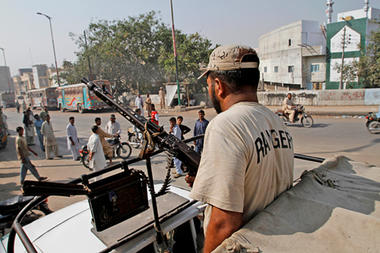
Surrounding our barracks and the control tower, hangars, airfield, and base itself are Pakistani military guards and commandos – tough, well-trained men armed with assault rifles and pistols tasked with maintaining security 24 hours a day.

I didn’t know what to make of these guys when I first saw them. Take, for example, the sturdily built sergeant (whom I now know as Ishaq) with a graying beard and long mustache whose appearance alone made him perfect to work for security.

“Where is your card?” He demanded one night as I waited by the control tower. I had ventured outside without my security badge affixed to my jacket. “Kidr ja rahe ho? (Where are you going?)” He continued sternly. “Here, sit down. Speak to my officer.” He motioned toward a chair and a gentleman wearing civilian clothes.

I produced the card from one of my cargo pockets, thankfully, and was able to excuse myself to the barracks, but Ishaq had made an impression. I vowed never to go anywhere without my security badge prominently displayed.

I mentioned the incident to some of my fellows, and they shared similar stories of this tough-looking sergeant. So the next time I saw him, I gave him some distance. Surprisingly, Ishaq called out to me. “How are you?” he asked, smiling, and we made small talk for a few minutes. The time after that, he gave me a hug and a handshake, and we chatted as if we were old friends. Within a few days, I had progressed from stranger to brother.

Working closely with Pakistanis for the past three months, I have seen that gestures of friendship like Ishaq’s are commonplace. They usually stand when someone enters the room, hug him, shake his hand, and offer chai. They love conversation and want to hear about each other’s families and speak about their own. Even people in far-flung villages will ply us with tea and food, inviting us to try our best at Urdu. This interaction is called “gupshup”, and as another commando friend told me today, “Zindagee sirf gupshup hay.” Life is just chitchat.

As I am writing this, I hear my American friends bantering outside the barracks. Some are playing a spirited game of dominoes. Others are telling jokes and laughing. Gupshup is not unique to Pakistan, but somehow Pakistan’s gupshup is unique. It’s in-your-face. I find myself unable to maintain a demure affect because everyone is so curious and welcoming. “Bockmann!” I hear as I walk to the washroom or hangar. “Assalamu aleikum! Keah hal hay? (Peace be with you! How are you?)”

Suffice to say, there is practically no way to go anywhere without saying hello to everyone, once they know you. I call it the “Gauntlet of Goodwill.” Friends, strangers, soldiers, and civilians – everyone greets us warmly. My friend Naeem calls me “brother” and asks how our family in America is doing. This makes me feel at home.

I hardly imagined Pakistanis would treat us so well! They are often critical of our government and society – as well as their own – but they see the good as well, and they are among the most courteous, genuine, and caring people I have ever met.

My American friends and colleagues can attest to this. Fellow pilots CW2 Denoncour, CPT Powers, and even our battalion commander, LTC Knightstep, have shared plenty of “doodh patii” (milk tea) with our hosts. CW2 Jenkins and PFC Mahadeo are regulars in the afternoon cricket matches. Several Pakistani friends have brought gifts for our families, as we bring stuffed animals for children in the villages. We have celebrated Eid and comforted each other in times of loss. Surely, this is not just flood relief but friendship.

Henry David Thoreau insisted that “No exertion of the legs can bring two minds much nearer to one another,” but I disagree. I’m glad we travelled from America to fly our humanitarian missions here because not only are we filling a profound need, but meaningful friendships are being made. Indeed, our gupshup and chai have brought minds “much nearer to one another” on topics ranging from politics and cricket to religion and movies.

After three months in Pakistan, I have come to appreciate this country for its breathtaking landscape and mouth-watering food. But more than these, I love it for its people, my friends: Ishaq, Naeem, and all the rest of the “Gauntlet of Goodwill”.

11/26/2008: How India Debated a War With Pakistan that November

By Pranab Dhal Samantha for Express India
The last of the 26/11 terrorists had been killed only a few hours back when Prime Minister Manmohan Singh presided over an urgently called meeting of the country’s security top brass. Present at that meeting on November 29, 2008, were Defence Minister A K Antony, the then National Security Advisor M K Narayanan, heads of both intelligence agencies and the three service chiefs — the Army was represented by its Vice-Chief Lt Gen M L Naidu as Army Chief Gen Deepak Kapoor was overseas — among other high-ranking officials. The key issue on the agenda — India’s response.

By then, there was no doubt among any of those present at this meeting, which lasted for over two hours at the PM’s residence, that the entire attack had been controlled, coordinated and plotted by the Lashkar-e-Toiba and its handlers in Pakistan. An undeniable body of evidence had already piled up from the calls monitored between the terrorists and their handlers in the course of the attack. More evidence was pouring in by the hour. There was no way any government in New Delhi could drag its feet — the Prime Minister knew he had to ask the dreaded question to all those responsible for the defence of India.

He started with the words that the people of India “will not forgive us” for what had happened and that the government had indeed failed them. This was not an empty comment. About 10 days before, US intelligence had intercepted a phone call from “somewhere in the Arabian Sea” to Pakistan-occupied-Kashmir. The input with coordinates of the boat’s position had been passed on to Indian agencies and then disseminated but not with the immediacy and urgency it deserved. Coast Guard authorities carried out reconnaissance sorties but by then it was too late. They found nothing on those coordinates except for scores of fishing boats that looked alike. The boat had obviously moved on. The Coast Guard filed a report that it needed the latest coordinates. And that’s where matters lay until the night of November 26 when the 10 terrorists surfaced in the heart of Mumbai.

Yet, the Prime Minister kept his calm and turned to the three service chiefs. He asked them whether they had any options in mind. In the same breath, he preemptively made it clear that he did not favour another Operation Parakram. That option was off the table from day one, recall sources. The then Navy Chief Admiral Sureesh Mehta chose to remain quiet. After all, the Navy was carrying out exercises in the area when the 10 terrorists slipped in without raising an alarm. The Army Vice-Chief wanted to wait for Gen Kapoor to return before they could crystallise their thoughts.

It was Air Chief Marshal Fali Major who eventually spoke up and suggested striking terror camps in PoK. The Air Chief was sure that his planes and pilots could do the job but the intelligence agencies would have to provide the coordinates. There was no further discussion on the subject that day, but it was also not the last conversation.

So, how close did India and Pakistan come to war? The views range from “very close” to “fleetingly close” but the fact which all key players confirm is that the military option was indeed on the table. It was subsumed by only a larger question of how would Pakistan react?

IN the days that followed, the military top brass went aboutnworking on the options. The Air Force, in particular, did go into the finer aspects of conducting a limited air strike in PoK but the political decision-making never moved any further.

However, the Defence Minister did hold a meeting with the three service chiefs after the PM’s first meet. At that point, the Army Chief was asked whether limited ground strikes could be carried out. Gen Kapoor is said to have responded that an operation was possible but he would need a week’s notice and that it would be a “highly risky” affair. He is said to have added that any political approval on this must include flexibility for the Army to respond anywhere along the LoC or for that matter, even the international border. In the Army’s assessment, any strike would definitely lead to an escalated military conflict and the government ought to prepared for it. The Air Force agreed that a strong Pakistani reaction was certain but was not willing to predict the levels of escalation.

While this continued, the Army proposed that it would like to prolong the stay of two of its brigades involved in a scheduled peacetime military exercise on the Rajasthan border. The go-ahead was given and the two brigades overstayed for about two weeks.

Much later, in early January, when then Foreign Secretary Shivshankar Menon, who is now the National Security Advisor, visited the US, his eloquent assertion in all his meetings about how India had not provoked Pakistan was only once challenged. Gen David Petraeus is learnt to have told him that this was not true because Indian troops had overstayed after finishing their military exercise. To Pakistan, he felt, this was a provocation to which it gave a disproportionate response by placing troops on alert and moving its fighters closer to the border.

There was also another incident about an Indian plane violating Pakistan airspace which apparently led to a F-16 scramble on the Pakistan side. Islamabad lodged a strong diplomatic protest. India denied with equal conviction. But at the same time the Air Force was asked to carry out an investigation.

The result was that there was indeed some violation by a reconnaissance plane of the Aviation Research Centre, RAW’s air wing, that was conducting a sortie along the LoC. This aircraft, perhaps, went too close to the LoC, violating the rule that both sides will not send their aircraft that near.

A few days later, a meeting was held in the nuclear bunker where the top leadership of the government is to be rushed in case of a nuclear strike. This was not provoked by 26/11. It was scheduled much before the attacks with the objective of familiarising the PM and other ministers of the emergency drill. But in the backdrop of the Mumbai attacks, the meeting could not have ignored the security environment of the day.

The PM is believed to have asked how would one distinguish a nuclear strike from any other non-nuclear, yet devastating attack. This was important because like many in the bunker, he too wanted to be sure that sufficient safeguards were in place to prevent a mistaken response. A long explanation was given. The PM then wanted to know if there was a chance Pakistan could misjudge a conventional strike by India and trigger a nuclear response.

There was near silence. Pakistan, by then, had already created “war hysteria” which many felt was unprovoked. The larger consensus was that you could not be sure about Pakistan’s response. It’s reliably learnt that it was this uncertainty which halted Indian strategists from fully backing any military response.

Under considerable pressure to show some response, the Prime Minister had independently tasked Menon to draw up a list of India’s options. Menon did carry out the exercise like a professional and gave an unsigned note that started with extreme measures like a limited military strike to less effective but dramatic steps like scaling down diplomatic relations, stopping cricketing ties, visa restrictions among others. He and Narayanan met regularly, at the PM’s instructions, to discuss the question of options in the days and weeks after the attacks.

In the wake of all the uncertainty over how Pakistan would respond, there was also talk about the “deniable option”. One which would involve covert operatives carrying out a sensational strike in Pakistan or in PoK. It’s learnt that RAW and the Army were specifically asked this question. RAW’s response to the NSA stunned all except, perhaps, Narayanan himself who is among the doyens of Indian intelligence. India’s premier external intelligence agency admitted that it had no assets in Pakistan to carry out such an action. It was explained that India lost all the meagre local support it had in pockets of Pakistan after the Babri Masjid attack and what little was left, was shut down by a prime ministerial diktat during I K Gujral’s tenure.

The Army said it had the ability to carry out commando operations but the government had to be clear what would be the approach if anyone was apprehended. Also, the Army let it be known that it was not sure how Pakistan would react if it found out.

This discussion headed nowhere after this because the ground realities were clear that India had consciously not cultivated this option. Some others felt it was pointless to discuss the “deniable option” because the whole idea of a response should be that the “other side” should know who did it.

Just as Singh deliberated these issues here, on November 29 itself, then US President George W Bush held a meeting with his security advisors and also on the video link with his missions in India and Pakistan. He told them that the last time something like this happened in the United States, “we went to war”. Prime Minister Singh, he added, was also under immense pressure and that the United States must do all it can to help him so that he does not go to war.

That eased matters a bit as Bush made it clear to Pakistan that it needed to “roll up and crush” the terror outfit behind the attack. US assistance was unprecedented, forcing Pakistan to accept that the attack was carried out from its soil.

But when the dust settled, all agreed that the unpredictability on the Pakistan side and the fear that its decision makers could opt for a disproportionate response, including the nuclear option, stymied any possible chance of military action on India’s behalf after 26/11.

After the first two weeks following the attack, the question that overtook everyone’s mind was what if there is another terror strike? Would India be able to hold back then?

Two years later, when asked if that phase is now over, a high-ranking security official remarked: “I can’t say, but I think that the question is still as serious. Can we keep quiet if there is another Mumbai? No, this question is still relevant.”

More Military Aid to Pakistan?

By Aaron Mannes, Rennie Silva and V.S. Subrahmanian for The Huffington Post

As part of the U.S.-Pakistan Strategic Dialogue, the United States has granted Pakistan over $2 billion in military equipment over the next five years. This aid is intended to support American policy objectives and help stabilize Pakistan, but it may be achieving the opposite.

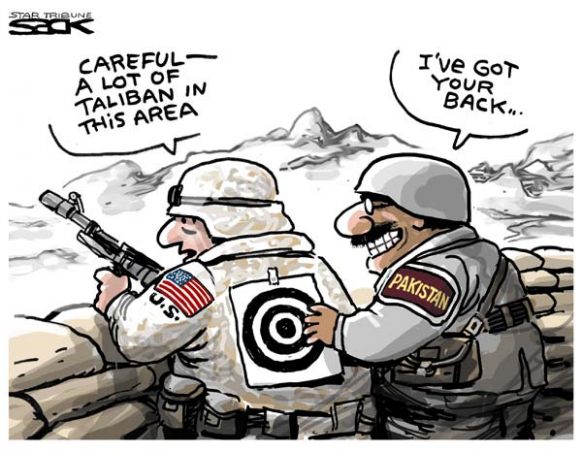
Military aid for Pakistan has a clear, if narrow, logic: to ensure the supply lines for the 100,000 American and NATO ally troops deployed to landlocked Afghanistan. The United States has few viable alternatives to the Pakistani-controlled routes into Afghanistan. When Pakistan recently shut down the Torkham crossing into Afghanistan (after an accidental border clash with a NATO helicopter that left two Pakistani soldiers dead and four wounded), supply trucks backed-up and Pakistani Taliban set fire to over 100 vehicles. Though there was no immediate danger of shortages, the event signaled how difficult US-led operations in Afghanistan could become without support from Pakistan’s military.

Despite its indispensable role in the war in Afghanistan, Pakistan’s own stability is in doubt and military aid has been of limited utility. Since 9/11 the United States has delivered over $18 billion in aid to Pakistan, about two-thirds of which has been military. In that period, violence by Pakistan-based terrorists both within Pakistan and without has increased substantially. According to the National Counter Terror Center’s World Incidents Tracking System, 110 Pakistanis were killed in terror attacks in 2004. By 2007 that number had jumped to 400, and in 2008 the casualty figure more than doubled to nearly 900.

As illustrated by the recent bombing of the Criminal Investigation Building in Karachi which killed 20, American aid has not enabled Pakistan’s security forces to control the violence. Instead, Pakistan has become a base for terrorism not only targeting the Pakistani state but also India, as demonstrated by the 2008 Mumbai massacre and a deadly series of 2006 commuter train bombings in Mumbai which killed over 200 people. India’s response to these attacks has been muted, but its restraint is finite. Open hostilities with its neighbor to the east would be devastating for Pakistan, and could even trigger a nuclear exchange.

Although several thousand Pakistani soldiers have died fighting Islamist extremists, the Pakistani security establishment has been slow to adopt counter-insurgency methods of war fighting. Instead, it has preferred to continue its India-centric focus. Investigations of U.S. military aid intended to help Pakistan fight the Taliban find that it is often re-purposed to counter India. “I’ll be the first to admit, I’m India-centric” Pakistani army chief of staff Gen. Ashfaq Parvez Kayani told Bob Woodward in his latest book, revealing a long-term strategy that is at odds with US interests.

Pakistan’s ongoing use of Islamist terrorists as proxies against India is especially troubling. President Zardari, who has stated “the undeclared policy of running with the hare and hunting with the hound was abandoned,” claims that Pakistan has turned against Islamist militants. But Pakistan’s generals have not received the memo, as investigations into the Mumbai attack show that links between at least some elements of the ISI and Lashkar-e-Taiba continue.

Pakistan has pursued some Taliban forces in its tribal areas, while leaving others alone to support future Pakistani interests in neighboring Afghanistan. Under such circumstances, America’s military aid is at best fueling Pakistan’s longstanding rivalry with India, and at worst enabling its enemies.

Pakistan’s high defense spending has robbed critical social programs of necessary resources. Pakistan continues lag behind comparable countries in general development indicators such as literacy and infant mortality, while its infrastructure is stretched to keep up with the needs of its fast-growing population. Under-funded and corrupt government institutions compound the situation. As Pakistan’s civilian and military leaders cynically seek to distract the public from these shortcomings, it is little surprise that Islamist groups often fill the vacuum by providing critical services or that the Pakistani people increasingly fall under their spell.

The long-term development shortfalls of Pakistan’s government have been exacerbated by a series of disasters including the 2005 Kashmir earthquake, the 2008 economic crisis, and last summer’s massive flooding. The latter, which caused nearly $10 billion in damage, has created millions of refugees and devastated an irrigation system that was strained to meet the demands of Pakistan’s agricultural sector before the flooding. Today, its failure threatens to cripple a vital sector of the Pakistani economy for years to come.

American development aid cannot counter decades of Pakistani neglect, but it can play a productive role in addressing critical needs. Providing Pakistan with more military capability-capability that could contribute to regional instability if it is used on American allies-is unlikely to achieve either.

Pakistan Rejects U.S. Drone Expansion

By Alex Rodriguez for The LA Times

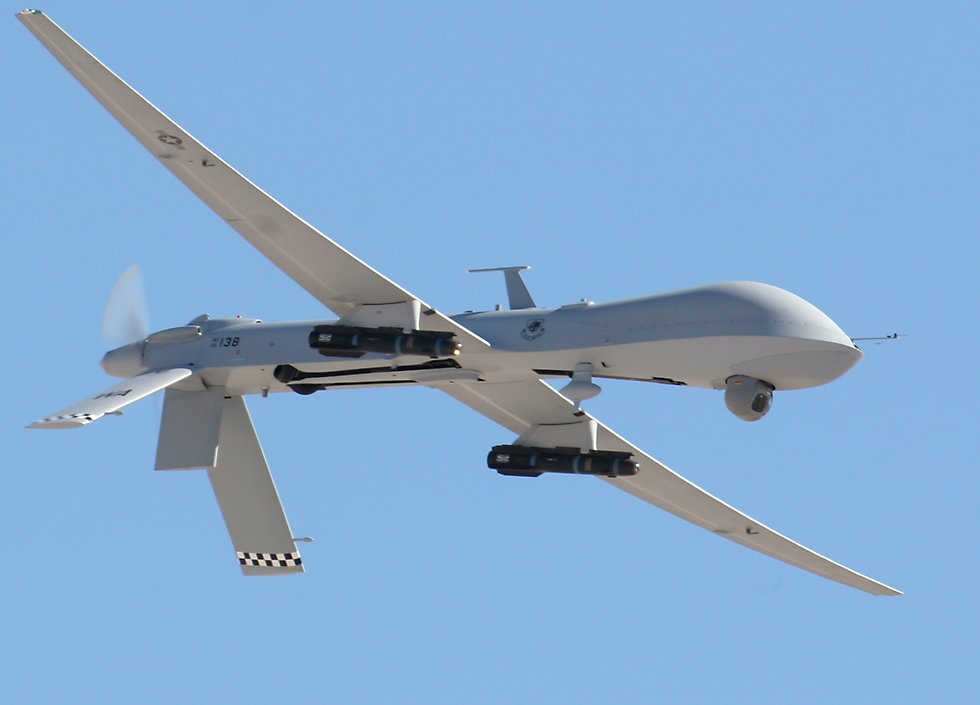
Pakistan has rejected a request from the U.S. to expand a drone missile campaign against Al Qaeda and Taliban militants, a decision that limits Washington’s use of one of its most effective tools against insurgents hiding in the nation.

Pakistani Foreign Ministry spokesman Abdul Basit said Islamabad would not allow the U.S. to carry out drone strikes outside the tribal belt along the Afghan border and repeated the government’s request that Washington abandon its use of drones in Pakistan on the grounds that the program violates the country’s sovereignty.

Basit did not say which additional areas the U.S. wanted to target. However, the Washington Post reported Saturday that the request focused on areas outside the southern city of Quetta, where Afghan Taliban leaders have hideouts.

“We are allies of the United States in the war against terror,” Basit said. “However, Pakistan will not compromise on sovereignty.”

Islamabad’s refusal comes as little surprise, given the animosity that the drone campaign has stirred among Pakistanis for years, but even as the government publicly condemns the drone program, it tacitly allows the missile strikes to take place. Pakistan even provides intelligence to facilitate the targeting of the strikes.

The drone missions are deeply unpopular in Pakistan, where they are viewed as an illustration of President Asif Ali Zardari’s willingness to acquiesce to most demands that Washington makes. Allowing an expansion of the drone program could further aggravate the vulnerability of Zardari’s government, already weakened by its mishandling of this summer’s catastrophic floods and the country’s ongoing economic troubles.

Any expansion of the drone campaign into Baluchistan, the province where Quetta is located, would also represent a dramatic departure in policy for Islamabad because it is not part of the semi-autonomous tribal region where the drones are permitted now.

In addition, the Quetta region is a heavily populated area; the city itself has a population of 900,000. The core leadership of the Afghan Taliban insurgency, known as the Quetta Shura and headed by Mullah Muhammad Omar, has used Quetta and its outlying regions as a sanctuary for years.

In recent months, the U.S. has dramatically stepped up its use of drone strikes in the tribal areas. So far this year, the U.S. has carried out 101 drone missile strikes in northwest Pakistan, compared to 53 in 2009.

The attacks have focused largely on North Waziristan, a primary stronghold of militants and commanders belonging to the Haqqani network, an Afghan Taliban wing regarded by the U.S. as one of the biggest threats facing coalition forces in Afghanistan.

According to the Long War Journal website, which keeps track of drone missile strike statistics, 92 of the attacks this year occurred in North Waziristan.

India, Pak Almost Agreed on K-deal: Musharraf

 As Reported by The Press Trust of India

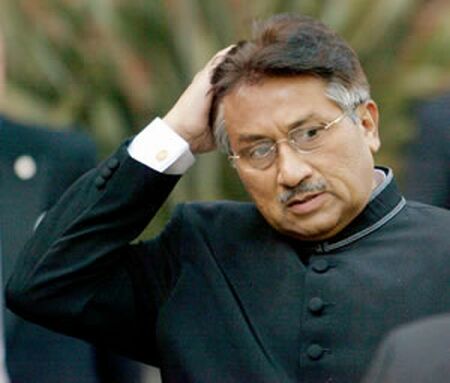
Former military ruler Pervez Musharraf on Friday said India and Pakistan were “moving forward towards drafting an agreement” on Kashmir during his tenure and that Prime Minister Manmohan Singh was genuinely committed to peace in the region. “I was certainly trying for it (peace).

And we were reaching success. I have always praised Prime Minister (of India) for his sincerity to reach peace,” said Musharraf, in an interview with NPR. Manmohan Singh and we almost reached peace on all the three issues…the third one, Kashmir, we had made some certain parameters and we were moving forward towards drafting an agreement,” he added. “Unfortunately, that was not to be, but I tried my best.”

Noting that peace is the only way forward, Musharraf noted that the deadlock on Kashmir was rendering the South Asian Association for Regional Cooperation (SAARC) useless.

“And I think the way forward is peace for the sake of world, which thinks that this is a nuclear flash point; for the sake of SAARC, which is impotent because of the conflict because of India and Pakistan,” said the former president.

“And for the sake of bilateral Pakistan-India advantages socio-economic advantages which will flow from peace between the two countries,” he noted.

Musharraf is in the US to drum up support for his comeback, which he announced earlier this year by launching a new political party — the All Pakistan Muslim League that would contest elections in 2013. Earlier this week, he accused India of trying to create an “anti-Pakistan Afghanistan.” “If I’m allowed to be very, very frank, India’s role in Afghanistan is to create an anti-Pakistan Afghanistan, said Musharraf, speaking at the Council on Foreign Relations on Tuesday.

Today, he characterised the narrative of the Indo-Pak dispute as “impartial”. “So, unfortunate reality, why I have to be so emotional about it, is every time it is Pakistan who is a rogue,” he said.

“Indian bomb is not a Hindu bomb. Pakistan bomb is a Islamic bomb. I think we are being very impartial, we are being very unfair to Pakistan…”

Pakistan Bomb Shows Militant Reach

By Shakil Adil for The Associated Press

A coordinated assault on a police compound far from Taliban and al-Qaida heartlands along the Afghan border showed the ability of militants to strike back despite being hit by U.S. drone strikes and Pakistani army operations.

The Pakistani Taliban claimed responsibility for Thursday night’s attack in downtown Karachi, the country’s largest city and commercial hub, according to media reports. Fifteen people were killed and more than 100 were injured in one of the first coordinated strikes against a state target in the city.

The Pakistani Taliban is allied with al-Qaida and has emerged as the most potent threat to the stability of the nuclear-armed country since 2007. Its suicide squads have killed thousands of people in attacks on government, security force and Western targets, most of them civilians, shaking faith in the civilian government.

“These attacks which are happening around the country, they are carried out by enemies of the nation,” said Faisal Mehmood, a resident of Karachi, said Friday. “It is not in Islam that you kill your brothers.”

The gang of around six gunmen managed to penetrate a high-security area of Karachi that is home to the U.S Consulate, two luxury hotels and the offices of regional leaders. They opened fire on the offices of the Crime Investigation Department before detonating a huge car bomb that leveled the building and others nearby.

The police offices housed a detention facility that was believed to be holding criminals. There were conflicting accounts over whether militants were also being held there.

The CID takes the lead in hunting down terrorists in Karachi. Earlier this week, the agency arrested six members of Lashkar-e-Jhangvi, an al-Qaida linked group blamed for several high profile attacks in recent years. The suspects were presented before a court earlier Thursday.

Islamist militants are known to have found shelter among Karachi’s 14 million people, and their have been occasional attacks on Shiite Muslims, whom al-Qaida and the Taliban believe to be infidels, as well a blast last month at a Sufi shrines.

But it had largely escaped a wave of violence last year that saw many attacks in Lahore, Pesahwar and other cities.

The government has declared war on the militants, and the army has moved into several areas in the northwest close to Afghanistan. The United States has increased the tempo of missile strikes in the region over the last two months, with close to 100 this year alone.

But the Pakistani state still distinguishes between militants who attack inside Pakistan and those who focus on fighting U.S. troops in Afghanistan or Indian rule in the disputed Kashmir region, believing the latter to be “good” militants. Critics say this policy is shortsighted, noting that groups are increasingly coalescing and support each other.

How to Win Back Pakistan

By Michael O’Hanlon for Foreign Policy

Nine years into the war in Afghanistan, the United States should have a clear idea of Pakistan’s interests there. It’s time to take these lessons to heart — and start applying the right incentives. As recent intelligence findings reported in late October confirm, Pakistan remains at the heart of the U.S.-led coalition’s problems in Afghanistan — where the war is hardly lost, yet hardly headed for clear victory either. Indeed, Pakistan arguably remains the most complex ally the United States has ever had in wartime, making President Franklin D. Roosevelt’s challenges in dealing with Stalin (a far worse leader, but at least one who knew the outcome he wanted) seem simple by comparison.

Nine years into the campaign, we still can’t clearly answer the question of whether Pakistan is with us or against us. America needs bold new policy measures to help Islamabad — in all its many dimensions and factions — make up its mind.

The crux of the problem is this: Despite allowing massive NATO logistics operations through its territory and helping the United States pursue al Qaeda operatives, Pakistan tolerates sanctuaries on its soil for the major insurgencies fighting in Afghanistan. These include the Afghan Taliban (otherwise known as the Quetta Shura Taliban because its principle base remains in Quetta in the Pakistani province of Baluchistan) as well as the Haqqani and Hezb-i-Islami Gulbuddin (HiG) networks. The Haqqanis straddle the border between the Afghan provinces of Khost, Paktia, and Paktika as well as North Waziristan and other tribal areas within Pakistan; HiG is further north, operating in and around the Khyber Pass connecting Kabul and Jalalabad in Afghanistan with Peshawar and points east in Pakistan. Thus, all three major Afghan insurgent groups have home bases in Pakistan, and despite the occasional drone strike are generally beyond NATO’s reach as a result.

Pakistan has done some worthy things against extremists in its remote northern and western areas in recent years. Specifically, it has recognized the so-called Pakistani Taliban (the Tehrik-i-Taliban Pakistan, or TTP) as a mortal threat to the Pakistani state and responded accordingly. After suffering hundreds of bombings and assassination attacks by the TTP, including the killing of former Prime Minister Benazir Bhutto in 2007 and several thousand casualties a year to its troops and citizens since roughly that time, it has responded in force, particularly over the last year and a half or so. It has swung about 100,000 troops previously guarding the border with Pakistan’s nemesis India to the northwestern tribal regions and cleared several major areas including South Waziristan, Bajaur, and the Swat Valley. This is all to the good.

Pakistanis argue, however, that limited numbers of ground troops combined with the past year’s admittedly devastating floods prevent them from doing more. Quetta, North Waziristan, and other key places remain dens of iniquity, havens for extremists who continue to attack NATO and Afghan troops across the border and then return home for rest, regrouping, and fresh recruiting. Major command-and-control hubs are permanently located within Pakistan as well, and key insurgent leaders like Mullah Omar (to say nothing of Osama bin Laden) probably remain safely ensconced on Pakistani territory where U.S. forces cannot get at them.

But even if limited Pakistani capacity is part of the problem, there’s more at stake. Pakistan worries that President Barack Obama’s promise to start reducing U.S. troops in Afghanistan come July will lead to anarchy and civil conflict next door, and it is retaining proxies that it can use to ensure that its top goal in Afghanistan — keeping India out — can be accomplished come what may. Pakistan would rather have the Taliban and the Haqqanis back in power, especially in the country’s south and east, than any group like the former Northern Alliance, which it views as too close to New Delhi. It is this strategic calculation, more than constrained Pakistani resources, that constitutes Obama’s main challenge in Afghanistan. And it could cost him the war.

Under these circumstances, part of the right policy is to keep doing more of what the Obama administration has been doing with Pakistan — building trust, as with last month’s strategic dialogue in Washington; increasing aid incrementally, as with the new five-year $2 billion aid package announced during that dialogue; and coordinating militarily across the border region. But Obama also needs to think bigger.

First, he needs to make clear America’s commitment to South Asia, to wean Pakistan away from its current hedging strategy. Obama has frequently used general language to try to reassure listeners in the region that there will be no precipitous U.S. withdrawal next summer. But few fully believe him. Hearing stories like Bob Woodward’s accounts of how the vice president and White House advisors have generally opposed a robust counterinsurgency strategy in favor of a counterterrorism-oriented operation with far fewer U.S. troops, they worry that next summer’s withdrawal will be fast. Obama needs to explain that he will not revert to such a minimalist “Plan B” approach under any imaginable circumstances. More appropriate would be a “Plan A-minus” that involves a gradual NATO troop drawdown as Afghan forces grow in number and capability, without necessarily first stabilizing the entire south and east, should the current strategy not turn around the violence by next summer or so. This would represent a modification to the current plan rather than a radical departure. The president can find a way to signal that this is in fact his own thinking, sooner rather than later — ideally before the year is out.

Second, Obama should offer Islamabad a much more expansive U.S.-Pakistani relationship if it helps win this war. Two major incentives would have particular appeal to Pakistan. One is a civilian nuclear energy deal like that being provided to India; Pakistan’s progress on export controls in the wake of the A.Q. Khan debacle has been good enough so far to allow a provisional approval of such a deal if other things fall into place as well. Second is a free trade accord. Struggling economically, Pakistan needs such a shot in the arm, and a trade deal could arguably do even more than aid at this point.

But the key point is this: Pakistan should be told that these deals will only be possible if the United States and its allies prevail in Afghanistan. Small gestures of greater helpfulness are not adequate; bottom-line results are what count and what are needed. If Afghanistan turns around in a year or two, the deals can be set in motion and implemented over a longer period that will allow the United States to continually monitor subsequent Pakistani cooperation in the war.

It may seem harsh to Pakistan that America would put things in such stark terms — but in fact, it is not realistic that any U.S. president or Congress would carry out such deals if the United States loses the war in Afghanistan partly due to Pakistani perfidy. As such, these terms are really just common sense, and they are based on political realism about America’s domestic politics as well as its strategic interests.

America’s current strategy for the war in Afghanistan is much improved. But it is not yet sound enough to point clearly toward victory. The most crucial problem is the role of Pakistan in the war, and so far, the Obama administration is not thinking creatively enough about how to fix it.

The Nexus of US-India-Pakistan Relations

By Manzer Munir for Pakistanis for Peace

As President Obama wraps up his visit to India in the next day, a couple of things are important to point out about relations between the United States and India as well as how Pakistan fits into the equation.

The balance of power between India and the US still lies with the United States, however, India is set to make more and more gains in becoming more influential as its economy grows and as the United States looks to it to counter China in Asia.

The strategic partnership between the two countries and the importance of India for the United States is going to become vital as America uses India to contain China’s influence in the region and around the world.

We do believe that President Obama is correct in stating that relations between the two countries warrant being called the defining relationship of the century as there is no other country that compliments the United States presently in the world as does India. Not only do both countries share democratic ideals and a multiethnic population, but both countries are also increasingly dependent on each other’s economies. Add to this the nuclear cooperation as well as America’s support for India to get a permanent seat on the UN Security Council, and it becomes evident that this relationship will continue to grow over time.

President Obama has offered criticism on Pakistan already but is careful in trying to walk the tight rope act that is India-Pakistan relations. There are certainly more behind the scene steps taking place that will chide Pakistan into doing more. But in our view, the single most important thing that the US and the Obama administration can do is to help India and Pakistan come back to the table to get the peace process moving along. There is widespread agreement with the President’s assessment that a prosperous and stable Pakistan is in the best interests of India, Afghanistan and the region. In this effort, we believe there needs to be done more by all parties involved.

India’s argument has always been that the terrorist infrastructure and support for some anti-India militant groups needs to end before New Delhi will resume the peace process with Pakistan.

India should not refuse extensive trade relationships with the US due to American support of Pakistan as it does not do anything to help India. India realizes the situation both inside Pakistan and America’s dependency of the Pakistan Army’s support in flushing out the Taliban. It would go against India’s interests if it put its relationship and advancement with the United States as being dependent on American support for Pakistan and its vital assistance in the war in Afghanistan and on terror.

Peace between India and Pakistan and in the Kashmir valley is the only solution to both the conflict between the two nations as well as it is in America’s interests for both countries and the region. Furthermore, peace between the two countries will allow both Pakistan’s full focus on the Afghan border in helping American troops against the Taliban as well as the elimination of anti-India militant groups within Pakistan, many of whom are alleged to still be receiving support from elements within Pakistan’s ISI spy agency, much to India’s chagrin.

Obama Calls for India – Pakistan Peace

By Andrew Buncombe for NZ Hearald

Barack Obama has called on India and Pakistan to renew their efforts to find peace, even as he said Islamabad was not moving quickly enough to counter militants operating from inside its borders.

In comments that appeared to underscore the high-wire act of diplomacy the US president is trying to pull off while on the three-day visit to India, Mr Obama said Washington would not act as an intermediary between the two countries.

However, he told a group of students in Mumbai: “My hope is that over time, trust develops between the two countries, that dialogue begins, perhaps on less controversial issues, building up to more controversial issues. There are more Pakistanis who’ve been killed by terrorists inside Pakistan than probably anywhere else.”

The president has received criticism from some opposition parties in India after he failed to directly mention Pakistan when he arrived in India on Saturday and spoke of the 2008 attacks at the Taj Hotel and other locations in Mumbai, that left more than 160 people dead.

In the aftermath of the attacks, the so-called “composite dialogue” peace process between India and Pakistan was put on hold and while there have been a series of high-level meetings, the relationship between the two remains tense.

The president, who stayed at the seafront hotel in what aides said was a clear sign of solidarity, had talked about the militants and the terror they wrought, but was criticised by the right-wing Bharatiya Janata Party (BJP) for failing to attribute the blame to Pakistan.

Asked why he had not done so, Mr Obama reflected a reality in which the US is paying billions of dollars to Pakistan in aid as it pushes it to do more against militants responsible for cross-border strikes in Afghanistan.

“Pakistan is a strategically important country, not just for America, but for the world,” he said. “India and Pakistan can prosper and live side by side. This can happen and this should be the ultimate goal. The US can be a partner but cannot impose this process. India and Pakistan have to arrive at an understanding.”

Mr Obama started his visit to India, one of four countries he is including on a tour through Asia, by announcing more than 20 deals he said were worth up to $10bn and would help support 50,000 US jobs.

He also said the US was to relax export controls over sensitive technology, a demand of India’s that will help deepen ties between the two countries. The president is to hold formal talks today with India’s prime minister, Manmohan Singh.

On a domestic level, Mr Obama also recognised he needed to make “midcourse corrections” in the aftermath of last week’s mid-term elections if he is going to win over a frustrated and divided electorate.

Pakistan Looks Ahead to End of Afghan War

By Olivia Ward for The Toronto Star

As NATO forces prepare to pull out of Afghanistan, worries about the country falling back to Taliban control are paramount. But in neighbouring Pakistan, where suicide bombings and brazen attacks on security forces have become regular occurrences, the stakes are also high.

“What happens in Afghanistan affects us and vice-versa,” says Akbar Zeb, Pakistan’s High Commissioner to Canada. “We have four million Afghan refugees still living in Pakistan, and it’s in our interest to have a stable country where we can send them back. A Taliban takeover won’t be just detrimental to Afghanistan. It would harm Pakistan and the whole region.”

Zeb said that under the civilian government of President Asif Ali Zardari, relations have improved with Afghanistan, and contrary to reports of friction, there are “frequent contacts” between the two countries that would be helpful in creating stability.

But he added that Canada, and other Western countries, should not repeat the mistakes of the post-Soviet era, when the West lost interest in Afghanistan and Pakistan as soon as the Soviet troops withdrew.

During the rule of Pakistan’s military leader, President Pervez Musharraf, groups of Taliban-linked militants got a foothold in Pakistan, but were not seen as a danger to the country until internal attacks began to spread. Former prime minister Benazir Bhutto was assassinated, and suicide bombings took the lives of hundreds of civilians. Under pressure from the U.S., the Pakistani military began a massive campaign against the Taliban along the Afghan border.

“We have managed to clear a lot of areas from the Taliban,” said Zeb. “Military campaigns are the only language they understand. But they alone won’t help to win the war. We have border regions with a lot of poverty, and backward elements that have been ignored for a long time.”

Canada has announced support for road and rail projects linking Afghanistan and Pakistan to speed trade between the two countries.

“It’s a very good initiative, but scope is limited,” said Zeb.”We wish the projects were larger and not just (confined to) those that involve both Afghanistan and Pakistan.”

Talks with Islamabad are also ongoing on the use of ports in Karachi for shipping out Canadian troops and military supplies from Afghanistan.

But as the war continues, Pakistan has also been urged to be tougher on the Taliban. In the past two years it has carried out attacks against the militants in its border regions with some success, while American-launched drone strikes have killed high-ranking Taliban. The catastrophic floods that wiped out some of the most important agricultural areas of Pakistan brought a temporary truce, but militant attacks have resumed since the waters receded.

Last week, talk of a peace deal between the notorious Taliban-linked Haqqani network, and an opposing tribe in the remote northwest raised fears that it could open the way for Taliban access to strategic border areas. But the U.S. has also urged a Pakistani offensive against the network in North Waziristan, a volatile region where 400,000 civilians are vulnerable to displacement.

According to Pakistani officials, the country has lost some 7,000 security forces in a decade of fighting the militants — more than three times the coalition deaths in Afghanistan. Meanwhile 30,000 Pakistani civilians have died. The border region, a tangle of mutually hostile tribes, remains a haven for militants.

“It’s a difficult balance for Pakistan,” said Zeb. “Foreign troops may leave, and for them Afghanistan is a distant land. We’re Afghanistan’s neighbours. We helped with the fighting in the decade-long war against the Soviets. And we have to live with the outcome of this war.”

New U.S. Ambassador to Pakistan Delivers Flood Relief

By Gunnery Sgt Bryce Piper for The Defense Video & Imagery Distribution Sysem

 U.S. Ambassador to Pakistan Cameron P. Munter distributed flood relief supplies today at a World Food Program distribution point at Hassan Khan Jamali, Pakistan.

As the newly-appointed ambassador, Munter participated in the operation to see and participate in the Pakistan and U.S. military flood relief efforts conducted in Sindh province.

“It is an honor to have the chance to work with the Pakistani military and the American military together, who are working to help the Pakistani people,” said Munter. “This is a place that I think all of us will remember as a symbol and as a reality of our cooperation, what we can do when we work together, when we face problems together. And I’m very, very grateful to the Pakistanis and Americans who’ve done all this work.”

Munter arrived at the Pakistan military’s Pano Aqil Cantonment in the afternoon and then flew to the Hassan Khan Jamali relief site where he and a team of Pakistani and U.S. military members unloaded approximately four tons of food aid from two helicopters. Pakistanis waiting at the site collected the humanitarian supplies for distribution in the surrounding area.

This was the ambassador’s first trip to flood-affected areas of Sindh since arriving in Pakistan Oct. 27.

In addition to delivering food aid, Munter and his wife Marilyn Wyatt had an opportunity to meet with local flood victims. The couple flew to Hassan Khan Jamali aboard a U.S. CH-53E Super Stallion helicopter of the 26th Marine Expeditionary Unit. 26th and 15th MEUs have been conducting humanitarian relief efforts from Pano Aqil Cantonment since Sept. 3, 2010.

The Marines there have delivered more than 3.7 million pounds (over 1.6 kilograms) of food and other supplies to more than 150 locations throughout Sindh Province, flying more than 450 heavy-lift helicopter sorties.

Since Aug. 5, 2010, U.S. military aircraft and personnel, working shoulder-to-shoulder with the Pakistan military, have provided humanitarian airlift for the delivery of more than 20 million pounds (over 9 million kilograms) of relief supplies and the transport of more than 27,000 displaced persons throughout Pakistan.

In addition to humanitarian airlift, the U.S. Government is providing more than $398 million to assist Pakistan with relief and recovery efforts, while USAID and other U.S. civilian agencies continue to provide assistance to flood victims.

U.S. efforts are part of a multi-national humanitarian assistance and support effort lead by the Pakistani government to bring aid to flood victims.

The Pakistan Paradox

By Bret Stephens for The Wall Street Journal

Any serious observer of the war in Afghanistan will tell you that we can’t win without striking hard at the safe havens the Taliban and its allies enjoy in Pakistan. That means going beyond drone strikes and deploying ground forces in places like North Waziristan.

Any serious observer of Pakistan will also tell you that such strikes would complicate, and perhaps fatally compromise, our relations with the country whose cooperation we require to win in Afghanistan.

Both observations are on the mark. Isolating the battlefield is a cardinal rule of warfare. So long as the Taliban can shrink away to Pakistan to lick their wounds and plot their return—as they have in the wake of their recent reversals in Kandahar—then we have failed to isolate them. Yet if Pakistan should begin to turn against us—as they briefly did earlier this month following the accidental killing of Pakistani border guards in a NATO strike—then we are the ones who will be isolated.

So how do we finesse the Pakistan paradox?

It helps to see the country for what it is. Pakistan suffers from an abandonment complex rooted in historical facts, especially the Pressler Amendment that cut off Pakistan-U.S. military ties throughout the 1990s. Those fears are compounded by a national paranoia that is the product of conspiracy theory, misplaced indignation and jingoism. The country’s elites typically divide between secularists, mainly feudal aristocrats or corrupt parvenus like President Asif Ali Zardari, and Islamists of either conservative or radical bent.

Standing astride the Islamist-secular divide is the military, which profits from cultivating both connections and is Pakistan’s most competent—and least accountable—institution. Down below is an ethnically fractious and largely destitute population of 170 million people, just emerging from a flood that swamped 20% of the country.

From this unsavory stew it’s unrealistic to expect a high degree of clarity or consistency in Pakistani policy. At best it leans one way or the other, never very far and rarely for very long. Mr. Zardari’s government has deployed the army against the Taliban, or parts of it, and consented to a dramatic increase in Predator strikes. But that’s happening concurrently with the intelligence service, or ISI, providing material aid to the al Qaeda-linked Haqqani network, and failing (or more likely refusing) to break up the so-called Quetta Shura of Mullah Mohammed Omar.

If there’s an overarching logic here it’s that Islamabad wants to preserve its options. Uncertainty about U.S. staying power in Afghanistan helps explain why Pakistan will not entirely forsake its erstwhile clients in the Taliban and the mujahedeen. Pakistani fears are further exacerbated by America’s recent tilt toward India. And while the Obama administration has made much of its aid packages for Pakistan—$1.5 billion a year on the civilian side, followed last week by the announcement of another $2 billion for the military—Pakistani officials complain that only a small fraction of the funds have been disbursed.

What, then, to do? First, instead of publicly lecturing Pakistanis on how they need to get tough with the Taliban, the administration would do better to make good on its existing commitments. Say what you will about Mr. Zardari’s abilities, he has aided the U.S. military effort in a way his predecessor Pervez Musharraf, supposedly a pro-American strongman, never did.

That’s a relationship to build on, quietly and incrementally, not to tear down. So it would be helpful if the administration doesn’t repeat the mistake of blabbing to Bob Woodward, whose book may have helped Mr. Obama seem more presidential but didn’t do any favors to his presidency.

Equally helpful would be to stop mindlessly demanding that military assistance to Pakistan go toward fighting the Taliban instead of arming against India. The missing ingredient in Pakistan’s counterinsurgency effort isn’t the right military tool kit, such as night-vision goggles or Apache helicopters. It’s the will of the Pakistani general staff to cooperate more fully in the fight. If that cooperation can be secured by selling conventional weapons such as F-15s and M-1 tanks to Pakistan, so much the better.

(As for India, it has less to fear from a reasonably well-armed, confident Pakistani army that has strong ties to the U.S. than it does from a poorly armed Pakistan that mistrusts the U.S. and continues to consort with jihadists as a way of compensating for its weakness.)

Finally, the administration ought to understand that Pakistan’s reluctance to defeat the Taliban at any price is a mirror image of our own reluctance. The July 2011 “deadline” to begin withdrawing troops was bound to affect Islamabad’s calculations, and not for the better. The sooner we junk it, the better the cooperation we’ll get.

It’s an old American habit to lament the incompetence and duplicity of our wartime allies, and Pakistan abounds in both qualities. But unless we are prepared to deal with Pakistan as an adversary, we must make do with it as a friend.

Pakistan Urges US to Intervene in Kashmir Dispute

As Reported by The Associated Press

Pakistan called Friday for President Barack Obama to intervene in its longstanding dispute with India over the Himalayan region of Kashmir, the cause of two of the three wars the nuclear-armed rivals have fought.

Pakistani Foreign Minister Shah Mahmood Qureshi made the unusually blunt appeal for Obama to seek a resolution of the dispute when he visits India next month, saying he should “redeem the pledge” he made as a candidate.

The conflict over Kashmir has been the main source of friction between India and Pakistan since they won independence from Britain in 1947. Pakistan has frequently sought outside intervention to resolve it but India vehemently opposes such involvement and the United States has traditionally stayed above the fray.

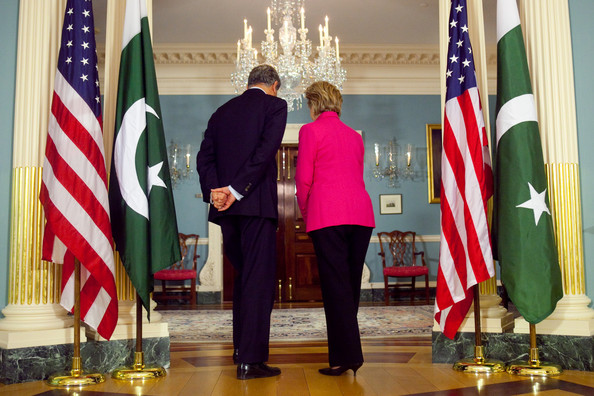
Qureshi, speaking next to Secretary of State Hillary Rodham Clinton at the closing day of three days of U.S.-Pakistan talks, said Obama must get involved because a crackdown against suspected Muslim militants in Indian-controlled Kashmir threatens the entire region.

“It is in the U.S. strategic interest to work for peace, stability and resolution of the disputes in South Asia,” he said. “The starting point in this quest is justice for the Kashmiri people.”

“President Obama has always understood the importance of a Kashmir solution,” Qureshi said. “His coming visit to the region is the time to begin to redeem the pledge that he made earlier.”

As a presidential candidate in 2008, Obama suggested that the U.S. should encourage India and Pakistan to resolve the Kashmir dispute so Pakistan could better focus on fighting extremists on its own territory and Afghanistan. Although he did not advocate direct mediation, his comments were met with disdain in India.

Obama will not visit Pakistan on his upcoming trip but he plans to spend several days in India, which has cracked down on violent anti-Indian protests in Kashmir since June. The violence has killed at least 111 people, mostly teenage boys and young men in their 20s. Authorities have imposed off-and-on curfews in an attempt to halt the unrest.

Quershi expressed astonishment that the U.S. and other major powers had said little about India’s response to the protests.

“People of conscience have protested the use of force against the defenseless people of Kashmir, in particular the targeting of the Kashmiri youth,” he said. “But the Kashmiri mothers are baffled by the deafening silence of the world’s leadership. History has proved that the force of arms cannot suppress the legitimate aspirations of the Kashmiri people.”

India and Pakistan fought two wars for control of Muslim-majority Kashmir, where rebels have sought independence from India or incorportation with neighboring Pakistan.

More than 68,000 people, most of them civilians, have been killed in Kashmir since fighting began in earnest in 1989.

Pakistan’s Musharraf is Launching a Long-Shot, Long-Distance Bid to be President Again

By Zain Shauk for The Houston Chronicle

Former Pakistani President Pervez Musharraf hopes to retake the leadership of his country, and he is actively campaigning — in Texas.

Musharraf, who relinquished his presidency in 2008, has a set of Houston meetings planned this week with wealthy Pakistani-Americans and corporate leaders.

He is scheduled to meet today with former President George H.W. Bush and Joanne King Herring, a longtime advocate for development in Afghanistan and Pakistan who was played by actress Julia Roberts in the film Charlie Wilson’s War.

Musharraf, a London resident, announced this month the creation of a new political party and a plan to run in Pakistan’s 2013 parliamentary elections.

But he has kicked off his campaign in the U.S., a decision that could say more about the perceived influence of the Pakistani-American community in cities such as Houston than Musharraf’s chances for success, experts say.

Musharraf said he believes connecting with Pakistanis in America will give him enough backing — financially and politically — to carry him to victory in Pakistan.

“I do need financial support, and I would ask the American Pakistani diaspora to support me … because I see darkness in Pakistan,” Musharraf said. “Because I don’t see a political party or a leader in Pakistan to be able to tackle the problems that Pakistan is facing.”

While Musharraf enjoys backing from the Pakistani-American elite, experts say he will be hard-pressed to develop a political base within his country and likely does not stand a chance against more established parties.

He is also in no position to campaign within Pakistan. Safety is a concern after multiple assassination attempts during his presidency, and he would likely face prosecution in connection with several criminal cases currently pending in Pakistani courts, experts said.

Still, Musharraf’s interest in wooing deep-pocketed Pakistani-Americans is revealing, said Walter Andersen, associate director of the South Asia program at Johns Hopkins University.

Not only do Pakistani-Americans play a role in financially supporting candidates, but their meetings in America are covered by Pakistani news media and seem to give politicians the idea that they are gaining traction, Andersen said.

Former Prime Ministers Benazir Bhutto and Nawaz Sharif also visited U.S. communities while campaigning, he said.

“Whether it works is not important,” Andersen said. “The perception among them (politicians) is that it works.”

Wide-ranging itinerary
U.S. communities don’t play a visible role in Pakistani elections, but Musharraf could stand to gain from his current North America tour, said Jamal Elias, an expert on contemporary Pakistan and chairman of the religious studies department at the University of Pennsylvania.

Musharraf’s itinerary will include stops in Chicago, New York, San Francisco and Toronto. He visited Dallas last week.

“Appearing statesman-like is going to help him in Pakistan,” Elias said. “It’s not going to build a constituency, but it may help him.”

There are more than 75,000 people of Pakistani origin in the Houston area, which includes more than 800 doctors, executives in the energy and information technology industries and scores of business owners, according to the Consulate of Pakistan in Houston.

Many of them have in the past contributed financially to political parties in Pakistan and will likely do so again, said M.J. Khan, a former Houston city councilman and member of the Pakistani community.

Khan said he does not send money to Pakistani political candidates, but knows U.S. residents in Houston and elsewhere who do. “They’re an educated community, and they send a lot of resources to Pakistan,” Khan said. “So I think every politician in Pakistan feels the Pakistani-American community is an important group to reach out to.”

Tactics questioned
Some community members – including Sajjad Burki, president of a Houston chapter for a political party headed by Pakistani cricket star Imran Khan – were not sure of the former president’s legitimacy as a candidate. Burki questioned Musharraf’s campaign tactics and priorities.

“It doesn’t make sense for him to be creating a political party and campaigning abroad rather than campaigning in Pakistan,” he said.

Herring, who is hoping to build support for Musharraf’s candidacy, said she planned to back him because of his support for her development efforts in Afghanistan.

“I think that Musharraf is interested in my plan,” Herring said. “I know he is. He supports it.”

Seeks ‘legitimacy’
Musharraf, a retired general, said he hopes a possible election to office will give him “the legitimacy that maybe I didn’t have in the past” as someone who had seized control of the government in a 1999 military coup.

He spent much of a luncheon Tuesday discussing the threats to Pakistan created by instability and lack of development in Afghanistan. Asked how he would solve that and a host of other challenges, Musharraf paused and smiled at his audience.

“First of all, get me elected,” he said.

Top of the Agenda at US-Pakistan Meetings: Mending Relations

By Howard LaFranchi for The Christian Science Monitor

If Osama bin Laden is really living comfortably in a house in northwest Pakistan, can we finally get him?

One might assume that the question would come up during this week’s three-day “strategic dialogue” between the United States and Pakistan – given the news out of NATO earlier this week that the Al Qaeda leader is no longer believed to be roughing it in a remote, no-man’s-land cave.

But instead, topic No. 1 at the three days of Washington meetings that begin Wednesday is likely to be relations-mending.

US-Pakistan ties, already roiled by frequent US drone attacks in Pakistani territory, suffered an abrupt setback over a NATO helicopter attack on the Pakistan-Afghanistan border late last month that killed several Pakistani soldiers. The US apologized for the incident, but not before the Khyber pass border crossing was closed and dozens of bottled-up trucks transporting fuel and supplies to NATO troops in Afghanistan were torched.

It is in the still-touchy aftermath of the border incident that the US is expected to offer Pakistan a multiyear, multibillion-dollar security package aimed at enhancing the ability of Pakistani security forces to take on domestic Islamist militants.

The US already offers Pakistan about $1.5 billion a year in military assistance through what is now a year-to-year program. The proposal to be presented at this week’s meetings is for a package of military hardware, training, and counterinsurgency materials stretching over several years – something the Pakistanis have been seeking for a while. Secretary of State Hillary Rodham Clinton had said at the last session of the US-Pakistan strategic dialogue in Islamabad in July that the US was “working on a multiyear package.”

Such a package for security assistance would presumably mirror a five-year, $7.5 billion development assistance package for Pakistan that the US approved last year.

US officials acknowledge that Pakistani security forces are stretched thin – especially after the summer’s devastating floods – and could use more supplies and training if they are to go after militants in their havens. But at the same time, US officials continue to harbor suspicions that some of the Taliban and other militant groups, in particular those involved in fighting in neighboring Afghanistan, continue to enjoy protection from certain elements of the Pakistani security structure.

The claim from a NATO official about Mr. bin Laden, reported by CNN, included the widely held contention that the Al Qaeda leadership is protected by elements within the Pakistani intelligence services.

Earlier this month, the White House submitted an assessment of Pakistan to Congress that is critical of the country’s antimilitancy campaign and suggests its existing capacities would allow it to do much more to confront the Taliban and Al Qaeda. A softer version of that assessment was offered at the State Department this week, when spokesman P.J. Crowley commended Pakistan for “aggressive action within its borders” before adding, “Clearly, this is an ongoing threat, and more needs to be done.”

At a State Department briefing Tuesday, the deputy US special representative for Afghanistan and Pakistan, Frank Ruggiero, said that while the Pakistanis have taken “some substantial steps” against organizations threatening the security of both countries, the US will call on Pakistan to do more – such as taking its campaign into North Waziristan.

Confronted with America’s you-can-do-more attitude, the Pakistanis are responding with requests of their own. Pakistan’s foreign minister, Shah Mehmood Qureshi, has a list of things he says the US could do to build his country’s confidence in the US partnership. Among them are a civilian nuclear energy deal like the one the US has signed with India, a wider door for Pakistani products to enter the US, and more US pressure on India to resolve issues of interest to both India and Pakistan, such as Kashmir.

Mr. Qureshi, who is to meet with Secretary Clinton on Friday, has already previewed the proudly independent tone he is likely to employ when meeting with senior Obama administration officials.

“We are an ally, not a satellite,” Qureshi said Monday in comments at Harvard University’s Institute of Politics in Cambridge, Mass. “We have to protect our borders. You have to respect our sovereignty,” he said, alluding to the recent helicopter border shooting.

Qureshi said the “trust deficit” affecting relations between the two countries has been furthered by such interventions in Pakistani territory, although he acknowledged that the outpouring of US relief assistance after the summer flooding was viewed much more positively.