Archive for the ‘ Pakistanis ’ Category

Veteran US Diplomat To Replace Holbrooke as Pakistan-Afghan Envoy

By David Usborne for The Independent, UK
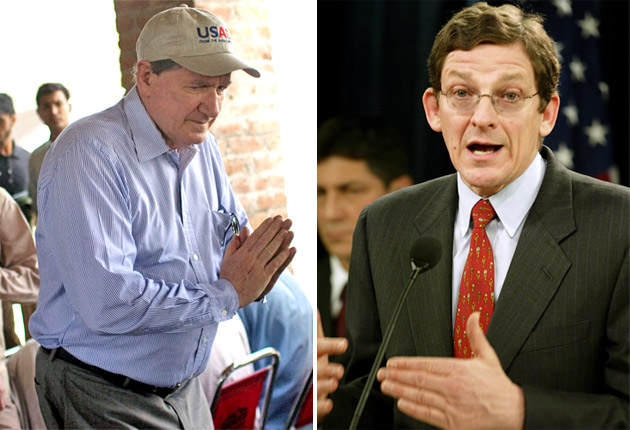
The long and fractious search for a replacement for the late Richard Holbrooke as a special US envoy to both Pakistan and Afghanistan is over, but the job of filling his shoes is looking more impossible than ever, not least because of an expected exodus of top American officials from Kabul this year.

Marc Grossman, who was a top-rank US diplomat for three decades until he moved to the private sector in 2005, has agreed to take on the post after others turned it down. His appointment is expected to be announced by Hillary Clinton, the US Secretary of State, during a speech in New York on Friday.

The death from a torn aorta of Mr Holbrooke, a giant on the diplomatic stage, left a void in America’s diplomatic front in Afghanistan and Pakistan. While some in the White House resented the wide remit he enjoyed dealing with both countries, Mrs Clinton was adamant she needed someone of similar stature in his place.

Several high profile names were passed over for the job or turned it down, including Strobe Talbott and John Podesta, both of whom served former President Bill Clinton. Another who declined to don the Holbrooke mantle was Frank Wisner, another former diplomat who unsuccessfully sought to mediate with Hosni Mubarak of Egypt before his ouster last week.

Mr Grossman, currently chairman of the Cohen Group which advises companies on ventures overseas, will take the job at a particularly tricky juncture. Relations between Washington and Islamabad are at an all time low, and in Afghanistan the clock is ticking on the start of US troop withdrawals this summer.

The diplomatic and military team he will inherit in Afghanistan will meanwhile begin to dissolve almost the moment he arrives there. Among those set to depart are Karl Eikenberry, the US Ambassador there, as well as all four of the top US officials in the embassy.

It is widely expected, meanwhile, that the top military commander of Nato forces in Afghanistan, General David Petraeus, will be rotated out before the end of the year. The number two military officer there, Lt Gen David Rodriguez, who runs day-to-day military operations, is also set to leave. Officials at the State Department and the Pentagon concede that finding replacements for the departing officials will be difficult.

Violence in Afghanistan is still at critical levels. On the political level, the US is striving to overcome long-running tensions with President Hamid Karzai, while trying to push forward a process of reconciliation talks with elements of the Taliban and other insurgent groups that are seen as crucial to achieving stability, and step up training of Afghan soldiers and police officers.

“Afghanistan is keen to work closely with the new Afghanistan-Pakistan envoy in better coordination and understanding,” commented Siamak Herawi, a spokesman for Mr Karzai, who had a prickly relationship with Mr Holbrooke.

The latest downturn in relations with Pakistan follows the arrest of an American at the US embassy on charges of murder. So far the Pakistani government has ignored calls from Washington that the accused, Raymond Davis, who is on the embassy staff, be given diplomatic immunity in the case. He has claimed that he shot the two men in self defence as they attempted to rob him.

In Islamabad yesterday on a mission to try to resolve the stand-off was Senator John Kerry, the chairman of the Senate Foreign Relations Committee and arguably the only person available in Washington with the stature to get the Pakistani government to focus on the issue. Bilateral talks that were scheduled to take place at the State Department next week have been postponed by Mrs Clinton because of the dispute.

The biggest challenge of all for Mr Grossman will be winning the trust and respect of leaders in both Pakistan and Afghanistan while navigating the sometimes conflicting priorities of his various bosses in Washington at the State Department, the Pentagon and the White House.

Leading players on their way out:

General David Petraeus

Unexpectedly pulled into Afghanistan after the sudden departure of General Stanley McChrystal last year, Petraeus is drafting withdrawal plans for President Obama. Once he has presented the President with options for the best exit strategy, which he is expected to do in July, there are suggestions that he could look to stand down. He has denied that he could seek the Republican presidential nomination for 2012.

Ambassador Karl Eikenberry

With his relationship with President Karzai strained at best, there have long been rumours in Washington of Eikenberry’s return home; any departure, though, was held up by the exit of McChrystal, when it was felt that another change at the top of Afghan policy would be unhelpful. A similar logic may have applied after Richard Holbrooke’s death. One of Grossman’s key tasks will be identifying the best candidates to replace him.

Lt. General David Rodriguez

Named as deputy commander in Afghanistan in 2009, Rodriguez has considerably more experience in the country than Petraeus, and holds responsibility for day-to-day operations, with particular expertise in counter-insurgency. If suggestions that he could be going home soon prove correct, there are fears that a shortage of top-class military leadership with knowledge of the country could be exposed.
Why Noor Inayat Khan, the Indian Princess and Decorated British Spy Who Was Shot By The Nazis, Deserves A Statue

by Gurinder Chadha and Shrabani Basu, Daily Mirror

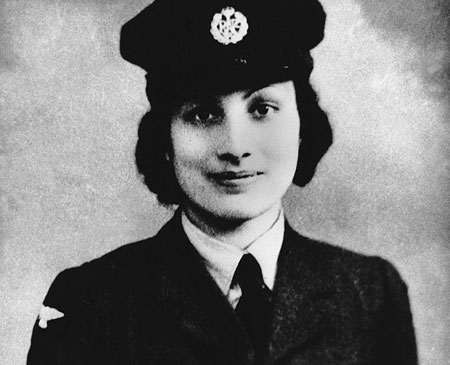
On September 13, 1944, a beautiful Indian princess lay dead on the floor at Dachau concentration camp. She had been brutally tortured by the Nazis then shot in the head. Her name was Noor Inayat Khan. The Germans knew her only as Nora Baker, a British spy.

The first female radio operator to infiltrate occupied Paris, she was posthumously awarded the Croix de Guerre and the George Cross – one of only three women from the Special Operations Executive to receive the latter medal.

But while Odette Hallowes and Violette Szabo have had Hollywood films made of their lives and blue plaques put up in their honour, Noor has been largely overlooked.

The gentle Indian woman who sacrificed her life for Britain, has become a footnote in history. A memorial to her has long been overdue.

And when a bust of Noor goes up in London’s Gordon Square in 2012, it will be the first statue to an Indian woman in Britain – and the first to any Muslim.

Given the contribution of Asian women in this country to arts, music, literature, law, human rights and education, it is a gap that is crying to out be filled.

Noor’s journey from her birthplace in Moscow to London was in many ways part of her exotic upbringing.

A descendant of Tipu Sultan – the famous 18th century ruler of South India, known as the Tiger of Mysore – she was brought up a fierce nationalist by her father, Hazrat Inayat Khan, a Sufi preacher and musician.

Inayat Khan left his hometown of Baroda in western India to take Sufism to the West. Deeply spiritual, he gave concerts and lecture tours in America where he met Noor’s mother, Ora Ray Baker. Soon the two moved to London where they were married, Ora taking the name of Ameena Begum.

In 1914, Inayat Khan was invited to Moscow and it was there that Noor-un-nisa Inayat Khan was born. She had the title of Pirzadi, daughter of the Pir.

Moscow at the time was rife with political discontent and Inayat Khan soon moved back to London. The family spent the next six years in a house on Gordon Square.

But the British government was suspicious of Inayat Khan, who was a friend of Nehru and Gandhi and a strong nationalist, so the family went to France. They began life again on the outskirts of Paris in a house called Fazal Manzil or House of Blessing. It was here Noor spent most of her life.

Educated and genteel, she went to the Sorbonne to study child psychology.

She started writing stories for children and in 1939 her first book, Twenty Jataka Tales, was published. But war clouds were gathering. And as England declared war on Germany, Noor and her brother Vilayat decided it was a crime to stand by and watch, even though as Sufis they believed in non-violence.

They went to London to be a part of the war effort. In November 1940, Noor volunteered for the Women’s Auxiliary Air Force.

Officers of the Special Operations Executive, Churchill’s secret army, were looking for people with language skills. Noor – fluent in French and now a trained wireless operator – fitted the bill. At an interview, she was told she would be sent as an agent to Paris – and shot if she was caught. She took the job.

Over the next few months, the gentle harp-playing Noor was trained as a secret agent, given arms training, taught to shoot and kill, and finally flown to Paris under the code name of Madeleine, carrying only a false passport, a clutch of French francs and a pistol. Despite her spy network collapsing around her, Noor stayed in France for three months, until she was betrayed. What followed in October 1943 was arrest, imprisonment in chains, torture and interrogation.

Noor bore it all. She revealed nothing to her captors, not even her real name. When the end came on September 13, 1944, it was not swift or painless.

All night long an SS officer kicked and tortured Noor. Defiant till the last, she shouted “Liberte” as she went down to a bullet fired at the back of her head. Then Britain gradually forgot about her brave sacrifice. Bringing Noor back to Gordon Square, near the house from where she left on her last mission, will be a worthy gesture by her adopted country.

Gurinder Chadha has directed Bend It Like Beckham, and Bhaji on the Beach. Shrabani Basu, author of Spy Princess, The Life of Noor Inayat Khan, is founder of the Noor Inayat Khan Memorial Trust. Contribute at www.noormemorial.org, or email noor.memorial@gmail.com.

Who is behind the war on Sufism?

By Dr Ehsan Azari Stanizi for Eurasia Review News & Analysis

On October 25, 2010 an al-Qaida affiliated militant group turned a majestic Sufi shrine into a bloodbath in the Punjab province of Pakistan, by detonating bombs hidden in milk cans, killing and wounding scores of innocent people. This was the latest of a spate of gruesome attacks on Sufism and dead Sufi saints this year alone, leaving hundreds of innocent people killed or wounded. Such violence has brought a new upheaval to Islam, shaking its ethical and moral foundations and reducing it to a merely a radical political ideology.

The ideological driving force behind this violence is religious extremism which considers everyone outside its ideological league, Muslim or non Muslim, dead or alive, as an enemy and an infidel deserving to be killed. The fanatics blow up ancient relics, Sufi heritage, Sufi shrines and the Sufi way of life everywhere they can. They want to micromanage social, cultural and individual life. They condemn gatherings and ceremonies in Sufi saints’ graves, shaving beards, wearing charms, music and painting as heresy. All this is like the Chinese Cultural Revolution of the 1960s.

The history of Islam is not alien to violence against Sufism. The root of the current upheaval lies in Wahhabism, which has been gradually institutionalised from a tiny band of theologians into a political ideology by the Saudi ruling dynasty. The Wahhabi religious movement was originated by Mohammad Ibn Abdul Wahhab (1703-1792), essentially to challenge the influence of the Ottoman Empire in the Arabian Peninsula. The Saudi petrodollars and Pakistani military ruling elite have helped the spread of this fanatical form of Islam.

In addition, the vision of this ideology was empowered in the Middle East and South Asia by another extremist movement known as the Muslim Brotherhood which originally emerged in Egypt in the 1920s. The Brotherhood copied much of its ideological agenda, political structure, revolutionary features and a violent persuasion from Marxism. Like the latter during the Cold War era, the Brotherhood’s ultimate objective has been to topple the state by violent means and extend a radical ideology to the West. The Iranian revolution of late 1970s gave further impetus to this ideology, which began to justify the export of Islamic revolution as an Islamic obligation everywhere in the world.

Like Saudi rulers, the secular Pakistani cunning and sly generals began to use the most lethal religious radicals for domestic security and as a tool to promote its foreign policy in Afghanistan and India. Pakistan served also as a gateway for the spread of Wahhabism in the region. At present they are pinching American coins in return for carrying out the Pashtun genocide.

As it was hinted, war on Sufism is not a new phenomenon. Hussein Al-Halaj, a great Sufi poet and teacher was condemned for heresy when in a state of mystical trance he exclaimed, “I am the Truth”. He was cut to pieces and his remains were burnt by a mob in Baghdad in 922 AD. He was the first Sufi martyr.

During the 17th-century Persian Safavid Empire, Sufis were suppressed, during the Indian Moguls, it flourished but in the twentieth-century the die-hard Turkish secular leader Kamal Atatürk banned Sufi monasteries and Sufi rituals in Turkey.

Sufism (comes from Arabic noun, suf, literary meaning course wool and the Sufi is the one wearing woolen garments) is the name of Islamic mysticism. The word Sufism was coined in the West for the first time by the German scholar August Tholuck in 1821. It has been divided into two practical and theoretical parts: To those who practice it, Sufism means a quick spiritual foray into a space where the presence of the divine could be experienced. To those who are concerned with its theory, it is a mystical and spiritual theology, a body of knowledge and an epistemology interwoven with Islamic metaphysical texts.

The Sufi philosophy was developed and promoted by the medieval Muslim philosophers such as Ibn-Arabi, Averroës (known in Islamic world as Ibn-i-Rushd), Avicenna and Farabi, who, for their Islamic Aristotelianism, were often referred to as the Oriental Peripatetics. This school of thought was greatly saturated with Plato and Aristotelian metaphysics. The Sufis also have created a vast body of a literary and poetic heritage.

As an elixir of wisdom and an intellectual Yoga, Sufism has been known, cherished and even practised in the West since time immemorial. It is hard to find a single great Western poet or thinker who has not been inspired by Sufism. Dr Johnson loved Sufi Oneness and pantheism; Voltaire in Candid saw Sufi philosophy as an antidote to religious extremism of his time. Goethe loved Sufi poetry, Richard Burton and Robert Graves were keen on practicing Sufism.

Sufism was cherished by Australia’s greatest poet professor Alec Derwent Hope. Hegel draws on Sufi thought in his works. Danish fairy-tale writer Hans Christian Andersen was the first who brought the news about the Sufi music and dance known as “Whirling Dervishes” to Europe.

Nobel laureate, Doris Lessing is the doyen of contemporary Sufis in the West. She identifies Western admiration of Sufism since the 1960s as ‘a Sufi craze,’ and ‘Sufi bandwagon’. For Lessing, Sufism was a kind of universal feeling, emotion, a quick fix and an access with no intermediary. “Sufism is something one experiences on one’s own,” she would say. In my own lectures in Australia and Europe, I came across with an enormous interest in Sufi philosophy and literature.

The al-Qaida zealots and the Pakistani militants will never win over Sufism. They might destroy their tombs on earth but cannot steal away Sufism from the hearts of people in the East and the West.

The 13th-century great Sufi poet and the founder of the Whirling Dervishes, Rumi knew this. He believed that fanatics will never extinguish the Sufi torch or destroy Sufi tombs as he says “when we are dead, see not our tombs in the earth, but find it in the hearts of the people.” And the 17th-century Pashtun Sufi poet Rahman Baba, known in the West as the Nightingale-of-Peshawar to the vandals:

We are all one body, whoever tortures another, wounds himself.

Last spring (2010), his mausoleum was bombed by the Punjabi Taliban. Rumi declared the Sufi manifesto of universal love, tolerance of nonbelievers, pluralism and interfaith harmony in one of his quatrains:

Come, come whoever you are, An unbeliever, a fire or idol-worshiper, come, Our convent is not of desperation, Even if you have broken your vows a hundred time,
Come, come again.

Books Not Bombs at Pakistan Literature Festival

As Reported by The AFP

Pakistan is hosting one of the world’s youngest and fastest-growing literary festivals, a showcase of new talent where writers urge citizens to reverse the tide of Islamist extremism and global isolation.

Now into a second year and determined to become an annual fixture on the international circuit, the Karachi Literature Festival portrays the softer face of a country more often associated with terrorism than award-winning prose.

Students, authors, budding writers and avid readers have descended on a hotel in an exclusive neighbourhood near the Arabian Sea for two days of book launches, workshops, dance, music and theatrical exhibits ending Sunday.

“It’s to promote our authors, who are underrated and do not get the credit they’re due, and also to interest people in reading and buying books,” organiser and Oxford University Press managing director Ameena Saiyid told AFP.

Women in T-shirts and skinny jeans rub shoulders with religious girls cloaked in Islamic veils at events with standing room only, as pensioners on crutches fold themselves into chairs and children race up the aisles.

Gathering nearly 100 authors and moderators, a handful from Britain, France, Germany and the United States give the event a veneer of the cosmopolitan, but the government denied visas to three of six Indians invited, organisers said.

Peace efforts between nuclear rivals India and Pakistan have been stagnant since Islamist gunmen killed 166 people in Mumbai in 2008. India and the United States blamed the attack on Pakistani militants.

Pakistan denies it is not doing enough to shut down Islamist terror groups, in a country where more than 4,000 people have been killed in Taliban-related bomb attacks in three years.

At the festival, where up to 5,000 people devoted their weekend to listen to their favourite authors — about twice the number of visitors compared with last year — some felt there was a duty to confront growing extremism.

“It’s the most fabulous development for Karachi,” said Aliya Naqvi, a doctorate student in Islamic history and wife of author H.M. Naqvi, whose debut novel “Home Boy” recently won an Indian prize for South Asian literature.

“Life goes on. You take a risk every time you step outside… But to ignore the rise of extremism would be disingenuous. It has to be acknowledged,” she told AFP between sessions.

The September 11, 2001 attacks put Pakistani writers on the international map as inquisitive Westerners searched for insight into the Taliban and Islam, at the same time as throwing the country into war and chaos.

Ahmed Rashid, whose book “Taliban” became a US bestseller, delivered a thundering address, saying it was time Pakistan faced up to its own mistakes rather than blame the United States.

“We have to do something to save ourselves,” he said, accusing Pakistan of meddling in Afghanistan, obsessing about India at the expense of national interest, failing the economy, sheltering Al-Qaeda and sponsoring the Taliban.

Nuclear physicist and social activist Pervez Hoodbhoy went further, warning a packed session on “Taking Stock: Where is Pakistan Now?” that the country is on “a knife-edge” and at risk of being overrun by a “clerical tsunami”.

Mohsin Hamid, best-selling author of novels “Moth Smoke” and “The Reluctant Fundamentalist”, said he did his best to look for the positive but conceded: “Fear is fundamental to what it’s like to live in Pakistan right now.”

The revolts in Egypt and Tunisia have resonated widely in Pakistan and were touched upon in questions from the audience. In response to one man, Hamid said it was not for him to lead a social movement onto the streets.

Inevitably in a country where mastery of English remains the preserve of the elite, who often live more luxuriously than the middle classes in the West and where the poor struggle on less than a dollar a day, there were cries of elitism.

While the event was free to all, sponsored by the British Council, Oxford University Press and USAID, some complained it was not on the public bus route.

US-educated novelist Bina Shah, whose new book “Slum Child” was snapped up like hotcakes, was asked how difficult she found it to write about a slum when she herself did not use public transport or go out to work.

“I’ve been in a rickshaw!” she hit back.

“My experience of a slum is obviously going to be different. It should convince you enough that a slum person could have told the story,” she said.

Pakistan Observes Kashmir Solidarity Day Today

As Reported on Sify News, India

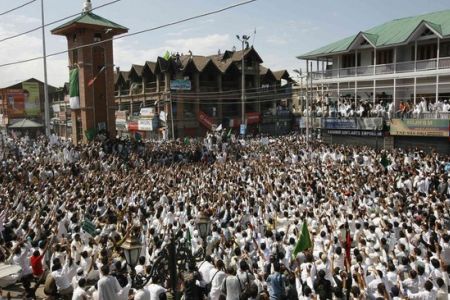
Pakistan is observing the Kashmir Solidarity Day on Saturday (today) to renew its pledge to provide full moral, political and diplomatic support to the Kashmiri people.

“We would not rest unless the people of Kashmir get their right to self-determination and win freedom from the Indian domination. We regard the Quaid-i-Azam’s dictum as our ideal wherein he said, “Kashmir is our jugular vein”. The day is not far when the Kashmiris would determine their own future,” The Nation quoted Prime Minister Syed Yousuf Raza Gilani, as saying in his message on the occasion.

The government and the people of Pakistan join their Kashmiri brothers and sisters in observing the Kashmir Solidarity Day, said Gilani, adding that the whole nation stands united in seeking a just and peaceful solution to the Jammu and Kashmir dispute in accordance with the legitimate aspirations of the Kashmiris as enshrined in relevant UN resolutions.

It will be a public holiday throughout Pakistan today, and special programmes will be broadcasted on television in this regard.

Apart from mass rallies, symposia, conventions meetings and speech declamations, a unique ceremony will be held at all six bridges linking Pakistan and PoK, where Pakistani and Kashmiri people will form a human chain.

It may be mentioned here that the day is observed every year in Pakistan, in continuation of the first call given by the then Prime Minister Zulfiqar Ali Bhutto in 1975.

Indo-Pak Express: Chugging for Peace

Originally posted on Aman Ki Asha

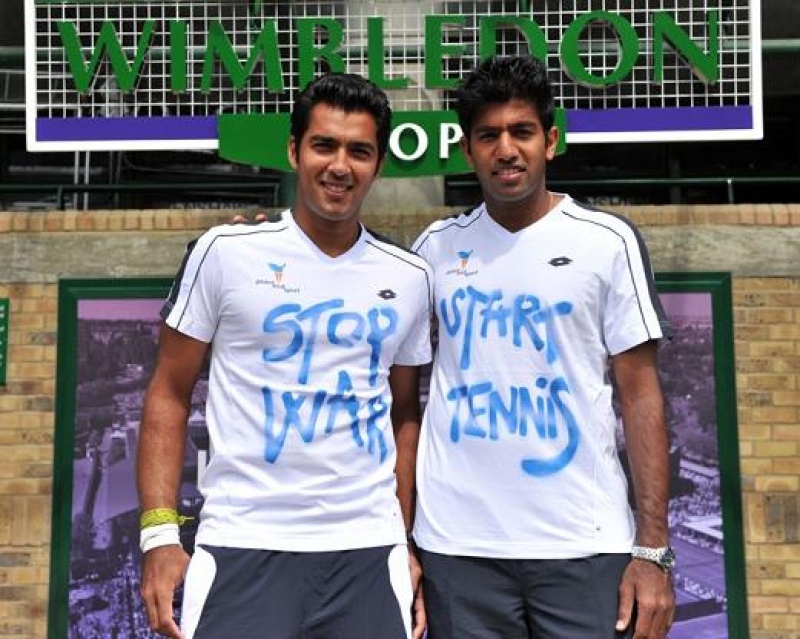
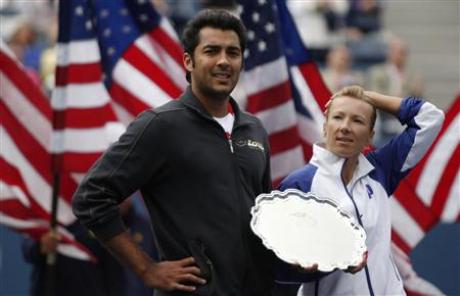
The unique tennis doubles team, Pakistani Aisam-ul-Haq Qureshi and Indian Rohan Bopanna popularly known as ‘Indo-Pak Express’ have urged their governments to allow tennis matches across the border.

There is growing support for their symbolic event – the Stop War Start Tennis campaign. Both players want a match organised between the two countries, but with a twist. They want the match to be held with a net strung across Wagah border. Now that would be a great feat.

The duo are hopeful that their doubles partnership will improve bitter relations between their countries, particularly since the initiative is now backed by the world tennis body and an international peace group.

The International Tennis Federation (ITF) has thrown its support behind the scheme, along with Peace and Sport, a non-governmental organisation run by Prince Albert of Monaco.

“A lot of good things have been achieved, the ITF is now supporting this, Peace and Sport is also supporting this,” Qureshi, who is also Aman ki Asha Ambassador, has said. “The letters have gone to both the prime minister and president of both countries.

“It is a political issue and there are a lot of security concerns, so we are just hoping that the governments will give us the green light so we can play that match on the border.”

Both players, who were finalists at last year’s US Open and gave their opponents, the top-seeded Bryan brothers tough competition, are confident of a positive response from their respective governments.

“Things are going in the right direction,” Qureshi said.
“Last year, at the US Open, both the UN Ambassadors for Pakistan and India came and watched our matches, which was a huge thing and they are supporting the cause as well.
“Things are going in the right direction; we just have to keep playing our matches and get more and more publicity on the bigger occasions. Hopefully it will happen this year.”
– Aman Ki Asha

Drug Row Sets Pakistan Scientists Against Ministries

By A A Khan for The Science and Development Network

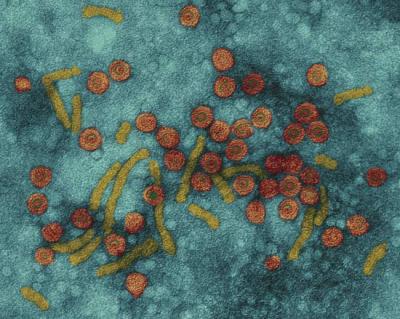
Efforts to produce a cheap local version of a hepatitis B drug have ground to a halt in Pakistan amidst a row between a leading scientist and senior officials from two government ministries.

Officials claim to have evidence that scientists involved in the drug’s production have cut corners in carrying out trials, abused resources and misused research funds.

But two of the scientists said they feel they are being deliberately prevented from launching the drug, interferon, because it could undermine the lucrative contracts for supplying it currently held by international pharmaceutical companies.

Viral hepatitis B is endemic in Pakistan, with an estimated seven million people infected,according to research published by the Pakistan Journal of Medical Sciences in 2009.   

The government’s claims relate to scientists at the Centre for Applied Molecular Biology (CAMB) in Lahore. The ministry of science and technology commissioned an audit of the centre, carried out by a committee of officials and external auditors, according to sources.

The ministry referred the findings to the Federal Investigation Agency this month (8 December) which will decide whether to proceed with charges. In the meantime, the centre’s accounts have been frozen.

Meanwhile, officials in the ministry of health said they are refusing to approve use of interferon produced by CAMB because of alleged irregularities in the clinical trials.

And, in a separate development, an independent petitioner, Batish Mahmood Tipu, filed a petition in the High Court this month (13 December) which has led to the court issuing notices to both ministries.

The notices require them to explain before the court why they are not allowing the use of locally produced interferon that, according to the petitioner, costs 70 Pakistan rupees (around 82 US cents) per injection, compared with the imported version, which costs around US$11.

CAMB trains molecular biologists and specialises in recombinant DNA technology. The centre has a good record of achievements related to Bt (Bacillus thuringiensis) rice, Bt cotton and Bt pesticide formulations. It has obtained more than ten patents. 

The centre received regular funding from the ministry of science and technology for the interferon project and, from 2004 onwards, it also received financial support from Pakistan’s Higher Education Commission (HEC).

CAMB also received prize money of US$100,000, in 2008, from the Islamic Development Bank for its outstanding contribution to molecular biology.

Clinical trials criticised

Sheikh Riazuddin, one of five scientists targeted by the government’s investigation, was director of CAMB from its establishment in 1985 until June 2009.

Riazuddin was working on a project entitled ‘Local Production of Interferon’, headed by Javed Akram, a professor at Jinnah Hospital, Lahore, which began in 2000.

According to Riazuddin phase III clinical trials of the local version of the drug were conducted at Jinnah Hospital, a teaching hospital of the Allama Iqbal Medical College, Lahore, and it was ready for final approval in December 2008.

By January 2009, CAMB had patented the drug and produced 100,000 vials of it — which have still not been used.

Sources from the ministry of health said they have not approved the drug because of the omission of two key stages normally conducted in clinical trials: phase I (laboratory testing of the drug) and phase II (safety testing on humans).

But Riazuddin said these stages are not necessary in the case of a ‘biosimilar’ drug — an exact copy of a drug for which these trials have already been conducted. 

Rauf Khalid, drug registration controller of the ministry of health, told SciDev.Net: “The approval of hepatitis interferon for commercial release can only be granted when CAMB completes all the requirements, including tests, and shows the capability of its production facilities”.   

The ministry of science and technology’s audit committee, whose findings have not been made public, has, according to sources, found among other alleged irregularities that Riazuddin had been using CAMB facilities, such as transport and phone, even after he had left the organisation.

The committee has also said it can find no satisfactory answer about where the bulk of the prize money from the IDB has gone.

Khalid Siddiqui, joint secretary of the ministry of science and technology, said: “Irregularities have taken place at CAMB for the last many years and all the findings by our committee have formally been sent to the Federal Investigation Agency for verification.

“We respect them [the CAMB scientists] as researchers but any irregularities identified by the fact-finding committee have to be dealt with according to law.” 

Allegations have ‘no substance’

Riazuddin confirmed to SciDev.Net that he has been contacted by the [FIA] which informed him that it had received a case against him involving corruption, to the tune of millions of rupees, and misuse of authority — charges he denies.

“There is no substance in the allegations,” he said.

He agreed that, even after leaving CAMB, he continued to direct the team and spent most of his time at CAMB.

“I did that not for my sake but to see my brainchild become a reality. I assumed if I do not look after the research I started, that might vanish, rendering many years’ effort futile.”

Riazuddin and Akram claimed that there have been government moves to try to block the development and production of their drug.

“Some sections in the ministry of science and technology and in the health ministry are playing into the hands of multinational companies who do not want a local launch of this medicine as Pakistan is importing hepatitis drugs worth Rs 4 billion (around US$47 million) annually from those multi-nationals,” Riazuddin said.

“This all is to force us into saying goodbye to the local production of interferon,” Akram told SciDev.Net. 

“At every step, from release of funds to the approval stages, we faced bureaucratic hurdles so much so that we felt that they do not want local production of hepatitis interferon,” Akram added.

Anwar Nasim, patron of the Pakistan Biotechnology Information Centre (PABIC), told SciDev.Net: “It is not shocking to know about corruption allegations in research when the menace of corruption is all around us. An external investigation by the FIA would soon help us know who was in the wrong — the ministry or the researchers”.

Bombers target Shiites in Pakistan, killing 12

As reported by The Associated Press

Suicide bombers attacked police protecting marches by minority Shiite Muslims in Pakistan’s two largest cities Tuesday, killing 12 people and wounding dozens, officials said.

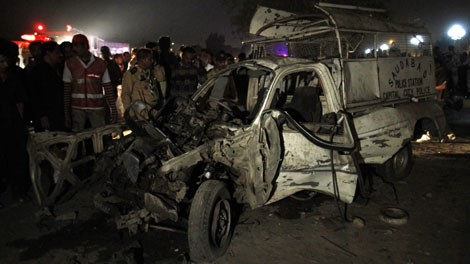
The first and most deadly attack occurred in the eastern city of Lahore, where the bomber detonated his explosives as police tried to search him, killing 10 people. About an hour later, a second bomber struck in the southern port city of Karachi, killing at least two people.

The attacks laid bare the challenges facing Pakistani officials trying to secure cities far from the northwest, where militants fighting Pakistan’s U.S.-allied government and American forces in neighboring Afghanistan have long thrived. Many recent attacks have targeted minority Muslim and other religious groups.

The Taliban claimed responsibility for the attack in Lahore, where thousands of Shiite worshippers were marking the end of a 40-day mourning period for the Islamic sect’s most beloved saint when the blast hit their procession early Tuesday evening.

The bomber is believed to have been a young teenage boy who was wearing a suicide bomb jacket and also carrying a bag full of explosives, said senior police official Aslam Tareen. He detonated his explosives when police tried to search him, he said.

“It is a great sacrifice by the police officers who laid down their lives to protect innocent people,” said Tareen.

Footage from the scene showed ambulances racing to the area and men carrying away victims. One young man whose arm was apparently hurt screamed as he was placed on a stretcher. A white car caught up in the explosion was largely destroyed, its hood twisted upward. A man lay wounded on the ground with two women and a child weeping beside him.

Dr. Zahid Pervaiz at the city’s Mayo Hospital told reporters that 10 dead bodies had come in, while another 52 people were wounded.

Shakirullah Shakir, a spokesman for the Fidayeen-e-Islam wing of the Pakistani Taliban, told The Associated Press in a phone call that the militant group had dispatched the bomber and warned of more bombings.

Later Tuesday evening, a suicide bomber struck police protecting a group of people returning from a Shiite march in the Malir neighborhood of Karachi, Pakistan’s largest city.

Three people were killed and three wounded in the attack, said Hamid Paryar, a doctor at Karachi’s largest hospital. Two of those killed and one wounded were policemen, he said.

The third person killed is believed to be the suicide bomber, who was riding a motorcycle and carrying his explosives in a bag, said senior police official Shaukat Shah.

The blast occurred near a police van protecting the Shiite marchers, said Akbar Jaffry, who witnessed the bombing.

Attacks roughly tripled last year in Lahore and Karachi, according to a recent report by the Islamabad-based Pak Institute for Peace Studies.

The trend is a sign that militants are having greater success exporting the fight far from their northwest heartland along the Afghan border. The Pakistani army, under U.S. pressure, has carried out several offensives against militants in its northwest, but violence persists.

Thou Shalt not Mock or It May Cost You Your Life!

By Manzer Munir for Pakistanis for Peace

In the wake of the murder of Salmaan Taseer, the Governor of Punjab a couple weeks back, I did a great deal of contemplation about the situation in Pakistan and the current state of affairs of Pakistan and indeed in much of the Muslim world.

The current situation, especially in Pakistan and when it concerns the rights of the non-Muslims, is apparently the worst of anywhere in the Muslim world. Indeed, the plight of Asia Bibi, (also known as Aasia, Ayesa Noreen) Islam and Islamic Blasphemy laws have come under rightful scrutiny as of late.

One question that tugs at the heart of the debate for me is why is it that Muslims seem to get so very offended to the point they want to KILL you over a remark or something that comes out of your mouth? As Americans, we wonder to ourselves, “Haven’t they ever heard of sticks and stones may break my bones, but words don’t hurt me?!

Sadly, what the fundamentalist preachers at all the podiums of their Friday sermon or khutbah, nor any of their brethren on the run and in caves like the Taliban and Al Qaeda fail to realize that we are all God’s children. And God, Allah, Yahweh, Jesus, or whatever name you assign him, he is One and the same God of all religions. He is too big to fit into just one religion, concept, version or story of him.

And we all are his creations. Not one of us is superior over the other in his eyes and he judges us all equally. To him, the children of these three religions and its offspring’s are all related to each other. Adam being the first man, then Eve, and then all the Biblical figures and names such as Noah, Abraham, Moses, Jesus, yes especially Jesus. He is their Messiah too!

Jesus, in fact is mentioned some 28 times in the Muslim holy book, Qu’ran whereas their own prophet Muhammad is mentioned only 4 times. And the fact that Jesus is also considered by Muslims to be the Messiah, it is sad that his followers should get such abject treatment in Pakistan and sadly, many Muslim countries.

If only the bad guys realized the connections between Christians and Jesus only then would a Pakistani Christian woman, suffering needlessly in a cell tonight going on 2 years away from her children in solitude, and constantly fearful for her life, would see her horrific ordeal come to an end.

These people are incapable of understanding basic rights, freedoms and even the unhindered concept of free will. No, they are primitive minded in their their spiritual and daily lives. They fail to see that a Christian’s God and a Muslim’s God are the one and the same. And he never would agree to laws like Pakistan’s Blasphemy laws at all. Why? Well because the Muslim God is known first and foremost as a Gracious, Merciful, Compassionate God.

In fact, the Arabic phrase Bismillah ir-Rahman ir-Rahim is a beautifully poetic phrase which offers both deep insight and brilliant inspiration to the average Muslim who says it countless times as he or she starts each day and till they rest their head to sleep. “ It has often been said that the phrase Bismillah ir-Rahman ir-Rahim contains the true essence of the entire Qur’an, as well as the true essence of all religions. Muslims often say this phrase when embarking on any significant endeavor and the phrase is considered by some to be a major pillar of Islam. This expression is so magnificent and so concise that all except one chapter of the Qur’an begins with the words Bismillah ir-Rahman ir-Rahim.”

The common translation:”In the name of God, most Gracious, most Compassionate” essentially is saying that God is compassionate, and full of grace. So how would this God punish Asia Bibi? What would he do if he is so full of compassion and mercy? Would he even punish her? And if he is such a gracious and a compassionate God, then wouldn’t he feel that nearly a two year jail sentence in solitary is already far more than her crime not to mention being away from husband and children and being worried about mob vengeance on her or the death penalty?

That God may act in a multitude of ways and we cannot ever know till said Judgment Day. That is what Judgment Day is all about after all. In fact, this is probably one day when the man upstairs works overtime judging all of us mankind, from the beginning with Adam to the last standing comes till Tribulation and the End of Days. It is only he, the Creator who will do the judging and this is something that the men with the loudspeakers who climb to the top of the minaret five times a day to call the faithful to prayers, just do not really understand, in my opinion. They apparently constantly seem to forget and pass judgment from the pulpit and this in turn helps set the “popular” opinion amongst the ultra-religious faithful of Pakistan’s society.

My only prayer to this Creator is that may he keep Asia Bibi safe tonight and continue to give her strength. And if God should call her home and have her die a death at the hands of the real savages those that not only kill but shockingly, in your name, then please Allah grant her heaven just as you should governor Salmaan Taseer, a man who was only defending the rights of all your children, including those of other faiths. He was being compassionate and gracious towards a fellow human being God, as he was only trying to emulate his creator, You Lord. Ameen.

And while you are at it Lord, will you also please let the imam at the microphone know that “Thou shall not mock, should not cost you your life.” Afterall, “Thou shall not kill is one of your top 10 commandments, whereas mocking prophets or religious figures does not make the list!

Manzer Munir, a proud Pakistani American and peace activist, is a Sufi Muslim who is also the founder of Pakistanis for Peace and blogs at www.PakistanisforPeace.com and at other websites such as www.DigitalJournal.com, www.Allvoices.com, www.Examiner.com and www.open.salon.com as a freelance journalist and writer. He asks that you like the Official Facebook Page of Pakistanis for Peace to get the latest articles as they publish here: http://www.facebook.com/home.php#!/pages/Pakistanis-for-Peace/141071882613054

VJ Syra, Most Wanted and MTV Pakistan

Taking a break away from all the current events, news, and politics to talk briefly about something completely different, my favorite MTV Pakistan VJ/Personality: Vy Syra Khan. The VJ of MTV Pakistan for the last couple years.

Difficult Outlook for India-Pakistan Talks

By Tom Wright for The Wall Street Journal 

The Times of India reported today that India and Pakistan may try to rekindle peace talks in early February.

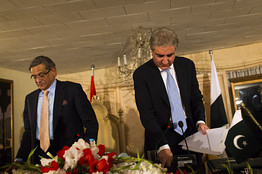
The paper says Pakistan Foreign Minister Shah Mehmood Qureshi could meet his Indian counterpart, S.M. Krishna, informally after a regional meeting in Bhutan on Feb. 8.

The report suggests that the idea is to set the ground rules for an official visit to India by Mr. Qureshi sometime later this year in a bid to normalize relations that have soured since a major terror attack in Mumbai in 2008.

Given the disastrous outcome of Mr. Krishna’s last formal visit to Pakistan – in July of last year – those ground rules will be important.

At that meeting, Mr. Qureshi became incensed during a press conference over India’s claims that Pakistan’s military intelligence services had orchestrated the Mumbai attacks in November 2008, during which 10 Pakistani gunmen killed more than 160 people over three days.

Mr. Krishna arrived back in India to criticism of being made to look a fool by Mr. Qureshi and a peace talks process begun in 2004 was put on hold amid mutual recriminations. The slow-moving (and now stalled) dialogue is an attempt to normalize relations that have been rocky ever since the two nations were created out of British India in 1947.

India has stuck to its claims of official Pakistan involvement in the Mumbai attacks and says Islamabad is not doing enough to prosecute the perpetrators and rein in India-focused militants in general.

Pakistan retorts that it is committed to fighting terrorism. It also has called on India to broaden the agenda for peace talks to include other topics, such as the disputed Himalayan territory of Kashmir, which both countries claim in its entirety.

It is uncertain whether talks at this stage can produce anything meaningful

India is set against any wider peace talks until Pakistan sentences seven militants that it has charged for involvement in the Mumbai attacks.

But the atmosphere in Pakistan right now means it is unlikely that any politician will want to be seen vigorously cracking down on Islamist groups.

The killing earlier this month of Salmaan Taseer, governor of Pakistan’s Punjab province, by one of his own police guards has uncovered the extent to which hardline religious views have permeated many layers of society.

The police guard admitted he was angered by Mr. Taseer’s defense of a Christian woman sentenced to death by a Pakistani court in November for blasphemy.

In recent days, scores of Pakistanis, including lawyers and clerics, have publicly rallied in support of the police officer.

Killings of Newborn Babies on the Rise in Pakistan

By Hasan Mansoor for The Associated Press

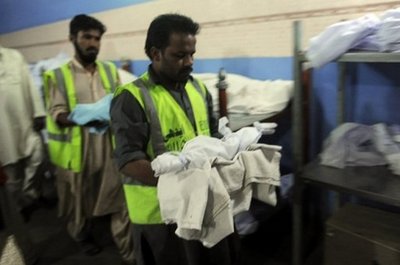
The lifeless bodies of two tiny babies are being given their final bath before burial in Karachi, after they were left to die in the southern Pakistani city’s garbage dumps.

“They can only have been one or two days old,” says volunteer worker Mohammad Saleem, pointing at the two small corpses being gently washed by his colleagues at a charity’s morgue.

In the conservative Muslim nation, where the birth of children outside of marriage is condemned and adultery is a crime punishable by death under strict interpretations of Islamic law, infanticide is a crime on the rise.

More than 1,000 infants — most of them girls — were killed or abandoned to die in Pakistan last year according to conservative estimates by the Edhi Foundation, a charity working to reverse the grim trend.

The infanticide figures are collected only from Pakistan’s main cities, leaving out huge swathes of the largely rural nation, and the charity says that in December alone it found 40 dead babies left in garbage dumps and sewers.

The number of dead infants found last year — 1,210 — was up from 890 in 2008 and 999 in 2009, says the Edhi Foundation manager in Karachi, Anwar Kazmi.

Tragic tales abound.

Kazmi recounts the discovery of the burnt body of a six-day-old infant who had been strangled. Another child was found on the steps of a mosque having been stoned to death on the orders of an extremist imam who has since disappeared, he says.

“Do not murder, lay them here,” reads a sign hanging outside the charity’s Karachi base where it has left cradles in the hope that parents will abandon their unwanted children there, instead of leaving them to die.

“People leave these children mostly because they think they are illegitimate, but they are as innocent and loveable as all human beings,” says the charity’s founder, well-known humanitarian Abdul Sattar Edhi.

Most children found are less than a week old. Khair Mohammad, 65, works as a watchman in the charity’s vast graveyard in the city outskirts. It is dotted with tiny unnamed graves.

“We acquired this land to bury children after another plot was filled with hundreds of bodies,” he says. The death toll is far worse among girls, says manager Kazmi, with nine out of ten dead babies the charity finds being female.

“The number of infanticides of girls has substantially increased,” Kazmi says, a rise attributed to increased poverty across the country.

Girls are seen by many Pakistanis as a greater economic burden as most women are not permitted to work and are considered to be the financial responsibilty of their fathers, and later their husbands.

A Pakistani family can be forced to raise more than one million rupees (11,700 dollars) to marry their daughter off. Edhi says that up to 200 babies are left in its 400 cradles nationwide each year and that it handles thousands of requests for adoption by childless couples.

Abortion is prohibited in Pakistan, except when the mother’s life is at risk from her pregnancy, but advocates say that legalisation would reduce infanticide and save mothers from potentially fatal back-street terminations.

According to Pakistani law, anyone found to have abandoned an infant can be jailed for seven years, while anyone guilty of secretly burying a child can be imprisoned for two years. Murder is punishable with life imprisonment.

But crimes of infanticide are rarely prosecuted. “The majority of police stations do not register cases of infanticide, let alone launch investigations into them,” said lawyer Abdul Rasheed.

Pakistanis for Peace Editor’s Note– The killing of innocent babies is utterly reprehensible in conservative Pakistan. If one does not want the baby, we urge the parents to drop off the unwanted babies at any Edhi Foundation center to be raised as an orphan. Islam does not condone killing of any life at any age under any circumstances. We are saddened by these stories and hope that this trend comes to an end soon.

Gandhi and King- Two Martyrs Who Will Never Die

By Manzer Munir for Pakistanis for Peace

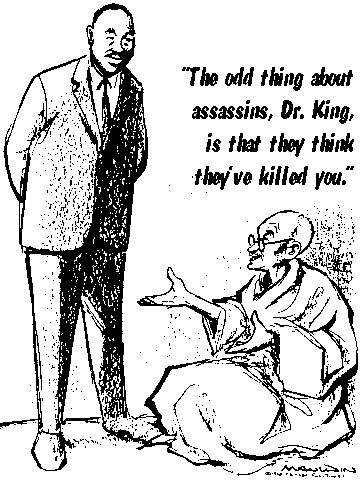
Martin Luther King Jr, who would have been 82 years old January 15, was a great believer of Mohandas K Gandhi, the leader of India’s independence movement from Britain. King saw that Gandhi’s peaceful civil disobedience and non-violent methods of protest were very effective in bringing down the British Empire in India and as a result Pakistan after some 300 years of direct and indirect rule. Gandhi had believed that people could resist immoral government action by simply refusing to cooperate. Gandhi adopted many peaceful resistance techniques in developing his concept of Satyagraha, which was a philosophy and practice of passive nonviolent resistance.

Gandhi had earlier used this resistance technique in his struggles for freedom and equality for blacks and Indians in South Africa where both minorities were subjected to second and third class citizenry. His methods and refusal to bow down to the injustices that Indians faced in colonial South Africa inspired Nelson Mandela several years later to start his own peaceful struggle that eventually led to the end of Apartheid in South Africa in 1990.

While at Morehouse College, King learned about Gandhi and became very excited about his ideas. He wanted to further educate himself and read many books on Gandhi and his life and beliefs. In his book, Stride Toward Freedom, King states that “Gandhi was probably the first person in history to lift the love ethic of Jesus above mere interaction between individuals to a powerful and effective social force on a large scale. He further writes in his book that “It was in this Gandhian emphasis on love and nonviolence that I discovered the method for social reform that I had been seeking. I came to feel that this was the only morally and practically sound method open to oppressed people in their struggle for freedom.”

King felt that he had finally found a way to where oppressed people could successfully unlock social protest through Jesus’ teachings of love. In fact Gandhi himself had said “What does Jesus mean to me? To me, he was one of the greatest teachers humanity has ever had.” He also once mentioned Jesus as the “most active resister known perhaps to history. His was non-violence par excellence” Therefore to the Christian minister living in the pre-civil rights era in the South in America, Gandhi appeared to King as a follower of Christ, someone who preached peace and love even at the expense of suffering. Martin Luther King once said of Gandhi “It is ironic yet inescapably true that the greatest Christian of the modern world was a man who never embraced Christianity.”

In 1959, King visited India and became fully convinced that Satyagraha could be effectively applied to the struggle by blacks in the United States for racial integration. He came back to the United States where he continued the struggle for freedom and equality for all Americans. Like Gandhi, King also talked about suffering as a path to self purification and spiritual growth. He not only experienced this suffering by being jailed, beaten and harassed by the authorities of the day, but he eventually ended up paying for this cause for freedom for all with his life.

 Mohandas K Gandhi and Martin Luther King Jr arguably were two of the greatest men of the last century.  Both men believed that “injustice anywhere was a threat to justice everywhere.” They both led their people and millions of others out of slavery and servitude against seemingly insurmountable odds to freedom and salvation. On what would have been his 82nd birthday, let us recognize that despite an assassin’s bullet and in the greatest democracy in the history of the world, the spirit and dream of a King still live on.


Originally published on 1/18/2010 for Pakistanis for Peace

Pakistan Army Propaganda Drama Set for TV

By Khurram hahzad for The Associated Press

Pakistan’s Taliban-fighting soldiers are set for celebrity status with the launch of a multi-million-dollar glossy television drama hailing army victories over militants.

Emotive tales of 11 “brave Pakistanis” battling an Islamist insurgency that is plaguing Pakistan and neighbouring Afghanistan, will air on the small screen in an army-funded drama that casts the anti-terror fight in a positive light.

Focused on the heroism of soldiers fighting a key air and ground offensive in the northwestern Swat valley in 2009, one tale looks at the deeds of soldier Hawaldar Naeem Asghar who died fighting an insurgent checkpoint.

Asghar, portrayed as a hardworking soldier from peasant roots, sacrifices his life to overcome Taliban dug in to a hilltop, during operations in the town of Mingora to flush militants from the picturesque valley.

Throwing grenades from his bunker without success, Asghar is depicted abandoning cover and climbing the hill, tossing more explosives on his way as bullets rain down from the rebels’ post.

The checkpoint is destroyed, but Asghar is killed.

“Hawaldar Asghar’s story is a common man’s story. It’s a message to the public that everybody can play a role in the fight against extremism,” says Sajjad Saji, one of the drama serial’s writers.

“It is filmed to encourage the common people in this war,” he adds.

Urged by its key but critical ally the United States to launch further operations in the lawless tribal areas bordering Afghanistan, the army wants to show the sacrifices it has already endured in the war on terror.

“The basic purpose is to reveal the deeds of bravery of our soldiers, officers and civilians who are at the front of this war…. This drama shows the human face of the war,” says Major General Athar Abbas, head of the army’s publicity wing.

“The nation should own these stories of bravery and sacrifice, they should be proud of our sons and daughters of the land who created these true stories with their blood and defended the motherland.”

One of the filmmakers, who would not be named, said the high-end production was a “multi-million-dollar” effort, but refused to put a precise figure on costs.

The production, peppered with special effects, was filmed amid rugged verdant hills and forests close to the Swat valley — scene of major operations by Pakistan’s military in 2009 to rid the area of rampant militancy.

“We travelled extensively to film this serial. A crew of more than 35 people with trucks of luggage roamed in the forests and hills for months to show the reality,” said Khawar Azhar, the show’s executive producer.

The former tourism hotspot of Swat slipped out of government control after a radical cleric led an uprising in July 2007, beheading opponents, burning schools and fighting to enforce a harsh brand of Islamic law.

Pakistan launched a blistering air and ground offensive in the valley after militants marched out of Swat and advanced to within 100 kilometres (60 miles) of the capital Islamabad in April 2009.

After heavy fighting that displaced an estimated two million people, the military declared the region back under army control last summer and efforts have begun to revive the local economy amid sporadic outbreaks of violence.

Television productions are one of the tools adopted by the military’s publicity wing to polish its image and boost recruitment and morale at a key juncture in anti-Taliban efforts and with religious conservatism on the rise.

Accused by US-based Human Rights Watch of carrying out collective punishments on relatives of militants since it re-established control over the Swat valley, the army knows the importance of securing local hearts and minds.

More than 4,000 people have been killed in Taliban and Al Qaeda-linked attacks since government forces launched an attack against militants in a mosque in Islamabad in 2007.

The television drama depicts the bitter divide between Pakistan’s opposing cultures as the moderate middle class fights religious extremism in a country fractured by deep regional political divided.

In other episodes the film makers show the victims of Taliban power — one girl is subject to brutal gang rape by militants, while in another a young boy is brain-washed into becoming a suicide bomber.

Pakistan Confronts Deepening Radicalism in Wake of Assassination

By Sarah A Topol for AOL News

ISLAMABAD, Pakistan — When Vice President Joe Biden made his surprise visit to Pakistan this week to shore up the battle against the Taliban and al-Qaida, he warned against the implications of increasing radicalism in Pakistani society in light of the assassination of a liberal governor by his bodyguard.

“The governor was killed simply because he was a voice of tolerance and understanding,” Biden said at a news conference Wednesday. “As you know all too well … societies that tolerate such actions end up being consumed by those actions.”

But when President Barack Obama meets Pakistani President Asif Ali Zardari later today in Washington to discuss counter-terrorism in Pakistan’s lawless frontier, he greets a president facing a new fight against radicalism deep in the heart of Pakistan’s urban centers.

Since Mumtaz Qadri unloaded over two-dozen bullets into Salmaan Taseer’s back because the outspoken liberal called the country’s blasphemy laws a “black law,” ecstatic crowds have flocked to shower Qadri with rose petals at his court appearances. Facebook fan pages and a fawning YouTube video cropped up within hours of the murder.

The glorification of a confessed killer by the masses has shocked the country’s small liberal minority. But most troubling has been the reaction of Pakistan’s urban middle class, whose support the United States needs in its war against terror and against the Taliban in neighboring Afghanistan.

From lawyers to tech-savvy Web users, the reaction of the educated middle class has most clearly illuminated the toehold that Islamic extremists have found when it comes to religious issues in Pakistan, even as the country continues to resist the allure of Islamic militants. Some see the reaction of the middle class as the expression of latent social outrage over how Islam is treated by the West, combined with a growing confusion over how to follow their faith in the modern world. This dormant indignation has found an outlet in the murder of a liberal governor.

“Taseer is a victim of religious extremism, but this religious extremism is wrapped up in a class and culture war, between the have-nots and the have, between the socially disposed and the possessors of society, between the globally connected and the globally disconnected,” Mosharraf Zaidi, a political analyst and policy development adviser in Islamabad, told AOL News.

Zaidi sees the convergence of educated Muslims around Qadri as a sign of confusion among the middle class over how to rationalize their modern lifestyle with Islamic tenets, prompting them to defer to radical right-wing mullahs when it comes to certain religious issues, like blasphemy.

“The Islamic narrative in Pakistan is dominated by a small religious establishment who has no viability electorally and who has limited social appeal. But on a number of specific issues they’re able to tap into something much deeper than what’s apparent in a day-to-day situation that awakens the inner radical,” Zaidi said. “The middle class is increasingly susceptible to the symbolism of the little guy taking on the big guy.”

Among Qadri’s most stalwart supporters are some of the same jurists who staged months of protests against Pakistan’s military dictator in 2007 and 2008, when Gen. Pervez Musharraf removed the country’s chief justice.

“We were supporting rule of law, the supremacy of the constitution and the independence of the judiciary,” said Mohammad Faisal Malik, who notes he was an active participant in the movement. “It was the most memorable year of my life.”

Dressed in a dapper black suit, Malik has a neat mustache and carefully styled sideburns that don’t suggest a picture of extremism taking root in Pakistan’s judicial system. But today he is among the group of lawyers who have been throwing garlands and chanting slogans in support of Qadri outside the district courthouse in Rawalpindi, and he is also one of the 500 lawyers signed on to represent Qadri.

Malik does not see a contradiction in supporting both the rule of law and a man who took the law into his own hands.

“Mr. Qadri reacted under certain provocation, feeling hurt from the remarks of the deceased governor. He acted like any Muslim will act when anyone uses filthy language against our prophet. … We were chanting and raising slogans against all those sectors that are using objectionable language against Muslims, against our holy prophet and against our religion. That was our message,” Malik explains in nearly flawless English, expressing a sense of global victimhood common among his compatriots.

In Pakistan, the day-to-day injustices in an impoverished society find no legal outlet. Corruption here is rife, and the rich can bribe their way out of anything. The lawyers supporting Qadri express an understanding of why the security guard picked up a gun.

“He took the law into his own hands when he thought he was helpless. He’s not in a position to initiate criminal proceedings against Mr. Taseer, so he reacted in this manner,” Malik said.

But some say the passivity of the educated class toward radical strains is not merely a product of a class and culture struggle but part of a larger generational gap in Pakistani society. Under the rule of Gen. Mohammad Zia ul-Haq in the 1980s, Pakistan underwent an Islamization campaign as the military dictator sought to unify the country and encourage jihadists to fight against Indian control of Kashmir and the Soviet occupation of Afghanistan. Today, some suggest, the younger generation is the product of state-sponsored radicalization.

“The state as a machinery is supporting and promoting religious extremism, and it happens through various means. It happens through media messages, it happens through textbooks,” said Marvi Sirmed, a human rights activist and blogger.

“The literate, quasi-educated urban population is the most vulnerable to these extremist propagandas, because they are exposed to electronic media and the outside world through social networking,” Sirmed said. “And I see a lot of stuff coming out through these sources that if you are naive, they can make you a suicide bomber very easily.”

It is this middle class, struggling with its faith in an age of global media and inter-connectivity, that the U.S. needs to win over, and it is precisely this sector it appears to be losing.

Pakistan’s middle class sees the United States not as a model of liberal values to be followed but rather as a country that inflicts repeated indignities upon Pakistanis’ culture and sense of worth with its military forays into the region in the past 10 years.

“We have to pay attention to the narrative of indignity, because it’s fueling things that start only as rhetorical and verbal but could very well link to Faisal Shahzad’s Nissan Pathfinder,” said Zaidi, referring to the failed Times Square bomber, an educated Pakistani who knew the United States only too well.