Archive for the ‘ Pakistanis ’ Category

Pakistan Army To Restore “Peace” in Bahrain?

By Aijaz Ahmed for Indus Herald
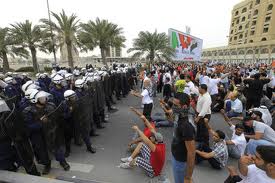
Pakistan and Bahrain are seriously considering ways and means and possible repercussions of Pakistan’s military and intelligence agencies’ help to the later in restoring “peace” in politically disturbed areas. Foreign Minster of Bahrain Sheikh Khalid bin Ahmed Al-Khalifa is to arrive in Pakistan on Tuesday to discuss the matter, highly placed sources have confided to Indus Herald. The Saudi led Gulf Cooperation Council (GCC) has already approved deployment of Peninsula Shield Force in the Kingdom of Bahrain to crush the movement for democracy that is getting stronger with every passing day. Assurances from King Hammad to introduce some reforms with regards to civil liberties and democratic and human rights have not succeeded so far to calm down anger among people demonstrating for a democratic system. Interestingly the reaction of the world community, the United States, Saudi Arabia and Pakistan is totally different on the situation as compared to the reaction demonstrated on the situation in Libya.

Pakistan has already expressed its support for the GCC decision, and that too on Saudi pressure, a source at the foreign office revealed. The economically hard-pressed Pakistan had no other way but to follow the Saudi demands as the holy kingdom has assured a sizable support in meeting the economic challenges ahead, the foreign office source added. However, Pakistan’s nauseating defense of its endorsement to GCC intervention in Bahrain to deploy Peninsula Shield Force isn’t finding any takers. Majority of foreign policy commentators and experts are not ready to buy Pakistani endorsement but people having close relations with PML-N including the likes of Shamshad Ahmed Khan, Tariq Fatmi and Riaz Khokhar are intriguingly silent on the support that Pakistan has diplomatically provided to Bahrain on the behest of Saudi Arabia. The sole reason for the silence of these former ‘babus’ of Foreign Office and some other “well informed experts” lies behind the special relationship that PML-N leader Mian Nawaz Sharif enjoys with the Royal family of the holy land.

Pakistan desired return of peace, security and stability to Middle East that had been hit by political upheaval, the newly designated foreign office spokesperson Ms Tahmina Janjua observed while briefing the media the other day. “As far as Bahrain is concerned, it was an internal decision of the GCC. The GCC decided on the basis of its founding principles that security forces would go to Bahrain,” said Foreign Office Spokesperson in her stammering voice while replying to hard hitting questions on Bahrain though her words did not match the principles of ‘non-intervention and non-interference in domestic affairs of others’ that she had painstakingly learnt during her 27 years long diplomatic career. This was not the first time that Foreign Office stood up for Bahrain’s monarchy. Foreign Secretary Salman Bashir had earlier praised the Bahraini Monarch on March 1. While the protestors were being tear-gassed and shot at, he had said: “We … admire the progress made by Bahrain under the leadership of His Majesty King Hamad bin Isa Al-Khalifa.”

The current political upheaval is a geniune cause of concern for Pakistan as there are some 65,000 Pakistanis in Bahrain, some of whom are working with Bahraini security services, the FO sources maintained adding that the security of King of Bahrain, the major installations, the Royal Family and the state dignitaries is prime responsibility of the Pakistanis employed in the Bahraini security services. Perhaps this was the reason that a number of Pakistanis became vistims of the public anger and some of them were seriously injured earlier this month during the violent protest of people on streets. Reports received from the tiny Gulf Kingdom suggest that the xenophobic attacks against Pakistani expatriates earlier this month were commited as Pakistani policemen had been at frontlines of riot police that attacked demonstrators.

In an atmosphere where common Pakistanis are quite unsafe in the Kingdom, Pakistan has not only quietly endorsed the intervention, but allowed the welfare wings of its military forces – Fauji Foundation and Bahria Foundation – to recruit about 1000 guards to bolster Bahrain’s security apparatus and the recruitment was not made secretly, instead the process was completed in very open way.

The reasons for the uprising in Bahrain are said to be more than just the political, the sources further revealed. The detailed analysis of the situation reflects that the political upheaval is being financed by some external factors and the sources point their fingers towards some hard core religious elements having strong presence in Pakistan and also towards the Iranian Government, thus both Saudi Arabia and Bahrain intend to use good offices of Pakistan Army and its intelligence wings to play their ole in bringing in peace and stability in the Gulf State.

Foreign Office has confirmed that the The Foreign Minister of Bahrain will discuss security cooperation and internal political situation of the country with Pakistani leadership. During his hectic visit, he will meet President Zardari, Prime Minister Yusuf Raza Gillani, State Minister for Foreign Affairs, and the military leadership in a very short span of time. The two sides will discuss further strengthening security cooperation and additional steps, sources revealed. Bahrain may formally furnish a request for Pakistan army contingents to be deployed with the GCC Shield Force in troubled areas as well as a request to ISI and Military Intelligence (MI) for using their good offices to establish contacts and facilitate parlays between the Bahrain Government and the right wing forces as well as in direct talks between Iran and Bahrain, sources confided with confidentiality. ‘Pakistan is the only country that can help Bahrain in bringing in the political stability in the country and thus a request is expected to be made for an active Pakistani role in the greater regional and trans regional interest’, sources said. But any decision will be taken keeping the sensitivities and threats in mind, the sources assured.

Meanwhile some brain storming is being done between Pakistan and Saudi Arabia for revival of an already expired defense agreement between Pakistan and the Kingdom of Saudi Arabia and an initial discussion has been made during the recent visit of Saudi National Security Chief, however few changes will be made in the previous agreement if any progress in this regard is made, sources in the diplomatic circles maintained.

Time For World, ICC To Realise Significance of Pak-India Cricket

By Ramiz Raja for Dawn

The stakes are massive, the pressure unbearable and Mohali is burning with Pak-India fever. As if the contest needed more spice, we now have the small matter of two prime ministers catching up with each other at the ground, looking to de freeze the bilateral dialogue over cricket diplomacy.

The world is seeing the power of India-Pakistan cricket. All those people in positions, who were cold and indifferent towards it, are now queueing up to use the occasion to cash in. The governments, the media and the ICC have been given enough evidence in the past also of the unfathomable strength of Indo-Pak match-up, to know that uncoupling the two can mean a turbulent world and a colorless cricket calendar. Yet, all of them allowed the most passionate cricket duel to get stuck by petty politics.

The game at Mohali can have significant repercussions for the players. A loss will be remembered like a tsunami aftermath. On the other hand, a win can, like a wedding video, linger on the minds for eternity. A performance against India is never forgotten and that’s such a strong point to motivate the players and deflect pressure. This game is all about nerves and who jangles them first. The greater the wait the higher the anxiety and it’s been a long break for both teams.

Listening to cricket pundits on channels, calling home to impress the folks that all is under control and filling the fans with high hopes must be taking a toll on the system. The players would be desperate to go out in the middle to settle the racket in the mind and settle the issue on the field.

People fear the Indian crowd and how their pressure will play up on the players. From playing in India I know that the one sided pro India crowd can in fact give you a high because you are fighting them against the odds, and draw from experience the moments when you have beaten them.

It’s such a great feeling when you box them into dead silence, stroke after stroke! I am sure most of our players have sampled that experience and will be motivated to repeat it for their fans.

Captains, at times, worry in normal situations about lack of effort and skill from the team. Afridi will not have any such issues at Mohali. The game gets raised by the players who tend to play above themselves against India. The captain has to remain cool and, in any eventuality, remain dignified. At the end of the day it’s only a game of cricket.

We may or may not win this but our team has certainly won the hearts of the people. Whether they go to Mumbai or Karachi, we need to give them a heroes welcome for they have bonded us together as one!

— The writer is a former Pakistan captain.

How Can India Beat Pakistan?

By Will Davies for The Wall Street Journal

It’s the million dollar question that a billion people are asking: How can India beat Pakistan? Setting aside the obvious answers such as score more runs and get more wickets, there are some key areas where India can gain an advantage over its fiercest rival.

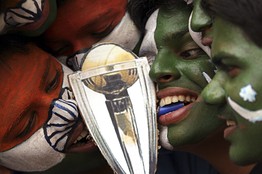
Indian and Pakistani cricket fans with a replica of the Cricket World Cup trophy. Unsettle Shahid Afridi – Pakistan’s captain has been an inspirational presence at this World Cup. He is the tournament’s leading wicket taker, with 21 scalps already to his name, comfortably ahead of the second-top bowler, India’s Zaheer Khan on 17. Afridi oozes charisma but he is prone to tantrums – it’s not uncommon seeing him shouting at teammates when things go wrong in the field, as is all too often the case with Pakistan – so India should try to frustrate him. Afridi is the nerve center of the Pakistan team, and if he is exasperated then negativity will spread to the other players.

Nullify Umar Gul – Afridi may have taken the most wickets, but Gul has been Pakistan’s most lethal pace bowler and looks on top of his game with 14 wickets (joint fifth with South Africa’s Imran Tahir in the tournament rankings). Gul has been so important to Pakistan’s campaign, particularly bearing in mind the team was stripped of two key bowling assets – Mohammad Asif and Mohammad Amir – ahead of the World Cup. The track at Mohali should favor pace bowlers over spin (will this mean we’ll see the Rawalpindi Express Shoaib Akhtar?), so the Pakistanis will be heavily reliant on another good showing from Gul, who has been effective with both the new and the old ball. If India’s excellent batsmen can nullify the ever aggressive Gul, Pakistan’s armory will be significantly weakened.

Silence Younis Khan – The big-hitting middle-order batsman has had a relatively quiet World Cup by his standards, scoring 172 runs in six innings, though that includes a 72 against a very fine Sri Lanka. He often saves his best for India so the co-hosts should be on guard if or when he comes to the crease. Out of his six career centuries, three have been made against India, including one at Mohali, the venue for Wednesday’s semifinal. India will do well to keep him contained.

Bat to Potential – India has a wonderful batting lineup but there’s a nagging feeling we haven’t seen the best of it at this World Cup. Sachin Tendulkar, Virender Sehwag and Yuvraj Singh are among the tournament’s top 10 run scorers, but India’s other batsmen haven’t consistently backed up the trio’s good work. Captain Mahendra Singh Dhoni hasn’t done much at all with the bat – his top score so far is 34 – though he has often come to the crease when his only option was to have a bit of a slog. All the batsmen in this star-studded lineup will need to play at least one great innings if India is to beat Pakistan and go on to win the World Cup final in Mumbai on April 2.

Support Zaheer Khan – India’s bowling was seen as a weakness at the start of this World Cup and it remains a concern. Zaheer Khan has been a revelation but the other pace bowlers need to give him better support. Munaf Patel was targeted by the Australians, particularly Brad Haddin, and it will be interesting to see if India’s coach Gary Kirsten selects him for the semifinal. Shanthakumaran Sreesanth and Ashish Nehra could get a call-up, but both have had their problems this tournament. Left-armer Nehra was hurt in the match against South Africa when he failed to defend 13 runs in the final over, while Sreesanth hasn’t featured since the opening match against Bangladesh when he returned disappointing figures of 0 for 53 from just five overs.

Kamran Akmal – It’s harsh to single out the Pakistani wicket-keeper, but he is prone to lapses that make him look like he has smeared his gloves in butter. Akmal put in a much improved performance in the quarterfinal against the West Indies, but India will be hoping he has another bad day at the office and gives the hosts a few reprieves.

Ignore the hype – Ok, that’s like telling a skydiver to relax and enjoy the view after his parachute has failed, but India must try to focus on the task at hand and not get carried away by the enormity of this match and the weight of expectation from a billion or so fans.

And how can Pakistan beat India?

Hide Sachin Tendulkar’s bat.

Also, Pakistan needs to silence the home crowd. The stadium in Mohali is small, with capacity for only 27,500 spectators, but they’ll be so loud it’ll seem like there are 10 times that many people. If Pakistan gets some early wickets or an early batting partnership, the home crowd will become restless and that will put India under pressure. Pakistan has the quality and talent to beat the best in the world, but it’s the kind of side that needs momentum and confidence. That will come if the team unsettles India early in the match.

Still, hiding Tendulkar’s bat wouldn’t be a bad tactic. And while they’re at it, they should probably take Sehwag’s and Yuvraj’s too.

India vs Pakistan – much more than just a game

By Anand Philar for Sify

With one stroke, India banished the ghosts of the 2003 final and the fantastic win at Motera virtually ended an era of Aussie dominance. Earlier this year, Ponting’s men lost the Ashes and now the World Cup, but like all great players, Punter left an indelible mark on the tournament with a century in what probably was his last CWC game.

While we rejoice the Indian win, let us show some grace and salute the Aussies for their achievements on the field that, sadly, has been sullied by the behaviour of some of the players. The sheer outpouring of emotions by Yuvraj and Raina after the winning boundary hit was indicative of the value the Indian team attaches to any win against the Aussies. Yes, it is always special to beat a top side even if it is on its way down.

India vs Australia: Turning point and Top performers

If anybody thought Australia are the favourites to win the Cup, then such presumption was based on the team’s track record of three consecutive triumphs, two of them under Ponting’s captaincy. As it turned out, pace, hitherto Australia’s biggest weapon, was unable to deliver and the absence of a quality spinner, much less a pair of them, eventually hurt them far more than their opponents.

On a Motera pitch that was on the slower side and assisting spin, the Aussies went at the Indians with a bevy of fast bowlers hoping to exploit the well-known weakness against the rising delivery. It was a ploy that boomeranged on the Aussies whose lone specialist spinner Krejza was just about club standard.

The fact that the three Aussie slow bowlers Krejza, Clarke and Hussey, sent down only 17 overs as against 33 by their Indian counterparts accurately reflects the difference in approach of the two teams. I feel that proved to be the decisive factor.

I am sure, Ponting would have given his arm to have a Shane Warne bowling during the Yuvraj-Raina partnership that eventually turned the game around for India or for that matter a Hayden or Gilchrist to light up their fragile batting.

India end Australia`s 12-year reign to reach semis

So, having lost to the two top sub-continental sides, Pakistan (in the league phase) and India, the Aussies return home well and truly beaten, leaving the two neighbours in a face-off at Mohali next week.

Although the Pakistanis also have beaten the Aussies, the Indian win came under far greater pressure and in a knock-out situation that offered no safety net. As such, I would rate the Motera win much higher than the one in Colombo where the Aussies fell for 176 to Pakistani spinners.

Of course, all that is history now that India and Pakistan clash at Mohali in a game that can be equated to a Brazil vs Argentina football game in terms of interest, rivalry and of course, the immense pressure on the teams to deliver.

For all that, I will still back India who I feel are better equipped than Pakistan, be it in batting or bowling with the teams being on par at fielding. The spin quotient virtually gets negated since it is a staple diet for the rival batsmen while it is not as if the two teams have a Lee or a Tait or a Johnson in their ranks to trouble anyone with searing pace. It is India’s superior batting line-up that could well tilt the scales.

Further, it will also boil down to the collective character and resilience to withstand the pressure of expectations. I have covered more than my share of Indo-Pak sporting encounters in some of the major sports to say that the levels of passion and emotions among the rival players defy words. You have to be in it to know it.

Since the rivalry between the two neighbours transcends sports and given the historical political enmity (never mind the diplomatic mumbo-jumbo to the contrary), even a sporting victory or defeat that is a mere pinhead in the big picture of life, triggers mass euphoria as if it were a Kargil.

The players themselves might not admit it in public, but the irrefutable fact is the adrenaline rush is greater and the emotions are on the boil among the contestants. It will never be ”just another game” regardless of at what stage the two teams meet and it being a World Cup semi-final, one can imagine the pressure on the players.

World Cup 2011

Under the circumstances, the saying that cricket is played more in the mind than on the field cannot be any truer in an Indo-Pak contest. We have said this before, but needs to be reiterated that ultimately, the team that blinks first will lose. The cricketing aspects such as team combination, technique, strategy and what have you, are secondary.

In effect, the stakes, like it or not, admit it or not, are much more than cricketing gains or losses. So, tighten your seatbelts and on to Mohali!

Pakistan Destroys the West Indies

By Will Davies for The Wall Street Journal

So much for close contests in the World Cup quarterfinals. In the first knock-out match Wednesday, Pakistan thrashed the West Indies by 10 wickets thanks to an inspirational bowling performance spearheaded by Mohammad Hafeez (2 for 16) and captain Shahid Afridi (4 for 30).

The West Indies batsmen were simply unable to cope with Pakistani spin, slumping to 111 all out – the team’s third-worst batting performance in World Cup history.

In one dramatic spell, the West Indies went from an already troubling 69 for 4 to an utterly disastrous 71 for 8 as Afridi & Co. showed no mercy (much like the dreaded advertisements on television after every wicket).

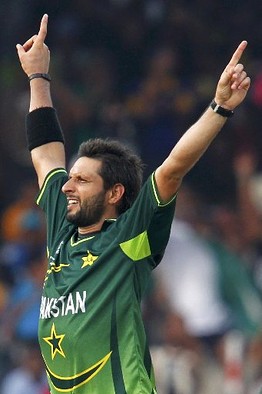
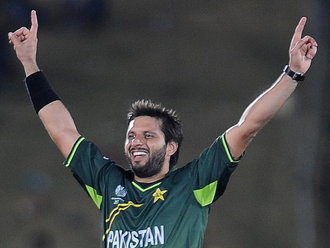
Afridi’s bowling at this tournament has been phenomenal. He is easily the top bowler with a handsome tally of 21 wickets, and his trademark celebration – arms outstretched with his two index fingers pointing to the heavens – could very well be the lasting image of the 2011 World Cup.

The West Indies team looked out of the game as soon as danger man Chris Gayle was caught by Afridi for eight. Shivnarine Chanderpaul, recalled to the team for the quarterfinal, was the only player to offer any real resistance, but he still couldn’t score fast enough and was left stranded on 44 not out at the end of the innings.

It took Pakistan just under 21 overs to reach the West Indies’ meek total, without the loss of a single wicket. Fresh from his great bowling performance, Hafeez clubbed 61 runs, while much improved wicket-keeper Kamran Akmal notched up 47. The two simply poured buckets of salt in weeping West Indian wounds.

It was humiliating for the West Indies. Not only did it mark the end of the team’s World Cup campaign, the abject performance could also have tragically hammered yet another nail into the coffin of Caribbean cricket. Despite its gloriously rich history, the sport there has been in rapid decline for more than a decade and the team’s latest efforts won’t have helped a bit.

But credit must go to Pakistan. If the team continues to play like this, Pakistan will win the World Cup. These players have to contend with so much more than other sportsmen – from the security situation back home to the involvement of former teammates in betting scandals. So while Wednesday’s match was depressing for the West Indies, for Pakistan, it was truly inspirational. And what better a day for it than March 23 – Pakistan’s Republic Day – which commemorates the signing of the Lahore Resolution back in 1940.

One more thing: If Australia loses tomorrow, we can look forward to the mother of all World Cup semifinals – India vs. Pakistan in Mohali on March 30.

Whisper it, but it’s surely destined to be.

Pakistan Christians Increase Security

As reportd by UCA News.com

 Worried Pakistani Christians have stepped up security following the assassination of minorities minister Shabhaz Bhatti last week, according to Archbishop Lawrence Saldanha of Lahore.

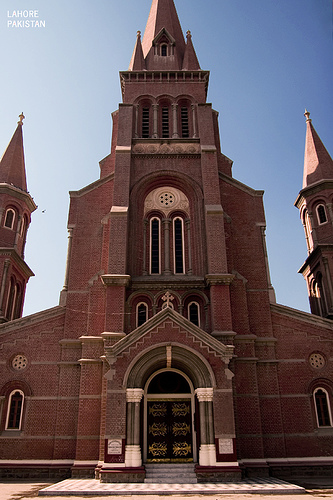
The country’s 2.5 million Christians fear for the future more than ever before and as a result security had been increased so much that his Sacred Heart Cathedral was “like Fort Knox,” he said in an interview with the charity Aid to the Church in Need (ACN).

“The murder means that we have lost a great leader in our community. Our people are quite down. They are fearful of the future – more so than before. People feel like second-class citizens. We cannot speak out. We feel oppressed, repressed and depressed.”

Accusing the government of failing to tackle fundamentalism effectively, he said: “The religious parties have put a lot of pressure on the government which is very weak and cannot make a stand against the menace of extremism.”

However, Archbishop Saldanha told ACN: “Our people are very resilient and determined. For centuries, they have been suffering. This is nothing new for them. They have always been under the thumb. We carry on with God’s grace.”

The archbishop was speaking five days after Bhatti, the only Catholic minister in the federal government, was gunned down on the streets of Islamabad, and less than two months after Salman Taseer, the governor of Punjab province, was killed by his own bodyguard.

In its report of the interview, the London office of ACN pointed out that both men had spoken out against Pakistan’s blasphemy laws. It said their criticism came amid widespread concern that extremists use the laws “as the pretext for acts of violence in response to unproven allegations of disrespect towards Islam.”

43 Dead in Pakistan Mine Blast, No Survivors

As Reported by The Associated Press

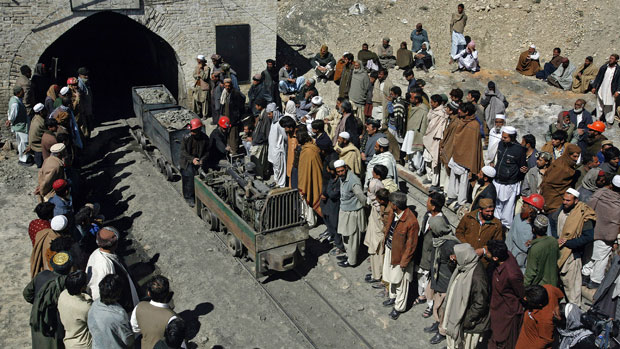
All 43 miners in a colliery in southwest Pakistan that was hit by a blast at the weekend have been confirmed dead, officials said Tuesday, as rescuers ended their search operation.

“All 43 bodies have been recovered,” Iftikhar Ahmed, provincial chief inspector of mines for the insurgency-torn Baluchistan province, told AFP.

“There are no survivors and the mine is being sealed,” Ahmed said.

President of Pakistan Mines Workers Federation Bakht Nawab confirmed the final toll.

The mine in the far-flung Sorange district of the troubled southwestern province was poorly ventilated, allowing poisonous gases to accumulate and trigger blasts that led to a collapse on Sunday, officials said.

The mine is run by the state-owned Pakistan Mineral Development Corporation and officials said they will launch an investigation into why the warnings to stop mining were not heeded.

Rich in mineral wealth, Baluchistan is plagued by an insurgency blamed on nationalist tribesmen demanding more jobs and royalties from the region’s natural resources. Hundreds of people have died in the violence since 2004.

Most coal mines in the impoverished province are notorious for overseeing poor safety standards and similar deadly accidents have occurred in the past.


Pakistan Snaps Australia’s 34-Match Unbeaten Run

By Shihar Aneez for The Los Angeles Times

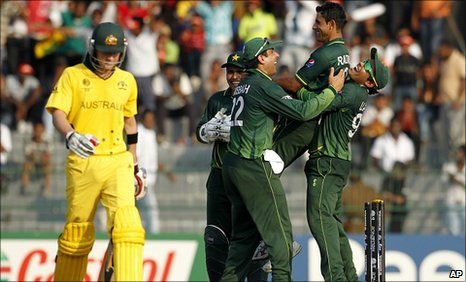
Australia’s 34-match unbeaten run in the Cricket World Cup dating back to 1999 was finally broken by Pakistan on Saturday when Ricky Ponting’s team were beaten by four wickets.

Australia, who have won the last three World Cups during the run and were unbeaten in five matches in Group A in this tournament, were skittled out for 176.

Pace bowler Brett Lee raised hopes of an Australian fightback when he got rid of opener Mohammad Hafeez in the third over but his haul of four for 28 could not prevent Pakistan from cruising to victory with 54 balls to spare.

“We certainly had a tough game today. We didn’t do ourselves any favours. I thought our batting effort was particularly ordinary,” said Ponting, who suffered his first World Cup defeat as captain.

“We stuck at it really well with the ball. I thought the guys bowled really well and gave ourselves a bit of a sniff when we got them six down but not enough runs on the board.”

Saturday’s result threw the tournament wide open as there is no undefeated team left in the competition heading into next week’s knockout stages.

Australia had already qualified for the quarter-finals but will now finish third in the group rather than top, a place now occupied by Pakistan.

“It’s a different sort of enjoyment playing against Australia. They may be World Champions but there was no pressure on us so we pulled it off today,” Umar Akmal said after finishing unbeaten on 44.

Ponting’s men struggled for momentum through out their innings after opting to bat first.

Pakistan’s pace and spin attack, backed up by sharp fielding, never allowed the Australian batting to settle down.

A 63-run second wicket stand between Brad Haddin (42) and Ponting (19), who failed once again with the bat, was the only notable partnership in the Australian innings.

Michael Clarke (34) and Steve Smith (25) were the only other batsmen to make any worthwhile contributions on a difficult surface that offered spin and some uneven bounce which the Australian batsmen failed to cope with.

Paceman Umar Gul (3-30) bowled superbly with both the new and the old ball for the 1992 champions, who were the last team to defeat Australia in a World Cup match in 1999.

Gul made the first breakthrough by bowling Shane Watson for nine and returned to clean up the tail by taking the wickets of Jason Krezja and Lee.

Shahbaz Bhatti, Modern Day Martyr in Pakistan

By Terry Mattingly for The Pocono Record

In the early days of Christianity, martyrs often gave their final testimonies of faith to Roman leaders before they were crucified, burned or fed to lions.
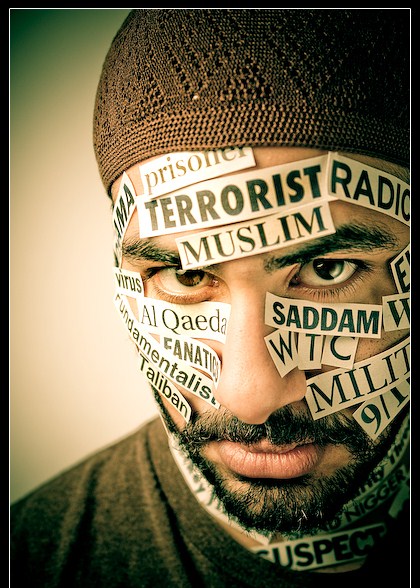
Times being what they are, Shahbaz Bhatti turned to Al-Jazeera and YouTube. The only Christian in Pakistan’s Cabinet knew it was only a matter of time before his work as minister for minority affairs got him killed. Threats by the Taliban and al-Qaida kept increasing.

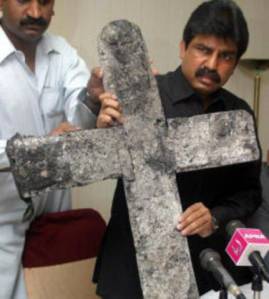
“I want to share that I believe in Jesus Christ, who has given his own life for us. I know what is the meaning of the cross and I follow him on the cross,” said Bhatti, in a startlingly calm video recorded several weeks before his assassination on March 2.

“When I’m leading this campaign against the sharia laws for the abolishment of blasphemy law, and speaking for the oppressed and marginalized persecuted Christian and other minorities, these Taliban threaten me. … I’m living for my community and suffering people and I will die to defend their rights. So these threats and these warnings cannot change my opinion and principles.”

The last straw was almost certainly the Catholic statesman’s defense of Asia Bibi, a Christian mother of five who was sentenced to death last November for the crime of blasphemy after she publicly defended her faith in a village argument. The verdict — which must be upheld by a higher court — further polarized a tense nation and sparked a global firestorm.

Then again, in 2009 Bhatti received the U.S. Commission on International Religious Freedom’s first medallion for the promotion of religious freedom. A year later, he met with Pope Benedict XVI to discuss interfaith work and religious liberty in Pakistan. Bhatti was not hiding his convictions.

The blasphemy laws in question went into effect in 1986, during the dictatorship of Gen. Muhammad Zia-ul-Haq. They ban, among other actions, the use of “derogatory remarks, etc; in respect of the Holy Prophet. Whoever by words, either spoken or written or by visible representation, or by any imputation, innuendo or insinuation, directly or indirectly, defiles the sacred name of the Holy Prophet Mohammed (PBUH) shall be punished with death, or imprisonment for life, and shall also be liable to fine.”

These blasphemy laws have been used against hundreds of Muslim dissenters and Ahmadi sect members, whose approach to Islam is specifically attacked in the laws. In practice, conversion from Islam to another faith is considered blasphemy, as are attempts to advocate or defend minority faiths, such as Christianity or Hinduism.

Vigilantes often kill those formally or informally accused of blasphemy — making trials irrelevant.

This was the case with Bhatti’s death in a wave of machine-gun fire into his unarmored car. Pakistani officials had denied his request for an armored car, despite the constant threat of drive-by shootings.

Formalities were also irrelevant on Jan. 4, when Salmaan Taseer, the governor of Pakistan’s Punjab Province, was assassinated by one of his bodyguards. This outspoken Muslim also defended Bibi and called for reform in the use of blasphemy laws.

Adoring crowds showered Taseer’s assassin with rose petals and garlands as he arrived to face a magistrate, while moderate Muslim leaders remained silent. Pakistan’s legislators observed a moment of silence for Bhatti, since it probably would have been fatal for anyone to offer a prayer in his honor.

After all, pamphlets left by those who killed Bhatti warned that they would keep fighting “all the world’s infidels, crusaders, Jews and their operatives within the Muslim brotherhood. … This is the fate of that cursed man. And now, with the grace of Allah, the warriors of Islam will pick you out one by one and send you to hell, God willing.”

Apparently, many radicals in Pakistan have concluded — a perfect Catch-22 — that it is blasphemy to oppose the blasphemy laws.

Meanwhile, the Pakistani conference of Catholic bishops is preparing to render a judgment of its own. Later this month the bishops will review a proposal to ask the Vatican to designate Bhatti as a martyr.

“Bhatti is a man who gave his life for his crystalline faith in Jesus Christ,” Bishop Andrew Francis of Multan told a Vatican news agency. “It is up to us, the bishops, to tell his story and experience to the church in Rome, to call for official recognition of his martyrdom.”

-Terry Mattingly is director of the Journalism Center at the Council for Christian Colleges and Universities.

Can Pakistan Tame Australia?

By Will Davies for The Wall Street Journal

Saturday’s Group A match between Pakistan and Australia is a tough one to predict, as is generally the case when Pakistan plays. One team – Australia – epitomizes consistency and solidity, while the other – Pakistan – is about as well-adjusted and reliable as a moody teenager.

On its day, Pakistan is one of the best sides at this World Cup, but on other occasions the team looks disorganized and uninterested. That’s one of the reasons why Pakistan is such a fascinating team to watch – you never quite know what you’re going to get.

This unpredictability can work in its favor as opponents struggle to form and stick to a game plan. Of all the sides at the World Cup, Australia is the most capable of dealing with Pakistan’s maverick approach, but it will have to tread carefully and blow off the rust that has tinged its performances thus far.

If the likes of Shahid Afridi and Shoaib Akhtar – two players who are such fun to watch – perform well, then Pakistan is in with a chance of upsetting Australia in Colombo and ending its incredible 34-match unbeaten run in World Cup cricket.

Australia has been prowling quietly but menacingly on the verges of this tournament, snapping up victims, while other teams – particularly in Group B – struggle to gain momentum and avoid upsets. But the Australians aren’t the threat they once were, and their World Cup record looks more vulnerable than in previous tournaments when the team boasted superstars like the Waugh brothers, Shane Warne, Glenn McGrath and Adam Gilchrist.

Australia’s captain Ricky Ponting is out of sorts with the bat and angry in the field. It looked like he was ready to thump Steven Smith when his teammate bumped into him as he took a catch in Wednesday’s match against Canada.

Smith is looking increasingly at ease in the Australian squad, but he’d do well to tread a little carefully, particularly when near Ponting’s toes. The Sydney-born youngster is a player of great promise and is now a regular in the Australian team, but he is yet to really shine. He needs a big performance, otherwise he risks slipping into nearly-man territory.

Pakistan has had its ups and downs this World Cup, from the heights of beating Sri Lanka to the lows of collapsing against New Zealand and a Ross Taylor batting onslaught. Australia beat New Zealand convincingly, while the match against Sri Lanka was cut short by a huge thunderstorm, an unfortunate outcome as the game was shaping up nicely and Australia, for once, looked like it had a tough opponent to deal with.

The weather forecast for tomorrow isn’t promising, but hopefully the rain will stay away from Colombo as matches between teams like Australia and Pakistan are the big occasions that make the World Cup so special.

Islamophobia and Radicalization

By James Zogby for Counter Punch

Let me state quite directly: Islamophobia and those who promote it are a greater threat to the United States than Anwar Al-Awlaqi and his rag-tag team of terrorists.

On one level, Al-Awlaqi, from his cave hide out in Yemen, can only prey off alienation where it exists. Adopting the persona of a latter-day Malcolm X (though he seems not to have read the last chapters of the “Autobiography” or learned the lessons of Malcolm’s ultimate conversion), he appears street-smart, brash, self- assured and assertive — all of the assets needed to attract lost or wounded souls looking for certainty and an outlet for their rage. Like some parasites, Al-Awlaqi cannot create his own prey. He must wait for others to create his opportunities, which until now have been isolated and limited: a disturbed young man here, an increasingly deranged soldier there.

Islamophobia, on the other hand, if left unchecked, may serve to erect barriers to Muslim inclusion in America, increasing alienation, especially among young Muslims. Not only would such a situation do grave damage to one of the fundamental cornerstones of America’s unique democracy, it would simultaneously and rapidly expand the pool of recruits for future radicalisation.

I have often remarked that America is different, in concept and reality, from our European allies. Third generation Kurds in Germany, Pakistanis in the UK, or Algerians in France, for example, may succeed and obtain citizenship, but they do not become German, British or French. Last year, I debated a German government official on this issue. She kept referring to “migrants” — a term she used to describe all those of Turkish descent living in her country — regardless of the number of generations they had been there. Similarly, following their last election, a leading British newspaper commented on the “number of immigrants” who won seats, without noting that many of those “immigrants” were third generation citizens.

America has prided itself on being different. Being “American” is not the possession of a single ethnic group, nor does any group define “America”. Not only do new immigrants become citizens, they also secure a new identity. More than that, as new groups become American and are transformed, the idea of “America” itself has also changed to embrace these new cultures.

Within a generation, diverse ethnic and religious groups from every corner or the globe have become Americans, dramatically changing America in the process. Problems remain and intolerant bigots, in every age, have reared up against new groups, but history demonstrates that, in the end, the newcomers have been accepted, incorporated and absorbed into the American mainstream.

This defines not only our national experience, but our defining narrative as well. When immigrant school children in Europe learn French, German or British history, they are learning their host’s history. In the US, from the outset, we are taught that this is “our new story” — that it includes all of us, and has included us all, from the beginning.

It is because new immigrants and diverse ethnic and religious communities have found their place and acceptance in the American mainstream that the country, during the last century, survived and prospered despite being sorely tested with world wars, economic upheaval and bouts with internal strife. During this time we had to contend with anti-black, anti-Asian, anti-Catholic, anti-Jewish, anti-immigrant, and anti-Japanese movements. In the end, after creating their moment of pain, these efforts have always lost.

They lose, but they don’t always go away. The Islamophobia we are witnessing today is the latest campaign by bigots to tear apart the very fabric of America. We know the groups promoting it. First, there is the well-funded “cottage industry”, on the right, of groups and individuals with a long history of anti-Arab or anti-Muslim activity. Some of the individuals associated with these efforts have been given legitimacy as commentators on “terrorism”, “radicalisation” or “national security concerns”, despite their obvious bias and even obsession with all things Arab or Muslim (in this, they remind me of good old-fashioned anti-Semites who never tired of warning of Jewish threats or conspiracies or who while always claiming to like individual Jews rallied against any and all Jewish organisations).

If these “professional bigots” have provided the grist, the mill itself was run by the vast network of right-wing talk radio and TV shows and websites, and prominent preachers who have combined to amplify the anti-Muslim message nationwide. Their efforts have done real damage. They have tormented decent public servants, created protests that have shuttered legitimate institutions, fomented hate crimes, and produced fear in the Muslim community.

In just the past two years, we have seen a dramatic upsurge in the activity of these bigots. More ominously, their cause has been embraced by national political leaders and by elements in the Republican Party, who appear to have decided, in 2010, to use “fear of Islam” as a base-building theme and a wedge issue against Democrats for electoral advantage.

In the past, only obscure or outrageous members of congress (like North Carolina’s Sue Myrick who expressed nervousness and insecurity because of “who was owning all those 7/11’s”; or Colorado’s Tom Tancredo who once warned that he “would bomb Mecca”) were outspoken Islamophobes. After the National Republican Congressional Campaign Committee embraced opposition to Park 51 as a campaign theme, it is hard to find a leading Republican who has not railed on some issue involving Islam or Muslims in the US.

The net impact here is that this current wave of Islamophobia has both played to the Republican base while firming up that base around this agenda. The polling numbers are striking and deeply disturbing. Some 54 per cent of Democrats have a favourable attitude towards Muslims, while 34 per cent do not. Among Republicans, on the other hand, only 12 per cent hold a favourable view of Muslims, with 85 per cent saying they have unfavourable views. Additionally, 74 per cent of Republicans believe “Islam teaches hate” and 60 per cent believe that “Muslims tend to be religious fanatics”.

The danger here is that to the degree that this issue has become a partisan — and in some cases a proven vote getter — issue for the Republican Party, it will not go away any time soon. The longer we are plagued by this bigotry, and the displays of intolerance it breeds (the anti-mosque building demonstrations or the anti-Sharia law efforts now spreading across the country) the longer young Muslims will feel that the “promise of America” does not include them, and they will feel like aliens in their own country.

It is this concern that has prompted many inter-faith religious groups and leaders and a diverse coalition of ethnic and civil rights organisations to so vigorously oppose Congressman Peter King’s (R-NY) hearings that will deal with the radicalisation of American Muslims later this week. They know, from previous statements made by King, of his personal hostility to American Muslims. They also know that what King is doing will only aggravate an already raw wound, creating greater fear and concern among young Muslims who have already witnessed too much bigotry and intolerance.

What they should also know is that in the process of targeting a religion in this way, and engaging in this most “un-American activity”, King and company are, in fact, opening the door for increased alienation and future radicalisation. Al-Awlaqi must be smiling from inside his cave.

-Dr James Zogby is president of the Arab American Institute and is a Roman Catholic of Lebanese descent and brother of prominent American political pollster and founder of Zogby Polls, John Zogby.

Pakistan Expresses “Total Solidarity and Support” to Quake, Tsunami-hit Japan

As Reported by Asian News International

Pakistan has expressed its “total solidarity and support” to the government and people of Japan in the aftermath of the devastating earthquake and tsunami that hit the country on Friday.

“We are deeply shocked over the terrible news of the strong earthquake and tsunami that has hit Japan. At this time of great trial, I wish you to know that the Government and people of Pakistan stand with you and the Japanese people in total solidarity and support,” President Asif Ali Zardari said in his condolence message to Emperor Akihito of Japan.

“Our profound sympathy and condolences to all those who lost their loved ones. Pakistan stands ready to provide any assistance to help our Japanese friends overcome the effects of this enormous natural calamity,” he added.

Prime Minister Yousaf Raza Gilani also expressed solidarity with the Japanese government and its people.

In a message to his Japanese counterpart Naoto Kan, Gilani said: “We stand ready to help, in any manner, to alleviate the suffering and assist our Japanese friends to overcome effects of this terrible natural calamity.”

In Pakistan, Justifying Murder for Those Who Blaspheme

By Aryn Baker for Time

“I believe in Jesus Christ who has given his own life for us,” the doomed man said, staring straight into the video camera. “And I am ready to die for a cause.” Shahbaz Bhatti had no hesitation in his voice as he responded to a question about threats from the Taliban and al-Qaeda. “I’m living for my community … and I will die to defend their rights.” It was his last answer in a four-month-old self-produced video that was to be broadcast in the event of his death. But the radicals had the final say. On March 2, Bhatti, Pakistan’s Minister for Minority Affairs, was shot dead in Islamabad. Pamphlets scattered on the ground claimed the act for a new alliance of “the organization of al-Qaeda and the Punjabi Taliban” and asserted that other infidels and apostates would meet the same fate.

Bhatti’s death had been foretold not just by himself but also in the nation’s response to a previous assassination, that of Punjab governor Salmaan Taseer on Jan. 4. Taseer, a self-made millionaire, had turned his largely ceremonial post into a platform for a campaign to amend Pakistan’s blasphemy laws. Bhatti, the only Christian in the Cabinet, refused to be a token and swore to battle intolerance. Both men supported clemency for Aasia Noreen, a Christian woman who had been accused of blasphemy and sentenced to death. Taseer’s stance on the issue infuriated a large part of the population that, thanks to religious leaders and school curriculums, believes that blasphemy is a sin deserving of execution. In the weeks leading up to his assassination, Taseer had been denounced at Friday prayers, excoriated in the media and largely abandoned by his Pakistan People’s Party (PPP) for fears that his campaign would prove politically toxic. The witch hunt culminated in a bodyguard’s pumping 27 rounds into his head and chest in the parking lot of a popular Islamabad shopping center.

Within hours of Taseer’s death, telephone text messages celebrating his assassination made the rounds. “Justice has been done,” read one. “If you love the Prophet, pass this on.” A Facebook fan page for assassin Malik Mumtaz Hussain Qadri garnered more than 2,000 members before site administrators shut it down. Even the leaders of state-funded mosques refused to say funeral prayers for the slain governor. When Qadri was transferred to a local jail, he was garlanded with roses by hundreds of lawyers — the vanguard of a movement that in 2008 helped unseat a military dictator — offering to take on his case for free.

At his court appearance a few days later, Qadri told the judge that he believed in a Pakistan where loyalty to the Prophet eclipses all other rights. According to Taseer’s daughter Shehrbano, her father “wanted an egalitarian society where open debate is protected and people are not killed for speaking out.” And Bhatti dreamed of a nation true to founder Muhammad Ali Jinnah’s vision, one where “you are free to go to your temples, you are free to go to your mosques or to any other place of worship.” Which vision prevails — Qadri’s or Taseer and Bhatti’s — will decide the future of the country.

The Roots of Extremism

 
It is not news that Pakistan has a lunatic fringe. What is disturbing is that after Taseer’s murder, when the silent majority finally spoke up, it praised Qadri, not his victim. The public reaction exploded the myth of Pakistan’s moderate Islam; Qadri belongs to a mainstream sect that routinely condemns the Taliban. “The Pakistan we saw in the wake of Taseer’s killing is the real Pakistan,” says Amir Muhammad Rana of the Pak Institute for Peace Studies. For the past two years, Rana’s organization has conducted in-depth interviews with a broad spectrum of Pakistani citizens. “They might dress Western and eat at McDonald’s, but when it comes to religion, most Pakistanis have a very conservative mind-set.”

Pakistan’s religious parties rarely do well at the polls — a fact often cited by those countering concerns that the country is going fundamentalist — but their street power is considerable. The furor over blasphemy appears to be partly in response to significant losses for the religious right in the 2008 elections. With the current government on the verge of collapse and popular sentiment against the PPP mounting, the religious parties are betting on significant gains if fresh elections are called. The case of Raymond Davis, a CIA contractor accused of killing two Pakistanis during what appears to have been a botched attempt to rob him, demonstrates the state of Pakistan’s politics. It has gone virtually unremarked in Pakistan that Qadri, a confessed murderer, has been hailed as a national hero, while Davis — who, whatever his background, seems to have been acting in self-defense — is considered worthy of the death penalty. Over the past few weeks, street rallies led by the religious right have simultaneously called for the release of Qadri and the hanging of Davis. (Read: “Pakistan’s Christians Mourn, and Fear for Their Future.”)

Using religion to shore up political support is nothing new in Pakistan. Founded as a Muslim nation carved from a newly independent India in 1947, Pakistan has long struggled to unite a diverse population divided by language, culture and ethnicity. Islam was the common denominator, but Jinnah was famously enigmatic about its role in government.

Then, in 1977, Muhammad Zia-ul-Haq, an Islamist military general, overthrew the democratically elected government of Zulfikar Ali Bhutto, who was already retrenching his secular vision of Pakistan in an effort to win religious support. To further appease Muslim religious leaders, Zia-ul-Haq strengthened the colonial-era blasphemy laws, mandating that breaches should be answered by the death penalty. Since then, more than 1,274 cases have been lodged. As repeating blasphemous words could be considered to be perpetuating the crime, many cases are accepted without evidence, a system well primed for the pursuit of vendettas. That nobody has yet been executed by court order is hardly reassuring: 37 of the accused have been killed by vigilantes. (In 1929, Jinnah famously defended an illiterate carpenter who shot to death a Hindu publisher accused of blasphemy. The plea failed, and after the carpenter was hanged, Taseer’s father was one of the pallbearers.)

The Uses of Blasphemy
When a nation rises up in support of a murderer instead of his victim, it’s hard not to believe it is heading down a dangerous path. “What is happening now won’t matter in five years,” says Shehrbano Taseer. “It will matter in 25 years. What we are seeing now is the fruit of what happened 30 years ago. If people had stood up against [Zia-ul-Haq], we would not be here today. Because of that silence we have madrasahs spewing venom, a true Islam threatened by the same people who claim to serve it, and a cowed majority too afraid to speak.”

President Asif Ali Zardari, an old friend of Taseer’s, condemned the murders but didn’t go to either funeral. After paying his respects to Taseer’s family, Interior Minister Rehman Malik gave an impromptu press conference outside Taseer’s house during which he announced that he too would kill any blasphemer “with his own hands.” A few days later, the Prime Minister announced that he would drop the issue of the blasphemy laws altogether. Meanwhile, the government is under pressure to go through with Aasia’s sentence, and now her two champions are dead.

Reaction to Bhatti’s murder has been muted, characterized mostly by denial. What little newspaper coverage there was focused on security lapses or the role of the country’s Christian community rather than on the motives of the killer. On television talk shows, members of the religious parties and right-wing commentators spun a conspiracy theory that alleged that Bhatti’s murder had been “a plot” hatched by “outside forces” to “divert attention from the Raymond Davis affair.” There was no mention of the fact that Bhatti was campaigning alongside Taseer on the issue of blasphemy.

The PPP was founded in 1967 with the goal of bringing secular democracy to a nation under military rule. It vowed to give power to the people and promised to protect the nation’s downtrodden. That Pakistan’s most progressive party — one that has already endured the assassination of former Prime Minister Benazir Bhutto — should cave in the face of religious fundamentalism speaks volumes about the strength of the religious right. A candlelight vigil promoting a progressive Pakistan a few days after Taseer’s assassination drew nearly 1,000 supporters; a religious rally in Karachi the same day had 40,000 in the street chanting Qadri’s name. “Taseer’s murderer was tried in the court of public opinion, and he has emerged a hero,” says a woman shopping for vegetables in the same market where the governor was killed. “If someone kills me because I criticize Qadri, will he too be called a hero?” She declined to give her name. (Read: “Murder in Islamabad: Pakistan’s Deepening Religious Divide.”)

Of course, few Pakistanis would ever go as far as Taseer’s or Bhatti’s killers. But their ambivalence can easily be manipulated. “Just because we are religious does not mean we will all be reaching for guns the next time someone says something wrong,” says Malik Khan, a university student who spent a recent afternoon at a shrine in Lahore dedicated to a revered Islamic saint. “But Salmaan Taseer was an extremist as well. He should not have touched the blasphemy law.” Khan received a text message praising Qadri and exhorting him to pass it along. It posed a moral quandary: “I don’t agree with the message,” he says. “But I love the Prophet. My thumb hesitated a long time over the delete button.” In the end, he passed the hate along.

Qadri himself was the religious-minded youngest son of a family just stepping into the middle class. Like his brother, he joined the special-forces branch of the Punjab police in 2002. He had been flagged as a security risk because of his strong religious leanings but was nevertheless appointed to Taseer’s security detail when he visited Islamabad. In his confession, Qadri said he had been inspired by the teachings of his local mullah, Hanif Qureshi. At a rally a few days later, Qureshi claimed credit for motivating Qadri. “He would come to my Friday prayers and listen to my sermons,” he said. Then he repeated his point: “The punishment for a blasphemer is death.”

But is it? Two weeks after Taseer’s murder, I visited Qari Muhammad Zawar Bahadur, the head of one of Pakistan’s mainstream religious groups and a co-signer of a statement that advised Muslims not to show “grief or sympathy on the death of the governor, as those who support blasphemy of the Prophet are themselves indulging in blasphemy.” For more than an hour, he justified his group’s stance, telling me that the Koran was clear on the issue. I asked Bahadur to show me the exact verse that detailed the punishments for blasphemy. He mumbled that “there are several passages,” as if there were so many, he couldn’t decide which one to quote. When pressed further, he consulted a Koran and read aloud a passage that spoke of killing a man who had once harmed the Prophet.

That verse has routinely been dismissed by leading Islamic scholars as referring to a specific case and having nothing to do with blasphemy. They say there is no definition of blasphemy in the Koran, nor any prescription for its punishment. “Nobody challenges these mullahs, and that is our problem,” says Omar Fazal Jamil, who runs a p.r. firm in Lahore. “We can’t invoke liberal secular values anymore. I have to have the knowledge to contradict these men who distort our religion for their own political gain. I have to be able to say, ‘No, this did not happen, this is not right, and show me where it says in the Koran that blasphemers should be shot on sight.’ ”

The Sin of Silence
In the absence of such challenges, those favoring religious intolerance will continue to have things go their way. In late 2007, Benazir Bhutto released an updated manifesto for her father’s party. “The statutes that discriminate against religious minorities and are sources of communal disharmony will be reviewed,” it said. Less than a month later she was dead, killed in a bomb attack just 13 km from where both Taseer and Bhatti were murdered. Her death was an opportunity to rally the nation against the forces of extremism. Instead the party focused on consolidating power. The manifesto remains an empty promise, and two more voices of tolerance have been silenced. For evil to prevail, goes the old aphorism, all that is required is for good men to do nothing.

— With reporting by Ershad Mahmud / Lahore and Omar Waraich / Rawalpindi

The Myth of ‘Moderate Pakistan’

By Sadanand Dhume for The Wall Street Journal

It’s time to bury the myth of moderate Pakistan. You know the one: the notion, repeated ad nauseam in magazine articles, think-tank reports and congressional testimony—as though saying it often enough will make it true—that Pakistan is an essentially tolerant country threatened by a rising tide of fundamentalism. Here’s a news flash: The tide has risen.

The most recent reminder of this came last Wednesday in Islamabad, when suspected Taliban militants shot dead Shahbaz Bhatti, Pakistan’s 42-year-old minister for minority affairs and the only Christian in the overwhelmingly Muslim nation’s cabinet. His crime? Supporting the repeal of a barbaric blasphemy law that makes insulting the prophet Muhammad punishable by death.

The law is often used to settle scores with hapless religious minorities, especially Christians such as Asia Bibi, an illiterate peasant sentenced to hang last year after she allegedly badmouthed the prophet during a row with Muslim coworkers. Bhatti’s assassination comes two months after a bodyguard murdered Punjab Gov. Salmaan Taseer for visiting Ms. Bibi in jail and speaking out against abuse of the law.

To be fair, Pakistan’s claim to relative moderation has been kept alive thus far by more than just wishful thinking. Overtly Islamist parties such as the Jamaat-e-Islami have rarely commanded more than a fraction of the national vote. Women enjoy freedoms in the public square that their counterparts in Saudi Arabia and Iran could only dream of. At great personal risk, a small but courageous group of activists, intellectuals and politicians speak out publicly against bigotry and religious intolerance.

Scratch the surface, however, and a bleaker picture emerges. Islamist parties may not garner large-scale electoral support, but Islamist ideas are widely tolerated by mainstream political parties. The major opposition party, former Prime Minister Nawaz Sharif’s Pakistan Muslim League, flaunts its closeness to sundry Islamists, including Jamaat-ud-Dawa, the parent organization of the international terrorist group Lashkar-e-Taiba.

Ostensibly secular, the ruling Pakistan Peoples Party supported both Kashmiri militancy and the Afghan Taliban in the past. In its current incarnation it appears permanently cowed by the country’s legion of vocal fundamentalists. President Asif Ali Zardari failed to attend the funerals of either Taseer or Bhatti. His government has made it clear that it will not touch the controversial blasphemy law. Interior Minister Rehman Malik declared that he would personally kill anyone who dared blaspheme Muhammad’s name.

As for Pakistan’s undeniably brave activists and intellectuals, unfortunately they appear to have more admirers overseas than among their compatriots. Hand-wringing in the pages of Dawn and the Friday Times, two of the country’s leading English-language newspapers, has not prevented Mumtaz Qadri, Taseer’s murderer, from becoming a national hero.

Not surprisingly, anti-American sentiment—often a reliable shorthand for a society’s paranoia and self-loathing—is rampant. According to the Pew Global Attitudes Project, American favorability ratings stood at 17% last year, the lowest of all countries surveyed. On the streets, bloodcurdling yells for the execution of alleged Central Intelligence Agency operative Raymond Davis, accused of killing two Pakistanis in January, have prevented the government from granting Mr. Davis the diplomatic immunity that the U.S. claims he is entitled to. This despite personal pleas by President Barack Obama and Sen. John Kerry.

By now the reasons for Pakistan’s predicament are well known. They include the intolerance embedded in the nation’s founding idea of a separate “land of the pure” for Indian Muslims, the malign shadow of Saudi Arabia on religious life, blowback from the anti-Soviet jihad of the 1980s, and the overwhelming influence that the army and its thuggish intelligence wing, the Inter-Services Intelligence, wield on national life. The army’s very motto, Jihad-fi-Sabilillah, or jihad in the path of Allah, is an exhortation to holy war.

For the international community, the long road to fixing Pakistan begins with the simple recognition that the country’s true face is not the urbane intellectual making reasoned arguments, but the frenzied mob showering rose petals on a murderer for his services to the faith. Over time, Pakistan can only be saved by re- arranging the basic building blocks of the country.

This means backing provincial autonomy and linguistic identity as an alternative to the centralized pan-Islamism used by the military and its supporters to weld the country together. It means deploying social networks and satellite television to open the door to reasonable discourse about religion. It means channeling aid to ensure that children are no longer taught to glorify Islamic conquest and reflexively mistrust the West and India. It means accepting that the most poisonous madrassas—such as Jamia Binoria in Karachi and Darul Uloom Haqqania outside Peshawar—must be shuttered if they can’t be reformed.

Needless to say, none of this will be easy. But the consequences of the alternative—pandering to fundamentalists while blaming outsiders for all the country’s ills—can be seen in the freshly turned soil of Bhatti’s grave.

-Sadanand Dhume is a resident fellow at the American Enterprise Institute and a columnist for WSJ.com.

Sindh Saves the Day

By Nadeem F Paracha for Dawn

Plans are afoot to build the world’s first ever international Sufi university near Bhit Shah in Sindh. The main purpose of the institution would be to promote interfaith and intercultural education to tackle extremism in the country.

Such a thought and project could only have come about in Sindh. Especially in the context of what Pakistan has beengoing through in the last many years.

Not only have the country’s other provinces – especially the Punjab and Khyber Pakhtunkhwa (KP) – become central targets of horrid terrorist attacks by extremist organisations, the Punjab in particular has also been witnessing a steady growth of faith-based conservatism within its urban middle and lower middle-classes.

When extremists (calling themselves ‘Punjabi Taliban’) attacked the famous Sufi shrine, Data Darbar in Lahore late last year, economist and political analyst, Asad Sayeed, made a rather insightful observation.

He said that had such an attack on the Darbar taken place twenty years ago, thousands of Lahorites would have poured out to protest.

But not anymore. The attack on one of Punjab’s most popular Sufi shrines was simply treated as just another terrorist attack.

Though it is now clear that the Wahabi/Deobandi extremists have been going around blowing up Sufi shrines frequented by the majority Barelvi Muslims, the Barelvi leadership has looked elsewhere, putting the blame on the ever-elusive ‘foreign hands.’

Journalist and intellectual Khaled Ahmed once wrote a telling tongue-in-cheek article about the annual gathering of the Dawat-i-Islami in Multan.

The Dawat is the Barelvi equivalent of the Deobandi Tableeghi Jamat. Both these outfits are considered to be non-political organisations who are more interested in evangelizing their respective versions of Islam and its rituals. One should also mention that both these (sub-continental) strains of Islam accuse one another of being ‘flawed Muslims.’

Ahmed wrote how after Dawat’s huge congregation in Multan, when police found some bullet-riddled bodies of Dawat members, the outfit’s main leadership simply refused to acknowledge the glaring evidence that pointed towards the involvement of an opposing Sunni sect’s organisation in the murders.

Ahmed adds that Dawat leaders began babbling about ‘outside forces (RAW, CIA, Mossad)’ who wanted to create disharmony between Pakistan’s Barelvi majority and the Deobandi and Wahabi sects.

Barelvis: From moderate to militant

One can understand the above-mentioned episode as an example of the confusion Barelvi spiritual leadership has gone through since the 1980s.

From its inception in the 18th century and until about the mid-1980s, the Barelvi sect was largely apolitical in orientation, non-Jihadist and followers of some of the most relaxed dictates of the Hanafi madhab – the first of the four main Islamic schools of law that is also considered to be the most moderate.

‘Barelvi Islam’ (as it is sometimes called) is purely a sub-continental phenomenon that fuses elements of Indian Sufism with the folk and populist strains of various cultures that exist in the sub-continent.

It is also called the ‘folk Islam’ of the region in which a high degree of tolerance exists between various faiths, sects, classes and ethnicities and in which the puritanical aspects of other Islamic sects are eschewed and even rejected.

The Sufi shrine and an intense reverence of the Prophet (PBUH) play a central role in Barelvi Islam. Its populist and moderate make-up helped it become the majority Sunni sect amongst the Muslims of the sub-continent.

Two of its leading opponents have been the Sunni Deobandi sect (also a product of the subcontinent) and the Saudi-inspired Wahabism.

Both have accused Barelvis of ‘adopting Hindu rituals and practices’ and assorted ‘heresies.’

In spite of being the majority sect amongst Sunni Muslims in Pakistan, ‘Barelvi Islam’ hardly ever had a coherent political expression in shape of a mass-based political party or organisation.

Its spiritual leadership remained pro-Jinnah (unlike Deobandi organizations of undivided India), and various Pakistani political leaders have continued to appeal to the symbolism and lingo associated with various populist aspects of Barelvi-ism.

Zulfikar Ali Bhutto and his Pakistan Peoples Party (PPP) was the most successful in this respect.

Bhutto was also one of the first leading Pakistani political figures to undertake the act of regularly visiting various famous Sufi shrines in Sindh and Punjab.

Barelvis are in the majority in Sindh and the Punjab, whereas Deobandis are largely centred in Khyber Pakthunkhwa and in the Pushtun-dominated areas of Balochistan.

Until the 1970s Barelvi-ism also prevailed among many of Sindh and Punjab’s urban middle-classes, especially those who considered themselves to be progressive and likely supporters of secular politics.

However, the arrangement in this context was suddenly disturbed with the arrival of the Ziaul Haq dictatorship in 1977.

Dipped in the political Islam of scholar and Jamat-i-Islami (JI) chief Abul Ala Mauddudi, Zia soon moved towards infiltrating the spiritual and political nerve centres of Barelvi-ism in an attempt to ‘reform’ them.

Barelvi dominance across the country’s religious landscape reminded him of Z A. Bhutto’s populism (which he, like JI, considered to be ‘vulgar’ and ‘un-Islamic’), and from 1979 onwards Pakistan under Zia also became one of the leading client states of Saudi-generated Wahabi propaganda and aid.

Stunned by the ‘Islamic revolution’ in the Shia-dominated Iran in 1979, Saudi Arabian monarchy and its Wahabi Sunni religious elite began seeing Pakistan’s Barelvi-dominated make-up as venerable to Shia-ism’s revolutionary symbolism and also of socialist propaganda, especially with the arrival of Soviet forces in Afghanistan.

At least that was one of the reasons used by Zia and his Saudi allies to draw the United States into giving Pakistan billions of dollars worth of aid and arms.

With the aid also came Wahabi propaganda literature and preachers who along with Pakistani Deobandi and Wahabi spiritual and political groups began setting up madressas and mosques.

These madressas operated as institutions that would indoctrinate young Pakistanis – most of whom were immersed in the non-Jihadi traditions of Barelvi-ism – and prepare them for Jihad against Soviet forces in Afghanistan.

Bralevi tradition had also not been very kind to the ulema and the clergy.

To address this, Zia also began describing famous Sufi saints as ulema and banned (in the media) all criticism and humour aimed at the clergy.

The Afghan war, Saudi propaganda, the mushrooming of Deobandi and Wahabi madressas and televangelists, and a concentrated campaign by the Zia regime to equate the dictatorship’s capitalist-Islamist makeup as something in accordance with the Shariah and with ‘Jinnah and Iqbal’s vision,’ had a telling impact on Pakistan’s religious sociology.

In the Khyber-Pakhtunkhwa many moderate and progressive Deobandi strains that had prevailed in the province began sliding into the sect’s more radical dictates, coming closer to the puritanical Wahabi and Salafi ideas about faith.

This slide was celebrated by the Punjab-dominated military as a successful blow to the secular and ‘treacherous’ Pukhtun separatist tendencies.

In the Punjab, the province benefited the most from Zia’s Punjab-centric capitalist maneuvers. This coupled with unprecedented remittances coming from Pakistanis who had begun going to Arab Gulf states to work from the 1970s onwards, gave birth to new moneyed classes.

Many from the petty-bourgeoisie and bourgeoisie sections began moving away from their Barelvi heritage and towards more puritanical strains of faith.

Their Barelvi past now reminded them of their lower status and economic modesty, whereas they began relating their enhanced economic standing with the adoption of the more puritanical strains of Islam.

That’s why the growth of puritanical Islamist and sectarian organizations that Punjab saw under Zia, a lot of their local funding came from Punjab’s nouveau-riche and petty-bourgeois trader classes.

Interestingly, it was also the same classes that also pushed the Barelvi leadership to become more conservative and radical. Those sections of the Punjabi petty-bourgeoisie that stuck to Barelvi-ism encouraged their spiritual leadership to compete with the Puritanism and radicalism of the growing number of Deobandi and Wahabi groups.

This trend saw the first ever emergence of radical Barelvi groups. In the early 1980s, the Dawat-i-Islami was formed to counterbalance the growth of the Deobandi Tableeghi Jamaat that had begun making deep inroads into Punjab’s bourgeoisie and the military.

The Dawat discouraged the Barelvis from indulging in antics associated with the region’s folk Islam, emphasising an increased reverence of holy personalities and encouraging holding of recitals of naats and milads instead of quwalis and dhamals. The last two became associated with the practices of the lower-class Barelvis.

In 1992, emerged the Sunni Thereek (ST). A Barelvi outfit that emerged from the splintering of the oldest Barelvi Islamic political party, the Jamiat Ulema Pakistan (JUP).

Such occurrences did not really help the Barelvi sect defend its traditions in the face of the state-sponsored Deobandi and Wahabi onslaught –  rather, these organisations began turning Barelvi-ism into an equally anti-pluralistic and militant political phenomenon.

Sindh saves the day?

By the 1990s, Zia’s manoeuvres and Saudi involvement in reshaping Pakistan’s religious tradition had seen Khyber Pakhtunkhwa and Punjab become hostage to various violent Deobandi/Wahabi outfits and new-born Barelvi reactionary-ism.

The Punjab also saw a rise in the use of reactionary political and religious narratives within its lower-middle and middle-classes, whereas in Balochistan attempts were being made (by intelligence agencies) to neutralize secular Baloch nationalist militancy with the help of puritanical evangelical outfits. The agencies had already done this successfullyin Khyber Pakhtunkhwa in the 1980s.

But what happened in Sindh? Barelvi-ism in Sindh (outside Karachi) has always been a lot more secular and pluralistic than the Bareilvi-ism in the Punjab.

Its  sociology  in Sindh heavily revolves around the staunchly secular historicity that the province’s famous scholar, GM Syed’s literary work generated.

He described a highly pluralistic and secular reading of Sufism as being the cultural and religious make-up of the Sindhis and it is this narrative that still rules the roost in the province’s social and religious psyche.

This is one of the reasons why Zia completely failed to impose his version of Islam here. Also, just like the majority of the Baloch who equate puritanical Islam with the ‘Punjabi civil-military elite,’ so does the socio-political discourse in Sindh.

On the other hand, in Karachi, though Zia-backed Deobandi and Wahabi radical outfits did manage to find a foothold, two things have always worked against these outfits here.

The first is the fact that the sprawling ethnic, sectarian and religious diversity found in Karachi actually absorbs and neutralizes any attempt by an outfit to impose its version of Islam.

Secondly, MQM, a party that first emerged as a mohajir nationalist group, adopted almost the same populist Barelvi symbolism and lingo as Bhutto did in the 1970s.

Also, the other two big political parties in the city too are secular: the PPP and ANP.

Though the Sunni Thereek (ST) has managed to infiltrate some sections of MQM’s support, ST is Barelvi and anti-Taliban (albeit reactionary).

In spite of the rampant crime and ethnic tensions that are a constant in Karachi, it will not be an overstatement to claim that Karachi along with the rest of Sindh today stands to be perhaps the only (ragged) sanctuaries in present-day Pakistan that are (comparatively-speaking) largely free of the factors that have created opportunities in the Punjab and KP for violent extremist activity as well as for reactionary conservatism to now become a mainstay in Punjab’s bourgeois psyche.