Archive for the ‘ Pakistanis ’ Category

Dr. Mahbub ul-Haq Reflects on Working Toward Peace

By Dr. Mahbub ul-Haq for Architects of Peace

Simply put, our challenge is this-can we make the twenty-first century a century of human development, when all people enjoy access to education and health, when each individual is enabled to utilize her or his full human potential, when all people have developed their basic capabilities and enjoy equal access to the opportunities of life? Now let us be clear. This is a vision of human competition, not state welfare. It is a vision of access to opportunities, not access to charity. It is a vision of the enrichment of human lives, not just the enrichment of national income or wealth, and the investment required to realize this vision is fairly modest.

We wish to move over the next fifteen years toward a society where there is universal basic education, primary health care for all, safe drinking water for all, adequate nutrition for all malnourished children, and family planning services for all willing couples. In other words, we wish to move toward a world society where basic social services are available to everyone, both men and women, and women before men; where the worst human deprivations curbing the potential of more than 1.3 billion people today have been finally overcome; where all essential ingredients for the full flowering of human potential are available in the form of adequate education, health, and nutrition. We wish to achieve all this.

What is the financial cost of achieving such a society? According to the best available estimates, the cost will be around an additional $34 billion a year-34 billion dollars. This cost is less than 1 percent of the total income if the poor nations bear all the burden themselves and this cost will be reduced to less than one-seventh of 1 percent of global income if the international community decides to share the cost along with the poor nations. That is the cost.

The question we face today is this: Can we persuade the leaders of the world to accept such a global compact for human development for the twenty-first century?

Let us again be very clear. Such a global compact is not yet another treaty requiring the formal approval of the governments of the world. It is, in fact, a shared vision of what the world can and must achieve. It requires global understanding, not a global treaty, because in the last analysis most action must begin at the national level, and often at the grassroots level, and such action must begin in the developing world itself.

These countries do not lack financial resources. What they lack is political courage. We need to ask the leaders of the Third World, and ask them bluntly, why they insist on spending $130 billion each year on the military when even a quarter of this expenditure can finance their entire essential social agenda. And we must ask them why they insist on having six soldiers for every one doctor when their people are dying of ordinary diseases, from internal disintegration, not from external aggression, from many threats to human security, not any threats to territorial security.

And we must also ask them why they are not convinced that everything they buy costs the immunization of four million children and every jet fighter they purchase costs the schooling of three million children and every submarine they store away in the waters denies safe drinking water to sixty million people. Why do we let them argue poverty of resources for human development when they have well-fed armies but unfed people and when many of these nations spend more on their armies every year than their total education and health budgets?

And at the same time, we must ask the leaders of the rich nations, why do you keep subsidizing your arms exports to poor lands when you argue against even food subsidies in these poor nations? Why is it that you refuse to close down your military bases, phase out your military assistance, and restrict the export of the sophisticated military weapons even now when the Cold War is over? What is your excuse? And why do you make such handsome profits on your exports of arms to poor, starved, disintegrating countries while giving them lectures all the time on respect for basic human rights? And we need to ask these leaders, why do they not invest in human development and instead make profits out of the future prosperity of poor lands and not out of the current state of human deprivation?

I believe, my friends, what we need to change is the mindset of our leaders in developing countries as well as in rich nations, because changes in policies will then follow and adequate resources for priority human development agendas will then be mobilized.

Let us spread the message to all world leaders that such a compact is not only desirable-it is eminently doable, it is feasible. And many years from now, we can look our grandchildren right in the eye and tell them quite proudly: “Yes, we tried.”


-Described as “the most articulate and persuasive spokesman” for the developing world, and as one of the most brilliant economists the world has ever known, Pakistan born Dr. Mahbub ul-Haq pioneered many economic policies to help the poor. He served as chief economist of Pakistan’s National Planning Commission during the 1960s, director of the World Bank’s Policy Planning Department in the 1970s, and in various Pakistani cabinet posts during the 1980s. As special advisor to the United Nations Development Program, he created the Human Development Index, which measures development by people’s well-being, rather than by their income alone. Haq was the author of six books on poverty and development. He died in 1998 in New York.
Aasia Bibi and Impurities in the Land of the Pure

By Manzer Munir for Pakistanis for Peace

The case of Aasia Noreen aka Aasia Bibi illustrates how far Pakistan has to go to secure freedoms for its religious minorities. Christians and Hindus are not the only minorities who are persecuted for their beliefs but it is also Muslim minorities such as the Ismailis, Ahmadis, and Shiites who are routinely harassed, discriminated and also killed. Sadly, it is the case of Aasia Bibi that has brought some much needed attention to Pakistan’s sad state of affairs towards the treatment of its religious minorities.

Several sections of Pakistan’s Criminal Code consist of its blasphemy laws and of all the Muslim countries of the world that have anti-blasphemy laws, Pakistan’s anti-blasphemy laws are by far the strictest. There is section 295 that forbids damaging or defiling a place of worship or a sacred object. Then there is section 295-A that “forbids outraging religious feelings.” There is also 295-B which prohibits defiling the Qu’ran and was originally punishable by life imprisonment but has since been amended to up to three years imprisonment.

No section of the blasphemy law is more controversial or harder to prove than Article 295-C, the law that Aasia Bibi is allegedly charged with having broken. In respect to prophet Muhammad, this statute states that ” Whoever by words, either spoken or written, or by visible representation, or by any imputation, innuendo, or insinuation, directly or indirectly defiles the sacred name of the Holy Prophet Muhammad shall be punished with death, or imprisonment for life and shall also be liable to a fine.”

Aasia’s case and charges against her started almost a year and a half ago when there was a quarrel over a bowl of water in a dusty village in the heart of Pakistan’s Punjab province. A group of women were working the fields in the heat of the Pakistani sun when one of them, Aasia Bibi, dipped her glass in the communal bucket of drinking water to fetch herself and others a glass of water to drink and immediately was rebuffed by the other women who claimed that the water was now unclean as it had been touched by a non-Muslim. According to witnesses, instead of quietly bowing her head and taking the indignities, Aasia’s crime was that she mounted a strong defense of her faith and remained steadfast in her demeanor that she did nothing wrong. Too often in Pakistan, the blasphemy laws are used against religious minorities to settle personal vendettas and old scores according to Pakistan’s Human Rights Watch, a watchdog group monitoring the case.

The news traveled fast in Aasia’s village of Ittan Wali, in Punjab’s Sheikhupura district that a Christian woman had insulted the prophet. The local mullah got on the mosque loudspeakers, urging the “faithful” to take action against Aasia Bibi. In sad but familiar pattern, her defense of her faith was somehow twisted into an accusation of blasphemy, according to her family and others familiar with the case. Soon as a mob gathered outside her home ready to take the law into their own hands and handing out vigilante justice, the police moved in and took her into custody. But instead of protecting her, they charged her with insulting Islam and its prophet under the blasphemy laws.

And then on Nov. 8, after suffering 18 months in prison, Aasia Bibi was sentenced to death by a district court, making her the first person to be handed the death penalty in Pakistan under the blasphemy laws. Many before her over the years have been charged, but punishment had been commuted to lesser penalties than the death sentence imposed on Aasia Bibi. No concrete evidence was ever presented against Aasia, according to Pakistan’s Human Rights Watch. Instead, the district judge relied on the testimonies of three other women, all of whom were hostile towards her.

Unfortunately this is a common insult hurled at many of Pakistan’s 2 million Christians who make up just 1.59% of the total population. Often, Christians in Pakistan are discriminated and persecuted and many times only get the lowest of the low jobs such as street sweepers, janitorial and sanitation workers. In fact, in Pakistan, the term ‘Chura‘ has become synonym with the Christian community as it relates to an unclean person akin to how the untouchables or Dalit community is seen in India. In India however, the Dalits are not subjected to arcane state blasphemy laws geared towards religious minorities as in Pakistan or are threatened with their lives at the hands of the Hindu majority.

As discussed in a couple of my previous articles, Taliban 1o1, History and Origins and Taliban 201, The Rise of the Pakistani Taliban, the Islamization of Pakistan started under the late General Zia ul Haq of Pakistan who took over the leadership of the country through a military coup in 1977 when he hung the deposed and democratically elected Prime Minister Zulfiqar Ali Bhutto. Earlier in 1973, the 1973 Constitution of Pakistan had declared that “Islam shall be the religion of the Pakistan” and had systematically begun the process of restricting the participation of religious minorities in government and politics.

Before General Zia, there were only two reported cases of blasphemy. Since the death sentence was inserted in 1986 into the Penal Code for the blasphemy laws, this number has now reached 962 — including 340 members of the Ahmadi Muslim community, 119 Christians, and 14 Hindus. A close examination of the cases reveals the blasphemy laws are often invoked to settle personal scores, or they are used by Islamist extremists as cover to persecute religious minorities, sadly with the help of the state under these laws.

General Zia began this policy of Islamization of Pakistan in conjunction with his support for the war against the Russians and assistance to the Afghan Mujahedeen as well as the building of thousands of madrassahs or religious schools across Afghanistan and Pakistan which nurtured the young men into what later became the Taliban. Many of these blasphemy laws fully came into being under his reign, although some were around since as early as more than 100 years prior when the British drew up the Indian Penal Code of 1860 which was initially an ill foreseen aim at keeping the peace among the many fractured faiths of the subcontinent. For instance, section 295-A, which “forbids outraging religious feelings”, could have been applied against a Muslim who insulted a Hindu or a Hindu who taunted a Sikh or Christian or vice versa. However under Zia, the blasphemy laws were expanded and almost exclusively applied against Muslim minorities such as the Ahmadis, Islamilis and Shiites as well as against the Christian and Hindu populations.

Recently, a religious ‘leader’ came out and has offered over $6000 to anyone who can kill Aasia Bibi while she awaits her punishment in police custody. Outrage and denunciations on this case are coming from across the world as many people are appalled at the sad state of rights for religious minorities in Pakistan. The Pope has intervened also asking for clemency for Aasia Bibi from Pakistan’s President Asif Ali Zardari. Against all manner of reason and justice, Lahore’s High Court recently issued an order on November 29, 2o1o, preventing Zardari from exercising his constitutional authority to pardon Aasia Bibi.

In a country rife with violence and chaos and one that has become synonymous with terror the world over, the case of Aasia Bibi is yet another dark stain on the country’s image around the world. The Taliban and the extremist groups ravaging Pakistan can be explained as being a violent minority and do not and should not reflect on the nation as a whole as the majority of people in Pakistan are opposed to them and their views of Islam. But the blasphemy laws, for as long as they have stayed on the books in Pakistan and in the constitution, cannot and should not be excused in any shape or form. These laws need to be repealed and the constitution needs to be amended in an emergency manner so that Aasia Bibi and other religious minority citizens of Pakistan are not subjected to cruel and subjective laws that are almost exclusively used against minorities to settle scores, personal vendettas, and instill terror in less than 3 percent of the country that is not part of the religious majority of Sunni Muslims.

There needs to be international pressure placed on Pakistan from the United Nations, the United States, Europe and others to modify the constitution immediately and to pardon this 45 year old mother of five children. It is ironic that in a country where many people sympathize with Osama’s Al Qaeda and profess to hate the west with one hand, they decry with the other why not enough western aid has came to their country when it recently saw the worst flooding in its history. Can you blame the American citizens, the Europeans or citizens of any other Christian nation from hesitating to give aid to a country that not only plays a duplicitous game when it comes to terrorists and terror havens but also treats Christians and other religious minorities in the manner as in the case of Aasia Bibi?

The name Pakistan literally translates into “The Land of the Pure”. And as a child growing up I was told that the meaning of Pakistan’s flag is this: “The green is a traditional Islamic color and the crescent moon and star are also Islamic symbols. The white stripe represents the non-Muslim minority and religious groups of Pakistan and there place in the country.” In my view, as long as the nation sanctions and tolerates these utterly unjust and biased blasphemy laws, the religious minorities of Pakistan clearly have no place in this land of the ‘pure’.

-Manzer Munir, a proud Pakistani American and peace activist, is the founder of Pakistanis for Peace and blogs at www.PakistanisforPeace.com as well at other websites as a freelance journalist and writer.

Majority of Muslims Reject Al-Qaeda

As Reported by Sandra Johnson for The Daily Mail

Muslims in many parts of the Islamic world overwhelmingly reject al Qaeda, support a large role for their faith in government and believe democracy is preferable to any other kind of political structure, according to a new survey released by Pew Research Center’s Global Attitudes Project.

The study also found falling support for suicide bombings, as well as mixed attitudes towards Hamas and Hezbollah, Islamic groups designated as terrorist organizations by Western governments but which operate extensive social services networks in parts of the Muslim world.

The survey, conducted this spring in Jordan, Lebanon, Nigeria, Indonesia, Egypt, Pakistan and Turkey, found that only in Nigeria did Muslim populations have anything approaching a favorable view of al Qaeda, with 49 percent expressing positive views and 34 percent holding an unfavorable opinion.

At least seven in 10 Muslims had unfavorable views of the group in Egypt, Turkey and Lebanon, as did lesser majorities in Jordan and Indonesia, according to the study.

But views of Hamas and Hezbollah were more mixed. Both groups got favorable ratings from a majority of Jordanian Muslims, with 60 percent supporting Hamas and 55 percent holding favorable views of Hezbollah, Pew reported.

Muslims in every nation but Turkey expressed a positive feeling about Islam’s influence in their nation’s politics. More than nine in 10 Indonesian Muslims said its influence is positive, as did more than eight in 10 Egyptian and Nigerian Muslims. In Jordan, 76 percent of Muslims approved of Islam’s influence, as did 69 percent in Pakistan and 58 percent in Lebanon.

In Turkey, 38 percent had a positive opinion of Islam’s influence in political life.

At the same time, majorities of Muslims in every country but Turkey said they were concerned about Islamic extremism in the world and their own countries.

Democracy was favored by a majority of Muslims in every country but Pakistan, although even there it received the largest share of responses. Lebanese Muslims were most favorable toward democracy, followed by those in Turkey, Jordan, Nigeria, Indonesia and Egypt.

Support for suicide bombing had also fallen by double digits since 2002 in every country except Turkey, where it was never well-received among Muslims, according to the study.

Pakistan Police Officers to be Arrested Over Death of Benazir Bhutto

By Delacn Walsh for The Guardian

A Pakistani court has ordered the arrest of two senior police officers in connection with Benazir Bhutto’s assassination, reviving hopes for a breakthrough in Pakistan’s most pressing political mystery.

An anti-terrorism court ordered the arrest of Rawalpindi’s former police chief, Saud Aziz, and his deputy Khurram Shahzad, who ordered the crime scene to be washed down less than two hours after the killing, destroying critical evidence.

“They were responsible for Bhutto’s security,” said special investigator Chaudhry Zulfiqar. “They ordered the crime scene to be hosed down despite resistance from other officials.”

A strongly-worded UN report into Bhutto’s death last April said the decision to wash the crime scene did “irreparable damage” to the subsequent investigation. Investigators speculated that Aziz had been influenced by powerful military intelligence agencies.

Aziz and Khurram, who are now retired from the police, could not be contacted today. They are due to be formally charged on 11 December along with five men already in custody.

The warrants are the latest twist in a torturously slow police investigation. Three years after Bhutto was killed in a suicide blast as she left an election rally in Rawalpindi on 27 December 2007, Pakistanis have little idea of who was behind her death.

Pervez Musharraf, who was president at the time, initially blamed Taliban leader Baitullah Mehsud, but officials from Bhutto’s party, the PPP, have said that other forces, possibly including elements of Pakistan’s powerful military, played a role in her death.

Bhutto’s widower, President Asif Zardari, has vowed to unveil her killers, but made little progress in an investigation bogged down by controversy, recrimination and conspiracy theories – one popular rumour in Pakistan has it that Zardari himself was responsible.

The three-man UN investigation into the killing, headed by Chilean diplomat Heraldo Muñoz, published its report last April in an effort to bring some clarity. It dismissed the allegations against Zardari and blamed Musharraf for failing to protect Bhutto, while accusing police and intelligence officials of hampering the investigation into her death.

The UN team said that Aziz stalled the investigation for two days after Bhutto’s death, deliberately prevented a postmortem on her body, and gave the order to sanitise the crime scene just 100 minutes after Bhutto’s death. As a result crucial DNA evidence was lost and investigators gathered just 23 pieces of evidence instead of the “thousands” that would be expected, Muñoz’s team noted.

The UN focused on the actions of Aziz, who witnesses said was “constantly talking on his mobile phone” as doctors scrambled to save Bhutto’s life in a Rawalpindi hospital.

The UN received “credible information” that the Pakistani intelligence agencies had intervened. But Aziz refused to say who he spoke with, and tried to blame the failure to carry out an autopsy on Zardari – something that was “highly improper”, the UN said. “It suggests a preconceived effort to prevent a thorough examination of Ms Bhutto’s remains.”

The strongly-worded report represented a watershed in moribund efforts to solve the mystery of Bhutto’s death – Pakistan’s greatest political trauma since the dictator General Zia-ul-Haq died in mysterious circumstances in 1988. But it fell short of identifying those behind her death, and government efforts to advance the probe has since floundered.

Bhutto’s own party has been split by divisions. Last week Zardari suspended the membership of Naheed Khan, Bhutto’s confidante, following simmering tensions that included criticism of his failure to find Bhutto’s killers. Critics have also raised questions about the role of Rehman Malik, Bhutto’s security chief and now Pakistan’s interior minister.

The main suspect in custody remains a teenager from the tribal belt accused of helping the Bhutto assassins. His case, and those of the police officers, will be heard in camera at Adiala jail outside Rawalpindi.

But the government has not probed the role of the other parties mentioned in the UN report – former president Pervez Musharraf, currently in exile in London, and the intelligence services that are considered beyond the control of the civilian authorities.

Pakistan Consider Pitching up in China

As Reported by Reuters

The Pakistan Cricket Board (PCB) is considering using China as a neutral venue for its international cricket events, Chinese state media said today. The official Xinhua news agency cited sources as saying that the board’s director Javed Miandad had submitted a report to the PCB suggesting its management “take special steps to finalise China as a neutral venue.”

“We should take immediate and solid steps to decide this issue soon before the time passes away,” Miandad was quoted as saying.

Pakistan became a no-go area for cricket’s leading nations after an armed attack on the Sri Lanka team bus in Lahore in March last year killed eight people, and injured seven Sri Lankan players and their assistant coach.

Pakistan was due to host matches in next year’s World Cup. But the attack on the Sri Lanka bus saw the tournament restricted to the three remaining Asian Test nations of India, Bangladesh and Sri Lanka.

Even before the Lahore incident, countries such as Australia had refused to tour Pakistan, where thousands have died in a decade of conflict.

The security situation led Pakistan to play its “home” series against Australia in England this year. In the last two years, the nation’s “home” games have also been staged in the United Arab Emirates and New Zealand.

According to Xinhua, Pakistan will support China in its bid to host the 2012 Asia Cup in the southern city of Guangzhou, where the Asian Games recently concluded successfully with their first-ever cricket tournament.

Pakistani authorities say China’s hosting of its first major international cricket event would pave the way for making it a neutral venue.

‘Bhutto’: For Pakistan’s Heroine, A Hagiography

By Ella Taylor for National Public Radio

A new documentary about Benazir Bhutto lets a full hour go by before entertaining the mildest doubts about its subject, the hugely popular prime minister of Pakistan who was assassinated on her triumphant return to Karachi from exile in 2007.

Bhutto is smart and thorough on the inflamed history of Pakistan. But as a portrait of the first woman elected head of state in an Islamic nation, it comes closer to hero-worship than to considered biography. Front-loaded with glowing testimonials from family and FOB’s East and West, the movie gives a startling degree of face time to its own co-producer, Mark Siegel, a political consultant and close friend of Bhutto who co-authored a book with her.

The director, Duane Baughman, also a political consultant, helped get Michael Bloomberg and Hillary Clinton elected, so he knows how to brand a public figure, dead or alive.

Not that this particular public figure needs much enlarging. Bhutto’s sense of mission and her personal courage, as she returned again and again to try and democratize a nation whose military leaders blithely murdered their opposition, are beyond dispute. Like her adored father Zulfikar Ali Bhutto, Pakistan’s first democratically elected head of state (and the creator of its nuclear program), she struggled to bring basic services to a country mired in poverty, illiteracy and chronic conflict across its volatile borders with India, Afghanistan and Iran — to say nothing of its ambivalent dependency on a United States worried to death by the Taliban, al-Qaida and the enriched uranium in Pakistan’s nuclear arsenals.

About Bhutto’s failings and mistakes, however, the film is discreet to the point of squeamishness. Luckily, this magnificently complicated woman’s contradictions tumble out anyway. Almost despite itself, the movie offers a riveting melodrama about a daddy’s girl born into a close but feuding Western-educated dynasty known both for its populist politics and its champagne tastes. (The Bhuttos were thought of — admiringly, Baughman implies, though given the straits in which most Pakistanis live, one wonders — as the Kennedys of Pakistan.)

From grieving family and friends (inevitably, Arianna Huffington was a pal at Oxford), we learn of a serious-minded young woman freed from her burqa by Dad while still in her teens. At Harvard, where she roomed with Kathleen Kennedy, she absorbed feminism and leftist politics.

After Bhutto’s murder, her husband, Asif Ali Zardari, became co-chairman of the Pakistan People’s Party — and the nation’s new president. After Bhutto’s murder, her husband, Asif Ali Zardari, became co-chairman of the Pakistan People’s Party — and the nation’s new president.
Yet later she willingly submitted to an arranged marriage with a Karachi playboy-entrepreneur, Asif Ali Zardari, who has been Pakistan’s president since the fall of Pervez Musharraf in 2008. She prayed to Allah in public, yet worked hard to bring schooling to girls in an Islamic state vehemently opposed to rights for women.

Bhutto inherited her father’s charm, charisma and elegant tailoring, as well as his preference for backroom wheeler-dealing. Remarkably, her father chose Benazir over her two brothers as his successor, and her political career eerily echoed his, zigzagging between triumph, prison, exile and return to repeated rapturous welcomes from adoring masses.

Bookended by footage of the sniper fire and suicide bombing that killed her, Bhutto faithfully follows the hectic arcs of her life and death. Yet the movie glides smoothly past the corruption charges — never proved or disproved — that led to Bhutto’s exile and her husband’s imprisonment, effectively dismissing them as trumped up by her enemies. Much time is spent, meanwhile, on the moving but sentimental memories of her tearful family, topped up with new but unedifying audiotapes of Bhutto herself outlining her ideals, the harshness of her incarceration in a Pakistani prison and the loneliness of exile in Dubai.

Bhutto could stand a less adulatory tone — and more reliable skeptics than her clearly disgruntled niece, for instance, when it comes to topics such as Bhutto’s role in the mysterious plane crash that killed the military dictator responsible for her father’s murder. Despite herself, and for all her efforts toward reconciliation, Bhutto proved an enormously polarizing figure.

Perhaps she had no choice, in a country so riven by internal strife and external threat. At its best, Bhutto is a fascinating study in the difficulties of bringing democracy to a radically unstable nation plagued by its colonial legacy, by the cowboy politics of a dictatorial military, by daily terrorism and the sporadic interventions of world powers arguably less interested in rural voting rights than in pushing their own interests on the global stage.

Bhutto’s untimely death at 54 years old was a private tragedy and a tremendous loss for a country desperate for moderate leadership. But she was a heroine, not a saint. Eliding this distinction, Bhutto unwittingly diminishes her.

A Silver Lining in Pakistan’s Floods

By Maha Hosain Aziz for Bloomberg Businessweek

With the devastating floods that began in July, Mother Nature has left an indelible imprint on Pakistan—its geography, its people, its national psyche. But it has also created an opportunity to change the destiny of millions of flood victims who traumatically lost their loved ones, homes, and livelihoods in mere days. This natural disaster may have given the country an opportunity to tackle a recurring point of contention in Pakistan—feudalism.

Academics, journalists, and analysts have frequently pointed to feudalism as a reason for the huge inequalities in Pakistan, claiming that many landlords treat their tenants and peasants like slaves. According to a 2009 estimate by campaigner Anti-Slavery International, debt has forced more than 1.8 million people to work for their landlords with no pay. If there is truth to this today, in even a few cases, perhaps the floods have delivered Pakistan an opportunity to empower those trapped in decades of feudalism and poverty.

The question is how to capitalize on this potential opportunity. Land reforms in 1959, 1972, and 1977 failed to redistribute land more equitably and are not expected ever to be legitimately carried out by any government, due to political constraints. What is possible today, in a post-flood scenario, is a collaborative effort among the private sector, entrepreneurs, NGOs, and foreign donors to be creative about job creation, even if only on a small scale. If successful, at least some of these landless flood victims could be given an opportunity to rebuild their lives outside the feudal context.

Laboring for the Owners

As many flood victims return to their homes to figure out how to rehabilitate their lives, others have already declared they will never go back. They appear to feel the floods have given them an opportunity to break away from the hold of their landlords. They did not own the land they were tilling and had to give large portions of their produce to their landlords while never coming close to paying off their debts.

Recent media coverage has captured the anger of many flood victims, particularly in rural Sindh. Some residents of Dari, near Kandhkhot, for instance, reportedly said they were literally left on the side of the road and abandoned by their landlords when the floods began. Unable to find shelter, they took refuge under some trees for a few weeks before making their way to overpopulated relief camps. Others with health problems made their way to camps but were turned away for medical treatment because they were not registered and have yet to be contacted by their landlords. Those who had small plots of land fear they will never retrieve what they owned because all the paperwork has been washed away.

There have also been reports of some influential landlords having had floodwaters diverted to save their own lands and instead engulf the villages of the poor. Others have said food rations and other forms of aid given to these landlords have only been passed on to their relatives and voters, while some apparently have kept the aid in storage for their own use in the coming months. While this has been difficult to prove, the perception of such acts has likely added to the resentment of some tenants and peasants toward their landlords that could derail feudal relations in the long term. As flood relief efforts increasingly focus on rehabilitation, we have to consider what these flood victims will do now. If they are not in a position to return to work on the land of their feudal lords, how will they make a living?

Earning Money in Aid Projects

Beyond finding housing for these landless flood victims, there is a real need to focus on job-creation strategies. Some aid agencies, such as Oxfam and the UNDP, have already teamed up with local NGOs to offer cash-for-work programs. In the Charsada and Nowshera districts of Khyber Pakhtunkhwa province, for instance, 1,500 flood victims from relief camps are being paid to pick up and dispose of rubble from the streets and build drains and roads,
working five days per week and receiving 400 to 600 Pakistani rupees ($4.7 to $7) for six hours of labor in a UNDP-sponsored project.

So while they earn money, these flood victims are rebuilding their homes.

But these jobs are short-term and do not cater to those who feel they cannot return home to work for their landlords. It would thus be prudent to think about long-term employment strategies, such as bottom-up programs, specifically for this cadre of flood victims. Perhaps foreign aid and NGO workers could work together with a local microfinance bank to introduce a combination of vocational training and loans for these flood victims so they can create their own employment and gain self-sufficiency. Or maybe social entrepreneurs can ally with the private sector to consider training flood victims for rural outsourcing in a particular area. There should also be a psychological component to any rehabilitation efforts, not only to help the flood-afflicted cope with the ongoing trauma of the floods, but also to introduce them to the idea of economic independence through these job creation projects.

This is the time to be creative for those flood victims who are not in a position to go home and work for their landlords anymore. It would be worthwhile for a local university, such as Lahore University of Management Sciences or Karachi’s Institute of Business Administration, to organize a job-creation conference, drawing on the perspectives of local businessmen, entrepreneurs, academics, NGO workers, and the flood victims themselves. These participants could start by “adopting” one flood-afflicted community of landless tenants and peasants, and brainstorming creative strategies specifically for their long-term employment and self-sufficiency.

We have already witnessed how quickly Pakistanis all over the world and in the country have rallied together to raise money aggressively for flood relief in the past few months. As the floods recede and recovery effects have turned to rehabilitation, perhaps these individuals would now be willing to offer “patient capital” to invest in their own job-creation project targeting those flood victims who will no longer go back to their feudal setup. It may not turn a profit for investors immediately, but if this works, it could provide at least one landless tenant or peasant with economic freedom—for the first time in his life

Maha Hosain Aziz is the senior teaching fellow in South Asian Politics at London’s School of Oriental & African Studies.

Pakistani Peace Builders Turn Cultural Diplomacy to Flood Relief

By Carrie Loewenthal Massey for America.gov

When Pakistani Americans Mahnaz Fancy and Zeyba Rahman launched Pakistani Peace Builders ( PPB ) in May, they did so to bring Pakistani music and heritage to American audiences. An independent cultural diplomacy campaign, PPB aimed to counteract stereotypes and misperceptions of Pakistanis that Fancy and Rahman saw becoming more prominent.

“The only way we know how to make a difference is to show the other face of Pakistan,” she added. “We as Pakistani Americans are very concerned about being misread and misconstrued.”

Exposing Pakistan’s rich cultural roots “is a really important way of explaining that the fundamentalists are a minority,” Fancy said.

In July, New York City delighted in a celebration of one aspect of Pakistani tradition at PPB’s first event, a hugely successful festival of Sufi music. Nearly 25 musicians representing different regions of Pakistan performed a free, outdoor show in Union Square, one of the most popular public spaces in Manhattan.

“It was an unbelievable experience. … People needed some way to feel good about themselves as Pakistani Americans,” Fancy said.

And then the floods came.

PPB immediately added a humanitarian angle to its cultural mission following the devastating floods that struck Pakistan in late July, killing 1,800 people, affecting more than 20 million others and destroying crops across the country. Building on the momentum generated by the Sufi festival, the PPB partnered with ML Social Vision, the venture philanthropy arm of Washington-based ML Resources, to start Relief4Pakistan, a grass-roots effort to mobilize funds for relief in the flood affected areas.

“As we were wrapping up the concert and the floods hit, I just kept getting phone calls from people all over [the United States] saying, ‘What do we do? How do we respond?’” said Fancy. “People had ideas of packing food and sending it. [The pace] was insane in that initial moment.”

To give donors some direction, Relief4Pakistan sends donations to Mercy Corps, a Seattle, Washington-based nongovernment organization. Mercy Corps has an established reputation and experience on the ground in Pakistan, according to Fancy. Some of Mercy Corps’ efforts include providing safe drinking water, setting up water filtration units and distributing food and relief materials.

Using Facebook and personal networks to encourage support and raise money, Relief4Pakistan has raised nearly $150,000 in aid since August.

“We’ve had donors from all over the place. We’ve had friends hosting events and sending the proceeds,” Fancy said.

Celebrity endorsements have helped bring in funds as well. Aasif Mandvi, an Indian-born, British-raised comedian and cast member of the popular U.S. television program The Daily Show, hosted a stand-up comedy night to benefit Relief4Pakistan, and Pakistani-American actor Faran Tahir — whose credits include Iron Man ( 2008 ) and Star Trek ( 2009 ) — has also joined the campaign.

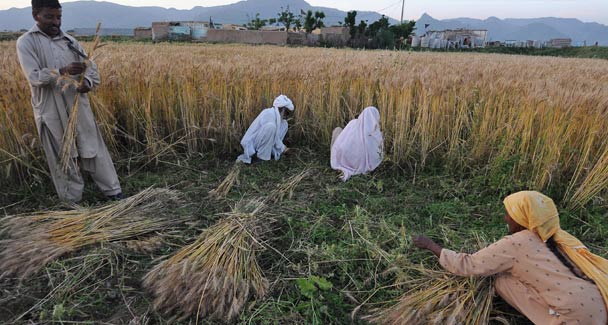
Relief4Pakistan’s second phase of flood assistance launches in November with a major reconstruction project. The effort will focus on Bangla Ichha Union Council, a four-village area in the Rojhan subdistrict of the Rajanpur district in southern Punjab. According to Fancy, 95 percent of the 40,000 people living in the villages depend on their own crops for sustenance, and their fields remain ravaged by the floods.

“Our first goal is to plant at least 1,000 acres of wheat by the end of November. We want to raise money to get seeds and fertilizer for some of the most vulnerable people, those that own less than five acres of land,” Fancy said.

To complete the project, Relief4Pakistan is partnering with Operation USA, a Los Angeles–based relief agency that “shares our philosophy that development ought to be done by empowering the local community to learn skills and develop a sustainable strategy to take care of themselves,” explained Fancy. Relief4Pakistan and Operation USA are reaching out to local Pakistani organizations to tap their resources and train the community members in necessary skills.

Relief4Pakistan will raise funds through Facebook again, but has also already engaged a wider circle of American philanthropists, Fancy said. Their goal is to build a sort of global village, a network of people worldwide coming together to help, and Fancy hopes the model of “the power of a global village” will set a precedent for other successful relief efforts.

“We’re really riffing off of [Secretary of State] Hillary Clinton’s ‘It takes a village to raise a child.’ … Our overarching goal is to appeal to the humanity of the wider donor public,” said Fancy. “It takes effort from Pakistani Americans and Pakistanis in other countries … it’s the responsibility of each member of this global village.”

At the height of its flood relief efforts, PPB has not forgotten its mission of cultural diplomacy. In fact, much fundraising continues to come from film screenings, art exhibitions and comedy performances showcasing the talents of Pakistani artists.

“Part of our cultural mission is using culture to humanize [Pakistan] and at the same time putting it into action through these much needed flood relief efforts,” Fancy said.

PPB plans to hold more cultural events beyond those dedicated to flood relief. The organization would like to hold the Sufi music festival annually, expanding it to include artists from other South Asian countries.

“[We want] to show what Sufism is in other parts of the world. Pakistan is a microcosm of a larger issue, which is the whole Muslim world,” Fancy said. “Muslims in [South Asia] have been remarkably liberal and secular in comparison to what people think they are.”

Through PPB, Fancy, who is 41 years old, will keep working to transform the younger Pakistani-American generation’s misconceptions of the Muslim world.

“I find it so distressing that people of our parents’ generation know much more about Pakistan than our generation,” she said.

And she worries that the knowledge the younger generation has gained from the media has left it grossly misled about Pakistani and Muslim identities.

“This sense of being primitive and tribal is not the true modern history of this part of the world,” Fancy said. “It’s only true of the minority that has taken the loudspeaker and is misbroadcasting lots of things they think are collective traits [of Muslims], but they’re not.”

( This is a product of the Bureau of International Information Programs, U.S. Department of State. Web site: http://www.america.gov )

Teen Held in Alleged Portland Bomb Plot

By Bob Drogin and April Choi for The Los Angeles Times

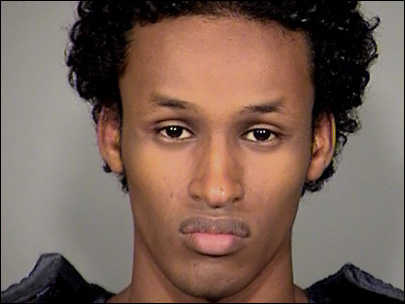
Reporting from Washington and Corvallis, Ore. — In August, the FBI says, 19-year-old Mohamed Osman Mohamud told two men who claimed to be Al Qaeda operatives that he had considered violent jihad since he was 15, and that he now was ready to commit mass slaughter.

Mohamud, a naturalized U.S. citizen from Somalia, said he wanted to set off a bomb during the lighting of a giant Christmas tree the day after Thanksgiving in an outdoor plaza in downtown Portland, Ore. The festive ceremony on the busiest shopping day of the year normally draws thousands of people.

“You know, the streets are packed,” said Mohamud, at the time a student at Oregon State University in Corvallis. When one of the men responded that “a lot of children” would attend, according to an FBI affidavit, he replied, “Yeah, I mean, that’s what I’m looking for.”

Mohamud — tall, thin and known for enjoying rap music and pickup basketball — reportedly shrugged off concerns about security at the event, explaining: “They don’t see it as a place where anything will happen…. It’s on the West Coast, it’s in Oregon, and Oregon’s like you know, nobody ever thinks about it.”

But the two men were undercover FBI agents, and audio and video recorders captured that conversation and many others like it. Mohamud now sits in federal custody — the latest alleged domestic terrorist to fall for an elaborate FBI sting — after months of secret surveillance and a grisly plot worthy of Jack Bauer.

A 38-page FBI affidavit released Saturday paints Mohamud as highly determined and deadly serious. He is charged with attempted use of a weapon of mass destruction, which carries a maximum sentence of life in prison. He is due in court Monday.

“The threat was very real,” said Arthur Balizan, special agent in charge of the FBI in Oregon. “Our investigation shows that Mohamud was absolutely committed to carrying out an attack on a very grand scale.”

According to the FBI, they arrested Mohamud after he dialed a cellphone that he thought would detonate a huge bomb — six 55-gallon drums, diesel fuel and a large box of screws — in a large white van parked near the tree lighting.

But the bomb was a fake built by the FBI, and the packed crowds who enjoyed a youth choir and a symphony orchestra at Friday’s holiday celebration at Pioneer Courthouse Square were never in danger, authorities said.

Mohamud appears to have joined a growing list of amateurs who have shown more fervor than smarts in their apparent plots against America. His alleged operation unfolded under the careful supervision, and with the direct assistance, of undercover FBI agents.

Aided by good luck and good intelligence, U.S. authorities have disrupted or uncovered at least 15 homegrown terrorist conspiracies over the last two years, often by penetrating the scheme at an early stage and carefully orchestrating the results.

Two domestic attacks have produced casualties — the shooting deaths of 13 people at Ft. Hood, Texas, and the slaying of an Army recruiter in Little Rock, Ark., both last year. Another plot, involving a failed car bomb in New York’s Times Square in May, was traced to a Pakistani-born U.S. citizen, who was arrested and pleaded guilty.

The alleged plot in Portland also would have carried the potential for mass slaughter.

According to the affidavit:

The FBI began tracking Mohamud in August 2009 when they discovered he was e-mailing a former Oregon student who was living in Pakistan’s lawless northwest region, where Al Qaeda has a stronghold. The Associated Press reported that the bureau was led to Mohamud by a tip from someone concerned about him.

By December, Mohamud was trying to visit the area. His friend, who was not named in court documents, urged him to contact an associate named Abdulhadi to arrange the trip. But Mohamud repeatedly mixed up the Hotmail address with the password, and the e-mails bounced back.

Apparently frustrated, Mohamud tried to fly to Kodiak, Alaska, on June 10. He already was on a no-fly list, however, and was stopped from boarding at Portland International Airport. He told the FBI that he had hoped to go to Yemen, but couldn’t obtain a visa or ticket, so had gotten a summer fishing job in Alaska instead.

Two weeks later, an FBI undercover agent contacted Mohamud and pretended to be Abdulhadi, providing an e-mail address that the FBI controlled. Mohamud and the agent met for the first time on July 30 in downtown Portland.

Mohamud boasted that he had written in support of violent jihad for an online, English-language propaganda magazine called Jihad Recollections, using the pen name Ibnul Mubarak.

The FBI later recovered the three articles, including one titled “Getting in shape without weights.” It seeks to introduce Pilates training to those preparing “physically for jihad.”

Mohamud also submitted an article to Inspire, an extremist magazine published by the media arm of the Al Qaeda affiliate in Yemen. Samir Khan, a Pakistani-American, allegedly ran Jihad Recollections from his parents’ home in Charlotte, N.C. He moved to Yemen last year and now is believed to edit Inspire.

Mohamud told “Abdulhadi” that he “initially wanted to wage war in the U.S.” The FBI agent told Mohamud he could not tell him what to do, but suggested several options, including going “operational” or becoming a shaheed, or martyr. Mohamud said he wanted to build a car bomb, but would need help.

At Oregon State, about 80 miles south of Portland, Mohamud had a benign profile. “He wasn’t the most social person, but he wasn’t anti-social,” said Omar Mohamed, president of the Muslim Student Assn. “He seemed like a pretty normal guy.”

Mohamud also was not known for being particularly pious. “From what I understand, he wasn’t the most religious person,” Mohamed said. “He didn’t regularly go to mosque.”

And unlike some Muslim students, he was known to attend college parties where alcohol was served, though it was unclear whether Mohamud actually drank.

On Aug. 19, Mohamud and “Abdulhadi” met again — in a bugged hotel room — and “Abdulhadi” brought another undercover FBI agent, who claimed to be an expert in explosives. Mohamud told them that he had begun thinking of jihad when he was 15.

The FBI affidavit then goes on to say how he described his plan to bomb the Nov. 26 event.

“They have a Christmas lighting and some 25,000 people that come,” he said. They should “be attacked in their own element with their families celebrating the holidays,” he added, quoting Osama bin Laden.

He said he had scouted where Black Friday shoppers streaming from nearby stores would likely gather in the busy outdoor square. The tree lighting was scheduled for 5:30 p.m., “so I was thinking that would be the perfect time.”

The trio met again Sept. 7. This time, the undercover agents asked Mohamud to buy the bomb components. They gave him $2,700 in cash to rent an apartment where they could all hide, and $110 to cover the cost of the bomb parts.

Over the next few weeks, the affidavit says, Mohamud mailed them a Utiliteck programmable timer, two Nokia cellphones, stereo phone jacks, a toggle switch and other gear, mostly from Radio Shack. One package also had a pack of gum and a scrawled note: “Good Luck with ur stereo system Sweetie. Enjoy the Gum.”

They held more meetings in early October in Corvallis, and Mohamud gave them a computer thumb drive with Google street-view photographs of his preferred parking spot, the attack site and escape routes. And he enthused again about his plan.

“It’s going to be a fireworks show… a spectacular show… New York Times will give it two thumbs up.”

According to the university, Mohamud stopped attending the school that month.

On Nov. 4, Mohamud and the two agents drove to a remote location near the coast west of Corvallis, supposedly to test the homemade bomb design. In reality, federal agents remotely detonated a device.

On the way home, he recalled the Sept. 11 attacks. “Do you remember when 9/11 happened, when those people were jumping from skyscrapers? … I thought that was awesome.” He said he hoped people attending the tree lighting would “leave either dead or injured.”

That afternoon, the undercover agents helped Mohamud record a video statement. Explaining that he wanted to dress “Sheik Osama style,” he donned a white robe and camouflage jacket. He then read a lengthy testimonial to jihad on camera. According to an FBI transcript of the statement, Mohamud, who was born in Mogadishu, briefly mentions his parents and suggests they had tried to steer him on another path in life. Arabic phrases are set off in brackets:

“To my parents, who held me back from jihad in the cause of Allah. I say to them [by Allah] if you — if you make allies with the enemy, then Allah’s power [the glorified and exalted] will ask you about that on the day of judgment, and nothing you can do can hold me back.”

In a follow-up meeting, their seventh, he gave the FBI agents hard hats, safety glasses, and reflective vests and gloves. He said they would wear the gear before the attack as a disguise, and put traffic markers around the parked van.

Abdulhadi, the first FBI agent, picked up Mohamud at about noon Friday, and they went to inspect the bomb. Built by FBI technicians, it appeared impressive. But the explosives, the detonation cord and the blasting caps all were inert.

“Beautiful,” Mohamud said.

At 4:45 p.m., they drove the van to Yamhill and Sixth Street and parked. Police had secretly kept the space open. Mohamud attached the blasting cap and flipped the toggle switch to arm the bomb, then put on his hard hat.

They walked several blocks, got in another car and drove to a pre-selected parking lot. Mohamud quickly dialed the number to detonate the bomb. When they didn’t hear anything, he got out of the car to look for a better signal, and FBI agents swarmed in for the arrest.

An Oregon State student directory listed an apartment address for Mohamud in the Portland suburb of Beaverton. A woman who answered the apartment door declined to speak with a reporter. Hanging to the right of the door was a heart-shaped sign with the words “Bless this home.”

When Mohamud attended Oregon State, he was not a member of the Muslim Student Assn. and rarely attended events held by the group. But Mohamed, the association president, recalls that Mohamud had recently attended “Night of the Crescent: Understanding Muslims,” a program aimed at showing that “Muslims in general are not scary people. They are neighbors, your best friends. We’re not all scary men with beards.”

That was Nov. 17. The next day, Mohamud met with the undercover agents to continue planning the attack.

Pakistanis for Peace Editor’s Note– We are thankful on this Thanksgiving Day weekend that the FBI folied this terror attack in Oregon and averted the loss of countless innocent lives. Both the authorities and Muslim Americans as a whole must keep vigilant about others like Mohamud in their midst who have extremist views and want to do us harm.

Wave of Joy Sweeps the Nation

As Reported by Dawn

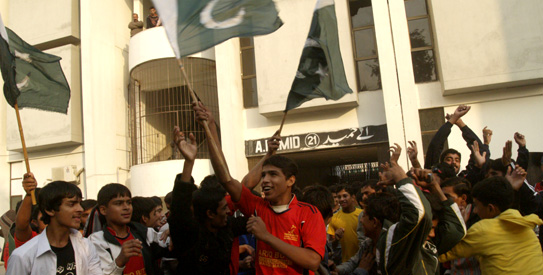
A wave of joy swept across Pakistan as it overcame a lackluster Malaysia in the final of the 16th Asian Games hockey. The win secured for Pakistan its first gold at the Games in 20 years and in the process an automatic berth at the 2012 Olympics in London.

The historic moment was witnessed by a large group of supporters that had thronged the various hockey centers across Pakistan to watch the final on the large screens that had been set up for the day. And the fans weren’t disappointed as their team put up a clinical performance to record a 2-0 win over Malaysia.

“It’s really a huge success for us and it’s extremely good news for the entire nation,” said Nawaz Ali as he waved national flag at a busy intersection of the capital Islamabad with scores of other Green Shirts supporters.

“It is good to see our team winning. We are happy because this is our national game,” said another man waving hockey sticks in joy. He said the victory would boost players’ morale and help them get more victories in future.

In Peshawar, people came out from their homes after the win and performed traditional dance moves to celebrate the moment.

“Hats off to Pakistan hockey players for their memorable win by giving joy and pleasure to 170million people,” a young hockey fan and resident of Qisakhwani, Abdur Rahim said. “The moment when our national anthem was played in China was historic and it would be remembered for a long time.

There were similar scenes in Lahore and Karachi where people even crowded the small TV screens at the international airports to catch a glimpse of the final.

There were also reports that many people at various workplaces extended their lunch to fit in the game that ended around 15:30 pst. The people in question, however, chose to remain anonymous.

Also brimming with delight was the Sports Minister of Pakistan Mir Ejaz Hussain Jakhrani who announced a cash award of Rs 5 million for the gold medal winning hockey team. He also paid glowing tributes to the squash team which also won gold in the team event beating their highly touted Malaysian opponents.

11/26/2008: How India Debated a War With Pakistan that November

By Pranab Dhal Samantha for Express India

The last of the 26/11 terrorists had been killed only a few hours back when Prime Minister Manmohan Singh presided over an urgently called meeting of the country’s security top brass. Present at that meeting on November 29, 2008, were Defence Minister A K Antony, the then National Security Advisor M K Narayanan, heads of both intelligence agencies and the three service chiefs — the Army was represented by its Vice-Chief Lt Gen M L Naidu as Army Chief Gen Deepak Kapoor was overseas — among other high-ranking officials. The key issue on the agenda — India’s response.

By then, there was no doubt among any of those present at this meeting, which lasted for over two hours at the PM’s residence, that the entire attack had been controlled, coordinated and plotted by the Lashkar-e-Toiba and its handlers in Pakistan. An undeniable body of evidence had already piled up from the calls monitored between the terrorists and their handlers in the course of the attack. More evidence was pouring in by the hour. There was no way any government in New Delhi could drag its feet — the Prime Minister knew he had to ask the dreaded question to all those responsible for the defence of India.

He started with the words that the people of India “will not forgive us” for what had happened and that the government had indeed failed them. This was not an empty comment. About 10 days before, US intelligence had intercepted a phone call from “somewhere in the Arabian Sea” to Pakistan-occupied-Kashmir. The input with coordinates of the boat’s position had been passed on to Indian agencies and then disseminated but not with the immediacy and urgency it deserved. Coast Guard authorities carried out reconnaissance sorties but by then it was too late. They found nothing on those coordinates except for scores of fishing boats that looked alike. The boat had obviously moved on. The Coast Guard filed a report that it needed the latest coordinates. And that’s where matters lay until the night of November 26 when the 10 terrorists surfaced in the heart of Mumbai.

Yet, the Prime Minister kept his calm and turned to the three service chiefs. He asked them whether they had any options in mind. In the same breath, he preemptively made it clear that he did not favour another Operation Parakram. That option was off the table from day one, recall sources. The then Navy Chief Admiral Sureesh Mehta chose to remain quiet. After all, the Navy was carrying out exercises in the area when the 10 terrorists slipped in without raising an alarm. The Army Vice-Chief wanted to wait for Gen Kapoor to return before they could crystallise their thoughts.

It was Air Chief Marshal Fali Major who eventually spoke up and suggested striking terror camps in PoK. The Air Chief was sure that his planes and pilots could do the job but the intelligence agencies would have to provide the coordinates. There was no further discussion on the subject that day, but it was also not the last conversation.

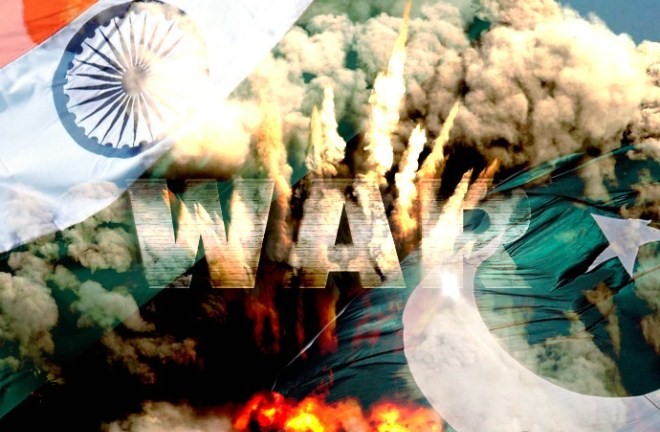
So, how close did India and Pakistan come to war? The views range from “very close” to “fleetingly close” but the fact which all key players confirm is that the military option was indeed on the table. It was subsumed by only a larger question of how would Pakistan react?

IN the days that followed, the military top brass went aboutnworking on the options. The Air Force, in particular, did go into the finer aspects of conducting a limited air strike in PoK but the political decision-making never moved any further.

However, the Defence Minister did hold a meeting with the three service chiefs after the PM’s first meet. At that point, the Army Chief was asked whether limited ground strikes could be carried out. Gen Kapoor is said to have responded that an operation was possible but he would need a week’s notice and that it would be a “highly risky” affair. He is said to have added that any political approval on this must include flexibility for the Army to respond anywhere along the LoC or for that matter, even the international border. In the Army’s assessment, any strike would definitely lead to an escalated military conflict and the government ought to prepared for it. The Air Force agreed that a strong Pakistani reaction was certain but was not willing to predict the levels of escalation.

While this continued, the Army proposed that it would like to prolong the stay of two of its brigades involved in a scheduled peacetime military exercise on the Rajasthan border. The go-ahead was given and the two brigades overstayed for about two weeks.

Much later, in early January, when then Foreign Secretary Shivshankar Menon, who is now the National Security Advisor, visited the US, his eloquent assertion in all his meetings about how India had not provoked Pakistan was only once challenged. Gen David Petraeus is learnt to have told him that this was not true because Indian troops had overstayed after finishing their military exercise. To Pakistan, he felt, this was a provocation to which it gave a disproportionate response by placing troops on alert and moving its fighters closer to the border.

There was also another incident about an Indian plane violating Pakistan airspace which apparently led to a F-16 scramble on the Pakistan side. Islamabad lodged a strong diplomatic protest. India denied with equal conviction. But at the same time the Air Force was asked to carry out an investigation.

The result was that there was indeed some violation by a reconnaissance plane of the Aviation Research Centre, RAW’s air wing, that was conducting a sortie along the LoC. This aircraft, perhaps, went too close to the LoC, violating the rule that both sides will not send their aircraft that near.

A few days later, a meeting was held in the nuclear bunker where the top leadership of the government is to be rushed in case of a nuclear strike. This was not provoked by 26/11. It was scheduled much before the attacks with the objective of familiarising the PM and other ministers of the emergency drill. But in the backdrop of the Mumbai attacks, the meeting could not have ignored the security environment of the day.

The PM is believed to have asked how would one distinguish a nuclear strike from any other non-nuclear, yet devastating attack. This was important because like many in the bunker, he too wanted to be sure that sufficient safeguards were in place to prevent a mistaken response. A long explanation was given. The PM then wanted to know if there was a chance Pakistan could misjudge a conventional strike by India and trigger a nuclear response.

There was near silence. Pakistan, by then, had already created “war hysteria” which many felt was unprovoked. The larger consensus was that you could not be sure about Pakistan’s response. It’s reliably learnt that it was this uncertainty which halted Indian strategists from fully backing any military response.

Under considerable pressure to show some response, the Prime Minister had independently tasked Menon to draw up a list of India’s options. Menon did carry out the exercise like a professional and gave an unsigned note that started with extreme measures like a limited military strike to less effective but dramatic steps like scaling down diplomatic relations, stopping cricketing ties, visa restrictions among others. He and Narayanan met regularly, at the PM’s instructions, to discuss the question of options in the days and weeks after the attacks.

In the wake of all the uncertainty over how Pakistan would respond, there was also talk about the “deniable option”. One which would involve covert operatives carrying out a sensational strike in Pakistan or in PoK. It’s learnt that RAW and the Army were specifically asked this question. RAW’s response to the NSA stunned all except, perhaps, Narayanan himself who is among the doyens of Indian intelligence. India’s premier external intelligence agency admitted that it had no assets in Pakistan to carry out such an action. It was explained that India lost all the meagre local support it had in pockets of Pakistan after the Babri Masjid attack and what little was left, was shut down by a prime ministerial diktat during I K Gujral’s tenure.

The Army said it had the ability to carry out commando operations but the government had to be clear what would be the approach if anyone was apprehended. Also, the Army let it be known that it was not sure how Pakistan would react if it found out.

This discussion headed nowhere after this because the ground realities were clear that India had consciously not cultivated this option. Some others felt it was pointless to discuss the “deniable option” because the whole idea of a response should be that the “other side” should know who did it.

Just as Singh deliberated these issues here, on November 29 itself, then US President George W Bush held a meeting with his security advisors and also on the video link with his missions in India and Pakistan. He told them that the last time something like this happened in the United States, “we went to war”. Prime Minister Singh, he added, was also under immense pressure and that the United States must do all it can to help him so that he does not go to war.

That eased matters a bit as Bush made it clear to Pakistan that it needed to “roll up and crush” the terror outfit behind the attack. US assistance was unprecedented, forcing Pakistan to accept that the attack was carried out from its soil.

But when the dust settled, all agreed that the unpredictability on the Pakistan side and the fear that its decision makers could opt for a disproportionate response, including the nuclear option, stymied any possible chance of military action on India’s behalf after 26/11.

After the first two weeks following the attack, the question that overtook everyone’s mind was what if there is another terror strike? Would India be able to hold back then?

Two years later, when asked if that phase is now over, a high-ranking security official remarked: “I can’t say, but I think that the question is still as serious. Can we keep quiet if there is another Mumbai? No, this question is still relevant.”

Thanksgiving: An American Eid

By Carmela Conroy for The Daily Times

Last week, some Pakistani friends welcomed me to their homes for Eidul Azha. As someone living far away from loved ones, it was wonderful to enjoy their hospitality and witness the warmth of family and food during this special time in Pakistan. It reminded me of our American Thanksgiving holiday, which is celebrated on the fourth Thursday of November.

Americans of all ethnicities, religions and national backgrounds celebrate Thanksgiving Day at home or in larger group settings. Traditional Thanksgiving foods, such as turkey with stuffing, mashed potatoes and gravy, sweet potatoes, cranberry sauce and pumpkin and pecan pies, harken back to the first Thanksgiving almost 400 years ago.

The first Thanksgiving was a feast shared by English pilgrims who founded the Plymouth Colony in what is now Massachusetts, with Native Americans of the Wampanoag tribe. In 1620, the pilgrims crossed the Atlantic Ocean in search of religious freedom. Arriving too late to plant many crops, and without fresh food, half of the pilgrims died of illness that first winter. The following spring, the Wampanoag people taught the English how to grow local crops, like corn, barley, beans and pumpkins, and helped them master hunting and fishing in the untamed wilderness.

The following fall, the pilgrims and the Wampanoags celebrated God’s blessings together at the new harvest. Very few pilgrims would have survived to celebrate that first Thanksgiving, but for the Wampanoag people’s charity towards them, helping them to adjust to their new home.

That spirit of giving thanks to God for our blessings, and sharing those blessings with others, lives on. I have observed that Pakistanis share a portion of their sacrificed bakra with their poorer neighbours during Eid. Similarly, many Americans spend part of their Thanksgiving serving meals to the needy or donating food or money to soup kitchens and homeless shelters. Families often participate together in charity fundraisers or donate to food drives. Thousands of charitable organisations serve hot dinners to the needy and many thousands of turkeys are donated to underprivileged families each year.

This year, the Thanksgiving and Eid traditions of charity and sharing are more important than ever here. The severe flooding this summer was the largest natural disaster that Pakistan has ever experienced, and I am proud to say that the American people contributed over one-third of the total relief provided by the international community to help people whose livelihoods and homes had been destroyed. American charities predict that more Americans will seek help during the holiday season than did last year, due to the ongoing economic downturn. As we count our blessings, we must recognise that although floodwaters have receded, many affected people still lack adequate shelter and livelihoods.

Today, Thanksgiving Day, I take time to reflect on my blessings, including the warm Eid hospitality so recently offered by Pakistani friends. Inshallah, I hope that the spirit of generosity and support from our “two Eids”, both American and Pakistani, can continue through the holiday season and into coming new year.

–Carmela Conroy is the US Counsel General in Lahore, Pakistan.

Christian Woman Sentenced to Death in Pakistan Not Yet Pardoned

By Reza Sayah for CNN

A Christian woman sentenced to death for blasphemy has not yet been pardoned by Pakistan’s president, representatives for the president said Wednesday, a day after a provincial governor told CNN that the president is expected to pardon the woman.

Asia Bibi, who has been jailed for nearly 15 months, was convicted in a Pakistani court earlier this month of breaking the country’s controversial blasphemy law by insulting Islam’s Prophet Mohammed, a crime punishable with death or life imprisonment, according to Pakistan’s penal code. She was sentenced to death.

Two representatives of President Asif Ali Zardari said Wednesday that no action has been taken, but the president will pardon if necessary.

“No decision has been taken,” spokesman Farhatullah Babar said. “Under the constitution, the president has to act under the advise of the prime minister. He will advise the president to take whatever action he proposes.”

On Tuesday, the governor of Punjab province said Zardari will pardon Bibi.

“What basically he’s made it clear is that she’s not going to be a victim of this law,” Gov. Salman Taseer told CNN International’s “Connect the World” program.

“I mean, he’s a liberal, modern-minded president and he’s not going to see a poor woman like this targeted and executed. … It’s just not going to happen,” Taseer said.

She has filed a petition for mercy with the high court, Taseer said.

“If the high court suspends the sentence and gives her bail then that is fine. We’ll see that, and if that doesn’t happen, then the president will pardon her,” he said.

Babar said jurists and legal experts have debated about whether the president has absolute power under the constitution to grant a pardon.

But he said Bibi is not in danger of being executed.

“Asia cannot be executed now,” Babar said. “Under the law, a death sentenced issued by a session court can not be carried out until it has been endorsed by the high court.”

Farahnaz Ispahani, a spokeswoman for the president, said Pakistan remains committed to protecting religious minorities.

“Pakistan is a nation of many faiths and religions, and all Pakistanis, no matter what their religion, are equal under the law,” Ispahani said in a written statement. “President Zardari has followed the case of Asia Bibi closely and will take appropriate action, if necessary, to issue a pardon or grant clemency to insure that Asia Bibi is neither incarcerated or harmed.”

A preliminary investigation showed Bibi was falsely accused, a government official said Monday.

“The president asked me to investigate her case, and my preliminary findings show she is innocent and the charges against her are baseless,” Pakistani Minister for Minority Affairs Shahbaz Bhatti told CNN.

Bhatti has said he will submit a final report Wednesday to Zardari’s office.

Prosecutors say Bibi, a 45-year-old field worker, insulted the Prophet Mohammed after she got into a heated argument with Muslim co-workers who refused to drink from a bucket of water she had touched.

In a brief news conference at the prison where she’s being held, Bibi said last weekend that the allegations against her are lies fabricated by a group of women who don’t like her.

“We had some differences and this was their way of taking revenge,” she said.

Bibi’s death sentence sparked outrage among human rights groups, who condemned Pakistan’s blasphemy law as a source of violence and persecution against religious minorities.

But Babar said the president’s party lacks the power in parliament to repeal Pakistan’s blasphemy laws.

“The manifesto of the Pakistan Peoples Party calls for the law to be repealed, but the party has not been able to repeal it because we lack the majority in parliament,” Babar said. “We don’t have the numbers to do it.”

More Military Aid to Pakistan?

By Aaron Mannes, Rennie Silva and V.S. Subrahmanian for The Huffington Post

As part of the U.S.-Pakistan Strategic Dialogue, the United States has granted Pakistan over $2 billion in military equipment over the next five years. This aid is intended to support American policy objectives and help stabilize Pakistan, but it may be achieving the opposite.

Military aid for Pakistan has a clear, if narrow, logic: to ensure the supply lines for the 100,000 American and NATO ally troops deployed to landlocked Afghanistan. The United States has few viable alternatives to the Pakistani-controlled routes into Afghanistan. When Pakistan recently shut down the Torkham crossing into Afghanistan (after an accidental border clash with a NATO helicopter that left two Pakistani soldiers dead and four wounded), supply trucks backed-up and Pakistani Taliban set fire to over 100 vehicles. Though there was no immediate danger of shortages, the event signaled how difficult US-led operations in Afghanistan could become without support from Pakistan’s military.

Despite its indispensable role in the war in Afghanistan, Pakistan’s own stability is in doubt and military aid has been of limited utility. Since 9/11 the United States has delivered over $18 billion in aid to Pakistan, about two-thirds of which has been military. In that period, violence by Pakistan-based terrorists both within Pakistan and without has increased substantially. According to the National Counter Terror Center’s World Incidents Tracking System, 110 Pakistanis were killed in terror attacks in 2004. By 2007 that number had jumped to 400, and in 2008 the casualty figure more than doubled to nearly 900.

As illustrated by the recent bombing of the Criminal Investigation Building in Karachi which killed 20, American aid has not enabled Pakistan’s security forces to control the violence. Instead, Pakistan has become a base for terrorism not only targeting the Pakistani state but also India, as demonstrated by the 2008 Mumbai massacre and a deadly series of 2006 commuter train bombings in Mumbai which killed over 200 people. India’s response to these attacks has been muted, but its restraint is finite. Open hostilities with its neighbor to the east would be devastating for Pakistan, and could even trigger a nuclear exchange.

Although several thousand Pakistani soldiers have died fighting Islamist extremists, the Pakistani security establishment has been slow to adopt counter-insurgency methods of war fighting. Instead, it has preferred to continue its India-centric focus. Investigations of U.S. military aid intended to help Pakistan fight the Taliban find that it is often re-purposed to counter India. “I’ll be the first to admit, I’m India-centric” Pakistani army chief of staff Gen. Ashfaq Parvez Kayani told Bob Woodward in his latest book, revealing a long-term strategy that is at odds with US interests.

Pakistan’s ongoing use of Islamist terrorists as proxies against India is especially troubling. President Zardari, who has stated “the undeclared policy of running with the hare and hunting with the hound was abandoned,” claims that Pakistan has turned against Islamist militants. But Pakistan’s generals have not received the memo, as investigations into the Mumbai attack show that links between at least some elements of the ISI and Lashkar-e-Taiba continue.

Pakistan has pursued some Taliban forces in its tribal areas, while leaving others alone to support future Pakistani interests in neighboring Afghanistan. Under such circumstances, America’s military aid is at best fueling Pakistan’s longstanding rivalry with India, and at worst enabling its enemies.

Pakistan’s high defense spending has robbed critical social programs of necessary resources. Pakistan continues lag behind comparable countries in general development indicators such as literacy and infant mortality, while its infrastructure is stretched to keep up with the needs of its fast-growing population. Under-funded and corrupt government institutions compound the situation. As Pakistan’s civilian and military leaders cynically seek to distract the public from these shortcomings, it is little surprise that Islamist groups often fill the vacuum by providing critical services or that the Pakistani people increasingly fall under their spell.

The long-term development shortfalls of Pakistan’s government have been exacerbated by a series of disasters including the 2005 Kashmir earthquake, the 2008 economic crisis, and last summer’s massive flooding. The latter, which caused nearly $10 billion in damage, has created millions of refugees and devastated an irrigation system that was strained to meet the demands of Pakistan’s agricultural sector before the flooding. Today, its failure threatens to cripple a vital sector of the Pakistani economy for years to come.

American development aid cannot counter decades of Pakistani neglect, but it can play a productive role in addressing critical needs. Providing Pakistan with more military capability-capability that could contribute to regional instability if it is used on American allies-is unlikely to achieve either.

Pakistani Women Break Taboos in Winning Asiad Gold

As reported by Reuters

Sana Mir, captain of the Pakistan women’s cricket team that won a gold medal at the Asian Games in Guangzhou, had other ideas.

“I belong to Abbotabad where girls are not encouraged to take up sports leave alone cricket but my family was supportive and made it possible for me to play cricket and study as well,” Mir said after a triumphant return home on Sunday.

“I hope our victory will serve as a catalyst for women’s sports in Pakistan.”

The women’s team, wearing their green team blazers, were garlanded and showered with rose petals in a rousing welcome at Karachi airport after winning the gold medal in a one-sided final against Bangladesh on Saturday.

“This welcome is like icing on the cake after our victory,” Mir said.

Pakistani media greeted the gold medal as a victory for women in the country.  “Looking for positive faces to show the world, Pakistan need go no further than its sportswomen,” the Dawn English daily newspaper said in an editorial.

“Despite the many restrictions they face, Pakistani women have done well in the field of sports from time to time.”  “Unfortunately too little has been done to encourage these brave young women,” the News daily paper said.

“We never dreamt one day women’s cricket would be acknowledged this way,” said Mir. “The day we won the medal I called up my family to thank them for their support.”

In a country where cricket remains a passion despite the spot-fixing allegations surrounding the men’s team, the Pakistan Cricket Board (PCB) has been giving steady exposure to the women’s team.

“The fact that we have played regularly since last year in International Cricket Council (ICC) tournaments and against better opposition has helped these girls gain confidence,” said Bushra Aitzaz who heads the women’s wing in the PCB.