Archive for the ‘ Pakistanis ’ Category

At Talks, Pakistan, India Close the Gap

By Anita Joshua for The Hindu

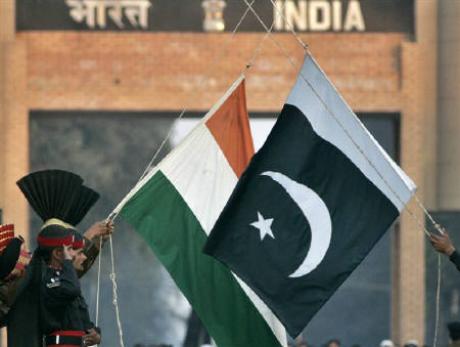
Conscious of the historical baggage, but unwilling to be burdened by it, India and Pakistan on Thursday inched closer to each other during the Foreign Secretary-level talks here and both sides held out the possibility of some tangible outcome after the July 15 ministerial engagement.

However, both Foreign Secretaries refused to be drawn into chalking out a road map or identifying goal posts. “There is a constituency for peace in both countries, and we should avoid stock phrases like road map,” Foreign Secretary Nirupama Rao said at a “joint press stakeout” here, shortly after spending a greater part of the morning with her Pakistan counterpart Salman Bashir.

The talks, according to Mr. Bashir, began as an exploratory venture, but “after this round, we are much more optimistic of good prospects at the Foreign Ministers meeting.” He summed up the talks as a “good essay in mutual comprehension,” a phrase he admitted to have borrowed from Ms. Rao.

Optimism apart, both conceded that this would be a protracted process that may not yield quick results, but decided to work on the doables in the interim. As to how they proposed to insulate the process from another freeze in relations in the eventuality of a flashpoint, Ms. Rao said this would also be a subject of discussion.

The first indication of some forward movement came with the announcement of the “joint press stakeout” soon after the talks had wound up, and the Foreign Secretaries were breaking bread in the Foreign Office.

In his opening remarks, Mr. Bashir said the two sides decided to work towards restoring confidence and building trust to make it possible for a comprehensive, sustained and substantial dialogue.

Speaking in a similar vein, Ms. Rao described the talks as forward-looking with both sides trying to understand each other’s position. “We reflected on the modalities for restoring trust and confidence to pave the way for a comprehensive, sustained and meaningful dialogue in all areas. We have agreed that dialogue is the best way forward.”

Asked whether terrorism was discussed, she said both sides agreed that terrorists must be denied the opportunity to derail the process of dialogue while pointing out that Pakistan Prime Minister Yusuf Raza Gilani had made an important commitment when he told his counterpart that efforts would be made to ensure that the Pakistani soil was not used for attacks on India.

Unlike in the past, when the two countries appeared to be speaking at cross purposes, this time the Foreign Secretaries seemed to complement each other.

If Ms. Rao deftly side-stepped a leading question on India’s reluctance to continue with composite dialogue by saying there was no issue over nomenclature, Mr. Bashir returned the favour by echoing this remark and refusing to be drawn into commenting on why Pakistan was not raising the issue of Indian-sponsored terrorism in Balochistan.

Instead, he broad-brushed the issue, stating that terrorism impacted Pakistan and was a concern to the region and the world. “Essentially, we have agreed to move from the rhetoric to the ways and means of addressing these concerns,” he said.

Aqsa Parvez: A Canadian Tragedy Lost in ‘Culture Talk’

By Uzma Shakir for Rabble Blogs

Aqsa Parvez is a “Canadian” tragedy — not an immigrant tragedy, or a Pakistani tragedy, or indeed a Muslim tragedy. In her formative years, Aqsa was raised in Canada; oppressed by her pathologically patriarchal father in Canada; failed by the family, the friends of the family, the education system, the student counseling services, the social service sector — in Canada. To make her tragedy a case of “these immigrant types with their medieval cultures” is to insult her memory and even worse learn nothing from it so that we can prevent it from happening again in the future — in Canada.

Like Aqsa and her father I was born and raised in Pakistan. Like Aqsa I grew up in a devout Muslim household. Unlike Aqsa’s father I came here as an immigrant while he came as a refugee. Like Aqsa and her father I was also raised with the notion of “honour.” In my upbringing there was honour in respecting your elders, there was honour in treating the women in the family with respect, there was honour in making sure that every child in the family had good education, there was honour in allowing your children (men or women) to make choices with regards to where they wanted to go for education or who they wanted to marry. My father and mother made decisions in the family by mutual dialogue and consent. As the only female child in the family and the youngest, my parents spent more money on my education than that of my brothers. And yes I had an arranged marriage — I arranged it myself, thank you. In fact, what was considered dishonourable in my family was to use physical force against women and children (my father used to say to my brothers “never raise your hand”), for adults to lie or cheat, to hurt someone and than justify it, and a particularly heinous act was to take a life — since, according to my dad, only God had that power. In fact, everyone I know in Pakistan or in Canada who is of Pakistani origin have similar values and family trajectories. Of course, my reality is very much conditioned by my family class background, my urban location, my family’s personal history, my parents’ education levels, and the socio-political context in which we grew up. So the question arises: who is the norm here and who is the exception? Who gets to define “the” Pakistani culture?

Neither Aqsa’s father nor I represent “the” Pakistani culture. We both experience it differently given our different locations of class, place, gender, education, family history etc. Mohammad Parvez may have suffered the same so-called culture shock in Lahore or Karachi as he is supposed to do in Toronto and Canada. Both Aqsa’s father and I immigrated to Canada but even our personal histories here are almost polar opposites — just like they were in Pakistan. Once again this is conditioned by our class, place, education, gender but this time it is further compounded by level of accessibility to the mainstream society in terms of language, economic opportunity, social inclusion and ultimately level of perceived cultural threat.

While I am lauded and praised by the mainstream society in Canada because I am “familiar” (probably the inevitable intimacy of bourgeois affinity), Mohammed Parvez was left in his own alienated world as the undesirable “other” facing what must have appeared to him to be a hostile world. Often enough Canadian experience is not just one of sampling diversity of cultural values but rather of hostile mainstream values actively undermining your perceived values as a cultural inferior. In my case, I can deal with this cultural assault because I have a voice in the public sphere and also I feel in control of my life because I have access to adequate financial, social, political and familial capital, while his control only went so far as his immediate family — and he exercised it to its grave end. However, to consider him to be more “cultural” than me, simply because he seems to exemplify what appears to be a “gaping divide” between the so-called traditional values and Western values, is patently absurd. We were divided about our notions of culture long before we came here because there is no neat little box that contains Pakistani monolithic cultural values that either of us can claim to be “authentic.”

Had we met in Pakistan he would have found me too urban and not Pakistani enough and I would have written him off as a fossil of entrenched feudalism and not Pakistani enough. However, if we meet here, he will find me to be Canadian and himself to be a Pakistani — a distinction encouraged by the mainstream notions of “our” and “their” values. But actually we are both the same — Canadian and Pakistani at the same time. This process of ‘othering’, denial and identity distinctions have more to do with Canada and immigrant experience here than with what might be or not be Pakistani culture. Over the years our experience of culture has changed, as has the Canadian society. So to turn this into either a case of “in our culture girls must obey their fathers” as an assertion of a simplistic fact by the Pakistani Canadian community or “he can’t handle our freedoms” as portrayed by the mainstream media is the worst form of myopia and chauvinism.

 These factors are critically important to understand because neither Aqsa’s father nor I represent either Pakistani or indeed immigrant “culture” but rather are a reflection of how our individual histories and personal interactions with the Canadian society shape our actions and responses — including our understanding of “culture.” However, ultimately Aqsa’s tragedy is about her father as an individual with his own pathological and uncontrolled desire for power and his own twisted notions of justifying his pathology through trumped up notions of “honour” and “shame.” To my mind the real dishonour and shame is to treat women and children as your personal property and not as equal members of society. The real dishonour and shame is to live in patriarchal societies where men exercise disproportionate power over women both personally and structurally — be it Pakistan or Canada. The real dishonour and shame is to brush off our collective responsibility and our institutional failures and treat a Canadian child’s tragedy as “their” problem or even worse our problem for allowing them to come here in the first place.

— Uzma Shakir is a community-based researcher, advocate, activist. She is the past Executive Director of Council of Agencies Serving South Asians (CASSA) and the South Asian Legal Clinic of Ontario (SALCO). She has worked as a teacher, journalist and researcher. She blogs at www.rabble.ca

The Education System of Pakistan- Past, Present, and Future

By Nagwa Malik for Pakistanis for Peace

Pakistan, when it appeared on the world map was referred to  by the Muslims of India as the “Land of Dreams”—not just because of the ideology behind its creation, nor by the method of its creation, both of which were unique in world history, but also because of the untiring work put out immediately by the masses and the leaders together making the world sit up, especially China, Korea and Singapore who, inspired by the fast “overnight” progress Pakistan was making, decided to follow our footsteps and are now farther ahead of us.

The ideology penned down and explained at length by Dr. Allama Iqbal created a wave. This two-nation theory, once accepted by the practical renowned barrister Muhammad Ali Jinnah, was put to effect, and Pakistan was born in the name of religion (Gandhi had tried a truce with Jinnah, agreeing to divide the country as brothers divide property, but not in the name of religion. Jinnah maintained the ideology of Islam and the two-nation theory, refusing Gandhi’s offer), and it was born constitutionally. The people were so excited over the power to make their future, that no one lost time or drive to get down to it. Pakistan made the Muslim world sit up again through its people’s drive, sincerity, talent and growing renown in the field of science, following in the footsteps of  many Muslim scholars and doctors that first brought science in an organized manner to that part of the world.

Have we forgotten that Pakistan already? Has it been so long since Pakistan last made an impression? Have we forgotten that not less than 20 years ago royal families from around the world, especially the Arab and African world sent their sons to study in our schools and colleges and universities? Have forgotten the massive immigration to this “Land of Hope” from all over Asia whenever people wanted to live in peace and prosperity? Pakistan was called the “Country of Doctors and Engineers” in the West and when there was an educational boom in African countries, amongst the most wanted and accepted educationists were those from Pakistan.

Even today most of the engineers in America and Europe, securing good positions in their jobs are from Pakistan, and even today most of the competent doctors we find in the West are from Pakistan—difference is, today nobody seems to note that fact. Nobody seems to count it anymore.

In the late sixties, especially in 1969, articles were written on the youth of Britain referring them to be probably the best generation yet, where strings of charity and community works were detailed and even there Pakistani youths were mentioned amongst the immigrants that added to community work, for example the Pakistani boys in Southall, Middlesex, going shopping for elderly people, and in the process learning colloquial English.

What happened then? Where did all the disillusionment begin? Why did all this positive images of Pakistan suddenly allow itself to flicker and burn out? Why did the education system fail us not more than ten years ago? We know that even today our education quality is higher compared to the quality abroad—then why do we choose to go abroad for education? Because we have lost the standard, not the quality, of educational system. The system has broken the backbone of our educational sectors. We have fake degrees allotted, we have references, and we have papers switched. Nothing is wrong with the actual standard of our education even now—but then again, what good is quality education when we cannot benefit from it? Schooling till Matric level  is compulsory and reportedly free—but nobody avails himself of the government schools because there are no teachers, and despite the fact that it is claimed free, it is not: payment of books, of a lot of miscellaneous stuff add up to a normal tuition fee anyway.

Only the colleges and professional universities are managing to maintain their merit—then again, the system has penetrated them so it doesn’t matter either way.

What went wrong was the generations before us, especially the previous two, lost the meaning of Pakistan. They indulged in materialism, selfishness and corruption. They were greedy children who ate everything that was cooked, and plucked the unripe ventures. The youth today is no less than the generation that made Pakistan. This present generation has been given nothing to run. It has to build; it has to start from scratch. The problem is this generation isn’t given the tools or the chance to start anything. If given even the slightest chance, the youth of today is capable and has the loyalty and the drive to reach Pakistan to its heights with the same overnight progress that was made by the creators of Pakistan.

This generation needs to remember the glory days of Pakistan and to gain confidence in itself rather than sit glumly and state, “What can we do”. A nation of 160 million cannot do anything? That is not possible. Our ancestors made their chance to make Pakistan; they were not given any chance. Our youth needs to pick itself up and march forward, remove all the dead wood (the old generation that still sits in power even after corrupting the very soil of our country) and begin afresh.  To quote Adlai Stevenson, “Those who corrupt the public mind are just as evil as those who steal from the public purse.” And to further quote a solution, “To fulfil a dream, to be allowed to sweat over lonely labour, to be given a chance to create, is the meat and potatoes of life. The money is the gravy” (Bette Davis). Everything will be rendered useless without honesty. Our country, our individuals are corrupted to the core so that lying is as breathing: we must search our souls and bring back our lost integrity through honesty: the first and foremost rule in Islam.

A country that produced success stories in its diaspora all over the world in such a short space of time is a country worth working hard for, worth looking into. It is a promising country with a promising past and an equally promising future, if only we take the step.

We haven’t lost anything yet. We can relive the glory of our small but so rich country. We ourselves are enough to turn things around. We don’t need help from anyone. In order to get things done properly, one must do them oneself. Dependency results in and breeds despondency, as we have experienced these past years.

We only need confidence and unity. We are already patriots, of that there is no doubt. We are united in our hearts, but we lack the confidence of success, but without toil how can one know? It is better to try rather than to wonder for the rest of our lives how things could or would be had we taken action. It’s only been 60 years, and this is a small length of time for the country is still young and all the mistakes have been made, so there is no more mistake left to make—that is an encouraging factor. Pakistan can still shine again as it did, in education, in sports, in talent, in technology and in every other profession imaginable. We were a nation that inspired, what’s to stop us from inspiring again? It is just a matter of cause and effect as it has always been.

Indian and Pakistani Players Join Forces to Promote Peace Through Wimbledon

Valerie Amant for Peace-Support.org

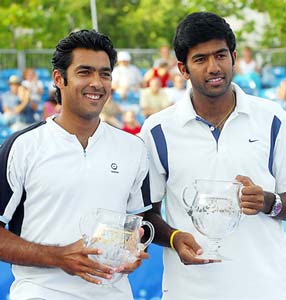
Lotto spokesmen Rohan Bopanna and Aisam-Ul-Haq Qureshi, Indian and Pakistani respectively, have decided to join forces as a doubles team at Wimbledon to help promote peace.

The two players, along with Peace and Sport, the Monaco-based and neutral international organization that works towards bringing together divided communities worldwide by encouraging dialogue and reconciliation through sport, have decided to team up at this prestigious sporting event, in order to help maintain and promote peace in their neighbouring countries.

Together with their technical supplier, Lotto Sport Italia, Bopanna and Qureshi have decided to promote this initiative by designing specially made t-shirts and sweatshirts with the high impact slogan “Stop War, Start Tennis”. The t-shirt will be worn during training sessions, whilst the sweatshirt will be used when entering the court before play.

Rohan, currently ranked 54th doubles player in the world, and Aisam, currently ranked 46th, have been friends for over ten years and have teamed up successfully for the last three years. Their respective countries have lived in a situation of unease and tension in the region of Kashmir since it won its independence from the British Empire in 1947. Peace and Sport would like to emphasise how much sport unites, as highlighted by the two players’ partnership.

The two tennis stars took the initiative to promote peace through sport after having noticed that communities from both countries forget hostility when they support them in international competitions. Indeed, during the first ATP tournament in Mumbai in 2007, Pakistani flags were waved inside the stadium during the final.

With the message “Stop War! Start Tennis!” Rohan Bopanna and Aisam-Ul-Haq Qureshi remind us that sport is a universal language that facilitates dialogue, going beyond political, racial, religious, ethnical and social differences.

Joël Bouzou, President and Founder of Peace and Sport, said: « Rohan and Aisam are big stars in their respective countries. Their story of friendship through sport is a real inspiration for youngsters. By transmitting a message of peace, they hope to change the mentalities and attitudes in India and Pakistan as well as other areas of the world destabilized by conflict. We are extremely proud to support this message that will benefit from the extensive publicity that Wimbledon attracts.

Alberto Fraticelli Marketing & Communications Director, from Lotto Sport Italia adds : « It is with great pleasure and good will that we decided to develop this initiative, in fact we already support “FreeFromLaces”, the movement that through blogs, forums, social networks, music and video, collects and proposes to the entire web community content and ideas that invite the user to reflect and ponder on “laces” that limit our daily routine: those personal, mental, virtual, social, cultural and physical ties that often seem impossible to untie. Through their initiative and personal backgrounds, Aisam et Rohan are perfect incarnations of this philosophy; thanks to sport we can rise above the hate and prejudice that condemns mankind to perpetual conflict, and we are extremely proud to have international representation of our brand, through players like Rohan and Aisam.”

Pakistan Rejects Allegations of Taliban Ties

As reported by CNN

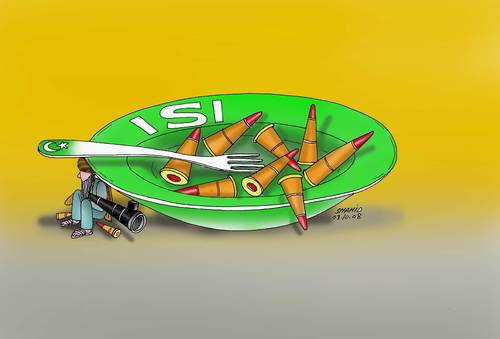
Pakistani officials Sunday rejected allegations that their country’s powerful intelligence agency still supports the Taliban and other Afghan insurgents after a paper from a Harvard academic accused the agency of continued links to the rebels.

The powerful Inter-Services Intelligence agency does not “actually control the Afghan insurgency” and does not have “the ability to bring it to an end,” Matt Waldman argues in a paper for the London School of Economics. But the ISI provides “sanctuary, and very substantial financial, military and logistical support to the insurgency,” giving it “strong strategic and operational influence — reinforced by coercion,” according to his report, which cites Taliban commanders among its sources.

The ISI is widely thought to have played a key role in creating the Afghan Taliban during the 1990s, but Pakistan officially denies supporting them now. Maj. Gen. Athar Abbas, spokesman for the Pakistani military, called the claim “rubbish” on Sunday and said Waldman’s report “does not have a credible source or authenticity.”

“At best, it is speculative and only gives open sources without naming [them],” Abbas told CNN. “So, therefore, this kind of report requires a treatment which it really deserves. We are not going to formally respond to this, but we reject these allegations and accusation. If there are hard evidence, we would like for them to be brought out and we would be able to respond accurately.”

And Farahnaz Ispahani, a spokeswoman for President Asif Ali Zardari, called Waldman’s report “one-sided” and dismissed what she called its “wild accusations.”

“If Mr. Waldman had been a seasoned academic, he would have conducted interviews in Pakistan itself to balance his so-called research report,” Ispahani said. “The Pakistani government and its military have been performing an outstanding service to the world community as well as the region in its fight against militancy and extremism, and we can count the dead we have sacrificed in the thousands.”

Waldman’s report is titled, “The Sun in the Sky: The relationship between Pakistan’s ISI and Afghan insurgents.” He based his conclusions on interviews with nine insurgent field commanders in three regions of Afghanistan, plus former Taliban officials, tribal leaders, politicians, experts and diplomats. The title comes from Taliban commanders’ claims that their relationship with Pakistani intelligence is “as clear as the sun in the sky.”

Waldman concluded that that Pakistan “continues to give extensive support to the insurgency in terms of funding, munitions and supplies.” But Abbas dismissed the unnamed sources, calling the report “rubbish.”

“Has he named any Taliban commanders in this, has he named any officials?” Abbas said. “So, therefore, if it doesn’t have any specific source, which is not willing to disclose a name, it just becomes one of those reports that keep appearing. It is a serious allegation, but unless it has a credible evidence to support it or substantiate the report, only then it warrants a serious consideration for response.”

The ISI works not only with the Taliban, but also with the armed Haqqani network, led by Jalaluddin Haqqani and his son Sirajuddin, Waldman wrote. The Haqqani network sometimes cooperates with the Taliban and sometimes fights it.

The Taliban members interviewed believe that the ISI has a heavy influence on their leadership, which some of them said amounts to control, according to the report.

One of the southern commanders claimed: “If anyone rejects that the ISI backs or controls the Taliban, he has a mental problem … all our plans and strategy are made in Pakistan and step by step it is brought to us, for military operations or other activities,” the report says.

And southern Taliban commanders all complained of heavy ISI involvement, which they blamed for some attacks on civilians.

“One southern commander described their predicament as follows: ‘Another group of Taliban is directly supported by the ISI. They will never stop fighting in the country; they want to destroy the government and bring chaos. Behind all the attacks on … NGOs, schools, teachers, doctors, this is Pakistan. We cannot deny that it is Taliban; but there are Pakistan controlled groups among us. They want destabilisation …,’ ” the report says.

Waldman’s report comes two months after a U.N. report on the assassination of former Prime Minister Benazir Bhutto in 2007 — an attack blamed on Pakistani Taliban leaders — found that intelligence agencies hindered the subsequent investigation. The report concluded that the “pervasive reach” of Pakistan’s intelligence agencies left police “unsure of how vigorously they ought to pursue actions, which they knew, as professionals, they should have taken,” the report states.

Why Pakistan’s Ahmadi Community is Officially Detested

By Mohammed Hanif  for BBC

By Mohammed Hanif for BBC

When a Pakistani Muslim applies for a passport or national ID card, they are asked to sign an oath that no Muslim anywhere in the world is asked to sign. The oath goes like this: “I consider Mirza Ghulam Ahmad an impostor prophet. And also consider his followers, whether belonging to the Lahori or Qadiani group, to be non-Muslims.”

Like millions of other Pakistanis, I have signed this oath several times without giving much thought to exactly what Mr Ahmad stands for, or what the technical difference between Lahoris or Qadianis is. I want my passport, and if I have to sign up to a fatwa to get it, so be it.

But like millions of people from my generation I also remember that when I was growing up, the minority Ahmadi sect were considered just another Muslim sect.

When a Pakistani Muslim applies for a passport or national ID card, they are asked to sign an oath that no Muslim anywhere in the world is asked to sign. The oath goes like this: “I consider Mirza Ghulam Ahmad an impostor prophet. And also consider his followers, whether belonging to the Lahori or Qadiani group, to be non-Muslims.

Like millions of other Pakistanis, I have signed this oath several times without giving much thought to exactly what Mr Ahmad stands for, or what the technical difference between Lahoris or Qadianis is. I want my passport, and if I have to sign up to a fatwa to get it, so be it.  But like millions of people from my generation I also remember that when I was growing up, the minority Ahmadi sect were considered just another Muslim sect.

Like scores of others I had friends who were Ahmadis. We played cricket together, and sometimes, when our parents ordered us off to the mosque, we even prayed side by side.

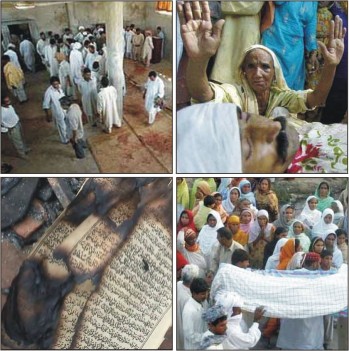
Last month, when more than 90 Ahmadis were massacred in two mosques in Lahore, I remembered the precise moment in 1974 when it all began to change.  There were street protests by religious parties against Ahmadis demanding that they should be declared non-Muslims.

One day I saw some bearded activists standing outside a clothes merchant’s shop in our town, chanting anti-Ahmadi slogans and turning customers away, telling them that buying clothes from Ahmadis was haram – forbidden. At the time I was learning to memorise the Koran from a very kind, mild-mannered teacher. I asked him what exactly was wrong with the Ahmadis.  He explained to me that they didn’t believe that the Prophet Muhammad was the last and the final messenger.

I said OK, maybe that makes them kafirs, infidels, but who says that kafirs can’t sell cloth?  My teacher’s response was a full-handed slap, so sudden, so unexpected that it rang in my ears for days to come. That same year Pakistan’s first elected parliament declared Ahmadis non-Muslims.  Then in 1984 Pakistan’s military dictator and self-appointed guardian of the faith General Zia-ul-Haq inserted that oath in the constitution that we are all required to sign.  Because of the new laws, Ahmadis have been sent to prison simply for using the Muslim greeting Assalamu alaikum, or putting a Koranic verse in a greeting card.

Over the last three decades the hatred against Ahmadis has become so widespread that Pakistan is now embarrassed by the only Nobel laureate it has ever produced.

Dr Abdus Salam Khan won the Nobel Prize for physics and, as a proud Pakistani, accepted his award in national dress.  But he was an Ahmadi so there is no monument to celebrate him, no universities named after him.

The word “Muslim” on his gravestone has been erased. Even the town he is buried in has been renamed in an attempt to erase our collective memory. This hatred was evident in the reactions to the massacre. TV channels were more obsessed with making sure that in their broadcasts Ahmadi mosques were called “places of worship”.

When you refuse to call a place of worship by its proper name, you are implying that it’s not a mosque, it’s not a church, it’s not a synagogue, it’s a place where godless people do godless things. And all the various Islamic political parties, whose leaders often refuse to pray together, are united on this.

When Pakistan’s main opposition leader Nawaz Sharif used the phrase “our brothers” for the murdered Ahmadis, leaders from 11 political parties came together to condemn him and threatened to issue a fatwa declaring him a heretic.  Over the last three decades the siege has been so palpable that those Ahmadis who couldn’t afford to emigrate have taken to hiding their identity.

If you want to destroy someone in public life it’s enough to drop a hint that they are Ahmadi. In the 1980s, the former chief minister of Punjab and current federal minister didn’t attend his own mother’s funeral because there were rumors that she was an Ahmadi.  When the funerals of the massacred Ahmadis took place there were no officials, no politicians present 

Pakistan’s liberal bloggers and some English-language columnists did write along the lines that Ahmadi blood is on our hands.  Others were adamant that it was yet another Friday, yet another massacre by the Pakistani Taliban, and we should just fight this sort of terrorism and leave the sectarian debates alone.

Two incidents in the past week made me realize how pathological our response was. At a vigil to mark the massacre, where a handful of people had turned up, a passer-by asked me “Are you an Ahmadi?” My own loud and aggressive denial surprised me.

Then an Ahmadi friend whose father survived the Lahore massacre wrote to me saying: “You know we have been living like this for decades. Did something like this have to happen for you to speak up?”

–Editor’s Note- It is high time that this law be repealed and the Ahmadi community of Pakistan be given all the basic human rights and privileges enjoyed by all Pakistanis.

American Arrested in Pakistan was on Solo Mission to Hunt Bin Laden

By Manzer Munir for Pakistanis for Peace

Gary Brooks Faulkner, a 51 year old construction worker from California was arrested by Pakistani police Monday night with a pistol, night vision goggles, and a 40 inch sword and apparently on a mission to kill Osama Bin Laden in revenge for the September 11 attacks on the US.

Faulkner was captured by the Pakistani police in the city of Chitral in the northwestern region of Pakistan near the Afghanistan border. According to a senior police officer, Faulkner was carrying religious Christian books and was reportedly on a mission to avenge the victims of the 9-11 attacks in New York, Washington and Pennsylvania.

According to Pakistani officials, Faulkner arrived in Pakistan on June 3 and stayed in a local hotel in an area of Pakistan known for its spring festivals and frequented by foreign tourists also. Apparently this was Mr. Faulkner’s sixth trip to Pakistan since 2002. At a press conference in his present state of Colorado, Faulkner’s brother Scott Faulkner, a physician, stated that his brother Gary was “on a mission.”

“He’s not crazy,” Dr. Faulkner said of his brother. “He’s not a psychopath. He’s not a sociopath.” Because of Osama Bin Laden’s security and Gary Faulkner’s kidney condition, Dr Faulkner did not believe he would see his brother again as he dropped him off at the airport prior to his flight to Pakistan this month. “I did not think I was going to see my brother again,” Dr. Faulkner said. “That’s the nature of going to Pakistan and hunting a wanted man who is surrounded by people with automatic weapons.”

Dr Faulkner stated that his brother underwent kidney dialysis three times a week and that if he killed or capture Bin Laden, he would use the reward money to live the rest of his life in Nicaragua helping build houses for the homeless.

According to Pakistani police, Mr Faulkner disappeared from his hotel Sunday night and away from the posted police guards, who are customarily there for the security of foreigners. When he checked out without informing police, officers began looking for him, according to the top police officer in the Chitral region, Mumtaz Ahmad Khan. He was in custody after a 10 hour search in a forest area in a high security zone close to the border with Afghanistan. He surrendered without any resistance and was flown to Peshawar where members of the United States embassy were notified of the arrest of an American.

“We initially laughed when he told us that he wanted to kill Osama bin Laden,” Khan said. But when officers seized the weapons and night-vision equipment, “our suspicion grew.” He said the American was trying to cross into the nearby Afghan region of Nuristan.

Chitral and Nuristan are among several rumored hiding places for bin Laden along the mountainous border between Afghanistan and Pakistan. He is currently being questioned by members of Pakistan’s intelligence officials according to reports and is in Peshawar where at present he has not been charged with any wrongdoing.

Whether Faulkner was there on a half baked suicidal, Rambo style mission or he truly believed he could be successful in finding and infiltrating Osama’s inner circle in order to capture or kill him remains to be seen. Nonetheless, it is a testament to the American “Can-do” spirit that a patriotic yet perhaps disillusioned and aging construction worker could take it upon himself to go to dangerous areas of Pakistan in order to avenge the victims of September 11. Whether he is simply crazy or foolish, one can not deny his desire to capture one of the most wanted man in history. We can only dream of the possibilities of real capture or death of Bin Laden if the majority of people in the Afghanistan-Pakistan region wanted to capture Osama and the terrorist Taliban leaders like Mullah Omar and others who shelter him.

India, Pakistan and the Musical Gurus of Peace

By Varun Soni for The Huffington Post

In July, India and Pakistan will begin a new round of talks in hopes of reviving their diplomatic efforts and renewing their peace process. While there are many pressing political issues to discuss, these talks could also be a remarkable opportunity for an innovative public diplomacy initiative between the nuclear neighbors. Although public diplomacy is often thought of as a form of state-to-state engagement, it also has the power to engage populations on a person-to-person level as well, especially in the age of social media and networking. Given the fact that many Indians and Pakistanis sing the same songs and listen to the same music, there is a unique opportunity now to promote popular music as a form of public diplomacy.

Although India and Pakistan are politically divided, their cultural roots still bind them together. Nowhere is this more apparent than Punjab — a region that was partitioned to create the modern nation-states of India and Pakistan in 1947, and further divided into the Indian states of Haryana and Himachal Pradesh in the 1960s. Despite these geopolitical divisions, Punjabis in both India and Pakistan remain united by “Punjabiyat,” a shared cultural heritage that has developed over millennia.

The historical Punjab is the only region in South Asia where Hindus, Muslims, and Sikhs are all represented in large numbers. Even as Punjab’s history is one of conflict and communalism, it is also one of overlapping musical and religious traditions. For example, the Guru Granth Sahib, the Sikh canonical text, contains within it not only the devotional compositions of Guru Nanak and his Sikh successors, but also verses from poets now considered Hindu and Muslim, such as Namdev and Baba Farid. Likewise, the Sikh devotional music of kirtan draws from similar lyrical sources and employs a similar instrumentation as Hindu bhajan music and Sufi qawwali music. For contemporary musicians, the devotional syncretism of Punjab remains a powerful model for how music can provide an encompassing framework for both unity and diversity.

Earlier this year, I interviewed the Sufi rock star Salman Ahmad as part of a USC book launch series focused on religion, popular culture, and diplomacy. As the founder of Junoon, Pakistan’s most popular rock band, Ahmad discussed his experiences performing in both India and Pakistan and explained how rock and roll empowers and connects the youth in both countries. In the name of rock-and-roll diplomacy, Ahmad organized last year’s Concert for Pakistan at the UN General Assembly Hall as a way of raising money and awareness for the three million internally displaced people of the Swat Valley in Pakistan. Inspired by George Harrison and Ravi Shankar’s famous Concert for Bangladesh, the Concert for Pakistan brought together prominent Indian and Pakistani musicians, diplomats, and entrepreneurs in solidarity and support for Swat.

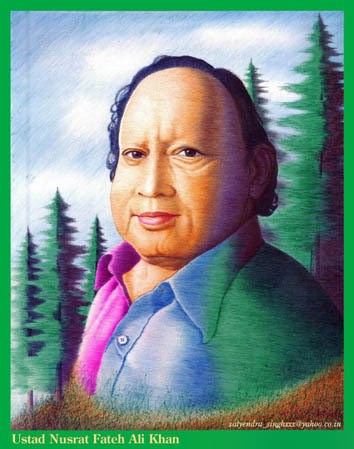
Another powerful moment in India-Pakistan musical diplomacy occurred in August of 1997, when India and Pakistan celebrated their fiftieth anniversaries of independence as nation-states. In order to commemorate this occasion, the virtuoso Indian music composer A.R. Rahman recorded with the late great Pakistani qawwali singer Nusrat Fateh Ali Khan. Together, the most famous musician from India and the most famous musician from Pakistan composed “Gurus of Peace,” an impassioned plea for peace between India and Pakistan. “Gurus of Peace” proved prescient, as the following year both India and Pakistan tested nuclear weapons, prompting President Clinton to call the India-Pakistan border the world’s most dangerous region. But A.R. Rahman and Nusrat Fateh Ali Khan had reminded the region the year earlier that India and Pakistan could unite through musical fusion instead of divide over nuclear fusion.

In the 1950s, the US State Department began sponsoring jazz luminaries, such as Duke Ellington and Dizzy Gillespie, to perform concerts overseas and serve as American cultural ambassadors. This public diplomacy initiative was aimed at winning the hearts and minds of potential allies in the Cold War, but the concerts also connected communities and ideas at a person-to-person level, and inspired artistic movements throughout the world. Likewise, India and Pakistan should sponsor and promote a series of musical concerts, workshops, and exchanges as a way of creating connections and engaging communities on a non-state level. Musical diplomacy certainly has its limits and should only be one part of a broader public diplomacy strategy, but after more than 60 years of missed public diplomacy opportunities, it’s time for India and Pakistan to follow the lead of A.R. Rahman and Nusrat Fateh Ali Khan and give music a chance.

Child Labor Alarmingly Rising in Pakistan

By Jamil Bhatti, Zeeshan Niazi for  Xinhua News Agency

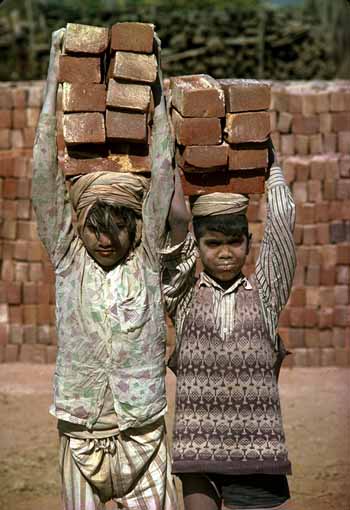
Shahzab, 10 years old, screwing the parts of motorbikes in a workshop with tinted hands and cloths with oil, was unaware of the seminar being held on the Child Labor Day in a five star hotel on Saturday in Islamabad.

“I don’t know what kind of this day is. I come for work at 8 a. m. and remain here till 8 p.m.,” Shahzab told Xinhua.

Shahzab is living with his senior mechanic and the owner of the workshop for last four years. His father handed him to the owner due to poverty. Now his father comes monthly only to receive his wages, about 1,200 rupees (1 dollar about equals 85 rupees) per month.

“Why the people don’t know these children are flowers of heaven and a beautiful creation of God, we should bring them up in soothing atmosphere instead of these hardships,” said Muhammad Zubair, a customer in the workshop.

Millions of children might be seen throughout the country working as a full time laborer even on the day when the International Labor Organization (ILO) along with other organizations, appealed to the world to “go for the goal – end child labor.”

ILO aims to end the worst form of child labor by 2016. But in Pakistan the child labor is growing instead of ending or lessening.

The Survey of All Pakistan Labor Force in 2007 and 2008 showed that there have been over 21 million labor children between the ages of 10 to 14 working in the country, out of which 73 percent are boys and 27 percent are girls. It is almost double of what Human Rights Commission of Pakistan estimated in 2005.

Pakistan’s National Child Labor Survey conducted in 1996 found that 3.3 million children between the ages of 5 and 14 were working in different fields on full time basis across the country. In Pakistan, ILO, along with Provincial Labor Department, is working to organize speech competition, an exhibition of paintings, a magic show for kids, and a street walks to raise awareness among people against the child labor.

Activists working to eliminate the child labor said that children work in the rural areas as bonded workers and often are not paid for their labor. Most of them work only for food and shelter that they get from the employer.

Sagheer Aslam, a child rights activist in Islamabad, is of the view that poverty, illiteracy and parents’ authority over the children’s choice of work and wages are the main reasons behind the child labor.

“Social status, lack of proper skills and the ignorant attitude of the society are some other major factors in the promotion of this social evil,” said Aslam.

The number of child laborers is rising day by day in Pakistan, opposite to the other parts of the world.

Sahiba Irfan, program officer of Society for the Protection of the Rights of the Child (SPARC), does not support the marking of international child labor day.

“This specific day cannot bring any change in the society for child labor or for any other problem. There should be all time struggle to create awareness among people for some positive change, ” she said. Irfan considered it is very hard to eradicate this evil suddenly from a society where more than 50 percent people are living below the poverty line.

“This practice continues for centuries. It is impossible to finish it in one go but we can change child labor into child work by sending children to school and to work for part time,” she added.

SPARC, an organization working for the rights of the children in Pakistan, is drafting a law to present it before the National Assembly, the lower house of the parliament, for getting the approval to implement it. Figures and their analysis advocated that the child labor is getting worse with every coming day in the country.

Children are found working in every field of life but some are the most common, like work inside mines, cutting marbles, mixing of pesticides, cement industry, filling gas cylinders, textile factories, stone crushing, hotels, workshops, carpet waving, deep fishing and glass factories.

Laik Khanzada, nine-year-old trainee motor mechanic, still wishes to go to school but cannot fulfill it. “I used to go to school but then left because we had no fee to pay,” said Khanzada, who wishes to be an officer if he gets a chance to study.

Owners of the workshops can’t help to appoint them in their workshops as trainee due to many reasons. “They come here due to poverty, if we do not keep them, they will become dangerous for society being loafer and addicted to drugs,” Yardost Khan, a workshop owner in Islamabad, told Xinhua.

Khan, responding to a question, said that it is not their duty but of the government to send them to school. “We are here only to teach them mechanical techniques for their future livelihood,” Khan said. Moving around Pakistan’s streets we can see underage children working very hard. If some one asks them the reason, they have only one answer “poverty”.

Continuing rise in the number of labor children hints that marking of this international day is limited only to the conferences in five star hotels. The children plight demands some serious actions to solve their problems.

Indian PM Manmohan Singh Renews Kashmir Talks Offer

As reported by BBC

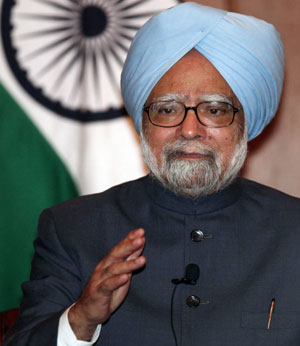
Indian Prime Minister Manmohan Singh has renewed an offer of talks with Kashmiri separatists who shun violence. He made the comments during a visit to a university in Indian-administered Kashmir. He is on a two-day trip to the state to review development schemes. Separatists have called a shutdown. The PM has disappointed those who expected him to announce a political package, the BBC’s Altaf Hussain in Srinagar says.

“We felt that the people of the state are not only interested in financial assistance and development projects, but also desire a political process that meets their aspirations,” Mr Singh told gathering at the agricultural university in Srinagar.

“We want to take the dialogue process forward. We are ready to talk to representatives of all sections who are opposed to terrorism and violence,” he said. ‘Strict instruction’  The prime minister repeated his government’s policy of “zero tolerance” for human rights violations.

“The security forces in Jammu and Kashmir have been strictly instructed to respect the rights of the civilians. We’ll act to remove any deficiency in the implementation of these instructions,” he said. The PM’s visit was greeted by protests against human rights violations  The prime minister’s visit came a day after the Indian army suspended a senior officer accused of killing three civilians in a staged gun battle.

The incident happened at Machhil near the Line of Control, the de facto border which separates Indian-administered Kashmir from Pakistani-administered Kashmir, in April. The Muslim-majority Kashmir Valley staged a total shutdown to protest against the prime minister’s visit. The strike was called by a hardline separatist leader Syed Ali Shah Geelani.

Mr Singh’s visit has also disappointed the moderate faction of the separatist Hurriyat Conference, headed by Mirwaiz Umar Farooq, our correspondent says. Mr Farooq had urged the prime minister to announce a political package during his visit.

He had demanded withdrawal of troops from cities and towns and release of political prisoners to facilitate talks between the separatist leadership and the government, our correspondent adds. Violence has declined in Kashmir in recent years, but analysts say militants opposed to Indian rule are now trying to regroup. There has been a spate of clashes in recent months along the LoC. Hundreds of thousands of Indian troops are based in Kashmir, where there has been a two decade-old insurgey against Indian rule.

India, Pakistan And U.S. Strategic Dialogue

By Apoorva Shah for The American Enterprise Institute

At this week’s first U.S.-India Strategic Dialogue in Washington, D.C., talks between the two countries will cover the spectrum of bilateral and multilateral issues, from trade and economic cooperation to terrorism and regional security. 

American participants may even feel the need to bring up India’s strained relationship with Pakistan. But it would serve them well to first consider a Times of India story from earlier this year, which went almost unreported in the United States.

According to an interview in the Indian newspaper with former Pakistani foreign minister Khurshid Mahmud Kasuri, India and Pakistan in 2007 were days away from reaching a comprehensive accord on their territorial dispute over Kashmir, the axis of the countries’ six-decade-long rivalry and casus belli of three wars between the two nations.

Kasuri, Pakistani leader General Pervez Musharraf’s chief diplomat from 2002 to 2007, said in April that the secret deal had been in progress for more than three years and would have led to a full demilitarization of both Indian- and Pakistani-occupied areas of Kashmir and would have awarded the region a package of loose sovereignty at a point “between complete independence and autonomy.” Not only were Indian and Pakistani leaders on board (including, most importantly, the Pakistani military), so was every Kashmiri leader except for one hard-line separatist, Syed Ali Shah Gilani.

The accord was slated to be signed during Indian Prime Minister Manmohan Singh’s scheduled visit to Islamabad in February and March of 2007, but before the trip ever occurred, a country-wide lawyers’ protest in Pakistan had turned into a broader opposition campaign against General Musharraf. The rest of the year would be one of the most tumultuous in Pakistan’s history, marked by the siege of the Red Mosque in July, the return of former Prime Minister Benazir Bhutto in October and her subsequent assassination in December, and the return of popular leader Nawaz Sharif from exile in September.

By August of the following year, public opposition had peaked, and Musharraf was forced to resign his post as president, ending his decade-long tenure as leader of Pakistan. After Musharraf’s ouster, it appears that the deal had lost much of its momentum.

Then in November, the accord suffered another setback as ten Lashkar-e-Taiba terrorists took India’s largest city, Mumbai, hostage for almost 72 hours, killing more than 160 people and injuring scores more. The attack was quickly coined “India’s 9/11,” and the evidence pointed directly to Pakistan, where the gunmen had been trained and equipped.

In protest, India cut off all diplomatic talks with Pakistan almost immediately; there were even rumors that the country was preparing military action against its northern neighbor. Within a span of less than two years, the India-Pakistan relationship had traveled the spectrum from apparent rapprochement and compromise to mutual suspicion and renewed hostility.

Since then, the signs have only appeared to worsen: for example, in 2009, when Indian Army chief General Deepak Kapoor publicly introduced revisions to his country’s “cold start” military strategy.

This military modernization and training program, which was developed in response to the army’s sluggish mobilization to the Pakistani border following the December 2001 terrorist attacks on the Indian parliament, remained mostly under the radar for most of the early 2000s, relegated to defense journals and the occasional news article.

It was only following the 2008 attacks that “cold start” began to receive renewed attention from the media on both sides of the border and was more publicly discussed by Indian military officials like General Kapoor. Indeed, it appeared as if the next breakthrough in Indo-Pak relations would occur through hard rather than soft power.

Concomitantly, India and Pakistan’s post-Mumbai attempts to return to diplomatic talks also appeared fraught with danger and seemed to only fuel more discord rather than reconciliation.

In February this year, Indian Foreign Secretary Nirupama Rao and her Pakistani counterpart Salman Bashir resumed high-level talks for the first time since November 2008, but both sides appeared unprepared (they could not even agree on the specific subject of the talks prior to sitting down) and spent more time bickering through separate press conferences.

For example, while Bashir accused India of covertly supplying weapons to militants in Pakistan’s Balochistan province, Rao complained that Pakistan had “not gone far enough” in the 2008 Mumbai attack investigation. As India presented a dossier of evidence against one of the Mumbai attack perpetrators, Pakistan responded by calling it a “piece of literature not a dossier.”

It’s hard to see how any progress could be made on improving Indo-Pakistani relations in the midst of this hostility. But does Kasuri’s revelation provide hope that a resolution on Kashmir could be revived? First, excepting Musharraf and Kasuri, many of the supporters of the failed 2007 accord—including Pakistani Army Chief of Staff Ashfaq Kayani, Pakistan’s current track II special negotiator Riaz Mohammed Khan, and, on the Indian side, Prime Minister Singh—still hold high-level positions in their respective governments.

And second, the secrecy of the original deal shows that outward indifference, or even enmity, between the two countries can belie an internal desire for change. In a relationship where hostility is status quo and where amicable relations seem aberrant if not bizarre, a furtive accord lets ruling elites make slow, institutional changes in the relationship while preserving outward form and precedent. It also allows deal-makers to keep tempestuous domestic politicians and party leaders at arms length while deliberating sensitive issues.

Even India’s traditionally hyperactive media seems to understand: A subsequent editorial in the Times of India noted, “the fact that such a deal exists emphasizes the importance of maintaining contact with Islamabad.”

So what can we expect in the months ahead? Indian officials will undoubtedly continue to pressure Pakistan to confront Lashkar-e-Taiba and other terrorist groups that plan to attack India, and another attack could indeed result in Indian military action. There will also be more bickering between the sides—on water rights, “most-favored-nation” clauses, and even cricket.

Yet the revelation of the secret deal should be both a lesson and a sign of hope. It is a lesson because it proves that progress on an entrenched conflict like Kashmir can occur without the United States’ public mediation.

American officials at the U.S.-India Strategic Dialogue this week should keep in mind that the accord was pursued during the final years of the Bush administration, in which the United States made it a point to separate the U.S.-India relationship from the more sensitive Indo-Pak relationship.

It is a sign of hope because, despite the outward appearance of discord between the countries, internally, leaders on both sides have—at least at some point in recent memory—wanted to move forward on a resolution.

As Pakistan continues its domestic offensive against terrorists and India pursues closer economic engagement with its northern neighbor, wanting change may be the best sign that change is on the way.

Official Admits Militancy’s Deep Roots in Pakistan

By Jane Perlez and Waqar Gillani for The New York Times

LAHORE, Pakistan — Days after one of the worst terrorist attacks in Pakistan, a senior Pakistani official declared in a surprising public admission that extremist groups were entrenched in the southern portion of the nation’s most populous province, underscoring the growing threats to the state.

 The statements by the interior minister, Rehman Malik, after the killing of more than 80 people at two mosques last week here in Lahore, were exceptional because few Pakistani politicians have acknowledged so explicitly the deep roots of militancy in Pakistan. They also highlighted the seeming impotence of the civilian government to root out the militant groups, even in Punjab Province, providing a troubling recognition that decades of state policy to nurture extremism had come home to roost in the very heart of the country.

 The extent of the problem has become an increasing concern for the United States, which has pressed the government to deal with the issue with renewed urgency since the failed attempt by a Pakistani-American to explode a car bomb in Times Square.

 “We’re dealing with a problem that is so deeply burrowed into the bosom of the society,” said a senior Western official about the difficulty of loosening the grip of the militant groups. “And we’re dealing with a government that is unhappy within itself.”

The problem for Pakistan, Western officials and some Pakistani politicians said, is not only the specific acts of terrorism by these groups, but the far more pervasive jihadi mentality that has been nurtured in the society by an extensive network of extremist madrasas and mosques.

Mr. Malik’s remarks — in which he rattled off a host of extremist groups once supported by the state — were a nod to these larger problems. In contrast to the tribal areas at the nation’s periphery, where the military is battling the Pakistani Taliban on several fronts, militants were “now active” in the southern part of Punjab and were trying to “destabilize the country,” he said.

Though Mr. Malik seemed to hint at possible military action in Punjab, the civilian government, led by the Pakistan Peoples Party, the more secular of the political parties in Pakistan, has little leverage to make it happen.

The Pakistani military, which still holds most power, has shown little interest in taking on extremist groups in Punjab. The province is a major recruiting area for the army, and many of the militant groups there were created by the state decades ago and have been fostered since as arms of Pakistan’s enduring anti-India strategy.

To a large degree, they have slipped from the control of their handlers in the military and intelligence services, according to Western diplomats and Pakistani security experts, and have linked up with Taliban fighters and other militant groups that are now striking deeper into Pakistan in an effort to overthrow the state.

Today these militants move back and forth easily between the tribal areas for training and Punjab, where they carry out a rising number of spectacular attacks.

“They — Lashkar-e-Janghvi, the Sipah-e-Sohaba Pakistan and Jaish-e-Mohammad — are allies of the Taliban and Al Qaeda,” Mr. Malik told reporters in Lahore after the mosque attacks. 

The loose conglomerate of militants that Mr. Malik listed is now being grouped by officials and others under the name of the Punjabi Taliban, a designation that itself highlights the expanding nature of the threat in Pakistan’s most important province and the militants’ shifting ambitions. Under that rubric also falls Lashkar-e-Taiba, an anti-India militant group. Like the others listed by Mr. Malik, Lashkar-e-Taiba has been banned by the state, but continues to operate under a different name and apparently with the blessing of the military.

The Punjabi Taliban took credit for the assaults on the two Ahmadi mosques last Friday. At least one of the men arrested by the Pakistani authorities in connection with the Times Square bombing case is connected to Jaish-e-Mohammed, according to law enforcement officials in Karachi.  Adding to the difficulty of clamping down on the groups, the Punjabi government, led by Shahbaz Sharif, a leader of the more conservative Pakistan Muslim League-N and a chief political rival of President Asif Ali Zardari, has stopped short of condemning the militants. In some respects, he has treated them as allies.

Two months ago, Mr. Sharif asked the Taliban to stay away from Punjab, arguing that his party and the Taliban had a common enemy in the United States. The Punjab government is “in a state of denial,” said Arif Nizami, a columnist with the newspaper The News. Mr. Sharif played down the attack on the two mosques in Lahore, Punjab’s capital. Instead, he visited the wounded survivors in a hospital quietly at night without the usual television coverage.

The groups hold such sway that Pakistani politicians frequently pander to some, like the pro-Taliban Sipah-e-Sohaba Pakistan, during elections.  In a bold illustration of the power of one of the militant groups in southern Punjab, the provincial law minister, Rana Sanaullah, campaigned alongside the leader of Sipah-e-Sohaba, Maulana Muhammad Ahmed Ludhianvi, during a March by-election for the provincial assembly in the city of Jhang.

In an interview, Mr. Sanaullah, said he saw nothing wrong with campaigning with Mr. Ludhianvi. It was a good thing, he said, because it helped bring groups that he described as no longer militant into the democratic mainstream. “If they want to be law-abiding citizens, we should allow them to be,” Mr. Sanaullah said.  Mr. Sanaullah was not alone in seeking votes from Sipah-e-Sohaba. A candidate for the National Assembly running for the Pakistan Peoples Party also won with its support earlier this year. Though security is a paramount concern, government officials and others acknowledge that the problem of militancy will not be solved by military force alone. Having been nurtured through generations, it will also not be undone quickly.

A program announced by Mr. Zardari two years ago to rein in the madrasas has yet to get off the ground, blocked by bureaucratic inertia and fears of a backlash from powerful conservative religious groups, Pakistani officials say. As state-sponsored education becomes too expensive for poor parents, the number of madrasas has actually increased in the past three years, to more than 17,000 in 2010 from 13,000 in 2007. At least several thousand of the madrasas churn out militant students, experts say.

Facebook in Pakistan: Islamists vs. Liberals

By Adam B Ellick and Ahmad Ziadi for The New York Times

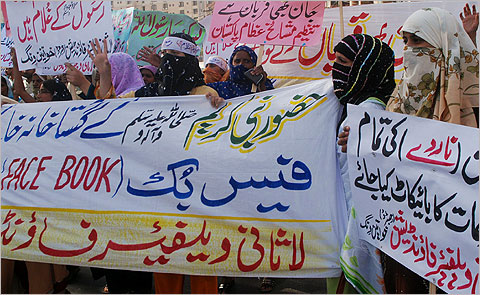
When Facebook was recently banned in Pakistan for hosting a “Draw Muhammad Day” fan page, one thing became very clear: Islamists here operate with organized precision, able to mobilize the masses in an instant, while the liberal voice remains paralyzed by fear and passivity.

Some media experts predicted that the ban – which a Pakistani court has now ordered the government to lift – might motivate the nation’s deeply disconnected liberal elite to take on the Islamists. After all, while members of the urban elite have been largely immune to the recent rise of violent militant attacks, the Facebook ban presented them with a personal vendetta.

In a nation without bars, and where entertainment options such as music concerts are rare, Facebook serves as a precious tool for the elite to organize discreet private events with music, drugs and alcohol. It has also helped mobilize social movements, including the lawyers’ march in 2009.

But the fervor that has followed the Facebook ban has been entirely one-sided in favor of the Islamists.

As the rest of Muslim world remains largely indifferent, tens of thousands of anti-Facebook Pakistanis protested in urban centers by burning American flags. A poll conducted by an IT portal called ProPakistani showed 73 percent out of about 8,000 voters favor a permanent ban on Facebook.

How did it get to this? There has been a widespread SMS campaign perpetuating a false narrative that Pakistan’s ban has brought a behemoth anti-Muslim company to its knees. One SMS attributes the recent fall in the Euro to the ban. Here’s another SMS I received:

THE BOYCOTT MADE BY MUSLIMS AGAINST FACEBOOK SINCE LAST 2 DAYS

CHARGE DEM A LOSS OF 2 BILLION EUROS..AND IF ITS CONTINUED AFTER 7 DAYS IT WOULD

REACH AROUND 40 BILLION EURO…. PLZ SPREAD AS MUCH AS U CAN.

Facts suggest otherwise. Facebook is not a publicly traded company, therefore, its earnings are not published. Still, some venture capitalists have valued Facebook at about $8 billion. Its annual revenue is estimated between $500 to $800 million.

In addition to the SMS campaign, this week, two new Muslim-friendly alternatives to Facebook have been launched. One of them, www.millatfacebook.com, was inaugurated by the bar association of the same Lahore court that banned Facebook. Millat means “Nation” in Urdu.

The site wooed more than 20,000 users with its slogan: “A site for Muslims by Muslims where sweet people of other religions are also welcome!!” Members are asked to specify if they drink alcohol. The founders are enraged at Facebook for curtailing Nazi-related hate speech while refusing to curb the Muhammad cartoons.

Their website says “Let’s prove to the world that if we can generate revenue for Facebook.com then we can also run our own website. Prove to the world that we are independent Muslims…” The other alternative site, www.Buddyflick.com , aims to “create/build/run our own network.” But where are Pakistan’s liberal and moderate voices?

Speaking out against the ban can be as hazardous as the forbidden cartoons. When those against the ban held a small news conference, the press mostly ignored it. After the press conference, several anti-ban activists were aggressively confronted by a large crowd of opposing activists as they left the venue. As tensions escalated, the anti-ban activists retreated into the building and waited for the crowd to dissipate.

One friend who is especially furious about the ban wouldn’t dare to speak out. “Nobody has the guts to go out and do something about it. The issue of Muhammad is so sensitive that you just never know.”

Instead, liberals are hashing out their frustrations in the low-traffic comment sections of liberal blogs and leftist newspapers, and, ironically enough, on their actual Facebook pages. Some have hacked into the banned site from the confines of their gated homes. Among the comment section in one newspaper is the latest joke: What’s the difference between Facebook and Lashkar  e Taiba? Answer: Facebook is banned!

Al Qaeda Aide Believed Dead- Drone Attack in Pakistan Said to Have Killed No. 3 Official

By Kimberley Dozier for AP
Al Qaeda’s third in command, who played key roles in a recently foiled terrorist plot against the U.S. and the 2001 terrorist attacks, is believed to have been killed by a U.S. drone strike in Pakistan’s tribal areas, potentially dealing a significant blow to the terrorist network. Mustafa al-Yazid, al Qaeda’s chief operating officer, was killed a little more than a week ago, according to two U.S. officials. This is the main person who everyone has been looking for,” one official said.

Al-Qaida announced Monday that its No. 3 official, Mustafa al-Yazid, had been killed along with members of his family — perhaps one of the most severe blows to the terror movement since the U.S. campaign against al-Qaida began. A U.S. official said al-Yazid was believed to have died in a U.S. missile strike.

A statement posted on an al-Qaida Website said al-Yazid, which it described as the organization’s top commander in Afghanistan, was killed along with his wife, three daughters, a grandchild and other men, women and children but did not say how or where.

The statement did not give an exact date for al-Yazid’s death, but it was dated by the Islamic calendar month of “Jemadi al-Akhar,” which falls in May.

A U.S. official in Washington said word was “spreading in extremist circles” of his death in Pakistan’s tribal areas in the past two weeks.

His death would be a major blow to al-Qaida, which in December “lost both its internal and external operations chiefs,” the official said on condition of anonymity because of the sensitivity of the information.

The Egyptian-born al-Yazid, also known as Sheik Saeed al-Masri, was a founding member of al-Qaida and the group’s prime conduit to Osama bin Laden and Ayman al-Zawahri. He was key to day-to-day control, with a hand in everything from finances to operational planning, the U.S. official said.

Al-Yazid has been reported killed before, in 2008, but this is the first time his death has been acknowledged by the militant group on the Internet.

Two Pakistani intelligence officials, speaking on condition of anonymity because they were not authorized to talk to the media, said al-Yazid died in a U.S. missile strike on May 21 in the North Waziristan tribal area.

Soon after the attack, officials reported that two foreigners were among the 10 people killed, but did not know their identities. Five women and two children were also wounded in the attack, which occurred in the village of Boya near the main town in the area, Miran Shah.

The intelligence officials said they received word of al-Yazid’s death last week and confirmed it by speaking to local tribal elders and Taliban members. They said their sources had not seen al-Yazid’s body and did not know where he was buried.

Al-Yazid has been one of many targets in a U.S. Predator drone campaign aimed at militants in Pakistan since President Barack Obama took office. Al-Yazid made no secret of his contempt for the United States, once calling it “the evil empire leading crusades against the Muslims.”

“We have reached the point where we see no difference between the state and the American people,” al-Yazid told Pakistan’s Geo TV in a June 2008 interview. “The United States is a non-Muslim state bent on the destruction of Muslims.”

The shadowy, 55-year-old al-Yazid has been involved with Islamic extremist movements for nearly 30 years since he joined radical student groups led by fellow Egyptian al-Zawahri, now the No. 2 figure in al-Qaida after bin Laden.

In the early 1980s, al-Yazid served three years in an Egyptian prison for purported links to the group responsible for the 1981 assassination of Egyptian President Anwar Sadat. After his release, al-Yazid turned up in Afghanistan, where, according to al-Qaida’s propaganda wing Al-Sabah, he became a founding member of the terrorist group.

He later followed bin Laden to Sudan and back to Afghanistan, where he served as al-Qaida’s chief financial officer, managing secret bank accounts in the Persian Gulf that were used to help finance the Sept. 11, 2001, attacks on New York and Washington. After the U.S. and its allies invaded Afghanistan in 2001, al-Yazid went into hiding for years. He surfaced in May 2007 during a 45-minute interview posted on the Web by Al-Sabah, in which he was introduced as the “official in charge” of the terrorist movement’s operations in Afghanistan.

Some security analysts believe the choice of al-Yazid as the Afghan chief may have signaled a new approach for al-Qaida in the country where it once reigned supreme.

Michael Scheuer, former head of the CIA unit that tracked bin Laden, believes bin Laden and al-Zawahri wanted a trusted figure to handle Afghanistan “while they turn to other aspects of the jihad outside” the country.

Al-Yazid had little background in leading combat operations. But terrorism experts say his advantage was that he was close to Taliban leader Mullah Omar. As a fluent Pashto speaker known for impeccable manners, al-Yazid enjoyed better relations with the Afghans than many of the al-Qaida Arabs, whom the Afghans found arrogant and abrasive.

That suggested a conscious decision by al-Qaida to embed within the Taliban organization, helping the Afghan allies with expertise and training while at the same time putting an Afghan face on the war.

Al-Yazid himself alluded to such an approach in an interview this year with Al-Jazeera television’s Islamabad correspondent Ahmad Zaidan. Al-Yazid said al-Qaida fighters were involved at every level with the Taliban.

“We participate with our brothers in the Islamic Emirate in all fields,” al-Yazid said. “This had a big positive effect on the (Taliban) self-esteem in Afghanistan.”

A September 2007 al-Qaida video sought to promote the notion of close Taliban-al-Qaida ties at a time when the Afghan insurgents were launching their comeback six years after their ouster from power in Kabul.

The video showed al-Yazid sitting with a senior Taliban commander in a field surrounded by trees as a jihad anthem played. The Taliban commander vowed to “target the infidels in Afghanistan and outside Afghanistan” and to “focus our attacks, Allah willing, on the coalition forces in Afghanistan.”

There is also evidence that al-Yazid has promoted ties with Islamic extremist groups in Central Asia and Pakistan, where other top al-Qaida figures are believed to be hiding.

“He definitely seems to have significant influence among the Pakistani Taliban and the Central Asian groups,” terrorism expert Evan Kohlman said. “They regularly post and share his videos on the Web, just as they would with bin Laden or al-Zawahri.”

In August 2008, Pakistani military officials claimed al-Yazid had been killed in fighting in the Bajaur tribal area along the Afghan border. However, he turned up in subsequent al-Qaida videos, all of which had clearly been made after the Bajaur fighting.

The Facebook Creed? Racism’s Bad, Bashing Religion Is Good

By Tommy De Seno for FoxNews.com

Recently, in a column for the Fox Forum called “Muhammad Cartoons vs. Piss Christ” I compared the insult Muslims feel when they see a drawing of Muhammad to the hurt Christians felt when an artist photographed a crucifix in a jar of urine, called it “Piss Christ” and received a tax-funded monetary award from the National Endowment of the Arts.

The point I tried to make is that just because the First Amendment allows you to say something doesn’t mean you should say it. Freedom comes with responsibility, which includes tactfulness when discussing the revered symbols of another’s religion.

Sure you are free to hurl insults – but remember the purpose of criticism is persuasion, and no one has ever been persuaded by first being insulted. Criticism can be made of Islam and Christianity without denigrating either’s most sacred symbols.

As Americans we should fight like hell for the right to draw a picture of Muhammad, but then choose not to.

This issue is hot today because some folks short on good criticism and long on juvenile insult declared May 20 “Everybody Draw Muhammad Day.” I wonder why they didn’t include “Everyone Piss On a Crucifix Day,” too? That they didn’t do just that, suggests that this is not a pro-First Amendment movement, but a purely an anti-Muslim movement.

So here’s my question: Why does Facebook allow a page whose purpose is to spread hate for a religion? After all, Facebook used to ban activity for no other reason than the author was home-schooled (and that’s some weird priorities right there).

A Facebook spokesperson defended the company’s decision to not ban the “Draw Muhammad” page to FoxNews.com earlier this week:

“Groups that express an opinion on a state, institution, or set of beliefs — even if that opinion is outrageous or offensive to some — do not by themselves violate our policies.”  

But compare that to this quote from an interview with a Facebook spokesman last year with Britain’s Daily Mail newspaper. Things were different when the topic was not anti-religion pages, but about pages that include racism:

“However, there is no place for content that is threatening, abusive, hateful, or racially or ethnically objectionable on the site and Facebook will remove any such content that violates our Terms of Use when it is reported… We have already removed a number of groups that violated these terms and we are continuing to be vigilant, immediately removing further postings when we become aware of them.”  

I see the Facebook matrix: “Racism is bad, but bashing religion is good.”

Facebook also said this to FoxNews.com about the “Draw Muhammad” page:

“When a group created to express an opinion devolves into threats or hate speech, we will remove the threatening or hateful comments and may even remove the group itself.” 

Hey Facebook – have you seen the two pages today? They are both a cesspool of hateful anti-religious commentary, devoid of useful criticism and swimming with the worst of distance-induced Internet hatred and nastiness.

If these pages don’t violate Facebook’s rules against hate speech, you can’t violate them.

Both pages have been taken over by anti-religious zealots whose purpose is to stir up anger for the sake of eliciting an even angrier response – all heat and no light. The folks posting the hate have the advantage of hiding whatever it is they hold sacred, so that no one can employ their own tactics against them. Cowards.

Both pages are filled with drawings, manipulated photos and commentary showing all religious leaders in acts of bestiality, pedophilia and outrages claims to calamities in history that religion couldn’t possibly be held accountable for.

Even if you’ve read hateful speech, you’ve still probably never read such blind, ignorant rage as is existent on these pages. Both pages should be taken down immediately, but they won’t be.

Facebook has obliterated civilized discourse.