Archive for the ‘ Pakistanis ’ Category

What Can Happen in a War

By Andrea Woo for The Vancouver Sun

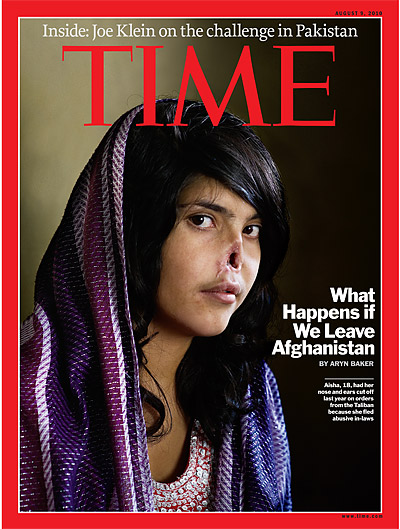
She looks back from the cover with an inscrutable gaze, her dark eyes intensified by the black hair that spirals out in thick curls from under her patterned purple head scarf. Her top is red and sequined; her mouth expressionless and slightly agape.

Where 18-year-old Aisha’s nose should be, however, is a hole: After attempting to flee abusive family members in Afghanistan, a Taliban commander sentenced Aisha to have her nose and ears cut off.

The powerful portrait is the front cover of the Aug. 9 Time magazine, accompanied by a story titled, “What Happens if We Leave Afghanistan.” In it, author Aryn Baker argues that the withdrawal of the U.S. military and its allies could result in a revival of the Taliban at a devastating cost to the nation’s women.

Christopher Schneider, an assistant professor of sociology at the University of B.C. whose research includes media studies, said the image is an obvious — and effective — attempt to garner attention.

“Things like sex and violence, our culture is so saturated with these kinds of images and symbols that people have become somewhat accustomed to them,” Schneider said.

“Something like this would probably tend to capture people’s perspectives or views in a way that, say, scantily clad woman on the cover of Time magazine might.” Photographer Jodi Bieber said in a video posted on the magazine’s website that Aisha’s beauty struck her.

“I said to her, ‘You know, you are really such a beautiful woman, and I could never understand or know how you’re feeling by having your nose and ears cut off,'” Bieber said.

“‘But what I can do is show you as beautiful in this photograph.’ I could have made a photograph with her looking or being portrayed more as the victim, and I thought, ‘No. This woman is beautiful.'”

In an accompanying editorial, managing editor Richard Stengel defended the image selection, saying he thought “long and hard” about whether to use it for the cover. “Bad things do happen to people, and it is part of our job to confront and explain them,” he wrote.

“In the end, I felt that the image is a window into the reality of what is happening — and what can happen — in a war that affects and involves all of us. I would rather confront readers with the Taliban’s treatment of women than ignore it. I would rather people know that reality as they make up their minds about what the U.S. and its allies should do in Afghanistan.”

Donald Gutstein, an adjunct professor at Simon Fraser University’s school of communications, whose research includes media analysis, said the image is unquestionably powerful, but its message misleading.

“It says that if Canada and the U.S. leave Afghanistan, this [mutilation] will be happening all over the place,” Gutstein said. “However, it happened while the U.S. and Canada were there, so what does that really tell us?”

Aisha is now in a secret women’s shelter in Kabul and is protected by armed guards, Stengel noted in his editorial. She will soon head to the U.S. for reconstructive surgery sponsored by the Grossman Burn Foundation.

Church Plans Quran-Burning Event

By Lauren Russell for CNN

In protest of what it calls a religion “of the devil,” a nondenominational church in Gainesville, Florida, plans to host an “International Burn a Quran Day” on the ninth anniversary of the September 11, 2001, attacks. 

The Dove World Outreach Center says it is hosting the event to remember 9/11 victims and take a stand against Islam. With promotions on its website and Facebook page, it invites Christians to burn the Muslim holy book at the church from 6 p.m. to 9 p.m.

“We believe that Islam is of the devil, that it’s causing billions of people to go to hell, it is a deceptive religion, it is a violent religion and that is proven many, many times,” Pastor Terry Jones told CNN’s Rick Sanchez earlier this week.

Jones wrote a book titled “Islam is of the Devil,” and the church sells coffee mugs and shirts featuring the phrase.  Muslims and many other Christians — including some evangelicals — are fighting the initiative. The church launched a YouTube channel to disseminate its messages.

“I mean ask yourself, have you ever really seen a really happy Muslim? As they’re on the way to Mecca? As they gather together in the mosque on the floor? Does it look like a real religion of joy?” Jones asks in one of his YouTube posts.

“No, to me it looks like a religion of the devil.”

The Islamic advocacy group Council on American-Islamic Relations called on Muslims and others to host “Share the Quran” dinners to educate the public during the month long fast of Ramadan beginning in August. In a news release, the group announced a campaign to give out 100,000 copies of the Quran to local, state and national leaders. “American Muslims and other people of conscience should support positive educational efforts to prevent the spread of Islamophobia,” said CAIR spokesman Ibrahim Hooper in the release.

The National Association of Evangelicals, the nation’s largest umbrella evangelical group, issued a statement urging the church to cancel the event, warning it could cause worldwide tension between the two religions. “The NAE calls on its members to cultivate relationships of trust and respect with our neighbors of other faiths. God created human beings in his image, and therefore all should be treated with dignity and respect,” it said in the statement. Dove’s Facebook page, set up for the September event, has more than 1,600 fans. “Eternal fire is the only destination the Quran can lead people to, so we want to put the Quran in it’s [sic] place — the fire!” the page says.

But another Facebook group with more than 3,100 fans says it stands “against the disrespect and intolerance that these people have for the Muslim people” and encourages people to report Dove’s page to Facebook. Targeting another group it calls “godless,” the Dove center is also hosting a protest against Gainesville Mayor Craig Lowe, who is openly gay, on Monday at Gainesville’s City Hall. The group previously fought — unsuccessfully — to derail Lowe’s election campaign.

“We protest sexual perversion because the Bible protests it. What is acceptable to today’s leadership becomes acceptable to tomorrow’s society,” the church says in its blog entry about the event. Lowe and other government figures and media outlets received e-mails from the church about the event, The Gainesville Sun reported. Lowe isn’t concerned with Monday’s event.

“I’ve got other things to do,” he said, The Sun reports.

On the outreach center’s front lawn, alongside a sign reading “Aug. 2 Protest, No Homo Mayor, City Hall,” stands not just one, but three signs bearing the slogan “Islam is of the Devil.”  One of the signs — one reading “Islam” on one side, “Devil” on the other — was vandalized. On its blog last week, the church said the sign will be replaced. “This is private property and vandalism is a crime here in America,” the blog says. “In Islam, many actions that we consider to be crimes are encouraged, condoned or sheltered under Islamic teaching and practice, though. Another reason to burn a Quran.”

With Friends Like These…

By Ron Moreau for Newsweek

The Afghan Taliban say they have one thing in common with the Americans: they’re both getting played by Pakistan. 

The Afghan Taliban logistics officer laughs about the news he’s been hearing on his radio this past week. The story is that a Web site known as WikiLeaks has obtained and posted thousands of classified field reports from U.S. troops in Afghanistan, and hundreds of those reports mention the Americans’ suspicions that Pakistan is secretly assisting the Taliban—a charge that Pakistan has repeatedly and vehemently denied. “At least we have something in common with America,” the logistics officer says. “The Pakistanis are playing a double game with us, too.”

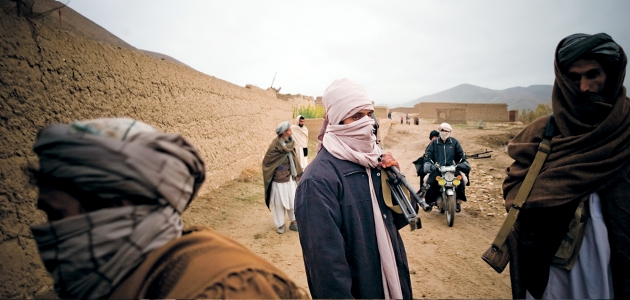
Pakistan’s ongoing support of the Afghan Taliban is anything but news to insurgents who have spoken to NEWSWEEK. Requesting anonymity for security reasons, many of them readily admit their utter dependence on the country’s Directorate for Inter-Services Intelligence (ISI) not only for sanctuary and safe passage but also, some say, for much of their financial support. The logistics officer, speaking at his mud-brick compound near the border, offers an unverifiable estimate that Pakistan provides roughly 80 percent of the insurgents’ funding, based on his conversations with other senior Taliban. He says the insurgents could barely cover their expenses in Kandahar province alone if not for the ISI. Not that he views them as friends. “They feed us with one hand and arrest and kill us with the other,” he says.

The militants say that most often they’re dealing with middlemen who appear to be merchants, money-changers, or businessmen, although the assumption is that they’re working for Pakistani intelligence. Some provide money, some motorbikes; others supply contacts for sources who can provide weapons. One smuggler who funnels much of his profits to the insurgency claims that Pakistani forces reserve one remote border crossing in Baluchistan for the Taliban and force civilians to divert to far-off posts.

But many insurgents still blame the Pakistani government for its cooperation in the U.S. invasion of Afghanistan after 9/11. “We can’t forget or forgive Pakistan for turning against us nine years ago,” says a senior Taliban intelligence operative, also speaking with NEWSWEEK along the remote border. And the betrayals didn’t stop there. Every Taliban can recite a long list of insurgent leaders who have been arrested in Pakistan or who were killed in Afghanistan with assumed Pakistani complicity. One of the biggest losses was Mullah Akhtar Mohammad Osmani, a driving force in the Taliban’s revival whose hideout near Quetta was raided by Pakistani forces in 2006. He fled across the border, where he was killed in a U.S. airstrike. Another was Mullah Dadullah Akhund, one of the insurgency’s most feared commanders, who died in a coalition raid in Helmand—with the help of the ISI, the Taliban suspects. The insurgents say he was too brazen, too independent, and too close to Al Qaeda for Pakistan’s comfort.

Some leading Taliban even suspect that Mullah Mohammed Omar, the leader and symbol of their jihad, may also be in ISI custody. He has appeared in no videos and issued no verifiable audio messages or written statements since he disappeared into the Kandahar mountains on the back of Baradar’s motorcycle in late 2001. “I wouldn’t be surprised if the ISI arrested us all in one day,” says a former cabinet minister. “We are like sheep the Pakistanis can round up whenever they want.”

On top of the years of grudges, there’s a persistent strain of ethnic animosity between the Taliban’s overwhelmingly Pashtun membership and its mostly Punjabi patrons from Pakistan’s security forces. The insurgents refer contemptuously to the ISI as “blacklegs,” for their supposedly darker skin. “Any commander who is more or less self-sufficient and independent of Pakistan becomes more popular with his fighters,” the intelligence officer says. Nevertheless, the insurgents see little choice about accepting any help they can get from Pakistan.

The Pakistanis, for their part, continue to resist U.S. pressure for strikes against Taliban sanctuaries. “Their aim seems to be to prolong the war in Afghanistan by aiding both the Americans and us,” says the logistics officer. “That way Pakistan continues to receive billions from the U.S., remains a key regional player, and still maintains influence with [the Taliban].” And which side is Pakistan on? “That’s a foolish question,” says Anatol Lieven, a professor in the Department of War Studies at King’s College London. “Pakistan is on Pakistan’s side, just as America is on America’s.” Nobody knows that better than the Taliban.

Karzai Questions Allies’ Willingness to Act on Pakistani Terror Havens

As Reported by the Voice of America

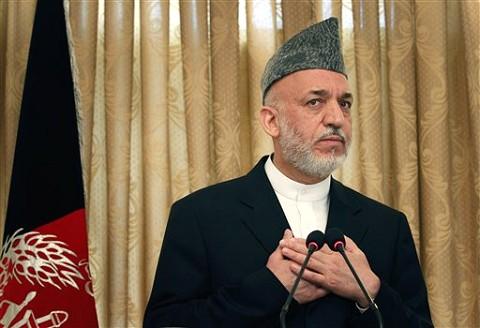
Afghan President Hamid Karzai is questioning the willingness of Western allies to go after terrorist sanctuaries in neighboring Pakistan.

Mr. Karzai said Thursday that the war against terrorism is “not in Afghanistan’s homes and villages” but in the sanctuaries and training centers that lie outside the country.

The Afghan leader told reporters in Kabul that only international forces have the ability to tackle such insurgent forces.

President Karzai’s comments come after the website WikiLeaks released thousands of classified U.S. military documents that allege Pakistan’s intelligence agency was actively collaborating with Afghan Taliban militants.

Pakistan has dismissed the allegations.

Pakistani foreign ministry spokesman Abdul Basit called Mr. Karzai’s remarks “incomprehensible.”  He said Pakistan’s ambassador in Kabul was seeking clarification, noting the neighboring nations have been closely cooperating against terrorism.

President Karzai on Thursday also condemned  WikiLeaks’ release of the military documents and said their leak endangers the lives of Afghans who worked closely with NATO forces.  He said he has ordered a government review of the files.

The 91,000 documents also contain details of civilian casualties allegedly caused by coalition forces.  

U.S. officials have also condemned the documents’ release and launched an investigation into the source of the leak.

What We Know About Crashed Flight in Pakistan

By Max Fisher for The Atlantic Wire

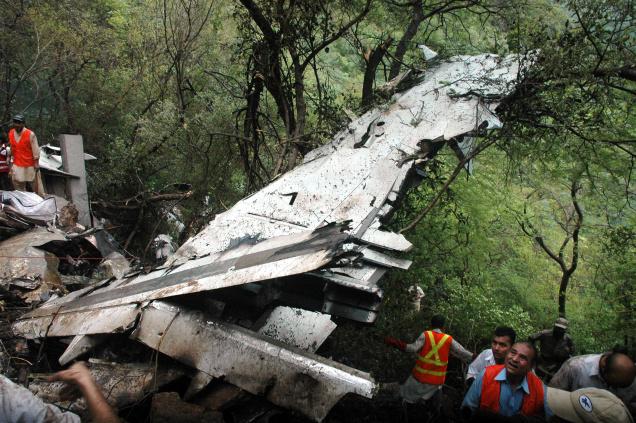
A passenger airliner has crashed outside of the Pakistani capital of Islamabad, reportedly killing all 152 people aboard, including two Americans. The flight, run by Pakistani airline Airblue, was traveling from Karachi. The plane crashed in the unpopulated Margalla Hills amid harsh weather and is not believed to have harmed any bystanders. At this point it remains unclear what precisely caused the crash and how officials will respond. Here’s what we know and possible explanations for what happened.

  • Flight Wasn’t Diverted Despite Bad Weather  The New York Times’ Adam Ellick reports, “Hashim Raza Garvaizi, a captain for Pakistan International Airlines, told GEO television that the airport’s runway has instruments that allow planes to land in weather conditions when there is no visibility. Mr. Garvaizi knew the pilot and said he had an impeccable record. He speculated that the plane could have been struck by lightening or that wind currents could have caused it to dip lower than expected. Mr. Garvaizi said another flight was diverted to Lahore about 30 minutes before the Airblue crash.” The Wall Street Journal’s Zahid Hussain adds, “Many other flights in to Islamabad were cancelled or diverted on Wednesday morning and it isn’t clear why the Airblue flight was given the go-ahead to approach the airport.”
  • Eyewitness: Plane ‘Lost Balance’  The Washington Post’s Shaiq Hussain finds an eyewitness. “A witness, Shahid Ameen, who was in a nearby residential section at the time of crash, said that he saw the plane with a low flight pattern. He said it looked ‘as if the plane had lost balance before I saw it coming down.'”
  • Technical Problems Uncertain  The Wall Street Journal’s Zahid Hussain reports, “Aimal Ahmed, an Airblue spokesman, said the plane was eight years old and flight worthy. ‘There was no technical fault in the plane when it took off. All the safety requirements were completed,’ he said. … ‘We are not sure whether the accident was caused by a mechanical fault or bad weather,’ Mr. Malik told the reporters.”
  • Islamabad Airport’s Dangerous Landing Issues  Pakistan Express Tribune columnist Meekal Ahmed explains the peculiarities of Islamabad airport.

If you are using runway 12 as it seems (the Murree road side) there is no ILS [instrument landing system]. The ILS is on runway 30 (the opposite side). So the procedure (which I never thought was safe) is you fly the ILS to 30 and then you break off and turn right and fly parallel to the Margalla hills and then turn back in and land on 12. It’s not a circle but more of a race-track pattern.

You may ask why not have the aircraft turn left rather than right towards the Margalla Hills. The reason is that on the left of runway 30 is Dhamial Air Base, GHQ and so on and as far as I remember that is all so-called “Restricted” airspace. You cannot fly over it.

This is CFIT (Controlled Flight Into Terrain) not as stated above.

Final point, when you are flying parallel to the Margalla Hills, you are required to keep the airport on your left in sight. So I can visualize the captain in the left seat looking left. Maybe the [flight officer] was flying and craning his neck too. They just seem to have drifted into the Margalla Hills — perhaps because of high winds. They lost what is called “Situational Awareness”. Basically they did not know where they were.

  • Airport Has One of World’s ‘Worst Weather Conditions’  Pakistani newspaper Dawn reports, “The craggy Margalla Hills to the north of the capital and unpredictable wind patterns can make an approach extremely difficult [a Pakistani pilot] said, going so far as to describe Islamabad as ‘one of the worst weather conditions in the world. … Irregular wind systems surround the Margalla Hills often make it difficult for the pilots while in the air.'”
  • Why Recovery Will Be So Difficult  Reuters’ Kamram Haider relates:

More than 90 bodies had been recovered so far, but the bad weather was making recovery efforts difficult.
“We have suspended the air operation because of rain. It will take a long time to clear the area. There’s no way to transport bodies from the site except via helicopters and even helicopters cannot land there,” said Aamir Ali Ahmed, senior city government official, said.

Rescuers said they had to dig through the rubble with their bare hands, with fire and thick smoke hampering their work. The fire has since been extinguished, but access to the hillside remained limited to pedestrians and helicopters.

“You find very few intact bodies. Basically, we are collecting bodies parts and putting them in bags,” police officer Bin Yameen.

Pakistan Suicide Bomber Targets Mourners

As Reported by BBC News

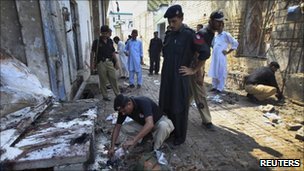
A suicide bomb near Peshawar has killed seven people near a gathering mourning a cabinet minister’s son murdered in a suspected Taliban attack, police say.

About 20 people were also injured when the bomber struck on foot near the home of Provincial Information Minister Mian Iftikhar Hussain in the town of Pabbi. Three policemen and four civilians died. The minister was not among the mourners.

The Taliban has told the BBC it killed his 28-year-old only son two days ago. The suicide bomber detonated his explosives near a mosque where people had gathered in mourning on Monday.

Police said the attacker was dropped off by a man on a motorcycle near the minister’s home in the town, 26km (16 miles) east of Peshawar.

“He [the bomber] was a young boy,” senior police officer Liaquat Ali told news agency Reuters.

“He was trying to cross the checkpost but when our policemen caught him, he exploded himself.”

Mian Iftikhar Hussain is considered the provincial government’s most outspoken critic of the Taliban militants who have carried out dozens of bombings in the area.

BBC Islamabad correspondent Ilyas Khan, whose hometown is Pabbi, says the minister and other VIPs were probably not the direct targets of this blast, as it was well known they were gathering at a college building several kilometres away.

Our correspondent says the militants may have been sending a message that they can reach Mr Hussain’s home should they choose.

A spokesman for the Pakistani Taliban, Ehsabullah Ehsan, has told the BBC the group was responsible for gunning down the minister’s son, Rashid Hussain, near his home in Pabbi on Saturday.

The town is close to the home village of Pakistani-American Faisal Shahzad, who admitted to trying to blow up New York’s Times Square in May.

Bombs and attacks blamed on Taliban and al-Qaeda-linked militants have killed more than 3,500 people across Pakistan, it is estimated, since government troops besieged a radical mosque in Islamabad in July 2007.

Much of the violence has focused on north-west Pakistan’s border area with Afghanistan, where US and Nato troops are battling to turn around a nine-year war against the Taliban.

Clinton Adds to Curious History of Mango Diplomacy

By Sebastian Abbot for The Associated Press

When U.S. Secretary of State Hillary Rodham Clinton offered Pakistan help last week in exporting mangoes to the U.S. in a bid to dampen anti-American sentiment, it marked the latest chapter in the fruit’s curious history of diplomacy and intrigue.

Clinton’s offer came three years after the Bush administration opened up the U.S. market to Indian mangoes in exchange for allowing Harley-Davidson to sell its famed motorcycles in India – a deal that generated goodwill as the two countries finalized a civilian nuclear agreement.

Washington’s mango-powered diplomacy this time around is part of a broader $7.5 billion aid effort that is meant to improve the image of the U.S. in Pakistan, a move officials hope will provide the Pakistani government with greater room to cooperate on turning around the war in Afghanistan.

“I have personally vouched for Pakistani mangoes, which are delicious, and I’m looking forward to seeing Americans be able to enjoy those in the coming months,” Clinton said during her visit to Islamabad last week.

The prominence of mangoes in South Asian diplomacy should come as no surprise since scientists believe the sweet and fleshy orange fruit originated in the region before Buddhist monks and Persian traders introduced the plant to other areas of the world.

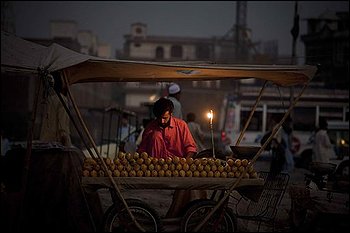
Pakistan and India recognize the mango as their national fruit, and summer in both countries is defined by the sights and sounds of vendors hawking piles of soft, sweet-smelling mangoes or pureeing them to create refreshing drinks that cut through the scorching heat.

Officials from both countries have exchanged crates of mangoes over the years in an attempt to soften tensions between the nuclear-armed rivals that have fought three wars since the partition of British India created the two nations a little over 60 years ago.

Former Pakistani President Zia ul-Haq may have begun the tradition when he swapped mangoes in the early 1980s with the Indian prime minister at the time, Indira Gandhi. The exchange took place several years before ul-Haq was killed in a plane crash that conspiracy theorists blame on a crate of mangoes placed on board moments before takeoff that was supposedly sprayed with a poisonous gas that killed the pilots and other passengers.

But like almost everything else, mangoes have also been a source of tension between Pakistan and India since the two countries view each other as competitors in the export market. Indians and Pakistanis argue over who grows the best mangoes – a debate that resembles the tussle between Lebanon and Israel over who can claim the mashed chickpea dish hummus as their own.

If all goes to plan, Americans will get a chance to conduct their own taste test once Pakistani mangoes break into the U.S. market. The U.S. plans trial shipments later this year and has pledged to support a three-year program to promote the export of Pakistani mangoes by sea to America, the world’s largest importer of the fruit. The initiative is part of a $21 million program to boost Pakistan’s agriculture. The U.S. will help finance hot water treatment facilities, sorting and grading machines and cold storage facilities.

India, meanwhile, is the world’s largest mango producer with about 13 million tons each year, far exceeding all other countries, including Pakistan, which comes in fifth place with about 1.6 million tons. But both countries have struggled to build the necessary infrastructure to really boost exports.

“Farmers are very grateful for the U.S. help,” said Muzaffar Khan Khakwani, the owner of a mango farm near the central Pakistani city of Multan that is benefiting from American aid. “It’s not just the financial help. It’s the capacity building and the exposure of farmers to well managed orchards.”

But it remains to be seen how quickly Pakistan can benefit from Clinton’s recently announced initiative. India had trouble with logistics and pricing when it first tried to export its mangoes to the U.S.

It is even more uncertain whether U.S. aid will really dent anti-American sentiment in Pakistan and motivate the government to step up support for the Afghan war, a move the Pakistanis have resisted for years.

As an Indian proverb says, “You can’t hurry a mango tree to ripen its fruit.”


Going After the Haqqani Network

From the Editors of The Express Tribune

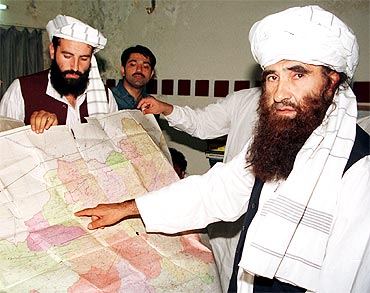
The question of the Haqqani network and how it is to be handled continues to fester. The US special envoy, Richard Holbrooke, this time in London, has suggested that Pakistan needs to go after the group with more force. The warning from Mr Holbrooke will have dashed hopes, raised during Hillary Clinton’s visit, that Washington was prepared to go along with a Pakistani strategy of dialogue with the network — led by Jalaluddin Haqqani and his son Sirajuddin. Links between the Pakistani intelligence forces and the Haqqanis have existed since the Afghan war and they have never been explicitly denied by either party. The elder Haqqani made his name as a formidable mujahideen commander during the Soviet occupation of Afghanistan when he was a member of Maulvi Yunis Khalis’s Hizb-i-Islami. He was also, according to American investigative journalist Steve Coll (who recently wrote Ghost Wars : The Secret History of the CIA, Afghanistan and Bin Laden, from the Soviet Invasion to September 10, 2001), offered a major role in the government by Afghan President Hamid Karzai some years ago.

For Islamabad, the pressure is on again. The Haqqani network is seen in Afghanistan as a key problem; it has carried out numerous attacks there. Washington believes Pakistan needs to do more to support the efforts against the militants in that country. The Pakistan military meanwhile, following its operation in South Waziristan, has avoided any move into North Waziristan – despite some gentle nudging from the US – reportedly following the intervention of the Haqqanis. They are also said to be facilitating talks with other militant factions across the conflict zone.

This brings us to an old issue: that of ‘good’ and ‘bad’ militants. It is clear that in the minds of the Pakistani military and the agencies allied to it this line of distinction continues to exist. Of course, Washington is in many ways responsible for creating this. The ghosts of the Afghan war, the alliance it formed with the mujahideen fighting the former Soviets and the engagement of Pakistan’s agencies, notably the ISI, are today coming back to haunt it. This is not to say that the CIA didn’t have its own connections to some of these actors in the past, but the point that is missed by most people is that it is America which calls the shots in this part of the world (or perhaps in most other parts as well).

There is a need for Islamabad to think things through. The division of militants into various camps, for example, so-called ‘good’ Taliban versus so-called ‘bad’ Taliban, has to stop. Essentially, these men of violence do more harm than good. The fact that a particular faction directs its wrath outside the country and avoids targeting Pakistani security forces should not be enough to cast it in the role of an ally. The effort against militancy does need to be seen in the wider regional context, and not as a matter of narrow allegiances and temporary agreements. The people who make decisions in Islamabad should keep in mind just how unsuccessful past efforts to do deals with the militants have been — with such attempts giving groups making up the complex Taliban network in the North a chance to reorganise and strengthen themselves on more than one occasion. There is reason to believe that this has contributed to the terrorism that has claimed thousands of lives. Even if the Haqqani network did not itself send out the bombers it has acted to back forces that have played a part in encouraging militant trends. The so-called Quetta Shura, led by the elusive Mullah Omar, is among these.

This having been said, Washington too needs also to review its own demands. There have been mixed signals over recent weeks. It is possible there is a lack of clarity on strategy within the US capital. This of course means the confusion in Islamabad has grown. A clear course of action needs to be planned in unison so the militants that Washington helped nurture can be driven away.

Cross-Border Unions: How Indo-Pakistani Marriages Prosper

By Vinita Bharadwaj for The National-UAE

While relations between their countries may be at an all-time low, Indians and Pakistanis who marry each other often find extended family ties confound their nations’ mutual hostility.

It is a truth universally acknowledged, that when two South Asians wed, they not only marry each other, they also marry into each other’s family.

And family matters between Indians and Pakistanis might be expected to be highly charged, given those two countries’ mutual antipathy for more than 60 years.

“When an Indian marries a Pakistani, it’s a loaded event that can only be matched by the energy of a cricket match between the two countries,” says Amra Hyder, a Pakistani.

The partition of British India into Pakistan and India is historically recorded as the largest human migration ever. It displaced millions and forced people of a common culture to choose a new geography and subscribe overnight to the idea of previously non-existent nations.

Most tragically, it split families. The ghosts of the 1947 partition loom large in the psyches of both countries’ modern histories that include three wars, a continuing dispute over Kashmir and terrorism.

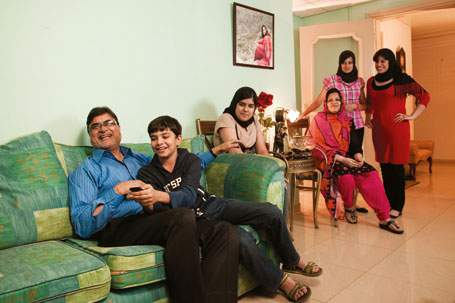
Amra is originally from Pakistan and is married to Zulfiqar Hyder, who hails from India. Amra and Zulfiqar, now Canadian citizens, have lived in Sharjah with their four children since 2006.

In 1992, when the gregarious, romantic 23-year-old Amra married the 33-year old Zulfiqar, a studious man from India, she did not quite know what to expect – from married life, her in-laws and most importantly, her husband’s country. “I also never would have imagined I would be apologetic for both countries’ ridiculous obsession with ‘Shonia’,” she says of the media brouhaha over the recent nuptials of the Pakistani cricketer Shoaib Malik and the Indian tennis player Sania Mirza.

For long before the Malik-Mirza marriage, thousands of Indians and Pakistanis, mostly from families divided by the 1947 partition, have been marrying each other.

The difference is that now these marital alliances are formed outside the extended family circuit. Amra and Zulfiqar did not have an arranged marriage, and neither of them had any intention of settling in either India or Pakistan. They opted to overcome predictable visa hassles by initially residing in the UAE soon after their wedding, and migrated to Canada in 1996 to obtain citizenship, in the hope that it would ease their trips between India and Pakistan.

 
Masooma Syed, from Lahore, met her Keralan husband Sumedh Rajendran at an artists’ residency programme in Delhi. ‘I knew he understood me perfectly.’ Charla Jones

The couple first met in Abu Dhabi at a mutual friend’s party, and married within a year. The wedding took place in Karachi, with Zulfiqar’s entire family flying in from the northern Indian city of Lucknow. “It was a lovely wedding,” Amra recalls, adding that the questioning – albeit, in jest – began soon after they were married. “It was like, ‘Now you’re an Indian daughter-in-law’ and ‘Who will you support in cricket’ or even ‘Who will you support in war’?”

Her response was simple. “I married an Indian, not India. Having said that, I have been welcomed so warmly and given unbelievable respect by Indians, whenever I visit. My relationship with the people, I cherish. The politics, I don’t care for.”

Amra grew up in Abu Dhabi and returned to Lahore for university. Her childhood perception of Indians was to lump them all as people from the Southern Indian state of Kerala. “It was so wrong,” she says regretfully admitting to an error of judgment on her part, “but I honestly never really gave it any thought.” Although her grandfather was an active political leader – initially in the Indian independence struggle and later in the Muslim League, which pressed for Pakistan’s creation – she was uninterested in matters of politics.

On numerous trips to Northern India in the last 18 years, Amra has returned amazed by the cultural similarities she has observed between Indians – including non-Muslims – and her community in Pakistan. “We speak the same kind of language, we appreciate the same food, we like the same clothes, we place the same importance on family values. We even share similar pre-wedding festivities. It’s hardly an alien experience,” she says.

The differences were more to do with class and little do with the country. “Compared to my husband’s childhood, mine was very privileged. He is a self-made man and has single-handedly contributed to his family’s success. If I had to get used to anything, it was holidaying in a home that would experience power cuts and water shortages.”

Amra and Zulfiqar’s children – Hira (17), Anum (13), Zahra (11) and Ali (10) – describe themselves as desi, a generic, originally sanskrit, term used by South Asian immigrants that loosely denotes their origins. They are an animated group and debate the definition of desi among themselves, as their parents look on proudly. The conclusion: among younger generations in urban settings, desi communities have spawned a culture bound by a fondness for Bollywood, cricket, South Asian food and fused elements of their upbringing at home with the globalised, western outlook they are exposed to outside.

Having said that, India and Pakistan enjoy enormous cultural riches – largely attributable to their ethnic, regional and linguistic diversity. Both countries together are akin to the European Union – with each of their provinces having their own quirks, tastes and sensibilities. These subtleties within communities are apparent when embedded among the people in their own land.

Shadab Raza, from Lucknow, India, his Pakistani wife Sana Zehri and their six-year-old son Ali have relatives on both sides of the border. ‘There’s never been this India-Pakistan mentality in our families,’ Shadab said. Siddharth Siva / Arabian Eye

Masooma Syed, an artist from Lahore, lives in Delhi with her husband Sumedh Rajendran, also an artist, but from the south of India. They were introduced to each other at an artists’ residency programme in the Indian capital Delhi in 2003. Following that, they would arrange to meet in Manchester, Sri Lanka and New York before finally geting married in July 2008.

Their cultural backgrounds could not be more different, as are their temperaments and artistic styles. “And yet, I knew he understood me perfectly,” says Masooma of the decision to marry across the border and step into the cumbersome world of visas, soon after exchanging wedding vows in Sri Lanka.

“We never thought about a third country [to live in]. Sumedh has lived in Delhi for the last 15 years and I’ve had absolutely no problem in adjusting to living here. It’s just like Lahore. Ironically, I find Sumedh is more of a foreigner in his own country’s capital than I am. We have discussed moving to a neutral country, especially if visa regulations became tighter, but then as artists all our inspirations stem from this region. Relocating would uproot those emotions and we wonder what impact that would have on our work.”

Kerala, where Sumedh is from, however, is an altogether different milieu. “The first time Masooma visited, she was stunned,” says Sumedh.

“I thought to myself, how lucky am I to be able to see and discover these different facets of India,” she says recalling her reaction to the abundant greenery, the aromatic spices, the swaying coconut palms and the simple people.

But since marrying Sumedh, Masooma has found herself saddled with the unexpected baggage of acting as an ambassador of sorts for both countries. “It’s annoying at times,” she says. “And really it’s all because of immature media reportage in one country about the other. So I end up having to either justify, explain or make excuses for India when in Pakistan or vice versa. I’m not used to being accountable to anyone and this new role is quite tiring, even if it does come with special treatment in some instances.”
The challenges within an Indo-Pak marriage, according to Masooma, seem to be similar to any mixed-culture marriage. Except that among South Asian communities, tradition dictates the wife follows the husband to his home, or homeland. In the specific India-Pakistan context of the 21st century, the complications of visas and work permits make it harder for educated women to carve out an identity for themselves in their new environment. “It’s definitely much easier to be in a third country – either resident or citizen – when in an Indo-Pak marriage. Also, in today’s world, the younger generations of Indians and Pakistanis are meeting and interacting abroad, first as students and then as professionals. Marriages between different faiths among this demographic is on the rise and logistics is no longer a deterrent to falling in love.”

Masooma has been visiting India since 2003 and as an artist she has travelled, exhibited and worked in both countries. “I go through the same motions as all Pakistani nationals applying for an Indian visa. It’s a process and is easy or difficult depending entirely on how you want to look at it,” she says. In early June, the Indian government announced it was relaxing the requirements for granting the extension of long-term visas to four categories of Pakistani nationals, including Pakistani women married to Indian nationals and staying in India. The announcement was welcomed by individuals in her situation.

Her current visa is a ‘visit visa’ valid for nine months that is split into three visits of 90 days each. She has to exit India after each ‘visit’, but says it suits her work commitments that require her to travel abroad. “And I can visit my family in Lahore,” she adds.

Pakistani nationals issued visas to India are typically allowed to visit a maximum of three cities and must report to a police station on arrival and before leaving for their next destination. Masooma is now exempted from the police reporting, as she is a regular traveller between India and Pakistan and is also now married to an Indian national. “I’m allowed to visit more than three cities each time, but it will be a while before I am given complete freedom to travel like any other foreigner,” she says.

She could apply for a residence permit, but would be compelled to stay in India until the paperwork is completed, but it’s diffiuclt to predict how long that would take. Nationality, however, remains a touchy issue, particularly among the educated and liberal women of either country, who see no reason in giving up the passport of the country they originally belong to.

“Unfortunately, political relations keep changing and this spills over into visas and affects people-to-people relationships,” says Zulfiqar Hyder, a staunch believer in encouraging contact between the two countries. The Hyder family hold Canadian passports, but they still have to apply for visas to visit India and Pakistan.

In the wake of the David Headley arrest – a US citizen of Pakistani origin – over his alleged terrorist connections and involvement in the 2008 Mumbai attack, Zulfiqar says having the Canadian passport makes little difference towards easing the process. “I’m trying to get a PIO (Person of Indian Origin) card for the children,” he says of the document issued by the Indian government that functions as a long-term multiple entry visa. As things stand, the foreign spouse of an Indian national is eligible for the PIO card, but the spouses from Pakistan are not, effectively ruling out Amra and her two elder daughters, as they were previously travelling on her passport. “I don’t understand the logic that my children cannot get the PIO card, because their mother is Pakistani,” says Zulfiqar.

The national security argument does not resonate with him as much as it does with Amra. “Frankly, if my family can be assured of safe travel, I don’t mind a little more waiting or dealing with a bit more bureaucracy,” she says. He shakes his head furiously, looks at me and asks: “Did the 26/11 terrorists enter India with passports? Did they? How did they enter India?”

They arrived by night. Across the Arabian Sea, first on a small boat, then a hijacked fishing trawler and finally entered Mumbai’s waters on a rubber dinghy.

Visa-related policies in both countries are updated depending on the warmth or frostiness of the political relationship. Shadab Raza, a 35-year old Indian also from Lucknow, married Pakistani national Sana Zehri, who grew up in the UAE. They have a six-year-old son who has an Indian passport. The families arranged their marriage, as Shadab’s maternal aunts live in Pakistan. “There’s never been this India-Pakistan mentality in our families, because we have relatives on both sides of the border,” says Shadab.

Sana’s ancestry can be traced back to Lucknow, as her grandparents migrated to Pakistan at the time of the partition. On her first visit to the city after her marriage, she visited the ancestral home of her grandparents and filmed it to share with them. “I filmed the house, the neighbourhood and some of the people recorded messages for them. When they watched the video they were consumed by nostalgic sadness. I think partition hurt their generation the most. Our parents to a lesser extent, but they still feel the impact of it as they grew up hearing about it from their parents and visiting immediate relatives in the other country. For my generation, the degree of the trauma is even more reduced, because we haven’t experienced much of the consequences of it directly,” she says.

Shadab and Sana’s son, Ali, however, is quite clear about where he is from. “India,” he says firmly.

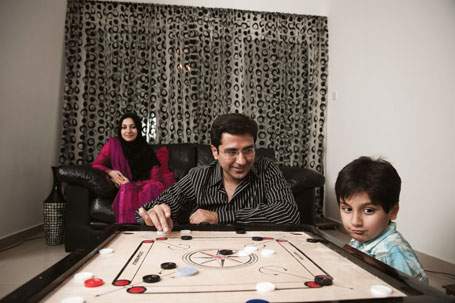
Sana laughs and recalls an incident of him wanting a carrom board specifically ‘made in India’. “My father-in-law had to get the lettering customised because the shop, where they bought it didn’t sell carrom boards with a ‘made in India’ label,” she says. In the meantime, Ali brings out his carrom board and empties out the coins from their container. He then calls out to Shadab to come and play with him.

“There’s never been this India-Pakistan mentality in our families, because we have relatives on both sides of the border,” says Shadab sitting down at the board, across from Ali, who flicks the large striker coin towards the arrangement of smaller black and white coins stacked by colour in the centre of the board. The two towers collapse, some of the coins disperse in four directions, but none of them is pocketed.

“What a mess,” exclaims Ali.
Pakistan Extends Gen. Kayani’s Term

By Zahid Hussain for The Wall Street Journal

Pakistan’s civilian government late Thursday extended the term of army chief General Ashfaq Kayani for three more years to ensure continuity in the military leadership at a crucial stage in the country’s battle against Islamic militants.  The announcement was made by Prime Minister Yousuf Raza Gilani in a televised speech.

“The decision is taken to maintain continuity in the military’s command as the country is passing through very critical times,” Mr. Gilani said. Gen. Kayani, 58 years old, was appointed army chief in December 2007 and was to retire at the end of the year under normal tenure limitations.

The general has won praise for leading two successful military operations against Islamic militants last year in Pakistan’s Swat Valley and South Waziristan tribal region. But militants have regrouped in many areas and continue to unleash suicide strikes across the country.

More than 50,000 Pakistani troops are still engaged in fighting al Qaeda backed Islamic militants in the Pakistan’s troubled northwestern region, which borders Afghanistan. They are aided by unmanned U.S. drone strikes.

The war is seen as a crucial piece of the ongoing conflict in Afghanistan as many Taliban fighters use Pakistan’s tribal regions as a safe haven.

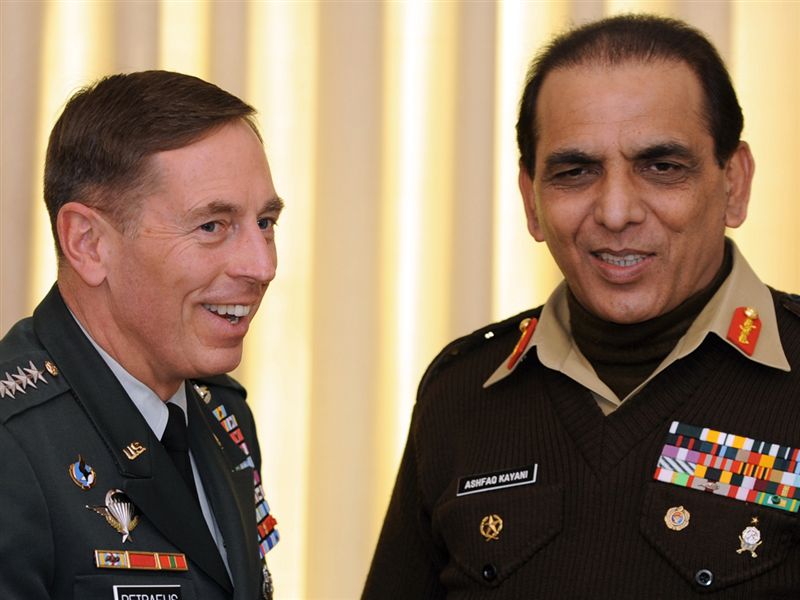
A senior government official said Gen. Kayani’s good rapport with Gen. David Petraeus, the commander of North Atlantic Treaty Organization forces in Afghanistan, and other American military leaders was a major factor in the decision to extend his term.

“He has worked closely with the current American military leadership and it is important for both Pakistan and the U.S. at this point for Gen. Kayani to stay at the helm,” said the official.

Other analysts agreed continuity was important at the current juncture of the war. “His leadership is crucial at the time when Pakistani army is fighting a decisive battle against the militants,” said Hasan-Askari Rizvi, an independent defense analyst.

Still, the extension of his tenure is likely to raise concerns among some pro-democracy activists about the pre-eminent role of the military in Pakistan.

The country has a democratically elected civilian government under President Asif Ali Zardari. But the country has been ruled more by military leaders in its 63-year history, most recently between 1999 and 2008.

Mr. Zardari’s government faces growing opposition and some analysts fear the army may step in again if they deem it necessary. Gen. Kayani, though, has focused on fighting militants. “We have to defeat them decisively,” he said during a recent discussion with a group of journalists.

Gen. Kayani received his commission in the Pakistani army in 1971. He served as the chief of Inter-Services Intelligence, Pakistan’s powerful spy agency, before his elevation to army chief.

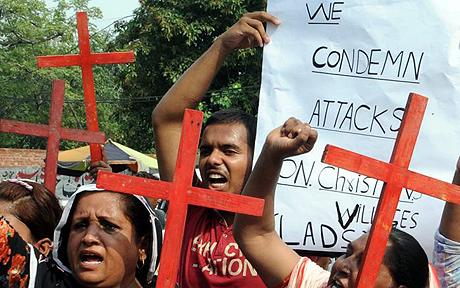
2 Pakistani Christians Killed At Courthouse

By Chris Brummitt for The Associated Press

Gunmen killed two Pakistani Christian brothers accused of blasphemy against Islam as they left court on Monday, a government minister and police said.

The men were chained together when the attack took place in the eastern city of Faislabad as they were being taken back into custody after their court appearance.

They were arrested a month ago after leaflets allegedly bearing their names and featuring derogatory remarks against the Prophet Muhammad were found in the town, said Shahbaz Bhatti, the minister for minority affairs. He said mosques in Faislabad had called for the men to be attacked.

Bhatti said he suspected the men were falsely accused of blasphemy by people with a grudge against them. Their families had maintained their innocence, he said.

The brothers were killed by two gunmen as they left court, said police officer Rana Ahmed Hasan. A police officer accompanying the men was wounded, he said, adding the killers escaped.

Pakistan’s blasphemy laws have been often criticized by religious minorities and human rights activists.

In its latest report on religious freedom in Pakistan, the U.S. State Department said the laws are often abused to settle local disputes and discriminate against minorities.

Muslims make up an estimated 97 percent of Pakistan’s 180 million people, most of them Sunni.

Bhatti said he believed the brothers were innocent.

“I personally don’t think that anyone who wrote derogatory things against Muhammad would put their names on the bottom,” he said. “This was just to settle a personal issue.”

Bhatti has long campaigned against the blasphemy laws, which were introduced President Gen. Zia ul-Haq in the 1980s to win the support of hard-line religious groups.

Repealing them now would likely meet opposition from the same groups, something that could cause unrest.

Clinton Reaffirms US Commitment to Pakistan

By Ayaz Gul for The Voice of America

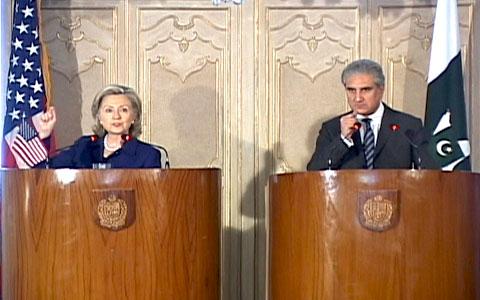
Concluding a second round of the so-called U.S.-Pakistan strategic dialogue in Islamabad, Secretary of State Hillary Clinton on Monday announced more than $500 million in several new aid programs for Pakistan.

The string of new projects unveiled by Clinton during a joint press conference with Pakistani Foreign Minister Shah Memood Qureshi are designed to help Pakistan meet its energy needs and boost power generation, health and agricultural development. The programs are the first to be launched under U.S legislation passed last year tripling civilian aid for Pakistan to $7.5 billion during the next five years.

Secretary Clinton said the United States hopes the new aid will translate into real life improvements for families and communities, describing them as long-term investments in Pakistan’s future.

“We are committed to building a partnership with Pakistan that of course strengthens security and protects the people of Pakistan, but goes far beyond security,” Clinton said. “We want to help you drive economic growth and prosperity, strengthen your democratic government institutions and expand access to the tools of opportunity.”

Pakistan is playing a key role in the international fighting against Taliban insurgents in Afghanistan. But public opinion in Pakistan still views U.S. motives with a considerable amount of suspicion. The skepticism stems from the U.S decision to abandon support for Pakistan after Soviet forces withdrew from Afghanistan.

But Secretary Clinton says she can see positive change resulting from what she called deeper and broader bilateral engagements in recent years.

“We have moved beyond a standoff of our misunderstandings that were allowed to fester and not addressed… to a position where we are engaged in the most open dialogue that I think our two countries have ever had,” she said.

Foreign minister Qureshi also agreed that the enhanced U.S cooperation in various fields such as energy, power, health, agricultural and education sector is critical for changing the public perception in Pakistan.

“The opinion of the United States will change when the people of Pakistan see that their lives have changed,” said Mr. Qureshi.

Sunday, Clinton attended the signing of a landmark trade deal reached by Pakistan and Afghanistan, after years of negotiations. The United States has been pushing Afghan and Pakistani leaders to improve bilateral relations it says will contribute to the fight against extremists.

Secretary Clinton’s next stop as part of her Asia trip will be Kabul, where she will attend an international conference on Tuesday.

At the news conference in Islamabad, she reiterated that insurgents who wish to reconcile must lay down their arms, renounce partnership with al-Qaida and accept Afghanistan’s constitution.

“It seems to us that there will be some who are willing to meet those conditions and others who are not. And we would strongly advise our friends in Afghanistan to deal with those who are committed to a peaceful future where their ideas can compete in the political arena through the ballot box, not through the force of arms.”

Taliban insurgents have stepped up attacks against Afghan and U.S-led coalition forces in recent months. More than 50 foreign troops have died in July while the previous month was the deadliest for international forces since the war against Taliban and its allies began nine years ago.

Clinton, With Initiatives in Hand, Arrives in Pakistan

By Mark Landler for The New York Times

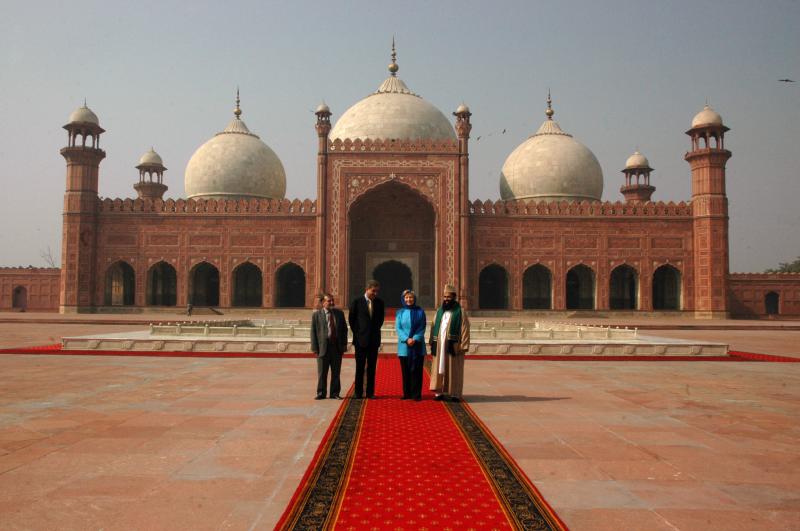
Secretary of State Hillary Rodham Clinton arrived here Sunday for high-level deliberations with Pakistani leaders, the latest in a series of encounters that the Obama administration hopes will chip away at decades of suspicion between Pakistan and the United States.

Hillary Rodham ClintonMrs. Clinton will announce a raft of initiatives to help Pakistan in public health, water distribution and agriculture, to be funded by $500 million in American economic aid. Among other things, the United States will build a 60-bed hospital in Karachi and help farmers export their mangoes.

Yet these projects, however beneficial to this economically fragile country, do not disguise several nagging sources of friction between the two sides. American officials still question Pakistan’s commitment to root out Taliban insurgents in its frontier areas, its motives in reaching out to war-torn Afghanistan and its determination to expand its own nuclear program.

Pakistan plans to buy two nuclear reactors from China — a deal that alarms the United States because it is cloaked in secrecy and is being conducted outside the global nonproliferation regime. Administration officials said they did not know if Mrs. Clinton planned to raise the purchase.

Relations could be further tested if the Obama administration decides to place a major Pakistani insurgent group, the Haqqani network, on the State Department’s list of terrorist organizations. Islamabad maintains ties to the group through its intelligence service, and it is seeking to exploit those connections as a way to extend its influence over Afghanistan.

For all that, tensions between the two sides have ebbed since Mrs. Clinton’s last visit here in October, when she was peppered with hostile questions in public meetings and bluntly suggested that people in the Pakistani government know the whereabouts of Osama bin Laden and Mullah Omar.

“We needed to change the core of the relationship with Pakistan,” said Richard C. Holbrooke, the special representative to Afghanistan and Pakistan. “The evolution of the strategic dialogue, and the fact that we are delivering, is producing a change in Pakistani attitudes.”

Mr. Holbrooke noted a U-turn in Pakistan’s policy on issuing visas to American diplomats. For months, Pakistani officials had held up those applications, creating a huge backlog and frustrating the United States. But Pakistan issued 450 visas in the last five days, he said.

Mr. Holbrooke conceded that public-opinion polls toward the United States had yet to show much of a change. Mrs. Clinton may receive more criticism on Monday at a town-hall meeting in Islamabad. Her visit, which was not announced due to security concerns, is being conducted under tight security.

Vali Nasr, a senior advisor to Mr. Holbrooke, said it was unrealistic to expect “to change 30 years of foreign policy of Pakistan on a dime.” But he said, “On foreign policy issues, we’re seeing a lot more convergence.”

The United States is encouraged by the burgeoning dialogue between President Hamid Karzai of Afghanistan and Pakistani leaders, including the chief of the staff of the army, Gen. Ashfaq Parvez Kayani. Any resolution of the war, Mr. Holbrooke said, must involve Pakistan.

While American officials would like to see a more aggressive Pakistani military push in North Waziristan, the stronghold of the Haqqani network, they praise the military’s campaigns in South Waziristan and the Swat Valley, where Taliban insurgents had also made gains.

Pakistan’s battle against insurgents has exacted a fearful civilian toll. Last week, a suicide bomber killed 45 people, and injured 175, in an attack on a 1,000-year-old Sufi shrine in Lahore. Many Pakistanis blame the American-led war in Afghanistan for fomenting anti-Pakistan terrorism.

A coalition of protest groups issued a statement Sunday, timed to Mrs. Clinton’s arrival, which calls for an end to the war in Afghanistan and for Americans and Pakistanis who are involved in clandestine air strikes on Pakistani targets to be tried for war crimes.

Mrs. Clinton is to meet General Kayani on Monday, after meetings on Sunday with President Asif Ali Zardari and Prime Minister Yousaf Raza Gillani. She was also scheduled to meet Pakistani business leaders and the head of the Pakistani opposition, Nawaz Sharif.

Mrs. Clinton has brought a shopping-bag full of commitments for Pakistan, drawn from the $7.5 billion in non-military aid, over five years, pledged by Congress last year. The emphasis is on basic services like electricity and water, politically-charged issues in this country, particularly during the hot summer.

“Our commitment is broad and deep,” said Rajiv Shah, the administrator of the United States Agency for International Development, who is with Mrs. Clinton. “We will not do what we’ve done in the past.”

Administration officials said the project to upgrade Pakistan’s creaky power grid, which involves building hydroelectric dams and rehabilitating power plants, had helped reduce chronic power outages. But on the day Mrs. Clinton landed, television reports here warned of further outages.

Pakistan Oil & Gas to Spend $1 Billion on Exploration, CEO Says

By Khaliq Ahmed and Farhan Sharif for Bloomberg

Oil & Gas Development Co., Pakistan’s biggest fuels explorer, plans to spend a record $1 billion this year to drill 48 new wells and increase production, to help bridge the nation’s record energy deficit.

“We are following a very aggressive exploration policy,” Chief Executive Shah Mehboob Alam said in an interview at his office in Islamabad yesterday. “We are targeting a number of discoveries.”

Improved domestic energy supplies may help Pakistan’s economy which has been hurt by terrorism and falling foreign investment. Demand for energy is three times supply and daily power outages have forced textile and engineering factories to close and caused riots across the country.

“There is a huge need and also huge potential to increase production by explorers,” said Umer Ayaz, a research analyst at JS Global Capital Ltd. in Karachi. “Pakistan has unusual risks in exploration and also unusually high potential.” A “sizeable” discovery in the northwest will be announced in “a couple of days,” Alam said, without giving details.

Shares of Oil & Gas Development rose 2.8 percent to 149.56 rupees on the Karachi Stock Exchange yesterday, the highest since Oct. 30, 2006. The stock has gained 35 percent this year compared with an 8 percent increase in the benchmark index. Oil & Gas plans to expand exploration in the western province of Baluchistan, where attacks on pipelines and installations have disrupted gas supplies, Alam said. The province is estimated to hold more than half the country’s gas reserves.

The company expects the Zin Block in Baluchistan to generate its first gas flows within two years. The block has estimated gas reserves of 10 trillion cubic feet and drilling is scheduled to start as soon as the government approves security plans within the next two weeks, he said.

“We drilled only five out a planned 15 wells in Baluchistan last year because of security issues,” he said. “Now, we have submitted a plan to the Finance Ministry under which the Frontier Corp. will raise a special force of 500 to 600 people.” Baluch nationalists want political autonomy and a share of the resources in the province, where the country’s largest gas fields, including Sui, are located. The Frontier Corp. is part of Pakistan’s paramilitary force.

The company is also working in fields in western Baluchistan, including the Samandar field, west of Karachi, and Shahana, which is near the border with Iran, Alam said. Oil & Gas will invite bids today for the development of Kunar Pasakhi Deep and Tando Allah Yar fields in the southern province of Sindh, Alam said. Previously awarded tenders had been canceled after being challenged in court for not complying with regulatory procedures. The two fields may produce 280 million cubic feet of gas a day, 360 metric tons of liquefied petroleum gas a day and 4,300 barrels of oil a day, Alam said.

The company drilled 26 wells and made six discoveries in the year ended June 30, including at Nashpa in the northwest, which is producing 15 million cubic feet a day of gas and 4,700 barrels of oil a day, he said. Oil & Gas Development discovers fuel in one out of every 2.3 wells drilled, compared with an industry average of one in every 3.8, he said.

Oil & Gas Development will increase production after installing new compressors to plug leaks at the Qadirpur gas field by September, Alam said. The company plans to buy two new rigs this year. The Qadirpur field in the southern province of Sindh contributes about 40 percent of the company’s total gas output.

Oil & Gas Development produces about 1 billion cubic feet of gas a day, or a quarter of the country’s total output. Its oil production is 60 percent of the nation’s total of 62,000 barrels a day. Pakistan imports 85 percent of its oil needs. The company’s profit in the 12 months ended June 30, will be “higher than last year,” Alam said, without giving details. Oil & Gas reported a net profit of 55.5 billion rupees ($647 million) in the year ended June 30, 2009, according to data compiled by Bloomberg.

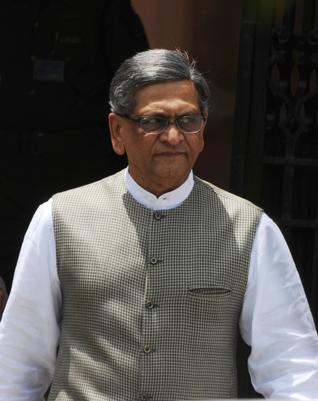
Krishna Arrives in Pakistan, Calls Visit ‘a New Beginning’

By Omer Farooq Khan for The Times of India

Indian external affairs minister S M Krishna, who arrived in Islamabad on Wednesday, said that he is on a mission to restore trust and increase confidence between the two countries.

“We hope to discuss all issues of mutual interest and concern that can contribute to restoring trust and building confidence in our bilateral relationship,” Krishna told journalists as he arrived here.

During his three-day visit, Krishna will hold talks with his Pakistani counterpart Shah Mahmood Qureshi on Thursday and will also meet President Asif Ali Zardari and PM Yusuf Raza Gillani. S M Krishna looks forward seeking progress on the issue of terrorism being raised by the Indian home minister P Chidambaram with his Pakistani counterpart Rehman Malik last month in Islamabad.

“I also look forward to receiving feedback on the issues raised by our home minister (P Chidambaram) during his visit to Pakistan last month on our core concern of terrorism, particularly in the light of the discussions our home minister had in Pakistan in the context of interrogation of David Headley regarding the Mumbai terrorist attack,” he said.

Krishna described his visit as important as it marks a new beginning of journey to build a prosperous, friendly and cooperative relationship between the two countries.

India is committed to resolving all issues with Pakistan through peaceful dialogue based on mutual trust and confidence, Krishna said.

“I brought a message of peace and friendship from the people of India and we hope to undertake this voyage of peace, however long and arduous, jointly with the government and people of Pakistan,” he said.
Pakistan’s foreign minister Shah Mehmood Qureshi has said that he will raise with Krishna the issue of alleged human rights in Jammu and Kashmir.

“We are approaching the meeting with a positive mindset,” Qureshi said.

The Krishna-Qureshi talks on Thursday will be the third major contact between the two countries in within a month.

Home minister Chidambaram conveyed India’s concerns and expectations on terrorism to Pakistani leadership last month when he visited Islamabad.

The Indian and Pakistani prime ministers met in April on the sidelines of a regional summit in Bhutan, which set in motion the process to revive suspended contacts at different levels of government.