Posts Tagged ‘ Al-Qaeda ’

U.S. Strategy in Pakistan Is Upended by Floods

By Mark Landler for The New York Times
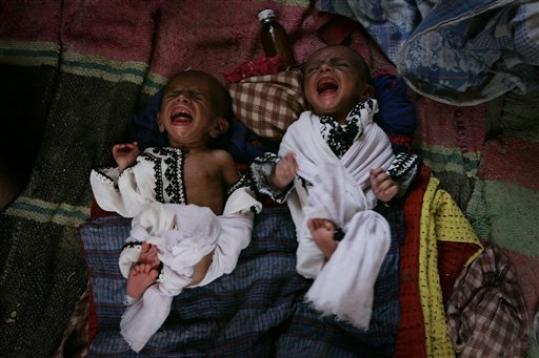
WASHINGTON — The floods in Pakistan have upended the Obama administration’s carefully honed strategy there, confronting the United States with a vast humanitarian crisis and militant groups determined to exploit the misery, in a country that was already one of its thorniest problems.

While the administration has kept its public emphasis on the relief effort, senior officials are busy assessing the longer-term strategic impact. One official said the disaster would affect virtually every aspect of the relationship between the United States and Pakistan, and could have ripple effects on the war in Afghanistan and the broader American battle against Al Qaeda.

With Pakistan’s economy suffering a grievous blow, the administration could be forced to redirect parts of its $7.5 billion economic aid package for Pakistan to urgent needs like rebuilding bridges, rather than more ambitious goals like upgrading the rickety electricity grid.

Beyond that, the United States will be dealing with a crippled Pakistani government and a military that, for now, has switched its focus from rooting out insurgents to plucking people from the floodwaters. The Pakistani authorities, a senior American official said, have been “stretched to the breaking point” by the crisis. Their ragged response has fueled fears that the Taliban will make gains by stepping in to provide emergency meals and shelter.

“It certainly has security implications,” said another official who, like others interviewed for this article, spoke on the condition of anonymity because he was not authorized to discuss internal policy deliberations. “An army that is consumed by flood relief is not conducting counterinsurgency operations.”

On Thursday, the United Nations will convene a special meeting devoted to the floods, hoping to galvanize what has been a lackluster global response. Secretary of State Hillary Rodham Clinton is expected to announce that American public aid has surpassed $100 million, an official said.

“We’re obviously not oblivious to the political and strategic implications of this catastrophe, but right now, we are fully focused on the emergency relief effort and trying to get a good assessment of the needs,” said the administration’s special representative to the region, Richard C. Holbrooke.

Noting that several weeks remain in the monsoon season, Mr. Holbrooke said, “Worse may be yet to come.”

The disaster comes after a period in which the administration seemed to have made strides in repairing the American relationship with Pakistan. Mrs. Clinton visited Islamabad in July with a long list of pledges, including the upgrading of several power plants and a plan to promote Pakistani mangoes. Now, these projects seem almost beside the point.

“Before, there were power plants in need of refurbishment,” said Daniel S. Markey, senior fellow for India, Pakistan and South Asia at the Council on Foreign Relations. “Now there are power plants underwater.”

In recent days, the United States has sent 15 helicopters, rescuing nearly 6,000 people. On Wednesday, military cargo planes delivered 60,000 pounds of food and other relief supplies, bringing total deliveries to 717,000 pounds. The speed and scale of the effort, officials in both countries said, have helped bolster the checkered American image in Pakistan.

In another hopeful sign, officials said Pakistan and India had been in close touch about the floodwaters, some of which are flowing into Pakistan from India. Such communication, between historic archenemies, could augur reduced tension in other areas, one of the officials said.

Against that, however, are the staggering dimensions of the disaster. A senior Pakistani official told the administration on Tuesday that the next flood surge was likely to inundate much of Punjab, the densely populated region that borders India and produces much of Pakistan’s food.

So far, this official said, the greatest damage has been in regions that are also hotbeds for Islamic insurgents, which has set back the army’s fight against extremist groups. Local governments in those places have largely collapsed, leaving the army as the only source of authority.

With 20 million people displaced from their homes, the Pakistani authorities are girding themselves for an immense migration to the major cities, which they fear could sow further instability.

“Americans have not yet registered the enormity of the crisis,” Pakistan’s ambassador to the United States, Husain Haqqani, said in a telephone interview from Islamabad, the capital.

Pakistani and American officials said reports of hard-line Islamic charities providing relief were exaggerated. One pointed out that the floods had hurt the insurgents as well: there was a report of small arms and ammunition belonging to a militant group floating in the water.

Still, people in both countries warned that if rebuilding and rehabilitation efforts bogged down, the Taliban and other militant groups would try to take advantage of it. “The real test is, can their government provide the most fundamental services?” said an administration official.

Parallels to this crisis are hard to find. One official cited the example of the Indonesian province of Aceh, which had been racked by a three-decade insurgency fought by the separatist Free Aceh Movement. After the tsunami swept through in 2004, killing 170,000 people, the separatists and the Indonesian government quickly signed a peace treaty, in August 2005.

There are, however, big differences between a localized separatist group and an international jihadist movement.

“If the flood proves to tilt the balance of power in Pakistan, it’s more likely to tilt toward the militants than toward the government,” said Bruce Riedel, a former intelligence official who helped the administration formulate its initial policy for Pakistan and Afghanistan.

Already, Pakistan’s president, Asif Ali Zardari, has been exposed to withering criticism at home for going on a trip to Europe during the early days of the flood. American officials said they were determined not to get drawn into the dispute, noting that in any event, Mr. Zardari had been stripped of many of his powers in a recent constitutional change.

Decisions on how the flood will affect American economic aid may be influenced by a trip to Pakistan by Senator John Kerry, the Massachusetts Democrat who co-sponsored the five-year nonmilitary assistance package with Senator Richard G. Lugar, Republican of Indiana.

Senator Kerry, accompanied by Dan Feldman, a deputy to Mr. Holbrooke, is scheduled to tour the flooded areas on Thursday. Mr. Kerry has said he is open to redirecting aid money, though some analysts said they were skeptical that Congress would approve additional financing. Military aid may also come under scrutiny, according to administration officials.

“Every dimension of our relationship — politics, economics, security — is going to see major shifts as a result of this historic disaster,” said Lt. Gen. Douglas Lute, the White House coordinator for Afghanistan and Pakistan. “All the tools of diplomacy have to be examined in light of this new reality.”
Pakistan Fight Stalls for U.S.

By Julian Barnes for The Wall Street Journal

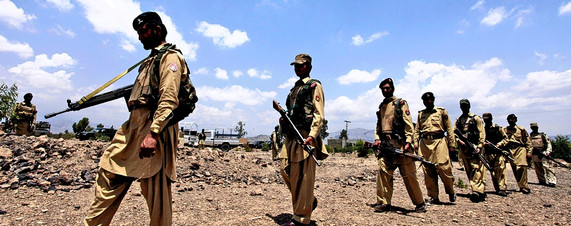
The U.S. military has stopped lobbying Pakistan to help root out one of the biggest militant threats to coalition forces in Afghanistan, U.S. officials say, acknowledging that the failure to win better help from Islamabad threatens to damage a linchpin of their Afghan strategy.

Until recently, the U.S. had been pressing Islamabad to launch major operations against the Haqqani network, a militant group connected to al Qaeda that controls a key border region where U.S. defense and intelligence officials believe Osama bin Laden has hidden.

The group has been implicated in the Dec. 30 bombing of a CIA base in Khost, a January assault on Afghan government ministries and a luxury hotel in Kabul, and in the killing of five United Nations staffers in last year’s raid on a U.N. guesthouse.

But military officials have decided that pressing Pakistan for help against the group—as much as it is needed—is counterproductive.

U.S. officials believe elements of Pakistan’s intelligence agency, Inter-Services Intelligence, are continuing to protect the Haqqani network to help it retain influence in Afghanistan once the U.S. military eventually leaves the country. U.S. officials say the support includes housing, intelligence and even strategic planning,

During a trip to Pakistan last month, Adm. Michael Mullen, chairman of the Joint Chiefs of Staff, chose not to raise the issue of an offensive against the Haqqani network—a departure from the message U.S. defense officials delivered earlier this year.

The U.S. also had intensified the pressure for Pakistani operations in North Waziristan in May after the attempted bombing of New York’s Times Square was linked to militants in Pakistan.

Pakistan officials reject the U.S. conclusions about their efforts. They say they are taking significant action against militants in North Waziristan. They say their intelligence service has severed all ties with the Haqqani network. Islamabad points to a series of surgical strikes the Pakistani military has executed in North Waziristan, and say they have ratcheted up those efforts in recent months in a precursor toward more aggressive moves.

Pakistan’s operations complement a Central Intelligence Agency drone campaign targeting militants in North Waziristan, a Pakistani official said.

Defense Secretary Robert Gates praised the Pakistani effort to rout al Qaeda and other militants from Swat and South Waziristan. “Are they doing a lot to help us? The answer is yes,” Mr. Gates said Thursday.

U.S. officials acknowledged the recent Pakistani operations, but discounted their value against the Haqqani network.

A U.S. defense official said that most of the raids have been against the Pakistani Taliban, a militant group that poses no direct threat to U.S. forces in Afghanistan, but opposes the Pakistani government.

Pakistan has failed to act on detailed intelligence about the Haqqanis provided in recent months, said a senior military official. “Our forces have put a significant dent in the Haqqani network,” said the official. “It would be good if the [Pakistanis] would do the same on their side.”

U.S. officials say they have concluded that making more demands, public or private, on Islamabad to start a military offensive against the Haqqani network will only strain U.S.-Pakistani relations.

The Haqqani network has decades-long ties with al Qaeda leaders that date back to their days of fighting the Soviets in Afghanistan prior to al Qaeda’s formation.

The network now is believed to provide al Qaeda with protection, shelter and support in North Waziristan. The group’s historic base is in Afghanistan’s Khost province and it remains the most potent insurgent force in the eastern part of the country and is closely aligned with the Taliban.

The number of al Qaeda fighters in Afghanistan is thought to be very small, under 100; Haqqani network fighters number in the thousands.

The U.S. shift partly is in recognition that the Pakistanis simply may not have the military capacity to expand operations enough to secure the North Waziristan area, one U.S. official acknowledged.

Pakistani efforts in North Waziristan so far are too small to have a significant impact, said Bruce Riedel, a former CIA analyst who headed the Obama administration’s first review of U.S. policy toward Afghan and Pakistan.

“It is mostly show to keep the Americans happy,” he said.

In the wake of Pakistan’s recent flooding, U.S. officials also are concerned the Pakistanis may ratchet back counterterrorism operations as they redeploy troops to help respond to a burgeoning humanitarian crisis.

U.S. defense officials now argue the only way to convince Pakistan to take action in North Waziristan is to weaken the Haqqani network so much that Pakistan sees little value in maintaining an alliance with the group—though they acknowledge that will be harder without Pakistani help.

The U.S. military has stepped up its own operations against the Haqqani network since April, and most significantly in the last two weeks, according to military officials. Strikes have significantly reduced the Haqqani network’s ability to mount attacks in Kabul and outside their traditional tribal areas of eastern Afghanistan, said senior U.S. military officials.

In eastern Afghanistan, a task force of elite troops assigned to target the Haqqani network conducted 19 operations in April, 11 in May, 20 in June and 23 in July. The high pace continued in the first week of August with seven operations.

The Haqqanis threatened to disrupt an international conference in Kabul last month, but were not able to make good on the threat.

Pakistan Suicide Bomber Targets Mourners

As Reported by BBC News

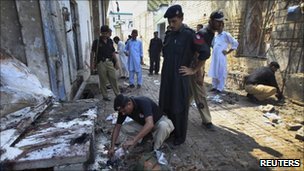
A suicide bomb near Peshawar has killed seven people near a gathering mourning a cabinet minister’s son murdered in a suspected Taliban attack, police say.

About 20 people were also injured when the bomber struck on foot near the home of Provincial Information Minister Mian Iftikhar Hussain in the town of Pabbi. Three policemen and four civilians died. The minister was not among the mourners.

The Taliban has told the BBC it killed his 28-year-old only son two days ago. The suicide bomber detonated his explosives near a mosque where people had gathered in mourning on Monday.

Police said the attacker was dropped off by a man on a motorcycle near the minister’s home in the town, 26km (16 miles) east of Peshawar.

“He [the bomber] was a young boy,” senior police officer Liaquat Ali told news agency Reuters.

“He was trying to cross the checkpost but when our policemen caught him, he exploded himself.”

Mian Iftikhar Hussain is considered the provincial government’s most outspoken critic of the Taliban militants who have carried out dozens of bombings in the area.

BBC Islamabad correspondent Ilyas Khan, whose hometown is Pabbi, says the minister and other VIPs were probably not the direct targets of this blast, as it was well known they were gathering at a college building several kilometres away.

Our correspondent says the militants may have been sending a message that they can reach Mr Hussain’s home should they choose.

A spokesman for the Pakistani Taliban, Ehsabullah Ehsan, has told the BBC the group was responsible for gunning down the minister’s son, Rashid Hussain, near his home in Pabbi on Saturday.

The town is close to the home village of Pakistani-American Faisal Shahzad, who admitted to trying to blow up New York’s Times Square in May.

Bombs and attacks blamed on Taliban and al-Qaeda-linked militants have killed more than 3,500 people across Pakistan, it is estimated, since government troops besieged a radical mosque in Islamabad in July 2007.

Much of the violence has focused on north-west Pakistan’s border area with Afghanistan, where US and Nato troops are battling to turn around a nine-year war against the Taliban.

Pakistan Extends Gen. Kayani’s Term

By Zahid Hussain for The Wall Street Journal

Pakistan’s civilian government late Thursday extended the term of army chief General Ashfaq Kayani for three more years to ensure continuity in the military leadership at a crucial stage in the country’s battle against Islamic militants.  The announcement was made by Prime Minister Yousuf Raza Gilani in a televised speech.

“The decision is taken to maintain continuity in the military’s command as the country is passing through very critical times,” Mr. Gilani said. Gen. Kayani, 58 years old, was appointed army chief in December 2007 and was to retire at the end of the year under normal tenure limitations.

The general has won praise for leading two successful military operations against Islamic militants last year in Pakistan’s Swat Valley and South Waziristan tribal region. But militants have regrouped in many areas and continue to unleash suicide strikes across the country.

More than 50,000 Pakistani troops are still engaged in fighting al Qaeda backed Islamic militants in the Pakistan’s troubled northwestern region, which borders Afghanistan. They are aided by unmanned U.S. drone strikes.

The war is seen as a crucial piece of the ongoing conflict in Afghanistan as many Taliban fighters use Pakistan’s tribal regions as a safe haven.

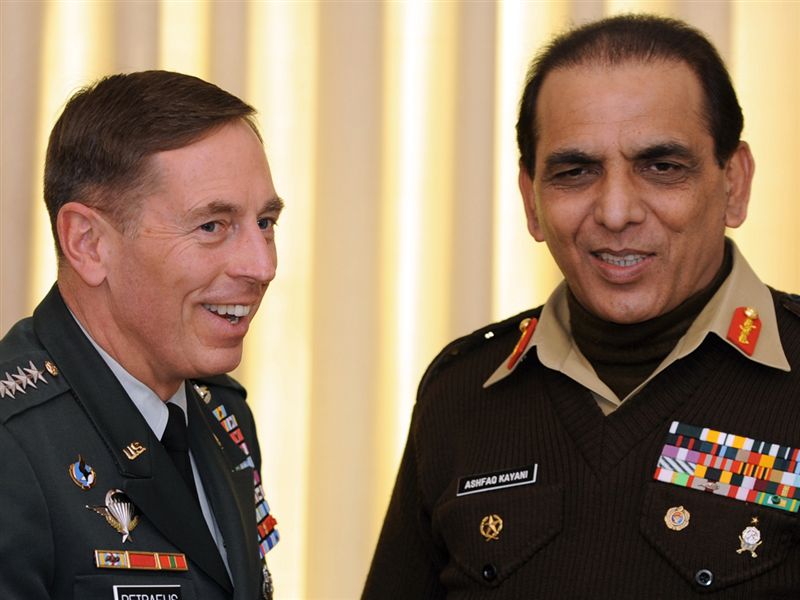
A senior government official said Gen. Kayani’s good rapport with Gen. David Petraeus, the commander of North Atlantic Treaty Organization forces in Afghanistan, and other American military leaders was a major factor in the decision to extend his term.

“He has worked closely with the current American military leadership and it is important for both Pakistan and the U.S. at this point for Gen. Kayani to stay at the helm,” said the official.

Other analysts agreed continuity was important at the current juncture of the war. “His leadership is crucial at the time when Pakistani army is fighting a decisive battle against the militants,” said Hasan-Askari Rizvi, an independent defense analyst.

Still, the extension of his tenure is likely to raise concerns among some pro-democracy activists about the pre-eminent role of the military in Pakistan.

The country has a democratically elected civilian government under President Asif Ali Zardari. But the country has been ruled more by military leaders in its 63-year history, most recently between 1999 and 2008.

Mr. Zardari’s government faces growing opposition and some analysts fear the army may step in again if they deem it necessary. Gen. Kayani, though, has focused on fighting militants. “We have to defeat them decisively,” he said during a recent discussion with a group of journalists.

Gen. Kayani received his commission in the Pakistani army in 1971. He served as the chief of Inter-Services Intelligence, Pakistan’s powerful spy agency, before his elevation to army chief.

Pakistan Bans India Osama Bin Laden Comedy

From The BBC

Pakistan has banned an Indian comedy called Tere Bin Laden (Without You Laden), about a lookalike of Osama Bin Laden.

The country’s film censor board has objected to the way the movie portrays Bin Laden and warned that it could trigger a “terrorist attack”. The film was due to have been released in Pakistan on Friday.

Its main distributor told the BBC that an appeal has been filed against Thursday’s decision. In a statement the film board said that Tere Bin Laden was “unsuitable for public exhibition”.

They said it was a “controversial subject which depicted the character of Osama Bin Laden in a comic way… and contains vulgar and objectionable dialogue, abuses and derogatory remarks”.

The board said that the film also “portrayed a bad and negative image of law enforcing agencies of the country”. Correspondents say that it is not unprecedented for Pakistan to ban films, especially if they are linked to India – Islamabad’s longtime regional arch rival.

But the impact of such censorship is likely to be limited, correspondents say, because DVDs are the most common means of watching movies in the country and pirated ones are easily secured.

The BBC’s Syed Shoaib Hasan says that although the announcement of the ban was unexpected, it was not altogether surprising as the country’s government remains touchy on the subject of Bin Laden. His current whereabouts are unknown, with some US officials maintaining that the world’s most wanted man is hiding in Pakistan.

The main distributor for the film, Nadeem Mandviwala, told the BBC that the the ministry of culture will announce its decision against the appeal on Friday. “I find it quite disturbing that we cannot portray Osama Bin Laden and the law enforcement agencies,” Mr Mandviwala told the BBC.

“It’s acceptable that we make comedies about the president and prime minister all the time, but not Osama.” Indian films are popular in Pakistan, though only some make it to the big screens.

Tere Bin Laden is about a struggling Pakistani journalist who tries to sell an interview of a fake Bin Laden as a scoop who wants to move to the US to fulfil his American dream.

When he comes across a person who looks like Osama, he decides to sell his interview as a scoop to the international media, which results in a series of goof-ups.

Though the film is a comedy, the director says they have been careful about the authenticity of locations in Karachi, facts about Osama Bin Laden and the context of the story

Pakistan Suicide Bombing Death Toll Jumps to 102

By Riaz Khan and Nahal Toosi for The Associated Press

The death toll from twin suicide bombings in Pakistan jumped to 102 with 115 people wounded on Saturday, making it the deadliest attack this year in the country.

Authorities continued to remove debris from the site of the attack in the village of Yakaghund in a northwest tribal region, after two bombers struck seconds apart Friday near a government office.

One of the bombs appeared fairly small but the other was huge, officials said. At least one bomber was on a motorcycle.

The attackers detonated their explosives near the office of Rasool Khan, a deputy Mohmand administrator who escaped unharmed. Tribal elders, including those involved in setting up militias to fight the Taliban, were in the building, but none was hurt, according to Mohmand chief administrator Amjad Ali Khan.

Video footage showed dozens of men searching through piles of yellow brick and mud rubble for survivors. Women and children were among the victims.

Mohmand is one of several areas in Pakistan’s lawless tribal belt where Taliban and al-Qaida members are believed to be hiding.

Abdul Wadood, 19, was sitting in a vehicle at the time of the bombings.

“I only heard the deafening blast and lost consciousness,” said Wadood, who was being treated for head and arm wounds in Peshawar, the main city in the northwest, about 15 miles (25 kilometers) away. “I found myself on a hospital bed after opening my eyes. I think those who planned or carried out this attack are not humans.”

Some 70 to 80 shops were damaged or destroyed, while damage to a prison building allowed 28 prisoners — ordinary criminals, not militants — to flee, said Rasool Khan, who gave the casualty figures.

Friday’s was the deadliest attack this year in Pakistan. On New Year’s Day, a suicide car bomber struck a sports event near a meeting of tribesmen who supervise an anti-Taliban militia near the South Waziristan tribal area, killing 96 people.

Near the attack site, officials had been distributing wheelchairs Friday to disabled people and equipment to poor farmers, Amjad Ali Khan said. It was unclear how many participants in that event were among the victims.

Pakistani Taliban spokesmen could not be immediately reached after the attack. There were scattered reports the militant group’s branch in Mohmand had claimed responsibility and said it was targeting the elders.

The Pakistani army has carried out operations in Mohmand, but it has been unable to extirpate the militants. Its efforts to rely on citizen militias to take on the militants have had limited success there.

Nevertheless, there have been fewer attacks in Pakistan this year than in previous years — most notably in the northwest. In the last three months of 2009, more than 500 people were killed in a surge of attacks in the country.

3 Arrested in Norway al-Qaida Bombing Plot

By Ian Macdougall, Matt Apuzzo, and Adam Goldman for The Associated Press

Three suspected al-Qaida members were arrested Thursday for what Norwegian and U.S. officials said was a terrorist plot linked to similar plans to bomb New York’s subway and blow up a shopping mall in England.

Officials believe the men were planning attacks with portable but powerful bombs like the ones at the heart of last year’s failed suicide attack in the New York City subway, an attack U.S. Attorney General Eric Holder has called one of the most serious plots since 9/11. On Wednesday, U.S. prosecutors revealed the existence of a related plot in Manchester, England.

The plots underscore al-Qaida’s interest in smaller-level attacks that don’t require the intricate planning and coordination of the Sept. 11, 2001 attacks in which airplanes were hijacked and flown into the World Trade Center towers in New York City and the Pentagon in Arlington, Va. And they follow a trend in which the terrorist group has used operatives inside potential target countries, rather than trying to sneak people across increasingly secure borders.

The three men, whose names were not released, had been under surveillance for more than a year. Two were arrested in Norway and one in Germany. Officials would not say what country or site was the target of the latest terror threat, or even whether they believed the men had selected a target.

Those arrested in Norway included a 39-year-old Norwegian of Uighur origin who has lived in the country since 1999 and a 31-year-old citizen of Uzbekistan who had a permanent Norwegian residency permit, said Janne Kristiansen, head of Norway’s Police Security Service. The man arrested in Germany was a 37-year-old Iraqi with a Norwegian residency permit, Kristiansen said.

She did not say exactly where the arrests took place but said all three men “had connections to Oslo.”

Norwegian and U.S. officials believe the Norway plan was organized by Salah al-Somali, al-Qaida’s former chief of external operations who is in charge of plotting attacks worldwide. Al-Qaida usually keeps its plots compartmentalized, and officials do not believe the suspects in Norway knew about the other plots. The officials spoke on condition of anonymity because they were not authorized to discuss the case.

Al-Somali, who was killed in a CIA drone airstrike last year, has been identified in U.S. court documents as one of the masterminds of the New York subway plot. Two men have pleaded guilty in that case, admitting they planned to detonate explosives during rush hour. A third man awaits trial.

Officials said the men were attempting to make peroxide bombs, the powerful homemade explosives that prosecutors say were attempted in both New York and England. Norwegian and U.S. officials said it was unclear whether the men ever perfected the recipe for the bomb and said investigators had contained the plot.

“According to our evaluation, the public has never been at risk,” Kristiansen said.

The Associated Press learned of the investigation in recent weeks and approached U.S. and Norwegian officials. Authorities told the AP that reporting on the case could jeopardize public safety and allow dangerous suspects to go free. The AP agreed not to report on the investigation until arrests were made.

“AP’s knowledge of the case was only one of several factors that was taken into consideration when deciding on the timing of the arrests,” Police Security Service spokesman Trond Hugubakken said. “It was not the decisive factor.”

U.S. and Norwegian counterterrorism officials worked closely together to unravel the Norwegian plot, officials said. Kristiansen traveled to the U.S. this spring to discuss the closely held intelligence gathered in the case.

Norwegian Prime Minister Jens Stoltenberg urged Norwegians not to judge large groups of people because of the arrests.

“These are separate individuals that are responsible for criminal acts,” Stoltenberg said. “It is always bad to judge a whole group of people from what individuals are doing and that is independently of what group these people belong to.”

Even though it was not clear if Norway was a target, Al-Qaida’s No. 2 leader, Ayman al-Zawahri, has called for attacks on Norway, among other countries.

Magnus Norell, a terrorism expert at the Swedish Defense Research Agency, said Norway’s 500 troops in Afghanistan could be a factor, as could the 2006 controversy sparked by a Danish newspaper’s publication of 12 cartoons depicting the Prophet Muhammad.

Norell said the controversy has extended to neighboring Norway and Sweden after newspapers there republished the cartoons and later published similar cartoons. Images of Muhammad, even favorable ones, are considered blasphemous by many Muslims.

British police and security officials have never provided details of the alleged target of the purported English plot, but said it was likely focused on a major shopping center in northern England. Media speculation centered on Manchester’s Arndale shopping center.

A judge said last year the gang was plotting a “mass casualty” attack in northern England.

Pakistani Student Britain Couldn’t Deport was ‘Involved in Planning Attack in US’

By Duncan Gardham for The Daily Telegraph

A suspected terrorist who Britain is unable to deport has been arrested on suspicion of plotting to bomb New York’s underground system. A US warrant was issued for Abid Naseer, who is accused of helping an al-Qaeda cell planning suicide bomb attacks in the city. Naseer was arrested on Wednesday in Middlesbrough, sources said, and the US authorities have requested he is extradited for trial.

He was among a group of 12 men arrested in Manchester last year accused of plotting to blow up shopping centres, but was never charged. Naseer, 24, was subsequently released and is thought to have been put under a control order and electronically tagged. In May the Special Immigration and Appeals Commission ruled that he was connected to al-Qaeda but could not be deported back to Pakistan on human rights grounds.

However, US authorities believe he stockpiled July 7-style bomb making materials for the planned attack in Manchester. The same type of material was to be used in the thwarted bomb attacks on the New York Metro.

He is also believed to have been in touch with the same senior al-Qaeda commanders.

The US Department of Justice (USDoJ) said the American plot was “directly related to a scheme by al-Qaeda plotters in Pakistan to use Western operatives to attack a target in the United Kingdom.”

Naseer is accused of providing material support to al-Qaeda and conspiracy to use a firearm in New York and elsewhere. According to a US statement, “large quantities of flour and oil were found” when Naseer’s address in Cheetham Hill, Manchester was raided by police.

The operation, codenamed Pathway, had to be brought forward 24 hours after Assistant Commissioner Bob Quick was photographed entering Downing Street to brief the Prime Minister with details of the raids visible.

Two members of the US cell, Najibullah Zazi and Zarein Ahmedzay have pleaded guilty to planning to conduct suicide bombings in New York using improvised explosive devices made from supplies such as hydrogen peroxide, acetone, flour and oil – ingredients similar to those used in the July 7 attacks five years ago.

In other addresses, Greater Manchester Police allegedly found surveillance photographs of public areas in Manchester – thought to be the Arndale shopping centre – and maps of Manchester’s city centre posted on the wall with one of the locations from the surveillance photographs highlighted.

Another student called Tariq ur-Rehman who returned to Pakistan after he was released from British custody, was allegedly recruited at the same time. The US Department of Justice said ur-Rehman was not in custody.

A US indictment says Naseer and ur-Rehman were members of a terrorist cell coordinated by Rashid Rauf – a British al-Qaeda commander who was also involved in the July 7 attacks of 2005.

Rauf is thought to have been killed in Pakistan by a missile from a US drone in November 2008 but according to the indictment the plot was also allegedly directed by Adnan el-Shukrijumah, known as “Hamad”, a 34-year-old Saudi citizen with a $5m price on his head from the FBI, and Saleh al-Somali, another al-Qaeda commander.

All three were said by the US to be leaders of al-Qaeda’s “external operations programme”.

The students were allegedly recruited in Peshawar, Pakistan in November 2008 along with the leader of the US plot, Najibullah Zazi.

After returning to Britain, Naseer allegedly sent emails to the same account that a man calling himself Sohaib, but also known as Ahmad and Zahid, was using to communicate with the US cell on behalf of al-Somali.

The Daily Telegraph previously reported that MI5 tipped off the FBI about the US plot and published the emails that used the names of girls as code words for bomb-making ingredients and a wedding to refer to the planned attack between April 15 and 20 last year.

Zazi had agreed a similar code, the Americans say, and emailed Sohaib that the “marriage is ready” just before he left Colorado for New York City in early September last year.

Pakistan’s Mosques, Media and Intolerance

By Zeeshan Haider for Reuters

Pakistan has been fighting Islamist militants for years, but tough measures are needed to overturn a system breeding religious intolerance after the long failure of authorities to confront mullahs and hardline groups.

Analysts say the notion of religious mistrust is deeply entrenched in the predominatly Muslim country — even in the school system — and it is now up to leaders to mobilise public.

Last week’s massacre in the city of Lahore of more than 80 Ahmadis – a minority religious sect deemed non-Muslim and heretical by the constitution – has generated a heated debate in Pakistan, a U.S. ally, on how to tackle the issue.

In a sign of how hatred is propagated, The News newspaper said one of the two surviving gunmen caught by security forces said he had been persuaded that Ahmadis were “blaspheming” Islam.

Identified as Abdullah, he told investigators that his mentors had him believe that Ahmadis were drawing caricatures of Prophet Mohammad during a recent online contest and “so their bloodshed was a great service to Islam”, the newspaper said. That raised alarm bells in a country combatting militancy.

“The nagging feeling that the government has already lost the battle against extremism has now acquired the force of conviction,” Zafar Hilaly, a former ambassador, wrote in The News last week.

After joining the U.S.-led war on terrorism after the September 11, 2001 attacks on the United States, Pakistan mounted a crackdown on militancy, outlawing several groups, arresting hundreds of suspects and warning hardline mullahs against delivering hate speeches and distributing hate literature.

The government also vowed to reform tens of thousands of Islamic seminaries, known as madrassas, many of which are considered as breeding grounds for militancy. Almost none of these measures, however, has been implemented.

Most outlawed groups have re-emerged under new names. Radical clerics still deliver fiery speeches against sects. The U.S. Embassy acknowledged the difficulties, given the importance placed on Pakistan helping Washington battle al Qaeda and its extremist allies.

“We recognise this is a problem,” an embassy official said, adding that the embassy encouraged Pakistanis to take part in exchange programmes to see a multi-faith United States.

Analysts say Pakistani leaders dating back to the 1970s, however popular, took no action to counter radicals. Hasan Askari Rizvi, a Lahore-based political and security analyst said governments have lacked the stomach to implement reforms, particularly in school curricula.

“In textbooks used in government schools, Pakistan is equated with Muslims…They teach Pakistan is a country only for Muslims. They don’t teach that non-Muslims also live here,” he said.

Journalist and analyst Ahmed Rashid described school programmes as “the most sensitive issue. But it is an issue in which any attempt to change the curriculum would have a whole host of fundamentalist groups oppose you.”

In 1974, Pakistan’s first popularly elected Prime Minister, Zulfikar Ali Bhutto, bowed to Islamic groups and won approval of a constitutional amendment declaring Ahmadis as non-Muslims. He also switched the weekly day off from Sunday to Friday.

But much of the upsurge in militancy occurred in the late 1970s and 1980s during the “Islamisation drive” by late military leader General Mohammad Zia-ul-Haq and Pakistan’s support for the U.S.-baked Afghan jihad or holy war against the Soviet invasion which saw a rapid growth of radical groups and madrasas.

Haq introduced several laws, such as the notorious blasphemy law, which are deemed discriminatory against non-Muslim minorities and fuelled tensions between different Muslim sects. Subsequent governments did nothing to reverse the laws.

Military dictators, who ruled Pakistan for more than half of its existence, have also used militant groups to further policy objectives in Afghanistan and India and marginalise liberals.

“In earlier years, in order to pursue its foreign policy using the instrument of jihad, the state actively sought to create a religiously charged citizenry,” said Pervez Hoodbhoy, a physicist and analyst. “But, now that the Pakistani military and political establishments have become a victim of extremism, they are foundering in confusion.”

Former President Pervez Musharraf, a military ruler, though he espoused a modern and liberal version of Islam, repeatedly failed to get the laws reviewed while in office from 1999-2008.

Former Prime Minister Benazir Bhutto, a pro-West politician and a vocal opponent of the militants, was killed in December 2007 in a suicide attack blamed on militants linked to al Qaeda. Civilian leaders are made even more cautious now in tackling radical groups by the tremendous fear of militants who have unleashed bomb and suicide attacks across the country.

“Religious intolerance is getting worse in Pakistan because the political leadership lacks the will to fight this,” said analyst Rizvi. “They don’t want to face the wrath of mullahs.”

Official Admits Militancy’s Deep Roots in Pakistan

By Jane Perlez and Waqar Gillani for The New York Times

LAHORE, Pakistan — Days after one of the worst terrorist attacks in Pakistan, a senior Pakistani official declared in a surprising public admission that extremist groups were entrenched in the southern portion of the nation’s most populous province, underscoring the growing threats to the state.

 The statements by the interior minister, Rehman Malik, after the killing of more than 80 people at two mosques last week here in Lahore, were exceptional because few Pakistani politicians have acknowledged so explicitly the deep roots of militancy in Pakistan. They also highlighted the seeming impotence of the civilian government to root out the militant groups, even in Punjab Province, providing a troubling recognition that decades of state policy to nurture extremism had come home to roost in the very heart of the country.

 The extent of the problem has become an increasing concern for the United States, which has pressed the government to deal with the issue with renewed urgency since the failed attempt by a Pakistani-American to explode a car bomb in Times Square.

 “We’re dealing with a problem that is so deeply burrowed into the bosom of the society,” said a senior Western official about the difficulty of loosening the grip of the militant groups. “And we’re dealing with a government that is unhappy within itself.”

The problem for Pakistan, Western officials and some Pakistani politicians said, is not only the specific acts of terrorism by these groups, but the far more pervasive jihadi mentality that has been nurtured in the society by an extensive network of extremist madrasas and mosques.

Mr. Malik’s remarks — in which he rattled off a host of extremist groups once supported by the state — were a nod to these larger problems. In contrast to the tribal areas at the nation’s periphery, where the military is battling the Pakistani Taliban on several fronts, militants were “now active” in the southern part of Punjab and were trying to “destabilize the country,” he said.

Though Mr. Malik seemed to hint at possible military action in Punjab, the civilian government, led by the Pakistan Peoples Party, the more secular of the political parties in Pakistan, has little leverage to make it happen.

The Pakistani military, which still holds most power, has shown little interest in taking on extremist groups in Punjab. The province is a major recruiting area for the army, and many of the militant groups there were created by the state decades ago and have been fostered since as arms of Pakistan’s enduring anti-India strategy.

To a large degree, they have slipped from the control of their handlers in the military and intelligence services, according to Western diplomats and Pakistani security experts, and have linked up with Taliban fighters and other militant groups that are now striking deeper into Pakistan in an effort to overthrow the state.

Today these militants move back and forth easily between the tribal areas for training and Punjab, where they carry out a rising number of spectacular attacks.

“They — Lashkar-e-Janghvi, the Sipah-e-Sohaba Pakistan and Jaish-e-Mohammad — are allies of the Taliban and Al Qaeda,” Mr. Malik told reporters in Lahore after the mosque attacks. 

The loose conglomerate of militants that Mr. Malik listed is now being grouped by officials and others under the name of the Punjabi Taliban, a designation that itself highlights the expanding nature of the threat in Pakistan’s most important province and the militants’ shifting ambitions. Under that rubric also falls Lashkar-e-Taiba, an anti-India militant group. Like the others listed by Mr. Malik, Lashkar-e-Taiba has been banned by the state, but continues to operate under a different name and apparently with the blessing of the military.

The Punjabi Taliban took credit for the assaults on the two Ahmadi mosques last Friday. At least one of the men arrested by the Pakistani authorities in connection with the Times Square bombing case is connected to Jaish-e-Mohammed, according to law enforcement officials in Karachi.  Adding to the difficulty of clamping down on the groups, the Punjabi government, led by Shahbaz Sharif, a leader of the more conservative Pakistan Muslim League-N and a chief political rival of President Asif Ali Zardari, has stopped short of condemning the militants. In some respects, he has treated them as allies.

Two months ago, Mr. Sharif asked the Taliban to stay away from Punjab, arguing that his party and the Taliban had a common enemy in the United States. The Punjab government is “in a state of denial,” said Arif Nizami, a columnist with the newspaper The News. Mr. Sharif played down the attack on the two mosques in Lahore, Punjab’s capital. Instead, he visited the wounded survivors in a hospital quietly at night without the usual television coverage.

The groups hold such sway that Pakistani politicians frequently pander to some, like the pro-Taliban Sipah-e-Sohaba Pakistan, during elections.  In a bold illustration of the power of one of the militant groups in southern Punjab, the provincial law minister, Rana Sanaullah, campaigned alongside the leader of Sipah-e-Sohaba, Maulana Muhammad Ahmed Ludhianvi, during a March by-election for the provincial assembly in the city of Jhang.

In an interview, Mr. Sanaullah, said he saw nothing wrong with campaigning with Mr. Ludhianvi. It was a good thing, he said, because it helped bring groups that he described as no longer militant into the democratic mainstream. “If they want to be law-abiding citizens, we should allow them to be,” Mr. Sanaullah said.  Mr. Sanaullah was not alone in seeking votes from Sipah-e-Sohaba. A candidate for the National Assembly running for the Pakistan Peoples Party also won with its support earlier this year. Though security is a paramount concern, government officials and others acknowledge that the problem of militancy will not be solved by military force alone. Having been nurtured through generations, it will also not be undone quickly.

A program announced by Mr. Zardari two years ago to rein in the madrasas has yet to get off the ground, blocked by bureaucratic inertia and fears of a backlash from powerful conservative religious groups, Pakistani officials say. As state-sponsored education becomes too expensive for poor parents, the number of madrasas has actually increased in the past three years, to more than 17,000 in 2010 from 13,000 in 2007. At least several thousand of the madrasas churn out militant students, experts say.

Facebook in Pakistan: Islamists vs. Liberals

By Adam B Ellick and Ahmad Ziadi for The New York Times

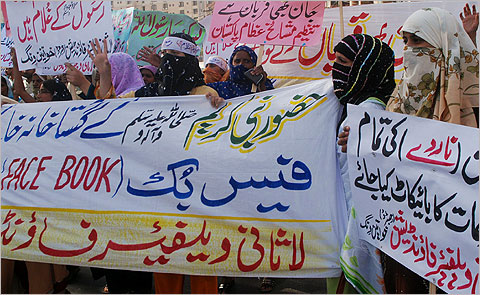
When Facebook was recently banned in Pakistan for hosting a “Draw Muhammad Day” fan page, one thing became very clear: Islamists here operate with organized precision, able to mobilize the masses in an instant, while the liberal voice remains paralyzed by fear and passivity.

Some media experts predicted that the ban – which a Pakistani court has now ordered the government to lift – might motivate the nation’s deeply disconnected liberal elite to take on the Islamists. After all, while members of the urban elite have been largely immune to the recent rise of violent militant attacks, the Facebook ban presented them with a personal vendetta.

In a nation without bars, and where entertainment options such as music concerts are rare, Facebook serves as a precious tool for the elite to organize discreet private events with music, drugs and alcohol. It has also helped mobilize social movements, including the lawyers’ march in 2009.

But the fervor that has followed the Facebook ban has been entirely one-sided in favor of the Islamists.

As the rest of Muslim world remains largely indifferent, tens of thousands of anti-Facebook Pakistanis protested in urban centers by burning American flags. A poll conducted by an IT portal called ProPakistani showed 73 percent out of about 8,000 voters favor a permanent ban on Facebook.

How did it get to this? There has been a widespread SMS campaign perpetuating a false narrative that Pakistan’s ban has brought a behemoth anti-Muslim company to its knees. One SMS attributes the recent fall in the Euro to the ban. Here’s another SMS I received:

THE BOYCOTT MADE BY MUSLIMS AGAINST FACEBOOK SINCE LAST 2 DAYS

CHARGE DEM A LOSS OF 2 BILLION EUROS..AND IF ITS CONTINUED AFTER 7 DAYS IT WOULD

REACH AROUND 40 BILLION EURO
. PLZ SPREAD AS MUCH AS U CAN.

Facts suggest otherwise. Facebook is not a publicly traded company, therefore, its earnings are not published. Still, some venture capitalists have valued Facebook at about $8 billion. Its annual revenue is estimated between $500 to $800 million.

In addition to the SMS campaign, this week, two new Muslim-friendly alternatives to Facebook have been launched. One of them, www.millatfacebook.com, was inaugurated by the bar association of the same Lahore court that banned Facebook. Millat means “Nation” in Urdu.

The site wooed more than 20,000 users with its slogan: “A site for Muslims by Muslims where sweet people of other religions are also welcome!!” Members are asked to specify if they drink alcohol. The founders are enraged at Facebook for curtailing Nazi-related hate speech while refusing to curb the Muhammad cartoons.

Their website says “Let’s prove to the world that if we can generate revenue for Facebook.com then we can also run our own website. Prove to the world that we are independent Muslims
” The other alternative site, www.Buddyflick.com , aims to “create/build/run our own network.” But where are Pakistan’s liberal and moderate voices?

Speaking out against the ban can be as hazardous as the forbidden cartoons. When those against the ban held a small news conference, the press mostly ignored it. After the press conference, several anti-ban activists were aggressively confronted by a large crowd of opposing activists as they left the venue. As tensions escalated, the anti-ban activists retreated into the building and waited for the crowd to dissipate.

One friend who is especially furious about the ban wouldn’t dare to speak out. “Nobody has the guts to go out and do something about it. The issue of Muhammad is so sensitive that you just never know.”

Instead, liberals are hashing out their frustrations in the low-traffic comment sections of liberal blogs and leftist newspapers, and, ironically enough, on their actual Facebook pages. Some have hacked into the banned site from the confines of their gated homes. Among the comment section in one newspaper is the latest joke: What’s the difference between Facebook and Lashkar  e Taiba? Answer: Facebook is banned!

Al Qaeda Aide Believed Dead- Drone Attack in Pakistan Said to Have Killed No. 3 Official

By Kimberley Dozier for AP

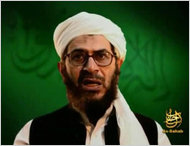
Al Qaeda’s third in command, who played key roles in a recently foiled terrorist plot against the U.S. and the 2001 terrorist attacks, is believed to have been killed by a U.S. drone strike in Pakistan’s tribal areas, potentially dealing a significant blow to the terrorist network. Mustafa al-Yazid, al Qaeda’s chief operating officer, was killed a little more than a week ago, according to two U.S. officials. This is the main person who everyone has been looking for,” one official said.

Al-Qaida announced Monday that its No. 3 official, Mustafa al-Yazid, had been killed along with members of his family — perhaps one of the most severe blows to the terror movement since the U.S. campaign against al-Qaida began. A U.S. official said al-Yazid was believed to have died in a U.S. missile strike.

A statement posted on an al-Qaida Website said al-Yazid, which it described as the organization’s top commander in Afghanistan, was killed along with his wife, three daughters, a grandchild and other men, women and children but did not say how or where.

The statement did not give an exact date for al-Yazid’s death, but it was dated by the Islamic calendar month of “Jemadi al-Akhar,” which falls in May.

A U.S. official in Washington said word was “spreading in extremist circles” of his death in Pakistan’s tribal areas in the past two weeks.

His death would be a major blow to al-Qaida, which in December “lost both its internal and external operations chiefs,” the official said on condition of anonymity because of the sensitivity of the information.

The Egyptian-born al-Yazid, also known as Sheik Saeed al-Masri, was a founding member of al-Qaida and the group’s prime conduit to Osama bin Laden and Ayman al-Zawahri. He was key to day-to-day control, with a hand in everything from finances to operational planning, the U.S. official said.

Al-Yazid has been reported killed before, in 2008, but this is the first time his death has been acknowledged by the militant group on the Internet.

Two Pakistani intelligence officials, speaking on condition of anonymity because they were not authorized to talk to the media, said al-Yazid died in a U.S. missile strike on May 21 in the North Waziristan tribal area.

Soon after the attack, officials reported that two foreigners were among the 10 people killed, but did not know their identities. Five women and two children were also wounded in the attack, which occurred in the village of Boya near the main town in the area, Miran Shah.

The intelligence officials said they received word of al-Yazid’s death last week and confirmed it by speaking to local tribal elders and Taliban members. They said their sources had not seen al-Yazid’s body and did not know where he was buried.

Al-Yazid has been one of many targets in a U.S. Predator drone campaign aimed at militants in Pakistan since President Barack Obama took office. Al-Yazid made no secret of his contempt for the United States, once calling it “the evil empire leading crusades against the Muslims.”

“We have reached the point where we see no difference between the state and the American people,” al-Yazid told Pakistan’s Geo TV in a June 2008 interview. “The United States is a non-Muslim state bent on the destruction of Muslims.”

The shadowy, 55-year-old al-Yazid has been involved with Islamic extremist movements for nearly 30 years since he joined radical student groups led by fellow Egyptian al-Zawahri, now the No. 2 figure in al-Qaida after bin Laden.

In the early 1980s, al-Yazid served three years in an Egyptian prison for purported links to the group responsible for the 1981 assassination of Egyptian President Anwar Sadat. After his release, al-Yazid turned up in Afghanistan, where, according to al-Qaida’s propaganda wing Al-Sabah, he became a founding member of the terrorist group.

He later followed bin Laden to Sudan and back to Afghanistan, where he served as al-Qaida’s chief financial officer, managing secret bank accounts in the Persian Gulf that were used to help finance the Sept. 11, 2001, attacks on New York and Washington. After the U.S. and its allies invaded Afghanistan in 2001, al-Yazid went into hiding for years. He surfaced in May 2007 during a 45-minute interview posted on the Web by Al-Sabah, in which he was introduced as the “official in charge” of the terrorist movement’s operations in Afghanistan.

Some security analysts believe the choice of al-Yazid as the Afghan chief may have signaled a new approach for al-Qaida in the country where it once reigned supreme.

Michael Scheuer, former head of the CIA unit that tracked bin Laden, believes bin Laden and al-Zawahri wanted a trusted figure to handle Afghanistan “while they turn to other aspects of the jihad outside” the country.

Al-Yazid had little background in leading combat operations. But terrorism experts say his advantage was that he was close to Taliban leader Mullah Omar. As a fluent Pashto speaker known for impeccable manners, al-Yazid enjoyed better relations with the Afghans than many of the al-Qaida Arabs, whom the Afghans found arrogant and abrasive.

That suggested a conscious decision by al-Qaida to embed within the Taliban organization, helping the Afghan allies with expertise and training while at the same time putting an Afghan face on the war.

Al-Yazid himself alluded to such an approach in an interview this year with Al-Jazeera television’s Islamabad correspondent Ahmad Zaidan. Al-Yazid said al-Qaida fighters were involved at every level with the Taliban.

“We participate with our brothers in the Islamic Emirate in all fields,” al-Yazid said. “This had a big positive effect on the (Taliban) self-esteem in Afghanistan.”

A September 2007 al-Qaida video sought to promote the notion of close Taliban-al-Qaida ties at a time when the Afghan insurgents were launching their comeback six years after their ouster from power in Kabul.

The video showed al-Yazid sitting with a senior Taliban commander in a field surrounded by trees as a jihad anthem played. The Taliban commander vowed to “target the infidels in Afghanistan and outside Afghanistan” and to “focus our attacks, Allah willing, on the coalition forces in Afghanistan.”

There is also evidence that al-Yazid has promoted ties with Islamic extremist groups in Central Asia and Pakistan, where other top al-Qaida figures are believed to be hiding.

“He definitely seems to have significant influence among the Pakistani Taliban and the Central Asian groups,” terrorism expert Evan Kohlman said. “They regularly post and share his videos on the Web, just as they would with bin Laden or al-Zawahri.”

In August 2008, Pakistani military officials claimed al-Yazid had been killed in fighting in the Bajaur tribal area along the Afghan border. However, he turned up in subsequent al-Qaida videos, all of which had clearly been made after the Bajaur fighting.

Obama, Karzai Strive To Project Unity, Deny Serious Differences

By Jonathan Landay for The Kansas City Star

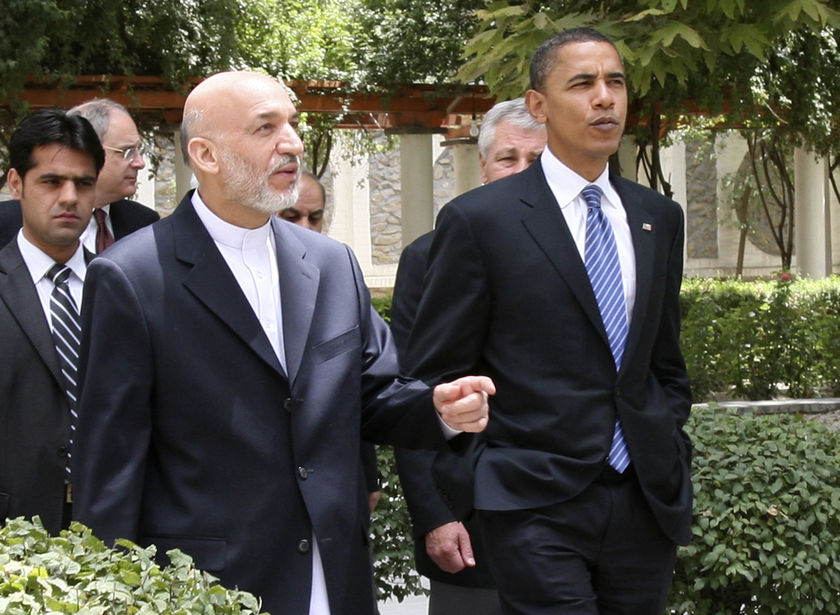
President Barack Obama and Afghan President Hamid Karzai asserted Wednesday that progress is being made toward crushing the Taliban-led insurgency, but new studies on the Afghan army and police raise serious doubts about whether the strategy can succeed before a U.S. troop drawdown begins in July 2011.

Flanked by Karzai at a White House news conference, Obama urged Americans to have patience with the “joint strategy” that he unveiled in December to stabilize Afghanistan, defeat the insurgency and prevent the country’s reversion to a Qaida sanctuary. He warned, however, that “there is going to be some hard fighting over the next couple of months.”

He apparently was referring to the summer “fighting season” that’s traditionally racked Afghanistan and that this year will see a drive to clear the Taliban from the southern city of Kandahar that’s being supplemented by an additional 30,000 U.S. troops.

The joint news conference was the public high point of a tightly scripted four-day visit in which Karzai was feted, praised and lavished with the full red-carpet treatment by the U.S. administration, which is determined to reset a relationship scarred by feuding and anti-American tirades by the Afghan leader amid record bloodshed.

The administration concluded that the tensions were an obstacle to Afghan cooperation on a number of fronts central to Obama’s strategy, especially the operations to drive the Taliban from their strongholds in the southern provinces of Helmand and Kandahar, turn them over to government control and jump-start economic development.

Moreover, U.S. officials want to reassure Karzai and ordinary Afghans – as well as regional powers that already are jockeying for influence – that the U.S. troop drawdown doesn’t mean that the United States will abandon Afghanistan as it did after the 1979-89 Soviet occupation, which was followed by a vicious 12-year civil war.

“We are not suddenly as of July 2011 finished with Afghanistan,” Obama said. “This is a long-term partnership that is not simply defined by our military presence.”

Obama and Karzai sought to present a portrait of unity, saying that progress is being made by the U.S.-led counterinsurgency campaign, by an American effort to avert civilian casualties and by Karzai on his vows to clean up narcotics-fueled corruption and boost public services, the rule of law and good governance.

“Our solidarity today sends an unmistakable message to those who would stand in the way of Afghanistan’s progress,” Obama said. “They will try to drive us apart, but we will partner with the Afghan people for the long term, toward a future of greater security, prosperity, justice and progress. And I am absolutely convinced we will succeed.”

Obama conceded that “there are going to be tensions in such a complicated and difficult environment and in a situation in which, on the ground, both Afghans and Americans are making enormous sacrifices.”

However, he said, a lot of “perceived tensions” between the sides “were simply overstated.”

“It’s a real relationship,” Karzai agreed. “It’s based on some very hard realities. We are in a campaign against terrorism together. There are days that we are happy. There are days that we are not happy.

“The bottom line is that we are much more strongly related to each other than we ever were before. That is a good message that I will take back to the Afghan people.”

U.S.-led international efforts have made considerable progress in helping to bring stability, education, health care and development to many parts of the country of 32 million people since the 2001 invasion drove the Taliban and al-Qaida leadership into neighboring Pakistan.

However, the Taliban and allied groups – aided by al-Qaida and the former Bush administration’s diversion of U.S. forces, time and money to Iraq – staged a major comeback that’s surged as U.S. commanders struggle to implement Obama’s strategy.

New reports on the Afghan army and police – each a crucial element of Obama’s plan to transfer responsibility for districts cleared of insurgents to Afghan government control as the U.S. troop drawdown begins – underscore the enormous hurdles that persist.

A report released Wednesday by the International Crisis Group, a respected conflict-prevention organization, says that the Afghan army is suffused with corruption, desertions, ethnic tensions and disputes between its highest leaders.

The report warns that Obama’s plan to expand the Afghan National Army to 240,000 troops from 90,000 by 2013 could worsen those problems and “risk the army’s disintegration after the withdrawal of international forces.”

A report by the Rand Corp. research center on the Afghan Civil Order Police, an elite unit that’s playing a key role in Helmand and Kandahar, found that the contingent is infected with the same problems of corruption and ineptitude that plague other police forces.

ANCOP members have set up checkpoints to shake down residents, been kicked out of the unit for drug use and been shunned in some areas as outsiders, according to U.S. officials briefed on the Rand Corp. analysis, who spoke to McClatchy only on the condition of anonymity because of the sensitivity of the issue.

Relations between Kabul and Washington have been brittle since Obama took office last year, shaken by U.S. criticism of Karzai’s failure to crack down on official corruption, his dubious dependability, his reliance on a patronage network of warlords and family members, and the massive fraud that marred his re-election to another term last August.

For his part, Karzai has complained about civilian casualties caused by U.S. military operations and launched tirades against the United States and his other international backers, reflecting his unpopularity among ordinary Afghans, who are angry that the war is still raging nearly nine years after the U.S.-led invasion.

“We have an interest in reducing civilian casualties not because it’s a problem for President Karzai. We have an interest in reducing civilian casualties because I don’t want civilians killed,” said Obama, who noted that the Taliban have killed more civilians.

A Pentagon report last month said the overall level of violence in Afghanistan rose 87 percent from February 2009 to March 2010. More than 1,760 international troops – including 1,068 Americans – have been killed, according to iCasualties.org, a website that tracks casualties in Iraq and Afghanistan.

Tens of thousands of Afghan security forces, officials and civilians have been killed and wounded. There are currently 102,000 troops from 46 nations, including the United States, in Afghanistan. There will be 98,000 U.S. troops there when the surge is completed later this summer.

Taliban 201- The Rise of The Pakistani Taliban

By Manzer Munir for Pakistanis for Peace

Peshawar, Pakistan- Taliban militants attacked the U.S. consulate in the Pakistani city of Peshawar on Monday, using  powerful bombs and rocket launchers in a sophisticated and daring attack killing 8 people, just hours after a suicide bomber killed 48 people elsewhere in the Swat valley. The attacks came as the United States has increased its airstrikes on targets both inside Afghanistan and Pakistan. The nearly decade long war waged against the Taliban in neighboring Afghanistan since 9-11 has created safe areas inside Pakistan for these militants to regroup and band with Pakistani militants sympathetic to their cause. Often, the militants on the Pakistani side and the Afghani Taliban share the Pashtun tribal and ethnic links among the border areas of both countries.
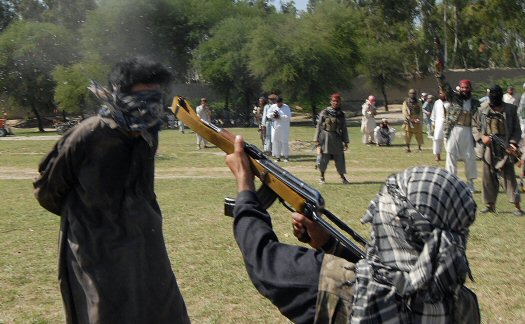
The US bombing of Afghanistan since late 2001 had pushed the Taliban and Al Qaeda militants to the mountains near the border with Pakistan. With help from sympathetic militant tribal warriors from the Pakistani side, the Taliban were able to dig in and have been able to fight the American forces for nearly a decade now. The onslaught by US and NATO forces continues in Afghanistan, but now for most of last year and certainly this year, the war has shifted to the streets and cities of Pakistan.

Now, much like Afghanistan, Pakistan too is a country that finds itself engulfed in the flames of religious extremism at the hands of determined and highly disciplined thugs. It used to be back during the Soviet-Afghan War, the only place perhaps not entirely safe inside Pakistan was Peshawar. Now, not one city or town of Pakistan has been spared from the violence by the Taliban. Back then, Peshawar was a city where attacks would happen frequently and often. During the 1980’s, the city became a haven for both jihadi militants fighting against the godless system of communism, and a base for spies as both the United States and Saudi Arabia funded a mujahedeen guerrilla war to defeat the Soviet troops from Afghanistan. President Reagan and General Zia of Pakistan used the fervor of religion to incite able bodied boys and men of Afghanistan and their distant cousins from the border area in Pakistan, along with thousands of volunteer Muslim fighters from across the Arab and Muslim world, to come and fight the Soviet Red Army. It was seen as a duty to come defend a Muslim land from occupation by a regime that would not allow the worship of Allah as communism discourages religion and encourages a sectarian society.

That strategy by General Zia ul Haq to promote the fight against the Russians as a holy war or jihad was brilliant at first. It mobilized not just every Muslim male in Afghanistan to stand and fight for his faith and their way of life, while also defending the country from invaders, but it also garnered the sympathy and enlistment of thousands upon thousands of Pakistani and Arab Muslim fighters to join the cause of these mujahedeen, as one who engages in jihad is called. The riling up of religious fervor and militant Islam was deemed necessary by both Reagan and Zia at the time as they sought to defeat the communists at all costs from succeeding in Afghanistan. It would not seem likely at the time, that this very same entity would become enemy number one of both the US and Pakistan a decade later.

It was monumental, it was historic,” retired Pakistani general Hamid Gul, who headed the ISI military spy agency from 1987-1989, said of Reagan’s role in defeating the Soviets. “We were receiving arms and logistics from the CIA, we were partners in this struggle,” Gul said, estimating the CIA spent up to $7bn in supplying arms and logistics to Islamic fighters or “jihadis.” “The jihadis he supported. It was their resistance against the forces of occupation and repression – that’s what jihad is – that Reagan identified himself with,” Gul said. “His greatest achievement was that he stood behind the Islamic world when it was arrayed against the Soviet empire.”

Pakistani analyst Hasan Askari Rivzi stated that “Al-Qaeda and the Taliban took shape later on, but they grew from this period of jihadism against the Soviets and with the initial help of Pakistan, Saudi Arabia along with the military and economic assistance from the United States to fight the Soviets during the ‘80’s. Rizvi sees the roots of the militancy that now ravages Pakistan and Afghanistan as having its beginnings from this period of war against the Soviets army.

That war with the Russians lasted almost 10 years. By the time the USSR pulled out all its troops from Afghanistan in 1989, the country had been completely destroyed. What was left of any government or authority of any sort was now held in the hands of a few militias and various warriors who commanded thousands of tribal and other ethnic fighters under them. These militias immediately started warring amongst themselves for more and more control of the country. The already weak, nonexistent central government of Afghanistan, post Soviet pullout was not able to cope and quickly capitulated. During the power vacuum that resulted, Pakistan’s spy agency, the ISI, realized the chance to wield power inside Afghanistan and threw its support behind a religious student movement based out of Kandahar. The ISI had previously assisted the cause to fight the Soviets by helping gather and organize radical Muslims from around the world to come and assist the Afghani mujahedeen in fighting the Soviets and had therefore developed good contacts with various religious groups including the young Taliban students and the fast growing movement.

The Afghani population initially welcomed the Taliban as they represented fairness and a rule of law over the notorious corruption, brutality and constant infighting of the warlord militias. Soon, with popular citizen support, along with Pakistan’s help, the Taliban became the dominant group within the country and soon held the seat of power in Kabul. Its leader Mullah Omar, was a friend of Osama Bin Laden and when the US forces came to Afghanistan in the hunt for Bin Laden, he gave the Al Qaeda leader refuge and in essence, became a fugitive of the US in the process for harboring America’s Most Wanted.

Fast forward to nearly nine years later as the war in Afghanistan continues against the Taliban and remnants of Al Qaeda responsible for the 9-11 attacks. However, the Taliban have grown and laid roots inside Pakistan also now as the nearly decade long war at the border with Afghanistan has ratcheted up sympathy by locals Pakistani Pashtun tribes for their brethren being bombed by both Pakistani and American forces. The Tehrik-i-Taliban Pakistan known as the Pakistani Taliban formed soon after the US invasion of Afghanistan and the Pakistani army’s offensive at the tribal areas near the border to combat the militants. The Pakistani Taliban led by the recently killed Baitullah Mehsud, has been largely responsible for hundreds of attacks in all major cities of Pakistan including Monday’s bombing of the American consulate in Peshawar.

The war in Afghanistan by the US against the Taliban that harbored and sheltered Bin Laden and the 9-11 killers of Al Qaeda is much the same as the war between the Pakistani army and the Pakistani Taliban in the Swat valley and the North West Frontier Province as well as in various cities of the country. This war has been brought home to the citizens of Pakistan. Over the last few months, bomb blasts in Lahore, Karachi, Islamabad and various other cities have now personalized this conflict for the average Pakistani as no longer a battle or skirmish at the border far away in the northwest of Pakistan near its border with Afghanistan.

No, the nearly daily attacks all over the country by the militants on government installations, public institutions like universities, factories and residential areas as well as markets and restaurants has made the country much less safer than at any time in its 63 year history. Many Pakistanis now are beginning to realize that the Taliban, operating with impunity all over Pakistan, pose a much bigger threat to the sovereignty and republic of Pakistan than any threat from anywhere else, including from that eternal archrival to the east, India. It is now well understood by both partners in this fight that only a sustained and vigorous fight taken to the militants inside both countries by the US and Pakistan over a long period of time can hope to defeat this disease known as the Taliban.

For an earlier report titled Taliban 101- Origins and History, Please click on this link:

https://pakistanisforpeace.wordpress.com/2009/05/25/taliban-101-origins-and-history/

U.S. Aims to Ease India-Pakistan Tension

By Peter Spiegel and Matthew Rosenberg for The Wall Street Journal

President Barack Obama issued a secret directive in December to intensify American diplomacy aimed at easing tensions between India and Pakistan, asserting that without dĂ©tente between the two rivals, the administration’s efforts to win Pakistani cooperation in Afghanistan would suffer.

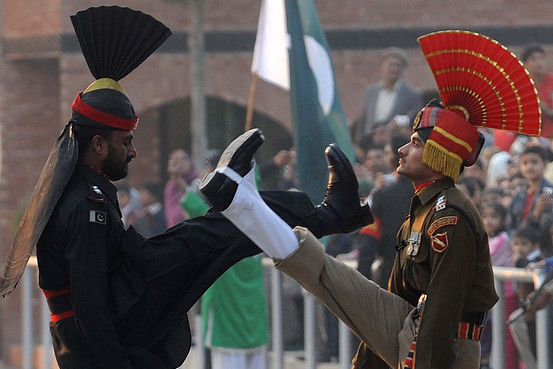
Pakistani Rangers (L) and Indian Border Security Force (BSF) personnel perform the daily retreat ceremony at the India-Pakistan Border at Wagah on December 26, 2009. The directive concluded that India must make resolving its tensions with Pakistan a priority for progress to be made on U.S. goals in the region, according to people familiar with its contents.

The U.S. has invested heavily in its own relations with Pakistan in recent months, agreeing to a $7.5 billion aid package and sending top military and diplomatic officials to Islamabad on repeated visits. The public embrace, which reached a high point last month in high-profile talks in Washington, reflects the Obama administration’s belief that Pakistan must be convinced to change its strategic calculus and take a more assertive stance against militants based in its western tribal regions over the course of the next year in order to turn the tide in Afghanistan.

A debate continues within the administration over how hard to push India, which has long resisted outside intervention in the conflict with its neighbor. The Pentagon, in particular, has sought more pressure on New Delhi, according to U.S. and Indian officials. Current and former U.S. officials said the discussion in Washington over how to approach India has intensified as Pakistan ratchets up requests that the U.S. intercede in a series of continuing disputes.

Pakistan has long regarded Afghanistan as providing “strategic depth”—essentially, a buffer zone—in a potential conflict with India. Some U.S. officials believe Islamabad will remain reluctant to wholeheartedly fight the Islamic militants based on its Afghan border unless the sense of threat from India is reduced.

Indian Prime Minister Manmohan Singh has already taken the political risk of pursuing peace talks with Pakistan, but faces significant domestic opposition to any additional outreach without Pakistani moves to further clamp down on Islamic militants who have targeted India.

U.S. and Indian officials say the Obama administration has so far made few concrete demands of New Delhi. According to U.S. officials, the only specific request has been to discourage India from getting more involved in training the Afghan military, to ease Pakistani concerns about getting squeezed by India on two borders.

“This is an administration that’s deeply divided about the wisdom of leaning on India to solve U.S. problems with Pakistan,” said Ashley Tellis, an analyst at the Carnegie Endowment for International Peace who has discussed the issue with senior officials in the U.S. and India. “There are still important constituencies within the administration that have not given up hope that India represents the answer.”

India has long resisted outside involvement in its differences with Pakistan, particularly over the disputed region of Kashmir. But, according to a U.S. government official, a 56-page dossier presented by the Pakistani government to the Obama administration ahead of high-level talks in Washington last month contained a litany of accusations against the Indian government, and suggestions the U.S. intercede on Pakistan’s behalf.

The official said the document alleges that India has never accepted Pakistan’s sovereignty as an independent state, and accuses India of diverting water from the Indus River and fomenting separatism in the southwestern Pakistani province of Baluchistan.

Secretary of State Hillary Clinton has signaled that Washington isn’t interested in mediating on water issues, which are covered by a bilateral treaty.

The White House declined to comment on Mr. Obama’s directive or on the debate within the administration over India policy. The directive to top foreign-policy and national-security officials was summarized in a memo written by National Security Adviser James Jones at the end of the White House’s three-month review of Afghan war policy in December.

An Indian government official said the U.S.’s increasing attention to Pakistani concerns hasn’t hurt bilateral relations overall. “Our relationship is mature—of course we have disagreements, but we’re trying not to have knee-jerk reactions,” the Indian official said.

According to U.S. and Indian officials, the Pentagon has emerged in internal Obama administration debates as an active lobbyist for more pressure on India, with some officials already informally pressing Indian officials to take Pakistan’s concerns more seriously. Adm. Mike Mullen, chairman of the Joint Chiefs of Staff and the U.S. government’s prime interlocutor with the powerful head of the Pakistani army, Gen. Ashfaq Kayani, has been among the more vocal advocates of a greater Indian role, according to a U.S. military official, encouraging New Delhi to be more “transparent” about its activities along the countries’ shared border and to cooperate more with Pakistan.

In interviews, U.S. military officials were circumspect about what specific moves they would like to see from New Delhi. But according to people who have discussed India policy with Pentagon officials, the ideas discussed in internal debates include reducing the number of Indian troops in Kashmir or pulling back forces along the border.

“They say, ‘The Pakistanis have this perception and you have to deal with the perception’,” said one foreign diplomat who has discussed India’s role with Pentagon officials. An Indian defense ministry spokesman said his country’s army has already moved about 30,000 troops out of Kashmir in recent years.

The State Department has resisted such moves to pressure India, according to current and former U.S. officials, insisting they could backfire. These officials have argued that the most recent promising peace effort—secret reconciliation talks several years ago between Indian Prime Minster Singh and then-Pakistani President Pervez Musharraf—occurred without U.S. involvement.