Posts Tagged ‘ Pakistan ’

Pakistan PM Prefers Jail to Writing to Swiss

As Reported by Agence France-Presse

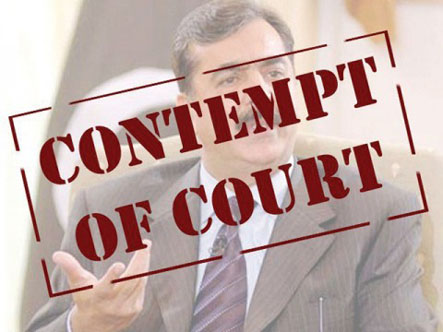
Pakistan’s embattled Prime Minister Yousuf Raza Gilani said Thursday he would rather go to jail than obey a court order and ask Switzerland to re-open graft cases against the president.

Gilani’s remarks revive speculation that he would rather risk losing his job than capitulate in a two-year showdown with the judiciary that culminated last month with him being charged with contempt by the Supreme Court.

He has always insisted that President Asif Ali Zardari is immune from prosecution as president and says the cases against him are politically motivated.

“If I write a letter it will be a violation of the constitution, which is treason and which carries the death sentence,” Gilani told PhD students in central Punjab province, with a few in the audience shouting “do not write, do not write”.

“If I don’t write, I will be convicted for contempt, the punishment for which is six months’ imprisonment,” Gilani said. “It’s better to face six months’ imprisonment than face the death sentence.”

Pakistan’s top court last week ordered Gilani to ask Switzerland to reopen corruption cases against Zardari by March 21.

It was the first time the court asked Gilani personally to write to the Swiss. It previously addressed repeated demands to the government since revoking in 2009 an amnesty freezing legal proceedings against key politicians.

Zardari and his late wife, former premier Benazir Bhutto, were suspected of using Swiss accounts to launder about $12 million in alleged bribes paid by companies seeking customs inspection contracts in the 1990s.

Playing to the gallery, Gilani asked the students in Bahawalpur district whether he should write the letter, to which the audience shouted: “No, no.”

“Ok, we will send your message to the court and tell them that they should charge parliament with contempt of court because parliament has given immunity to the president. All heads of state all over the world have this immunity.”

Zardari is so tainted by corruption allegations that he is nicknamed “Mr 10 Percent”. He has already spent 11 years in jail in Pakistan on charges ranging from corruption to murder although he has never been convicted.

Rushdie Coming, Imran Backs Out

By Imtiaz Ahmad for The Hindustan Times

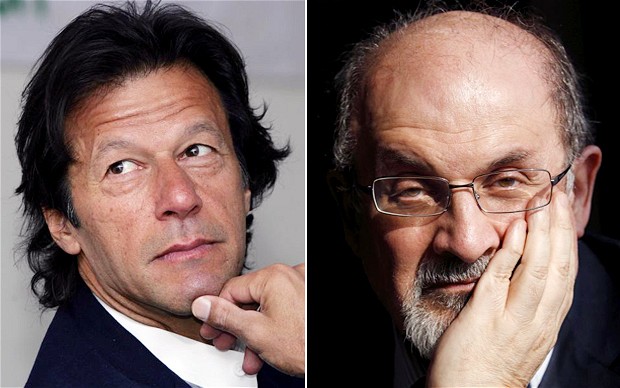
Pakistan Tehreek-e-Insaf (PTI) chairman Imran Khan has refused to attend a function in New Delhi later this week after learning that British author Salman Rushdie will also be a participant.

Senior PTI leader Shireen Mazari said in a statement on Wednesday that Khan cancelled his participation as keynote speaker at the event, stating that he could not even think of taking part in a programme that included Rushdie, who has caused “immeasurable hurt to Muslims across the globe”.

Quoting Khan, Mazari said the party leader received the full programme of the event on Tuesday night and took his decision on Wednesday morning.

The organisers of the event announced on Tuesday that Rushdie would deliver a speech titled The Liberty Verses —I Am What I Am And That’s All That I Am.

Rushdie’s works are banned in Pakistan. He is seen to have committed blasphemy in his book, The Satanic Verses.

Several people in Pakistan have been killed in the past couple of years on suspicion of blasphemy, the most high-profile case being that of Punjab governor Salman Taseer, who was shot dead in 2011 by a member of his security detail.

Taseer opposed Pakistan’s blasphemy law and had backed a mercy petition for Asia Bibi, a Christian woman sentenced to death for blasphemy.

Khan’s party recently aligned with the Difa-e-Pakistan council — a collection of religious parties, including many banned outfits — which has been campaigning against US drone attacks and allowing transit passage for Nato supplies.

Pakistan Wants U.S. Drones Out

By Indira A.R. Lakshmanan for Bloomberg News

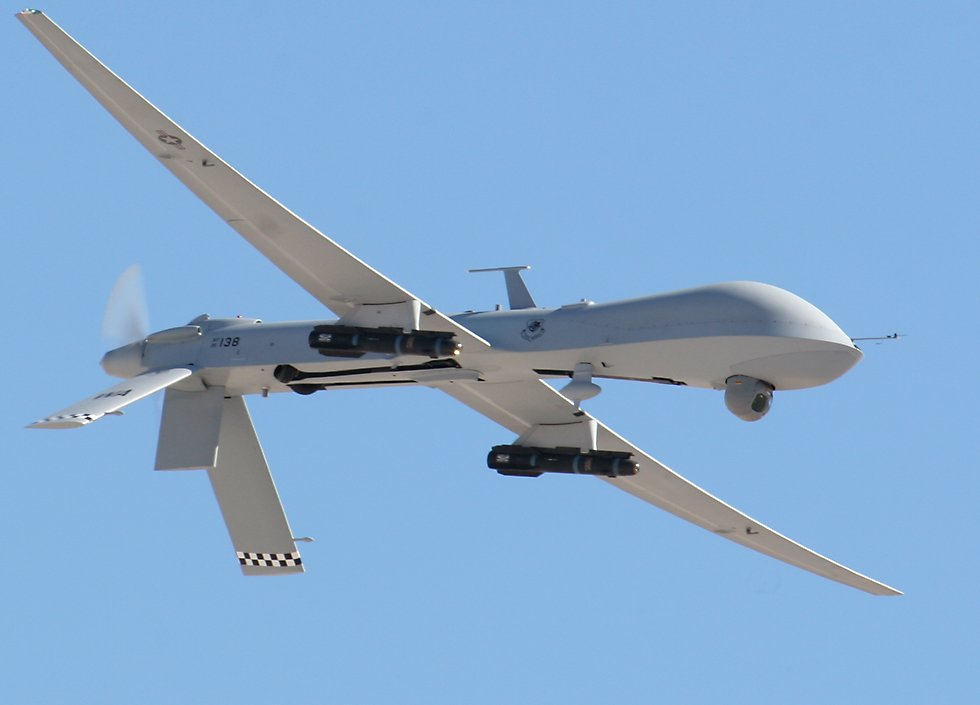
Pakistan has told the White House it no longer will permit U.S. drones to use its airspace to attack and collect intelligence on Al-Qaida and other militants, according to officials involved.

Eliminating drone missions would aid the resurgence of extremist groups operating along Pakistan’s border with Afghanistan, said Peter Singer, author of “Wired for War: The Robotics Revolution and Conflict in the 21st Century.”

Pakistan’s ambassador to Washington, Sherry Rehman, met Vice President Joe Biden’s national security adviser, Antony Blinken, on Friday and told him that Pakistan’s political parties have agreed that the drone flights over Pakistan must end, officials involved said.

Pakistan’s sovereignty over its airspace and the civilian casualties that have resulted from drone strikes are emotional issues in Pakistan, where public opinion heavily favors terminating drone missions.

The only chance for a compromise, Pakistani officials said, may be if the United States agrees to share intelligence and coordinate strikes first. The United States has resisted giving information to Pakistan in advance because of fears that some in Pakistan’s security forces might warn the targets of impending strikes.

The drone program has been part of U.S. counter-terrorism strategy in Pakistan since 2004, officials and experts say. The administration authorized 53 drone attacks in 2009 and 117 in 2010, compared with 35 in 2008 under former President George W. Bush, according to Bill Roggio, a U.S. military analyst whose website, the Long War Journal, maintains a database of the campaign.

The drone program is “critical” because it provides better real-time surveillance and reconnaissance than satellite imagery does, Seth Jones, a senior political scientist for the RAND Corp. research institute, said in an interview.

Singer said that “for several years, Pakistan has openly said, ‘How dare you violate our sovereignty,’ but it turned out the CIA was flying from Pakistani bases with Pakistan’s permission.” This time, it’s possible “they really mean it,” after a series of high-profile disputes have damaged relations, Singer said.

Afghan Village Massacre Will Compound US Problem

By Amin Saikal for The Sydney Morning Herald

US forces are stumbling from one disaster to another in Afghanistan. The latest is the killing of at least 16 Afghan civilians by an American soldier in Kandahar province, the spiritual seat of the Taliban.

It comes shortly after the American burning of copies of the Koran that set off a week of riots across Afghanistan in which some 30 Afghans were killed. This latest incident is set to heighten anti-American sentiment in the country, with serious repercussions for the international forces and their Afghan partners.

President Barack Obama and the commander of the International Security Assistance Force, General John Allen, have profusely apologised and promised an immediate investigation. The perpetrator is described as a rogue soldier, who recently had a nervous breakdown. This is unlikely to placate many Afghans, especially in the ethnic Pashtun-dominated areas of southern and eastern Afghanistan, where the Taliban-led insurgency is at its peak. Nor will it deter the Taliban from capitalising on the incident to once again castigate the US and its allies as infidel occupiers, and the Karzai government as their stooge.

It is also bound to add to the complexity of the new strategic partnership that Washington and Kabul are currently negotiating to establish the parameters for US military-security involvement in Afghanistan after the US and its allies have withdrawn most of their troops from Afghanistan by 2014. While Karzai will find it expedient to become more demanding in the negotiations to show that he is not an American lackey, the Obama administration may need to make more concessions to Karzai, despite the fact that he has proved to be an incompetent and untrustworthy partner, who has continued to preside over a corrupt and dysfunctional government for more than a decade.

Rogue actions in conflicts are not unusual. There were many during the Vietnam War and the Soviet occupation of Afghanistan. The present US-led military involvement in Afghanistan has not been free of them either. An American soldier has just been convicted of premeditated murder of three Afghans two years ago.

American and ISAF troops have also been killed by rogue Afghan soldiers for one reason or another. However, what makes the latest incident alarming is that it has been enacted by a soldier who had a nervous breakdown, and yet was still on duty. He committed a massacre in a zone of insurgency where the Taliban had not been active for six months. Inhabitants across the region now will become more receptive to the Taliban than ever before.

All this does not augur well for a smooth withdrawal of foreign troops from Afghanistan, and the current efforts by Washington, and, for that matter, the Karzai government, to reach a political settlement with the Taliban as part of the US-led NATO exit strategy. As the anti-US and anti-Karzai government feelings escalate, the more they will play into the hands of the Taliban and their supporters, most importantly Pakistan’s notorious military intelligence, ISI, to drive a hard bargain. The Taliban and ISI have never found the situation more conducive to their belief that the final victory is ultimately theirs. All they now need to do is await the substantial drawdown of foreign troops and further ineffectiveness and humiliation of the Karzai government. As one Taliban commander joked: ”We have the time and the Americans have the watch.”

It is most unfortunate that after some $450 billion in military expenditure, more than $60 billion in reconstruction costs, and 3000 foreign troops, mostly American, killed, and thousands of Afghans sacrificed, stability, security and good governance still elude most Afghans. The biggest question that will confront the US and its allies by 2014 is: what was that all about?

If it was for the purpose of destroying al-Qaeda and its harbourers, the Taliban, this objective has not been achieved. Osama bin Laden is dead, as are many of his ranking operatives, but the network remains operative, especially in Pakistan, Iraq, Yemen, and Somalia. As for the Taliban, the US now wants to negotiate a political deal with the militia.

If it was for rebuilding and securing Afghanistan, this goal is nowhere near fruition. The country continues to teeter on the verge of the return of the Taliban to power and civil war, with the prospects of Afghanistan’s neighbours intensifying their scramble for influence.

Amin Saikal is professor of political science and director of the Centre for Arab and Islamic Studies at the Australian National University and the author of Modern Afghanistan.

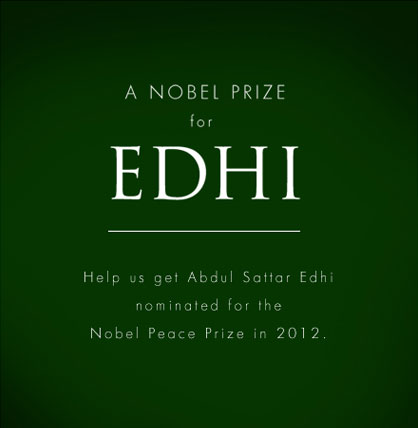
A Nobel Prize for Edhi

Pakistanis for Peace and Manzer Munir cordially and humbly request you to please sign this petition to nominate Abdul Sattar Edhi for the Nobel Peace Prize.

The Nobel Peace prize is an annual prize awarded to individuals who have made formidable contributions to the pursuit of peace and have, through their work, changed the world for the better.

As the founder of Pakistan’s largest welfare organization, the Edhi Foundation and trust, Mr Abdul Sattar Edhi embodies the spirit of this prize, and is a deserving candidate for this honour. He has single-handedly served countless Pakistani’s and has left a lasting impact on his fellow countrymen and the world.

Quite simply, there has never been anyone more deserving of the Nobel Peace prize in its entire history than Mr Abdul Sattar Edhi. Please help us get him his dues by having him finally nominated this year.

Please sign this petition to show your support for the nomination of Mr.Edhi for the 2012 Nobel Peace Prize.


Terrorism Will Not Harm Pakistan Ties: China

As Reported By The Business Recorder

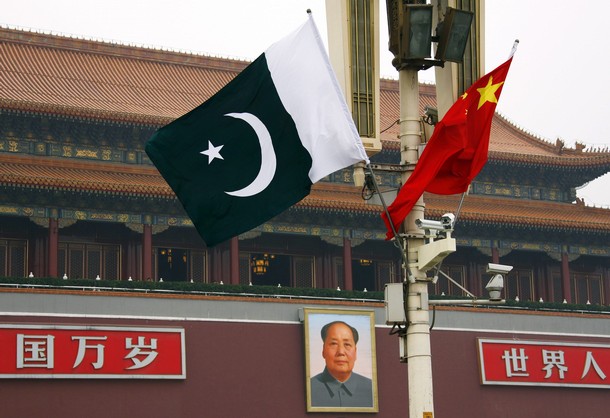
Cross-border terrorism in China’s ethnically divided far western region of Xinjiang will not harm the nation’s diplomatic ties with Pakistan and other neighbouring countries, a regional official said on Wednesday.

Chinese security authorities had found “countless ties between ‘East Turkestan’ terrorists and terrorists from our neighbouring countries,” regional government head Nur Bekri said, quoting the name used by members of the Uighur ethnic minority who seek an independent state in Xinjiang.

“But our neighbouring countries, especially Pakistan, have been declaring officially that in terms of any violent activity aimed at China, they will maintain China’s national security and core interests,” Bekri told reporters on the sidelines of China’s annual parliament.

He said the basic interests of China, Pakistan and other countries bordering Xinjiang were “the same.”
“So just a few terrorists will definitely not harm the China-Pakistan relationship,” Bekri said.

He said the vast region – which borders Pakistan, Afghanistan, Tajikistan, Kyrgyzstan and Kazakhstan – was “generally stable” despite recent ethnic conflict and the threat of terrorism.
The government has reported several terrorist attacks that killed dozens of people in Xinjiang in the past few years.

But Uighur exile groups have accused China of using the global fight against terrorism as an excuse to suppress political and religious activity among Uighurs.
Ethnic violence and a clash with police left about 20 people dead in southern Xinjiang’s Yecheng town last week, according to reports by international rights groups and state media.

Xinjiang’s capital, Urumqi, and other areas of Xinjiang have remained tense since protests by Uighurs escalated into rioting that left about 200 people dead and 1,700 injured in the city in July 2009.

Security Forces in Kashmir Charged With Rights Abuses

By Riyaz Masroor for The BBC

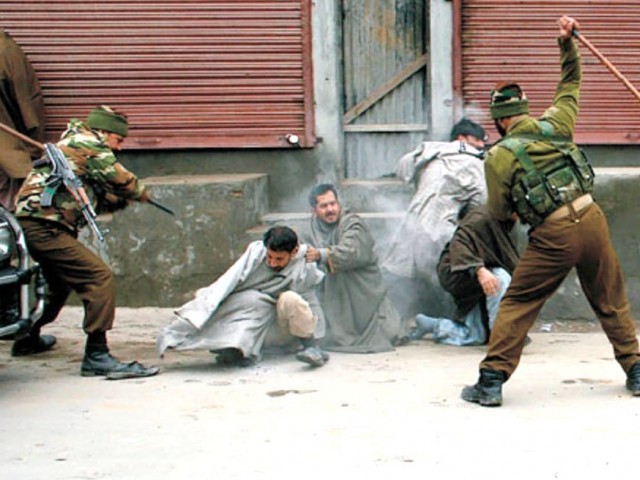
The authorities in Indian-administered Kashmir have launched more than 400 cases of alleged human rights abuses against security forces personnel. The region’s minister for internal security released the figures in the Jammu and Kashmir legislative assembly.

Kashmiri officials want to revoke the Armed Forces Special Powers Act, which prevents prosecution of security staff. There has been a rebellion against Indian rule in divided Kashmir, which is also claimed by Pakistan.

Thousands of people have been killed in the region since the rebellion began in 1989, though violence has dropped off recently. India’s defence ministry has resisted moves to revoke the Armed Forces Special Powers Act (AFSPA).

According to the state government of Indian-administered Kashmir, 444 soldiers, police and security officials have been charged in the past three years.

Nearly 300 cases have been seen in local courts, the government said on Monday in a written response to the Jammu and Kashmir assembly. Human rights activists say the Indian authorities are forcing the Kashmir government to move slowly on these cases.

Kashmiri officials have been pleading with Delhi to scrap the AFSPA so they can proceed with prosecuting security officials against whom cases are pending.

But army officials say it is needed to prevent militant groups based in Pakistan from focusing their resources on Kashmir.

Islam & the NYPD

By Dr Qanta A Ahmed for NY Post

The relentless campaign to paint the NYPD as Islamophobic is itself an offense to Islam. In fact, our faith compels American Muslims to stand with the NYPD — both to protect the faith, and by its direct dictates.

Let me be clear: By investigating Islamist sympathizers who seek to curtail the freedoms of all Americans, the NYPD is aggressively protecting the freedoms and privileges that Muslims enjoy in America (freedoms that aren’t available even in the birthplace of Islam).

Islamism is distinct from the beliefs the majority of Islam’s 1.6 billion followers hold dear. The cry of “Islamophobia” is often merely an effort to silence those of us who seek to communicate this distinction, or to express concerns about Islamism. Most Muslims are spiritually private, committed persons active in their societies without a subversive political agenda. Think of them as pluralistic Muslims.

Because America’s religious freedom is protected by constitutional ideals, Muslims can pursue this pluralistic life — an American life that makes private space for faith, in parallel to public roles. Indeed, Muslims in America are freer to do this than Muslims in Pakistan (where my family is from), Saudi Arabia (where I have lived) or even Indonesia, because each of these Muslim-majority countries imposes laws restricting the practice of religion.

In many ways, Muslims are best able to follow their Islam — to become Muslim in the fullest sense — here in America, because of this nation’s astonishing, constitutionally guaranteed freedoms.

Political Islamism — variously called radical Islam, jihadism or Islamic fundamentalism — is completely different. In contrast to our centuries-old faith, it’s a modern political project that seeks to return any society to a supposed “scriptural foundation” of the Muslim community, removing existing forms of government and laws.

Sound like a war? Well, in the wider world and here in America, there is indeed a war afoot — a war of ideas, a “Battle for the Soul of Islam,” as my colleague, American Islamic Forum for Democracy president Zudhi Jasser, has termed it.

In this battle, the Islamist thrives — citing freedom of speech, claiming disadvantaged civil rights, exploiting the privileges that a liberal democracy accords him. Often operating via advocacy groups or “Islamic societies” that purport to represent mainstream Muslims, he or she truly serves a political agenda centered on replacing liberal democracy with fundamentalist theocracy.

In fact, the Koran is explicit on the loyalties a Muslim must accord his host nation, mandating a Muslim’s duty to be an unwavering and loyal patriot:
O ye who believe! Obey Allah, and obey His Messenger and those who are in authority from among you. (Ch.4: V.60).

That verse demands the Muslim express loyalty to any ruling authority. This isn’t a suggestion, this is mandated Islamic duty.
The Koran does not state leadership specified as Muslim. Leadership is whomsoever is empowered in the society where the Muslim finds himself. For us here, that includes loyalty to the NYPD, the FBI and their work to safeguard our highest authority — the principles of our liberal democracy.
Can any one group speak for the entire American Muslim community? Islam is diverse — especially in America. Islamism isn’t. The sooner we understand this, the better — because at stake are America’s ideals.

America’s extraordinary freedoms afford us an ability to define our own expressions of Islam as Muslims in a way that no Muslim-majority nation secures for any Muslim anywhere today. We must preserve these values, and join the NYPD, in understanding the Islamist threat to these values.
This means we must support, not vilify, our policemen and -women, our federal agents and our police commissioner — especially when they gather and interpret information they need to preserve us and our values.

How many devout Muslims were among the thousands killed on 9/11? Let us never forget that Islamists — moving among the broader Muslim and secular communities — have wrought atrocities in this city and around the world, and seek to do so again.
If you choose to smear the NYPD for its work to protect us and our society, so too you choose to smear me, a pluralistic patriotic Muslim in America, for demanding an honest discourse.

Dr. Qanta Ahmed practices medicine in New York. She is the author of “In the Land of Invisible Women.”
Twitter: @MissDiagnosis

Pakistan’s Hindu Girls Forced into Muslim Marriages

As Reported by IRIN

Sixteen-year-old Ameena Ahmed*, now living in the town of Rahim Yar Khan in Pakistan’s Punjab Province, does not always respond when her mother-in-law calls out to her. 


“Even after a year of `marriage’ I am not used to my new name. I was called Radha before,” she told IRIN on a rare occasion when she was allowed to go to the corner shop on her own to buy vegetables. 


Ameena, or Radha as she still calls herself, was abducted from Karachi about 13 months ago by a group of young men who offered her ice-cream and a ride in their car. Before she knew what was happening, she was dragged into a larger van, and driven to an area she did not know. 


She was then pressured into signing forms which she later found meant she was married to Ahmed Salim, 25; she was converted to a Muslim after being asked to recite some verses in front of a cleric. She was obliged to wear a veil. Seven months ago, Ameena, who has not seen her parents or three siblings since then and “misses them a lot”, moved with her new family to southern Punjab. 


“The abduction and kidnapping of Hindu girls is becoming more and more common,” Amarnath Motumal, a lawyer and leader of Karachi’s Hindu community, told IRIN. “This trend has been growing over the past four or five years, and it is getting worse day by day.

Pakistan is one of several nations across Asia suffering from a shortage of females as sex-selective abortion has played growing role in the deficit. Portable ultrasound machines have made gender selection much easier. A 2005 study quoted by Wiki estimated that more than 90 million females were “missing” from the expected populations in Afghanistan, Bangladesh, China, India, Pakistan, South Korea and Taiwan alone.

He said there were at least 15-20 forced abductions and conversions of young girls from Karachi each month, mainly from the multi-ethnic Lyari area. The fact that more and more people were moving to Karachi from the interior of Sindh Province added to the dangers, as there were now more Hindus in Karachi, he said. 


“They come to search for better schooling, for work and to escape growing extremism,” said Motumal who believes Muslim religious schools are involved in the conversion business. 


“Hindus are non-believers. They believe in many gods, not one, and are heretics. So they should be converted,” said Abdul Mannan, 20, a Muslim student. He said he would be willing to marry a Hindu girl, if asked to by his teachers, “because conversions brought big rewards from Allah [God]. But later I will marry a `real’ Muslim girl as my second wife,” he said. 


According to local law, a Muslim man can take more than one wife, but rights activists argue that the law infringes the rights of women and needs to be altered. 


Motumal says Hindu organizations are concerned only with the “forced conversion” of girls under 18. “Adult women are of course free to choose,” he said. 


“Lured away”

Sunil Sushmt, 40, who lives in a village close to the city of Mirpurkhas in central Sindh Province, said his 14-year-old daughter was “lured away” by an older neighbour and, her parents believe, forcibly converted after marriage to a Muslim. “She was a child. What choice did she have?” her father asked. He said her mother still cries for her “almost daily” a year after the event. 


Sushmat is also concerned about how his daughter is being treated. “We know many converts are treated like slaves, not wives,” he said. 


According to official figures, Hindus based mainly in Sindh make up 2 percent of Pakistan’s total population of 165 million. “We believe this figure could be higher,” Motumal said. 


According to media reports, a growing number of Hindus have been fleeing Pakistan, mainly for neighbouring India. The kidnapping of girls and other forms of persecution is a factor in this, according to those who have decided not to stay in the country any longer. 


“My family has lived in Sindh for generations,” Parvati Devi, 70, told IRIN. “But now I worry for the future of my granddaughters and their children. Maybe we too should leave,” she said. “The entire family is seriously considering this.” 


Pakistanis for Peace Editor’s Note– This is an absolutely despicable practice that the Pakistani government needs to put an end to just like the blasphemy laws of the nation. The religious minorities of Pakistan deserve equal rights, protections and freedoms.

Pakistan Builds Web Wall Out in the Open

By Eric Pfannier for The New York Times
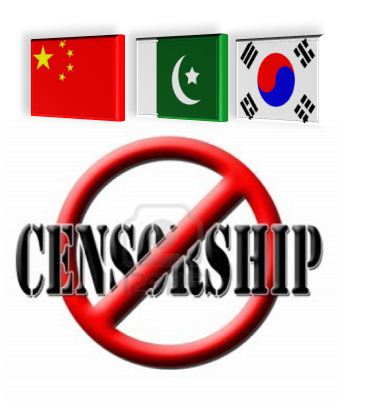
Many countries censor the Internet, but few spell out their intentions as explicitly as Pakistan.

In an effort to tighten its control over the Internet, the government recently published a public tender for the “development, deployment and operation of a national-level URL filtering and blocking system.”

Technology companies, academic institutions and other interested parties have until March 16 to submit proposals for the $10 million project, but anger about it has been growing both inside and outside Pakistan.

Censorship of the Web is nothing new in Pakistan, which, like other countries in the region, says it wants to uphold public morality, protect national security or prevent blasphemy. The government has blocked access to pornographic sites, as well as, from time to time, mainstream services like Facebook and YouTube.

Until now, however, Pakistan has done so in a makeshift way, demanding that Internet service providers cut off access to specific sites upon request. With Internet use growing rapidly, the censors are struggling to keep up, so the government wants to build an automatic blocking and filtering system, like the so-called Great Firewall of China.

While China and other governments that sanitize the Internet generally do so with little public disclosure, Pakistan is being surprisingly forthcoming about its censorship needs. It published its request for proposals on the Web site of the Information and Communications Technology Ministry’s Research and Development Fund and even took out newspaper advertisements to publicize the project.

“The system would have a central database of undesirable URL’s that would be loaded on the distributed hardware boxes at each POP and updated on daily basis,” the request for proposals says, referring to uniform resource locators, the unique addresses for specific Web pages, and points of presence, or access points.

“The database would be regularly updated through subscription to an international reputed company maintaining and updating such databases,” according to the request, which was published last month.

The tender details a number of technical specifications, including the fact that the technology “should be able to handle a block list of up to 50 million URL’s (concurrent unidirectional filtering capacity) with processing delay of not more than 1 milliseconds.”

Following the Arab Spring, which demonstrated the power of the Internet to help spread political and social change, Pakistan’s move to clamp down has set off a storm of protest among free-speech groups in the country and beyond.

Opponents of censorship say they are doubly appalled because they associated this kind of heavy-handed approach more with the previous regime of Gen. Pervez Musharraf than with the current government of President Asif Ali Zardari.

“The authorities here are big fans of China and how it filters the Internet,” said Sana Saleem, chief executive of Bolo Bhi, a group that campaigns against restrictions on the Internet. “They overlook the fact that China is an autocratic regime and we are a democracy.”

“What makes this kind of censorship so insidious is that they always use national security, pornography or blasphemy as an explanation for blocking other kinds of speech,” Ms. Saleem said, adding that her site had been blocked for several months in 2010 when it made reference to a ban on Facebook. Access to the social networking service had been restricted because of a page featuring a competition to draw the prophet Mohammed — something that is considered blasphemous by Muslims.

The Technology Ministry’s Research and Development Fund says in its tender that the Internet filtering and blocking system will be “indigenously developed,” but campaigners like Ms. Saleem say they think it is likely the agency will try to adapt Western technology for the purpose.

To try to prevent this from happening, Ms. Saleem wrote to the chief executives of eight international companies that make Net filtering technology, asking them to make a public commitment not to apply for the Pakistani grant.

On Friday, one of them, Websense, which is based in San Diego, responded, declaring in a statement on its Web site that it would not seek the contract.

“Broad government censorship of citizen access to the Internet is morally wrong,” Websense said. “We further believe that any company whose products are currently being used for government-imposed censorship should remove their technology so that it is not used in this way by oppressive governments.”

Websense had previously withdrawn the use of its technology from Yemen after facing accusations from the OpenNet Initiative, a U.S.-Canadian academic group, and other organizations that it had been used by the government of that country to stifle political expression on the Internet.

Governments around the world buy filtering and blocking technology to root out illegal content like child pornography. Some private companies employ it to restrict access to social networks and other distractions on company computers.

But the use of Western technology to rein in political speech in countries with repressive regimes has come under increasing scrutiny since the Arab Spring. The OpenNet Initiative said in a report last year that at least nine governments in the Middle East or North Africa had used such products, with the Western companies maintaining lists of sites to be blocked, including sites featuring skeptical views of Islam and even dating services.

Even before implementing its new system, Pakistan has been an active censor. The country was 151st, out of 179, on a ranking of media freedom by the Paris-based group Reporters Without Borders in 2011.

“Reporters Without Borders urges you to abandon this project, which would reinforce the arsenal of measures for communications surveillance and Internet censorship that have already been put in place by your government,” the group wrote in a letter Friday to Prime Minister Yousaf Raza Gilani.

To free-speech advocates in Pakistan, the government’s seeming insouciance about censorship is a particular cause for alarm.

“This is a case study,” said Ms. Saleem of Bolo Bhi, which is based in Karachi and whose name means “speak up.” “No government has ever done this so publicly.”
Pakistan’s Move on Trade With India Can Help in Wider Normalization of Ties

As Reported by The Economic Times

The reported move by the Pakistan government to phase out major restrictions on trade with India by switching to the negative list, and doing away with that too by the end of the year, is wholly welcome. Normalising trade relations with India will help establish a template of wider normalization of mutual ties.

An indication of deep-rooted animosities and suspicions which have stymied that goal can be seen in the opposition from quarters within Pakistan to Islamabad’s declared – and logical – aim of granting India the World Trade Organization-compliant Most Favoured Nation status next year.

But the arrangement to separate commerce from thornier issues like Kashmir and Pakistan’s actions against those accused of terror attacks against India can lay a foundation for minimising mutual distrust. For New Delhi, this would be in keeping with the idea of engaging various power centres in Pakistan, given the fractured power structure in that country.

While being perfectly aware that policy on India, like in other areas deemed to be ‘strategic’ by the military, is mostly determined by the latter, the aim should be to defang and isolate hardline elements by positing the real and tangible benefits enhanced mutual trade can offer Pakistan.

And there certainly is ample scope to do that: direct Indo-Pak trade is less than 1% of their global trade; annual mutual trade was around $2.7 billion through March 2011, which, despite being up 50% from the previous year is still measly compared to, say, India’s $60 billion annual trade with China or the potential.

But a beginning has been made with Pakistani industry backing the new move, which, in turn, can help allay fears that Indian goods will swamp Pakistani markets. What will happen is the ending of trade routed through third countries (mostly Dubai).

Legitimate mutual trade can lead to both countries envisaging cooperation in a wider trading entity comprising Afghanistan and Central Asia, with obvious benefits for regional stability. This might sound utopian for now, but mutually-beneficial commerce does have a way of tempering hostilities.

Saving Pakistan’s Face?

By Huma Yusuf for The New York Times

On Monday morning, Pakistanis awoke to news that their country had just won its first Oscar. Sharmeen Obaid-Chinoy and her co-director Daniel Junge received the award for best documentary in the short-subject category for “Saving Face.” The film chronicles the work of the British-Pakistani plastic surgeon Mohammad Jawad, who performs reconstructive surgery on women who were attacked with acid.

The media in Pakistan couldn’t get enough of the story. Television channels repeatedly broadcast footage of Obaid-Chinoy receiving her award. Fans posted on their Facebook pages pictures of the filmmaker on the red carpet. Her acceptance speech was tweeted and retweeted: “To all the women in Pakistan who are working for change, don’t give up on your dreams — this is for you.”

Politicians tried to share the limelight. Altaf Hussain, the head of the Karachi-based M.Q.M. party, congratulated Obaid-Chinoy publicly. Prime Minister Yousaf Raza Gilani announced that she would be given a civilian award for making Pakistan proud and catalyzing social change.

The chain restaurant Nando’s, which specializes in grilled chicken, even designed an advertising campaign riffing on the documentary’s name: “From one hot chick to another: Thanks for Saving our Face.”

But Obaid-Chinoy’s triumph, a rare piece of good news out of Pakistan, also reveals the extent to which Pakistanis have become accustomed to feeling dejected.

For once, Pakistan is making headlines for a positive achievement, not another terrorist attack, political squabble or natural disaster. For Pakistanis who have been struggling to restore their country’s flailing image, it’s a relief to see a talented, young Pakistani woman receiving a coveted international award — and hobnobbing with George Clooney. As the cultural critic Nadeem F. Paracha put it in a tweet, “Viva la @sharmeenochiony! The pride of Pakistan is in their artistes & intellectuals. Not in bombs and bans!”

But what does it say about a country that it would rejoice at attracting global attention for rampant violations of women’s rights?

Pakistan is the world’s third-most dangerous country for women. Over 150 Pakistani women are the victims of acid attacks each year. Activists for women’s rights claim that only 30 percent of acid cases are reported and that this form of violence is extremely widespread because acid is easily available and inexpensive. Last year, the government passed the Acid Control and Acid Crime Prevention Bill, which imposes on attackers prison terms from 14 years to life and fines of up to one million rupees (about $11,000). But the new law has yet to be rigorously implemented, and attitudes toward women’s rights are far from reformed.

Obaid-Chinoy’s film highlights these problems — hardly a point of pride for Pakistanis.

Once the Oscar high subsides, Pakistanis will have to contend with the fact that their nation remains notorious for its challenges, violence against women included. Then the question will be, can the hundreds of thousands of Pakistanis who rooted for Obaid-Chinoy at the Academy Awards muster the same enthusiasm to tackle the problems that her work exposes?

Huma Yusuf is a columnist for the Pakistani newspaper Dawn and was the 2010-11 Pakistan Scholar at the Woodrow Wilson International Center for Scholars in Washington.

Rick Santorum, Meet Hamza Kashgari

By George Packer for The New Yorker

President Kennedy’s 1960 speech on religious freedom makes Rick Santorum “throw up.” “What kind of country do we live in that says only people of nonfaith can come into the public square and make their case?” Santorum says. It’s a central part of his campaign strategy to distort such things as a Kennedy speech, or an Obama speech, to whip up outrage at the supposed war on religious people in America. Here’s what Kennedy said:

I believe in an America where the separation of church and state is absolute; where no Catholic prelate would tell the President—should he be Catholic—how to act, and no Protestant minister would tell his parishioners for whom to vote; where no church or church school is granted any public funds or political preference, and where no man is denied public office merely because his religion differs from the President who might appoint him, or the people who might elect him… I believe in a President whose religious views are his own private affair.

Kennedy said much more, but this is the strongest passage of that famous campaign speech to a group of ministers in Houston, in which he argued that the election of a Catholic President who believed in the Constitution shouldn’t concern any American who believed in the Constitution—and, Santorum says, “That makes me throw up.” Santorum’s rhetorical eloquence is about equal to his analytical skill. Kennedy had nothing to say against believers entering public life, or believers bringing their religious conscience to bear on public policy. He spoke against any move to make religion official. The Constitution speaks against this, too—Article VI establishes an oath to the Constitution as the basis for public office, and explicitly prohibits a religious test, while the First Amendment forbids the official establishment of religion and protects its free practice. Santorum claims to be a constitutionalist, but that’s just rhetoric and opportunism. Santorum believes in a religious test—that may be all he believes in. (Mitt Romney believes in a religious test of a slimy, halfway, Romneyesque variety: in 2007, he reportedly dismissed the idea of appointing a Muslim to his Cabinet, saying, “Based on the numbers of American Muslims [as a percentage] in our population, I cannot see that a Cabinet position would be justified.” So does Newt Gingrich, who has made atheist-baiting a central part of his political business.)

Kennedy seemed to have someone like Santorum in mind when he warned, “For while this year it may be a Catholic against whom the finger of suspicion is pointed, in other years it has been—and may someday be again—a Jew, or a Quaker, or a Unitarian, or a Baptist. It was Virginia’s harassment of Baptist preachers, for example, that led to Jefferson’s statute of religious freedom. Today, I may be the victim, but tomorrow it may be you—until the whole fabric of our harmonious society is ripped apart at a time of great national peril.” In 1960, it would have been hard to imagine how thoroughly religious sectarianism and intolerance would infect American politics, and especially one major party. The outcry over Obama’s policy on health insurance and contraception has almost nothing to do with that part of the First Amendment about the right to free religious practice, which is under no threat in this country. It is all about a modern conservative Kulturkampf that will not accept the other part of the religion clause, which prohibits any official religion.

Santorum, like most conservatives these days, says he is a constitutionalist. Jefferson wrote, and Madison worked to pass, the Commonwealth of Virginia’s Bill for Establishing Religious Freedom, which held that “all men shall be free to profess, and by argument to maintain, their opinions in matters of religion, and that the same shall in no wise diminish, enlarge, or affect their civil capacities.” Jefferson included an even stronger phrase that was eventually struck out by amendment: “the opinions of men are not the object of civil government, nor under its jurisdiction.” Presumably, all of this originalist nonsense makes Rick Santorum heave, gag, vomit, and puke.

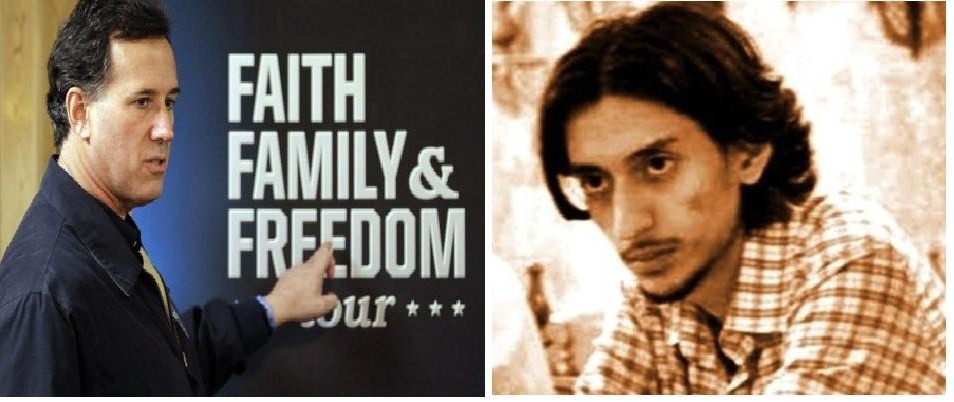
What makes me throw up is the story of Hamza Kashgari. It’s a shame that every American doesn’t know his name. He’s a young, slender, philosophical-minded columnist and blogger from Saudi Arabia who, earlier this month, dared to tweet phrases of an imagined conversation with the Prophet Mohammad: “I have loved things about you and I have hated things about you and there is a lot I don’t understand about you…I loved the rebel in you…I will not pray for you.” Within twenty-four hours, more than thirty thousand furious replies had been posted on Twitter. Within a few days, more than twenty thousand people had signed on to a Facebook page called “Saudi People Want Punishment for Hamza Kashgari.” (So much for Arab liberation by social media.) One commenter wrote, “The only choice is for Kashgari to be killed and crucified in order to be a lesson to other secularists.”

Kashgari backed down, apologized profusely, and continued to be attacked. He went into hiding. Clerics and government officials threatened him with execution for blasphemy. He fled to Malaysia, hoping to continue to fly to New Zealand, where he would ask for asylum. But Malaysian officials, behaving against law and decency, had him detained at the airport and sent back to Saudi Arabia, where he was promptly arrested. Since mid-February there’s been no word of Kashgari. The Saudis have said they will put him on trial. What a pity there’s no First Amendment to protect him.
If only he had more powerful friends—if only Christopher Hitchens were still alive—Hamza Kashgari would be called the Saudi Rushdie. There would be a worldwide campaign to pressure the Saudis into releasing him. The United States would offer him asylum and quietly push our friends the Saudis into letting him go. But we’ve come to expect these things from our friends the Saudis.

We’ve come to expect these things from the Muslim world. We expect Afghans to riot for days and kill Americans and each other because a few NATO soldiers were stupid enough to burn copies of the Koran along with other objects discarded from a prison outside Kabul. Yes, those soldiers were colossally, destructively insensitive. Yes, we should know by now. Yes, the reaction has a lot to do with ten years of war and occupation and civilian deaths and marines urinating on Taliban corpses. Still, can we have a little outrage at the outrage? Can we reaffirm that human lives are more sacred than books? Can we point out that every time something like this happens, there’s a manufactured and whipped-up quality to much of the hysteria, which has its own cold political calculation (not unlike the jihad against secularists by Sean Hannity and other Salafist mouthpieces)?

Saudi Arabia needs an absolute separation of religion and state so that Hamza Kashgari can say things that other people don’t like without having to flee for his life. Afghanistan needs it, too, and so does Pakistan, so that mob violence and political assassination can’t enjoy the encouragement of religious authorities and the tolerance or acquiescence of government officials. And America needs it so that our Presidents’ religious views remain their own private affairs, and Rick Santorum and his party can’t impose dominion of one narrow, sectarian, Bible-based idea of the public good over a vast, pluralist, heterodox, freedom-loving democracy.

Pakistan Wins Its First Oscar

By Manzer Munir for Pakistanis for Peace

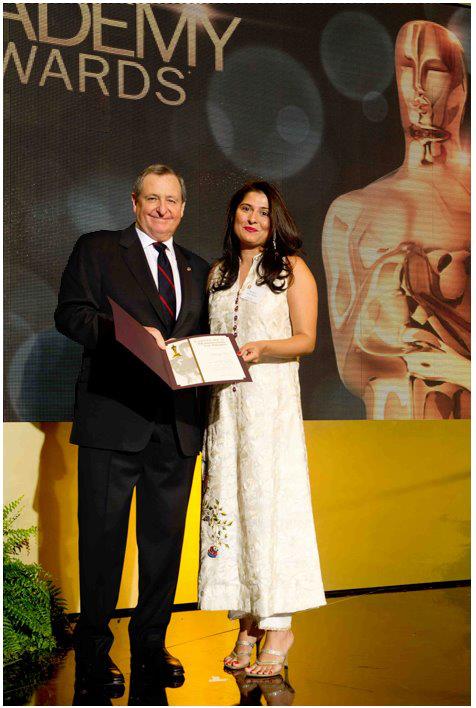
Pakistan won its first Oscar Sunday night when director Sharmeen Obaid Chinoy’s film, Saving Face, won at the 84th Academy Awards at the Kodak Theatre in Los Angeles, California.

The film was directed by Daniel Junge and Pakistani born Sharmeen Obaid Chinoy and won in its category for the Best Documentary (Short Subject), making it the first win for Chinoy and for Pakistan. Earlier in the evening, Asghar Farhadi of Iran won that country its first Oscar when his movie, A Separation, won in the Best Foreign Language Film category.

Sharmeen’s film, Saving Face, follows London-based Pakistani plastic surgeon, Dr Muhammad Jawad, on his travels to Pakistan where he performs reconstructive surgery on survivors of acid violence. The short film features two women who were attacked by acid and their struggles for justice as well as healing. It is estimated that over 100 such attacks occur each year in Pakistan and many more are feared unreported as under-reporting of this ‘acid violence‘ due to the many inequalities that women face in Pakistan.

Sharmeen Obaid-Chinoy earlier won an Emmy for her documentary, Pakistan: Children of the Taliban in 2010. “To all the women in Pakistan working for your dreams, this is for you”, Sharmeen said at her acceptance speech Sunday night in front of the packed star studded audience in the Kodak Theatre.

It is hoped by many in Pakistan that this Oscar win will bring more attention to the plight of women in their beleaguered country.

“Saving Face” Pakistan’s first Academy Award Nomination

By Mudassar Ali Khan for The Washington Times

On 26th February 2012, the world will discover three different faces of Pakistan during the 84th Academy Awards, with the nomination of a Pakistani documentary ‘Saving Face’ for the best documentary (short subject).

The first face is the Pakistani filmmaker who is contending for the Oscar, the second is the internationally acclaimed British-Pakistani plastic surgeon who traveled to his motherland to heal victims of acid attacks, and last but not the least is of the heroic survivors of acid attacks who are struggling to deal with the consequences of their disfigurement.

‘Saving Face’ tells the story of a British-Pakistani plastic surgeon, Dr. Muhammad Jawad, who traveled to Pakistan to treat acid attack victims. Jawad has made several trips to Pakistan with surgical teams to work with the victims. He also organized a major medical relief effort to help earthquake survivors in Pakistan in 2005. In 2008, he received widespread public and international media attention when he performed his pioneering treatment on British model and television presenter Katie Piper, whose ex-boyfriend threw acid on her face.

Central characters of this documentary are two women, Zakia and Rukhsana, from southern Punjab who survived acid attacks and have been fighting for justice ever since. Instead of only portraying the misery of the victims, the film focuses on the vigor with which they endure the process of emotional and physical healing.

Sharmeen Obaid-Chinoy is the first Pakistani filmmaker to win an Oscar nomination for co-directing this film with Daniel Junge. Obaid-Chinoy previously won an Emmy award for her film Pakistan’s Taliban Generation. This film was also the recipient of the Alfred Dupont Award and the Association for International Broadcasting Award. Obaid-Chinoy is the first non-American to receive the Livingston Award for best international reporting. In 2007, she received the broadcast journalist of the year award in the UK from One World Media for her work in a series of documentary films. For her work on other films, she also received the Overseas Press Club Award, the American Women in Radio and Television Award, the Cine Golden Eagle Award and the Banff Rockie Award.

Above all, this documentary, along with its accolades, is truly a testimony of the devotion and fervor with which Sharmeen, Dr. Jawad, Zakia and Rukhsana are pursuing their individual goals. Saving Face brings together the hard work and creativity of an ambitious documentarian, the dedication of a passionate doctor, and determination of valiant victims of acid attacks.

The film also emerges as a face-saver for Pakistan, amid growing negative perceptions about the country worldwide.

The Oscar nod for Saving Face recognizes of a Pakistani filmmaker and sends message to all the ambitious Pakistanis and the world that hard work pays off, no matter where you live and your passion to prevail over the crisis can take you places whether you are a filmmaker, a doctor or a survivor.