Posts Tagged ‘ United States ’

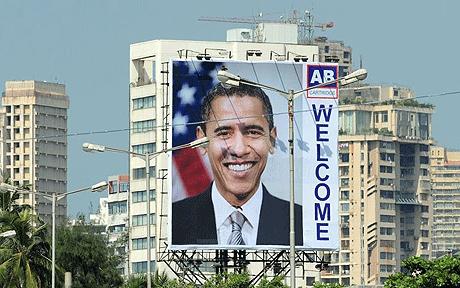
Obama Calls for India – Pakistan Peace

By Andrew Buncombe for NZ Hearald

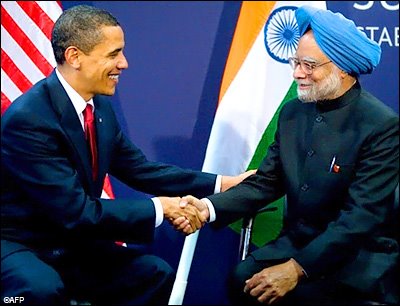
Barack Obama has called on India and Pakistan to renew their efforts to find peace, even as he said Islamabad was not moving quickly enough to counter militants operating from inside its borders.

In comments that appeared to underscore the high-wire act of diplomacy the US president is trying to pull off while on the three-day visit to India, Mr Obama said Washington would not act as an intermediary between the two countries.

However, he told a group of students in Mumbai: “My hope is that over time, trust develops between the two countries, that dialogue begins, perhaps on less controversial issues, building up to more controversial issues. There are more Pakistanis who’ve been killed by terrorists inside Pakistan than probably anywhere else.”

The president has received criticism from some opposition parties in India after he failed to directly mention Pakistan when he arrived in India on Saturday and spoke of the 2008 attacks at the Taj Hotel and other locations in Mumbai, that left more than 160 people dead.

In the aftermath of the attacks, the so-called “composite dialogue” peace process between India and Pakistan was put on hold and while there have been a series of high-level meetings, the relationship between the two remains tense.

The president, who stayed at the seafront hotel in what aides said was a clear sign of solidarity, had talked about the militants and the terror they wrought, but was criticised by the right-wing Bharatiya Janata Party (BJP) for failing to attribute the blame to Pakistan.

Asked why he had not done so, Mr Obama reflected a reality in which the US is paying billions of dollars to Pakistan in aid as it pushes it to do more against militants responsible for cross-border strikes in Afghanistan.

“Pakistan is a strategically important country, not just for America, but for the world,” he said. “India and Pakistan can prosper and live side by side. This can happen and this should be the ultimate goal. The US can be a partner but cannot impose this process. India and Pakistan have to arrive at an understanding.”

Mr Obama started his visit to India, one of four countries he is including on a tour through Asia, by announcing more than 20 deals he said were worth up to $10bn and would help support 50,000 US jobs.

He also said the US was to relax export controls over sensitive technology, a demand of India’s that will help deepen ties between the two countries. The president is to hold formal talks today with India’s prime minister, Manmohan Singh.

On a domestic level, Mr Obama also recognised he needed to make “midcourse corrections” in the aftermath of last week’s mid-term elections if he is going to win over a frustrated and divided electorate.

America and India: The Almost-Special Relationship

By Jim Yardley for The New York Times

At a panel discussion last week on relations between India and the United States, Strobe Talbott, the former American diplomat, told an audience of Indian business leaders that he had learned a valuable lesson about India: Do not hyphenate it. As in Indo-Pak. (Or, in a close cousin of a hyphen, as in Chindia.) The audience smiled at his epiphany: India matters because it is India.

In a nutshell, President Obama is trying to deliver the same message during his three-day visit to India, the first stop on a broader Asian tour. Both countries are eager to build on their improved ties and set up a unique, special relationship, given that together they represent the world’s richest and largest democracies. Faced with a rising authoritarian China, and an economically wounded Europe, a weakened United States is casting about for global partners. India would seem a nice fit.

“This is the time to be ambitious about this relationship,” said Shivshankar Menon, India’s national security adviser, speaking on the panel with Mr. Talbott.

And yet eliminating the hyphen is not easy, especially given India’s fraught relations with its neighbors in what is perhaps the most politically complicated region on earth, one in which American lives and treasure are at stake in Pakistan and Afghanistan. And India’s evolving relationship with another neighbor, China, is also a prime concern for America. Indeed, the decision to focus Mr. Obama’s India trip on India was itself not easily achieved; some senior administration officials lobbied the president to put pressure on Indian leaders for a conciliatory gesture toward Pakistan, in hope that such a carrot might entice the Pakistanis to do more to help America against the Taliban.

These sorts of political equations have long tangled the U.S.-India relationship: The Americans, at different times, have pushed the Indians to cut a deal with Pakistan over the disputed region of Kashmir, but the Indians have bristled at any interference. The Indians still want the Americans to sponsor India for a permanent seat on the United Nations Security Council. Not such an easy thing, the Americans reply, since America alone can’t do this and it creates issues between America and China. It has sometimes seemed like a relationship built around one country asking the other to do something it considers against its self-interest.

Moreover, the economic relationship between the two countries often has been a source of friction. High unemployment in America has renewed complaints that outsourcing to India hurts American workers. Indians complain that American protectionism is hurting Indian companies and that American export restrictions on technologies that can have both military and civil uses are outdated and unnecessary in a relationship between putative allies.

Mr. Obama’s trip is an attempt to reboot or refocus the relationship away from these disputes and de-emphasize the tangible goodies (for example, contracts) that politicians call “deliverables.” Instead, the two sides are discussing how they can partner on education, clean energy, agriculture, technological development and military cooperation. The thematic emphasis of the visit is on shared democratic values — a pointed dig at China — and what the two countries say are shared opportunities. American officials say that an expected $4 billion deal for India to buy military transport aircraft — yes, a goodie — will provide thousands of American jobs. Indian officials emphasize that trade between the two countries is basically balanced — unlike with China — and that the anger over outsourcing is misplaced, especially since some Indian companies are investing and creating jobs in the United States.

Some Indian commentators have groused that all the diplospeak about shared opportunities obscures the fact that the trip lacks a “big idea” to excite or elevate the relationship, even as big, unavoidable problems are seemingly being avoided. In 2000, former President Bill Clinton spent five days in India on a door-opening visit that was credited with righting what had been a stalled relationship. Then former President George W. Bush made the most dramatic gesture by pushing through an agreement to cooperate on civilian nuclear projects; the move effectively legitimized India as a nuclear power and lifted a 30-year moratorium on nuclear trade with India even though India had not signed the Nuclear Nonproliferation Treaty. By comparison, Mr. Obama seems not to be offering much.

“The jury is out,” said Shekhar Gupta, editor of The Indian Express, speaking of how India’s political establishment views Mr. Obama.

But Ronen Sen, who recently retired from India’s diplomatic corps after serving as ambassador to the United States, says the focus on a “big idea” is misplaced. Given the litany of difficult problems between the two countries, Mr. Sen said, Mr. Obama’s approach was a reasonable way to build trust and broaden a bilateral relationship that, while greatly improved, had not yet fully matured.

“It has not yet reached a critical mass where it can be self sustaining,” Mr. Sen said.

Indeed, even the landmark civil nuclear deal remains a subject of dispute as the two sides still squabble over fine details of how American suppliers could begin doing business in the lucrative Indian market. The Americans say that rules recently approved by India are inconsistent with accepted global practice, which exempts foreign suppliers from liability in cases of accidents, leaving it solely with local operators. A senior American official said “intense discussions” were underway to find a solution. If one is found, Mr. Obama may get a nice “deliverable” — an open door through which American firms, as originally expected, can sell nuclear equipment to India and provide jobs at home.

There is less talk of the chances of solving bigger problems, like differences between America and India in global negotiations on global warming climate change and trade. And the uncertainty over the most problematic hyphens — Afghanistan and Pakistan — looms over the visit. Even as Mr. Obama seeks a way to stabilize Afghanistan and get out, Indian officials dread the day America leaves. They worry about what will be left behind, since India cannot leave the neighborhood.

“Quite obviously, we have strategic stakes there,” said Brig. Gurmeet Kanwal, director of the Center for Land Warfare Studies, a military research institute. “We do not wish to have a government in Afghanistan or a government in Kabul that is inimical to Indian interests.”

He added: “We see the United States as a stabilizing influence in Asia.”

And so a political courtship will continue, problems and all. Governmental ties already lag far behind the people-to-people relationships. America remains the premier destination for Indian students studying abroad, and Indian immigrants in America have achieved disproportionate success in business, medicine and many other fields. It is this backchannel closeness that serves as a cattle prod nudging the governments to become closer, too.

K. Subrahmanyam, a leading Indian defense analyst, believes that India and the United States represent the inevitable and necessary partnership of the 21st century because China’s rise represents a threat to a global order based on democratic principles. He said that demographic trends, too, should bind the two countries together.

“If America needs a partner, Europe is aging, Japan is aging and China is going to age,” he said. “The only two major nations in the world who will not be aging, at least for the next 30 years, are the United States and India.”

‘Islam in a Nutshell’ Explained at Episcopal Church

By Mitchell Landsberg for The Los Angeles Times

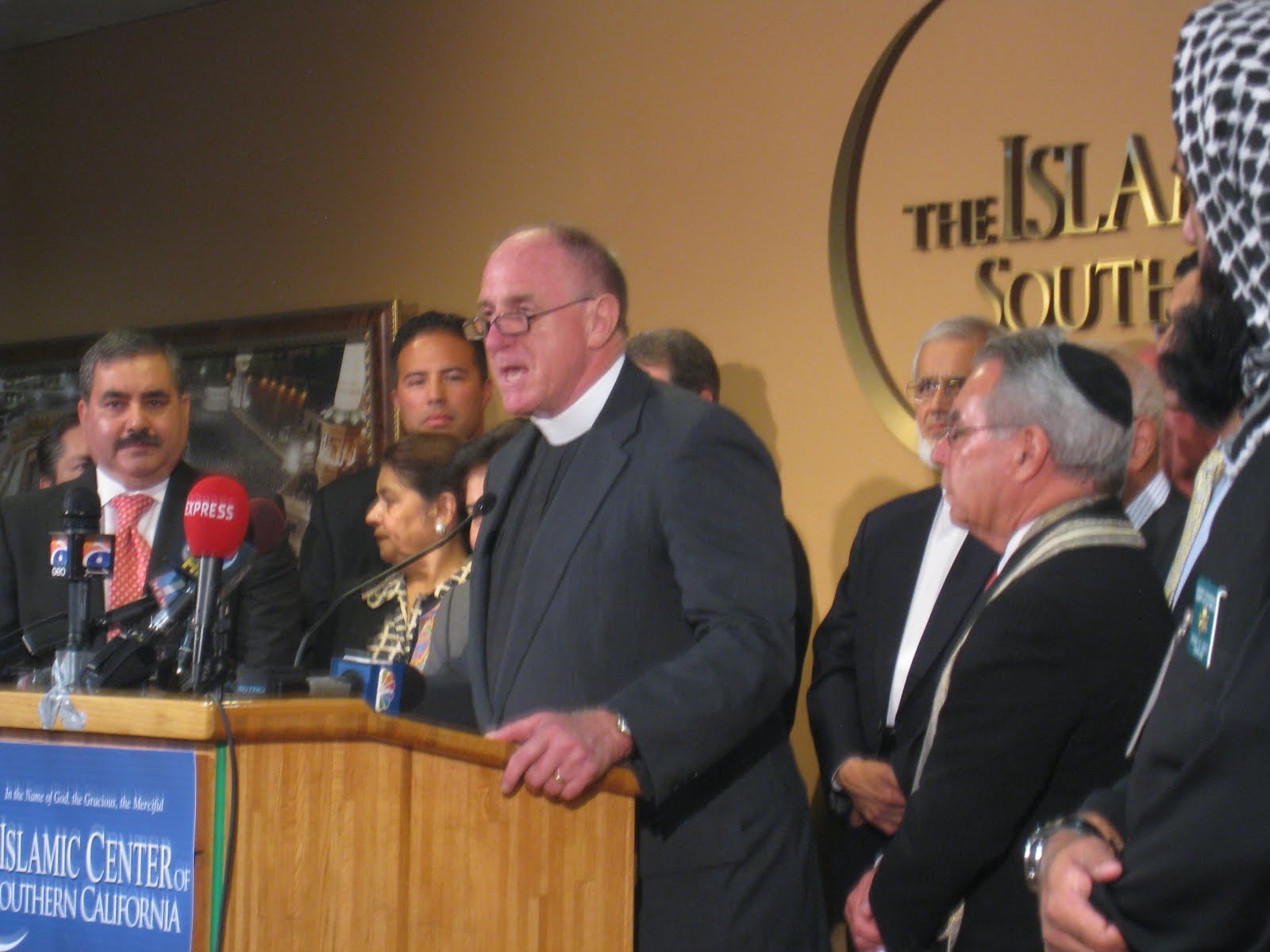
The Rev. J. Edwin Bacon, rector of All Saints Church in Pasadena, had just returned from vacation when he heard about a Florida pastor who was threatening to burn copies of the Koran, Islam’s holy book.

“I was disgusted,” said Bacon, whose Episcopal church is known for its progressive stance on many issues, interfaith relations among them. He said he thought: “Rather than burning Korans, we should be studying them.”

The Koran burning never took place. But from Bacon’s reaction was born “Islam 101,” a speaker series that ended Saturday with a lecture by Dr. Maher Hathout, senior advisor to the Muslim Public Affairs Council and a leading voice of Muslims in Southern California.

About 75 people went to the church to hear Hathout give a brief overview of “Islam in a nutshell,” then answer questions from a friendly audience that seemed concerned about both Muslim extremism and American hostility toward Islam.

Hathout told the audience that as the “new kid on the block” among the three Abrahamic faiths, which include Judaism and Christianity, Islam has had two options: “to be accepted by other religions or to fight with them.”

He continued: “We are now discovering … that we can be different without fighting, or it will be a miserable life. And it is a miserable life right now, if you ask me.”

Hathout expressed horror at the discovery of explosives bound from Yemen to the United States, part of a suspected Al Qaeda terrorist plot. He said terrorism violates Islamic theology and could ultimately destroy Islam. By using it “to defend Islam, you sacrifice Islam,” he said.

At the same time, Hathout complained about the use of the term “Muslim terrorist.” No one ever says a “Christian terrorist” bombed an abortion clinic, he said, adding, “They will not give the religious adjective to that person.”

And he said he is angered by people who say that moderate Muslims have been too reluctant to denounce extremism.

“If I shout and you don’t hear me, it means you are deaf,” he said. “It doesn’t mean I didn’t shout.”

All Saints is not alone in reaching out to the Muslim community in an attempt to better understand Islam. In the years since Sept. 11, 2001, numerous churches and synagogues, generally those associated with the progressive or liberal wings of their faiths, have invited Muslim speakers or partnered with Islamic organizations on interfaith events.

During the question-and-answer session, one member of the audience observed that if Hathout were to attend a “Christianity 101” lecture at All Saints, it would be different than a similar lecture at an evangelical church. She wondered if the same were true of Islam. Hathout said there is diversity within Islam, but also boundaries that cannot be crossed.

The question also spoke to another point: To a large degree, Saturday’s event was a meeting of like-minded sensibilities. There probably weren’t any prospective Koran burners in the audience. Hathout wasn’t changing minds so much as informing them.

Bacon acknowledged as much afterward. “I’ve always thought that preaching to the choir is a very important thing,” he said, “because the choir needs to be radicalized. On one level, you want to get the message taught. But on another level, you want them to be equipped and empowered to go out and courageously act.”

Those who attended the three-lecture series, he said, will be better able to explain to others that “most of the 1.6 billion Muslims in the world view their religion as a religion of peace, not as a religion of terrorism.”

“This is the real Islam,” he said.

Obama Will Try to Avoid the K Word

By Paul Beckett for The Wall Street Journal

To some U.S. officials, it is known simply as the “K-word.” Kashmir. It’s a topic we expect U.S. President Barack Obama to try his level best to avoid during his three-day trip to India that starts next week.

The issue got the former British foreign secretary in hot water when he was here last year. And when Richard Holbrooke, Mr. Obama’s special representative on Afghanistan and Pakistan at one point suggested he tackle Kashmir too, the idea received a furious rebuff from the Indians.

If the topic does come up, Mr. Obama will likely follow the same tack taken by his advisers earlier this week in a briefing with reporters. When asked, “Will the President talk publicly or privately about Kashmir and the tensions between India and Pakistan?” this was the response from Ben Rhodes, deputy national security advisor for strategic communication.

“The President believes that the U.S. relationship with India and the U.S. relationship with Pakistan does not take place within any kind of zero-sum dynamic.  It’s often been viewed that way in the past, that if we become closer to one it’s at the expense of the other. And we’ve tried to send the signal that it’s the opposite with this administration; that, in fact, actually you see that borne out in the fact that we had a very successful strategic dialogue here, with the Pakistanis in town last week, discussing greater security cooperation in governance and economic issues.

And as a part of that, the President met with the Pakistani delegation and ended up speaking to President Zardari yesterday to discuss that strategic dialogue and said that he’d very much like to visit Pakistan next year and is planning to visit Pakistan next year.”

If you’re counting, that almost 150 words – and not one of them is “Kashmir.”

William Burns, undersecretary of state for political affairs, added his own non-Kashmir Kashmir response. “We have always welcomed dialogue between India and Pakistan and certainly encouraged efforts to improve relations between those two very important countries.  Obviously, the pace, scope and character of that dialogue is something that Indians and Pakistanis have to shape.  But we’ll continue to both welcome and encourage it.”

White House reporters being an intrepid bunch, another questioner brought up the topic again, using the K-word specifically.

“Just to follow Steven’s question on Kashmir. Will the President be making some public remarks explaining the U.S. position on Kashmir?  And will he also be addressing — explaining the U.S. relationship with Pakistan publicly?”

This time Mr. Rhodes was even more eloquent, going for a full 286 words, not a single one of them Kashmir.

Top of the Agenda at US-Pakistan Meetings: Mending Relations

By Howard LaFranchi for The Christian Science Monitor

If Osama bin Laden is really living comfortably in a house in northwest Pakistan, can we finally get him?

One might assume that the question would come up during this week’s three-day “strategic dialogue” between the United States and Pakistan – given the news out of NATO earlier this week that the Al Qaeda leader is no longer believed to be roughing it in a remote, no-man’s-land cave.

But instead, topic No. 1 at the three days of Washington meetings that begin Wednesday is likely to be relations-mending.

US-Pakistan ties, already roiled by frequent US drone attacks in Pakistani territory, suffered an abrupt setback over a NATO helicopter attack on the Pakistan-Afghanistan border late last month that killed several Pakistani soldiers. The US apologized for the incident, but not before the Khyber pass border crossing was closed and dozens of bottled-up trucks transporting fuel and supplies to NATO troops in Afghanistan were torched.

It is in the still-touchy aftermath of the border incident that the US is expected to offer Pakistan a multiyear, multibillion-dollar security package aimed at enhancing the ability of Pakistani security forces to take on domestic Islamist militants.

The US already offers Pakistan about $1.5 billion a year in military assistance through what is now a year-to-year program. The proposal to be presented at this week’s meetings is for a package of military hardware, training, and counterinsurgency materials stretching over several years – something the Pakistanis have been seeking for a while. Secretary of State Hillary Rodham Clinton had said at the last session of the US-Pakistan strategic dialogue in Islamabad in July that the US was “working on a multiyear package.”

Such a package for security assistance would presumably mirror a five-year, $7.5 billion development assistance package for Pakistan that the US approved last year.

US officials acknowledge that Pakistani security forces are stretched thin – especially after the summer’s devastating floods – and could use more supplies and training if they are to go after militants in their havens. But at the same time, US officials continue to harbor suspicions that some of the Taliban and other militant groups, in particular those involved in fighting in neighboring Afghanistan, continue to enjoy protection from certain elements of the Pakistani security structure.

The claim from a NATO official about Mr. bin Laden, reported by CNN, included the widely held contention that the Al Qaeda leadership is protected by elements within the Pakistani intelligence services.

Earlier this month, the White House submitted an assessment of Pakistan to Congress that is critical of the country’s antimilitancy campaign and suggests its existing capacities would allow it to do much more to confront the Taliban and Al Qaeda. A softer version of that assessment was offered at the State Department this week, when spokesman P.J. Crowley commended Pakistan for “aggressive action within its borders” before adding, “Clearly, this is an ongoing threat, and more needs to be done.”

At a State Department briefing Tuesday, the deputy US special representative for Afghanistan and Pakistan, Frank Ruggiero, said that while the Pakistanis have taken “some substantial steps” against organizations threatening the security of both countries, the US will call on Pakistan to do more – such as taking its campaign into North Waziristan.

Confronted with America’s you-can-do-more attitude, the Pakistanis are responding with requests of their own. Pakistan’s foreign minister, Shah Mehmood Qureshi, has a list of things he says the US could do to build his country’s confidence in the US partnership. Among them are a civilian nuclear energy deal like the one the US has signed with India, a wider door for Pakistani products to enter the US, and more US pressure on India to resolve issues of interest to both India and Pakistan, such as Kashmir.

Mr. Qureshi, who is to meet with Secretary Clinton on Friday, has already previewed the proudly independent tone he is likely to employ when meeting with senior Obama administration officials.

“We are an ally, not a satellite,” Qureshi said Monday in comments at Harvard University’s Institute of Politics in Cambridge, Mass. “We have to protect our borders. You have to respect our sovereignty,” he said, alluding to the recent helicopter border shooting.

Qureshi said the “trust deficit” affecting relations between the two countries has been furthered by such interventions in Pakistani territory, although he acknowledged that the outpouring of US relief assistance after the summer flooding was viewed much more positively.

Pakistan is Not America’s Enemy

 By Ryan Crocker for The Wall Street Journal

 The news from Pakistan is grim. NATO helicopters engage suspected militants inside Pakistan, killing three, only to discover they are Pakistani soldiers. The angry Pakistani government blocks NATO fuel shipments at the Khyber Pass, and militants attack the stalled trucks. An Obama administration report to Congress charges that the Pakistanis aren’t doing enough against the Taliban and al Qaeda. Press accounts quote unnamed officials asserting that elements in Pakistani intelligence are encouraging the Taliban to step up attacks on NATO forces. And Bob Woodward cites President Obama as saying “the cancer is in Pakistan.”

One could easily conclude that we are describing an enemy, not an ally. Many in Pakistan feel the same way. And yet the prospects for stabilizing Afghanistan, defeating al Qaeda and preventing further attacks on the United States are a direct function of that strained alliance. It is time for a collective deep breath.

Pakistan’s historical narrative focuses on how the U.S. worked with Pakistanis and Afghans to drive the Soviets from Afghanistan in the 1980s: We succeeded—and then we left. And on our way out, we slapped sanctions on Pakistan, ending all security and economic assistance because of the country’s nuclear program, which we had known about since 1974 when Pakistan’s prime minister announced it publicly. We left Pakistan alone to deal with a destabilizing civil war in Afghanistan, and when the Taliban emerged as a dominant force in the mid-1990s, Islamabad supported them as a means of ending the conflict.

Then came 9/11 and the U.S. was back. Pakistanis welcomed the renewed assistance. But a constant question I heard while serving as ambassador to Pakistan from 2004-2007 was “How long will you stay this time, and what mess will you leave us with when you go?” For a fragile state with innumerable problems, including a vicious internal insurgency, these are existential questions.

Never in Pakistan’s six decades of existence has the U.S. sustained a long-term, strategic commitment in the country. The Bush administration recognized this and enacted security and economic assistance programs designed to make a long-term difference in education, health care and governance. In 2006, I argued successfully for a five-year assistance package for Pakistan’s Federally Administered Tribal Areas (FATA), which are notable both for chronic underdevelopment and extremism. The Obama administration has built on this, and last year’s Kerry-Lugar bill provided $7.5 billion in assistance over five years. So we have the architecture in place to build a strategic relationship.

Still, short-term pressures risk undermining long-term strategy. When I was ambassador, voices in Congress, the media and even the administration were constantly calling for the U.S. to get tough on Pakistan, make Pakistanis do more, threaten them with consequences. Such exhortations were—and remain—generally counterproductive, as they fuel fears that the U.S. will again abandon Pakistan.

The U.S. can better work with Pakistan if we improve our understanding of history: Given its rivalry with India and its organic disunity, which dates back to its founding, Pakistan fears for its basic survival. The country has always had a difficult relationship with Afghanistan, not least because in the 19th century the British deliberately drew the Pakistani-Afghan border, the so-called Durand Line, in order to divide the Pashtun people. Today Pashtuns make up Afghanistan’s largest community, but there are more Pashtuns in Pakistan.

The Durand Line also set the groundwork for the tribal areas, which are legally distinct from the rest of Pakistan because the British could never exert direct control over them. No central authority ever has. Winston Churchill’s first published work, “The Story of the Malakand Field Force,” is about fierce tribesmen declaring jihad against a Western army. It could be a contemporary account.

So what does this mean in concrete terms?

First, the U.S. should appreciate Pakistan’s challenges and support its government in dealing with them. This summer’s devastating floods have disappeared from the U.S. media but will continue to wreak havoc in Pakistan for a long time to come. In 2005 and 2006, after an earthquake in Kashmir killed almost 80,000 Pakistanis, the U.S. organized the largest relief operation since the Berlin Airlift. The floods’ death toll is lower, but their long-term damage will be far greater. U.S. support should be commensurate.

Second, the U.S. should not carry out cross-border military actions, which I strongly resisted as ambassador. They are clearly counterproductive, and not just because we hit the wrong target. If NATO can carry out military actions in Pakistan from the west, Pakistanis wonder, what stops India from doing the same from the east? There are other options, including drone strikes, which the U.S. is now coordinating more closely with Pakistanis.

Third, with Pakistan’s government (as with Afghanistan’s), we must be private in our criticism and public in our support

Private talks should deepen regarding challenges like the insurgent Haqqani network in North Waziristan, and we need to listen at least as much as we lecture.Fourth, any talks between the U.S. or Afghanistan and the Taliban must be transparent to the Pakistanis. A nightmare for Islamabad is the prospect that the Americans and Afghans come to some accommodation with Taliban elements that would leave them hostile to Pakistan. If Pakistan is not part of the process, we will be working at cross-purposes and only the Taliban will benefit.

Pakistan’s arrest of Taliban leader Abdul Ghani Baradar—at a time when he had begun reconciliation talks with Afghan authorities—underscored the risks of leaving Islamabad out of the loop. Going forward, the timing and nature of talks with the Taliban should be set by Afghans, Pakistanis and Americans working together.

None of this will be easy, but it is essential. A sustained U.S.-Pakistani partnership after the Soviet withdrawal from Afghanistan could have produced a very different history than the one we wrestle with today. Writing a different future requires making long-term commitments—on both sides of the Durand Line.

Mr. Crocker, the dean of Texas A&M’s George Bush School of Government and Public Service, was U.S. ambassador to Pakistan from 2004 to 2007 and U.S. ambassador to Iraq from 2007 to 2009.

Revisiting Pakistan’s ‘Strategic Depth’

By Syed Nadir El Edroos for The Express Tribune

Two words that hold our country hostage is our policy of maintaining ‘strategic depth’ in Afghanistan. Apart from referring to a poorly titled adult film, the policy envisages to protect Pakistan’s eastern borders from unwanted Indian influence.

However, the consequences of continuing with this policy and differentiating between the ‘good’ and the ‘bad’ Taliban, has led to accusations of Pakistan playing a ‘double-game’  in Afghanistan. For many the accusation has become quite stale and repetitive. It seems to have become an open secret, with many accepting it as a reality, a part of the status-quo for dealing with the troubles in the region.

Whether the policy has been successful is debatable. The military’s and the ISI’s continued links with the Haqqani network ensures that they are a sought after broker for any back channel attempt to woo the Taliban.

The strategy aims to maintain Pakistani influence in/over Afghanistan, and to thwart alleged Indian designs. However, the policy has at the same time made Pakistan quite unpopular with large segments of the Afghan establishment. Interfering in Afghanistan’s affairs, while demanding an end to foreign influence in Pakistan is met with much ridicule in foreign capitals; it reeks of hypocrisy.

The policy is also questionable, as it breeds violence, and is responsible for the deaths of thousands in Pakistan and Afghanistan. As the violence continues, Pakistan is sure to be in the news, accused for fostering, abating or at the very least tolerating continued bloodshed to maintain its interests.

The result is the ‘image deficit’ that haunts Pakistan. The dismal public response to the floods in Pakistan for example was attributed to this effect. It has also been more difficult for our economic managers to garner favourable trade concessions and development grants. Winning over wider public support remains a problem, as Pakistan remains associated with fostering rather than curtailing violence in Afghanistan. Politicians in the west are portrayed as weak by the right-wing media, such as Fox News in the US, for taking initiatives to support Pakistan.

Look at any article posted on any western news outlet. The comments question the calls for sympathy for Pakistan as we are branded as supporters of terrorism, who inflict material and physical damage on their interests.

An alternative strategy

There needs to be an alternative to our current strategy. The alternative need not be between defending Pakistan from India or bowing before it and allowing it a free hand in Afghanistan. We need to engage with both Afghanistan and India to leverage our geographic position to develop strategic depth with positive connotations.

The US, Afghanistan and India have been pressing Pakistan to allow the transit of Indian goods over Pakistan through to Afghanistan and vice versa for years. I say, let the goods pass, hell put them on the trains. That will help to give our faltering railways a financial shot in the arm. Extend the Iran-Pakistan pipeline into India, let the gas flow. Transit fees galore! Rather than questioning Indian development aid to Afghanistan we should support it. Geographically it’s more of an advantage for us, as any increase in economic activity in Afghanistan will immediately suck in Pakistani exports.

What would the advantages be? Imagine the headlines. Pakistan would look like the peace builder, shunning international criticism and situating itself as committed to the development of an Afghan state. We would also be seen on the diplomatic offensive vis-à-vis India. With Pakistan offering so many incentives, India will have to respond in the affirmative. After all India is cultivating its image as a regional and global superpower, the ball will firmly be in India’s court. It cannot be seen rebuffing genuine gestures from its old foe.

Importantly, a policy that leverages our geographic position economically rather than militarily negates any association with violence.  We would be treated as victims rather than the guilty.

If India is indeed developing consulates across Afghanistan housing RAW agents that ferment trouble in Pakistan, improved economic ties will help shed a spotlight on the functioning of these consulates. As Pakistan becomes vital for transporting Indian-Afghanistan exports and imports to each other, minimising any threat to these links will become a primary concern for Indian traders. This will build added pressure on those who dare concoct nefarious designs to fuel militancy in Balochistan for example.

India can switch on and off the belligerent rhetoric as India’s economy has little or no interests in Pakistan. However, a Pakistan which is vital for Indian trade, supply of resources etc will have no choice but to tone down any sabre rattling that seems to be a cyclical part of Pakistan-India relations.

So where does Pakistan’s security come in?

In any period of belligerent hostility Pakistan will have the ability to cut of energy and trade links. Containers can be seized, Indian traders in Pakistan arrested, and diplomatically we can garner support by portraying ourselves of peace. We have gone the extra mile to foster our relations with India and support a viable Afghanistan. India would be seen as the aggressor. How is that for maintaining strategic depth?

Our present policy allows for India’s security establishment to deal with her interests in Afghanistan ignoring any media or public scrutiny. A policy that places economic links at its foundations will open up Indian policy on Pakistan and Afghanistan and the actions of its security agencies to wider scrutiny. The competition between competing interests will insure that whatever policy is actually implemented is a watered down compromise that is not a real threat to Pakistan.

We have to find alternatives to the status-quo. With the nation reeling under flooding, terrorism and economic stagnation we are more dependent on foreign assistance than at any point in our history. They are not many variables that we can control for. We can’t control how the foreign press paints us, how we are perceived abroad etc. However, what little we can do to help alter these perceptions, we must. And this does not have to lead to subjugation to Indian influence that many right wing commentators would suggest.

If we are to continue with our obsession with thwarting Indian designs, can we please do it in a manner that doesn’t hold us all hostage to violence and paint us as terrorist?

Shaping global opinion is a long term effort which must start sooner than later. Our challenges for the future, access to water, natural disasters caused by climate change and development depends in a large part to interaction and support of our neighbours and the international community. Politics and security needs are always a concern, but we must get society at large, the world over on our sign. We are not the cause but the victims. Strategic depth? Sure, but by other means.

U.N. Speakers Urge Pakistan to Free Up Arms Talks

By Patrick Worsnip for Reuters

Heaping pressure on Pakistan, a high-level U.N. meeting called on Friday for talks to start immediately on a treaty to ban production of fissile material used as fuel for nuclear weapons.

But Pakistan has insisted it will continue to block such talks, arguing that a ban would put it at a permanent disadvantage to its nuclear rival India. The dispute has led to deadlock at the 65-nation Conference on Disarmament in Geneva.

At the U.N. meeting of some 70 states to discuss the paralysis at the conference, speakers avoided openly naming Pakistan, but several referred to “one country” that was causing the problem.

In a closing summary of the views expressed, U.N. Secretary-General Ban Ki-moon said there was “broad agreement on the need to immediately start negotiations on a … treaty banning the production of fissile material.”

Continued impasse could result in states going outside the Geneva conference, known as the “CD,” to tackle the issue, Ban warned.

Support has appeared to be growing in Geneva to find another approach — possibly small-group talks in parallel to CD sessions. A precedent was set when Canada and Norway moved talks on a landmine ban out of the forum, eventually clinching the landmark 1997 Ottawa Treaty.

At Friday’s U.N. meeting, Western powers sharply attacked Pakistan’s blockage of the CD, which requires consensus for its actions.

“It strikes us as unwarranted for a single country to abuse the consensus principle and thereby frustrate everyone else’s desire to resume serious disarmament efforts,” said U.S. delegate Gary Samore, a special adviser to President Barack Obama.

Washington understood that all countries needed to protect their security interests, and with that principle in place, “no country need fear the prospect of (fissile material) negotiations,” Samore said.

NO CONSENSUS

British junior foreign minister Alistair Burt said blocking the negotiations was “damaging for multilateral arms control.”

Launched in 1978, the CD has clinched treaties banning biological and chemical weapons as well as underground nuclear tests. Its members include all five official nuclear powers — the United States, Russia, Britain, France and China.

But it has been unable to reach consensus on substantive work for the past 12 years. Pakistan’s refusal since January to launch negotiations on fissile material like plutonium and highly enriched uranium is the latest obstacle.

Zamir Akram, Pakistan’s ambassador to the United Nations in Geneva, said earlier this month his country would continue to hold out, arguing that India has an unfair advantage with bigger fissile material stockpiles and “discriminatory” nuclear cooperation deals with the United States.

“Pakistan’s security concerns can be addressed only once we have developed sufficient capacity to ensure our deterrent is credible in the face of growing asymmetry,” he told Reuters. “My instructions are, ‘We continue to maintain our position.'”

Pakistan did not speak at Friday’s meeting in New York. No decisions were made, but Ban said he would ask a panel of advisers to review the issues raised.

Separately, French delegate Jacques Audibert said Paris would host a meeting of the five official nuclear powers next year to discuss their obligations stemming from a May conference on nuclear non-proliferation.

The conference called on the powers to pursue negotiations ultimately aimed at the total abolition of nuclear weapons.

U.S. Walks Out as Iran Leader Speaks

By Neil MacFarquhar for The New York Times

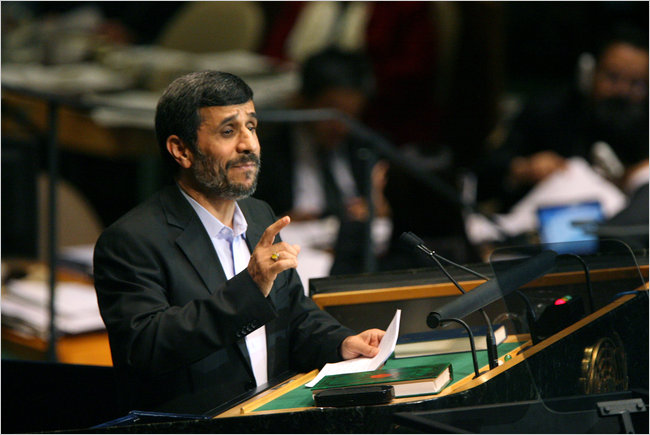
UNITED NATIONS — President Mahmoud Ahmadinejad of Iran made a series of incendiary remarks in his speech to the United Nations General Assembly on Thursday, notably the claim that the United States orchestrated the Sept. 11 attacks to rescue its declining economy, to reassert its weakening grip on the Middle East and to save Israel.

Those comments prompted at least 33 delegations to walk out, including the United States, Canada, Australia, New Zealand, Costa Rica, all 27 members of the European Union and the union’s representative, diplomats said.

The annual General Assembly started formally on Thursday, with scores of presidents, kings and ministers expected to address the gathering over the coming week. The speeches often fail to break new ground or lack electricity, so the occasional theatrics inevitably attract considerable attention.

Mr. Ahmadinejad rarely disappoints on that scale, although he seemed to go out of his way to sabotage any comments he made previously this week about Iran’s readiness for dialogue with the United States. The theme of his often flowery speech was that the capitalist world order was collapsing and he cited three examples: the attacks of Sept. 11, 2001, the Israeli occupation of Palestinian lands, and the pressure on Iran over its nuclear program.

He said there were three theories about the origins of the Sept. 11 attacks, including “that some segments within the U.S. government orchestrated the attack to reverse the declining American economy and its grips on the Middle East in order also to save the Zionist regime.”

The United States Mission to the United Nations swiftly issued a terse response. “Rather than representing the aspirations and goodwill of the Iranian people, Mr. Ahmadinejad has yet again chosen to spout vile conspiracy theories and anti-Semitic slurs that are as abhorrent and delusional as they are predictable,” it said in a statement.

It was not the first time Mr. Ahmadinejad espoused the theory, but never before so publicly. “The majority of the American people as well as other nations and politicians agree with this view,” he said.

Mr. Ahmadinejad obviously delights in being provocative during his annual visit to the United Nations. He framed his comments about Sept. 11 as an examination of opinions, an approach he has used repeatedly in questioning the Holocaust.

But his assertion that the majority of Americans agree with him surely lacked any factual basis. As did his claim that reviving the American economy was the motive behind the devastating attacks on the World Trade Center and the Pentagon; the United States economy declined significantly after the attacks. In his interviews with journalists, much like during his debates with opponents in the disputed Iranian presidential election last year, Mr. Ahmadinejad has often been accused of making up statements wholesale.

But analysts noted that his remarks should be viewed through the prism of domestic politics in Iran, where conservatives try to outflank him. They said that during a recent Friday prayer sermon, Ayatollah Ahmad Jannati said that 84 percent of Americans believed their own government was behind the attacks.

Iran also cultivates an image as the voice of all Muslims in confronting the United States, and the idea that Americans rather than Islamic extremists carried out the 2001 attacks has long resonated among Arabs. “This is very helpful to Ahmadinejad’s desire for greatness in the Arab world,” said Ali Mirsepassi, a professor of Middle Eastern studies and sociology at New York University.

The other two theories on the attacks presented by Mr. Ahmadinejad were that terrorists who penetrated American security were responsible, and that terrorists carried out the attacks but then the American government took advantage of the situation. He even suggested that the United Nations create a fact-finding panel to study the theories.

Farideh Farhi, an Iran expert at the University of Hawaii, said, “Apparently now he has decided that by going to the core of American sensitivities — in the same way he did with Israel by questioning the legitimacy of that country’s existence — he can continue to keep himself at the center of global attention while deflecting attention away from his dismal domestic record.”

Mr. Ahmadinejad also lambasted those Americans who had threatened to burn the Koran. “The truth could not be burned,” he said, hefting a green Koran aloft with his one hand and a black Bible with another, saying he respected both of them. “We should wisely avoid playing into the hands of Satan.”

The other speeches Thursday followed more traditional lines, although not without moments of passion.

Prime Minister Wen Jiabao of China focused his speech exclusively on China’s domestic accomplishments, with a brief global reference at the end when he suggested a vital, peaceful China was good for the world’s peace and prosperity.

The speech, entitled “Getting to Know the Real China,” lauded the country’s economic progress while recognizing that it had a way to go with 150 million people still living in poverty. Mr. Wen said China was determined to forge even greater progress through education, science and technology.

The Turkish president, Abdullah Gul, endorsed American efforts to negotiate peace in the Middle East, but criticized Israel both for its presumed nuclear arsenal and for attacking a Turkish-organized humanitarian convoy at sea in May during which nine people were killed.

“We hope that this new engagement can take us closer to a viable and fair settlement,” Mr. Gul said. “On the other hand, it would be very difficult to make progress toward permanent peace unless we put an end to the humanitarian tragedy in Gaza.”

Mr. Gul called the attack a violation of international law, and he welcomed a report released Wednesday by United Nations Human Rights Council, which endorsed that viewpoint.President Bingu wa Mutharika of Malawi, speaking on behalf of the African Union, urged the General Assembly to defer for one year the war crimes charges brought by the International Criminal Court against President Omar Hassan al-Bashir of Sudan. He said that would avoid jeopardizing the outcome of a referendum scheduled for January on independence for southern Sudan.

God Bless Islam with Courageous Leadership

By Ebrahim Moosa for Religion Dispatches

As Muslim Americans and millions around the world celebrate the end of Ramadan 2010 what will they pray for? What was the spiritual harvest of the month of fasting, prayer, deep reflection, and discipline? Given the growing hostility directed towards Muslims in the United States and the horrible deeds perpetrated by persons aligned to Islam on 9/11 and elsewhere in the world, I for my part, will be making two prayers.

The first is to urge Muslims to affirm their solidarity with all of humanity. The words of this prayer come from a tradition of the Prophet Muhammad. It reads:

Oh Allah, Lord (Rabb) of all things. I testify that You alone are the Lord of the world, Lord of all things… I testify that all servants of God are one family… Make me and my family truthful to you in every moment of life in this world and the next. Oh powerful and generous one, hear and respond to my prayers…

My second prayer is that God bless Islam with a religious leadership that has a modicum of Solomonic wisdom and tons of moral courage.

Why these two prayers? I think many Muslims have forgotten the message of humanism and solidarity with all creation that are the cornerstones of Islam. All servants of God are part of a single family, the Prophet Muhammad taught. So how can faiths be at war, if only to serve earthly gods? Many of our religious leaders have forgotten that our theologies, teachings, and practices were means to serve a transcendent Creator; not for idolatrous ends. Many of the most prominent Muslim religious and moral authorities the world over—clergy, intellectuals, scholars, politicians—have, through silence and inaction, invited a plague of craven violence on a number of Muslim societies. In a manner of speaking, in many places, the asylum is in charge of the mosque. Religious leaders are more interested in cowing to public adulation through demagoguery than in showing courage and exhorting people to piety and sanity.

Check if the sermon in the`Id al-Fitr (End of Fasting) sermon at your mosque hinted at the cowardly acts of al-Qaeda who killed thousands on September 11 and elsewhere. Or if deeds of the Somalian Shabab who killed dozens of Ugandans watching a soccer World Cup match in the suburbs of Kampala caused outrage. Has anyone been able to keep track of the death toll inflicted in Pakistan by Taliban suicide bombers, who most recently killed more than 60 people in Quetta because they were Shi’a? Did anyone even notice that a radical Muslim group in India chopped off the hand of a Catholic professor in the state of Kerala in July for apparently offending the image of the Prophet Muhammad in an exam questionnaire?

`Id is a day of celebration with family and friends. But it is unconscionable if Muslims do not think seriously and act in unison about the deep moral crises afflicting our communities here and abroad. To think critically is not to bow to the hate of the Islamophobes, it is a sign of strength and faith. Those who claim that there are no “moderate” Muslim voices denouncing acts of violence committed by Muslims are wrong, and yes, there are many good things happening in Muslim societies that do not make the headlines. Yet it is delusional to think that the evil masquerading as faith does not erode the belief and values each Muslim.

To Muslim Americans I say, next time you wonder why young men like the Times Square bomber Faisal Shahzad become entangled in conspiracies to commit acts of violence in this country and abroad please ask the following questions: What is the qualification of the imam at your mosque? Is he enriched by the best of American and Islamic culture, in tune with his environment, or is he preaching a theology no longer even appropriate for people in Iran, Egypt, or Pakistan? Does he teach the tradition creatively and help people think imaginatively? Or does he focus on impieties and promote the virtues of paraphernalia like the dress code and the mandatory length of facial hairs? If the imam is as wise as the religious leader in the Canadian sitcom Little Mosque on the Prairie, it will be a huge step up.

Mosque committees share their burden of responsibility too. Often they appoint preachers by applying the lowest and cheapest standard; theological diversity is frequently absent and enlightened thinking is considered too challenging and burdensome for them to contemplate. Will the smart Muslims in America and around the world stand up and be counted?

-Originally printed on Sep 9, 2010 for Religion Dispatches. Ebrahim Moosa is a professor of Islamic Studies at Duke University and an author of several books on Islam.

Give White House Credit for Mideast Peace Efforts

By Peter A Joseph for The Huffington Post

Skeptics have had a field day criticizing the direct negotiations between Israelis and Palestinians to be launched this week in Washington. To be sure, the obstacles to concluding an agreement are significant, the stakes are high and expectations are low.

But it is time to give the Obama Administration some credit. The White House is launching direct talks on Thursday with tools that previous administrations did not have or were unwilling to employ in past negotiation efforts. Despite the rampant skepticism, there are indeed reasons to be hopeful without being naïve.

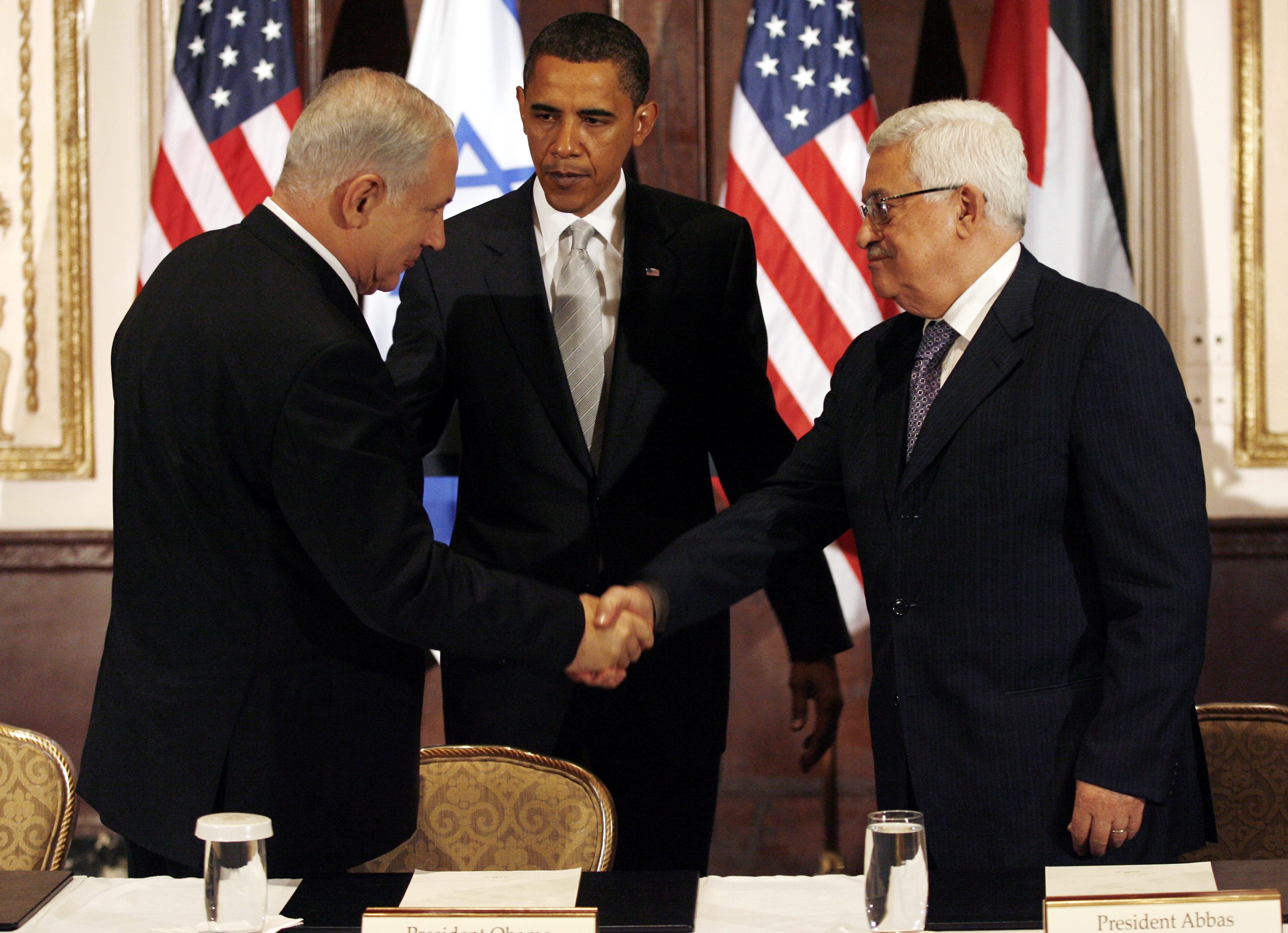
The Obama Administration has come a long way to get to this point. The year-long tussle with Israel over West Bank settlement construction, a botched photo-op between the Israeli and Palestinian leadership in New York one year ago, and painstaking attempts to bring the parties to direct talks in recent months have eroded the optimism and expectations that came with the election of President Obama.

However, there are a number of essential ingredients that the Administration has got right as it launches direct talks. Martin Indyk mentioned four of them last week in the New York Times: 1) there is very little violence between the parties today; 2) settlement activity has been limited; 3) the majority on both sides support a two-state solution; and 4) the contours of an agreement are largely already known. Here are four more:

First, violence is down because security cooperation between Israel and the Palestinians is at an all-time high. Palestinian security forces trained with the direct support and supervision of the United States, Israel and Jordan have significantly secured the West Bank and created an atmosphere conducive to economic growth. The success of the burgeoning Palestinian security force is providing Israelis with much needed confidence. Security is – and always has been – Israel’s number one concern. With such cooperation already in place, these talks will have a distinct advantage over all other previous efforts.

Second, the Arab states have endorsed President Mahmoud Abbas’ negotiating with Israel and pledged to be part of the effort. The inclusion of Egypt and Jordan in the launch next week is vital. As co-chairs of the Arab League’s Arab Peace Initiative follow-up committee, Egypt and Jordan bring with them the promise of normal relations for Israel with 22 Arab states following a successfully negotiated agreement on the final status issues.

Regardless of whether Yasser Arafat truly intended to achieve peace with Israel, he never enjoyed the mobilized support of the Arab states, let alone the United States and Israel. Mahmoud Abbas does. The Arab states are providing Abbas with the kind of backing and legitimacy to negotiate with Israel on all of the sensitive final status issues that he will need in order to conclude a historic agreement. This is particularly significant given the political split of the Palestinians between the West Bank and Gaza.

Third, the Palestinians are invested in building the foundation for a Palestinian state. The Palestinians have been plagued in previous negotiation efforts by poor governance and widespread corruption. While concerning issues remain, the progress of Prime Minister Salaam Fayyad to establish the infrastructure for a future state – like the aforementioned security advancements – distinguishes these negotiations from previous ones. The success of the state-building effort to this point and the growth of the West Bank economy lends credibility to the moderate leadership of Abbas and Fayyad and their ability to govern a viable, contiguous state, should the political process enable one to be established. Their efforts should also give Israelis added confidence that they would be establishing a conflict-ending agreement with a responsible neighbor.

Fourth, the Netanyahu government has been calling for negotiations for months, repeatedly stating that an agreement could be reached quickly if negotiated in good faith. The Administration now has a chance to test them on their word.

The make-up of the Israeli government presents both a challenge and an advantage to the renewed talks. The fact that this is a largely right-wing government intended to provide Israel with essential guarantees on security could bolster confidence among the Israeli public for an agreement, should one be achieved. This would remain true even if the government were at some point to replace Avigdor Lieberman’s Yisrael Beiteinu party with Tzipi Livni’s Kadima party. Just as the Likud Prime Minister Menachem Begin secured a peace agreement with Egypt, so too might the current Likud Prime Minister secure the elusive peace agreement with the Palestinians.

Finally, the White House has pledged to be actively engaged and bridge the gaps when necessary. The failed Annapolis process proved that Israelis and Palestinians need the United States to be at the negotiating table in order to help the parties bridge the gaps.

Active engagement by the United States does not just require bridging proposals, but also reminding the parties of the interests at stake. To Israelis, concluding an agreement with the Palestinians would certainly help amplify efforts to mobilize the international community to counter the threat from Iran. To Palestinians, a viable and secure state can only come about through negotiations.

However, even with these various important ingredients in place, there remains a missing one that is vital to the success of direct talks: trust. Without trust between the parties – or in the United States’ leadership – the current effort will undoubtedly fail. Building this trust, beginning with navigating the parties past the September 26th deadline of Israel’s settlement moratorium, is clearly the United States’ most pressing challenge in the weeks ahead. But the foundation to succeed in doing so is beginning to be put into place. The Administration deserves some credit for laying it.

– Peter A Joseph is the president of the Israel Policy Forum

Analysis: US Struggles With Image in Pakistan

By Foster Klug  for The Associated Press

U.S. efforts to help Pakistani flood victims will give America’s image there a boost, but not much of one.

The U.S. reputation in a country the Obama administration sees as crucial to defeating the Taliban and al-Qaida already is so tarnished that even millions of dollars from Washington and the work of U.S. soldiers and diplomats probably will do little to change the thinking of most Pakistanis.

After all, U.S. flood aid is only a drop in a bucket already filled with billions of American dollars that have been shipped to Pakistan since the Sept. 11, 2001, terror attacks against the United States.

All that money, apparently, has done little to impress. A recent Pew Foundation poll found nearly six in 10 Pakistanis viewed the United States as an enemy; only one in 10 called it a partner.

Still, the Obama administration does not have the option of doing nothing.

The U.S. interest in helping goes beyond easing the suffering of the more than 17 million people affected by the floods. Washington also wants Pakistan’s weak civilian government to succeed so that it does not lose ground to the aid work of Muslim charity groups associated with militants.

Making sure the pro-U.S. government looks good, or at least competent, is important to the Obama administration as it encourages Pakistan in its fight against militants operating along the border with Afghanistan, where the United States is fighting a 9-year-old war.

Robert Hathaway, director of the Woodrow Wilson Center’s Asia program, warns against expecting U.S. aid to immediately turn around the deep distrust many Pakistanis feel toward America. “This relationship has a lot of baggage, and it will take an incredible amount of hard work over many years really to rebuild,” Hathaway said.

Many in Pakistan see the United States as interested more in killing insurgents than in helping the country’s poor. Past U.S. support for former Gen. Pervez Musharraf and other military rulers has fueled a perception that Washington cares little about Pakistan’s democracy. Then there is the idea in Pakistan that the United States is anti-Muslim, a view that could be strengthened by opposition to a mosque planned near the World Trade Center site that Islamic extremists destroyed in 2001.

Dan Feldman, the Obama administration’s deputy special representative for Afghanistan and Pakistan, recently bristled at the notion that U.S. relief work is an attempt at image improvement. “We’re doing it as a response to a humanitarian crisis,” he said.

Still, the United States has made sure to spread the word of its response to the floods aggressively, with senior U.S. officials, including Secretary of State Hillary Rodham Clinton, making regular statements.

Feldman said in a briefing this week that the United States is providing up to $150 million in aid. U.S. military helicopters have evacuated thousands of people and delivered hundreds of tons of relief supplies. Among those supplies are 700,000 mosquito nets to help families ward off malaria, giant water treatment machines to provide safe drinking water and tens of thousands of blankets and inflatable boats to help isolated villages.

For people saved from rising waters by U.S. helicopters or given lifesaving medicine or food, America’s image will rise. U.S. aid cannot reach every flood victim, however, and not everyone getting the aid will know it is from the United States.

Along with worrying about helping as many people as possible, the Obama administration also must keep an eye on insurgents who know the people and the terrain and can use the flood to build support among its victims.

Jason Campbell, a South Asia analyst at the Rand Corp. think tank, said Washington understands that any “gaps in U.S. assistance will likely be filled by charities that, if not directly tied to militant groups, are at least sympathetic with them.”

The U.S. aid could provide another boost to counterinsurgency efforts. The sooner the Pakistani military can scale down its relief work, the sooner it can return to fighting insurgents.

Teresita Schaffer, a former State Department South Asia specialist, said the United States must do everything it can to help. But, she said, “I don’t think there will be an attack of the warm fuzzies just because we’re providing some helicopters.”

Aid Flooded Pak by Withdrawing Army

By Swaminathan S Anklesaria Aiyar for The Times of India

Pakistan is suffering its greatest human tragedy since Partition. The floodwaters of the Indus are an incredible 20 miles wide, sweeping away entire towns, villages and farms. Over 20 million people have been displaced, far more than the nine million displaced by Partition in 1947. The immediate death count of 1,500 will soon increase hugely through disease and deprivation. Rehabilitation could cost $100 billion.

Some Indians might be perverse enough to rejoice that an enemy has been hit by a natural disaster — an act of God, as it were — and will be crippled economically for years. But most Indians will surely want to help their neighbours. In these traumatic times, we need to think of Pakistanis as humans in distress, not foes.

Even those who cannot think beyond realpolitik should see that the floods are potentially a strategic disaster for India too. Flood damage will create a fertile breeding ground for Islamist militancy. Islamist NGOs with links to terrorist groups like the Lashkar-e-Taiba and Jaish-e-Mohammed are at the very forefront of flood relief efforts and hence are gaining popularity. Meanwhile, the civil administration is seen as corrupt and ineffective. President Asif Zardari has further ruined his low reputation by going on foreign junkets.

The Pakistani army has in the last year battled some, though by no means all, militant groups in Swat and FATA (federally administered tribal areas). But much of the infrastructure built to reach the remote tribal areas has been destroyed by the floods. Besides, the Pakistani army is redirecting its efforts in the region, from combating militants to combating flood damage. The militants are re-occupying the resultant political vacuum.

The ISI recently came out with a study suggesting that Islamist militants had become a greater threat to the country than India. Flood damage can only deepen that perception. True, the army wants to back the Afghan Taliban even while battling the Pakistani Taliban, and this results in muddled thinking and sabotage of peace initiatives. The resolution of these contradictions is not in sight.

One day, the Pakistani army and the ISI will have no choice but to confront the reality that Islamist militants are Frankensteins that threaten their own creator. The ISI’s assessment should bring that day somewhat closer.
In the light of both human and strategic considerations, how can India help Pakistan? Individual contributions from Indian citizens must be encouraged, and red tape thwarting contributions in cash and kind must be cut. But the Indian government should not offer more than a modest amount of food and financial aid. Pakistan requires billions of dollars for relief and rehabilitation, so anything India offers will be a drop in the ocean.

Besides, recipients are rarely grateful for alms: they resent being supplicants, and suspect the motives of the donors. The US saved India from mass starvation after the twin droughts of 1965 and 1966 by giving record food aid. But this won the US very few friends and stoked resentment from many who felt India’s independence was being compromised. The US will once again be the chief donor to Pakistan, but will gain virtually no popularity or gratitude.

If food and financial aid will not help much, how can India best help Pakistan? The best way will be for the Indian Army to unilaterally withdraw from the border in Punjab, Rajasthan and Gujarat. This will pose no military risk whatsoever: flood-stricken Pakistan cannot possibly embark on military adventures against India. But the withdrawal of Indian troops will mean that the Pakistan army loses all excuses to avoid diverting manpower and financial resources from the border to flood relief and rehabilitation. This will cost India nothing, yet will release very large resources within Pakistan. Its impact on the Pakistani psyche will be significant. Even analysts who distrust Pakistan agree widely that India has no alternative to diplomatic engagement: cutting off ties will not win any minds and hearts there. Unilateral withdrawal will itself be a form of engagement, and will encourage other forms.

The wrong strategy will be to try to negotiate a mutual withdrawal of troops. Withdrawal must be unilateral and immediate. Defence hawks will express dismay that India is so soft on an enemy that encourages terrorism. But unilateral withdrawal will be a flood relief measure, not a military surrender. In the bargain, it will oblige Pakistan to withdraw its own troops and redeploy them for flood relief: its public opinion will be outraged otherwise.

Dr Manmohan Singh, you say we must be proactive in the peace process with Pakistan. The tragic floods there have given you an opportunity to be proactive in a way that will not come again. Go for it.

U.S. Strategy in Pakistan Is Upended by Floods

By Mark Landler for The New York Times
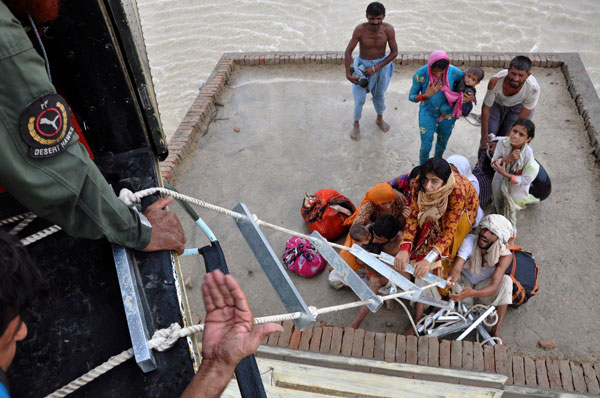
WASHINGTON — The floods in Pakistan have upended the Obama administration’s carefully honed strategy there, confronting the United States with a vast humanitarian crisis and militant groups determined to exploit the misery, in a country that was already one of its thorniest problems.

While the administration has kept its public emphasis on the relief effort, senior officials are busy assessing the longer-term strategic impact. One official said the disaster would affect virtually every aspect of the relationship between the United States and Pakistan, and could have ripple effects on the war in Afghanistan and the broader American battle against Al Qaeda.

With Pakistan’s economy suffering a grievous blow, the administration could be forced to redirect parts of its $7.5 billion economic aid package for Pakistan to urgent needs like rebuilding bridges, rather than more ambitious goals like upgrading the rickety electricity grid.

Beyond that, the United States will be dealing with a crippled Pakistani government and a military that, for now, has switched its focus from rooting out insurgents to plucking people from the floodwaters. The Pakistani authorities, a senior American official said, have been “stretched to the breaking point” by the crisis. Their ragged response has fueled fears that the Taliban will make gains by stepping in to provide emergency meals and shelter.

“It certainly has security implications,” said another official who, like others interviewed for this article, spoke on the condition of anonymity because he was not authorized to discuss internal policy deliberations. “An army that is consumed by flood relief is not conducting counterinsurgency operations.”

On Thursday, the United Nations will convene a special meeting devoted to the floods, hoping to galvanize what has been a lackluster global response. Secretary of State Hillary Rodham Clinton is expected to announce that American public aid has surpassed $100 million, an official said.

“We’re obviously not oblivious to the political and strategic implications of this catastrophe, but right now, we are fully focused on the emergency relief effort and trying to get a good assessment of the needs,” said the administration’s special representative to the region, Richard C. Holbrooke.

Noting that several weeks remain in the monsoon season, Mr. Holbrooke said, “Worse may be yet to come.”

The disaster comes after a period in which the administration seemed to have made strides in repairing the American relationship with Pakistan. Mrs. Clinton visited Islamabad in July with a long list of pledges, including the upgrading of several power plants and a plan to promote Pakistani mangoes. Now, these projects seem almost beside the point.

“Before, there were power plants in need of refurbishment,” said Daniel S. Markey, senior fellow for India, Pakistan and South Asia at the Council on Foreign Relations. “Now there are power plants underwater.”

In recent days, the United States has sent 15 helicopters, rescuing nearly 6,000 people. On Wednesday, military cargo planes delivered 60,000 pounds of food and other relief supplies, bringing total deliveries to 717,000 pounds. The speed and scale of the effort, officials in both countries said, have helped bolster the checkered American image in Pakistan.

In another hopeful sign, officials said Pakistan and India had been in close touch about the floodwaters, some of which are flowing into Pakistan from India. Such communication, between historic archenemies, could augur reduced tension in other areas, one of the officials said.

Against that, however, are the staggering dimensions of the disaster. A senior Pakistani official told the administration on Tuesday that the next flood surge was likely to inundate much of Punjab, the densely populated region that borders India and produces much of Pakistan’s food.

So far, this official said, the greatest damage has been in regions that are also hotbeds for Islamic insurgents, which has set back the army’s fight against extremist groups. Local governments in those places have largely collapsed, leaving the army as the only source of authority.

With 20 million people displaced from their homes, the Pakistani authorities are girding themselves for an immense migration to the major cities, which they fear could sow further instability.

“Americans have not yet registered the enormity of the crisis,” Pakistan’s ambassador to the United States, Husain Haqqani, said in a telephone interview from Islamabad, the capital.

Pakistani and American officials said reports of hard-line Islamic charities providing relief were exaggerated. One pointed out that the floods had hurt the insurgents as well: there was a report of small arms and ammunition belonging to a militant group floating in the water.

Still, people in both countries warned that if rebuilding and rehabilitation efforts bogged down, the Taliban and other militant groups would try to take advantage of it. “The real test is, can their government provide the most fundamental services?” said an administration official.

Parallels to this crisis are hard to find. One official cited the example of the Indonesian province of Aceh, which had been racked by a three-decade insurgency fought by the separatist Free Aceh Movement. After the tsunami swept through in 2004, killing 170,000 people, the separatists and the Indonesian government quickly signed a peace treaty, in August 2005.

There are, however, big differences between a localized separatist group and an international jihadist movement.

“If the flood proves to tilt the balance of power in Pakistan, it’s more likely to tilt toward the militants than toward the government,” said Bruce Riedel, a former intelligence official who helped the administration formulate its initial policy for Pakistan and Afghanistan.

Already, Pakistan’s president, Asif Ali Zardari, has been exposed to withering criticism at home for going on a trip to Europe during the early days of the flood. American officials said they were determined not to get drawn into the dispute, noting that in any event, Mr. Zardari had been stripped of many of his powers in a recent constitutional change.

Decisions on how the flood will affect American economic aid may be influenced by a trip to Pakistan by Senator John Kerry, the Massachusetts Democrat who co-sponsored the five-year nonmilitary assistance package with Senator Richard G. Lugar, Republican of Indiana.

Senator Kerry, accompanied by Dan Feldman, a deputy to Mr. Holbrooke, is scheduled to tour the flooded areas on Thursday. Mr. Kerry has said he is open to redirecting aid money, though some analysts said they were skeptical that Congress would approve additional financing. Military aid may also come under scrutiny, according to administration officials.

“Every dimension of our relationship — politics, economics, security — is going to see major shifts as a result of this historic disaster,” said Lt. Gen. Douglas Lute, the White House coordinator for Afghanistan and Pakistan. “All the tools of diplomacy have to be examined in light of this new reality.”
The Scope of Pakistan’s Floods: By the Numbers

By David Knowles for AOL News

Dubbed Pakistan’s “flood of the century,” heavy monsoon rains have washed out upward of one-fourth of the area of the country. The scope of the ongoing devastation is on a scale that is difficult to comprehend, especially to those far away and unfamiliar with the territory. Still it is alarming to consider the estimate given by concerned officials on Wednesday — that up to one-fifth of the entire landmass is now underwater.

The flooding has largely been located in the center of the country and is being caused by overflow from the Indus and Chenab rivers. Surge Desk has been rounding up the figures from the tragedy and has the following context.

Area
Some 150,000 square kilometers, or approximately 93,000 square miles, have been affected by the rising waters, Voice of America reported. That’s a little smaller than the size of the state of Michigan.

Fatalities
So far, at least 1,600 have been killed in the floods.

Agricultural losses
The floods have so far destroyed 2 million bales of cotton, BusinessWeek reported, nearly one-seventh of the country’s yearly target. In addition, 500,000 tons of wheat have been ruined, The New York Times said.

U.S. military response
One thousand U.S. Marines and 24 military helicopters have been deployed to Pakistan to help with relief efforts, The Associated Press reported.

Pakistanis displaced

According to the United Nations, 7 million citizens of Pakistan have been left homeless because of the floodwaters. Furthermore, the U.N. estimates that 14 million Pakistanis, roughly 8 percent of the country’s population, have been adversely affected by the floods. According to UNICEF, 6 million of those are children. All told, approximately 4,700 villages have been wiped out, Voice of America news reported.

Effect on war with the Taliban
Some 60,000 Pakistani troops that had recently been fighting the Taliban have now been put on flood assistance, The Telegraph reports.

Foreign aid
The United Nations is seeking foreign contributions of $460 million to tend to immediate needs, such as food, water and temporary shelters. The United States has pledged $71 million in aid, the biggest amount offered by any country so far, The New York Times reports.