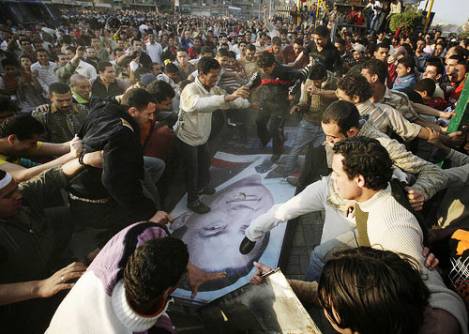
Archive for the ‘ Democracy ’ Category

Saudi Arabia to Allow Women to Vote

By Jeffrey Fleishmam for The Los Angeles Times
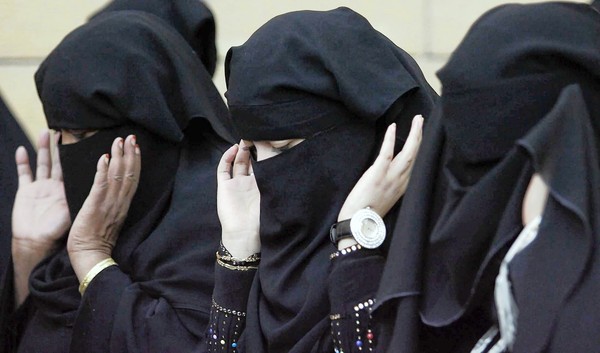
King Abdullah of Saudi Arabia surprised his ultraconservative nation Sunday by announcing bold reforms that for the first time will give women the right to vote, run for local office and serve on the Shura Council, the king’s advisory board.

The measures by an aging monarch who has battled Islamic hard-liners for years will marginally improve the standing of women in a country that still forbids them to drive or leave the house without their faces covered. The moves appear likely to enrage religious conservatives while advancing at least a veneer of change in one of the world’s most repressive states.

“Because we refuse to marginalize women in society in all roles that comply with sharia [Islamic law], we have decided … to involve women in the Shura Council as members, starting from the next term,” the king said in a five-minute speech to his advisors.

He added: “Women will be able to run as candidates” in the 2015 municipal election “and will even have a right to vote.”

The announcement suggests that the ailing 87-year-old king seeks a legacy as a reformer, despite making only modest inroads on human rights. Abdullah built the country’s first coeducational university and has granted 120,000 scholarships to students, many of them women, to study outside the country. Each move was opposed by clerics and religious ultraconservatives in the royal family.

Allowing women to vote is “hugely significant,” said Lubna Hussain, a Saudi writer. “The king is implementing the reform promises he made when he became leader. It shows he is not willing to pander to religious fundamentalists … who are quite weakened and don’t seem to have the voice they used to.”

The new rights for women come as Saudi Arabia has bristled at demands for political freedoms that have sparked spirited rebellions across the Arab world and toppled such longtime allies of the king as Egyptian President Hosni Mubarak. When rumblings of revolt echoed in Saudi Arabia, the government, whose security forces are omnipresent, promised $130 billion in salary raises and spending for social and religious programs.

Such largesse and attempts at modernization have kept Abdullah popular even as challenges to the royal family have been quickly crushed. Saudi dissidents and human rights groups have condemned the government for crackdowns that have occasionally damaged the king’s image and led to criticism that his family’s reliance on religious conservatives to stay in power makes him too cautious a reformer.

The king is the counterbalance to influential anti-reformist forces, including Prince Nayif ibn Abdulaziz, the interior minister, who many believe may succeed Abdullah. Nayif is sympathetic to fundamentalist Wahhabi clerics who uphold the segregation of sexes and have resisted the monarch’s attempts at modest reforms to ease religion’s grip on schools, courts and other institutions.

Yet discriminatory laws, such as those preventing women from driving, have become an international embarrassment for the kingdom, a key U.S. ally that relies on oil wealth to expand its diplomatic stature. A number of women were arrested over the summer for defying the driving ban. Analysts predicted that by allowing women to vote the king has opened the possibility for wider rights debates.

But others said the latest reforms were diversions that did little to change the plight of women in a country where they can be flogged for adultery and cannot travel abroad without the permission of a male guardian.

“It’s a mixed feeling. On one hand he opens the door for her and on the other hand she is still banned from driving,” said Mohammad Fahad Qahtani, a college professor and human rights advocate. “It doesn’t save her from horrible treatment by government agencies and the courts. It’s a symbolic gesture, but it is in no way enough to improve the lives of women.”

He added: “These rights to vote are still, if you see how it’s worded, are contingent on Islamic jurisprudence. So we’ll have to see in coming years what happens. The devil could be in the details. But maybe it’ll get some international praise for the regime.”

Sunday’s announcements “represent an important step forward in expanding the rights of women in Saudi Arabia, and we support King Abdullah and the people of Saudi Arabia as they undertake these and other reforms,” said Tommy Vietor, spokesman for the U.S. National Security Council.

The change will not alter the Saudi power structure. Municipal councils have little authority and only half their members are elected. The Shura Council, a body akin to a parliament but with no legislative power, advises the king on economic, social and international affairs.

But liberals and activists believe that even a little nudge forward in the kingdom is significant.

“It’s almost like a watershed,” said Hussain, who has written eloquently over the years on women’s rights. “You’ll now have women in [the Shura Council] taking up women’s causes. Before it was men talking for us. It’s quite revolutionary and it will open up a Pandora’s box.”


Anna’s Trip to Pakistan: Should He Or Shouldn’t He

By Akshaya Mishra for Firstpost

Should he or shouldn’t he?

The supporters of Anna Hazare are in a bind. Two days after the Gandhian accepted the invitation of a human rights delegation from Pakistan to visit that country, the public opinion in India stands divided.

The Shiv Sena was first off the block opposing Anna’s move. Its argument follows the usual political theme. Islamabad must stop sponsoring terrorist activities in India first. The anti-corruption crusader should have taken cognisance of the sentiments of people before even considering such an invitation, it said.

Others are likely follow the Sena’s line soon. The hard line Hindutva followers, who have been silent so far, may erupt in anger, putting a communal spin to the visit.

Anna might just have put his feet in uncharted territory, and a minefield of potential controversies. Pakistan is not an easy proposition even for seasoned politicians to handle. He could be risking his reputation.

So, should he or should not he? There are no easy answers.

Anna is not just an individual, he is a phenomenon. He is an idea that easily transcends boundaries. The massive support to his anti-corruption movement across the social spectrum was a pointer to the fact.

“I will go to Pakistan. In fact, I will go anywhere for the sake of peace and poor people,” he said while meeting the Pakistani delegation, which included former judge of Supreme Court of Pakistan Nasir Aslam Zahid and founder of Pakistan India Forum for Peace and Democracy Karamat Ali.

Anna might just have put his feet in uncharted territory, and a minefield of potential controversies. PTI
“I believe in the religion of humanity, and humanity should begin with your neighbour. Like Indians, Pakistanis too are suffering due to widespread corruption in their country,” he added.

The statements reflect the man as he is — simple, honest and innocent of concerns that bother others so much. It’s possible he would not have given a serious thought to the troubled India-Pakistan equations. It is possible he would be worried about people and their happiness only, not issues or borders.

Isn’t corruption a big issue in Pakistan too? Don’t people suffer because of that? That would be his line of thinking. He would be oblivious to the fact that any movement there guided by him would amount to challenging the rulers in Islamabad and that any intention to help the country would inflame passions in India.

Sena chief Bal Thackeray has sounded the warning note. “Be it Anna or anyone else, they should first speak to kin of those killed in the Mumbai and Delhi blasts, before anointing themselves Nishan-e-Pakistan (Pakistan’s highest civilian award),” he wrote in the party mouthpiece Saamna today.

“Whether Anna goes to Pakistan or not is another matter, but it would have been better had he given a thought to the country’s sentiments on the issue,” he added.

Earlier, the party’s spokesperson Sanjay Raut had made his disapproval clear. “Anna should have told the visiting delegation to go back to Pakistan and create awareness among the people about the Pak-sponsored terrorism in India. The entire world may have praised the anti-corruption movement in India, but Anna cannot ignore sentiments of the people in his own country vis-a vis Pakistan,” he had said.

Anna is likely to lose most of his following in India if he goes ahead with his Pakistan trip, which for all practical purposes would be a symbolic one. Worse, notwithstanding the nature of his visit he would turn a political entity, without intending to be so.

His biggest achievement so far has been that he has managed to stay apolitical despite the desperate efforts from parties to align with him. He represents the common Indian and the other India, which stays out of the power circle that rules the country.

But the other India hates Pakistan too. This is where Anna is likely to run into a problem. Questions could be raised about his intention — the ordinary follower is not expected to understand and appreciate the nuances of his high thinking. The adulation for him is likely to shrink.

Anna should not let that happen. Pakistan can wait.

In This Country, Religious Freedom Is Real

By Imran Hayee for The StarTribune

My childhood memories of celebrating Independence Day are no different than those of my fellow citizens — except that it was on Aug. 14th instead of July 4th.

I grew up in Pakistan, which obtained its independence from British rule on Aug. 14, 1947.

As a child, I marked Independence Day year after year without having a clue about what independence really meant. As I grew older, I read from a speech of Muhammad Ali Jinnah, Pakistan’s founder, which he had delivered immediately after the nation’s independence was announced.

“You are free; you are free to go to your temples,” he said. “You are free to go to your mosques or to any other places of worship in this State of Pakistan. You may belong to any religion or cast or creed — that has nothing to do with the business of the State.”

This was Jinnah’s dream, the founding principle behind the independence of Pakistan as he himself stated in the same landmark speech: “We are all citizens and equal citizens of one State. We should keep that in front of us as our ideal and you will find that in due course, Hindus would cease to be Hindus and Muslims would cease to be Muslims, not in the religious sense, because that is the personal faith of each individual, but in the political sense as citizens of the State.”

Growing up in Pakistan, as a Muslim, I never saw Jinnah’s dream materializing. The constitution of Pakistan defines who is a Muslim — any “impersonator” is subject to imprisonment or death. Temples, churches and mosques not ascribing to a single distorted version of Islam are routinely attacked.

What caused the secular ideology of Jinnah to take this U-turn?

Soon after the nation’s creation in 1947, and Jinnah’s demise a year later, Pakistan’s rulers succumbed to the demands of religious extremists who wanted to convert Pakistan into a puritanical fundamentalist state.

Gradually, the monster of religious fundamentalism grew large enough to devour Jinnah’s philosophy of spreading freedom and equality.

I never experienced independence until I came to America 18 years ago. For the first time — when Independence Day was being celebrated on July 4th instead of Aug. 14th — I wanted to rejoice once again.

I was unaware of the history behind America’s Independence Day, but still, I saw freedom and equality prevail all around me. I could freely go to my mosque without having to fear the state’s interference.

As I learned more about the history behind July 4th, it reminded me of the same philosophy of freedom and equality that Jinnah dreamed for Pakistan. What made the difference in America was that its rulers never succumbed to extremists’ demands.

Rather, its forefathers risked their wealth and lives to uphold the principles of freedom and equality. Their sacrifices paved the way for a Muslim like me to emigrate from a Muslim country and practice Islam the way I wanted to but could not do in the country of my birth.

More recently, while some European countries have banned building minarets on mosques and the wearing of veils by Muslim women, U.S. courts have struck down any such attempted restrictions as unconstitutional.

Addressing the Muslim world in Cairo, President Obama proudly announced, “Freedom in America is indivisible from the freedom to practice one’s religion. That is why there is a mosque in every state of our union, and over 1,200 mosques within our borders. That is why the U.S. government has gone to court to protect the right of women and girls to wear hijab, and to punish those who would deny it.”

As a Muslim-American, I feel proud and honored to be in America and find many reasons to celebrate Independence Day on July 4th. Among others, let me add that the founding principles of America’s Constitution are in perfect harmony with the Qur’an.

The Qur’an (2:257) proclaims, “There is no compulsion in religion. Surely, the right way has become distinct from error.” It further declares fundamental human equality: “O mankind, We have created you from male and female; and We have made you into tribes and sub-tribes that you may recognize one another” (Qur’an 49:14).

These golden principles of freedom and equality have been implemented — in America. In fact, I find the American Constitution to be more Islamic than the constitution of Pakistan or of any other Muslim country in the world today.

Imran Hayee is a professor of engineering at the University of Minnesota Duluth.

The End of AfPak

By Scott Malcomson for The New York Times

Remember how after 9/11, Osama bin Laden’s attacks on us could be linked to almost anything, from shopping habits to the rediscovery of Western values to carbon-pricing schemes? Something similar appears to be happening with Bin Laden’s death. Jihadism sure isn’t what it used to be. After 10 years, it seems, the time has come to go home. Troops are and will be coming back to the United States from Iraq and Afghanistan. The military budget will be cut. The outgoing secretary of defense feels able to openly mock NATO because, presumably, he thinks he can afford to — because it doesn’t matter all that much. The global war on terror is being downgraded from Armageddon to something more out of Leviticus: a tricked-out police action, just as John Kerry, in this magazine, always said it should be. On Sunday, Helene Cooper and Mark Landler reported that “American success in the counterterrorism campaign would seem to bolster arguments for a swift withdrawal from Afghanistan.” By Tuesday morning, they were reporting that President Obama would announce his withdrawal plans on Wednesday. Meanwhile, a Harris poll revealed that 51 percent of Americans and 54 percent of Britons believed “the death of Bin Laden meant it was time to bring troops from their countries home.”

That isn’t quite how it looked when I was in Washington a few weeks ago and spoke with about a dozen current and former American officials and with Pakistanis. The impression they each gave was that American withdrawal would be speeded not because of Bin Laden’s death but because of Pakistan’s reaction to it. After the initial shock, Pakistan’s (government-influenced) press latched onto a narrative of “national humiliation” as a result of the American raid, rather than, say, one of jubilation at the demise of a killer whose fantasies have brought Pakistan nothing but misery. A younger generation of military officers — Pakistan is dominated by its military — seemed at times about to revolt in reaction to the insult to Pakistan’s sovereignty. And the Inter Services Intelligence (I.S.I.), Pakistan’s ubiquitous military intelligence outfit, reacted, as was subsequently reported, by scouring the neighborhood around Bin Laden’s house for … evidence of how the C.I.A. found out he was there, and to determine who had been helping the Americans.

Finally, the Pakistan government did not respond to the Bin Laden raid by pressing its new advantage and rolling up terrorist networks across the land. No, it did not do that at all. So Secretary of State Hillary Rodham Clinton and Admiral Mike Mullen, chairman of the joint chiefs of staff, went to Islamabad and on May 27 presented a list of demands. These included the arrest or elimination of Ayman al-Zawahiri (of Al Qaeda), Ilyas Kashmiri (a long-sought semi-free-agent and former Pakistani military man), Sirajuddin Haqqani (of the AfPak-border based Haqqani network) and Atiya Abdur Rahman (Al Qaeda), and the shutting down of bomb factories in Pakistan.

By June 3, Kashmiri was dead. But this promising start now seems isolated. The other wanted men are still at large. The bomb-makers might well be getting tipped off. The revolt by younger Pakistani officers seemed only to get worse.

In short, the U.S. and Pakistan are really not getting along. Among members of Congress, beating up Pakistan has become ritualized; Senators McCain and Rogers were doing it again on the Sunday programs. I wondered: How many times can Pakistan be abandoned? As Bruce Riedel, a former C.I.A. officer and the head of President Obama’s first major AfPak review, shows in his excellent new book, “Deadly Embrace: Pakistan, America and the Future of Islamist Jihad,” embrace and abandonment have formed the pattern of American-Pakistani relations since the majority-Muslim nation was formed out of the breakup of British India in 1947. Harry Truman’s lack of interest yielded to Dwight Eisenhower’s enthusiasm for Pakistan as an anti-Communist bulwark and a base for spying on the Soviets. The relationship was and remained built around security and intelligence. Lyndon Johnson reversed course when India and Pakistan went to war in 1965; he cut off both, but Pakistan had, unlike India, been a strong ally, and it felt betrayed. This set the pattern: ultimately, Pakistan was tactical and India was strategic.

Now, after almost 10 years of intense engagement, Pakistan and the U.S. appear set for another split; at least that was the consensus among the officials I spoke with. There was a pervasive sadness in these conversations. It was due in part to the sheer human effort that has gone into the U.S.-Pakistan relationship. A lot of spies and soldiers and diplomats and politicians have put years of their lives into making “AfPak” work, which requires making Pak work. A lot (not all) of that effort seems to be going down the drain, along with much of the billions of taxpayer dollars that financed it.

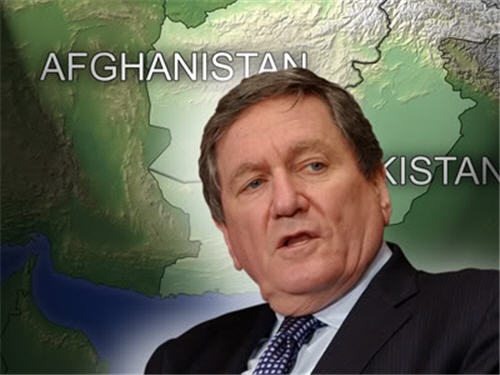
There is also personal sadness in that the AfPak effort was associated toward the end with Richard Holbrooke, whose death late last year brought the foreign-policy world up short. Holbrooke did not take great care of himself, so objectively his death could not be entirely a surprise, and among people over 70 the reactions I heard were more of the well-what-did-you-expect variety. But in the 35-to-65 range it was different. Holbrooke represented, very attractively, the assertion of youth and hope against experience. Even at 69 he had a distinct eagerness, even boyishness, alongside the baritone gravitas. He attracted bright young people. He could be young and old at the same time. Once he was gone, that sort of generational bridging disappeared. (Older figures are few in this administration.) The sense of continuity (as well as of optimism) is weakening. There’s something missing now.

There was also a sense of ideological loss of direction. For all their differences, Bill Clinton and George W. Bush shared a tangible optimism about American governmental involvement abroad. President Obama is different, and even if he weren’t the national mood is. The people’s representatives in Congress are vying to bring troops home faster, and if there is an internationalist remaining in the House he or she is keeping quiet. The Republican candidates for president seem to have settled on anti-war isolationism as a winning position. Obama’s great strength in foreign policy — his ability to repackage, and optimize, American power in a multipolar world — is the strategy that dare not speak its name, or it will bring accusations of “declinism.”

Finally, there is the tremendous sadness of Pakistan itself. The country doesn’t have enough water. It lacks the electricity to develop its industries. Literacy, by some reckonings, is actually declining. Democracy has been restored but the government is hardly stable. The one truly semi-stable institution, the military, is struggling against itself, just as Pakistanis are dividing, and attacking each other on an increasing scale (which is saying something).

But, in a way, the saddest thing of all, from a foreign-policy point of view — Pakistani or American — is that the one great card Pakistan has to play is to make itself a problem. Pakistan formed itself into a regional player through building its army, running terrorist proxies in Kashmir and Afghanistan, indulging in enough Islamist millenarianism to make itself frightening, and developing nuclear weapons. None of these strategies have a good future. But in the absence of a long-term committed relationship — what Holbrooke promoted as a “strategic partnership” — with the United States or, perhaps, with China, Pakistan is left with fear as its most successful export.

There was some discussion in Washington as to whether Mullah Omar’s name was on that list that Clinton and Mullen presented in Islamabad. It almost doesn’t matter. The doubt itself is the message: Pakistan stays valuable because it has terrorist “ties” or “links” or “proxies” or whatever. As national existential dilemmas go, Pakistan’s is particularly nightmarish. The U.S. will leave them to it — abandonment again — and choose the happier relationship with India. Secretary Clinton will be at the regional forum of the Association of Southeast Asian Nations in late July, helping to take her longtime initiative of eastward Indian engagement, and the integration of the United States into East Asian political structures, to a new level. This is part of a long-term strategy of accommodating the rise of China and of India.

And Pakistan, after 10 years, will be left behind; as the line in Washington goes, “There is no good solution.”

Pakistan Orders an Inquiry After Troops Kill a Teenager

By Salman Masood for The New York Times

President Asif Ali Zardari of Pakistan ordered an investigation on Thursday into the shooting death of an apparently unarmed teenager by paramilitary troops in the southern port city of Karachi. The shooting, which was captured on video and broadcast on national television, has led to protests and has been condemned by political parties and human rights groups.

It was the second time in recent weeks that a video has shown paramilitary troops using extreme force against civilians. Last month, five Chechens were gunned down in Quetta, Pakistan.

The shootings are sure to feed complaints that Pakistan’s security forces are too aggressive and sometimes bypass the sluggish and corrupt judicial system. Pakistan’s military leaders are also still embarrassed by the American raid on Osama bin Laden’s compound in Abbottabad, which the armed forces did not detect.

The victim of the Karachi shooting, Sarfraz Shah, whose age was given as 18 or 19, was stopped by paramilitary troops on Wednesday and accused of being involved in an attempted robbery in a nearby park.

A spokesman for the troops said a gun had been taken from him, but in the video, Mr. Shah does not appear to be armed when he is shot.

The recording shows the young man begging for mercy before being led toward a group of troops. One points his gun at Mr. Shah before firing several shots. Mr. Shah crouches, asking forgiveness while bleeding profusely.

“My hand is gone,” Mr. Shah shouts. “Take me to the hospital.” The troops step back, out of the video frame. A government official said five of the troops had been arrested.

Mr. Shah was buried on Thursday in Karachi, accompanied by protests from family members.

The shootings in Quetta last month were also recorded. The police and paramilitary troops initially reported that the victims, three women and two men, were suicide bombers. They were killed near a checkpoint on the outskirts of Quetta, the capital of Baluchistan Province in southwestern Pakistan, in a volley of fire as police officers stood by.

Video from local television networks showed one young woman raising her arm, as if to try to stop the gunfire. No weapons were recovered on the victims. An investigation of that shooting is under way.

The Pakistani security forces have repeatedly been accused of misusing their power. The army was accused of extrajudicial killings during a military operation to drive out militants that began in the Swat Valley in 2009. The army denied the allegations.

The country’s powerful intelligence agencies have also been accused of illegally detaining hundreds of terrorism suspects. And military intelligence has been accused of gross human rights violations in Baluchistan, where a separatist insurgency by Baluch nationalists has long simmered.

Pakistani Rangers, the group involved in Mr. Shah’s death, are controlled by the Interior Ministry. Rehman Malik, the country’s interior minister, announced the arrests in the case on Thursday evening, but he also accused Mr. Shah of being part of a gang involved in robberies, according to the local news media.

Mr. Malik said Mr. Shah had tried to steal a woman’s purse and was caught by guards in the park before being handed over to the Rangers.

The Rangers have been deployed in Karachi for several years and help the local law enforcement authorities in maintaining peace in the city, which is riven by political, ethnic and sectarian tensions.

Syria Steps Up Crackdown; International Outcry Grows

As Reported by Voice of America

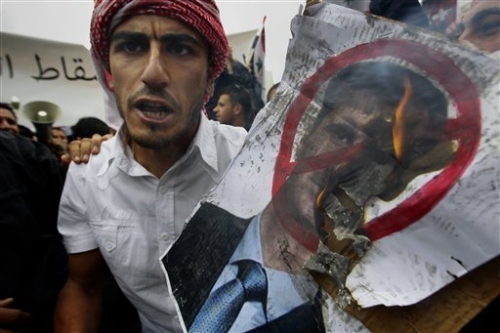
Syria has intensified its bloody military crackdown on pro-democracy demonstrators, as international criticism against the government’s action mounts. Gunfire continued Tuesday in the flashpoint city of Daraa, where an armed assault to end anti-government protests was in its second day.

Human rights activists say at least 34 people have been killed and dozens more arrested since Syrian troops and tanks entered the city at dawn Monday to crush the demonstrations.

Residents were said to be too afraid to venture out in Daraa. Electricity, water and telecommunications to the city remain cut.

Also Tuesday, thousands of riot police deployed near the coastal city of Banias and in two areas on the outskirts of the Syrian capital. Activists say clashes have been especially brutal near the town of Douma. Demonstrators who attempted to enter Damascus from there during the last two weeks were met with bullets.

More than 400 people have been killed since pro-democracy protests erupted last month. The Syrian rights organization Sawasiah said Tuesday the government has arrested at least 500 people during the ensuing crackdown.

Also Tuesday, the international response to Syrian President Bashar al-Assad’s brutal crackdown intensified. The U.S. ambassador to the United Nations accused the Syrian leader of “disingenuously blaming outsiders” for the protests.

Susan Rice also reiterated that Washington has evidence of active Iranian support for what she called Syria’s “abhorrent and deplorable” crackdown on peaceful demonstrators. She said the “outrageous use of violence to quell protests” must end now.

U.N. Secretary-General Ban Ki-moon also condemned “the continuing violence against peaceful demonstrators,” including the use of tanks and live fire that have “killed and injured hundreds of people.” The U.N. chief has called for an independent inquiry into the violence.

But Syria’s U.N. envoy said Damascus is capable of undertaking its own transparent investigation into the deaths of anti-government protesters, rejecting outside assistance.

Bashar Ja’afari also said the U.N. Security Council “should not rely on media reports” when making its decisions. Britain, France, Germany and Portugal asked the council to condemn Syria’s crackdown in a draft statement circulated on Tuesday.

Ja’afari told reporters Syria regrets civilian casualties, but said the unrest has “hidden agendas,” adding that some foreign governments are attempting to destabilize the country.

Earlier Tuesday, ltalian Prime Minister Silvio Berlusconi and French President Nicolas Sarkozy urged Syria to “show moderation” and halt the “violent repression” of peaceful demonstrations.

Turkish Prime Minister Recep Tayyip Erdogan telephoned Mr. Assad and urged him to show restraint. British Foreign Secretary William Hague said the European Union is exploring possibilities for action against Syria, including asset freezes and targeted travel bans on the country’s leadership.

While U.S. officials have condemned the violence against Syrian citizens, Defense Secretary Robert Gates and his British counterpart, Liam Fox, played down the likelihood of a Libya-style intervention in Syria.

At a joint news conference in Washington Tuesday, Fox said the world’s response to popular revolts across the Middle East and North Africa must reflect the circumstances in each country. Gates made a similar point, saying that although the U.S. applies its values to all countries in the region, its actions will not always be the same.

A U.S. State Department official said Tuesday that, for now, Washington will limit its response to diplomacy and possible sanctions.

Iran Calls Saudi Troops in Bahrain ‘Unacceptable’

By Ethan Bronner and Michael Slackman for The New York Times

A day after Saudi Arabia’s military rolled into Bahrain, the Iranian government branded the move “unacceptable” on Tuesday, threatening to escalate a local political conflict into a regional showdown with Iran.

“The presence of foreign forces and interference in Bahrain’s internal affairs is unacceptable and will further complicate the issue,” Ramin Mehmanparast, the Iranian Foreign Ministry spokesman told a news conference in Tehran, according to state-run media.

Even as predominantly Shiite Muslim Iran pursues a determined crackdown against dissent at home, Tehran has supported the protests led by the Shiite majority in Bahrain.

“People have some legitimate demands and they are expressing them peacefully,” Mr. Memanparast said. “It should not be responded to violently.”

“We expect their demands be fulfilled through correct means,” Mr. Mehmanparast added. Iran’s response — while anticipated — showed the depth of rivalry across the Persian Gulf in a contest that has far-reaching consequences in many parts of the Middle East.

On Monday, Iranian state-run media went so far as to call the troop movement an invasion. Saudi Arabia has been watching uneasily as Bahrain’s Shiite majority has staged weeks of protests against a Sunni monarchy, fearing that if the protesters prevailed, Iran, Saudi Arabia’s bitter regional rival, could expand its influence and inspire unrest elsewhere.

The Saudi decision to send in troops on Monday could further inflame the conflict and transform this teardrop of a nation in the Persian Gulf into the Middle East’s next proxy battlefield between regional and global powers. On Tuesday, there was no immediate indication that the Saudi forces were confronting protesters in the central Pearl Square — the emblem of the Bahrain protest much as Cairo’s Tahrir Square assumed symbolic significance in the Egyptian uprising.

Several hundred protesters camped out there on what seemed initially to be a quiet day with little traffic on the streets as the details of the deployment by Bahrain’s neighbors — and their mission — remained ill-defined.

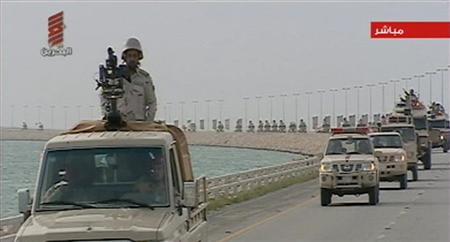
On Monday, about 2,000 troops — 1,200 from Saudi Arabia and 800 from the United Arab Emirates — entered Bahrain as part of a force operating under the aegis of the Gulf Cooperation Council, a six-nation regional coalition of Sunni rulers that has grown increasingly anxious over the sustained challenge to Bahrain’s king, Hamad bin Isa al-Khalifa. “This is the initial phase,” a Saudi official said. “Bahrain will get whatever assistance it needs. It’s open-ended.”

The decision is the first time the council has used collective military action to help suppress a popular revolt — in this case a Shiite popular revolt. It was rejected by the opposition, and by Iran, as an “occupation.” Iran has long claimed that Bahrain is historically part of Iran.

The troops entered Bahrain at an especially combustible moment in the standoff between protesters and the monarchy. In recent days protesters have begun to move from the encampment in Pearl Square, the symbolic center of the nation, to the actual seat of power and influence, the Royal Court and the financial district. As the troops moved in, protesters controlled the main highway and said they were determined not to leave.

“We don’t know what is going to happen,” Jassim Hussein Ali, a member of the opposition Wefaq party and a former member of Parliament, said in a phone interview. “Bahrain is heading toward major problems, anarchy. This is an occupation, and this is not welcome.”

Rasool Nafisi, an academic and Iran expert based in Virginia, said: “Now that the Saudis have gone in, they may spur a similar reaction from Iran, and Bahrain becomes a battleground between Saudi and Iran. This may prolong the conflict rather than put an end to it, and make it an international event rather than a local uprising.”

An adviser to the United States government, who spoke on the condition of anonymity because he was not authorized to talk to the press, agreed. “Iran’s preference was not to get engaged because the flow of events was in their direction,” he said. “If the Saudi intervention changes the calculus, they will be more aggressive.”

Though Bahrain said it had invited the force, the Saudi presence highlights the degree to which the kingdom has become concerned over Iran’s growing regional influence, and demonstrates that the Saudi monarchy has drawn the line at its back door. Oil-rich Saudi Arabia, a close ally of Washington, has traditionally preferred to operate in the shadows through checkbook diplomacy. It has long provided an economic lifeline to Bahrain.

But it now finds itself largely standing alone to face Iran since its most important ally in that fight, Hosni Mubarak of Egypt, has been ousted in a popular uprising. Iran’s ally, Hezbollah, recently toppled the Saudi-backed government of Lebanon — a symbol of its regional might and Saudi Arabia’s diminishing clout.

But Bahrain is right at Saudi Arabia’s eastern border, where the kingdoms are connected by a causeway.

The Gulf Cooperation Council was clearly alarmed at the prospect of a Shiite political victory in Bahrain, fearing that it would inspire restive Shiite populations in Saudi Arabia and Kuwait to protest as well. The majority of the population in Saudi Arabia’s eastern provinces, where the oil is found, is Shiite, and there have already been small protests there.

“If the opposition in Bahrain wins, then Saudi loses,” said Mustafa el-Labbad, director of Al Sharq Center for Regional and Strategic Studies in Cairo. “In this regional context, the decision to move troops into Bahrain is not to help the monarchy of Bahrain, but to help Saudi Arabia itself .”

The Bahrain government said that it had invited the force in to help restore and preserve public order. The United States — which has continued to back the monarchy — said Monday that the move was not an occupation. The United States has long been allied with Bahrain’s royal family and has based the Navy’s Fifth Fleet in Bahrain for many years.

Though the United States eventually sided with the demonstrators in Egypt, in Bahrain it has instead supported the leadership while calling for restraint and democratic change. The Saudi official said the United States was informed Sunday that the Saudi troops would enter Bahrain on Monday.

Saudi and council officials said the military forces would not engage with the demonstrators, but would protect infrastructure, government offices and industries, even though the protests had largely been peaceful. The mobilization would allow Bahrain to free up its own police and military forces to deal with the demonstrators, the officials said.

The Gulf Cooperation Council “forces are not there to kill people,” said a Saudi official, speaking on the condition of anonymity because he was not authorized to talk to the press. “This is a G.C.C. decision; we do not violate international law.”

But the officials also acknowledged that it was a message to Iran. “There is no doubt Iran is involved,” said the official, though no proof has been offered that Iran has had anything to do with the political unrest.

Political analysts said that it was likely that the United States did not object to the deployment in part because it, too, saw a weakened monarchy as a net benefit to Iran at a time when the United States wants to move troops out of Iraq, where Iran has already established an influence.

The military force is one part of a Gulf Cooperation Council effort to try to contain the crisis in Bahrain that broke out Feb. 14, when young people called for a Day of Rage, fashioned after events in Egypt and Tunisia. The police and then the army killed seven demonstrators, leading Washington to press Bahrain to remove its forces from the street.

The royal family allowed thousands of demonstrators to camp at Pearl Square. It freed some political prisoners, allowed an exiled opposition leader to return and reshuffled the cabinet. And it called for a national dialogue.

But the concessions — after the killings — seemed to embolden a movement that went from calling for a true constitutional monarchy to demanding the downfall of the monarchy. The monarchy has said it will consider instituting a fairly elected Parliament, but it insisted that the first step would be opening a national dialogue — a position the opposition has rejected, though it was unclear whether the protesters were speaking with one voice.

The council moved troops in after deciding earlier to help prop up the king with a contribution of $10 billion over 10 years, and said that it might increase that figure. But if the goal was to intimidate Iran, or the protesters, that clearly was not the first response.

Bahrain’s opposition groups issued a statement: “We consider the entry of any soldier or military machinery into the Kingdom of Bahrain’s air, sea or land territories a blatant occupation.”

In Pakistan, Justifying Murder for Those Who Blaspheme

By Aryn Baker for Time

“I believe in Jesus Christ who has given his own life for us,” the doomed man said, staring straight into the video camera. “And I am ready to die for a cause.” Shahbaz Bhatti had no hesitation in his voice as he responded to a question about threats from the Taliban and al-Qaeda. “I’m living for my community … and I will die to defend their rights.” It was his last answer in a four-month-old self-produced video that was to be broadcast in the event of his death. But the radicals had the final say. On March 2, Bhatti, Pakistan’s Minister for Minority Affairs, was shot dead in Islamabad. Pamphlets scattered on the ground claimed the act for a new alliance of “the organization of al-Qaeda and the Punjabi Taliban” and asserted that other infidels and apostates would meet the same fate.

Bhatti’s death had been foretold not just by himself but also in the nation’s response to a previous assassination, that of Punjab governor Salmaan Taseer on Jan. 4. Taseer, a self-made millionaire, had turned his largely ceremonial post into a platform for a campaign to amend Pakistan’s blasphemy laws. Bhatti, the only Christian in the Cabinet, refused to be a token and swore to battle intolerance. Both men supported clemency for Aasia Noreen, a Christian woman who had been accused of blasphemy and sentenced to death. Taseer’s stance on the issue infuriated a large part of the population that, thanks to religious leaders and school curriculums, believes that blasphemy is a sin deserving of execution. In the weeks leading up to his assassination, Taseer had been denounced at Friday prayers, excoriated in the media and largely abandoned by his Pakistan People’s Party (PPP) for fears that his campaign would prove politically toxic. The witch hunt culminated in a bodyguard’s pumping 27 rounds into his head and chest in the parking lot of a popular Islamabad shopping center.

Within hours of Taseer’s death, telephone text messages celebrating his assassination made the rounds. “Justice has been done,” read one. “If you love the Prophet, pass this on.” A Facebook fan page for assassin Malik Mumtaz Hussain Qadri garnered more than 2,000 members before site administrators shut it down. Even the leaders of state-funded mosques refused to say funeral prayers for the slain governor. When Qadri was transferred to a local jail, he was garlanded with roses by hundreds of lawyers — the vanguard of a movement that in 2008 helped unseat a military dictator — offering to take on his case for free.

At his court appearance a few days later, Qadri told the judge that he believed in a Pakistan where loyalty to the Prophet eclipses all other rights. According to Taseer’s daughter Shehrbano, her father “wanted an egalitarian society where open debate is protected and people are not killed for speaking out.” And Bhatti dreamed of a nation true to founder Muhammad Ali Jinnah’s vision, one where “you are free to go to your temples, you are free to go to your mosques or to any other place of worship.” Which vision prevails — Qadri’s or Taseer and Bhatti’s — will decide the future of the country.

The Roots of Extremism

 
It is not news that Pakistan has a lunatic fringe. What is disturbing is that after Taseer’s murder, when the silent majority finally spoke up, it praised Qadri, not his victim. The public reaction exploded the myth of Pakistan’s moderate Islam; Qadri belongs to a mainstream sect that routinely condemns the Taliban. “The Pakistan we saw in the wake of Taseer’s killing is the real Pakistan,” says Amir Muhammad Rana of the Pak Institute for Peace Studies. For the past two years, Rana’s organization has conducted in-depth interviews with a broad spectrum of Pakistani citizens. “They might dress Western and eat at McDonald’s, but when it comes to religion, most Pakistanis have a very conservative mind-set.”

Pakistan’s religious parties rarely do well at the polls — a fact often cited by those countering concerns that the country is going fundamentalist — but their street power is considerable. The furor over blasphemy appears to be partly in response to significant losses for the religious right in the 2008 elections. With the current government on the verge of collapse and popular sentiment against the PPP mounting, the religious parties are betting on significant gains if fresh elections are called. The case of Raymond Davis, a CIA contractor accused of killing two Pakistanis during what appears to have been a botched attempt to rob him, demonstrates the state of Pakistan’s politics. It has gone virtually unremarked in Pakistan that Qadri, a confessed murderer, has been hailed as a national hero, while Davis — who, whatever his background, seems to have been acting in self-defense — is considered worthy of the death penalty. Over the past few weeks, street rallies led by the religious right have simultaneously called for the release of Qadri and the hanging of Davis. (Read: “Pakistan’s Christians Mourn, and Fear for Their Future.”)

Using religion to shore up political support is nothing new in Pakistan. Founded as a Muslim nation carved from a newly independent India in 1947, Pakistan has long struggled to unite a diverse population divided by language, culture and ethnicity. Islam was the common denominator, but Jinnah was famously enigmatic about its role in government.

Then, in 1977, Muhammad Zia-ul-Haq, an Islamist military general, overthrew the democratically elected government of Zulfikar Ali Bhutto, who was already retrenching his secular vision of Pakistan in an effort to win religious support. To further appease Muslim religious leaders, Zia-ul-Haq strengthened the colonial-era blasphemy laws, mandating that breaches should be answered by the death penalty. Since then, more than 1,274 cases have been lodged. As repeating blasphemous words could be considered to be perpetuating the crime, many cases are accepted without evidence, a system well primed for the pursuit of vendettas. That nobody has yet been executed by court order is hardly reassuring: 37 of the accused have been killed by vigilantes. (In 1929, Jinnah famously defended an illiterate carpenter who shot to death a Hindu publisher accused of blasphemy. The plea failed, and after the carpenter was hanged, Taseer’s father was one of the pallbearers.)

The Uses of Blasphemy
When a nation rises up in support of a murderer instead of his victim, it’s hard not to believe it is heading down a dangerous path. “What is happening now won’t matter in five years,” says Shehrbano Taseer. “It will matter in 25 years. What we are seeing now is the fruit of what happened 30 years ago. If people had stood up against [Zia-ul-Haq], we would not be here today. Because of that silence we have madrasahs spewing venom, a true Islam threatened by the same people who claim to serve it, and a cowed majority too afraid to speak.”

President Asif Ali Zardari, an old friend of Taseer’s, condemned the murders but didn’t go to either funeral. After paying his respects to Taseer’s family, Interior Minister Rehman Malik gave an impromptu press conference outside Taseer’s house during which he announced that he too would kill any blasphemer “with his own hands.” A few days later, the Prime Minister announced that he would drop the issue of the blasphemy laws altogether. Meanwhile, the government is under pressure to go through with Aasia’s sentence, and now her two champions are dead.

Reaction to Bhatti’s murder has been muted, characterized mostly by denial. What little newspaper coverage there was focused on security lapses or the role of the country’s Christian community rather than on the motives of the killer. On television talk shows, members of the religious parties and right-wing commentators spun a conspiracy theory that alleged that Bhatti’s murder had been “a plot” hatched by “outside forces” to “divert attention from the Raymond Davis affair.” There was no mention of the fact that Bhatti was campaigning alongside Taseer on the issue of blasphemy.

The PPP was founded in 1967 with the goal of bringing secular democracy to a nation under military rule. It vowed to give power to the people and promised to protect the nation’s downtrodden. That Pakistan’s most progressive party — one that has already endured the assassination of former Prime Minister Benazir Bhutto — should cave in the face of religious fundamentalism speaks volumes about the strength of the religious right. A candlelight vigil promoting a progressive Pakistan a few days after Taseer’s assassination drew nearly 1,000 supporters; a religious rally in Karachi the same day had 40,000 in the street chanting Qadri’s name. “Taseer’s murderer was tried in the court of public opinion, and he has emerged a hero,” says a woman shopping for vegetables in the same market where the governor was killed. “If someone kills me because I criticize Qadri, will he too be called a hero?” She declined to give her name. (Read: “Murder in Islamabad: Pakistan’s Deepening Religious Divide.”)

Of course, few Pakistanis would ever go as far as Taseer’s or Bhatti’s killers. But their ambivalence can easily be manipulated. “Just because we are religious does not mean we will all be reaching for guns the next time someone says something wrong,” says Malik Khan, a university student who spent a recent afternoon at a shrine in Lahore dedicated to a revered Islamic saint. “But Salmaan Taseer was an extremist as well. He should not have touched the blasphemy law.” Khan received a text message praising Qadri and exhorting him to pass it along. It posed a moral quandary: “I don’t agree with the message,” he says. “But I love the Prophet. My thumb hesitated a long time over the delete button.” In the end, he passed the hate along.

Qadri himself was the religious-minded youngest son of a family just stepping into the middle class. Like his brother, he joined the special-forces branch of the Punjab police in 2002. He had been flagged as a security risk because of his strong religious leanings but was nevertheless appointed to Taseer’s security detail when he visited Islamabad. In his confession, Qadri said he had been inspired by the teachings of his local mullah, Hanif Qureshi. At a rally a few days later, Qureshi claimed credit for motivating Qadri. “He would come to my Friday prayers and listen to my sermons,” he said. Then he repeated his point: “The punishment for a blasphemer is death.”

But is it? Two weeks after Taseer’s murder, I visited Qari Muhammad Zawar Bahadur, the head of one of Pakistan’s mainstream religious groups and a co-signer of a statement that advised Muslims not to show “grief or sympathy on the death of the governor, as those who support blasphemy of the Prophet are themselves indulging in blasphemy.” For more than an hour, he justified his group’s stance, telling me that the Koran was clear on the issue. I asked Bahadur to show me the exact verse that detailed the punishments for blasphemy. He mumbled that “there are several passages,” as if there were so many, he couldn’t decide which one to quote. When pressed further, he consulted a Koran and read aloud a passage that spoke of killing a man who had once harmed the Prophet.

That verse has routinely been dismissed by leading Islamic scholars as referring to a specific case and having nothing to do with blasphemy. They say there is no definition of blasphemy in the Koran, nor any prescription for its punishment. “Nobody challenges these mullahs, and that is our problem,” says Omar Fazal Jamil, who runs a p.r. firm in Lahore. “We can’t invoke liberal secular values anymore. I have to have the knowledge to contradict these men who distort our religion for their own political gain. I have to be able to say, ‘No, this did not happen, this is not right, and show me where it says in the Koran that blasphemers should be shot on sight.’ ”

The Sin of Silence
In the absence of such challenges, those favoring religious intolerance will continue to have things go their way. In late 2007, Benazir Bhutto released an updated manifesto for her father’s party. “The statutes that discriminate against religious minorities and are sources of communal disharmony will be reviewed,” it said. Less than a month later she was dead, killed in a bomb attack just 13 km from where both Taseer and Bhatti were murdered. Her death was an opportunity to rally the nation against the forces of extremism. Instead the party focused on consolidating power. The manifesto remains an empty promise, and two more voices of tolerance have been silenced. For evil to prevail, goes the old aphorism, all that is required is for good men to do nothing.

— With reporting by Ershad Mahmud / Lahore and Omar Waraich / Rawalpindi

The Myth of ‘Moderate Pakistan’

By Sadanand Dhume for The Wall Street Journal

It’s time to bury the myth of moderate Pakistan. You know the one: the notion, repeated ad nauseam in magazine articles, think-tank reports and congressional testimony—as though saying it often enough will make it true—that Pakistan is an essentially tolerant country threatened by a rising tide of fundamentalism. Here’s a news flash: The tide has risen.

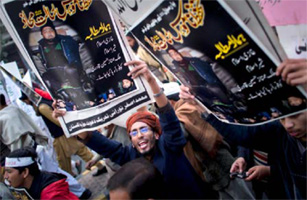
The most recent reminder of this came last Wednesday in Islamabad, when suspected Taliban militants shot dead Shahbaz Bhatti, Pakistan’s 42-year-old minister for minority affairs and the only Christian in the overwhelmingly Muslim nation’s cabinet. His crime? Supporting the repeal of a barbaric blasphemy law that makes insulting the prophet Muhammad punishable by death.

The law is often used to settle scores with hapless religious minorities, especially Christians such as Asia Bibi, an illiterate peasant sentenced to hang last year after she allegedly badmouthed the prophet during a row with Muslim coworkers. Bhatti’s assassination comes two months after a bodyguard murdered Punjab Gov. Salmaan Taseer for visiting Ms. Bibi in jail and speaking out against abuse of the law.

To be fair, Pakistan’s claim to relative moderation has been kept alive thus far by more than just wishful thinking. Overtly Islamist parties such as the Jamaat-e-Islami have rarely commanded more than a fraction of the national vote. Women enjoy freedoms in the public square that their counterparts in Saudi Arabia and Iran could only dream of. At great personal risk, a small but courageous group of activists, intellectuals and politicians speak out publicly against bigotry and religious intolerance.

Scratch the surface, however, and a bleaker picture emerges. Islamist parties may not garner large-scale electoral support, but Islamist ideas are widely tolerated by mainstream political parties. The major opposition party, former Prime Minister Nawaz Sharif’s Pakistan Muslim League, flaunts its closeness to sundry Islamists, including Jamaat-ud-Dawa, the parent organization of the international terrorist group Lashkar-e-Taiba.

Ostensibly secular, the ruling Pakistan Peoples Party supported both Kashmiri militancy and the Afghan Taliban in the past. In its current incarnation it appears permanently cowed by the country’s legion of vocal fundamentalists. President Asif Ali Zardari failed to attend the funerals of either Taseer or Bhatti. His government has made it clear that it will not touch the controversial blasphemy law. Interior Minister Rehman Malik declared that he would personally kill anyone who dared blaspheme Muhammad’s name.

As for Pakistan’s undeniably brave activists and intellectuals, unfortunately they appear to have more admirers overseas than among their compatriots. Hand-wringing in the pages of Dawn and the Friday Times, two of the country’s leading English-language newspapers, has not prevented Mumtaz Qadri, Taseer’s murderer, from becoming a national hero.

Not surprisingly, anti-American sentiment—often a reliable shorthand for a society’s paranoia and self-loathing—is rampant. According to the Pew Global Attitudes Project, American favorability ratings stood at 17% last year, the lowest of all countries surveyed. On the streets, bloodcurdling yells for the execution of alleged Central Intelligence Agency operative Raymond Davis, accused of killing two Pakistanis in January, have prevented the government from granting Mr. Davis the diplomatic immunity that the U.S. claims he is entitled to. This despite personal pleas by President Barack Obama and Sen. John Kerry.

By now the reasons for Pakistan’s predicament are well known. They include the intolerance embedded in the nation’s founding idea of a separate “land of the pure” for Indian Muslims, the malign shadow of Saudi Arabia on religious life, blowback from the anti-Soviet jihad of the 1980s, and the overwhelming influence that the army and its thuggish intelligence wing, the Inter-Services Intelligence, wield on national life. The army’s very motto, Jihad-fi-Sabilillah, or jihad in the path of Allah, is an exhortation to holy war.

For the international community, the long road to fixing Pakistan begins with the simple recognition that the country’s true face is not the urbane intellectual making reasoned arguments, but the frenzied mob showering rose petals on a murderer for his services to the faith. Over time, Pakistan can only be saved by re- arranging the basic building blocks of the country.

This means backing provincial autonomy and linguistic identity as an alternative to the centralized pan-Islamism used by the military and its supporters to weld the country together. It means deploying social networks and satellite television to open the door to reasonable discourse about religion. It means channeling aid to ensure that children are no longer taught to glorify Islamic conquest and reflexively mistrust the West and India. It means accepting that the most poisonous madrassas—such as Jamia Binoria in Karachi and Darul Uloom Haqqania outside Peshawar—must be shuttered if they can’t be reformed.

Needless to say, none of this will be easy. But the consequences of the alternative—pandering to fundamentalists while blaming outsiders for all the country’s ills—can be seen in the freshly turned soil of Bhatti’s grave.

-Sadanand Dhume is a resident fellow at the American Enterprise Institute and a columnist for WSJ.com.

How Hosni Mubarak Got Filthy Rich

By Rick Newman for US News Money

There are no Mubaraks on the Forbes list of the world’s richest people, but there sure ought to be.

The mounting pressure from 18 days of historic protests finally drove Egyptian President Hosni Mubarak from office, after three decades as his nation’s iron-fisted ruler. But over that time, Mubarak amassed a fortune that should finance a pretty comfortable retirement. The British Guardian newspaper cites Middle Eastern sources placing the wealth of Mubarak and his family at somewhere between $40 billion and $70 billion. That’s a pretty good pension for government work. The world’s richest man—Mexican business magnate Carlos Slim—is worth about $54 billion, by comparison. Bill Gates is close behind, with a net worth of about $53 billion.

Mubarak, of course, was a military man, not a businessman. But running a country with a suspended constitution for 30 years generates certain perks, and Mubarak was in a position to take a slice of virtually every significant business deal in the country, from development projects throughout the Nile basin to transit projects on the Suez Canal, which is a conduit for about 4 percent of the world’s oil shipments. “There was no accountability, no need for transparency,” says Prof. Amaney Jamal of Princeton University. “He was able to reach into the economic sphere and benefit from monopolies, bribery fees, red-tape fees, and nepotism. It was guaranteed profit.”

Had the typical Egyptian enjoyed a morsel of that, Mubarak might still be in power. But Egypt, despite a cadre of well-educated young people, has struggled as an economic backwater. The nation’s GDP per capita is just $6,200, according to the CIA—one-seventh what it is in the United States. That output ranks 136th in the world, even though Egypt ranks 16th in population. Mubarak had been working on a set of economic reforms, but they stalled during the global recession. The chronic lack of jobs and upward mobility was perhaps the biggest factor driving millions of enraged Egyptian youths into the streets, demanding change.

Estimates of Mubarak’s wealth will probably be hard to verify, if not impossible (one reason dictators tend not to make it onto Forbes’s annual list). His money is certainly not sitting in an Egyptian vault, waiting to be counted. And his delayed exit may have allowed Mubarak time to move money around and hide significant parts of his fortune. The Swiss government has said it is temporarily freezing any assets in Swiss banks that could be linked to Mubarak, an uncharacteristically aggressive move for the secretive banking nation. But that doesn’t mean the money will ever be returned to the Egyptian people, and it may even find its way to Mubarak eventually. Other Mubarak funds are reportedly sitting in British banks, and Mubarak was no doubt wily enough to squire away some cash in unlikely places. Plus, an eventual exile deal could allow Mubarak to retain some of his wealth, no questions asked, as long as he and his family leave Egypt and make no further bids for power.

Epic skimming is a common privilege of Middle Eastern despots, and Mubarak and his two sons, Gamal and Alaa, were a bit less conspicuous than some of the Saudi princes and other Middle Eastern royals seen partying from time to time on the French Riviera or other hotspots. The family does reportedly own posh estates in London, New York, and Beverly Hills, plus a number of properties around the Egyptian resort town of Sharm El Sheikh, where Mubarak reportedly went after resigning the presidency.

Mubarak also spread the wealth far and wide in Egyptian power circles—another Middle Eastern tradition—one reason he incurred the kind of loyalty that allowed him to rule for a remarkable three decades. Top Army officials were almost certainly on his payroll, which might help explain why the Army eased him out in the end—allowing a kind of in-country exile—instead of hounding him out of Egypt or imprisoning him once it was clear the tide had turned against him for good.

That money trail, in fact, will help determine whether Egypt becomes a more prosperous, democratic country, or continues to muddle along as an economic basket case. Even though he’s out of power, Mubarak may still be able to influence the Army officials running the country, through the financial connections that made them all wealthy. And if not Mubarak, the next leader may be poised to start lining his pockets the same way Mubarak did. For Egypt to have a more effective, transparent economy, all of that will have to be cleaned up. There are probably a lot of people in Cairo who have been checking their bank balances lately.

World Leaders React to Mubarak Resignation

By Henry Ridgewell for the Voice of America

With the resignation of Hosni Mubarak as president of Egypt and the transition of presidential powers to the military, leaders across Europe have called for a quick transition from military to democratic rule. And in cities across the Middle East, celebrations erupted in support of Egypt’s anti-government protests that brought down the man who had ruled Egypt for three decades.

As the protesters who had been calling for Mubarak to resign celebrated their victory in Cairo’s Tahrir Square, leaders across the world marked this milestone in Middle East history.

Since the protests began late last month, Western leaders had walked a tightrope, calling for democratic reform, but stopping short of openly calling for Mubarak, a long-time ally in the region, to resign.

Barely an hour after the announcement of Mubarak’s resignation, British Prime Minister David Cameron had this message for Egypt’s new rulers. “We believe it must be a government that starts to put in place the building blocks of a truly open, free and democratic society.”

The call for a quick transition from military to democratic rule was echoed across the capitals of Europe.

The European Union’s foreign affairs chief, Catherine Ashton, said Europe stands with the people. “To say to those who are now charged with being the guardians of the transitional period that we have high expectations that they will deliver for the people, and that the European Union will be there to offer its support.”

German Chancellor Angela Merkel urged Egypt to honor its international obligations. She said that by resigning, Mubarak “did one last service to the people of Egypt.” She expressed hope that future Egyptian governments would continue with peace in the Middle East and honor the treaties with Israel, saying the safety of Israel must be guaranteed.

From the United Nations in New York, United Nations Secretary General Ban Ki-moon hailed the patience of the protesters. “The voice of the Egyptian people, particularly the youth, has been heard and it is for them to determine the future of their country.”

In Tunisia, where a wave of unrest just a few weeks ago forced the collapse of that country’s government and inspired Egyptians and others, few could believe the chain of events that has since swept through the region.

Tunis resident Safia Ruwees summed up the mood. He said he wanted to congratulate the Egyptian people and all Arabs. He said, “These are democracies that we are bringing with our hands, no one has brought them to us, not America, not France, no one.”

Across the Middle East, people are taking to the streets in solidarity with the Egyptian protesters.

In Jordan, which has witnessed its own anti-government protests on a smaller scale, Egyptian flags filled the night sky.

It was the same story in Gaza where the roads filled with people celebrating. Hamas, which controls the Gaza strip, offered its support through spokesman Sami Abu Zuhri.

Zuhri said the resignation announcement in Egypt was the start of “victory of the Egyptian revolution,” and that Hamas supported the demands of the Egyptian people.

And in Beirut, there were more fireworks and more celebrations. Egyptian expatriate Issam Allawi gave his view. “We are very happy today that we were able to overcome the dictator Hosni Mubarak,” he said. Tomorrow, he said, “the next dictators throughout the entire Arab world.”

That final sentiment likely will be on the minds of many world leaders. While they praise Egypt’s show of people power, governments across the Arab world and beyond are wondering where might be next.

U.S. Pressure on Mubarak Opens a Rift With Arab Allies

Adam Entous, Julian E. Barnes, and Jay Solomon for The Wall Street Journal

President Barack Obama’s attempt to abruptly push aside Egyptian President Hosni Mubarak in favor of a transition government has sparked a rift with key Arab allies Saudi Arabia and United Arab Emirates, which fear the U.S. is opening the door for Islamist groups to gain influence and destabilize the region.

Vying to influence the outcome of events, Saudi Arabia and the U.A.E. have sent public and private messages of solidarity to Mr. Mubarak and his vice president, longtime intelligence chief Omar Suleiman, diplomats said. The messages amount to support for the president and Mr. Suleiman to oversee the transition and to ensure that Islamists can’t fill any possible power vacuum.

The support from Arab states has provided a measure of comfort to Mr. Mubarak, who announced he wouldn’t take part in September’s election. It may in part explain why the Egyptian president rebuffed Mr. Obama’s call for an immediate transition that includes the opposition.

The backlash shows how the turmoil in Egypt is rapidly reshaping U.S. policy in the region. In deciding to set itself against Mr. Mubarak, a U.S. ally for decades, the United States is now facing the disquiet of other friendly Arab governments, who have long provided support for American policy goals. Meanwhile, Islamists in the region, including Hamas and Hezbollah, believe they are on the ascent as U.S. allies falter.

Such a scenario was one that defenders of the Middle East’s status quo warned was possible, and shows how Mr. Obama’s options were all, in some sense, unpalatable. The president was criticized early in the unrest for not clearly favoring antigovernment protesters. Now, having done so, he might have alienated key regional U.S. partners in the fight against al Qaeda and Iran. People familiar with the situation said Israel, the United States’ closest ally, has privately echoed Arab concerns about a U.S. push to kick out Mr. Mubarak, and worries Washington underestimates domestic Egyptian support for the Muslim Brotherhood and other Islamist parties.

It is unclear how much sway the Saudis have with Mr. Mubarak’s regime in Cairo, given that the extent of its financial aid to Egypt isn’t known. The United States gives Cairo about $2 billion a year. Egypt and Saudi Arabia are major trading partners, and experts say Saudi and Egyptian intelligence services have especially close ties.

Saudi King Abdullah bin Abdulaziz al-Saud has harshly criticized Egyptian protesters in a statement carried by the Saudi state news agency, describing them as “infiltrators” bent on destabilizing Egypt and the region, accusing them of “malicious sedition.”

“You don’t need to read between the lines too much to see [the Saudis] are in favor of stability,” said Richard Fontaine, an analyst with the Center for New American Security and a former adviser to Republican Sen. John McCain of Arizona.

Senior officials from the U.A.E., another key regional ally, have said in recent days that the unraveling of Mr. Mubarak’s government threatens to provide breathing room for Islamic extremists and Tehran. Egyptian security forces have been among the most aggressive in seeking to combat Hamas and Hezbollah, Palestinian and Lebanese militant groups that receive their arms from Iran and Syria.

“What hurts men and women as well as the leadership in Egypt hurts us all, and our standing with Egypt is an urgent need,” U.A.E. Foreign Minister Sheikh Abdullah bin Zayed Al Nahyan said on a visit to Iraq this week. “But our disapproval is of certain parties who might try to exploit the situation with an external agenda.”

Another Arab official from a government aligned with Washington said the Obama administration seems to be humiliating Mr. Mubarak, despite his close cooperation over the years. This could lessen the willingness of Arab states to cooperate with Washington in the future, said the official.

“[The Saudis] are at odds with the U.S. position, publicly pushing Mubarak out. And frankly so are we—this isn’t how you handle issues in region,” said the Arab official. “Egypt needs to be treated with respect.”

Mr. Obama took a calculated risk by aligning himself this week with the opposition, which includes the powerful Muslim Brotherhood, a group banned by Cairo and long shunned by Washington because of concerns about its ties to Islamist extremism.

U.S. officials acknowledge that Mr. Obama’s decision to turn on Mr. Mubarak has raised ire in Arab states, which fear the United States could turn up the pressure on them next.

The perception among key U.S. allies in the region is that the U.S. “threw Mubarak under the bus,” a senior U.S. official said. “It is fair to say there is definitely concern.”

Another U.S. official said the Obama administration understood Arab concerns that Islamists might try to take advantage of the Egyptian elections to win power, but said Arab states nonetheless needed to revamp their sclerotic political systems. Officials are reassessing the extent it could engage with Muslim Brotherhood.

White House spokesman Tommy Vietor said what really matters is the “voices of the Egyptian people.”

Anthony Cordesman, an influential defense analyst at the Center for Strategic and International Studies, played down the impact of outside influences on Mr. Mubarak, whether Saudi or U.S. Mr. Obama, he added, was “one voice among many” and argued that domestic considerations were the biggest factor for the regime in figuring out what to do next.

White House officials spent Thursday working on new language the U.S. president might use to make his demands on Mr. Mubarak more forceful, according to outside advisers. Much of the administration’s attention was on the treatment of journalists in Cairo. U.S. officials suspect regime element might have been behind the attacks.
Secretary of State Hillary Clinton urged Mr. Mubarak to “immediately” begin talks with opposition leaders on handing over power to a transitional government. “I urge the government and a broad and credible representation of Egypt’s opposition, civil society and political factions to begin immediately serious negotiations on a peaceful and orderly transition,” Mrs. Clinton said.

Middle East experts say the goal of creating a new transitional government is not yet in reach. The Egyptian military would have to become more assertive to “control the arena,” said Martin Indyk, a former U.S. ambassador to Israel.

“This will require the military to undergo an overnight conversion to democracy promoters. That’s more than a stretch in the current circumstances,” Mr. Indyk said.

Administration officials are anxiously awaiting events Friday, a traditional day of protest in the Muslim world. “Friday could be a ‘Tiananmen moment,’ ” said Mr. Indyk. “If that happens, there will be no orderly and peaceful transition, just a bloody and long confrontation.”

—Jonathan Weisman contributed to this article.

Third World Thugs and Dictators- A History of Self Serving Interests

By Manzer Munir, Pakistanis for Peace

What is it about power and its hold on a person? Not just the common man, but even the most noblest and patriotic of men have let its allure defy the loyalty to their county’s best interests. They say that absolute power corrupts absolutely. The recent events in Egypt have proven this axiom quite aptly as we are witnessing history in the making with the protests against the regime of Hosni Mubarak.

There is a popular, grassroots, and mostly peaceful uprising against the repressive and longtime authoritative administration of President Hosni Mubarak. Only the fourth president in the history of the modern day republic of Egypt, Mubarak was a soldier in the Yom Kippur War against Israel and served as the Commander of the Air Force as well as the Deputy Minister of Defense.

Having served nearly 30 years, he is the only leader most people in Egypt have ever known where more than half the population is under 25. Long seen by the outside world as a model of stability in the volatile neighborhood of the Middle East, Mubarak’s policies of continuing the peace treaty with Israel signed by his predecessor Anwar Sadat, belied the fact that at home in Egypt he had employed many heavy handed and authoritarian tactics to quell dissent at various times in his 30 year rule.

But what may have appeared as strengths to the outside world were weaknesses at a domestic level. Mubarak came to be seen by the average Egyptians as presiding over policies that increased unemployment and also raised the cost of living for many already struggling people. For many, the economic reforms had come to be equated with corruption, as many political leaders were mixing  family business interests with their official roles, and corruption at the highest levels has fully become entrenched in all levels of Egyptian society, much like in many developing countries.

Another example of the measure of cronyism and despotic rule practiced in Mubarak’s Egypt that showed contempt for the democratic aspirations of the common man was his grooming of his son Gamal for eventual leadership of Egypt. It was no surprise in the international community that for the last 8 years Mubarak was exposing his son to more and more official state functions and visits, having most recently brought Gamal to Washington for the opening of Middle East peace talks in the fall of 2010.

Now in the last few weeks, after protests in another North African Arab country of Tunisia that saw the toppling of the 24 year reign of Zine El Abidine Ben Ali, Mubarak’s iron grip on power seems a lot less secure to Egyptians who have been bolstered by the ouster of Ali, another notoriously corrupt and dictatorial ruler of Mubarak’s ilk.

It has become common place to see time after time, in developing countries across the world, but especially in Africa and Asia, autocratic and corrupt rulers who either seize power in military coups or are initially elected in some democratic way, only to hold on to power any way they can. Whether the ruler be Robert Mugabe of Zimbabwe, who has held power of that country since 1980 and who despite having lost even the last few rigged elections, has remained defiantly in power. One could also point to another African leader, Laurent Gbagbo of the Ivory Coast who refuses to step down from power after having lost the elections of his country in November of 2010 to Alassane Ouattara. Despite losing the election he sits in the presidential palace in the capital Yamoussoukro, still refusing to listen to the world community and even personal pleas from President Obama to relinquish power to the victor of the Ivory Coast elections, Alassane Ouattara.

An Indonesian friend mentioned to me that what is happening in Egypt is exactly how the Indonesians got rid of Suharto, who had come to power and control over Indonesia 32 years prior in large part due to his service and rank in the military.

Examples of such greed for power, money and influence as well as the disregard for the health and well being of their nations are more commonplace in the developing world than in the industrialized nations. It is not to say that in European and western countries there have not been cases of greed and corruption.  However, when the stability and very health of a country’s political system was severely tested, as in my homeland of the United States, a president like Richard Nixon resigned from power, however embarrassingly and went off quietly into history, rather than hold on to the last vestiges of power and control over a sinking country and its national spirit.

For Mubarak, the question should be asked how can this soldier of the uniform can look in the mirror the last few days knowing that every passing day that there are riots in the streets of Cairo, he is undermining the sovereignty, nationhood and the very peace of his motherland. A person like this obviously cares more about their place in history than the well being of their people, their institutions, and their country.

Sooner or later, the chants will get loud enough to be heard outside Mubarak’s residence in the presidential Heliopolis Palace and the people will undoubtedly ask: “Oh Mubarak can’t you see? Time to join Ben Ali.”

Manzer Munir is a proud Pakistani American and peace activist, who is a Sufi Muslim and is also the founder of Pakistanis for Peace and blogs at www.PakistanisforPeace.com and at other websites such as www.DigitalJournal.com, www.Allvoices.com, www.Examiner.com and www.open.salon.com as a freelance journalist and writer. He asks that you join the official Facebook Page of Pakistanis for Peace to be informed of the latest articles  here: http://www.facebook.com/home.php#!/pages/Pakistanis-for-Peace/141071882613054


Egypt Restores Internet as Turmoil Escalates

By Cecilia Kang for The Washington Post

Egypt restored Internet access on Wednesday, after a one-week blackout for Web and cell phone users to try to stem civil unrest.

The nation was the second ever to completely shut its citizens off of the Internet. Burma made a similar move in 1997. As the turmoil accelerates, experts say, the move has failed to affect what began as a Web campaign but continued even after the government block.

As of about 11:29 a.m. Cairo time, all major Egyptian Internet service providers appeared to have reopened connection to their domestic customer networks in a global routing table, network expert Renesys Group said in a blog.

Web sites such as the Egyptian State Information Service have been restored. The Wall Street Journal reports that cell phone service MobiNil also is back up.

U.S. Web sites such as social network Facebook were available again to Egyptians.

“We’re pleased that Internet service has been restored and the five million people who use Facebook in Egypt can continue using our service to connect, learn, and share,” said Andrew Noyes, spokesman for Facebook.

The restoration comes as opposition groups and supporters of President Hosni Mubarak have clashed in street confrontations Wednesday. Mubarak said he would not seek reelection, but anti-government protesters have called for him to step down immediately.

“One of big questions is does it work for a government to shut off the network entirely? I think the answer is no,” said John Palfrey, a co-director of Harvard University’s Berkman Center for Internet & Society.

Alaa Abd El Fattah, an Egyptian activist and blogger in South Africa, said at first people organized on social media sites such as the Facebook page “We are Khaled Said.” The page documented the brutal death of a Egyptian blogger who exposed police corruption. There, opposition groups organized initial demonstrations. But predicting a clampdown on networks, Fattah said that anti-government activists, many of whom were young and politically engaged for the first time, switched to proxy technology that would allow them to access the Internet without being identified. They used low-end Nokia phones with Opera browser, which automatically serves as a proxy for users. And they passed along demonstration plans with pamphlets and by word of mouth.

“This movement started online but continued through many other avenues,” said Fattah.

Andrew McLaughlin, former White House deputy chief technology officer, said the shutdown shocked nations who had seen Egypt as a proponent of mobile and Internet technology. It serves as a key regional hub that operates several critical underwater fiber cable systems used for communications for many neighboring nations.

“The implications of shutting down the Internet are huge from an economic point of view,” McLaughlin said. “The idea that transportation grid ground to halt, you couldn’t access your bank or move money around and the entire communications systems was shut down is insane.”

Rejoicing at being given a digital voice again, Egyptians burst back onto the Internet. On Twitter, human rights activist Dalia Ziada wrote that she had over 500 e-mails in her e-mail.

Numerous accounts on Twitter also show that social the networking site and others may still be blocked in Egypt. When the government began to target communications services, they first hit Twitter and Facebook on Jan. 25. Two days later, the Egyptian government, with an Internet adoption rate of about 30 percent, entirely shut down access. Cell phone services were blocked intermittently throughout the last week.

Reports from Twitter indicate that 3G, mobile Web and BlackBerry services are online again for some people. Vodafone Egypt, which released a statement about restoring mobile phone service on Jan. 31, has not commented on its mobile Web service.

With the service restored, Egyptians began to give personal reports of clashes between Mubarak supporters and dissenters, which turned violent in Cairo’s Tahrir Square.

Egypt Protests Continue as Government Resigns

By David Kirkpatrick for The New York Times

CAIRO — Egypt was engulfed in a fifth day of protests on Saturday but an attempt by President Hosni Mubarak to salvage his 30-year rule by firing his cabinet and calling out the army appeared to backfire as troops and demonstrators fraternized and called for the president himself to resign.

While some protesters clashed with police, army tanks expected to disperse the crowds in central Cairo and in the northern city of Alexandria instead became rest points and even, on occasion, part of the protests as anti-Mubarak graffiti were scrawled on them without interference from soldiers.

“Leave Hosni, you, your son and your corrupted party!” declared the graffiti on one tank as soldiers invited demonstrators to climb aboard and have their photographs taken with them.

“This is the revolution of all the people,” declared the side of a second tank in downtown Cairo. Egyptian men all serve in the army, giving it a very different relationship to the people from that of the police.

The feared security police had largely withdrawn from central Cairo to take up positions around the presidential palace, with their places taken up by the army.

Following Mr. Mubarak’s demand in his late-night speech, the Egyptian cabinet officially resigned on Saturday. But there was no sign of letup in the tumult. Reports from morgues and hospitals suggested that at least 50 people had been killed so far.

In Ramses Square in central Cairo Saturday midday, protesters commandeered a flatbed army truck. One protester was driving the truck around the square while a dozen others on the back were chanting for President Mubarak to leave office. Nearby, soldiers relaxed around their tanks and armored vehicles and chatted with protestors. There were no policemen in sight.

In another sign that the army was showing sympathy for the demonstrations, in a different central Cairo square on Saturday a soldier in camouflage addressed a crowd through a bullhorn declaring that the army would stand with the people.

“I don’t care what happens,” the soldier said. “You are the ones who are going to make the change.” The crowd responded, “The army and the people will purify the country.”

Workers at the Alexandria morgue said they had counted more than 20 bodies from the last 24 hours of violence. Meanwhile, protests had started up again in the city. But there too, the demonstrators and the soldiers showed sympathy for one another. Demonstrators brought tea to the troops and had their pictures taken with them. Protesters walked by armored carriers unmolested with few signs of animosity. People gathered outside the morgue looking for their relatives. In the main hospital, there were a number of people lying wounded from live fire.

Cell phone service, cut off by the government on Friday, was partially restored although other elements of the communication shut down remained in force. On Friday, with much of the nation in open revolt, Mr. Mubarak deployed the nation’s military and imposed a near-total blackout on communications to save his authoritarian government of nearly 30 years.

In the early hours of Saturday, protesters continued to defy a nationwide curfew as Mr. Mubarak, 82, breaking days of silence, appeared on national television, promising to replace the ministers in his government, but calling popular protests “part of bigger plot to shake the stability” of Egypt. He refused calls, shouted by huge, angry crowds on Friday in the central squares of Cairo, the northern port of Alexandria and the canal city of Suez, for him to resign.

“I will not shy away from taking any decision that maintains the security of every Egyptian,” he vowed.

Whether his infamously efficient security apparatus and well-financed but politicized military could enforce that order — and whether it would stay loyal to him even if it came to shedding blood — was the main question for many Egyptians.

It was also a pressing concern for the White House, where President Obama called Mr. Mubarak and then, in his own Friday television appearance, urged him to take “concrete steps” toward the political and economic reform that the stalwart American ally had repeatedly failed to deliver.

Whatever the fallout from the protests — be it change that comes suddenly or unfolds over years — the upheaval at the heart of the Arab world has vast repercussions for the status quo in the region, including tolerance for secular dictators by a new generation of frustrated youth, the viability of opposition that had been kept mute or locked up for years and the orientation of regional governments toward the United States and Israel, which had long counted Egypt as its most important friend in the region.

Many regional experts were still predicting that the wily Mr. Mubarak, who has outmaneuvered domestic political rivals and Egypt’s Islamic movement, the Muslim Brotherhood, for decades, would find a way to suppress dissent and restore control. But the apparently spontaneous, nonideological and youthful protesters also posed a new kind of challenge to a state security system focused on more traditional threats from organized religious groups and terrorists.

Friday’s protests were the largest and most diverse yet, including young and old, women with Louis Vuitton bags and men in galabeyas, factory workers and film stars. All came surging out of mosques after midday prayers headed for Tahrir Square, and their clashes with the police left clouds of tear gas wafting through empty streets.

For the first time since the 1980s, Mr. Mubarak felt compelled to call the military into the streets of the major cities to restore order and enforce a national 6 p.m. curfew. He also ordered that Egypt be essentially severed from the global Internet and telecommunications systems. Even so, videos from Cairo and other major cities showed protesters openly defying the curfew and few efforts being made to enforce it.

Street battles unfolded throughout the day Friday, as hundreds of thousands of people streamed out of mosques after noon prayers on Friday in Cairo, Alexandria, Suez and other cities around the country.

By nightfall, the protesters had burned down the ruling party’s headquarters in Cairo, and looters marched away with computers, briefcases and other equipment emblazoned with the party’s logo. Other groups assaulted the Interior Ministry and the state television headquarters, until after dark when the military occupied both buildings and regained control. At one point, the American Embassy came under attack.

Six Cairo police stations and several police cars were in flames, and stations in Suez and other cities were burning as well. Office equipment and police vehicles burned, and the police seemed to have retreated from Cairo’s main streets. Brigades of riot police officers deployed at mosques, bridges and intersections, and they battered the protesters with tear gas, water, rubber-coated bullets and, by day’s end, live ammunition.

With the help of five armored trucks and at least two fire trucks, more than a thousand riot police officers fought most of the day to hold the central Kasr al-Nil bridge. But, after hours of advances and retreats, by nightfall a crowd of at least twice as many protesters broke through. The Interior Ministry said nearly 900 were injured there and in the neighboring Giza area, with more than 400 hospitalized with critical injuries. State television said 13 were killed in Suez and 75 injured; a total of at least six were dead in Cairo and Giza.

The uprising here was also the biggest outbreak yet in a wave of youth-led revolts around the region since the Jan. 14 ouster of President Zine el-Abidine Ben Ali of Tunisia — a country with just half Cairo’s population of 20 million. “Tunis, Tunis, Tunis,” protesters chanted outside the Tunisian Embassy here.

“Egyptians right now are not afraid at all,” said Walid Rachid, a student taking refuge from tear gas inside a Giza mosque. “It may take time, but our goal will come, an end to this regime. I want to say to this regime: 30 years is more than enough. Our country is going down and down because of your policies.”

Mr. Mubarak, in his televised address, said he was working to open up democracy and to fight “corruption,” and he said he understood the hardships facing the Egyptian people. But, he said, “a very thin line separates freedom from chaos.”

David Kirkpatrick talks about the close call he had while with Nobel laureate, Mohamed ElBaradei, the kinds of police on the streets in Egypt and the possible prospects for the Mubarak government.
 

His offer to replace his cabinet is unlikely to be viewed as a major concession; Mr. Mubarak often changes ministers without undertaking fundamental reforms.

A crowd of young men who had gathered around car radios on a bridge in downtown Cairo to listen to the speech said they were enraged by it, saying that they had heard it before and wanted him to go. “Leave, leave,” they chanted, vowing to return to the streets the next day. “Down, down with Mubarak.”

A bonfire of office furniture from the ruling party headquarters was burning nearby, and the carcasses of police vehicles were still smoldering. The police appeared to have retreated from large parts of the city.

Protesters throughout the day on Friday spoke of the military’s eventual deployment as a foregone conclusion, given the scale of the uprising and Egyptian history. The military remains one of Egypt’s most esteemed institutions, a source of nationalist pride.

It was military officers who led the coup that toppled the British-backed monarch here in 1952, and all three Egypt’s presidents, including Mr. Mubarak, a former air force commander, have risen to power through the ranks of the military. It has historically been a decisive factor in Egyptian politics and has become a major player — a business owner — in the economy as well.

Some protesters seemed to welcome the soldiers, even expressing hopes that the military would somehow take over and potentially oust Mr. Mubarak. Others said they despaired that, unlike the relatively small and apolitical army in Tunisia, the Egyptian military was loyal first of all to its own institutions and alumni, including Mr. Mubarak.

“Will they stage a coup?” asked Hosam Sowilan, a retired general and a former director of a military research center here. “This will never happen.” He added: “The army in Tunisia put pressure on Ben Ali to leave. We are not going to do that here. The army here is loyal to this country and to the regime.”

One of the protesters leaving a mosque near Cairo was Mohamed ElBaradei, an Egyptian who won the Nobel Peace Prize for his work with the International Atomic Energy Agency and has since emerged as a leading critic of the government.

“This is the work of a barbaric regime that is in my view doomed,” he said after being sprayed by a water cannon.

Now, he said, “it is the people versus the thugs.”