Archive for the ‘ India ’ Category

Allama Iqbal: The Great philosopher Poet of Pakistan

By G. Sabir for Iqbal Academy Scandinavia
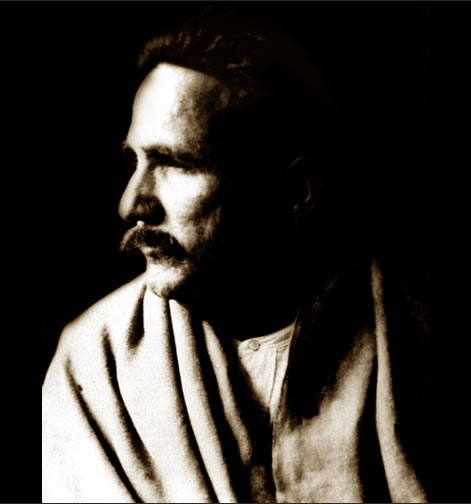
Nature gives birth to great philosophers and poets when the need arises. Natural calamities, wars, epidemics, storms and earthquakes etc causing human sufferings have always given birth to creative minds. Plato was born in 420 BC when his country had almost been ruined as a result of Peloponnesian war. Iqbal was born in 1877 AD when the inhabitants of India were suffering from miseries and deaths while struggling for the Independence of their country from British rule.

The people of Muslim community of India were the worst hit. They were being crushed ruthlessly. At that time Iqbal’s poetry played miraculous role. It awakened the people from slumbering hopelessness, made them stood on their own feet. They were united and then fought courageously for Independence with the result that they achieved a free homeland for them within a few years time.

Creative thinker

This means that despite being a creative thinker, Iqbal was addressing the situation at hand. The ideas he enunciated, though intrinsically creative in themselves and abiding in appeal beyond a particular time and place, were yet primarily meant to salvage the bleak Muslim situation in India and the world at large. This makes Iqbal, in a sense, oriented towards the Indian Muslim psyche and situation.

This framework makes his periodic forays into discussing and suggesting solutions to the problems of the Muslim world at large and his consuming concern with the ‘Reconstruction of Religious Thought in Islam’ (1930) – a logical extension of his role as a modern Muslim ideologue, attempting to analyze and, see Muslim India’s problems and predicament on a wider canvas and in a total context. After all, Iqbal regarded India, if only because of the Muslim numerical strength, as ‘the greatest Muslim country in the world’, to quote his own words. These tasks, both critical and onerous as they were, he fulfilled squarely.

Effective medium

His emotion-leaden and soul-lifting poetry was the medium Iqbal chose to bring his people a new awareness of the depths of degradation to which they had fallen, to diagnose their ailments, their predicament and the prime cause of their decline and to warn them of the dire consequences if they failed to mend themselves in good time. A more effective medium he could not have possibly chosen.

For one thing, poetry is the most powerful medium for touching the deepest emotions of people and for driving a message into their subconscious. For another, the Indian Muslims had been among the most poetry-oriented people in the wold, with a long tradition of readily taking to heart what was written in verse. Political orations may stir and audience into action, but their impact is bound to be restricted to a particular audience and dissipate with time and events. In contrast, a poetic message seeps through the ethos of a nation, working on its psyche all the while.

Political leaders

Hence Iqbal achieved through his poems what a thousand speeches could not. But for the silence mental preparation that had gone on for long decades, the people would not have responded to the call of political leaders – in this case, especially of Jinnah during the 1937-47 epochal decade. No wonder, the pandals of the League sessions from Lucknow (1937) onwards were plastered with Iqbal’s couplets, calling on Muslims to rise and take their destiny in their own. Iqbal was quoted oft and on to rouse Muslims to a new awareness of their destiny. All this had an electrifying effect on the audience since Iqbal, though generally complex and couched in an appropriate idiom, was, straightforward and yielded clear guidelines.

Besides being a poet of extraordinary merit, Iqbal was a thinker of a high order. Thus, while Syed Ahmed Khan, Maulana Mohammed Ali and Jinnah provided political leadership to Muslims, Iqbal took upon himself the task of setting the intellectual tone for Muslim thought and action. (Previously, this was done by Sir Syed’s, writing and the Aligarh school). In addressing himself to this task, Iqbal brought a revolution in Muslim thinking at various levels, he also made a significant contribution to keeping them stolidly anchored to their pristine ideology and historical legacy.

New consciousness

His role in awakening the Muslims to a new consciousness began in 1899 when he recited a poem at the annual session of the Anjuman-i-Islam, Lahore. His moving ‘Nala-i-Yatim’ was symbolic of the echoing cry of the faceless masses of the Indian Muslims, who had long felt themselves sidelined neglected.

What pained him most was the impact of nationalism on various Muslim countries, eroding the pan-Islamic concept, enfeebling the Muslim world and laying it open to European aggression and exploitation.

To the ailments the Muslim world was afflicted with, Iqbal found the solution in Islam and its message. In order to reach the innermost recesses of their consciousness, he invoked the past glory of Islam, telling Muslims of the accomplishments of their ancestors. In so doing, he tried to fight off the prevalent slough of despondency, raising drooping spirit of Muslims and replacing it with a sense of soaring confidence.

Message of hope

Next, he gave them a message of hope. He told them that they could still redeem themselves if they could only recapture their soul and regain their pristine moral and spiritual values.

He emphasized the imperative need to develop human qualities and the right type of character. He attributed their degeneration to their taking to a life of passivity and resignation for several generations. That debilitating trend could be reversed by opting for initiative and endeavour which, he believed, Islam stood for. To him, an active, struggling non-believer was preferable to a sleeping Muslim.

But if Muslims were to be beckoned to a new destiny, they must first be confirmed as Muslims and they must own up their pristine values. This was all he more necessary in the context of the rise of positivism and skepticism, which posed a serious challenge to the modern Muslim.

Modern Muslim

To Iqbal, the task before the modern Muslim is to re-think the whole system of Islam without completely breaking with the past. And this crucial task he undertook in a series of lectures since compiled as ‘The Reconstruction of Religious Thought in Islam’ (1930). In these he argued that Islam represented a philosophy of action, for faith without action was a life bereft of any significance. Seldom does a poet exert such profound influence on the course of history and in changing the destiny of a nation. But Iqbal did because his accomplishments extended far beyond the realm of mere imagination and into the sphere of objective realities, because in the final years of his eventful life he donned the mantle of an ideologue, besides being a national poet. And, to be sure, all of Iqbal’s efforts throughout the whole span of his active life were directed towards the regeneration of Muslims and the resurgence of Islam.

Human rights

The question, ‘do we need Iqbal today?’ The reply is a clear ‘Yes’. It is a need of the time, because the honour of humanity is at stake. The preachers of human rights are abusing humanity. Masses of men are being trampled ruthlessly under the heavy feet of the powerful. There is dearth of love in the world these days. Iqbal is a messenger of love. His message of love is universal… the humanity needs him.. we do need him without any doubt.
How to Win Back Pakistan

By Michael O’Hanlon for Foreign Policy

Nine years into the war in Afghanistan, the United States should have a clear idea of Pakistan’s interests there. It’s time to take these lessons to heart — and start applying the right incentives. As recent intelligence findings reported in late October confirm, Pakistan remains at the heart of the U.S.-led coalition’s problems in Afghanistan — where the war is hardly lost, yet hardly headed for clear victory either. Indeed, Pakistan arguably remains the most complex ally the United States has ever had in wartime, making President Franklin D. Roosevelt’s challenges in dealing with Stalin (a far worse leader, but at least one who knew the outcome he wanted) seem simple by comparison.

Nine years into the campaign, we still can’t clearly answer the question of whether Pakistan is with us or against us. America needs bold new policy measures to help Islamabad — in all its many dimensions and factions — make up its mind.

The crux of the problem is this: Despite allowing massive NATO logistics operations through its territory and helping the United States pursue al Qaeda operatives, Pakistan tolerates sanctuaries on its soil for the major insurgencies fighting in Afghanistan. These include the Afghan Taliban (otherwise known as the Quetta Shura Taliban because its principle base remains in Quetta in the Pakistani province of Baluchistan) as well as the Haqqani and Hezb-i-Islami Gulbuddin (HiG) networks. The Haqqanis straddle the border between the Afghan provinces of Khost, Paktia, and Paktika as well as North Waziristan and other tribal areas within Pakistan; HiG is further north, operating in and around the Khyber Pass connecting Kabul and Jalalabad in Afghanistan with Peshawar and points east in Pakistan. Thus, all three major Afghan insurgent groups have home bases in Pakistan, and despite the occasional drone strike are generally beyond NATO’s reach as a result.

Pakistan has done some worthy things against extremists in its remote northern and western areas in recent years. Specifically, it has recognized the so-called Pakistani Taliban (the Tehrik-i-Taliban Pakistan, or TTP) as a mortal threat to the Pakistani state and responded accordingly. After suffering hundreds of bombings and assassination attacks by the TTP, including the killing of former Prime Minister Benazir Bhutto in 2007 and several thousand casualties a year to its troops and citizens since roughly that time, it has responded in force, particularly over the last year and a half or so. It has swung about 100,000 troops previously guarding the border with Pakistan’s nemesis India to the northwestern tribal regions and cleared several major areas including South Waziristan, Bajaur, and the Swat Valley. This is all to the good.

Pakistanis argue, however, that limited numbers of ground troops combined with the past year’s admittedly devastating floods prevent them from doing more. Quetta, North Waziristan, and other key places remain dens of iniquity, havens for extremists who continue to attack NATO and Afghan troops across the border and then return home for rest, regrouping, and fresh recruiting. Major command-and-control hubs are permanently located within Pakistan as well, and key insurgent leaders like Mullah Omar (to say nothing of Osama bin Laden) probably remain safely ensconced on Pakistani territory where U.S. forces cannot get at them.

But even if limited Pakistani capacity is part of the problem, there’s more at stake. Pakistan worries that President Barack Obama’s promise to start reducing U.S. troops in Afghanistan come July will lead to anarchy and civil conflict next door, and it is retaining proxies that it can use to ensure that its top goal in Afghanistan — keeping India out — can be accomplished come what may. Pakistan would rather have the Taliban and the Haqqanis back in power, especially in the country’s south and east, than any group like the former Northern Alliance, which it views as too close to New Delhi. It is this strategic calculation, more than constrained Pakistani resources, that constitutes Obama’s main challenge in Afghanistan. And it could cost him the war.

Under these circumstances, part of the right policy is to keep doing more of what the Obama administration has been doing with Pakistan — building trust, as with last month’s strategic dialogue in Washington; increasing aid incrementally, as with the new five-year $2 billion aid package announced during that dialogue; and coordinating militarily across the border region. But Obama also needs to think bigger.

First, he needs to make clear America’s commitment to South Asia, to wean Pakistan away from its current hedging strategy. Obama has frequently used general language to try to reassure listeners in the region that there will be no precipitous U.S. withdrawal next summer. But few fully believe him. Hearing stories like Bob Woodward’s accounts of how the vice president and White House advisors have generally opposed a robust counterinsurgency strategy in favor of a counterterrorism-oriented operation with far fewer U.S. troops, they worry that next summer’s withdrawal will be fast. Obama needs to explain that he will not revert to such a minimalist “Plan B” approach under any imaginable circumstances. More appropriate would be a “Plan A-minus” that involves a gradual NATO troop drawdown as Afghan forces grow in number and capability, without necessarily first stabilizing the entire south and east, should the current strategy not turn around the violence by next summer or so. This would represent a modification to the current plan rather than a radical departure. The president can find a way to signal that this is in fact his own thinking, sooner rather than later — ideally before the year is out.

Second, Obama should offer Islamabad a much more expansive U.S.-Pakistani relationship if it helps win this war. Two major incentives would have particular appeal to Pakistan. One is a civilian nuclear energy deal like that being provided to India; Pakistan’s progress on export controls in the wake of the A.Q. Khan debacle has been good enough so far to allow a provisional approval of such a deal if other things fall into place as well. Second is a free trade accord. Struggling economically, Pakistan needs such a shot in the arm, and a trade deal could arguably do even more than aid at this point.

But the key point is this: Pakistan should be told that these deals will only be possible if the United States and its allies prevail in Afghanistan. Small gestures of greater helpfulness are not adequate; bottom-line results are what count and what are needed. If Afghanistan turns around in a year or two, the deals can be set in motion and implemented over a longer period that will allow the United States to continually monitor subsequent Pakistani cooperation in the war.

It may seem harsh to Pakistan that America would put things in such stark terms — but in fact, it is not realistic that any U.S. president or Congress would carry out such deals if the United States loses the war in Afghanistan partly due to Pakistani perfidy. As such, these terms are really just common sense, and they are based on political realism about America’s domestic politics as well as its strategic interests.

America’s current strategy for the war in Afghanistan is much improved. But it is not yet sound enough to point clearly toward victory. The most crucial problem is the role of Pakistan in the war, and so far, the Obama administration is not thinking creatively enough about how to fix it.

The Nexus of US-India-Pakistan Relations

By Manzer Munir for Pakistanis for Peace

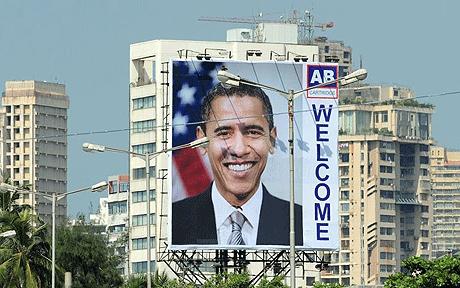
As President Obama wraps up his visit to India in the next day, a couple of things are important to point out about relations between the United States and India as well as how Pakistan fits into the equation.

The balance of power between India and the US still lies with the United States, however, India is set to make more and more gains in becoming more influential as its economy grows and as the United States looks to it to counter China in Asia.

The strategic partnership between the two countries and the importance of India for the United States is going to become vital as America uses India to contain China’s influence in the region and around the world.

We do believe that President Obama is correct in stating that relations between the two countries warrant being called the defining relationship of the century as there is no other country that compliments the United States presently in the world as does India. Not only do both countries share democratic ideals and a multiethnic population, but both countries are also increasingly dependent on each other’s economies. Add to this the nuclear cooperation as well as America’s support for India to get a permanent seat on the UN Security Council, and it becomes evident that this relationship will continue to grow over time.

President Obama has offered criticism on Pakistan already but is careful in trying to walk the tight rope act that is India-Pakistan relations. There are certainly more behind the scene steps taking place that will chide Pakistan into doing more. But in our view, the single most important thing that the US and the Obama administration can do is to help India and Pakistan come back to the table to get the peace process moving along. There is widespread agreement with the President’s assessment that a prosperous and stable Pakistan is in the best interests of India, Afghanistan and the region. In this effort, we believe there needs to be done more by all parties involved.

India’s argument has always been that the terrorist infrastructure and support for some anti-India militant groups needs to end before New Delhi will resume the peace process with Pakistan.

India should not refuse extensive trade relationships with the US due to American support of Pakistan as it does not do anything to help India. India realizes the situation both inside Pakistan and America’s dependency of the Pakistan Army’s support in flushing out the Taliban. It would go against India’s interests if it put its relationship and advancement with the United States as being dependent on American support for Pakistan and its vital assistance in the war in Afghanistan and on terror.

Peace between India and Pakistan and in the Kashmir valley is the only solution to both the conflict between the two nations as well as it is in America’s interests for both countries and the region. Furthermore, peace between the two countries will allow both Pakistan’s full focus on the Afghan border in helping American troops against the Taliban as well as the elimination of anti-India militant groups within Pakistan, many of whom are alleged to still be receiving support from elements within Pakistan’s ISI spy agency, much to India’s chagrin.

Obama Calls for India – Pakistan Peace

By Andrew Buncombe for NZ Hearald

Barack Obama has called on India and Pakistan to renew their efforts to find peace, even as he said Islamabad was not moving quickly enough to counter militants operating from inside its borders.

In comments that appeared to underscore the high-wire act of diplomacy the US president is trying to pull off while on the three-day visit to India, Mr Obama said Washington would not act as an intermediary between the two countries.

However, he told a group of students in Mumbai: “My hope is that over time, trust develops between the two countries, that dialogue begins, perhaps on less controversial issues, building up to more controversial issues. There are more Pakistanis who’ve been killed by terrorists inside Pakistan than probably anywhere else.”

The president has received criticism from some opposition parties in India after he failed to directly mention Pakistan when he arrived in India on Saturday and spoke of the 2008 attacks at the Taj Hotel and other locations in Mumbai, that left more than 160 people dead.

In the aftermath of the attacks, the so-called “composite dialogue” peace process between India and Pakistan was put on hold and while there have been a series of high-level meetings, the relationship between the two remains tense.

The president, who stayed at the seafront hotel in what aides said was a clear sign of solidarity, had talked about the militants and the terror they wrought, but was criticised by the right-wing Bharatiya Janata Party (BJP) for failing to attribute the blame to Pakistan.

Asked why he had not done so, Mr Obama reflected a reality in which the US is paying billions of dollars to Pakistan in aid as it pushes it to do more against militants responsible for cross-border strikes in Afghanistan.

“Pakistan is a strategically important country, not just for America, but for the world,” he said. “India and Pakistan can prosper and live side by side. This can happen and this should be the ultimate goal. The US can be a partner but cannot impose this process. India and Pakistan have to arrive at an understanding.”

Mr Obama started his visit to India, one of four countries he is including on a tour through Asia, by announcing more than 20 deals he said were worth up to $10bn and would help support 50,000 US jobs.

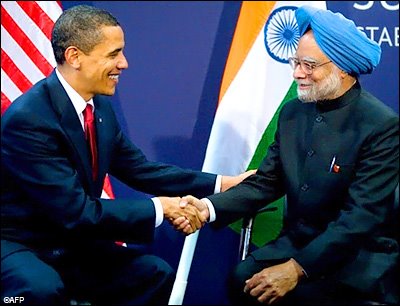
He also said the US was to relax export controls over sensitive technology, a demand of India’s that will help deepen ties between the two countries. The president is to hold formal talks today with India’s prime minister, Manmohan Singh.

On a domestic level, Mr Obama also recognised he needed to make “midcourse corrections” in the aftermath of last week’s mid-term elections if he is going to win over a frustrated and divided electorate.

India Urged to Revive Pakistan Talks

By James Lamont and Edward Luce for The Financial Times

Barack Obama, the US president, has urged India to step up its dialogue with Pakistan to help to secure the region’s stability, warning that efforts to combat extremism in India’s nuclear-armed neighbour have not progressed as quickly as Washington had hoped.

Mr Obama, on a three-day visit to India, called on Sunday for New Delhi to revive a dialogue with Islamabad badly set back by the 2008 terror attacks on Mumbai by Pakistani militants.

His comments at a town hall event with students in Mumbai were a sharp break from his initial emphasis on creating jobs in the US and gaining more access to the fast-growing Indian economy for US companies.

“My hope is that over time trust develops between the two countries, that dialogue begins,” he told students at St Xavier’s College. “Ultimately India and Pakistan have to arrive at their own understandings”.

Mr Obama cautioned that the economic success that India was enjoying would be imperilled by an unstable region where militant insurgencies raged in Pakistan and Afghanistan, where US troops are fighting the Taliban.

“The country that has the biggest stake in Pakistan’s success is India. I think that if Pakistan is unstable that is bad for India. If Pakistan is stable and prosperous that’s good,” he said.

Mr Obama recommended the two rivals start talking about the “less controversial issues” and then build up to tougher issues, such as the disputed territory of Kashmir, over which the two have fought three wars over the past 63 years.

Manmohan Singh, India’s prime minister, believes the two countries have shared destinies, and has stressed that India poses no threat to Pakistan in an effort to scale down military forces on the border.

Yet Mr Obama’s emphasis of linkages between Pakistan and India, which were separated at the end of British rule in 1947, is highly sensitive. Many Indian leaders gauge the growing maturity of New Delhi’s relationship with Washington by what they call the “de-hyphenation” of India and Pakistan in recognition of India as a global power and vibrant economy.

New Delhi is suspicious of US military assistance to Pakistan and is uneasy about Washington identifying any role for Islamabad in bringing stability to Afghanistan and brokering talks with the Taliban.

Mr Obama warned that Pakistan was confronted by a “profound problem” and that its progress towards eradicating extremism was “not as quick as we would like”. He said that his administration was “engaging aggressively” with the Pakistani government to bring peace and stability.

“There’s a need to look for practical steps . . . Living in the past simply won’t work,” said Stephen Cohen, a senior fellow at the Brookings Institution, in Washington.

“I see a 100 years of conflict between India and Pakistan looking ahead.”

America and India: The Almost-Special Relationship

By Jim Yardley for The New York Times

At a panel discussion last week on relations between India and the United States, Strobe Talbott, the former American diplomat, told an audience of Indian business leaders that he had learned a valuable lesson about India: Do not hyphenate it. As in Indo-Pak. (Or, in a close cousin of a hyphen, as in Chindia.) The audience smiled at his epiphany: India matters because it is India.

In a nutshell, President Obama is trying to deliver the same message during his three-day visit to India, the first stop on a broader Asian tour. Both countries are eager to build on their improved ties and set up a unique, special relationship, given that together they represent the world’s richest and largest democracies. Faced with a rising authoritarian China, and an economically wounded Europe, a weakened United States is casting about for global partners. India would seem a nice fit.

“This is the time to be ambitious about this relationship,” said Shivshankar Menon, India’s national security adviser, speaking on the panel with Mr. Talbott.

And yet eliminating the hyphen is not easy, especially given India’s fraught relations with its neighbors in what is perhaps the most politically complicated region on earth, one in which American lives and treasure are at stake in Pakistan and Afghanistan. And India’s evolving relationship with another neighbor, China, is also a prime concern for America. Indeed, the decision to focus Mr. Obama’s India trip on India was itself not easily achieved; some senior administration officials lobbied the president to put pressure on Indian leaders for a conciliatory gesture toward Pakistan, in hope that such a carrot might entice the Pakistanis to do more to help America against the Taliban.

These sorts of political equations have long tangled the U.S.-India relationship: The Americans, at different times, have pushed the Indians to cut a deal with Pakistan over the disputed region of Kashmir, but the Indians have bristled at any interference. The Indians still want the Americans to sponsor India for a permanent seat on the United Nations Security Council. Not such an easy thing, the Americans reply, since America alone can’t do this and it creates issues between America and China. It has sometimes seemed like a relationship built around one country asking the other to do something it considers against its self-interest.

Moreover, the economic relationship between the two countries often has been a source of friction. High unemployment in America has renewed complaints that outsourcing to India hurts American workers. Indians complain that American protectionism is hurting Indian companies and that American export restrictions on technologies that can have both military and civil uses are outdated and unnecessary in a relationship between putative allies.

Mr. Obama’s trip is an attempt to reboot or refocus the relationship away from these disputes and de-emphasize the tangible goodies (for example, contracts) that politicians call “deliverables.” Instead, the two sides are discussing how they can partner on education, clean energy, agriculture, technological development and military cooperation. The thematic emphasis of the visit is on shared democratic values — a pointed dig at China — and what the two countries say are shared opportunities. American officials say that an expected $4 billion deal for India to buy military transport aircraft — yes, a goodie — will provide thousands of American jobs. Indian officials emphasize that trade between the two countries is basically balanced — unlike with China — and that the anger over outsourcing is misplaced, especially since some Indian companies are investing and creating jobs in the United States.

Some Indian commentators have groused that all the diplospeak about shared opportunities obscures the fact that the trip lacks a “big idea” to excite or elevate the relationship, even as big, unavoidable problems are seemingly being avoided. In 2000, former President Bill Clinton spent five days in India on a door-opening visit that was credited with righting what had been a stalled relationship. Then former President George W. Bush made the most dramatic gesture by pushing through an agreement to cooperate on civilian nuclear projects; the move effectively legitimized India as a nuclear power and lifted a 30-year moratorium on nuclear trade with India even though India had not signed the Nuclear Nonproliferation Treaty. By comparison, Mr. Obama seems not to be offering much.

“The jury is out,” said Shekhar Gupta, editor of The Indian Express, speaking of how India’s political establishment views Mr. Obama.

But Ronen Sen, who recently retired from India’s diplomatic corps after serving as ambassador to the United States, says the focus on a “big idea” is misplaced. Given the litany of difficult problems between the two countries, Mr. Sen said, Mr. Obama’s approach was a reasonable way to build trust and broaden a bilateral relationship that, while greatly improved, had not yet fully matured.

“It has not yet reached a critical mass where it can be self sustaining,” Mr. Sen said.

Indeed, even the landmark civil nuclear deal remains a subject of dispute as the two sides still squabble over fine details of how American suppliers could begin doing business in the lucrative Indian market. The Americans say that rules recently approved by India are inconsistent with accepted global practice, which exempts foreign suppliers from liability in cases of accidents, leaving it solely with local operators. A senior American official said “intense discussions” were underway to find a solution. If one is found, Mr. Obama may get a nice “deliverable” — an open door through which American firms, as originally expected, can sell nuclear equipment to India and provide jobs at home.

There is less talk of the chances of solving bigger problems, like differences between America and India in global negotiations on global warming climate change and trade. And the uncertainty over the most problematic hyphens — Afghanistan and Pakistan — looms over the visit. Even as Mr. Obama seeks a way to stabilize Afghanistan and get out, Indian officials dread the day America leaves. They worry about what will be left behind, since India cannot leave the neighborhood.

“Quite obviously, we have strategic stakes there,” said Brig. Gurmeet Kanwal, director of the Center for Land Warfare Studies, a military research institute. “We do not wish to have a government in Afghanistan or a government in Kabul that is inimical to Indian interests.”

He added: “We see the United States as a stabilizing influence in Asia.”

And so a political courtship will continue, problems and all. Governmental ties already lag far behind the people-to-people relationships. America remains the premier destination for Indian students studying abroad, and Indian immigrants in America have achieved disproportionate success in business, medicine and many other fields. It is this backchannel closeness that serves as a cattle prod nudging the governments to become closer, too.

K. Subrahmanyam, a leading Indian defense analyst, believes that India and the United States represent the inevitable and necessary partnership of the 21st century because China’s rise represents a threat to a global order based on democratic principles. He said that demographic trends, too, should bind the two countries together.

“If America needs a partner, Europe is aging, Japan is aging and China is going to age,” he said. “The only two major nations in the world who will not be aging, at least for the next 30 years, are the United States and India.”

India Link in US: Nikki Haley Creates History as First Woman Governor

As Reported by The Hindustan Times

Parents of both Nikki Randhawa Haley, who on Tuesday won the governor’s election in South Carolina, and Bobby Jindal, the other Indian American governor of Lousiana, were born to immigrants from Punjab. Nikki Haley is the first woman and the second person of Indian origin after Bobby Jindal to become governor in the US. Jindal won the top job in Louisiana state in 2007.

While Nikki’s father Ajit Singh came to the US from Amritsar, Bobby Jindal’s (who name before his conversion to Christianity was Piyush Amrit Jindal) father Amar Jindal came from Malerkotla, not far from Amritsar.

Nikki’s victory is another sweet moment for Amritsar because the first Indian American Congressman Dalip Singh Saund, who served three terms (1957-1963) in the US Congress from California, also came from that city, the home of the Golden Temple, Sikhism’s most famous shrine.

Nikki, whose family is running a garment showroom called Exotica International in West Columbia since 1976, has been serving as a legislator in the South Carolina state assembly since 2004.

“I don’t do anything halfway – I’m in this race to win,” Nikki had told IANS in July taking time off her busy campaign for raising money.

“I am confident that come November, the people of South Carolina will send me to the Governor’s Mansion.

“When they (voters) do, I will immediately get to work to give them progress that makes them proud.”

Asked whether her Sikh background will matter in the race, she had said,”What matters most in South Carolina – and I imagine elsewhere in the country – is not the personalities of the candidates but the message they carry.

“Our message of bringing good government back to the people of this state, creating jobs by reforming our tax code so it’s flatter and fairer, and reminding government of the value of a dollar resonates with all the people of this state.

“I am very proud of my background and how I was raised. Just as in 2004 (when her opponents had raised the issue of background) I will hold my head up high and focus on what I can do for the people of this state.”

Nikki beat Democrat Vincent Sheheen who tried to steal her conservative agenda by projecting himself as “pro-life, pro-gun rights and pro-jobs”.

Pakistanis for Peace Editor’s  Note 11/03/2010– We at Pakistanis for Peace want to congratulate Nikki Haley for winning the governorship of South Carolina in a very tough and hard fought race. Both as an American as well as ethnically being a person from the Indian subcontinent aka Desi, we are proud to see her elected to serve as governor, despite disagreeing with her party on many issues.

Her rise as well as that of Governor Bobby Jindal of Louisiana to the top of American politics is a source of pride for all Desis, be they Indian, Pakistani, Bengali, etc. We invite people of all races, ethnicities, and backgrounds to join our Facebook group at Pakistanis for Peace and strengthen those who support peace between India and Pakistan and around the world. To join, clik  http://www.facebook.com/group.php?gid=37793413510&v=wall

Unending Love By Rabindranath Tagore

I seem to have loved you in numberless forms, numberless times…In life after life, in age after age, forever. My spellbound heart has made and remade the necklace of songs, That you take as a gift, wear round your neck in your many forms,In life after life, in age after age, forever.

Whenever I hear old chronicles of love, it’s age-old pain, It’s ancient tale of being apart or together. As I stare on and on into the past, in the end you emerge, Clad in the light of a pole-star piercing the darkness of time: You become an image of what is remembered forever.

You and I have floated here on the stream that brings from the fount. At the heart of time, love of one for another. We have played along side millions of lovers, shared in the same Shy sweetness of meeting, the same distressful tears of farewell-Old love but in shapes that renew and renew forever.

Today it is heaped at your feet, it has found its end in you The love of all man’s days both past and forever: Universal joy, universal sorrow, universal life. The memories of all loves merging with this one love of ours – And the songs of every poet past and forever~ 

– Rabindranath Tagore was the first non-European to win the Nobel Prize as he won in Literature. He was a de facto Poet Laureate of his day before India’s independence from Britain and this is Pakistanis for Peace’s homage to the man and to the human sentiment of love. 

Obama Will Try to Avoid the K Word

By Paul Beckett for The Wall Street Journal

To some U.S. officials, it is known simply as the “K-word.” Kashmir. It’s a topic we expect U.S. President Barack Obama to try his level best to avoid during his three-day trip to India that starts next week.

The issue got the former British foreign secretary in hot water when he was here last year. And when Richard Holbrooke, Mr. Obama’s special representative on Afghanistan and Pakistan at one point suggested he tackle Kashmir too, the idea received a furious rebuff from the Indians.

If the topic does come up, Mr. Obama will likely follow the same tack taken by his advisers earlier this week in a briefing with reporters. When asked, “Will the President talk publicly or privately about Kashmir and the tensions between India and Pakistan?” this was the response from Ben Rhodes, deputy national security advisor for strategic communication.

“The President believes that the U.S. relationship with India and the U.S. relationship with Pakistan does not take place within any kind of zero-sum dynamic.  It’s often been viewed that way in the past, that if we become closer to one it’s at the expense of the other. And we’ve tried to send the signal that it’s the opposite with this administration; that, in fact, actually you see that borne out in the fact that we had a very successful strategic dialogue here, with the Pakistanis in town last week, discussing greater security cooperation in governance and economic issues.

And as a part of that, the President met with the Pakistani delegation and ended up speaking to President Zardari yesterday to discuss that strategic dialogue and said that he’d very much like to visit Pakistan next year and is planning to visit Pakistan next year.”

If you’re counting, that almost 150 words – and not one of them is “Kashmir.”

William Burns, undersecretary of state for political affairs, added his own non-Kashmir Kashmir response. “We have always welcomed dialogue between India and Pakistan and certainly encouraged efforts to improve relations between those two very important countries.  Obviously, the pace, scope and character of that dialogue is something that Indians and Pakistanis have to shape.  But we’ll continue to both welcome and encourage it.”

White House reporters being an intrepid bunch, another questioner brought up the topic again, using the K-word specifically.

“Just to follow Steven’s question on Kashmir. Will the President be making some public remarks explaining the U.S. position on Kashmir?  And will he also be addressing — explaining the U.S. relationship with Pakistan publicly?”

This time Mr. Rhodes was even more eloquent, going for a full 286 words, not a single one of them Kashmir.

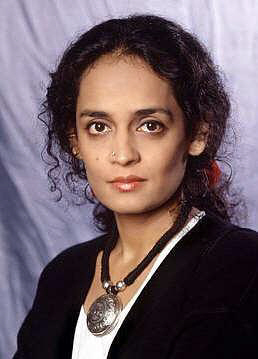
Arundhati’s Statement From Srinagar: Full Text

By Arundhati Roy
October 26, 2010
Noted Indian Hindu writer Arundhati Roy Tuesday said her speeches supporting the call for azadi were what “millions” in Kashmir say every day and were “fundamentally a call for justice”. Following is the full text of the statement that she has issued.
 
“I write this from Srinagar, Kashmir. This morning’s papers say that I may be arrested on charges of sedition for what I have said at recent public meetings on Kashmir. I said what millions of people here say every day. I said what I, as well as other commentators have written and said for years. Anybody who cares to read the transcripts of my speeches will see that they were fundamentally a call for justice. I spoke about justice for the people of Kashmir who live under one of the most brutal military occupations in the world; for Kashmiri Pandits who live out the tragedy of having been driven out of their homeland; for Dalit soldiers killed in Kashmir whose graves I visited on garbage heaps in their villags in Cuddalore; for the Indian poor who pay the price of this occupation in material ways and who are now learning to live in the terror of what is becoming a police state.  

“Yesterday I traveled to Shopian, the apple-town in South Kashmir which had remained closed for 47 days last year in protest against the brutal rape and murder of Asiya and Nilofer, the young women whose bodies were found in a shallow stream near their homes and whose murderers have still not been brought to justice. I met Shakeel, who is Nilofer’s husband and Asiya’s brother. We sat in a circle of people crazed with grief and anger who had lost hope that they would ever get ‘insaf’—justice—from India, and now believed that Azadi—freedom— was their only hope. I met young stone pelters who had been shot through their eyes. I traveled with a young man who told me how three of his friends, teenagers in Anantnag district, had been taken into custody and had their finger-nails pulled out as punishment for throwing stones.

“In the papers some have accused me of giving ‘hate-speeches’, of wanting India to break up. On the contrary, what I say comes from love and pride. It comes from not wanting people to be killed, raped, imprisoned or have their finger-nails pulled out in order to force them to say they are Indians. It comes from wanting to live in a society that is striving to be a just one. Pity the nation that has to silence its writers for speaking their minds. Pity the nation that needs to jail those who ask for justice, while communal killers, mass murderers, corporate scamsters, looters, rapists, and those who prey on the poorest of the poor, roam free.”

Arundhati Roy is a novelist, essayist and human rights activist. She won a Booker Prize in 1997 for her novel, The God of Small Things. For more on her read http://en.wikipedia.org/wiki/Arundhati_Roy

Pakistanis for Peace Editor’s Note– Arundhati Roy’s courageous plea to her country is to be lauded. Although branded a traitor by many in India and within the government, she knows that she stands for peace, justice and fairness for all humanity. She wants self determination for all Kashmiris, be they Muslim, Hindu, Buddhist or Christian.

We at Pakistanis for Peace want nothing more than peace between India and Pakistan and therefore understand that Kashmir is the one and single most important issue between the two countries. Solve it and you do not have the threat of cross border attacks, friction, animosity, perpetual war and a tense border between two neighbors of nearly 2,000 miles. If we continue to ignore it then it will eventually be the crisis that starts a 4th and possibly nuclear war between the two neighbors. A war that neither the neighborhood nor the world can afford.

Meet Nikki Haley, the Next Indian American Governor of a US State

By Manzer Munir for Pakistanis for Peace

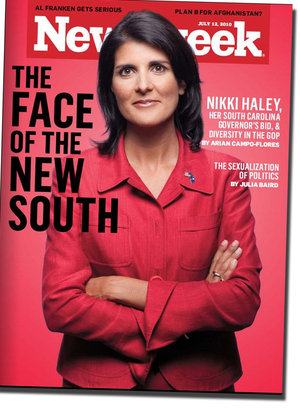
Nikki Haley is not destined to be the first Indian American governor of a US state. No that honor already belongs to Governor Bobby Jindal of Louisiana. Haley however is poised to do something greater and that is to become the first minority female governor as she competes for South Carolina’s highest office on Tuesday November 2.

Already the first Indian to hold office in South Carolina, she currently serves as a member of the South Carolina House of Representatives from the 87th district. A past president of the National Association of Women Business Owners, she is a CFO and an accountant by trade who worked in her mother’s apparel business that has grown into a multi-million dollar company.

Although born to Sikh parents, she converted to Methodism after marrying her husband Michael Haley and describes herself as a Christian. Her religious conversion as well as her ethnicity has not hampered her dreams of becoming the first female governor of South Carolina.  Neither have allegations of extramarital affairs or reports of paying taxes late.

Nikki Haley’s candidacy received a boost when Sarah Palin and Tea Party officials gave her their backing for the election and she is leading her opponent, Democrat Vincent Sheheen, in most polls. If she wins, this will not be the first time she has won in a state where politics is mainly a male run enterprise. In 2004, she challenged and won against Rep. Larry Koon who was South Carolina legislature’s longest serving member, having served 30 years in the House. She is a tough lady who also happens to have a concealed weapons permit and strongly supports gun rights, a staple of Republican Party values.

Aside from Haley, an unprecedented number of Indian Americans are contesting for office this year across the country. There is Manan Trivedi in Pennsylvania running for the House of Representatives in the state legislature. Others running for house seats in their states are Ami Bera in California, Raj Goyle in Kansas, Ravi Sangisetty in Louisiana, where Bobby Jindal is the governor, and Surya Yalamanchili in Ohio.

After making inroads into American boardrooms with top jobs in the corporate world such as Vikram Pandit, the CEO at Citibank and Indra Nooyi, the boss at PepsiCo, Indian Americans are exploring opportunities in politics which is good for America as more involvement by minorities in public service makes the country stronger and shows that there is room for everyone at the top. Many other minorities also can take encouragement from her candidacy and be mindful that race and ethnicity is not always a barrier for running for office and that the right candidate and platform can land a person in the governor’s mansion.

Should Nikki Haley be successful in winning the governorship of South Carolina, she will instantly become one of the rising young stars of the Republican Party and a face for women leaders the world over. Regardless where you stand on the political aisle, her candidacy and subsequent election will be a turning point in the US for Indian Americans and South Asians who have become an indispensable part of the nation’s fabric.

Pakistanis for Peace Editor’s  Note 11/03/2010– We at Pakistanis for Peace want to congratulate Nikki Haley for winning the governorship of South Carolina in a very tough and hard fought race. Both as an American as well as ethnically being a person from the Indian subcontinent aka Desi, we are proud to see her elected to serve as governor, despite disagreeing with her party on many issues.

Her rise as well as that of Governor Bobby Jindal of Louisiana to the top of American politics is a source of pride for all Desis, be they Indian, Pakistani, Bengali, etc. We invite people of all races, ethnicities, and backgrounds to join our Facebook group at Pakistanis for Peace and strengthen those who support peace between India and Pakistan and around the world. http://www.facebook.com/group.php?gid=37793413510&v=wall

Pakistan Urges US to Intervene in Kashmir Dispute

As Reported by The Associated Press

Pakistan called Friday for President Barack Obama to intervene in its longstanding dispute with India over the Himalayan region of Kashmir, the cause of two of the three wars the nuclear-armed rivals have fought.

Pakistani Foreign Minister Shah Mahmood Qureshi made the unusually blunt appeal for Obama to seek a resolution of the dispute when he visits India next month, saying he should “redeem the pledge” he made as a candidate.

The conflict over Kashmir has been the main source of friction between India and Pakistan since they won independence from Britain in 1947. Pakistan has frequently sought outside intervention to resolve it but India vehemently opposes such involvement and the United States has traditionally stayed above the fray.

Qureshi, speaking next to Secretary of State Hillary Rodham Clinton at the closing day of three days of U.S.-Pakistan talks, said Obama must get involved because a crackdown against suspected Muslim militants in Indian-controlled Kashmir threatens the entire region.

“It is in the U.S. strategic interest to work for peace, stability and resolution of the disputes in South Asia,” he said. “The starting point in this quest is justice for the Kashmiri people.”

“President Obama has always understood the importance of a Kashmir solution,” Qureshi said. “His coming visit to the region is the time to begin to redeem the pledge that he made earlier.”

As a presidential candidate in 2008, Obama suggested that the U.S. should encourage India and Pakistan to resolve the Kashmir dispute so Pakistan could better focus on fighting extremists on its own territory and Afghanistan. Although he did not advocate direct mediation, his comments were met with disdain in India.

Obama will not visit Pakistan on his upcoming trip but he plans to spend several days in India, which has cracked down on violent anti-Indian protests in Kashmir since June. The violence has killed at least 111 people, mostly teenage boys and young men in their 20s. Authorities have imposed off-and-on curfews in an attempt to halt the unrest.

Quershi expressed astonishment that the U.S. and other major powers had said little about India’s response to the protests.

“People of conscience have protested the use of force against the defenseless people of Kashmir, in particular the targeting of the Kashmiri youth,” he said. “But the Kashmiri mothers are baffled by the deafening silence of the world’s leadership. History has proved that the force of arms cannot suppress the legitimate aspirations of the Kashmiri people.”

India and Pakistan fought two wars for control of Muslim-majority Kashmir, where rebels have sought independence from India or incorportation with neighboring Pakistan.

More than 68,000 people, most of them civilians, have been killed in Kashmir since fighting began in earnest in 1989.

Meeting Pakistanis, U.S. Will Try to Fix Relations

By Mark Landler and Eric Schmitt for The New York Times

WASHINGTON — As Pakistani civilian and military leaders arrive here this week for high-level meetings, the Obama administration will begin trying to mend a relationship badly damaged by the American military’s tough new stance in the region.

Among the sweeteners on the table will be a multiyear security pact with Pakistan, complete with more reliable military aid — something the Pakistani military has long sought to complement the five-year, $7.5 billion package of nonmilitary aid approved by Congress last year. The administration will also discuss how to channel money to help Pakistan rebuild after its ruinous flood.

But the American gestures come at a time of fraying patience on the part of the Obama administration, and they will carry a familiar warning, a senior American official said: if Pakistan does not intensify its efforts to crack down on militants hiding out in the tribal areas of North Waziristan, or if another terrorist plot against the United States were to emanate from Pakistani soil, the administration would find it hard to persuade Congress or the American public to keep supporting the country.

“Pakistan has taken aggressive action within its own borders. But clearly, this is an ongoing threat and more needs to be done,” the State Department spokesman, Philip J. Crowley, said Monday. “That will be among the issues talked about.”

The Pakistanis will come with a similarly mixed message. While Pakistan is grateful for the strong American support after the flood, Pakistani officials said, it remains frustrated by what it perceives as the slow pace of economic aid, the lack of access to American markets for Pakistani goods and the administration’s continued lack of sympathy for the country’s confrontation with India.

Other potentially divisive topics are likely to come up, too, including NATO’s role in reconciliation talks between President Hamid Karzai of Afghanistan and the Taliban. Pakistani officials say they are nervous about being left out of any political settlement involving the Taliban.

Still, in a relationship suffused by tension and flare-ups — most recently over a NATO helicopter gunship that accidentally killed three Pakistani soldiers and Pakistan’s subsequent decision to close a supply route into Afghanistan — this regular meeting, known here as the strategic dialogue, serves as a lubricant to keep both countries talking.

At this meeting, Secretary of State Hillary Rodham Clinton will formally introduce the new American ambassador to Pakistan, Cameron Munter. Mr. Munter, who recently served in Iraq, replaces Anne W. Patterson, who just wrapped up her tour of duty in Islamabad.

“No country has gotten more attention from Secretary Clinton than Pakistan,” said Richard C. Holbrooke, the administration’s special representative for Afghanistan and Pakistan. Pakistan’s delegation will be led by its foreign minister, Shah Mahmood Qureshi, but much of the attention will be on another official, the military chief, Gen. Ashfaq Parvez Kayani, who is viewed by many as the most powerful man in Pakistan.

White House and Pentagon officials said one immediate goal of this meeting was to ease the tensions that led Pakistan to close the border crossing at Torkham, halting NATO supplies into Afghanistan. Officials on both sides said that acrimony from the border flare-up had already receded, soothed by the multiple apologies that American officials made to Pakistan last week.

Last week, Adm. Mike Mullen, the chairman of the Joint Chiefs of Staff, said that General Kayani had assured him that Pakistan’s army would tackle the North Waziristan haven, but on Pakistan’s timetable. In an interview, Pakistan’s ambassador to the United States, Husain Haqqani, said, “Our American partners understand that we have 34,000 troops in North Waziristan. Our soldiers have been engaged in flood relief after history’s worst floods. It is not a question of lack of will.”

The new security pact would have three parts: the sale of American military equipment to Pakistan, a program to allow Pakistani military officers to study at American war colleges and counterinsurgency assistance to Pakistani troops.

Currently, the United States spends about $1.5 billion a year to provide this same assistance, but it is doled out year by year. The new agreement, if endorsed by Congress, would approve a multiyear plan assuring stability and continuity in the programs, although Congress would continue to appropriate the financing on a yearly basis. “This is designed to make our military and security assistance to Pakistan predictable and to signal to them that they can count on us,” said a senior official.

At the last dialogue in Islamabad in July, Mrs. Clinton presented more than $500 million in economic aid, including plans to renovate hospitals, upgrade hydroelectric dams, improve water distribution and help farmers export mangoes. But the floods upended those plans, and officials said they now planned to redirect funds to more urgent needs.

This week’s meeting will also be shadowed by a new eruption of political instability in Pakistan: the government of President Asif Ali Zardari is locked in a confrontation with the Supreme Court over the court’s demand that senior ministers be fired on corruption charges. Analysts said they were less worried about the atmospherics than the underlying differences in perspective. The administration’s public contrition for the cross-border attack has largely resolved that issue, said Daniel S. Markey, senior fellow for India, Pakistan and South Asia at the Council on Foreign Relations.

But Mr. Markey said he saw potential friction stemming from the American openness to reconciliation with the Taliban. With the United States facilitating rather than guiding the talks, he said, there could be poor coordination between the Afghans, NATO and others — all of which would rattle the Pakistanis.

“Washington is opening the door to a range of negotiations with groups that it has discouraged Pakistan against working with in the past,” he said. “This sends a mixed signal, and cannot help but encourage hedging on Islamabad’s part.”

Another potential bone of contention is one of President Obama’s nuclear objectives: a global accord to end the production of new nuclear fuel. Pakistan has led the opposition to the accord. And without its agreement, the treaty would be basically useless.

Mr. Qureshi blamed the United States for the situation, saying Washington signed a civilian nuclear accord with India that discriminated against Pakistan. “You have disturbed the nuclear balance,” he said in a recent interview in New York, “and we have been forced to develop a new strategy.”

Off-Court Honour for IndoPak Express

As Reported by Dawn

The two South Asian players who paired up to form a formidable force in men’s doubles tennis have been rewarded for their efforts by the Peace and Sport Organization.

Aisam-ul-Haq Qureshi and Rohan Bopanna were announced as the winners of ‘Peace and Sport Image of the Year’ award by the World Peace and Sport Forum on Friday.

The award is given to the best image of fraternity through sport or a symbolic moment showing the ability of sport to advance peace in the world and to encourage reconciliation among peoples.

“The Peace and Sport Image of the Year Award will be given to India’s Rohan Bopanna and Pakistan’s Aisam-ul-Haq Qureshi – two tennis players who managed to bring the political authorities in their respective countries closer, through their own history of personal friendship and commitment,” a statement issued by Peace and Sport said.

The duo’s ‘Stop War, Start Tennis’ campaign made a breakthrough achievement this year, when they managed to bring together the Pakistani and Indian ambassadors to the United Nations.

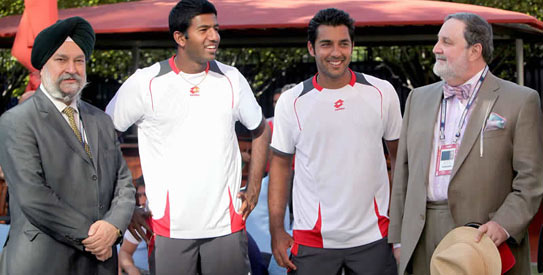
Hardeep Singh Puri (India) and Abdullah Hussain Haroon (Pakistan) watched from the stands as the IndoPak Express contested in the men’s doubles semi-finals and final of the US Open 2010 in New York last month.

The winning image, taken by Jay Mandal for the ATP World Tour, shows the two players chatting with the two ambassadors after their semi-final win at the Billie Jean King National Tennis Center in New York.

Based on worldwide open voting competition and jury’s decision the image was declared the winner, having received 60 per cent of the votes cast globally.

Rohan (Hindu) and Aisam (Muslim) have played in a doubles team for three years and are building their careers together, despite historical hostilities that divide India and Pakistan. Motivated by their friendship, they decided to actively campaign for peace between their two nations.

During several events on the ATP World Tour 2010, they wore warm-up gear displaying the slogan “Stop War, Start Tennis”, thus affirming their belief that friendship between India and Pakistan is possible.

“The message of peace given by Rohan and Aisam is a unique source of inspiration for young people in their respective countries, but its significance does not stop there. They use their charisma and their sporting success to raise awareness amongst the entire international community, their fellow athletes and political authorities in their countries, as we saw at the US Open. I hope that their appeal will lead the way to new rapprochement initiatives,” Joel Bouzou, President and Founder of Peace and Sport said.

“Sport’s greatest victory is not measured in terms of medals. It is measured by its ability to positively change people’s lives and bring them hope. And that’s exactly what Rohan and Aisam succeed in doing. They demonstrate what champions can achieve when they use their celebrity for a good cause.”

The players’ next humanistic goal is to organize a friendly tennis match at the Wagah border, the only checkpoint that exists between India and Pakistan. This symbolic event, supported by Peace and Sport, will incarnate the wish of Indian and Pakistani young people to live in peace.

Other contestants for this year’s award were, “Young Pentathletes bridge the gap between the USA and Cuba,” “Nelson Mandela, hero of the anti-apartheid struggle and symbol of the 2010 World Cup,” and “Iran and the USA forget their differences on a basketball pitch.”

The award will be presented to the duo by Prince Albert II of Monaco at a grand gala ceremony on December 2.

U.S. Had Warnings on Plotter of Mumbai Attack

By Jane Perlez, Eric Schmitt and Ginger Thompson for The New York Times

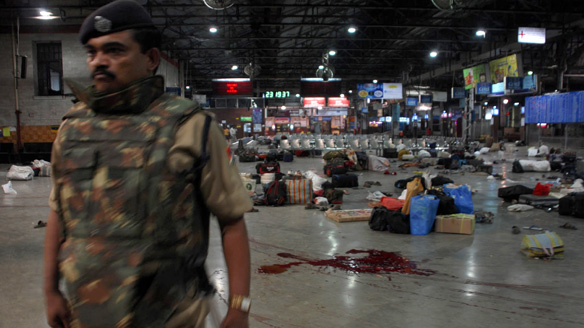
Less than a year before terrorists killed at least 163 people in Mumbai, India, a young Moroccan woman went to American authorities in Pakistan to warn them that she believed her husband, David C. Headley, was plotting an attack.

It was not the first time American law enforcement authorities were warned about Mr. Headley, a longtime informer in Pakistan for the United States Drug Enforcement Administration whose roots in Pakistan and the United States allowed him to move easily in both worlds.

Two years earlier, in 2005, an American woman who was also married to the 50-year-old Mr. Headley told federal investigators in New York that she believed he was a member of the militant group Lashkar-e-Taiba created and sponsored by Pakistan’s powerful intelligence agency.

Despite those warnings by two of his three wives, Mr. Headley roamed far and wide on Lashkar’s behalf between 2002 and 2009, receiving training in small-caliber weapons and countersurveillance, scouting targets for attacks, and building a network of connections that extended from Chicago to Pakistan’s lawless northwestern frontier.

Then in 2008, it was his handiwork as chief reconnaissance scout that set the stage for Lashkar’s strike against Mumbai, an assault intended to provoke a conflict between nuclear-armed adversaries, Pakistan and India.

An examination of Mr. Headley’s movements in the years before the bombing, based on interviews in Washington, Pakistan, India and Morocco, shows that he had overlapping, even baffling, contacts among seemingly disparate groups — Pakistani intelligence, terrorists, and American drug investigators.

Those ties are rekindling concerns that the Mumbai bombings represent another communications breakdown in the fight against terrorism, and are raising the question of whether United States officials were reluctant to dig deeper into Mr. Headley’s movements because he had been an informant for the D.E.A.

More significantly, they may indicate American wariness to pursue evidence that some officials in Pakistan, its major ally in the war against Al Qaeda, were involved in planning an attack that killed six Americans.

The Pakistani government has insisted that its spy agency, the Inter-Services Intelligence Directorate, a close partner of the C.I.A., did not know of the attack. The United States says it has no evidence to counter this, though officials acknowledge that some current or retired ISI officers probably played some role.

It is unclear what United States officials did with the warnings they had gotten about Mr. Headley, who has pleaded guilty to the crimes and is cooperating with authorities, or whether they saw them as complaints from wives whose motives might be colored by strained relations with their husband.

Federal officials say that the State Department and the F.B.I. investigated the warnings they received about Mr. Headley at the time, but that they could not confirm any connections between him and Lashkar-e-Taiba. D.E.A. officials have said they ended their association with him at the end of 2001, at least two months before Mr. Headley reportedly attended his first terrorist training. But some Indian officials say they suspect that Mr. Headley’s contacts with the American drug agency lasted much longer.

The investigative news organization ProPublica reported the 2005 warning from Mr. Headley’s American former wife on its Web site and in the Saturday issue of The Washington Post. By ProPublica’s account, she told the authorities that Mr. Headley boasted about working as an American informant while he trained with Lashkar.

On Saturday, Mike Hammer, a spokesman for the National Security Council, said in a statement, “The United States regularly provided threat information to Indian officials in 2008 before the attacks in Mumbai.” He also said, “Had we known about the timing and other specifics related to the Mumbai attacks, we would have immediately shared those details with the government of India.”

Mr. Headley’s American wife was not the only one to come forward. The Moroccan wife described her separate warnings in an interview with The New York Times. Interviews with United States and allied intelligence and security officials illustrate his longstanding connections to American law enforcement and the ISI:

¶ An officer of the Pakistani spy agency handed Mr. Headley $25,000 in early 2006 to open an office and set up a house in Mumbai to be used as a front during his scouting trips, according to Mr. Headley’s testimony to Indian investigators in Chicago in June. As part of Mr. Headley’s plea agreement, Indian investigators were allowed to interview him in Chicago, where he was arrested in October 2009. ¶ The ISI officer who gave Mr. Headley the cash, known as Major Iqbal, served as the supervisor of Lashkar’s planning, helping to arrange a communications system for the attack, and overseeing a model of the Taj Mahal Hotel, according to Mr. Headley’s testimony to the Indians.

¶ While working for Lashkar, which has close ties to the ISI, Mr. Headley was also enlisted by the Pakistani spy agency to recruit Indian agents to monitor Indian troop levels and movements, an American official said.

Besides Mr. Headley’s guilty plea in a United States court, seven Pakistani suspects have been charged there. American investigators say a critical figure who has not been charged is Sajid Mir, a Lashkar operative who became close to Mr. Headley as the plans for the Mumbai operation unfolded. The investigators fear he is still working on other plots.

Mr. Headley was known both to Pakistani and American security officials long before his arrest as a terrorist. He went to an elite military high school in Pakistan. After arrests in 1988 and 1997 on drug-trafficking charges, Mr. Headley became such a valued D.E.A. informant that the drug agency sent him back and forth between Pakistan and the United States. In several interviews in her home, Mr. Headley’s Moroccan wife, Faiza Outalha, described the warnings she gave to American officials less than a year before gunmen attacked several popular tourist attractions in Mumbai. She claims she even showed the embassy officials a photo of Mr. Headley and herself in the Taj Mahal Hotel, where they stayed twice in April and May 2007. Hotel records confirm their stay.

Ms. Outalha, 27, said that in two meetings with American officials at the United States Embassy in Islamabad, she told the authorities that her husband had many friends who were known members of Lashkar-e-Taiba. She said she told them that he was passionately anti-Indian, but that he traveled to India all the time for business deals that never seemed to amount to much.

And she said she told them Mr. Headley assumed different identities: as a devout Muslim who went by the name Daood when he was in Pakistan, and as an American playboy named David, when he was in India.

“I told them, he’s either a terrorist, or he’s working for you,” she recalled saying to American officials at the United States Embassy in Islamabad. “Indirectly, they told me to get lost.”

Though there are lots of gaping holes left in Mr. Headley’s public profile, the one thing that is clear is he assumed multiple personas.

He was born in the United States, the son of a Pakistani diplomat and a socialite from Philadelphia’s Main Line. When he was about a year old, his parents took him to Pakistan, where he attended the Hasan Abdal Cadet College, the country’s oldest military boarding school, just outside of Islamabad.

Mr. Headley’s parents divorced. And before he finished high school, he moved to Philadelphia to help his American mother run a bar, called the Khyber Pass. Later he opened a couple of video rental stores.

But at the same time he was involved in a life of crime. Each time he was arrested on drug trafficking charges, he used his roots in the United States and Pakistan to make himself as valuable an asset to law enforcement as he was to the traffickers; one with the looks and passports to move easily across borders, and the charisma to penetrate secretive organizations.

He was married at least three times. For one period he was married to all three wives — Ms. Outalha, who is a medical student half his age, a New York makeup artist, and a conservative Pakistani Muslim — at the same time.

Those relationships, however, caused him trouble. In 2005, his American wife filed domestic abuse charges against Mr. Headley, according to federal investigators in New York, and reported his ties to Lashkar-e-Taiba. The investigators said the tip was passed on to the F.B.I.’s Joint Terrorism Task Force.

Then in December 2007, Ms. Outalha talked her way into the heavily guarded American Embassy in Islamabad. She went back a month later with more information. A senior administration official acknowledged that Ms. Outalha met twice with an assistant regional security officer and an Immigration and Customs Enforcement officer at the embassy. However, the administration official said Ms. Outalha offered almost no details to give credibility to her warnings.

“The texture of the meeting was that her husband was involved with bad people, and they were planning jihad,” the official said. “But she gave no details about who was involved, or what they planned to target.”

Given that she had been jilted, Ms. Outalha acknowledged she may not have been composed. “I wanted him in Guantánamo,” she said. More than that, however, Ms. Outalha says, she went to American authorities looking for answers to questions about Mr. Headley’s real identity. In public he criticized the United States for the war in Iraq and Afghanistan. But at night he loved watching “Seinfeld” and Jay Leno.

Sipping tea in a cafe overlooking a plaza in Morocco, Ms. Outalha said that in hindsight, she is convinced that he is both men. She claims to be puzzled that American officials did not heed her warning.

“I told them anything I could to get their attention,” she said of the American authorities at the embassy in Islamabad. “It was as if I was shouting, ‘This guy was a terrorist! You have to do something.’ ”