Archive for the ‘ Pakistan Army ’ Category

Meeting Pakistanis, U.S. Will Try to Fix Relations

By Mark Landler and Eric Schmitt for The New York Times

WASHINGTON — As Pakistani civilian and military leaders arrive here this week for high-level meetings, the Obama administration will begin trying to mend a relationship badly damaged by the American military’s tough new stance in the region.

Among the sweeteners on the table will be a multiyear security pact with Pakistan, complete with more reliable military aid — something the Pakistani military has long sought to complement the five-year, $7.5 billion package of nonmilitary aid approved by Congress last year. The administration will also discuss how to channel money to help Pakistan rebuild after its ruinous flood.

But the American gestures come at a time of fraying patience on the part of the Obama administration, and they will carry a familiar warning, a senior American official said: if Pakistan does not intensify its efforts to crack down on militants hiding out in the tribal areas of North Waziristan, or if another terrorist plot against the United States were to emanate from Pakistani soil, the administration would find it hard to persuade Congress or the American public to keep supporting the country.

“Pakistan has taken aggressive action within its own borders. But clearly, this is an ongoing threat and more needs to be done,” the State Department spokesman, Philip J. Crowley, said Monday. “That will be among the issues talked about.”

The Pakistanis will come with a similarly mixed message. While Pakistan is grateful for the strong American support after the flood, Pakistani officials said, it remains frustrated by what it perceives as the slow pace of economic aid, the lack of access to American markets for Pakistani goods and the administration’s continued lack of sympathy for the country’s confrontation with India.

Other potentially divisive topics are likely to come up, too, including NATO’s role in reconciliation talks between President Hamid Karzai of Afghanistan and the Taliban. Pakistani officials say they are nervous about being left out of any political settlement involving the Taliban.

Still, in a relationship suffused by tension and flare-ups — most recently over a NATO helicopter gunship that accidentally killed three Pakistani soldiers and Pakistan’s subsequent decision to close a supply route into Afghanistan — this regular meeting, known here as the strategic dialogue, serves as a lubricant to keep both countries talking.

At this meeting, Secretary of State Hillary Rodham Clinton will formally introduce the new American ambassador to Pakistan, Cameron Munter. Mr. Munter, who recently served in Iraq, replaces Anne W. Patterson, who just wrapped up her tour of duty in Islamabad.

“No country has gotten more attention from Secretary Clinton than Pakistan,” said Richard C. Holbrooke, the administration’s special representative for Afghanistan and Pakistan. Pakistan’s delegation will be led by its foreign minister, Shah Mahmood Qureshi, but much of the attention will be on another official, the military chief, Gen. Ashfaq Parvez Kayani, who is viewed by many as the most powerful man in Pakistan.

White House and Pentagon officials said one immediate goal of this meeting was to ease the tensions that led Pakistan to close the border crossing at Torkham, halting NATO supplies into Afghanistan. Officials on both sides said that acrimony from the border flare-up had already receded, soothed by the multiple apologies that American officials made to Pakistan last week.

Last week, Adm. Mike Mullen, the chairman of the Joint Chiefs of Staff, said that General Kayani had assured him that Pakistan’s army would tackle the North Waziristan haven, but on Pakistan’s timetable. In an interview, Pakistan’s ambassador to the United States, Husain Haqqani, said, “Our American partners understand that we have 34,000 troops in North Waziristan. Our soldiers have been engaged in flood relief after history’s worst floods. It is not a question of lack of will.”

The new security pact would have three parts: the sale of American military equipment to Pakistan, a program to allow Pakistani military officers to study at American war colleges and counterinsurgency assistance to Pakistani troops.

Currently, the United States spends about $1.5 billion a year to provide this same assistance, but it is doled out year by year. The new agreement, if endorsed by Congress, would approve a multiyear plan assuring stability and continuity in the programs, although Congress would continue to appropriate the financing on a yearly basis. “This is designed to make our military and security assistance to Pakistan predictable and to signal to them that they can count on us,” said a senior official.

At the last dialogue in Islamabad in July, Mrs. Clinton presented more than $500 million in economic aid, including plans to renovate hospitals, upgrade hydroelectric dams, improve water distribution and help farmers export mangoes. But the floods upended those plans, and officials said they now planned to redirect funds to more urgent needs.

This week’s meeting will also be shadowed by a new eruption of political instability in Pakistan: the government of President Asif Ali Zardari is locked in a confrontation with the Supreme Court over the court’s demand that senior ministers be fired on corruption charges. Analysts said they were less worried about the atmospherics than the underlying differences in perspective. The administration’s public contrition for the cross-border attack has largely resolved that issue, said Daniel S. Markey, senior fellow for India, Pakistan and South Asia at the Council on Foreign Relations.

But Mr. Markey said he saw potential friction stemming from the American openness to reconciliation with the Taliban. With the United States facilitating rather than guiding the talks, he said, there could be poor coordination between the Afghans, NATO and others — all of which would rattle the Pakistanis.

“Washington is opening the door to a range of negotiations with groups that it has discouraged Pakistan against working with in the past,” he said. “This sends a mixed signal, and cannot help but encourage hedging on Islamabad’s part.”

Another potential bone of contention is one of President Obama’s nuclear objectives: a global accord to end the production of new nuclear fuel. Pakistan has led the opposition to the accord. And without its agreement, the treaty would be basically useless.

Mr. Qureshi blamed the United States for the situation, saying Washington signed a civilian nuclear accord with India that discriminated against Pakistan. “You have disturbed the nuclear balance,” he said in a recent interview in New York, “and we have been forced to develop a new strategy.”
Pakistan is Not America’s Enemy

 By Ryan Crocker for The Wall Street Journal

 The news from Pakistan is grim. NATO helicopters engage suspected militants inside Pakistan, killing three, only to discover they are Pakistani soldiers. The angry Pakistani government blocks NATO fuel shipments at the Khyber Pass, and militants attack the stalled trucks. An Obama administration report to Congress charges that the Pakistanis aren’t doing enough against the Taliban and al Qaeda. Press accounts quote unnamed officials asserting that elements in Pakistani intelligence are encouraging the Taliban to step up attacks on NATO forces. And Bob Woodward cites President Obama as saying “the cancer is in Pakistan.”

One could easily conclude that we are describing an enemy, not an ally. Many in Pakistan feel the same way. And yet the prospects for stabilizing Afghanistan, defeating al Qaeda and preventing further attacks on the United States are a direct function of that strained alliance. It is time for a collective deep breath.

Pakistan’s historical narrative focuses on how the U.S. worked with Pakistanis and Afghans to drive the Soviets from Afghanistan in the 1980s: We succeeded—and then we left. And on our way out, we slapped sanctions on Pakistan, ending all security and economic assistance because of the country’s nuclear program, which we had known about since 1974 when Pakistan’s prime minister announced it publicly. We left Pakistan alone to deal with a destabilizing civil war in Afghanistan, and when the Taliban emerged as a dominant force in the mid-1990s, Islamabad supported them as a means of ending the conflict.

Then came 9/11 and the U.S. was back. Pakistanis welcomed the renewed assistance. But a constant question I heard while serving as ambassador to Pakistan from 2004-2007 was “How long will you stay this time, and what mess will you leave us with when you go?” For a fragile state with innumerable problems, including a vicious internal insurgency, these are existential questions.

Never in Pakistan’s six decades of existence has the U.S. sustained a long-term, strategic commitment in the country. The Bush administration recognized this and enacted security and economic assistance programs designed to make a long-term difference in education, health care and governance. In 2006, I argued successfully for a five-year assistance package for Pakistan’s Federally Administered Tribal Areas (FATA), which are notable both for chronic underdevelopment and extremism. The Obama administration has built on this, and last year’s Kerry-Lugar bill provided $7.5 billion in assistance over five years. So we have the architecture in place to build a strategic relationship.

Still, short-term pressures risk undermining long-term strategy. When I was ambassador, voices in Congress, the media and even the administration were constantly calling for the U.S. to get tough on Pakistan, make Pakistanis do more, threaten them with consequences. Such exhortations were—and remain—generally counterproductive, as they fuel fears that the U.S. will again abandon Pakistan.

The U.S. can better work with Pakistan if we improve our understanding of history: Given its rivalry with India and its organic disunity, which dates back to its founding, Pakistan fears for its basic survival. The country has always had a difficult relationship with Afghanistan, not least because in the 19th century the British deliberately drew the Pakistani-Afghan border, the so-called Durand Line, in order to divide the Pashtun people. Today Pashtuns make up Afghanistan’s largest community, but there are more Pashtuns in Pakistan.

The Durand Line also set the groundwork for the tribal areas, which are legally distinct from the rest of Pakistan because the British could never exert direct control over them. No central authority ever has. Winston Churchill’s first published work, “The Story of the Malakand Field Force,” is about fierce tribesmen declaring jihad against a Western army. It could be a contemporary account.

So what does this mean in concrete terms?

First, the U.S. should appreciate Pakistan’s challenges and support its government in dealing with them. This summer’s devastating floods have disappeared from the U.S. media but will continue to wreak havoc in Pakistan for a long time to come. In 2005 and 2006, after an earthquake in Kashmir killed almost 80,000 Pakistanis, the U.S. organized the largest relief operation since the Berlin Airlift. The floods’ death toll is lower, but their long-term damage will be far greater. U.S. support should be commensurate.

Second, the U.S. should not carry out cross-border military actions, which I strongly resisted as ambassador. They are clearly counterproductive, and not just because we hit the wrong target. If NATO can carry out military actions in Pakistan from the west, Pakistanis wonder, what stops India from doing the same from the east? There are other options, including drone strikes, which the U.S. is now coordinating more closely with Pakistanis.

Third, with Pakistan’s government (as with Afghanistan’s), we must be private in our criticism and public in our support

Private talks should deepen regarding challenges like the insurgent Haqqani network in North Waziristan, and we need to listen at least as much as we lecture.Fourth, any talks between the U.S. or Afghanistan and the Taliban must be transparent to the Pakistanis. A nightmare for Islamabad is the prospect that the Americans and Afghans come to some accommodation with Taliban elements that would leave them hostile to Pakistan. If Pakistan is not part of the process, we will be working at cross-purposes and only the Taliban will benefit.

Pakistan’s arrest of Taliban leader Abdul Ghani Baradar—at a time when he had begun reconciliation talks with Afghan authorities—underscored the risks of leaving Islamabad out of the loop. Going forward, the timing and nature of talks with the Taliban should be set by Afghans, Pakistanis and Americans working together.

None of this will be easy, but it is essential. A sustained U.S.-Pakistani partnership after the Soviet withdrawal from Afghanistan could have produced a very different history than the one we wrestle with today. Writing a different future requires making long-term commitments—on both sides of the Durand Line.

Mr. Crocker, the dean of Texas A&M’s George Bush School of Government and Public Service, was U.S. ambassador to Pakistan from 2004 to 2007 and U.S. ambassador to Iraq from 2007 to 2009.

How to End the War in Afghanistan

As Reported on CNN

New York (CNN) — Afghan President Hamid Karzai has started talks with representatives of the Taliban, a move that analyst Fareed Zakaria says could bring an end to the nine-year-long war.

Karzai convened a meeting Thursday with the Afghan Peace Council, which was formed to help negotiate with the Taliban. Referring to the militants, Karzai said, “I call on them once again to use this opportunity and say ‘yes’ to this endeavor. I want them to come and bring peace to this land.”

The author and host of CNN’s “Fareed Zakaria GPS” spoke to CNN on Thursday. Here is an edited transcript:

CNN: Hamid Karzai has launched a council to help negotiate with the Taliban? What’s the significance of that step?

Fareed Zakaria: I think it’s about time. If you look at any good study of civil wars, what you find is that most of them end in a negotiated settlement. Maybe because Americans have the memory of our civil war in which the North crushes the South, we somehow think that that’s how civil wars end. But that’s actually is very unusual.

What normally happens is some kind of settlement that is negotiated in which the losers are reintegrated into the political order. Civil wars are unlike normal wars, because the winners and losers are going to have to live with one another.

CNN: How does that apply to Afghanistan?

Zakaria: The Taliban, which is mounting this insurgency, is not a foreign element within the body politic. The Taliban is basically the political representative of the conservative elements of the Pashtun community.

The Pashtuns are 50 percent of Afghanistan. … It is a political force in Afghanistan. Coming to terms with it politically and seeing if there’s some way it can be reintegrated into the political order makes sense. You’re not going to kill every member of the Taliban. They’re not going to be exiled to a foreign land. They’re going to be there at the end of the day so it’s better to to have them in the tent.

CNN: The U.S. military view seems to be that the talks haven’t yielded progress so far, and a senior defense official told CNN, “We don’t think the Taliban believe that they’re losing to the degree that they’d come to terms in large numbers.” Are the talks premature because the effects of the U.S. military buildup haven’t been felt yet?

Zakaria: First the very fact that the Taliban are coming to the table in a way they had not been willing to before suggests that they are feeling some pressure.

But I also think you can’t get too hung up with this idea that you have to negotiate from a position of strength. Ideally we would have them totally prostrate on the floor and that would be the time to negotiate. But the reality is that this is a very mixed military campaign. I don’t know if it’s going to be dramatically better one year from now or three years from now.

This is a little like somebody who owns a stock, who says, it’s at six now, I need to sell it, but I’m going to wait till it goes to eight. Well maybe it will go to eight, maybe it will go to four.

You might as well start talking at this point. First of all you learn a lot in the process of negotiations. And secondly, the military campaign could move in many different directions. If the surge starts succeeding even more, that will be reflected in our negotiating posture.

CNN: Is there an idea yet of what a negotiated settlement might involve?

Zakaria: It seems as though the Taliban demands are that they want all foreign troops out. They don’t want to accept the Afghan constitution and they don’t want to lay down their arms.

Now those are obviously their opening demands. Foreign troops aren’t going to be out, but one could point out that President Obama has said there is going to be a reduction of foreign forces next year.

On the Afghan constitution, there is a compromise there where there could be a few amendments to the constitution. But on laying down their arms, that it seems to me you can’t really compromise, they would have to lay down their arms. Could some elements be integrated into the militia, or the Afghan national army? Perhaps — that’s what happened in Iraq.

CNN: Isn’t there also a clashing conception of society, with the Taliban being a closed society that doesn’t recognize an elevated role for women as opposed to a potentially democratic kind of society that’s envisioned by the Afghan constitution?

Zakaria: Yes, it is the kind of society envisioned by the Afghan constitution. But Afghanistan is a fairly conservative society. While the extreme elements of the Taliban have draconian visions which are obviously not supported by the Afghans — the polls bear this out — it’s also true that on issues of women’s rights and some of the more progressive elements of the Afghan constitution, the Karzai government is in a minority and those rights are not popularly supported.

There are clashing visions, but there is probably a reality of Afghanistan which is a lot more progressive and open than the Taliban believe but is still a society that is somewhat conservative, and often tribal, and with very traditional views on something like women’s rights.

The key is creating a situation where these rights are guaranteed but not fetishizing it. For example, one of the things the Afghan constitution has is a requirement for 25 percent representation of women in parliament. We don’t have such a requirement either in the U.S. Constitution or in the amendments. Many European countries don’t.

Is it conceivable that something like that could be compromised? Perhaps, and that’s the kind of thing where we’d have to be creative in coming up with a solution that moderates and some elements of the Taliban could live with.

CNN: Is this an honorable exit for the United States?

Zakaria: I think so, and it’s not really an exit, it’s a reduction in our forces and in our role. And I think it would be appropriate. We’ve been there for nine years. It’s not the only battleground, the only place where al Qaeda operates. There are many more members of al Qaeda in Pakistan than in Afghanistan.

You’re trying to create a political settlement, and a self-sustaining political framework in Afghanistan that can survive the departure of American troops. And finally you’re leaving enough troops in there where you could still prosecute a fairly vigorous counterterrorism operation against those elements of the Taliban or al Qaeda that continue to plot and plan to do violence to civilians, foreigners, westerners.

And I do think, if we could get this kind of a settlement, it would be an honorable way for the United States to begin reducing its exposure in Afghanistan.

Fareed Zakaria is an author and foreign affairs analyst who hosts “Fareed Zakaria GPS” on CNN

Envoy Insists Pakistan Will Tackle Terrorists As Attack Kills 3

By Nasir Habib for Cnn

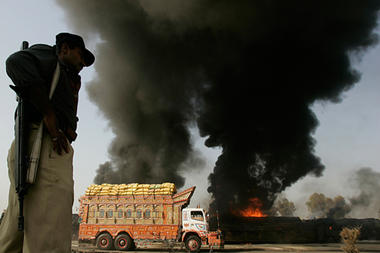
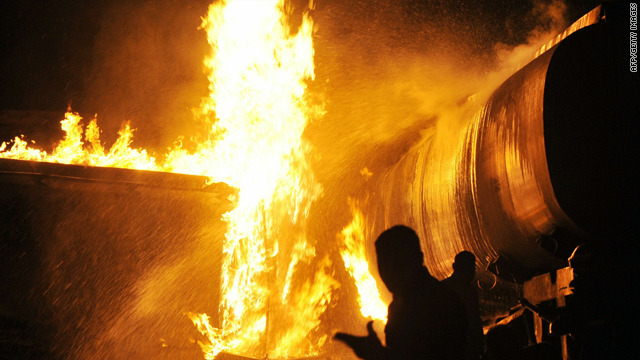
Islamabad, Pakistan (CNN) — Gunmen in Pakistan opened fire on oil trucks bound for NATO forces in Afghanistan, setting some 20 vehicles on fire and killing three, police said Monday. The attack came shortly after Pakistan’s ambassador to the United States vowed his country would go after terrorists on its soil.

Naeem Iqbal, a police spokesman, said five people were wounded in the attack on tankers parked on a main road outside a housing complex near the capital city of Islamabad. Efforts to put out the blaze are ongoing, he said.

Bin Yamin, a deputy police chief, said eight gunmen entered the area on Monday around 12:15 a.m. local time. He said they told people near the trucks to run away and that most did. Then they opened fire.

The tankers were parked in the vicinity of an oil refinery where they were going to go to pick up fuel for NATO forces in Afghanistan, Yamin said. Video images of the scene showed firefighters working to put out flames that stood out in the night against the overturned trucks.

On Sunday, Pakistan’s ambassador to the United States insisted his country would go after terrorists on its soil and needed only “technical” help from Washington, not U.S. troops on the ground.

Husain Haqqani, told CNN’s “State of the Union” that Pakistan would reopen a NATO supply route into Afghanistan “relatively quickly,” probably in less than a week.

Pakistan halted the convoys Thursday after officials blamed cross-border NATO helicopter fire for the deaths of three Pakistani soldiers. Haqqani said the United States and Pakistan were investigating the killings together. He said Pakistan will move against militants on its own schedule, not Washington’s.

“Pakistan is saying we will take care of all terrorists on the Pakistani side of the border, but we will do it on our timeline,” Haqqani said Sunday. “We cannot always follow a timeline that our allies set for us, because we are allies, not a satellite.”

Pakistan has lodged protests against NATO helicopter incursions into its territory — which the International Security Assistance Force says its rules of engagement permit — and is very sensitive about reported U.S. drone strikes in Pakistan.

There were a record number of drone strikes last month, according to a CNN count. On Saturday, three suspected drone strikes killed 18 people.

Pakistani intelligence officials said 10 people died in one drone strike targeting a militant hideout, four people died when a vehicle was struck, and four others were killed when another hideout was targeted.

All three occurred in the Data Khel area of North Waziristan. The intelligence officials did not want to be named because they are not authorized to speak to the media.

Security analysts have described North Waziristan as a haven for various factions of Afghan and Pakistani Taliban and al Qaeda militants. The majority of reported strikes this year have hit targets in the district, a mountainous tribal area on Pakistan’s border with Afghanistan, analysts said.

The United States does not officially acknowledge that it has unmanned aircraft firing missiles at suspected militants in Pakistan, but it is the only country operating in the area that is known to have the ability to do so.

Ambassador Haqqani also said Pakistan couldn’t do everything Washington wants “because sometimes we don’t have the capacity and sometimes we don’t have the means.” He said Pakistan’s geography makes it hard to hit militants.

“Sometimes people in the U.S. think … that it’s all flat land with everything visible. Not even the drones can identify everyone in North Waziristan because of the complexity of terrain,” Haqqani said.

Haqqani also argued that Pakistani politicians, just like U.S. counterparts, are constrained by public opinion. “All politics is local and the local situation in Pakistan is that the United States is not very popular amongst our public,” he said. “The fact remains that an elected democratic government in Pakistan is limited by public opinion to the extent of what it can do,” he said.

The Continuous Struggle Along Pakistan’s Frontier

By David Ignatius for The Wall Street Journal

In the same week when U.S. helicopters mistakenly killed three members of Pakistan’s Frontier Corps near the Afghan border, American Special Forces were training members of that same force on how to use radios, sniper rifles and other counterinsurgency tools at a remote base here.

Pakistanis and Americans don’t talk much about this joint training camp, northwest of Peshawar about 20 miles from Afghanistan. But the program is a symbol of the weird duality of the relationship — a mix of public distance and private cooperation that’s awkward for both sides.

“We have good relations; it’s going very well,” Col. Ahsan Raza, the camp commander, said when I visited Tuesday afternoon, two days before the fatal U.S. cross-border attack. But the Pakistani commandant was eager not to appear too close to America, stressing that the U.S. trainers were supplying technical skills, not running the show.

Both sides view the program here as a success story. But the joint effort masks a tension that is only likely to deepen in coming months.

Pakistan wants to use the 70,000-strong Frontier Corps to stabilize the Federally Administered Tribal Areas, or FATA, and halt the domestic Taliban insurgency. The United States, struggling in Afghanistan, wants Pakistan to help seal the border and destroy the sanctuaries used by al-Qaeda and the Afghan Taliban. The two sides talk as if their goals are identical, but they aren’t. The differing priorities became clear in conversations last week with Pakistani commanders.

Warsak is a pet project of Maj. Gen. Tariq Khan, the commander of the Frontier Corps. At his headquarters in the ancient Bala Hissar fortress in Peshawar, the traditional garb of the tribal “scouts,” as they’re called, makes you wonder whether the days of the British Raj ever really ended. Behind Khan’s desk is a plaque bearing the names of his predecessors back to 1907.

Khan argues that it’s time for Pakistan to move from big military offensives in the tribal areas to what he calls “policing” actions. “No steamroller operations,” he says.

Lt. Gen. Asif Yasin Malik, who commands the Pakistani army in the western border areas and is Khan’s boss, makes the same point. “Don’t expect major new kinetic operations,” he says. “We have changed gears to a softer approach.”

This can’t be comforting to Gen. David Petraeus, the U.S. commander in Afghanistan. He is said to have concluded, after several months in Kabul, that more Pakistani pressure on the havens is crucial for American success. That’s the basic conflict — an overstretched America wants a Pakistani surge in the tribal areas; an overstretched Pakistan just wants to keep the peace.

Khan’s strategy is an updated version of the old British approach: work through the tribal chiefs, or maliks, keep the roads open and pound any renegades back into line. He wants to maintain order through three tiers of force: local militias, known as “levies,” recruited by the maliks; the Frontier Corps dispersed across the FATA; and the big guns of the Pakistani army.

Working with the American trainers at Warsak, Khan has devised some smart tactics: Private vehicles in the FATA will have electronic chips that register their movements. The scouts will report suspicious activities on their American-made radios, and the snipers will blow away any miscreants using their American-made sniper rifles. To demonstrate that order is returning, the burly Khan, the scion of a princely Pashtun family, took a car trip last summer through the FATA with his wife and daughter.

Khan’s enthusiasm is infectious: “There are no safe havens in my area of responsibility — I can take you anywhere, any place, anytime.” That sidesteps the fact that North and South Waziristan, the main trouble spots, are still the responsibility of the army.

Driving down the roads of the border areas, you sometimes have the sense that you are traveling back in time. But that “back to the future” strategy is a temporary fix, at best. Pakistan, with U.S. support, should be moving forward, not in reverse. The years of war have shattered the old tribal order, and the long-run goal should be to bring the tribal areas into a modern Pakistan, rather than let them fester on their own.

U.S. drone attacks and other firepower can keep the insurgents on the run, but they won’t bring stability. Neither will Tariq Khan’s snipers. Somehow, the people in this desolate region have to feel they have a stake in a future that’s something other than continuous warfare.

Pakistan Furious With US Over Fatal Raid, But There’s Little It Can Do

By Howard LaFranchi for The Christian Science Monitor

Pakistan has always bristled at US airstrikes inside its territory, but a helicopter gunship attack earlier this week that killed three Pakistani border guards has led to new frictions and exposed heightened sensitivities over Pakistan’s growing dependence on American support.

US and Pakistani officials have until now managed to paper over unresolved differences over how to deal with insurgents who attack US and NATO forces in Afghanistan from their command-and-control centers in neighboring Pakistan. But this time Pakistan closed a vital supply route for provisioning US and NATO forces in Afghanistan, causing US military and civilian leaders to scramble to attempt to undo the action.

US officials predict the border crossing – one of two Pakistani crossings used by NATO to move supplies into Afghanistan – will reopen soon. The Pakistani government, largely dependent on the US and the West, has no other choice, analysts agree. But the move to close the border crossing, they add, lays bare the government’s inability to react strongly to violations of its sovereignty.

“They don’t have too many cards to play without hurting themselves,” says Marvin Weinbaum, a former State Department Pakistan expert now at the Middle East Institute in Washington. Closing border crossings used by the US “in some ways is their trump card, but they are not really going to play it.”

“They know full well that if they persevered with this, they’d be putting the whole relationship with the US in jeopardy,” he says.

US and Pakistan: uneasy alliance

About three-quarters of the supplies for the 120,000-strong NATO force in Afghanistan move through Pakistan. The US, meanwhile, provides Pakistan with about $2 billion in military aid annually.

The cross-border attack came at a time when the US was already stepping up unmanned drone attacks on Taliban and insurgent refuges inside Pakistan. The US launched a record number of these attacks in August.

The NATO helicopter attack that killed the three border guards – the fourth such manned cross-border strike in about a week – is part of an upswing in manned aircraft strikes. It reflects new NATO willingness to enter Pakistani airspace to pursue insurgents fleeing to refuge across the border.

But Pakistan’s tit-for-tat action also suggests a civilian government that is weak and desperate to demonstrate to the Pakistani public – already estranged by government corruption and an ineffective flood response – that it is standing up to the deeply unpopular Americans.

“I want to assure the entire nation from this house that we will consider other options if there is interference in the sovereignty of our country,” Prime Minister Yusuf Raza Gilani said Friday in a speech to parliament.

Mr. Gilani’s comments, in which he repeated Pakistan’s commitment to fighting Islamist extremists that have targeted the country’s civilian government, came a day after he took a call from Sen. John Kerry, chairman of the Senate Foreign relations Committee, seeking to smooth out the rough patch in US-Pakistan relations.

A reminder of the fragility of the Pakistani supply line came Friday when gunmen attacked a convoy of NATO fuel tankers, burning as many as 40 vehicles.

How to ‘walk back’ now?

The key now will be some US effort allowing the Pakistanis to “walk back” from the border closing while saving face, Mr. Weinbaum says.

“If they [in the government] hadn’t shown some backbone here it could have really been devastating for them,” he says. “But now they will have to walk back on this, and the key will be the way they do it.”

“The US can help them do that,” he adds.

One possibility is a joint investigation into the incident.

Continuing deterioration in the Pakistani government’s standing with the public has led to speculation of a military coup.

But Weinbaum says he doesn’t see the military itching to topple the civilian leadership. “Yes, the military is putting pressure on the government, but the way I see it the military leadership really does want the government to do better,” he says. Pointing to the Pakistani military chief, Gen. Ashfaq Kayani, he adds, “He would welcome the government being able to stand up more so that his hand isn’t forced.”

For Better or Worse, White House Bets on Pakistan’s Civilian Government

Reported by Josh Rogin for Foreign Policy magazine

The Obama administration has always been clear that the path to winning the war in Afghanistan goes through Pakistan. But if Bob Woodward’s new book is accurate, the White House considers its war effort much more dependent on the success and survival of Pakistan’s civilian government than was previously known.

Woodward’s “Obama’s Wars,” which hit bookstores Monday, sheds new light on the Obama administration’s vast outreach to the Pakistani civilian government led by President Asif Ali Zardari. It paints a picture of an administration working hard to court the Pakistanis while remaining somewhat confused about Pakistani thinking on a range of issues.

Obama himself was confused about the nature of Pakistani intentions during two crucial decision points in his administration’s Afghan policy — the March 2009 strategy rollout and the deliberations in November 2009, which resulted in a troop surge and a huge expansion of covert operations in Pakistan. However, based on advice from the majority of his key advisers, he nonetheless tried to entice Pakistan to commit to a deep and long-term partnership with the United States by offering the Zardari government incentive after incentive, with relatively few pressures.

According to Woodward’s account, the centrality of Pakistan was championed early on by Bruce Riedel, the Brookings scholar who was brought on as a key figure in the Obama administration’s March 2009 Afghanistan strategy review.

Riedel, who referred to Islamist extremists in Pakistan as the “real, central threat” to U.S. national security, personally convinced Obama, only two months after he took office, that Pakistan needed to be the centerpiece of his new strategy. Riedel’s plan involved arming the Pakistani military for counterinsurgency and increasing economic and other forms of aid to the civilian government. This marked the beginning of the term “Af-Pak,” which drove the administration’s belief that stability in Afghanistan and Pakistan were inextricably linked.

Riedel’s Pakistan focus was not due to his confidence that the civilian government could control the military and intelligence services. In fact, he referred to Army Chief of Staff Gen. Ashfaq Parvez Kayani as a “liar” with regards to the activities of the secretive Inter Services Intelligence agency (ISI), which is widely suspected of aiding the Taliban insurgency. Then Director of National Intelligence Dennis Blair reportedly echoed Riedel’s views on this matter.

Inside the administration, Blair argued that Obama was approaching Pakistan with too many carrots and not enough sticks. He at one point advocated bombing inside Pakistan and conducting raids there without the Pakistani government’s approval. “I think Pakistan would be completely, completely pissed off and they would probably take actions against us … but they would probably adjust,” he once told Obama.

Obama, however, opted to pursue a less confrontational path. He concluded the central task would be convincing the Pakistani leadership to throw its lot in with the United States He said at the time of the initial strategy review in March 2009, “that we had to have a serious heart-to-heart with Pakistani civilian, military and intelligence leaders.”

Later that year, when making the decision to send an additional 30,000 “surge” troops to Afghanistan, Obama knew that his plans to also expand the U.S. military presence in Pakistan and widen drone strikes would be a hard sell to the Zardari government. In an attempt to sweeten the deal, Obama framed the policy as a new “strategic partnership” with Pakistan, even tying the success of the U.S. mission in Afghanistan to the survival of Zardari and the legacy of his deceased wife Benazir Bhutto.

“I know that I am speaking to you on a personal level when I say that my commitment to ending the ability of these groups to strike at our families is as much about my family’s security as it is about yours,” Obama wrote in a letter to Zardari delivered by National Security Advisor Jim Jones and counterterrorism advisor John Brennan.

Zardari’s response to that letter reinforced what many in the administration already suspected: Pakistan’s government was in the grips of an internal struggle over whether to embrace the United States. Zardari’s initial response focused heavily on India, though the Pakistani president only referred obliquely to his country’s strategic rival. Woodward reports that the White House believed the letter was written by the Pakistani military and the ISI. However, the Zardari government did end up accepting Obama’s offer.

Obama’s top advisors told the U.S. president that he would have to accept something short of complete success in convincing Pakistan to turn away from its longstanding obsession with the military threat it perceives from India.

When Obama had a meeting with Zardari in May 2009, he told the Pakistani president the he did not want U.S. taxpayers to be funding Pakistan’s military buildup against India “We are trying to change our world view,” Zardari told Obama, “but it’s not going to happen overnight.”

At times, Obama was downright puzzled by his advisors’ advice regarding Pakistan. For example, intelligence reports confirmed that Pakistani officials were afraid that the United States would leave Afghanistan too early, as they believed had occurred after the end of the resistance to the Soviet regime in the 1980s. On the other hand, Pakistan worried that if the United States was too involved in Afghanistan, it might aid in the establishment of a larger Afghan army than Islamabad was comfortable with.

“What am I to believe?” Obama asked his senior staff. Secretary of State Hillary Clinton, Special Representative Richard Holbrooke, and Defense Secretary Robert Gates all told him these were the types of contradictions that were commonplace when dealing with Pakistan.

For its part, the Pakistani government was just as confused and puzzled by the Obama administration. Woodward recounts one anecdote, in which Zardari tells the former U.S. Ambassador to Afghanistan Zalmay Khalilzad that he believed the United States was involved in orchestrating attacks by the Pakistani Taliban against the Pakistani civilian government.

Pakistan’s Ambassador to Washington Husain Haqqani, a key go-between, tried several times to explain to the Obama administration how to court Pakistani leaders, comparing the dynamic to “a man who is trying to woo a woman.”

“We all know what he wants from her. Right?” Haqqani said in a meeting with Jones, Deputy National Security Advisor Tom Donilon and the NSC’s Gen. Doug Lute.

“But she has other ideas. She wants to be taken to the theater. She wants that nice new bottle of perfume,” Haqqani told them. “If you get down on one knee and give the ring, that’s the big prize. And boy, you know, it works.”

Haqqani said the “ring” was official U.S. recognition of Pakistan’s nuclear program as legitimate. He also warned that the Pakistanis would always ask for the moon as a starting point in negotiations. He compared it to the salesmanship of rug merchants.

“The guy starts at 10,000 and you settle for 1,200,” Haqqani told the Obama team. “So be reasonable, but never let the guy walk out of the shop without a sale.”

Although the Obama administration has had some success improving the relationship between the two governments, Pakistan’s civilian leadership still faces a series of difficulties in its goal of exerting control over its entire national security structure. Stability has also been threatened by the enormous pressures resulting from the war that it is waging inside its own borders, and political attacks leveled against it from the media and the courts. Zardari’s perceived sluggish response to the devastating flood crisis has cost him even more credibility among the Pakistani public.

But while the end of Zardari regime has often been predicted, it appears that he will remain in place for the foreseeable future. The Obama administration, meanwhile, is aware of how crucial his cooperation remains for the success of the mission in Afghanistan.

When Woodward sat down for his interview with Obama earlier this year, he asked the president if the situation was still that Pakistan is the centerpiece of the U.S. strategy. “It continues to this day,” Obama replied.

The Next Nuclear Arms Race

By Tim Sullivan and Michael Mazza for The Wall Street Journal

India and Pakistan are the two countries most likely to engage in nuclear war, or so goes the common wisdom. Yet if recent events are any indication, the world’s most vigorous nuclear competition may well erupt between Asia’s two giants: India and China.

Both countries already house significant and growing arsenals. China is estimated to have approximately 450 warheads; India, roughly 100. Though intensifying as of late, Sino-Indian nuclear competition has a long history: India’s pursuit of a weapons program in the 1960s was triggered in part by China’s initial nuclear tests, and the two have eyed one another’s arsenals with mounting concern ever since. The competition intensified in 2007, when China began to upgrade missile facilities near Tibet, placing targets in northern India within range of its forces.

Yet the stakes have been raised yet again in recent months. Indian defense minister A.K. Antony announced last month that the military will soon incorporate into its arsenal a new intermediate-range missile, the Agni-III, which is capable of reaching all of China’s major cities. Delhi is also reportedly considering redeploying survivable, medium-range Agni-IIs to its northeastern border. And just last month, India shifted a squadron of Su-30MKI fighters to a base just 150 kilometers from the disputed Sino-Indian border. An Indian Air Force official told Defense News these nuclear-armed planes could operate deep within China with midflight refueling.

For its part, China continues to enhance the quality, quantity and delivery systems of its nuclear forces. The Pentagon reported last month that the People’s Liberation Army has replaced older, vulnerable ballistic missiles deployed in Western China with modern, survivable ones; this transition has taken place over the last four years. China’s Hainan Island naval base houses new, nuclear-powered ballistic-missile submarines and affords those boats easy access to the Indian Ocean. China’s military is also developing a new, longer range submarine-launched ballistic missile which will allow its subs to strike targets throughout India from the secure confines of the South China Sea.

No single event has stoked this rise in tensions. China, already concerned about India’s growing strength and its desire to play a greater role in Asia, is even less enthused about the burgeoning strategic partnership between Delhi and Washington. While Beijing has learned to live with American forces on its eastern periphery, the possibility of an intimate U.S.-India military relationship has generated fears of encirclement. The ongoing Sino-Indian border dispute, as well as India’s position astride China’s key maritime shipping lanes, has made the prospect of a Washington-Delhi axis appear particularly troubling.

India’s surface-to-surface missile Agni-II launches off Wheelers island in Orissa state, India, on May 17, 2010.

India likewise feels encircled by China’s so-called “string of pearls”—a series of Chinese-built, ostensibly commercial port facilities in the Bay of Bengal, Indian Ocean and Arabian Sea. Beijing’s military ties to Pakistan, interference in the Kashmir dispute and references to Arunachal Pradesh, an Indian state, as “Southern Tibet” have done little to reassure New Delhi of Chinese intentions. The rapid growth of China’s conventional military might in recent years—between 2000 and 2009, China’s military spending more than tripled—and the lack of clarity as to its intentions, has spurred India to pursue its own military modernization.

These shifts in India’s and China’s nuclear force postures thus represent only the latest and most serious efforts to constrain and convey dissatisfaction with the other’s perceived regional ambitions. But they are more troubling than conventional redeployments.

First, these developments suggest that neither country has confidence in the other’s “no first use” policy. India has good reason for concern: The number of missions attributed to China’s deterrent—responding to nuclear attacks, deterring conventional attacks against nuclear assets, providing Beijing freedom from nuclear coercion and otherwise “reinforcing China’s great power status”—were enough to make the authors of the Pentagon’s annual report on China’s military power last year question the country’s commitment to its “no first use” policy. India, for its part, relies on its nuclear forces to offset gaps and imbalances between its conventional military capabilities and those of China.

Second, there is a point at which efforts to enhance deterrence can foster an arms race. Any attempt on the part of China to increase its own defenses necessarily weakens, or is perceived to weaken, the security of India, thus spurring further defense build-ups; the opposite is true as well. Shifts in nuclear force posture can be particularly disruptive, and have been known to precipitate crises. Upon the discovery of Soviet efforts to deploy missiles to Cuba in 1962, for example, the U.S. responded militarily with a naval “quarantine” of the island, bringing Washington and Moscow as close as they have ever come to a nuclear war.

Finally, the redeployments of India’s and China’s nuclear forces suggest that there is deep-seated and growing discord between the two Asian giants. This is troubling news for a region whose future peace and prosperity depends heavily on continued comity between Delhi and Beijing. It is only a matter of time before the China-India military competition begins to affect neighboring states. China’s nuclear force modernization, for instance, stands to threaten not only India, but also Korea, Japan and other U.S. partners in Asia. A dramatic defense buildup in India, meanwhile, will no doubt leave Pakistan feeling less secure.

Tensions are unlikely to ease any time soon. The two countries appear much closer to the brink of an all-out arms race than they do to any resolution of their differences. While each profits from the other’s economic growth, it is that very growth—which finances military modernization and which is so dependent on potentially vulnerable overseas trade—that creates the conditions for heightened insecurity.

Mr. Sullivan is research fellow and program manager at the American Enterprise Institute’s Center for Defense Studies. Mr. Mazza is a senior research associate at AEI.

Revisiting Pakistan’s ‘Strategic Depth’

By Syed Nadir El Edroos for The Express Tribune

Two words that hold our country hostage is our policy of maintaining ‘strategic depth’ in Afghanistan. Apart from referring to a poorly titled adult film, the policy envisages to protect Pakistan’s eastern borders from unwanted Indian influence.

However, the consequences of continuing with this policy and differentiating between the ‘good’ and the ‘bad’ Taliban, has led to accusations of Pakistan playing a ‘double-game’  in Afghanistan. For many the accusation has become quite stale and repetitive. It seems to have become an open secret, with many accepting it as a reality, a part of the status-quo for dealing with the troubles in the region.

Whether the policy has been successful is debatable. The military’s and the ISI’s continued links with the Haqqani network ensures that they are a sought after broker for any back channel attempt to woo the Taliban.

The strategy aims to maintain Pakistani influence in/over Afghanistan, and to thwart alleged Indian designs. However, the policy has at the same time made Pakistan quite unpopular with large segments of the Afghan establishment. Interfering in Afghanistan’s affairs, while demanding an end to foreign influence in Pakistan is met with much ridicule in foreign capitals; it reeks of hypocrisy.

The policy is also questionable, as it breeds violence, and is responsible for the deaths of thousands in Pakistan and Afghanistan. As the violence continues, Pakistan is sure to be in the news, accused for fostering, abating or at the very least tolerating continued bloodshed to maintain its interests.

The result is the ‘image deficit’ that haunts Pakistan. The dismal public response to the floods in Pakistan for example was attributed to this effect. It has also been more difficult for our economic managers to garner favourable trade concessions and development grants. Winning over wider public support remains a problem, as Pakistan remains associated with fostering rather than curtailing violence in Afghanistan. Politicians in the west are portrayed as weak by the right-wing media, such as Fox News in the US, for taking initiatives to support Pakistan.

Look at any article posted on any western news outlet. The comments question the calls for sympathy for Pakistan as we are branded as supporters of terrorism, who inflict material and physical damage on their interests.

An alternative strategy

There needs to be an alternative to our current strategy. The alternative need not be between defending Pakistan from India or bowing before it and allowing it a free hand in Afghanistan. We need to engage with both Afghanistan and India to leverage our geographic position to develop strategic depth with positive connotations.

The US, Afghanistan and India have been pressing Pakistan to allow the transit of Indian goods over Pakistan through to Afghanistan and vice versa for years. I say, let the goods pass, hell put them on the trains. That will help to give our faltering railways a financial shot in the arm. Extend the Iran-Pakistan pipeline into India, let the gas flow. Transit fees galore! Rather than questioning Indian development aid to Afghanistan we should support it. Geographically it’s more of an advantage for us, as any increase in economic activity in Afghanistan will immediately suck in Pakistani exports.

What would the advantages be? Imagine the headlines. Pakistan would look like the peace builder, shunning international criticism and situating itself as committed to the development of an Afghan state. We would also be seen on the diplomatic offensive vis-à-vis India. With Pakistan offering so many incentives, India will have to respond in the affirmative. After all India is cultivating its image as a regional and global superpower, the ball will firmly be in India’s court. It cannot be seen rebuffing genuine gestures from its old foe.

Importantly, a policy that leverages our geographic position economically rather than militarily negates any association with violence.  We would be treated as victims rather than the guilty.

If India is indeed developing consulates across Afghanistan housing RAW agents that ferment trouble in Pakistan, improved economic ties will help shed a spotlight on the functioning of these consulates. As Pakistan becomes vital for transporting Indian-Afghanistan exports and imports to each other, minimising any threat to these links will become a primary concern for Indian traders. This will build added pressure on those who dare concoct nefarious designs to fuel militancy in Balochistan for example.

India can switch on and off the belligerent rhetoric as India’s economy has little or no interests in Pakistan. However, a Pakistan which is vital for Indian trade, supply of resources etc will have no choice but to tone down any sabre rattling that seems to be a cyclical part of Pakistan-India relations.

So where does Pakistan’s security come in?

In any period of belligerent hostility Pakistan will have the ability to cut of energy and trade links. Containers can be seized, Indian traders in Pakistan arrested, and diplomatically we can garner support by portraying ourselves of peace. We have gone the extra mile to foster our relations with India and support a viable Afghanistan. India would be seen as the aggressor. How is that for maintaining strategic depth?

Our present policy allows for India’s security establishment to deal with her interests in Afghanistan ignoring any media or public scrutiny. A policy that places economic links at its foundations will open up Indian policy on Pakistan and Afghanistan and the actions of its security agencies to wider scrutiny. The competition between competing interests will insure that whatever policy is actually implemented is a watered down compromise that is not a real threat to Pakistan.

We have to find alternatives to the status-quo. With the nation reeling under flooding, terrorism and economic stagnation we are more dependent on foreign assistance than at any point in our history. They are not many variables that we can control for. We can’t control how the foreign press paints us, how we are perceived abroad etc. However, what little we can do to help alter these perceptions, we must. And this does not have to lead to subjugation to Indian influence that many right wing commentators would suggest.

If we are to continue with our obsession with thwarting Indian designs, can we please do it in a manner that doesn’t hold us all hostage to violence and paint us as terrorist?

Shaping global opinion is a long term effort which must start sooner than later. Our challenges for the future, access to water, natural disasters caused by climate change and development depends in a large part to interaction and support of our neighbours and the international community. Politics and security needs are always a concern, but we must get society at large, the world over on our sign. We are not the cause but the victims. Strategic depth? Sure, but by other means.

U.N. Speakers Urge Pakistan to Free Up Arms Talks

By Patrick Worsnip for Reuters

Heaping pressure on Pakistan, a high-level U.N. meeting called on Friday for talks to start immediately on a treaty to ban production of fissile material used as fuel for nuclear weapons.

But Pakistan has insisted it will continue to block such talks, arguing that a ban would put it at a permanent disadvantage to its nuclear rival India. The dispute has led to deadlock at the 65-nation Conference on Disarmament in Geneva.

At the U.N. meeting of some 70 states to discuss the paralysis at the conference, speakers avoided openly naming Pakistan, but several referred to “one country” that was causing the problem.

In a closing summary of the views expressed, U.N. Secretary-General Ban Ki-moon said there was “broad agreement on the need to immediately start negotiations on a … treaty banning the production of fissile material.”

Continued impasse could result in states going outside the Geneva conference, known as the “CD,” to tackle the issue, Ban warned.

Support has appeared to be growing in Geneva to find another approach — possibly small-group talks in parallel to CD sessions. A precedent was set when Canada and Norway moved talks on a landmine ban out of the forum, eventually clinching the landmark 1997 Ottawa Treaty.

At Friday’s U.N. meeting, Western powers sharply attacked Pakistan’s blockage of the CD, which requires consensus for its actions.

“It strikes us as unwarranted for a single country to abuse the consensus principle and thereby frustrate everyone else’s desire to resume serious disarmament efforts,” said U.S. delegate Gary Samore, a special adviser to President Barack Obama.

Washington understood that all countries needed to protect their security interests, and with that principle in place, “no country need fear the prospect of (fissile material) negotiations,” Samore said.

NO CONSENSUS

British junior foreign minister Alistair Burt said blocking the negotiations was “damaging for multilateral arms control.”

Launched in 1978, the CD has clinched treaties banning biological and chemical weapons as well as underground nuclear tests. Its members include all five official nuclear powers — the United States, Russia, Britain, France and China.

But it has been unable to reach consensus on substantive work for the past 12 years. Pakistan’s refusal since January to launch negotiations on fissile material like plutonium and highly enriched uranium is the latest obstacle.

Zamir Akram, Pakistan’s ambassador to the United Nations in Geneva, said earlier this month his country would continue to hold out, arguing that India has an unfair advantage with bigger fissile material stockpiles and “discriminatory” nuclear cooperation deals with the United States.

“Pakistan’s security concerns can be addressed only once we have developed sufficient capacity to ensure our deterrent is credible in the face of growing asymmetry,” he told Reuters. “My instructions are, ‘We continue to maintain our position.'”

Pakistan did not speak at Friday’s meeting in New York. No decisions were made, but Ban said he would ask a panel of advisers to review the issues raised.

Separately, French delegate Jacques Audibert said Paris would host a meeting of the five official nuclear powers next year to discuss their obligations stemming from a May conference on nuclear non-proliferation.

The conference called on the powers to pursue negotiations ultimately aimed at the total abolition of nuclear weapons.

China, Pakistan Discuss Another Nuclear Plant

By Jeremy Page for The Wall Street Journal

BEIJING—China’s main nuclear power company announced that it is in talks to build a one-gigawatt nuclear power plant in Pakistan, even as the two countries face U.S. and Indian concerns over their cooperation to build other plants in Pakistan.

Pakistan has not signed the Nuclear Non-Proliferation Treaty, and U.S. and Indian officials worry that nuclear material might fall into the hands of al Qaeda and Taliban militants based near the Afghan border in northwestern Pakistan.

The state-run China National Nuclear Corp. has already helped Pakistan build its main nuclear power facility at Chashma in Punjab province, is completing a second reactor there and has contracts to build two more 300-megawatt reactors.

Qiu Jiangang, vice president of CNNC, told a meeting in Beijing on Monday that the first reactor was operating safely, the second one was now being tested and expected to start formal operations by the end of the year. “Both sides are in discussions over the CNNC exporting a one-gigawatt nuclear plant to Pakistan,” he added, without giving details.

There was no immediate reaction from the U.S. or India. Officials from both countries expressed concern after China signed a deal in February to build the additional two 300-MW reactors. U.S. officials said such plans required special exemption from the 46-nation Nuclear Suppliers Group, which China joined in 2004, and which is supposed to regulate the global nuclear trade.

Vann H. Van Diepen, the U.S. acting assistant secretary of state for international security and nonproliferation, suggested before the House Foreign Affairs Committee in July that the U.S. would vote against such an exemption.

The U.S. and many other NSG members have long had concerns about nuclear proliferation from Pakistan, especially since A.Q. Khan, its top nuclear scientist, confessed in 2004 to selling nuclear secrets to North Korea, Iran and Libya.

Abdul Basit, a Pakistani Foreign Ministry spokesman, declined to comment on the one-gigawatt plant, but said Pakistan’s nuclear cooperation with China was for civilian purposes. “The nuclear cooperation between the two countries are in accordance with international obligations and comes under IAEA safeguards,” he said, referring to the International Atomic Energy Agency.

China and Pakistan argue that the U.S. set a precedent by sealing a landmark deal to sell civilian nuclear fuel and technology to India in 2006 even though New Delhi had yet to sign the NPT.

That agreement, which lifted a U.S. ban imposed after India tested its first nuclear device in 1974, is seen as the cornerstone of a new partnership with New Delhi designed to counterbalance China’s influence in Asia.

Critics, however, say it undermined the global non-proliferation regime by recognizing India as a global nuclear power, but not Pakistan, even though the South Asian rivals developed nuclear bombs simultaneously.

What Are Chinese Troops Doing in Kashmir?

By Randeep Ramesh for The Guardian

The claim that more than 7,000 Chinese troops have been handed “de facto control” of Gilgit-Baltistan, a northern part of Kashmir, by Islamabad, has set alarm bells ringing in Delhi. India – which, like its nuclear-armed rival Pakistan, claims the entire state – has long been worried that the People’s Liberation Army was working on roads and railway projects in the Karakoram mountains.

What is true is that China plans a massive highway linking western China to the port it is building at Gwadar, Pakistan, on the shore of the Arabian Sea. The benefits are obvious: the journey time from factory gate in, say, China’s wild west, to container ships bound for the Gulf will be cut from weeks to a few days. Eventually it may even become a key energy supply route.

All of this troubles Delhi, which has long asked for China to keep its nose out of Kashmiri affairs. However, the rise of the Middle Kingdom and its need to secure passage through its own troublesome provinces of Xinjiang and Tibet through to Pakistan make this unlikely. But India suspects, too, that China is intent on becoming the hegemon of much of the eastern hemisphere – able to dictate to smaller powers the rules of the game.

In Kashmir this had led to a round of tit-for-tat diplomatic incidents. So when India refuses to allow a Chinese diplomat to visit its troubled north-eastern state of Manipur for a talk, China responds by blocking the visa of a top Indian general because it appears his command includes Kashmir.

The Himalayan state is a piece of real estate whose sovereignty has long been contested. With its demography as varied as its topography, its various peoples have long been imbued with a stubborn streak of independence.

So it may be unsurprising that when heavy rains washed away villages in the Pakistan’s “Northern Areas” and Islamabad’s response was to sit on its hands, the simmering revolt against Pakistani rule flared again. In response Pakistan, so the claim goes, turned to its all-weather friend China, which was more than happy to send boots flying.

All this is dismissed in Beijing but only after referring to Gilgit as a “northern part of Pakistan”, which simply angered Delhi further. While Pakistan’s problem in its part of Kashmir has been of too little government action, India’s rule in its portion of the state has been heavy-handed and self-defeating.

Faced with a largely nonviolent revolt which began in 2008, the Indian authorities have provoked a much larger crisis with a regime of curfews and the killings of teenagers shot dead with nothing but slogans in their mouths and rocks in their hands. It is time for India to admit that its political and military strategy has failed to stabilise Kashmir.

The actions of both Pakistan and India vitiate claims that somehow either could keep the entire state happy. China has little sympathy with separatist claims – and holds sway over large chunks of the former Kashmiri kingdom.

The only way out of this mess is for Islamabad and Delhi to start rebuilding a peace process that will eventually lead to self-governance on both sides of the de facto border and a withdrawal of substantial numbers of Indian, Pakistani and, yes, even Chinese troops from Kashmir.

Pakistan is Nursing an Injured National Pride

By David Nelson by The Telegraph

The questioning of eight senior Pakistan military officers as terrorist suspects as they arrived in the United States has all the makings of a good gag. They’d just boarded a flight from Washington DC to Tampa, Florida when a female passenger heard one of the delegation, which included a Navy rear admiral, ask a colleague if this was “the final plane to the destination”.

They were hauled off the plane and questioned, as they were on their way to a meeting at the U.S. military’s Central Command. All were subsequently cleared by security, but the officers decided to abandon their trip in protest at their treatment. Given the importance of military ties between the United States and Pakistan in the fight against terrorism, the officers’ treatment is beyond a joke, and their exasperation entirely understandable.

Pakistan is one of only two states I can think of which wages a war on its own people to meet the demands of third party countries. Earlier this week, it launched an air raid on militants in its tribal areas, killing an estimated 50 Taliban suspects.

It allows American Predator drones to strike at Pakistani militant groups Islamabad believes can only be pacified through political dialogue. It has turned its highways from Karachi to the Khyber Pass into a supply route for NATO troops in Afghanistan, and has paid a high price for it. Suicide bombers and fidayeen commando gunmen have struck every major city in the country including the training bases of its elite police and the headquarters of the Army itself.

So its officers have good reason to expect a degree of courtesy and protocol when they travel halfway around the world to offer further help in fighting terrorists on their own turf. The incident tells us a lot about the real nature of the relationship between Pakistan and the United States. The fact that they were traveling without protocol reveals a lack of respect, compounded by the time it took for the authorities to realise their error and apologise. The reaction of the anxious passenger who heard a piece of a conversation and let terror get the better of her reveals the psychological frailty of the American public and their default panic in the face of a “Pakistani”.

It must be blind panic, because on appearance alone, it would be impossible to mistake a Pakistan Army officer. Their ramrod posture, crisply ironed polo T shirts, or blazers and ties mark them out as military men, and often Sandhurst at that.

I first met Pakistani Army officers in 1990 when I stayed at an old colonial cottage belonging to the North West Frontier Province’s Public Work’s Department in Thandiani, in the Himalayan foothills. They were staying in the adjoining cottage, drinking whisky and firing Kalashnikovs at the empties in the garden. They were, despite their seniors’ propensity to overthrow elected governments, great fun.

They spoke perfect English in clipped accents and spoke about their polo triumphs while their regimental bagpipe band entertained them. That they could have been mistaken for terrorists in the United States is explained in Mohsin Hamid’s The Reluctant Fundamentalist which tells the story of a chance encounter of a once westernised Pakistani explaining to a fearful American how his experience of Islamaphobia after 9/11 had turned his love for the United States into hate.

The airport incident also reveals a disconnect in the battle for hearts and minds. America has given vast sums for flood relief in Pakistan and hopes it is seen as an act of friendship. But in incidents like these, the treatment suffered by individuals has, I think, a greater impact.

They heighten suspicions that acts of military and humanitarian generosity are transactional and that the real feelings of Americans are revealed in humiliating incidents at airports.

Britain is in similar territory. David Cameron’s claim that Pakistan supports terrorist attacks in neighbouring countries during his recent trip to its old enemy India reinforced the views of those in Pakistan who say “they need us, but don’t like us, and are not our true friends.”

This was seen last month when senior Pakistan intelligence officers pulled out of a trip to Britain, and urged President Zardari to follow suit, in protest at Mr Cameron’s comments. There was further evidence of this suspicion and resentment when Pakistan declined British military aid – logistics support and medical assistance – for flood victims.

Our relationship with Pakistan is complicated. Suspicion of President Zardari’s governance is widespread, Pakistan is wary of attacking some Taliban factions with whom it has had close ties. It doesn’t believe it can fight all the militant groups we urge it to attack at the same time without disastrous consequences.

I’m not arguing for naivety or blind faith, but simple respect and human courtesy would be more cost-effective in our battle for hearts and minds in Pakistan than any amount of military aid.

No Change Seen in Pakistan’s View of India Threat

By Myra MacDonald for Reuters

The Pakistan army is unlikely to change its assessment of the threat from India despite heavy demands on its troops to provide flood relief while also fighting Islamist militants, a senior security official said.

The Wall Street Journal said this month Pakistan’s Inter-Services Intelligence (ISI) agency had decided — for the first time in the country’s history — that Islamist militants had overtaken India as the greatest threat to national security.

But the security official suggested this was a misinterpretation of the stance of the Pakistan army, which views the threat from militants and India in very different ways, rather than comparing them against each other.

“These are two mutually exclusive threats. The magnitude, the type, is quite different. One is an internal threat which is insidious, difficult to quantify. It is a clear and present danger. This is a very serious threat,” he said. “The other is a conventional threat. What has India done, politically and militarily, for this threat to have been reduced?”

Another official said the threat from India had if anything increased into both a conventional and unconventional threat, as it used its presence in Afghanistan to support those fighting against the Pakistani state in its western border regions.

India denies accusations by Islamabad that it backs separatists in Baluchistan province, which borders Afghanistan, saying it is interested only in promoting Afghan development.

With flooding which has uprooted some 6 million people further destabilizing a country already battling militants, the WSJ report raised the possibility the Pakistan army might revise its assessment of the threat from its much bigger neighbor.

It keeps the bulk of its troops on the Indian border.

INDIAN FLOOD RELIEF

India has promised Pakistan $5 million in flood relief and analysts there see no chance of it exploiting its nuclear rival’s current vulnerability by raising tensions on the border.

“At this time no one is thinking of anything other than how to help them get over the suffering and the damage,” said retired Brigadier Gurmeet Kanwal at the Center for Land Warfare Studies.

“The Pakistanis should feel free to pull out their troops for flood relief as and when they want. The Indian Army obviously cannot give any written guarantees but our DGMO (Director General of Military Operations) could reassure his counterpart that we have no intention of attacking them at such a time.”

The DGMO’s of the two countries talk by phone once a week, mainly to clear up misunderstandings over any ceasefire violations on the Line of Control dividing disputed Kashmir.

But the security official said that Pakistan’s military deployment was based on its assessment of India’s potential offensive strength. “The configuration of any defense force is based on enemy’s capabilities and not intentions,” he said.

Pakistan has taken more casualties in its battle with Islamist militants than in all its wars against India combined — the two countries have fought three full-scale wars since independence in 1947 along with other smaller conflicts.

Yet for Pakistan to drop its guard against India would require progress on political disputes, including over Kashmir, officials say.

India broke off a peace process with Pakistan after the 2008 attack on Mumbai by Pakistan-based militants and despite several attempts the two countries have been unable to get their talks back on track again.

And even while Pakistan fights militants on its western border with Afghanistan, it remains wary of sudden Indian retaliation should there be another Mumbai-style attack on India.

“This enforced attention to the western border has made the Pakistan army reassess its priorities,” said western military analyst Brian Cloughley, an expert on the Pakistan army.

“But it still does not wish to drop its guard to the east, especially as the there is still the threat of a swift and dramatic attack if a terrorist outrage in India is determined by India to have been planned in Pakistan.”

Pakistan has said it cannot guarantee there will be no more attacks on India, arguing that it too is a victim of bombings.

Aid Flooded Pak by Withdrawing Army

By Swaminathan S Anklesaria Aiyar for The Times of India

Pakistan is suffering its greatest human tragedy since Partition. The floodwaters of the Indus are an incredible 20 miles wide, sweeping away entire towns, villages and farms. Over 20 million people have been displaced, far more than the nine million displaced by Partition in 1947. The immediate death count of 1,500 will soon increase hugely through disease and deprivation. Rehabilitation could cost $100 billion.

Some Indians might be perverse enough to rejoice that an enemy has been hit by a natural disaster — an act of God, as it were — and will be crippled economically for years. But most Indians will surely want to help their neighbours. In these traumatic times, we need to think of Pakistanis as humans in distress, not foes.

Even those who cannot think beyond realpolitik should see that the floods are potentially a strategic disaster for India too. Flood damage will create a fertile breeding ground for Islamist militancy. Islamist NGOs with links to terrorist groups like the Lashkar-e-Taiba and Jaish-e-Mohammed are at the very forefront of flood relief efforts and hence are gaining popularity. Meanwhile, the civil administration is seen as corrupt and ineffective. President Asif Zardari has further ruined his low reputation by going on foreign junkets.

The Pakistani army has in the last year battled some, though by no means all, militant groups in Swat and FATA (federally administered tribal areas). But much of the infrastructure built to reach the remote tribal areas has been destroyed by the floods. Besides, the Pakistani army is redirecting its efforts in the region, from combating militants to combating flood damage. The militants are re-occupying the resultant political vacuum.

The ISI recently came out with a study suggesting that Islamist militants had become a greater threat to the country than India. Flood damage can only deepen that perception. True, the army wants to back the Afghan Taliban even while battling the Pakistani Taliban, and this results in muddled thinking and sabotage of peace initiatives. The resolution of these contradictions is not in sight.

One day, the Pakistani army and the ISI will have no choice but to confront the reality that Islamist militants are Frankensteins that threaten their own creator. The ISI’s assessment should bring that day somewhat closer.
In the light of both human and strategic considerations, how can India help Pakistan? Individual contributions from Indian citizens must be encouraged, and red tape thwarting contributions in cash and kind must be cut. But the Indian government should not offer more than a modest amount of food and financial aid. Pakistan requires billions of dollars for relief and rehabilitation, so anything India offers will be a drop in the ocean.

Besides, recipients are rarely grateful for alms: they resent being supplicants, and suspect the motives of the donors. The US saved India from mass starvation after the twin droughts of 1965 and 1966 by giving record food aid. But this won the US very few friends and stoked resentment from many who felt India’s independence was being compromised. The US will once again be the chief donor to Pakistan, but will gain virtually no popularity or gratitude.

If food and financial aid will not help much, how can India best help Pakistan? The best way will be for the Indian Army to unilaterally withdraw from the border in Punjab, Rajasthan and Gujarat. This will pose no military risk whatsoever: flood-stricken Pakistan cannot possibly embark on military adventures against India. But the withdrawal of Indian troops will mean that the Pakistan army loses all excuses to avoid diverting manpower and financial resources from the border to flood relief and rehabilitation. This will cost India nothing, yet will release very large resources within Pakistan. Its impact on the Pakistani psyche will be significant. Even analysts who distrust Pakistan agree widely that India has no alternative to diplomatic engagement: cutting off ties will not win any minds and hearts there. Unilateral withdrawal will itself be a form of engagement, and will encourage other forms.

The wrong strategy will be to try to negotiate a mutual withdrawal of troops. Withdrawal must be unilateral and immediate. Defence hawks will express dismay that India is so soft on an enemy that encourages terrorism. But unilateral withdrawal will be a flood relief measure, not a military surrender. In the bargain, it will oblige Pakistan to withdraw its own troops and redeploy them for flood relief: its public opinion will be outraged otherwise.

Dr Manmohan Singh, you say we must be proactive in the peace process with Pakistan. The tragic floods there have given you an opportunity to be proactive in a way that will not come again. Go for it.