Archive for the ‘ Pakistanis ’ Category

Pakistan Floods: World Bank to Lend $900m For Recovery

As Reported by the BBC
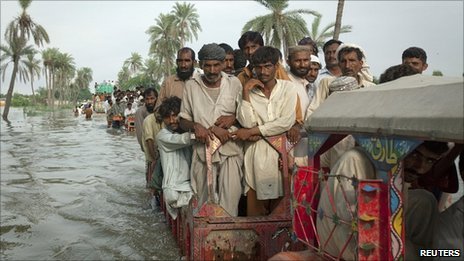
The World Bank is to loan $900m (£574m) to Pakistan to help it recover from its worst ever flooding. The devastating floods have affected up to 20 million people and left some 2,000 dead, say officials.

But the UN says international aid has been slow and that it has raised only a third of the $460m (£294m) needed for emergency relief.

Pakistan’s High Commissioner to Britain said it could take five years and $15bn (£9.6bn) for the country to recover. The World Bank funds will come through the reprogramming of planned projects and the reallocation of money, a World Bank spokesman said.

“We are reprioritising to make the funds immediately available,” he told Reuters news agency.

Health officials have warned that disease could spread quickly among the millions of displaced people and that 3.5m children are at risk.

Maurizio Giuliano, of the UN Office for the Coordination of Humanitarian Affairs (OCHA), warned that Pakistan would face “a second wave of deaths” from water-borne diseases and food shortages unless more aid arrived soon.

He estimated the number of people at risk from such diseases was six million.

Meanwhile, rival political groups in Sindh province have been accusing each other of creating breaches in embankments and dykes to save their own towns and property.

Many of the breaches were reportedly made to divert flood waters away from military garrisons in the area.

Jacobabad city, for example, has been saved, but low-lying areas around it, including Dera Allahyar and some other towns in Balochistan province, have been inundated.

In India, Prime Minister Manmohan Singh has promised more funds to help areas affected by the recent devastating floods in Ladakh, a remote mountain region in Indian-administered Kashmir.

During a visit to the heavily damaged town of Leh, he said all the destroyed homes would be rebuilt within the next two-and-a-half months with money from a government relief fund.

The flash floods over 10 days ago killed more than 80 people and caused heavy damage to property. Many people are still missing.

‘Marshall Plan’

Pakistan’s High Commissioner to Britain Wajid Shamsul Hasan told the AFP news agency that 2,000 people had now been killed by the floods – previous estimates have put the number of dead at around 1,500. He said it would take at least five years for the country to recover, and put the reconstruction bill at “more than $10 to $15bn”.

He warned that a failure to provide sufficient relief and rebuilding assistance could lead to an increase in extremism and instability in the wider region.

He called for a new Marshall Plan, referring to the extensive US development programme in Europe after World War II.

Not only have the floods affected around one-fifth of the country, they have also caused considerable damage to roads, bridges and communications, says the BBC’s Mike Wooldridge in Islamabad.

Thousands of homes and other buildings including schools and hospitals have been swept away, and crops for domestic food consumption and for export have been lost.

One of the key questions is whether farmers will be able to use their land to plant their winter wheat crop in September, our correspondent adds.

‘Image deficit’

The UN has so far only received about a third of its appeal amount – the US has made the biggest contribution so far, followed by the UK.

Aid agencies have blamed Pakistan’s “image deficit” for the shortfall, as potential donors fear the funds would be diverted into extremism in the country.

A spokeswoman for Care International told AFP the UN had to do more to convince donors that the money was “not going to go to the hands of the Taliban”.

“The victims are the mothers, the farmers, children. But in the past, information linked to Pakistan has always been linked to Taliban and terrorism,” said Melanie Brooks.

Bill Berger, USAID’s principal regional adviser for South Asia, told the BBC it had been difficult to communicate the scale of the disaster to the rest of the world:

“Remember that this flood has built up over time… I just don’t think the world has realised the magnitude of this now, because this story has just been slowly increasing. It doesn’t have the drama of an earthquake that impacts a huge number of people all at once.”

The floods began more than two weeks ago in the mountainous north-west and has swept south across a quarter of the country, including its agricultural heartland.

How The Rest of the World Has So Far Responded To Pakistan Crisis

By James Burton and David Randall for The Independent

The world is now beginning to respond in a significant way to the almost bottomless pit of need in Pakistan. Whether – with some 20 million affected and the nation’s ability to feed itself ruined for years to come – it will be enough is very doubtful.

So far, according to the UN, some $93m (unofficial reports say $150m) has been given or promised, in cash or kind; with a further $366m needed immediately. That number is likely to increase, and the UN estimates that billions will be required to rebuild once waters have receded.

But criticisms of the British response (one newspaper called it “tight-fisted”) are ill-judged. The Government has already allocated £17m (out of £31.3m earmarked), and the public has donated £12m to the Disasters Emergency Committee appeal. In terms of money given, as opposed to pledged, Britain is one of the world’s most generous givers.

All kinds of comparisons have been made between the response to this disaster and those to the Haiti earthquake, the Boxing Day tsunami, and the 2005 Pakistan earthquake, all of which raised far more from the public. But appeals for single cataclysms, such as earthquakes and tsunamis, always do better than the more creeping – but often more serious in terms of need – disasters such as food crises and floods. One aid agency source said: “What stirs people to give are high death tolls – even though nothing can help the dead – and arresting images of people amid destruction.”

By the standards of previous “creeping disaster” appeals, the DEC’s for Pakistan 2010 is doing well – £12m in only a week. And a lot of British giving is not being logged. Members of our large Pakistan-origin diaspora are sending money, with money transfers from Britain to Pakistan up 36 per cent in the past seven days. And many mosques and community groups are organising aid. Overall, using figures supplied by the UN, international wire services and London’s Pakistan High Commission, these are the aid donations so far:

Australia: $9m plus $30m pledged; two C-17 freight aircraft.

Azerbaijan: $1m; embassy staff in Pakistan gave two days’ salary.

Belgium: $655,000.

Brazil: $700,000.

Canada: $2m; $30m pledged.

China: $1.5m; $7.4m pledged.

Denmark: $10m; $50m pledged; $771,000 provided for immediate aid.

Estonia: $84,000 for food assistance.

Finland: $1.5m.

France: $1.4m; money for water sanitisation.

Germany: $2.4m; pledged $13m for improving water, sanitation and hygiene.

Greece: $131,000.

India: Offered $5m; Pakistan considering response.

Italy: $1.8m; $3.3m pledged. Silvio Berlusconi gave $7m of own money.

Ireland: $260,000; $1.1m pledged.

Japan: $230,000 for emergency relief; $3m for aftermath.

Kuwait: $5m; plus aid flights.

Luxembourg: $327,000.

Malaysia: $1m; plus private donations.

Netherlands: $1.3m; $2.6m pledged.

New Zealand: $1.5m pledged.

Nigeria: $1m.

Norway: $16m.

Saudi Arabia: pledged $100m, plus air transport.

Spain: $855,000; plus relief plane.

Sri Lanka: $26,709.

Sweden: $3m; plus water purification.

Switzerland: $1.6m; plus relief workers.

Thailand: $75,000.

Turkey: $5m; 115 tons of aid.

UAE: $1.5m; Sheikha Fatima bint Mubarak personally donated $1.4m.

UK: £17m ($26m); provided RAF C-17 heavy freight aircraft, which has already delivered 2,500 tents; the Queen donated an undisclosed amount through the British Red Cross; DEC total reached £12m ($19m) last Friday.

USA: $22m; pledged $40m; provided 56,000 ready meals, 12 temporary bridges and two water filtration plants; 1,000 US marines; 25 Chinook helicopters.

India, Pakistan Peaceniks Hold Candlelight Vigil on Wagah Border

By Sawinder Singh for ANI

Several intellectuals and peace activists from India and Pakistan held a candlelight vigil at Wagah border crossing in on the eve of Independence Day.

The objective of this annual event is to spread the message of peace and brotherhood on the occasion of the Independence Day celebrations of the two neighbouring countries-India and Pakistan.

The midnight vigil on August 14-15 was held on the 63rd Independence Day celebrations of both the countries.

Bollywood Film Producer-Director Mahesh Bhatt, veteran Indian journalist-writer Kuldeep Nayar, Aitzaz Ahsan, former Pakistan Supreme Court Bar Association President and many social activists participated in the midnight vigil.

The participants carrying candlelights and torches marched to the Wagah Border raising slogans of Long Live India-Pakistan Friendship.

“Borders should be open and it should be soft and let people meet from both the countries. Because when people of both the countries will meet then governments will come under pressure and the situation will improve,” said Kuldeep Nayyar.

“Both countries can prosper only if there is a good relationship between them, we have to remove the poverty. Both countries are stricken with acute poverty, unemployment and hunger. Both the countries need to reduce their expenditure on weapons and then only we can reduce poverty and for that it is necessary to have peace, friendship and brotherhood,” added Aitzaz Ahsan, former Pakistan Supreme Court Bar Association President.

On this occasion, a music concert was also held.

India and Pakistan achieved independence from Britain on the midnight of August 14, 1947. While Pakistan celebrates its Independence Day on August 14, India marks its Independence Day on August 15.

This year Pakistan did not celebrate its independence day as a tribut to victims of recent floods in the country.

Flood-Ravaged Pakistan Cancels Independence Day Events

As reported by CNN

Pakistan canceled independence day celebrations Saturday as a second wave of floods continued to put millions in peril, the nation’s prime minister said.

Prime Minister Yousaf Raza Gilani said the devastating floods had affected 20 million people, a figure much larger than officials had given earlier. Gilani said some religious events connected to Ramadan were also canceled.

“In solidarity with the flood victims, all independence day celebrations have been canceled and moreover, all Iftar dinner events and celebration of eid by government ministries have been canceled so that these resources can be utilized in the affected areas,” Gilani said.

A second wave of floodwater is expected to wash through southern Pakistan this weekend, adding hundreds of thousands of people to the number already stranded by a first wave earlier this month, Pakistani officials said.

At least 1,384 people have died and 1,630 more have been injured by flooding that has damaged or destroyed 8,300 Pakistani villages so far, according to Ahmed Kamal, spokesman for the National Disaster Management Authority.

The United Nations said it was racing against time to reach the suffering.

“Relief supplies must reach women, men and children as soon as possible, in order to avoid further death caused by waterborne diseases and food shortages,” said Martin Mogwanja, the United Nations’ humanitarian coordinator for Pakistan.

“The death toll has so far been relatively low compared with other major natural disasters, and we want to keep it that way,” he said.

Pakistan emergency officials predicted the second wave could reach Sukkar on Saturday evening.

Hundreds of thousands of people living along the Indus River in northern Sindh could be stranded, along with the tens of thousands stranded by the first wave, said Lt. Cmdr. Jawad Khawaja of the Pakistani navy.

Many residents have ignored government warnings to evacuate the area, causing a big concern, Khawaja said.

It estimated that 723,950 homes have been damaged or destroyed.

The Scope of Pakistan’s Floods: By the Numbers

By David Knowles for AOL News

Dubbed Pakistan’s “flood of the century,” heavy monsoon rains have washed out upward of one-fourth of the area of the country. The scope of the ongoing devastation is on a scale that is difficult to comprehend, especially to those far away and unfamiliar with the territory. Still it is alarming to consider the estimate given by concerned officials on Wednesday — that up to one-fifth of the entire landmass is now underwater.

The flooding has largely been located in the center of the country and is being caused by overflow from the Indus and Chenab rivers. Surge Desk has been rounding up the figures from the tragedy and has the following context.

Area
Some 150,000 square kilometers, or approximately 93,000 square miles, have been affected by the rising waters, Voice of America reported. That’s a little smaller than the size of the state of Michigan.

Fatalities
So far, at least 1,600 have been killed in the floods.

Agricultural losses
The floods have so far destroyed 2 million bales of cotton, BusinessWeek reported, nearly one-seventh of the country’s yearly target. In addition, 500,000 tons of wheat have been ruined, The New York Times said.

U.S. military response
One thousand U.S. Marines and 24 military helicopters have been deployed to Pakistan to help with relief efforts, The Associated Press reported.

Pakistanis displaced

According to the United Nations, 7 million citizens of Pakistan have been left homeless because of the floodwaters. Furthermore, the U.N. estimates that 14 million Pakistanis, roughly 8 percent of the country’s population, have been adversely affected by the floods. According to UNICEF, 6 million of those are children. All told, approximately 4,700 villages have been wiped out, Voice of America news reported.

Effect on war with the Taliban
Some 60,000 Pakistani troops that had recently been fighting the Taliban have now been put on flood assistance, The Telegraph reports.

Foreign aid
The United Nations is seeking foreign contributions of $460 million to tend to immediate needs, such as food, water and temporary shelters. The United States has pledged $71 million in aid, the biggest amount offered by any country so far, The New York Times reports.

Pakistan Fight Stalls for U.S.

By Julian Barnes for The Wall Street Journal

The U.S. military has stopped lobbying Pakistan to help root out one of the biggest militant threats to coalition forces in Afghanistan, U.S. officials say, acknowledging that the failure to win better help from Islamabad threatens to damage a linchpin of their Afghan strategy.

Until recently, the U.S. had been pressing Islamabad to launch major operations against the Haqqani network, a militant group connected to al Qaeda that controls a key border region where U.S. defense and intelligence officials believe Osama bin Laden has hidden.

The group has been implicated in the Dec. 30 bombing of a CIA base in Khost, a January assault on Afghan government ministries and a luxury hotel in Kabul, and in the killing of five United Nations staffers in last year’s raid on a U.N. guesthouse.

But military officials have decided that pressing Pakistan for help against the group—as much as it is needed—is counterproductive.

U.S. officials believe elements of Pakistan’s intelligence agency, Inter-Services Intelligence, are continuing to protect the Haqqani network to help it retain influence in Afghanistan once the U.S. military eventually leaves the country. U.S. officials say the support includes housing, intelligence and even strategic planning,

During a trip to Pakistan last month, Adm. Michael Mullen, chairman of the Joint Chiefs of Staff, chose not to raise the issue of an offensive against the Haqqani network—a departure from the message U.S. defense officials delivered earlier this year.

The U.S. also had intensified the pressure for Pakistani operations in North Waziristan in May after the attempted bombing of New York’s Times Square was linked to militants in Pakistan.

Pakistan officials reject the U.S. conclusions about their efforts. They say they are taking significant action against militants in North Waziristan. They say their intelligence service has severed all ties with the Haqqani network. Islamabad points to a series of surgical strikes the Pakistani military has executed in North Waziristan, and say they have ratcheted up those efforts in recent months in a precursor toward more aggressive moves.

Pakistan’s operations complement a Central Intelligence Agency drone campaign targeting militants in North Waziristan, a Pakistani official said.

Defense Secretary Robert Gates praised the Pakistani effort to rout al Qaeda and other militants from Swat and South Waziristan. “Are they doing a lot to help us? The answer is yes,” Mr. Gates said Thursday.

U.S. officials acknowledged the recent Pakistani operations, but discounted their value against the Haqqani network.

A U.S. defense official said that most of the raids have been against the Pakistani Taliban, a militant group that poses no direct threat to U.S. forces in Afghanistan, but opposes the Pakistani government.

Pakistan has failed to act on detailed intelligence about the Haqqanis provided in recent months, said a senior military official. “Our forces have put a significant dent in the Haqqani network,” said the official. “It would be good if the [Pakistanis] would do the same on their side.”

U.S. officials say they have concluded that making more demands, public or private, on Islamabad to start a military offensive against the Haqqani network will only strain U.S.-Pakistani relations.

The Haqqani network has decades-long ties with al Qaeda leaders that date back to their days of fighting the Soviets in Afghanistan prior to al Qaeda’s formation.

The network now is believed to provide al Qaeda with protection, shelter and support in North Waziristan. The group’s historic base is in Afghanistan’s Khost province and it remains the most potent insurgent force in the eastern part of the country and is closely aligned with the Taliban.

The number of al Qaeda fighters in Afghanistan is thought to be very small, under 100; Haqqani network fighters number in the thousands.

The U.S. shift partly is in recognition that the Pakistanis simply may not have the military capacity to expand operations enough to secure the North Waziristan area, one U.S. official acknowledged.

Pakistani efforts in North Waziristan so far are too small to have a significant impact, said Bruce Riedel, a former CIA analyst who headed the Obama administration’s first review of U.S. policy toward Afghan and Pakistan.

“It is mostly show to keep the Americans happy,” he said.

In the wake of Pakistan’s recent flooding, U.S. officials also are concerned the Pakistanis may ratchet back counterterrorism operations as they redeploy troops to help respond to a burgeoning humanitarian crisis.

U.S. defense officials now argue the only way to convince Pakistan to take action in North Waziristan is to weaken the Haqqani network so much that Pakistan sees little value in maintaining an alliance with the group—though they acknowledge that will be harder without Pakistani help.

The U.S. military has stepped up its own operations against the Haqqani network since April, and most significantly in the last two weeks, according to military officials. Strikes have significantly reduced the Haqqani network’s ability to mount attacks in Kabul and outside their traditional tribal areas of eastern Afghanistan, said senior U.S. military officials.

In eastern Afghanistan, a task force of elite troops assigned to target the Haqqani network conducted 19 operations in April, 11 in May, 20 in June and 23 in July. The high pace continued in the first week of August with seven operations.

The Haqqanis threatened to disrupt an international conference in Kabul last month, but were not able to make good on the threat.

U.N. Appeals for Pakistan Aid as Rains Threaten More Flooding

By Saeed Shah for The McClatchy Newspapers

The United Nations appealed Wednesday for $459 million in emergency aid for Pakistan as fresh monsoon rains raised fears that new flooding could drive more people from their homes, deepening the humanitarian catastrophe.

Storms lashed the mountainous northwest, close to the border with Afghanistan, and the northeastern Gilgit region, swelling rivers that empty into the central Indus River before it reaches the city of Sukkur in southern Sindh province, which already is full of people displaced from surrounding areas.

More flooding would prevent vital repairs to Indus River embankments and dikes that protect farmland, allowing water to spread even further when the fresh flows reach Sukkur sometime next week, officials warned.

“Once this peak passes, another flood is being formed in the mountains and then a third,” Sindh’s irrigation minister, Saifullah Dharejo, said in an interview. “If we cannot plug the breaches (in the embankments), the water will keep expanding out.”

“This is a grave situation,” he said.

Sindh is now the focus of the worst floods in Pakistan’s history. They reached the province after washing down the Indus River Valley, powered by unusually fierce monsoon rains that began in northern areas of the country some three weeks ago.

The deluge has left a trail of devastation, destroying roads, bridges and other infrastructure and overwhelming the government’s ability to cope. It’s affected some 14 million people, of whom an estimated 1,600 have been killed and about 2 million left homeless.

The overwhelmingly Muslim country of 170 million, a key U.S. ally in the fight against terrorism, already had been struggling to cope with an economic crisis and Islamic militants allied with al-Qaida when the disaster hit.

The United Nations appealed Wednesday for emergency aid, warning that even those who had been saved from drowning were threatened with sickness and hunger.

“If we don’t act fast enough, many more people could die,” John Holmes, the U.N. humanitarian aid chief, said in New York. He called the disaster “one of the most challenging that any country has faced in recent years.”

In Sukkur, the head of Sindh’s provincial government, Qaim Ali Shah, dismissed the amount of international aid pledged so far as “peanuts.”

The U.S. will be beefing up its assistance to the relief effort with 19 helicopters from the U.S.S. Peleliu, an amphibious assault vessel that is deploying off the Pakistani port city of Karachi, Secretary of Defense Robert Gates announced Wednesday in Tampa, Fla. The helicopters will be used to distribute food aid and ferry displaced people.

The ship’s aircraft will replace six U.S. military helicopters that were diverted from missions in Afghanistan.

At the Sukkur Barrage, 1.13 million cubic feet of water per second was rushing through the 66 gates of the mile-wide flood-control barrier, which the former British colonial government built on the Indus River in 1932.

Experts think that the flooding at Sukkur probably will ebb Thursday, but with more rain falling in the north, the water will remain high and the next onslaught of flooding could push it even higher, they said.

“Rainfall (in the north) takes about a week to reach Sukkur,” said Muzammil Qureshi, a retired engineer formerly in charge of irrigation for Sindh. “All five rivers converge before Sukkur.”

The onslaught has burst dike banks, drowning hundreds of thousands of acres of farmland in Sindh alone.

Only from the air do the scale of the disaster and the remoteness of the affected villages become apparent.

A McClatchy Newspapers reporter toured the region around Sukkur on a Pakistani army helicopter and saw mile after mile of water, swamp-like in some places, like the open sea in others. Thatched roofs and the tops of trees rose above the water. The outlines of abandoned villages were just visible beneath the surface.

The helicopter pilots had been diverted from battling Taliban militants in the Waziristan region bordering Afghanistan. Around 60,000 Pakistani troops are participating in rescue efforts, raising concerns about the country’s anti-terrorism campaign.

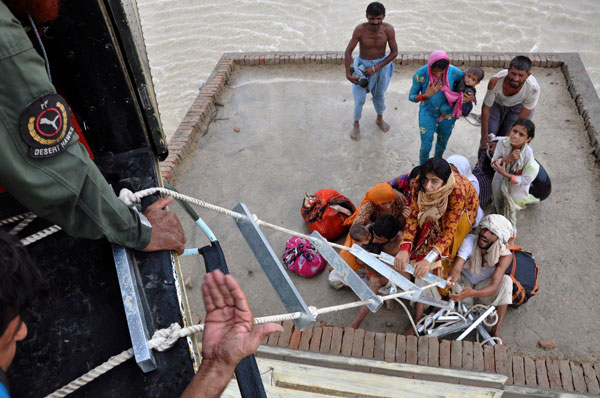
When the helicopter swooped low, it became apparent that there were people struggling to survive in the watery landscape, marooned in dozens of villages on slightly raised ground. Women, men and children could be seen in waist-high water, their buffaloes wallowing in groups.

Hundreds of people had taken refuge on raised embankments, built to hold irrigation channels or dirt roads, but they were stranded without food or shelter from the ferocious sun. Goats, donkeys and trunks of possessions kept them company.

While the military continues to rescue people, many others are refusing to leave their villages, hoping for the water to recede. However, the fresh onslaught that’s on its way from the north could make survival all but impossible.

Ramadan or Not, Hunger Hits Pakistan Flood Victims

By Mahmood Farooq for The Associated Press

Pakistani flood survivors already short on food and water began the fasting month of Ramadan on Thursday, a normally festive, social time marked this year by misery and fears of an uncertain future.

The U.S. announced a navy ship with 19 helicopters and 1,000 Marines on board was close to the southern coast of the country and relief flights would soon begin. The U.N. launched an emergency appeal for international assistance for Pakistan after the already-poor nation was hit with one of its worst-ever natural disasters.

Damage to crops, roads and bridges have caused food prices to triple in some parts of the country, adding to the pain of those marking the fasting month.

“Ramadan or no Ramadan, we are already dying of hunger,” said Mai Hakeema, a 50-year-old who sat alongside her ailing husband in a tent outside the city of Sukkur. “We are fasting forcibly, and mourning our losses.”

Observant Muslims fast from dawn to dusk each day for a month each year to control their desires and show empathy for the poor. The month is marked by increased attendance at mosques, a rise in charitable giving and family gatherings that coincide with the evening breaking of the fast.

While millions of flood-affected people were performing the fast, Mufti Muneebur Rehman, one of the country’s top religious scholars, said victims living in difficult conditions dependent on charity could skip the fast and perform later in the year.

“I am sad to miss the first day of fasting,” said Ghullam Fareed of Gormani village in eastern Punjab province. “Later, when we reach home, we will compensate for this.”

In the northwest, where many are especially devout, many refugees said flood or no flood, they would fast.

“I cannot disobey God, so I am fasting as it is part of my faith no matter what the conditions are,” said Fazal Rabi, 47, who was staying in a tent village in Akbarpura.

The floods hit the country more than two weeks ago, beginning in the northwest before spreading down the country and inundating thousands of villages. Around 1,500 people have been killed, and the U.N. estimates up to 7 million people need emergency assistance.

On Wednesday, the U.N. appealed for $460 million to provide immediate help, including shelter, food, clean water, sanitation and medical care.

“Make no mistake, this is a major catastrophe,” U.N. humanitarian chief John Holmes told diplomats from several dozen countries in launching the appeal in New York. “We have a huge task in front of us. The death toll has so far been relatively low compared to other major natural disasters, but the numbers affected are extraordinarily high.”

The United States said it was more than doubling the number of helicopters it is providing to help.

Defense Secretary Robert Gates said the USS Peleliu was off the coast near Karachi, carrying 19 helicopters and about 1,000 Marines. The helicopters will help rescue people and deliver food and other supplies.

The Pakistani government’s response to the crisis has been criticized by many as too slow and patchy, and the civilian leaders have struggled to rally public opinion in their favor.

Pakistani Prime Minister Yousuf Raza Gilani flew to southwestern Baluchistan province Thursday to see flood-hit areas. He told The Associated Press that Pakistan still needs more helicopters to assist in the relief work.

“We will try our best to reach millions of people to ensure that they get food and other basic items during and after the month of Ramadan,” he said while aboard a military plane.

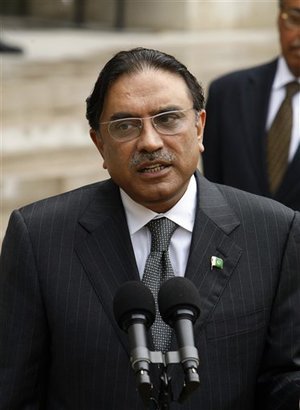
Pakistan’s Project of Renewal

By Asif Ali Zardari for The Wall Street Journal

Pakistan, a nation beset by political tragedies for generations, now faces a new test of its national character: a natural calamity unprecedented in our history. Millions have been displaced and thousands have died in floods caused by unabated rain. The monsoons are destroying villages and exposing thousands to illnesses including cholera and dysentery. Apart from organizing immediate rescue and relief operations, our people and our government also face the challenges of rehabilitation and reconstruction.

As the floods hit the country, I faced a dilemma as head of state. I could stay in Pakistan and support the prime minister in our response to the floods, or I could continue with a scheduled visit abroad. I chose to use my travels to mobilize foreign assistance—money, supplies, food, tents, medical care, engineers, clean water and medicine—for our people. Some have criticized my decision, saying it represented aloofness, but I felt that I had to choose substance over symbolism.

As a result of my meetings with French President Nicolas Sarkozy and British Prime Minister David Cameron, the plight of Pakistan’s flood victims is receiving full international attention. The British government pledged $24 million in aid. The U.S. government, with which I was in touch by telephone, has pledged $35 million in relief funds and made helicopters available for rescue efforts. The NATO coalition, at war in neighboring Afghanistan, has also offered help, as have major European nations and Japan.

My visit to Britain, an important ally in fighting terrorism, also helped defuse potential political friction over Mr. Cameron’s remarks in India ostensibly criticizing past Pakistani policy on jihadist militancy. And it allowed me to reaffirm to the relatively new British government Pakistan’s commitment to fighting all terrorist groups.

After a decade of suffering the political, economic and social abuses of military dictatorship, Pakistan has spent the last two years re-establishing our democratic infrastructure and rebuilding our national character and cohesiveness.

Our project of national renewal is even more difficult because we are on the front lines of the battle against international terrorism. In particular, we live with the effects of the historical errors of the 1980s that have come back to haunt the world. The use of jihad in Afghanistan as the blunt instrument to destroy the Soviet Union certainly had short-term benefits. But the decision to empower the most radical elements of the mujahideen—and then to abandon Afghanistan economically, politically and militarily after 1989—set the stage for the dreaded clash of civilizations that has plagued the world since.

Whatever horror the Western world has faced at the hands of extremists acting in the name of Islam pales in comparison to the nightmare endured by the people and government of Pakistan. Terrorists have killed more Pakistani soldiers than NATO coalition troops fighting in Afghanistan. Pakistan has lost 2,000 police in the war on terror, more than all other countries combined. And we have lost almost 6,000 civilians, twice the number who died in the World Trade Center.

We have also lost our country’s greatest recent political leader—my wife, Benazir Bhutto. My wife’s death was even more shocking than the United States losing a president or Britain its prime minister, because she defined our democratic consciousness in the face of dictatorship. She was a symbol of hope to tens of millions in my country—and hundreds of millions around the world—that there could be a better future ahead for our children.

As I return to Pakistan, I bring back tangible results that will help the flood victims in the short run and lay the foundations for national recovery in the long run. I might have benefitted personally from the political symbolism of being in the country at the time of natural disaster. But hungry people can’t eat symbols. The situation demanded action, and I acted to mobilize the world.

Now the work must continue. I call on the generous people of the United States to rise to this occasion as they have countless times over the last two centuries. Pakistan welcomes your contributions, as individuals and by your government.

Mr. Zardari is the president of Pakistan.

Slain American Volunteers Were Devoted to Service

By Laura King and Ashley Powers for The Los Angeles Times

They were a disparate group of American altruists who had long cared for the poor and ailing, thrown together on a mission to provide medical help in the most daunting and needy of places.

Last week, the six Americans were among 10 volunteers shot to death in a remote swath of Afghanistan while returning from an aid mission, a tragic end to their years of risk-laden service in the war-ravaged and impoverished nation.

Tom Little, for one, remained in Afghanistan through its brutal civil war in the 1990s, talking his way through checkpoints manned by various ethnic militias, and saving the lives of co-workers who might otherwise have been dragged from the car and killed.

Colorado dentist Thomas Grams often traveled with a bodyguard and told friends how he’d persuaded a tribal leader to bring his mother in for a dental exam by agreeing that she’d peel back as little of her burka as possible.

“He was just there out of kindness,” Katy Shaw, a friend of Grams, said Sunday, her voice catching. “I can’t get my arms around why someone would do that to a group of people trying to be helpful.”

The Taliban has claimed responsibility for the ambush in a rugged, isolated valley, which also killed two Afghan men, a German woman and a British woman working with the International Assistance Mission. The Taliban accused the Christian group’s volunteers of proselytizing and spying for Western military forces, which the charity vehemently denied.

The charity team, which had been providing eye care and other health services to villagers, had hiked over a steep mountain pass into neighboring Nuristan province, where insurgents had been battling Afghan and Western forces. Police theorized that the assailants might have followed them back from there.

Two other Afghan members of the group escaped the massacre: an interpreter who had left before the ambush and a driver who told police he recited verses from the Koran as he pleaded for his life. Afghan authorities are still questioning the driver about his account of the incident, and police said it would take two days for investigators to reach the scene of the killings.

The Western military condemned the attack as part of a pattern of insurgent behavior that exacerbated the suffering of Afghan civilians.

“This is something the Afghan population has to face,” said Brig. Gen. Josef Blotz, a spokesman for NATO’s International Security Assistance Force. “Because of these brutal, indiscriminate and absolutely deranged tactics and activities of the Taliban, international aid workers and nongovernmental organizations can’t do their job, which is so necessary for this country.”

The bodies of the slain American volunteers were flown by helicopter to the Afghan capital on Sunday from Badakhshan province, in Afghanistan’s northeast, the U.S. Embassy said. FBI agents in Kabul helped identify the victims and aid groups released most of their names. One American had not yet been publicly identified.

“We are heartbroken by the loss of these heroic, generous people,” U.S. Secretary of State Hillary Rodham Clinton said in Washington.

Even before deplaning in Afghanistan, the team’s members had devoted themselves to helping the world’s most destitute. Grams, 51, was a prime example.

In 2001, he became the first dentist to join a volunteer group in Denver that whisks teams of dentists around the world. At weeklong clinics, they provided children free cleanings, fillings, extractions and tooth-brushing lessons — always without toothpaste, in case the villagers ran out.

Tall, blondish “Doctor Tom,” who usually manned the first of six chairs, stuck out among his thousands of Indian and Nepalese patients. But he’d put them at ease by pulling down his mask and sharing a toothy grin.

“In America, the view is that the dentist gives you pain,” said Laurie Mathews, Global Dental Relief’s director. “In these countries, he only relieves pain.”

Grams so enjoyed aid work that, a few years back, he gave up his dental practice. He’d also started traveling to Afghanistan periodically with other charity groups. It was no surprise to Mathews that Grams ended up in one of the country’s far-flung corners: Once, to treat patients on Mt. Everest, they’d hauled dental equipment to a Buddhist monastery on rented yaks.

“His life mattered,” Mathews said. “He is defined by more than how it ended.”

Another victim, Cheryl Beckett, 32, was a former senior class president in Ohio with a sharp sense of humor and a strong Christian faith, said her grandmother Jean Fink. Both characteristics helped the aid worker power through the last six years, with Beckett educating Afghan villagers in nutritional gardening and mother-child health, and herself in the local languages.

She had this love for the people and she immersed herself in their culture,” Fink said. “Cheryl was as beautiful inside as she was outside.”

Since 2008, Glen Lapp, a former nurse and real estate agent from Pennsylvania, had helped manage a program that delivered eye care to Afghanistan’s remote areas. In a report for the Christian aid group Mennonite Central Committee, he’d written that workers must continue “treating people with respect and with love and trying to be a little bit of Christ in this part of the world.”

“He just had a real sense of peace … toward the Afghan people,” said John Williamson, a fellow relief worker who talked to Lapp last month. Lapp, 40, told Williamson that he believed the country’s security situation was improving, and that he had high hopes for peace.

The British victim, Karen Woo, had given up a private medical practice in London to work in Afghanistan on mother-child health.

The deaths rattled the tightknit world of Afghanistan aid groups, which had already been struggling to weigh a deteriorating security situation against enormous humanitarian needs.

“People would walk long distances, sometimes carrying the old and sick on their backs, to see the doctors, getting glasses, treatment and minor surgery,” Kate Clark of the Afghanistan Analysts Network wrote in a eulogy for the victims. “And many considered blind, literally getting their sight back.”

Two of the victims — Little, a 61-year-old optometrist, and his longtime associate Dan Terry, 64 — were both fathers of three, and both had worked in Afghanistan for decades and were fluent in Dari. The men told friends that, over time, they’d made peace with the battle-scarred country’s inherent dangers.

In the dingy halls of the Kabul eye hospital where the bespectacled Little spent much of his working life, the sorrow was palpable. Co-workers and patients paid emotional tribute to a man they described as kind, caring and determined to aid Afghans whose eye ailments might otherwise have condemned them to a lifetime of misery and poverty.

“God only knows why anyone would hurt them,” said a woman named Bibi Sheerrin, who was recovering from cataract surgery. “They were trying to help us.”

NYC Mosque Should Be Seen As a Reconciliation Not a Provocation

By Manzer Munir for Pakistanis for Peace

A New York City panel cleared the way Tuesday for an Islamic Center and mosque to be built several blocks from Ground Zero and the tragedy of September 11, 2001. The New York City Landmarks Preservation Commission voted unanimously to deny historic status to a 19th century building near Ground Zero. By doing so, it paves the way for the old building’s demolition and the construction of a 15 story Muslim community center, a mere two blocks from the World Trade Center site. The controversy has brewed for months over the creation of a mosque and an Islamic center so close to the site of the World Trade Centers where nearly 3,000 Americans died in terrorist attacks blamed on Muslim terrorists affiliated with the terrorist group Al-Qaeda.

Opponents of the mosque have argued that the creation of it so close to the site of the 9/11 terrorist attacks disrespects the memory of those killed. They also question who is behind the funding and bankrolling of the proposed structure, Cordoba House, which is estimated to cost nearly $100 million. Many prominent members of the Republican Party such as Newt Gingrich and Sarah Palin have come out strongly against the building of the mosque and Muslim center so close to the site of the attacks. Gingrich argued that “that the Ground Zero mosque is all about conquest and thus an assertion of Islamist triumphalism which we should not tolerate.”

Seemingly directed at peace seekers such as myself, Sarah Palin posted the following message on her Twitter page “Peace-seeking Muslims, please understand. Ground Zero Mosque is UNNECESSARY provocation; it stabs hearts. Please reject it in the interest of healing.”

Some of the relatives of the victims of the 9/11 attacks have come out and said that the mosque and Islamic center would amount to a monument for terrorists as the extremists would see it as a celebration of their destruction of an American monument and lives lost. According to them, the building of the Muslim structure gives an impression that the Islamic extremists won and we Americans lost, not just in terms of lives lost but also in terms of lost and lowered morale.

The proponents of the Cordoba House have advocated the building of the structure especially since they see the center as an organization that promoted tolerance and inter faith dialogue, reflecting the rich diversity of New York City. They say that the “center will be community-driven, serving as a platform for inter-community gatherings and cooperation at all levels, providing a space for all New Yorkers to enjoy.”

Their website further states that the Cordoba House project is “about promoting integration, tolerance of difference and community cohesion through arts and culture. Cordoba House will provide a place where individuals, regardless of their backgrounds, will find a center of learning, art and culture; and most importantly, a center guided by Islamic values in their truest form – compassion, generosity, and respect for all.”

In fact the name Cordoba House, takes its name from the medieval Spanish city where Christians, Jews and Muslims lived in peace and harmony under the Moors of Spain for over 800 years. Mayor Michael Bloomberg was right in supporting the construction of the Cordoba House not just on the basis that religious freedom is enshrined in our constitution, but because it was the right thing to do. Denying the building of this structure would have been a blatant admission on the part of the city and indeed the entire country that there is absolutely no difference in the twisted misinterpretation of Islam practiced by the hijackers and the Taliban and the one practiced by the rest of the 1.5 billion Muslims worldwide. As if a mere 19 deranged, misguided, yet determined adolescent men could change the fact that the vast majority of the adherents of Islam are peaceful, hardworking, average people like you and me who want nothing more than to live a good life, raise their kids, and worship their creator.

No, the opponents of the Cordoba House and their hate wagering backers and right wing politicians like Palin and Gingrich want nothing more than to incite people into believing that Islam in general is bad and evil and to suspect anything that goes on in a mosque. Oddly enough, it seems that much like their enemy, the Taliban and Muslim fundamentalists, the right wing politicians in the GOP want nothing more than “Clash of Civilizations” to come about between Islam and the West. Preachers like the Pastor Terry Jones in Gainesville, Florida who is organizing an “Everybody burn a Quran Day” as well as mainstream evangelicals like Pat Robertson also condone this view and treatment of Islam and Muslims.

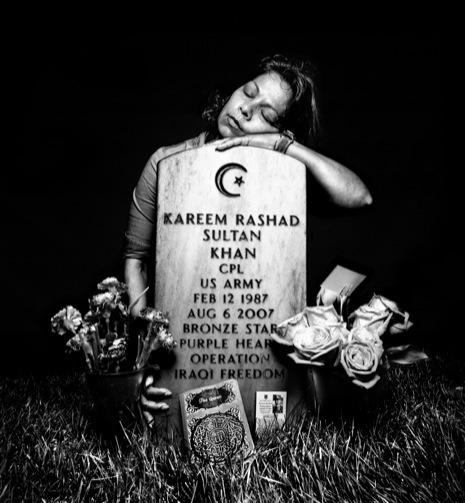
Little do these so called “leaders” realize that scores of Muslim Americans also perished that day on September 11, 2001. The hate and fear mongers will not want you to know the story of Salman Hamdani, a NYPD police cadet, who was a part time ambulance driver, an incoming medical student, and devout Muslim whose remains were found at the North Tower, with his EMT medical bag beside him, presumably trying his best to help those at the site of the attacks. Or the Muslim waiter at the Windows of the World restaurant, who never got to see his wife give birth to their son two days after the attacks. I wonder if Gingrich, Palin or any of the others could look US Army Specialist Kareem Rashad Sultan Khan’s mother in the eye and tell her that although her son died in an American uniform fighting in Iraq under the American flag, his religion and his beliefs system are evil and have no place in American life. The deceased Purple Heart and Bronze Star recipient would turn in his grave at Arlington National Cemetery if he knew how his faith was being disrespected and marginalized by politicians and right wing blowhards like Rush Limbaugh and Glenn Beck, individuals who never served this country or risked their life as had Specialist Khan.

It is heartening to see that good sense prevailed by the New York City panel that had the tough job of deciding on this issue and this heavily watched story. Although there promises to be a further fight and appeal by the opponents of the Islamic center, one hopes that the ruling would stand as denying it would clearly violate the freedom of religion that all faiths should get in America, regardless of the actions of some of their members. After all, one should not punish and ostracize the many for the actions of a few.

-Manzer Munir, founder of Pakistanis for Peace, is a freelance journalist who writes for PakistanisforPeace.com and other online journals.

Pakistani British MPs Slam Zardari Visit

As Reported by AFP

British MPs of Pakistani origin hit out at President Asif Ali Zardari on Tuesday, saying he should be back home sorting out the flooding disaster rather than launching his son’s career.

Some ethnic Pakistani politicians have pulled out of a planned meeting with Zardari, insisting he should abandon his visit to Britain to head up Islamabad’s response to the devastating floods.

Zardari starts his five-day visit later Tuesday. Alongside talks with Prime Minister David Cameron, Zardari was to meet with Pakistani-origin MPs, and attend an event Saturday which reports say is primarily to launch the political career of his son Bilawal Bhutto Zardari.

The 21-year-old is the son of Zardari and former prime minister Benazir Bhutto. He is co-chairman of the Pakistan Peoples Party alongside his father and has been studying at Britain’s Oxford University.

“I’m not going to meet with the president because I believe that a head of state needs to be in his country of origin when there’s a state of emergency,” Lord Nazir Ahmed told AFP.

“For him to spend tens of thousands of pounds (dollars, euros) on the launch of his son’s political career at a time when his country needs him shows that he’s out of touch and his advisors are ill-informed.

“Quite frankly, staying in five-star hotels with his huge entourage, tens of big cars that have been hired just to give him this protocol in London, it’s quite outrageous.”

Ahmed, from the opposition Labour Party, has pulled out of Thursday’s lunch event at a London hotel.

“I would rather the money should go to the flood victims than wasting money on a five-star lunch. I could have easily met him at the high commission for a cup of tea,” the Pakistan-born peer said.

Fellow Labour MP Khalid Mahmood has also turned down his invite, insisting Zardari should be in Pakistan rather than visiting Britain for political reasons.

“The issue is the huge environmental catastrophe that’s going on — a lot of people are dying there,” he said.

“No matter what he can do or can’t do, he should be there to try to support the people, not swanning around in the UK and France.”

A spokesman for Baroness Sayeeda Warsi, Britain’s first female Muslim Cabinet minister, told AFP she will be attending the meeting.

Qassim Afzal, a senior Lib Dem politician of Pakistan origin, said he would attend the meeting, even if “British Pakistanis themselves feel that at this moment in time he should have stayed in Pakistan.”

National Interest Equals 180 million

By Sibtayn Naqvi for The Blue Rickshaw

With the calamity struck upon Pakistan, many of our citizens have suffered at the hands of a horrific torrential downpour, a tragic AirBlue accident and a sickening “target killing” environment prevalent in Karachi. One would believe to look for guidance, consolation and leadership in the civilian government. To quote spider-man “with great power comes great responsibility”, but for Asif Zardari, this means pursuing “national interests” abroad, while thousands of lives have been disrupted and lost across the nation.

Now all in fairness, as one politician proudly displayed on his twitter “I cannot understand y a State visit by a President to further Pakistan’s national interests shud be politicised. It’s hard work no holiday”. Do tell me, is it absolutely vital for Mr. Zardari at this time to be pursing “national interests” by sipping tea and munching on biscuits with the very Prime Minister who stated that my country should not be allowed to “promote the export of terror”?

The President has made numerous trips abroad to pursue “national interests” since taking the reins of the Presidency. Even though such trips cost (on average) Rs. 20 million, I have rarely seen a public outcry in regards to such escapades. Being the President of a powerful nation housing 180 million people, Mr. President, some empathy in regards to the timing of your foreign affairs could have been witnessed this time around.

Was it absolutely crucial to use public money (that is already bare minimum) to travel abroad in the current circumstances? Would it not have been possible to formulate a domestic trip to Swat, Peshawar or Nowshera to stand by the unfortunate flood victims? Could the Rs. 20 million not have been used to conduct a memorial service for the tragic victims who lost their lives in the Margalla Hills? Is it too much to ask for Rs. 20 million to be spent on increased security in Karachi so we don’t read headlines on target killings every morning?

Throughout Pakistan’s turbulent history we have constantly heard drawing room chatter in regards to the Establishment not allowing the civilian government to flourish. Let’s put a spotlight over the recent weeks to see why the Pakistan Army has an image of being our savior rather than the civilian government. When target killings are carried out in Karachi, the Rangers step in. When ED202 crashed in the Margalla Hills, the Army came to the rescue (while one Minister exclaimed prematurely that there were a number of survivors), when the monsoonal floods hit the Northern regions, General Kayani surveyed the damage while expediting relief efforts, when the British Prime Minister made scathing remarks towards Pakistan, our ISI chief suspended his foreign trip to the United Kingdom. You of all people should know Mr. President public perception does matter.

Why was there a lack of civilian government presence in all the incidents mentioned above? Is the launch of Bilawal Zardari as a 21-year-old PPP-Chairman more important than the diminished livelihood of thousands across the country? Correct me if I am wrong, but didn’t the young Zardari exclaim “jaan chahyai, jaan deingay hum, khoon chahyai, khoon deingay hum”? I’d like to see some of that passion come to the forefront Mr. President.

Now let’s get to the favorite topic of the day. Fake degrees. For the 2008 general elections, there was a provision requiring all candidates to have an undergraduate degree. Regardless of whether the law is satisfactory, it was penned in ink. Do tell me, who gives the right to 47 sitting members of Parliament to provide the Election Commission of Pakistan with phony documents? Ironically, the majority of these illegal Parliamentarians are not even from the Pakistan Peoples Party. Take the high ground, the moral ground, Mr. President. Allow the report presented by the autonomous Higher Education Commission to run its proper course. Break down the barriers being constructed by the Ministry of Education.

Pakistan is a very resilient nation. Over the last decade, we have experienced the effects of an on-going war being carried out in Afghanistan. We have seen a rise in domestic violence that has cost 3,433 lives in 215 suicide attacks. Pakistan lost nearly 80,000 citizens in the tragic earthquake of 2005. Our military has suffered 8785 casualties of which 2273 soldiers have died. Karachi endured 156 incidents of targeted killings in 2009. 334 were targeted and killed in the first seven months of 2010, while their have been 889 murders in Karachi alone during the same time period. 152 Pakistani’s tragically lost their lives in the Margalla Hills, while the current flood that has swept the country has already taken the lives of more than 1,200 citizens.

But we are still standing strong. We carry out an honest day of living without electricity and ridiculously high prices of domestic commodities. Despite the hardships we have faced, our faith in this country has strengthened our confidence. In less than two weeks we will be out in the streets, waving our flags, saluting our soldiers and standing with our heads high. The globe may assume we are a fractured nation, and some may state that we export terror, but our national interests lay within our own borders. Our morals will carry us forward, but being at the helm of affairs Mr. President it is your duty to lead the way. We have suffered enough to watch Establishment dictate terms, or civilian governments bankrupting the national exchequer. It is high time the 180 million are looked after for they make up the “national interests”.

Sibtayn Naqvi is a freelance journalist and writes for The Blue Rickshaw. He may be contacted at sibtaynnaqvi@gmail.com

Haroon in Pakistan squad for Common Wealth Games

By Fawad Hussain for The Express Tribune

Haroon Shahid Khan, the younger brother of Britain’s light welterweight world champion, Amir Khan will be representing Pakistan in this year’s Commonwealth Games. The Pakistan Boxing Federation decided to include Haroon in the six-member national squad for the event that will be held from October 3 till October 14 in New Delhi.

Haroon won the Amateur Boxing Association (ABA) bantam weight title last year and also has other junior titles under his belt. The PBF secretary Akram Khan felt his inclusion in the side has brightened the team’s chances of winning in the event.

“He is an excellent boxer and has been trained at his brother’s academy – so definitely our chances of winning medals have increased,” Khan told The Express Tribune following the team’s announcement.

Haroon, who is famous in the UK as “Harry Khan”, will join the national training camp next month. “Haroon will be coming in August to join his teammates. It is important for him to train in our conditions which are similar to those in India,” said the secretary.

According to Akram, the PBF are not only relying on Haroon for winning medals at the competition.

“Wasim, Nisar and Mir Waiz also have a lot of experience and have also won accolades for the country- so we are banking on all our boxers,” said Akram while adding that the Cuban coach recommended the names of these boxers after working with them for months.

Officials: Pakistan Flood Deaths Top 1100‎

As Reported By CNN

The devastating floods in Pakistan have killed more 1,100 people, Pakistani government officials told CNN on Sunday. Another 30,000 people were stuck on their rooftops and in higher areas as they tried to escape rushing floodwaters, a United Nations official said Sunday.

“We’ve got the government sending boats and helicopters to try to reach people and bring them to safety at the same time as trying to deliver emergency relief,” said Nicki Bennett, a senior humanitarian affairs officer for the U.N.

Damaged roads and bridges have made rescuing stranded residents difficult, she said, noting that even a U.N. warehouse where the organization stores food, blankets, soaps and bucks is partially underwater. “As we are trying to reach people, we have to battle with the ongoing access problems,” she said. The rescue and recovery efforts of the Pakistan flooding could become more complicated as weather officials predict more monsoon rains starting Monday.

The Pakistan Meteorological Department said Sindh, Punjab, Kashmir, eastern parts of Khyber-Pakhtunkhwa and eastern parts of Balochistan would receive monsoon rains. Areas along the Indus River would be badly affected due to extremely high flood conditions.

The number reflects those killed only in Khyber Pakhtunkhwa province, previously known as the North West Frontier Province, said spokesman Mian Iftikhar Hussain. Flooding has also been reported in Pakistani-controlled Kashmir. Twenty-five deaths were recorded there Friday, Hussain said.

A Pakistani Red Crescent official told CNN that the number of people affected by the floods has risen to nearly 2.5 million people, with infrastructure receiving major damage. Rushing water also has washed away thousands of acres of crops, government buildings, businesses, schools, bridges and homes, officials said.

The United States will assist in relief efforts by bringing in 50,000 meals, rescue boats and helicopters, 12 pre-fabricated steel bridges and water filtration units, the embassy in Islamabad said.

According to Geo TV, 150 people are missing in a northwestern province, and 3,700 homes were swept away. Forty-seven bridges in Swat have been destroyed or damaged.

Geo TV also said 3,000 are in a camp in Nowshera and are without enough water and food. Displaced residents are unhappy with the government response, Geo TV said. Trains have also been delayed, frustrating commuters.

“They have made this a joke,” a commuter told the network. “There are young children here, but there is no water, nor is there any seating. They have taken our ticket money. Yet after every few minutes they change the train timings. They are playing a game of lies and deceit.”

Pakistani Interior Minister Rehman Malik visited Khyber Pakhtunkhwa on Saturday and found tourists and local residents trapped because of the heavy floods, the state-run Associated Press of Pakistan reported.

President Asif Ali Zardari said all available resources would be used to help those stranded by the waters, the APP reported.

Many of the victims died when flood waters swept away hundreds of mud houses in parts of Swat Valley and the districts of Shangla and Tank, according to Bashir Ahmed Bilour, a provincial minister in Khyber Pakhtunkhwa.

Hussain said flooding has cut off the Swat Valley and the districts of Shangla and Peshawar. There is no way to get to these areas by road, he said.

The Pakistani Air Force has been helping with rescue efforts, spokesman Tariq Yazdanie said in an interview on Pakistani TV. The recent torrential rains have broken all previous records of rainfall in the country, he said.

The United Nations said there is a need for help in providing emergency shelter, food, drinking water and sanitation facilities. Its agencies are geared to help with these issues.

The European Commission is providing 30 million euros ($39 million) to help the people affected by the flooding.

U.S. Embassy officials in Pakistan said the United States has committed $10 million to support flood relief priorities, four inflatable rescue boats, two water filtration units that can fulfill the daily water requirements of up to 10,000 people, and 12 pre-fabricated steel bridges to temporarily replace damaged bridges.

U.S. officials have also provided more than 51,000 halal meals (military rations tailored for people of Islamic faith) and another 62,000 will arrive Sunday.

In addition, the U.S. provided helicopters to support the Ministry of Interior’s rescue operations.

The same weather system is also responsible for flooding in bordering Afghanistan, where 65 people have died, and 61 were injured since Thursday, according to Abdul Matin Adrak, head of disaster management for Afghanistan.

The flooding started Thursday and continued for more than six hours. Rescue teams were able to access all the flooded villages using ministry of defense helicopters. Food and equipment was donated and transferred to the affected people by ISAF and Afghan Security forces.

U.S. Air Force Lt. Col. Greg “Boomer” Roberts, adviser to the Afghan Air Force, told CNN Sunday morning that the Afghan air force rescued about 2,000 villagers who were stranded. Roberts accompanied the air force during their rescue mission in the Kunar province — a known insurgent stronghold.

“They knew they could accomplish their mission. When we came into the area and the Taliban made their presence known, they continued … and picked up 2,000 people who were definitely overcome by the floods. And they did it right there in full view of the Taliban.

“There’s not a doubt in my mind that some of the folks we picked up are Taliban,” he said, adding that most were probably looking for employment with the organization. He said the rescue mission is the type of move that could sway people away from the Taliban and toward the Afghan government.